


prEN 15267-1
(Main)Air quality - Certification of automated measuring systems - Part 1: General aspects
Air quality - Certification of automated measuring systems - Part 1: General aspects
This document specifies the general principles of certification, including common procedures and requirements, for the certification of air quality monitoring equipment (AQME).
This document applies to the certification of AQME for ambient air quality and emissions from stationary sources for which performance criteria and test procedures are available in European Standards.
This document provides for the certification of AQME according to the requirements of EN ISO/IEC 17065:2012.
This document elaborates and supplements the requirements of EN ISO/IEC 17065:2012 for bodies certifying AQME. It specifies requirements on testing laboratories as well as the manufacturer’s quality management system (QMS) and the surveillance for the manufacturing process as part of the certification process.
Kakovost zraka - Certificiranje avtomatskih merilnih sistemov - 1. del: Splošni vidiki
General Information
- Status
- Not Published
- Publication Date
- 27-May-2008
- Technical Committee
- CEN/TC 264 - Air quality
- Drafting Committee
- CEN/TC 264/WG 22 - Certification scheme for AMS
- Current Stage
- 3098 - Decision to reject - Consensus building
- Start Date
- 07-Jun-2006
- Completion Date
- 11-Feb-2026
Overview
prEN 15267-1: Air Quality - Certification of Automated Measuring Systems - Part 1: General Aspects is a European standard developed by CEN to define the general principles for certifying air quality monitoring equipment (AQME). This standard is essential for manufacturers, testing laboratories, and certification bodies involved in producing and assessing automated measuring systems (AMS) and data acquisition and handling systems (DAHS) used for monitoring ambient air quality and emissions from stationary sources. prEN 15267-1 aligns with EN ISO/IEC 17065:2012, specifying the criteria to guarantee reliable product certification and promote mutual recognition across Europe.
Key Topics
- Scope of Certification: Covers certification procedures and requirements for AQME with established European performance criteria and test methods, supporting compliance with EU Directives on industrial emissions and ambient air quality.
- Certification Framework: Establishes a certification process based on performance testing, manufacturer quality management system (QMS) assessment, and ongoing manufacturing surveillance.
- Alignment to ISO/IEC 17065:2012: Supplements this standard with sector-specific clarification to support competent and impartial product certification for AQME.
- Roles and Responsibilities: Details obligations of manufacturers, testing laboratories, and certification bodies within the product certification lifecycle.
- Structural and Process Requirements: Specifies organizational structure for certification bodies, impartiality mechanisms, liability, confidentiality, and public disclosure of certification data.
- Resource Requirements: Focuses on competency of personnel and necessary resources to conduct thorough and reliable certification evaluations.
- Surveillance and Compliance: Describes mechanisms for post-certification surveillance, including monitoring manufacturing processes to ensure ongoing product conformity.
Applications
- Ambient Air Quality Monitoring: Certification of fixed automated measuring systems used by environmental agencies and industries to ensure reliable data on ambient air pollutants.
- Emissions Monitoring for Stationary Sources: Validates AMS used to continuously or periodically track pollutants from industrial plants, supporting regulatory compliance under the EU Industrial Emissions Directive (IED).
- Manufacturer Quality Assurance: Assists manufacturers in implementing effective QMS aligned with certification requirements to continuously meet stringent product standards.
- Certification Bodies Operations: Provides a robust framework guiding certification bodies to maintain impartial and competent assessment processes recognized throughout the EU.
- Regulatory Compliance Support: Facilitates legal approval procedures of AQME by national authorities or designated bodies, ensuring measurement systems meet harmonized European standards.
Related Standards
- EN 15267-2: Covers the initial assessment of the manufacturer’s quality management system and ongoing surveillance of the manufacturing process.
- EN 15267-3: Defines performance criteria and test procedures for stationary automated measuring systems for continuous emission monitoring.
- EN 15267-4: Specifies performance criteria and test procedures for portable automated measuring systems used for periodic emission measurements.
- EN ISO/IEC 17065:2012: International standard providing general requirements for bodies certifying products, processes, and services, forming the basis of AQME certification under prEN 15267-1.
- EN ISO 19011: Provides guidelines for auditing management systems, relevant for auditing manufacturer QMS in the certification process.
Keywords: air quality monitoring equipment certification, automated measuring systems, ambient air quality, emissions monitoring, EN 15267-1, EN ISO/IEC 17065, manufacturer quality management system, certification body requirements, European standards for AQME, environmental monitoring compliance.



Get Certified
Connect with accredited certification bodies for this standard

NSF International
Global independent organization facilitating standards development and certification.

CIS Institut d.o.o.
Personal Protective Equipment (PPE) certification body. Notified Body NB-2890 for EU Regulation 2016/425 PPE.

Kiwa BDA Testing
Building and construction product certification.
Sponsored listings
Frequently Asked Questions
prEN 15267-1 is a draft published by the European Committee for Standardization (CEN). Its full title is "Air quality - Certification of automated measuring systems - Part 1: General aspects". This standard covers: This document specifies the general principles of certification, including common procedures and requirements, for the certification of air quality monitoring equipment (AQME). This document applies to the certification of AQME for ambient air quality and emissions from stationary sources for which performance criteria and test procedures are available in European Standards. This document provides for the certification of AQME according to the requirements of EN ISO/IEC 17065:2012. This document elaborates and supplements the requirements of EN ISO/IEC 17065:2012 for bodies certifying AQME. It specifies requirements on testing laboratories as well as the manufacturer’s quality management system (QMS) and the surveillance for the manufacturing process as part of the certification process.
This document specifies the general principles of certification, including common procedures and requirements, for the certification of air quality monitoring equipment (AQME). This document applies to the certification of AQME for ambient air quality and emissions from stationary sources for which performance criteria and test procedures are available in European Standards. This document provides for the certification of AQME according to the requirements of EN ISO/IEC 17065:2012. This document elaborates and supplements the requirements of EN ISO/IEC 17065:2012 for bodies certifying AQME. It specifies requirements on testing laboratories as well as the manufacturer’s quality management system (QMS) and the surveillance for the manufacturing process as part of the certification process.
prEN 15267-1 is classified under the following ICS (International Classification for Standards) categories: 13.040.99 - Other standards related to air quality. The ICS classification helps identify the subject area and facilitates finding related standards.
prEN 15267-1 is associated with the following European legislation: EU Directives/Regulations: 2000/76/EC, 2001/80/EC, 2008/50/EC. When a standard is cited in the Official Journal of the European Union, products manufactured in conformity with it benefit from a presumption of conformity with the essential requirements of the corresponding EU directive or regulation.
prEN 15267-1 is available in PDF format for immediate download after purchase. The document can be added to your cart and obtained through the secure checkout process. Digital delivery ensures instant access to the complete standard document.
Standards Content (Sample)
SLOVENSKI STANDARD
01-december-2021
Kakovost zraka - Ocenjevanje opreme za monitoring kakovosti zraka - 1. del:
Splošna načela certificiranja
Air quality - Assessment of air quality monitoring equipment - Part 1: General principles
of certification
Luftbeschaffenheit - Beurteilung von Einrichtungen zur Überwachung der
Luftbeschaffenheit - Teil 1: Grundlagen der Zertifizierung
Ta slovenski standard je istoveten z: prEN 15267-1
ICS:
03.120.20 Certificiranje proizvodov in Product and company
podjetij. Ugotavljanje certification. Conformity
skladnosti assessment
13.040.99 Drugi standardi v zvezi s Other standards related to air
kakovostjo zraka quality
2003-01.Slovenski inštitut za standardizacijo. Razmnoževanje celote ali delov tega standarda ni dovoljeno.
DRAFT
EUROPEAN STANDARD
NORME EUROPÉENNE
EUROPÄISCHE NORM
December 2021
ICS 13.040.99 Will supersede EN 15267-1:2009
English Version
Air quality - Assessment of air quality monitoring
equipment - Part 1: General principles of certification
Luftbeschaffenheit - Beurteilung von Einrichtungen zur
Überwachung der Luftbeschaffenheit - Teil 1:
Grundlagen der Zertifizierung
This draft European Standard is submitted to CEN members for enquiry. It has been drawn up by the Technical Committee
CEN/TC 264.
If this draft becomes a European Standard, CEN members are bound to comply with the CEN/CENELEC Internal Regulations
which stipulate the conditions for giving this European Standard the status of a national standard without any alteration.
This draft European Standard was established by CEN in three official versions (English, French, German). A version in any other
language made by translation under the responsibility of a CEN member into its own language and notified to the CEN-CENELEC
Management Centre has the same status as the official versions.
CEN members are the national standards bodies of Austria, Belgium, Bulgaria, Croatia, Cyprus, Czech Republic, Denmark, Estonia,
Finland, France, Germany, Greece, Hungary, Iceland, Ireland, Italy, Latvia, Lithuania, Luxembourg, Malta, Netherlands, Norway,
Poland, Portugal, Republic of North Macedonia, Romania, Serbia, Slovakia, Slovenia, Spain, Sweden, Switzerland, Turkey and
United Kingdom.
Recipients of this draft are invited to submit, with their comments, notification of any relevant patent rights of which they are
aware and to provide supporting documentation.
Warning : This document is not a European Standard. It is distributed for review and comments. It is subject to change without
notice and shall not be referred to as a European Standard.
EUROPEAN COMMITTEE FOR STANDARDIZATION
COMITÉ EUROPÉEN DE NORMALISATION
EUROPÄISCHES KOMITEE FÜR NORMUNG
CEN-CENELEC Management Centre: Rue de la Science 23, B-1040 Brussels
© 2021 CEN All rights of exploitation in any form and by any means reserved Ref. No. prEN 15267-1:2021 E
worldwide for CEN national Members.
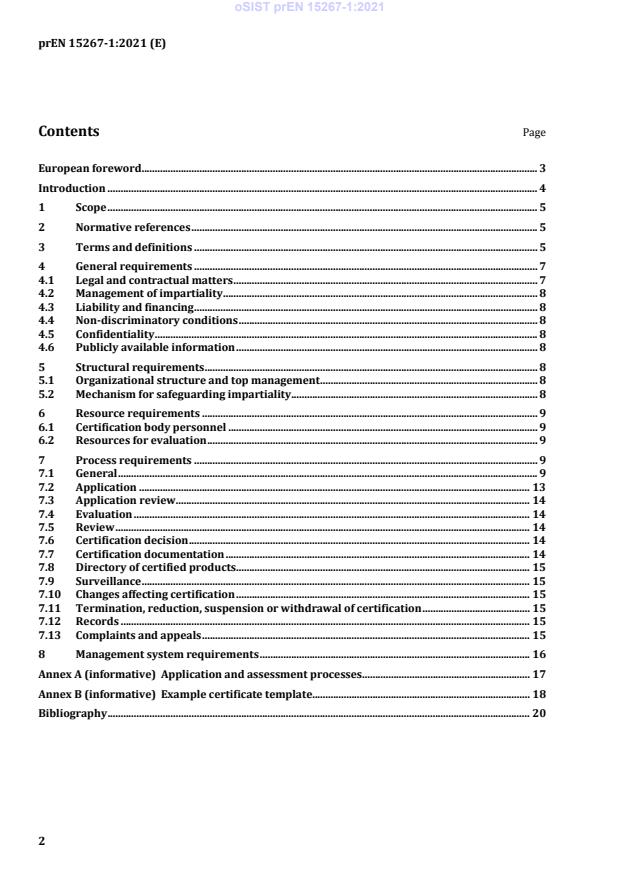
Contents Page
European foreword . 3
Introduction . 4
1 Scope . 5
2 Normative references . 5
3 Terms and definitions . 5
4 General requirements . 7
4.1 Legal and contractual matters . 7
4.2 Management of impartiality . 8
4.3 Liability and financing . 8
4.4 Non-discriminatory conditions . 8
4.5 Confidentiality . 8
4.6 Publicly available information . 8
5 Structural requirements . 8
5.1 Organizational structure and top management . 8
5.2 Mechanism for safeguarding impartiality . 8
6 Resource requirements . 9
6.1 Certification body personnel . 9
6.2 Resources for evaluation . 9
7 Process requirements . 9
7.1 General . 9
7.2 Application . 13
7.3 Application review . 14
7.4 Evaluation . 14
7.5 Review . 14
7.6 Certification decision . 14
7.7 Certification documentation . 14
7.8 Directory of certified products . 15
7.9 Surveillance . 15
7.10 Changes affecting certification . 15
7.11 Termination, reduction, suspension or withdrawal of certification . 15
7.12 Records . 15
7.13 Complaints and appeals . 15
8 Management system requirements . 16
Annex A (informative) Application and assessment processes . 17
Annex B (informative) Example certificate template. 18
Bibliography . 20
European foreword
This document (prEN 15267-1:2021) has been prepared by Technical Committee CEN/TC 264 “Air
quality”, the secretariat of which is held by DIN.
This document is currently submitted to the CEN Enquiry.
This document will supersede EN 15267-1:2009.
The main changes with respect to the previous edition are listed below:
a) The title of the revised EN 15267 series has been clarified to avoid the impression that all parts deal
with the certification of automated measuring systems. The title has been generalized so that
specifically Part 1 and Part 2 are also applicable to other air quality monitoring equipment.
b) The title of revised EN 15267-1 has been clarified to make it clear that only Part 1 deals with the basic
principles of the certification of air quality monitoring equipment.
c) The revised EN15267-1 is based on EN ISO/IEC 17065:2012 and is identically structured. It provides
guidance on the application of EN ISO/IEC 17065:2012 to the certification of AQME for monitoring
ambient air quality and emissions from stationary sources. It supplements EN ISO/IEC 17065:2012
by providing clarification and additional information. However, it does not re-state all the provisions
of EN ISO/IEC 17065:2012 and users are reminded of the need to comply with all of the relevant
criteria detailed in EN ISO/IEC 17065:2012.
d) The basic contents of EN 15267-1:2009 were largely adopted, updated and inserted into the
structure of EN ISO/IEC 17065:2012.
e) The term “competent body” has been deleted and replaced throughout the text by the term
“certification body”.
This document is Part 1 of a series of European Standards:
— EN 15267-1, Air quality — Assessment of air quality monitoring equipment — Part 1: General
principles of certification
— EN 15267-2, Air quality — Assessment of air quality monitoring equipment — Part 2: Initial assessment
of the manufacturer’s quality management system and post certification surveillance for the
manufacturing process
— EN 15267-3, Air quality — Assessment of air quality monitoring equipment — Part 3: Performance
criteria and test procedures for stationary automated measuring systems for continuous monitoring of
emissions from stationary sources
— EN 15267-4, Air quality — Assessment of air quality monitoring equipment — Part 4: Performance
criteria and test procedures for portable automated measuring systems for periodic measurements of
emissions from stationary sources
Introduction
The assessment of air quality monitoring equipment (AQME) supports the requirements of certain
Directives of the European Union (EU), which require, either directly or indirectly, that this equipment
complies with performance criteria, maximum permissible measurement uncertainties and test
requirements. These Directives include the Directive 2010/75/EU on industrial emissions (IED),
Directive (EU) 2015/2193 on medium combustion plants and the Directive 2008/50/EC on ambient air
quality and cleaner air for Europe.
The assessment of AQME consists of the following sequential stages:
a) performance test;
b) initial assessment of the manufacturer’s quality management system (QMS);
c) certification;
d) surveillance for the manufacturing process.
This document is based on EN ISO/IEC 17065:2012 and defines common procedures and requirements
for the certification of AQME to facilitate mutual recognition and thereby minimize administrative and
cost burdens on manufacturers seeking certification in multiple member states. It also describes the roles
and responsibilities of manufacturers, testing laboratories and certification bodies.
EN ISO/IEC 17065:2012 specifies general criteria that a certification body operating product certification
shall follow if it is to be recognized at a national or European level as competent and reliable in the
operation of a product certification system, irrespective of the sector involved. It is intended for the use
of accreditation bodies concerned with recognizing the competence of certification bodies.
EN ISO/IEC 17065 recognizes that these general criteria may have to be supplemented when applied to
a particular sector. This document provides guidance on the application of EN ISO/IEC 17065:2012 to
the certification of AQME for monitoring ambient air quality and emissions from stationary sources. This
document supplements EN ISO/IEC 17065:2012 by providing clarification and additional information.
However, it does not re-state all the provisions of EN ISO/IEC 17065:2012 and users are reminded of the
need to comply with all of the relevant criteria detailed in EN ISO/IEC 17065:2012.
Assessment and the included certification of AQME form the basis for the legal approval of this
equipment. However, this document does not define the process for the legal approval of AQME. The
responsibility for approving automated measuring systems (AMS) for monitoring ambient air quality
under Directive 2008/50/EC lies with the national competent authority or a body designated by the EU
member state. No explicit requirement for approving automated measuring systems (AMS) and data
acquisition and handling systems (DAHS) for monitoring emissions from stationary sources is defined in
the relevant EU Directives, although the competent authorities in some EU member states have such
arrangements in place. Additionally, the IED and its implementing measures (BAT Conclusions Decision
Documents) prescribe the use of European Standards for monitoring, whilst approval schemes are a
means for both suppliers and users of AQME to demonstrate compliance with the requirement of
applicable European Standards.
In some EU member states the competent authority delegates the responsibility for approval of AQME to
a certification body accredited to EN ISO/IEC 17065:2012 by national accreditation bodies.
1 Scope
This document specifies the general principles of certification, including common procedures and
requirements, for the certification of air quality monitoring equipment (AQME).
This document applies to the certification of AQME for ambient air quality and emissions from stationary
sources for which performance criteria and test procedures are available in European Standards.
This document provides for the certification of AQME according to the requirements of
EN ISO/IEC 17065:2012.
This document elaborates and supplements the requirements of EN ISO/IEC 17065:2012 for bodies
certifying AQME. It specifies requirements on testing laboratories as well as the manufacturer’s quality
management system (QMS) and the surveillance for the manufacturing process as part of the certification
process.
2 Normative references
The following documents, in whole or in part, are normatively referenced in this document and are
indispensable for its application. For dated references, only the edition cited applies. For undated
references, the latest edition of the referenced document (including any amendments) applies.
EN ISO 19011, Guidelines for auditing management systems (ISO 19011)
EN ISO/IEC 17065:2012, Conformity assessment — Requirements for bodies certifying products, processes
and services (ISO/IEC 17065:2012)
EN 15267-2, Air quality - Assessment of air quality monitoring equipment - Part 2: Initial assessment of the
manufacturer’s quality management system and post certification surveillance for the manufacturing
process
3 Terms and definitions
For the purposes of this document, the following terms and definitions apply.
ISO and IEC maintain terminological databases for use in standardization at the following addresses:
— ISO Online browsing platform: available at https://www.iso.org/obp
— IEC Electropedia: available at https://www.electropedia.org/
3.1
air quality monitoring equipment
AQME
automated measuring system or data acquisition and handling system
3.2
automated measuring system
AMS
entirety of all measuring instruments and additional devices for obtaining a result of measurement
Note 1 to entry: The term “automated measuring system” applies to stationary and portable AMS.
Note 2 to entry: Apart from the actual measuring device (the analyser), a stationary AMS includes facilities for
taking samples (e.g. probe, sample gas lines, flow meters and regulator, delivery pump) and for sample conditioning
(e.g. dust filter, pre-separator for interferents, cooler, converter). This definition also includes testing and adjusting
devices that are required for functional checks and QAL3 procedures and, if applicable, for commissioning.
Note 3 to entry: The term “automated measuring system” (AMS) is typically used in Europe. The terms
“continuous emission monitoring system” (CEM) and “continuous ambient-air-quality monitoring system” (CAM)
are also typically used in the UK and USA.
3.3
portable automated measuring system
P-AMS
automated measuring system which is in a condition or application to be moved from one to another
measurement site to obtain measurement results for a short measurement period
Note 1 to entry: The measurement period is typically 8 h for a day.
Note 2 to entry: The P-AMS can be configured at the measurement site for the special application but can be also
set-up in a van or mobile container. The probe and the sample gas lines are installed often just before the
measurement task is started.
3.4
data acquisition and handling system
DAHS
system which automatically receives, processes, stores and outputs data from automated measuring
systems
3.5
product
air quality monitoring equipment
3.6
testing laboratory
laboratory carrying out the performance test
3.7
manufacturer
organisation, situated at a stated location or locations, that carries out or controls such stages in the
manufacture, assessment, handling and storage of a product that enables it to accept responsibility for
continued compliance of the product and its certification, and undertakes all obligations in that
connection
Note 1 to entry: The term “manufacturer” is used instead of “organisation” as used in EN ISO 9001. For the
purpose of this document they are interchangeable.
3.8
certification body
third-party conformity assessment body operating certification schemes
[SOURCE: EN ISO/IEC 17065:2012, 3.12]
3.9
technical file
record of the reference documents and changes to the reference documents
3.10
reference document
document that controls the manufacture and design of air quality monitoring equipment and is
referenced in the test report
Note 1 to entry: Reference documents can include drawings, specifications, instructions and computer code.
3.11
related document
document not referenced in the test report
Note 1 to entry A related document can be used, for example, for the detailed manufacture of
component parts.
3.12
certification range
range over which the automated measuring system is tested and certified for compliance with the
relevant performance criteria
Note 1 to entry: The lower limit of the certification range is usually zero.
Note 2 to entry: Generally, the lower the certification range, the better the performance of the AMS. Also an AMS
typically performs satisfactorily at higher values over the measurement range.
3.13
surveillance
systematic iteration of conformity assessment activities as a basis for maintaining the validity of the
statement of conformity
[SOURCE: EN ISO/IEC 17000:2020, 8.1]
Note 1 to entry: For the purposes of this document surveillance focuses on the manufacturer’s QMS to ensure
that AQME continue to comply with the standard to which they are certified.
3.14
competent authority
organisation which implements the requirements of legislation and regulates installations
3.15
legislation
directives, acts, ordinances and regulations
4 General requirements
4.1 Legal and contractual matters
4.1.1 Legal responsibility
The requirements of EN ISO/IEC 17065:2012, 4.1.1, and the following apply.
The certification body shall liaise as appropriate with the relevant national competent authority.
4.1.2 Certification agreement
The requirements of EN ISO/IEC 17065:2012, 4.1.2, apply.
4.1.3 Use of license, certificates and marks of conformity
The requirements of EN ISO/IEC 17065:2012, 4.1.3, apply.
4.2 Management of impartiality
The requirements of EN ISO/IEC 17065:2012, 4.2, apply.
4.3 Liability and financing
The requirements of EN ISO/IEC 17065:2012, 4.3, apply.
4.4 Non-discriminatory conditions
The requirements of EN ISO/IEC 17065:2012, 4.4, apply.
4.5 Confidentiality
The requirements of EN ISO/IEC 17065:2012, 4.5, apply.
4.6 Publicly available information
The requirements of EN ISO/IEC 17065:2012, 4.6, and the following apply.
The certification body shall
— issue certificates with an appropriate scope of certification;
— issue certificates in at least one of the three principal CEN languages, i.e. English, French or German.
NOTE The scope of certification includes e.g. for AMS the measured components, certification ranges, process
applications and any limitations of use.
5 Structural requirements
5.1 Organizational structure and top management
The requirements of EN ISO/IEC 17065:2012, 5.1, and the following apply.
The certification body shall have in place appropriate procedures for the certification of AQME in
accordance with the requirements of this document.
NOTE The competence for certification of AQME in accordance with the requirements of this document can be
demonstrated by an accreditation to EN ISO/IEC 17065.
5.2 Mechanism for safeguarding impartiality
The requirements of EN ISO/IEC 17065:2012, 5.2, and the following apply.
6 Resource requirements
6.1 Certification body personnel
6.1.1 General
The requirements of EN ISO/IEC 17065:2012, 6.1.1, and the following apply.
6.1.2 Management of competence for personnel involved in the certification process
The requirements of EN ISO/IEC 17065:2012, 6.1.2, and the following apply.
Personnel involved in the certification process shall know and understand the applicable European
Standards for AQME.
6.1.3 Contract with the personnel
The requirements of EN ISO/IEC 17065:2012, 6.1.3, apply.
6.2 Resources for evaluation
6.2.1 Internal resources
The requirements of EN ISO/IEC 17065:2012, 6.2.1, and the following apply.
If the testing laboratory is part of the certification body, the requirements of 7.1.1.3.2 apply.
6.2.2 External resources (outsourcing)
The requirements of EN ISO/IEC 17065:2012, 6.2.2, apply.
7 Process requirements
7.1 General
7.1.1 Certification schemes
7.1.1.1 General
The requirements of EN ISO/IEC 17065:2012, 7.1.1, and the requirements specified in 7.1.1.2 and 7.1.1.3
apply.
7.1.1.2 Assessment of AQME
7.1.1.2.1 General
The assessment of AQME consists of the following sequential stages:
a) performance test;
b) initial assessment of the manufacturer’s QMS;
c) certification;
d) surveillance for the manufacturing process.
Annex A, Figure A.1 illustrates the main stages involved in obtaining certification of AQME. These stages
a
...
Questions, Comments and Discussion
Ask us and Technical Secretary will try to provide an answer. You can facilitate discussion about the standard in here.
Loading comments...