

EN 13894-2:2002
(Main)Products and systems for the protection and repair of concrete structures - Test methods - Determination of fatigue under dynamic loading - Part 2: After hardening
- Abstract
The purpose of this standard is to define a laboratory method of testing to ascertain the fatigue of structural bonding agents in composite systems involving the bonding of steel-to-steel, steel-to-concrete and hardened concrete-to-hardened concrete.
- Status
- Published
- Publication Date
- 22-Oct-2002
- Technical Committee
- CEN/TC 104 - Concrete ( performance, production, placing and compliance criteria )
- Drafting Committee
- CEN/TC 104/SC 8/WG 3 - Bonding
- Current Stage
- 9093 - Decision to confirm - Review Enquiry
- Start Date
- 26-Jun-2026
- Completion Date
- 21-Oct-2026

EN 13894-2:2002 Overview
EN 13894-2:2002 is a European Standard developed by CEN, focusing on the testing of structural bonding agents used in the protection and repair of concrete structures. Specifically, it defines a laboratory method for determining the fatigue resistance of adhesives after hardening under dynamic loading conditions. This standard assesses bonding performance in composite systems involving steel-to-steel, steel-to-concrete, and hardened concrete-to-hardened concrete interfaces.
The method supports engineers and quality assurance professionals by providing a consistent, reproducible test to measure how bonding agents behave under cyclic tensile loads, reflecting real-world fatigue conditions. The standardized approach ensures reliable evaluation of adhesive durability for infrastructure and repair projects.
Key Topics
Scope and Purpose
Determines fatigue behavior of hardened structural bonding agents under dynamic tension, relevant for steel and concrete composites.Test Principle
Uses a slant shear test applying dynamic tension on bonded steel prisms oriented at 45°, progressively increasing load cycles until failure.Specimen Preparation
Steel prisms (40 mm × 40 mm × 160 mm) are grit blasted to SA 2.5 grade according to EN ISO 8501-1, cleaned, and bonded with a controlled adhesive bond line of 1.0 mm thickness.Testing Procedure
Fatigue testing applies cyclic tension at 2-5 Hz, with load levels set as percentages of the short-term failure load (Fum):- Minimum load: 5% of Fum
- Upper loads: 80%, 70%, and 60% of Fum at different test stages
Failure Modes
- Type A: Cohesive failure within adhesive
- Type B: Adhesive failure at bonding interface
Mixed modes are quantified by surface area percentages.
Test Reporting Requirements
Includes detailed information about test conditions, specimen details, equipment, failure loads, number of load cycles, failure mode, and any deviations from the standard.
Practical Applications
Structural Repair Verification
Verifies the longevity and reliability of epoxy and polymer bonding agents used in repairing concrete and steel structures under fatigue loads.Quality Control in Construction Materials
Ensures bonding products meet fatigue performance requirements during manufacturing and pre-installation testing.Bridge and Infrastructure Maintenance
Assists in selecting appropriate adhesives for strengthening and retrofitting aging infrastructures subject to repeated dynamic stress.Research and Development
Provides a benchmark for new bonding materials designed for high durability in dynamic loading environments.
Related Standards
EN ISO 8501-1
Preparation of steel substrates by visual assessment of surface cleanliness, critical for specimen preparation in adhesive testing.ISO 3800
Test methods and evaluation of axial load fatigue for threaded fasteners, adapted here for dynamic load cycling of bonded assemblies.EN 13894-1
Covers related test methods for bonding agents prior to hardening, complementing Part 2 which focuses after hardening.Other Concrete Repair Standards by CEN/TC 104
Address various test methods and system requirements for concrete protection and repair products.
By adopting EN 13894-2:2002, engineers and testing laboratories gain a scientifically validated approach to gauge fatigue durability of bonding agents in concrete structure repair systems, ensuring safer, more durable construction outcomes.
Relations
- Effective Date
- 09-Feb-2026
- Effective Date
- 28-Jan-2026
- Effective Date
- 22-Dec-2008
Get Certified
Connect with accredited certification bodies for this standard

DIBt (Deutsches Institut für Bautechnik)
German Institute for Building Technology.
DIN CERTCO
DIN Group product certification.

Aboma Certification B.V.
Specialized in construction, metal, and transport sectors.
Sponsored listings
Frequently Asked Questions
EN 13894-2:2002 is a standard published by the European Committee for Standardization (CEN). Its full title is "Products and systems for the protection and repair of concrete structures - Test methods - Determination of fatigue under dynamic loading - Part 2: After hardening". This standard covers: The purpose of this standard is to define a laboratory method of testing to ascertain the fatigue of structural bonding agents in composite systems involving the bonding of steel-to-steel, steel-to-concrete and hardened concrete-to-hardened concrete.
The purpose of this standard is to define a laboratory method of testing to ascertain the fatigue of structural bonding agents in composite systems involving the bonding of steel-to-steel, steel-to-concrete and hardened concrete-to-hardened concrete.
EN 13894-2:2002 is classified under the following ICS (International Classification for Standards) categories: 91.080.40 - Concrete structures. The ICS classification helps identify the subject area and facilitates finding related standards.
EN 13894-2:2002 has the following relationships with other standards: It is inter standard links to ISO 3800:1993, EN ISO 8501-1:2007; is excused to EN 13894-1:2003. Understanding these relationships helps ensure you are using the most current and applicable version of the standard.
EN 13894-2:2002 is associated with the following European legislation: EU Directives/Regulations: 305/2011, 89/106/EEC. When a standard is cited in the Official Journal of the European Union, products manufactured in conformity with it benefit from a presumption of conformity with the essential requirements of the corresponding EU directive or regulation.
EN 13894-2:2002 is available in PDF format for immediate download after purchase. The document can be added to your cart and obtained through the secure checkout process. Digital delivery ensures instant access to the complete standard document.
Standards Content (Sample)
2003-01.Slovenski inštitut za standardizacijo. Razmnoževanje celote ali delov tega standarda ni dovoljeno.Produkte und Systeme für den Schutz und die Instandsetzung von Betontragwerken - Prüfverfahren - Bestimmung des Ermüdungsverhaltens bei dynamischer Belastung - Teil 2: Nach dem ErhärtenProduits et systemes pour la protection et la réparation des structures en béton - Méthodes d'essai - Détermination de la fatigue sous charge dynamique - Partie 2: Apres durcissementProducts and systems for the protection and repair of concrete structures - Test methods - Determination of fatigue under dynamic loading - Part 2: After hardening91.080.40Betonske konstrukcijeConcrete structuresICS:Ta slovenski standard je istoveten z:EN 13894-2:2002SIST EN 13894-2:2003en01-marec-2003SIST EN 13894-2:2003SLOVENSKI
STANDARD
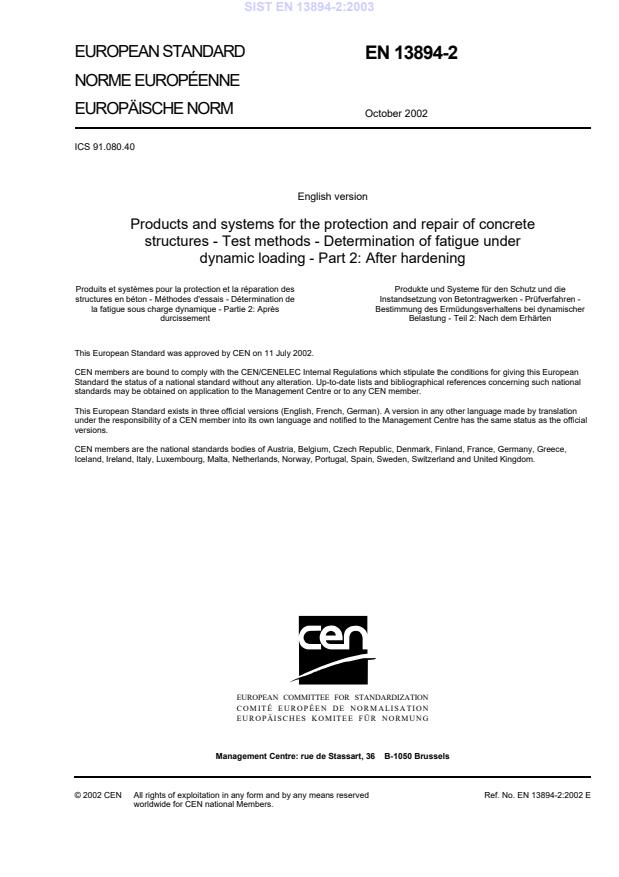
EUROPEAN STANDARDNORME EUROPÉENNEEUROPÄISCHE NORMEN 13894-2October 2002ICS 91.080.40English versionProducts and systems for the protection and repair of concretestructures - Test methods - Determination of fatigue underdynamic loading - Part 2: After hardeningProduits et systèmes pour la protection et la réparation desstructures en béton - Méthodes d'essais - Détermination dela fatigue sous charge dynamique - Partie 2: AprèsdurcissementProdukte und Systeme für den Schutz und dieInstandsetzung von Betontragwerken - Prüfverfahren -Bestimmung des Ermüdungsverhaltens bei dynamischerBelastung - Teil 2: Nach dem ErhärtenThis European Standard was approved by CEN on 11 July 2002.CEN members are bound to comply with the CEN/CENELEC Internal Regulations which stipulate the conditions for giving this EuropeanStandard the status of a national standard without any alteration. Up-to-date lists and bibliographical references concerning such nationalstandards may be obtained on application to the Management Centre or to any CEN member.This European Standard exists in three official versions (English, French, German). A version in any other language made by translationunder the responsibility of a CEN member into its own language and notified to the Management Centre has the same status as the officialversions.CEN members are the national standards bodies of Austria, Belgium, Czech Republic, Denmark, Finland, France, Germany, Greece,Iceland, Ireland, Italy, Luxembourg, Malta, Netherlands, Norway, Portugal, Spain, Sweden, Switzerland and United Kingdom.EUROPEAN COMMITTEE FOR STANDARDIZATIONCOMITÉ EUROPÉEN DE NORMALISATIONEUROPÄISCHES KOMITEE FÜR NORMUNGManagement Centre: rue de Stassart, 36
B-1050 Brussels© 2002 CENAll rights of exploitation in any form and by any means reservedworldwide for CEN national Members.Ref. No. EN 13894-2:2002 ESIST EN 13894-2:2003
...