


EN 10083-3:2006
(Main)Steels for quenching and tempering - Part 3: Technical delivery conditions for alloy steels
Steels for quenching and tempering - Part 3: Technical delivery conditions for alloy steels
This part of EN 10083, in addition to Part 1, specifies the technical delivery requirements for:
semi-finished products, hot formed, e.g. blooms, billets, slabs (see NOTES 2 and 3 in EN 10083-1:2006, Clause 1),
bars (see NOTE 2 in EN 10083-1:2006, Clause 1),
rod,
wide flats,
hot-rolled strip and sheet/plate,
forgings (see NOTE 2 in EN 10083-1:2006, Clause 1),
manufactured from the direct hardening alloy steels for quenching and tempering and the alloy flame and induction hardening steels and supplied in one of the heat treatment conditions given for the different types of products in Table 1, lines 2 to 6, and in one of the surface conditions given in Table 2.
The steels are generally intended for the fabrication of quenched and tempered or induction hardened machine parts.
The requirements for mechanical properties given in this document are restricted to the sizes given in Table 8.
NOTE This document does not apply for bright steel products. For bright steel products EN 10277-1 and EN 10277-5 apply.
In special cases, variations in these technical delivery requirements or additions to them may be agreed at the time of enquiry and order (see Annex A).
Vergütungsstahle - Teil 3: Technische Lieferbedingungen für legierte Stähle
Dieser Teil der EN 10083 enthält in Ergänzung zu Teil 1 die allgemeinen technischen Lieferbedingungen für
- Halbzeug, warmgeformt, zum Beispiel Vorblöcke, Knüppel, Vorbrammen (siehe Anmerkungen 2 und 3 in EN 10083-1:2006, Abschnitt 1),
- Stabstahl (siehe Anmerkung 2 in EN 10083-1:2006, Abschnitt 1),
- Walzdraht,
- Breitflachstahl,
- warmgewalztes Blech und Band,
- Schmiedestücke (siehe Anmerkung 2 in EN 10083-1:2006, Abschnitt 1),
hergestellt aus legierten Vergütungsstählen und legierten Stählen zum Flamm und Induktionshärten, welche in einem der für die verschiedenen Erzeugnisformen in Tabelle 1, Zeilen 2 bis 6 angegebenen Wärmebehandlungszustände und in einer der in Tabelle 2 angegebenen Oberflächenausführungen geliefert werden.
Die Stähle sind im Allgemeinen zur Herstellung vergüteter, flamm oder induktionsgehärteter Maschinenteile vorgesehen.
Die Anforderungen an die in dieser Europäischen Norm gegebenen mechanischen Eigenschaften beschränken sich auf die in der Tabelle 8 angegebenen Maße.
ANMERKUNG Diese Norm gilt nicht für Blankstahlprodukte. Für Blankstahl gelten die EN 10277 1 und die EN 10277 5.
In Sonderfällen können bei der Anfrage und Bestellung Abweichungen von oder Zusätze zu diesen technischen Lieferbedingungen vereinbart werden (siehe Anhang A).
Aciers pour trempe et revenu - Partie 3: Conditions techniques de livraison des aciers alliés
Cette partie de la présente norme EN 10083, qui complète la partie 1, précise les exigences techniques de livraison des :
- demi-produits formés à chaud, comme par exemple les blooms, billettes et brames (voir NOTES 2 et 3 de l’EN 10083-1:2006, Article 1) ;
- barres (voir NOTE 2 de l’EN 10083-1:2006, Article 1) ;
- fils machine ;
- larges plats ;
- tôles/feuillards et bandes laminés à chaud ;
- pièces forgées (voir NOTE 2 de l’EN 10083-1:2006, Article 1) ;
fabriqués à partir d'aciers alliés à trempe directe pour les produits trempés et revenus et d'aciers alliés par trempe au chalumeau et par induction et livrés dans l'un des états de traitement thermique donnés pour les différents types de produits dans le Tableau 1, lignes 2 à 6, et dans l'un des états de surface donnés dans le Tableau 2.
D'une manière générale, ces aciers sont destinés à la fabrication de pièces mécaniques trempées et revenues ou, trempées par induction.
Les exigences en matière de propriétés mécaniques données dans la présente Norme européenne sont limitées aux dimensions données dans le Tableau 8.
NOTE La présente norme ne s'applique pas aux produits en acier clair. Les produits en acier clair font l'objet des normes EN 10277-1 et EN 10277-5.
Dans certains cas particuliers, les variations ou additifs par rapport aux conditions techniques de livraison peuvent faire l'objet d'un accord au moment de l'appel d'offres et de la commande (voir Annexe A).
Jekla za poboljšanje - 3. del: Tehnični dobavni pogoji za legirana jekla
General Information
- Status
- Withdrawn
- Publication Date
- 01-Aug-2006
- Withdrawal Date
- 13-Apr-2025
- Current Stage
- 9960 - Withdrawal effective - Withdrawal
- Start Date
- 20-Jun-2018
- Completion Date
- 14-Apr-2025
- Directive
- 89/106/EEC - Construction products
Relations
- Effective Date
- 22-Dec-2008
- Effective Date
- 27-Jun-2018
- Effective Date
- 08-Jun-2022
Frequently Asked Questions
EN 10083-3:2006 is a standard published by the European Committee for Standardization (CEN). Its full title is "Steels for quenching and tempering - Part 3: Technical delivery conditions for alloy steels". This standard covers: This part of EN 10083, in addition to Part 1, specifies the technical delivery requirements for: semi-finished products, hot formed, e.g. blooms, billets, slabs (see NOTES 2 and 3 in EN 10083-1:2006, Clause 1), bars (see NOTE 2 in EN 10083-1:2006, Clause 1), rod, wide flats, hot-rolled strip and sheet/plate, forgings (see NOTE 2 in EN 10083-1:2006, Clause 1), manufactured from the direct hardening alloy steels for quenching and tempering and the alloy flame and induction hardening steels and supplied in one of the heat treatment conditions given for the different types of products in Table 1, lines 2 to 6, and in one of the surface conditions given in Table 2. The steels are generally intended for the fabrication of quenched and tempered or induction hardened machine parts. The requirements for mechanical properties given in this document are restricted to the sizes given in Table 8. NOTE This document does not apply for bright steel products. For bright steel products EN 10277-1 and EN 10277-5 apply. In special cases, variations in these technical delivery requirements or additions to them may be agreed at the time of enquiry and order (see Annex A).
This part of EN 10083, in addition to Part 1, specifies the technical delivery requirements for: semi-finished products, hot formed, e.g. blooms, billets, slabs (see NOTES 2 and 3 in EN 10083-1:2006, Clause 1), bars (see NOTE 2 in EN 10083-1:2006, Clause 1), rod, wide flats, hot-rolled strip and sheet/plate, forgings (see NOTE 2 in EN 10083-1:2006, Clause 1), manufactured from the direct hardening alloy steels for quenching and tempering and the alloy flame and induction hardening steels and supplied in one of the heat treatment conditions given for the different types of products in Table 1, lines 2 to 6, and in one of the surface conditions given in Table 2. The steels are generally intended for the fabrication of quenched and tempered or induction hardened machine parts. The requirements for mechanical properties given in this document are restricted to the sizes given in Table 8. NOTE This document does not apply for bright steel products. For bright steel products EN 10277-1 and EN 10277-5 apply. In special cases, variations in these technical delivery requirements or additions to them may be agreed at the time of enquiry and order (see Annex A).
EN 10083-3:2006 is classified under the following ICS (International Classification for Standards) categories: 77.140.10 - Heat-treatable steels. The ICS classification helps identify the subject area and facilitates finding related standards.
EN 10083-3:2006 has the following relationships with other standards: It is inter standard links to EN 10083-3:1995, EN ISO 683-2:2018, EN 10083-3:2006/AC:2008. Understanding these relationships helps ensure you are using the most current and applicable version of the standard.
EN 10083-3:2006 is associated with the following European legislation: EU Directives/Regulations: 305/2011, 89/106/EEC, 97/23/EC; Standardization Mandates: M/071, M/120. When a standard is cited in the Official Journal of the European Union, products manufactured in conformity with it benefit from a presumption of conformity with the essential requirements of the corresponding EU directive or regulation.
You can purchase EN 10083-3:2006 directly from iTeh Standards. The document is available in PDF format and is delivered instantly after payment. Add the standard to your cart and complete the secure checkout process. iTeh Standards is an authorized distributor of CEN standards.
Standards Content (Sample)
6,67(16/29(16.,QRYHPEHU67$1'$5'-HNOD]DSREROMãDQMHGHO7HKQLþQLGREDYQLSRJRML]DOHJLUDQDMHNOD6WHHOVIRUTXHQFKLQJDQGWHPSHULQJ3DUW7HFKQLFDOGHOLYHU\FRQGLWLRQVIRUDOOR\VWHHOV !"#$%&'( )&!*- . 5HIHUHQþQDãWHYLOND6,67(1HQ,&6
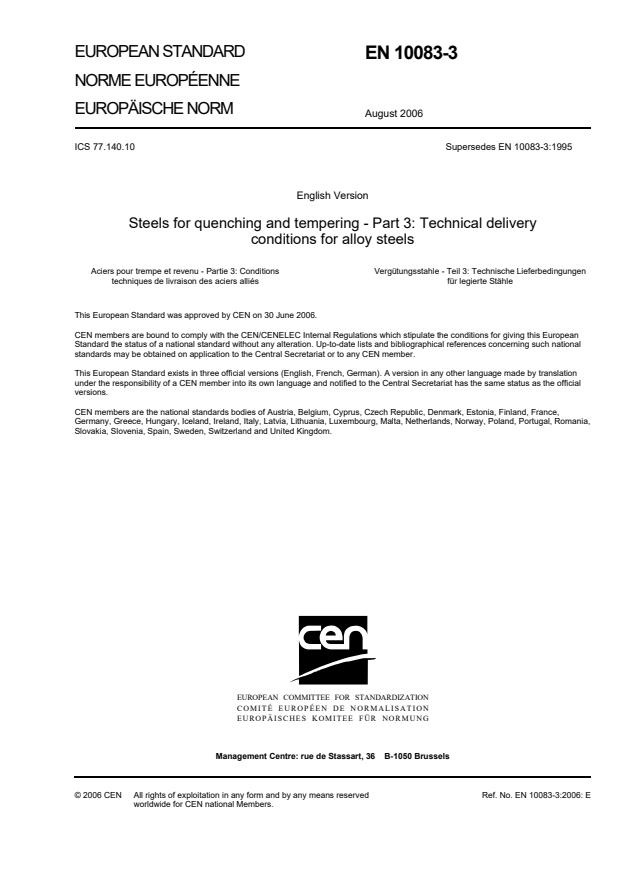
EUROPEAN STANDARDNORME EUROPÉENNEEUROPÄISCHE NORMEN 10083-3August 2006ICS 77.140.10Supersedes EN 10083-3:1995
English VersionSteels for quenching and tempering - Part 3: Technical deliveryconditions for alloy steelsAciers pour trempe et revenu - Partie 3: Conditionstechniques de livraison des aciers alliésVergütungsstahle - Teil 3: Technische Lieferbedingungenfür legierte StähleThis European Standard was approved by CEN on 30 June 2006.CEN members are bound to comply with the CEN/CENELEC Internal Regulations which stipulate the conditions for giving this EuropeanStandard the status of a national standard without any alteration. Up-to-date lists and bibliographical references concerning such nationalstandards may be obtained on application to the Central Secretariat or to any CEN member.This European Standard exists in three official versions (English, French, German). A version in any other language made by translationunder the responsibility of a CEN member into its own language and notified to the Central Secretariat has the same status as the officialversions.CEN members are the national standards bodies of Austria, Belgium, Cyprus, Czech Republic, Denmark, Estonia, Finland, France,Germany, Greece, Hungary, Iceland, Ireland, Italy, Latvia, Lithuania, Luxembourg, Malta, Netherlands, Norway, Poland, Portugal, Romania,Slovakia, Slovenia, Spain, Sweden, Switzerland and United Kingdom.EUROPEAN COMMITTEE FOR STANDARDIZATIONCOMITÉ EUROPÉEN DE NORMALISATIONEUROPÄISCHES KOMITEE FÜR NORMUNGManagement Centre: rue de Stassart, 36
B-1050 Brussels© 2006 CENAll rights of exploitation in any form and by any means reservedworldwide for CEN national Members.Ref. No. EN 10083-3:2006: E
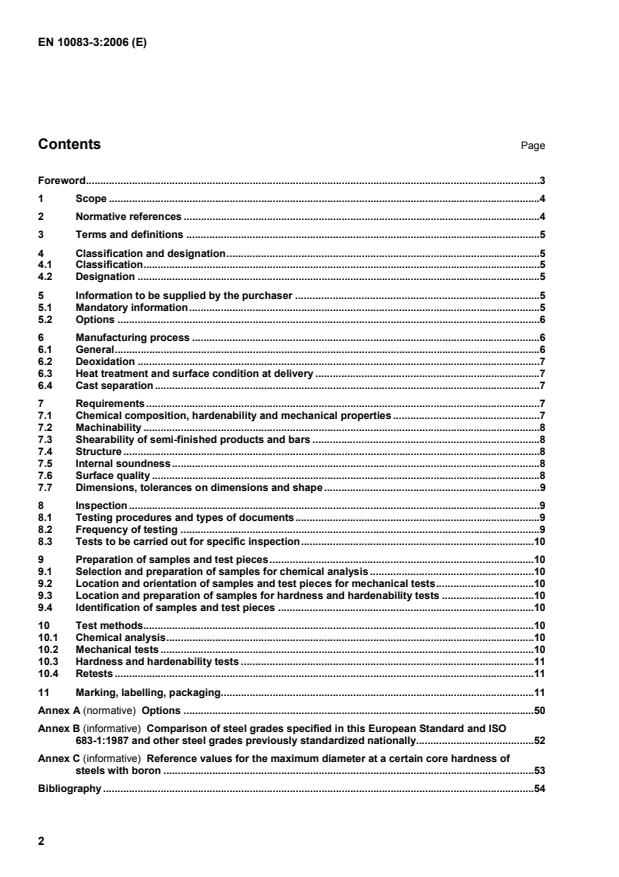
Options.50 Annex B (informative)
Comparison of steel grades specified in this European Standard and ISO 683-1:1987 and other steel grades previously standardized nationally.52 Annex C (informative)
Reference values for the maximum diameter at a certain core hardness of steels with boron.53 Bibliography.54
This document does not apply for bright steel products. For bright steel products EN 10277-1 and EN 10277-5 apply. In special cases, variations in these technical delivery requirements or additions to them may be agreed at the time of enquiry and order (see Annex A). 2 Normative references The following referenced documents are indispensable for the application of this document. For dated references, only the edition cited applies. For undated references, the latest edition of the referenced document (including any amendments) applies. EN 10002-1, Metallic materials – Tensile testing – Part 1: Method of test at ambient temperature EN 10020, Definition and classification of grades of steel EN 10027-1, Designation systems for steels – Part 1: Steel names EN 10027-2, Designation systems for steels – Part 2: Numerical system EN 10045-1, Metallic materials – Charpy impact test – Part 1: Test method EN 10083-1:2006, Steels for quenching and tempering – Part 1: General technical delivery conditions EN 10160, Ultrasonic testing of steel flat product of thickness equal or greater than 6 mm (reflection method) EN 10163-2, Delivery requirements for surface condition of hot-rolled steel plates, wide flats and sections – Part 2: Plate and wide flats EN 10204, Metallic products – Types of inspection documents
6 Manufacturing process 6.1 General The manufacturing process of steel and of the products is left to the discretion of the manufacturer with the restrictions given by the requirements in 6.2 to 6.4.
EN ISO 3887. 7.6.5 If suitability of bars and rods for bright drawing is required, this shall be agreed at the time of enquiry and order. 7.6.6 The removal of surface defects by welding shall only be permitted with the approval of the customer or his representative. If surface discontinuities are repaired, the method and maximum depth of removal shall be agreed at the time of enquiry and order. 7.7 Dimensions, tolerances on dimensions and shape The nominal dimensions, tolerances on dimensions and shape for the product shall be agreed at the time of enquiry and order, if possible, with reference to the dimensional standards applicable (see EN 10083-1:2006, Annex D). 8 Inspection
8.1 Testing procedures and types of documents 8.1.1 Products complying with this document shall be ordered and delivered with one of the inspection documents as specified in EN 10204. The type of document shall be agreed upon at the time of enquiry and order. If the order does not contain any specification of this type, a test report shall be issued. 8.1.2 For the information to be included in a test report, see EN 10083-1:2006, 8.1.2. 8.1.3 For the information to be included in an inspection certificate, see EN 10083-1:2006 8.1.3. 8.1.4 Unless otherwise agreed at the time of the order, inspection of surface quality and dimensions shall be carried out by the manufacturer. 8.2 Frequency of testing 8.2.1 Sampling Sampling shall be in accordance with Table 10. 8.2.2 Test units The test units and the extent of testing shall be in accordance with Table 10.
10.3.3 Surface hardness The surface hardness of steels after flame or induction hardening (see Table 9) shall be determined in accordance with EN ISO 6508-1, scale C. 10.4 Retests See EN 10083-1:2006, 10.4. 11 Marking, labelling, packaging The manufacturer shall mark the products or the bundles or boxes in a suitable way so that it is possible to determine the cast, the steel grade and the origin of the delivery (see A.6).
1 2 3 4 5 6 7 8 9 x indicates applicable for Applicable requirements if the steel is ordered with the designation given in Table 3 Table 5 or 6 1 Heat treatment condition at delivery Symbol Semi- finished products Bars Rod Flat products Hammer and drop forgings 8.1 8.2 9.1 9.2 9.3 2 Untreated none or +U x x x x x a
3 Treated to improve shearability +S x x - x - Table 7 column +Sa 4 Soft annealed +A x x x xb x
Maximum hardness Table 7 column +Aa Hardenability values according to Table 5 or 6 5 Quenched and tempered +QT - x x xb x
Chemical composition according to Tables 3 and 4 Mechanical properties according to Table 8
As in columns 8.1 and 8.2 (see footnote b in Table 3) Not Applicable 6 Others Other treatment conditions, e.g. certain annealing conditions to achieve a certain structure may be agreed at the time of enquiry and order. The treatment condition annealed for spheroidal carbide (+AC) as required for cold upsetting and cold extrusion is covered by EN 10263-4. a For deliveries in the untreated condition and in the "treated to improve shearability" and "soft annealed" condition, the mechanical properties specified in Table 8 shall be
achievable for the ruling end cross-section after appropriate heat treatment (for verification on reference test pieces, see A.1). b It is not possible to deliver all dimensions of flat products in this heat-treatment condition.
1 2 3 4 5 6 7 8 9 1 x indicates in general applicable for Notes
Surface condition at delivery Symbol Semi-finished products (such as blooms, billets) Bars Rod Flat productsHammer and drop forgings
(see note 2 in EN 10083-1:2006, Clause 1)
2 Unless
otherwise agreed Hot worked None or +HW x x x x x - 3 Unformed continuously cast +CC x - - - - - 4 Hot worked and pickled +PI x x x x x a 5 Hot worked and blast cleaned +BC x x x x x a 6 Hot worked and rough machined +RM - x x - x - 7 Particular conditions supplied by agreement Others - - - - - - - a In addition, it may be agreed that the products be oiled or, where appropriate, limed or phosphated.
0,020 to 0,040
37Cr4 1.7034 0,34 to 0,41 0,40 0,60 to 0,90 0,025 max. 0,035 0,90 to 1,20 - - - - 37CrS4 1.7038
0,020 to 0,040
41Cr4 1.7035 0,38 to 0,45 0,40 0,60 to 0,90 0,025 max. 0,035 0,90 to 1,20 - - - - 41CrS4 1.7039
0,020 to 0,040
25CrMo4 1.7218 0,22 to 0,29 0,40 0,60 to 0,90 0,025 max. 0,035 0,90 to 1,20 0,15 to 0,30 - - - 25CrMoS4 1.7213
0,020 to 0,040
34CrMo4 1.7220 0,30 to 0,37 0,40 0,60 to 0,90 0,025 max. 0,035 0,90 to 1,20 0,15 to 0,30 - - - 34CrMoS4 1.7226
0,020 to 0,040
42CrMo4 1.7225 0,38 to 0,45 0,40 0,60 to 0,90 0,025 max. 0,035 0,90 to 1,20 0,15 to 0,30 - - - 42CrMoS4 1.7227
0,020 to 0,040
50CrMo4 1.7228 0,46 to 0,54 0,40 0,50 to 0,80 0,025 max. 0,035 0,90 to 1,20 0,15 to 0,30 - - - 34CrNiMo6 1.6582 0,30 to 0,38 0,40 0,50 to 0,80 0,025 max. 0,035 1,30 to 1,70 0,15 to 0,30 1,30 to 1,70 - - 30CrNiMo8 1.6580 0,26 to 0,34 0,40 0,50 to 0,80 0,025 max. 0,035 1,80 to 2,20 0,30 to 0,50 1,80 to 2,20 - - 35NiCr6 1.5815 0,30 to 0,37 0,40 0,60 to 0,90 0,025 max. 0,025 0,80 to 1,10 - 1,20 to 1,60 - - 36NiCrMo16 1.6773 0,32 to 0,39 0,40 0,50 to 0,80 0,025 max. 0,025 1,60 to 2,00 0,25 to 0,45 3,6 to 4,1 - - 39NiCrMo3 1.6510 0,35 to 0,43 0,40 0,50 to 0,80 0,025 max. 0,035 0,60 to 1,00 0,15 to 0,25 0,70 to 1,00 - - 30NiCrMo16-6 1.6747 0,26 to 0,33 0,40 0,50 to 0,80 0,025 max. 0,025 1,20 to 1,50 0,30 to 0,60 3,3 to 4,3 - - 51CrV4 1.8159 0,47 to 0,55 0,40 0,70 to 1,10 0,025 max. 0,025 0,90 to 1,20 - - 0,10 to 0,25 - Steels with boron 20MnB5 1.5530 0,17 to 0,23 0,40 1,10 to 1,40 0,025 max. 0,035 - - - - 0,0008 to 0,0050 30MnB5 1.5531 0,27 to 0,33 0,40 1,15 to 1,45 0,025 max. 0,035 - - - - 0,0008 to 0,0050 38MnB5 1.5532 0,36 to 0,42 0,40 1,15 to 1,45 0,025 max. 0,035 - - - - 0,0008 to 0,0050 27MnCrB5-2 1.7182 0,24 to 0,30 0,40 1,10 to 1,40 0,025 max. 0,035 0,30 to 0,60 - - - 0,0008 to 0,0050 33MnCrB5-2 1.7185 0,30 to 0,36 0,40 1,20 to 1,50 0,025 max. 0,035 0,30 to 0,60 - - - 0,0008 to 0,0050 39MnCrB6-2 1.7189 0,36 to 0,42 0,40 1,40 to 1,70 0,025 max. 0,035 0,30 to 0,60 - - - 0,0008 to 0,0050 a Elements not quoted in this table shall not be intentionally added to the steel without the agreement of the purchaser, other than for the purpose of finishing the heat and for boron to have its effect
on the hardenability. All reasonable precautions shall be taken to prevent the addition of such elements from scrap or other material used in the manufacture which affect the hardenability,
mechanical properties and applicability. b Where requirements are made on hardenability (see Tables 5 and 6) or on the mechanical properties in the quenched and tempered condition (see Table 8), slight deviations from the limits for
the cast analysis are permissible, except for the elements carbon, phosphorus and sulfur; the deviations shall not exceed the specifications of Table 4. c Steels with improved machinability as a result of the addition of higher sulphur contents up to around 0,10% S (including resulphurized steels with controlled inclusion content (e.g. Ca-treatment))
may be supplied on request. In this case the upper limit for the manganese content may be increased by 0,15 %.
given in Table 3 for the cast analysis Element Permissible maximum content in the cast analysis % by mass Permissible deviationa % by mass C
≤ 0,55 ± 0,02 Si
≤ 0,40 + 0,03 Mn
≤ 1,00 ± 0,04
> 1,00
≤ 1,70 ± 0,05 P
≤ 0,025 + 0,005 S
≤ 0,040 + 0,005b Cr
≤ 2,00 ± 0,05
> 2,00
≤ 2,20 ± 0,10 Mo
≤ 0,30 ± 0,03
> 0,30
≤ 0,60 ± 0,04 Ni
≤ 2,00 ± 0,05
> 2,00
≤ 4,3 ± 0,07 V
≤ 0,25 ± 0,02 B
≤ 0,0050 ± 0,0003 a ± means that in one cast, the deviation may occur over the upper value
or under the lower value of the specified range in Table 3, but not both
at the same time. b For steels with a specified sulphur range of 0,020% to 0,040%
according to cast analysis, the permissible deviation is ± 0,005%.
(+H grades) Steel designation Distance in mm from quenched end Hardness in HRC Name Number Symbol Limits of range 1,5 3 5 7 9 11 13 15 20 25 30 35 40 45 50 Steels without boron 38Cr2 1.7003 +H max. 59 57 54 49 43 39 37 35 32 30 27 - - - -
min. 51 46 37 29 25 22 20 - - - - - - - - 46Cr2 1.7006 +H max. 63 61 59 57 53 47 42 39 36 33 32 - - - -
min. 54 49 40 32 28 25 23 22 20 - - - - - - 34Cr4 1.7033 +H max. 57 57 56 54 52 49 46 44 39 37 35 3
...
The standard EN 10083-3:2006 plays a crucial role in the field of materials engineering, specifically addressing the technical delivery conditions for alloy steels intended for quenching and tempering processes. Its comprehensive scope covers a variety of products, including semi-finished items like blooms, billets, and slabs, as well as finished products such as bars, rods, wide flats, hot-rolled strips, sheets, and forgings. These specifications ensure that all products meet the stringent requirements needed for high-performance applications in machine parts. One of the significant strengths of this standard is its detailed approach to the mechanical properties required for different product sizes, systematically outlined in Table 8. This clarity helps manufacturers and engineers select appropriate materials that comply with industry standards, leading to enhanced reliability and safety in their applications. Moreover, the inclusion of various heat treatment conditions in Table 1 allows for flexibility and adaptability in the production process, which can be critical for meeting specific performance demands. The relevance of EN 10083-3:2006 extends beyond merely defining specifications; it serves as a benchmark for quality assurance in the fabrication of quenched and tempered or induction hardened components. By providing a clear framework for the technical delivery requirements, the standard fosters consistency across the industry, which is particularly beneficial for manufacturers seeking to maintain high-quality standards. Furthermore, the provision for potential variations or additions to the technical delivery requirements, as noted in Annex A, acknowledges the evolving nature of engineering requirements. This flexibility is essential in a rapidly advancing technological landscape, allowing for customization in response to specific client needs without compromising on safety or performance. In summary, EN 10083-3:2006 stands out for its systematic and comprehensive guidelines for alloy steels used in high-stress applications. Its strong emphasis on mechanical properties, diverse product specifications, and adaptability makes it a vital document for manufacturers and engineers in the field of steel production and processing.
SIST EN 10083-3:2006は、浸炭および焼入れ・焼き戻しプロセスに使用される合金鋼の技術的な納入条件を詳細に規定しており、その範囲は非常に広いです。この規格は、様々な半製品および最終製品の製造に関する要求事項を明確に示しています。特に、半製品(例えばビルレット、スラブ)、バー、ロッド、広いフラット、熱間圧延ストリップおよびシート/プレート、鍛造品などに適用される点が特徴です。 この標準の強みは、具体的な熱処理条件や表面状態の指定により、製造者とユーザー間の理解を深め、製品の一貫性を確保することにあります。例えば、製品が様々なサイズでの機械的特性を満たすことを求めることで、実際の用途に適した材料を選定できるよう配慮されています。特に、表8においては、求められる機械的特性が明確に示されているため、材料を選ぶ際の信頼性が高まります。 さらに、特に重要な点として、この文書は明るい鋼製品には適用されないことが明記されており、必要に応じてEN 10277-1およびEN 10277-5が適用されることが示されています。これは、異なる製品群に対する正確な適用範囲を明確にし、誤解を招くことを防ぐための重要な要素です。 最後に、特別なケースにおいては、技術的な納入条件の変更や追加が可能であることが挙げられます。これにより、顧客のニーズに柔軟に対応できる点が、SIST EN 10083-3:2006の魅力をさらに高めています。全体として、この標準は浸炭・焼入れ・焼き戻し用合金鋼の分野において、非常に有用であり、業界のニーズに応える品質基準を提供しています。
SIST EN 10083-3:2006 표준은 열처리된 합금강을 위한 기술적인 납품 조건을 규정하고 있습니다. 이 표준은 주로 반제품, 바, 봉, 넓은 평판, 열간 압연 스트립 및 시트/플레이트, 단조품에 대한 요구 사항을 상세하게 다루고 있으며, 이러한 제품들이 직접 경화 합금강 및 합금 불꽃과 유도 경화 강재로 제조됨을 명시합니다. 표준의 범위는 특히 경화 및 템퍼링 처리된 기계 부품의 제조에 적합한 강재의 특성을 규명하고 있습니다. 이 표준의 강점 중 하나는 다양한 제품 유형에 대한 열처리 상태를 구체적으로 명시하고 있다는 점과, Table 1 및 Table 2에서 다양한 표면 조건과 열처리 조건을 정의하여 사용자에게 필요한 정보를 제공합니다. 또한, 이 문서는 기계적 특성의 요구 사항을 명확하게 규정하고 있으며, Table 8에 명시된 크기 제한을 통해 특정 제품에 대한 조건을 잘 충족시킬 수 있도록 구성되어 있는 점이 주목할 만합니다. 브라이트 스틸 제품에 대해서는 별도의 표준인 EN 10277-1 및 EN 10277-5가 적용된다는 점도 가치 있는 정보입니다. 전반적으로 SIST EN 10083-3:2006 표준은 열처리된 합금강 제품을 제조하는 데 필요한 다양한 기술적 요구 사항을 충족시키며, 업계의 요구에 부합하는 강력한 가이드라인을 제공합니다.
Die Norm EN 10083-3:2006 ist eine maßgebliche Richtlinie für legierte Stähle, die für das Härten und Anlassen verwendet werden, und bietet umfassende technische Lieferbedingungen. Ihr Anwendungsbereich umfasst ein breites Spektrum an Halbfertigprodukten wie Blöcke, Knüppel, Platten, sowie verschiedene Stab- und Flachprodukte. Dies zeigt die Vielseitigkeit der Norm, da sie sowohl für Produkte aus direkt härtenden legierten Stählen als auch für Stähle, die durch Flamme oder Induktion gehärtet werden, gilt. Ein wesentliches Merkmal der EN 10083-3:2006 ist die präzise Klassifizierung und die spezifizierten Wärmebehandlungsbedingungen, die transparent die unterschiedlichen Produktarten in Tabelle 1 definieren. Diese Klarheit sorgt dafür, dass Hersteller und Nutzer von diesen Materialien genau nachvollziehen können, welche Eigenschaften sie erwarten dürfen, und fördert damit die Qualitätssicherung im Produktionsprozess. Die Norm geht zudem auf die mechanischen Eigenschaften der Materialien ein, welche auf die in Tabelle 8 angegebenen Größen beschränkt sind. Dies ist ein bedeutender Vorteil, da es den Herstellern ermöglicht, spezifische Anforderungen zu erfüllen und die Zuverlässigkeit und Leistung der gefertigten Maschinenbauteile zu optimieren. Während die Norm für die meisten Anwendungen im Bereich der Maschinenbauindustrie von erheblichem Nutzen ist, wird klar darauf hingewiesen, dass sie nicht für blanke Stahlprodukte gilt, für die andere Normen wie EN 10277-1 und EN 10277-5 zur Anwendung kommen müssen. Ein weiterer positiver Aspekt der EN 10083-3:2006 ist die Möglichkeit, in besonderen Fällen von den technischen Lieferanforderungen abzuweichen oder diese zu ergänzen, was in Annex A gut dokumentiert ist. Somit können maßgeschneiderte Lösungen für spezifische Kundenbedürfnisse geschaffen werden, was die Relevanz und Anpassungsfähigkeit der Norm in der heutigen industriellen Anwendung unterstreicht. Alles in allem stellt die EN 10083-3:2006 eine bedeutende Ressource dar, die nicht nur Anforderungen an legierte Stähle für das Härten und Anlassen klar definiert, sondern auch eine solide Grundlage für die Qualität und Zuverlässigkeit von Maschinenbauteilen bietet.
La norme SIST EN 10083-3:2006 se positionne comme un document essentiel pour les professionnels et les industriels travaillant avec des aciers destinés au durcissement et au revenu. Elle précise les conditions techniques de livraison des aciers alliés, en mettant l'accent sur des produits semi-finis tels que les blooms, les billettes et les plaques fabriquées à partir d’aciers à durcissement direct. Cette normalisation est cruciale pour garantir la qualité et la performance des pièces mécaniques, en particulier celles qui nécessitent un traitement thermique spécifique pour atteindre les propriétés mécaniques souhaitées. Parmi les forces principales de cette norme, on souligne la clarté des exigences techniques énoncées, qui facilitent la compréhension et l'application par les manufacturiers. Les détails fournis dans les tableaux 1 et 2 concernant les conditions de traitement thermique et les états de surface optimisent la sélection des matériaux en fonction des applications prévues. De plus, la norme définit précisément les propriétés mécaniques, en se limitant aux dimensions spécifiées dans le tableau 8, ce qui aide à éviter toute ambiguïté lors de la fabrication et de l'utilisation des aciers concernés. La pertinence de ce document se manifeste également par sa capacité à répondre aux besoins évolutifs du marché, en prévoyant des possibilités de variations ou d'ajouts aux exigences techniques lors de la commande, comme indiqué dans l'Annexe A. Cela permet une certaine flexibilité aux fabricants tout en maintenant un standard élevé de qualité et de performance. Enfin, cette norme ne s'appliquant pas aux produits en acier brillant, les utilisateurs sont clairement dirigés vers les normes EN 10277-1 et EN 10277-5 pour ces produits, permettant ainsi une approche systématique et cohérente de la normalisation dans le secteur de l'acier. Dans l'ensemble, la norme SIST EN 10083-3:2006 se révèle être un outil vital pour assurer la fiabilité et l'efficacité dans la fabrication des pièces mécaniques traitées thermiquement.
Questions, Comments and Discussion
Ask us and Technical Secretary will try to provide an answer. You can facilitate discussion about the standard in here.
Loading comments...