

EN 16317:2013+A1:2017
(Main + Amendment)Fertilizers and liming materials - Determination of arsenic by inductively coupled plasma-atomic emission spectrometry (ICP-AES) after aqua regia dissolution
- Abstract
This European Standard specifies a method for the determination of the content of arsenic in fertilizers and liming materials using inductively coupled plasma-atomic emission spectrometry (ICP-AES) after aqua regia dissolution. Limits of quantification are dependent on the sample matrix as well as on the instrument, but can roughly be expected to be 1,5 mg/kg for As.
NOTE The term fertilizer is used throughout the body of this European Standard and includes liming materials unless otherwise indicated.
- Status
- Published
- Publication Date
- 21-Feb-2017
- Technical Committee
- CEN/TC 260 - Fertilizers and liming materials
- Drafting Committee
- CEN/TC 260/WG 3 - Liming materials
- Current Stage
- 9093 - Decision to confirm - Review Enquiry
- Start Date
- 05-Jun-2025
- Completion Date
- 21-Oct-2026


Overview
EN 16317:2013+A1:2017 (CEN) specifies a validated laboratory method for the determination of arsenic (As) in fertilizers and liming materials. The method combines aqua regia dissolution (HCl/HNO3 digestion and conventional boiling/reflux) with measurement by inductively coupled plasma–atomic emission spectrometry (ICP‑AES). Limits of quantification depend on matrix and instrument but are typically around 1.5 mg/kg As.
Key topics and technical requirements
- Scope: Analysis of arsenic in fertilizers and liming materials (the term “fertilizer” includes liming materials unless otherwise stated).
- Sample preparation: Follow EN 1482‑2 for sample preparation. The standard gives an aqua regia digestion procedure (sample aliquot, controlled addition of HCl and HNO3, reflux, dilution and filtration where needed).
- Instrumentation: ICP‑AES with axial or radial viewing; instrument settings (gas flows, RF power, uptake rates) must be optimized per manufacturer guidance.
- Calibration & matrix correction:
- External calibration is recommended for routine use.
- Matrix effects must be addressed-options include spike recovery correction, standard additions, matrix‑matched calibration, or internal standardization. Spike recovery (single standard spike) is described as a practical compromise for unknown or complex fertilizer matrices.
- Quality controls: Use analytical‑grade reagents and traceable stock standards; renew standards regularly. Filter choices (e.g., ash‑free paper) and dilution accuracy must be documented to avoid contamination.
- Performance data: Precision and reproducibility are reported via inter‑laboratory tests; laboratories must report test conditions and results per the standard.
Practical applications and users
- Routine quality control and compliance testing by:
- Fertilizer manufacturers and producers of liming materials
- Accredited testing laboratories and contract analytical services
- Regulatory agencies and environmental monitoring labs checking As limits in agricultural products
- Use cases:
- Verifying product safety and compliance with national/international contaminant limits
- Characterizing raw materials and finished fertilizer blends
- Supporting registration, labeling and risk assessments where As content is relevant
Related standards
- EN 1482‑2 (sampling and sample preparation for fertilizers)
- EN 12944‑1/2/3 (vocabulary for fertilizers and liming materials)
- EN ISO 3696 (water for analytical laboratory use)
EN 16317:2013+A1:2017 is a practical, standardized procedure for reliable arsenic measurement in fertilizer matrices using aqua regia extraction + ICP‑AES, emphasizing matrix correction and validated laboratory practice.
Relations
- Effective Date
- 18-Jan-2023
- Effective Date
- 23-Nov-2016
- Effective Date
- 28-Jan-2026
- Effective Date
- 28-Jan-2026
- Effective Date
- 28-Jan-2026
- Effective Date
- 28-Jan-2026
- Effective Date
- 28-Jan-2026
- Effective Date
- 28-Jan-2026
- Effective Date
- 28-Jan-2026
Get Certified
Connect with accredited certification bodies for this standard

Control Union Certifications
Global certification for agriculture and sustainability.

ECOCERT
Organic and sustainability certification.

FSC International
Forest Stewardship Council certification.
Sponsored listings
Frequently Asked Questions
EN 16317:2013+A1:2017 is a standard published by the European Committee for Standardization (CEN). Its full title is "Fertilizers and liming materials - Determination of arsenic by inductively coupled plasma-atomic emission spectrometry (ICP-AES) after aqua regia dissolution". This standard covers: This European Standard specifies a method for the determination of the content of arsenic in fertilizers and liming materials using inductively coupled plasma-atomic emission spectrometry (ICP-AES) after aqua regia dissolution. Limits of quantification are dependent on the sample matrix as well as on the instrument, but can roughly be expected to be 1,5 mg/kg for As. NOTE The term fertilizer is used throughout the body of this European Standard and includes liming materials unless otherwise indicated.
This European Standard specifies a method for the determination of the content of arsenic in fertilizers and liming materials using inductively coupled plasma-atomic emission spectrometry (ICP-AES) after aqua regia dissolution. Limits of quantification are dependent on the sample matrix as well as on the instrument, but can roughly be expected to be 1,5 mg/kg for As. NOTE The term fertilizer is used throughout the body of this European Standard and includes liming materials unless otherwise indicated.
EN 16317:2013+A1:2017 is classified under the following ICS (International Classification for Standards) categories: 65.080 - Fertilizers. The ICS classification helps identify the subject area and facilitates finding related standards.
EN 16317:2013+A1:2017 has the following relationships with other standards: It is inter standard links to EN 16317:2013, EN 16317:2013/FprA1:2016, EN 12944-2:1999, EN 12944-1:1999, EN 12944-3:2001, EN ISO 3696:1995, EN 1482-2:2024, CEN/TS 17753:2022, EN 17816:2023. Understanding these relationships helps ensure you are using the most current and applicable version of the standard.
EN 16317:2013+A1:2017 is associated with the following European legislation: Standardization Mandates: M/418. When a standard is cited in the Official Journal of the European Union, products manufactured in conformity with it benefit from a presumption of conformity with the essential requirements of the corresponding EU directive or regulation.
EN 16317:2013+A1:2017 is available in PDF format for immediate download after purchase. The document can be added to your cart and obtained through the secure checkout process. Digital delivery ensures instant access to the complete standard document.
Standards Content (Sample)
2003-01.Slovenski inštitut za standardizacijo. Razmnoževanje celote ali delov tega standarda ni dovoljeno.LVLMVNRDüngemittel und Kalkdünger - Bestimmung von Arsen mit Atomemissionsspektrometrie mit induktiv gekoppeltem Plasma (ICP-AES) nach KönigswasseraufschlussEngrais et amendements minéraux basiques - Détermination de l'arsenic par spectrométrie d'émission atomique avec plasma induit par haute fréquence (ICP-AES) après digestion á l'eau régaleFertilizers and liming materials - Determination of arsenic by inductively coupled plasma-atomic emission spectrometry (ICP-AES) after aqua regia dissolution65.080GnojilaFertilizersICS:Ta slovenski standard je istoveten z:EN 16317:2013+A1:2017SIST EN 16317:2013+A1:2017en,fr,de01-december-2017SIST EN 16317:2013+A1:2017SLOVENSKI
STANDARDSIST EN 16317:20131DGRPHãþD
EUROPEAN STANDARD NORME EUROPÉENNE EUROPÄISCHE NORM
EN 16317:2013+A1
February
t r s y ICS
x wä r z r English Version
Fertilizers and liming materials æ Determination of arsenic by inductively coupled plasmaæatomic emission Engrais et amendements minéraux basiques æ Détermination de l 5arsenic par spectrométrie d 5émission atomique avec plasma induit par haute
Düngemittel und Kalkdünger æ Bestimmung von Arsen mit Atomemissionsspektrometrie mit induktiv Königswasseraufschluss This European Standard was approved by CEN on
t { August
t r s u and includes Amendment
s approved by CEN on
s s December
t r s xä
egulations which stipulate the conditions for giving this European Standard the status of a national standard without any alterationä Upætoædate lists and bibliographical references concerning such national standards may be obtained on application to the CENæCENELEC Management Centre or to any CEN memberä
translation under the responsibility of a CEN member into its own language and notified to the CENæCENELEC Management Centre has the same status as the official versionsä
CEN members are the national standards bodies of Austriaá Belgiumá Bulgariaá Croatiaá Cyprusá Czech Republicá Denmarká Estoniaá Finlandá Former Yugoslav Republic of Macedoniaá Franceá Germanyá Greeceá Hungaryá Icelandá Irelandá Italyá Latviaá Lithuaniaá Luxembourgá Maltaá Netherlandsá Norwayá Polandá Portugalá Romaniaá Serbiaá Slovakiaá Sloveniaá Spainá Swedená Switzerlandá Turkey and United Kingdomä
EUROPEAN COMMITTEE FOR STANDARDIZATION COMITÉ EUROPÉEN DE NORMALISATION EUROPÄISCHES KOMITEE FÜR NORMUNG
CEN-CENELEC Management Centre:
Avenue Marnix 17,
B-1000 Brussels
t r s y CEN All rights of exploitation in any form and by any means reserved worldwide for CEN national Membersä Refä Noä EN
s x u s yã t r s u ªA sã t r s y ESIST EN 16317:2013+A1:2017
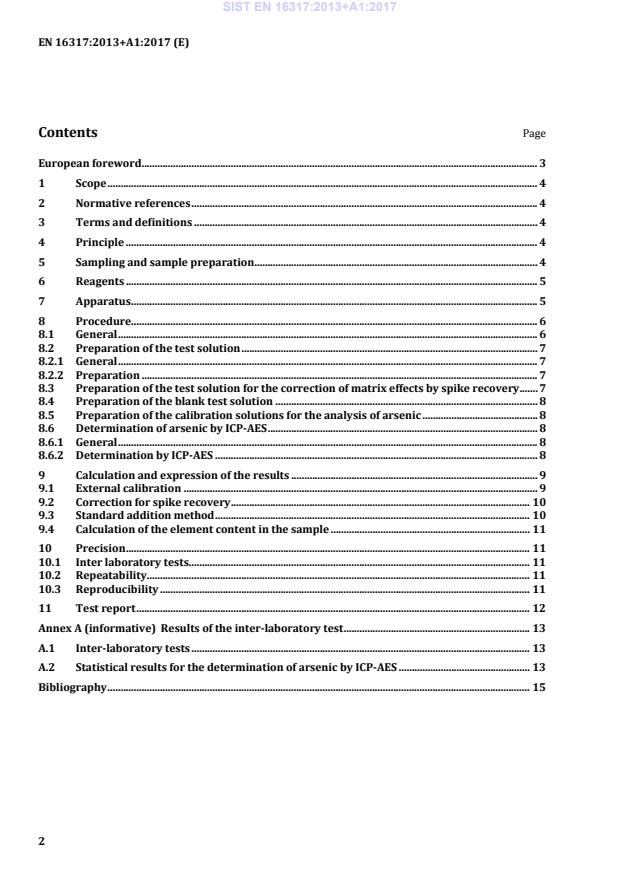
Results of the inter-laboratory test . 13 A.1 Inter-laboratory tests . 13 A.2 Statistical results for the determination of arsenic by ICP-AES . 13 Bibliography . 15
approximately 1,18 g/ml. 6.3 Nitric acid, c(HNO3) = 16 mol/l; not less than 65 % volume fraction,
approximately 1,42 g/ml. 6.4 Mixed acid solution of 0,8 mol/l nitric acid and 1,8 mol/l hydrochloric acid. Mix 150 ml of hydrochloric acid (6.2) and 50 ml nitric acid (6.3) to 1,0 l of water (6.1). 6.5 Standard stock solution arsenic standard stock solution, e.g.
= 1 000 mg/l in arsenic. Use suitable stock solutions. Single-element stock solutions with adequate specification stating the acid used and the preparation technique are commercially available. It is recommended to use a commercially available standard stock solution for arsenic. 6.6 Working standard solutions. Depending on the scope, different working standard solutions may be necessary. 6.6.1 Working standard solution I,
= 100 mg/l for arsenic. Dilute 10,0 ml of the stock solution of arsenic (6.5) to 100,0 ml with the mixed acid solution (6.4) in the same 100 ml flask. This solution is used to prepare spiked test solutions and standard and calibration solutions. 6.6.2 Working standard solution II,
= 10 mg/l for arsenic. Dilute 10,0 ml of the working standard solution I (6.6.1) to 100,0 ml with the mixed acid solution (6.4) in a 100 ml flask. This solution is used to prepare spiked test solutions and calibration solutions. 7 Apparatus 7.1 Common laboratory glassware. 7.2 Analytical balance, capable of weighing to an accuracy of 1 mg. 7.3 Inductively coupled plasma-atomic emission spectrometer, with axial or radial viewing of the plasma and with suitable background correction. The settings of the working conditions (e.g. gas flows, RF or plasma power, sample uptake rate, integration time, number of replicates) shall be optimized according to the manufacturer’s instructions. Radial viewing of the plasma may be used if it can be shown that the limit of quantification for arsenic is below the required legal limit values. The use of axial orientation of the viewing optics requires good control of the matrix effects coming from “easily ionisable elements” (i.e. the influence of easily ionisable elements in varying concentrations on the signal intensities of the analytes). For alkali-elements, this can be achieved by adding caesium-chloride solution (CsCl). In general, matrix matching of calibration solutions or calibration by standard SIST EN 16317:2013+A1:2017
...