

FprEN 12697-13
(Main)Bituminous mixtures - Test methods - Part 13: Temperature measurement
- Abstract
This document describes a test method for measuring the temperature of asphalt mixtures after mixing and during storage, transportation and laying. This document includes the contact temperature-measuring device and the non-contact temperature-measuring device (infrared-thermometer). In cases of dispute, the reference method uses the contact temperature-measuring device.
- Status
- Not Published
- Publication Date
- 03-Jan-2027
- Technical Committee
- CEN/TC 227 - Road materials
- Drafting Committee
- CEN/TC 227/WG 1 - Bituminous mixtures
- Current Stage
- 5020 - Submission to Vote - Formal Approval
- Start Date
- 10-Sep-2026
- Due Date
- 09-Feb-2026
- Completion Date
- 10-Sep-2026
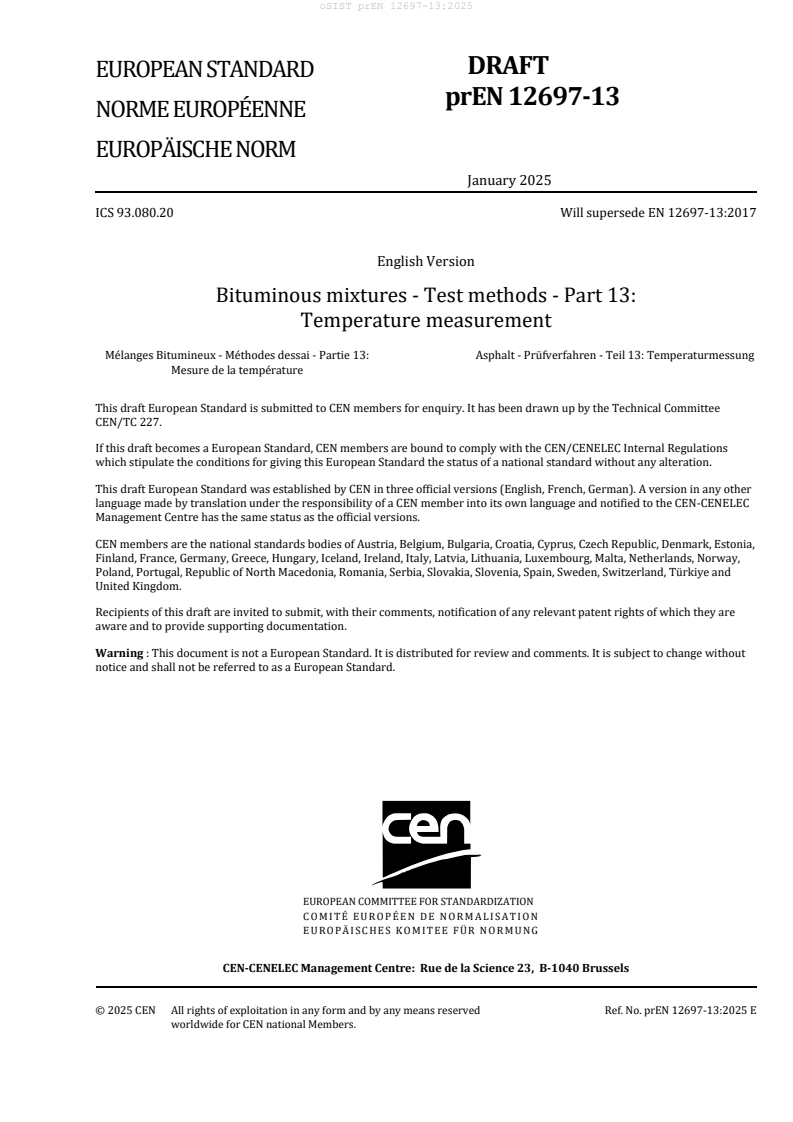

FprEN 12697-13 is a CEN draft European Standard for measuring the temperature of bituminous mixtures, including asphalt mixtures, after mixing and during storage, transportation and laying. It specifies both a contact temperature-measuring device and a non-contact infrared-thermometer, and in cases of dispute the contact method is the reference method.
What does FprEN 12697-13 specify?
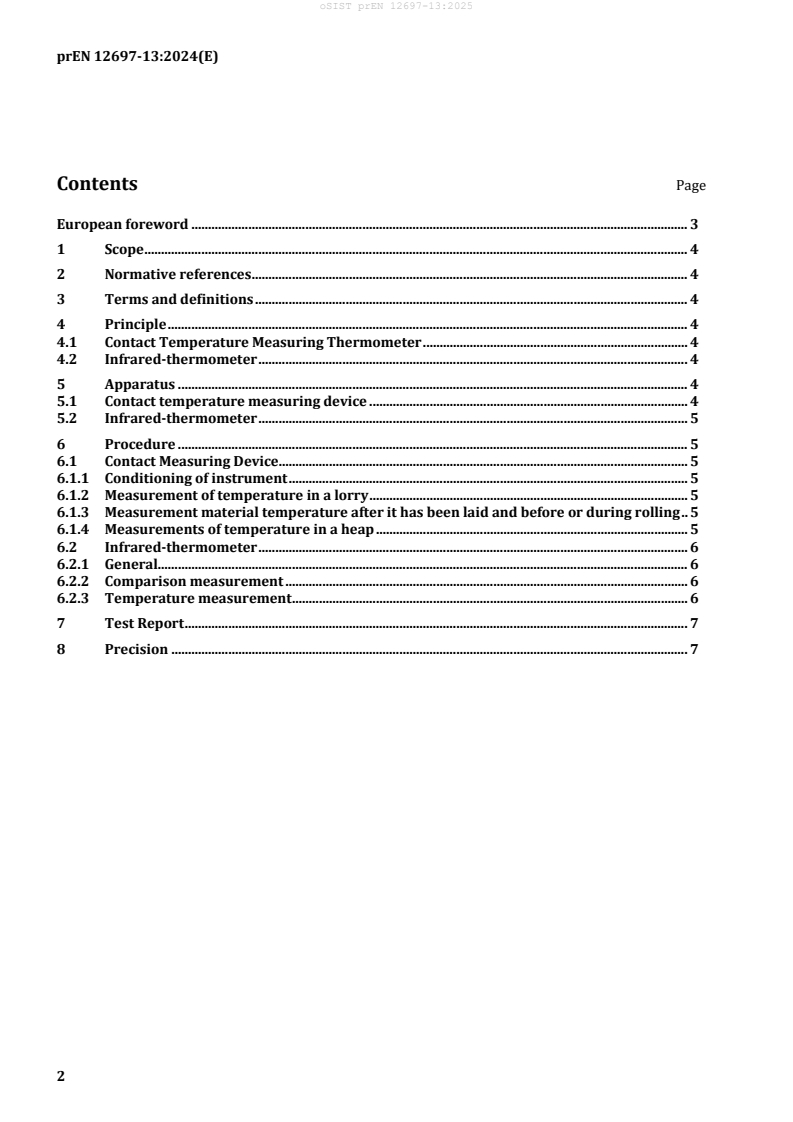
FprEN 12697-13 specifies a test method for temperature measurement on asphalt mixtures throughout production and paving. The document is organized into scope, principle, apparatus, procedure, test report and precision, so a reader can move from the overall purpose to the measuring method and then to what must be recorded.
Clause 4 explains the two measurement principles. Clause 5 sets the apparatus requirements for the contact device and the infrared-thermometer. Clause 6 gives the procedures for lorry loads, heaps, laid material and paver hoppers. Clause 7 covers the test report, and Clause 8 addresses precision.
What are the key requirements of FprEN 12697-13?
Clause 4 sets out two ways to measure temperature: a contact probe that measures at stated depths, and an infrared method that measures surface temperature. In practice, this means the user must choose whether the task is internal temperature or surface temperature, and must use the contact method when a disputed result needs the reference method.
Clause 5.1 requires the contact temperature-measuring device and probe to suit the measurement location, with a probe at least 200 mm long and a known response time. The device must read to the nearest 1 °C with a maximum permissible error of 2 °C. In practice, the instrument has to be fast enough and accurate enough for hot asphalt work, not just technically available.
Clause 5.2 requires the infrared-thermometer to detect radiation in the 2 µm to 14 µm range and to record thermal radiation from the surface. It must be possible to adjust emissivity, and accurate use depends on the correct angle, distance and emissivity value. In practice, the operator has to set the thermometer for the mixture before taking readings.
Clause 6.1.2 gives the procedure for measuring temperature in a lorry load with the contact device. The probe goes at least 100 mm into the load, with at least four measurements on each side, at least 500 mm from the edges, and the result is the average. This gives a representative load temperature instead of a single spot reading.
Clause 6.1.3 covers material after laying and before or during rolling. The standard calls for at least four measurements before rolling is complete, with the sensing element as close as possible to the mid-depth of the layer. In practice, the reading has to be taken quickly enough not to interfere with rolling.
Clause 6.1.4 covers heaps of material. The probe goes at least 100 mm into the heap, with at least four measurements around the accessible perimeter and at least 300 mm from the base. This helps check temperature in stored material without relying on only one point.
Clause 6.2.2 and 6.2.3 set up infrared use by first comparing it with a calibrated contact device on the same asphalt sample, then taking readings at a suitable angle and distance. The infrared method is also described for lorry loads, heaps and paver hoppers. In practice, the emissivity setting and viewing geometry are part of the measurement, not optional details.
What changed in FprEN 12697-13 from the previous edition?
FprEN 12697-13 supersedes EN 12697-13:2017. The foreword states two technical changes: the wording for the contact temperature-measuring device in Clause 5.1 was revised, and the reporting information in Clause 7 was amended.
Who uses FprEN 12697-13?
FprEN 12697-13 is used by laboratories, asphalt producers, road contractors and site inspection teams that need to check mixture temperature during mixing, transport, laying and rolling. It is also relevant to quality control staff and buyers who need a common method for accepting or comparing temperature measurements on road construction materials.
What does the FprEN 12697-13 document contain?
FprEN 12697-13 contains the measurement principles, apparatus requirements and step-by-step procedures for both contact and infrared temperature measurement. It gives separate procedures for lorry loads, laid material, heaps and paver hoppers, so users can match the method to the work situation.
It also specifies what the test report must include: reference to the document, sample identification, site of measurement, device type and the average result in °C. Clause 8 then states the precision position for these devices.
Relations
- Effective Date
- 28-Jan-2026
- Effective Date
- 28-Jan-2026
- Effective Date
- 28-Jan-2026
- Effective Date
- 21-Feb-2024
Get Certified
Connect with accredited certification bodies for this standard

Zavod za gradbeništvo Slovenije (ZAG) - Inšpekcija
ZAG inspection body for construction products, structures, and materials.
Sponsored listings
Frequently Asked Questions
FprEN 12697-13 is a draft published by the European Committee for Standardization (CEN). Its full title is "Bituminous mixtures - Test methods - Part 13: Temperature measurement". This standard covers: This document describes a test method for measuring the temperature of asphalt mixtures after mixing and during storage, transportation and laying. This document includes the contact temperature-measuring device and the non-contact temperature-measuring device (infrared-thermometer). In cases of dispute, the reference method uses the contact temperature-measuring device.
This document describes a test method for measuring the temperature of asphalt mixtures after mixing and during storage, transportation and laying. This document includes the contact temperature-measuring device and the non-contact temperature-measuring device (infrared-thermometer). In cases of dispute, the reference method uses the contact temperature-measuring device.
FprEN 12697-13 is classified under the following ICS (International Classification for Standards) categories: 93.080.20 - Road construction materials. The ICS classification helps identify the subject area and facilitates finding related standards.
FprEN 12697-13 has the following relationships with other standards: It is inter standard links to CEN ISO/TS 5387:2024, CEN ISO/TS 23359:2025, CEN ISO/TS 24672:2024, EN 12697-13:2017. Understanding these relationships helps ensure you are using the most current and applicable version of the standard.
FprEN 12697-13 is available in PDF format for immediate download after purchase. The document can be added to your cart and obtained through the secure checkout process. Digital delivery ensures instant access to the complete standard document.
Standards Content (Sample)
SLOVENSKI STANDARD
01-marec-2025
Bitumenske zmesi - Preskusne metode - 13. del: Merjenje temperature
Bituminous mixtures - Test methods - Part 13: Temperature measurement
Asphalt - Prüfverfahren - Teil 13: Temperaturmessung
Mélanges Bitumineux - Méthodes ďessai - Partie 13: Mesure de la température
Ta slovenski standard je istoveten z: prEN 12697-13
ICS:
93.080.20 Materiali za gradnjo cest Road construction materials
2003-01.Slovenski inštitut za standardizacijo. Razmnoževanje celote ali delov tega standarda ni dovoljeno.
DRAFT
EUROPEAN STANDARD
prEN 12697-13
NORME EUROPÉENNE
EUROPÄISCHE NORM
January 2025
ICS 93.080.20 Will supersede EN 12697-13:2017
English Version
Bituminous mixtures - Test methods - Part 13:
Temperature measurement
Mélanges Bitumineux - Méthodes dessai - Partie 13: Asphalt - Prüfverfahren - Teil 13: Temperaturmessung
Mesure de la température
This draft European Standard is submitted to CEN members for enquiry. It has been drawn up by the Technical Committee
CEN/TC 227.
If this draft becomes a European Standard, CEN members are bound to comply with the CEN/CENELEC Internal Regulations
which stipulate the conditions for giving this European Standard the status of a national standard without any alteration.
This draft European Standard was established by CEN in three official versions (English, French, German). A version in any other
language made by translation under the responsibility of a CEN member into its own language and notified to the CEN-CENELEC
Management Centre has the same status as the official versions.
CEN members are the national standards bodies of Austria, Belgium, Bulgaria, Croatia, Cyprus, Czech Republic, Denmark, Estonia,
Finland, France, Germany, Greece, Hungary, Iceland, Ireland, Italy, Latvia, Lithuania, Luxembourg, Malta, Netherlands, Norway,
Poland, Portugal, Republic of North Macedonia, Romania, Serbia, Slovakia, Slovenia, Spain, Sweden, Switzerland, Türkiye and
United Kingdom.
Recipients of this draft are invited to submit, with their comments, notification of any relevant patent rights of which they are
aware and to provide supporting documentation.
Warning : This document is not a European Standard. It is distributed for review and comments. It is subject to change without
notice and shall not be referred to as a European Standard.
EUROPEAN COMMITTEE FOR STANDARDIZATION
COMITÉ EUROPÉEN DE NORMALISATION
EUROPÄISCHES KOMITEE FÜR NORMUNG
CEN-CENELEC Management Centre: Rue de la Science 23, B-1040 Brussels
© 2025 CEN All rights of exploitation in any form and by any means reserved Ref. No. prEN 12697-13:2025 E
worldwide for CEN national Members.
prEN 12697-13:2024(E)
Contents Page
European foreword . 3
1 Scope . 4
2 Normative references . 4
3 Terms and definitions . 4
4 Principle . 4
4.1 Contact Temperature Measuring Thermometer . 4
4.2 Infrared-thermometer . 4
5 Apparatus . 4
5.1 Contact temperature measuring device . 4
5.2 Infrared-thermometer . 5
6 Procedure . 5
6.1 Contact Measuring Device. 5
6.1.1 Conditioning of instrument . 5
6.1.2 Measurement of temperature in a lorry . 5
6.1.3 Measurement material temperature after it has been laid and before or during rolling . 5
6.1.4 Measurements of temperature in a heap . 5
6.2 Infrared-thermometer . 6
6.2.1 General. 6
6.2.2 Comparison measurement . 6
6.2.3 Temperature measurement . 6
7 Test Report . 7
8 Precision . 7
prEN 12697-13:2024 (E)
European foreword
This document (prEN 12697-13:2024) has been prepared by Technical Committee CEN/TC 227 “Road
materials”, the secretariat of which is held by BSI.
This document is currently submitted to the CEN Enquiry.
This document will supersede EN 12697-13:2017.
prEN 12697-13:2024 includes the following significant technical changes with respect to
EN 12697-13:2017:
— [ 5.1], (3.1.1 and 3.1.2 in EN 12697-13:2017), the wording: “The temperature measuring device shall
have the capacity to measure the temperature with an accuracy of ± 2 °C”, amended to read: “The
contact temperature measuring device shall be capable to measure the temperature to the nearest 1
°C with a maximum permissible error of 2 °C.”;
— [Clause 7], (Clause 5 in EN 12697-13:2017), information to be reported amended.
A list of all parts in the EN 12697 series, published under general title Bituminous mixtures - Test methods
can be found on the CEN website: https://www.cencenelec.eu/.
prEN 12697-13:2024(E)
1 Scope
This document describes a test method for measuring the temperature of asphalt mixtures after mixing
and during storage, transportation and laying. This document includes the contact temperature-
measuring device and the non-contact temperature-measuring device (infrared-thermometer). In cases
of dispute, the refence method shall be using the contact temperature measuring device.
2 Normative references
There are no
...