

EN 14964:2006
(Main)Rigid underlays for discontinuous roofing - Definitions and characteristics
- Abstract
This European Standard specifies the technical requirements for factory made flat or profiled sheets (wood-based, fibre cement flat sheets or corrugated bituminous sheets or other materials which can be characterised as one of these materials) that are used as underlays in pitched roof constructions with discontinuously laid coverings (e.g. tiles, slates). This European Standard also establishes methods of inspection and testing as well as criteria for evaluation of conformity.
This European Standard does not include rigid underlays which have a stiffening function or a load bearing function.
- Status
- Published
- Publication Date
- 17-Oct-2006
- Withdrawal Date
- 30-Jul-2008
- Technical Committee
- CEN/TC 128 - Roof covering products for discontinuous laying and products for wall cladding
- Drafting Committee
- CEN/TC 128/SC 9 - Prefabricated accessories for roofing
- Current Stage
- 9060 - Closure of 2 Year Review Enquiry - Review Enquiry
- Start Date
- 02-Dec-2021
- Completion Date
- 02-Dec-2021
- Directive
- 305/2011 - Regulation (eu) No 305/2011 of the European Parliament and of the Council of 9 march 2011 laying down harmonised conditions for the marketing of construction products and repealing council directive 89/106/eecOJ Ref: C, C 259 OJ Date: 08-Aug-2014
89/106/EEC - Construction productsOJ Ref: C, C 290 OJ Date: 04-Dec-2007



Overview
EN 14964:2006 - published by CEN - defines rigid underlays for discontinuous roofing (underpitched roofs with tile or slate coverings). The standard covers factory-made flat or profiled sheets (wood-based panels, fibre‑cement flat sheets, corrugated bitumen sheets or equivalent materials), specifying definitions, technical requirements, test methods and criteria for conformity. It explicitly excludes rigid underlays that provide structural stiffening or load‑bearing functions.
Key topics and requirements
- Scope & definitions
- Defines “rigid underlay” and material groups (wood‑based, fibre cement, corrugated bitumen) and laying types (overlapping OL, interlocking IL).
- Dimensions & tolerances
- Prescribes dimensional tolerances for OL and IL types and references EN 324, EN 12467 and EN 534 for measurement procedures.
- Application‑related characteristics
- Mechanical resistance (bending strength) - tests referenced to EN 534 (corrugated bitumen), EN 12467 (fibre cement) and relevant wood panel standards (EN 622 series, EN 300, EN 312, EN 636, EN 14279).
- Reaction to fire - classification in accordance with EN 13501‑1 where required; wood panels may use EN 13986 tables.
- Water impermeability - tests per EN 534 (bitumen), EN 12467 (fibre cement) and adapted methods for wood‑based panels.
- Water vapour permeability, durability, thermal resistance and airborne sound insulation - test methods referenced (e.g., EN 12524, EN 12664, EN ISO 140‑3 / EN ISO 717‑1).
- Conformity & factory control
- Sets out initial type testing, factory production control (FPC) (Annex A) and procedures for evaluation of conformity, including informative Annex ZA addressing the EU Construction Products Directive and CE marking requirements.
Practical applications and users
- Target audience:
- Roof material manufacturers, product designers, test laboratories, specifiers, building inspectors, and contractors installing pitched roofs with discontinuous coverings (tiles, slates).
- Uses:
- Specifying compliant rigid underlays for pitched roof systems.
- Developing product specifications, performing type testing, establishing FPC and preparing documentation for CE marking and declarations of conformity.
- Harmonising performance claims (e.g., bending strength, water resistance, fire classification) across the EU market.
Related standards (select)
- EN 12467 - Fibre cement flat sheets (product specs & tests)
- EN 534 - Corrugated bitumen sheets
- EN 300, EN 312, EN 622 series, EN 636 - Wood‑based panel standards
- EN 13501‑1 - Reaction to fire classification
- EN 12524 / EN 12664 - Hygrothermal and thermal properties
- EN ISO 140‑3 / EN ISO 717‑1 - Airborne sound insulation
EN 14964:2006 is essential when specifying or certifying non‑structural rigid underlays for pitched roofing, ensuring consistent performance, testing and conformity across European markets.
Relations
- Effective Date
- 22-Jul-2026
- Refers
EN 12524:2000 - Building materials and products - Hygrothermal properties - Tabulated design values - Effective Date
- 28-Jan-2026
- Effective Date
- 28-Jan-2026
- Effective Date
- 28-Jan-2026
- Effective Date
- 28-Jan-2026
- Effective Date
- 28-Jan-2026
- Effective Date
- 28-Jan-2026
- Effective Date
- 28-Jan-2026
- Effective Date
- 28-Jan-2026
- Effective Date
- 28-Jan-2026
- Effective Date
- 28-Jan-2026
- Effective Date
- 28-Jan-2026
- Effective Date
- 28-Jan-2026
- Effective Date
- 28-Jan-2026
- Effective Date
- 28-Jan-2026
Get Certified
Connect with accredited certification bodies for this standard

DIBt (Deutsches Institut für Bautechnik)
German Institute for Building Technology.
DIN CERTCO
DIN Group product certification.

Aboma Certification B.V.
Specialized in construction, metal, and transport sectors.
Sponsored listings
Frequently Asked Questions
EN 14964:2006 is a standard published by the European Committee for Standardization (CEN). Its full title is "Rigid underlays for discontinuous roofing - Definitions and characteristics". This standard covers: This European Standard specifies the technical requirements for factory made flat or profiled sheets (wood-based, fibre cement flat sheets or corrugated bituminous sheets or other materials which can be characterised as one of these materials) that are used as underlays in pitched roof constructions with discontinuously laid coverings (e.g. tiles, slates). This European Standard also establishes methods of inspection and testing as well as criteria for evaluation of conformity. This European Standard does not include rigid underlays which have a stiffening function or a load bearing function.
This European Standard specifies the technical requirements for factory made flat or profiled sheets (wood-based, fibre cement flat sheets or corrugated bituminous sheets or other materials which can be characterised as one of these materials) that are used as underlays in pitched roof constructions with discontinuously laid coverings (e.g. tiles, slates). This European Standard also establishes methods of inspection and testing as well as criteria for evaluation of conformity. This European Standard does not include rigid underlays which have a stiffening function or a load bearing function.
EN 14964:2006 is classified under the following ICS (International Classification for Standards) categories: 91.060.20 - Roofs. The ICS classification helps identify the subject area and facilitates finding related standards.
EN 14964:2006 has the following relationships with other standards: It is inter standard links to EN 312:2010, EN 12524:2000, EN ISO 12572:2016, EN ISO 717-1:2020, EN 622-4:2024, EN 534:2006, EN ISO 10140-5:2021, EN 14279:2004+A1:2009, EN 622-2:2004, EN 13501-1:2002, EN 324-2:1993, EN ISO 10140-2:2021, EN 636:2012+A1:2015, EN 622-3:2004, EN ISO 10140-4:2021. Understanding these relationships helps ensure you are using the most current and applicable version of the standard.
EN 14964:2006 is associated with the following European legislation: EU Directives/Regulations: 305/2011, 89/106/EEC; Standardization Mandates: M/122. When a standard is cited in the Official Journal of the European Union, products manufactured in conformity with it benefit from a presumption of conformity with the essential requirements of the corresponding EU directive or regulation.
EN 14964:2006 is available in PDF format for immediate download after purchase. The document can be added to your cart and obtained through the secure checkout process. Digital delivery ensures instant access to the complete standard document.
Standards Content (Sample)
2003-01.Slovenski inštitut za standardizacijo. Razmnoževanje celote ali delov tega standarda ni dovoljeno.Rigid underlays for discontinuous roofing - Definitions and characteristicsToge podložne folije za strehe - Definicije in lastnostiEcrans rigides de sous-toiture pour pose en discontinu - Définitions et caractéristiquesUnterdeckplatten für Dachdeckungen - Definitionen und EigenschaftenTa slovenski standard je istoveten z:EN 14964:2006SIST EN 14964:2007en91.060.20StreheRoofsICS:SLOVENSKI
STANDARDSIST EN 14964:200701-marec-2007
EUROPEAN STANDARDNORME EUROPÉENNEEUROPÄISCHE NORMEN 14964October 2006ICS 91.060.20 English VersionRigid underlays for discontinuous roofing - Definitions andcharacteristicsEcrans rigides de sous-toiture pour pose en discontinu -Définitions et caractéristiquesUnterdeckplatten für Dachdeckungen - Definitionen undEigenschaftenThis European Standard was approved by CEN on 28 August 2006.CEN members are bound to comply with the CEN/CENELEC Internal Regulations which stipulate the conditions for giving this EuropeanStandard the status of a national standard without any alteration. Up-to-date lists and bibliographical references concerning such nationalstandards may be obtained on application to the Central Secretariat or to any CEN member.This European Standard exists in three official versions (English, French, German). A version in any other language made by translationunder the responsibility of a CEN member into its own language and notified to the Central Secretariat has the same status as the officialversions.CEN members are the national standards bodies of Austria, Belgium, Cyprus, Czech Republic, Denmark, Estonia, Finland, France,Germany, Greece, Hungary, Iceland, Ireland, Italy, Latvia, Lithuania, Luxembourg, Malta, Netherlands, Norway, Poland, Portugal, Romania,Slovakia, Slovenia, Spain, Sweden, Switzerland and United Kingdom.EUROPEAN COMMITTEE FOR STANDARDIZATIONCOMITÉ EUROPÉEN DE NORMALISATIONEUROPÄISCHES KOMITEE FÜR NORMUNGManagement Centre: rue de Stassart, 36
B-1050 Brussels© 2006 CENAll rights of exploitation in any form and by any means reservedworldwide for CEN national Members.Ref. No. EN 14964:2006: E
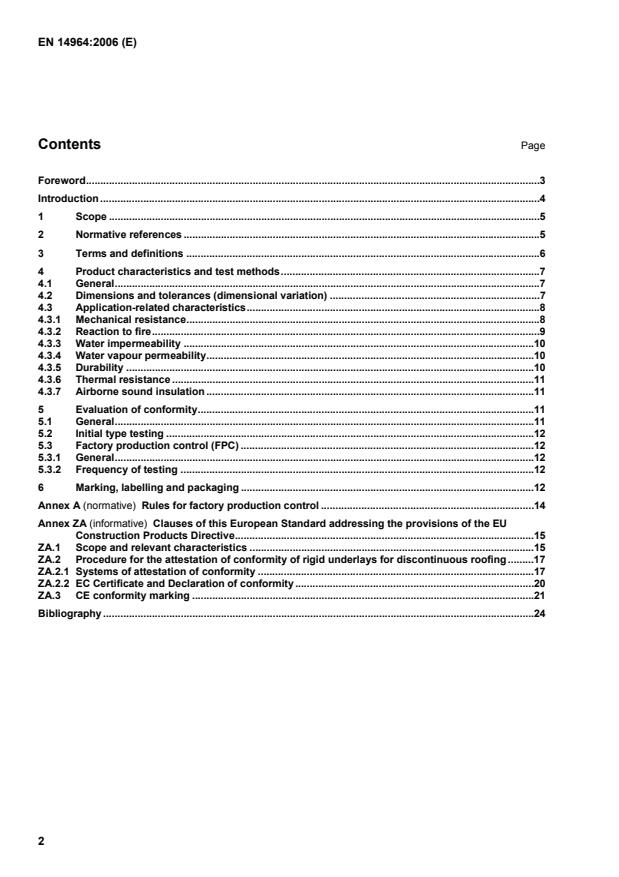
Rules for factory production control.14 Annex ZA (informative)
Clauses of this European Standard addressing the provisions of the EU Construction Products Directive.15 ZA.1 Scope and relevant characteristics.15 ZA.2 Procedure for the attestation of conformity of rigid underlays for discontinuous roofing.17 ZA.2.1 Systems of attestation of conformity.17 ZA.2.2 EC Certificate and Declaration of conformity.20 ZA.3 CE conformity marking.21 Bibliography.24
1 Scope This European Standard specifies the technical requirements for factory made flat or profiled sheets (wood-based, fibre cement flat sheets or corrugated bituminous sheets or other materials which can be characterised as one of these materials) that are used as underlays in pitched roof constructions with discontinuously laid coverings (e.g. tiles, slates). This European Standard also establishes methods of inspection and testing as well as criteria for evaluation of conformity. This European Standard does not include rigid underlays which have a stiffening function or a load bearing function. 2 Normative references The following referenced documents are indispensable for the application of this document. For dated references, only the edition cited applies. For undated references, the latest edition of the referenced document (including any amendments) applies. EN 300, Oriented Strand Boards (OSB) — Definitions, classification and specifications EN 312, Particleboards — Specifications EN 324-1, Wood-based panels — Determination of dimensions of boards — Part 1: Determination of thickness, width and length EN 324-2, Wood-based panels — Determination of dimensions of boards — Part 2: Determination of squareness and edge straightness EN 534:2006 Corrugated bitumen sheets — Product specification and test methods EN 622-2, Fibreboards — Specifications — Part 2: Requirements for hardboards EN 622-3, Fibreboards — Specifications — Part 3: Requirements for medium boards EN 622-4, Fibreboards — Specifications — Part 4: Requirements for softboards EN 622-5, Fibreboards — Specifications — Part 5: Requirements for dry process boards (MDF) EN 636, Plywood — Specifications EN 12467:2004, Fibre cement flat sheets — Product specifications and test methods EN 12524:2000, Building materials and products — Hygrothermal properties — Tabulated design values EN 12664, Thermal performance of building materials and products — Determination of thermal resistance by means of guarded hot plate and heat flow meter methods — Dry and moist products of medium and low thermal resistance EN 13501-1:2002, Fire classification of construction products and building elements — Part 1: Classification using test data from reaction to fire tests EN 13986:2004, Wood-based panels for use in construction — Characteristics, evaluation of conformity and marking EN 14279, Laminated Veneer Lumber (LVL) — Definitions, classification and specifications
NOTE They are used as underlay to coverings of pitched roofs (e.g. tiles, slates). They can be laid overlapping, one sheet covering the other (OL) or interlocking, sheets side by side (IL) 3.1.1 wood-based panel solid wood panel, laminated veneer lumber (LVL), plywood, oriented strand board (OSB), resin-bonded particleboard, cement-bonded particleboard, fibreboard or wood fibre insulation board 3.1.2 fibre cement flat sheet sheets consisting essentially of cement or a calcium silicate formed by a chemical reaction of a siliceous and a calcareous material, reinforced by organic and/or inorganic fibres.
NOTE Fibre cement sheets can be pressed or un-pressed 3.1.3 corrugated bitumen sheet profiled sheet consisting of an intimate and homogeneous mixture of organic and/or inorganic fibres and bitumen.
NOTE The surface may be natural coloured, spun-dyed, coated, granulised or mineralised 3.2 sampling procedure used to draw or constitute a sample 3.3 sample sheet from which a test piece is taken 3.3.1 test piece part of the sample from which test specimens are taken 3.3.2 test specimen piece of accurate dimensions taken from the test piece
Table 1 — Type OL: Tolerances for rigid underlays laid overlapping Characteristic Tolerance Length ± 5 mm Width ± 1 % Straightness or squareness a Deviation: 4 mm/m length Flat products ± 1 mm Thickness Corrugated products ± 10 % Height of corrugations ± 1 % Pitch of corrugations ± 1 % a
Either one may be declared. Table 2 — Type IL: Tolerances for rigid underlays laid interlocking Characteristic Tolerance Length ± 5 mm Width ± 3 mm, max 1/3 of interlocking Thickness + 3 mm/ -1 mm Squareness 2 mm/m Straightness 1,5 mm/m, max. 1/3 of interlocking
4.3 Application-related characteristics 4.3.1 Mechanical resistance 4.3.1.1 General The mechanical resistance of products used as rigid underlays (under the scope of this European Standard) is characterized through bending strength. 4.3.1.2 Corrugated bitumen sheets The bending under downward load shall be determined in accordance with EN 534:2006, 7.2.1, with the following modifications: the distance between the tubes (Figure 8/key 2) shall be 400 mm instead of 620 mm; the distance between the three supports (Figure 8/key 5) shall be modified in the proportion of 400/620: e.g. 210 mm instead of 325 mm, 200 mm instead of 310 mm;
EN 13501-1:2002, Table 1 or taken from EN 13986:2004, Table 8 (CWFT). Where the test method requires it, products shall be mounted and fixed in a manner representative of their intended end use conditions.
Products shall meet the requirements for category B. 4.3.3.3 Wood-based panels Water impermeability shall be determined in accordance with EN 12467:2004, 7.3.3 (20 mm water column, test period 24 h, 3 test specimens), with the modification that for wood-based panels: the diameter of the testing frame shall be ≥ 100 mm and the test specimen shall be conditioned at the climate of (23 ± 5) °C and (50 ± 10) %. Evaluation shall be carried out in accordance with EN 12467. 4.3.3.4 Other materials The water impermeability of products for use as rigid underlays shall be determined in accordance with the product standards of corrugated bitumen sheets, fibre cement sheets or wood-based panels and all tests shall be carried out according to the respective material group. 4.3.4 Water vapour permeability For wood-based panels and corrugated bitumen sheets the declaration of values of water vapour permeability may be made by reference to standardised values of EN 12524:2000, Table 1 (wet cup) or shall be declared by test results according to EN ISO 12572, climate C. For fibre cement products the values of water vapour permeability shall be declared by test results according to EN ISO 12572, climate C. If the product is tested according to EN ISO 12572, climate C, the results shall lie within the declared tolerance of the manufacturer's declared value. 4.3.5 Durability 4.3.5.1 Corrugated bitumen sheets Durability shall be determined according to EN 534:2006, 5.4.2, water impermeability after freeze/thaw ageing, category S. 4.3.5.2 Fibre cement products Durability shall be determined according EN 12467. Bending strength shall be measured in ambient conditions before and after conditioning for warm water, soak-dry and freeze-thaw for category D. Evaluation shall be carried out in accordance with EN 12467.
...