

EN ISO/IEEE 11073-10101:2020/A1:2026
(Amendment)Health informatics - Device interoperability - Part 10101: Point-of-care medical device communication - Nomenclature - Amendment 1: Additional definitions (ISO/IEEE 11073-10101:2020/Amd 1:2026)
- Status
- Published
- Publication Date
- 04-Aug-2026
- Technical Committee
- CEN/TC 251 - Medical informatics
- Drafting Committee
- CEN/TC 251/WG 2 - Terminology and knowledge representation
- Current Stage
- 6060 - Definitive text made available (DAV) - Publishing
- Start Date
- 05-Aug-2026
- Completion Date
- 05-Aug-2026


EN ISO/IEEE 11073-10101:2020/A1:2026 is a CEN and ISO/IEEE amendment to the point-of-care medical device communication nomenclature in the 11073 series. It updates the codes, definitions and mapping rules used to exchange data from medical devices at the point of care, with a strong focus on acute care, patient vital signs, infusion pumps, ventilators and dialysis equipment.
In practice, the document gives implementers a shared vocabulary for device objects, measurements, events, alerts and units so different systems can encode the same clinical meaning consistently.
What does EN ISO/IEEE 11073-10101:2020/A1:2026 specify?
EN ISO/IEEE 11073-10101:2020/A1:2026 specifies a nomenclature for communication of information from point-of-care medical devices. Its main emphasis is acute care medical devices and patient vital signs information, and it also supports an object-oriented information model for medical device communication.
The amendment is organized into Clause 1 for the overview, Clause 2 for normative references, Clause 3 for terms and abbreviations, and Annexes A, C, I, J, K, L and M.
| Annex | What it covers |
|---|---|
| Annex A | Normative nomenclature semantics, including device types, measurements, units, body sites, events, alerts and ventilator modes |
| Annex C | Normative terms, discriminators and numeric codes, including Alarm Inactivation State [AIS] |
| Annex I | Informative mapping of vendor ventilation modes to ISO 19223 and IEEE 11073, including an XSLT transform |
| Annex J | Normative units of measure and _UOM_GROUPS |
| Annex K | Normative MDC_ENUMGV enumeration groups and values |
| Annex L | Informative bibliography |
| Annex M | Informative revision history |
What are the key requirements of EN ISO/IEEE 11073-10101:2020/A1:2026?
EN ISO/IEEE 11073-10101:2020/A1:2026 extends the existing nomenclature rather than replacing the whole structure. The main practical effect is new or updated coded concepts for device identity, measurements, alerts, units and ventilator modes, plus clearer rules for how those codes are formed and mapped.
Clause 1 and Clause 1.2 set the reading rules
Clause 1 states the document’s scope: it is a nomenclature for point-of-care medical device communication, with emphasis on acute care and patient vital signs. Clause 1.2 defines how to read the wording in the standard - “shall” is mandatory, “should” is recommended, “may” is permitted, and “can” expresses capability. That matters because it tells implementers which statements are required for conformance and which are guidance.
Clause 3 adds terms and abbreviations needed for infusion, ventilation and code handling
Clause 3 adds the terms container and pump relay, which are both important for infusion-pump status and source tracking. It also adds abbreviations such as CF_CODE10, CODE10, PART, PartCode, REFID, UOM_MDC, UOM_UCUM, NAVA, NMT, PCA, rSO2, SQI and TCI. In practice, these labels are used in code tables, data dictionaries and software interfaces, so they need to mean the same thing across devices and systems.
Annex A expands the data dictionary and device model
Annex A extends the object-oriented modeling elements and device-type nomenclature. It adds or expands code coverage for infusion pumps, hemodialysis, neuromuscular transmission, respiratory and anesthesia devices, high-frequency ventilation, high-flow therapy, regional brain oxygen saturation, environmental monitoring and other acute-care device types. For implementers, this is the part that drives how a device is named in transmitted data and how a receiving system classifies it.
Annex A adds placeholder device types for tree transformations
Annex A adds device placeholder terms for MDS, VMD, CHAN, METRIC and related levels. The text explains that these placeholders support transformations between HL7 V2 OBX-4 dot notation and XML containment trees when every containment level must be present. That matters when software has to round-trip the same device hierarchy across different message formats without losing structure.
Annex A and Annex J define units of measure and group handling
Annex A introduces UOM_MDC and UOM_UCUM columns for numeric observations, settings and measurements, and Annex J defines the related unit-of-measure groups and the mapping between UOM_MDC and UOM_UCUM. In practice, this is what lets a receiving system display, store or compare a measurement with the correct unit instead of only the number.
Annex A expands measurements, enumerations and device status codes
Annex A.7 adds nomenclature for ECG, haemodynamic monitoring, respiratory and ventilator measurements, chemistry measurements, pump data, stimulation modes, neuromuscular transmission and hemodialysis. The amendment also adds enumerated values for pump status, delivery mode, relay state, therapy modes and other device states. That gives manufacturers and integrators a standard way to transmit clinical and operational status, not just raw numeric readings.
Annex A.8 and Annex I standardize ventilator mode mapping
Annex A.8.11 defines ventilator mode nomenclature based on ISO 19223 and gives the character-substitution rules used to form IEEE Reference IDs. The text states, for example, how certain symbols are normalized before mapping and how NoteRefs are formatted. Annex I then gives the preferred process for mapping vendor ventilator modes to the ISO 19223 string representation and then to IEEE 11073 Reference IDs, including an XSLT transform and round-trip verification. This is especially useful for ventilator software, gateways and terminology tools.
Annex A.9, Annex C and alarm inactivation add event and alert handling
Annex A.9 extends the event and alert vocabulary with diagnostic pattern events, device-related and environment-related events and alerts, and Alarm Inactivation State [AIS] events. Annex C defines the AIS discriminators and numeric codes used with that event family. In practice, this supports alarm-management data exchange, which is important for surveillance systems, device integration and audit trails.
Annex A.16 and Annex A.17 support broader interoperability profiles
Annex A.16 adds information attributes to support IHE PCD DEC and PCHA/Continua Services Interface. Annex A.17 adds nomenclature to support the Service-oriented Device Connectivity (SDC) series of standards, including ensemble nomenclature, context validator nomenclature and an enumerated value set for medical device operational mode. This helps systems that need to bridge 11073 device data with profile- or service-based interoperability stacks.
What terms does EN ISO/IEEE 11073-10101:2020/A1:2026 define?
- container - The reservoir holding fluid for an infusion pump, such as an IV bag, cassette or syringe.
- pump relay - The operating state in which one infusion pump takes over delivery automatically when the corresponding pump has finished its programmed delivery.
- CF_CODE10 - The label for the 32-bit “context-free” numeric code used in the code structure.
- CODE10 - The lower 16-bit “context-sensitive” part of a 32-bit “context-free” numeric code.
- PartCode - The concatenation of the upper and lower parts of a 32-bit “context-free” code in the form Part::Code.
- REFID - An alternative label for “Reference ID” or “RefId”, used for coded nomenclature entries.
- UOM_MDC and UOM_UCUM - The labels for the IEEE 11073 medical-device unit and the UCUM unit used to carry measurement units in the tables.
Who uses EN ISO/IEEE 11073-10101:2020/A1:2026?
EN ISO/IEEE 11073-10101:2020/A1:2026 is used by people who build, integrate, test or buy point-of-care medical devices and their connectivity software.
- Medical device manufacturers use it to assign names, codes and status values to device data.
- Interoperability software developers and middleware vendors use it to map device outputs into a common message model.
- Hospital integration teams and health informatics teams use it to align ventilators, infusion pumps, dialysis systems and monitors with a shared vocabulary.
- Quality managers, buyer teams and validation engineers use it to check whether a device or interface supports the coded concepts they need.
- Test and certification teams use it to verify that measurements, units, events, alerts and ventilator modes are represented with the expected identifiers.
What changed in EN ISO/IEEE 11073-10101:2020/A1:2026 from the previous edition?
EN ISO/IEEE 11073-10101:2020/A1:2026 modifies EN ISO 11073-10101:2020 by adding additional definitions and code content.
The amendment adds support for:
- infusion pump concepts, including delivery information, therapy types and pump states
- ventilator and anesthesia concepts, including ISO 19223-based ventilator mode mapping
- hemodialysis concepts and related fluid and treatment data
- neuromuscular transmission and stimulation modes
- new device types, including high flow therapy, high-frequency ventilation and environmental monitoring
- signal quality index (SQI), event and alert extensions, and Alarm Inactivation State [AIS]
- new units of measure and additional enumerated values
Which standards are used with EN ISO/IEEE 11073-10101:2020/A1:2026?
- EN ISO 11073-10101:2020 - the base European Standard that this amendment modifies.
- ISO 19223 - used for the ventilator mode string structure and verification in Annex A.8.11 and Annex I.
- IEEE P11073-10700 - referenced in Annex A.17 for SDC-related nomenclature, including ensemble and context validator terms.
- ISO/IEEE 11073 series - the amendment belongs to this device-interoperability family, which groups the related 11073 parts.
What does the EN ISO/IEEE 11073-10101:2020/A1:2026 document contain?
The document contains large coded tables for device types, measurements, units, body sites, events, alerts and ventilator modes, organized mainly in Annex A. It also contains code and discriminator tables in Annex C, a recommended mapping method and XSLT for ventilator mode conversion in Annex I, and unit and enumeration rules in Annexes J and K.
For implementation work, the most useful material is the code tables and the mapping rules, because they tell software exactly which reference IDs, enumeration groups and unit groupings to use. Annex M then records the revision history for the amendment.
Relations
- Effective Date
- 12-Feb-2026
- Effective Date
- 04-Feb-2026
Get Certified
Connect with accredited certification bodies for this standard

BSI Group
BSI (British Standards Institution) is the business standards company that helps organizations make excellence a habit.

NYCE
Mexican standards and certification body.
Sponsored listings
Frequently Asked Questions
EN ISO/IEEE 11073-10101:2020/A1:2026 is a amendment published by the European Committee for Standardization (CEN). Its full title is "Health informatics - Device interoperability - Part 10101: Point-of-care medical device communication - Nomenclature - Amendment 1: Additional definitions (ISO/IEEE 11073-10101:2020/Amd 1:2026)". This standard covers: Health informatics - Device interoperability - Part 10101: Point-of-care medical device communication - Nomenclature - Amendment 1: Additional definitions (ISO/IEEE 11073-10101:2020/Amd 1:2026)
Health informatics - Device interoperability - Part 10101: Point-of-care medical device communication - Nomenclature - Amendment 1: Additional definitions (ISO/IEEE 11073-10101:2020/Amd 1:2026)
EN ISO/IEEE 11073-10101:2020/A1:2026 is classified under the following ICS (International Classification for Standards) categories: 01.040.35 - Information technology (Vocabularies); 35.240.80 - IT applications in health care technology. The ICS classification helps identify the subject area and facilitates finding related standards.
EN ISO/IEEE 11073-10101:2020/A1:2026 has the following relationships with other standards: It is inter standard links to ISO/IEEE 11073-10101:2020/Amd 1:2026, EN ISO 11073-10101:2020. Understanding these relationships helps ensure you are using the most current and applicable version of the standard.
EN ISO/IEEE 11073-10101:2020/A1:2026 is available in PDF format for immediate download after purchase. The document can be added to your cart and obtained through the secure checkout process. Digital delivery ensures instant access to the complete standard document.
Standards Content (Sample)
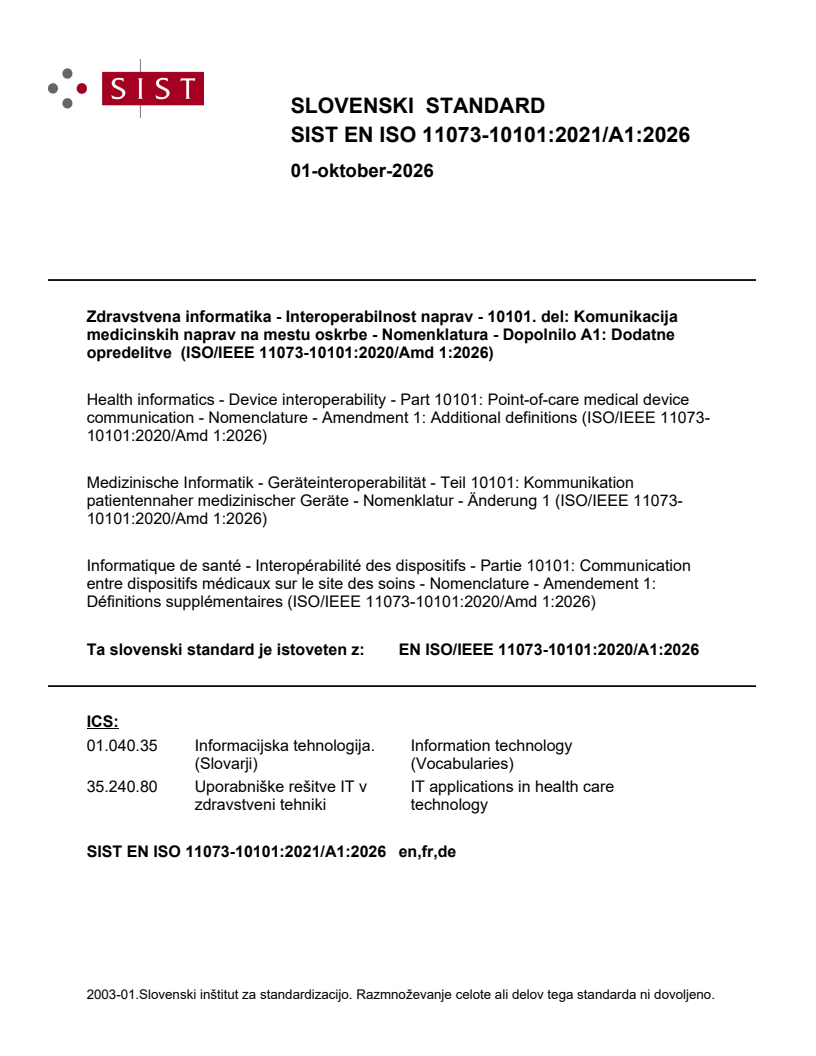
SLOVENSKI STANDARD
01-oktober-2026
Zdravstvena informatika - Interoperabilnost naprav - 10101. del: Komunikacija
medicinskih naprav na mestu oskrbe - Nomenklatura - Dopolnilo A1: Dodatne
opredelitve (ISO/IEEE 11073-10101:2020/Amd 1:2026)
Health informatics - Device interoperability - Part 10101: Point-of-care medical device
communication - Nomenclature - Amendment 1: Additional definitions (ISO/IEEE 11073-
10101:2020/Amd 1:2026)
Medizinische Informatik - Geräteinteroperabilität - Teil 10101: Kommunikation
patientennaher medizinischer Geräte - Nomenklatur - Änderung 1 (ISO/IEEE 11073-
10101:2020/Amd 1:2026)
Informatique de santé - Interopérabilité des dispositifs - Partie 10101: Communication
entre dispositifs médicaux sur le site des soins - Nomenclature - Amendement 1:
Définitions supplémentaires (ISO/IEEE 11073-10101:2020/Amd 1:2026)
Ta slovenski standard je istoveten z: EN ISO/IEEE 11073-10101:2020/A1:2026
ICS:
01.040.35 Informacijska tehnologija. Information technology
(Slovarji) (Vocabularies)
35.240.80 Uporabniške rešitve IT v IT applications in health care
zdravstveni tehniki technology
2003-01.Slovenski inštitut za standardizacijo. Razmnoževanje celote ali delov tega standarda ni dovoljeno.
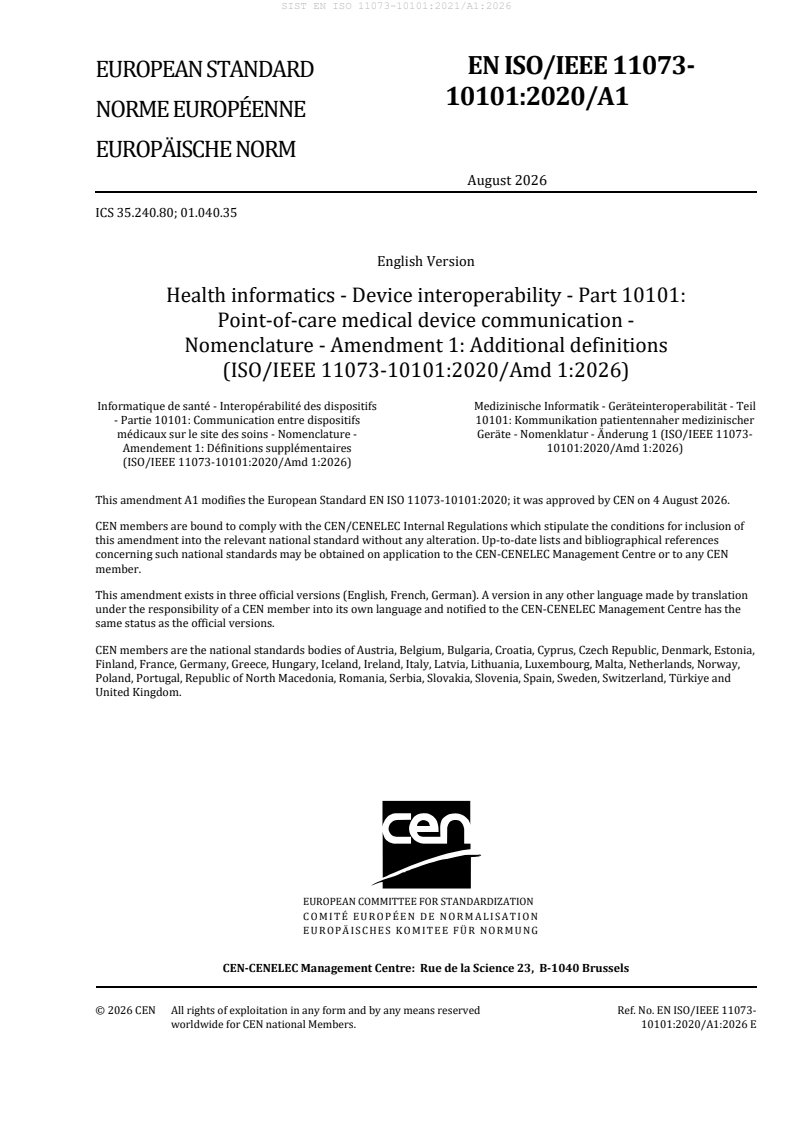
EN ISO/IEEE 11073-
EUROPEAN STANDARD
10101:2020/A1
NORME EUROPÉENNE
EUROPÄISCHE NORM
August 2026
ICS 35.240.80; 01.040.35
English Version
Health informatics - Device interoperability - Part 10101:
Point-of-care medical device communication -
Nomenclature - Amendment 1: Additional definitions
(ISO/IEEE 11073-10101:2020/Amd 1:2026)
Informatique de santé - Interopérabilité des dispositifs Medizinische Informatik - Geräteinteroperabilität - Teil
- Partie 10101: Communication entre dispositifs 10101: Kommunikation patientennaher medizinischer
médicaux sur le site des soins - Nomenclature - Geräte - Nomenklatur - Änderung 1 (ISO/IEEE 11073-
Amendement 1: Définitions supplémentaires 10101:2020/Amd 1:2026)
(ISO/IEEE 11073-10101:2020/Amd 1:2026)
This amendment A1 modifies the European Standard EN ISO 11073-10101:2020; it was approved by CEN on 4 August 2026.
CEN members are bound to comply with the CEN/CENELEC Internal Regulations which stipulate the conditions for inclusion of
this amendment into the relevant national standard without any alteration. Up-to-date lists and bibliographical references
concerning such national standards may be obtained on application to the CEN-CENELEC Management Centre or to any CEN
member.
This amendment exists in three official versions (English, French, German). A version in any other language made by translation
under the responsibility of a CEN member into its own language and notified to the CEN-CENELEC Management Centre has the
same status as the official versions.
CEN members are the national standards bodies of Austria, Belgium, Bulgaria, Croatia, Cyprus, Czech Republic, Denmark, Estonia,
Finland, France, Germany, Greece, Hungary, Iceland, Ireland, Italy, Latvia, Lithuania, Luxembourg, Malta, Netherlands, Norway,
Poland, Portugal, Republic of North Macedonia, Romania, Serbia, Slovakia, Slovenia, Spain, Sweden, Switzerland, Türkiye and
United Kingdom.
EUROPEAN COMMITTEE FOR STANDARDIZATION
COMITÉ EUROPÉEN DE NORMALISATION
EUROPÄISCHES KOMITEE FÜR NORMUNG
CEN-CENELEC Management Centre: Rue de la Science 23, B-1040 Brussels
© 2026 CEN All rights of exploitation in any form and by any means reserved Ref. No. EN ISO/IEEE 11073-
worldwide for CEN national Members. 10101:2020/A1:2026 E
Contents Page
European foreword . 3
European foreword
This document (EN ISO/IEEE 11073-10101:2020/A1:2026) has been prepared by Technical Committee
ISO/TC 215 "Health informatics" in collaboration with Technical Committee CEN/TC 251 “Health
informatics” the secretariat of which is held by NEN.
This Amendment to the European Standard EN ISO 11073-10101:2020 shall be given the status of a
national standard, either by publication of an identical text or by endorsement, at the latest by February
2027, and conflicting national standards shall be withdrawn at the latest by February 2027.
Attention is drawn to the possibility that some of the elements of this document may be the subject of
patent rights. CEN shall not be held responsible for identifying any or all such patent rights.
Any feedback and questions on this document should be directed to the users’ national standards
body/national committee. A complete listing of these bodies can be found on the CEN website.
According to the CEN-CENELEC Internal Regulations, the national standards organizations of the
following countries are bound to implement this European Standard: Austria, Belgium, Bulgaria,
Croatia, Cyprus, Czech Republic, Denmark, Estonia, Finland, France, Germany, Greece, Hungary, Iceland,
Ireland, Italy, Latvia, Lithuania, Luxembourg, Malta, Netherlands, Norway, Poland, Portugal, Republic of
North Macedonia, Romania, Serbia, Slovakia, Slovenia, Spain, Sweden, Switzerland, Türkiye and the
United Kingdom.
Endorsement notice
The text of ISO/IEEE 11073-10101:2020/Amd 1:2026 has been approved by CEN as EN ISO/IEEE
11073-10101:2020/A1:2026 without any modification.
International
Standard
ISO/IEEE
11073-10101
Second edition
Health informatics — Device
2020-08
interoperability —
AMENDMENT 1
Part 10101:
2026-07
Point-of-care medical device
communication — Nomenclature
AMENDMENT 1: Additional definitions
Informatique de santé — Interopérabilité des dispositifs —
Partie 10101: Communication entre dispositifs médicaux sur le
site des soins — Nomenclature
AMENDEMENT 1: Définitions supplémentaires
Reference number
ISO/IEEE 11073-10101:2020/Amd 1:2026(en)
© IEEE 2024
ISO/IEEE 11073-10101:2020/Amd 1:2026(en)
© IEEE 2024
All rights reserved. Unless otherwise specified, or required in the context of its implementation, no part of this publication may
be reproduced or utilized otherwise in any form or by any means, electronic or mechanical, including photocopying, or posting on
the internet or an intranet, without prior written permission. Permission can be requested from IEEE at the address below.
Institute of Electrical and Electronics Engineers, Inc
3 Park Avenue, New York
NY 10016-5997, USA
Email: stds.ipr@ieee.org
Website: www.ieee.org
Published in Switzerland
© IEEE 2024 – All rights reserved
ii
ISO/IEEE 11073-10101:2020/Amd 1:2026(en)
Foreword
ISO (the International Organization for Standardization) is a worldwide federation of national standards
bodies (ISO member bodies). The work of preparing International Standards is normally carried out through
ISO technical committees. Each member body interested in a subject for which a technical committee has
been established has the right to be represented on that committee. International organizations,
governmental and non-governmental, in liaison with ISO, also take part in the work. ISO collaborates closely
with the International Electrotechnical Commission (IEC) on all matters of electrotechnical standardization.
The procedures used to develop this document and those intended for its further maintenance are described
in the ISO/IEC Directives, Part 1. In particular, the different approval criteria needed for the different types
of ISO document should be noted (see www.iso.org/directives).
IEEE Standards documents are developed within the IEEE Societies and the Standards Coordinating
Committees of the IEEE Standards Association (IEEE-SA) Standards Board. The IEEE develops its standards
through a consensus development process, approved by the American National Standards Institute, which
brings together volunteers representing varied viewpoints and interests to achieve the final product.
Volunteers are not necessarily members of the Institute and serve without compensation. While the IEEE
administers the process and establishes rules to promote fairness in the consensus development process,
the IEEE does not independently evaluate, test, or verify the accuracy of any of the information contained in
its standards.
ISO draws attention to the possibility that the implementation of this document may involve the use of (a)
patent(s). ISO takes no position concerning the evidence, validity or applicability of any claimed patent
rights in respect thereof. As of the date of publication of this document, ISO had not received notice of (a)
patent(s) which may be required to implement this document. However, implementers are cautioned that
this may not represent the latest information, which may be obtained from the patent database available at
www.iso.org/patents. ISO shall not be held responsible for identifying any or all such patent rights.
Any trade name used in this document is information given for the convenience of users and does not
constitute an endorsement.
For an explanation of the voluntary nature of standards, the meaning of ISO specific terms and expressions
related to conformity assessment, as well as information about ISO's adherence to the World Trade
Organization (WTO) principles in the Technical Barriers to Trade (TBT), see www.iso.org/iso/foreword.html.
ISO/IEEE 11073-10101 was prepared by the IEEE 11073 Standards Committee of the IEEE Engineering in
Medicine and Biology Society (as IEEE Std 11073-10101-2023) and drafted in accordance with its editorial
rules. It was adopted, under the “fast-track procedure” defined in the Partner Standards Development
Organization cooperation agreement between ISO and IEEE, by Technical Committee ISO/TC 215, Health
informatics.
A list of all parts in the ISO/IEEE 11073 series can be found on the ISO website.
Any feedback or questions on this document should be directed to the user’s national standards body. A
complete listing of these bodies can be found at www.iso.org/members.html.
© IEEE 2024 – All rights reserved
iii
IEEE Std 11073-10101b™-2023
(Amendment to IEEE Std 11073-10101-2019)
Health informatics—Device Interoperability
Part 10101: Foundational—Nomenclature
Amendment 1: Additional definitions
Developed by the
IEEE 11073™ Standards Committee
of the
IEEE Engineering in Medicine and Biology Society
Approved 8 November 2023
IEEE SA Standards Board
ISO/IEEE 11073-10101:2020/Amd 1:2026(en)
Abstract: The scope of this standard is to define a nomenclature for communication of information from point-of-
care medical devices. Primary emphasis is placed on acute care medical devices and patient vital signs
information. The nomenclature also supports concepts in an object oriented information model that is for medical
device communications. This amendment extends IEEE Std 11073-10101-2019 to include additional terms
primarily related to infusion pumps, ventilators, dialysis and other key medical devices as well as event and alert
identifiers for devices and systems used in acute care.
Keywords: alarm, alarm inactivation, alarms, alert communication, anesthesia, device containment model, device
model, dialysis, diaphragm, ECG, EDI, electrocardiography, events, fluid chemistry, hemodialysis, hemodynamic
monitoring, HFV, high flow therapy, high frequency ventilation, IEEE 11073-10101b™, IHE PCD, information
model, infusion pump, ISO 19223, ISO/IEEE 11073-10101, medical device alarms, medical device alerts, medical
device communication, medical device types, NAVA, network communication controller, neurally adjusted
ventilatory assist, neuromuscular blockade, neuromuscular stimulation, neuromuscular transmission, NMT,
nomenclature, observation set identifier, ontology, patient, patient controlled analgesia, PCA, POC, point-of-care,
pulse oximetry, pump library, query identifier, regional cerebral oximetry, rSO2, semantics, service-oriented device
connectivity, signal quality index, SQI, target controlled infusion, TCI, terminology, UCUM, units of measure,
ventilation, ventilation mode
•
The Institute of Electrical and Electronics Engineers, Inc.
3 Park Avenue, New York, NY 10016-5997, USA
All rights reserved. Published 12 January 2024. Printed in the United States of America.
IEEE is a registered trademark in the U.S. Patent & Trademark Office, owned by The Institute of Electrical and Electronics
Engineers, Incorporated.
Wi-Fi Protected Access is a registered trademark of Wi-Fi Alliance.
PDF: ISBN 979-8-8557-0347-4 STD26643
Print: ISBN 979-8-8557-0348-1 STDPD26643
IEEE prohibits discrimination, harassment, and bullying.
For more information, visit http://www.ieee.org/web/aboutus/whatis/policies/p9-26.html.
No part of this publication may be reproduced in any form, in an electronic retrieval system or otherwise, without the prior written permission of the publisher.
vi
ISO/IEEE 11073-10101:2020/Amd 1:2026(en)
Important Notices and Disclaimers Concerning IEEE Standards Documents
IEEE Standards documents are made available for use subject to important notices and legal disclaimers. These notices and
disclaimers, or a reference to this page (https://standards.ieee.org/ipr/disclaimers.html), appear in all standards and may be
found under the heading “Important Notices and Disclaimers Concerning IEEE Standards Documents.”
Notice and Disclaimer of Liability Concerning the Use of IEEE Standards Documents
IEEE Standards documents are developed within the IEEE Societies and the Standards Coordinating Committees of the IEEE
Standards Association (IEEE SA) Standards Board. IEEE develops its standards through an accredited consensus development
process, which brings together volunteers representing varied viewpoints and interests to achieve the final product. IEEE
Standards are documents developed by volunteers with scientific, academic, and industry-based expertise in technical working
groups. Volunteers are not necessarily members of IEEE or IEEE SA, and participate without compensation from IEEE. While
IEEE administers the process and establishes rules to promote fairness in the consensus development process, IEEE does not
independently evaluate, test, or verify the accuracy of any of the information or the soundness of any judgments contained in
its standards.
IEEE makes no warranties or representations concerning its standards, and expressly disclaims all warranties, express or
implied, concerning this standard, including but not limited to the warranties of merchantability, fitness for a particular purpose
and non-infringement. In addition, IEEE does not warrant or represent that the use of the material contained in its standards is
free from patent infringement. IEEE standards documents are supplied “AS IS” and “WITH ALL FAULTS.”
Use of an IEEE standard is wholly voluntary. The existence of an IEEE Standard does not imply that there are no other ways to
produce, test, measure, purchase, market, or provide other goods and services related to the scope of the IEEE standard.
Furthermore, the viewpoint expressed at the time a standard is approved and issued is subject to change brought about through
developments in the state of the art and comments received from users of the standard.
In publishing and making its standards available, IEEE is not suggesting or rendering professional or other services for, or on
behalf of, any person or entity, nor is IEEE undertaking to perform any duty owed by any other person or entity to another.
Any person utilizing any IEEE Standards document, should rely upon his or her own independent judgment in the exercise of
reasonable care in any given circumstances or, as appropriate, seek the advice of a competent professional in determining the
appropriateness of a given IEEE standard.
IN NO EVENT SHALL IEEE BE LIABLE FOR ANY DIRECT, INDIRECT, INCIDENTAL, SPECIAL, EXEMPLARY, OR
CONSEQUENTIAL DAMAGES (INCLUDING, BUT NOT LIMITED TO: THE NEED TO PROCURE SUBSTITUTE
GOODS OR SERVICES; LOSS OF USE, DATA, OR PROFITS; OR BUSINESS INTERRUPTION) HOWEVER CAUSED
AND ON ANY THEORY OF LIABILITY, WHETHER IN CONTRACT, STRICT LIABILITY, OR TORT (INCLUDING
NEGLIGENCE OR OTHERWISE) ARISING IN ANY WAY OUT OF THE PUBLICATION, USE OF, OR RELIANCE
UPON ANY STANDARD, EVEN IF ADVISED OF THE POSSIBILITY OF SUCH DAMAGE AND REGARDLESS OF
WHETHER SUCH DAMAGE WAS FORESEEABLE.
Translations
The IEEE consensus development process involves the review of documents in English only. In the event that an IEEE
standard is translated, only the English version published by IEEE is the approved IEEE standard.
vii
ISO/IEEE 11073-10101:2020/Amd 1:2026(en)
Official statements
A statement, written or oral, that is not processed in accordance with the IEEE SA Standards Board Operations Manual shall
not be considered or inferred to be the official position of IEEE or any of its committees and shall not be considered to be, nor
be relied upon as, a formal position of IEEE. At lectures, symposia, seminars, or educational courses, an individual presenting
information on IEEE standards shall make it clear that the presenter’s views should be considered the personal views of that
individual rather than the formal position of IEEE, IEEE SA, the Standards Committee, or the Working Group.
Comments on standards
Comments for revision of IEEE Standards documents are welcome from any interested party, regardless of membership
affiliation with IEEE or IEEE SA. However, IEEE does not provide interpretations, consulting information, or advice
pertaining to IEEE Standards documents.
Suggestions for changes in documents should be in the form of a proposed change of text, together with appropriate supporting
comments. Since IEEE standards represent a consensus of concerned interests, it is important that any responses to comments
and questions also receive the concurrence of a balance of interests. For this reason, IEEE and the members of its Societies and
Standards Coordinating Committees are not able to provide an instant response to comments, or questions except in those cases
where the matter has previously been addressed. For the same reason, IEEE does not respond to interpretation requests. Any
person who would like to participate in evaluating comments or in revisions to an IEEE standard is welcome to join the
relevant IEEE working group. You can indicate interest in a working group using the Interests tab in the Manage Profile &
Interests area of the IEEE SA myProject system. An IEEE Account is needed to access the application.
Comments on standards should be submitted using the Contact Us form.
Laws and regulations
Users of IEEE Standards documents should consult all applicable laws and regulations. Compliance with the provisions of any
IEEE Standards document does not constitute compliance to any applicable regulatory requirements. Implementers of the
standard are responsible for observing or referring to the applicable regulatory requirements. IEEE does not, by the publication
of its standards, intend to urge action that is not in compliance with applicable laws, and these documents may not be construed
as doing so.
Data privacy
Users of IEEE Standards documents should evaluate the standards for considerations of data privacy and data ownership in the
context of assessing and using the standards in compliance with applicable laws and regulations.
Copyrights
IEEE draft and approved standards are copyrighted by IEEE under US and international copyright laws. They are made
available by IEEE and are adopted for a wide variety of both public and private uses. These include both use, by reference, in
laws and regulations, and use in private self-regulation, standardization, and the promotion of engineering practices and
methods. By making these documents available for use and adoption by public authorities and private users, IEEE does not
waive any rights in copyright to the documents.
Photocopies
Subject to payment of the appropriate licensing fees, IEEE will grant users a limited, non-exclusive license to photocopy
portions of any individual standard for company or organizational internal use or individual, non-commercial use only. To
arrange for payment of licensing fees, please contact Copyright Clearance Center, Customer Service, 222 Rosewood Drive,
Danvers, MA 01923 USA; +1 978 750 8400; https://www.copyright.com/. Permission to photocopy portions of any individual
standard for educational classroom use can also be obtained through the Copyright Clearance Center.
viii
ISO/IEEE 11073-10101:2020/Amd 1:2026(en)
Updating of IEEE Standards documents
Users of IEEE Standards documents should be aware that these documents may be superseded at any time by the issuance of
new editions or may be amended from time to time through the issuance of amendments, corrigenda, or errata. An official
IEEE document at any point in time consists of the current edition of the document together with any amendments, corrigenda,
or errata then in effect.
Every IEEE standard is subjected to review at least every 10 years. When a document is more than 10 years old and has not
undergone a revision process, it is reasonable to conclude that its contents, although still of some value, do not wholly reflect
the present state of the art. Users are cautioned to check to determine that they have the latest edition of any IEEE standard.
In order to determine whether a given document is the current edition and whether it has been amended through the issuance of
amendments, corrigenda, or errata, visit IEEE Xplore or contact IEEE. For more information about the IEEE SA or IEEE’s
standards development process, visit the IEEE SA Website.
Errata
Errata, if any, for all IEEE standards can be accessed on the IEEE SA Website. Search for standard number and year of
approval to access the web page of the published standard. Errata links are located under the Additional Resources Details
section. Errata are also available in IEEE Xplore. Users are encouraged to periodically check for errata.
Patents
IEEE Standards are developed in compliance with the IEEE SA Patent Policy.
Attention is called to the possibility that implementation of this standard may require use of subject matter covered by patent
rights. By publication of this standard, no position is taken by the IEEE with respect to the existence or validity of any patent
rights in connection therewith. If a patent holder or patent applicant has filed a statement of assurance via an Accepted Letter
of Assurance, then the statement is listed on the IEEE SA Website at https://standards.ieee.org/about/sasb/patcom/patents.html.
Letters of Assurance may indicate whether the Submitter is willing or unwilling to grant licenses under patent rights without
compensation or under reasonable rates, with reasonable terms and conditions that are demonstrably free of any unfair
discrimination to applicants desiring to obtain such licenses.
Essential Patent Claims may exist for which a Letter of Assurance has not been received. The IEEE is not responsible for
identifying Essential Patent Claims for which a license may be required, for conducting inquiries into the legal validity or
scope of Patents Claims, or determining whether any licensing terms or conditions provided in connection with submission of a
Letter of Assurance, if any, or in any licensing agreements are reasonable or non-discriminatory. Users of this standard are
expressly advised that determination of the validity of any patent rights, and the risk of infringement of such rights, is entirely
their own responsibility. Further information may be obtained from the IEEE Standards Association.
IMPORTANT NOTICE
IEEE Standards do not guarantee or ensure safety, security, health, or environmental protection, or ensure against interference
with or from other devices or networks. IEEE Standards development activities consider research and information presented to
the standards development group in developing any safety recommendations. Other information about safety practices,
changes in technology or technology implementation, or impact by peripheral systems also may be pertinent to safety
considerations during implementation of the standard. Implementers and users of IEEE Standards documents are responsible
for determining and complying with all appropriate safety, security, environmental, health, and interference protection
practices and all applicable laws and regulations.
ix
ISO/IEEE 11073-10101:2020/Amd 1:2026(en)
Participants
At the time this standard was completed, the Point-of-Care Devices Working Group had the following membership:
Stefan Schlichting, Working Group Chair
Paul Schluter, Working Subgroup Chair
Björn Andersen Martin Hurrell Roland Persson
Piyush Bhageriya Anders Häggström Mikael Petrini
Manfred Bier Per Johansson Jan-Alrik Philipsen
Kimberly Brauer Norman Jones Dalibor Pokrajac
Malcolm Clarke Martin Kasparick John Rhoads
Todd Cooper Tobias Klotz Jeff Rinda
Steven Dain Tom Kowalczyk Mathieu Roullet
Lisa Diggett Mike Krajnak Daniel Rubery
Kurt Elliason Thomas Kreuger Neil Seidl
Al Engelbert Konstantinos Makrodimitris Naveen Sharma
Javier Espina Duane Martz Michael Tietz
Michael Faughn Eldon Metz Peter Verständig
Kenneth Fuchs Steve Myers John Walsh
John Garguilo Teri Neal Rob Wilder
David Gregorczyk Steven Nichols Brian Witkowski
Bill Haralson Monroe Pattillo Daidi Zhong
The following members of the individual Standards Association balloting group voted on this standard. Balloters may have
voted for approval, disapproval, or abstention.
Björn Andersen David Gregorczyk Stefan Schlichting
Pradeep Balachandran Charles Gropper Paul Schluter
Malcolm Clarke Werner Hoelzl Harry Solomon
Kurt Elliason Piotr Karocki Walter Struppler
Javier Espina Martin Kasparick Lisa Ward
Michael Faughn Raymond Krasinski Yu Yuan
Kenneth Fuchs H. Moll Oren Yuen
John Garguilo Rajesh Murthy Janusz Zalewski
Frank Golatowski John Rhoads Daidi Zhong
Scott Robertson
When the IEEE SA Standards Board approved this standard on 8 November 2023, it had the following membership:
David J. Law, Chair
Ted Burse, Vice Chair
Gary Hoffman, Past Chair
Konstantinos Karachalios, Secretary
Sara R. Biyabani Joseph S. Levy Paul Nikolich
Doug Edwards Howard Li Annette D. Reilly
Ramy Ahmed Fathy Johnny Daozhuang Lin Robby Robson
Guido R. Hiertz Gui Lin Lei Wang
Yousef Kimiagar Xiaohui Liu F. Keith Waters
Joseph L. Koepfinger* Kevin W. Lu Karl Weber
Thomas Koshy Daleep C. Mohla Philip B. Winston
John D. Kulick Andrew Myles Don Wright
*Member Emeritus
x
ISO/IEEE 11073-10101:2020/Amd 1:2026(en)
Introduction
This introduction is not part of IEEE Std 11073-10101b-2023, Health informatics—Device interoperability—
Part 10101: Foundational—Nomenclature—Amendment 1: Additional definitions.
ISO/IEEE 11073 standards enable communication between medical devices and external computer systems. They provide
automatic and detailed electronic data capture of patient vital signs information and device operational data. The primary goals are
to:
Provide real-time plug-and-play interoperability for patient-connected medical devices
Facilitate the efficient exchange of vital signs and medical device data, acquired at the point-of-care, in all health care
environments
This amendment extends the nomenclature defined in IEEE Std 11073-10101-2019. It reflects the continued innovation in
medical device and is based on a highly successful collaboration with the following organizations:
Integrating the Healthcare Enterprise Devices (IHE DEV) domain, which includes the Patient Care Devices (PCD),
Personal Connected Health (PCH) and Device Point-of-Care Interoperability (DPi) Programs
ISO/TC 121, Anaesthetic and respiratory equipment, Subcommittee 4, Terminology and semantics
In addition, other vendors and standards development and profiling organizations have contributed to and have recognized the
value of this work and the benefit it provides to the user and provider communities and to the patients that we ultimately serve.
This nomenclature amendment includes significant extensions to support:
Haemodynamic monitoring, pulse oximetry and regional cerebral oxygen monitoring
Respiratory, ventilation and anesthesia: high-frequency ventilation, high-flow therapy, neurally adjusted ventilatory
assist (NAVA) and ventilation mode based on ISO 19223
Infusion pumps, target-controlled infusion (TCI), patient-controlled analgesia (PCA) and other capabilities based on
the work of the IHE DEV PCD domain program
Hemodialysis for chronic and acute care, including fluid chemistry and other fluid related metrics
Neuromuscular transmission monitoring (NMT) and stimulation modes
Signal quality index (SQI) and mapping to a unified vendor- and device-independent representation
Major extension of medical device event and alert nomenclature and grouping with existing terms
Alarm inactivation and additional attributes related to alert management and communication
New units of measurement
New medical device types and monitoring parameters
This amendment also includes:
Units of measure associated with individual numeric observations and attributes
Enumerated values with descriptions associated with individual observations and attributes
NOTES as used in this amendment (preceding editorial instructions) are not meant to be included in the rollup or part of the
editorial instructions. They are used solely to provide informative guidance and background to the reader as to why certain
changes were made.
xi
ISO/IEEE 11073-10101:2020/Amd 1:2026(en)
Acknowledgments
Permissions have been granted as follows:
Hemodialysis Overview reprinted with permission from the Dialysis Interoperability Consortium © 2022.
xii
ISO/IEEE 11073-10101:2020/Amd 1:2026(en)
Contents
1. Overview . 1
1.1 Scope . 1
1.2 Word usage . 1
2. Normative references . 2
3. Terms, definitions, acronyms, and abbreviations . 2
3.1 Terms and definitions . 2
3.2 Symbols and abbreviated terms . 2
Annex A (normative) Nomenclature semantics . 4
A.1 Overview of nomenclature for vital signs—Semantics . 4
A.3 Data dictionary and codes for object-oriented modeling elements (Partition 1) . 5
A.3.2 Object-oriented modeling elements: inventory tables . 5
A.5 Nomenclature, data dictionary, and codes for vital signs, diagnostic and therapeutic devices (Partition 1) . 16
A.6 Terminology and codes for units of measurement (Partition 4) . 23
A.6.4 Units of measurement . 23
A.7 Nomenclature, data dictionary, and codes for metrics (measurements and enumerations)
(Partition 2) . 25
A.7.1 Nomenclature for ECG measurements . 25
A.7.3 Nomenclature, data dictionary, and codes for haemodynamic monitoring measurements . 26
A.7.4 Nomenclature and codes for respiratory, ventilator, and anesthesia measurements . 28
A.7.5 Nomenclature, data dictionary, and codes for common blood-gas, blood, urine, and
other fluid chemistry measurements . 38
A.7.7 Nomenclature, data dictionary, and codes for pumps . 40
A.7.10 Nomenclature, data dictionary, and codes for stimulation modes . 53
A.7.11 Nomenclature, data dictionary, and codes for miscellaneous measurements . 58
A.7.15 Nomenclature and codes for hemodialysis measurements . 63
A.8 Nomenclature, data dictionary, and codes for body sites and enumerated values (Partition 7) . 87
A.8.11 Nomenclature and codes for ventilator mode based on ISO 19223 . 87
A.9 Nomenclature, data dictionary, and codes for events and alerts (Partition 3) . 99
A.9.1 Introduction . 99
A.9.2 Diagnostic pattern events . 100
A.9.3 Device-related and environment-related events and alerts . 109
A.9.4 Alarm Inactivation State (AIS) events . 179
A.16 Information attributes to support IHE PCD DEC and PCHA/Continua Services Interface
(Partition 1 and Partition 8) . 185
A.17 Nomenclature to support the Service-oriented Device Connectivity (SDC) series of standards (Partition 8) . 187
A.17.1 IEEE P11073-10700 Ensemble nomenclature . 187
A.17.2 IEEE P11073-10700 Context validator nomenclature . 187
A.17.3 IEEE P11073-10700 Enumerated value set for medical device operational mode . 188
Annex C (normative) Terms, discriminators, and numeric codes . 189
C.3.18 Alarm Inactivation State [AIS] discriminator set . 189
Annex I (informative) Mapping vendor ventilation modes to ISO 19223 and IEEE 11073 . 235
I.1 Recommended process . 235
I.2 XSLT for converting ISO 19223 ventilator mode to IEEE 11073 Reference IDs . 252
xiii
ISO/IEEE 11073-10101:2020/Amd 1:2026(en)
Annex J (normative) Units of measure and _UOM_GROUPS . 257
J.1 Specifying individual UOM_MDC and UOM_UCUM units of measure in Annex A . 257
J.2 Specifying _UOM_GROUPS . 258
J.3 Mapping UOM_MDC to UOM_UCUM units of measure . 259
J.4 List of UOM_MDC to UOM_UCUM units of measure . 259
Annex K (normative) MDC_ENUMGV enumeration groups and values. 284
K.3 Enum_Groups . 284
K.4 Enum_Values . 284
K.5 Creating Reference ID(s) from Enum_Group and Enum_Value . 285
K.6 Referencing enumerated value sets and/or PEGjs validation expressions . 285
K.7 Referencing enumerated value sets and/or PEGjs validation expressions . 286
Annex L (informative) Bibliography . 287
Annex M (informative) Revision history . 288
xiv
ISO/IEEE 11073-10101:2020/Amd 1:2026(en)
Tables
Table A.3.2.2.2—Object-oriented modeling elements—Medical Package—attributes . 5
Table A.3.2.2.2.1—Enumerated values for [_MDC_ATTR_PT_BODY_POSN] (multipage table) . 5
Table A.3.2.2.2.1—Enumerated values for [_MDC_ATTR_PT_BODY_POSN] (multipage table) . 6
Table A.3.2.4.1—Object-oriented modeling elements—System Package—object class items . 7
Table A.3.2.4.2—Object-oriented modeling elements—System Package—attributes . 8
Table A.3.2.4.2.1—Enumerated values for [_MDC_ATTR_BATT_CONFIG] . 8
Table A.3.2.4.2.2—Enumerated values for [_MDC_ATTR_PILLAR_ASSEMBLY] . 9
Table A.3.2.4.2.3—PEGjs for [_MDC_ATTR_PILLAR_ASSEMBLY] . 9
Table A.3.2.4.2.4—PEGjs for [_MDC_ATTR_PUMP_PILLAR_DETAILS] . 9
Table A.3.2.4.6—Object-oriented modeling elements—System Package—additional object class items . 10
Table A.3.2.13.1—Object-oriented modeling elements—MEM-DMC NCC-Wired—attributes . 11
Table A.3.2.13.1.1—Enumerated values for [_BOOL] . 11
Table A.3.2.13.1.2—Enumerated values for [_MDC_NCC_WIRED_STATE] . 12
Table A.3.2.13.2—Object-oriented modeling elements—MEM-DMC NCC-Wireless—attributes (multipage table). 12
Table A.3.2.13.2.1—Enumerated values for [_MDC_NCC_WIRELESS_STATE] . 13
Table A.3.2.13.2.2—Enumerated values for [_MDC_NCC_WIRELESS_AUTH] . 13
Table A.3.2.13.2.3—Enumerated values for [_MDC_NCC_WIRELESS_ENCRYPT] . 14
Table A.3.2.13.2.4—Enumerated values for [_MDC_NCC_WIRELESS_BAND] . 14
Table A.3.2.14.2—Object-oriented modeling elements—USI—attributes . 15
Table A.3.2.15.1—Object-oriented modeling elements—QPD—message query name identifiers . 15
Table A.5.1—Nomenclature and codes for vital signs, diagnostic and therapeutic devices (multipage table) . 16
Table A.5.1—Nomenclature and codes for vital signs, diagnostic and therapeutic devices (multipage table) . 17
Table A.5.1—Nomenclature and codes for vital signs, diagnostic and therapeutic devices (multipage table) . 18
Table A.5.1—Nomenclature and codes for vital signs, diagnostic and therapeutic devices (multipage table) . 19
Table A.5.1—Nomenclature and codes for vital signs, diagnostic and therapeutic
...