

EN 16907-3:2018
(Main)Earthworks - Part 3: Construction procedures
General Information
- Abstract
This European Standard provides execution procedures for excavating, transporting and placing soils and rocks for the construction of earth-structures and guidance for the work. Additionally, it includes excavation and placement of rock materials underwater.
Dredging of soils and the associated hydraulic placement of fills are covered by EN 16907-6 and EN 16907-7.
Execution of earthworks follows the conclusions of the earthworks design and optimization phase (EN 16907-1), which should anticipate soil and rock specificities and their suitability. In case some events could not be foreseen, additional design is performed during the execution of works.
- Status
- Published
- Publication Date
- 04-Dec-2018
- Withdrawal Date
- 29-Jun-2019
- Technical Committee
- CEN/TC 396 - Earthworks
- Drafting Committee
- CEN/TC 396/WG 3 - Construction procedures
- Current Stage
- 9093 - Decision to confirm - Review Enquiry
- Start Date
- 25-Sep-2024
- Completion Date
- 30-Sep-2026



Overview
EN 16907-3:2018 - Earthworks. Part 3: Construction procedures (CEN) provides practical execution procedures for excavating, transporting and placing soils and rocks in the construction of earth-structures. The standard covers on‑shore and underwater rock excavation and placement, and sets out requirements that follow the earthworks design and optimisation phase (EN 16907-1). Dredging of soils and hydraulic placement of fills are addressed separately in EN 16907-6 and EN 16907-7.
Key topics and technical requirements
The standard guides contractors and engineers through the full execution cycle of earthworks with emphasis on practical control and safety. Major topics include:
- Prerequisites and design interface
- Execution must follow conclusions from the design/optimisation phase (EN 16907-1); unforeseen events require additional design during execution.
- Climatic and environmental considerations
- Site-specific seasonal limitations, dust control, noise, contamination handling and protection of watercourses.
- Excavation
- Material‑based excavation techniques, rock excavation considerations (including underwater blasting precautions), protection of cuts, stability and drainage measures.
- Underwater works
- Equipment selection, tolerance and monitoring requirements, and environmental protection when excavating or placing rock underwater.
- Transportation
- Bulk transport methods, haul road design and trafficability, lorry transport, alternative transport (water, rail) and protection of existing structures and buried utilities.
- Filling and compaction
- Material grouping, compaction specifications, layer thickness and spreading, compaction equipment selection, risks such as over‑compaction and generation of pore pressures.
- Quality measures
- Trial sections, supervision, monitoring and verification during execution (informative annexes provide example practices and equipment types).
Applications and who uses it
EN 16907-3 is targeted to professionals involved in earthworks construction and quality control:
- Civil and geotechnical engineers
- Earthworks contractors and site managers
- Project engineers and construction supervisors
- Environmental managers and public works authorities
- Consultants preparing specifications, execution plans and tender documents
Practical applications include road and railway embankments, earth dams, foundations and coastal or marine rock placements where underwater execution is required.
Related standards
- EN 16907-1 - Principles and general rules (design interface)
- EN 16907-2 - Classification of materials
- EN 16907-6 / EN 16907-7 - Dredging and hydraulic placement of fills (related hydraulic works)
Keywords: EN 16907-3:2018, earthworks, construction procedures, excavation, compaction, underwater rock placement, CEN, earth-structures, transportation, environmental protection.
Relations
- Effective Date
- 28-Jan-2026
- Refers
EN 16907-6:2018 - Earthworks - Part 6: Land reclamation earthworks using dredged hydraulic fill - Effective Date
- 28-Jan-2026
- Effective Date
- 28-Jan-2026
- Effective Date
- 28-Jan-2026
- Effective Date
- 28-Jan-2026
Get Certified
Connect with accredited certification bodies for this standard

Zavod za gradbeništvo Slovenije (ZAG) - Inšpekcija
ZAG inspection body for construction products, structures, and materials.
Sponsored listings
Frequently Asked Questions
EN 16907-3:2018 is a standard published by the European Committee for Standardization (CEN). Its full title is "Earthworks - Part 3: Construction procedures". This standard covers: This European Standard provides execution procedures for excavating, transporting and placing soils and rocks for the construction of earth-structures and guidance for the work. Additionally, it includes excavation and placement of rock materials underwater. Dredging of soils and the associated hydraulic placement of fills are covered by EN 16907-6 and EN 16907-7. Execution of earthworks follows the conclusions of the earthworks design and optimization phase (EN 16907-1), which should anticipate soil and rock specificities and their suitability. In case some events could not be foreseen, additional design is performed during the execution of works.
This European Standard provides execution procedures for excavating, transporting and placing soils and rocks for the construction of earth-structures and guidance for the work. Additionally, it includes excavation and placement of rock materials underwater. Dredging of soils and the associated hydraulic placement of fills are covered by EN 16907-6 and EN 16907-7. Execution of earthworks follows the conclusions of the earthworks design and optimization phase (EN 16907-1), which should anticipate soil and rock specificities and their suitability. In case some events could not be foreseen, additional design is performed during the execution of works.
EN 16907-3:2018 is classified under the following ICS (International Classification for Standards) categories: 93.020 - Earthworks. Excavations. Foundation construction. Underground works. The ICS classification helps identify the subject area and facilitates finding related standards.
EN 16907-3:2018 has the following relationships with other standards: It is inter standard links to EN 16907-2:2018, EN 16907-6:2018, EN 16907-7:2021, EN 16907-1:2018, EN 16907-5:2018. Understanding these relationships helps ensure you are using the most current and applicable version of the standard.
EN 16907-3:2018 is available in PDF format for immediate download after purchase. The document can be added to your cart and obtained through the secure checkout process. Digital delivery ensures instant access to the complete standard document.
Standards Content (Sample)
2003-01.Slovenski inštitut za standardizacijo. Razmnoževanje celote ali delov tega standarda ni dovoljeno.Zemeljska dela - 3. del: Postopki izvajanja zemeljskih delErdarbeiten - Teil 3: Ausführung von ErdarbeitenTerrassement - Partie 3 : Procédés de constructionEarthworks - Part 3: Construction procedures93.020Zemeljska dela. Izkopavanja. Gradnja temeljev. Dela pod zemljoEarthworks. Excavations. Foundation construction. Underground worksICS:Ta slovenski standard je istoveten z:EN 16907-3:2018SIST EN 16907-3:2019en,fr,de01-april-2019SIST EN 16907-3:2019SLOVENSKI
STANDARD
EUROPEAN STANDARD NORME EUROPÉENNE EUROPÄISCHE NORM
EN 16907-3
December
t r s z ICS
{ uä r t r English Version
Earthworks æ Part
uã Construction procedures Terrassement æ Partie
u ã Procédés de construction
Erdarbeiten æ Teil
uã Ausführung von Erdarbeiten This European Standard was approved by CEN on
s v May
t r s zä
egulations which stipulate the conditions for giving this European Standard the status of a national standard without any alterationä Upætoædate lists and bibliographical references concerning such national standards may be obtained on application to the CENæCENELEC Management Centre or to any CEN memberä
translation under the responsibility of a CEN member into its own language and notified to the CENæCENELEC Management Centre has the same status as the official versionsä
CEN members are the national standards bodies of Austriaá Belgiumá Bulgariaá Croatiaá Cyprusá Czech Republicá Denmarká Estoniaá Finlandá Former Yugoslav Republic of Macedoniaá Franceá Germanyá Greeceá Hungaryá Icelandá Irelandá Italyá Latviaá Lithuaniaá Luxembourgá Maltaá Netherlandsá Norwayá Polandá Portugalá Romaniaá Serbiaá Slovakiaá Sloveniaá Spainá Swedená Switzerlandá Turkey and United Kingdomä
EUROPEAN COMMITTEE FOR STANDARDIZATION COMITÉ EUROPÉEN DE NORMALISATION EUROPÄISCHES KOMITEE FÜR NORMUNG
CEN-CENELEC Management Centre:
Rue de la Science 23,
B-1040 Brussels
t r s z CEN All rights of exploitation in any form and by any means reserved worldwide for CEN national Membersä Refä Noä EN
s x { r yæ uã t r s z ESIST EN 16907-3:2019
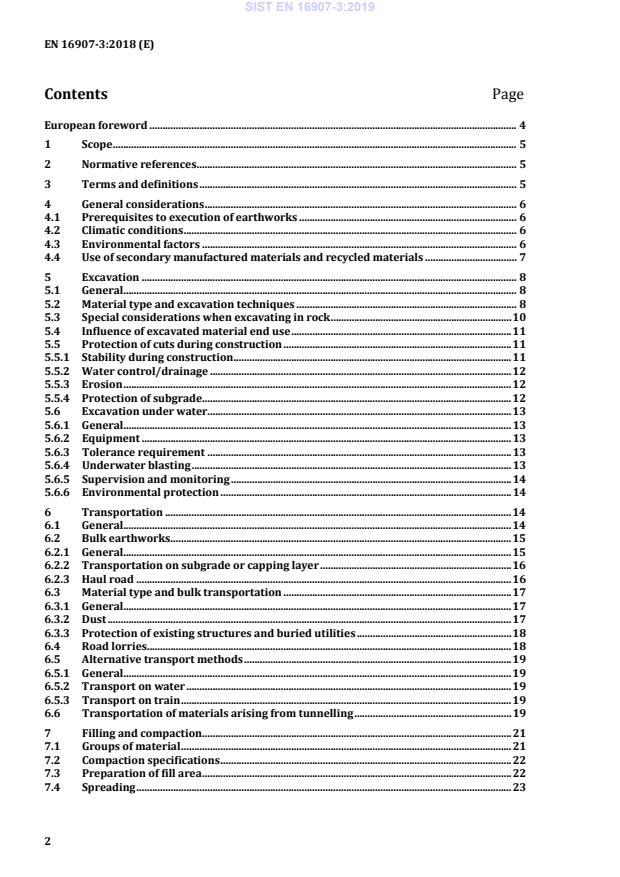
Organization and execution of trial sections . 34 Annex B (informative)
Conditions of use for main groups of material . 37 Annex C (informative)
Excavation machine types . 79 Annex D (informative)
Transportation equipment types . 81 Annex E (informative)
Examples of national practices . 82 Bibliography . 85
IEC Electropedia: available at http://www.electropedia.org/
ISO Online browsing platform: available at http://www.iso.org/obp 3.1 trafficability ability of a material surface to support the passage of earthworks 3.2 compaction process of removing air from a soil normally by mechanical means 3.3 compactive effort energy applied to achieve compaction 3.4 over compaction condition that arises during compaction when sufficient air has been expelled from a fill such that further compactive effort results in elevated pore water pressures causing the fill surface to become unstable as the material “mattresses” Note 1 to entry: Over compaction of granular soils can also result in the crushing of individual particles thereby modifying the particle size distribution. SIST EN 16907-3:2019
Note 1 to entry: The minimum and maximum void ratios correspond to the densest state (ID = 100 %) and loosest state (ID = 0 %) respectively (=[emax – e/ emax - emin] × 100 %). 3.6 fine soil soil with at least 15 % fines content, depending on national practices 3.7 fine active soil water-sensitive fine soil which exhibits specific shrinking/swelling properties to be taken into consideration for earthworks 4 General considerations 4.1 Prerequisites to execution of earthworks Before the beginning of construction, all geotechnical design issues should be solved, including temporary and permanent stability, erosion and settlements. All unresolved issues during design shall be identified to all parties and highlighted before the commencement of construction. In this case, the responsibility for closing out shall be made clear. Before the commencement of each part of works, the design of each part of the earthworks shall have been completed, including the assessment of the available materials and their suitability (see EN 16907-1 and EN 16907-2). 4.2 Climatic conditions Before commencing earthworks, the prevailing climatic conditions at the construction site shall be considered. Seasonal climatic variations can impose limiting factors on earthworks. During periods of rainfall, consideration should be given to suspending earthworks operations in wet sensitive materials. When necessary, the earth surfaces should be sealed to prevent the ingress of water. In dry climatic conditions, consideration should be given to preventing evaporative losses by covering the exposed earth surfaces with non-sensitive materials. NOTE Seasonal climatic considerations will vary depending on different regions. For example, a frozen ground surface may provide a temporary working platform that can enhance the excavation of soft soil. 4.3 Environmental factors All earthworks should comply with the relevant environmental legislation. Earthworks have the potential to harm the natural and built environment and therefore they should be planned in such a manner so as to minimize the potential for harm. The environmental factors to be considered during earthworks construction commonly include the following: Noise – European and national regulations should be considered. It is applying for receptors, e.g. domestic dwellings which are affected by the increase of noise beyond legal limits. Assessments should be made of the noise emissions of the various types of earthwork machinery and background noise level readings taken prior to commencement of the earthwork operations. SIST EN 16907-3:2019
...