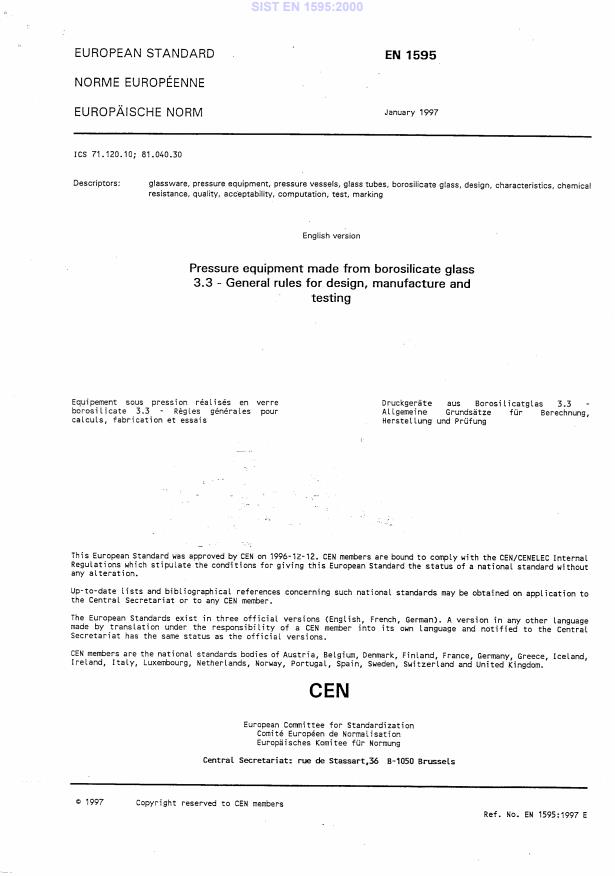
Pressure equipment made from borosilicate glass 3.3 - General rules for design, manufacture and testing

This European Standard specifies material, design, inspection, testing and marking requirements of pressure equipment (e.g. vessels, pipes, valves) made from borosilicate glass 3.3 with a coefficient of mean linear thermal expansion of (3,3 +/- 0,1) x 10-6 K-1. The following are excluded: - circular, flat and tubular sight glasses, - equipment made from borosilicate glass with another coefficient of thermal expansion.

Druckgeräte aus Borosilicatglas 3.3 - Allgemeine Grundsätze für Berechnung, Herstellung und Prüfung

Diese Europäische Norm legt die Anforderungen an den Werkstoff, die Berechnung,die Inspektion, die Prüfung und Kennzeichnung an Druckgeräten (z.B. Behälter,Rohre, Ventile) aus Borosilicatglas 3.3 mit dem mittleren Längenausdehnungs- koeffizienten (3,30 +/- 0,1) x 10-6 K-1 fest. Sie gilt nicht für: - Runde und lange Schauglasplatten; - Behälter aus Borosilicatglas mit einem anderen Längenausdehnungskoeffizienten.

Equipements sous pression réalisés en verre borosilicate 3.3 - Règles générales pour calculs, fabrication et essais

La présente norme prescrit le matériau, la conception, le contrôle, les essais et les exigences concernant le marquage d'équipements sous pression (par exemple récipients, tuyauteries, robinets) réalisés en verre borosilicaté 3.3 dont le coefficient moyen de dilatation thermique linéaire est égal à (3,3 +/- 0,1) x 10-6 K-1. Note: Les regards tubulaires, plats ou circulaires ainsi que les équipements en verre borosilicaté ayant un coefficient de dilatation thermique linéaire différent sont exclus.

Pressure equipment made from borosilicate glass 3.3 - General rules for design, manufacture and testing

General Information

Status
Published
Publication Date
21-Jan-1997
Withdrawal Date
30-Jul-1997
Technical Committee
CEN/SS I06 - Pressure vessels
Current Stage
9093 - Decision to confirm - Review Enquiry
Start Date
16-Apr-2025
Completion Date
23-Apr-2025

Overview

EN 1595:1997 is a European standard developed by CEN that establishes general rules for the design, manufacture, and testing of pressure equipment made from borosilicate glass 3.3. This standard specifically addresses equipment such as vessels, pipes, and valves that utilize borosilicate glass with a mean linear thermal expansion coefficient of (3.3 ± 0.1) x 10⁻⁶ K⁻¹. It defines comprehensive requirements for materials, inspection processes, testing protocols, and marking to ensure safety and reliability in industrial applications. Notably, this standard excludes certain glass products like circular, flat, and tubular sight glasses and equipment made from borosilicate glass with different thermal expansion coefficients.

Key Topics

  • Material Specifications
    Defines the precise characteristics of borosilicate glass 3.3, including thermal expansion properties crucial for pressure resistance under varying temperature conditions.

  • Design Principles
    Provides general rules for the safe and effective design of pressure vessels and associated components, emphasizing dimensional stability and structural integrity when subjected to pressure and thermal stresses.

  • Manufacturing Guidelines
    Outlines recommended manufacturing procedures to maintain the mechanical and chemical properties of borosilicate glass during fabrication of pressure equipment.

  • Inspection and Testing
    Details required inspection methods and testing techniques to verify compliance with mechanical strength and safety criteria, including pressure testing and defect identification.

  • Marking Requirements
    Specifies marking protocols to ensure traceability and identification of compliant pressure equipment throughout its lifecycle.

Applications

EN 1595:1997 is essential for industries where pressure vessels made from borosilicate glass 3.3 are used, including:

  • Chemical and Pharmaceutical Manufacturing
    Reaction vessels and pipelines requiring resistance to thermal shock and chemical corrosion.

  • Food and Beverage Processing
    Transparent pressure equipment allowing visual monitoring while maintaining high safety standards.

  • Laboratory Equipment Production
    Fabrication of specialized containers and apparatus designed to withstand internal pressure and variable temperatures.

  • Industrial Process Engineering
    Installation of borosilicate glass components in chemical reactors, distillation columns, and storage vessels where durability and visibility are critical.

Related Standards

  • EN 13445 – Unfired Pressure Vessels: Provides design and manufacturing rules for metal pressure vessels, complementary to glass equipment standards.
  • EN 1092 – Flanges and Their Joints: Details standards on flanges often used alongside borosilicate glass pressure components.
  • ISO 9001 – Quality Management Systems: Relevant for manufacturers implementing consistent quality control processes for compliance.
  • EN 10204 – Metallic Products Inspection Documents: Related to inspection documentation which may guide marking and certification practices.

By adhering to EN 1595:1997, manufacturers and users of borosilicate glass pressure equipment can ensure optimal safety, quality, and performance in a variety of demanding industrial environments. This standard plays a critical role in improving product reliability while facilitating regulatory compliance across European markets.

Frequently Asked Questions

EN 1595:1997 is a standard published by the European Committee for Standardization (CEN). Its full title is "Pressure equipment made from borosilicate glass 3.3 - General rules for design, manufacture and testing". This standard covers: This European Standard specifies material, design, inspection, testing and marking requirements of pressure equipment (e.g. vessels, pipes, valves) made from borosilicate glass 3.3 with a coefficient of mean linear thermal expansion of (3,3 +/- 0,1) x 10-6 K-1. The following are excluded: - circular, flat and tubular sight glasses, - equipment made from borosilicate glass with another coefficient of thermal expansion.

This European Standard specifies material, design, inspection, testing and marking requirements of pressure equipment (e.g. vessels, pipes, valves) made from borosilicate glass 3.3 with a coefficient of mean linear thermal expansion of (3,3 +/- 0,1) x 10-6 K-1. The following are excluded: - circular, flat and tubular sight glasses, - equipment made from borosilicate glass with another coefficient of thermal expansion.

EN 1595:1997 is classified under the following ICS (International Classification for Standards) categories: 71.120.10 - Reaction vessels and their components; 81.040.30 - Glass products. The ICS classification helps identify the subject area and facilitates finding related standards.

You can purchase EN 1595:1997 directly from iTeh Standards. The document is available in PDF format and is delivered instantly after payment. Add the standard to your cart and complete the secure checkout process. iTeh Standards is an authorized distributor of CEN standards.

Standards Content (Sample)


2003-01.Slovenski inštitut za standardizacijo. Razmnoževanje celote ali delov tega standarda ni dovoljeno.Pressure equipment made from borosilicate glass 3.3 - General rules for design, manufacture and testingDruckgeräte aus Borosilicatglas 3.3 - Allgemeine Grundsätze für Berechnung, Herstellung und PrüfungEquipements sous pression réalisés en verre borosilicate 3.3 - Regles générales pour calculs, fabrication et essaisPressure equipment made from borosilicate glass 3.3 - General rul
...

Questions, Comments and Discussion

Ask us and Technical Secretary will try to provide an answer. You can facilitate discussion about the standard in here.

Loading comments...

The EN 1595:1997 standard presents a comprehensive framework for the design, manufacture, and testing of pressure equipment made from borosilicate glass 3.3. Its scope is particularly important as it specifies essential material requirements, drawing attention to the unique properties of borosilicate glass, including its coefficient of mean linear thermal expansion of (3.3 +/- 0.1) x 10-6 K-1. This specificity ensures that manufacturers maintain a consistent quality and performance standard while working with this material. One of the strengths of EN 1595:1997 lies in its detailed inspection and testing requirements, which bolster safety and reliability for pressure equipment applications, including vessels, pipes, and valves. The standard sets forth rigorous criteria that enhance manufacturing processes and ensure that all components meet necessary safety regulations and operational demands. Further, the exclusion of certain items such as circular, flat, and tubular sight glasses, along with equipment made from borosilicate glass with a different coefficient of thermal expansion, streamlines the focus of the standard. This clear delineation of intent helps manufacturers and designers direct their efforts towards compliance in the specified area, enhancing the relevance of the standard in practice. Overall, EN 1595:1997 serves as a crucial reference point for the industry's approach to safety and quality in pressure equipment made from borosilicate glass 3.3, ensuring that all aspects from design to testing are guided by a well-established set of rules.

Die Norm EN 1595:1997 legt grundlegende Anforderungen für die Gestaltung, Herstellung und Prüfung von Druckgeräten fest, die aus Borosilikatglas 3.3 bestehen. Der Anwendungsbereich dieser europäischen Norm umfasst damit sowohl Behälter als auch Rohre und Armaturen, die für den Einsatz unter Druck ausgelegt sind. Ein zentrales Merkmal dieser Norm ist die Spezifikation des mittleren linearen thermischen Ausdehnungskoeffizienten von (3,3 +/- 0,1) x 10-6 K-1, was eine präzise Grundlage für die thermische Stabilität der Materialien bietet. Die Stärke der Norm liegt in ihrer detaillierten Aufschlüsselung der Anforderungen an die Materialauswahl, das Design und die Inspektionsprozesse. Solche strengen Kriterien sichern nicht nur die Sicherheit und Zuverlässigkeit der Druckgeräte, sondern fördern auch die Konsistenz in der Herstellung und den Einsatz von Borosilikatglas 3.3. Die Norm zielt darauf ab, potenzielle Risiken bei der Nutzung von Druckgeräten zu minimieren und gleichzeitig die Anforderungen an die Qualität und Leistung der Produkte zu erfüllen. Die Relevanz dieser Norm wird durch die Tatsache unterstützt, dass sie spezifische Ausschlüsse für bestimmte Arten von Sichtgläsern und für Borosilikatglas mit abweichenden thermischen Ausdehnungskoeffizienten definiert. Dies sorgt dafür, dass nur geeignete Materialien und Designs für die festgelegten Anwendungen verwendet werden, wodurch die Gefahr von Materialversagen verringert wird. Insgesamt bietet die EN 1595:1997 eine umfassende Grundlage für die Entwicklung und den Einsatz von Druckgeräten aus Borosilikatglas 3.3 und trägt dazu bei, sowohl die Produktsicherheit als auch die Verwendbarkeit in verschiedenen Industrien zu erhöhen.

SIST EN 1595:2000은 보로실리케이트 유리 3.3으로 제작된 압력 장비에 대한 종합적인 규칙을 제시하는 유럽 표준으로, 이 표준은 설계, 제조, 검사, 시험 및 표시 요건을 명확하게 정의하고 있습니다. 이 표준의 적용 범위는 보로실리케이트 유리 3.3으로 만들어진 압력 장비, 즉 용기, 파이프 및 밸브에 대한 것으로 한정되며, 평균 선형 열팽창 계수는 (3,3 +/- 0,1) x 10-6 K-1이어야 합니다. SIST EN 1595:2000의 강점은 고온의 환경에서도 안정적인 성능을 보장하는 보로실리케이트 유리의 특성을 충분히 고려하여 설계된 점에 있습니다. 또한, 이 표준은 엄격한 검사 및 시험 절차를 포함하여 품질 관리를 강화하고, 안전성을 보장하는 데 기여합니다. 이 표준은 압력 장비의 설계 및 제조 시 유럽 내에서 요구되는 법적 요건을 충족할 수 있도록 도움을 주며, 제조업체가 일관된 품질의 제품을 생산할 수 있는 기반을 마련합니다. 따라서, SIST EN 1595:2000은 산업 전반 특히 화학 및 제약 분야에서 압력 장비의 안전성과 신뢰성을 높이는 데 필수적인 기준으로 자리 잡고 있습니다. 더불어, 이 표준은 보로실리케이트 유리로 제작된 압력 장비의 특수 요구사항과 관련하여 매우 중요한 문서이며, 상기 표준이 적용되는 범위는 일정한 기준을 통해 제품의 품질 및 신뢰성을 제공하도록 설계되었다는 점에서 그 중요성을 더합니다.

EN 1595:1997は、ホウケイ酸ガラス3.3から作られた圧力機器に関する重要な基準であり、設計、製造、検査、試験、およびマーキングの要件を規定しています。この標準の適用範囲は広く、圧力容器、配管、バルブなどの用途に対応しています。また、基準内で定義された材料仕様は、熱膨張係数(3.3 +/- 0.1)× 10^-6 K^-1を持つホウケイ酸ガラス3.3に特化しています。 この文書の強みは、圧力機器の特性に基づいた設計および製造の一貫性と安全性を確保する点にあります。具体的には、圧力機器が運用条件においてどのように機能するかを詳細に考慮しており、設計段階でのリスク軽減にも寄与しています。また、検査および試験の要件により、製造プロセスの品質が保証され、最終製品の信頼性が高まります。 この基準は、ホウケイ酸ガラス3.3を用いた圧力機器の市場において、その設計および製造に関する規範を提供するため、業界の専門家にとって非常に重要です。この文書により、ユーザーやメーカーは一貫した品質管理を行うことができ、製品の安全性を維持できます。 ただし、明記された除外事項には、円形、平面、管状の視窓や、他の熱膨張係数を持つホウケイ酸ガラス製の機器が含まれています。これにより、基準の適用範囲が明確化され、特定の用途における誤解を避けることができます。全体として、EN 1595:1997はホウケイ酸ガラス製の圧力機器に関連する技術的要件を包括的に取り扱っており、その重要性は今後も続くと考えられます。

La norme EN 1595:1997 établit des règles générales pour la conception, la fabrication et l'essai des équipements sous pression en verre borosilicate 3.3. Son domaine d'application est essentiel dans des industries où l'utilisation d'équipements en verre est indispensable, comme dans les laboratoires et les installations chimiques. Elle couvre spécifiquement les exigences relatives aux matériaux, à la conception, à l'inspection, aux essais et au marquage de ces équipements, garantissant ainsi des niveaux élevés de sécurité et de performance. L'un des points forts de cette norme est sa précision dans la définition des exigences techniques, notamment en ce qui concerne le coefficient de dilatation thermique linéaire moyen du verre borosilicate. Avec un coefficient de (3,3 ± 0,1) x 10^-6 K^-1, elle assure une adéquation entre les différents composants sous pression, ce qui est crucial pour éviter les défaillances dues aux variations de température. De plus, la norme exclut clairement certains types d'équipements, tels que les verres de vue circulaires, plats et tubulaires, ainsi que ceux fabriqués à partir de verre borosilicate ayant un autre coefficient de dilatation thermique. Cette stratégie de délimitation élargit la pertinence de la norme pour les utilisateurs en évitant les ambiguïtés et en garantissant que seules les applications appropriées soient couvertes. Dans un environnement où le contrôle de la qualité et la conformité réglementaire sont des préoccupations majeures, la norme EN 1595 se révèle pertinente et utile. En standardisant les procédés de conception et d'essai, elle contribue à l'amélioration continue des pratiques industrielles et à l'augmentation de la confiance des utilisateurs dans les équipements en verre borosilicate 3.3. C'est donc une référence incontournable pour les professionnels impliqués dans la fabrication et la vérification de ce type d'équipement sous pression.