


EN 1998-1-1:2024
(Main)Eurocode 8 - Design of structures for earthquake resistance - Part 1-1: General rules and seismic action
Eurocode 8 - Design of structures for earthquake resistance - Part 1-1: General rules and seismic action
1.1 Scope of EN 1998-1-1
(1) This document is applicable to the design and verification of buildings and other structures for earthquake resistance. It gives general rules relevant to all types of structures, except for structures belonging to consequence classes CC0 or CC4.
NOTE For further details on consequence class CC4, see 4.2.
(2) This document provides basic performance requirements and compliance criteria applicable to buildings and other structures for earthquake resistance.
(3) This document gives rules for the representation of seismic actions and the description of the design seismic situations.
NOTE Certain types of structures, dealt with in other parts of Eurocode 8, need supplementary rules which are given in those relevant Parts.
(4) This document contains general methods for structural analysis and verification under seismic actions, including base-isolated structures and structures with distributed dissipative systems.
(5) This document contains rules for modelling and verification of ultimate strengths and deformations.
1.2 Assumptions
(1) The assumptions of EN 1990 apply to this document.
(2) It is assumed that no change in the structure and in the masses carried by the structure takes place during the construction phase or during the subsequent life of the structure with respect to the design unless proper justification and verification is provided. This applies also to ancillary elements (see 3.1.2). Due to the specific nature of seismic response, this applies even in the case of changes that lead to an increase of the structural resistance.
(3) The design documents are assumed to indicate the geometry, the detailing, and the properties of the materials of all structural members. If appropriate, the design documents are also assumed to include the properties of special devices to be used and the distances between structural and ancillary elements. The necessary quality control provisions are assumed to be specified.
(4) Members of special structural importance requiring special checking during construction are assumed to be identified in the design documents and the verification methods to be used are assumed to be specified.
(5) It is assumed that in the case of high seismic action class (4.1.1(4)), formal quality system plans, covering design, construction, and use, additional to the control procedures prescribed in the other relevant Eurocodes, are specified.
Eurocode 8 - Auslegung von Bauwerken gegen Erdbeben - Teil 1-1: Grundlagen und Erdbebeneinwirkung
1.1 Anwendungsbereich von EN 1998-1-1
(1) Dieses Dokument gilt für die Bemessung und den Nachweis von Hochbauten und anderen Bauwerken gegen Erdbeben. Es enthält allgemeine Regeln, die für alle Arten von Tragwerken gelten, mit Ausnahme von Tragwerken der Versagensfolgeklasse CC0 oder CC4.
ANMERKUNG Für weitere Einzelheiten zur Versagensfolgeklasse CC4 siehe 4.2.
(2) Dieses Dokument enthält die grundlegenden Leistungsanforderungen und die Übereinstimmungs-kriterien, die für Hochbauten und andere Tragwerke hinsichtlich der Erdbebensicherheit gelten.
(3) Dieses Dokument enthält Regeln für die Darstellung von Erdbebeneinwirkungen und die Beschreibung von Bemessungssituationen mit Erdbebeneinwirkungen.
ANMERKUNG Für bestimmte Tragwerksarten, die in anderen Teilen von Eurocode 8 behandelt werden, sind ergänzende Regeln erforderlich, die in diesen einschlägigen Teilen enthalten sind.
(4) Dieses Dokument enthält allgemeine Verfahren für die statische Berechnung und den Nachweis unter Erdbebeneinwirkungen, einschließlich schwingungsisolierter Bauwerke und dissipativer dezentraler Anlagen.
(5) Dieses Dokument enthält Regeln für die Modellierung und den Nachweis von Bruchfestigkeiten und Bruchverformungen.
1.2 Voraussetzungen
(1) Die Voraussetzungen von EN 1990 gelten für dieses Dokument.
(2) Es wird vorausgesetzt, dass die Bemessung des Tragwerks und der vom Tragwerk getragenen Massen weder in der Bauphase noch während seiner Lebensdauer geändert werden, es sei denn, es wird eine geeignete Begründung und ein ebensolcher Nachweis geliefert. Dies gilt auch für nichttragende Bauteile (siehe 3.1.2). Wegen der besonderen Art der Erdbebenantwort gilt dies sogar im Fall von Änderungen, die eine Erhöhung des Tragwiderstands bewirken.
(3) Es wird vorausgesetzt, dass die Bauunterlagen die Geometrie, die konstruktive Durchbildung und die Eigenschaften der für alle tragende Bauteile verwendeten Werkstoffe enthalten. Gegebenenfalls wird auch vorausgesetzt, dass die Bauunterlagen die Eigenschaften von anzuwendenden besonderen Vorrichtungen und die Abstände zwischen tragenden und nichttragenden Bauteilen enthalten. Es wird vorausgesetzt, dass die für die Güteüberwachung erforderlichen Vorschriften festgelegt sind.
(4) Es wird vorausgesetzt, dass Bauteile von besonderer Bedeutung für das Tragwerk, die eine spezielle Überprüfung während der Bauausführung erfordern, in den Konstruktionsunterlagen gekennzeichnet sind, und dass die anzuwendenden Nachweisverfahren festgelegt sind.
(5) Es wird vorausgesetzt, dass im Fall einer Klasse mit hohen Erdbebeneinwirkungen (4.1.1(4)) formale Qualitätssicherungssysteme für die Bemessung, die Bauausführung und die Nutzung zusätzlich zu den in den anderen einschlägigen Eurocodes vorgeschriebenen Kontrollverfahren festgelegt sind.
Eurocode 8 - Calcul des structures pour leur résistance au séisme - Partie 1-1 : Règles générales et actions sismiques
1 Domaine d'application
1.1 Domaine d'application de l'EN 1998-1-1
(1) Le présent document s'applique au dimensionnement et à la vérification des bâtiments et autres structures pour leur résistance aux séismes. Il énonce des règles générales applicables à tous les types de structures, à l'exception des structures appartenant aux classes de conséquences CC0 ou CC4.
NOTE Pour plus de détails sur la classe de conséquences CC4, voir 4.2.
(2) Le présent document contient les exigences de performance de base et les critères de conformité applicables aux bâtiments et autres structures pour leur résistance aux séismes.
(3) Le présent document donne des règles pour la représentation des actions sismiques et la description des situations sismiques de calcul.
NOTE Certains types de structures, abordés dans d'autres parties de l'Eurocode 8, nécessitent des règles complémentaires qui sont données dans ces parties.
(4) Le présent document contient des méthodes générales pour l'analyse et la vérification des structures soumises à des actions sismiques, y compris les structures sur appuis parasismiques et les structures avec des systèmes dissipatifs répartis.
(5) Le présent document contient des règles pour la modélisation et la vérification des résistances ultimes et des déformations.
1.2 Hypothèses
(1) Les hypothèses de l'EN 1990 s'appliquent au présent document.
(2) Il est supposé que, par rapport aux hypothèses de conception, aucune modification de la structure et de la masse portée n'est effectuée pendant la phase de construction ou pendant la durée de vie de la structure, à moins qu'elle ne soit correctement justifiée et vérifiée. Ceci s'applique également aux éléments annexes (voir 3.1.2). En raison de la nature spécifique de la réponse sismique, ceci s'applique également aux modifications entraînant un renforcement de la résistance de la structure.
(3) Les documents de conception sont censés indiquer la géométrie, les dispositions constructives et les propriétés des matériaux constitutifs des éléments structuraux. Ces documents sont également censés indiquer les propriétés des dispositifs spéciaux utilisés s'il y en a, et les distances entre les éléments structuraux et annexes. Les dispositions relatives à la maîtrise de la qualité sont également censées être données.
(4) Les éléments d'importance structurale particulière, nécessitant des vérifications spéciales durant la mise en œuvre, sont censés être identifiés dans les documents de conception et les méthodes de vérification à utiliser sont censées être spécifiées.
(5) Dans le cas d'une classe d'action sismique élevée (4.1.1(4)), des plans de système qualité formels, couvrant le dimensionnement, l'exécution et l'utilisation, sont censés être spécifiés, en complément des procédures de contrôle prescrites dans les autres Eurocodes concernés.
Evrokod 8 - Projektiranje potresnoodpornih konstrukcij - 1-1. del: Splošna pravila in potresni vpliv
General Information
- Status
- Published
- Publication Date
- 24-Sep-2024
- Technical Committee
- CEN/TC 250 - Structural Eurocodes
- Drafting Committee
- CEN/TC 250/SC 8/WG 7 - Evolution of Eurocode 8
- Current Stage
- 6060 - Definitive text made available (DAV) - Publishing
- Start Date
- 25-Sep-2024
- Due Date
- 25-Sep-2023
- Completion Date
- 25-Sep-2024
Relations
- Effective Date
- 02-Oct-2024
- Effective Date
- 02-Oct-2024
- Effective Date
- 23-Jun-2021
- Effective Date
- 09-Feb-2026
- Effective Date
- 09-Feb-2026
- Effective Date
- 09-Feb-2026
- Effective Date
- 28-Jan-2026
- Effective Date
- 28-Jan-2026
- Effective Date
- 28-Jan-2026
- Refers
EN 1990:2023/FprA1 - Eurocode - Basis of structural and geotechnical design - Part 1: New structures - Effective Date
- 28-Jan-2026
- Effective Date
- 28-Jan-2026
- Effective Date
- 28-Jan-2026
- Effective Date
- 28-Jan-2026
- Referred By
EN 13031-1:2019 - Greenhouses - Design and construction - Part 1: Commercial production greenhouses - Effective Date
- 28-Jan-2026
- Referred By
EN 15129:2018 - Anti-seismic devices - Effective Date
- 28-Jan-2026
Overview
EN 1998-1-1:2024 - Eurocode 8 Part 1-1 defines general rules and seismic action for the design and verification of buildings and other structures for earthquake resistance. It sets out performance requirements, compliance criteria and modelling/analysis methods applicable to most structures (excluding those in consequence classes CC0 and CC4). The standard covers representation of seismic action, site categorization, and general rules for linear and non‑linear analysis including base‑isolated and dissipative systems.
Key topics and technical requirements
- Scope & assumptions
- Applies to design and verification for earthquake resistance; basic performance requirements and limit‑state approach.
- Assumptions of EN 1990 apply (design documents, material properties, quality control).
- No unverified changes to structure or masses during construction/use; special members must be identified and checked.
- Seismic action
- Use of spectral acceleration maps, basic and alternative representations of seismic action.
- Site categorization and site‑specific elastic response spectra (normative annexes).
- Analysis methods
- Force‑based (reduced spectrum) and response‑spectrum approaches.
- Non‑linear static (pushover) analysis, equivalent SDOF modelling and target displacement determination.
- Non‑linear response‑history (time‑history) analysis with guidance on selection/scaling of input motions (Annex D).
- Modeling & verification
- Rules for modelling primary/secondary members, linear vs non‑linear modelling, and verification to limit states (e.g., Significant Damage).
- Provisions for base‑isolated structures and structures with distributed dissipative systems, including antiseismic device verification.
- Deformation & strength criteria
- General deformation criteria and strength models for reinforced concrete, steel/composite and timber (detailed in later parts).
- Annexes
- Hazard maps, site‑specific spectral procedures, input‑motion selection, target displacement methods, and simplified reliability formats.
Practical applications and users
This standard is essential for:
- Structural and seismic engineers designing new buildings and major structures for earthquake resistance.
- Geotechnical engineers performing site categorization and site‑specific spectra evaluations.
- Design offices, building authorities, and code enforcers verifying compliance with performance criteria.
- Contractors and manufacturers of base isolation and energy‑dissipating devices for specification and testing. Practical uses include design verification, performance‑based design, retrofit strategy development, and preparation of design documentation and quality plans for high seismic action classes.
Related standards
- EN 1990 (Basis of structural design) - assumptions and design principles.
- Other parts of Eurocode 8 for specialized structure types and supplementary rules (see relevant Part numbers for bridges, towers, chimneys, etc.).


Get Certified
Connect with accredited certification bodies for this standard

ICC Evaluation Service
Building products evaluation and certification.

QAI Laboratories
Building and construction product testing and certification.

Aboma Certification B.V.
Specialized in construction, metal, and transport sectors.
Sponsored listings
Frequently Asked Questions
EN 1998-1-1:2024 is a draft published by the European Committee for Standardization (CEN). Its full title is "Eurocode 8 - Design of structures for earthquake resistance - Part 1-1: General rules and seismic action". This standard covers: 1.1 Scope of EN 1998-1-1 (1) This document is applicable to the design and verification of buildings and other structures for earthquake resistance. It gives general rules relevant to all types of structures, except for structures belonging to consequence classes CC0 or CC4. NOTE For further details on consequence class CC4, see 4.2. (2) This document provides basic performance requirements and compliance criteria applicable to buildings and other structures for earthquake resistance. (3) This document gives rules for the representation of seismic actions and the description of the design seismic situations. NOTE Certain types of structures, dealt with in other parts of Eurocode 8, need supplementary rules which are given in those relevant Parts. (4) This document contains general methods for structural analysis and verification under seismic actions, including base-isolated structures and structures with distributed dissipative systems. (5) This document contains rules for modelling and verification of ultimate strengths and deformations. 1.2 Assumptions (1) The assumptions of EN 1990 apply to this document. (2) It is assumed that no change in the structure and in the masses carried by the structure takes place during the construction phase or during the subsequent life of the structure with respect to the design unless proper justification and verification is provided. This applies also to ancillary elements (see 3.1.2). Due to the specific nature of seismic response, this applies even in the case of changes that lead to an increase of the structural resistance. (3) The design documents are assumed to indicate the geometry, the detailing, and the properties of the materials of all structural members. If appropriate, the design documents are also assumed to include the properties of special devices to be used and the distances between structural and ancillary elements. The necessary quality control provisions are assumed to be specified. (4) Members of special structural importance requiring special checking during construction are assumed to be identified in the design documents and the verification methods to be used are assumed to be specified. (5) It is assumed that in the case of high seismic action class (4.1.1(4)), formal quality system plans, covering design, construction, and use, additional to the control procedures prescribed in the other relevant Eurocodes, are specified.
1.1 Scope of EN 1998-1-1 (1) This document is applicable to the design and verification of buildings and other structures for earthquake resistance. It gives general rules relevant to all types of structures, except for structures belonging to consequence classes CC0 or CC4. NOTE For further details on consequence class CC4, see 4.2. (2) This document provides basic performance requirements and compliance criteria applicable to buildings and other structures for earthquake resistance. (3) This document gives rules for the representation of seismic actions and the description of the design seismic situations. NOTE Certain types of structures, dealt with in other parts of Eurocode 8, need supplementary rules which are given in those relevant Parts. (4) This document contains general methods for structural analysis and verification under seismic actions, including base-isolated structures and structures with distributed dissipative systems. (5) This document contains rules for modelling and verification of ultimate strengths and deformations. 1.2 Assumptions (1) The assumptions of EN 1990 apply to this document. (2) It is assumed that no change in the structure and in the masses carried by the structure takes place during the construction phase or during the subsequent life of the structure with respect to the design unless proper justification and verification is provided. This applies also to ancillary elements (see 3.1.2). Due to the specific nature of seismic response, this applies even in the case of changes that lead to an increase of the structural resistance. (3) The design documents are assumed to indicate the geometry, the detailing, and the properties of the materials of all structural members. If appropriate, the design documents are also assumed to include the properties of special devices to be used and the distances between structural and ancillary elements. The necessary quality control provisions are assumed to be specified. (4) Members of special structural importance requiring special checking during construction are assumed to be identified in the design documents and the verification methods to be used are assumed to be specified. (5) It is assumed that in the case of high seismic action class (4.1.1(4)), formal quality system plans, covering design, construction, and use, additional to the control procedures prescribed in the other relevant Eurocodes, are specified.
EN 1998-1-1:2024 is classified under the following ICS (International Classification for Standards) categories: 91.010.30 - Technical aspects; 91.120.25 - Seismic and vibration protection. The ICS classification helps identify the subject area and facilitates finding related standards.
EN 1998-1-1:2024 has the following relationships with other standards: It is inter standard links to EN 1998-1:2004/AC:2009, EN 1998-1:2004/A1:2013, EN 1998-1:2004, ISO 80000-12:2019, ISO 80000-11:2019, ISO 80000-9:2019, CEN/TR 17292:2018, EN 6059-309:2018, EN 13697:2015/FprA1:2019, EN 1990:2023/FprA1, EN 1998-5:2024, EN 12309-1:2023, EN 14825:2022/prA1, EN 13031-1:2019, EN 15129:2018. Understanding these relationships helps ensure you are using the most current and applicable version of the standard.
EN 1998-1-1:2024 is available in PDF format for immediate download after purchase. The document can be added to your cart and obtained through the secure checkout process. Digital delivery ensures instant access to the complete standard document.
Standards Content (Sample)
SLOVENSKI STANDARD
oSIST prEN 1998-1-1:2022
01-december-2022
Evrokod 8 - Projektiranje potresnoodpornih konstrukcij - 1-1. del: Splošna pravila
in potresni vpliv
Eurocode 8 - Design of structures for earthquake resistance - Part 1-1: General rules
and seismic action
Eurocode 8 - Auslegung von Bauwerken gegen Erdbeben - Teil 1-1: Grundlagen und
Erdbebeneinwirkung
Eurocode 8 - Calcul des structures pour leur résistance aux séismes - Partie 1-1 :
Règles générales et action sismique
Ta slovenski standard je istoveten z: prEN 1998-1-1
ICS:
91.010.30 Tehnični vidiki Technical aspects
91.120.25 Zaščita pred potresi in Seismic and vibration
vibracijami protection
oSIST prEN 1998-1-1:2022 en,fr,de
2003-01.Slovenski inštitut za standardizacijo. Razmnoževanje celote ali delov tega standarda ni dovoljeno.
oSIST prEN 1998-1-1:2022
oSIST prEN 1998-1-1:2022
DRAFT
EUROPEAN STANDARD
prEN 1998-1-1
NORME EUROPÉENNE
EUROPÄISCHE NORM
September 2022
ICS 91.010.30; 91.120.25 Will supersede EN 1998-1:2004
English Version
Eurocode 8 - Design of structures for earthquake
resistance - Part 1-1: General rules and seismic action
Eurocode 8 - Calcul des structures pour leur résistance Eurocode 8 - Auslegung von Bauwerken gegen
aux séismes - Partie 1-1 : Règles générales et action Erdbeben - Teil 1-1: Grundlagen und
sismique Erdbebeneinwirkung
This draft European Standard is submitted to CEN members for enquiry. It has been drawn up by the Technical Committee
CEN/TC 250.
If this draft becomes a European Standard, CEN members are bound to comply with the CEN/CENELEC Internal Regulations
which stipulate the conditions for giving this European Standard the status of a national standard without any alteration.
This draft European Standard was established by CEN in three official versions (English, French, German). A version in any other
language made by translation under the responsibility of a CEN member into its own language and notified to the CEN-CENELEC
Management Centre has the same status as the official versions.
CEN members are the national standards bodies of Austria, Belgium, Bulgaria, Croatia, Cyprus, Czech Republic, Denmark, Estonia,
Finland, France, Germany, Greece, Hungary, Iceland, Ireland, Italy, Latvia, Lithuania, Luxembourg, Malta, Netherlands, Norway,
Poland, Portugal, Republic of North Macedonia, Romania, Serbia, Slovakia, Slovenia, Spain, Sweden, Switzerland, Turkey and
United Kingdom.
Recipients of this draft are invited to submit, with their comments, notification of any relevant patent rights of which they are
aware and to provide supporting documentation.
Warning : This document is not a European Standard. It is distributed for review and comments. It is subject to change without
notice and shall not be referred to as a European Standard.
EUROPEAN COMMITTEE FOR STANDARDIZATION
COMITÉ EUROPÉEN DE NORMALISATIO N
EUROPÄISCHES KOMITEE FÜR NORMUN G
CEN-CENELEC Management Centre: Rue de la Science 23, B-1040 Brussels
© 2022 CEN All rights of exploitation in any form and by any means reserved Ref. No. prEN 1998-1-1:2022 E
worldwide for CEN national Members.
oSIST prEN 1998-1-1:2022
prEN 1998-1-1:2022 (E)
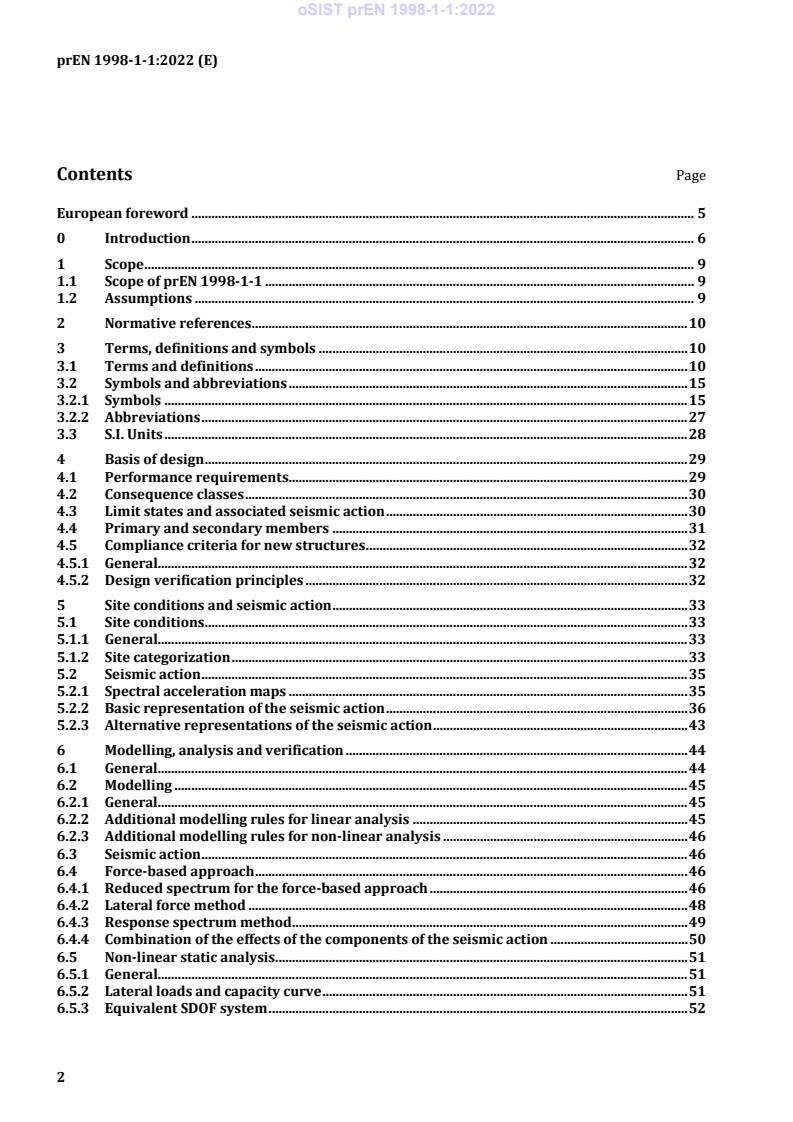
Contents Page
European foreword . 5
0 Introduction . 6
1 Scope . 9
1.1 Scope of prEN 1998-1-1 . 9
1.2 Assumptions . 9
2 Normative references . 10
3 Terms, definitions and symbols . 10
3.1 Terms and definitions . 10
3.2 Symbols and abbreviations . 15
3.2.1 Symbols . 15
3.2.2 Abbreviations . 27
3.3 S.I. Units . 28
4 Basis of design . 29
4.1 Performance requirements . 29
4.2 Consequence classes . 30
4.3 Limit states and associated seismic action . 30
4.4 Primary and secondary members . 31
4.5 Compliance criteria for new structures . 32
4.5.1 General. 32
4.5.2 Design verification principles . 32
5 Site conditions and seismic action . 33
5.1 Site conditions . 33
5.1.1 General. 33
5.1.2 Site categorization . 33
5.2 Seismic action . 35
5.2.1 Spectral acceleration maps . 35
5.2.2 Basic representation of the seismic action . 36
5.2.3 Alternative representations of the seismic action . 43
6 Modelling, analysis and verification . 44
6.1 General. 44
6.2 Modelling . 45
6.2.1 General. 45
6.2.2 Additional modelling rules for linear analysis . 45
6.2.3 Additional modelling rules for non-linear analysis . 46
6.3 Seismic action . 46
6.4 Force-based approach . 46
6.4.1 Reduced spectrum for the force-based approach . 46
6.4.2 Lateral force method . 48
6.4.3 Response spectrum method . 49
6.4.4 Combination of the effects of the components of the seismic action . 50
6.5 Non-linear static analysis. 51
6.5.1 General. 51
6.5.2 Lateral loads and capacity curve . 51
6.5.3 Equivalent SDOF system . 52
oSIST prEN 1998-1-1:2022
prEN 1998-1-1:2022 (E)
6.5.4 Target displacement . 54
6.6 Response-history analysis . 55
6.7 Verification to limit states . 55
6.7.1 General . 55
6.7.2 Verifications to Significant Damage limit state. 56
6.7.3 Verifications to additional limit states . 57
6.8 Structures equipped with antiseismic devices . 58
6.8.1 Scope . 58
6.8.2 Basis of design for structures equipped with antiseismic devices . 58
6.8.3 Seismic action . 61
6.8.4 Modelling . 62
6.8.5 Analysis of structures equipped with antiseismic devices . 63
6.8.6 Verifications of antiseismic devices to limit states . 65
7 Deformation criteria and strength models . 66
7.1 General . 66
7.2 Reinforced concrete structures . 68
7.2.1 General . 68
7.2.2 Deformation criteria . 68
7.2.3 Resistance to shear . 73
7.2.4 Resistance of beam-column joints . 74
7.3 Steel and composite steel-concrete structures . 78
7.3.1 General . 78
7.3.2 Beams and columns under flexure with or without axial load . 80
7.3.3 Steel bracings . 85
7.3.4 Beam-to-column web panel joint . 88
7.3.5 Links in frames with eccentric bracings . 89
7.3.6 Buckling restrained bracings . 91
7.4 Timber structures . 91
Annex A (informative) European hazard maps . 93
A.1 Use of this annex . 93
A.2 Scope . 93
Annex B (normative) Alternative identification of site categories . 96
B.1 Use of this normative annex . 96
B.2 Scope and field of application . 96
B.3 Simplified identification of site categories . 96
B.4 Case of incomplete quantitative information for identification of site categories . 97
B.4.1 Missing direct measurements of v or values available only to a limited depth . 97
s
B.4.2 Missing quantitative information on H . 97
Annex C (normative) Site-specific elastic response spectra . 99
C.1 Use of this annex . 99
C.2 Scope and field of application . 99
C.3 Site-specific elastic response spectra based on a local seismic hazard analysis . 99
C.4 Site-specific elastic response spectra based on evaluation of local seismic wave
amplification effects . 99
C.5 Limitations on site-specific spectral values . 100
Annex D (normative) Criteria for selection and scaling of input motions . 101
D.1 Use of this annex . 101
D.2 Scope and field of application . 101
D.3 Recorded accelerograms . 101
D.4 Multiple input motions using recorded accelerograms . 102
oSIST prEN 1998-1-1:2022
prEN 1998-1-1:2022 (E)
D.5 Simulated accelerograms . 103
D.6 Artificial accelerograms . 103
Annex E (normative) Determination of target displacement and limit-state spectral
acceleration by using non-linear response-history analyses of an equivalent SDOF
model . 104
E.1 Use of this annex . 104
E.2 Scope and field of application . 104
E.3 Definition of a multi-linear equivalent SDOF model . 104
E.4 Determination of the target displacement through non-linear response-history
analyses . 106
E.5 Determination of the limit-state spectral acceleration through non-linear response-
history analyses . 106
Annex F (informative) Simplified reliability-based verification format . 107
F.1 Use of this annex . 107
F.2 Scope . 107
F.3 Reliability-based verification . 107
Annex G (normative) Design of fastenings to concrete in the seismic design situation . 110
G.1 Use of this annex . 110
G.2 Scope and field of application . 110
G.3 Basis of design . 111
G.4 Resistance . 115
G.5 Displacement of fasteners . 117
Annex M (normative) Material or product properties in EN 1998-1-1 . 118
M.1 Use of this annex . 118
M.2 Scope and field of application . 118
Bibliography . 119
oSIST prEN 1998-1-1:2022
prEN 1998-1-1:2022 (E)
European foreword
This document (prEN 1998-1-1:2022) has been prepared by Technical Committee CEN/TC 250
“Structural Eurocodes”, the secretariat of which is held by BSI. CEN/TC 250 is responsible for all
Structural Eurocodes and has been assigned responsibility for structural and geotechnical design
matters by CEN.
This document will supersede EN 1998-1:2004.
The first generation of EN Eurocodes was published between 2002 and 2007. This document forms part
of the second generation of the Eurocodes, which have been prepared under Mandate M/515 issued to
CEN by the European Commission and the European Free Trade Association.
The Eurocodes have been drafted to be used in conjunction with relevant execution, material, product
and test standards, and to identify requirements for execution, materials, products and testing that are
relied upon by the Eurocodes.
The Eurocodes recognize the responsibility of each Member State and have safeguarded their right to
determine values related to regulatory safety matters at national level through the use of National
Annexes.
oSIST prEN 1998-1-1:2022
prEN 1998-1-1:2022 (E)
0 Introduction
0.1 Introduction to the Eurocodes
The Structural Eurocodes comprise the following standards generally consisting of a number of Parts:
— EN 1990 Eurocode: Basis of structural and geotechnical design
— EN 1991 Eurocode 1: Actions on structures
— EN 1992 Eurocode 2: Design of concrete structures
— EN 1993 Eurocode 3: Design of steel structures
— EN 1994 Eurocode 4: Design of composite steel and concrete structures
— EN 1995 Eurocode 5: Design of timber structures
— EN 1996 Eurocode 6: Design of masonry structures
— EN 1997 Eurocode 7: Geotechnical design
— EN 1998 Eurocode 8: Design of structures for earthquake resistance
— EN 1999 Eurocode 9: Design of aluminium structures
— New parts are under development, e.g. Eurocode for design of structural glass
The Eurocodes are intended for use by designers, clients, manufacturers, constructors, relevant
authorities (in exercising their duties in accordance with national or international regulations),
educators, software developers, and committees drafting standards for related product, testing and
execution standards.
NOTE Some aspects of design are most appropriately specified by relevant authorities or, where not specified,
can be agreed on a project-specific basis between relevant parties such as designers and clients. The Eurocodes
identify such aspects making explicit reference to relevant authorities and relevant parties.
0.2 Introduction to EN 1998 Eurocode 8
The scope of EN 1998 is to define the rules for the seismic design of new buildings and engineering
works and the assessment and retrofit of existing ones, including geotechnical aspects, as well as
temporary structures.
NOTE This standard also covers the verification of structures in the seismic situation during construction,
when required.
Attention should be paid to the fact that, for the design of structures in seismic regions, the provisions
of EN 1998 should be applied in addition to the relevant provisions of EN 1990 to EN 1997 and
EN 1999. In particular, EN 1998 should be applied to structures of consequence classes CC1, CC2 and
CC3, as defined in prEN 1990:2021, 4.3. Structures of consequence class CC4 are not fully covered by
the Eurocodes but may be required to follow EN 1998, or parts of it, by the relevant Authorities.
By nature, perfect protection (a null seismic risk) against earthquakes is not feasible in practice, in
particular because the knowledge of the hazard itself is characterized by a significant uncertainty.
Therefore, in Eurocode 8, the seismic action is represented in a conventional form, proportional in
amplitude to earthquakes likely to occur at a given location and representative of their frequency
content. This representation is not the prediction of a particular seismic movement, and such a
movement could give rise to more severe effects than those of the seismic action considered, inflicting
damage greater than the one described by the Limit States contemplated in this Standard.
oSIST prEN 1998-1-1:2022
prEN 1998-1-1:2022 (E)
Not only the seismic action cannot be predicted but, in addition, it should be recognized that
engineering methods are not perfectly predictive when considering the effects of this specific action,
under which structures are assumed to respond in the non-linear regime. Such uncertainties are taken
into account according to the general framework of EN 1990, with a residual risk of underestimation of
their effects.
Further Parts of EN 1998 include, in addition to prEN 1998-1-1, the following:
— prEN 1998-1-2 contains specific provisions relevant to buildings;
— EN 1998-2 contains specific provisions relevant to bridges;
— EN 1998-3 contains provisions for the seismic assessment and retrofitting of existing buildings and
bridges;
— EN 1998-4 contains specific provisions relevant to silos, tanks, pipelines, towers, masts and
chimneys;
— EN 1998-5 contains specific provisions relevant to foundations, retaining structures and
geotechnical aspects.
0.3 Introduction to prEN 1998-1-1
prEN 1998-1-1 contains general requirements for all types of structures for earthquake resistant
design, including definition of the seismic action and the description of the methods of analysis and
verification, in general terms.
Nevertheless, the definition of the seismic action allows adaptation to a local specific seismic context
through Nationally Determined Parameters (NDP) defined by the National Authorities or in the
National Annex or through a site-specific description.
prEN 1998-1-1 is subdivided in seven clauses and includes the following annexes, where Annexes B to E
and G are normative and Annexes A and F are informative:
— Annex A: European hazard maps;
— Annex B: Alternative identification of site categories;
— Annex C: Site-specific elastic response spectra;
— Annex D: Criteria for selection and scaling of input motions;
— Annex E: Determination of target displacement and limit-state spectral acceleration by using a non-
linear response-history analysis of an equivalent SDOF model;
— Annex F: Simplified reliability-based verification format;
— Annex G: Design of fastenings to concrete in the seismic design situation.
0.4 Verbal forms used in the Eurocodes
The verb “shall” expresses a requirement strictly to be followed and from which no deviation is
permitted in order to comply with the Eurocodes.
The verb “should” expresses a highly recommended choice or course of action. Subject to national
regulation and/or any relevant contractual provisions, alternative approaches could be used/adopted
where technically justified.
The verb “may" expresses a course of action permissible within the limits of the Eurocodes.
The verb “can" expresses possibility and capability; it is used for statements of fact and clarification of
concepts.
oSIST prEN 1998-1-1:2022
prEN 1998-1-1:2022 (E)
0.5 National annex for prEN 1998-1-1
National choice is allowed in this document where explicitly stated within notes. National choice
includes the selection of values for Nationally Determined Parameters (NDPs).
The national standard implementing prEN 1998-1-1 can have a National Annex containing all national
choices to be used for the design of buildings and civil engineering works to be constructed in the
relevant country.
When no national choice is given, the default choice given in this document is to be used.
When no national choice is made and no default is given in this document, the choice can be specified by
a relevant authority or, where not specified, agreed for a specific project by appropriate parties.
National choice is allowed in prEN 1998-1-1 through notes to the following:
1.1(1) 4.1(6) 4.1(8) 4.5.1(2)
5.2.1(1) 5.2.1(3) 5.2.1(4)
5.2.1(5)
5.2.2.2(2) 5.2.2.2(9) 5.2.2.5(2)
F.3(1)
G.4(1)
National choice is allowed in prEN 1998-1-1 on the application of the following informative annexes:
Annex A Annex F
The National Annex can contain, directly or by reference, non-contradictory complementary
information for ease of implementation, provided it does not alter any provisions of the Eurocodes.
oSIST prEN 1998-1-1:2022
prEN 1998-1-1:2022 (E)
1 Scope
1.1 Scope of prEN 1998-1-1
(1) This document is applicable to the design and verification of buildings and other structures in
seismic regions. It gives general rules relevant to all types of structures, with the exception of special
structures.
NOTE Special structures belong to consequence class CC4, which is not fully covered by the Eurocodes. The
categories of structures of consequence class CC4 where EN 1998, or parts of it, apply in a country can be
provided by the relevant Authorities or can be found in the National Annex.
(2) This document provides basic performance requirements and compliance criteria applicable to
buildings and civil engineering works in seismic regions.
(3) This document gives rules for the representation of seismic actions and the description of the
design seismic situations. Certain types of structures, dealt with in other parts of EN 1998, need
supplementary rules which are given in those relevant Parts.
(4) This document contains general methods for structural analysis and verification under seismic
actions, including base-isolated structures and structures with distributed dissipative systems.
(5) This document 1 contains rules for modelling and verification of ultimate strengths and
deformations.
1.2 Assumptions
(1) The general assumptions of prEN 1990:2021, 1.2, are supplemented as given in (2) to (6).
(2) It is assumed that no change in the structure and in the masses carried by the structure will take
place during the construction phase or during the subsequent life of the structure with respect to the
design unless proper justification and verification is provided. This applies to ancillary elements as well
(see 3.1.2). Due to the specific nature of the seismic response, this applies even in the case of changes
that lead to an increase of the structural resistance.
(3) The design documents are assumed to indicate the sizes, the details and the properties of the
materials of the structural members. If appropriate, the design documents are also assumed to include
the properties of special devices to be used and the distances between structural and ancillary
elements. The necessary quality control provisions are assumed to be specified.
(4) Members of special structural importance requiring special checking during construction are
assumed to be identified on the design documents. In this case, the verification methods to be used are
also assumed to be specified.
(5) In case of high seismic action class (4.1.1(4)), formal quality system plans, covering design,
construction, and use, additional to the control procedures prescribed in the other relevant Eurocodes,
are assumed to be specified.
oSIST prEN 1998-1-1:2022
prEN 1998-1-1:2022 (E)
2 Normative references
The following documents are referred to in the text in such a way that some or all of their content
constitutes requirements of this document. For dated references, only the edition cited applies. For
undated references, the latest edition of the referenced document (including any amendments) applies.
NOTE See the Bibliography for a list of other documents cited that are not normative references, including
those referenced as recommendations (i.e. in ‘should’ clauses), permissions (‘may’ clauses), possibilities ('can'
clauses), and in notes.
prEN 1990:2021, Basis of structural and geotechnical design
EN 1998 (all parts), Eurocode 8: Design of structures for earthquake resistance
ISO 80000, Quantities and units
3 Terms, definitions and symbols
3.1 Terms and definitions
For the purposes of this document, the terms and definitions given in EN 1990 and the following apply.
3.1.1
ancillary element
architectural, mechanical or electrical element, system and component which, whether due to lack of
strength or to the way it is connected to the structure, is not considered in seismic design as load
carrying element but may be the cause of risk to persons or to the structure in case of earthquake
3.1.2
antiseismic devices
devices which contribute to modify the seismic response of a structure by isolating it, by dissipating
energy or by creating permanent or temporary restraints via rigid connections
Note 1 to entry: The devices considered in EN 1998 are those covered in EN 1337 (all parts) and EN 15129.
3.1.3
bearings
devices that support vertical loads and do not modify the natural period of the structure nor its
dissipating energy
3.1.4
behaviour factor
factor used for design purposes to reduce the forces obtained from a linear analysis, to account for the
overstrength as well as for the non-linear response of a structure, associated with the material, the
structural system and the design procedures
3.1.5
capacity design method
design method in which members of the structural system are chosen and suitably designed and
detailed for energy dissipation under severe deformations while all other structural members are
provided with sufficient strength so that the chosen means of energy dissipation can be maintained
oSIST prEN 1998-1-1:2022
prEN 1998-1-1:2022 (E)
3.1.6
design displacement (of the isolation system in a principal direction)
maximum horizontal displacement at the effective stiffness centre between the top of the substructure
and the bottom of the superstructure, occurring in the design seismic situation
3.1.7
displacement-based approach
design method that explicitly accounts for the strength and deformation capacity of the structure, in
most cases considering its non-linear response and uses verifications in terms of displacements or
deformations
Note 1 to entry: In EN 1998, the displacement-based approach is implemented in the form of a non-linear static
procedure based on a pushover analysis.
3.1.8
dissipative structure
structure which can dissipate energy by means of ductile hysteretic behaviour and/or by other
mechanisms
3.1.9
dissipative zones
predetermined parts of a dissipative structure where the dissipative capabilities are mainly located
Note 1 to entry: These are also called critical regions.
3.1.10
dynamically independent unit
structure or part of a structure which is directly subjected to the ground motion and whose response is
not affected by the response of adjacent units or structures
3.1.11
effective damping (of the isolation system in a principal direction)
value of the viscous damping that corresponds to the energy dissipated by the isolation system during
cyclic response at the design displacement
3.1.12
effective period (of the isolation system in a principal direction)
fundamental period, in the direction considered, of a single degree of freedom system having the mass
of the superstructure and stiffness equal to the effective stiffness of the isolation system
3.1.13
effective stiffness (of the isolation system in a principal direction)
ratio of the value of the total horizontal force transferred through the isolation interface when the
design displacement takes place in the same direction, to the absolute value of that design displacement
(see 3.1.7). This corresponds to the secant stiffness associated to the design displacement.
Note 1 to entry: The effective stiffness is generally obtained by iterative dynamic analysis.
oSIST prEN 1998-1-1:2022
prEN 1998-1-1:2022 (E)
3.1.14
effective stiffness centre of the isolation system
stiffness centre calculated at the upper face of the isolation interface, i.e. including the flexibility of the
isolators and of the substructure(s)
Note 1 to entry: In buildings, tanks and similar structures, the flexibility of the substructure may often be
neglected in the determination of this point, which then coincides with the stiffness centre of the isolators.
3.1.15
energy dissipation device
disposable element of the energy dissipation system that dissipates energy caused by relative motion of
each end of the device and does not form part of the main structural system
3.1.16
energy dissipation system
collection of structural members that includes all the energy dissipation devices and all structural
members required to transfer the forces from the energy dissipation devices to the main structural
system and to the base of the structure. It includes also all pins, bolts, gusset plates, brace extensions
and other components required to connect the energy dissipation devices to other elements of the
structure.
3.1.17
force-based approach
force-based method of design which employs a linear analysis that implicitly accounts for the
overstrength and the non-linear response through a behaviour factor and verifications in terms of
forces. In EN 1998 it is implemented in the form of a static lateral force method or a dynamic response
spectrum method.
3.1.18
full isolation
the superstructure is fully isolated if, in the seismic design situation, it remains within the elastic range.
Otherwise, the superstructure is partially isolated.
3.1.19
isolation system
collection of isolators used for providing seismic isolation, which are arranged within the isolation
interface
Note 1 to entry: These are usually located below the main mass of the structure.
3.1.20
isolators
devices constituting the isolation system
Note 1 to entry: The devices considered in EN 1998-1-1 consist of laminated elastomeric bearings, elastoplastic
devices, viscous or friction dampers, sliders with a spherical surface and other devices the behaviour of which
conforms to 6.8.2.4.
oSIST prEN 1998-1-1:2022
prEN 1998-1-1:2022 (E)
3.1.21
main structural system
in structures equipped with energy dissipation systems, collection of primary and secondary seismic
members and their connections designed and detailed to maintain support of the gravity loading when
subjected to the displacements caused by the most unfavourable seismic design condition
Note 1 to entry: The primary seismic members of the main structural system form part of the seismic action
resisting system. They provide strength and stiffness. They can also contribute to dissipation of energy through
inelastic response.
Note 2 to entry: The main structural system and the energy dissipation system may have common structural
members.
3.1.22
non-dissipative structure
structure designed for a seismic design situation solely relying on the linear elastic material behaviour
3.1.23
performance factor
factor that accounts concurrently for the consequence class of a structure and the limit state under
consideration
3.1.24
primary structure
set of structural members which can resist seismic action on their own
3.1.25
primary seismic member
structural member considered as part of the primary structure, modelled in the analysis for the seismic
design situation and fully designed and detailed for earthquake resistance in accordance with the
corresponding rules of EN 1998
3.1.26
reduced spectrum
spectrum that is derived from the elastic response spectrum by applying a behaviour factor, to be used
in the framework of the force-based approach
3.1.27
reference seismic action
seismic action associated to the Significant Damage limit state for consequence class CC2
3.1.28
resistant structural member
structural member the resistance of which is not lower than the action effects in the seismic design
situation
3.1.29
resistance
resistance of a structural member is the (generalized) force or (generalized) deformation it can sustain
without exceeding a prescribed limit state
oSIST prEN 1998-1-1:2022
prEN 1998-1-1:2022 (E)
3.1.30
secondary seismic member
structural member which is not considered as part of the primary system and whose resistance and
stiffness against seismic actions is neglected
Note 1 to entry: They are not required to comply with all the rules of EN 1998 but are designed and detailed to
maintain support of gravity loads when subjected to the displacements caused by the seismic design situation.
Note 2 to entry: Secondary seismic members can contribute to the lateral load resistance of the system in case of
second order effects (e.g. in the case of hinged columns).
3.1.31
seismic action class
interval of seismic action intensity used to establish the applicability of simplified methods and ductility
classes. It accounts for site amplification, due to topography and site category, as well as for
consequence class.
3.1.32
seismic action index
spectral acceleration based on seismic hazard and safety choices used to define seismic action classes
3.1.33
specific seismic hazard studies
investigations and subsequent studies that are carried out for a given site in order to obtain information
about the seismic action at the site which is more detailed than the one provided by spectral
acceleration maps
3.1.34
stable site
site that is not affected by ground rupture, slope instability and/or permanent settlements caused by
liquefaction or significant densification under the considered seismic action
3.1.35
structure with energy dissipation systems
structure composed of a main structural system and of an energy dissipation system working in parallel
3.1.36
substructure(s)
part(s) of the structure located under the isolation interface
3.1.37
superstructure
part of the structure located above the isolation interface
3.1.38
total design displacement (of an isolator in a principal direction)
maximum horizontal displacement at the location of the isolator, including that due to the design
displacement and to the global rotation due to torsion about the vertical axis
oSIST prEN 1998-1-1:2022
prEN 1998-1-1:2022 (E)
3.1.39
type of structures
set of structures that are addressed by a given Part of EN 1998. The considered types of structures are:
— buildings;
— bridges;
— silos;
— tanks;
— pipelines;
— geotechnical structures and systems;
— underground structures;
— towers;
— masts;
— chimneys
3.2 Symbols and abbreviations
For the purposes of this document, the symbols and abbreviations given in prEN 1990:2021, 3.2, apply.
For the symbols related to materials, as well as for symbols not
...
Questions, Comments and Discussion
Ask us and Technical Secretary will try to provide an answer. You can facilitate discussion about the standard in here.
Loading comments...