

EN 17106-2:2021
(Main)Road operation machinery - Safety - Part 2: Specific requirements for road surface cleaning machines
General Information
- Abstract
This document together with EN 17106 1:2021 deals with all significant hazards, hazardous situations and events relevant to road surface cleaning machines (as defined in EN 15429 1:2007 and EN 17106 1:2021, 3.7) when used as intended and under the conditions of misuse which are reasonably foreseeable by the manufacturer (see Annex B) associated with the whole lifetime of the machine as described in EN ISO 12100:2010, 5.4.
The requirements of this document are complementary to the common requirements formulated in EN 17106 1:2021. This document does not repeat the requirements from EN 17106 1:2021 but supplements or modifies the requirements for road surface cleaning machines.
This document is not applicable to road surface cleaning machines manufactured before the date of its publication.
- Status
- Published
- Publication Date
- 19-Oct-2021
- Withdrawal Date
- 29-Apr-2022
- Technical Committee
- CEN/TC 151 - Construction equipment and building material machines - Safety
- Current Stage
- 6060 - Definitive text made available (DAV) - Publishing
- Start Date
- 20-Oct-2021
- Due Date
- 26-May-2019
- Completion Date
- 20-Oct-2021
- Directive
- 2006/42/EC - Directive 2006/42/EC of the European Parliament and of the Council of 17 May 2006 on machinery, and amending Directive 95/16/EC (recast)OJ Ref: OJ L 194 OJ Date: 02-Aug-2023



Overview
EN 17106-2:2021 - published by CEN - is the Part 2 safety standard for road surface cleaning machines (sweepers). It complements EN 17106-1:2021 (general requirements) and addresses all significant hazards, hazardous situations and events relevant to road surface cleaning machines during their whole lifetime, as described in EN ISO 12100:2010. The standard applies to machines manufactured after its publication and does not repeat Part 1 but supplements or modifies requirements specific to sweepers and associated equipment (e.g., demountable units, hoppers, washing/flushing systems, wander hoses, water lances).
Key Topics and Technical Requirements
EN 17106-2:2021 covers suite of machine-specific safety and risk-reduction measures, including:
- Risk management scope - hazards during intended use and foreseeable misuse across machine lifetime (per EN ISO 12100).
- Noise control - mandatory design-stage noise reduction and declared noise measurement (identifies main noise sources such as hydraulic units, internal combustion engines, suction fans, sweeping units, cooling fans and flow of materials). Practical noise-reduction measures are listed (vibration balancing, low-noise components, enclosures, silencers, damping, fan selection).
- Controls and displays - ergonomic and safety requirements for operator interfaces and operator station visibility.
- Guards, access systems and minimum spaces - rules for guarding hazardous parts, safe maintenance access and required operator clearances.
- Water systems and tanks - safety for washing/flushing systems, high-pressure water components and water storage.
- Stability and lifting mechanisms - requirements for safe raising, lowering and slewing of sweepers and associated equipment.
- Hand-held devices - safety provisions for wander hoses and hand-held lances.
- Machine types - specific clauses for self-propelled ride-on machines and trailed sweepers.
- Verification & documentation - verification procedures, noise test code (annex), and required operating instructions and safety information.
Applications and Practical Value
This standard is essential for:
- Machine manufacturers designing or adapting road surface cleaning machines to meet EU/European safety expectations.
- Safety engineers and compliance teams assessing conformity with machinery safety rules and EU Machinery Directive requirements.
- Purchasers, fleet managers and municipal authorities procuring sweepers who need assurance of safety features (noise, guards, stability, maintenance access).
- Service and maintenance providers ensuring safe maintenance procedures and transport/storage provisions.
EN 17106-2 helps reduce occupational risk, improve operator safety and ensure predictable performance for public road cleaning, municipal fleets and contract cleaning services.
Related Standards
Normative and related references include:
- EN 17106-1:2021 (general requirements)
- EN 15429-1:2007 (sweeper terminology)
- EN ISO 12100:2010, EN ISO 11201, EN ISO 3744 (risk, acoustics)
- EN ISO 13849-1, EN ISO 13850, EN ISO 14119 (control & safety functions)
- EN 1829-1:2021, EN ISO 2867, various EN 60335 parts for specific equipment
For manufacturers and specifiers seeking compliance or safer machine design, EN 17106-2:2021 is the authoritative, machine-specific safety reference for road surface cleaning equipment.
Relations
- Effective Date
- 08-Jun-2022
- Effective Date
- 09-Feb-2026
- Effective Date
- 09-Feb-2026
- Effective Date
- 09-Feb-2026
- Effective Date
- 09-Feb-2026
- Effective Date
- 28-Jan-2026
- Effective Date
- 28-Jan-2026
- Effective Date
- 28-Jan-2026
- Effective Date
- 28-Jan-2026
- Effective Date
- 28-Jan-2026
- Effective Date
- 28-Jan-2026
- Effective Date
- 28-Jan-2026
- Effective Date
- 28-Jan-2026
- Effective Date
- 28-Jan-2026
- Effective Date
- 28-Jan-2026
Get Certified
Connect with accredited certification bodies for this standard

TÜV Rheinland
TÜV Rheinland is a leading international provider of technical services.

TÜV SÜD
TÜV SÜD is a trusted partner of choice for safety, security and sustainability solutions.

DEKRA Certification Inc.
DEKRA US certification services.
Sponsored listings
Frequently Asked Questions
EN 17106-2:2021 is a standard published by the European Committee for Standardization (CEN). Its full title is "Road operation machinery - Safety - Part 2: Specific requirements for road surface cleaning machines". This standard covers: This document together with EN 17106 1:2021 deals with all significant hazards, hazardous situations and events relevant to road surface cleaning machines (as defined in EN 15429 1:2007 and EN 17106 1:2021, 3.7) when used as intended and under the conditions of misuse which are reasonably foreseeable by the manufacturer (see Annex B) associated with the whole lifetime of the machine as described in EN ISO 12100:2010, 5.4. The requirements of this document are complementary to the common requirements formulated in EN 17106 1:2021. This document does not repeat the requirements from EN 17106 1:2021 but supplements or modifies the requirements for road surface cleaning machines. This document is not applicable to road surface cleaning machines manufactured before the date of its publication.
This document together with EN 17106 1:2021 deals with all significant hazards, hazardous situations and events relevant to road surface cleaning machines (as defined in EN 15429 1:2007 and EN 17106 1:2021, 3.7) when used as intended and under the conditions of misuse which are reasonably foreseeable by the manufacturer (see Annex B) associated with the whole lifetime of the machine as described in EN ISO 12100:2010, 5.4. The requirements of this document are complementary to the common requirements formulated in EN 17106 1:2021. This document does not repeat the requirements from EN 17106 1:2021 but supplements or modifies the requirements for road surface cleaning machines. This document is not applicable to road surface cleaning machines manufactured before the date of its publication.
EN 17106-2:2021 is classified under the following ICS (International Classification for Standards) categories: 43.160 - Special purpose vehicles; 93.080.99 - Other standards related to road engineering. The ICS classification helps identify the subject area and facilitates finding related standards.
EN 17106-2:2021 has the following relationships with other standards: It is inter standard links to EN 13019:2001+A1:2008, ISO 26322-2:2010, EN 60335-2-79:2012, ISO 5006:2017, EN 60335-2-72:2012, EN ISO 13849-1:2015, EN 1829-1:2021, EN ISO 11201:2010, EN ISO 2867:2011, EN 15429-1:2007, EN 15429-4:2015, EN ISO 12100:2010, EN ISO 3744:2010, EN 17106-1:2021, EN ISO 13850:2015. Understanding these relationships helps ensure you are using the most current and applicable version of the standard.
EN 17106-2:2021 is associated with the following European legislation: EU Directives/Regulations: 2006/42/EC; Standardization Mandates: M/396. When a standard is cited in the Official Journal of the European Union, products manufactured in conformity with it benefit from a presumption of conformity with the essential requirements of the corresponding EU directive or regulation.
EN 17106-2:2021 is available in PDF format for immediate download after purchase. The document can be added to your cart and obtained through the secure checkout process. Digital delivery ensures instant access to the complete standard document.
Standards Content (Sample)
SLOVENSKI STANDARD
01-december-2021
Nadomešča:
SIST EN 13019:2002+A1:2009
SIST EN 13021:2004+A1:2009
SIST EN 13524:2004+A2:2014
Obratovanje cestnih strojev - Varnost - 2. del: Posebne zahteve za stroje za
čiščenje cestnih površin
Road operation machinery - Safety - Part 2: Specific requirements for road surface
cleaning machines
Maschinen für den Straßenbetriebsdienst - Sicherheit - Teil 2 Spezifische Anforderungen
für Kehrmaschinen
Machines d'exploitation des routes - Sécurité - Partie 2 : Prescriptions spécifiques pour
les machines de nettoiement des surfaces routières
Ta slovenski standard je istoveten z: EN 17106-2:2021
ICS:
43.160 Vozila za posebne namene Special purpose vehicles
2003-01.Slovenski inštitut za standardizacijo. Razmnoževanje celote ali delov tega standarda ni dovoljeno.
EN 17106-2
EUROPEAN STANDARD
NORME EUROPÉENNE
October 2021
EUROPÄISCHE NORM
ICS 43.160; 93.080.99; C Supersedes EN 13019:2001+A1:2008, EN
13021:2003+A1:2008, EN 13524:2003+A2:2014
English Version
Road operation machinery - Safety - Part 2: Specific
requirements for road surface cleaning machines
Machines d'exploitation des routes - Sécurité - Partie 2 Maschinen für den Straßenbetriebsdienst - Sicherheit -
: Prescriptions spécifiques pour les machines de Teil 2 Spezifische Anforderungen für Kehrmaschinen
nettoiement des surfaces routières
This European Standard was approved by CEN on 16 August 2021.
CEN members are bound to comply with the CEN/CENELEC Internal Regulations which stipulate the conditions for giving this
European Standard the status of a national standard without any alteration. Up-to-date lists and bibliographical references
concerning such national standards may be obtained on application to the CEN-CENELEC Management Centre or to any CEN
member.
This European Standard exists in three official versions (English, French, German). A version in any other language made by
translation under the responsibility of a CEN member into its own language and notified to the CEN-CENELEC Management
Centre has the same status as the official versions.
CEN members are the national standards bodies of Austria, Belgium, Bulgaria, Croatia, Cyprus, Czech Republic, Denmark, Estonia,
Finland, France, Germany, Greece, Hungary, Iceland, Ireland, Italy, Latvia, Lithuania, Luxembourg, Malta, Netherlands, Norway,
Poland, Portugal, Republic of North Macedonia, Romania, Serbia, Slovakia, Slovenia, Spain, Sweden, Switzerland, Turkey and
United Kingdom.
EUROPEAN COMMITTEE FOR STANDARDIZATION
COMITÉ EUROPÉEN DE NORMALISATION
EUROPÄISCHES KOMITEE FÜR NORMUNG
CEN-CENELEC Management Centre: Rue de la Science 23, B-1040 Brussels
© 2021 CEN All rights of exploitation in any form and by any means reserved Ref. No. EN 17106-2:2021 E
worldwide for CEN national Members.
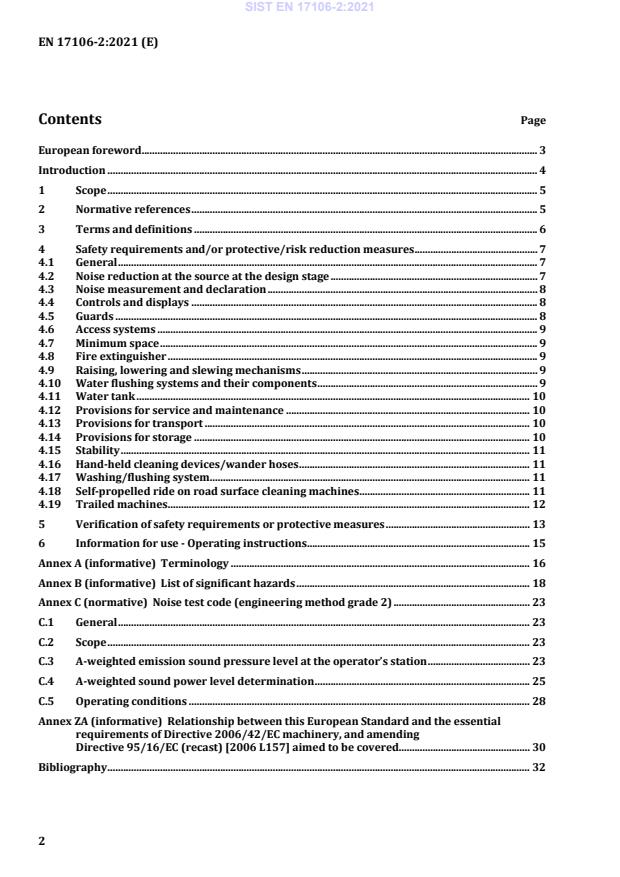
Contents Page
European foreword . 3
Introduction . 4
1 Scope . 5
2 Normative references . 5
3 Terms and definitions . 6
4 Safety requirements and/or protective/risk reduction measures . 7
4.1 General . 7
4.2 Noise reduction at the source at the design stage . 7
4.3 Noise measurement and declaration . 8
4.4 Controls and displays . 8
4.5 Guards . 8
4.6 Access systems . 9
4.7 Minimum space . 9
4.8 Fire extinguisher . 9
4.9 Raising, lowering and slewing mechanisms . 9
4.10 Water flushing systems and their components . 9
4.11 Water tank . 10
4.12 Provisions for service and maintenance . 10
4.13 Provisions for transport . 10
4.14 Provisions for storage . 10
4.15 Stability . 11
4.16 Hand-held cleaning devices/wander hoses . 11
4.17 Washing/flushing system . 11
4.18 Self-propelled ride on road surface cleaning machines . 11
4.19 Trailed machines . 12
5 Verification of safety requirements or protective measures . 13
6 Information for use - Operating instructions . 15
Annex A (informative) Terminology . 16
Annex B (informative) List of significant hazards . 18
Annex C (normative) Noise test code (engineering method grade 2) . 23
C.1 General . 23
C.2 Scope . 23
C.3 A-weighted emission sound pressure level at the operator’s station . 23
C.4 A-weighted sound power level determination . 25
C.5 Operating conditions . 28
Annex ZA (informative) Relationship between this European Standard and the essential
requirements of Directive 2006/42/EC machinery, and amending
Directive 95/16/EC (recast) [2006 L157] aimed to be covered. 30
Bibliography . 32
European foreword
This document (EN 17106-2:2021) has been prepared by Technical Committee CEN/TC 151
“Construction equipment and building material machines - Safet”, the secretariat of which is held by DIN.
This European Standard shall be given the status of a national standard, either by publication of an
identical text or by endorsement, at the latest by April 2022, and conflicting national standards shall be
withdrawn at the latest by April 2022.
Attention is drawn to the possibility that some of the elements of this document may be the subject of
patent rights. CEN shall not be held responsible for identifying any or all such patent rights.
This document supersedes EN 13019:2001+A1:2008, EN 13021:2003+A1:2008 and
EN 13524:2003+A2:2014.
This document has been prepared under a standardization request given to CEN by the European
Commission and the European Free Trade Association, and supports essential requirements of
EU Directive(s).
For relationship with EU Directive(s), see informative Annex ZA, which is an integral part of this
document.
EN 17106:2021 consists of the following parts under the general title “Road operation machinery –
Safety”:
— Part 1: General requirements
— Part 2: Specific requirements for road surface cleaning machines
— Part 3-1: Winter service machines - Specific requirements for snow clearing machines with rotating
tools and snow ploughs
— Part 3-2: Winter service machines - Specific requirements for spreading machines
— Part 4: Road service area maintenance machines - Specific requirements for grass and brush cutting
machines
Any feedback and questions on this document should be directed to the users’ national standards body.
A complete listing of these bodies can be found on the CEN website.
According to the CEN-CENELEC Internal Regulations, the national standards organisations of the
following countries are bound to implement this European Standard: Austria, Belgium, Bulgaria, Croatia,
Cyprus, Czech Republic, Denmark, Estonia, Finland, France, Germany, Greece, Hungary, Iceland, Ireland,
Italy, Latvia, Lithuania, Luxembourg, Malta, Netherlands, Norway, Poland, Portugal, Republic of North
Macedonia, Romania, Serbia, Slovakia, Slovenia, Spain, Sweden, Switzerland, Turkey and the United
Kingdom.
Introduction
This document is a type-C standard as stated in EN ISO 12100:2010.
This document is of relevance, in particular, to the following stakeholder groups representing the market
players with regard to machinery safety:
— machine manufacturers (small, medium and large enterprises);
— health and safety bodies (regulators, accident prevention organizations, market surveillance etc.).
Others can be affected by the level of machinery safety achieved with the means of the document by the
above-mentioned stakeholder groups:
— machine users/employers (small, medium and large enterprises);
— machine users/employees (e.g. trade unions, organizations for people with special needs);
— service providers, e.g. for maintenance (small, medium and large enterprises);
— consumers (in case of machinery intended for use by consumers).
The above-mentioned stakeholder groups have been given the possibility to participate at the drafting
process of this document.
The machinery concerned and the extent to which hazards, hazardous situations or hazardous events are
covered are indicated in the Scope of this document.
When requirements of this type-C standard are different from those which are stated in type-A or type-B
standards, the requirements of this type-C standard take precedence over the requirements of the other
standards for machines that have been designed and built according to the requirements of this type-C
standard.
1 Scope
This document together with EN 17106-1:2021 deals with all significant hazards, hazardous situations
and events relevant to road surface cleaning machines (as defined in EN 15429-1:2007 and
EN 17106-1:2021, 3.7) when used as intended and under the conditions of misuse which are reasonably
foreseeable by the manufacturer (see Annex B) associated with the whole lifetime of the machine as
described in EN ISO 12100:2010, 5.4.
The requirements of this document are complementary to the common requirements formulated in
EN 17106-1:2021. This document does not repeat the requirements from EN 17106-1:2021 but
supplements or modifies the requirements for road surface cleaning machines.
This document is not applicable to road surface cleaning machines manufactured before the date of its
publication.
2 Normative references
The following documents are referred to in the text in such a way that some or all of their content
constitutes requirements of this document. For dated references, only the edition cited applies. For
undated references, the latest edition of the referenced document (including any amendments) applies.
EN 1829-1:2021, High pressure water jet machines - Safety requirements - Part 1: Machines
EN 15429-1:2007, Sweepers - Part 1: Classification and Terminology
EN 15429-4:2015, Sweepers - Part 4: Symbols for operator controls and other displays
EN 17106-1:2021, Road operation machinery - Safety - Part 1: General requirements
EN 60335-2-72:2012, Household and similar electrical appliances - Safety - Part 2-72: Particular
requirements for floor treatment machines with or without traction drive, for commercial use
EN 60335-2-79:2012, Household and similar electrical appliances - Safety - Part 2-79: Particular
requirements for high pressure cleaners and steam cleaners
EN ISO 2867:2011, Earth-moving machinery - Access systems (ISO 2867:2011)
EN ISO 3744:2010, Acoustics - Determination of sound power levels and sound energy levels of noise sources
using sound pressure - Engineering methods for an essentially free field over a reflecting plane (ISO
3744:2010)
EN ISO 11201:2010, Acoustics - Noise emitted by machinery and equipment - Determination of emission
sound pressure levels at a work station and at other specified positions in an essentially free field over a
reflecting plane with negligible environmental corrections (ISO 11201:2010)
EN ISO 12100:2010, Safety of machinery - General principles for design - Risk assessment and risk reduction
(ISO 12100:2010)
EN ISO 13849-1:2015, Safety of machinery - Safety-related parts of control systems - Part 1: General
principles for design (ISO 13849-1:2015)
EN ISO 13850:2015, Safety of machinery - Emergency stop function - Principles for design (ISO 13850:2015)
EN ISO 14119:2013, Safety of machinery - Interlocking devices associated with guards - Principles for
design and selection (ISO 14119:2013)
ISO 5006:2017, Earth-moving machinery - Operator's field of view - Test method and performance criteria
ISO 26322-2:2010, Tractors for agriculture and forestry - Safety - Part 2: Narrow-track and small tractors
3 Terms and definitions
For the purposes of this document, the terms and definitions given in EN 17106-1:2021,
EN 15429-1:2007 and EN ISO 12100:2010 and the following apply.
NOTE Further terminology can be found in Annex A.
3.1
road surface cleaning machine (sweeper)
machine for removal of spoil on traffic areas, where the machine is permanently fixed or demountable
from a carrier vehicle or specially designed chassis
3.2
demountable machine
machine (e.g. hopper, sweeping gear, washing/flushing system, pick-up system), that may be demounted
from and remounted to the carrier vehicle
3.3
hopper
container for the collected sweepings or spoil
3.4
wander hose
manually operated dirt pick-up system
3.5
water lance
manually operated washing/flushing system
3.6
operator station
area from which an operator controls the travel and/or work functions of the machine
Note 1 to entry: For road surface cleaning machines these specific work functions could apply:
— sweeping;
— sucking with wander hose;
— cleaning with hand-held cleaning device (e.g. high-pressure water lance);
— discharge of the hopper, dirt water.
3.7
washing/flushing system
system using water to clean a surface using high velocity jets and/or copious use to move and dislodge
spoil from the surface being cleaned; the system may use scrubbing brooms and/or detergents to aid the
cleansing function
4 Safety requirements and/or protective/risk reduction measures
4.1 General
Road surface cleaning machines shall comply with the safety requirements and/or protective/risk
reduction measures of this clause. In addition, the machines shall be designed according to the principles
of EN ISO 12100:2010 for relevant but not significant hazards which are not dealt with by this document.
Road surface cleaning machines shall comply with the requirements of EN 17106-1:2021, as far as not
modified or replaced by the requirements of this part.
4.2 Noise reduction at the source at the design stage
EN 17106-1:2021, 4.1.2.1 and 4.1.2.2 applies with the following additions:
The main sources of noise are:
— hydraulic unit;
— internal combustion engine;
— air compressor;
— flow of materials;
— suction fan;
— sweeping units;
— cooling fans.
NOTE 1 The noise of the carrier vehicle significantly contributes to the overall level of noise emission.
The noise at source shall be minimized as much as possible by design, e.g. by using the following non-
exhaustive measures:
a) reduction of vibrations via the static and dynamic balancing of rotating parts;
b) reduction of vibrations inside the machine by reducing the weight of mobile parts and their
acceleration;
c) choice of low-noise transmission components, e.g. gear assemblies, pulleys, belts, bearings;
d) design of machine structures, considering vibration damping and avoiding structural resonance
phenomena;
e) choice of silencers and placement of exhausts;
f) choice and design of engine supports;
g) choice of cooling fans with optimized clearances and possible integration of hydraulic or magnetic
speed limiters;
h) reduction of noise from pneumatic exhausts, vibration damping of hydraulic systems;
i) enclosure of part(s) of the machine.
NOTE 2 Other measures offering identical or superior noise reduction can be implemented.
4.3 Noise measurement and declaration
EN 17106-1:2021, 4.1.2.3 is replaced by the following:
In order to quantify the residual risk for noise, the measurement of the sound power level and the
emission sound pressure level at the operator's position shall be carried out in accordance with Annex C
and the results shall be stated in the operator’s manual.
4.4 Controls and displays
4.4.1 General
EN 17106-1:2021, 4.1.4.1 applies with the following modification:
Symbols for operator controls shall be in accordance with EN 15429-4:2015.
4.4.2 Starting
EN 17106-1:2021, 4.1.4.4 applies with the following addition:
In case of road surface cleaning machines these requirements are deemed to be met for intended
combinations of sequential and/or simultaneous starting of functions (e.g. the automatic starting of the
brush rotation caused by the starting movement of the brush arms, since the starting of the movement of
the brush arms is treated as an intended starting).
4.4.3 Emergency stop
EN 17106-1:2021, 4.1.4.5.3 applies with the following addition:
There shall be an emergency stop at the driving position.
For the following operator's stations an emergency stop is not required:
— sucking with wander hose;
— cleaning with hand-held cleaning device (e.g. high-pressure water lance);
— discharge of the hopper, dirt water.
The category of stop shall be Category '0' according to EN ISO 13850:2015, 4.1.3.
4.4.4 Safety and reliability of control systems
EN 17106-1:2021, 4.1.4.3 applies with the following addition:
The safety related parts of the interlocking system shall be at least required performance level PL c
r
according to EN ISO 13849-1:2015.
4.5 Guards
EN 17106-1:2021, 4.1.5 applies with the following additions.
Sweeping gear does not need to be guarded. Warning signs shall be provided in the vicinity of the hazard
zone to indicate risk and avoidance measures to operators and third parties.
Inspection doors giving access to moving parts, access shall be interlocked without a guard locking
according to EN ISO 14119:2013 in such a way that the respective assemblies inside the hopper (e.g.
compaction mechanism and discharge system for the body) become inoperative when opened.
If suction fans are fitted, the outlet shall be fitted with a fixed guard to ensure that the hazardous ejection
of parts/particles and fluids to the surrounding area does not occur.
4.6 Access systems
EN 17106-1:2021, 4.1.9 applies with the following modification:
Access systems, where fitted, other than driver’s cab shall be in accordance with Table 1.
Table 1 — Access standard reference
Machine type Sub-type Net Volume Capacity in Access systems
in accordance with
m
Truck mounted sweeper Large > 4 EN ISO 2867:2011
Small ≤ 4 EN ISO 2867:2011
Self-propelled sweeper Maxi-compact sweeper > 2,5 EN ISO 2867:2011
Compact sweeper ≤ 2,5 ISO 26322-2:2010
Midi-compact sweeper ≤ 1 ISO 26322-2:2010
Mini-compact sweeper ≤ 0,2 ISO 26322-2:2010
Attached sweeping With hopper ≤ 1 ISO 26322-2:2010
equipment
4.7 Minimum space
EN 17106-1:2021, 4.2.1.1 applies with the following modification:
The minimum space available to the operator for self-propelled machines shall comply with
ISO 26322-2:2010.
4.8 Fire extinguisher
EN 17106-1:2021, 4.1.13 applies with the following modification:
This requirement does not apply to mini-compact sweeper, midi-compact sweeper and compact sweeper
(as defined in Table 1).
4.9 Raising, lowering and slewing mechanisms
Free fall and uncontrolled movements of sweep gear mechanisms shall be prevented. The raising,
lowering and slewing shall be in a controlled movement. Orifices, restrictors or specially sized hoses and
pipes serving the hydraulic or pneumatic actuator system may be used to effect control.
4.10 Water flushing systems and their components
EN 17106-1:2021, 4.1.14 applies with the following addition:
Water flushing systems and their components with an operating pressure between 2,5 MPa to 35 MPa
shall comply with EN 60335-2-79:2012.
Water flushing systems and their components with an operating pressure exceeding 35 MPa shall comply
with EN 1829-1:2021.
4.11 Water tank
The filling port of the water tank shall be equipped with water back flow prevention system (e.g. valve or
air gap).
NOTE National regulations for water backflow prevention systems can apply.
4.12 Provisions for service and maintenance
EN 17106-1:2021, 4.1.20 applies with the following addition:
Cabs, hoppers and discharge doors shall be constructed or designed so that any unintentional lowering
of the cab/hopper/discharge doors, including lowering resulting from power interruption, shall be
prevented.
For example this requirement is met by one of the following means:
— check valves or similar functions within the control valves of hydraulic or pneumatic lifting
equipment;
— self-locking actuators or automatically engaging latches;
— mechanical safety mechanisms.
If persons have to enter beneath the elevated or tilted cab/hopper/discharge doors when used as
intended and under conditions foreseen by the manufacturer (e.g. maintenance, cleaning, inspection) it
is necessary to provide safeguards. For example this requirement is met by one of the following means:
— automatically engaging mechanical safety mechanisms;
— pilot controlled check valves integrated into the lifting cylinder;
— mechanical safety mechanisms that can be operated from outside the hazard zone.
For maintenance, means shall be provided to lower all sweep gear to the lowered ground position and to
render all controls and actuation power systems inert. In the case of fluid power systems, all pumps shall
be stationary and stored energy expended, pneumatic systems shall be open and vented to atmosphere.
Where power operated systems using fluid power cylinders or pneumatic means are employed,
protection against free falling conditions through power failure shall be employed e.g. restrictors, flow
controllers, check valves fitted directly to the actuator.
4.13 Provisions for transport
EN 17106-1:2021, 4.1.18 applies with the following addition:
A warning device at the driver’s position shall indicate that the tipped or elevating hopper is not in the
transport position.
4.14 Provisions for storage
EN 17106-1:2021, 4.1.20 applies with the following additions:
Suitable devices for storage/supporting disconnected hoses of a hand-held cleaning device shall be
provided on the road surface cleaning machine.
If the control unit is removable from the towing vehicle, a storage place/box for the control unit shall be
provided at the trailer.
4.15 Stability
The elevation of the hopper whether empty or laden shall not cause the machine to tip up or roll over
when used according to the manufacturer’s intended use. This is particularly relevant to road surface
cleaning machines with high dumping hoppers that discharge into containers.
Verification of this stability requirement shall be derived from measurement according to
EN 60335-2-72:2012, 20.1, functional tests or calculation.
4.16 Hand-held cleaning devices/wander hoses
Manually guided wander hoses shall be provided with hand holds permitting easy guiding of the wander
hose in a controlled manner.
Counterbalance means by springs, pneumatic cylinders, mechanical actuators or hydraulic cylinders shall
be employed when the force required by the operator exceeds 250 N.
Where power operated systems using fluid power cylinders or pneumatic means are employed,
protection against free falling conditions through power failure shall be employed e.g. restrictors, flow
controllers, check valves fitted directly to the actuator.
For manually guided hoses including rotatable booms, suitable means shall be provided which positively
arrest these in a locked position.
4.17 Washing/flushing system
Washing jets shall be so designed and positioned to act only in the intended direction. Shields or
curtaining shall be employed if hazards from fierce over spray exist.
4.18 Self-propelled ride on road surface cleaning machines
4.18.1 Operator station
4.18.1.1 Cabin
EN 17106-1:2021, 4.2.1.1 applies with the following addition:
Self-propelled ride on road surface cleaning machines shall be equipped with a cabin for the driver's
position. Exempted from this requirement are mini compact sweepers and midi compact sweepers (as
defined in EN 15429-1:2007, Table A.1).
4.18.1.2 Access to operator's seat
Access systems of self-propelled sweepers (as defined in EN 15429-1:2007) shall be in accordance with
4.6, Table 1.
NOTE Access systems of truck mounted sweepers (as defined in EN 15429-1) are regulated by EC-Directives
or ECE regulations.
4.18.2 Visibility
4.18.2.1 General
EN 17106-1:2021, 4.1.3 applies with the following modification(s):
Road surface cleaning machines shall be designed in accordance with ISO 5006:2017 so that the operator
has sufficient visibility from the operator's station in relation to the travel and work areas of the machine
that are necessary for the intended use of the machine.
Road surface cleaning machines shall meet the performance criteria on the visibility test circle according
to Table 2.
Road operation machines shall be equipped with rear view mirrors.
Rear view mirrors should comply to ECE R 46.
The vertical test object height shall be 1 200 mm.
4.18.2.2 Visibility performance criteria on the visibility test cycle
Table 2 — Visibility performance criteria on the visibility test circle
Dimensions in millimetres
d d
Capacity according to A D E F RB
B C
EN 15429-1
Mini-compact- 65 65 65 No No 65 405
sweeper specific specific
c
2 - 700 2 - 700 2 - 700 300
2 – 3000
criteria criteria
...