

EN 413-2:2016
(Main)Masonry cement - Part 2: Test methods
- Abstract
This draft European Standard describes reference and alternative test methods to be used when testing masonry cements to assess their conformity to EN 413 1. It gives the tests on fresh mortar for consistence, water retention and air content.
In the event of a dispute, only the reference methods are used.
- Status
- Published
- Publication Date
- 11-Oct-2016
- Technical Committee
- CEN/TC 51 - Cement and building limes
- Drafting Committee
- CEN/TC 51/WG 10 - Masonry cement
- Current Stage
- 9093 - Decision to confirm - Review Enquiry
- Start Date
- 14-Jun-2022
- Completion Date
- 07-Oct-2026

Overview
EN 413-2:2016 - Masonry cement - Part 2: Test methods (CEN) specifies the standardized laboratory methods for testing masonry cements to assess conformity with EN 413‑1. It focuses on tests on fresh mortar: consistence, water retention and air content. The standard defines both reference and alternative methods (reference methods take precedence in disputes) and includes environmental and equipment tolerances to ensure repeatable results.
Key topics and requirements
- Scope: Test methods for fresh mortar made with masonry cement to verify conformity with EN 413‑1.
- Laboratory conditions: Typical testing environment at (20 ± 2) °C and relative humidity ≥ 50 %. Some tests (setting time Method B) require (20 ± 1) °C and ≥ 90 % RH.
- Setting time:
- Two options: Method A (EN 196‑3) or Method B (reference) using a Vicat apparatus.
- Initial setting reported when Vicat needle distance = (6 ± 3) mm (to nearest 5 min). Final setting when penetration is 0.5 mm (to nearest 15 min).
- Precision: repeatability SD - initial 4 min, final 7 min; reproducibility SD - initial 20 min, final 24 min.
- Consistence (fresh mortar):
- Reference method: plunger apparatus (mass of plunger/rod (90 ± 2) g; initial plunger position 100 ± 0.5 mm above mortar).
- Alternative method: flow table test - acceptable only when an equivalent flow spread to the plunger penetration is established for the masonry cement under test.
- Water retention:
- Procedure and apparatus defined; guidance updated for gauze properties used in the test. Precision data revised following inter-laboratory studies.
- Air content:
- Reference: pressure method (detailed principle, calibration and procedure).
- Alternative: alcohol method.
- General measurement controls: manufacturing and in-use tolerances for test equipment, number of tests (single test for statistical series; two tests otherwise).
Applications and users
EN 413-2 is used by:
- Cement and mortar manufacturers for product development and factory quality control.
- Independent testing laboratories performing conformity checks against EN 413‑1.
- Construction quality assurance teams and specifiers verifying material performance for bedding, rendering and plastering.
- Regulatory bodies and certification schemes that require standardized test evidence.
Practical benefits include consistent assessment of fresh-mortar performance (workability, water retention and entrained air), better comparability between labs, and defensible test results in procurement and compliance contexts.
Related standards
- EN 413‑1 - Masonry cement: composition, specifications and conformity criteria
- EN 196‑1 - Methods of testing cement - determination of strength
- EN 196‑3 - Methods of testing cement - setting times and soundness
- EN 459‑2 - Building lime - test methods
Keywords: EN 413-2, masonry cement, test methods, fresh mortar, consistence, water retention, air content, Vicat, plunger apparatus, flow table, CEN.
Relations
- Effective Date
- 19-Oct-2016
- Effective Date
- 28-Jan-2026
- Effective Date
- 28-Jan-2026
- Effective Date
- 28-Jan-2026
- Effective Date
- 28-Jan-2026
- Referred By
EN 413-1:2011 - Masonry cement - Part 1: Composition, specifications and conformity criteria - Effective Date
- 28-Jan-2026
- Effective Date
- 28-Jan-2026
- Effective Date
- 28-Jan-2026
- Effective Date
- 28-Jan-2026
- Effective Date
- 28-Jan-2026
- Referred By
EN 16622:2015 - Silica-calcium fume for concrete - Definitions, requirements and conformity criteria - Effective Date
- 28-Jan-2026
Get Certified
Connect with accredited certification bodies for this standard

DIBt (Deutsches Institut für Bautechnik)
German Institute for Building Technology.
DIN CERTCO
DIN Group product certification.

Aboma Certification B.V.
Specialized in construction, metal, and transport sectors.
Sponsored listings
Frequently Asked Questions
EN 413-2:2016 is a standard published by the European Committee for Standardization (CEN). Its full title is "Masonry cement - Part 2: Test methods". This standard covers: This draft European Standard describes reference and alternative test methods to be used when testing masonry cements to assess their conformity to EN 413 1. It gives the tests on fresh mortar for consistence, water retention and air content. In the event of a dispute, only the reference methods are used.
This draft European Standard describes reference and alternative test methods to be used when testing masonry cements to assess their conformity to EN 413 1. It gives the tests on fresh mortar for consistence, water retention and air content. In the event of a dispute, only the reference methods are used.
EN 413-2:2016 is classified under the following ICS (International Classification for Standards) categories: 91.100.10 - Cement. Gypsum. Lime. Mortar. The ICS classification helps identify the subject area and facilitates finding related standards.
EN 413-2:2016 has the following relationships with other standards: It is inter standard links to EN 413-2:2005, EN 459-2:2010, EN 196-3:2005+A1:2008, EN 196-1:2016, EN 480-1:2023, EN 413-1:2011, EN 480-2:2006, EN 480-1:2014, EN ISO 12863:2022, EN 480-1:2006+A1:2011, EN 16622:2015. Understanding these relationships helps ensure you are using the most current and applicable version of the standard.
EN 413-2:2016 is associated with the following European legislation: Standardization Mandates: M/114. When a standard is cited in the Official Journal of the European Union, products manufactured in conformity with it benefit from a presumption of conformity with the essential requirements of the corresponding EU directive or regulation.
EN 413-2:2016 is available in PDF format for immediate download after purchase. The document can be added to your cart and obtained through the secure checkout process. Digital delivery ensures instant access to the complete standard document.
Standards Content (Sample)
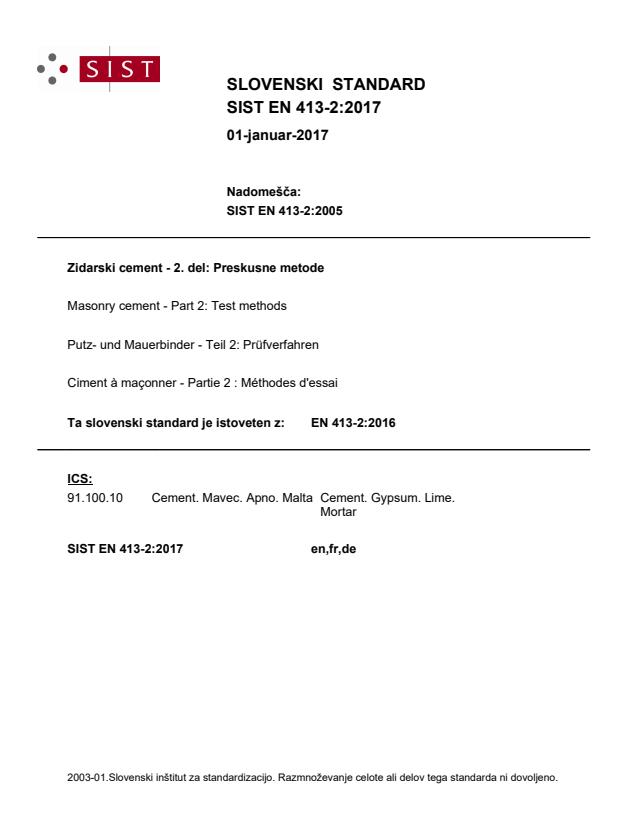
2003-01.Slovenski inštitut za standardizacijo. Razmnoževanje celote ali delov tega standarda ni dovoljeno.Zidarski cement - 2. del: Preskusne metodePutz- und Mauerbinder - Teil 2: PrüfverfahrenCiment à maçonner - Partie 2 : Méthodes d'essaiMasonry cement - Part 2: Test methods91.100.10Cement. Mavec. Apno. MaltaCement. Gypsum. Lime. MortarICS:Ta slovenski standard je istoveten z:EN 413-2:2016SIST EN 413-2:2017en,fr,de01-januar-2017SIST EN 413-2:2017SLOVENSKI
STANDARDSIST EN 413-2:20051DGRPHãþD
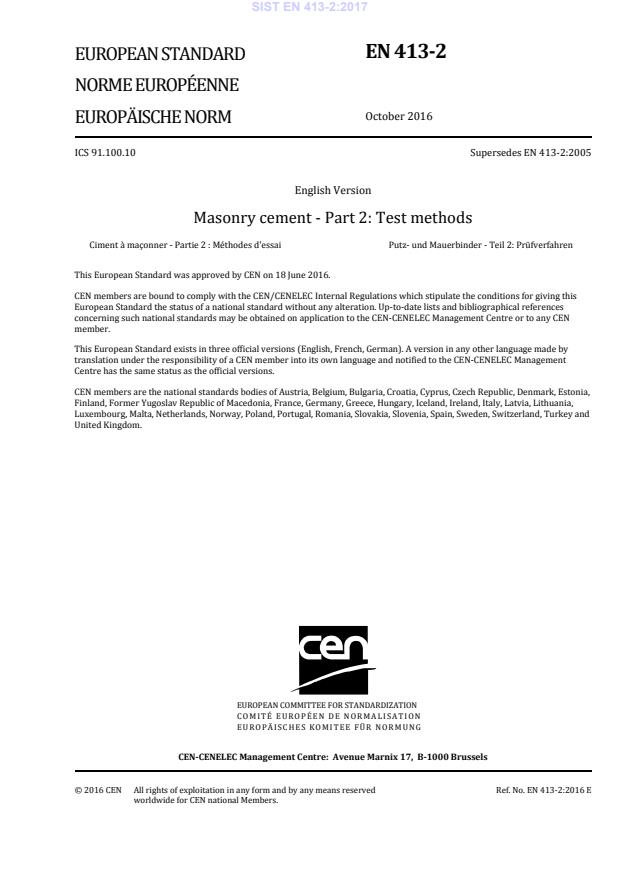
EUROPEAN STANDARD NORME EUROPÉENNE EUROPÄISCHE NORM
EN 413-2
October
t r s x ICS
{ sä s r rä s r Supersedes EN
v s uæ tã t r r wEnglish Version
Masonry cement æ Part
tã Test methods Ciment à maçonner æ Partie
t ã Méthodes d 5essai
Putzæ und Mauerbinder æ Teil
tã Prüfverfahren This European Standard was approved by CEN on
s z June
t r s xä
egulations which stipulate the conditions for giving this European Standard the status of a national standard without any alterationä Upætoædate lists and bibliographical references concerning such national standards may be obtained on application to the CENæCENELEC Management Centre or to any CEN memberä
translation under the responsibility of a CEN member into its own language and notified to the CENæCENELEC Management Centre has the same status as the official versionsä
CEN members are the national standards bodies of Austriaá Belgiumá Bulgariaá Croatiaá Cyprusá Czech Republicá Denmarká Estoniaá Finlandá Former Yugoslav Republic of Macedoniaá Franceá Germanyá Greeceá Hungaryá Icelandá Irelandá Italyá Latviaá Lithuaniaá Luxembourgá Maltaá Netherlandsá Norwayá Polandá Portugalá Romaniaá Slovakiaá Sloveniaá Spainá Swedená Switzerlandá Turkey and United Kingdomä
EUROPEAN COMMITTEE FOR STANDARDIZATION COMITÉ EUROPÉEN DE NORMALISATION EUROPÄISCHES KOMITEE FÜR NORMUNG
CEN-CENELEC Management Centre:
Avenue Marnix 17,
B-1000 Brussels
t r s x CEN All rights of exploitation in any form and by any means reserved worldwide for CEN national Membersä Refä Noä EN
v s uæ tã t r s x ESIST EN 413-2:2017
...