

EN 480-1:2023
(Main)Admixtures for concrete, mortar and grout - Test methods - Part 1: Reference concrete and reference mortar for testing
- Abstract
This document specifies the constituent materials, the composition and the mixing method to produce reference concrete and reference mortar for testing the efficacy and the compatibility of admixtures in accordance with the EN 934 series.
- Status
- Published
- Publication Date
- 04-Jul-2023
- Technical Committee
- CEN/TC 104 - Concrete ( performance, production, placing and compliance criteria )
- Drafting Committee
- CEN/TC 104/SC 3 - Admixtures for concrete
- Current Stage
- 6060 - Definitive text made available (DAV) - Publishing
- Start Date
- 05-Jul-2023
- Due Date
- 03-May-2023
- Completion Date
- 05-Jul-2023

Overview
EN 480-1:2023 - "Admixtures for concrete, mortar and grout - Test methods - Part 1: Reference concrete and reference mortar for testing" (CEN) defines the constituent materials, composition and standardized mixing procedures to produce reference concrete and reference mortar used to assess the efficacy and compatibility of chemical admixtures in accordance with the EN 934 series. It updates and supersedes the 2014 edition and is intended for comparative testing where a control mix (no admixture) is compared with a test mix (with admixture).
Key topics and technical requirements
- Purpose: Produce repeatable reference mixes for testing admixture performance and compatibility.
- Cement: Use CEM I (strength class 42.5 or 52.5) conforming to EN 197‑1 with CaO content 7–11% (EN 196‑2) and specific surface 3 200–4 600 cm2/g (EN 196‑6).
- Aggregates:
- Reference concrete: natural normal-weight aggregate per EN 12620 with low water absorption (< 2%) and defined grading limits (see table in standard). Aggregate should be oven-dry (≥105 °C) or moisture-corrected.
- Reference mortar: standard sand per EN 196‑1.
- Mixing water: Conform to EN 1008 (distilled or de‑ionized allowed in special cases; no wash water).
- Comparative testing: Test mixes must use the same aggregate:cement ratio as the control mix; water adjusted to match required consistence unless testing at equal w/c ratio.
- Consistence and fresh properties: Slump or flow test alternatives (EN 12350‑2 or EN 12350‑5); control mix air content ≤ 2% (EN 12350‑7); density (EN 12350‑6).
- Mixing procedure: Forced‑action pan mixer at 50–90% capacity with specified sequence and timings (e.g., add aggregate + half water, mix 2 min, stand 2 min, add cement + remaining water, mix 2 min). Determine consistence within 5 minutes of mixing.
- Specimens and curing: Make 3 cubes/cylinders per test age (EN 12390‑1 / EN 12390‑2); discard any specimen differing >10% from set average.
- Reporting: Tests are to be documented in a test report (see Clause 9).
Applications and users
- Manufacturers and formulators of concrete admixtures validating efficacy (plasticizers, superplasticizers, air‑entraining agents, water‑resisting admixtures).
- Independent testing laboratories and quality control/assurance teams performing comparative performance and compatibility tests.
- Cement and aggregate producers supplying reference materials for laboratory testing.
- Product certifiers, R&D teams and standards bodies referencing consistent test methods in product specifications and compliance assessment.
Related standards
- EN 934 (all parts) - Admixtures for concrete, mortar and grout (used together with EN 480‑1)
- EN 196‑1/2/6, EN 197‑1, EN 1008, EN 12350 series, EN 12390 series, EN 12620
Keywords: EN 480-1:2023, reference concrete, reference mortar, admixtures testing, EN 934, mixing method, constituent materials, concrete testing, compatibility, test methods.
Relations
- Effective Date
- 19-Jan-2023
- Effective Date
- 28-Jan-2026
- Effective Date
- 28-Jan-2026
- Effective Date
- 28-Jan-2026
- Effective Date
- 28-Jan-2026
- Effective Date
- 28-Jan-2026
- Effective Date
- 28-Jan-2026
- Effective Date
- 28-Jan-2026
- Effective Date
- 28-Jan-2026
- Effective Date
- 28-Jan-2026
- Effective Date
- 28-Jan-2026
- Refers
EN 12390-2:2019 - Testing hardened concrete - Part 2: Making and curing specimens for strength tests - Effective Date
- 28-Jan-2026
- Effective Date
- 28-Jan-2026
- Effective Date
- 28-Jan-2026
- Effective Date
- 28-Jan-2026
Get Certified
Connect with accredited certification bodies for this standard

DIBt (Deutsches Institut für Bautechnik)
German Institute for Building Technology.
DIN CERTCO
DIN Group product certification.

Aboma Certification B.V.
Specialized in construction, metal, and transport sectors.
Sponsored listings
Frequently Asked Questions
EN 480-1:2023 is a standard published by the European Committee for Standardization (CEN). Its full title is "Admixtures for concrete, mortar and grout - Test methods - Part 1: Reference concrete and reference mortar for testing". This standard covers: This document specifies the constituent materials, the composition and the mixing method to produce reference concrete and reference mortar for testing the efficacy and the compatibility of admixtures in accordance with the EN 934 series.
This document specifies the constituent materials, the composition and the mixing method to produce reference concrete and reference mortar for testing the efficacy and the compatibility of admixtures in accordance with the EN 934 series.
EN 480-1:2023 is classified under the following ICS (International Classification for Standards) categories: 91.100.10 - Cement. Gypsum. Lime. Mortar; 91.100.30 - Concrete and concrete products. The ICS classification helps identify the subject area and facilitates finding related standards.
EN 480-1:2023 has the following relationships with other standards: It is inter standard links to EN 480-1:2014, EN 934-1:2008, EN 12350-6:2019, EN 197-1:2011, EN 12620:2013, EN 12390-1:2021, EN 934-4:2009, EN 12350-5:2019, EN 196-6:2018, EN 12620:2002, EN 413-2:2016, EN 12390-2:2019, EN 1008:2002, EN 934-3:2009+A1:2012, EN 934-7:2024. Understanding these relationships helps ensure you are using the most current and applicable version of the standard.
EN 480-1:2023 is available in PDF format for immediate download after purchase. The document can be added to your cart and obtained through the secure checkout process. Digital delivery ensures instant access to the complete standard document.
Standards Content (Sample)
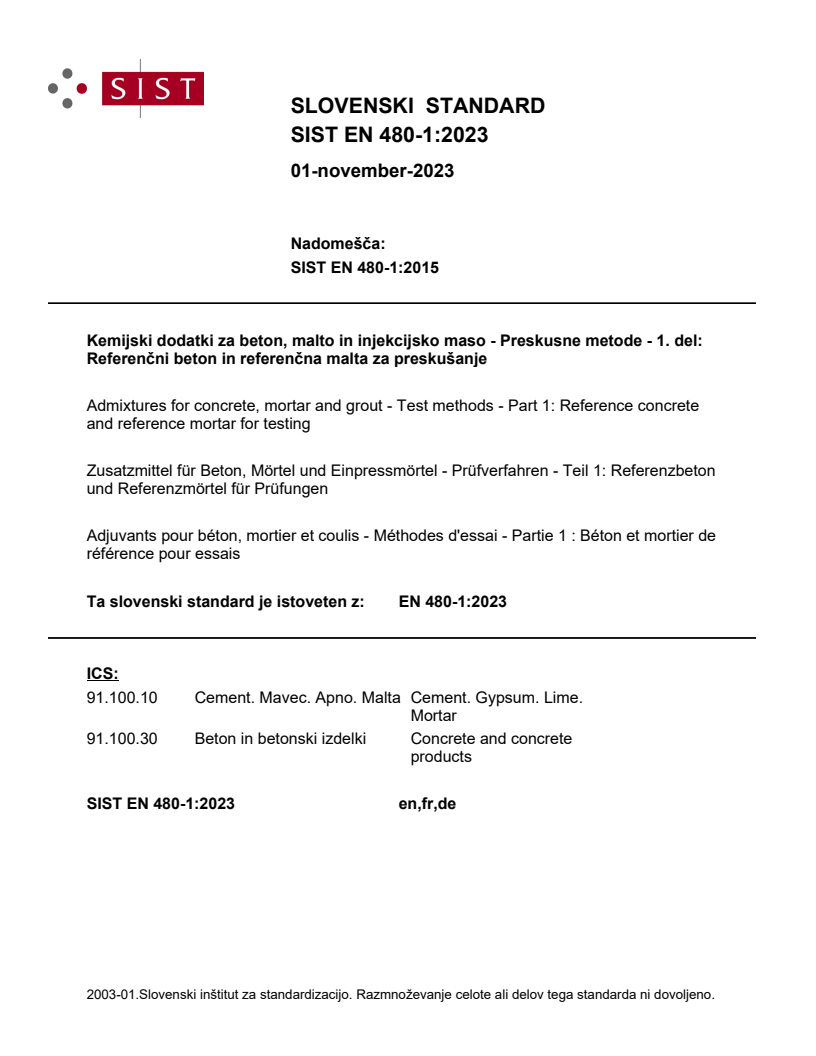
SLOVENSKI STANDARD
01-november-2023
Nadomešča:
SIST EN 480-1:2015
Kemijski dodatki za beton, malto in injekcijsko maso - Preskusne metode - 1. del:
Referenčni beton in referenčna malta za preskušanje
Admixtures for concrete, mortar and grout - Test methods - Part 1: Reference concrete
and reference mortar for testing
Zusatzmittel für Beton, Mörtel und Einpressmörtel - Prüfverfahren - Teil 1: Referenzbeton
und Referenzmörtel für Prüfungen
Adjuvants pour béton, mortier et coulis - Méthodes d'essai - Partie 1 : Béton et mortier de
référence pour essais
Ta slovenski standard je istoveten z: EN 480-1:2023
ICS:
91.100.10 Cement. Mavec. Apno. Malta Cement. Gypsum. Lime.
Mortar
91.100.30 Beton in betonski izdelki Concrete and concrete
products
2003-01.Slovenski inštitut za standardizacijo. Razmnoževanje celote ali delov tega standarda ni dovoljeno.
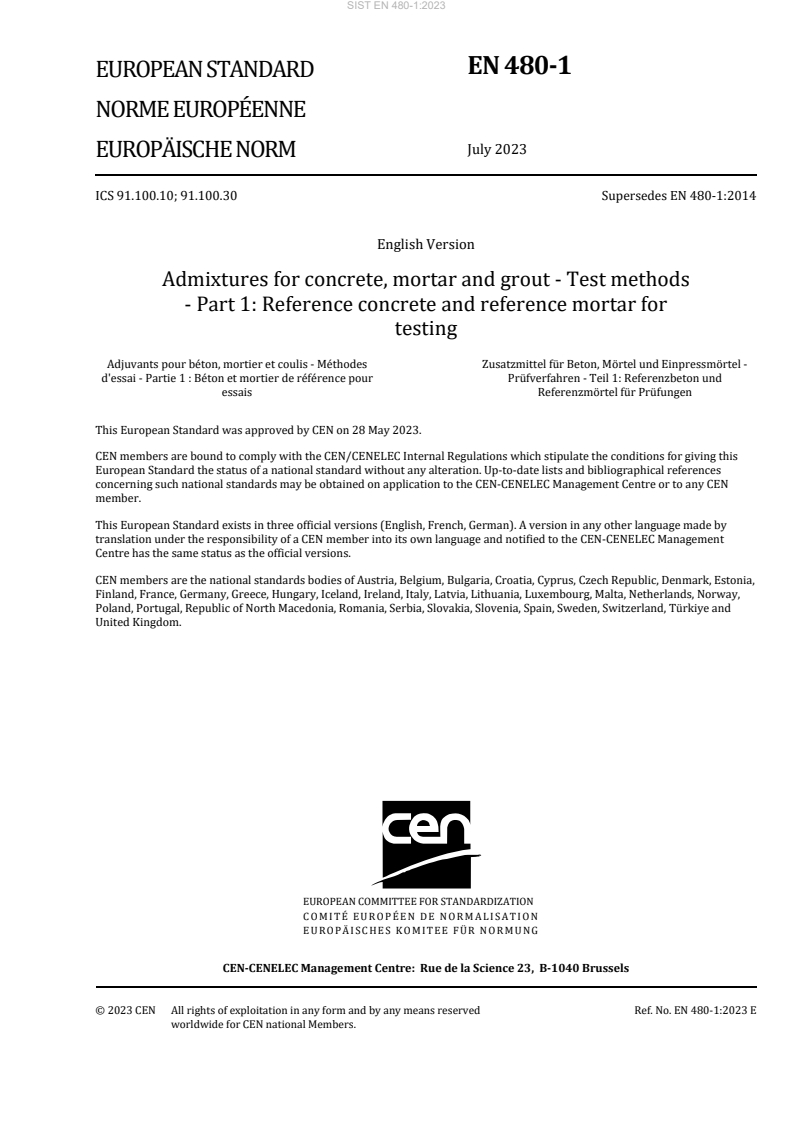
EN 480-1
EUROPEAN STANDARD
NORME EUROPÉENNE
July 2023
EUROPÄISCHE NORM
ICS 91.100.10; 91.100.30 Supersedes EN 480-1:2014
English Version
Admixtures for concrete, mortar and grout - Test methods
- Part 1: Reference concrete and reference mortar for
testing
Adjuvants pour béton, mortier et coulis - Méthodes Zusatzmittel für Beton, Mörtel und Einpressmörtel -
d'essai - Partie 1 : Béton et mortier de référence pour Prüfverfahren - Teil 1: Referenzbeton und
essais Referenzmörtel für Prüfungen
This European Standard was approved by CEN on 28 May 2023.
CEN members are bound to comply with the CEN/CENELEC Internal Regulations which stipulate the conditions for giving this
European Standard the status of a national standard without any alteration. Up-to-date lists and bibliographical references
concerning such national standards may be obtained on application to the CEN-CENELEC Management Centre or to any CEN
member.
This European Standard exists in three official versions (English, French, German). A version in any other language made by
translation under the responsibility of a CEN member into its own language and notified to the CEN-CENELEC Management
Centre has the same status as the official versions.
CEN members are the national standards bodies of Austria, Belgium, Bulgaria, Croatia, Cyprus, Czech Republic, Denmark, Estonia,
Finland, France, Germany, Greece, Hungary, Iceland, Ireland, Italy, Latvia, Lithuania, Luxembourg, Malta, Netherlands, Norway,
Poland, Portugal, Republic of North Macedonia, Romania, Serbia, Slovakia, Slovenia, Spain, Sweden, Switzerland, Türkiye and
United Kingdom.
EUROPEAN COMMITTEE FOR STANDARDIZATION
COMITÉ EUROPÉEN DE NORMALISATION
EUROPÄISCHES KOMITEE FÜR NORMUNG
CEN-CENELEC Management Centre: Rue de la Science 23, B-1040 Brussels
© 2023 CEN All rights of exploitation in any form and by any means reserved Ref. No. EN 480-1:2023 E
worldwide for CEN national Members.
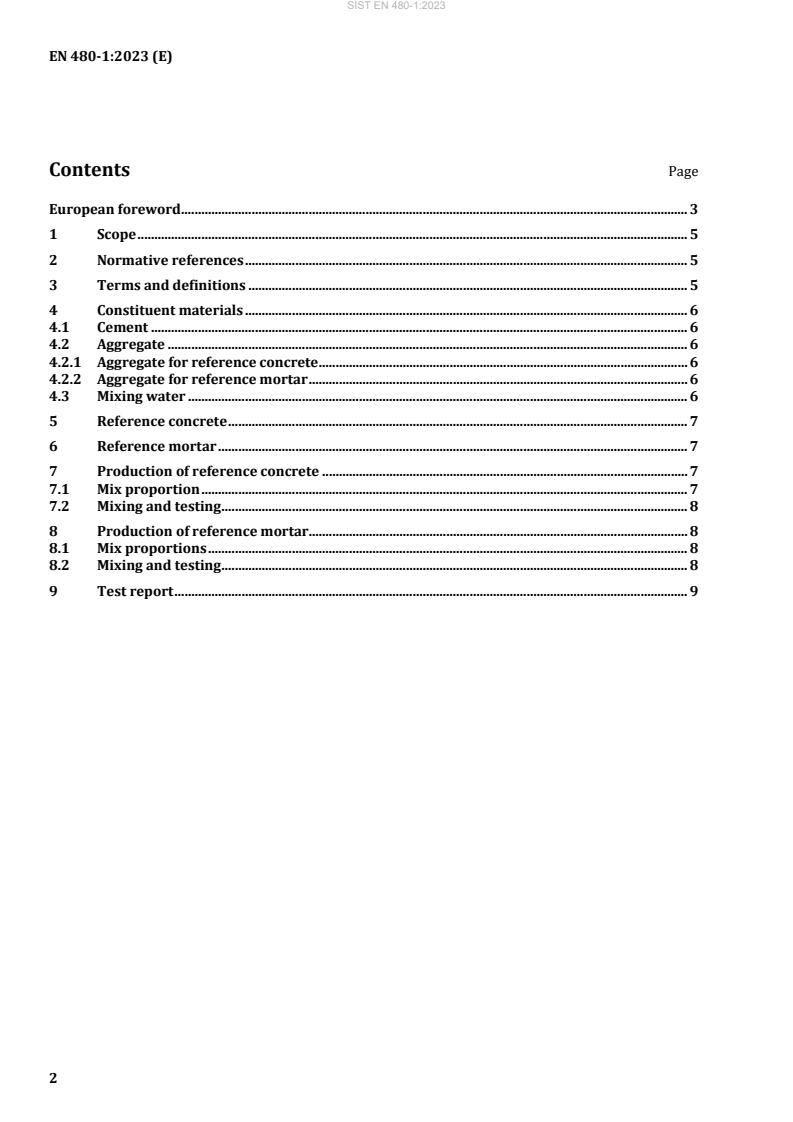
Contents Page
European foreword . 3
1 Scope . 5
2 Normative references . 5
3 Terms and definitions . 5
4 Constituent materials . 6
4.1 Cement . 6
4.2 Aggregate . 6
4.2.1 Aggregate for reference concrete . 6
4.2.2 Aggregate for reference mortar . 6
4.3 Mixing water . 6
5 Reference concrete . 7
6 Reference mortar . 7
7 Production of reference concrete . 7
7.1 Mix proportion . 7
7.2 Mixing and testing . 8
8 Production of reference mortar . 8
8.1 Mix proportions . 8
8.2 Mixing and testing . 8
9 Test report . 9
European foreword
This document (EN 480-1:2023) has been prepared by Technical Committee CEN/TC 104 “Concrete
and related products”, the secretariat of which is held by SN.
This European Standard shall be given the status of a national standard, either by publication of an
identical text or by endorsement, at the latest by January 2024, and conflicting national standards shall
be withdrawn at the latest by January 2024.
Attention is drawn to the possibility that some of the elements of this document may be the subject of
patent rights. CEN shall not be held responsible for identifying any or all such patent rights.
This document supersedes EN 480-1:2014.
This document is part of the EN 480 series, with the title Admixtures for concrete, mortar and grout —
Test methods, which comprises the following parts:
— Part 1: Reference concrete and reference mortar for testing (the present document)
— Part 2: Determination of setting time
— Part 4: Determination of bleeding of concrete
— Part 5: Determination of capillary absorption
— Part 6: Infrared analysis
— Part 8: Determination of the conventional dry material content
— Part 10: Determination of water soluble chloride content
— Part 11: Determination of air void characteristics in hardened concrete
— Part 12: Determination of the alkali content of admixtures
— Part 13: Reference masonry mortar for testing mortar admixtures
— Part 14: Determination of the effect on corrosion susceptibility of reinforcing steel by potentiostatic
electro-chemical test
— Part 15: Reference concrete and method for testing viscosity modifying admixtures
This document is intended to be used together with the standards of the EN 934 series, with the title of
Admixtures for concrete, mortar and grout.
The main changes compared to the previous edition are listed below:
a) the determination of the consistence of the reference mortar by workability in accordance with
EN 413-2 is deleted as this option is no longer covered by EN 413-2;
b) editorial changes.
Any feedback and questions on this document should be directed to the users’ national standards body.
A complete listing of these bodies can be found on the CEN website.
According to the CEN-CENELEC Internal Regulations, the national standards organisations of the
following countries are bound to implement this European Standard: Austria, Belgium, Bulgaria,
Croatia, Cyprus, Czech Republic, Denmark, Estonia, Finland, France, Germany, Greece, Hungary, Iceland,
Ireland, Italy, Latvia, Lithuania, Luxembourg, Malta, Netherlands, Norway, Poland, Portugal, Republic of
North Macedonia, Romania, Serbia, Slovakia, Slovenia, Spain, Sweden, Switzerland, Türkiye and the
United Kingdom.
1 Scope
This document specifies the constituent materials, the composition and the mixing method to produce
reference concrete and reference mortar for testing the efficacy and the compatibility of admixtures in
accordance with the EN 934 series.
2 Normative references
The following documents are referred to in the text in such a way that some or all of their content
constitutes requirements of this document. For dated references, only the edition cited applies. For
undated references, the latest edition of the referenced document (including any amendments) applies.
EN 196-1, Methods of testing cement - Part 1: Determination of strength
EN 196-2, Method of testing cement - Part 2: Chemical analysis of cement
EN 196-6, Methods of testing cement - Part 6: Determination of fineness
EN 197-1, Cement - Part 1: Composition, specifications and conformity criteria for common cements
EN 413-2, Masonry cement - Part 2: Test methods
EN 934 (all parts), Admixtures for concrete, mortar and grout
EN 1008, Mixing water for concrete - Specification for sampling, testing and assessing the suitability of
water, including water recovered from processes in the concrete industry, as mixing water for concrete
EN 12350-2, Testing f
...