

EN 14574:2015
(Main)Geosynthetics - Determination of the pyramid puncture resistance of supported geosynthetics
General Information
- Abstract
This European Standard specifies an index test method to determine the puncture resistance of a geosynthetic on a rigid support.
This method simulates the efficiency of a geosynthetic protecting a geosynthetic barrier material or another contact surface against sharp rigid elements under short term loading.
- Status
- Published
- Publication Date
- 07-Apr-2015
- Withdrawal Date
- 30-Oct-2015
- Technical Committee
- CEN/TC 189 - Geotextiles and geotextile-related products
- Drafting Committee
- CEN/TC 189/WG 3 - Mechanical testing
- Current Stage
- 9020 - Submission to 2 Year Review Enquiry - Review Enquiry
- Start Date
- 15-Jul-2026
- Completion Date
- 15-Jul-2026


Overview
EN 14574:2015 is a European Standard developed by CEN that specifies an index test method for determining the pyramid puncture resistance of supported geosynthetics. This assessment focuses on the ability of geosynthetics to withstand puncture by sharp, rigid elements when placed on a hard support under short-term loading conditions. The method simulates real-world scenarios where geosynthetics protect barrier materials or contact surfaces from damage due to mechanical puncture forces.
This standard is essential for manufacturers, engineers, and quality control professionals involved in geosynthetic selection and performance verification to ensure durability and reliability in applications such as landfill liners, waterproofing membranes, erosion control layers, and reinforcement systems.
Key Topics
Test Principle
The test involves securing the geosynthetic specimen flat on a rigid aluminium plate supported by a steel base. A steel loading piston with a pyramid-shaped apex presses onto the specimen at a controlled speed until puncture occurs. The maximum load at perforation, known as the push-through load, indicates the specimen's protection efficiency against sharp objects.Apparatus and Test Setup
- A tensile/compression testing machine capable of maintaining a constant piston speed with calibrated force measurement according to EN ISO 7500-1.
- A 3 mm thick aluminium plate (AlMgSi1F32) simulates the rigid underlying medium.
- The loading piston features a four-sided pyramid apex with a 90° angle, polished and hardened, with precise rounded radii to standardize the puncture characteristics.
- An electrical circuit between the piston and aluminium plate detects the exact moment of specimen perforation by monitoring electrical continuity.
Specimen Preparation and Conditioning
- Ten specimens sized 100 mm x 100 mm are sampled as per EN ISO 9862 for testing.
- Conditioning in a controlled atmosphere (20 ± 2 °C and 65 ± 5 % relative humidity) following ISO 554 ensures consistent and comparable results.
- Mass stability of less than 0.25% between successive weighing over 2-hour intervals confirms proper conditioning.
Testing Procedure and Reporting
- The test speed is maintained at 1.0 ± 0.1 mm/min during loading.
- The push-through load is recorded via the electrical circuit or carefully noted manually if automatic detection is unavailable.
- Results are reported as the arithmetic average of the ten tests, including individual values, coefficient of variation, and any deviations from the prescribed method.
Applications
EN 14574:2015 is highly relevant for evaluating the mechanical protection performance in:
Landfill and Waste Containment Systems
Protecting geomembranes and barrier layers from puncture by debris or sharp objects embedded in overlying materials.Road and Railway Infrastructure
Ensuring geosynthetics used in reinforcement or drainage layers resist damage from aggregate or machinery-induced sharp forces.Environmental Engineering
Verifying durability of barrier systems in water reservoirs, canals, and industrial containment where geosynthetics prevent leakage yet face mechanical risks.Civil Engineering Projects
Assessing product resistance in erosion control mats, retaining wall reinforcements, and other ground stabilization applications with potential puncture threats.
Related Standards
- EN ISO 9862 - Sampling and preparation of geosynthetic test specimens to ensure standardized specimen selection.
- EN ISO 7500-1 - Calibration and verification of testing machines used in tension and compression tests, vital for accurate force measurement.
- EN 485-2 - Mechanical properties of aluminium sheets, defining specifications for the rigid supporting plate used in testing.
- ISO 554 - Standard atmospheres for conditioning and testing, providing a consistent environmental context for reproducible results.
- EN ISO 10320 - Site identification and labelling of geotextiles and related products to maintain traceability during testing.
This standard plays a critical role in quality assurance and material selection by providing a clear, repeatable procedure for measuring the puncture resistance of geosynthetics supported on rigid substrates. Its adoption supports product development, compliance verification, and risk management in geotechnical and environmental engineering applications.
Relations
- Effective Date
- 28-Nov-2009
- Effective Date
- 04-Mar-2026
- Effective Date
- 28-Jan-2026
- Effective Date
- 28-Jan-2026
- Effective Date
- 28-Jan-2026
- Effective Date
- 28-Jan-2026
- Effective Date
- 28-Jan-2026
- Effective Date
- 28-Jan-2026
- Effective Date
- 28-Jan-2026
- Effective Date
- 28-Jan-2026
- Effective Date
- 28-Jan-2026
- Effective Date
- 28-Jan-2026
- Effective Date
- 28-Jan-2026
- Effective Date
- 28-Jan-2026
- Effective Date
- 28-Jan-2026
Get Certified
Connect with accredited certification bodies for this standard

Control Union Certifications
Global certification for agriculture and sustainability.

Hohenstein Institut
Textile testing and certification.

Bureau Veritas Bangladesh
Bureau Veritas certification services in Bangladesh.
Sponsored listings
Frequently Asked Questions
EN 14574:2015 is a standard published by the European Committee for Standardization (CEN). Its full title is "Geosynthetics - Determination of the pyramid puncture resistance of supported geosynthetics". This standard covers: This European Standard specifies an index test method to determine the puncture resistance of a geosynthetic on a rigid support. This method simulates the efficiency of a geosynthetic protecting a geosynthetic barrier material or another contact surface against sharp rigid elements under short term loading.
This European Standard specifies an index test method to determine the puncture resistance of a geosynthetic on a rigid support. This method simulates the efficiency of a geosynthetic protecting a geosynthetic barrier material or another contact surface against sharp rigid elements under short term loading.
EN 14574:2015 is classified under the following ICS (International Classification for Standards) categories: 59.080.70 - Geotextiles. The ICS classification helps identify the subject area and facilitates finding related standards.
EN 14574:2015 has the following relationships with other standards: It is inter standard links to EN 14574:2004, ISO 554:1976, EN 485-2:2016+A1:2018, EN 915:1996, EN ISO 9862:2023, EN ISO 10320:2019, EN ISO 7500-1:2018, EN 13254:2014, EN 13256:2016, EN 13255:2014+A1:2015, EN 13265:2014+A1:2015, EN 13254:2014+A1:2015, EN 13254:2016, EN 13257:2014+A1:2015, EN 13256:2014. Understanding these relationships helps ensure you are using the most current and applicable version of the standard.
EN 14574:2015 is associated with the following European legislation: EU Directives/Regulations: 305/2011, 89/106/EEC. When a standard is cited in the Official Journal of the European Union, products manufactured in conformity with it benefit from a presumption of conformity with the essential requirements of the corresponding EU directive or regulation.
EN 14574:2015 is available in PDF format for immediate download after purchase. The document can be added to your cart and obtained through the secure checkout process. Digital delivery ensures instant access to the complete standard document.
Standards Content (Sample)
2003-01.Slovenski inštitut za standardizacijo. Razmnoževanje celote ali delov tega standarda ni dovoljeno.Geosintetika - Ugotavljanje prebodne odpornosti podporne geosintetike proti preluknjanju s piramidnim bodalomGeokunststoffe - Bestimmung der Pyramidendurchdrückwiderstandes von Geokunststoffen auf harter UnterlageGéosynthétiques - Détermination de la résistance au poinçonnement pyramidal de géosynthétiques sur supportGeosynthetics - Determination of the pyramid puncture resistance of supported geosynthetics59.080.70GeotekstilijeGeotextilesICS:Ta slovenski standard je istoveten z:EN 14574:2015SIST EN 14574:2015en,fr,de01-junij-2015SIST EN 14574:2015SLOVENSKI
STANDARDSIST EN 14574:20051DGRPHãþD
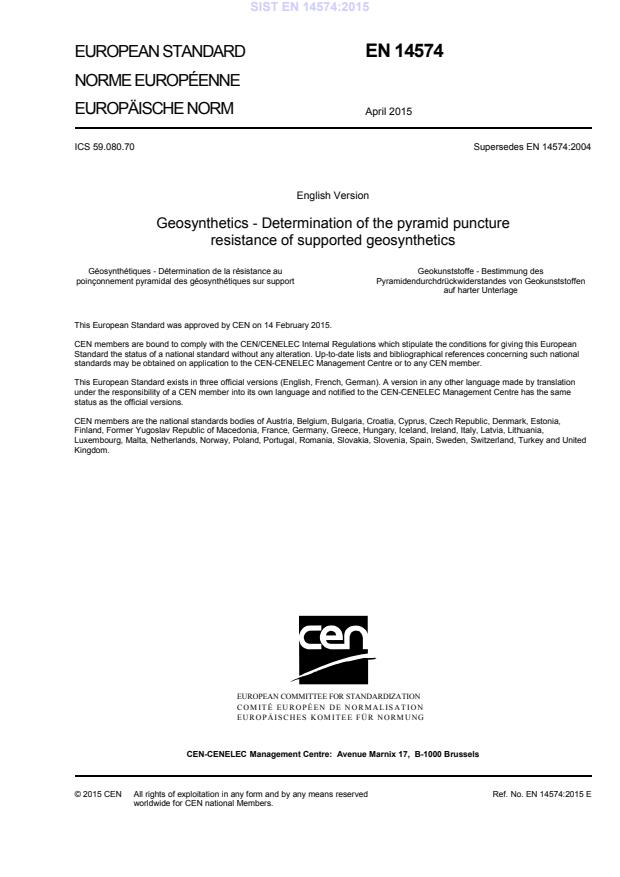
EUROPEAN STANDARD NORME EUROPÉENNE EUROPÄISCHE NORM
EN 14574
April 2015 ICS 59.080.70 Supersedes EN 14574:2004English Version
Geosynthetics - Determination of the pyramid puncture resistance of supported geosynthetics
Géosynthétiques - Détermination de la résistance au poinçonnement pyramidal des géosynthétiques sur support Geokunststoffe - Bestimmung des Pyramidendurchdrückwiderstandes von Geokunststoffen auf harter Unterlage This European Standard was approved by CEN on 14 February 2015.
CEN members are bound to comply with the CEN/CENELEC Internal Regulations which stipulate the conditions for giving this European Standard the status of a national standard without any alteration. Up-to-date lists and bibliographical references concerning such national standards may be obtained on application to the CEN-CENELEC Management Centre or to any CEN member.
This European Standard exists in three official versions (English, French, German). A version in any other language made by translation under the responsibility of a CEN member into its own language and notified to the CEN-CENELEC Management Centre has the same status as the official versions.
CEN members are the national standards bodies of Austria, Belgium, Bulgaria, Croatia, Cyprus, Czech Republic, Denmark, Estonia, Finland, Former Yugoslav Republic of Macedonia, France, Germany, Greece, Hungary, Iceland, Ireland, Italy, Latvia, Lithuania, Luxembourg, Malta, Netherlands, Norway, Poland, Portugal, Romania, Slovakia, Slovenia, Spain, Sweden, Switzerland, Turkey and United Kingdom.
EUROPEAN COMMITTEE FOR STANDARDIZATION
COMITÉ EUROPÉEN DE NORMALISATION EUROPÄISCHES KOMITEE FÜR NORMUNG
CEN-CENELEC Management Centre:
Avenue Marnix 17,
B-1000 Brussels © 2015 CEN All rights of exploitation in any form and by any means reserved worldwide for CEN national Members. Ref. No. EN 14574:2015 ESIST EN 14574:2015
...