EN 10248-1:2023
(Main)Hot-rolled steel sheet piles - Part 1: Technical delivery conditions
Hot-rolled steel sheet piles - Part 1: Technical delivery conditions
This document specifies the requirements for hot rolled steel sheet piles in respect of its chemical composition, mechanical properties and conditions of delivery.
The products specified are for general, structural and civil engineering works. The types of steel sheet piles covered by this document are: Z-shaped, U-shaped, straight web, H-shaped with their interlocking bars. The types of interlocks and the requirements in respect of tolerances on shape and dimensions are specified in Part 2 of this document.
Warmgewalzte Spundbohlen aus Stahl - Teil 1: Technische Lieferbedingungen
Dieses Dokument legt Anforderungen an warmgewalzte Spundbohlen aus Stahl hinsichtlich ihrer chemischen Zusammensetzung, mechanischen Eigenschaften und Lieferbedingungen fest.
Die angegebenen Erzeugnisse eignen sich für allgemeine Zwecke, Stahlbau und Tiefbauarbeiten. Dieses Dokument behandelt folgende Formen von Stahlspundbohlen: Z-Profil, U-Profil, Flachprofil, H-Profil mit ihren Verbindungsschlössern. Die Formen der Schlösser und die Festlegungen bezüglich der Grenzabmaße und Formtoleranzen sind in Teil 2 dieses Dokumentes enthalten.
Palplanches en acier laminées à chaud - Partie 1: Conditions techniques de livraison
Le présent document spécifie les prescriptions relatives à la composition chimique, aux caractéristiques mécaniques et aux conditions de livraison des palplanches en acier laminées à chaud.
Les produits désignés sont destinés à être utilisés dans la réalisation d'ouvrages divers, d'ouvrages de génie civil et d'éléments de construction. Les types de palplanches en acier couverts dans le présent document sont : les palplanches en Z, en U, plates, en H avec leurs serrures. Les types de serrures et les prescriptions relatives aux tolérances sur forme et dimensions sont spécifiés dans la Partie 2 du présent document.
Vroče valjane jeklene zagatnice - 1. del: Tehnični dobavni pogoji
Ta dokument določa zahteve za pilote iz vroče valjanega jekla glede na njegovo kemično sestavo, mehanske lastnosti in dobavne pogoje. Navedeni izdelki so namenjeni za splošna, konstrukcijska in gradbena dela. Vrste pilotov iz jeklene pločevine, ki jih zajema ta standard, so: Jeklena pločevina v obliki črke Z, črke U, ravne mreže, obliki črke H s prepletenimi palicami
General Information
- Status
- Published
- Publication Date
- 07-Mar-2023
- Technical Committee
- ECISS/TC 103 - Structural steels other than reinforcements
- Drafting Committee
- CEN/TC 459/SC 3/WG 1 - Sheet piles
- Current Stage
- 6060 - Definitive text made available (DAV) - Publishing
- Start Date
- 08-Mar-2023
- Due Date
- 09-Nov-2022
- Completion Date
- 08-Mar-2023
Relations
- Effective Date
- 16-Dec-2020
Overview
EN 10248-1:2023 - Hot-rolled steel sheet piles - Part 1: Technical delivery conditions (CEN) defines the technical delivery requirements for hot-rolled steel sheet piles used in general, structural and civil engineering works. The standard covers Z-shaped, U-shaped, straight web and H-shaped sheet piles (including their interlocking bars), specifying required chemical composition, mechanical properties, delivery conditions, and inspection and testing arrangements. Part 2 of EN 10248 addresses tolerances on shape and dimensions.
Key topics and requirements
- Steel grades and classification: Covers non-alloy structural grades S240, S270, S320, S355, S390, S430, S460 and S500 supplied in quality GP. Designation follows EN 10027 conventions (e.g., EN 10248-1 – S430GP).
- Chemical composition: Heat and product analysis limits are required. The standard uses the IIW carbon equivalent (CEV) formula to control weldability and mechanical behaviour. Agreed copper levels (0.20–0.35% or 0.35–0.50%) and small CEV increases (typically +0.02) are permitted by order.
- Mechanical properties: Minimum yield/tensile values and impact provisions are specified under defined inspection/testing conditions (see Clauses 7.3 and 10).
- Manufacturing & delivery: Steelmaking routes are at the manufacturer’s discretion (open‑hearth/Siemens‑Martin excluded). Unless agreed otherwise, sheet piles are delivered as-rolled; options allow other delivery conditions.
- Surface protection: Provisions include requirements relevant to hot-dip zinc-coating and interaction with chemistry (see Clause 7.4.3 and EN ISO 14713-2 guidance).
- Interlocks, tolerances & load capacity: Interlock types and dimensional/tolerance rules are in Part 2. Part 1 adds requirements and test methods for load-bearing capacity, interlock resistance and crimped-point resistance (Normative annexes C–E).
- Inspection & documentation: Inspection types, sampling, test frequencies, and inspection documents (EN 10204) are defined in Clauses 8–10. Marking, labelling, packaging and complaint procedures are included.
Applications and users
- Target users: steel producers, sheet pile manufacturers, structural/civil engineers, piling contractors, specification writers, procurement and QA teams.
- Typical applications: retaining walls, cofferdams, quay walls, marine and flood defence works, foundation and temporary works where consistent material properties, interlock performance and corrosion protection are essential.
- Practical benefit: EN 10248-1:2023 ensures repeatable performance, weldability and traceability of hot-rolled sheet piles and supports conformity with Eurocode piling design (EN 1993-5).
Related standards
- EN 10248-2 (Tolerances on shape and dimensions)
- EN 10204 (Inspection documents)
- EN 1993-5 / EN 1990 (Eurocode - piling/design basis)
- EN ISO 6892-1, EN ISO 148-1 (tensile and impact testing)
- EN ISO 14713-2 (hot-dip galvanizing guidance)
Keywords: EN 10248-1:2023, hot-rolled steel sheet piles, technical delivery conditions, steel grades S240–S500, chemical composition, mechanical properties, inspection and testing.
Frequently Asked Questions
EN 10248-1:2023 is a standard published by the European Committee for Standardization (CEN). Its full title is "Hot-rolled steel sheet piles - Part 1: Technical delivery conditions". This standard covers: This document specifies the requirements for hot rolled steel sheet piles in respect of its chemical composition, mechanical properties and conditions of delivery. The products specified are for general, structural and civil engineering works. The types of steel sheet piles covered by this document are: Z-shaped, U-shaped, straight web, H-shaped with their interlocking bars. The types of interlocks and the requirements in respect of tolerances on shape and dimensions are specified in Part 2 of this document.
This document specifies the requirements for hot rolled steel sheet piles in respect of its chemical composition, mechanical properties and conditions of delivery. The products specified are for general, structural and civil engineering works. The types of steel sheet piles covered by this document are: Z-shaped, U-shaped, straight web, H-shaped with their interlocking bars. The types of interlocks and the requirements in respect of tolerances on shape and dimensions are specified in Part 2 of this document.
EN 10248-1:2023 is classified under the following ICS (International Classification for Standards) categories: 77.140.70 - Steel profiles. The ICS classification helps identify the subject area and facilitates finding related standards.
EN 10248-1:2023 has the following relationships with other standards: It is inter standard links to EN 10248-1:1995. Understanding these relationships helps ensure you are using the most current and applicable version of the standard.
You can purchase EN 10248-1:2023 directly from iTeh Standards. The document is available in PDF format and is delivered instantly after payment. Add the standard to your cart and complete the secure checkout process. iTeh Standards is an authorized distributor of CEN standards.
Standards Content (Sample)
SLOVENSKI STANDARD
01-maj-2023
Vroče valjane jeklene zagatnice - 1. del: Tehnični dobavni pogoji
Hot-rolled steel sheet piles - Part 1: Technical delivery conditions
Warmgewalzte Spundbohlen aus Stahl - Teil 1: Technische Lieferbedingungen
Palplanches en acier laminées à chaud - Partie 1: Conditions techniques de livraison
Ta slovenski standard je istoveten z: EN 10248-1:2023
ICS:
77.140.45 Nelegirana jekla Non-alloyed steels
77.140.70 Jekleni profili Steel profiles
2003-01.Slovenski inštitut za standardizacijo. Razmnoževanje celote ali delov tega standarda ni dovoljeno.
EN 10248-1
EUROPEAN STANDARD
NORME EUROPÉENNE
March 2023
EUROPÄISCHE NORM
ICS 77.140.70 Supersedes EN 10248-1:1995
English Version
Hot-rolled steel sheet piles - Part 1: Technical delivery
conditions
Palplanches en acier laminées à chaud - Partie 1: Warmgewalzte Spundbohlen aus Stahl - Teil 1:
Conditions techniques de livraison Technische Lieferbedingungen
This European Standard was approved by CEN on 17 January 2023.
CEN members are bound to comply with the CEN/CENELEC Internal Regulations which stipulate the conditions for giving this
European Standard the status of a national standard without any alteration. Up-to-date lists and bibliographical references
concerning such national standards may be obtained on application to the CEN-CENELEC Management Centre or to any CEN
member.
This European Standard exists in three official versions (English, French, German). A version in any other language made by
translation under the responsibility of a CEN member into its own language and notified to the CEN-CENELEC Management
Centre has the same status as the official versions.
CEN members are the national standards bodies of Austria, Belgium, Bulgaria, Croatia, Cyprus, Czech Republic, Denmark, Estonia,
Finland, France, Germany, Greece, Hungary, Iceland, Ireland, Italy, Latvia, Lithuania, Luxembourg, Malta, Netherlands, Norway,
Poland, Portugal, Republic of North Macedonia, Romania, Serbia, Slovakia, Slovenia, Spain, Sweden, Switzerland, Türkiye and
United Kingdom.
EUROPEAN COMMITTEE FOR STANDARDIZATION
COMITÉ EUROPÉEN DE NORMALISATION
EUROPÄISCHES KOMITEE FÜR NORMUNG
CEN-CENELEC Management Centre: Rue de la Science 23, B-1040 Brussels
© 2023 CEN All rights of exploitation in any form and by any means reserved Ref. No. EN 10248-1:2023 E
worldwide for CEN national Members.
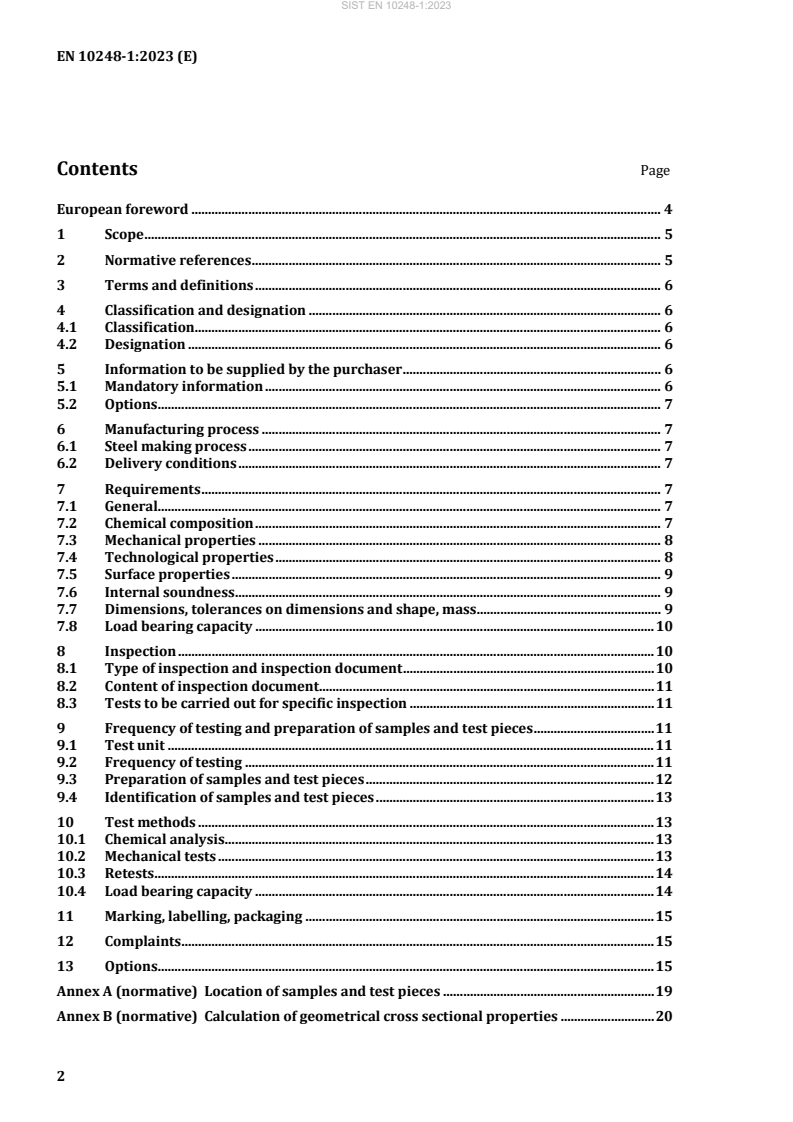
Contents Page
European foreword . 4
1 Scope . 5
2 Normative references . 5
3 Terms and definitions . 6
4 Classification and designation . 6
4.1 Classification. 6
4.2 Designation . 6
5 Information to be supplied by the purchaser . 6
5.1 Mandatory information . 6
5.2 Options . 7
6 Manufacturing process . 7
6.1 Steel making process . 7
6.2 Delivery conditions . 7
7 Requirements . 7
7.1 General. 7
7.2 Chemical composition . 7
7.3 Mechanical properties . 8
7.4 Technological properties . 8
7.5 Surface properties . 9
7.6 Internal soundness . 9
7.7 Dimensions, tolerances on dimensions and shape, mass . 9
7.8 Load bearing capacity . 10
8 Inspection . 10
8.1 Type of inspection and inspection document . 10
8.2 Content of inspection document. 11
8.3 Tests to be carried out for specific inspection . 11
9 Frequency of testing and preparation of samples and test pieces . 11
9.1 Test unit . 11
9.2 Frequency of testing . 11
9.3 Preparation of samples and test pieces . 12
9.4 Identification of samples and test pieces . 13
10 Test methods . 13
10.1 Chemical analysis . 13
10.2 Mechanical tests . 13
10.3 Retests . 14
10.4 Load bearing capacity . 14
11 Marking, labelling, packaging . 15
12 Complaints . 15
13 Options . 15
Annex A (normative) Location of samples and test pieces . 19
Annex B (normative) Calculation of geometrical cross sectional properties . 20
Annex C (normative) Interlock resistance of straight web sheet piles . 21
Annex D (normative) Determination of the resistance of crimped points for U-shaped sheet
piles . 23
Annex E (normative) Interlock performance criteria . 27
Bibliography . 33
European foreword
This document (EN 10248-1:2023) has been prepared by Technical Committee CEN/TC 459/SC 3
“Structural steels other than reinforcements”, the secretariat of which is held by DIN.
This European Standard shall be given the status of a national standard, either by publication of an
identical text or by endorsement, at the latest by September 2023, and conflicting national standards shall
be withdrawn at the latest by September 2023.
Attention is drawn to the possibility that some of the elements of this document may be the subject of
patent rights. CEN shall not be held responsible for identifying any or all such patent rights.
This document supersedes EN 10248-1:1995.
In comparison with the previous edition, the following technical modifications have been made:
a) Document was restructured;
b) Normative references were updated;
c) Grades S460 and S500 in quality GP were introduced;
d) Modification concerning the maximum values for the chemical composition;
e) Addition of 7.4.3 dedicated for hot-dip zinc-coating and 7.8 for load bearing capacity;
f) New wording for Clauses 8, 9 and 10 for inspection and testing;
g) Addition of Clause 12 on the complaints;
h) Removal of the former Annexes B and C on Euronorms and equivalent designations;
i) Addition of the Annexes B, C, D and E.
EN 10248 consists of the following parts, under the general title Hot-rolled steel sheet piles:
— Part 1: Technical delivery conditions
— Part 2: Tolerances on shape and dimensions
A further standard prEN 10375 with the title Hot-rolled steel sheet piles – General (Characteristics,
evaluation of conformity and marking) is in preparation and can be used together with EN 10248 after
publication.
Any feedback and questions on this document should be directed to the users’ national standards body.
A complete listing of these bodies can be found on the CEN website.
According to the CEN-CENELEC Internal Regulations, the national standards organisations of the
following countries are bound to implement this European Standard: Austria, Belgium, Bulgaria, Croatia,
Cyprus, Czech Republic, Denmark, Estonia, Finland, France, Germany, Greece, Hungary, Iceland, Ireland,
Italy, Latvia, Lithuania, Luxembourg, Malta, Netherlands, Norway, Poland, Portugal, Republic of North
Macedonia, Romania, Serbia, Slovakia, Slovenia, Spain, Sweden, Switzerland, Türkiye and the United
Kingdom.
1 Scope
This document specifies the requirements for hot rolled steel sheet piles in respect of its chemical
composition, mechanical properties and conditions of delivery.
The products specified are for general, structural and civil engineering works. The types of steel sheet
piles covered by this document are: Z-shaped, U-shaped, straight web, H-shaped with their interlocking
bars. The types of interlocks and the requirements in respect of tolerances on shape and dimensions are
specified in Part 2 of this document.
2 Normative references
The following documents are referred to in the text in such a way that some or all of their content
constitutes requirements of this document. For dated references, only the edition cited applies. For
undated references, the latest edition of the referenced document (including any amendments) applies.
EN 1011-2, Welding - Recommendations for welding of metallic materials - Part 2: Arc welding of ferritic
steels
EN 1990:2002, Eurocode - Basis of structural design
EN 1993-5:2007, Eurocode 3 - Design of steel structures - Part 5: Piling
EN 10020:2000, Definition and classification of grades of steel
EN 10021:2006, General technical delivery conditions for steel products
EN 10027-1, Designation systems for steels - Part 1: Steel names
EN 10027-2, Designation systems for steels - Part 2: Numerical system
EN 10079:2007, Definition of steel products
EN 10168, Steel products - Inspection documents - List of information and description
EN 10204, Metallic products - Types of inspection documents
EN 10248-2, Hot-rolled steel sheet piles - Part 2: Tolerances on shape and dimensions
CEN/TR 10261, Iron and steel - European standards for the determination of chemical composition
EN ISO 148-1, Metallic materials - Charpy pendulum impact test - Part 1: Test method (ISO 148-1)
EN ISO 377, Steel and steel products - Location and preparation of samples and test pieces for mechanical
testing (ISO 377)
EN ISO 2566-1, Steel - Conversion of elongation values - Part 1: Carbon and low-alloy steels (ISO 2566-
1:2021, Corrected version 2022-06)
EN ISO 6892-1, Metallic materials - Tensile testing - Part 1: Method of test at room temperature (ISO 6892-
1)
EN ISO 14284, Steel and iron - Sampling and preparation of samples for the determination of chemical
composition (ISO 14284)
As impacted by EN 1990:2002/A1:2005.
EN ISO 14713-2:2020, Zinc coatings - Guidelines and recommendations for the protection against corrosion
of iron and steel in structures - Part 2: Hot dip galvanizing (ISO 14713-2:2019)
3 Terms and definitions
For the purposes of this document, the terms and definitions given in EN 10020:2000, EN 10021:2006
and EN 10079:2007 apply.
ISO and IEC maintain terminological databases for use in standardization at the following addresses:
— IEC Electropedia: available at https://www.electropedia.org/
— ISO Online browsing platform: available at https://www.iso.org/obp
4 Classification and designation
4.1 Classification
4.1.1 Main quality classes
The steel grades specified in this document shall be classified as non-alloy quality steels according to
EN 10020.
4.1.2 Grades and qualities
This document specifies eight steel grades S240, S270, S320, S355, S390, S430, S460 and S500 on the
basis of the minimum specified yield strength at room temperature.
The eight steel grades are supplied in quality GP.
4.2 Designation
4.2.1 For the steel grades covered by this document in Table 1 the steel names shall be allocated in
accordance with EN 10027-1; the steel numbers shall be allocated in accordance with EN 10027-2.
4.2.2 The designation of the steel grade shall consist of:
— the number of this document (EN 10248-1);
— the steel name or the steel number.
EXAMPLE Steel sheet piles in accordance with EN 10248-1 made of structural steels (S) with a specified
minimum yield strength at room temperature of 430 MPa, followed by GP for steel sheet piles:
EN 10248-1 – S430GP
or
EN 10248-1 – 1.0523
5 Information to be supplied by the purchaser
5.1 Mandatory information
The following information shall be supplied by the purchaser at the time of the enquiry and order:
a) quantity to be delivered;
b) product name (including all necessary information);
c) the name of the standard for tolerances on dimensions and shape (see 7.7);
d) length and delivery form;
e) steel designation (see 4.2.2);
f) additional requirements of inspection and testing and all required options (see 5.2 and Clause 13);
g) type of inspection document according to EN 10204 (see 8.1).
5.2 Options
A number of options are specified in Clause 13. In the event that the purchaser does not indicate his wish
to implement any of these options, the supplier shall supply in accordance with the basic specification,
see 5.1 a) to e) and g).
6 Manufacturing process
6.1 Steel making process
The steel making process is at the discretion of the manufacturer with the exclusion of the open hearth
(Siemens-Martin) process.
See Option 1, Clause 13, (Details of manufacturing process).
6.2 Delivery conditions
Unless otherwise agreed, sheet piles shall be delivered in the as-rolled condition.
See Option 2, Clause 13, (Delivery conditions).
7 Requirements
7.1 General
The requirements in 7.2 and 7.3 apply for sampling, preparation of test pieces and testing specified in
Clauses 9 and 10.
7.2 Chemical composition
7.2.1 The chemical composition determined by heat analysis shall comply with the specified values of
Table 1.
For elements not specified in tables for the chemical composition for heat analysis, limit values of Table 1
of EN 10020:2000 shall apply as maximum values.
7.2.2 The upper limits applicable for the product analysis are given in Table 2.
For elements not specified in tables for the chemical composition for product analysis, limit values of
Table 1 of EN 10020:2000 shall apply as maximum values.
7.2.3 The maximum carbon equivalent values for the grades based on the heat analysis given in Table 1
shall apply.
The maximum carbon equivalent values for the grades based on the product analysis given in Table 2
shall apply.
For determining the carbon equivalent value, the following IIW (International Institute of Welding)
formula shall be used:
Mn Cr++Mo V Ni+Cu
(1)
CEV=C++ +
6 5 15
7.2.4 For all steel grades a copper-content between 0,20 % and 0,35 %, or between 0,35 % and 0,50 %
on the heat analysis (for different corrosion protection levels) can be agreed upon at the time of enquiry
and order. In both cases, the maximum carbon equivalent value of Table 1 shall be increased by 0,02.
See Option 3, Clause 13, (Cu alloyed).
7.2.5 When products of grades S270 to S355 are supplied with a control on Si, e. g. for hot-dip
zinc-coating, so that there could be a need to increase the content of other elements like C and Mn to
achieve the required tensile properties, the maximum carbon equivalent values of Table 1 may be
increased as follows:
— for Si ≤ 0,04 %, increase the value of the CEV by 0,02;
— for Si ≤ 0,25 %, increase the value of the CEV by 0,01.
7.3 Mechanical properties
7.3.1 General
Under the inspection and testing conditions as specified in Clauses 8, 9 and 10, the mechanical properties
shall comply with the values given in Table 3.
7.3.2 Impact properties
The impact properties shall be verified by test at the temperature given in Table 3, unless otherwise
agreed upon at the time of the order.
Using test pieces of width less than 10 mm, the minimum values given in Table 3 shall be reduced in direct
proportion to the cross-sectional area of the test piece.
See Option 4, Clause 13, (Verification of impact energy).
7.4 Technological properties
7.4.1 Weldability
General requirements for arc welding of the steels shall be as given in EN 1011-2. In general, steel sheet
pile grades are suitable for arc welding.
NOTE 1 With increasing product thickness and strength level, cold cracking can occur. Cold cracking is caused
by the following factors in combination:
— the amount of diffusible hydrogen in the weld metal;
— a brittle structure of the heat affected zone;
— significant tensile stress concentrations in the welded joint.
NOTE 2 Steels specified in this document do not have unlimited suitability for the various welding processes,
since the behaviour of a steel during and after welding depends not only on the material, but also on the dimensions
and shape and on the manufacturing and service conditions of the components.
7.4.2 Flame straightening
Recommendations regarding flame straightening are laid down in CEN/TR 10347.
7.4.3 Hot-dip zinc-coating
EN ISO 1461 should be used to specify coating requirements. EN ISO 14713-2 provides further guidance,
including information on the influence of various factors, including steel chemical composition, on the
coating formation.
Option 5, Clause 13, can be used to order steels with a chemical composition required for hot-dip zinc
coating. When Option 5 is implemented, the purchaser and manufacturer shall agree to a steel
composition (heat analysis) of silicon and phosphorous according to either:
Category A (see also EN ISO 14713-2:2020, Table 1, Note 1); or
Category B; or
Category D (limited to 0,25 % < Si ≤ 0,35 %)
with required values as cited by the ranges given in EN ISO 14713-2:2020, Table 1, column 2.
NOTE EN ISO 14713-2:2020, Table 1, gives guidance on typical coating characteristics associated with certain
steel compositions on the basis of the surface composition of silicon and phosphorous.
The maximum carbon equivalent shall be increased by 0,02 or by 0,01 (see 7.2.5).
In some cases, steels above S460 may be sensitive to cracking during galvanizing and therefore special
care should be taken.
See Option 5, Clause 13, (Chemical composition for hot-dip zinc-coating).
7.5 Surface properties
EN 10163-1 and EN 10163-3 shall apply for the permissible surface discontinuities and for the repair of
surface defects by grinding and/or welding. Class C, subclass 1 of EN 10163-3 shall apply, unless
otherwise agreed upon at the time of the order.
The surface requirements and repair conditions of sheet piles shall apply to all surfaces excluding
interlocks and radii at the connection between web and flange.
See Option 6, Clause 13, (Other surface class).
7.6 Internal soundness
The internal soundness shall be in accordance with EN 10021.
7.7 Dimensions, tolerances on dimensions and shape, mass
Dimensions, tolerances on dimensions and shape shall be in accordance with the requirements given in
the standard EN 10248-2.
The nominal mass shall be determined from the nominal dimensions using a volumetric mass of
7 850 kg/m .
7.8 Load bearing capacity
7.8.1 General
The design of steel sheet pile structures requires determination of the actions on the structure, for
example the earth pressure, the water pressure, the surface surcharge, etc., and the appropriate
resistances. The actions will give rise to effects all over the structure, for instance internal forces and
moments, stresses, strains and displacements. Additional local effects will also be produced for instance
at points of load applications. The resistances of the sheet piles to the effects of the loads shall be
determined according to EN 1993-5, if applicable. For applicability, reference can be made to Report
EUR 20034 EN (Development of unified design rules for steel sheet piles for introduction into
EN 1993-5). If a calculation method for a specific resistance is not applicable, the resistance shall be
determined by direct testing in accordance with EN 1993-5.
In general, the section resistance can be expressed as the product of the material strength for the chosen
steel grade and a specified geometrical section property dependant on the nominal dimensions of the
section. The rules for calculating the section properties from the nominal dimensions shall be in
accordance with normative Annex B.
7.8.2 Interlock resistance of straight web sheet piles
The interlock resistance of straight web sheet piles shall be agreed at the time of enquiry and order, and
shall be tested according to the conditions as specified in 9.2.4.
7.8.3 Resistance of crimped points of U-shaped sheet piles
Crimped points can be used to enhance the shear force transmission in the interlocks of U-shaped sheet
piles.
If crimped points are used to enhance the shear force transmission in the interlocks of U-shaped sheet
piles, the resistance shall be agreed at the time of enquiry and order, and shall be tested according to the
testing procedure specified in 9.2.5.
If agreed at the time of enquiry and order, the manufacturer can replace the crimping of interlocks by
intermittent welding of interlocks that achieves the same shear force transmission.
EXAMPLE Triple U-shaped sheet piles delivered with one common interlock crimped and one common
interlock partially welded.
See Option 7, Clause 13, (Welding of common interlocks).
7.8.4 Interlock performance criteria
The interlock performance criteria shall comply with the requirements of 9.2.6.
8 Inspection
8.1 Type of inspection and inspection document
The products shall be delivered either with specific or non-specific inspection and testing to indicate
compliance with the order and this document. The manufacturer shall obtain from the purchaser the
information which inspection document according to EN 10204 is required, otherwise a test report 2.2
will be issued.
In the case of specific inspection, testing shall be carried out according to the requirements of 8.3,
Clauses 9 and 10.
8.2 Content of inspection document
The inspection document shall include, in accordance with EN 10168, the following codes and/or
information, where applicable:
A commercial transactions and parties involved;
B description of products to which the inspection document applies;
C00-C03 identification of the sample, location of the sample, direction of the test pieces, test
temperature;
C10-C13 shape of the test piece, yield or proof strength, tensile strength, elongation after
fracture;
C40-C43 type of test piece, width of test piece, individual values, mean value;
C70-C92 steel making process, chemical composition;
D other tests;
Z validation.
8.3 Tests to be carried out for specific inspection
8.3.1 The following tests shall be carried out:
— the heat analysis (chemical composition);
— the tensile test;
— the impact test for the grades S355GP, S390GP, S430GP, S460GP and S500GP.
8.3.2 At the time of the enquiry and order the following additional tests can be agreed upon:
a) the product analysis, see 7.2.2 and Option 8, Clause 13, (Product analysis);
b) the impact energy for the grades S240GP, S270GP and S320GP, see Option 4, Clause 13, (Verification
of impact energy).
8.3.3 Unless otherwise agreed at the time of enquiry and order, inspection of surface conditions and
dimensions shall be carried out by the manufacturer.
See Option 9, Clause 13, (Inspection of surface conditions and dimensions).
9 Frequency of testing and preparation of samples and test pieces
9.1 Test unit
The test unit shall comprise products of the same shape and the same steel grade as specified in Table 1,
produced from the same cast, and shall have a maximum mass of 150 tonnes.
9.2 Frequency of testing
9.2.1 Chemical analysis
For heat analysis, one sample shall be taken from each cast.
If a product analysis has been agreed upon at the time of enquiry and order, one sample shall be taken
from each cast unless otherwise specified by the purchaser.
9.2.2 Mechanical tests
The verification of the mechanical properties (tensile strength, yield strength, elongation and impact
energy) shall be by test unit from within each cast.
The following samples shall be taken from one sample product of each test unit:
— one sample for tensile testing;
— one sample sufficient for one set of six impact test pieces.
9.2.3 Tolerances on dimensions and shape
Tolerances on dimension and shape shall be subject to the tests indicated in 7.7, at least with a test
frequency of one sheet pile per test unit.
9.2.4 Interlock resistance of straight web sheet piles
Interlock resistance of straight web sheet piles shall be subject to the tests as indicated in 7.8.2, with a
test frequency of one sample per test unit.
9.2.5 Resistance of crimped points of U-shaped sheet piles
...
SLOVENSKI STANDARD
01-maj-2023
Vroče valjana jeklena obešala - 1. del: Tehnični dobavni pogoji
Hot-rolled steel sheet piles - Part 1: Technical delivery conditions
Warmgewalzte Spundbohlen aus Stahl - Teil 1: Technische Lieferbedingungen
Palplanches en acier laminées à chaud - Partie 1: Conditions techniques de livraison
Ta slovenski standard je istoveten z: EN 10248-1:2023
ICS:
77.140.45 Nelegirana jekla Non-alloyed steels
77.140.70 Jekleni profili Steel profiles
2003-01.Slovenski inštitut za standardizacijo. Razmnoževanje celote ali delov tega standarda ni dovoljeno.
EN 10248-1
EUROPEAN STANDARD
NORME EUROPÉENNE
March 2023
EUROPÄISCHE NORM
ICS 77.140.70 Supersedes EN 10248-1:1995
English Version
Hot-rolled steel sheet piles - Part 1: Technical delivery
conditions
Palplanches en acier laminées à chaud - Partie 1: Warmgewalzte Spundbohlen aus Stahl - Teil 1:
Conditions techniques de livraison Technische Lieferbedingungen
This European Standard was approved by CEN on 17 January 2023.
CEN members are bound to comply with the CEN/CENELEC Internal Regulations which stipulate the conditions for giving this
European Standard the status of a national standard without any alteration. Up-to-date lists and bibliographical references
concerning such national standards may be obtained on application to the CEN-CENELEC Management Centre or to any CEN
member.
This European Standard exists in three official versions (English, French, German). A version in any other language made by
translation under the responsibility of a CEN member into its own language and notified to the CEN-CENELEC Management
Centre has the same status as the official versions.
CEN members are the national standards bodies of Austria, Belgium, Bulgaria, Croatia, Cyprus, Czech Republic, Denmark, Estonia,
Finland, France, Germany, Greece, Hungary, Iceland, Ireland, Italy, Latvia, Lithuania, Luxembourg, Malta, Netherlands, Norway,
Poland, Portugal, Republic of North Macedonia, Romania, Serbia, Slovakia, Slovenia, Spain, Sweden, Switzerland, Türkiye and
United Kingdom.
EUROPEAN COMMITTEE FOR STANDARDIZATION
COMITÉ EUROPÉEN DE NORMALISATION
EUROPÄISCHES KOMITEE FÜR NORMUNG
CEN-CENELEC Management Centre: Rue de la Science 23, B-1040 Brussels
© 2023 CEN All rights of exploitation in any form and by any means reserved Ref. No. EN 10248-1:2023 E
worldwide for CEN national Members.
Contents Page
European foreword . 4
1 Scope . 5
2 Normative references . 5
3 Terms and definitions . 6
4 Classification and designation . 6
4.1 Classification. 6
4.2 Designation . 6
5 Information to be supplied by the purchaser . 6
5.1 Mandatory information . 6
5.2 Options . 7
6 Manufacturing process . 7
6.1 Steel making process . 7
6.2 Delivery conditions . 7
7 Requirements . 7
7.1 General. 7
7.2 Chemical composition . 7
7.3 Mechanical properties . 8
7.4 Technological properties . 8
7.5 Surface properties . 9
7.6 Internal soundness . 9
7.7 Dimensions, tolerances on dimensions and shape, mass . 9
7.8 Load bearing capacity . 10
8 Inspection . 10
8.1 Type of inspection and inspection document . 10
8.2 Content of inspection document. 11
8.3 Tests to be carried out for specific inspection . 11
9 Frequency of testing and preparation of samples and test pieces . 11
9.1 Test unit . 11
9.2 Frequency of testing . 11
9.3 Preparation of samples and test pieces . 12
9.4 Identification of samples and test pieces . 13
10 Test methods . 13
10.1 Chemical analysis . 13
10.2 Mechanical tests . 13
10.3 Retests . 14
10.4 Load bearing capacity . 14
11 Marking, labelling, packaging . 15
12 Complaints . 15
13 Options . 15
Annex A (normative) Location of samples and test pieces . 19
Annex B (normative) Calculation of geometrical cross sectional properties . 20
Annex C (normative) Interlock resistance of straight web sheet piles . 21
Annex D (normative) Determination of the resistance of crimped points for U-shaped sheet
piles . 23
Annex E (normative) Interlock performance criteria . 27
Bibliography . 33
European foreword
This document (EN 10248-1:2023) has been prepared by Technical Committee CEN/TC 459/SC 3
“Structural steels other than reinforcements”, the secretariat of which is held by DIN.
This European Standard shall be given the status of a national standard, either by publication of an
identical text or by endorsement, at the latest by September 2023, and conflicting national standards shall
be withdrawn at the latest by September 2023.
Attention is drawn to the possibility that some of the elements of this document may be the subject of
patent rights. CEN shall not be held responsible for identifying any or all such patent rights.
This document supersedes EN 10248-1:1995.
In comparison with the previous edition, the following technical modifications have been made:
a) Document was restructured;
b) Normative references were updated;
c) Grades S460 and S500 in quality GP were introduced;
d) Modification concerning the maximum values for the chemical composition;
e) Addition of 7.4.3 dedicated for hot-dip zinc-coating and 7.8 for load bearing capacity;
f) New wording for Clauses 8, 9 and 10 for inspection and testing;
g) Addition of Clause 12 on the complaints;
h) Removal of the former Annexes B and C on Euronorms and equivalent designations;
i) Addition of the Annexes B, C, D and E.
EN 10248 consists of the following parts, under the general title Hot-rolled steel sheet piles:
— Part 1: Technical delivery conditions
— Part 2: Tolerances on shape and dimensions
A further standard prEN 10375 with the title Hot-rolled steel sheet piles – General (Characteristics,
evaluation of conformity and marking) is in preparation and can be used together with EN 10248 after
publication.
Any feedback and questions on this document should be directed to the users’ national standards body.
A complete listing of these bodies can be found on the CEN website.
According to the CEN-CENELEC Internal Regulations, the national standards organisations of the
following countries are bound to implement this European Standard: Austria, Belgium, Bulgaria, Croatia,
Cyprus, Czech Republic, Denmark, Estonia, Finland, France, Germany, Greece, Hungary, Iceland, Ireland,
Italy, Latvia, Lithuania, Luxembourg, Malta, Netherlands, Norway, Poland, Portugal, Republic of North
Macedonia, Romania, Serbia, Slovakia, Slovenia, Spain, Sweden, Switzerland, Türkiye and the United
Kingdom.
1 Scope
This document specifies the requirements for hot rolled steel sheet piles in respect of its chemical
composition, mechanical properties and conditions of delivery.
The products specified are for general, structural and civil engineering works. The types of steel sheet
piles covered by this document are: Z-shaped, U-shaped, straight web, H-shaped with their interlocking
bars. The types of interlocks and the requirements in respect of tolerances on shape and dimensions are
specified in Part 2 of this document.
2 Normative references
The following documents are referred to in the text in such a way that some or all of their content
constitutes requirements of this document. For dated references, only the edition cited applies. For
undated references, the latest edition of the referenced document (including any amendments) applies.
EN 1011-2, Welding - Recommendations for welding of metallic materials - Part 2: Arc welding of ferritic
steels
EN 1990:2002, Eurocode - Basis of structural design
EN 1993-5:2007, Eurocode 3 - Design of steel structures - Part 5: Piling
EN 10020:2000, Definition and classification of grades of steel
EN 10021:2006, General technical delivery conditions for steel products
EN 10027-1, Designation systems for steels - Part 1: Steel names
EN 10027-2, Designation systems for steels - Part 2: Numerical system
EN 10079:2007, Definition of steel products
EN 10168, Steel products - Inspection documents - List of information and description
EN 10204, Metallic products - Types of inspection documents
EN 10248-2, Hot-rolled steel sheet piles - Part 2: Tolerances on shape and dimensions
CEN/TR 10261, Iron and steel - European standards for the determination of chemical composition
EN ISO 148-1, Metallic materials - Charpy pendulum impact test - Part 1: Test method (ISO 148-1)
EN ISO 377, Steel and steel products - Location and preparation of samples and test pieces for mechanical
testing (ISO 377)
EN ISO 2566-1, Steel - Conversion of elongation values - Part 1: Carbon and low-alloy steels (ISO 2566-
1:2021, Corrected version 2022-06)
EN ISO 6892-1, Metallic materials - Tensile testing - Part 1: Method of test at room temperature (ISO 6892-
1)
EN ISO 14284, Steel and iron - Sampling and preparation of samples for the determination of chemical
composition (ISO 14284)
As impacted by EN 1990:2002/A1:2005.
EN ISO 14713-2:2020, Zinc coatings - Guidelines and recommendations for the protection against corrosion
of iron and steel in structures - Part 2: Hot dip galvanizing (ISO 14713-2:2019)
3 Terms and definitions
For the purposes of this document, the terms and definitions given in EN 10020:2000, EN 10021:2006
and EN 10079:2007 apply.
ISO and IEC maintain terminological databases for use in standardization at the following addresses:
— IEC Electropedia: available at https://www.electropedia.org/
— ISO Online browsing platform: available at https://www.iso.org/obp
4 Classification and designation
4.1 Classification
4.1.1 Main quality classes
The steel grades specified in this document shall be classified as non-alloy quality steels according to
EN 10020.
4.1.2 Grades and qualities
This document specifies eight steel grades S240, S270, S320, S355, S390, S430, S460 and S500 on the
basis of the minimum specified yield strength at room temperature.
The eight steel grades are supplied in quality GP.
4.2 Designation
4.2.1 For the steel grades covered by this document in Table 1 the steel names shall be allocated in
accordance with EN 10027-1; the steel numbers shall be allocated in accordance with EN 10027-2.
4.2.2 The designation of the steel grade shall consist of:
— the number of this document (EN 10248-1);
— the steel name or the steel number.
EXAMPLE Steel sheet piles in accordance with EN 10248-1 made of structural steels (S) with a specified
minimum yield strength at room temperature of 430 MPa, followed by GP for steel sheet piles:
EN 10248-1 – S430GP
or
EN 10248-1 – 1.0523
5 Information to be supplied by the purchaser
5.1 Mandatory information
The following information shall be supplied by the purchaser at the time of the enquiry and order:
a) quantity to be delivered;
b) product name (including all necessary information);
c) the name of the standard for tolerances on dimensions and shape (see 7.7);
d) length and delivery form;
e) steel designation (see 4.2.2);
f) additional requirements of inspection and testing and all required options (see 5.2 and Clause 13);
g) type of inspection document according to EN 10204 (see 8.1).
5.2 Options
A number of options are specified in Clause 13. In the event that the purchaser does not indicate his wish
to implement any of these options, the supplier shall supply in accordance with the basic specification,
see 5.1 a) to e) and g).
6 Manufacturing process
6.1 Steel making process
The steel making process is at the discretion of the manufacturer with the exclusion of the open hearth
(Siemens-Martin) process.
See Option 1, Clause 13, (Details of manufacturing process).
6.2 Delivery conditions
Unless otherwise agreed, sheet piles shall be delivered in the as-rolled condition.
See Option 2, Clause 13, (Delivery conditions).
7 Requirements
7.1 General
The requirements in 7.2 and 7.3 apply for sampling, preparation of test pieces and testing specified in
Clauses 9 and 10.
7.2 Chemical composition
7.2.1 The chemical composition determined by heat analysis shall comply with the specified values of
Table 1.
For elements not specified in tables for the chemical composition for heat analysis, limit values of Table 1
of EN 10020:2000 shall apply as maximum values.
7.2.2 The upper limits applicable for the product analysis are given in Table 2.
For elements not specified in tables for the chemical composition for product analysis, limit values of
Table 1 of EN 10020:2000 shall apply as maximum values.
7.2.3 The maximum carbon equivalent values for the grades based on the heat analysis given in Table 1
shall apply.
The maximum carbon equivalent values for the grades based on the product analysis given in Table 2
shall apply.
For determining the carbon equivalent value, the following IIW (International Institute of Welding)
formula shall be used:
Mn Cr++Mo V Ni+Cu
(1)
CEV=C++ +
6 5 15
7.2.4 For all steel grades a copper-content between 0,20 % and 0,35 %, or between 0,35 % and 0,50 %
on the heat analysis (for different corrosion protection levels) can be agreed upon at the time of enquiry
and order. In both cases, the maximum carbon equivalent value of Table 1 shall be increased by 0,02.
See Option 3, Clause 13, (Cu alloyed).
7.2.5 When products of grades S270 to S355 are supplied with a control on Si, e. g. for hot-dip
zinc-coating, so that there could be a need to increase the content of other elements like C and Mn to
achieve the required tensile properties, the maximum carbon equivalent values of Table 1 may be
increased as follows:
— for Si ≤ 0,04 %, increase the value of the CEV by 0,02;
— for Si ≤ 0,25 %, increase the value of the CEV by 0,01.
7.3 Mechanical properties
7.3.1 General
Under the inspection and testing conditions as specified in Clauses 8, 9 and 10, the mechanical properties
shall comply with the values given in Table 3.
7.3.2 Impact properties
The impact properties shall be verified by test at the temperature given in Table 3, unless otherwise
agreed upon at the time of the order.
Using test pieces of width less than 10 mm, the minimum values given in Table 3 shall be reduced in direct
proportion to the cross-sectional area of the test piece.
See Option 4, Clause 13, (Verification of impact energy).
7.4 Technological properties
7.4.1 Weldability
General requirements for arc welding of the steels shall be as given in EN 1011-2. In general, steel sheet
pile grades are suitable for arc welding.
NOTE 1 With increasing product thickness and strength level, cold cracking can occur. Cold cracking is caused
by the following factors in combination:
— the amount of diffusible hydrogen in the weld metal;
— a brittle structure of the heat affected zone;
— significant tensile stress concentrations in the welded joint.
NOTE 2 Steels specified in this document do not have unlimited suitability for the various welding processes,
since the behaviour of a steel during and after welding depends not only on the material, but also on the dimensions
and shape and on the manufacturing and service conditions of the components.
7.4.2 Flame straightening
Recommendations regarding flame straightening are laid down in CEN/TR 10347.
7.4.3 Hot-dip zinc-coating
EN ISO 1461 should be used to specify coating requirements. EN ISO 14713-2 provides further guidance,
including information on the influence of various factors, including steel chemical composition, on the
coating formation.
Option 5, Clause 13, can be used to order steels with a chemical composition required for hot-dip zinc
coating. When Option 5 is implemented, the purchaser and manufacturer shall agree to a steel
composition (heat analysis) of silicon and phosphorous according to either:
Category A (see also EN ISO 14713-2:2020, Table 1, Note 1); or
Category B; or
Category D (limited to 0,25 % < Si ≤ 0,35 %)
with required values as cited by the ranges given in EN ISO 14713-2:2020, Table 1, column 2.
NOTE EN ISO 14713-2:2020, Table 1, gives guidance on typical coating characteristics associated with certain
steel compositions on the basis of the surface composition of silicon and phosphorous.
The maximum carbon equivalent shall be increased by 0,02 or by 0,01 (see 7.2.5).
In some cases, steels above S460 may be sensitive to cracking during galvanizing and therefore special
care should be taken.
See Option 5, Clause 13, (Chemical composition for hot-dip zinc-coating).
7.5 Surface properties
EN 10163-1 and EN 10163-3 shall apply for the permissible surface discontinuities and for the repair of
surface defects by grinding and/or welding. Class C, subclass 1 of EN 10163-3 shall apply, unless
otherwise agreed upon at the time of the order.
The surface requirements and repair conditions of sheet piles shall apply to all surfaces excluding
interlocks and radii at the connection between web and flange.
See Option 6, Clause 13, (Other surface class).
7.6 Internal soundness
The internal soundness shall be in accordance with EN 10021.
7.7 Dimensions, tolerances on dimensions and shape, mass
Dimensions, tolerances on dimensions and shape shall be in accordance with the requirements given in
the standard EN 10248-2.
The nominal mass shall be determined from the nominal dimensions using a volumetric mass of
7 850 kg/m .
7.8 Load bearing capacity
7.8.1 General
The design of steel sheet pile structures requires determination of the actions on the structure, for
example the earth pressure, the water pressure, the surface surcharge, etc., and the appropriate
resistances. The actions will give rise to effects all over the structure, for instance internal forces and
moments, stresses, strains and displacements. Additional local effects will also be produced for instance
at points of load applications. The resistances of the sheet piles to the effects of the loads shall be
determined according to EN 1993-5, if applicable. For applicability, reference can be made to Report
EUR 20034 EN (Development of unified design rules for steel sheet piles for introduction into
EN 1993-5). If a calculation method for a specific resistance is not applicable, the resistance shall be
determined by direct testing in accordance with EN 1993-5.
In general, the section resistance can be expressed as the product of the material strength for the chosen
steel grade and a specified geometrical section property dependant on the nominal dimensions of the
section. The rules for calculating the section properties from the nominal dimensions shall be in
accordance with normative Annex B.
7.8.2 Interlock resistance of straight web sheet piles
The interlock resistance of straight web sheet piles shall be agreed at the time of enquiry and order, and
shall be tested according to the conditions as specified in 9.2.4.
7.8.3 Resistance of crimped points of U-shaped sheet piles
Crimped points can be used to enhance the shear force transmission in the interlocks of U-shaped sheet
piles.
If crimped points are used to enhance the shear force transmission in the interlocks of U-shaped sheet
piles, the resistance shall be agreed at the time of enquiry and order, and shall be tested according to the
testing procedure specified in 9.2.5.
If agreed at the time of enquiry and order, the manufacturer can replace the crimping of interlocks by
intermittent welding of interlocks that achieves the same shear force transmission.
EXAMPLE Triple U-shaped sheet piles delivered with one common interlock crimped and one common
interlock partially welded.
See Option 7, Clause 13, (Welding of common interlocks).
7.8.4 Interlock performance criteria
The interlock performance criteria shall comply with the requirements of 9.2.6.
8 Inspection
8.1 Type of inspection and inspection document
The products shall be delivered either with specific or non-specific inspection and testing to indicate
compliance with the order and this document. The manufacturer shall obtain from the purchaser the
information which inspection document according to EN 10204 is required, otherwise a test report 2.2
will be issued.
In the case of specific inspection, testing shall be carried out according to the requirements of 8.3,
Clauses 9 and 10.
8.2 Content of inspection document
The inspection document shall include, in accordance with EN 10168, the following codes and/or
information, where applicable:
A commercial transactions and parties involved;
B description of products to which the inspection document applies;
C00-C03 identification of the sample, location of the sample, direction of the test pieces, test
temperature;
C10-C13 shape of the test piece, yield or proof strength, tensile strength, elongation after
fracture;
C40-C43 type of test piece, width of test piece, individual values, mean value;
C70-C92 steel making process, chemical composition;
D other tests;
Z validation.
8.3 Tests to be carried out for specific inspection
8.3.1 The following tests shall be carried out:
— the heat analysis (chemical composition);
— the tensile test;
— the impact test for the grades S355GP, S390GP, S430GP, S460GP and S500GP.
8.3.2 At the time of the enquiry and order the following additional tests can be agreed upon:
a) the product analysis, see 7.2.2 and Option 8, Clause 13, (Product analysis);
b) the impact energy for the grades S240GP, S270GP and S320GP, see Option 4, Clause 13, (Verification
of impact energy).
8.3.3 Unless otherwise agreed at the time of enquiry and order, inspection of surface conditions and
dimensions shall be carried out by the manufacturer.
See Option 9, Clause 13, (Inspection of surface conditions and dimensions).
9 Frequency of testing and preparation of samples and test pieces
9.1 Test unit
The test unit shall comprise products of the same shape and the same steel grade as specified in Table 1,
produced from the same cast, and shall have a maximum mass of 150 tonnes.
9.2 Frequency of testing
9.2.1 Chemical analysis
For heat analysis, one sample shall be taken from each cast.
If a product analysis has been agreed upon at the time of enquiry and order, one sample shall be taken
from each cast unless otherwise specified by the purchaser.
9.2.2 Mechanical tests
The verification of the mechanical properties (tensile strength, yield strength, elongation and impact
energy) shall be by test unit from within each cast.
The following samples shall be taken from one sample product of each test unit:
— one sample for tensile testing;
— one sample sufficient for one set of six impact test pieces.
9.2.3 Tolerances on dimensions and shape
Tolerances on dimension and shape shall be subject to the tests indicated in 7.7, at least with a test
frequency of one sheet pile per test unit.
9.2.4 Interlock resistance of straight web sheet piles
Interlock resistance of straight web sheet piles shall be subject to the tests as indicated in 7.8.2, with a
test frequency of one sample per test unit.
9.2.5 Resistance of crimped points of U-shaped sheet piles
...
標準EN 10248-1:2023は、熱間圧延鋼シートパイルに関する技術的な供給条件を定めた重要な文書です。この標準は、鋼シートパイルの化学組成、機械的特性、納入条件に関する要求事項を明確に示しており、一般的な構造および土木工事において必要不可欠なものとなっています。 この文書では、Z形、U形、ストレートウェブ、H形の各タイプの鋼シートパイルが取り扱われており、それぞれのタイプに関する詳細な仕様が提供されています。特に、異なるタイプの鋼シートパイルの接続部分に関する要件が強調されており、パイルの相互連結が円滑に行えるように設計されています。 また、形状および寸法に関する公差については、文書の第2部で詳しく定義されています。これにより、製品が高い精度で製造され、設計意図に沿ったパフォーマンスを達成することが保証されています。 EN 10248-1:2023の強みは、実用的でありながら、技術的な詳細が充実している点です。これにより、構造エンジニアや建設業者は、必要な材料を適切に評価し、選択できるため、プロジェクトの成功に直結します。本標準は、鋼シートパイルの使用が求められるあらゆるプロジェクトにおいて、その関連性が非常に高いといえます。
La norme SIST EN 10248-1:2023 offre une approche exhaustive pour la spécification des exigences relatives aux palplanches en acier laminées à chaud, soulignant ainsi son rôle essentiel dans les applications d'ingénierie générale, de structure et de génie civil. La portée de ce document est clairement définie, englobant des aspects cruciaux tels que la composition chimique, les propriétés mécaniques et les conditions de livraison des produits en acier. L'une des forces majeures de cette norme réside dans sa capacité à couvrir une variété de types de palplanches, y compris les palplanches en forme de Z, de U, à âme droite et en forme de H. Cette diversité permet aux professionnels de l'ingénierie de choisir les solutions les mieux adaptées à leurs besoins spécifiques, tout en garantissant la conformité aux exigences techniques. De plus, la norme précise également les exigences relatives aux interlocks et les tolérances en matière de forme et de dimensions, ce qui est essentiel pour assurer un assemblage correct et sécuritaire des palplanches. La clarté des spécifications contribue à réduire le risque d'erreurs lors de la conception et de la mise en œuvre des projets. En résumé, la norme EN 10248-1:2023 se révèle être un document fondamental pour les professionnels du secteur, offrant des directives précises et pertinentes qui renforcent la qualité et la fiabilité des travaux d'ingénierie en utilisant des palplanches en acier. Sa conformité aux exigences techniques renforce également son appréciation dans le domaine tant au niveau national qu'international.
EN 10248-1:2023 표준은 열간 압연 강철 시트 파일에 대한 기술적 인도 조건을 정의하고 있습니다. 이 문서의 범위는 화학 성분, 기계적 성질 및 인도 조건에 관한 요구 사항을 명시하며, 일반적인 구조 및 토목 공사에 사용되는 제품을 대상으로 하고 있습니다. 이 표준의 강점은 Z형, U형, 직선 웹형, H형 강철 시트 파일 및 그에 따른 상호 결합 바를 포함하는 다양한 강철 시트 파일 유형을 포괄적으로 다룬다는 점입니다. 또한, Part 2에서 명시된 모양 및 치수에 대한 허용 오차 요구 사항이 있다는 것은 사용자가 원하는 품질 수준의 일관성을 유지하는 데 중요한 요소입니다. EN 10248-1:2023 표준은 건축 및 토목 분야에서의 적용 가능성이 높아 이 표준의 적합성과 신뢰성을 더욱 강화합니다. 이러한 표준은 강철 시트 파일의 품질과 성능에 대한 명확한 기준을 제시함으로써 엔지니어링 작업의 안전성과 효율성을 보장하는 데 중요한 역할을 합니다.
Die Norm EN 10248-1:2023 legt die technischen Lieferbedingungen für heißgewalzte Stahlspundwände fest und beschreibt die Anforderungen hinsichtlich der chemischen Zusammensetzung und der mechanischen Eigenschaften dieser Produkte. Die Norm umfasst eine umfassende Palette an Anwendungen im allgemeinen, strukturellen und Tiefbau, was ihre Relevanz in der Bauindustrie unterstreicht. Ein hervorstechendes Merkmal der Norm ist ihr klar definierter Anwendungsbereich, der verschiedene Typen von Stahlspundwänden abdeckt, einschließlich Z-förmiger, U-förmiger, gerader Web- und H-förmiger Profile mit entsprechender Verzahnung. Dadurch bietet die Norm vielfältige Einsatzmöglichkeiten und ermöglicht eine gezielte Auswahl geeigneter Produkte je nach Bauanforderungen. Die Detailierung der mechanischen Eigenschaften und der chemischen Zusammensetzung fördert die Qualitätssicherung in der Produktion von Stahlspundwänden. Durch die Festlegung spezifischer Anforderungen sorgt die Norm für Konsistenz und Zuverlässigkeit der Produkte, was für Ingenieure und Bauunternehmen von entscheidender Bedeutung ist, um die gewünschten strukturellen Eigenschaften zu gewährleisten. Ein weiterer Pluspunkt der EN 10248-1:2023 ist die Integration von Sicherheit und Effizienz in der Baupraxis. Die Norm berücksichtigt die Anforderungen an Toleranzen in Form und Abmessungen, die in Teil 2 der Norm näher definiert sind. Dies trägt dazu bei, die Kompatibilität zwischen verschiedenen Systemen zu gewährleisten und ermöglicht eine präzise Planung und Ausführung von Bauprojekten. Zusammenfassend lässt sich sagen, dass die Norm EN 10248-1:2023 nicht nur die Anforderungen an heißgewalzte Stahlspundwände standardisiert, sondern auch die Grundlage für hochwertige und sichere Konstruktionspraktiken in der Bauindustrie bildet.
The EN 10248-1:2023 standard provides comprehensive guidelines for hot-rolled steel sheet piles, detailing essential requirements related to chemical composition, mechanical properties, and delivery conditions. Its scope is particularly relevant for professionals in general, structural, and civil engineering works, ensuring that the products meet industry standards for quality and performance. A significant strength of this standard lies in its meticulous specification of various types of steel sheet piles, including Z-shaped, U-shaped, straight web, and H-shaped configurations. By addressing the nuances of each design, the standard facilitates a better understanding of their respective applications and interlocking mechanisms, which is crucial for engineers and construction professionals focusing on durability and structural integrity. Moreover, the standard emphasizes the importance of tolerances on shape and dimensions, which are crucial for achieving the intended performance in construction projects. This attention to detail guarantees that the hot-rolled steel sheet piles can accommodate the specific demands of various engineering applications while maintaining compatibility with existing structures. In addition, by laying out clear technical delivery conditions, EN 10248-1:2023 ensures that suppliers and manufacturers can reliably produce and deliver products that adhere to these stringent quality metrics. This aspect of the standard increases its relevance in the marketplace, as it helps to mitigate risks associated with material performance and compliance. Overall, EN 10248-1:2023 stands as a robust framework for the specification of hot-rolled steel sheet piles, reinforcing its position as an essential reference for engineers and industry stakeholders committed to excellence in structural design and construction.


Questions, Comments and Discussion
Ask us and Technical Secretary will try to provide an answer. You can facilitate discussion about the standard in here.
Loading comments...