

prEN 50663:2025
(Main)Generic standard for assessment of low power electronic and electrical equipment related to human exposure restrictions for electromagnetic fields (10 MHz - 300 GHz)
General Information
- Abstract
This document provides electromagnetic field (EMF) exposure conformity assessment methods for low power electronic and electrical equipment. It is applicable to intentionally radiating equipment operating at frequencies between 10 MHz and 300 GHz with time-averaged transmitted power less than or equal to 20 mW in case of equipment intended for use by the general public, or less than or equal to 100 mW in case of equipment intended for use only by workers when at work, respectively. In the context of this document, time-averaging is over any 6-min period up to 10 GHz and over any 68/ƒ1.05 -minute period (ƒ in GHz) for frequencies exceeding 10 GHz. It also applies to non-intentionally radiating equipment in the same frequency range.
- Status
- Not Published
- Publication Date
- 03-Jul-2023
- Technical Committee
- CLC/TC 106X - Electromagnetic fields in the human environment
- Drafting Committee
- CLC/TC 106X/WG 21 - Basic standards and generic standards
- Current Stage
- 4060 - Enquiry results established and sent to TC, SR, BTTF - Enquiry
- Start Date
- 04-Apr-2025
- Due Date
- 26-Jul-2021
- Completion Date
- 04-Apr-2025

Overview
prEN 50663:2025 is a CLC draft European product standard that sets out conformity assessment methods for EMF exposure of low power electronic and electrical equipment operating in the 10 MHz – 300 GHz frequency range. It covers both intentionally radiating and non‑intentionally radiating devices and defines when equipment can be considered inherently compliant based on its time‑averaged transmitted power. The document updates and will supersede EN 50663:2017 and references EN 62479:2010 as a normative assessment method.
Key topics and requirements
- Scope: applies to devices with time‑averaged transmitted power ≤ 20 mW for equipment intended for the general public, and ≤ 100 mW for equipment intended only for workers when at work.
- Time‑averaging: exposure averaging periods are 6 minutes up to 10 GHz and a frequency‑dependent shorter period above 10 GHz (specified in the standard).
- Low power exclusion level (Pmax): a defined maximum time‑averaged transmitted power below which basic restrictions/exposure limits are deemed met.
- Exposure metrics: assessment considers SAR (specific absorption rate), SA (specific absorption), and power density as applicable for the frequency and use case.
- Evaluation process: conformity assessment follows EN 62479:2010 procedures, including consideration of intended and reasonably foreseeable use, uncertainty assessment and documented assessment reports.
- User groups: separate normative limits and annexes for the general public (basic restrictions) and workers (exposure limit values). If professional equipment may be used by the public, the more stringent public limits apply.
- Reporting: requirements for measurement/calculation results, assessment method, equipment information and uncertainty are specified for the evaluation report.
Applications and practical value
This standard is directly applicable to manufacturers, test laboratories and conformity assessors working with low power wireless and electronic products where human EMF exposure is a consideration. Typical uses include:
- Demonstrating compliance for consumer wireless gadgets, IoT devices and small transmitters
- Assessing industrial or professional wireless equipment intended for worker use
- Producing technical documentation and test reports for regulatory conformity and market access in CENELEC member countries
- Informing product design decisions to remain below low power exclusion levels and simplify compliance
Who should use this standard
- Product designers and manufacturers of low power transmitters and non‑intentional radiators
- EMC/EMF test laboratories and conformity assessment bodies
- Regulatory affairs and compliance engineers preparing reports for EU/ national market entry
Related standards and references
- EN 62479:2010 (normative reference for assessment methodology)
- prEN 50663:2025 will supersede EN 50663:2017
- Informative annexes map the standard to EU Directives (e.g., 2014/35/EU, 2014/53/EU) for regulatory alignment
Keywords: EMF exposure, low power equipment, 10 MHz–300 GHz, time‑averaged transmitted power, Pmax, SAR, power density, conformity assessment, EN 62479, CENELEC.
Relations
- Effective Date
- 04-Jun-2020
Get Certified
Connect with accredited certification bodies for this standard

BSMI (Bureau of Standards, Metrology and Inspection)
Taiwan's standards and inspection authority.
Sponsored listings
Frequently Asked Questions
prEN 50663:2025 is a draft published by CLC. Its full title is "Generic standard for assessment of low power electronic and electrical equipment related to human exposure restrictions for electromagnetic fields (10 MHz - 300 GHz)". This standard covers: This document provides electromagnetic field (EMF) exposure conformity assessment methods for low power electronic and electrical equipment. It is applicable to intentionally radiating equipment operating at frequencies between 10 MHz and 300 GHz with time-averaged transmitted power less than or equal to 20 mW in case of equipment intended for use by the general public, or less than or equal to 100 mW in case of equipment intended for use only by workers when at work, respectively. In the context of this document, time-averaging is over any 6-min period up to 10 GHz and over any 68/ƒ1.05 -minute period (ƒ in GHz) for frequencies exceeding 10 GHz. It also applies to non-intentionally radiating equipment in the same frequency range.
This document provides electromagnetic field (EMF) exposure conformity assessment methods for low power electronic and electrical equipment. It is applicable to intentionally radiating equipment operating at frequencies between 10 MHz and 300 GHz with time-averaged transmitted power less than or equal to 20 mW in case of equipment intended for use by the general public, or less than or equal to 100 mW in case of equipment intended for use only by workers when at work, respectively. In the context of this document, time-averaging is over any 6-min period up to 10 GHz and over any 68/ƒ1.05 -minute period (ƒ in GHz) for frequencies exceeding 10 GHz. It also applies to non-intentionally radiating equipment in the same frequency range.
prEN 50663:2025 is classified under the following ICS (International Classification for Standards) categories: 17.240 - Radiation measurements. The ICS classification helps identify the subject area and facilitates finding related standards.
prEN 50663:2025 has the following relationships with other standards: It is inter standard links to EN 50663:2017. Understanding these relationships helps ensure you are using the most current and applicable version of the standard.
prEN 50663:2025 is associated with the following European legislation: EU Directives/Regulations: 2014/35/EU, 2014/53/EU; Standardization Mandates: M/511, M/536. When a standard is cited in the Official Journal of the European Union, products manufactured in conformity with it benefit from a presumption of conformity with the essential requirements of the corresponding EU directive or regulation.
prEN 50663:2025 is available in PDF format for immediate download after purchase. The document can be added to your cart and obtained through the secure checkout process. Digital delivery ensures instant access to the complete standard document.
Standards Content (Sample)
SLOVENSKI STANDARD
01-marec-2025
Splošni standard za oceno skladnosti nizkonapetostne elektronske in električne
opreme glede na mejne vrednosti izpostavljenosti ljudi elektromagnetnemu
sevanju (10 MHz - 300 GHz)
Generic standard for assessment of low power electronic and electrical equipment
related to human exposure restrictions for electromagnetic fields (10 MHz - 300 GHz)
Produktnorm für die Beurteilung der Übereinstimmung von elektronischen und
elektrischen Geräten kleiner Leistung mit den Basisgrenzwerten für die Exposition von
Personen gegenüber elektromagnetischen Feldern (10 MHz bis 300 GHz)
Norme de produit pour l'évaluation de la conformité des appareils électriques et
électroniques de faible puissance aux restrictions de base concernant l'exposition des
personnes aux champs électromagnétiques (10 MHz à 300 GHz)
Ta slovenski standard je istoveten z: prEN 50663:2025
ICS:
13.280 Varstvo pred sevanjem Radiation protection
17.240 Merjenje sevanja Radiation measurements
2003-01.Slovenski inštitut za standardizacijo. Razmnoževanje celote ali delov tega standarda ni dovoljeno.
EUROPEAN STANDARD DRAFT
prEN 50663
NORME EUROPÉENNE
EUROPÄISCHE NORM
January 2025
ICS 17.240 Will supersede EN 50663:2017
English Version
Generic standard for assessment of low power electronic and
electrical equipment related to human exposure restrictions for
electromagnetic fields (10 MHz - 300 GHz)
Norme de produit pour l'évaluation de la conformité des Produktnorm für die Beurteilung der Übereinstimmung von
appareils électriques et électroniques de faible puissance elektronischen und elektrischen Geräten kleiner Leistung
aux restrictions de base concernant l'exposition des mit den Basisgrenzwerten für die Exposition von Personen
personnes aux champs électromagnétiques (10 MHz à 300 gegenüber elektromagnetischen Feldern (10 MHz bis 300
GHz) GHz)
This draft European Standard is submitted to CENELEC members for enquiry.
Deadline for CENELEC: 2025-04-04.
It has been drawn up by CLC/TC 106X.
If this draft becomes a European Standard, CENELEC members are bound to comply with the CEN/CENELEC Internal Regulations which
stipulate the conditions for giving this European Standard the status of a national standard without any alteration.
This draft European Standard was established by CENELEC in three official versions (English, French, German).
A version in any other language made by translation under the responsibility of a CENELEC member into its own language and notified to
the CEN-CENELEC Management Centre has the same status as the official versions.
CENELEC members are the national electrotechnical committees of Austria, Belgium, Bulgaria, Croatia, Cyprus, the Czech Republic,
Denmark, Estonia, Finland, France, Germany, Greece, Hungary, Iceland, Ireland, Italy, Latvia, Lithuania, Luxembourg, Malta, the
Netherlands, Norway, Poland, Portugal, Republic of North Macedonia, Romania, Serbia, Slovakia, Slovenia, Spain, Sweden, Switzerland,
Türkiye and the United Kingdom.
Recipients of this draft are invited to submit, with their comments, notification of any relevant patent rights of which they are aware and to
provide supporting documentation.
Warning : This document is not a European Standard. It is distributed for review and comments. It is subject to change without notice and
shall not be referred to as a European Standard.
European Committee for Electrotechnical Standardization
Comité Européen de Normalisation Electrotechnique
Europäisches Komitee für Elektrotechnische Normung
CEN-CENELEC Management Centre: Rue de la Science 23, B-1040 Brussels
© 2025 CENELEC All rights of exploitation in any form and by any means reserved worldwide for CENELEC Members.
Project: 72079 Ref. No. prEN 50663:2025 E
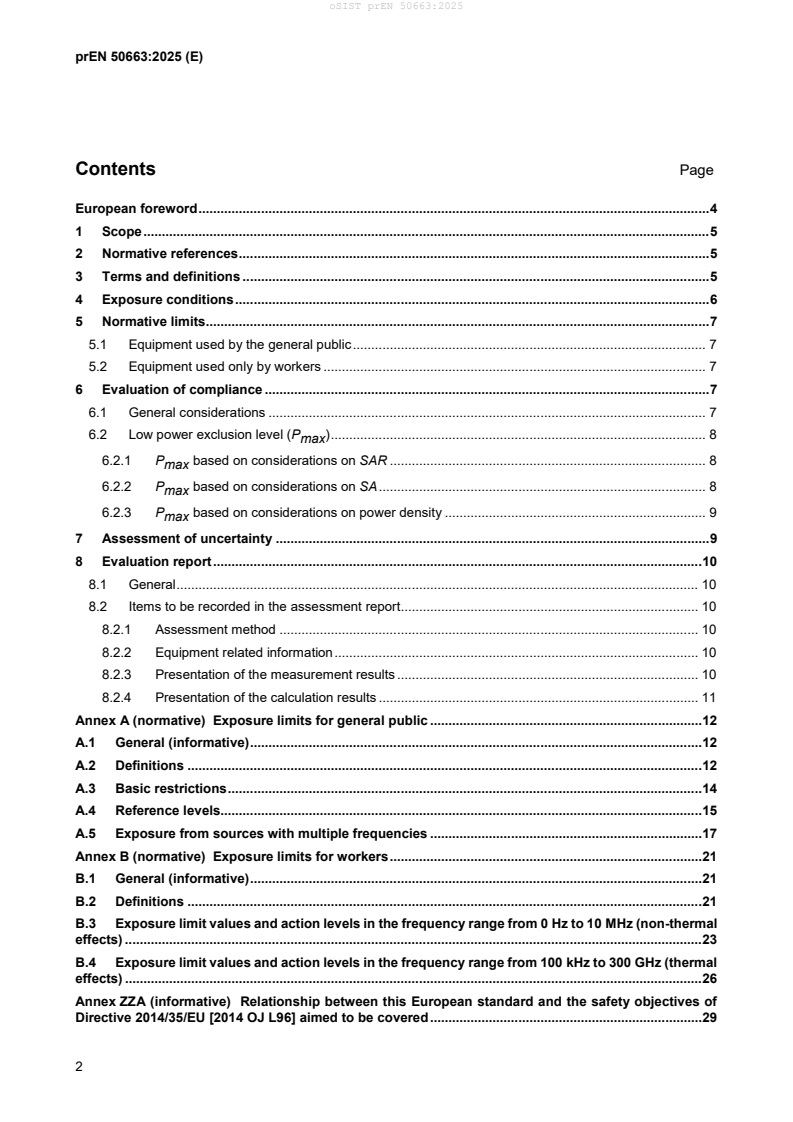
Contents Page
European foreword . 4
1 Scope . 5
2 Normative references . 5
3 Terms and definitions . 5
4 Exposure conditions . 6
5 Normative limits . 7
5.1 Equipment used by the general public . 7
5.2 Equipment used only by workers . 7
6 Evaluation of compliance . 7
6.1 General considerations . 7
6.2 Low power exclusion level (P ) . 8
max
6.2.1 P based on considerations on SAR . 8
max
6.2.2 P based on considerations on SA . 8
max
6.2.3 P based on considerations on power density . 9
max
7 Assessment of uncertainty . 9
8 Evaluation report . 10
8.1 General . 10
8.2 Items to be recorded in the assessment report . 10
8.2.1 Assessment method . 10
8.2.2 Equipment related information . 10
8.2.3 Presentation of the measurement results . 10
8.2.4 Presentation of the calculation results . 11
Annex A (normative) Exposure limits for general public . 12
A.1 General (informative) . 12
A.2 Definitions . 12
A.3 Basic restrictions . 14
A.4 Reference levels. 15
A.5 Exposure from sources with multiple frequencies . 17
Annex B (normative) Exposure limits for workers . 21
B.1 General (informative) . 21
B.2 Definitions . 21
B.3 Exposure limit values and action levels in the frequency range from 0 Hz to 10 MHz (non-thermal
effects) . 23
B.4 Exposure limit values and action levels in the frequency range from 100 kHz to 300 GHz (thermal
effects) . 26
Annex ZZA (informative) Relationship between this European standard and the safety objectives of
Directive 2014/35/EU [2014 OJ L96] aimed to be covered . 29
Annex ZZB (informative) Relationship between this European standard and the essential requirements
of Directive 2014/53/EU [2014 OJ L153] aimed to be covered. 30
Bibliography . 31
European foreword
This document (prEN 50663:2025) has been prepared by Technical Committee CLC/TC 106X
“Electromagnetic fields in the human environment”, the secretariat of which is held by DKE.
This document is currently submitted to the Enquiry.
The following dates are proposed:
• latest date by which the existence of this (doa) dav + 6 months
document has to be announced at national level
• latest date by which this document has to be (dop) dav + 12 months
implemented at national level by publication of
an identical national standard or by
endorsement
• latest date by which the national standards (dow) dav + 36 months
conflicting with this document have to be (to be confirmed or
withdrawn modified when voting)
This document will supersede EN 50663:2017 and all of its amendments and corrigenda (if any).
— The value applied to head and trunk is also applied to the limb in this edition.
— The conformity assessment is more detailed.
This document has been prepared under a standardization request addressed to CENELEC by the European
Commission. The Standing Committee of the EFTA States subsequently approves these requests for its
Member States.
For the relationship with EU Legislation, see informative Annexes ZZA and ZZB, which are an integral part of
this document.
1 Scope
This document provides electromagnetic field (EMF) exposure conformity assessment methods for low power
electronic and electrical equipment. It is applicable to intentionally radiating equipment operating
at frequencies between 10 MHz and 300 GHz with time-averaged transmitted power less than or equal to
20 mW in case of equipment intended for use by the general public, or less than or equal to 100 mW in case
of equipment intended for use only by workers when at work, respectively. In the context of this document,
1.05
time-averaging is over any 6-min period up to 10 GHz and over any 68/ƒ -minute period (ƒ in GHz) for
frequencies exceeding 10 GHz.
It also applies to non-intentionally radiating equipment in the same frequency range.
2 Normative references
The following documents are referred to in the text in such a way that some or all of their content constitutes
requirements of this document. For dated references, only the edition cited applies. For undated references,
the latest edition of the referenced document (including any amendments) applies.
EN 62479:2010, Assessment of the compliance of low power electronic and electrical equipment with the basic
restrictions related to human exposure to electromagnetic fields (10 MHz to 300 GHz) (IEC 62479:2010)
3 Terms and definitions
For the purposes of this document, the following terms and definitions apply.
ISO and IEC maintain terminology databases for use in standardization at the following addresses:
— ISO Online browsing platform: available at https://www.iso.org/obp
— IEC Electropedia: available at https://www.electropedia.org/
3.1
low power equipment
equipment where the maximum time-averaged transmitted power is less than or equal to the low power
exclusion level
3.2
low power exclusion level
P
max
maximum time-averaged transmitted power which, depending on the user group, ensures that the applicable
basic restrictions for the general public laid down in Annex A, or the exposure limit values for workers laid
down in Annex B, are met
Note 1 to entry: values of P and the user groups are given in Table 1.
max
[SOURCE: EN 62479:2010, modified]
3.3
basic restrictions
restrictions on exposure of the general public to electric, magnetic and electromagnetic fields that are based
directly on established health effects and biological considerations as defined in Annex A
3.4
exposure limit values
restrictions on exposure of workers to electric, magnetic and electromagnetic fields that are based directly on
established health effects and biological considerations as defined in Annex B
3.5
reasonably foreseeable conditions
intended conditions of use as well as use of equipment in conditions, which results from lawful and readily
predictable human and system behaviour, that can be anticipated by the manufacturer
Note 1 to entry: Use conditions explicitly excluded by the manufacturer in the information for use or user training, but
nevertheless reasonably foreseeable under the assumption that the user has not read the information for use or has not
followed training instructions, are deemed to represent reasonably foreseeable misuse and such conditions fall outside
this definition. The first sentence of this note applies only if a potentially exposed person is given free access to the
information for use or user training. The first sentence of this note does not apply to RF sources installed in public areas
in a way that they are not clearly and obviously perceivable as sources of RF, such that a potentially exposed person can
take appropriate action as required by the information of use.
Note 2 to entry: The reasonably foreseeable conditions of exposure should be based on realistic exposure and/or
installation parameters representative of all readily-predictable human and system behaviour such as the duration of
exposure, time variability of transmitted power, simultaneously operated frequency bands and time averaging as defined
in normative limits.
3.6
specific absorption
SA
energy absorbed by (dissipated in) an incremental mass contained in a volume element of biological tissue
when exposure to a radio frequency electromagnetic field occurs
Note 1 to entry: Specific absorption is expressed in joules per kilogram.
[SOURCE: EN 62479:2010]
3.7
specific absorption rate
SAR
power absorbed by (dissipated in) an incremental mass contained in a volume element of biological tissue
when exposure to a radio frequency electromagnetic field occurs
Note 1 to entry: SAR is expressed in watts per kilogram.
[SOURCE: EN 62479:2010]
3.8
time-averaged transmitted power
power transmitted by device or equipment under test, assessed either at the antenna input port(s) (conducted
power) or as the total radiated power (TRP), averaged over time as specified in the normative limits
Note 1 to entry: In the context of this document, both the basic restrictions and exposure limit values, for general public
1.05
and workers, respectively, require time-averaging over any 6-minute period up to 10 GHz and over any 68/ƒ -minute
period (ƒ in GHz) for frequencies exceeding 10 GHz
3.9
worker
person employed by an employer, including trainees and apprentices but excluding domestic servants,
exposed to electric, magnetic and electromagnetic fields as defined in Directive 2013/35/EU
[SOURCE: Directive 89/391/EEC, modified]
4 Exposure conditions
All intended operating conditions as well as the reasonably foreseeable conditions of exposure from the
equipment shall be taken into account in the evaluation of compliance with the applicable exposure limits.
5 Normative limits
5.1 Equipment used by the general public
The basic restrictions for frequencies above 10 MHz in Table A.1 of Annex A shall be applied.
NOTE Items 1, 6, 7 and 8 of Table A.1 are an integral part of the table.
5.2 Equipment used only by workers
The exposure limit values in Tables B.8, B.9 and B.10 of Annex B shall be applied.
NOTE Item 1 of these Tables also are integral part of the tables.
If it is reasonably foreseeable that equipment intended for professional use can be used by members of the
general public, then 5.1 shall be applied.
6 Evaluation of compliance
6.1 General considerations
The low power exclusion level (P ) is a specified condition of an equipment’s maximum time-averaged
max
transmitted power such that the exposure level produced by the source will not exceed the normative limits
defined in Clause 5.
Equipment complying with the basic restrictions for the general public is deemed to comply with the exposure
limits values for workers without further testing.
Equipment which meets the exposure limit values for workers do not necessarily meet the basic restrictions
for the general public. Unless the equipment is intended exclusively for use by workers when at work and use
by the general public can reasonably be excluded, such equipment shall also be tested against the basic
restrictions for the general public. Equipment intended only for use by workers when at work shall have this
condition clearly identified in the user instructions and in the test report.
The conformity assessment to demonstrate equipment compliance shall be performed according to
EN 62479:2010, 4.1.
If the equipment time-averaged transmitted power is less than or equal to P , then the equipment is deemed
max
to comply with the basic restrictions or the exposure limit values.
The following equipment is deemed to be compliant without further assessment:
1. if low power equipment includes unintentional (or non-intentional) radiators, and typical usage, installation
and the physical characteristics of the equipment make it inherently compliant;
2. if the input power level to electrical or electronic components that are capable of radiating electromagnetic
energy in the relevant frequency range is so low that the available maximum time-averaged transmitted
power cannot exceed the low power exclusion level P ;
max
3. if the available maximum time-averaged transmitted power is limited by product standards for transmitters
to levels below or equal to the low power exclusion level P .
max
For other equipment, further compliance evaluation is required by way of measurements or calculations to
assess that the available maximum time-averaged transmitted power is below or equal to the low power
exclusion level P .
max
If the low power criteria specified in 6.2 cannot be met, the equipment is deemed to be out of the scope of this
document.
6.2 Low power exclusion level (P )
max
6.2.1 P based on considerations on SAR
max
The values of P to be used for conformity assessment purposes as referred to in 6.1, based on SAR
max
considerations, are those provided in Table 1. Further details to derive conservative minimum value for P
max
are provided in Clause A.2 of Annex A of EN 62479:2010.
Table 1 — Values of P based on SAR
max
Exposure tier/user groups P
max
(mW)
General public
(Annex A)
Workers
(Annex B)
6.2.2 P based on considerations on SA
max
For low power equipment using pulsed signals, other limits may apply in addition to those considered in
Table 1. Both Annex A and Annex B have additional restrictions on SA for localized exposure of the head to
pulsed fields in the frequency range 0,3 to 10 GHz (0,3 to 6 GHz in Annex B). The SA should not exceed
-1 -1
10 mJ kg for workers and 2 mJ kg for the general public averaged over 10 g tissue.
If the pulse repetition frequency of the signal is greater than 1000 Hz, compliance with the SAR restriction will
ensure compliance with the SA restriction. Accordingly, the values of P to be used for conformity
max,
assessment purposes are those provided in Table 1.
If the pulse repetition frequency is less than 1000 Hz, specific considerations shall be given to showing
compliance with the SA restriction, as discussed in Annex C of EN 62479:2010, leading to Formula (1) if there
is one pulse per repetition period:
SAR SA ⋅PRF (1)
avg
where:
-1
is the SAR (W kg ) as averaged over any 6-min period in 10 g mass of tissue in the head and
SAR
avg
-1
trunk, for which the basic restrictions is equal to 2 W kg for the exposure of the general
-1
public, and the exposure limit value is 10 W kg for the exposure of workers, respectively;
-1
SA
is the specific absorption (mJ kg ) for localized exposure of the head as averaged in a 10 g
-1
mass of tissue, for which the basic restriction is equal to 2 mJ kg for the exposure of the
general public in the frequency range from 0,3 to 10 GHz, and the exposure limit value is
-1
10 mJ kg for the exposure of workers in the frequency range from 0,3 to 6 GHz, respectively;
PRF is the pulse repetition frequency (Hz).
Accordingly, if the pulse repetition frequency is less than 1000 Hz and there is one pulse per repetition period,
the values of P to be used for conformity assessment purposes, based on considerations on SA, are those
max,
provided in Table 2.
=
Table 2 — Values of P based on SA
max
Exposure tier/user groups P (mW)
max
General public
0,02 x PRF (for PRF ≤ 1000 Hz)
(Annex A)
Workers
0,1 x PRF (for PRF ≤ 1000 Hz)
(Annex B)
Further details to a derive conservative minimum value for P based on considerations on SA are provided
max
in Annex C of EN 62479:2010.
6.2.3 P based on considerations on power density
max
The values of P based on considerations on power density are 20 mW (over the 10 GHz to 300 GHz
max,
frequency range) and 100 mW (over the 6 GHz to 300 GHz frequency range) for general public and
occupational exposures, respectively. Further details to a derive conservative minimum value for P based
max
on considerations on power density are provided in Clause A.3 of Annex A of EN 62479:2010.
7 Assessment of uncertainty
Measurement uncertainty should be assessed in compliance with JCGM 100:2008 or
ISO/IEC Guide 98-3:2008 (see bibliography). Although JCGM 100:2008 is concerned with measurement
uncertainty, the same concepts can be extended to computational uncertainty.
Uncertainty should be estimated for every measured and calculated electromagnetic field strength, power
density or SAR evaluation. It should take into account specific requirements as specified in EN 50413:2019 or
EN IEC 62311:2020.
NOTE There are two major groups of uncertainty contributions (see Annex A of EN 50413:2019):
— random effects resulting in errors that vary in an unpredictable way while the measurement is being made or is repeated
under the same conditions. The uncertainty associated with these contributions can be evaluated by statistical techniques
from repeated measurements;
— contributions to uncertainty arising from systematic effects are those that remain constant while the measurement is
being made but can change if the measurement conditions, method or equipment is altered.
In order to determine the total uncertainty associated with root-mean square (RMS) measurements of the
electric or magnetic field in different measurement environments, there should be an appropriate accounting
of the various sources of uncertainty. Standard uncertainty associated with each quantity influencing the
measurement should be determined on the basis of measurements performed (type A) or on the basis of
experience (type B).
Possible sources of type-A uncertainty are: calibration uncertainty, repeatability of the measurement,
reproducibility of the measurement;
Possible sources of type-B uncertainty are: correction factor, averaging effects of coil probes during non-
uniform field measurements, errors in positioning the probe in non-uniform fields, frequency response or pass-
band limitations (choice of the filter), instrument measurement time constant, metrological drift, resolution,
temperature, proximity to objects or obstacles, humidity (only for electric field), hysteresis of scale in automatic
range mode.
Some sources of uncertainty can be reduced to negligible levels. For example, stands fabricated from
insulating materials may be used for precise positioning of the field meter probe.
Known correction factors should be applied to readings obtained when possible. This may be complex due to
the fact that the correction factors are defined for each axis.
The combined standard uncertainty is based on a mathematical model that defines how the influence quantities
are added. A simple multiplicative model, expressed as a linear series of dB variation terms, is generally
appropriate. Alternatively, the combined uncertainty can be determined by combining uncertainties expressed
in percent. The use of mixed dB and linear units should be avoided when determining the combined
uncertainty.
The expanded uncertainty, U, defines an interval about the measured result that will encompass the true value
with a specified level of confidence, p %. The expanded uncertainty is obtained by multiplying the combined
standard uncertainty by coverage factor, k, then:
U=ku (y)
c
The recommended level of confidence is 95 %, which can be obtained with k = 1,96.
The combined standard uncertainty u (y) is obtained by taking the square root of the sum of squares of the
c
individual standard uncertainties. If any of the standard uncertainties are not already in terms of the measured
quantity, then they should be converted using the appropriate sensitivity coefficient, c , then:
i
u y = c u x
( ) ( )
i i i
Any contributions with known or suspected adverse correlation should be added together, then for m
contributions:
m
uy = u y
( ) ( )
ci∑
i=1
8 Evaluation report
8.1 General
The results of each conformity assessment carried out should be reported accurately, clearly, unambiguously
and objectively.
Evaluations should be recorded, usually in an assessment report, and should include all the information
necessary for the interpretation of the applied conformity assessment.
All the information needed for performing repeatable assessments, calculations, or measurements should be
recorded.
Further information on the assessment report can be found in ISO/IEC 17025.
8.2 Items to be recorded in the assessment report
8.2.1 Assessment method
The applied conformity assessment should be recorded including the rationale (see 6.1) for the assessment
method.
8.2.2 Equipment related information
Relevant information concerning the settings of controls and the intended usage of the equipment should be
recorded. In addition, a description of the equipment including manufacturer, model, serial number (if
available), etc should also be provided in the assessment report.
If the equipment cannot be considered belonging to the cases of items 1, 2 or 3 in 6.1 and further compliance
evaluation is required by way of measurements or calculations, then see 8.2.3 for measurements report or
8.2.4 for calculations report.
8.2.3 Presentation of the measurement results
The following information should be provided when measurement results are presented according to 6.1:
— identification of assessment report;
— date and time of measurements;
— persons who performed the measurement(s);
— location of measurement (e.g. room number, street address);
— characteristics of the relevant EM field sources (e.g. frequency, modulation, model, serial number);
— identification of each measuring instrument: brand name, model (and serial number);
— operating conditions of the relevant EM field source during measure (power);
— settings of the measurement equipment (e.g. measurement range, pass band, sampling frequency);
— environmental conditions (e.g. temperature);
— total measurement uncertainty;
— location of measurement positions;
— the rationale for the measuring positions (e.g. because of possible locations and activities of exposed
person);
— results of each performed assessment;
— date of last calibration of the measurement equipment.
Other information that may be provided, when appropriate, includes:
— drawings, photographs which describe the area and locations where measurements are performed;
— statistical information, e.g. the largest and smallest field values, median, geometric mean, etc.;
— frequency resolution of spectra for fields containing multiple frequencies.
8.2.4 Presentation of the calculation results
The following information should be provided when calculation results are presented according to 6.1:
— identification of assessment report;
— name, version and manufacturer of used calculation software;
— calculation method
— description of the calculation model(s), including geometry and boundary conditions;
— sufficient details to enable reproducibility of the calculation results;
— description of assumptions;
— estimation of the uncertainty in the calculated results (also as a result of model assumptions);
— the rationale for the calculated positions (e.g. because of possible locations and activities of exposed
person);
— results of each performed assessment.
Annex A
(normative)
Exposure limits for general public
A.1 General (informative)
The limits in this annex are based on European Council Recommendation of 12 July 1999, 1999/519/EC,
which has the objective to provide for a high level of health protection against exposure to electromagnetic
fields for the general public.
NOTE The European Council recommends for the purpose of the above-mentioned Council Recommendation that
European Member States assign to the physical quantities listed in 1999/519/EC in Annex I.A (in this Annex: “Clause A.2”);
adopt a framework of basic restrictions and reference levels based on Annex I.B (in this Annex: “A.2.2”); and, aim to
achieve respect of the basic restrictions given in Annex II (in this Annex: “Clause A.3”).
The text in Clause A.2 to Clause A.5 is identical to the text in 1999/519/EC with minor editorial updates to meet
the editorial rules of this document.
The definitions in Clause A.2 are provided only for usage within Annex A. Unless otherwise specified, the
definitions in Clause 3 apply for the rest of this document.
A.2 Definitions
A.2.1 General
For the purposes of this annex, the term electromagnetic fields (EMF) includes static fields, extremely low
frequency (ELF) fields and radiofrequency (RF) fields, including microwaves, encompassing the frequency
range of 0 Hz to 300 GHz.
A.2.2 Physical quantities
A.2.2.1 General
In the context of EMF exposure, eight physical quantities are commonly used:
A.2.2.2 Contact current (I )
C
Between a person and an object is expressed in amperes (A). A conductive object in an electric field can be
charged by the field.
A.2.2.3 Current density (J)
Is defined as the current flowing through a unit cross section perpendicular to its direction in a volume
conductor such as the human body or part of it, expressed in amperes per square metre (A/m ).
A.2.2.4 Electric field strength
Is a vector quantity (E) that corresponds to the force exerted on a charged particle regardless of its motion in
space. It is expressed in volts per metre (V/m).
A.2.2.5 Magnetic field strength
Is a vector quantity (H), which, together with the magnetic flux density, specifies a magnetic field at any point
in space. It is expressed in amperes per metre (A/m).
A.2.2.6 Magnetic flux density
Is a vector quantity (B), resulting in a force that acts on moving charges, it is expressed in teslas (T). In free
space and in biological materials, magnetic flux density and magnetic field strength can be interchanged using
–1 −7
the equivalence 1 A m = 4π 10 T.
A.2.2.7 Power density (S)
Is the appropriate quantity used for very high frequencies, where the depth of penetration in the body is low. It
is the radiant power incident perpendicular to a surface, divided by the area of the surface and is expressed in
watts per square metre (W/m ).
A.2.2.8 Specific energy absorption (SA)
Is defined as the energy absorbed per unit mass of biological tissue, expressed in joules per kilogram (J/kg).
In this annex it is used for limiting non-thermal effects from pulsed microwave radiation.
A.2.2.9 Specific energy absorption rate (SAR)
Averaged over the whole body or over parts of the body, is defined as the rate at which energy is absorbed
per unit mass of body tissue and is expressed in watts per kilogram (W/kg). Whole body SAR is a widely
accepted measure for relating adverse thermal effects to RF exposure. Besides the whole body average SAR,
local SAR values are necessary to evaluate and limit excessive energy deposition in small parts of the body
resulting from special exposure conditions. Examples of such conditions are a grounded individual exposed to
RF in the low MHz range and individuals exposed in the near field of an antenna.
Of these quantities, magnetic flux density, contact current, electric and magnetic field strengths and power
density can be measured directly.
A.2.3 Basic restrictions and reference levels
A.2.3.1 General
For the application of restrictions based on the assessment of possible health effects of electromagnetic fields,
differentiation should be made between basic restrictions and reference levels.
NOTE These basic restrictions and reference levels for limiting exposure have been developed following a thorough
review of all published scientific literature. The criteria applied in the course of the review were designed to evaluate the
credibility of the various reported findings; only established effects were used as a basis for the proposed exposure
restrictions. Induction of cancer from long-term EMF exposure was not considered to be established. However, since there
are safety factors of about 50 between the threshold values for acute effects and the basis restrictions, this annex implicitly
covers possible long-term effects in the whole frequency range.
A.2.3.2 Basic restrictions
Restrictions on exposure to time-varying electric, magnetic, and electromagnetic fields which are based directly
on established health effects and biological considerations are termed “basic restrictions”. Depending upon
the frequency of the field, the physical quantities used to specify these restrictions are magnetic flux density
(B), current density (J), specific energy absorption rate (SAR), and power density (S). Magnetic flux density
and power density can be readily measured in exposed individuals.
A.2.3.3 Reference levels
These levels are provided for practical exposure-assessment purposes to determine whether the basic
restrictions are likely to be exceeded. Some reference levels are derived from relevant basic restrictions using
measurements and/or computational techniques and some reference levels address perception and adverse
indirect effects of exposure to EMFs. The derived quantities are electric field strength (E), magnetic field
strength (H), magnetic flux density (B), power density (S), and limb current (I ). Quantities that address
L
perception and other indirect effects are (contact) current (I ) and, for pulsed fields, specific energy absorption
C
(SA). In any particular exposure situation, measured or calculated values of any of these quantities can be
compared with the appropriate reference level. Respect of the reference level will ensure respect of the
relevant basic restriction. If the measured value exceeds the reference level, it does not necessarily follow that
the basic restriction will be exceeded. Under such circumstances, however, there is a need to establish
whether there is respect of the basic restriction.
Quantitative restrictions on static electric fields are not given in this annex. However, it is recommended that
annoying perception of surface electric charges and spark discharges causing stress or annoyance should be
avoided.
Some quantities such as magnetic flux density (B) and power density (S) serve both as basic restrictions and
reference levels, at certain frequencies (see Clauses A.3 and A.4).
A.3 Basic restrictions
Depending on frequency, the following physical quantities (dosimetric/exposimetric quantities) are used to
specify the basic restrictions on electromagnetic fields:
— between 0 and 1 Hz basic restrictions are provided for magnetic flux density for static magnetic fields
(0 Hz) and current density for time-varying fields up to 1 Hz, in order to prevent effects on the
cardiovascular and central nervous system,
— between 1 Hz and 10 MHz basic restrictions are provided for current density to prevent effects on nervous
system functions,
— between 100 kHz and 10 GHz basic restrictions on SAR are provided to prevent whole-body heat stress
and excessive localized heating of tissues. In the range 100 kHz to 10 MHz, restrictions on both current
density and SAR are provided,
— between 10 GHz and 300 GHz basic restrictions on power density are provided to prevent heating in
tissue at or near the body surface.
The basic restrictions, given in Table A.1, are set so as to account for uncertainties related to individual
sensitivities, environmental conditions, and for the fact that the age and health status of members of the public
vary.
Table A.1 — Basic restrictions for electric, magnetic and electromagnetic fields (0 Hz to 300 GHz)
Frequency range Magnetic Current Whole Localised Localised Power
flux density body SAR SAR density,
density average (head (limbs)
(mA/m )
S (W/m )
(mT) SAR and (W/kg)
(rms)
(W/kg) trunk)
(W/kg)
0 Hz 40 - - - - -
> 0–1 Hz - 8 - - - -
1–4 Hz - 8/f - - - -
4–1000 Hz - 2 - - - -
1000 Hz-100 kHz - f/500 - - - -
100 kHz-10 MHz - f/500 0,08 2 4 -
10 MHz-10 GHz - - 0,08 2 4 -
10–300 GHz - - - - - 10
1. ƒ is the frequency in Hz.
2. The basic restriction on the current density is intended to protect against acute exposure effects
on central nervous system tissues in the head and trunk of the body and includes a safety factor.
The basic restrictions for ELF fields are based on established adverse effects on the central nervous
system. Such acute effects are essentially instantaneous and there is no scientific justification to
modify the basic restrictions for exposure of short duration. However, since the basic restriction
refers to adverse effects on the central nervous system, this basic restriction may permit higher
current densities in body tissues other than the central nervous system under the same exposure
conditions.
3. Because of electrical inhomogeneity of the body, current densities should be averaged over a
cross section of 1 cm perpendicular to the current direction.
4. For frequencies up to 100 kHz, peak current density values can be obtained by multiplying the
rms value by √2 (=1,414). For pulses of duration t the equivalent frequency to apply in the basic
p
restrictions should be calculated as ƒ = 1/(2t ).
p
5. For frequencies up to 100 kHz and for pulsed magnetic fields, the maximum current density
associated with the pulses can be calculated from the rise/fall times and the maximum rate of change
of magnetic flux density. The induced current density can then be compared with the appropriate
basic restriction.
6. All SAR values are to be averaged over any six-minute period.
7. Localised SAR averaging mass is any 10g of contiguous tissue; the maximum SAR so obtained
should be the value used for the estimation of exposure. These 10g of tissue are intended to be a
mass of contiguous tissue with nearly homogeneous electrical properties. In specifying a contiguous
mass of tissue, it is recognized that this concept can be used in computational dosimetry but may
present difficulties for direct physical measurements. A simple geometry such as cubic tissue mass
can be used provided that the calculated dosimetric quantities have conservative values relative to
the exposure guidelines.
8. For pulses of duration t the equivalent frequency to apply in the basic restrictions should be
p
calculated as ƒ = 1/(2t ). Additionally, for pulsed exposures, in the frequency range 0,3 to 10 GHz
p
and for localised exposure of the head, in order to limit and avoid auditory effects caused by
thermoelastic expansion, an additional basic restriction is recommended. This is that the SA should
–1
not exceed 2mJ kg averaged over 10 g of tissue.
A.4 Reference levels
A.4.1 General
Reference levels of exposure are provided for the purpose of comparison with values of measured quantities.
Respect of all recommended reference levels will ensure respect of basic restrictions.
If the quantities of measured values are greater than the reference levels, it does not necessarily follow that
the basic restrictions have been exceeded. In this case, an assessment should be made as to whether
exposure levels are below the basic restrictions.
The reference levels for limiting exposure are obtained from the basic restrictions for the condition of maximum
coupling of the field to the exposed individual, thereby providing maximum protection. A summary of the
reference levels is given in Table A.2 and Table A.3. The reference levels are generally intended to be spatially
averaged values over the dimension of the body of the exposed individual, but with the important proviso that
the localized basic restrictions on exposure are not exceeded.
In certain situations where the exposure is highly localized, such as with hand-held telephones and the human
head, the use of reference levels is not appropriate. In such cases respect of the localized basic restriction
should be assessed directly.
A.4.2 Field levels
The field reference levels are presented in Table A.2.
Table A.2 — Reference levels for electric, magnetic and electromagnetic fields (0 Hz to 300 GHz,
unperturbed rms values)
Frequency E-field strength H-field strength B-field (µT) Equivalent plane
range (V/m) (A/m) wave power
density S
eq
(W/m )
4 4
0–1 Hz -
-
3,2 × 10 4 × 10
4 2 4 2
1–8 Hz 10 000 -
3,2 × 10 /f 4 × 10 /f
8–25 Hz 10 000 4 000/f 5 000/f -
0,025–0,8 kHz 250/f 4/f 5/f -
0,8–3 kHz 250/f 5 6,25 -
3–150 kHz 87 5 6,25 -
0,15–1 MHz 87 0,73/f 0,92/f -
1/2
1–10 MHz 0,73/f 0,92/f -
87/f
10–400 MHz 28 0,073 0,092 2
1/2 1/2 1/2
...