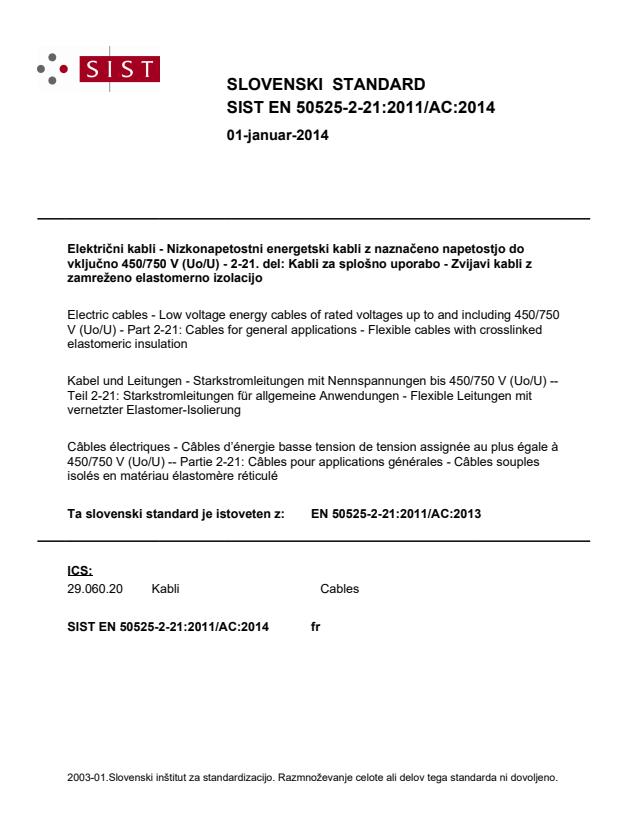
EN 50525-2-21:2011/AC:2013
(Corrigendum)Electric cables - Low voltage energy cables of rated voltages up to and including 450/750 V (Uo/U) - Part 2-21: Cables for general applications - Flexible cables with crosslinked elastomeric insulation
Electric cables - Low voltage energy cables of rated voltages up to and including 450/750 V (Uo/U) - Part 2-21: Cables for general applications - Flexible cables with crosslinked elastomeric insulation
EN 50525-2-21 applies to flexible cables, insulated with crosslinked elastomeric compound, and sheathed with either crosslinked elastomeric compound or thermoplastic polyurethane (TPU). The cables are of rated voltages U0/U up to and including 450/750 V. The cables are intended for a variety of applications where appliances or equipment, including heavy industrial equipment, require a flexible connection to the power supply. The maximum conductor operating temperatures for the cables in this standard are 60 °C (R types), 90 °C (B types) and 110 °C (G types). The following particular cable types are included: - General purpose cables (RR and RN types); - Water-resistant cables (RN8 types); - General purpose cables (BB and BN4 types); - TPU sheathed cables (BQ types); - Heat resistant cables (GG types)
Kabel und Leitungen - Starkstromleitungen mit Nennspannungen bis 450/750 V (Uo/U) - Teil 2-21: Starkstromleitungen für allgemeine Anwendungen - Flexible Leitungen mit vernetzter Elastomer-Isolierung
Câbles électriques - Câbles d’énergie basse tension de tension assignée au plus égale à 450/750 V (Uo/U) - Partie 2-21: Câbles pour applications générales - Câbles souples isolés en matériau élastomère réticulé
Električni kabli - Nizkonapetostni energetski kabli z naznačeno napetostjo do vključno 450/750 V (Uo/U) - 2-21. del: Kabli za splošno uporabo - Zvijavi kabli z zamreženo elastomerno izolacijo
EN 50525-2-21 velja za zvijave kable, izolirane z zamreženo elastomerno sestavino in s plaščem iz bodisi zamrežene elastomerne sestavine bodisi termoplastičnega poliuretana (TPU). Ti kabli imajo nazivno napetost do in vključno 450/750 V (UO/U). Kabli so namenjeni različnim uporabam, pri katerih aparati ali oprema vključno s težko industrijsko opremo zahtevajo fleksibilno povezavo z napajanjem. Maksimalne delovne temperature pretvornika za kable iz tega standarda so 60 °C (tipi R), 90 °C (tipi B) in 110 °C (tipi G). Vključeni so naslednji tipi kablov: – kabli za splošne namene (tipov RR in RN); – vodoodporni kabli (tipov RN8); – kabli za splošne namene (tipov BB in BN4); – kabli s plaščem iz TPU (tipov BQ); – toplotno odporni kabli (tipov GG).
General Information
- Status
- Published
- Publication Date
- 22-Aug-2013
- Technical Committee
- CLC/TC 20 - Electric cables
- Drafting Committee
- CLC/TC 20 - Electric cables
- Current Stage
- 6060 - Document made available - Publishing
- Start Date
- 23-Aug-2013
- Completion Date
- 23-Aug-2013
Relations
- Effective Date
- 28-Jan-2023
Frequently Asked Questions
EN 50525-2-21:2011/AC:2013 is a corrigendum published by CLC. Its full title is "Electric cables - Low voltage energy cables of rated voltages up to and including 450/750 V (Uo/U) - Part 2-21: Cables for general applications - Flexible cables with crosslinked elastomeric insulation". This standard covers: EN 50525-2-21 applies to flexible cables, insulated with crosslinked elastomeric compound, and sheathed with either crosslinked elastomeric compound or thermoplastic polyurethane (TPU). The cables are of rated voltages U0/U up to and including 450/750 V. The cables are intended for a variety of applications where appliances or equipment, including heavy industrial equipment, require a flexible connection to the power supply. The maximum conductor operating temperatures for the cables in this standard are 60 °C (R types), 90 °C (B types) and 110 °C (G types). The following particular cable types are included: - General purpose cables (RR and RN types); - Water-resistant cables (RN8 types); - General purpose cables (BB and BN4 types); - TPU sheathed cables (BQ types); - Heat resistant cables (GG types)
EN 50525-2-21 applies to flexible cables, insulated with crosslinked elastomeric compound, and sheathed with either crosslinked elastomeric compound or thermoplastic polyurethane (TPU). The cables are of rated voltages U0/U up to and including 450/750 V. The cables are intended for a variety of applications where appliances or equipment, including heavy industrial equipment, require a flexible connection to the power supply. The maximum conductor operating temperatures for the cables in this standard are 60 °C (R types), 90 °C (B types) and 110 °C (G types). The following particular cable types are included: - General purpose cables (RR and RN types); - Water-resistant cables (RN8 types); - General purpose cables (BB and BN4 types); - TPU sheathed cables (BQ types); - Heat resistant cables (GG types)
EN 50525-2-21:2011/AC:2013 is classified under the following ICS (International Classification for Standards) categories: 29.060.20 - Cables. The ICS classification helps identify the subject area and facilitates finding related standards.
EN 50525-2-21:2011/AC:2013 has the following relationships with other standards: It is inter standard links to EN 50525-2-21:2011. Understanding these relationships helps ensure you are using the most current and applicable version of the standard.
EN 50525-2-21:2011/AC:2013 is associated with the following European legislation: EU Directives/Regulations: 2006/95/EC, 2014/35/EU, 2014/53/EU. When a standard is cited in the Official Journal of the European Union, products manufactured in conformity with it benefit from a presumption of conformity with the essential requirements of the corresponding EU directive or regulation.
You can purchase EN 50525-2-21:2011/AC:2013 directly from iTeh Standards. The document is available in PDF format and is delivered instantly after payment. Add the standard to your cart and complete the secure checkout process. iTeh Standards is an authorized distributor of CLC standards.
Standards Content (Sample)
2003-01.Slovenski inštitut za standardizacijo. Razmnoževanje celote ali delov tega standarda ni dovoljeno.Kabel und Leitungen - Starkstromleitungen mit Nennspannungen bis 450/750 V (Uo/U) -- Teil 2-21: Starkstromleitungen für allgemeine Anwendungen - Flexible Leitungen mit vernetzter Elastomer-IsolierungCâbles électriques - Câbles d’énergie basse tension de tension assignée au plus égale à 450/750 V (Uo/U) -- Partie 2-21: Câbles pour applications générales - Câbles souples isolés en matériau élastomère réticuléElectric cables - Low voltage energy cables of rated voltages
...
The standard EN 50525-2-21:2011/AC:2013 provides a comprehensive framework for flexible cables specifically designed for low voltage energy applications. The scope of this standard is clearly defined, centering on cables with rated voltages up to and including 450/750 V (Uo/U), which makes it highly relevant for a myriad of applications that require reliable electrical connections, particularly in industrial settings. One of the notable strengths of EN 50525-2-21 is its focus on cables insulated with crosslinked elastomeric compounds, which enhances the performance and durability of the cables in various environmental conditions. The inclusion of specific cable types, such as general purpose, water-resistant, TPU sheathed, and heat resistant cables, demonstrates the standard's adaptability to the diverse demands of modern applications. This variety ensures that users can select the appropriate cable type based on the specific operational requirements, such as maximum conductor operating temperatures of 60 °C, 90 °C, and 110 °C depending on the cable classification. Furthermore, the clear delineation of cable types, including RR and RN types for general purposes and specialized designs like RN8 and BQ types, enhances the standard's practical utility. This comprehensive classification supports manufacturers and engineers in meeting performance expectations and compliance with safety regulations. Overall, the relevance of EN 50525-2-21:2011/AC:2013 in today’s electrical engineering landscape cannot be overstated. Its thorough approach to standardizing flexible cables with crosslinked elastomeric insulation addresses both industry needs and legislative requirements, ensuring that the cables perform safely and efficiently across various applications. This standard stands as a critical reference point for stakeholders involved in the production and utilization of low voltage energy cables.
EN 50525-2-21:2011/AC:2013 표준은 최대 450/750 V(Uo/U)의 정격 전압을 가진 전기 케이블에 관한 것을 다루고 있으며, 특히 교차 연결된 엘라스토머 단열로 절연된 유연 케이블에 중점을 두고 있습니다. 이 표준은 다양한 어플리케이션을 위한 케이블의 범위를 규정하고 있으며, 특히 중장비를 포함한 다양한 기계 및 장비와의 유연한 연결을 필요로 하는 환경에서의 사용이 적합합니다. 표준의 강점은 유연성이 필요한 모든 응용 분야에 효과적이라는 점입니다. RR 및 RN 유형의 일반 목적 케이블, RN8 유형의 방수 케이블, BB 및 BN4 유형의 일반 목적 케이블, BQ 유형의 TPU 피복 케이블, GG 유형의 내열 케이블 등 다양한 케이블 유형을 포함하고 있어 특정 요구 사항에 맞는 선택이 가능합니다. 이와 같은 포괄적인 내용은 산업 현장뿐만 아니라 일반 가정에서도 유용하게 활용될 수 있습니다. 또한, 이 표준의 적용 범위는 케이블이 사용될 수 있는 온도 조건을 명시하고 있으며, R 유형 케이블의 경우 최대 작업 온도는 60 °C, B 유형은 90 °C, G 유형은 110 °C로 설정되어 있습니다. 이러한 온도 기준은 케이블의 안전성 및 내구성을 보장하는 데 중요한 요소로 작용하며, 사용자는 각 케이블의 적합한 적용법을 정확히 이해하고 선택할 수 있습니다. 결론적으로, EN 50525-2-21:2011/AC:2013 표준은 교차 연결된 엘라스토머 단열을 가진 유연 케이블의 안전하고 효과적인 사용을 보장하며, 다양한 산업 분야에서의 유용성을 강조합니다. 이 표준은 전기 케이블의 품질과 성능을 관리하는 데 필수적이며, 특정 응용 분야에 대한 명확한 지침을 제공하여 사용자들이 복잡한 요구 사항을 충족할 수 있도록 돕습니다.
La norme EN 50525-2-21:2011/AC:2013 se distingue par son champ d'application spécifique et ses spécifications techniques adaptées aux câbles électriques en basse tension. Cette norme s'applique aux câbles flexibles isolés avec un mélange élastomère réticulé, ce qui leur confère une robustesse et une flexibilité essentielles pour des applications variées. Les câbles sont conçus pour des tensions nominales allant jusqu'à 450/750 V (Uo/U), ce qui les rend pertinents pour des équipements électroménagers ainsi que pour des installations industrielles lourdes. Les caractéristiques thermiques de la norme, avec des températures de fonctionnement maximales allant de 60 °C pour les types R à 110 °C pour les types G, assurent une performance fiable dans des conditions diverses et exigentes. Une des forces majeures de cette norme réside dans sa diversité de types de câbles, y compris les câbles à usage général, les câbles résistant à l'eau, les câbles à revêtement en TPU, et les câbles résistant à la chaleur. Cette large gamme répond à divers besoins d'application, garantissant que les utilisateurs peuvent trouver le type de câble approprié pour chaque situation spécifique. En termes de pertinence, la norme EN 50525-2-21 est essentielle pour les fabricants, les installateurs et les utilisateurs d'équipements nécessitant des connexions flexibles à l'alimentation électrique. Son adoption aide à garantir la conformité aux exigences de sécurité et de performance, et contribue ainsi à l'amélioration de la fiabilité et de la durabilité des installations électriques à basse tension.
EN 50525-2-21:2011/AC:2013は、450/750V(Uo/U)までの定格電圧を持つ低電圧エネルギーケーブルに関する非常に重要な標準です。この標準は、架橋エラストマー絶縁体で絶縁された柔軟なケーブルに適用されており、架橋エラストマーまたは熱可塑性ポリウレタン(TPU)で被覆されています。主に、重工業機器を含む様々な機器への柔軟な電力供給接続を必要とする用途に使用されます。 この標準の強みとしては、まず、最大導体動作温度が多様に設定されている点が挙げられます。Rタイプは60 °C、Bタイプは90 °C、Gタイプは110 °Cまで対応しており、使用環境に応じた選択が可能です。また、一般用途ケーブル(RRおよびRNタイプ)、耐水性ケーブル(RN8タイプ)、TPU被覆ケーブル(BQタイプ)、耐熱ケーブル(GGタイプ)など、特定のケーブルタイプが含まれていることにより、ユーザーは具体的な用途に適したケーブルを選択しやすくなっています。 EN 50525-2-21の関連性は非常に高く、特に電力供給の柔軟性が求められる現代の産業環境において、標準が提供する規格は重要な指針となっています。この標準を遵守することで、信頼性の高い電力供給を確保し、安全な運用が可能となるため、業界全体において高く評価されるべき基準です。
Die Norm EN 50525-2-21:2011/AC:2013 behandelt elektrische Leitungen, insbesondere Niederspannungsenergiekabel mit Nennspannungen bis einschließlich 450/750 V (Uo/U). Der Anwendungsbereich dieser Norm umfasst flexible Kabel, die mit einem vernetzten elastomeren Stoff isoliert sind und entweder mit einem vernetzten elastomeren Material oder thermoplastischem Polyurethan (TPU) ummantelt werden. Diese Kabel sind für verschiedene Anwendungen konzipiert, die eine flexible Verbindung zur Stromversorgung erfordern, darunter auch schwere Industrieanlagen. Ein herausragendes Merkmal der Norm ist die klare Definition der maximalen Betriebstemperaturen für die Kabel, die den verschiedenen Typen zugeordnet sind: 60 °C für die R-Typen, 90 °C für die B-Typen und 110 °C für die G-Typen. Diese Informationen sind von wesentlicher Bedeutung, um sicherzustellen, dass die Kabel unter den vorgesehenen Bedingungen sicher und effizient betrieben werden können. Die Norm listet spezifische Kabeltypen, die abgedeckt werden, darunter allgemeine Kabel (RR und RN-Typen), wasserbeständige Kabel (RN8-Typen), allgemeine Kabel (BB und BN4-Typen), TPU-ummantelte Kabel (BQ-Typen) und hitzebeständige Kabel (GG-Typen). Diese Vielfalt an Kabeltypen verleiht der Norm zusätzliche Relevanz, da sie die Bedürfnisse einer breiten Palette von Anwendungen abdeckt. Zusammenfassend bietet die EN 50525-2-21:2011/AC:2013 eine umfassende und detaillierte Grundlage für Hersteller und Benutzer von flexiblen Niederspannungskabeln, unterstützt die Einhaltung von Sicherheitsstandards und fördert die Verwendung geeigneter Produkte in verschiedenen industriellen Anwendungen. Die Norm ist eine relevante Orientierungshilfe, um die Auswahl und Verwendung von Kabeln sicher und effizient zu gestalten.


Questions, Comments and Discussion
Ask us and Technical Secretary will try to provide an answer. You can facilitate discussion about the standard in here.
Loading comments...