


EN IEC 61207-3:2019
(Main)Gas Analyzers - Expression of performance - Part 3: Paramagnetic oxygen analysers
Gas Analyzers - Expression of performance - Part 3: Paramagnetic oxygen analysers
IEC 61207-3:2019 is available as IEC 61207-3:2019 RLV which contains the International Standard and its Redline version, showing all changes of the technical content compared to the previous edition. IEC 61207-3:2019 applies to the three main methods for measuring oxygen by its paramagnetic property, which are outlined in the introduction. It considers essential ancillary units and applies to analyzers installed indoors and outdoors. Safety-critical applications can require additional requirements from system and analyzer specifications not covered in this document. This document is intended: - to specify terminology and definitions related to the functional performance of paramagnetic gas analyzers for the measurement of oxygen in a source gas; - to unify methods used in making and verifying statements on the functional performance of such analyzers; - to specify what tests are performed to determine the functional performance and how such tests are carried out; - to provide basic documents to support the application of internationally recognized quality management standards. This third edition cancels and replaces the second edition published in 2002. This edition constitutes a technical revision. This edition includes the following significant technical changes with respect to the previous edition: a) all references (normative and informative) have been updated, deleted or added to as appropriate; b) all the terms, descriptions and definitions relating to the document have been updated where appropriate; c) all references to “errors” have been replaced by “uncertainties” and appropriate updated definitions applied.
Angabe zum Betriebsverhalten von Gasanalysatoren - Teil 3: Paramagnetische Sauerstoffanalysatoren
Analyseurs de gaz - Expression des performances - Partie 3: Analyseurs d'oxygène paramagnétiques
IEC 61207-3:2019 est disponible sous forme de IEC 61207-3:2019 RLV qui contient la Norme internationale et sa version Redline, illustrant les modifications du contenu technique depuis l'édition précédente. IEC 61207-3:2019 traite des trois principales méthodes de mesure de l’oxygène par sa propriété paramagnétique présentées dans l'introduction. Elle porte sur des unités auxiliaires essentielles et concerne les analyseurs installés à l’intérieur comme à l’extérieur. Les applications présentant un risque particulier du point de vue de la sécurité peuvent nécessiter des exigences supplémentaires quant aux spécifications du système et de l'analyseur qui ne sont pas traitées dans la présente norme. La présente norme a pour objet: - de spécifier la terminologie et les définitions relatives aux performances fonctionnelles des analyseurs de gaz paramagnétiques utilisés pour le mesurage de l'oxygène dans un gaz source; - d’unifier les méthodes utilisées en fournissant et en vérifiant les indications relatives aux performances fonctionnelles de ces analyseurs; - de spécifier les essais à effectuer pour déterminer les performances fonctionnelles et la manière de réaliser ces essais; - fournir des documents de base appuyant l'application des normes de gestion de la qualité reconnues sur le plan international. Cette troisième édition annule et remplace la deuxième édition parue en 2002. Cette édition constitue une révision technique. Cette édition inclut les modifications techniques majeures suivantes par rapport à l'édition précédente: a) toutes les références (normatives et informatives) ont été mises à jour, retirées ou ajoutées comme il convient; b) tous les termes, descriptions et définitions en rapport avec le document ont été mis à jour le cas échéant; c) toutes les références aux "erreurs" ont été remplacées par le terme «incertitudes» et les définitions ont été mises à jour comme il convient.
Analizatorji plina - Izražanje lastnosti - 3. del: Paramagnetni analizatorji kisika (IEC 61207-3:2019)
Ta dokument se uporablja za tri glavne načine merjenje kisika na podlagi njegove paramagnetnosti, ki so opisani v uvodu. Obravnava osnovne pomožne enote in se uporablja za analizatorje, ki so postavljeni v notranjih prostorih ali na prostem. Pri načinih uporabe, pri katerih je ključna varnost, so lahko zahtevane dodatne zahteve glede specifikacij sistema in analizatorja, ki niso zajete v tem dokumentu. Namen tega dokumenta je: – določiti terminologijo in definicije v zvezi s funkcionalnimi lastnostmi paramagnetnih analizatorjev plina za merjenje kisika v izhodnem plinu; – poenotiti metode, ki se uporabljajo pri ustvarjanju in preverjanju navedb o funkcionalnih lastnostih takšnih analizatorjev; – določiti, katere preskuse je treba opraviti, da se določijo funkcionalne lastnosti, in kako jih je treba opraviti; – zagotoviti osnovne dokumente za podporo uporabe mednarodno priznanih standardov vodenja kakovosti.
General Information
- Status
- Published
- Publication Date
- 22-Aug-2019
- Withdrawal Date
- 30-Jul-2022
- Technical Committee
- CLC/TC 65X - Industrial-process measurement, control and automation
- Drafting Committee
- IEC/SC 65B - IEC_SC_65B
- Current Stage
- 6060 - Document made available - Publishing
- Start Date
- 23-Aug-2019
- Completion Date
- 23-Aug-2019
Relations
- Replaces
EN 61207-3:2002 - Gas analyzers - Expression of performance - Part 3: Paramagnetic oxygen analyzers - Effective Date
- 23-Jan-2023
Overview
EN IEC 61207-3:2019 (published by CLC as IEC 61207-3:2019 RLV) is the third edition of the international standard for the expression of performance of paramagnetic oxygen analysers. It supersedes the 2002 edition and provides a harmonized basis to specify, test and report functional performance for oxygen analysers that exploit oxygen’s paramagnetic properties. The standard covers indoor and outdoor installations and includes the standard text and a redline version showing technical changes from the previous edition.
Key topics and requirements
- Measurement methods covered: the three main paramagnetic techniques - automatic null balance, thermomagnetic (magnetic wind) and differential pressure (Quincke).
- Terminology and definitions: unified terms for reporting analyzer performance and influence quantities.
- Performance statements and tests: standardized procedures for making and verifying claims about accuracy/uncertainty, linearity, interference uncertainty, response times (delay, rise/fall), and operation with wet or dry samples.
- Sampling and ancillary units: specification of essential sampling systems, sample conditioning (filtering, drying, steam aspiration examples), sample flow and pressure requirements, and other services needed for reliable operation.
- Environmental and influence ranges: rated ranges for ambient temperature, sample temperature, pressure and particulate content that affect analyzer performance.
- Uncertainty philosophy: all references to “errors” have been replaced by “uncertainties”, aligning with modern metrological practice.
- Test arrangements: guidance on test equipment and general test setups for compliance testing and verification.
- Quality management support: provides baseline documentation to support application of internationally recognized quality management standards (e.g., EN ISO 9001 references).
Applications and who uses it
EN IEC 61207-3:2019 is essential for:
- Manufacturers of paramagnetic oxygen analysers to develop datasheets and test protocols.
- Test laboratories and calibration houses performing compliance testing and uncertainty assessments.
- System integrators and OEMs specifying analyzers for industrial process control, environmental monitoring, laboratory and medical gas systems.
- Procurement and QA engineers who need objective performance criteria for tendering and acceptance.
- Regulatory and certification bodies assessing analyzer performance claims.
The standard is particularly useful where precise oxygen measurement is needed across 0–100 % ranges and where sample conditioning and interference evaluation are critical.
Related standards
- IEC 61207-1:2010 – Gas analyzers: Expression of performance - Part 1 (general).
- Normative cross-references include standards harmonized as EN 61115, EN 60654-1 and quality-management reference EN ISO 9001.
Keywords: EN IEC 61207-3:2019, paramagnetic oxygen analysers, gas analyzers, expression of performance, IEC 61207-3, sampling system, interference uncertainty, pressure compensation.



Frequently Asked Questions
EN IEC 61207-3:2019 is a standard published by CLC. Its full title is "Gas Analyzers - Expression of performance - Part 3: Paramagnetic oxygen analysers". This standard covers: IEC 61207-3:2019 is available as IEC 61207-3:2019 RLV which contains the International Standard and its Redline version, showing all changes of the technical content compared to the previous edition. IEC 61207-3:2019 applies to the three main methods for measuring oxygen by its paramagnetic property, which are outlined in the introduction. It considers essential ancillary units and applies to analyzers installed indoors and outdoors. Safety-critical applications can require additional requirements from system and analyzer specifications not covered in this document. This document is intended: - to specify terminology and definitions related to the functional performance of paramagnetic gas analyzers for the measurement of oxygen in a source gas; - to unify methods used in making and verifying statements on the functional performance of such analyzers; - to specify what tests are performed to determine the functional performance and how such tests are carried out; - to provide basic documents to support the application of internationally recognized quality management standards. This third edition cancels and replaces the second edition published in 2002. This edition constitutes a technical revision. This edition includes the following significant technical changes with respect to the previous edition: a) all references (normative and informative) have been updated, deleted or added to as appropriate; b) all the terms, descriptions and definitions relating to the document have been updated where appropriate; c) all references to “errors” have been replaced by “uncertainties” and appropriate updated definitions applied.
IEC 61207-3:2019 is available as IEC 61207-3:2019 RLV which contains the International Standard and its Redline version, showing all changes of the technical content compared to the previous edition. IEC 61207-3:2019 applies to the three main methods for measuring oxygen by its paramagnetic property, which are outlined in the introduction. It considers essential ancillary units and applies to analyzers installed indoors and outdoors. Safety-critical applications can require additional requirements from system and analyzer specifications not covered in this document. This document is intended: - to specify terminology and definitions related to the functional performance of paramagnetic gas analyzers for the measurement of oxygen in a source gas; - to unify methods used in making and verifying statements on the functional performance of such analyzers; - to specify what tests are performed to determine the functional performance and how such tests are carried out; - to provide basic documents to support the application of internationally recognized quality management standards. This third edition cancels and replaces the second edition published in 2002. This edition constitutes a technical revision. This edition includes the following significant technical changes with respect to the previous edition: a) all references (normative and informative) have been updated, deleted or added to as appropriate; b) all the terms, descriptions and definitions relating to the document have been updated where appropriate; c) all references to “errors” have been replaced by “uncertainties” and appropriate updated definitions applied.
EN IEC 61207-3:2019 is classified under the following ICS (International Classification for Standards) categories: 19.040 - Environmental testing; 71.040.40 - Chemical analysis. The ICS classification helps identify the subject area and facilitates finding related standards.
EN IEC 61207-3:2019 has the following relationships with other standards: It is inter standard links to EN 61207-3:2002. Understanding these relationships helps ensure you are using the most current and applicable version of the standard.
You can purchase EN IEC 61207-3:2019 directly from iTeh Standards. The document is available in PDF format and is delivered instantly after payment. Add the standard to your cart and complete the secure checkout process. iTeh Standards is an authorized distributor of CLC standards.
Standards Content (Sample)
SLOVENSKI STANDARD
01-november-2019
Nadomešča:
SIST EN 61207-3:2002
Analizatorji plina - Izražanje lastnosti - 3. del: Paramagnetni analizatorji kisika (IEC
61207-3:2019)
Gas Analyzers - Expression of performance - Part 3: Paramagnetic oxygen analysers
(IEC 61207-3:2019)
Angabe zum Betriebsverhalten von Gasanalysatoren - Teil 3: Paramagnetische
Sauerstoffanalysatoren (IEC 61207-3:2019)
Analyseurs de gaz - Expression des performances - Partie 3: Analyseurs d'oxygène
paramagnétiques (IEC 61207-3:2019)
Ta slovenski standard je istoveten z: EN IEC 61207-3:2019
ICS:
71.040.40 Kemijska analiza Chemical analysis
2003-01.Slovenski inštitut za standardizacijo. Razmnoževanje celote ali delov tega standarda ni dovoljeno.
EUROPEAN STANDARD EN IEC 61207-3
NORME EUROPÉENNE
EUROPÄISCHE NORM
August 2019
ICS 19.040; 71.040.40 Supersedes EN 61207-3:2002 and all of its amendments
and corrigenda (if any)
English Version
Gas Analyzers - Expression of performance - Part 3:
Paramagnetic oxygen analysers
(IEC 61207-3:2019)
Analyseurs de gaz - Expression des performances - Partie Angabe zum Betriebsverhalten von Gasanalysatoren - Teil
3: Analyseurs d'oxygène paramagnétiques 3: Paramagnetische Sauerstoffanalysatoren
(IEC 61207-3:2019) (IEC 61207-3:2019)
This European Standard was approved by CENELEC on 2019-07-31. CENELEC members are bound to comply with the CEN/CENELEC
Internal Regulations which stipulate the conditions for giving this European Standard the status of a national standard without any alteration.
Up-to-date lists and bibliographical references concerning such national standards may be obtained on application to the CEN-CENELEC
Management Centre or to any CENELEC member.
This European Standard exists in three official versions (English, French, German). A version in any other language made by translation
under the responsibility of a CENELEC member into its own language and notified to the CEN-CENELEC Management Centre has the
same status as the official versions.
CENELEC members are the national electrotechnical committees of Austria, Belgium, Bulgaria, Croatia, Cyprus, the Czech Republic,
Denmark, Estonia, Finland, France, Germany, Greece, Hungary, Iceland, Ireland, Italy, Latvia, Lithuania, Luxembourg, Malta, the
Netherlands, Norway, Poland, Portugal, Republic of North Macedonia, Romania, Serbia, Slovakia, Slovenia, Spain, Sweden, Switzerland,
Turkey and the United Kingdom.
European Committee for Electrotechnical Standardization
Comité Européen de Normalisation Electrotechnique
Europäisches Komitee für Elektrotechnische Normung
CEN-CENELEC Management Centre: Rue de la Science 23, B-1040 Brussels
© 2019 CENELEC All rights of exploitation in any form and by any means reserved worldwide for CENELEC Members.
Ref. No. EN IEC 61207-3:2019 E
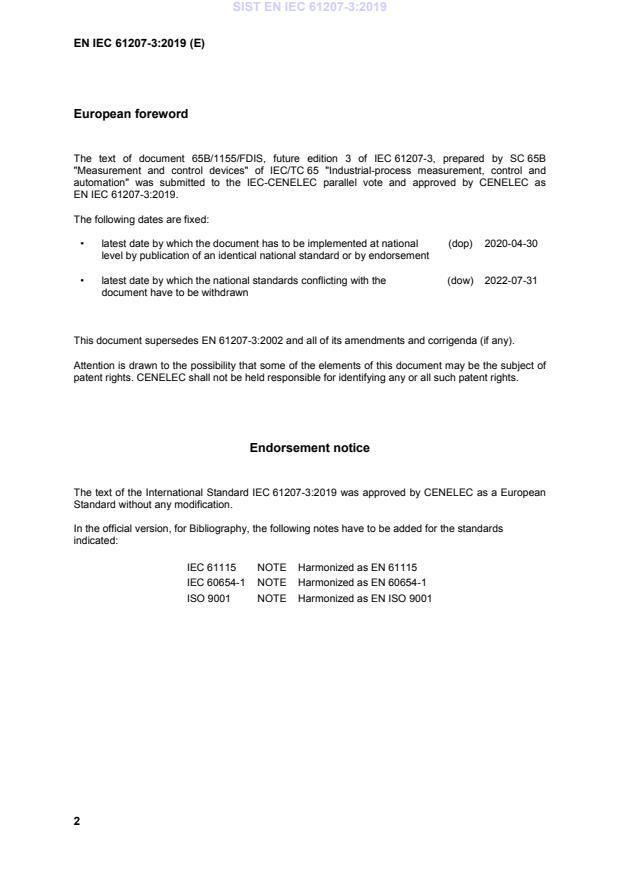
European foreword
The text of document 65B/1155/FDIS, future edition 3 of IEC 61207-3, prepared by SC 65B
"Measurement and control devices" of IEC/TC 65 "Industrial-process measurement, control and
automation" was submitted to the IEC-CENELEC parallel vote and approved by CENELEC as
The following dates are fixed:
• latest date by which the document has to be implemented at national (dop) 2020-04-30
level by publication of an identical national standard or by endorsement
• latest date by which the national standards conflicting with the (dow) 2022-07-31
document have to be withdrawn
This document supersedes EN 61207-3:2002 and all of its amendments and corrigenda (if any).
Attention is drawn to the possibility that some of the elements of this document may be the subject of
patent rights. CENELEC shall not be held responsible for identifying any or all such patent rights.
Endorsement notice
The text of the International Standard IEC 61207-3:2019 was approved by CENELEC as a European
Standard without any modification.
In the official version, for Bibliography, the following notes have to be added for the standards
indicated:
IEC 61115 NOTE Harmonized as EN 61115
IEC 60654-1 NOTE Harmonized as EN 60654-1
ISO 9001 NOTE Harmonized as EN ISO 9001
Annex ZA
(normative)
Normative references to international publications
with their corresponding European publications
The following documents are referred to in the text in such a way that some or all of their content
constitutes requirements of this document. For dated references, only the edition cited applies. For
undated references, the latest edition of the referenced document (including any amendments)
applies.
NOTE 1 Where an International Publication has been modified by common modifications, indicated by (mod), the relevant
EN/HD applies.
NOTE 2 Up-to-date information on the latest versions of the European Standards listed in this annex is available here:
www.cenelec.eu.
Publication Year Title EN/HD Year
IEC 61207-1 - Expression of performance of gas EN 61207-1 -
analyzers - Part 1: General
IEC 61207-3 ®
Edition 3.0 2019-06
INTERNATIONAL
STANDARD
NORME
INTERNATIONALE
Gas analyzers – Expression of performance –
Part 3: Paramagnetic oxygen analyzers
Analyseurs de gaz – Expression des performances –
Partie 3: Analyseurs d'oxygène paramagnétiques
INTERNATIONAL
ELECTROTECHNICAL
COMMISSION
COMMISSION
ELECTROTECHNIQUE
INTERNATIONALE
ICS 19.040; 71.040.40 ISBN 978-2-8322-7046-2
– 2 – IEC 61207-3:2019 © IEC 2019
CONTENTS
FOREWORD . 4
INTRODUCTION . 6
1 Scope . 7
2 Normative references . 7
3 Terms and definitions . 7
4 Procedures for specification . 15
4.1 General . 15
4.2 Specification of essential ancillary units and services . 15
4.2.1 Sampling system . 15
4.2.2 Services . 15
4.3 Additional characteristics related to specification of performance . 16
4.4 Important aspects related to specification of performance . 16
4.4.1 General . 16
4.4.2 Rated range of ambient temperature . 16
4.4.3 Rated range of sample gas temperature . 16
4.4.4 Rated range of ambient pressure . 17
4.4.5 Rated range of sample pressure . 17
4.4.6 Rated range of sample flow . 17
4.4.7 Rated range of sample dew point . 17
4.4.8 Rated range of sample particulate content . 17
4.4.9 Rated range of interference uncertainties . 18
4.4.10 Rated range of linearity uncertainty . 18
4.4.11 Rated ranges of influence quantities . 18
5 Procedures for compliance testing . 18
5.1 Analyzer testing . 18
5.1.1 General . 18
5.1.2 Test equipment . 18
5.2 Testing procedures . 19
5.2.1 General . 19
5.2.2 Interference uncertainty . 19
5.2.3 Wet samples . 20
5.2.4 Delay times, rise time, fall time . 20
Annex A (informative) Interfering gases . 22
Annex B (informative) Methods of preparation of water vapour in test gases . 26
Bibliography . 28
Figure 1 – Magnetic auto-balance system with current feedback . 9
Figure 2 – Thermomagnetic oxygen sensor . 11
Figure 3 – Differential pressure oxygen sensor . 12
Figure 4 – Typical sampling systems – Filtered and dried system with pump for wet
samples . 13
Figure 5 – Typical sampling system – Steam-aspirated system with water wash for wet
samples . 14
Figure 6 – General test arrangement – Dry gases . 19
Figure 7 – Test apparatus to apply gases and water vapour to analysis systems . 21
IEC 61207-3:2019 © IEC 2019 – 3 –
Table A.1 – Zero correction factors for current gases . 23
– 4 – IEC 61207-3:2019 © IEC 2019
INTERNATIONAL ELECTROTECHNICAL COMMISSION
____________
GAS ANALYZERS –
EXPRESSION OF PERFORMANCE –
Part 3: Paramagnetic oxygen analyzers
FOREWORD
1) The International Electrotechnical Commission (IEC) is a worldwide organization for standardization comprising
all national electrotechnical committees (IEC National Committees). The object of IEC is to promote
international co-operation on all questions concerning standardization in the electrical and electronic fields. To
this end and in addition to other activities, IEC publishes International Standards, Technical Specifications,
Technical Reports, Publicly Available Specifications (PAS) and Guides (hereafter referred to as “IEC
Publication(s)”). Their preparation is entrusted to technical committees; any IEC National Committee interested
in the subject dealt with may participate in this preparatory work. International, governmental and non-
governmental organizations liaising with the IEC also participate in this preparation. IEC collaborates closely
with the International Organization for Standardization (ISO) in accordance with conditions determined by
agreement between the two organizations.
2) The formal decisions or agreements of IEC on technical matters express, as nearly as possible, an international
consensus of opinion on the relevant subjects since each technical committee has representation from all
interested IEC National Committees.
3) IEC Publications have the form of recommendations for international use and are accepted by IEC National
Committees in that sense. While all reasonable efforts are made to ensure that the technical content of IEC
Publications is accurate, IEC cannot be held responsible for the way in which they are used or for any
misinterpretation by any end user.
4) In order to promote international uniformity, IEC National Committees undertake to apply IEC Publications
transparently to the maximum extent possible in their national and regional publications. Any divergence
between any IEC Publication and the corresponding national or regional publication shall be clearly indicated in
the latter.
5) IEC itself does not provide any attestation of conformity. Independent certification bodies provide conformity
assessment services and, in some areas, access to IEC marks of conformity. IEC is not responsible for any
services carried out by independent certification bodies.
6) All users should ensure that they have the latest edition of this publication.
7) No liability shall attach to IEC or its directors, employees, servants or agents including individual experts and
members of its technical committees and IEC National Committees for any personal injury, property damage or
other damage of any nature whatsoever, whether direct or indirect, or for costs (including legal fees) and
expenses arising out of the publication, use of, or reliance upon, this IEC Publication or any other IEC
Publications.
8) Attention is drawn to the Normative references cited in this publication. Use of the referenced publications is
indispensable for the correct application of this publication.
9) Attention is drawn to the possibility that some of the elements of this IEC Publication may be the subject of
patent rights. IEC shall not be held responsible for identifying any or all such patent rights.
International Standard IEC 61207-3 has been prepared by sub-committee 65B: Measurement
and control devices, of IEC technical committee 65: Industrial-process measurement, control
and automation.
This third edition cancels and replaces the second edition published in 2002. This edition
constitutes a technical revision.
This edition includes the following significant technical changes with respect to the previous
edition:
a) all references (normative and informative) have been updated, deleted or added to as
appropriate;
b) all the terms, descriptions and definitions relating to the document have been updated
where appropriate;
IEC 61207-3:2019 © IEC 2019 – 5 –
c) all references to “errors” have been replaced by “uncertainties” and appropriate updated
definitions applied.
The text of this International Standard is based on the following documents:
FDIS Report on voting
65B/1155/FDIS 65B/1157/RVD
Full information on the voting for the approval of this International Standard can be found in
the report on voting indicated in the above table.
This document has been drafted in accordance with the ISO/IEC Directives, Part 2.
This International Standard is to be used in conjunction with IEC 61207-1:2010.
A list of all parts in the IEC 61207 series, published under the general title Gas analyzers –
Expression of performance, can be found on the IEC website.
The committee has decided that the contents of this document will remain unchanged until the
stability date indicated on the IEC website under "http://webstore.iec.ch" in the data related to
the specific document. At this date, the document will be
• reconfirmed,
• withdrawn,
• replaced by a revised edition, or
• amended.
– 6 – IEC 61207-3:2019 © IEC 2019
INTRODUCTION
Paramagnetic oxygen analyzers respond to the partial pressure of oxygen in the measured
gas, and the volumetric concentration is then determined by knowledge of the total pressure,
as in many other gas analyzers. Due to this fact, many paramagnetic oxygen analyzers use
pressure compensation (see 4.4.4 and 4.4.5). They are used in a wide range of industrial,
laboratory, medical, and other applications where the rated measuring range of the analyzer
is between 0 % to 1 % and 0 % to 100 %, at reference pressure (usually near atmospheric).
Only a few gases display significant paramagnetism (for example, oxygen, nitric oxide and
nitrogen dioxide), and oxygen has the strongest paramagnetic susceptibility (see Annex A)
among gases. By employing this particular property of oxygen, analyzers have been designed
that can be highly specific to the measurement in most industrial and medical applications,
where, for example, high background levels of hydrocarbons or moisture may be present.
There are several different techniques described for measuring oxygen by its paramagnetic
property, but three main methods have evolved over many years of commercial application.
The three methods are:
– automatic null balance;
– thermomagnetic or magnetic wind;
– differential pressure or Quincke.
These methods all require the sample gas to be clean and non-condensing, though some
versions work at elevated temperatures so that samples that are likely to condense at a lower
temperature can be analyzed. Because of this requirement, analyzers often require a sample
system to condition the sample prior to measurement.
IEC 61207-3:2019 © IEC 2019 – 7 –
GAS ANALYZERS –
EXPRESSION OF PERFORMANCE –
Part 3: Paramagnetic oxygen analyzers
1 Scope
This part of IEC 61207 applies to the three main methods for measuring oxygen by its
paramagnetic property, which are outlined in the introduction. It considers essential ancillary
units and applies to analyzers installed indoors and outdoors.
Safety-critical applications can require additional requirements from system and analyzer
specifications not covered in this document.
This document is intended
– to specify terminology and definitions related to the functional performance of para-
magnetic gas analyzers for the measurement of oxygen in a source gas;
– to unify methods used in making and verifying statements on the functional performance of
such analyzers;
– to specify what tests are performed to determine the functional performance and how such
tests are carried out;
– to provide basic documents to support the application of internationally recognized quality
management standards.
2 Normative references
The following documents are referred to in the text in such a way that some or all of their
content constitutes requirements of this document. For dated references, only the edition
cited applies. For undated references, the latest edition of the referenced document (including
any amendments) applies.
IEC 61207-1, Expression of performance of gas analyzers – Part 1: General
3 Terms and definitions
For the purposes of this document, the following terms and definitions apply.
NOTE Although cgs (centimetre-gram-second) units have been used in this document, SI (Système International)
units (such as defined in IUPAC [1] ) can also be used.
ISO and IEC maintain terminological databases for use in standardization at the following
addresses:
• IEC Electropedia: available at http://www.electropedia.org/
• ISO Online browsing platform: available at http://www.iso.org/obp
__________
Numbers in square brackets refer to the bibliography
– 8 – IEC 61207-3:2019 © IEC 2019
3.1
magnetic susceptibility
measure (X) of the variation of the intensity of a magnetic field H, existing in a vacuum, when
the vacuum is substituted (filled) by the test substance, expressed as:
H −H
X=
H
where
H is the magnetic field intensity in vacuum
H is the magnetic field intensity in the test substance
Note 1 to entry: H – H is also known as the magnetisation MV (magnetic dipole per unit volume) and therefore
this is also the volume magnetic susceptibility.
3.2
paramagnetism
property of substances causing an increase of the magnetic field intensity (X > 0)
3.3
diamagnetism
property of substances causing a diminution of the magnetic field intensity
(X < 0 because H < H)
3.4
specific magnetic susceptibility
ratio of magnetic susceptibility to the density derived as follows:
X
X =
s
D
where
−3
D is the density of the considered substance, expressed in g·cm at 273,15 K, 101,3 kPa
3 −1
Note 1 to entry: The measuring unit of X is therefore cm ·g . This is also known as the mass magnetic
s
susceptibility.
3.5
molar magnetic susceptibility
X
m
specific magnetic susceptibility multiplied by the molecular mass (M) of the substance
considered:
X X⋅M
ms
where
−1
M is expressed in g per mole (g·mol ) (for oxygen M = 31,998 8)
3 −1
Note 1 to entry: The measuring unit of X is therefore cm ·mol .
m
Note 2 to entry: Electrons determine the magnetic properties of matter in two ways:
– an electron can be considered as a small sphere of negative charge spinning on its axis. This spinning charge
produces a magnetic moment;
– an electron travelling in an orbit around a nucleus will also produce a magnetic moment.
It is the combination of the spin moment and the orbital moment that governs the resulting magnetic properties of
an individual atom or ion.
=
IEC 61207-3:2019 © IEC 2019 – 9 –
In paramagnetic materials, the main contribution to the magnetic moment comes from unpaired electrons. It is the
configuration of the orbital electrons and their spin orientations that establish the paramagnetism of the oxygen
molecule and distinguish it from most other gases.
Note 3 to entry: When paramagnetic gases are placed within an external magnetic field, the flux within the gas is
higher than it would be in a vacuum, thus paramagnetic gases are attracted to the part of the magnetic field with
the strongest magnetic flux. On the contrary, diamagnetic substances contain magnetic dipoles which cancel out
some lines of force from the external field; thus diamagnetic gases are subject to repulsion by the magnetic flux.
Note 4 to entry: The molar magnetic susceptibility of oxygen is inversely proportional to the absolute temperature.
According to Van Vleck [2] the molar susceptibility of oxygen can be approximated by Equation (4).
8L⋅µ
B
For oxygen, X = (4)
m
3kT
where
3 −1
X is the molar susceptibility of oxygen, expressed in cm ·mol ;
m
23 −1
L is the Avogadro constant = 6,022 7 × 10 mol ;
−24 2
µ is the Bohr magneton = 9,274 × 10 A·m ;
B
−23 −1
k is the Boltzmann constant = 1,38 × 10 J·K ;
T is the temperature, expressed in K (kelvin).
Equation (4) can be written as follows:
−6 3 −1
X = × 10 cm ·mol (only for oxygen).
m
T
Note 5 to entry: A full understanding of paramagnetism and diamagnetism can be obtained from physics and
inorganic chemistry textbooks. The explanation in this document is to give the user of paramagnetic oxygen
analyzers a simple understanding of the physical property utilized.
3.6
automatic null balance analyzer
analyzer that uses, as a general principle of operation, the displacement of a body containing
a vacuum or a diamagnetic gas, from a region of high magnetic field by paramagnetic oxygen
molecules
Note 1 to entry: See Figure 1.
Figure 1 – Magnetic auto-balance system with current feedback
Note 2 to entry: The measuring cell typically employs a glass dumb-bell, with the spheres containing nitrogen,
suspended on a torsion strip between magnetic pole pieces or magnets that produce a very strong magnetic field
gradient around the dumb-bell. The dumb-bell is then deflected when oxygen molecules enter the measuring cell, a
force being exerted on the dumb-bell by the oxygen molecules which are attracted to the strongest part of the
– 10 – IEC 61207-3:2019 © IEC 2019
magnetic field. By use of an optical lever, a magnetic actuation coil, and suitable electronics to generate a
feedback signal that nulls the magnetic susceptibility force, an output that is directly proportional to the partial
pressure of oxygen can be achieved. The transducer can be maintained at a constant temperature to prevent the
variations in magnetic susceptibility to temperature from introducing uncertainties. Alternatively, built-in
temperature sensors may be used to provide temperature compensation of the oxygen reading. Additionally, the
elevated temperature helps in applications where the sample is not particularly dry. Some analyzers are designed
so that the transducer operates at a temperature in excess of 373,15 K (100 °C) to further facilitate applications
where condensates would form at a lower temperature. Paramagnetic sensor orientation may also affect the
oxygen measurement uncertainty and this may be corrected by using a compensation algorithm using, for example,
a three-dimensional accelerometer to determine the sensor orientation relative to its orientation during calibration.
Due to the mechanical nature of this type of device, there is some inherent susceptibility to vibrational and
gyroscopic motion, potentially resulting in increased measurement uncertainty.
3.7
thermomagnetic analyzer
3.7.1
magnetic wind analyzer
analyzer that uses the temperature dependence of the magnetic susceptibility to generate a
magnetically induced gas flow which can then be measured by a flow sensor
Note 1 to entry: The sample gas passes into a chamber designed in such a way that the inlet splits the flow.
Note 2 to entry: See Figure 2.
IEC 61207-3:2019 © IEC 2019 – 11 –
Figure 2 – Thermomagnetic oxygen sensor
Note 3 to entry: The two flows recombine at the outlet. A connecting tube is placed centrally with the flow sensor
wound on it. Half of the connecting tube is placed between the poles of a strong magnet. The flow sensor is
effectively two coils of wire heated to about 353,15 K (80 °C) by passage of a current. The cold oxygen molecules
are diverted by the magnetic field into the central tube, and, as they heat up, their magnetic susceptibility is
reduced and more cold oxygen molecules enter the connecting tube. A flow of oxygen is generated in this way
through the transversal connecting tube, with the effect of cooling the first coil (which is placed in the magnetic
field area), while the temperature of the second coil is not essentially influenced by this transversal flow. Since the
two coils are wound with thermosensitive wire (for example, platinum wire) and connected together to build a
Wheatstone bridge, the resulting unbalance current is a nearly proportional function of the oxygen partial pressure
in the test gas.
More recent analyzers use more refined measuring cells, toroidal shaped resistors instead of the two-coil flow
sensor, and employ temperature control to minimize ambient temperature changes.
As this method relies on heat transfer, the thermal conductivity of background gases will affect the oxygen reading
and the composition of the background has to be known. Some analyzers can give a first-order correction for this
by utilizing further compensation devices.
Thermomagnetic analyzers do not produce a strictly linear output and additional signal processing is required to
linearize the output.
– 12 – IEC 61207-3:2019 © IEC 2019
3.8
Quincke analyzer
3.8.1
differential pressure analyzer
analyzer that uses a pneumatic balance system established by using a flowing reference gas
(such as nitrogen or air)
Note 1 to entry: The measuring cell is designed so that at the reference gas inlet the flow is divided into two
paths. These flows recombine at the reference gas outlet, where the sample is also introduced. A differential
pressure sensor (or microflow sensor) is positioned across the two reference gas flows so that any imbalance is
detected. A magnet is situated in the vicinity of the reference gas outlet in one arm of the measuring cell so that
oxygen in the sample is attracted into the arm, thereby causing a small back pressure which is detected by the
pressure sensor (see Figure 3).
Figure 3 – Differential pressure oxygen sensor
Note 2 to entry: Differential pressure analyzers are independent of thermal conductivity of background gases, and
as only the reference gas comes in contact with the sensor, corrosion problems are minimal. Some instruments use
pulsed magnetic fields to improve tilt sensitivity, and certain designs compensate for vibration effects.
3.9
hazardous area
area in which an explos
...
記事タイトル:EN IEC 61207-3:2019 - ガスアナライザー - 性能表現 - 第3部:常磁性酸素分析器 記事内容:IEC 61207-3:2019は、以前の版と比較して技術内容のすべての変更を示す国際規格とその脚注付きバージョンであるIEC 61207-3:2019 RLVが利用可能です。 IEC 61207-3:2019は、酸素をその常磁性特性によって測定するための3つの主要な方法を適用します。イントロダクションで概説されているように、必要な付属ユニットを考慮し、屋内および屋外に設置されたアナライザーに適用されます。安全重要なアプリケーションでは、この文書でカバーされていないシステムおよびアナライザーの仕様に追加の要件が必要になる場合があります。この文書は以下の目的であります:- 原ガス中の酸素の測定のための常磁性ガスアナライザーの機能的性能に関連する用語および定義を具体化すること;- このようなアナライザーの機能的性能に関する声明を作成および検証するために使用する方法を統一すること;- 機能的性能を決定するために実施されるテストと、そのようなテストがどのように実施されるかを具体化すること;- 国際的に認められた品質管理基準の適用をサポートするための基本文書を提供すること。この第3版は、2002年に発行された第2版を取り消し、技術的な改訂版です。この版には、以下の重要な技術的変更が含まれています:a) すべての参照(規定上のものおよび情報提供上のもの)が適切に更新、削除、または追加されました;b) 文書に関連する用語、説明、および定義は、適切な場合に更新されました;c) 「エラー」という用語は「不確かさ」に置き換えられ、適切な更新された定義が適用されました。
기사 제목: EN IEC 61207-3:2019 - 가스 분석기 - 성능 표현 - 제 3부: 자기 침샘 산소 분석기 기사 내용: IEC 61207-3:2019은 이전 버전과 기술 내용에 대한 변경 사항을 모두 보여주는 국제 기준과 그의 Redline 버전인 IEC 61207-3:2019 RLV로 사용 가능하다. IEC 61207-3:2019는 자기 침샘 특성에 의한 산소 측정을 위해 세 가지 주요 방법에 적용된다. 글의 소개에서는 필수적인 부속 장치를 고려하며, 실내 및 실외에 설치된 분석기에 적용된다. 안전 중요 응용 프로그램에서는 본 문서에서 다루지 않는 시스템 및 분석기 사양에 대한 추가 요구 사항이 발생할 수 있다. 이 문서는 다음을 목적으로 한다: - 원시 기체의 산소 측정을 위한 자기 침샘 가스 분석기의 기능적 성능과 관련된 용어 및 정의를 명시하고; - 이러한 분석기의 기능적 성능에 대한 진술 및 검증 방법을 통일하는 것; - 기능적 성능을 결정하기 위해 수행되는 테스트와 해당 테스트가 어떻게 수행되는지 명시하는 것; - 국제적으로 인정받는 품질 관리 표준의 적용을 지원하기 위한 기본 문서를 제공하는 것. 이번 제 3판은 2002년에 발행된 제 2판을 폐기하고 개정한 기술 개정판이다. 이번 판은 다음과 같은 주요 기술적 변화를 포함한다: a) 모든 참고문헌(관련 문헌 및 정보 문헌)이 적절하게 업데이트, 삭제 또는 추가되었다; b) 문서와 관련된 모든 용어, 설명 및 정의가 필요에 따라 업데이트되었다; c) "오류"라는 모든 용어가 "불확실성"으로 대체되었으며 업데이트된 정의가 적용되었다.
The article discusses the standard EN IEC 61207-3:2019, which pertains to paramagnetic oxygen analyzers. It outlines the three main methods for measuring oxygen using paramagnetic properties and includes essential ancillary units. The standard applies to analyzers used both indoors and outdoors, but additional requirements may be necessary for safety-critical applications. The document aims to provide terminology, definitions, and unified methods for assessing the functional performance of these analyzers. It also specifies the tests that should be conducted and offers support for the application of quality management standards. This third edition of the standard replaces the second edition published in 2002 and includes updated references, terms, and definitions, as well as a shift from using the term "errors" to "uncertainties."
The article discusses the details of the EN IEC 61207-3:2019 standard, which pertains to paramagnetic oxygen analyzers. The standard outlines the three main methods for measuring oxygen using its paramagnetic property, and addresses essential ancillary units. It applies to analyzers used both indoors and outdoors, although safety-critical applications may have additional requirements not covered in the document. The purpose of the standard is to provide terminology, define functional performance, specify testing methods, and support the application of quality management standards. This third edition of the standard is a technical revision, with updates to references, terms, and definitions. It also replaces the term "errors" with "uncertainties" and provides updated definitions for them.
기사 제목: EN IEC 61207-3:2019 - 가스 분석기 - 성능 표현 - 파라자기 산소 분석기 기사 내용: IEC 61207-3:2019는 이전 판과의 기술 내용 변경 사항을 모두 보여주는 인터내셔널 표준과 레드라인 버전을 포함한 IEC 61207-3:2019 RLV로서 이용 가능하다. 이 표준은 파라자기 특성에 의해 산소를 측정하는 세 가지 주요 방법에 적용되며, 이를 서론에서 설명한다. 이 표준은 필수적인 부수 장치로 설치되는 분석기들에 적용되며, 심각한 안전 요구 사항이 있는 경우에는 이 문서에서 다루지 않는 시스템 및 분석기 사양에 대한 추가 요구 사항이 발생할 수 있다. 본 문서는 다음과 같은 목적을 가진다: - 산소 측정을 위한 파라자기 가스 분석기의 기능적 성능과 관련된 용어 및 정의를 명시하기 위함; - 이와 관련된 기능적 성능에 대한 주장의 제작 및 확인 방법을 통일하기 위함; - 기능적 성능을 결정하기 위해 수행되는 시험과 시험 방법을 명시하기 위함; - 국제적으로 인지되는 품질 관리 표준의 적용을 지원하기 위한 기본 문서를 제공하기 위함. 이 세 번째 판은 2002년 발행된 두 번째 판을 대체한다. 이 판은 기술적 개정을 포함하고 있으며, 중요한 기술적 변경 사항은 다음과 같다: a) 모든 참조(표준 및 정보성)가 업데이트되거나 필요에 따라 삭제되거나 추가되었다; b) 문서와 관련된 모든 용어, 설명 및 정의가 필요에 따라 업데이트되었다; c) "오류"에 대한 모든 참조가 "불확정성"으로 대체되었고, 적절한 업데이트된 정의가 적용되었다.
記事のタイトル: EN IEC 61207-3:2019 - ガスアナライザー - 性能の表現 - パラ磁性酸素アナライザー 記事内容: IEC 61207-3:2019は、以前のエディションとの技術内容の変更点を示す国際標準とそのレッドラインバージョンであるIEC 61207-3:2019 RLVが利用可能です。この規格は、パラ磁性の特性を利用して酸素を測定するための3つの主要な方法に適用され、導入部で概説されています。必要不可欠な付属装置に適用され、屋内および屋外に設置されるアナライザーに対応していますが、安全要件に関わるアプリケーションでは、この文書で取り上げられていないシステムおよびアナライザーの仕様に追加要件が必要となる場合があります。この文書の目的は、次のような項目です: - 源ガス中の酸素の測定のためのパラ磁性ガスアナライザーの機能的な性能に関連する用語と定義を明記すること。 - このようなアナライザーの機能的な性能に関する主張を作成・検証するために使用される方法を統一すること。 - 機能的な性能を決定するために実施されるテストとその実施方法を明記すること。 - 国際的に認識される品質管理基準の適用をサポートするための基本文書を提供すること。この第3版は、2002年に発行された第2版を取り消し、置き換えます。この版は技術的な改訂を行っており、以下の重要な技術的変更点が含まれています: a)すべての参照(規定的および情報提供的)が適切に更新、削除、または追加されました。b)文書に関連する用語、説明、および定義が適切に更新されました。c)"エラー"という用語は"不確定性"に置き換えられ、適切な定義が適用されました。
Questions, Comments and Discussion
Ask us and Technical Secretary will try to provide an answer. You can facilitate discussion about the standard in here.
Loading comments...