

EN 62552-3:2020
(Main)Household refrigerating appliances - Characteristics and test methods - Part 3: Energy consumption and volume
General Information
- Abstract
IEC 62552-3:2015 specifies the essential characteristics of household and similar refrigerating appliances cooled by internal natural convection or forced air circulation, and establishes test methods for checking these characteristics. This part of IEC 62552 describes the methods for the determination of energy consumption characteristics and defines how these can be assembled to estimate energy consumption under different usage and climate conditions. This part of IEC 62552 also defines the determination of volume. - All parts of the standard have been largely rewritten and updated to cope with new testing requirements, new product configurations, the advent of electronic product controls and computer based test-room data collection and processing equipment. - For more efficient analysis and to better characterise the key product characteristics under different operating conditions, the test data from many of the energy tests in Part 3 (this part) is now split into components (such as steady state operation and defrost and recovery). The approach to determination of energy consumption has been completely revised, with many internal checks now included to ensure that data complying with the requirements of the standard is as accurate as possible and of high quality. - Part 3 (this part) now provides a method to quantify each of the relevant energy components and approaches on how these can be combined to estimate energy under different conditions on the expectation that different regions will select components and weightings that are most applicable when setting both their local performance and energy efficiency criteria while using a single set of global test measurements. - For energy consumption measurements in Part 3 (this part), no thermal mass (test packages) is included in any compartment and compartment temperatures are based on the average of air temperature sensors (compared to the temperature in the warmest test package). There are also significant differences in the position of temperature sensors in unfrozen compartments. - The energy consumption test in Part 3 (this part) now has two specified ambient temperatures (16°C and 32°C). - A load processing energy efficiency test has been added in Part 3 (this part). - Tests (both performance (Part 2) and energy (Part 3 (this part)) have been added for wine storage appliances.
- Status
- Published
- Publication Date
- 23-Apr-2020
- Technical Committee
- CLC/TC 59X - Consumer information related to household electrical appliances
- Current Stage
- 6060 - Document made available - Publishing
- Start Date
- 24-Apr-2020
- Due Date
- 03-Apr-2020
- Completion Date
- 24-Apr-2020


Overview
EN 62552-3:2020 - published by CLC and based on IEC 62552-3:2015 - defines test methods and measurement procedures for the energy consumption and volume of household and similar refrigerating appliances. This part focuses on how to determine energy-use components (steady‑state, defrost/recovery, auxiliaries) and how to combine them into an annual energy estimate for different climates and usage patterns. The standard reflects updates for modern product configurations, electronic controls and computer-based test-room data acquisition.
Key topics and requirements
- Energy component breakdown: Energy tests are split into components (steady‑state operation, defrost & recovery, auxiliary loads) so regional authorities can apply local weightings to estimate annual consumption.
- Ambient test temperatures: Energy consumption is measured at two specified ambient temperatures - 16 °C and 32 °C - with a special 25 °C procedure for low‑noise appliances.
- No thermal mass in compartments: Tests exclude test packages/thermal mass; compartment temperatures are based on average air temperature sensors, with revised sensor positions for unfrozen compartments.
- Defrost and recovery: Detailed procedures for measuring defrost energy, representative defrost adders and correcting load‑processing tests where defrosts occur; guidance on defrost controller types (elapsed time, compressor run‑time, variable).
- Load processing efficiency test: New test to quantify the energy impact of user‑related processing (e.g., door openings, loading).
- Volume determination: Updated annexes specify methods for measuring internal volume across compartments and ice-makers.
- Wine storage appliances: New performance and energy tests added to accommodate wine storage products.
- Regional function for annual energy: Formulae and examples for assembling daily energy results into annual consumption (European regional function provided).
- Traceability & data quality: Internal checks and updated data‑collection requirements for high‑quality, reproducible energy measurements.
- Compliance links: Explicit relationship to EU ecodesign and energy labelling regulations (Reg. (EU) 2019/2019 and 2019/2016).
Practical applications
- Product development: optimize refrigeration system design, defrost strategy and control algorithms for energy efficiency.
- Compliance testing: demonstrate conformity with ecodesign and energy labelling requirements.
- Certification and type‑approval: provide standardized test data for energy labels and market surveillance.
- Comparative performance testing: enable consistent, reproducible comparisons between models and regions.
- Lab test procedures: adopt updated sensor placement, data acquisition and test-room setups.
Who uses this standard
- Appliance manufacturers and design engineers
- Accredited testing laboratories and certification bodies
- Regulatory authorities and market surveillance authorities
- Energy consultants and test‑room operators
Related standards
- EN 62552-1:2020 (general requirements)
- EN 62552-2:2020 (performance)
- IEC 62552-3:2015 (base international text)
- EU Regulations: (EU) 2019/2016 (energy labelling) and (EU) 2019/2019 (ecodesign)
Keywords: EN 62552-3:2020, household refrigerating appliances, energy consumption, volume, test methods, energy efficiency, ecodesign, energy labelling.
Relations
- Effective Date
- 28-Jan-2023
- Effective Date
- 03-Feb-2026
- Effective Date
- 03-Feb-2026
- Effective Date
- 03-Feb-2026
- Effective Date
- 26-Jul-2021
Frequently Asked Questions
EN 62552-3:2020 is a standard published by CLC. Its full title is "Household refrigerating appliances - Characteristics and test methods - Part 3: Energy consumption and volume". This standard covers: IEC 62552-3:2015 specifies the essential characteristics of household and similar refrigerating appliances cooled by internal natural convection or forced air circulation, and establishes test methods for checking these characteristics. This part of IEC 62552 describes the methods for the determination of energy consumption characteristics and defines how these can be assembled to estimate energy consumption under different usage and climate conditions. This part of IEC 62552 also defines the determination of volume. - All parts of the standard have been largely rewritten and updated to cope with new testing requirements, new product configurations, the advent of electronic product controls and computer based test-room data collection and processing equipment. - For more efficient analysis and to better characterise the key product characteristics under different operating conditions, the test data from many of the energy tests in Part 3 (this part) is now split into components (such as steady state operation and defrost and recovery). The approach to determination of energy consumption has been completely revised, with many internal checks now included to ensure that data complying with the requirements of the standard is as accurate as possible and of high quality. - Part 3 (this part) now provides a method to quantify each of the relevant energy components and approaches on how these can be combined to estimate energy under different conditions on the expectation that different regions will select components and weightings that are most applicable when setting both their local performance and energy efficiency criteria while using a single set of global test measurements. - For energy consumption measurements in Part 3 (this part), no thermal mass (test packages) is included in any compartment and compartment temperatures are based on the average of air temperature sensors (compared to the temperature in the warmest test package). There are also significant differences in the position of temperature sensors in unfrozen compartments. - The energy consumption test in Part 3 (this part) now has two specified ambient temperatures (16°C and 32°C). - A load processing energy efficiency test has been added in Part 3 (this part). - Tests (both performance (Part 2) and energy (Part 3 (this part)) have been added for wine storage appliances.
IEC 62552-3:2015 specifies the essential characteristics of household and similar refrigerating appliances cooled by internal natural convection or forced air circulation, and establishes test methods for checking these characteristics. This part of IEC 62552 describes the methods for the determination of energy consumption characteristics and defines how these can be assembled to estimate energy consumption under different usage and climate conditions. This part of IEC 62552 also defines the determination of volume. - All parts of the standard have been largely rewritten and updated to cope with new testing requirements, new product configurations, the advent of electronic product controls and computer based test-room data collection and processing equipment. - For more efficient analysis and to better characterise the key product characteristics under different operating conditions, the test data from many of the energy tests in Part 3 (this part) is now split into components (such as steady state operation and defrost and recovery). The approach to determination of energy consumption has been completely revised, with many internal checks now included to ensure that data complying with the requirements of the standard is as accurate as possible and of high quality. - Part 3 (this part) now provides a method to quantify each of the relevant energy components and approaches on how these can be combined to estimate energy under different conditions on the expectation that different regions will select components and weightings that are most applicable when setting both their local performance and energy efficiency criteria while using a single set of global test measurements. - For energy consumption measurements in Part 3 (this part), no thermal mass (test packages) is included in any compartment and compartment temperatures are based on the average of air temperature sensors (compared to the temperature in the warmest test package). There are also significant differences in the position of temperature sensors in unfrozen compartments. - The energy consumption test in Part 3 (this part) now has two specified ambient temperatures (16°C and 32°C). - A load processing energy efficiency test has been added in Part 3 (this part). - Tests (both performance (Part 2) and energy (Part 3 (this part)) have been added for wine storage appliances.
EN 62552-3:2020 is classified under the following ICS (International Classification for Standards) categories: 97.030 - Domestic electrical appliances in general. The ICS classification helps identify the subject area and facilitates finding related standards.
EN 62552-3:2020 has the following relationships with other standards: It is inter standard links to EN 62552:2013, EN 62552-1:2020, EN 62552-2:2020, EN IEC 63169:2020, EN 62552-3:2020/A11:2024. Understanding these relationships helps ensure you are using the most current and applicable version of the standard.
EN 62552-3:2020 is associated with the following European legislation: EU Directives/Regulations: 1060/2010, 2019/2016, 2019/2019, 643/2009; Standardization Mandates: M/459, M/586. When a standard is cited in the Official Journal of the European Union, products manufactured in conformity with it benefit from a presumption of conformity with the essential requirements of the corresponding EU directive or regulation.
EN 62552-3:2020 is available in PDF format for immediate download after purchase. The document can be added to your cart and obtained through the secure checkout process. Digital delivery ensures instant access to the complete standard document.
Standards Content (Sample)
SLOVENSKI STANDARD
01-junij-2020
Nadomešča:
SIST EN 62552:2013
Gospodinjski hladilni aparati - Značilnosti in preskusne metode - 3. del: Poraba
energije in prostornina
Household refrigerating appliances - Characteristics and test methods -- Part 3: Energy
consumption and volume
Ta slovenski standard je istoveten z: EN 62552-3:2020
ICS:
97.040.30 Hladilni aparati za dom Domestic refrigerating
appliances
2003-01.Slovenski inštitut za standardizacijo. Razmnoževanje celote ali delov tega standarda ni dovoljeno.
EUROPEAN STANDARD EN 62552-3
NORME EUROPÉENNE
EUROPÄISCHE NORM
April 2020
ICS 97.030
Supersedes EN 62552:2013 (partially) and all of its
amendments and corrigenda (if any)
English Version
Household refrigerating appliances - Characteristics and test
methods - Part 3: Energy consumption and volume
(IEC 62552-3:2015 , modified)
Appareils de réfrigération à usage ménager - Haushaltskühlgeräte - Eigenschaften und Prüfverfahren -
Caractéristiques et méthodes d'essai - Partie 3: Teil 3: Energieverbrauch und Rauminhalt
Consommation d'énergie et volume (IEC 62552-3:2015 , modifiziert)
(IEC 62552-3:2015 , modifiée)
This European Standard was approved by CENELEC on 2020-02-24. CENELEC members are bound to comply with the CEN/CENELEC
Internal Regulations which stipulate the conditions for giving this European Standard the status of a national standard without any alteration.
Up-to-date lists and bibliographical references concerning such national standards may be obtained on application to the CEN-CENELEC
Management Centre or to any CENELEC member.
This European Standard exists in three official versions (English, French, German). A version in any other language made by translation
under the responsibility of a CENELEC member into its own language and notified to the CEN-CENELEC Management Centre has the
same status as the official versions.
CENELEC members are the national electrotechnical committees of Austria, Belgium, Bulgaria, Croatia, Cyprus, the Czech Republic,
Denmark, Estonia, Finland, France, Germany, Greece, Hungary, Iceland, Ireland, Italy, Latvia, Lithuania, Luxembourg, Malta, the
Netherlands, Norway, Poland, Portugal, Republic of North Macedonia, Romania, Serbia, Slovakia, Slovenia, Spain, Sweden, Switzerland,
Turkey and the United Kingdom.
European Committee for Electrotechnical Standardization
Comité Européen de Normalisation Electrotechnique
Europäisches Komitee für Elektrotechnische Normung
CEN-CENELEC Management Centre: Rue de la Science 23, B-1040 Brussels
© 2020 CENELEC All rights of exploitation in any form and by any means reserved worldwide for CENELEC Members.
Ref. No. EN 62552-3:2020 E
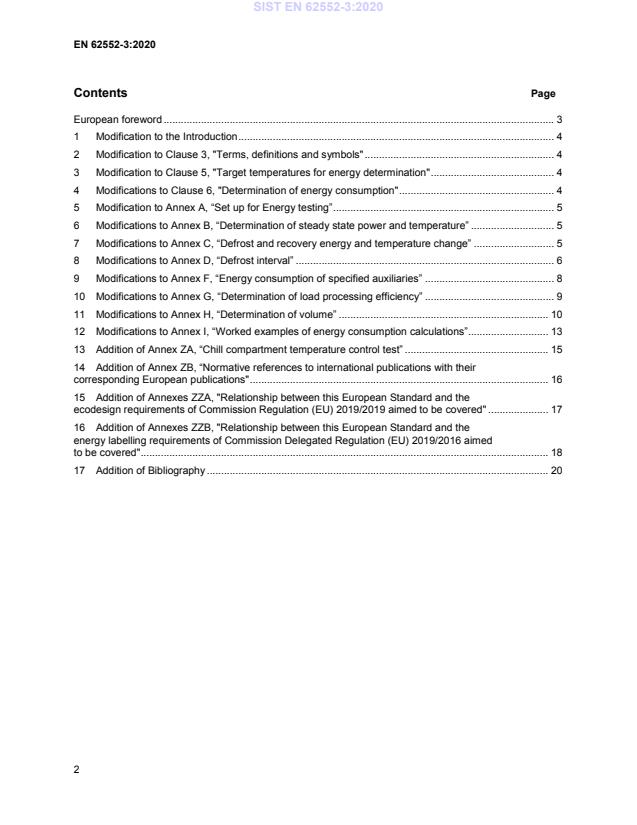
Contents Page
European foreword . 3
1 Modification to the Introduction . 4
2 Modification to Clause 3, "Terms, definitions and symbols" . 4
3 Modification to Clause 5, "Target temperatures for energy determination" . 4
4 Modifications to Clause 6, "Determination of energy consumption" . 4
5 Modification to Annex A, “Set up for Energy testing” . 5
6 Modifications to Annex B, “Determination of steady state power and temperature” . 5
7 Modifications to Annex C, “Defrost and recovery energy and temperature change” . 5
8 Modifications to Annex D, “Defrost interval” . 6
9 Modifications to Annex F, “Energy consumption of specified auxiliaries” . 8
10 Modifications to Annex G, “Determination of load processing efficiency” . 9
11 Modifications to Annex H, “Determination of volume” . 10
12 Modifications to Annex I, “Worked examples of energy consumption calculations” . 13
13 Addition of Annex ZA, “Chill compartment temperature control test” . 15
14 Addition of Annex ZB, “Normative references to international publications with their
corresponding European publications" . 16
15 Addition of Annexes ZZA, "Relationship between this European Standard and the
ecodesign requirements of Commission Regulation (EU) 2019/2019 aimed to be covered" . 17
16 Addition of Annexes ZZB, "Relationship between this European Standard and the
energy labelling requirements of Commission Delegated Regulation (EU) 2019/2016 aimed
to be covered" . 18
17 Addition of Bibliography . 20
European foreword
This document (EN 62552-3:2020) consists of the text of IEC 62552-3:2015 prepared by IEC/TC 59
“Performance of household and similar electrical appliances”, together with the common modifications
prepared by CLC/TC 59X “Performance of household and similar electrical appliances”.
The following dates are fixed:
• latest date by which this document has (dop) 2021-02-24
to be implemented at national level by
publication of an identical national
standard or by endorsement
• latest date by which the national (dow) 2023-02-24
standards conflicting with this document
have to be withdrawn
This standard in combination with standards EN 62552-1:2020 and EN 62552-2:2020 will supersede
EN 62552:2013.
This standard shall be read in combination with standards EN 62552-1:2020 and EN 62552-2:2020.
a) definition of the “regional function”, i.e. calculation formula for annual energy consumption for Europe;
b) some clauses have been completely modified, i.e. D.3, F.1 and H.2.2;
c) adding of H.Z1 and Figures H.Z1, H.Z2, H.Z3, H.Z4 and H.Z5.
Clauses, subclauses, notes, tables, figures and annexes which are additional to those in IEC 62552-3:2015
are prefixed “Z”.
Attention is drawn to the possibility that some of the elements of this document may be the subject of patent
rights. CENELEC shall not be held responsible for identifying any or all such patent rights.
This document has been prepared under Standardization Request M/459 given to CENELEC by the
European Commission and the European Free Trade Association, and supports essential requirements of
EU Directive(s).
Endorsement notice
The text of IEC 62552-3:2015 was approved by CENELEC as a European Standard with agreed common
modifications.
1 Modification to the Introduction
Add the following paragraph:
"This standard was developed in relationship with Regulations (EU) 2019/2016 of 11.3.2019 on energy
labelling and (EU) 2019/2019 of 1.10.2019 on ecodesign for refrigerating appliances."
2 Modification to Clause 3, "Terms, definitions and symbols"
Add the following definition:
"3.1.Z1
low noise refrigerator
refrigerating appliance without vapour compression and with airborne acoustical noise emission lower than
27 A-weighted decibel referred to 1 pico Watt [dB(A) re 1 pW]"
3 Modification to Clause 5, "Target temperatures for energy determination"
Add the following subclause:
"5.Z1 Controllability of temperatures in a compartment
The standard does generally not include tests for the controllability of temperatures in a compartment (i.e.
how well the temperature is kept constant during changing environmental conditions without the user having
to adjust temperature control settings). The exception is the chill compartment for which a chill compartment
temperature control test has been included in Annex ZA."
4 Modifications to Clause 6, "Determination of energy consumption"
In 6.8.5, "Total energy consumption", delete the sentence "E expressed as an integrated energy value
aux
over a year".
Replace the seventh and eighth paragraph and Formula (4) with:
"The total annual energy consumption of a refrigerating appliance E (except for low noise refrigerating
total
appliances) can be given by:
E fE E+ E
{ }
total daily16°C , daily32°C aux
(4)
where
f is a regional function to give the annual energy based on daily energy at 16 °C and 32 °C. In
this standard this function is defined as:
f{E , E } = ( Day × E ) + (Day × E )
daily16°C daily32°C 16°C Daily16°C 32°C Daily32°C
where Day = Day = 365/2 days = 182,5 days;
16°C 32°C
see Annex I for examples by taking into account D = D = 365/2 d = 182,5 days;
16°C 32°C
E
aux is the annual energy from ambient controlled anti-condensation heater(s) as described in
Annex F. See I.5 for an example how to calculate this auxiliary.
The E shall be calculated in according the following equation:
total
E= 182,5× E +×182,5 EE+
total daily16°°C daily32 C aux
For low noise refrigerating appliances, the energy consumption shall be determined as provided for in
Formula 4, but at an ambient temperature of 25 °C instead of at 16 °C and 32 °C.
=
E , expressed in kWh/24h and rounded to three decimal places for the calculation of the AE is then as
daily
follows:
E = E25
daily
where E25 is E at an ambient temperature of 25 °C and derived by interpolation of the energy tests at the
T
target temperatures listed in Table 1."
5 Modification to Annex A, “Set up for Energy testing”
Replace the first paragraph of A.2.6.5, "Position of the temperature sensor in automatic ice-makers" with:
"An automatic ice-maker bin shall have a single temperature sensor located in the position specified as
follows for all energy tests:"
6 Modifications to Annex B, “Determination of steady state power and
temperature”
In B.4.3, "Case SS2 calculation of values", replace Formula (13) with:
∆Th
dfj−i
TT()−
SS 2−i av−endX−endY−i
()tt−
end−−Y end X
" (13)"
In B.4.3, "Case SS2 calculation of values", replace item ΔTh under Formula (13) with:
dfj-i
"
ΔTh
dfj-i is the accumulated temperature difference over time in each compartment i in Kh as
determined in accordance with C.3.3 for the defrost and recovery period j commencing at
the end of Period X"
In B.4.3, "Case SS2 calculation of values", replace Formula (14) with:
Rt − Rt −∆t
end−−Y end X drj
CRt =
SS 2
()tt−
end−−Y end X
" (14)"
In B.4.3, "Case SS2 calculation of values", replace item Δt under Formula (14) with:
dr
"
Δt is the additional compressor run time in h as determined in accordance with C.3.3 for
drj
the defrost and recovery period j commencing at the end of period X"
7 Modifications to Annex C, “Defrost and recovery energy and temperature
change”
In C.3.3, "Case DF1 calculation of values" add the following after the NOTE:
"During a load processing efficiency test, it is possible that one or more defrosts occur for which a
correction shall be made. This correction is based on splitting the defrost and recovery energy in a fixed
part and the energy used by the defrost heater:
Fixed defrost adder is:
ΔE ΔE−E
df−−adder, j df , j df heater, j
(19a)
where:
=
=
E is the energy used by the defrost heater during the defrost and recovery period j in Wh."
df-adder,j
In C.4, "Number of valid defrost and recovery periods", add the following note at the end:
"NOTE Z1 The defrost heater energy ΔEdf-adder,j and incremental defrost and recovery energy ΔEdf,i for new appliances
and appliances that have not been operated for some time could be initially low until the defrost heater energy stabilizes."
In C.5, "Calculation of representative defrost energy and temperature", replace Formula 22 with:
m
∆E
∑ df , j
j=1
∆E =F
df df
m
" (22)"
In C.5, "Calculation of representative defrost energy and temperature", add the following text below the line
∆E :
df,j
"F is a regional scaling factor which can be used to compensate for frost load and usage factor which
df
impacts the defrosts intervals. The value for F is set to 1,0."
df
In C.5, "Calculation of representative defrost energy and temperature", add the following text above
Formula (23):
"For correcting a load processing efficiency tests where one or more defrosts occurs, a representative
value for the fixed defrost adder is defined:"
In C.5, "Calculation of representative defrost energy and temperature", replace Formula 23 with:
m
∆E
∑ df−adder, j
j=1
∆=E
df−adder
m
" (23)"
8 Modifications to Annex D, “Defrost interval”
In D.2, "Elapsed time defrost controllers", replace Note 2 with:
"NOTE 2 The same timers could be used as compressor run time controllers or as elapsed time controllers,
depending on how they are configured in the refrigerating appliance."
Replace the entire subclause of D.3, "Compressor run time defrost controllers" with:
"For these controllers, the defrost interval is defined by the compressor run time (or on time in hours) (or
in some cases the compressor run time plus the maximum time allocated for defrost heater operation).
These controllers are only applicable to single speed compressors. The defrost interval is therefore
approximately inversely proportional to the total heat load on the refrigeration system (ambient
temperature and user loads plus any internal heat loads). The most common defrost run time controllers
range from 6 h to 12 h of compressor run time. Typically this would result in defrost intervals of the order
of 12 h to 30 h (elapsed time) at elevated ambient temperatures and somewhat longer defrost intervals
at lower ambient temperatures.
NOTE 1 The same timers could be used as compressor run time controllers or as elapsed time controllers,
depending on how they are configured in the refrigerating appliance.
If the run time controller is not accessible (or where it is not clear whether the controller is a run time
controller) or where the laboratory is not able to directly measure the controller operation and does not know
its run time, the value for the proxy run time shall be measured by testing as set out below. Any routine
energy tests or other tests may be used for this purpose.
Each measurement shall be undertaken over a whole defrost control cycle and tests shall be undertaken
in at least two different ambient temperatures in order to verify that it is a run time controller and to estimate
the value of t . The period selected shall comply with the following requirements:
prt
— The first defrost shall qualify as a valid defrost as specified in C.3;
— the test period shall include at least part of the subsequent defrost and recovery period that is initiated
automatically without any intervention (defrost heater on).
The estimated proxy run time of the compressor run time defrost controller for a given set of test data that
complies with these requirements is given by:
t tt+
prt, j crt,,j dh j
(25)
where
t is the estimated proxy run time of the compressor run time defrost controller for the test period
prt,j
starting with defrost and recovery period j in h;
t is the measured compressor run time in h from the initiation of defrost heater operation for
crt,j
defrost and recovery period j to the initiation of defrost heater operation for the subsequent
defrost and recovery period j + 1;
t is the time from the start of the defrost heater on until the compressor restarts in h during
dh,j
defrost and recovery period j where the timer advances during the heater operation;
otherwise a value of zero if the timer does not advance during the heater operation.
A common configuration is that the defrost heater is allocated a fixed maximum time of operation in the
timer defrost controller (for example 20 min). The actual heater on time will vary depending on the frost load
for the specific defrost. So the time between the heater off and the compressor on may vary, but the total
time from heater on to compressor on should be constant in this configuration. Where the laboratory has
any doubt about the appliance configuration, it is assumed that the defrost timer does not advance when
the defrost heater is on, so that only compressor on time is counted and the value of t is set to zero in
dhj
Formula (25).
Additional routine tests undertaken at other ambient temperatures and/or temperature control settings,
including user related loads such as door openings and small processing loads should be reviewed to
assess defrosting behaviour. The observed defrost interval should be consistent with the measured proxy
run time, otherwise it shall be classified as a variable defrost controller.
NOTE 2 These tests can be used to detect whether the run time controller is over-ridden by some other control
mechanism during normal use conditions.
To qualify as a compressor run time defrost controller, the coefficient of variation (standard deviation divided
by the mean) of the measured values for either compressor proxy run time t or compressor run time alone
prt,j
t shall be less than 5 % for the defrost intervals examined. Where the product does not comply with this
crt,j
requirement, it shall be classified as a variable defrost controller. The value of t used in subsequent
prt
calculations shall be the average of all measured values of t .
prt,j
Once confirmed, the proxy run time can be used to calculate the actual defrost interval (in elapsed time)
for any temperature control setting, ambient temperature and load processing condition, as a function
of the compressor run time. For all refrigerating appliances with compressor run time defrost controllers,
the percentage run time shall be reported for steady-state conditions in Annex B and the extra compressor
run time (in h) shall be calculated for defrost and recovery periods (in Annex C, Formula (21). The defrost
interval for each test condition and temperature control setting is given by:
tt−∆
prt dr t −∆t
crt dr
t
df
CRt CRt
SS SS
(26)
where
==
=
t is the estimated defrost interval (elapsed time) for each temperature control setting and
df
ambient temperature under test in h, including the impact of defrost and recovery
t is the representative measured proxy run time of the compressor run time defrost controller
prt
(in h) in accordance with Formula (25)
CRt is the compressor run time (as a percentage) during the steady-state operation for each
SS
temperature control setting and ambient temperature under test as determined in B.3.3
or B.4.3
Δt is the representative incremental compressor run time (in hours) for defrost and recovery
dr
in accordance with C.5 in accordance with Formula (25)
t is the representative time from the start of the defrost heater on until the compressor restarts
dh
in h during a defrost and recovery period where the timer advances during the heater
operation, otherwise a value of zero
t
crt is the representative compressor run time in h from the initiation of one defrost heater
operation until the initiation of the next defrost heater operation (this can be determined from
rearranging Formula (25).
NOTE Z1 The exclusion of heater on time t and t is the default assumption for calculations in Formula (25) and
dh,j dh
Formula (26). If the defrost timer does not advance during the defrost heater operation or if the laboratory is unsure,
then the value of tdh,j and tdh is set to be zero for both equations. It is essential to apply consistently heater on time tdh,j
and t in Formula (25) and Formula (26)."
dh
In D.4.2, "Variable defrost controllers – declared defrost intervals", replace the first bullet of third paragraph
with:
"— Δt shall not exceed 12 h at an ambient temperature of 32 °C (elapsed time)."
d-min
9 Modifications to Annex F, “Energy consumption of specified auxiliaries”
In F.2.5, "Calculation of power consumption", add the following sentence and Note Z1:
"The data as set out in Table F.1 shall be used.
NOTE Z1 Values (R1 to R30) are defined based on the weather data of Karlsruhe/Germany covering the years 1998
to 2007. Power values that are specific to these regional values (PH1 to PH30 for bins R1 to R30) are normally provided by
the product supplier or manufacturer."
Replace Table F.1 with:
"
Table F.1 — Format for temperature and humidity data – Ambient controlled anti-condensation
heaters
Relative RH band Probability Probability Probability Heater W Heater W Heater W
Humidity mid-point R at 16 °C R at 22 °C R at 32 °C at 16 °C at 22 °C at 32 °C
i i i
0 to 10 % 5 % 0,00 % 0,00 % 0,34 % P P P
H1 H11 H21
10 to 20 % 15 % 0,61 % 6,86 % 2,01 % P P P
H2 H12 H22
20 to 30 % 25 % 3,11 % 14,57 % 1,61 % P P P
H3 H13 H23
30 to 40 % 35 % 5,03 % 14,83 % 0,86 % P P P
H4 H14 H24
40 to 50 % 45 % 5,09 % 11,67 % 0,18 % P P P
H5 H15 H25
50 to 60 % 55 % 4,67 % 8,31 % 0,01 % P P P
H6 H16 H26
60 to 70 % 65 % 3,39 % 5,54 % 0,00 % P P P
H7 H17 H27
Relative RH band Probability Probability Probability Heater W Heater W Heater W
R at 16 °C R at 22 °C R at 32 °C
Humidity mid-point i i i at 16 °C at 22 °C at 32 °C
P P P
70 to 80 % 75 % 3,17 % 2,51 % 0,00 % H8 H18 H28
P P P
80 to 90 % 85 % 2,85 % 0,66 % 0,00 % H9 H19 H29
P P P
90 to 100 % 95 % 2,05 % 0,07 % 0,00 % H10 H20 H30
"
Replace Formula (40) and the text just above and below with the following:
"The heater power can be calculated as follows:
k
W ()R××P 1,3
heaters ∑ i H i
i=1
(40)
where
W is the annual average additional power consumption associated with the ambient controlled
heaters
anti-condensation heater;
R is a regional factor to indicate the probability of the i-th temperature and humidity bin in
i
Table F.1;
P is the average heater power associated with the i-th temperature and humidity bin in
h,i
Table F.1,
k is the total number of temperature and humidity bins used ( = 30 if all bins in Table F.1 are
used);
1,3 is the assumed loss factor (is the energy used by the heater (1,0) plus a loss component of
0,3 to account for heat leakage into the compartment and its subsequent removal by the
refrigeration system)."
10 Modifications to Annex G, “Determination of load processing efficiency”
In G 5.3, "Quantification of additional energy used to process the load", replace Formula 51 and the text
below with:
nn
ΔE = (E−E )−P×−(t t )− z×ΔE − E
( )
additional-test end start after end start ∑∑i df-adder,i df-heater,ij
ii11
"
(51)
where
ΔE is the additional energy consumed by the refrigerating appliance during the test
additional-test
to fully process the loaded added as specified in Clause G.3;
E is the accumulated energy reading at the start of load processing efficiency test
start
as defined in G.4.1 in Wh;
E is the accumulated energy reading at the end of load processing efficiency test
end
as defined in G.4.4 in Wh;
P is the steady-state power consumption that occurs after the load has been fully
after
processed during the valid energy test period (Clause B.3 or Clause B.4) as
defined in G.4.4 in W;
==
=
t is the test time at the start of load processing efficiency test as defined in G.4.1
start
in h;
t is the test time at the end of load processing efficiency test as defined in G.4.4
end
in h;
ΔE is the average defrost adder calculated in Annex C for all valid defrosts specified
df-adder,i
for defrost system i for the relevant ambient temperature;
n
is the number of defrost systems in the appliance;
z is a count of the number of defrosts that occur for defrost system i;
E is the sum of the defrost heater energy for the j defrosts that occur during the load
df-heater,ij
processing test for each defrost system i."
In G.5.5, "Load processing multiplier", modify first sentence of the second paragraph with:
"Where a load multiplier is used to estimate the additional energy associated with a processing load, it is
important to calculate a normalized value for E in order to correct for small variations in
input-nominal
compartment temperatures and ambient temperature conditions that occur during a test."
11 Modifications to Annex H, “Determination of volume”
Replace H.2.2, "Determination of volume" with:
"The volume shall take into account the exact shapes of the walls including all depressions or projections.
For through the door ice and water dispensers, the ice chute shall be included in the volume up to the
dispensing function.
The items below shall be considered as being in place and their volumes deducted:
a) The volume of control housings, including integral parts of it.
b) The volume of the evaporator space (which includes any space made inaccessible by the evaporator)
(see H.2.3).
c) The volume of air ducts required for proper cooling and operation of the unit.
d) Space occupied by shelves moulded into the inner door panel.
e) The volume of any insulating partition between compartments and/or sub-compartments. An
average thickness of greater than 5 mm is considered to be an insulating partition.
For clarification, the through the door ice and water dispensers and the insulating hump are not included in
the volume. No part of the dispenser unit shall be included as volume.
NOTE Z1 When the volume is determined, internal fittings are considered as not being in place, such as
— shelves;
— removable partitions;
— containers;
— convenience features (not classified as sub-compartments);
— interior light housings and lights."
In H.2.3, "Volume of evaporator space" replace item c) and add item:
"c) In the case of refrigerant filled shelving, the volume above the uppermost shelf and below the
lowermost shelf, if the distance between the shelf and the nearest horizontal plane of the cabinet inner
wall is less than or equal to 50 mm. All refrigerated shelves are considered as not present.
d) In the case where a fan is installed in an unfrozen compartment with a refrigerated wall evaporator or
a plate style evaporator, the volume of the fan and the fan scroll."
Add the following subclause H.Z1:
"H.Z1 Calculation of the volume of the section or sub-compartment in the compartment whose
target temperatures are different from each other
Calculation of the volume of the section or sub-compartment in the compartment whose target temperatures
are different from each other
Figures H.Z1 to H.Z5 show typical examples of volume calculation for a two-star section or compartment
inside the freezer compartment (three-star or four-star) and should be considered as generic examples.
The examples shown in Figures H.Z1 to H.Z5 may be combined to adapt the calculation to be representative
of the section or compartment in the refrigerating appliance under consideration.
Figures H.Z1, H.Z2 and H.Z4 can also be applied to a chill sub-compartment inside a fresh food
compartment.
Two-star
compartment or chill
compartment
Freezer or
If there is an
Fresh Food
interior wall
compartment
surrounding the
section (including
fixed partitions), the
calculation includes
all the space up to
Front view Side view
Figure H.Z1 — Part with partition in the freezer is a two-star compartment (or a chill compartment
next to a fresh food compartment)
Two-star compartment or chill
compartment
Freezer or fresh
The boundary for the
food
part of the section
compartment
without a
surrounding interior
wall, etc., is to the
midway point of the
compartment
boundary.
Front view Side view
Figure H.Z2 — Part without partition next to the freezer or fresh food compartment is a two-star
compartment or a chill compartment, respectively
The door shelf edge
is to be the
ドアポケット淵を
boundary of the
The throat areas 区画の境界線とす
section.
are to be
る。
スロート部も
classified as two-
2スター区画
star sections.
とする
Side view
Figure H.Z3 — Freezer door shelves are a two-star section
The midway point
of the thickness of
the shelf is to be
the boundary of
the section.
The edge of the shelf or the edge of the case is to be boundary of
the section, whichever is nearer to the front.
Front view Side view
Figure H.Z4 — Drawer in the freezer is a two-star section (or a chill sub-compartment in a fresh
food compartment)
Door shelf
扉ポケット
(Two-star section)
(2スター区画)
The midway
horizontal line
between the highest
point and lowest point
引き出しケース
Drawer (two-star section)
(2スター区画)
To be classifi2ed スタas tーに挟wo-starまれて sectionいる場合 if located は、
between two-2sスタtar arー区画eas. とする。
Figure H.Z5 — Space between a door shelf and drawer-type two-star section"
12 Modifications to Annex I, “Worked examples of energy consumption
calculations”
In I.2, "Variable defrost – calculation of defrost intervals" replace definition of Δt with:
d-min
"— Δt shall not exceed 12 h at an ambient temperature of 32 °C (elapsed time)."
dm-min
In I.7, "Determination of annual energy consumption", replace the eighth paragraph with:
"The regional equivalent operating factors for a refrigerating appliance are:
— Annual days operating at an ambient temperature of 16 °C equivalent is 182,5 days (Day );
— Annual days operating at an ambient temperature of 32 °C equivalent is 182,5 days (Day ).
Day + Day = 365 days
16 32
A regional function of the annual energy at 16 °C and 32 °C is expressed as follows:
E f E ,E+ E+∆E
{ }
total daily16C daily32C aux processing−annual
(Z1)
E= Day× E + Day× E ++(E ) ∆E
( ) ( ) ( )
total 16 daily16C 32 daily32C aux processing−annual
E = 182,5×597/1000 + 182,5×1230/1000 + 27,51 + 182,5×135/ 1,47×1000 + 182,5×390/ 1,15×1000 kWh/year
(( )) ( ) ( ) ( ( )) ( ( ))
total
E = 108,95+224,47+27,51+16,76+61,89 kWh/year
( )
total
E = 439,58 kWh/year
total
NOTE The factor of 1 000 in this formula converts the units of Wh/d to kWh/d. Care is required to make sure all
units are consistent."
In I.5, "Automatically controlled anti-condensation heater(s)", replace Table I.9 with:
"Table I.9 — Example of population-weighted humidity probabilities and heater wattages at 16 °C,
22 °C and 32 °C
RH band Regional Probability, R Average heater power Probability times power
i
mid-point P (in W) (from at each ambient
Hi
manufacturer) temperature
16 °C 22 °C 32 °C 16 °C 22 °C 32 °C 16 °C 22 °C 32 °C
5 % 0,00 % 0,00 % 0,34 % 0 0 0 0,0000 0,0000 0,0000
15 % 0,61 % 6,86 % 2,01 % 0 0 1 0,0000 0,0000 0,0201
25 % 3,11 % 14,57 % 1,61 % 0 1 2 0,0000 0,1457 0,0322
35 % 5,03 % 14,83 % 0,86 % 0 2 3 0,0000 0,3966 0,0258
45 % 5,09 % 11,67 % 0,18 % 1 2 4 0,0509 0,2334 0,0720
55 % 4,6 7 % 8,31 % 0,01 % 1 3 5 0,0467 0,2493 0,0050
65 % 3,39 % 5,54 % 0,00 % 1 3 6 0,0339 0,1662 0,0000
75 % 3,17 % 2,51 % 0,00 % 2 4 7 0,0634 0,1004 0,0000
85 % 2,85 % 0,66 % 0,00 % 2 5 8 0,0570 0,0330 0,0000
95 % 2,05 % 0,07 % 0,00 % 3 6 9 0,0615 0,0042 0,0000
Total 30 % 65 % 5 %
NOTE The example in this table is based on the weather data of Karlsruhe/Germany covering the years 1998 to 2007 for a
hypothetical refrigerating appliance.
"
=
13 Addition of Annex ZA, “Chill compartment temperature control test”
Add the following Annex ZA:
"
Annex ZA
(normative)
Chill compartment temperature control test
A chill compartment shall be able to control its average temperature within a certain range without user-
adjustments of its control. This shall be checked during a set of temperature control tests which consists of
two parts: reference tests at 32 °C and verification tests at 16 °C. All temperature control tests shall be
performed as prescribed for the energy consumption tests. The controller setting of the chill compartment,
if present, shall be the same for all temperature control tests.
Note Z1 In general all or part of the temperature control tests can also be used for the energy consumption
determination.
Determine the reference chill compartment temperature T by performing one or more reference tests
ccma,ref
at 32 °C ambient. T is the interpolated value of T according Annex E and all reference tests shall be
ccma,ref ccma
valid tests for interpolation subject to the following conditions:
a) If the temperature control of the chill compartment is not adjustable by the user, the chill compartment
is tested in the condition as delivered.
b) If the temperature control of the chill compartment is accessible to the user (e.g. visible control on the
display or by following manufacturer instructions), it is set to a position which leads to an interpolated
temperature of T at or as close as possible below the target temperature (+2 °C) .
ccma
The interpolation can be to the target temperature(s) of any controlled compartment present, with the
exception of the chill compartment as the controller setting shall be the same for each reference test.
Perform one or more verification tests at 16 °C ambient temperature with the same temperature control
setting of the chill compartment as applied at 32 °C. Other control settings shall be such that the controlled
compartments are within 4 K of their target temperature, with the exception of the fresh food compartment,
where, if present, the fresh food compartment temperature T shall be in the range from 2 °C to 6 °C.
ma
For each of these verification tests, T shall be within T ± 1,5 K. An example of a temperature control
ccma ccma,ref
diagram is given in Figure Z1. In case any of the verification tests is not complying with this requirement,
the compartment shall not be classified as a chill compartment.
It is allowed to perform the reference tests for determining T at 16 °C ambient temperature and perform
ccma,ref
the verification tests at 32 °C.
Figure Z1 − Example of a temperature control diagram for a combination appliance with a fresh
food and chill compartment
"
14 Addition of Annex ZB, “Normative references to international publications with
their corresponding European publications"
Add the following Annex ZB:
"
Annex ZB
(normative)
Normative references to international publications
with their corresponding European publications
The following documents are referred to in the text in such a way that some or all of their content constitutes
requirements of this document. For dated references, only the edition cited applies. For undated references,
the latest edition of the referenced document (including any amendments) applies.
NOTE Z1 When an International Publication has been modified by common modifications, indicated by
(mod), the relevant EN/HD applies.
NOTE Z2 Up-to-date information on the latest versions of the European Standards listed in this annex is
available here: www.cenelec.eu.
Publication Year Title EN/HD Year
IEC 62552-1 2015 Household refrigerating appliances – Characteristics EN 62552-1 2020
(mod) and test methods – Part 1: General requirements
IEC 62552-2 2015 Household refrigerating appliances – Characteristics EN 62552-2 2020
(mod) and test methods – Part 2: Performance requirements
"
15 Addition of Annexes ZZA, "Relationship between this European Standard and
the ecodesign requirements of Commission Regulation (EU) 2019/2019 aimed
to be covered"
"
Annex ZZA
(informative)
Relationship between this European Standard and the ecodesign
requirements of Commission Regulation (EU) 2019/2019 aimed to be
covered
This European standard has been prepared under a Commission’s standardisation request “Mandate to
CEN, CENELEC and ETSI for Standardisation in the field of household refrigerating appliances”, M/459
(2009) to provide one voluntary means of conforming to the ecodesign requirements of Commission
Regulation (EU) 2019/2019 of 1.10.2019 laying down ecodesign requirements for refrigerating appliances
pursuant to Directive 2009/125/EC of the European Parliament and of the Council and repealing
Commission Regulation (EC) No 643/2009 [OJEU L315/187 of 5.12.2019].
Once this standard is cited in the Official Journal of the European Union under that Regulation, compliance
with the normative clauses of this standard given in Table ZZA.1 confers, within the limits of the scope of
this standard, a presumption of conformity with the corresponding ecodesign requirements of that
Regulation and associated EFTA Regulations.
Table ZZA.1 – Correspondence between this European Standard and Commission Regulation (EU)
2019/2019 of 1.10.2019 laying down ecodesign requirements for refrigerating appliances pursuant
to Directive 2009/125/EC of the European Parliament and of the Council and repealing Commission
Regulation (EC) No 643/2009 [OJEU L315/187 of 5.12.2019] and Commission’s standardisation
request “Mandate to CEN, CENELEC and ETSI for Standardisation in the field of household
refrigerating appliances”, M/459 (2009)
Ecodesign requirements of
Clause(s) / sub-clause(s)
Regulation No 2019/2019 Remarks/ Notes
of this EN
[OJEU L315/187 of 5.12.2019]
Art. 6 Clause 7
Circumvention
Article 4.4 Annex F.2.6, F.2.7, F.2.8
Anti-condensation heater that can be
switched on and off by the end-user
Article 4.4 Annex F.2.5
Ecodesign requirements of
Clause(s) / sub-clause(s)
Regulation No 2019/2019 Remarks/ Notes
of this EN
[OJEU L315/187 of 5.12.2019]
Ambient controlled anti-condensation heaters
Article 4.4Chill requirements Annex ZA
Article 4.4, Annex II, 1 a), Table 1 and 1 b), Clauses 4, 5, 6, 8
Table 2
Energy efficiency index
Article 4.4, Annex II, 1 a), Table 1 and 1 b), Clause 6
Table 2Energy efficiency index for low noise
refrigerator
WARNING 1: Presumption of conformity stays valid only as long as a reference to this European Standard
is maintained in the list published in the Official Journal of the European Union. Users of this standard should
consult frequently the latest list published in the Official Journal of the European Union.
WARNING 2: Other Union legislation may be applicable to the products falling within the scope of this
standard."
16 Addition of Annexes ZZB, "Relationship between this European Standard and
the energy labelling requirements of Commission Delegated Regulation (EU)
2019/2016 aimed to be covered"
"
Annex ZZB
(informative)
Relationship between this European Standard and the energy labelling
requirements of Commission Delegated Regulation (EU) 2019/2016
aimed to be covered
This European standard has been prepared under a Commission’s standardisation request “Mandate to
CEN, CENELEC and ETSI for Standardisation in the field of household refrigerating appliances”, M/459
(2009) to provide one voluntary means of conforming to the energy labelling requirements of Commission
Delegated Regulation (EU) 2019/2016 of 11.3.2019 supplementing Regulation (EU) 2017/1369 of the
European Parliament and of the Council with regard to energy labelling of refrigerating appliances and
repealing Commission Delegated Regulation (EU) No 1060/2010 [OJEU L315/102 of 5.12.2019].
Once this standard is cited in the Official Journal of the European Union under that Regulation, compliance
with the normative clauses of this standard given in Table ZZB.1 confers, within the limits of the scope of
this standard, a presumption of conformity with the corresponding energy labelling requirements of that
Regulation and associated EFTA Regulations.
Table ZZB.1 – Correspondence between this European Standard and Commission Delegated
Regulation (EU) 2019/2016 of 11.3.2019 supplementing Regulation (EU) 2017/1369 of the European
Parliament and of the Council with regard to energy labelling of refrigerating appliances and
repealing Commission Delegated Regulation (EU) No 1060/2010 [OJEU L315/102 of 5.12.2019] and
Commission’s standardisation request “Mandate to CEN, CENELEC and ETSI for Standardisation
in the field of household refrigerating appliances”, M/459 (2009)
Energy labelling
Requirements of
Clause(s) / sub-clause(s)
Remarks/ Notes
of this EN
Regulation No 2019/2016
[OJEU L315/102 of 5.12.2019]
Annex VI, Table 7 (general product Annex F.2.6, F.2.7, F.2.8
specification)
Anti-condensation heater that can be
switched on and off by the end-user
Annex VI, Table 7 (general product Annex F.2.5
specification)Ambient controlled anti-
condensation heaters
Annex V, Table 6 (compartment Annex ZA
parameters); Annex VI, Table 7
(compartment specifications)
Chill requirements
Annex III, 1.2.V. and 2.2.V.;Annex V, Table
Clauses 4, 5, 6, 8
6 (general product parameters); Annex VI,
Table 7 (general product specifications)
Energy consumption and energy efficiency
index
Annex III, 1.2 and 2.2; Annex IV, 4 a); Annex H
Annex V, Table 6 (compartment
parameters)Compartment volume and total
volume
WARNING 1: Presumption of conformity stays valid only as long as a reference to this European Standard
is maintained in the list published in the Official Journal of the European Union. Users of this standard should
consult frequently the latest list published in the Official Journal of the European Union.
WARNING 2: Other Union legislation may be applicable to the products falling within the scope of this
standard."
17 Addition of Bibliography
Add the following Bibliography:
"
Bibliography
COMMISSION DELEGATED REGULATION (EU) 2019/2016 of 11.3.2019 supplementing Regulation (EU)
2017/1369 of the European Parliament and of the Council with regard to energy labelling of
refrigerating appliances and repealing Commission Delegated Regulation (EU) No 1060/2010
COMMISSION REGULATION (EU) 2019/2019 of 1.10.2019 laying down ecodesign requirements for
refrigerating appliances pursuant to Directive 2009/125/EC of the European Parliament and of the
Council and repealing Commission Regulation (EC) No 643/2009
"
IEC 62552-3 ®
Edition 1.0 2015-02
INTERNATIONAL
STANDARD
NORME
INTERNATIONALE
colour
inside
Household refrigerating appliances – Characteristics and test methods –
Part 3: Energy consumption and volume
Appareils de réfrigération à usage ménager – Caractéristiques et méthodes
d'essai –
Partie 3: Consommation d'énergie et volume
INTERNATIONAL
ELECTROTECHNICAL
COMMISSION
COMMISSION
ELECTROTECHNIQUE
INTERNATIONALE
ICS 97.030 ISBN 978-2-8322-2229-4
Attention! Veuillez
...