

prEN 50174-2:2026
(Main)Information technology - Cabling installation - Part 2: Installation planning and practices inside buildings
- Abstract
This document specifies requirements for the following aspects of information technology cabling: a) planning; b) installation practice. This document is applicable to all types of information technology cabling inside buildings (and can be applied to cabling that is defined as part of the building) including generic cabling systems designed in accordance with the EN 50173 series. NOTE Planning and installation of certain types of application-specific cabling can be supplemented by other standards e.g. EN 63044–6 for Home Building Electronics System (HBES) and Building Automation and Control Systems (BACS). The requirements of Clauses 5, 6 and 7 of this document are premises-independent unless amended by the requirements of premises-specific clauses. This document: 1) contains requirements and recommendations for satisfactory installation and operation of information technology cabling; 2) describes the methodology for the assessment of spaces, pathways (and pathway systems) and cabling (either installed or planned) in support of remote powering objectives; 3) excludes specific requirements applicable to other cabling systems (e.g. power supply cabling); however, it takes account of the effects other cabling systems have on the installation of information technology cabling (and vice versa) and gives general advice; 4) excludes those aspects of installation associated with the transmission of signals in free space between transmitters, receivers or their associated antenna systems. This document is applicable to certain hazardous environments. It does not exclude additional requirements which are applicable in particular circumstances, defined by e.g. electricity supply and electrified railways. Safety (electrical safety and protection, optical power, fire protection, etc.) and electromagnetic compatibility (EMC) requirements are outside the scope of this document and are covered by other standards and regulations. However, information given in this document can be of assistance in meeting these standards and regulations.
- Status
- Not Published
- Publication Date
- 14-Jul-2027
- Technical Committee
- CLC/TC 215 - Electrotechnical aspects of telecommunication equipment
- Drafting Committee
- CLC/TC 215/WG 02 - Electrical safety
- Current Stage
- 4060 - Enquiry results established and sent to TC, SR, BTTF - Enquiry
- Start Date
- 25-Sep-2026
- Due Date
- 22-Nov-2025
- Completion Date
- 25-Sep-2026


prEN 50174-2:2026 is a draft European Standard from CLC for planning and installing information technology cabling inside buildings. It covers both metallic and optical fibre cabling, and it is written for planners, installers, designers, owners, and others who need to specify, coordinate, install, inspect, or maintain cabling systems.
This draft specifies how to plan the installation, how to carry out installation practice, and how to deal with segregation, safety, documentation, remote powering, and building-specific cases such as offices, homes, data centres, industrial spaces, distributed building services, and multi-tenant buildings.
What does prEN 50174-2:2026 specify?
prEN 50174-2:2026 specifies requirements for planning and installation practice for information technology cabling inside buildings. It applies to all types of information technology cabling inside buildings, including generic cabling systems designed to the EN 50173 series.
The document is organized into general clauses plus premises-specific clauses, so the core planning and installation rules are followed by additional requirements for offices, industrial spaces, homes, data centre spaces, distributed building services, and common infrastructures in multi-tenant buildings. It also includes annexes that give responsibilities, installation conditions, remote powering calculations, segregation values, cable reaction-to-fire information, and microduct planning guidance.
| Annex | What it covers |
|---|---|
| Annex A | Application of responsibilities |
| Annex B | Installation conditions |
| Annex C | Additional information for remote powering installations on 4-pair cabling installations |
| Annex D | Equipment accommodation environments |
| Annex E | Discrete values for cabling segregation |
| Annex F | Additional information for remote powering installations of 1-pair cabling |
| Annex G | “Reaction to fire” performance of cables |
| Annex H | Requirements and recommendations for planning the installation of micro ducts |
The scope also states several important limits. PrEN 50174-2:2026 excludes free-space signal transmission between transmitters, receivers, and antennas, and it excludes the specific requirements of other cabling systems such as power supply cabling, while still taking account of their interaction with information technology cabling. Safety and EMC requirements are outside its scope and are covered by other standards and regulations.
What are the key requirements of prEN 50174-2:2026?
The draft European Standard sets a clear chain from planning to installation to operation. Clause 4 says a conforming installation must meet the planning requirements in Clause 5, the installation practices in Clause 6, the applicable premises-specific clauses, and the bonding and lightning-related conditions where relevant. In practice, this means the cabling cannot be treated as only a building fit-out task - it has to be coordinated with the building, power, and protection systems.
Planning must be based on approved specifications
Clause 5.1 requires planning to be based on the installation specification, the technical specification, and the quality plan approved by the customer. This matters because the standard expects the installer to work from agreed documents, not from ad hoc decisions on site.
Safety, equipment, and hazardous situations must be addressed up front
Clause 5.2 covers personnel safety, power supply cabling, optical fibre hazards, transmission and terminal equipment, functional safety, intrinsically safe networks, security, and closures. It requires internal procedures for visitors and workers in hazardous areas, calls for the use of the appropriate power-installation standards, and requires laser hazard classification for optical fibre areas. For practice, this means the cabling plan must already account for site hazards, equipment safety, and any extra constraints from functional safety or intrinsically safe environments.
Documentation, pathways, pathway systems, closures, and spaces are part of the design
Clause 5 includes planning requirements for documentation, pathways, pathway systems, cable management systems, closures, cabling, filtering and surge protection, spaces, repair planning, remote powering objectives, and microducts. The standard also requires coordination with architects and other responsible engineers. In practice, the route, the room, the cabinet, and the access arrangement all need to be planned before installation starts.
Remote powering gets specific planning and assessment rules
Clause 5.12 and Annexes C and F address cabling in support of remote powering objectives. The document provides a methodology for assessing spaces, pathways, and cabling for remote powering, and it adds extra information for 4-pair and 1-pair cabling. For a buyer or engineer, the practical point is that cable length, temperature, bundle size, and installation environment can all affect whether remote powering will work as intended.
Installation practice has its own controls
Clause 6 requires safe installation practice, plus requirements for surge protective devices, labelling, testing, contractual acceptance, and operation. It also covers cable installation, jointing and termination, cords and jumpers, storage of cabling components, and microduct-related installation. This means the standard is not only about design intent - it also governs how the installed cabling is identified, checked, accepted, and handed over.
Segregation from power cabling is a major topic
Clause 7 and Annex E deal with segregation of metallic information technology cabling and power supply cabling. The standard uses segregation classifications and minimum distances, including conditions for metallic barriers, dividers, and crossings. In practice, this is one of the main design checks on a real project because it affects tray layout, route sharing, cabinet layout, and whether a barrier or spacing is needed.
Electrical distribution and lightning protection are coordinated with cabling
Clause 8 addresses electricity distribution systems and lightning protection. It gives planning advice on supply arrangements, continuity of supply, earthing, measures for signal connections in existing installations, and protection against lightning-induced overvoltages. The practical outcome is that cabling planners must think about the building power system and surge protection early, especially where electromagnetic disturbance or overvoltage risk is present.
Premises-specific clauses adapt the general rules
Clauses 9 to 14 adapt the general requirements for office spaces, industrial spaces, homes, data centre spaces, distributed building services, and common infrastructures within multi-tenant buildings. These clauses tell the reader where the general rules need to be amended or supplemented for the building type. That matters because the same cabling rules do not fit every environment in the same way.
What terms does prEN 50174-2:2026 define?
- Catenary wire - a wire hung under tension between supports for information technology cabling.
- Closed pathway system - a cable management system that does not allow cables to be installed by laying them in without tensile load.
- Data centre - a structure or group of structures dedicated to centralized IT and network telecommunications equipment, together with the power, environmental control, resilience, and security needed for service availability.
- Distributor - a functional element that terminates and connects cabling subsystems to other cabling subsystems or transmission equipment.
- Segregation - the use of bonded conductive barriers or physical separation to prevent electromagnetic interference between external noise sources, including power supply cabling, and information technology cabling.
- Surge protective device (SPD) - a device intended to protect equipment from transient overvoltages and divert surge currents.
- MOFC - micro optical fibre cabling, the short form used in the document for this cabling type.
Who uses prEN 50174-2:2026?
prEN 50174-2:2026 is used by the people who plan, design, install, inspect, accept, and maintain information technology cabling inside buildings. The foreword specifically names architects, building designers, builders, main contractors, designers, suppliers, installers, inspectors, maintainers, owners, public network providers, local service providers, and end users.
It is especially relevant where the cabling must work with building services, power systems, remote powering, EMC constraints, fire considerations, or special premises types. Typical use cases include office cabling, industrial cabling, home cabling, data centre cabling, distributed building services, and shared infrastructure in multi-tenant buildings.
What changed in prEN 50174-2:2026 from the previous edition?
prEN 50174-2:2026 supersedes EN 50174-2:2018. The foreword lists these significant technical changes:
- conformance requirements were moved into a new Clause 4
- terms, definitions, and abbreviations were updated
- planning requirements were revised, including expanded remote powering requirements for 1-pair cabling
- installation requirements were revised, and the former documentation subclause was deleted
- segregation requirements for IT cabling and power cabling were revised and restructured
- office-space requirements were mostly transferred into the new general clauses
- requirements for industrial spaces, homes, data centre spaces, and distributed building services were updated
- Annex D was updated
- Annex E on discrete segregation values was added
- Annex F on remote powering of 1-pair cabling was added
- Annex G on reaction-to-fire performance was added
- Annex H on microduct planning was added
Which standards are used with prEN 50174-2:2026?
- EN 50173 (all parts) - provides the generic cabling design basis that prEN 50174-2:2026 can support during planning and installation.
- prEN 50174-1:2026 - supplies installation specification and quality assurance requirements used alongside this part.
- EN 50174-3 - covers outside-building installation planning and practices.
- EN 50174-4 - covers testing of installed optical fibre cabling.
- EN 50310 - gives telecommunications bonding networks for buildings and other structures.
- EN 50600-2-4 - adds cabling requirements for data centres.
- EN 50600-2-5 - contributes data centre security system requirements.
- EN 60825-2 - supports optical fibre laser safety and hazard classification.
- EN IEC 61643 (all parts) - supports surge protective device selection and installation.
- EN IEC 62305-4 - covers lightning protection of electrical and electronic systems within structures.
- HD 60364 (all parts) - supports low-voltage electrical installation requirements, including wiring systems and power-supply interfaces.
- EN IEC 63044-6:2021 - gives planning and installation requirements for HBES and BACS cabling.
- EN 13501-6 - gives reaction-to-fire classification for electric cables.
- EN 60079-0, EN 60079-14, EN 60079-17 - support use in explosive atmospheres.
- ISO/IEC 24383 - provides guidance on physical network security for customer premises cabling infrastructure.
What does the prEN 50174-2:2026 document contain?
The document contains planning and installation clauses, premises-specific clauses, and annexes with tables, figures, equations, and worked methods. It includes responsibility templates, examples of installation conditions, remote powering calculation methods for 4-pair and 1-pair cabling, segregation tables and distance rules, environmental specifications for equipment accommodation, and fire reaction class guidance.
Several annexes are especially practical for design and verification work. Annex C and Annex F provide calculation methods for remote powering assessment, Annex E provides discrete segregation values, Annex G explains cable reaction-to-fire classes, and Annex H gives planning requirements for microducts, including routing, protection, marking, documentation, testing, and future expansion.
The main body also contains figures for pathways, cable management, segregation, rooms, and data centre layouts. For engineers and installers, these figures and tables turn the general requirements into concrete layout and acceptance guidance for building projects.
Relations
- Effective Date
- 28-May-2024
Get Certified
Connect with accredited certification bodies for this standard

BSI Group
BSI (British Standards Institution) is the business standards company that helps organizations make excellence a habit.

DIBt (Deutsches Institut für Bautechnik)
German Institute for Building Technology.
DIN CERTCO
DIN Group product certification.
Sponsored listings
Frequently Asked Questions
prEN 50174-2:2026 is a draft published by CLC. Its full title is "Information technology - Cabling installation - Part 2: Installation planning and practices inside buildings". This standard covers: This document specifies requirements for the following aspects of information technology cabling: a) planning; b) installation practice. This document is applicable to all types of information technology cabling inside buildings (and can be applied to cabling that is defined as part of the building) including generic cabling systems designed in accordance with the EN 50173 series. NOTE Planning and installation of certain types of application-specific cabling can be supplemented by other standards e.g. EN 63044–6 for Home Building Electronics System (HBES) and Building Automation and Control Systems (BACS). The requirements of Clauses 5, 6 and 7 of this document are premises-independent unless amended by the requirements of premises-specific clauses. This document: 1) contains requirements and recommendations for satisfactory installation and operation of information technology cabling; 2) describes the methodology for the assessment of spaces, pathways (and pathway systems) and cabling (either installed or planned) in support of remote powering objectives; 3) excludes specific requirements applicable to other cabling systems (e.g. power supply cabling); however, it takes account of the effects other cabling systems have on the installation of information technology cabling (and vice versa) and gives general advice; 4) excludes those aspects of installation associated with the transmission of signals in free space between transmitters, receivers or their associated antenna systems. This document is applicable to certain hazardous environments. It does not exclude additional requirements which are applicable in particular circumstances, defined by e.g. electricity supply and electrified railways. Safety (electrical safety and protection, optical power, fire protection, etc.) and electromagnetic compatibility (EMC) requirements are outside the scope of this document and are covered by other standards and regulations. However, information given in this document can be of assistance in meeting these standards and regulations.
This document specifies requirements for the following aspects of information technology cabling: a) planning; b) installation practice. This document is applicable to all types of information technology cabling inside buildings (and can be applied to cabling that is defined as part of the building) including generic cabling systems designed in accordance with the EN 50173 series. NOTE Planning and installation of certain types of application-specific cabling can be supplemented by other standards e.g. EN 63044–6 for Home Building Electronics System (HBES) and Building Automation and Control Systems (BACS). The requirements of Clauses 5, 6 and 7 of this document are premises-independent unless amended by the requirements of premises-specific clauses. This document: 1) contains requirements and recommendations for satisfactory installation and operation of information technology cabling; 2) describes the methodology for the assessment of spaces, pathways (and pathway systems) and cabling (either installed or planned) in support of remote powering objectives; 3) excludes specific requirements applicable to other cabling systems (e.g. power supply cabling); however, it takes account of the effects other cabling systems have on the installation of information technology cabling (and vice versa) and gives general advice; 4) excludes those aspects of installation associated with the transmission of signals in free space between transmitters, receivers or their associated antenna systems. This document is applicable to certain hazardous environments. It does not exclude additional requirements which are applicable in particular circumstances, defined by e.g. electricity supply and electrified railways. Safety (electrical safety and protection, optical power, fire protection, etc.) and electromagnetic compatibility (EMC) requirements are outside the scope of this document and are covered by other standards and regulations. However, information given in this document can be of assistance in meeting these standards and regulations.
prEN 50174-2:2026 is classified under the following ICS (International Classification for Standards) categories: 35.110 - Networking; 91.140.50 - Electricity supply systems. The ICS classification helps identify the subject area and facilitates finding related standards.
prEN 50174-2:2026 has the following relationships with other standards: It is inter standard links to EN 50174-2:2018. Understanding these relationships helps ensure you are using the most current and applicable version of the standard.
prEN 50174-2:2026 is available in PDF format for immediate download after purchase. The document can be added to your cart and obtained through the secure checkout process. Digital delivery ensures instant access to the complete standard document.
Standards Content (Sample)
SLOVENSKI STANDARD
01-september-2026
Informacijska tehnologija - Kabelska inštalacija - 2. del: Načrtovanje inštalacij in
tehnike dela v stavbah
Information technology - Cabling installation - Part 2: Installation planning and practices
inside buildings
Informationstechnik - Installation von Kommunikationsverkabelung - Teil 2:
Installationsplanung und Installationspraktiken in Gebäuden
Technologies de l'information - Installation de câblage - Partie 2 : Planification et
pratiques d'installation à l'intérieur des bâtiments
Ta slovenski standard je istoveten z: prEN 50174-2:2026
ICS:
33.040.50 Vodi, zveze in tokokrogi Lines, connections and
circuits
35.110 Omreževanje Networking
91.140.50 Sistemi za oskrbo z elektriko Electricity supply systems
2003-01.Slovenski inštitut za standardizacijo. Razmnoževanje celote ali delov tega standarda ni dovoljeno.
EUROPEAN STANDARD DRAFT
prEN 50174-2
NORME EUROPÉENNE
EUROPÄISCHE NORM
July 2026
ICS 35.110; 91.140.50 Will supersede EN 50174-2:2018
English Version
Information technology - Cabling installation - Part 2: Installation
planning and practices inside buildings
Technologies de l'information - Installation de câblages - Informationstechnik - Installation von
Partie 2 : Planification et pratiques d'installation à l'intérieur Kommunikationsverkabelung - Teil 2: Installationsplanung
des bâtiments und Installationspraktiken in Gebäuden
This draft European Standard is submitted to CENELEC members for enquiry.
Deadline for CENELEC: 2026-09-25.
It has been drawn up by CLC/TC 215.
If this draft becomes a European Standard, CENELEC members are bound to comply with the CEN/CENELEC Internal Regulations which
stipulate the conditions for giving this European Standard the status of a national standard without any alteration.
This draft European Standard was established by CENELEC in three official versions (English, French, German).
A version in any other language made by translation under the responsibility of a CENELEC member into its own language and notified to
the CEN-CENELEC Management Centre has the same status as the official versions.
CENELEC members are the national electrotechnical committees of Austria, Belgium, Bulgaria, Croatia, Cyprus, the Czech Republic,
Denmark, Estonia, Finland, France, Germany, Greece, Hungary, Iceland, Ireland, Italy, Latvia, Lithuania, Luxembourg, Malta, the
Netherlands, Norway, Poland, Portugal, Republic of North Macedonia, Romania, Serbia, Slovakia, Slovenia, Spain, Sweden, Switzerland,
Türkiye and the United Kingdom.
Recipients of this draft are invited to submit, with their comments, notification of any relevant patent rights of which they are aware and to
provide supporting documentation.
Warning : This document is not a European Standard. It is distributed for review and comments. It is subject to change without notice and
shall not be referred to as a European Standard.
European Committee for Electrotechnical Standardization
Comité Européen de Normalisation Electrotechnique
Europäisches Komitee für Elektrotechnische Normung
CEN-CENELEC Management Centre: Rue de la Science 23, B-1040 Brussels
© 2026 CENELEC All rights of exploitation in any form and by any means reserved worldwide for CENELEC Members.
Project: 80034 Ref. No. prEN 50174-2:2026 E
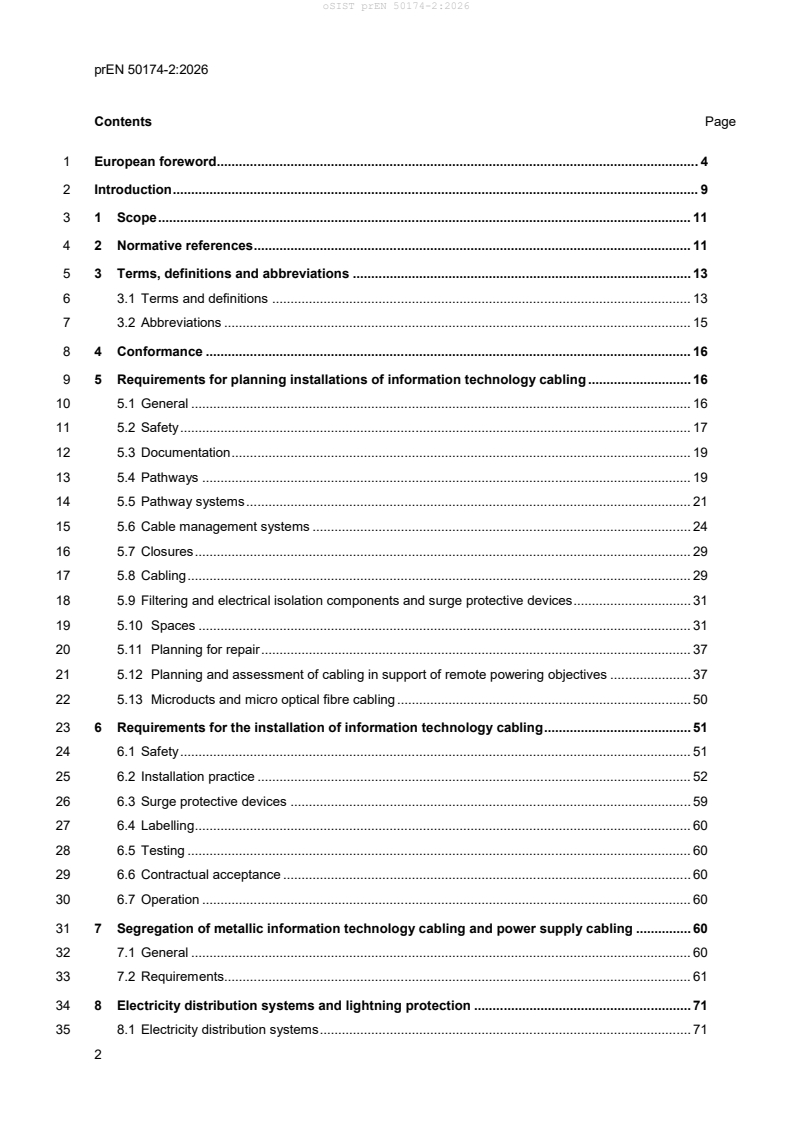
Contents Page
1 European foreword . 4
2 Introduction . 9
3 1 Scope . 11
4 2 Normative references . 11
5 3 Terms, definitions and abbreviations . 13
6 3.1 Terms and definitions . 13
7 3.2 Abbreviations . 15
8 4 Conformance . 16
9 5 Requirements for planning installations of information technology cabling . 16
10 5.1 General . 16
11 5.2 Safety . 17
12 5.3 Documentation . 19
13 5.4 Pathways . 19
14 5.5 Pathway systems . 21
15 5.6 Cable management systems . 24
16 5.7 Closures . 29
17 5.8 Cabling . 29
18 5.9 Filtering and electrical isolation components and surge protective devices . 31
19 5.10 Spaces . 31
20 5.11 Planning for repair . 37
21 5.12 Planning and assessment of cabling in support of remote powering objectives . 37
22 5.13 Microducts and micro optical fibre cabling . 50
23 6 Requirements for the installation of information technology cabling . 51
24 6.1 Safety . 51
25 6.2 Installation practice . 52
26 6.3 Surge protective devices . 59
27 6.4 Labelling . 60
28 6.5 Testing . 60
29 6.6 Contractual acceptance . 60
30 6.7 Operation . 60
31 7 Segregation of metallic information technology cabling and power supply cabling . 60
32 7.1 General . 60
33 7.2 Requirements . 61
34 8 Electricity distribution systems and lightning protection . 71
35 8.1 Electricity distribution systems . 71
36 8.2 Protection against lightning and induced overvoltages . 72
37 9 Office (commercial) spaces. 73
38 9.1 General . 73
39 9.2 Office (commercial) spaces cabling design overview . 73
40 9.3 Requirements for planning installations of information technology cabling . 73
41 9.4 Requirements for installation of information technology cabling . 75
42 9.5 Segregation of metallic information technology cabling and power supply cabling . 75
43 10 Industrial spaces . 75
44 10.1 General. 75
45 10.2 Industrial premises cabling design overview . 75
46 10.3 Requirements for planning installations of information technology cabling . 75
47 10.4 Requirements for installation of information technology cabling . 76
48 10.5 Segregation of metallic information technology cabling and power supply cabling . 76
49 11 Homes . 77
50 11.1 General. 77
51 11.2 Home cabling design overview . 77
52 11.3 Requirements for planning installations of information technology cabling . 81
53 11.4 Requirements for installation of information technology cabling . 86
54 11.5 Segregation of metallic information technology cabling and power supply cabling . 86
55 12 Data centre spaces . 86
56 12.1 General. 86
57 12.2 Data centre cabling design and planning overview . 87
58 12.3 Requirements for planning installations of information technology cabling . 88
59 12.4 Requirements for installation of information technology cabling . 92
60 12.5 Segregation of metallic information technology cabling and power supply cabling . 92
61 13 Cabling for distributed building services . 92
62 13.1 General. 92
63 Planning installations for information technology cabling . 93
64 Requirements for installation of information technology cabling . 95
65 Segregation of metallic information technology cabling and power supply cabling . 95
66 14 Common infrastructures within multi-tenant buildings . 95
67 14.1 General. 95
68 14.2 Pathways and spaces in common areas . 96
69 14.3 Requirements for planning installations of information technology cabling . 97
70 14.4 Requirements for the installation of information technology cabling . 100
71 14.5 Segregation of metallic information technology cabling and power supply cabling . 100
72 Annex A (informative) Application of responsibilities . 101
73 Annex B (informative) Installation conditions . 105
74 Annex C (normative) Additional information for remote powering installations on 4-pair cabling
75 installations . 106
76 C.1 General . 106
77 C.2 Calculation of T . 106
global
78 C.3 Remote powering installation of Category RP2 . 106
79 Annex D (informative) Equipment accommodation environments . 109
80 Annex E (informative) Discrete values for cabling segregation . 110
81 Annex F (normative) Additional information for remote powering installations of 1-pair cabling
82 112
83 F.1 General . 112
84 F.2 Channel length due to voltage drop . 112
85 F.3 Length scaling of 1-pair channel for application support . 113
86 F.4 Heating of cord bundles . 113
87 Annex G (informative) “Reaction to fire” performance of cables . 114
88 G.1 Class designation . 114
89 G.2 Application of cables of a given class designation . 114
90 Annex H (normative) Requirements and recommendations for Planning the Installation of Micro
91 ducts . 116
92 H.1 General Requirements . 116
93 H.2 Routing and Pathways . 116
94 H.3 Mechanical Protection and Environmental Considerations . 116
95 H.4 Reaction to fire . 116
96 H.5 MOFC Installation within Microducts . 117
97 H.6 Futureproofing, sustainability and scalability. 117
98 H.7 Marking and Documentation . 117
99 H.8 Testing and Verification . 118
100 Bibliography . 119
101 Figures
102 Figure 1 — Schematic relationship between the EN 50174 series and other relevant documents . 10
103 Figure 2 — Examples of pathway systems protruding through floors . 20
104 Figure 3 — Examples of non-conformant and conformant bend limiting techniques. 22
105 Figure 4 — Cable arrangement in a metallic section . 26
106 Figure 5 — Example of layered cable trays with smaller width upper trays . 27
107 Figure 6 — Example of accessible row of raised access floor panels to provide access to lower tray . 28
108 Figure 7 — Examples of spaces . 32
109 Figure 8 — Minimum dimensions for rooms housing cabling components only . 34
110 Figure 9 — Minimum dimensions for rooms housing active equipment in addition to cabling
111 components . 35
112 Figure 10: 4-Pair remote powering compliance flowchart for new installations . 39
113 Figure 11: 4-Pair remote powering compliance evaluation flowchart for existing installations . 39
114 Figure 12: 1-Pair Remote powering compliance flowchart for new installations . 44
115 Figure 13 — Separation of cable bundles to minimize heating . 50
116 Figure 14 — Continuity of metallic cable management systems . 54
117 Figure 15 — Interruption of metallic cable management systems at fire barriers . 55
118 Figure 16 – Flowchart for segregation . 63
119 Figure 18 — Minimum segregation distance of power supply and information technology cables . 68
120 Figure 19 — Segregation distance of power supply and information technology cables without dividers
121 . 68
122 Figure 20 — Segregation distance of power supply and information technology cables with dividers. 69
123 Figure 21 — Examples of crossings between technology cables and power supply cables . 70
124 Figure 22 — Pathways within homes . 78
125 Figure 23 — Example of primary distribution space . 79
126 Figure 24 — Example of local distribution spaces, junction boxes and draw-boxes . 80
127 Figure 25 — Example of infrastructure supporting star cabling topology . 80
128 Figure 26 — Example of common pathways and spaces in a multi-tenant building . 96
129 Figure B.1 — Illustration of installation environments . 105
130 Tables
131 Table 1 — Contextual relationship between EN 50174 series and other documents relevant for
132 information technology cabling systems . 10
133 Table 2 — Stacking height for typical distances l . 23
134 Table 3 — Typical elements of information exchange . 33
135 Table 4 — Example of channel length derating vs. temperature . 40
136 Table 5 — Temperature changes for various 4-pair cable bundle sizes (Category RP3) . 41
137 Table 6 — Reduction factors for rectangular cable groups . 42
138 Table 7 — Relative length reduction of channel based on temperature . 44
139 Table 8 — 1-pair channel length reduction for screened cables at 60°C . 45
140 Table 9 — Temperature changes for various 1-pair cable bundle sizes . 46
141 Table 10 — Precalculated setup to the maximum number of cables in a bundle . 48
142 Table 11 — Segregation classification of information technology cables . 63
143 Table 12 — Minimum segregation distance S when at least one of the power or the information
144 technology cabling is in a solid metallic containment equivalent to a steel conduit . 64
145 Figure 17 — Diagrams of types for metallic separation . 65
146 Table 13 — Minimum segregation distance S. 65
147 Table 16 — Minimum requirements for dimensions of primary distribution spaces . 84
148 Table 18 — Minimum dimensions of spaces allocated to junction boxes . 86
149 Table A.1 — Responsibilities template . 101
150 Table A.2 — Example of completed responsibilities . 103
151 Table C.1 — Temperature changes for remote power installations of Category RP2 . 107
152 Table D.1 — Equipment environmental specifications . 109
153 Table E.1 — Minimum segregation discrete values for cable swith classification “a” . 110
154 Table E.2 — Minimum segregation discrete values for cable swith classification “b” . 110
155 Table E.3 — Minimum segregation discrete values for cable swith classification “c” . 111
156 Table E.4 — Minimum segregation discrete values for cable with classification “d”. 111
157 Table G.1 — Class designations and their foundation standards . 115
158 European foreword
159 This document (prEN 50174-2:2026) has been prepared by Technical Committee CLC/TC 215,
160 “Electrotechnical aspects of telecommunication equipment”.
161 This document is currently submitted to the Enquiry.
162 This document supersedes EN 50174-2:2018.
163 prEN 50174-2:2026 includes the following significant technical changes with respect to EN 50174-2:
164 a) the conformance requirements (previously subclause 1.2) have been moved into a new Clause 4 and the
165 existing clause numbers were updated accordingly;
166 b) terms, definitions and abbreviations updated;
167 c) requirements for planning the installation of IT cabling (former Clause 4) revised, in particular, the former
168 4.11 has been extended to cover remote powering requirements for 1-pair cabling;
169 d) requirements for the installation of IT cabling (former Clause 5) revised and former 5.2 on documentation
170 deleted;
171 e) requirements for the segration of IT cabling and power cabling (former Clause 6) revised and restructured;
172 f) requirements for office (commercial) spaces (former Clause 8) mostly transferred to new Clauses 5 and
173 6;
174 g) specific requirements for industral spaces, homes, data centre spaces and distributed building services
175 (former Clauses 9, 10, 11 and 12) updated;
176 h) Information in Annex D updated;
177 i) Annex E on discrete values for cabling segregation added;
178 j) Annex F on remote powering of 1-pair cabling added;
179 k) Annex G on reaction of cables to fire added ;
180 l) Annex H on planning of the installation of micro ducts added.
181 EN 50174 comprises four parts:
182 — EN 50174-1, Information technology — Cabling installation — Part 1: Installation specification and quality
183 assurance;
184 — EN 50174-2, Information technology — Cabling installation — Part 2: Installation planning and practices
185 inside buildings;
186 — EN 50174-3, Information technology — Cabling installation — Part 3: Installation planning and practices
187 outside buildings (the present document);
188 — EN 50174-4, Information technology — Cabling installation — Part 4: Testing of installed optical fibre
189 cabling.
190 There are specific requirements for cabling systems that are in accordance with the design requirements of
191 the EN 50173 series. However, the four parts also apply to cabling systems of any design including those in
192 accordance with standards such as EN 50700.
193 This part, EN 50174-2, is concerned with the planning and installation of information technology cabling using
194 metallic cabling and optical fibre cabling inside buildings. It provides guidance as to the responsibilities of those
195 involved and is intended to be referenced in relevant contracts.
196 It does not cover those aspects of installation associated with the transmission of signals in free space between
197 transmitters, receivers or their associated antenna systems (e.g. wireless, radio, microwave or satellite).
198 Introduction
199 The importance of services delivered by information technology cabling infrastructure is similar to that of
200 utilities such as heating, lighting and electricity supplies. As with those utilities, interruptions to service can
201 have a serious impact. Poor quality of service due to lack of planning, use of inappropriate components,
202 incorrect installation, poor administration or inadequate support can threaten an organization’s effectiveness.
203 There are four phases in the successful implementation of information technology cabling. These are:
204 a) design;
205 b) specification – the detailed requirement for the cabling, including the planning of its accommodation and
206 associated building services addressing specific environments (e.g. electromagnetic, reaction to fire,
207 remote powering) together with the quality assurance requirements to be applied;
208 c) installation – in accordance with the requirements of the specification;
209 d) operation – the management of connectivity and the maintenance of transmission performance during the
210 life of the cabling.
211 EN 50174 series is in four parts and addresses the specification, installation, operational aspects of information
212 technology cabling and the testing of installed optical fibre cabling. The EN 50173 series and other application
213 standards cover design issues.
214 EN 50174-1, EN 50174-2 and EN 50174-3 are intended to be used by the personnel directly involved in the
215 planning aspects (of the specification phase) and the installation phase. EN 50174-2 is applicable inside
216 buildings and EN 50174-3 is applicable outside buildings. EN 50174-4 is applicable for testing of installed
217 optical fibre cabling.
218 EN 50174 series is also relevant to:
219 • architects, building designers and builders;
220 • main contractors;
221 • designers, suppliers, installers, inspectors (auditors), maintainers and owners of information technology
222 cabling;
223 • public network providers and local service providers;
224 • end users.
225 This part, EN 50174-2, contains requirements and recommendations relating to the installation planning and
226 practices by defining:
227 i) planning strategy (road map) and guidance depending on the application, electromagnetic environment,
228 building infrastructure and facilities, etc.;
229 ii) planning and installation requirements for metallic and optical fibre information technology cabling
230 depending on the application, electromagnetic environment, remote powering, building infrastructure and
231 facilities, etc.;
232 iii) the practices and procedures to be adopted to ensure that the cabling is installed in accordance with the
233 specification.
234 iv) the practices and procedure involved in the methodology for the assessment of spaces in support of
235 remote powering objectives, in accordance with the regulations and specifications.
236 Figure 1 and Table 1 show the schematic and contextual relationships between the documents produced by
237 CLC/TC 215 for information technology cabling, namely:
238 1) this and other parts of the EN 50174 series;
239 2) generic cabling design (EN 50173 series);
240 3) application dependent cabling design (e.g. EN 50700);
241 4) bonding requirements (EN 50310).
243 Figure 1 — Schematic relationship between the EN 50174 series
244 and other relevant documents
245 Table 1 — Contextual relationship between EN 50174 series and other documents
246 relevant for information technology cabling systems
Building design Generic cabling Specification Installation Operation phase
phase design phase phase phase
EN 50173–2
EN 50174–1
EN 50173–3
Planning phase
EN 50173–4
EN 50173–5 EN 50174–2
EN 50174–3 EN 50174–1
EN 50173–6
EN 50174–2
EN 50310
(these ENs EN 50174-4 EN 50174-4
EN 50174–3
reference general
EN 50310
EN 50174-4
requirements of
EN 50173–1)
EN 50310
EN 50173-10
EN 50173-20
247 1 Scope
248 This document specifies requirements for the following aspects of information technology cabling:
249 a) planning;
250 b) installation practice.
251 This document is applicable to all types of information technology cabling inside buildings (and can be applied
252 to cabling that is defined as part of the building) including generic cabling systems designed in accordance
253 with the EN 50173 series.
254 NOTE Planning and installation of certain types of application-specific cabling can be supplemented by other
255 standards e.g. EN 63044–6 for Home Building Electronics System (HBES) and Building Automation and Control Systems
256 (BACS).
257 The requirements of Clauses 5, 6 and 7 of this document are premises-independent unless amended by the
258 requirements of premises-specific clauses.
259 This document:
260 1) contains requirements and recommendations for satisfactory installation and operation of information
261 technology cabling;
262 2) describes the methodology for the assessment of spaces, pathways (and pathway systems) and cabling
263 (either installed or planned) in support of remote powering objectives;
264 3) excludes specific requirements applicable to other cabling systems (e.g. power supply cabling); however,
265 it takes account of the effects other cabling systems have on the installation of information technology
266 cabling (and vice versa) and gives general advice;
267 4) excludes those aspects of installation associated with the transmission of signals in free space between
268 transmitters, receivers or their associated antenna systems.
269 This document is applicable to certain hazardous environments. It does not exclude additional requirements
270 which are applicable in particular circumstances, defined by e.g. electricity supply and electrified railways.
271 Safety (electrical safety and protection, optical power, fire protection, etc.) and electromagnetic compatibility
272 (EMC) requirements are outside the scope of this document and are covered by other standards and
273 regulations. However, information given in this document can be of assistance in meeting these standards and
274 regulations.
275 2 Normative references
276 The following documents are referred to in the text in such a way that some or all of their content constitutes
277 requirements of this document. For dated references, only the edition cited applies. For undated references,
278 the latest edition of the referenced document (including any amendments) applies.
279 EN 13501-6, Fire classification of construction products and building elements – Part 6: Classification using
280 data from reaction to fire tests on electric cables
281 EN 50173 (all parts), Information technology - Generic cabling systems
282 prEN 50174-1:2026, Information technology – Cabling installation – Part 1: Installation specification and quality
283 assurance
284 EN 50174-3, Information technology - Cabling installation - Part 3: Installation planning and practices outside
285 buildings
286 EN 50174-4, Information technology - Cabling installation - Part 4: Testing of installed optical fibre cabling
287 EN 50288 (all parts), Multi-element metallic cables used in analogue and digital communication and control
288 EN 50310, Telecommunications bonding networks for buildings and other structures
289 EN 50600-2-4, Information technology - Data centre facilities and infrastructures - Part 2-4:
290 Telecommunications cabling infrastructure
291 EN 50600-2-5, Information technology - Data centre facilities and infrastructures - Part 2-5: Security systems
292 EN 60079-0, Explosive atmospheres – Part 0: Equipment – General requirements (IEC 60079-0:2004)
293 EN 60079-14, Explosive atmospheres - Part 14: Electrical installations design, selection and erection (IEC
294 60079 14)
295 EN 60079-17, Explosive atmospheres - Part 17: Electrical installations inspection and maintenance (IEC
296 60079 17)
297 EN 60529, Degrees of protection provided by enclosures (IP Code) (IEC 60529)
298 EN 60825-2, Safety of laser products - Part 2: Safety of optical fibre communication systems (OFCS) (IEC
299 60825 2)
300 EN IEC 61084-1, Cable trunking systems and cable ducting systems for electrical installations - Part 1: General
301 requirements
302 EN IEC 61084, 2-x (all parts) Cable trunking systems and cable ducting systems for electrical installations (IEC
303 61084)
304 EN 61386-1, Conduit systems for cable management - Part 1: General requirements (IEC 61386 1)
305 EN IEC 61386-2X, (all parts), Conduit systems for cable management – Part 2X: Particular requirements
306 (IEC 61386-2X all parts)
307 EN 61534 (all parts), Powertrack systems (IEC 61534 all parts)
308 EN 61537,1 Cable management – Cable tray systems and cable ladder systems (IEC 61537)
309 EN IEC 61643-(all parts),2 Low voltage surge protective devices (IEC 61643 all parts)
310 EN IEC 61784-3, Industrial communication networks - Profiles - Part 3: Functional safety fieldbuses - General
311 rules and profile definitions (IEC 61784 3)
312 EN IEC 61918, Industrial communication networks - Installation of communication networks in industrial
313 premises (IEC 61918)
314 EN IEC 62305-4, Protection against lightning - Part 4: Electrical and electronic systems within structures (IEC
315 62305 4)
316 EN IEC 62368-3, Audio/video, information and communication technology equipment - Part 3: Safety aspects
317 for DC power transfer through communication cables and ports (IEC 62368 3)
———————
Under revision. Currently, FprEN IEC 61537, as amended by FprEN IEC 61537/FprAA, is awaiting publication.
Some documents are still published as EN 61643-X.
318 EN IEC 63044-6:2021, Home and building electronic systems (HBES) and building automation and control
319 systems (BACS) - Part 6: Requirements for planning and installation
320 HD 60364 (all parts), Low-voltage electrical installations (IEC 60364 series)
321 3 Terms, definitions and abbreviations
322 3.1 Terms and definitions
323 For the purposes of this document, the terms and definitions given in EN 50174-1, EN 50310 and the following
324 apply.
325 Where the cabling is designed in accordance with documents in the EN 50173 series, the additional definitions
326 of those documents are applicable.
327 ISO and IEC maintain terminological databases for use in standardization at the following addresses:
328 — IEC Electropedia: available at http://www.electropedia.org/
329 — ISO Online browsing platform: available at http://www.iso.org/obp
330 3.1.1
331 catenary wire
332 wire hung at a specific tension between supporting structures for information technology cabling
333 [SOURCE: prEN 50174-3:2026, 3.1.6]
334 3.1.2
335 closed pathway system
336 cable management system which does not allow installation of cables by laying without tensile load
337 3.1.3
338 data centre
339 structure, or group of structures, dedicated to the centralized accommodation, interconnection and operation
340 of information technology and network telecommunications equipment providing data storage, processing and
341 transport services together with all the facilities and infrastructures for power distribution and environmental
342 control together with the necessary levels of resilience and security required to provide the desired service
343 availability
344 Note 1 to entry: A structure can consist of multiple buildings and/or spaces with specific functions to support the primary
345 function.
346 Note 2 to entry: The boundaries of the structure or space considered the data centre which includes the information and
347 communication technology equipment and supporting environmental controls can be defined within a larger structure or
348 building.
349 [SOURCE: prEN 50600-1:2026, 3.1.8]
350 3.1.4
351 distribution space
352 space that can house a distributor of EN 50173 series together with associated equipment
353 3.1.5
354 distributor
355 functional element enabling the termination and connection of cabling subsystems to other cabling subsystems
356 or transmission equipment
357 [SOURCE: EN 50173-1:2018, 3.1.39]
358 3.1.6
359 draw rope
360 rope used for pulling cables through pathways
361 3.1.7
362 equipment connection space
363 space within a home that corresponds to the installation space IS6 of EN IEC 63044-6 and that can house the
364 outlets (TO, BO) of EN 50173-4 together with attached equipment
365 3.1.8
366 hand hole
367 point of access to a pathway that is too small for a person to enter to perform work but that allows the routing
368 of cables during the cable installation process such that bending and pulling requirements are met
369 [SOURCE: prEN 50174-3:2026, 3.1.10]
370 3.1.9
371 junction box
372 space within a home that corresponds to the installation space IS5 of EN IEC 63044-6 and housing a closure,
373 typically in accordance with the EN 60670 series, designed to allow cables to be routed between pathway
374 systems
375 3.1.10
376 mechanical splice
377 fibre splice accomplished by fixtures or materials, rather than by thermal fusion
378 [SOURCE: IEC 60050-731:1991, 731-05-07]
379 3.1.11
380 metallic information technology cable/cabling
381 cables (cabling) utilising metallic conductors for signal transmission
382 3.1.12
383 multi-tenant building
384 building which is designed to accommodate more than one tenant each of which has their own tenant entrance
385 facility but share building entrance facilities (BEF) and associated distribution spaces
386 3.1.13
387 optical fibre cable
388 assembly comprising one or more optical fibres or fibre bundles inside a common covering designed to protect
389 them against mechanical stresses and other environmental influences while retaining the transmission quality
390 of the fibres
391 Note 1 to entry: May also contain metallic conductors.
392 [SOURCE: IEC 60050-731:1991, 731-04-01]
393 3.1.14
394 primary building distribution space
395 space accommodating the main point of distribution of any common cabling infrastructure within multi-tenant
396 buildings
397 3.1.15
398 raised access floor
399 factory made flooring system comprising panels supported on understructure of pedestals, and/or stringers or
400 other components as applicable providing a load bearing structure for the fitting out of a building
401 [SOURCE: EN 12825:2001, 3.18]
402 3.1.16
403 secondary building distribution space
404 space accommodating optional points of distribution, additional to the main point of distribution, of any common
405 cabling infrastructure within multi-tenant buildings
406 3.1.17
407 segregation
408 use of bonded electrically conductive barriers or physical separation to prevent electromagnetic interference
409 between external noise sources, including power supply cabling, and information technology cabling
410 3.1.18
411 semi-detached house
412 residence of a single family within a building containing two single-family houses where access to external
413 service provision is shared
414 3.1.19
415 single-family house
416 residence of a single family within which access to the home entrance space is limited to dweller of the house
417 3.1.20
418 surge protective device
419 device that is intended to protect the electrical apparatus from transient over-voltages and to divert surge
420 currents
421 Note 1 to entry: A surge protective device contains at least one nonlinear component.
422 [SOURCE: IEC 60050-614:2016, 614-03-48]
423 3.1.21
424 transverse conversion loss
425 ratio between the common mode signal power and the injected differential mode signal power
426 [SOURCE: EN 50173-1:2018, 3.1.87]
427 3.2 Abbreviations
428 For the purposes of this document, the abbreviations given in EN 50174-1 and the following apply.
429 Where the cabling is designed in accordance with standards in the EN 50173 series, the additional
430 abbreviations of those standards are applicable:
AC alternating current
BACS building automation and control systems
BD building distributor
CATV cabled distribution television
CD campus distributor
CMS cable management system
CSA cross-sectional area
DC dire
...