

prEN IEC 60825-18:2026
(Main)Safety of laser products - Part 18: Guided beam delivery systems
- Status
- Not Published
- Publication Date
- 23-Feb-2028
- Technical Committee
- CLC/TC 76 - Optical radiation safety and laser equipment
- Drafting Committee
- IEC/TC 76 - IEC_TC_76
- Current Stage
- 4020 - Enquiry circulated - Enquiry
- Start Date
- 18-Sep-2026
- Completion Date
- 18-Sep-2026

prEN IEC 60825-18:2026 is a draft IEC/CENELEC standard for the safety of laser products, focused on guided beam delivery systems. It specifies how to arrange, install and use beam paths that carry laser radiation away from the laser product housing, and it is aimed mainly at manufacturers and at users who assemble such systems themselves.
The standard concentrates on protecting personnel from laser radiation hazards created after the output coupler or protective housing, where the beam may travel through free space, fibre optic cables or other beam waveguides. It sets out risk assessment, protective measures, labeling, warning, service and user-information requirements.
What does prEN IEC 60825-18:2026 specify?
prEN IEC 60825-18:2026 specifies the arrangement, installation and use of guided beam delivery systems. It covers systems used in measurement, scientific research and material processing, and it applies to protective measures for hazards beyond the laser product’s own protective housing.
The scope includes combining multiple laser products, or combining laser products with other safety enclosures where lasers feed into other machines or products. It excludes incorporated beam delivery components inside the protective housing of a single laser product, communications applications and medical applications.
The document is organized into:
- Scope
- Normative references
- Terms and definitions
- General requirements
- Information for users
- Annex A with risk assessment examples
| Annex | What it covers |
|---|---|
| Annex A | Examples of risk assessment and example risk-reduction measures for guided beam delivery systems |
What are the key requirements of prEN IEC 60825-18:2026?
prEN IEC 60825-18:2026 requires the guided beam delivery system to be treated as part of the overall machine risk assessment. In practice, the designer or integrator must identify hazards along the defined beam path, assess the risk using ISO 12100 principles, and choose protective measures that reduce risk while keeping the machine functional.
Risk assessment and design priority
Clause 4.1 requires the hazards to be assessed for failures, faults, damage and foreseeable misuse or abuse. The standard puts design measures first, then additional safeguarding and safe working procedures if the design alone is not enough. That matters because the beam path can fail in ways that create hazards far from the source.
Containment and access control
Clause 4.2 requires the system to prevent access to laser radiation above Class 1 AEL along the defined beam path. For maintenance, access must not expose people to Class 3B or Class 4 radiation, and if the system protects against Class 3B or Class 4 radiation it must withstand reasonably foreseeable single fault conditions without human intervention.
Removal, displacement and service
Clauses 4.2.1 and 4.2.2 set conditions for removing or moving parts of the guided beam delivery system. This can be done only with a key or tool, or by stopping emission before access, or by other protective measures described in the instructions. For service, removable parts that would expose hazardous radiation need tool-controlled removal, service-area separation measures, and the minimum feasible number of access panels.
Access panels and interlocks
Clause 4.3 requires access panels to follow the access-panel rules of IEC 60825-1, and it requires safety interlocks for those panels. Associated safety-related control circuits must meet an appropriate control-system safety standard, such as IEC 61508 or ISO 13849. This is what links physical access protection to the control system.
Proactive safety features
Clause 4.4 allows proactive safety features only when the manufacturer defines the conditions for effective risk reduction. Clause 4.4.1 requires verification that the feature detects abnormal or degraded conditions in time and triggers the intended protective response. In practice, the manufacturer must show the feature works only within the stated operating and environmental limits.
Warning, labeling and environment
Clauses 4.5 to 4.7 cover access-panel warning labels, extra laser radiation emission warning devices when parts are separated by 2 m or more from the product warning device, and environmental conditions such as temperature, humidity, vibration, shock, electromagnetic interference, corrosive atmospheres and explosive atmospheres. These points matter because a system can become hazardous if warnings are not visible or if the installation environment degrades protection.
User information
Clause 5.1 requires technical documentation for safe installation, use, maintenance and servicing, including connection details, electrical and control requirements, radiation limits, environmental information, spare parts, safeguard and interlock diagrams, and procedures for suspending safeguarding.
What terms does prEN IEC 60825-18:2026 define?
- guided beam delivery system - A system of beam path components, supports, protective enclosures and guards that transfers or manipulates laser radiation from one laser product to another target, enclosure or product.
- defined beam path - The intended path of the laser beam within the laser product, protective enclosure or guided beam delivery system.
- beam path components - Optical components located on the defined beam path.
- protective housing - The parts of a laser product designed to prevent human access to laser radiation above the prescribed Accessible Emission Limit (AEL).
- protective enclosure - A physical means for preventing human exposure to laser radiation unless access is needed for the intended function.
- laser guard - A physical barrier that limits the danger zone by ensuring radiation accessible at its rear surface does not exceed Class 1 AEL.
- fibre optic cable - A fibre-optic beam-guiding component, and in this document the term also includes other transmission devices such as waveguides.
Who uses prEN IEC 60825-18:2026?
prEN IEC 60825-18:2026 is intended primarily for manufacturers of beam delivery systems, and it is also relevant to users who assemble their own systems to reduce workplace risk. It is used by laser product makers, machine builders, system integrators, safety engineers, and authorised service personnel.
It is relevant in measurement, scientific research and material processing, where laser beams may be routed through free space or fibre optic cables and then into other enclosures, guards or machines. Quality and compliance teams use it to define documentation, interlocks, labeling and service controls.
What changed in prEN IEC 60825-18:2026 from the previous edition?
prEN IEC 60825-18:2026 supersedes IEC documents 76/779/CD and 76/795/CC.
Which standards are used with prEN IEC 60825-18:2026?
prEN IEC 60825-18:2026 uses these normative references:
- IEC 60825-1 - classification and requirements for the laser product and its protective housing
- IEC 60825-4 - requirements for laser guards
- IEC 61508 (all parts) - safety-related control system principles
- ISO 12100 - risk assessment and risk reduction principles for machinery
- ISO 13849-1 - safety-related parts of control systems
What does the prEN IEC 60825-18:2026 document contain?
prEN IEC 60825-18:2026 contains figures, tables, procedures and examples rather than product-specific values. Figure 1 shows a guided beam delivery system connected to a laser guard, and Figure 2 shows additional laser radiation emission warning devices on a separated system section.
Annex A provides example risk assessments for free-space and fibre-optic guided beam delivery systems. Tables 1 and 2 list typical misuse, failure mechanisms, hazards and example risk-reduction measures, which is useful for design reviews, hazard analysis and safety documentation.
Get Certified
Connect with accredited certification bodies for this standard

CIS Institut d.o.o.
Personal Protective Equipment (PPE) certification body. Notified Body NB-2890 for EU Regulation 2016/425 PPE.

Kiwa BDA Testing
Building and construction product certification.
Kmetijski inštitut Slovenije
Agricultural Institute of Slovenia. Soil testing, plant health, agricultural product analysis.
Sponsored listings
Frequently Asked Questions
prEN IEC 60825-18:2026 is a draft published by CLC. Its full title is "Safety of laser products - Part 18: Guided beam delivery systems". This standard covers: Safety of laser products - Part 18: Guided beam delivery systems
Safety of laser products - Part 18: Guided beam delivery systems
prEN IEC 60825-18:2026 is classified under the following ICS (International Classification for Standards) categories: 13.110 - Safety of machinery; 31.260 - Optoelectronics. Laser equipment. The ICS classification helps identify the subject area and facilitates finding related standards.
prEN IEC 60825-18:2026 is associated with the following European legislation: EU Directives/Regulations: 2006/42/EC, 2023/1230; Standardization Mandates: M/396, M/605. When a standard is cited in the Official Journal of the European Union, products manufactured in conformity with it benefit from a presumption of conformity with the essential requirements of the corresponding EU directive or regulation.
prEN IEC 60825-18:2026 is available in PDF format for immediate download after purchase. The document can be added to your cart and obtained through the secure checkout process. Digital delivery ensures instant access to the complete standard document.
Standards Content (Sample)
SLOVENSKI STANDARD
01-november-2026
Varnost laserskih izdelkov - 18. del: Sistemi za vodenje žarka
Safety of laser products - Part 18: Guided beam delivery systems
Ta slovenski standard je istoveten z: prEN IEC 60825-18:2026
ICS:
13.110 Varnost strojev Safety of machinery
31.260 Optoelektronika, laserska Optoelectronics. Laser
oprema equipment
2003-01.Slovenski inštitut za standardizacijo. Razmnoževanje celote ali delov tega standarda ni dovoljeno.
76/803/CDV
COMMITTEE DRAFT FOR VOTE (CDV)
PROJECT NUMBER:
IEC 60825-18 ED1
DATE OF CIRCULATION: CLOSING DATE FOR VOTING:
2026-09-18 2026-12-11
SUPERSEDES DOCUMENTS:
76/779/CD, 76/795/CC
IEC TC 76 : OPTICAL RADIATION SAFETY AND LASER EQUIPMENT
SECRETARIAT: SECRETARY:
United States of America Mr Winn Henderson
OF INTEREST TO THE FOLLOWING COMMITTEES: HORIZONTAL FUNCTION(S):
ASPECTS CONCERNED:
Safety
SUBMITTED FOR CENELEC PARALLEL VOTING NOT SUBMITTED FOR CENELEC PARALLEL VOTING
Attention IEC-CENELEC parallel voting
The attention of IEC National Committees, members of
CENELEC, is drawn to the fact that this Committee Draft
for Vote (CDV) is submitted for parallel voting.
The CENELEC members are invited to vote through the
CENELEC online voting system.
This document is still under study and subject to change. It should not be used for reference purposes.
Recipients of this document are invited to submit, with their comments, notification of any relevant patent rights of which they
are aware and to provide supporting documentation.
Recipients of this document are invited to submit, with their comments, notification of any relevant “In Some Countries” clauses
to be included should this proposal proceed. Recipients are reminded that the CDV stage is the final stage for submitting ISC
clauses. (SEE AC/22/2007 OR NEW GUIDANCE DOC).
TITLE:
Safety of laser products - Part 18: Guided beam delivery systems
PROPOSED STABILITY DATE: 2031
NOTE FROM TC/SC OFFICERS:
The TC76 Officers would like to request that comments be received by October 16, 2026 if possible, in an attempt
to collate comments in sufficient time to discuss at the TC76 meetings in Didcot starting October 26, 2026.
electronic file, to make a copy and to print out the content for the sole purpose of preparing National Committee positions. You
may not copy or "mirror" the file or printed version of the document, or any part of it, for any other purpose without permission
in writing from IEC.
IEC CDV 60825-18 © IEC 2026
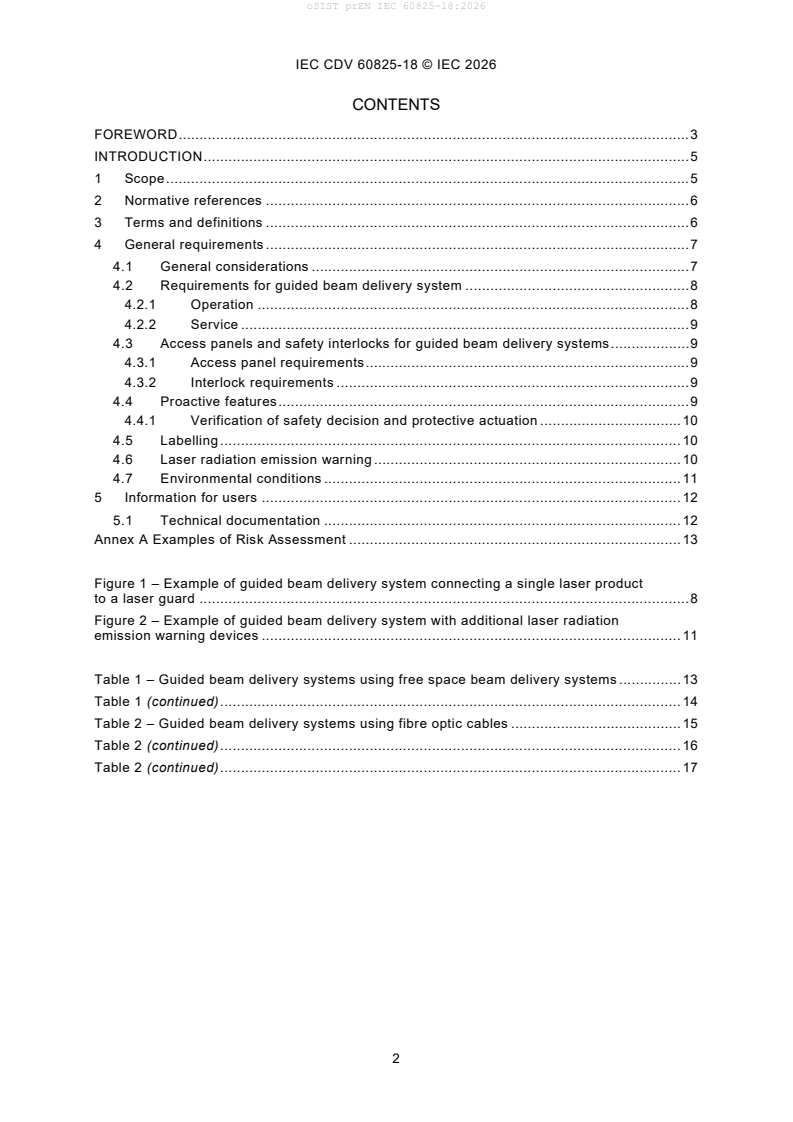
CONTENTS
FOREWORD . 3
INTRODUCTION . 5
1 Scope . 5
2 Normative references . 6
3 Terms and definitions . 6
4 General requirements . 7
4.1 General considerations . 7
4.2 Requirements for guided beam delivery system . 8
4.2.1 Operation . 8
4.2.2 Service . 9
4.3 Access panels and safety interlocks for guided beam delivery systems . 9
4.3.1 Access panel requirements . 9
4.3.2 Interlock requirements . 9
4.4 Proactive features . 9
4.4.1 Verification of safety decision and protective actuation . 10
4.5 Labelling . 10
4.6 Laser radiation emission warning . 10
4.7 Environmental conditions . 11
5 Information for users . 12
5.1 Technical documentation . 12
Annex A Examples of Risk Assessment . 13
Figure 1 – Example of guided beam delivery system connecting a single laser product
to a laser guard . 8
Figure 2 – Example of guided beam delivery system with additional laser radiation
emission warning devices . 11
Table 1 – Guided beam delivery systems using free space beam delivery systems . 13
Table 1 (continued) . 14
Table 2 – Guided beam delivery systems using fibre optic cables . 15
Table 2 (continued) . 16
Table 2 (continued) . 17
IEC CDV 60825-18 © IEC 2026
INTERNATIONAL ELECTROTECHNICAL COMMISSION
____________
SAFETY OF LASER PRODUCTS
Part 18: Guided beam delivery systems
FOREWORD
1) The International Electrotechnical Commission (IEC) is a worldwide organization for standardization comprising
all national electrotechnical committees (IEC National Committees). The object of IEC is to promote international
co-operation on all questions concerning standardization in the electrical and electronic fields. To this end and
in addition to other activities, IEC publishes International Standards, Technical Specifications, Technical Reports,
Publicly Available Specifications (PAS) and Guides (hereafter referred to as “IEC Publication(s)”). Their
preparation is entrusted to technical committees; any IEC National Committee interested in the subject dealt with
may participate in this preparatory work. International, governmental and non-governmental organizations liaising
with the IEC also participate in this preparation. IEC collaborates closely with the International Organization for
Standardization (ISO) in accordance with conditions determined by agreement between the two organizations.
2) The formal decisions or agreements of IEC on technical matters express, as nearly as possible, an international
consensus of opinion on the relevant subjects since each technical committee has representation from all
interested IEC National Committees.
3) IEC Publications have the form of recommendations for international use and are accepted by IEC National
Committees in that sense. While all reasonable efforts are made to ensure that the technical content of IEC
Publications is accurate, IEC cannot be held responsible for the way in which they are used or for any
misinterpretation by any end user.
4) In order to promote international uniformity, IEC National Committees undertake to apply IEC Publications
transparently to the maximum extent possible in their national and regional publications. Any divergence between
any IEC Publication and the corresponding national or regional publication shall be clearly indicated in the latter.
5) IEC itself does not provide any attestation of conformity. Independent certification bodies provide conformity
assessment services and, in some areas, access to IEC marks of conformity. IEC is not responsible for any
services carried out by independent certification bodies.
6) All users should ensure that they have the latest edition of this publication.
7) No liability shall attach to IEC or its directors, employees, servants or agents including individual experts and
members of its technical committees and IEC National Committees for any personal injury, property damage or
other damage of any nature whatsoever, whether direct or indirect, or for costs (including legal fees) and
expenses arising out of the publication, use of, or reliance upon, this IEC Publication or any other IEC
Publications.
8) Attention is drawn to the Normative references cited in this publication. Use of the referenced publications is
indispensable for the correct application of this publication.
9) IEC draws attention to the possibility that the implementation of this document may involve the use of (a)
patent(s). IEC takes no position concerning the evidence, validity or applicability of any claimed patent rights in
respect thereof. As of the date of publication of this document, IEC [had/had not] received notice of (a) patent(s),
which may be required to implement this document. However, implementers are cautioned that this may not
represent the latest information, which may be obtained from the patent database available at
https://patents.iec.ch. IEC shall not be held responsible for identifying any or all such patent rights.
IEC 60825-18 has been prepared by subcommittee WG 7: High power lasers and laser systems,
of IEC technical committee 76: Optical radiation safety and laser equipment. It is an
International Standard.
The text of this International Standard is based on the following documents:
Draft Report on voting
XX/XX/FDIS XX/XX/RVD
Full information on the voting for its approval can be found in the report on voting indicated in
the above table.
The language used for the development of this International Standard is English.
IEC CDV 60825-18 © IEC 2026
This document was drafted in accordance with ISO/IEC Directives, Part 2, and developed in
accordance with ISO/IEC Directives, Part 1 and ISO/IEC Directives, IEC Supplement, available
at www.iec.ch/members_experts/refdocs. The main document types developed by IEC are
described in greater detail at www.iec.ch/publications.
The committee has decided that the contents of this document will remain unchanged until the
stability date indicated on the IEC website under webstore.iec.ch in the data related to the
specific document. At this date, the document will be
• reconfirmed,
• withdrawn, or
• revised.
IEC CDV 60825-18 © IEC 2026
INTRODUCTION
The IEC 60825 series addresses the safety of laser products. IEC 60825-1 establishes the
classification of laser products and specifies the requirements for the laser product up to and
including its protective housing. As laser powers and the range of applications have increased,
the laser beam is frequently conveyed from the source to the point of application by a guided
beam delivery system, propagating through free space, fibre optic cables or other beam
waveguides. The beam path and its terminations, downstream of the output coupler and/or the
protective housing, can give rise to laser radiation hazards to personnel that are not fully
addressed by the requirements for the laser product itself. Systems may comprise several
protective housings or protective enclosures and guards separated by significant physical
distances. Consequently, work carried out at protective enclosure can present laser radiation
hazards that are controlled or initiated at another, and these interactions can differ between
lifecycle phases such as installation, normal operation, maintenance and service. Protective
measures therefore need to address the guided beam delivery system as a whole, including the
interaction between its physically separated parts across all phases of its life.
Within the IEC 60825 series, IEC 60825-4 specifies the requirements for laser guards that
enclose the process zone of a laser processing machine, but does not comprehensively address
the arrangement, installation and use of the guided beam delivery system that connects the
source to the point of application. Such requirements were previously contained in an annex to
IEC 60825-4; as that document is concerned with guards enclosing the process zone, and as
guided beam delivery systems raise distinct considerations including access panels and safety
interlocks, the integrity of fibre optic cables and other beam waveguides, proactive protective
features, laser radiation emission warnings and environmental conditions they have been
developed in this separate standard. Establishing them as a dedicated part provides normative
requirements that apply to the guided beam delivery system irrespective of whether a guard
enclosing a process zone is present.
1 Scope
This document specifies the arrangement, installation and use of guided beam delivery
systems. Laser beams can be propagated through air, gas, liquid, or vacuum, whether enclosed
or not (free space), or through fibre optic cables or other beam waveguides. Such systems are
used in a range of applications, including measurement, scientific research, and material
processing.
This standard is applicable to the protective measures implemented to protect personnel
against laser radiation hazards for guided beam delivery systems after the output coupler and/or
the protective housing of the laser product (the requirements of which are specified in IEC
60825-1).This standard specifies requirements for combining multiple laser products together
or combing laser products with other safety enclosures where lasers may feed into other
machines or products.
Note: While this is intended primarily for manufacturers of beam delivery systems it would also be appropriate for
users who are assembling their own system to mitigate workplace risk.
This standard specifies methods for assessing the risks (including reasonably foreseeable use,
abuse and misuse) and provides examples of control measures to meet the normative
requirements this document.
This standard is not applicable to:
– incorporated beam delivery components and systems inside the protective housing of a
single laser product, as they are subject to 60825-1;
– communications applications;
– medical applications.
IEC CDV 60825-18 © IEC 2026
2 Normative references
The following documents are referred to in the text in such a way that some or all of their content
constitutes requirements of this document. For dated references, only the edition cited applies.
For undated references, the latest edition of the referenced document (including any
amendments) applies.
IEC 60825-1, Safety of laser products – Part 1: Equipment classification and requirements
IEC 60825-4, Safety of laser products — Part 4: Laser guards
IEC 61508 (all parts), Functional safety of electrical/electronic/programmable electronic safety-
related systems
ISO 12100, Safety of machinery -- General principles for design -- Risk assessment and risk
reduction
ISO 13849-1, Safety of machinery -- Safety-related parts of control systems -- Part 1: General
principles for design
3 Terms and definitions
For the purposes of this document, the terms and definitions given in IEC 60825-1:2014 or other
parts of IEC 60825 and the following apply.
ISO and IEC maintain terminology databases for use in standardization at the following
addresses:
• IEC Electropedia: available at https://www.electropedia.org/
• ISO Online browsing platform: available at https://www.iso.org/obp
3.1
guided beam delivery system
a system containing one or more beam path components to create the defined beam path,
including protective enclosures, guards and the support of these components, which when
combined, transfer or manipulate laser radiation emitted from one laser radiation generator
(laser product) to other laser products, enclosures, and the intended target
Note 1 to entry: The components of the guided delivery system may also include all elements for shaping and
switching the laser beam as well as the enclosure of and support for the beam path components, devices to prevent
errant laser radiation and beam stops.
Note 2 to entry: See figure 1 for a diagram of a guided beam delivery system.
3.2
defined beam path
intended path of a laser beam within the laser product, protective enclosure, or guided beam
delivery system
3.3
beam path components
optical component which lies on a defined beam path
3.4
protective housing
those portions of a laser product (including a product incorporating and embedded laser) which
are designed to prevent human access to laser radiation in excess of the prescribed AEL
(generally installed or assembled by a manufacturer)
IEC CDV 60825-18 © IEC 2026
3.5
protective enclosure
physical means for preventing human exposure to laser radiation unless such access is
necessary for the intended functions of the installation
3.6
laser guard
physical barrier which limits the extent of a danger zone by preventing laser radiation accessible
at its rear surface from exceeding Class 1 AEL
3.7
beam shaping components
optical components introduced in the beam path to transform the profile or cross-section of the
laser beam by means of apertures, reflective, refractive, diffractive optical components, multi-
mode or multi-clad fibres, or beam combining
3.8
beam switching components
optical components or an assembly of components introduced in the beam path to direct or
divert, under external control, the beam path along predetermined direction(s)
Note 1 to entry: The external control allows the beam path to be switched from one predetermined direction to
another.
3.9
fibre optic cable
fibre optical beam guiding component that enables the transmission of laser radiation along a
transparent medium
Note 1 to entry: A fibre optic cable may have a glass or other core material that carries the laser radiation and be
surrounded by one or more cladding(s) to further confine the radiation to the core. The outside of the fibre core is
surrounded by one or more claddings and is protected by a buffer layer and may be further protected by additional
layers of other material such as a polymer or a metal to protect the fibre from mechanical deformation, the ingress
of water, etc.
Note 2 to entry: For this document, this term also includes other forms of transmission devices such as
waveguides.
4 General requirements
4.1 General considerations
The risks associated with the hazards relevant to the guided beam delivery systems shall be
assessed as part of the overall requirements for risk assessment of the machine. The principles
for risk assessment given in standard ISO 12100 shall be used in carrying out this assessment.
This assessment shall determine the acceptable level of risk and the necessary protective
measures for persons who can be exposed to those hazards, while maintaining an acceptable
level of performance of the machine.
Hazards can result from, but are not limited to, the following causes:
a) failures, faults or damage in the protective housing or other mechanical protective measures
incorporated in the guided beam delivery system resulting in the inadvertent emission of
laser radiation from the protective housing;
b) failures or faults in the beam path components resulting in damage to the protective housing
or other protective devices;
c) failures or faults in the associated equipment or controls resulting in injury or
malfunction or failure of the safety functions of the laser product or laser system;
d) failures or faults from reasonably foreseeable misuse or abuse resulting in the
inadvertent emission of laser radiation from the protective housings.
IEC CDV 60825-18 © IEC 2026
The engineering and administrative controls adopted are a combination of the measures
incorporated at the design stage and include those instructions to be followed by the user.
Design shall be the first consideration in the reduction of risks. Where this is not sufficient to
eliminate risks to a negligible level, additional safeguarding and safe working procedures shall
be considered.
NOTE Examples of risk assessments and potential solutions for risk reduction measures are shown in Annex A.
4.2 Requirements for guided beam delivery system
The guided beam delivery system shall be used to control the hazard of laser radiation along
the defined beam path between laser products or laser guards. An example of this is given in
Figure 1. The specific requirements for operation, maintenance, and servicing are given below.
3 5
Key
1 protective housing of a laser product
2 boundary of guided beam delivery system
3 beam path component
4 laser guard (protective enclosure)
5 workpiece or intended target
Figure 1 – Example of guided beam delivery system connecting a single laser product
to a laser guard
4.2.1 Operation
In addition to the requirements for protective housing specified in IEC 60825-1 guided beam
delivery system shall comply with the following conditions.
a) The guided beam delivery system shall be designed to prevent access to laser radiation in
excess of the AEL for Class 1.
b) Maintenance of a guided beam delivery system shall not permit human access to levels of
laser radiation of Class 3B or Class 4.
c) When the guided beam delivery system is intended to prevent human access to radiation
that is of Class 3B or Class 4 the guided beam delivery system shall withstand exposures
under reasonably foreseeable single fault conditions, without human intervention.
NOTE The use of a guided beam delivery
...