

EN IEC 63580:2026
(Main)Measuring equipment for electrical and electromagnetic quantities - Environmental aspects
- Status
- Published
- Publication Date
- 10-Sep-2026
- Current Stage
- 6060 - Document made available - Publishing
- Start Date
- 11-Sep-2026
- Due Date
- 04-Dec-2026
- Completion Date
- 04-Dec-2026

EN IEC 63580:2026 is a CLC standard on the environmental aspects of measuring equipment for electrical and electromagnetic quantities (ME3Q). It gives manufacturers rules for evaluating product environmental impact and for communicating environmental information consistently across the supply chain. It is written for manufacturers, customers, authorities, program operators, LCA practitioners and verifiers who need environmental data they can compare and use.
What does EN IEC 63580:2026 specify?
EN IEC 63580:2026 specifies environmental rules for ME3Q, with a focus on product life cycle assessment (LCA), environmental communication, environmentally conscious design (ECD), material efficiency, material declaration and end-of-life information. It is organized as a technical framework plus product-specific rules for the covered device families.
| Annex | What it covers |
|---|---|
| Annex A (informative) | Description of the ME3Q device families covered by TC85 and an overview of the product families |
The document is structured into clauses on scope, normative references, terms and definitions, Product Life Cycle Assessment, product-specific rules, product environmental profile, ECD, material efficiency, material declaration and EOL information. In practice, that means it tells the reader both how to model environmental impacts and what information to disclose.
What are the key requirements of EN IEC 63580:2026?
Common LCA rules
Clause 4 sets the common LCA rules for all covered product families. EN IEC 63580:2026 requires a single reference scenario per product family, the use of the functional unit, and the use of the reference service life and use scenario defined in the document so that declarations stay comparable.
For modular products, all elements needed to provide the function have to be included in the model. Batteries must be treated consistently: removable batteries are separated and treated at end of life, delivered batteries are counted in manufacturing, replacement batteries are counted in use, and rechargeable batteries include the charging energy in the use stage. This matters because batteries can change both the manufacturing footprint and the use-stage footprint.
Inventory, cut-offs and allocation
Clause 4.2.3 requires that specific materials and components be systematically included in the reference product model. The listed materials include aluminium, silver, copper, gold, certain rare earths and antimony trioxide, and the listed components include items such as tantalum capacitors, diodes, screens, micro-processors, batteries and semiconductors. In practice, these items cannot be casually cut off from the model when they are part of the product.
Clause 4.2.5 and 4.2.6 set allocation rules for co-products and recovery operations. If primary data are shared with other products, impacts may be allocated in proportion to device mass unless another justified rule is used. Recovery-related inputs and outputs are allocated to the current life cycle, which matters when recycling or energy recovery affects the reported result.
Default scenarios and data quality
Clause 4.2.9 gives default scenarios for manufacturing, distribution, installation, use and end of life when specific data are not available. It covers packaging, waste transport, transport distances by mode, manufacturing waste treatment and installed product scrap. For the reader, this means the standard provides a fallback model, so an LCA can still be built when supplier or factory data are incomplete.
Clause 4.2.8 links data quality to verification and to the choice of primary or secondary data. Clause 4.2.10 allows extrapolation within a homogeneous product family only when the products share the same main function, the same product standard and similar manufacturing technology, with extrapolation based on mass and energy consumption. That keeps family-level environmental declarations from mixing unrelated products.
Product-specific rules
Clause 5 sets specific rules for PMD, PQI, DDM and TRD. Each family has its own functional unit, reference service life and use scenario, but the reference service life is 10 years across the families covered. The use scenarios define operating conditions such as service uptime, communication state, standby behaviour and test conditions from the related product standards.
For PMD, PQI, DDM and TRD, the reference flow includes the device, packaging, documentation and any accessory needed for installation. This is important because the declaration is built around the complete sold set, not only the electronic unit itself.
Environmental declaration and design information
Clause 6 tells manufacturers what to include in the product environmental profile. EN IEC 63580:2026 requires the technical specifications used to define the functional units, the total mass of the product and packaging, the mass distribution of the included materials, and regulated reporting of hazardous substances. It also supports two ways of presenting impacts: per functional unit and, where useful for building LCA, per declared unit.
Clause 7 links the document to ECD. It expects environmental considerations to be documented in the company management system or, if none exists, in an equivalent internal process. Clause 8 addresses material efficiency and points to durability assessment conditions, including temperatures and vibration assumptions in Table 19. Clauses 9 and 10 cover material declaration and end-of-life information.
What terms does EN IEC 63580:2026 define?
- LCA (life cycle assessment) - the compilation and evaluation of inputs, outputs and potential environmental impacts across a product’s life cycle.
- FU (functional unit) - the quantified performance of the product system used as the reference unit in LCA.
- RSL (reference service life) - the expected service life under defined in-use conditions used as the basis for estimation.
- PSR (Product Specific Rules) - the specific rules and guidelines for developing Type III environmental declarations for a product category.
- EPD (Environmental Product Declaration, Type III environmental declaration) - a declaration that provides quantified environmental data using predetermined parameters, and where relevant additional environmental information.
- ECD (environmentally conscious design) - a systematic approach that considers environmental aspects during design and development to reduce adverse impacts across the life cycle.
- GHG (greenhouse gas) - a gaseous atmospheric constituent that absorbs and emits infrared radiation.
Who uses EN IEC 63580:2026?
Manufacturers of ME3Q use EN IEC 63580:2026 to build environmental declarations, select default scenarios and document design choices. LCA practitioners use it to model impacts in a way that matches the product family and its declared use.
Customers, authorities, program operators and verifiers use it to compare declarations, check supporting evidence and review reported environmental claims. It is also relevant to contractors, installers and end users who need product-level environmental data for system-level assessments, including building LCA.
What changed in EN IEC 63580:2026 from the previous edition?
EN IEC 63580:2026 is presented as a new edition. It supersedes 85/952/CD and 85/961/CC.
Which standards are used with EN IEC 63580:2026?
- IEC 60050-904 - provides terminology for environmental standardization.
- IEC 63366:2025 - provides the product category rules and the generic LCA framework that this document builds on.
- ISO 14040 and ISO 14044 - provide the core LCA principles, framework, requirements and guidelines.
- ISO 14067, ISO 14068-1 and IEC 63372 - support carbon footprint and greenhouse-gas related quantification and communication.
- ISO 14020, ISO 14021, ISO 14024, ISO 14025, ISO 14026, ISO 21930, EN 15978 and EN15804:2019+A2 - support environmental statements, Type II and Type III declarations, footprint communication and building-related declarations.
- ISO/IEC 62430, IEC 62474, IEC 62474 DB and IEC TR 62635 - support ECD, material declaration and end-of-life information.
- IEC 60688, IEC 61557-12, IEC 62586-1, IEC 62586-2 and IEC 62974-1 - define the product families and test conditions used in the family-specific rules.
What does the EN IEC 63580:2026 document contain?
The document contains the full set of LCA rules, default scenarios and product-specific functional units needed to prepare ME3Q environmental declarations. It includes tables for mandatory materials and components, default scrap rates, default use-stage values, functional units, reference service lives and temperature conditions, plus Figure 4 on the relationship between product standards and environmental impacts.
It also contains the wording for the environmental profile, ECD, material efficiency, material declaration and EOL information sections. Annex A adds an informative overview of the ME3Q device families covered by TC85, which helps readers identify where the standard applies.
Relations
- Effective Date
- 25-Aug-2026
- Effective Date
- 25-Aug-2026
- Effective Date
- 25-Aug-2026
- Effective Date
- 25-Aug-2026
- Effective Date
- 25-Aug-2026
- Effective Date
- 25-Aug-2026
- Effective Date
- 25-Aug-2026
- Effective Date
- 25-Aug-2026
- Effective Date
- 25-Aug-2026
- Effective Date
- 25-Aug-2026
- Refers
EN IEC 62430:2019 - Environmentally conscious design (ECD) - Principles, requirements and guidance - Effective Date
- 25-Aug-2026
Get Certified
Connect with accredited certification bodies for this standard

BSMI (Bureau of Standards, Metrology and Inspection)
Taiwan's standards and inspection authority.
Sponsored listings
Frequently Asked Questions
EN IEC 63580:2026 is a draft published by CLC. Its full title is "Measuring equipment for electrical and electromagnetic quantities - Environmental aspects". This standard covers: Measuring equipment for electrical and electromagnetic quantities - Environmental aspects
Measuring equipment for electrical and electromagnetic quantities - Environmental aspects
EN IEC 63580:2026 is classified under the following ICS (International Classification for Standards) categories: 17.220.20 - Measurement of electrical and magnetic quantities. The ICS classification helps identify the subject area and facilitates finding related standards.
EN IEC 63580:2026 has the following relationships with other standards: It is inter standard links to EN ISO 14025:2010, EN IEC 63366:2025, EN IEC 62974-1:2024, EN IEC 61557-12:2022, EN ISO 14044:2006, EN IEC 60688:2024, EN ISO 14040:2006, IEC 60050-904:2014, EN 62586-1:2017, EN ISO 14021:2016, EN IEC 62430:2019. Understanding these relationships helps ensure you are using the most current and applicable version of the standard.
EN IEC 63580:2026 is available in PDF format for immediate download after purchase. The document can be added to your cart and obtained through the secure checkout process. Digital delivery ensures instant access to the complete standard document.
Standards Content (Sample)
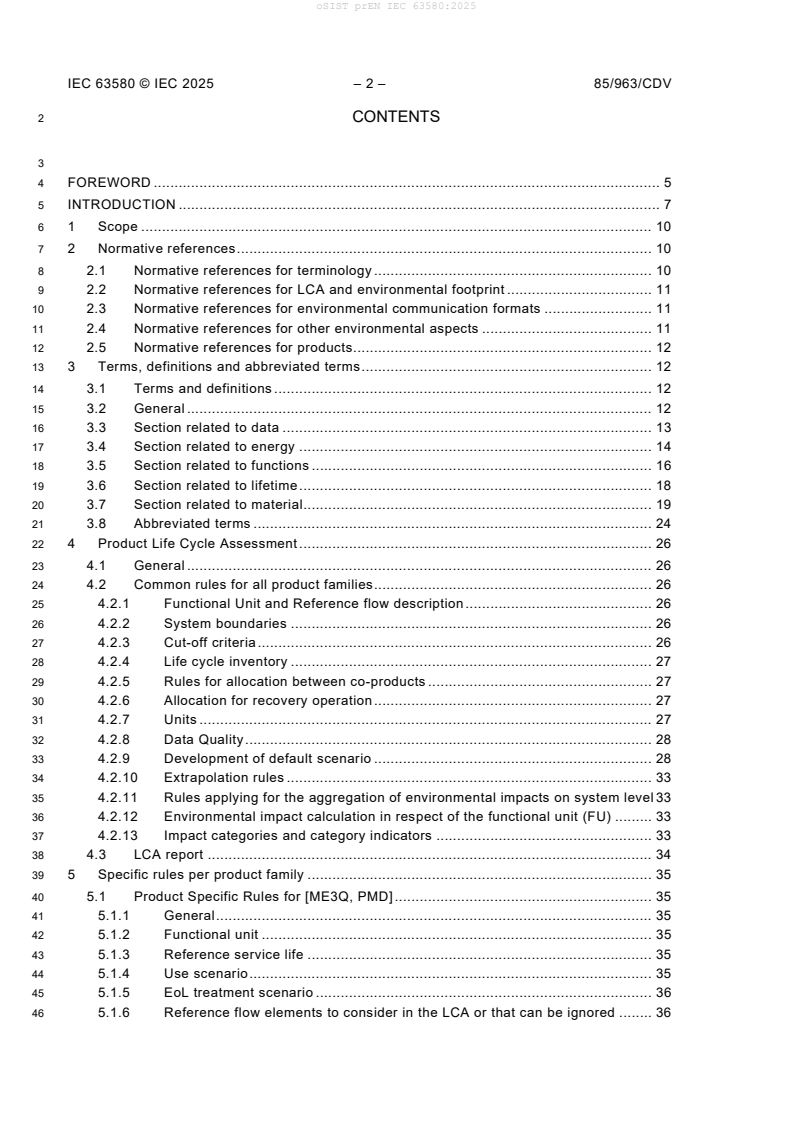
Contents
- 48 can be ignored
- 49 5.1.8 Allocation rules
- 50 5.2 Specific rules for [ME3Q, PQI]
- 51 5.2.1 General
- 52 5.2.2 Functional unit
- 53 5.2.3 Reference service life
- 54 5.2.4 Use scenario
- 55 5.2.5 EoL treatment scenario
- 56 5.2.6 Reference flow elements to consider in the LCA or that can be ignored
- 57 5.2.7 List of impact categories and category indicators to consider in the LCA or that 58 can be ignored
- 59 5.2.8 Allocation rules
- 60 5.3 Specific rules for [ME3Q, DDM]
- 61 5.3.1 General
- 62 5.3.2 Functional unit
- 63 5.3.3 Reference service life
- 64 5.3.4 Use scenario
- 65 5.3.5 EoL treatment scenario
- 66 5.3.6 Reference flow elements to consider in the LCA or that can be ignored
- 67 5.3.7 List of impact categories and category indicators to consider in the LCA or that 68 can be ignored
- 69 5.3.8 Allocation rules
- 70 5.4 Specific rules for [ME3Q, TRD]
- 71 5.4.1 General
- 72 5.4.2 Functional unit
- 73 5.4.3 Reference service life
- 74 5.4.4 Use scenario
- 75 5.4.5 EoL treatment scenario
- 76 5.4.6 Reference flow elements to consider in the LCA or that can be ignored
- 77 5.4.7 List of impact categories and category indicators to consider in the LCA or that 78 can be ignored
- 79 5.4.8 Allocation rules
- 80 6 Drawing up the product environmental profile
- 81 6.1 General
- 82 6.2 Constitutive materials and substances
- 83 6.3 Environmental impact
- 84 6.4 Additional environmental information
- 85 7 Environmentally conscious design
- 86 7.1 General
- 87 7.2 "Cradle to grave" approach
- 88 7.3 Inputs
- 89 7.4 Outputs
- 90 7.5 Qualitative and quantitative assessments
- 91 8 Material Efficiency
- 92 8.1.1 General
- 93 8.1.2 Durability
- 94 9 Material declaration
- oSIST prEN IEC 63580:2025 IEC 63580 © IEC 2025 – 4 – 85/963/CDV 95 10 EOL information
- 96 Annex A (informative) Description of ME3Q devices covered by TC85
- 97 Bibliography
- 100 Figure 1 – Standard family for life cycle assessment (LCA)
- 101 Figure 2 – Standard family for environmental communication
- 102 Figure 3 – Standard family for interoperability with Building LCA
- 103 Figure 4 – Copy of Figure 1 of guide 109 “Conceptual relationship between provisions in 104 product standards and the environmental impacts associated with the product during its life 105 cycle”
- 106 Figure A.1 –Overview of the ME3Q product families
- 108 Table 1 – Mandatory modelled materials
- 109 Table 2 – Mandatory components
- 110 Table 3 – Default scrap rates to be used in the absence of specific data
- 111 Table 4 – List of default values for use stage
- 112 Table 5 – Key parameters per operations
- 113 Table 6 – Functional unit (FU) for PMD
- 114 Table 7 – Reference service life (RSL) for PMD
- 115 Table 8 – List of default values for use stage for PMD
- 116 Table 9 – Functional unit (FU) for PQI
- 117 Table 10 – Reference service life (RSL) for PQI
- 118 Table 11 – List of default values for use stage for fixed-installed PQI
- 119 Table 12 – List of default values for use stage for portable PQI
- 120 Table 13 – Functional unit (FU) for DDM
- 121 Table 14 – Reference service life (RSL) for DDM
- 122 Table 15 – List of default values for use stage for DDM
- 123 Table 16 – Functional unit (FU) for TRD2
- 124 Table 17 – Reference service life (RSL) for TRD2
- 125 Table 18 – List of default values for use stage for TRD2
- 126 Table 19 – Temperature for devices covered by this standard
190 INTRODUCTION 191 Increasingly, there is a focus on preserving the natural environment for the good of future generations. 192 This results in the publication of various regulations that require environmental data, whether at the 193 local or national level. Product manufacturers are also faced by requests from their stakeholders’ 194 customers (wholesalers, installers, specifiers, authorities…) for environmental data. In addition to 195 reduce product environmental impact, manufacturers need a standardized methodology to quantify and 196 to consequently reduce the environmental impact of the product.
197 It is necessary to establish product specific rules (PSR) to have standardized science-based 198 methodologies for the data to be evaluated and transmitted.
199 Specific rules for assessing the environmental impacts and providing appropriate data for ME3Q are 200 among the purposes of this document. These rules establish a common evaluation scheme of their 201 environmental impacts in terms of characterized impact indicators (e.g. CO2-equivalents, ozone 202 depletion) over their whole life cycle.
203 204 Figure 1 – Standard family for life cycle assessment (LCA) 205 This document is to be used by manufacturers, customers, authorities, program operators, LCA 206 practitioners and verifiers, whatever the type of environmental data related to life cycle assessment, 207 including extract for one specific impact (carbon footprint).
209 Figure 2 – Standard family for environmental communication 210 Even though ME3Q have a relatively minor impact on the environment, there is a market need for 211 appropriate methods for managing these environmental matters. A simplified means of estimating the 212 environmental impacts is required together with readily available data to make the stakeholders, for 213 example contractor's, installer's and end user's, task of assessing environmental impacts at system 214 level easier.
215 Generally, the environmental impact of ME3Q is very low compared with that of the overall system into 216 which they are incorporated and the processes to which they contribute. The lifetime impact of 217 processes such as the air-conditioning of a building, the manufacture of steel or shipping far exceed 218 that of the manufacture and use of any associated ME3Q.
219 Figure 3 – Standard family for interoperability with Building LCA 220 In addition, 221 release of substances and materials that might be harmful for the environment or induce climatic 222 changes are to be avoided or minimized. From conception to end of life of a product, the environmental 223 impact of all the relevant processes should be considered, including how materials are disposed of or 224 recovered for future use.
225 In order to contribute to conserving natural resources, manufacturers of measuring equipment for 226 electrical and electromagnetic quantities (ME3Q) should ensure an environmentally conscious design 227 (ECD) involving:
228 • phasing-out or minimizing use of hazardous substances or materials; 229 • efficient use of energy and materials in the manufacture of products; 230 • ensuring the lowest practical energy consumption by the products while they are in use; 231 • at the end of product life, the possibility, as far as practical, of recycling materials for future use, and 232 sorting hazardous components requiring a specific treatment.
233 Declarations and ECD are increasingly required and in some instances mandated. These can take 234 several forms, for example, Type II or Type III environmental declaration, material declaration (MD). In 235 some business, Green Public Procurement (GPP) is applicable and/or ECD is part of the ISO 14001 236 certification. Some countries and regions are also actively pushing for environmental conservation, for 237 example, the European Union through its Ecodesign Directive and China through Ecodesign Initiative. 238 Systematic demands for ECD will be required by most, if not all customers, in the medium term.
239 Assessing the environmental impact of ME3Q is part of an ECD process. ECD requires the 240 identification, measurement and reporting of particular impacts. ISO/IEC 62430 describes the basic 241 principles of ECD, with the goal of reducing the potential environmental impacts of products.
243 MEASURING EQUIPMENT FOR ELECTRICAL AND ELECTROMAGNETIC 244 QUANTITIES – ENVIRONMENTAL ASPECTS 245 1 Scope 246 This document provides guidance to manufacturers of measuring equipment for electrical and 247 electromagnetic quantities (ME3Q) in evaluating and improving the environmental impact of their 248 products, and in enabling effective communication using common references for environmental 249 information throughout the supply chain.
250 NOTE - ME3Q devices are described in Annex A.
251 This standard covers only the below fixed installed measuring equipment:
252 - IEC 61557-12 (PMD) 253 - IEC 62586-1 (PQI) 254 - IEC 60688 (TRD) 255 - IEC 62974-1 (DDM) 256 This document provides:
257 – guidance on the process and general aspects to implement environmentally-conscious product 258 design principles, as given in ISO/IEC 62430; 259 – the Product Specific Rules (PSR) for Life Cycle Assessment (LCA); 260 NOTE 1 The general methods and the process to execute the LCA are in accordance with ISO 14040 and ISO 14044 but 261 not addressed in this document.
262 NOTE 2 PSR and LCA can be used for quantitative ECD and also apply for some environmental declarations, for example 263 Type III.
264 – standard environmental impact data derived from case studies and a means of using them; 265 NOTE 3 This is to encourage manufacturers to apply more effective quantitative methods in the ECD process to improve 266 the environmental efficiency of their products.
267 – common rules for communicating information about the presence of regulated substances and the 268 materials contained in the product; 269 – guidance on communicating information about the end-of-life treatment of the product. 270 2 Normative references 271 The following documents are referred to in the text in such a way that some or all of their content 272 constitutes requirements of this document. For dated references, only the edition cited applies. For 273 undated references, the latest edition of the referenced document (including any amendments) applies. 274 2.1 Normative references for terminology 275 IEC 60050-904, International Electrotechnical Vocabulary (IEV) – Part 904: Environmental 276 standardization for electrical and electronic products and systems (available at www.electropedia.org) 277 2.2 Normative references for LCA and environmental footprint 278 IEC 63366:2025, Product category rules for life cycle assessments of electrical and electronic products 279 and systems 280 ISO 14040:2006, Environmental management – Life cycle assessment – Principles and framework 281 ISO 14044:2006, Environmental management – Life cycle assessment – Requirements and guidelines 282 ISO 14044:2006/AMD1:2017 283 ISO 14044:2006/AMD2:2020 284 ISO 14067:2018: Greenhouse gases — Carbon footprint of products — Requirements and guidelines 285 for quantification 286 ISO 14068-1:2023: Climate change management — Transition to net zero – Carbon neutrality 287 IEC 63372 (111/757/CDV) Quantification and communication of GHG emissions and emission 288 reductions/avoided emissions from electric and electronic products, services and systems - Principles, 289 methodologies and guidance 290 2.3 Normative references for environmental communication formats 291 ISO 14020:2022, Environmental statements and programmes for products - Principles and general 292 requirements 293 ISO 14021:2016, Environmental labels and declarations – Self-declared environmental claims (Type II 294 environmental labelling) 295 ISO 14024:2018, Environmental labels and declarations: Type I environmental labelling. Principles and 296 procedures.
297 ISO 14025:2006, Environmental labels and declarations – Type III environmental declarations – 298 Principles and procedures 299 ISO 14026:2017, Environmental labels and declarations: Principles, requirements and guidelines for 300 communication of footprint information 301 ISO 21930:2017, Sustainability in buildings and civil engineering works - Core rules for environmental 302 product declarations of construction products and services 303 EN 15978:2012, Sustainability of construction works - Assessment of environmental performance of 304 buildings - Calculation method 305 EN15804:2019+A2, Sustainability of construction works - Environmental product declarations - Core 306 rules for the product category of construction products 307 IEC 63058 CD (121/168/CD), Switchgear and controlgear and their assemblies for low voltage – 308 Environmental aspects 309 2.4 Normative references for other environmental aspects 310 ISO/IEC 62430:2019, Environmentally conscious design (ECD) – Principles, requirements and guidance 311 IEC 62474:2018, Material declaration for products of and for the electrotechnical industry 312 IEC 62474 DB, Material declaration for products of and for the electrotechnical industry (available at 313 http://std.iec.ch/iec62474) 314 IEC TR 62635:2012, Guidelines for end-of-life information provided by manufacturers and recyclers and 315 for recyclability rate calculation of electrical and electronic equipment 316 2.5 Normative references for products 317 IEC 60688:2024, Electrical measuring transducers for converting AC and DC electrical quantities to 318 analogue or digital signals 319 IEC 61557-12:2018, Electrical safety in low voltage distribution systems up to 1 000 V AC and 320 1 500 V DC – Equipment for testing, measuring or monitoring of protective measures – Part 12: Power 321 metering and monitoring devices (PMD) 322 IEC 61557-12:2018/AMD1:2021 323 IEC 62586-1:2017, Power quality measurement in power supply systems – Part 1: Power quality 324 instruments (PQI) 325 IEC 62586-2:2017, Power quality measurement in power supply systems – Part 2: Functional tests and 326 uncertainty requirements 327 IEC 62974-1:2024, Monitoring and measuring systems used for data collection, gathering and analysis 328 – Part 1: Device requirements 329 3 Terms, definitions and abbreviated terms 330 3.1 Terms and definitions 331 For the purposes of this document, the terms and definitions given in IEC 60050-904 and the following 332 apply.
333 ISO and IEC maintain terminological databases for use in standardization at the following addresses:
334 • ISO Online browsing platform: available at http://www.iso.org/obp 335 • IEC Electropedia: available at http://www.electropedia.org/ 336 3.2 General 337 3.2.1 338 Greenhouse gas 339 GHG 340 gaseous constituent of the atmosphere, both natural and anthropogenic, that absorbs and emits 341 radiation at specific wavelengths within the spectrum of infrared radiation emitted by the earth’s surface, 342 the atmosphere, and clouds 343 Note 1 to entry: For a list of GHGs, see the latest IPCC Assessment Report.
344 Note 2 to entry: Water vapour and ozone, which are anthropogenic as well as natural GHGs, are not included in the CFP and 345 partial CFP.
346 Note 3 to entry: The focus of this document is limited to long-lived GHGs, it therefore excludes climate effects due to changes 347 in surface reflectivity (albedo) and short-lived radiative forcing agents (e.g., black carbon and aerosols). 348 [SOURCE: ISO 14067:2018, 3.1.2.1] 350 co-product 351 any of two or more products coming from the same unit process or product system 352 Note 1 to entry: Co-product, by-product and product have the same status and are used for identification of several 353 distinguished flows of products from the same unit process. From co-product, by-product and product, waste is the only output 354 to be distinguished as a non-product.
355 [SOURCE: ISO 14040:2006, 3.10, modified, a note to entry has been added] 356 3.2.3 357 cut-off criteria 358 Specification of the amount of material or energy flow or the level of environmental significance 359 associated with unit processes or product system to be excluded from a study.
360 [SOURCE: ISO 14040:2006, 3.18] 361 3.3 Section related to data 362 3.3.1 363 primary data 364 quantified value of a unit process or an activity obtained from a direct measurement or a calculation 365 based on direct measurements at the original source 366 [SOURCE: ISO 14050:2020, 3.6.34] 367 3.3.2 368 secondary data 369 data that do not fulfil the requirements for primary data 370 [SOURCE: ISO 14050:2020, 3.6.35] 371 3.3.3 372 Data quality 373 Characteristics of data that relate to their ability to satisfy stated requirements. 374 [SOURCE: ISO 14044:2006, 3.19] 375 3.3.4 376 declared unit 377 quantity of the product used as a reference unit in a Type III environmental declaration or footprint 378 communication, based on one or more information modules Note 1 to entry: Information module is a compilation of data covering a unit process or a combination of unit processes that are part of the life cycle of a product.
[SOURCE: ISO 14040:2006, 3.7.11, modified, note 1 to entry had been added] 379 3.3.5 380 Disposal 381 Any operation which is not recovery even where this operation has a reclamation of substances or 382 energy secondary consequences.
[SOURCE: IEC/TR 62635:2012, 3.1] 384 durability 385 <of a product> 386 ability to function as required, under defined conditions of use, maintenance and repair, until a limiting 387 state is reached 388 Note 1 to entry: The degree to which maintenance and repair are within the scope of durability will vary by product or product- 389 group.
390 Note 2 to entry: Durability can be expressed in units appropriate to the part or product concerned, e.g. calendar time, operating 391 cycles, distance run, etc. The units should always be clearly stated.
392 [SOURCE: EN 45550:2020; 4.2.1.1, modified: Note 2 deleted] 393 3.3.7 394 end of life 395 life cycle stage of a product starting when it is removed from its intended use phase 396 [SOURCE: IEC TR 62635:2012, 3.2, modified – Hyphens deleted in term, alternate term deleted, "use- 397 stage" replaced with "use phase".] 398 3.3.8 399 end of life treatment 400 operation after a waste has been handed over to a facility for product and product part reuse, material 401 recycling, energy recovery and residue disposal 402 Note 1 to entry: This includes dismantling, material separation and disposal.
403 [SOURCE: IEC TR 62635:2012, 3.3, modified – Hyphens in term deleted, insertion of Note 1 to entry.] 404 3.4 Section related to energy 405 3.4.1 406 energy recovery 407 production of useful energy through direct and controlled combustion or other processing of waste 408 Note 1 to entry: Waste incinerators producing hot water, steam and/or electricity are common means for energy recovery. 409 [SOURCE: IEC 60050-904:2014, 904-04-03] 410 3.4.2 411 environment 412 surroundings in which a product or system exists, including air, water, land, natural resources, flora, 413 fauna, humans and their interrelation 414 [SOURCE: IEC Guide 109:2012, 3.3] 415 3.4.3 416 environmental aspect 417 element of an organization's activities or products that interacts or can interact with the environment 418 Note 1 to entry: An environmental aspect can cause (an) environmental impact(s). A significant environmental aspect is one 419 that has or can have one or more significant environmental impact(s).
420 Note 2 to entry: Significant environmental aspects are determined by the organization applying one or more criteria. 421 [SOURCE: ISO 14001:2015, 3.2.2, modified – "or services" deleted in the definition.] 423 environmental claim 424 statement, symbol or graphic that indicates an environmental aspect of a product, including any 425 associated components and packaging 426 [SOURCE: ISO 14050:2020, 3.7.3] 427 3.4.5 428 environmentally conscious design 429 systematic approach which considers environmental aspects in the design and development with the 430 aim to reduce adverse environmental impacts throughout the life cycle of a product 431 Note 1 to entry: Other terminology used worldwide with the same meaning includes ecodesign, design for environment (DFE), 432 green design and environmentally sustainable design.
433 [SOURCE: ISO/IEC 62430:2019, 3.1.1, modified – Abbreviated term "ECD" and Note 2 to entry deleted.] 434 3.4.6 435 environmental declaration 436 Claim which indicates the environmental aspects of a product or service.
437 [SOURCE: ISO 14020:2000, 2.1] 438 3.4.7 439 environmental declaration program 440 voluntary program for the development and use of Type III environmental declarations, based on a set 441 of operating rules (program instructions) 442 [SOURCE: ISO 14025:2006, 3.3, modified – "Type III" removed from the term and "(program 443 instructions)" added to the definition.] 444 3.4.8 445 environmental impact 446 change to the environment, whether adverse or beneficial, wholly or partly resulting from environmental 447 aspects.
448 [SOURCE: IEC Guide 109:2012, 3.5, modified, In the definition, "an organization's" has been omitted.] 449 3.4.9 450 Environmental product declaration, Type III environmental declaration 451 EPD 452 Environmental declaration (ISO 14025:2006, 3.1) providing quantified environmental data using 453 predetermined parameters and, where relevant, additional environmental information 454 [SOURCE: ISO21930:2017] 455 3.4.10 456 Extrapolated 457 Qualifies a predicted value based on observed or estimated values for one or a set of conditions, 458 intended to apply to other conditions such as time, maintenance and environmental conditions 459 [SOURCE: IEC 62059-31-1:2008] 460 3.5 Section related to functions 461 3.5.1 462 Functional Unit (LCA) 463 FU 464 quantified performance of a product system for use as a reference unit in life cycle assessment 465 [SOURCE: ISO 14040:2006, 3.20, modified – The abbreviated term "FU" and "in life cycle assessment" 466 have been added.] 467 3.5.2 468 primary function 469 function fulfilling the intended use 470 Note 1 to entry: There can be more than one primary function.
471 Note 2 to entry: examples of primary function for circuit breakers are: conducting the current, breaking normal and fault currents, 472 providing isolation, …..
473 [SOURCE: EN 45550:2020; 4.2.2.1, modified: Note 2 added] 474 3.5.3 475 secondary function 476 function that enables the primary function(s) 477 Note 1 to entry: examples of secondary function are: current and voltage measurement, …, 478 [SOURCE: EN 62542:2017; 5.14, modified: “supplements or enhances” deleted, Note 1 added] 479 3.5.4 480 Hazardous substance 481 substance that has, according to defined classification criteria, the potential for adversely impacting 482 human health and/or the environment.
483 Note 1 to entry: The criteria for determining whether a substance is classified as hazardous are defined by law or regulation. 484 [SOURCE: IEC Guide109:2012, 3.6] 485 3.5.5 486 Homogenous product family 487 subgroup of a product family based on the underlying technology or build where the environmental 488 impacts can reasonably be expected to be similar and therefore scalable over the group through a 489 function of certain physical characteristics, for example, power or weight 490 [SOURCE: IEC 63366:2025, 3.1.15] 491 3.5.6 492 Input 493 product, material or energy flow that enters a unit process 494 Note 1 to entry: Products and materials include raw materials, intermediate products and co-products. 495 [SOURCE: ISO 14040:2006, 3.21] 496 3.5.7 497 Landfill site used for the disposal of waste onto or into land (i.e. underground), including onsite waste disposal sites and storage site used to store waste for more than one year
Note 1 to entry: Onsite waste disposal sites refer to sites where a producer of waste is carrying out its own waste disposal at the place of production.
...