

IEC TS 62565-4-3:2026
(Main)Nanomanufacturing - Product specification - Part 4-3: Nanophotonic products - Blank detail specification: quantum dot enabled light emitting diodes
- Abstract
IEC TS 62565-4-3:2026, which is a Technical Specification, establishes a blank detail specification (BDS) for quantum dot enabled light emitting diodes (QLEDs) used for printed light emitting diodes (LEDs).
This document is intended to be used for display applications.
The relevant key control characteristics (KCCs) include optical, physical, chemical, and structural properties of colloidal quantum dots (QDs). For each KCC listed, methods and existing standards for their measurement are reported. The applicability of such methods and standards to different material categories (physical forms) of QDs, for example colloidal solution, inks, films, is indicated.
Numeric values for the KCCs are left blank as they will be specified between customer and supplier in the detail specification (DS). In the DS, KCCs can be added or removed if agreed between customer and supplier.
- Status
- Published
- Publication Date
- 09-Jun-2026
- Technical Committee
- TC 113 - Nanotechnology for electrotechnical products and systems
- Drafting Committee
- WG 10 - TC 113/WG 10
- Current Stage
- PPUB - Publication issued
- Start Date
- 10-Jun-2026
- Completion Date
- 26-Jun-2026
Buy Documents

IEC TS 62565-4-3:2026 - Nanomanufacturing - Product specification - Part 4-3: Nanophotonic products - Blank detail specification: quantum dot enabled light emitting diodes
IEC TS 62565-4-3:2026 is an IEC Technical Specification that provides a blank detail specification for quantum dot enabled light emitting diodes (QLEDs) used for printed LEDs. It is intended for display applications and sets out the key control characteristics (KCCs), measurement methods and related standards to be agreed between customer and supplier. The document covers QD materials, QD inks, QD films and QLED prototype devices.
What does IEC TS 62565-4-3:2026 specify?
IEC TS 62565-4-3:2026 specifies the structure of a detail specification for QLEDs, rather than fixed numeric product values. It organizes the information needed to describe the product, the procurement data, the relevant KCCs and the measurement approach for each KCC.
The scope ties the document to colloidal QDs in different physical forms, such as colloidal solution, inks and films. For each KCC, the document indicates the measurement method and any existing standard that can be used.
| Annex | What it covers |
|---|---|
| Annex A | Normative supporting information and documented measurement procedures for selected KCCs |
| Annex B | Informative supporting information for additional KCC measurement procedures and related context |
Clause 5 gives the recommended specification format. Clause 6 gives an overview of test methods and shows how the document links KCCs to available standards.
What are the key requirements of IEC TS 62565-4-3:2026?
Clause 4 sets out how to treat measurement maturity
IEC TS 62565-4-3:2026 uses a standard maturity level (SML) system from 1 to 4. This matters because it tells the user whether a KCC already has a standardized procedure, whether a good practice guide can be used, or whether the parties need to agree a procedure themselves.
- SML 1 means no standardized procedure is available yet, so the customer and supplier need an agreed approach.
- SML 2 means a good practice guide may support the measurement.
- SML 3 means an existing standard can be adapted for the QLED use case.
- SML 4 means the standard can be used directly.
Clause 5.1 and 5.2 define what the specification should record
IEC TS 62565-4-3:2026 asks for a general product description and general procurement information. The product description records the material type, physical form, manufacturing method and dispersant. The procurement information records items such as supplier, trade name, batch and series data, dispersion agent, dispersion method and specification revision level.
In practice, this is the minimum information needed to avoid mixing different QD states or batches in purchasing, incoming inspection and technical correspondence.
Clauses 5.3 to 5.6 group the KCCs by product state
IEC TS 62565-4-3:2026 separates the KCCs for QD materials, QD inks, QD films and QLED prototype devices. This helps the user select only the characteristics that matter for the stage of the material or device being specified.
Key KCC groups include:
- QD materials - optical properties, structure and chemical composition.
- QD inks - solubility, viscosity, wettability, surface tension, transparency and photoluminescence quantum yield (PLQY).
- QD films - carrier mobility, sheet resistance, Fermi level, film uniformity and film thickness.
- QLED prototype devices - voltage, current, luminance, emission wavelength and full width at half maximum.
Clause 5 links each KCC to a measurement route
IEC TS 62565-4-3:2026 associates each KCC with a measurement method and, where available, an existing standard. That is important because the document is not only naming what to measure - it also points to how to measure it.
Examples include:
- ultrafast spectroscopy for single exciton, biexciton and trion lifetimes
- fluorescence spectrometer for emission wavelength, PLQY and full width at half maximum
- colorimeter for colour coordinates
- ICP-MS for chemical composition
- Hall effect measurement for carrier mobility
- four-point probe method for sheet resistance
- ellipsometry for film uniformity and film thickness
Annex A provides the normative measurement procedures
IEC TS 62565-4-3:2026 uses Annex A for documented procedures that support several KCCs. The annex covers the main measurement route for the stated KCCs and identifies the referenced standard to use.
This is the practical part a laboratory needs when it is preparing test work, because it shows which procedures are treated as the working basis for the BDS.
Clause 6 gives the overview of test methods
IEC TS 62565-4-3:2026 includes a test-method overview that maps KCCs to the method categories and to the available standard or procedure. Where a method is not standardized, the document points users toward scientific publications.
In practice, this helps a specifier see whether a KCC can be handled with a mature method or whether the test plan needs a project-specific approach.
What terms does IEC TS 62565-4-3:2026 define?
- Quantum dot enabled light emitting diode (QLED) - a light emitting diode in which quantum dots emit light through electroluminescence after charge injection and radiative recombination.
- Quantum dot (QD) - the document uses QDs as the nanomaterial whose optical, chemical and structural properties are being specified.
- Key control characteristic (KCC) - a property that is listed and controlled in the detail specification, such as a band edge, film thickness or sheet resistance.
- Photoluminescence quantum efficiency (PLQE) - the ratio of emitted photons to absorbed photons for a photoluminescent material.
- External quantum efficiency (EQE) - the ratio of photons extracted from the device to electrons injected into the device.
- Standard maturity level (SML) - the document’s way of showing how ready a measurement procedure is for routine use.
- QD ink - a composite material containing quantum dots as colorants, functional components, vehicle and additives.
Who uses IEC TS 62565-4-3:2026?
IEC TS 62565-4-3:2026 is used by suppliers and customers who need to write or review a QLED detail specification. It is also relevant to display developers, materials manufacturers, test laboratories, quality teams and buyers working with printed LED and QD-based display products.
In practice, these users rely on it to agree what to measure, how to measure it and how to record the product state, batch identity and revision status.
Which standards are used with IEC TS 62565-4-3:2026?
IEC TS 62565-4-3:2026 relies on several cited standards for measurement and safety:
- IEC 61010-2-033:2023 - safety requirements for meters used in the voltage and current measurements of prototype devices.
- IEC TS 62565-4-2:2018 - supports emission wavelength and full width at half maximum for QD materials.
- IEC 62595-2-1:2016 - supports colour coordinates.
- IEC 62607-3-1:2014 - supports quantum efficiency and PLQY measurements.
- IEC TS 62607-3-3:2020 - supports fluorescence lifetime measurements for excitons and trions.
- IEC TS 62607-5-1:2014 - supports carrier transport and carrier mobility measurements.
- IEC TS 62607-6-8:2023 - supports sheet resistance by the four-point probe method.
- IEC TS 62607-6-20:2022 - supports chemical composition by ICP-MS.
- IEC 62899-203:2024 - supports surface tension measurements for QD inks.
- IEC TR 63258:2021 - supports ellipsometry-based film uniformity and film thickness.
- ISO 15989:2004 - supports contact angle measurement for wettability.
- OECD 114:2012 - supports viscosity measurement.
- IEC TS 62607-3-4 - is cited in Table 6 for luminance measurement of QLED prototype devices and is noted as under development in IEC TC 113.
What does the IEC TS 62565-4-3:2026 document contain?
IEC TS 62565-4-3:2026 contains a foreword, introduction, scope, normative references, terms and definitions, a general introduction to measurement methods, and the recommended specification format for QLEDs. It also includes tables for product description, procurement information and KCCs, plus a test-method overview.
Annex A and Annex B give supporting measurement information, while Figure A.1 shows the sessile drop method and Figure A.2 shows the four-point probe scheme. Table 7 is the main map of KCCs, measurement methods and SML values, which makes the document useful for drafting specifications, planning tests and comparing laboratory results.
Buy Documents
IEC TS 62565-4-3:2026 - Nanomanufacturing - Product specification - Part 4-3: Nanophotonic products - Blank detail specification: quantum dot enabled light emitting diodes
Frequently Asked Questions
IEC TS 62565-4-3:2026 is a technical specification published by the International Electrotechnical Commission (IEC). Its full title is "Nanomanufacturing - Product specification - Part 4-3: Nanophotonic products - Blank detail specification: quantum dot enabled light emitting diodes". This standard covers: IEC TS 62565-4-3:2026, which is a Technical Specification, establishes a blank detail specification (BDS) for quantum dot enabled light emitting diodes (QLEDs) used for printed light emitting diodes (LEDs). This document is intended to be used for display applications. The relevant key control characteristics (KCCs) include optical, physical, chemical, and structural properties of colloidal quantum dots (QDs). For each KCC listed, methods and existing standards for their measurement are reported. The applicability of such methods and standards to different material categories (physical forms) of QDs, for example colloidal solution, inks, films, is indicated. Numeric values for the KCCs are left blank as they will be specified between customer and supplier in the detail specification (DS). In the DS, KCCs can be added or removed if agreed between customer and supplier.
IEC TS 62565-4-3:2026, which is a Technical Specification, establishes a blank detail specification (BDS) for quantum dot enabled light emitting diodes (QLEDs) used for printed light emitting diodes (LEDs). This document is intended to be used for display applications. The relevant key control characteristics (KCCs) include optical, physical, chemical, and structural properties of colloidal quantum dots (QDs). For each KCC listed, methods and existing standards for their measurement are reported. The applicability of such methods and standards to different material categories (physical forms) of QDs, for example colloidal solution, inks, films, is indicated. Numeric values for the KCCs are left blank as they will be specified between customer and supplier in the detail specification (DS). In the DS, KCCs can be added or removed if agreed between customer and supplier.
IEC TS 62565-4-3:2026 is classified under the following ICS (International Classification for Standards) categories: 07.120 - Nanotechnologies. The ICS classification helps identify the subject area and facilitates finding related standards.
IEC TS 62565-4-3:2026 is available in PDF format for immediate download after purchase. The document can be added to your cart and obtained through the secure checkout process. Digital delivery ensures instant access to the complete standard document.
Standards Content (Sample)
IEC TS 62565-4-3 ®
Edition 1.0 2026-06
TECHNICAL
SPECIFICATION
Nanomanufacturing - Product specification -
Part 4-3: Nanophotonic products - Blank detail specification: quantum dot
enabled light emitting diodes
ICS 07.120 ISBN 978-2-8327-1258-0
All rights reserved. Unless otherwise specified, no part of this publication may be reproduced or utilized in any form or
by any means, electronic or mechanical, including photocopying and microfilm, without permission in writing from either
IEC or IEC's member National Committee in the country of the requester. If you have any questions about IEC copyright
or have an enquiry about obtaining additional rights to this publication, please contact the address below or your local
IEC member National Committee for further information.
IEC Secretariat Tel.: +41 22 919 02 11
3, rue de Varembé info@iec.ch
CH-1211 Geneva 20 www.iec.ch
Switzerland
About the IEC
The International Electrotechnical Commission (IEC) is the leading global organization that prepares and publishes
International Standards for all electrical, electronic and related technologies.
About IEC publications
The technical content of IEC publications is kept under constant review by the IEC. Please make sure that you have the
latest edition, a corrigendum or an amendment might have been published.
IEC publications search - IEC Products & Services Portal - products.iec.ch
webstore.iec.ch/advsearchform Discover our powerful search engine and read freely all the
The advanced search enables to find IEC publications by a
publications previews, graphical symbols and the glossary.
variety of criteria (reference number, text, technical With a subscription you will always have access to up to date
committee, …). It also gives information on projects, content tailored to your needs.
replaced and withdrawn publications.
Electropedia - www.electropedia.org
IEC Just Published - webstore.iec.ch/justpublished The world's leading online dictionary on electrotechnology,
Stay up to date on all new IEC publications. Just Published containing more than 22 500 terminological entries in English
details all new publications released. Available online and and French, with equivalent terms in 25 additional languages.
once a month by email. Also known as the International Electrotechnical Vocabulary
(IEV) online.
IEC Customer Service Centre - webstore.iec.ch/csc
If you wish to give us your feedback on this publication or
need further assistance, please contact the Customer
Service Centre: sales@iec.ch.
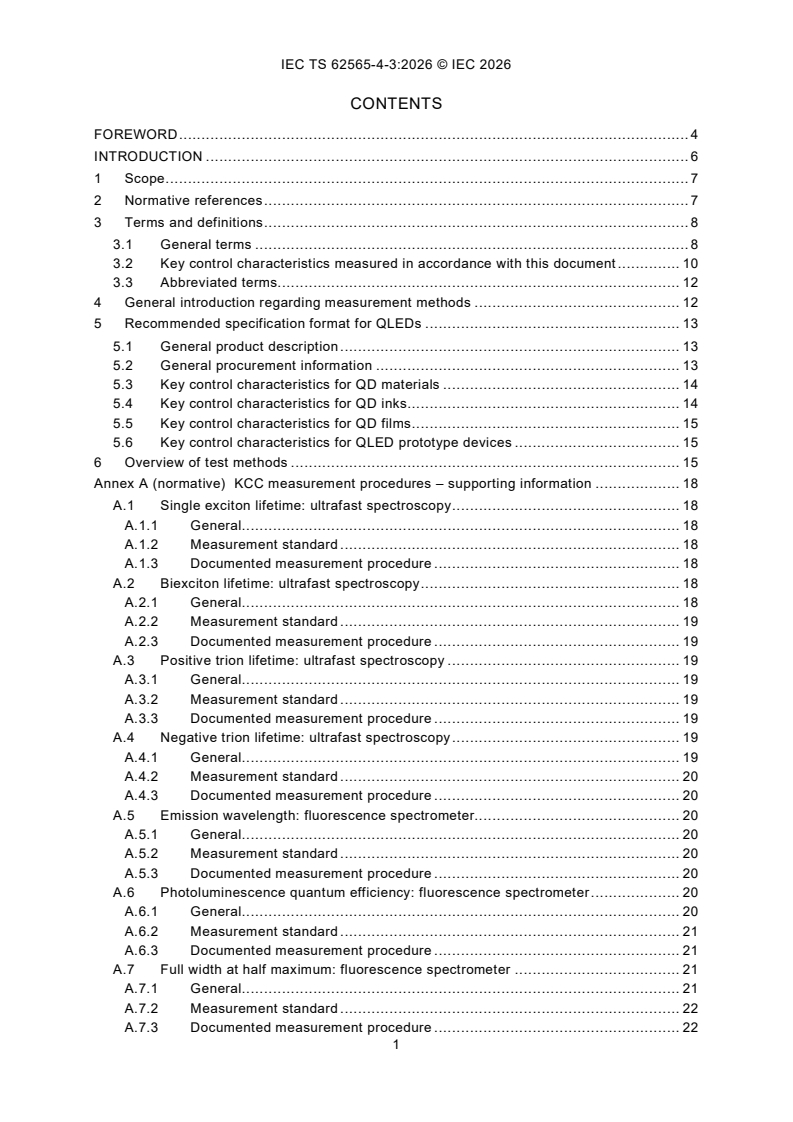
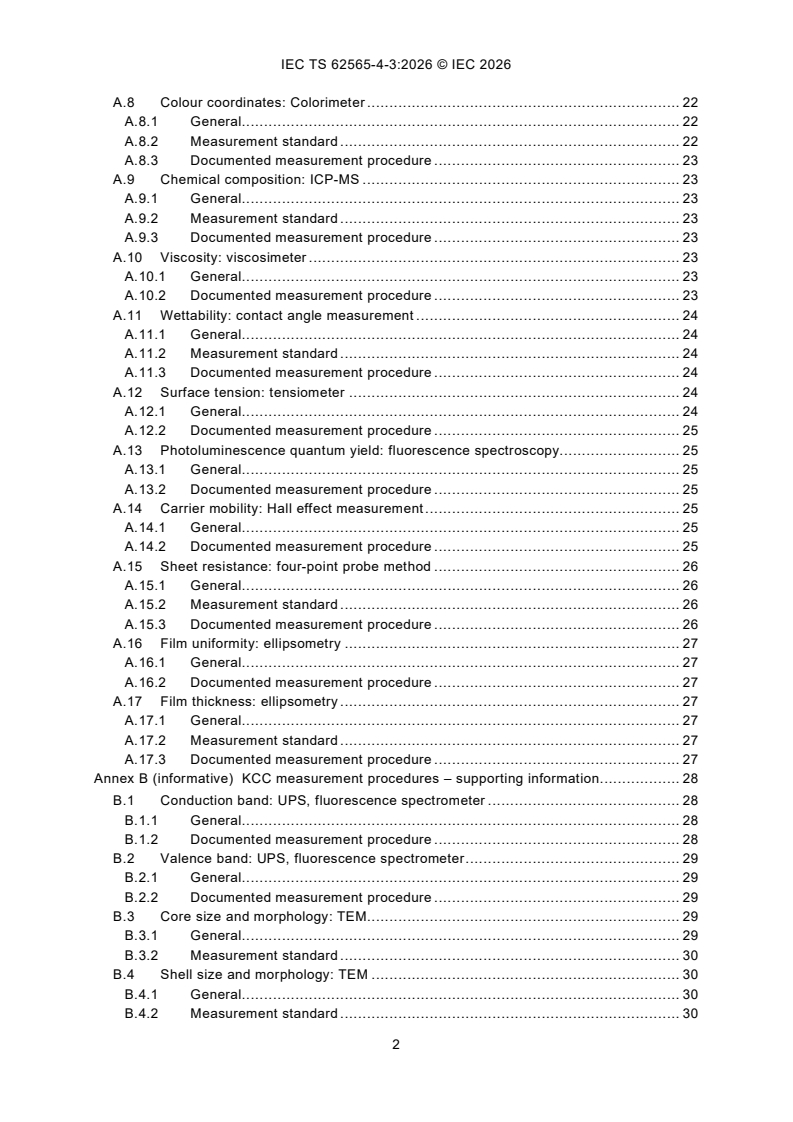
CONTENTS
FOREWORD . 4
INTRODUCTION . 6
1 Scope . 7
2 Normative references . 7
3 Terms and definitions . 8
3.1 General terms . 8
3.2 Key control characteristics measured in accordance with this document . 10
3.3 Abbreviated terms. 12
4 General introduction regarding measurement methods . 12
5 Recommended specification format for QLEDs . 13
5.1 General product description . 13
5.2 General procurement information . 13
5.3 Key control characteristics for QD materials . 14
5.4 Key control characteristics for QD inks . 14
5.5 Key control characteristics for QD films . 15
5.6 Key control characteristics for QLED prototype devices . 15
6 Overview of test methods . 15
Annex A (normative) KCC measurement procedures – supporting information . 18
A.1 Single exciton lifetime: ultrafast spectroscopy . 18
A.1.1 General. 18
A.1.2 Measurement standard . 18
A.1.3 Documented measurement procedure . 18
A.2 Biexciton lifetime: ultrafast spectroscopy . 18
A.2.1 General. 18
A.2.2 Measurement standard . 19
A.2.3 Documented measurement procedure . 19
A.3 Positive trion lifetime: ultrafast spectroscopy . 19
A.3.1 General. 19
A.3.2 Measurement standard . 19
A.3.3 Documented measurement procedure . 19
A.4 Negative trion lifetime: ultrafast spectroscopy . 19
A.4.1 General. 19
A.4.2 Measurement standard . 20
A.4.3 Documented measurement procedure . 20
A.5 Emission wavelength: fluorescence spectrometer. 20
A.5.1 General. 20
A.5.2 Measurement standard . 20
A.5.3 Documented measurement procedure . 20
A.6 Photoluminescence quantum efficiency: fluorescence spectrometer . 20
A.6.1 General. 20
A.6.2 Measurement standard . 21
A.6.3 Documented measurement procedure . 21
A.7 Full width at half maximum: fluorescence spectrometer . 21
A.7.1 General. 21
A.7.2 Measurement standard . 22
A.7.3 Documented measurement procedure . 22
A.8 Colour coordinates: Colorimeter . 22
A.8.1 General. 22
A.8.2 Measurement standard . 22
A.8.3 Documented measurement procedure . 23
A.9 Chemical composition: ICP-MS . 23
A.9.1 General. 23
A.9.2 Measurement standard . 23
A.9.3 Documented measurement procedure . 23
A.10 Viscosity: viscosimeter . 23
A.10.1 General. 23
A.10.2 Documented measurement procedure . 23
A.11 Wettability: contact angle measurement . 24
A.11.1 General. 24
A.11.2 Measurement standard . 24
A.11.3 Documented measurement procedure . 24
A.12 Surface tension: tensiometer . 24
A.12.1 General. 24
A.12.2 Documented measurement procedure . 25
A.13 Photoluminescence quantum yield: fluorescence spectroscopy. 25
A.13.1 General. 25
A.13.2 Documented measurement procedure . 25
A.14 Carrier mobility: Hall effect measurement . 25
A.14.1 General. 25
A.14.2 Documented measurement procedure . 25
A.15 Sheet resistance: four-point probe method . 26
A.15.1 General. 26
A.15.2 Measurement standard . 26
A.15.3 Documented measurement procedure . 26
A.16 Film uniformity: ellipsometry . 27
A.16.1 General. 27
A.16.2 Documented measurement procedure . 27
A.17 Film thickness: ellipsometry . 27
A.17.1 General. 27
A.17.2 Measurement standard . 27
A.17.3 Documented measurement procedure . 27
Annex B (informative) KCC measurement procedures – supporting information . 28
B.1 Conduction band: UPS, fluorescence spectrometer . 28
B.1.1 General. 28
B.1.2 Documented measurement procedure . 28
B.2 Valence band: UPS, fluorescence spectrometer . 29
B.2.1 General. 29
B.2.2 Documented measurement procedure . 29
B.3 Core size and morphology: TEM. 29
B.3.1 General. 29
B.3.2 Measurement standard . 30
B.4 Shell size and morphology: TEM . 30
B.4.1 General. 30
B.4.2 Measurement standard . 30
B.5 Size distribution: TEM . 31
B.5.1 General. 31
B.5.2 Measurement standard . 31
B.6 Surfactants: FTIR . 31
B.6.1 General. 31
B.6.2 Measurement standard . 31
B.7 Crystallinity: P-XRD . 32
B.7.1 General. 32
B.7.2 Measurement standard . 32
B.8 Solubility . 32
B.8.1 General. 32
B.8.2 Measurement standard . 32
B.9 Transparency: UV-vis spectroscopy . 33
B.9.1 General. 33
B.9.2 Measurement standard . 33
B.10 Fermi level: scanning Kelvin probe microscopy . 34
B.10.1 General. 34
B.10.2 Measurement standard . 34
Bibliography . 35
Figure A.1 – Sessile drop measurement method . 24
Figure A.2 – The scheme of four-point probe . 26
Table 1 – Format for general product description . 13
Table 2 – Format for general procurement information . 13
Table 3 – Key control characteristics for QD materials . 14
Table 4 – Key control characteristics for QD inks . 14
Table 5 – Key control characteristics for QD films . 15
Table 6 – Key control characteristics for QLED prototype devices . 15
Table 7 – Measurement methods of KCCs . 16
INTERNATIONAL ELECTROTECHNICAL COMMISSION
____________
Nanomanufacturing - Product specification -
Part 4-3: Nanophotonic products - Blank detail specification:
quantum dot enabled light emitting diodes
FOREWORD
1) The International Electrotechnical Commission (IEC) is a worldwide organization for standardization comprising
all national electrotechnical committees (IEC National Committees). The object of IEC is to promote international
co-operation on all questions concerning standardization in the electrical and electronic fields. To this end and
in addition to other activities, IEC publishes International Standards, Technical Specifications, Technical Reports,
Publicly Available Specifications (PAS) and Guides (hereafter referred to as "IEC Publication(s)"). Their
preparation is entrusted to technical committees; any IEC National Committee interested in the subject dealt with
may participate in this preparatory work. International, governmental and non-governmental organizations liaising
with the IEC also participate in this preparation. IEC collaborates closely with the International Organization for
Standardization (ISO) in accordance with conditions determined by agreement between the two organizations.
2) The formal decisions or agreements of IEC on technical matters express, as nearly as possible, an international
consensus of opinion on the relevant subjects since each technical committee has representation from all
interested IEC National Committees.
3) IEC Publications have the form of recommendations for international use and are accepted by IEC National
Committees in that sense. While all reasonable efforts are made to ensure that the technical content of IEC
Publications is accurate, IEC cannot be held responsible for the way in which they are used or for any
misinterpretation by any end user.
4) In order to promote international uniformity, IEC National Committees undertake to apply IEC Publications
transparently to the maximum extent possible in their national and regional publications. Any divergence between
any IEC Publication and the corresponding national or regional publication shall be clearly indicated in the latter.
5) IEC itself does not provide any attestation of conformity. Independent certification bodies provide conformity
assessment services and, in some areas, access to IEC marks of conformity. IEC is not responsible for any
services carried out by independent certification bodies.
6) All users should ensure that they have the latest edition of this publication.
7) No liability shall attach to IEC or its directors, employees, servants or agents including individual experts and
members of its technical committees and IEC National Committees for any personal injury, property damage or
other damage of any nature whatsoever, whether direct or indirect, or for costs (including legal fees) and
expenses arising out of the publication, use of, or reliance upon, this IEC Publication or any other IEC
Publications.
8) Attention is drawn to the Normative references cited in this publication. Use of the referenced publications is
indispensable for the correct application of this publication.
9) IEC draws attention to the possibility that the implementation of this document may involve the use of (a)
patent(s). IEC takes no position concerning the evidence, validity or applicability of any claimed patent rights in
respect thereof. As of the date of publication of this document, IEC had not received notice of (a) patent(s), which
may be required to implement this document. However, implementers are cautioned that this may not represent
the latest information, which may be obtained from the patent database available at https://patents.iec.ch. IEC
shall not be held responsible for identifying any or all such patent rights.
IEC TS 62565-4-3 has been prepared by IEC technical committee 113: Nanotechnology for
electrotechnical products and systems. It is a Technical Specification.
The text of this Technical Specification is based on the following documents:
Draft Report on voting
113/956/DTS 113/975/RVDTS
Full information on the voting for its approval can be found in the report on voting indicated in
the above table.
The language used for the development of this Technical Specification is English.
This document was drafted in accordance with ISO/IEC Directives, Part 2, and developed in
accordance with ISO/IEC Directives, Part 1 and ISO/IEC Directives, IEC Supplement, available
at www.iec.ch/members_experts/refdocs. The main document types developed by IEC are
described in greater detail at www.iec.ch/publications.
A list of all parts in the IEC 62565 series, published under the general title Nanomanufacturing -
Product specification, can be found on the IEC website.
Future standards in this series will carry the new general title as cited above. Titles of existing
standards in this series will be updated at the time of the next edition.
The committee has decided that the contents of this document will remain unchanged until the
stability date indicated on the IEC website under webstore.iec.ch in the data related to the
specific document. At this date, the document will be
– reconfirmed,
– withdrawn, or
– revised.
INTRODUCTION
This document details how to specify the key control characteristics of quantum dot enabled
light emitting diodes (QLEDs) in a systematic and consistent manner. It gives the key control
characteristics (KCCs) and corresponding measurement methods related to QD materials, QD
inks, QD films and QLED prototype devices.
Typically, the applications of QDs in displays have two technological pathways:
photoluminescence (PL) and electroluminescence (EL). The former is passive luminescence,
where green and red light is generated by excitation via higher energy blue light illumination.
The latter is active luminescence. In electroluminescent QLEDs, electrons and holes are
injected into the colloidal QD emissive layer to form excitons that then radiatively decay to
release photons. Electroluminescent QD display technology has become more and more
appealing in research and industry recently due to its high contrast, fast response, foldability,
and ultra-thin structure, as compared with the use of photoluminescent QDs.
The importance of QDs to QLED performance cannot be overemphasized. Specifically, its
chemical composition, core-shell structure, crystallinity, energy levels for both conduction and
valence bands, static optical properties, ultrafast optical properties and so on have been
demonstrated repeatedly in numerous publications to play major roles in affecting device
internal quantum efficiency (IQE), external quantum efficiency (EQE) and stability. Slight QD
material modifications lead to noticeable changes in the device performance. Although multiple
characterizations for each of these factors have been reported in different publications, thus far
there are no unanimous protocols established. Therefore, it is important to report a systematic
and well-accepted protocol of characteristics.
Preparation of QD inks suitable for the ink-jet printing techniques is crucial for the mass
production of QLED-based displays. This is a non-trivial assignment since the quality of ink-jet
printed films is closely related to the properties of the inks. On one hand, it is important to
preserve the solubility and optical stability of QDs; and on the other hand, the inks' compatibility
with substrate and process conditions is crucial to produce excellent films. Decent progress has
been made, but there is still more to be done to achieve reproducible high-quality films.
Standardization of the detailed physical properties will definitely facilitate this process.
Film qualities for QDs as well as other functional layers – including electron transfer, hole
transfer, and hole injection layers – are directly related to the balance of carrier injections,
which is highly correlated to the device performance. Thus, it is extremely important to develop
the ability to reproducibly prepare uniform film. Characterizations of film thickness, uniformity,
QD optical stability, physical stability and conductivity are necessary to assure the quality of
prepared films.
The luminance of QLEDs is one of the most important parameters, determining the accuracy of
device lifetime conversion. Unfortunately, despite its significance, the reported results from
different laboratories and institutes contradict each other. Currently, there are three widely used
methods for this measurement. They are spectroradiometer, silicon photodetector and
integrating sphere. It turns out the major discrepancies arise from the different methods used.
Particularly for prototype QLEDs, different luminance measurement methods lead to rather
different results. Therefore, the standardization of luminance measurement for QLEDs is urgent
in order to obtain reliable results. And this is the cornerstone for the further improvement of
QLED research.
This document also provides information about measurement methods and existing standards
concerning the correct determination of key control characteristics.
1 Scope
This part of IEC 62565 establishes a blank detail specification (BDS) for quantum dot enabled
light emitting diodes (QLEDs) used for printed light emitting diodes (LEDs).
This document is intended to be used for display applications.
The relevant key control characteristics (KCCs) include optical, physical, chemical, and
structural properties of colloidal quantum dots (QDs). For each KCC listed, methods and
existing standards for their measurement are reported. The applicability of such methods and
standards to different material categories (physical forms) of QDs, for example colloidal solution,
inks, films, is indicated.
Numeric values for the KCCs are left blank as they will be specified between customer and
supplier in the detail specification (DS). In the DS, KCCs can be added or removed if agreed
between customer and supplier.
2 Normative references
The following documents are referred to in the text in such a way that some or all of their content
constitutes requirements of this document. For dated references, only the edition cited applies.
For undated references, the latest edition of the referenced document (including any
amendments) applies.
IEC 61010-2-033:2023, Safety requirements for electrical equipment for measurement, control,
and laboratory use - Part 2-033: Particular requirements for hand-held multimeters and other
meters for domestic and professional use, capable of measuring mains voltage
IEC TS 62565-4-2:2018, Nanomanufacturing - Material specifications - Part 4-2: Luminescent
nanomaterials - Detail specification for general lighting and display applications
IEC 62595-2-1:2016, Display lighting unit - Part 2-1: Electro-optical measuring methods of LED
backlight unit
IEC 62607-3-1:2014, Nanomanufacturing - Key control characteristics - Part 3-1: Luminescent
nanomaterials - Quantum efficiency
IEC TS 62607-3-3:2020, Nanomanufacturing - Key control characteristics - Part 3-3:
Luminescent nanomaterials - Determination of fluorescence lifetime of semiconductor quantum
dots using time correlated single photon counting (TCSPC)
IEC TS 62607-5-1:2014, Nanomanufacturing - Key control characteristics - Part 5-1: Thin-film
organic/nano electronic devices - Carrier transport measurements
IEC TS 62607-6-8:2023, Nanomanufacturing - Key control characteristics - Part 6-8:
Graphene - Sheet resistance: In-line four-point probe
IEC TS 62607-6-20:2022, Nanomanufacturing - Key control characteristics - Part 6-20:
Graphene-based material - Metallic impurity content: Inductively coupled plasma mass
spectroscopy
IEC 62899-203:2024, Printed electronics - Part 203: Materials - Semiconductor ink
IEC TR 63258:2021, Nanotechnologies - A guideline for ellipsometry application to evaluate the
thickness of nanoscale films
ISO 15989:2004, Plastics - Film and sheeting - Measurement of water-contact angle of corona-
treated films
OECD 114:2012, Viscosity of Liquids
3 Terms and definitions
For the purposes of this document, the following terms and definitions apply.
ISO and IEC maintain terminology databases for use in standardization at the following
addresses:
– IEC Electropedia: available at https://www.electropedia.org/
– ISO Online browsing platform: available at https://www.iso.org/obp
3.1 General terms
3.1.1
conduction band edge
minimum energy of the allowed energy band partially occupied by quasi-free electrons
Note 1 to entry: The electrons on conduction band are mobile and responsible for electric conductivity of QD film.
Note 2 to entry: Matching the conduction band of the electron transfer layer with that of QD film facilitates electron
transfer.
[SOURCE: IEC 60050-113:2011, 113-06-20, modified – In the term, "edge" has been added. In
the definition, "minimum energy of the" has been added. Notes 1 and 2 to entry have been
added.]
3.1.2
valence band edge
maximum energy of the allowed energy band completely occupied by electrons at a
thermodynamic temperature of zero kelvin
Note 1 to entry: Holes on valence band are mobile and responsible for hole conductivity of QD film.
Note 2 to entry: Matching the valence band of the hole transfer layer with that of QD film facilitates hole transfer.
[SOURCE: IEC 60050-113:2011, 113-06-19, modified – In the term, "edge" has been added. In
the definition, "maximum energy of the" has been added, "band" has been replaced with "energy
band", "completely" has been added, and "the valence electrons" has been replaced with
"electrons". Notes 1 and 2 to entry have been added.]
3.1.3
single exciton lifetime
time it takes for an exciton to decay to the ground state
Note 1 to entry: Quantum lifetime is within the range of tens of nanoseconds.
Note 2 to entry: An exciton is a pair of electron and hole confined in QDs created by photo excitation or carrier
injection.
3.1.4
Auger recombination
non-radiative process where the excess energy from the electron-hole recombination is
transferred to electrons or holes that are subsequently excited to higher energy states within
the same band instead of giving off photons
Note 1 to entry: Due to discrete energy states near the band edge of QDs, Auger recombination rate is much slower
than that of bulk material.
Note 2 to entry: Auger recombination of a negative trion, for instance, can be described in terms of Coulomb
scattering between the two electrons in the conduction band and one hole in the valence band when one pair of
electron and hole undergoes recombination while the remaining electron is excited within the conduction band. Auger
recombination of a neutral biexciton can involve re-excitation of either an electron (negative trion pathway) or a hole
(positive trion pathway).
3.1.5
viscosity
property of a liquid resulting from internal flow resistance opposing the relative movement of
adjacent layers
[SOURCE: IEC 60050-212:2010, 212-18-03, modified – In the term, "(dynamic)" has been
deleted. The note has been deleted.]
3.1.6
wettability
ability of a solid material to absorb a liquid
Note 1 to entry: A measure of wettability is the contact angle between the solid surface and the liquid surface of a
drop of the liquid on the solid.
Note 2 to entry: The liquid for which the wettability is determined is not necessarily water.
[SOURCE: IEC 60050-212:2010, 212-12-21, modified – In the definition, "surface" has been
deleted and "adsorb" has been replaced with "absorb".]
3.1.7
surface tension
γ
at a point of a line on the interface of two fluids or a fluid and a solid, quantity equal to the
derivative of component F of the force, tangent to the surface and perpendicular to the line,
with respect to curvilinear abscissa l
γ= ddFl
Note 1 to entry: The surface tension is equal to the work ∆W needed to expand the surface by an area ∆A, divided
by ∆A, thus γ = ∆W / ∆A.
Note 2 to entry: The coherent SI unit of surface tension is newton per metre (N/m) or, equally, joule per square
metre (J/m ).
[SOURCE: IEC 60050-113:2011, 113-03-42]
3.1.8
film uniformity
measurement of the degree of variations in the film surface topology, typically characterized by
surface roughness
3.1.9
carrier mobility
average drift velocity of carriers per unit electric field in a homogeneous semiconductor
Note 1 to entry: The carrier mobility of electrons is usually different from that of holes.
Note 2 to entry: Determining the carrier mobility from a simple measurement of resistivity and carrier concentration
gives a measure of the transport mean free time (or lifetime), τ, through the relation μ = eτ/m, where e is the magnitude
of the electric charge carried by a single electron, and m is the effective mass of the charge carrier.
Note 3 to entry: Carrier mobility is typically defined as μ ≡ ν/E = σ/en, where ν is the Drude carrier drift velocity, E is
applied electric field, assumed to be small, σ is conductivity, e is the magnitude of the electric charge carried by a
single electron, and n is carrier density.
Note 4 to entry: Carrier concentrations and carrier mobilities for a sample can be determined from measurements
of the Hall coefficient and resistivity as a function of temperature.
[SOURCE: McGraw-Hill Dictionary of Scientific and Technical Terms, sixth edition, modified –
The second part of the source definition has been moved to Note 1 to entry. Other notes to
entry have been added.]
3.1.10
sheet resistance
electric resistance of a thin film material measured across the opposite ends of a square area
Note 1 to entry: The unit of sheet resistance is expressed in ohms (Ω). However, for the purpose of this procedure,
it represents the unit of ohms per square (Ω/sq) with the thickness of the film.
[SOURCE: IEC 62899-202-3:2019, 3.1]
3.1.11
integrating sphere
hollow sphere, the interior of which is formed from, or coated with, a diffusely reflecting material
that is as spectrally neutral and as spatially uniform as possible
Note 1 to entry: Owing to the internal reflections within the sphere, the illuminance on any part of the inside surface
of the sphere for which the direct flux is hidden is theoretically proportional to the luminous flux entering the sphere
or produced inside the sphere. The illuminance of the internal sphere wall can be measured via a small window.
Note 2 to entry: The window of an integrating sphere is often used in radiometric measurement systems to provide
a source with good spatial uniformity and with an angular distribution of radiance or luminance that is close to
Lambert's cosine law.
[SOURCE: IEC 60050-845:2020, 845-25-028]
3.2 Key control characteristics measured in accordance with this document
3.2.1
quantum dot enabled light emitting diode
QLED
light emitting diode in which light is emitted from quantum dots via electroluminescence, as a
result of charge carrier injection and radiative recombination within the quantum dots
Note 1 to entry: A QLED comprises basic functional layers including cathode, anode, hole injection layer, hole
transfer layer, emission layer, electron transfer layer, etc.
3.2.2
photoluminescence quantum efficiency
quotient of the photon flux of the radiation emitted by a photoluminescent material and the
photon flux of the exciting radiation absorbed by that material
Note 1 to entry: The photoluminescence quantum efficiency has unit one.
3.2.3
external quantum efficiency
EQE
quotient of the number of photons extracted from the device and the number of electrons
injected into the device
Note 1 to entry: The EQE can be expressed as the product of four main influencing parameters: charge balance,
radiative quantum efficiency, singlet-triplet factor and out coupling efficiency.
Note 2 to entry: The EQE was calculated from number of photons over number of electrons (N /N ).
p e
3.2.4
morphology
form and structure of quantum dots including crystallinity, shell integrity, and monodispersity
Note 1 to entry: Quantum dot crystallinity tends to have defects such as stacking fault, vacancy, interstitial defects.
3.2.5
chemical composition
type and ratio of chemical elements across quantum dots
Note 1 to entry: In the case of alloying, elemental distribution across quantum dots is not uniform, which can affect
the wave function of an exciton.
3.2.6
size distribution
cumulative distribution of quantum dot concentration as a function of quantum dot size
3.2.7
QD ink
composite material containing quantum dots as colorants, functional components, vehicle and
additives
Note 1 to entry: In most cases, it is applied as a fluid to a substrate by a printing process and setting or drying by
either physical (evaporation) and/or chemical (polymerizations, e.g. oxidation, radiation induced, or other) processes
in order to form an image for decorative, informative or technical purposes.
[SOURCE: ISO 2834-2:2022, 3.6, modified – The term "printing ink" has been replaced with
"QD ink". In the definition, the words "quantum dots as" have been added.]
3.2.8
ink formulation
set of chemical elements and their compounds in the natural state or obtained by printing
process, including any additive necessary to preserve ink stability
3.2.9
ink stability
ability of ink to withstand aging from environmental effects, including temperature, oxidation,
humidity, and light
3.3 Abbreviated terms
ICP-MS inductively coupled plasma mass spectroscopy
P-XRD powder X-ray diffraction
SEM scanning electron microscopy
SML standard maturity level
STM scanning tunnelling microscopy
TEM transmission electron microscopy
UPS ultraviolet photoelectron spectroscopy
UV-vis ultraviolet visible
4 General introduction regarding measurement methods
For the entry under "measurement procedure" in the KCC tables, there are four scenarios
regarding the availability of documented measurement procedures which are summarized in
Clause 6 for each combination of KCCs and measurement method.
a) SML 1: A standardized measurement procedure is not yet available, but the technical
community has consensus about the need to specify the KCC. Also, a Good Practice Guide
(GPG) is not available. This is the lowest level of common understanding in the community,
and it is left to the parties involved in the delivery process to define a way of dealing with
the situation, for example by adding an agreed standard operation procedure (SOP) to the
specification. That shall be mentioned in Annex A also.
b) SML 2: A standardized measurement procedure is not yet available, but the technical
community has consensus about the need to specify the KCC. In this case, a GPG
developed by a group of stakeholders or a consortium may serve as the basis for the
measurement. The GPGs shall be attached to the BDS as clauses in Annex B with an
introduction of their use and a comment of their scientific validation. If the GPG is publicly
available, it can be referenced instead.
c) SML 3: A standardized measurement procedure is available which is intended to be used
for another use case but can be adapted for the desired use case, e.g. other materials or
other applications. They are possibly not yet validated for the use case in the BDS. In this
case the method shall be listed in Annex A with a description of how the standard shall be
adopted. Reference to the Annex A clause shall be given in the KCC tables.
d) SML 4: A standardized measurement procedure is available and can be used exactly for the
use case under consideration. In this case it is suitable just to list the standard in column
"measurement procedure" of the KCC tables.
In the cases of SML 2 and SML 3, it is recommended to transform the measurement protocol
into a documented standard and to perform all necessary steps to prepare submission of a New
Work Item Proposal to the IEC through the appropriate National Committee.
5 Recommended specification format for QLEDs
5.1 General product description
QD materials present different types of state through the manufacturing process of QLEDs.
Therefore, the general material type of state information as detailed in Table 1 shall be notified.
Table 1 – Format for general product description
Item no. Item Information F P D
01-01 Material type
Sheet or film on substrate (F)
01-02 Physical form Powder (P)
Liquid dispersion (D)
Manufacturing
01-03
method
01-04 Dispersant
5.2 General procurement information
General information about QDs intended for a QLED application should be provided by the
manufacturer or product specifier according to Table 2.
Table 2 – Format for general procurement information
Item no. Item Information
02-01 Supplier
02-02 Trade name
02-03 Date of manufacture
02-04 ID number
02-05 Batch number
02-06 Series number
02-07 Dispersion agent
Solution (specify solvent)
02-08 Dispersion method
Solid (specify matrix)
Number
02-09 Specification Revision level
Date of issue
NOTE General procurement specification number, revision level, and part number
or revision level are specified by either the customer or QD supplier.
5.3 Key control characteristics for QD materials
Key control characteristics, specific parameters, units, measurement methods and related
standards if existing for QD materials are listed in Table 3.
Table 3 – Key control characteristics for QD materials
Measurement
Item no. Item Unit SML Measurement procedure
method
Conduction band edge eV STM 1 Not available
STM, UPS,
03-01
Valence band edge eV fluorescence 1 Not available
spectrometer
Single exciton lifetime ns Ultrafast 3 IEC TS 62607-3-3:2020
spectroscopy
Biexciton lifetime ns 3 IEC TS 62607-3-3:2020
Ultrafast
(Clause A.1,
03-02 optical
Positive trion lifetime ns 3 IEC TS 62607-3-3:2020
Clause A.2,
properties
Clause A.3,
Negative trion lifetime
ns 3 IEC TS 62607-3-3:2020
Clause A.4)
Emission wavelength nm 4 IEC TS 62565-4-2:2018
Fluorescence
spectrometer
Photoluminescence
4 IEC 62607-3-1:2014
quantum efficiency
(Clause A.5,
Static optical
03-03 Clause A.6,
Full width at half
properties
nm 4 IEC TS 62565-4-2:2018
Clause A.7)
maximum
Colorimeter
Colour coordinates 4 IEC 62595-2-1:2016
(Clause A.8)
Core size and
nm 1 Not available
morphology TEM
(Clause B.3,
Shell size and
nm 1 Not available
03-04 QD structure Clause B.4,
morphology
Clause B.5)
Size distribution 1 Not available
Surfactants FTIR (Clause B.6) 1 Not available
03-05 Chemical composition ICP-MS (Clause A.9) 3 IEC TS 62607-6-20:2022
03-06 Crystallinity P-XRD (Clause B.7) 1 Not available
5.4 Key control characteristics for QD inks
Key control characteristics, specific parameters, units, measurement methods and related
standards if existing for QD inks are listed in Table 4.
Table 4 – Key control characteristics for QD inks
Item no. Item Unit Measurement method SML Measurement procedure
04-01 Solubility mg/ml (Clause B.8) 1 Not available
04-02 Viscosity Cp Viscosimeter (A.10) 4 OECD 114:2012
Contact angle measurement
04-03 Wettability 4 ISO 15989:
...