

IEC TS 62607-4-9:2026
(Main)Nanomanufacturing - Key control characteristics - Part 4-9: Nano-enabled energy storage - Electrochemical characteristics of carbon nanomaterial for the electrodes of electric double-layer capacitors: Coin cell preparation
- Abstract
IEC TS 62607-4-9:2026, which is a Technical Specification, establishes a standardized method for assembling
• coin-cell EDLCs
in order to characterize the electrochemical key control characteristic of carbon nanomaterials.
The coin-cell EDLC is fabricated through sequential steps: electrode slurry preparation (mixing), coating, rolling, cutting, weighing, and final assembly.
• The document specifies the assembly process and data recording.
• The document is applicable for carbon nanomaterials used in EDLC as active material or conductive agents, such as nanoporous activated carbon, carbon aerogel, carbon nanotube, carbon black, graphene, nano graphite sheet, vapour-grown carbon fibre and so on.
• Typical application areas of this method are research, manufacturer and downstream user to guide material processing and quality control
- Status
- Published
- Publication Date
- 13-Jul-2026
- Technical Committee
- TC 113 - Nanotechnology for electrotechnical products and systems
- Drafting Committee
- WG 11 - TC 113/WG 11
- Current Stage
- PPUB - Publication issued
- Start Date
- 14-Jul-2026
- Completion Date
- 24-Jul-2026
Buy Documents
IEC TS 62607-4-9:2026 - Nanomanufacturing - Key control characteristics - Part 4-9: Nano-enabled energy storage - Electrochemical characteristics of carbon nanomaterial for the electrodes of electric double-layer capacitors: Coin cell preparation
IEC TS 62607-4-9:2026 is a Technical Specification from the International Electrotechnical Commission (IEC). It specifies a standardized method for preparing coin-cell electric double-layer capacitors (EDLCs) from carbon nanomaterials, together with the data to record so the electrochemical behavior can be characterized in a repeatable way. The document is intended for research, manufacturers, and downstream users who need a common preparation route for material evaluation and quality control.
What does IEC TS 62607-4-9:2026 specify?
IEC TS 62607-4-9:2026 specifies the preparation of coin-cell EDLCs for characterizing the electrochemical key control characteristic of carbon nanomaterials. It covers the full preparation chain from slurry making to final standing before testing, and it also defines what assembly information should be documented.
The document is organized into Clause 1 to Clause 6, with Annexes A to C supporting the procedure.
| Annex | What it covers |
|---|---|
| A | Data recording formats for sample identification and assembly information |
| B | Coin-cell structure and stacking arrangement |
| C | Case study for nanoporous activated carbon, including a worked preparation example |
Clause 2 gives the normative reference, Clause 3 defines the terms, acronyms and abbreviated terms, Clause 4 sets general conditions and equipment, Clause 5 gives the assembling procedure, and Clause 6 lists the data to be recorded.
What are the key requirements of IEC TS 62607-4-9:2026?
IEC TS 62607-4-9:2026 focuses on controlling each preparation step, because small changes in slurry, coating, drying, or assembly can affect the electrochemical result. In practice, the user must keep the process consistent enough that the coin-cell EDLC is a valid sample for comparison.
General setup and materials
Clause 4 requires the work to be done under standard atmospheric conditions unless otherwise specified, with temperature, relative humidity, and air pressure within the stated ranges. This matters because humidity and temperature can change slurry behavior, drying, and cell assembly.
Clause 4 also identifies the main apparatus needed: balances, a mixing and dispersing machine or mortar, coater, drying ovens, rolling press, cutter, vacuum oven, electrolyte injection system, micrometer, crimper, potentiostatic/galvanostatic equipment, and an environmental chamber. The practical point is that the method depends on equipment that can control mass, thickness, temperature, pressure, and electrochemical measurement conditions.
Supporting materials include carbon nanomaterials as active material or conductive additives, suitable binders, current collectors, separators, electrolyte, and solvents. The document ties the method to specific material types so users can select compatible inputs before starting.
Slurry design and preparation
Clause 5.1 requires pre-treatment of the electrode materials before slurry making, including drying to reduce water content and keeping particle size within the recommended range. This helps prevent poor mixing and unstable coating behavior.
Clause 5.2 sets out the slurry design. The solid component mass must be sufficient for assembling cells, and the document gives recommended ranges for conductive additive, binder, and active material proportions. It also distinguishes between water-based systems and other binder systems, which matters because the binder choice affects slurry stability and electrode strength.
The mixing step may use manual grinding or a mixing and dispersing machine, depending on sample quantity. The slurry must be coated soon after mixing, so the user should plan the process to avoid settling or property change before coating.
Coating, rolling, cutting, and drying
Clause 5.3 requires the current collector to be measured before coating, including thickness and surface density. It also gives a coating procedure with controlled temperature, speed, and scraper height, and then checks the coated layer by mass and surface density. In practice, this lets the user confirm that each electrode has a comparable coating load.
Clause 5.4 converts the measured coating data into a target rolled thickness using the rolling density. The rolling press gap is then adjusted to reach that thickness. This step matters because the final electrode compactness affects cell assembly and later electrochemical behavior.
Clause 5.5 requires cutting a sufficient number of electrode discs, weighing them individually, and selecting discs with closely matched mass. The point is to reduce cell-to-cell variation, since mass differences change the amount of active material in each cell.
Clause 5.6 requires vacuum drying of the selected discs and transfer into an argon glove box with very low oxygen and water content. This limits contamination before assembly and helps keep the cell chemistry stable.
Final assembly and waiting time
Clause 5.7 requires cleaning and drying the cell parts, then assembling the coin-cell EDLC in a glove box. The electrode discs, separator, springs, spacer, shell parts, and electrolyte are assembled in a defined order, and the cell is sealed with a pneumatic crimper.
The document also requires a minimum number of coin-cell EDLCs for one sample and a standing period before testing. This gives the assembled cells time to stabilize before electrochemical measurement.
Recording and traceability
Clause 6 requires documentation of the material information, process conditions, assembly data, date and time, and the responsible person. In practice, this is what makes the preparation traceable and repeatable across batches and between organizations.
What terms does IEC TS 62607-4-9:2026 define?
- Electric double-layer capacitor (EDLC) - A device that stores electrical energy by charge separation at the interface, so the standard is aimed at this capacitor type.
- Coin cell - A cylindrical cell with height less than diameter, used here as the test format for EDLC preparation.
- Active material - The material that stores energy by double-layer or pseudocapacitance effects, which is the main performance-driving component in the electrode.
- Current collector - The conductive part that collects or carries electrons in the electrochemical capacitor electrode.
- Separator - The ion-permeable cell component that prevents electrical contact between electrodes of opposite polarity.
- Binder - The resinous material that holds the slurry components together and gives the electrode mechanical integrity.
- Solid content - The mass percentage of the slurry that remains after drying under the specified conditions, used to control slurry formulation.
- Surface density - Mass per area, used to judge collector and coating loading consistency.
Who uses IEC TS 62607-4-9:2026?
IEC TS 62607-4-9:2026 is used by laboratories, material developers, manufacturers, and downstream users working on EDLC materials. It is relevant to research teams that need a controlled preparation method, to manufacturers that need process guidance, and to quality teams that need consistent data records for batch comparison.
It is especially useful for people handling carbon nanomaterials such as nanoporous activated carbon, carbon aerogel, carbon nanotube, carbon black, graphene, nano graphite sheet, and vapour-grown carbon fibre. In practice, these users apply the document to electrode processing, coin-cell assembly, electrochemical characterization, and quality control.
Which standards are used with IEC TS 62607-4-9:2026?
The normative reference is IEC TS 62565-5-1:2023, which supplies the sample identification scheme used for traceability and data recording. The document also draws terminology from IEC TS 62565-5-2:2022, ISO 18300:2016, and several IEC vocabulary standards, including the definitions for EDLC, coin cell, electrode, current collector, separator, thickness, and surface density.
For the user, this means Clause 3 and Clause 6 are not standalone descriptions - they rely on these referenced standards for consistent naming and identification.
What does the IEC TS 62607-4-9:2026 document contain?
IEC TS 62607-4-9:2026 contains the equipment list, preparation sequence, calculation methods, recording templates, and an example application. Table 1 defines the key apparatus and their required capabilities, so a lab can check whether its setup can run the method.
Clause 5 contains the practical preparation steps, including the formulas for current-collector surface density, coating density, rolled thickness, and active-material mass per disc. These calculations are used to choose or reject electrodes before assembly.
Annex A provides record formats for sample identification, slurry data, collector and separator data, electrode disc data, electrolyte data, and coin-cell EDLC data. Annex B shows the coin-cell structure and stacking order, while Annex C gives a worked case study for nanoporous activated carbon with figures and tables for each preparation stage.
Buy Documents
IEC TS 62607-4-9:2026 - Nanomanufacturing - Key control characteristics - Part 4-9: Nano-enabled energy storage - Electrochemical characteristics of carbon nanomaterial for the electrodes of electric double-layer capacitors: Coin cell preparation
Frequently Asked Questions
IEC TS 62607-4-9:2026 is a technical specification published by the International Electrotechnical Commission (IEC). Its full title is "Nanomanufacturing - Key control characteristics - Part 4-9: Nano-enabled energy storage - Electrochemical characteristics of carbon nanomaterial for the electrodes of electric double-layer capacitors: Coin cell preparation". This standard covers: IEC TS 62607-4-9:2026, which is a Technical Specification, establishes a standardized method for assembling • coin-cell EDLCs in order to characterize the electrochemical key control characteristic of carbon nanomaterials. The coin-cell EDLC is fabricated through sequential steps: electrode slurry preparation (mixing), coating, rolling, cutting, weighing, and final assembly. • The document specifies the assembly process and data recording. • The document is applicable for carbon nanomaterials used in EDLC as active material or conductive agents, such as nanoporous activated carbon, carbon aerogel, carbon nanotube, carbon black, graphene, nano graphite sheet, vapour-grown carbon fibre and so on. • Typical application areas of this method are research, manufacturer and downstream user to guide material processing and quality control
IEC TS 62607-4-9:2026, which is a Technical Specification, establishes a standardized method for assembling • coin-cell EDLCs in order to characterize the electrochemical key control characteristic of carbon nanomaterials. The coin-cell EDLC is fabricated through sequential steps: electrode slurry preparation (mixing), coating, rolling, cutting, weighing, and final assembly. • The document specifies the assembly process and data recording. • The document is applicable for carbon nanomaterials used in EDLC as active material or conductive agents, such as nanoporous activated carbon, carbon aerogel, carbon nanotube, carbon black, graphene, nano graphite sheet, vapour-grown carbon fibre and so on. • Typical application areas of this method are research, manufacturer and downstream user to guide material processing and quality control
IEC TS 62607-4-9:2026 is classified under the following ICS (International Classification for Standards) categories: 07.120 - Nanotechnologies. The ICS classification helps identify the subject area and facilitates finding related standards.
IEC TS 62607-4-9:2026 is available in PDF format for immediate download after purchase. The document can be added to your cart and obtained through the secure checkout process. Digital delivery ensures instant access to the complete standard document.
Standards Content (Sample)
IEC TS 62607-4-9 ®
Edition 1.0 2026-07
TECHNICAL
SPECIFICATION
Nanomanufacturing - Key control characteristics -
Part 4-9: Nano-enabled energy storage - Electrochemical characteristics of
carbon nanomaterial for the electrodes of electric double-layer capacitors: Coin
cell preparation
ICS 07.120 ISBN 978-2-8327-1355-6
All rights reserved. Unless otherwise specified, no part of this publication may be reproduced or utilized in any form or
by any means, electronic or mechanical, including photocopying and microfilm, without permission in writing from either
IEC or IEC's member National Committee in the country of the requester. If you have any questions about IEC copyright
or have an enquiry about obtaining additional rights to this publication, please contact the address below or your local
IEC member National Committee for further information.
IEC Secretariat Tel.: +41 22 919 02 11
3, rue de Varembé info@iec.ch
CH-1211 Geneva 20 www.iec.ch
Switzerland
About the IEC
The International Electrotechnical Commission (IEC) is the leading global organization that prepares and publishes
International Standards for all electrical, electronic and related technologies.
About IEC publications
The technical content of IEC publications is kept under constant review by the IEC. Please make sure that you have the
latest edition, a corrigendum or an amendment might have been published.
IEC publications search - IEC Products & Services Portal - products.iec.ch
webstore.iec.ch/advsearchform Discover our powerful search engine and read freely all the
The advanced search enables to find IEC publications by a publications previews, graphical symbols and the glossary.
variety of criteria (reference number, text, technical With a subscription you will always have access to up to date
committee, …). It also gives information on projects, content tailored to your needs.
replaced and withdrawn publications.
Electropedia - www.electropedia.org
The world's leading online dictionary on electrotechnology,
IEC Just Published - webstore.iec.ch/justpublished
Stay up to date on all new IEC publications. Just Published containing more than 22 500 terminological entries in English
details all new publications released. Available online and and French, with equivalent terms in 25 additional languages.
once a month by email. Also known as the International Electrotechnical Vocabulary
(IEV) online.
IEC Customer Service Centre - webstore.iec.ch/csc
If you wish to give us your feedback on this publication or
need further assistance, please contact the Customer
Service Centre: sales@iec.ch.
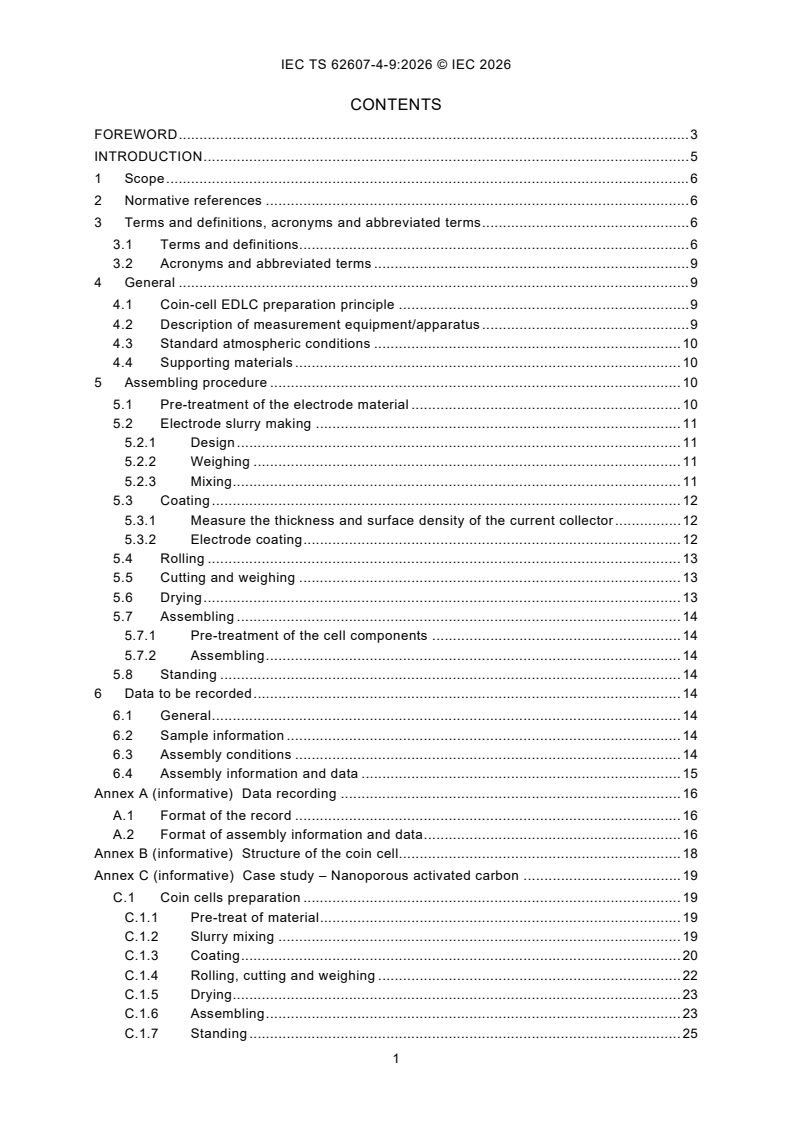
CONTENTS
FOREWORD . 3
INTRODUCTION . 5
1 Scope . 6
2 Normative references . 6
3 Terms and definitions, acronyms and abbreviated terms . 6
3.1 Terms and definitions. 6
3.2 Acronyms and abbreviated terms . 9
4 General . 9
4.1 Coin-cell EDLC preparation principle . 9
4.2 Description of measurement equipment/apparatus . 9
4.3 Standard atmospheric conditions . 10
4.4 Supporting materials . 10
5 Assembling procedure . 10
5.1 Pre-treatment of the electrode material . 10
5.2 Electrode slurry making . 11
5.2.1 Design . 11
5.2.2 Weighing . 11
5.2.3 Mixing . 11
5.3 Coating . 12
5.3.1 Measure the thickness and surface density of the current collector . 12
5.3.2 Electrode coating . 12
5.4 Rolling . 13
5.5 Cutting and weighing . 13
5.6 Drying . 13
5.7 Assembling . 14
5.7.1 Pre-treatment of the cell components . 14
5.7.2 Assembling . 14
5.8 Standing . 14
6 Data to be recorded . 14
6.1 General . 14
6.2 Sample information . 14
6.3 Assembly conditions . 14
6.4 Assembly information and data . 15
Annex A (informative) Data recording . 16
A.1 Format of the record . 16
A.2 Format of assembly information and data . 16
Annex B (informative) Structure of the coin cell. 18
Annex C (informative) Case study – Nanoporous activated carbon . 19
C.1 Coin cells preparation . 19
C.1.1 Pre-treat of material . 19
C.1.2 Slurry mixing . 19
C.1.3 Coating . 20
C.1.4 Rolling, cutting and weighing . 22
C.1.5 Drying . 23
C.1.6 Assembling . 23
C.1.7 Standing . 25
C.2 Data recording . 25
Bibliography . 27
Figure B.1 – Components and stacking structure for the coin-cell EDLC . 18
Figure C.1 – Drying active material and conductor . 19
Figure C.2 – Slurry preparation . 20
Figure C.3 – The coating process of electrodes . 21
Figure C.4 – Electrode cutting and weighing . 22
Figure C.5 – Electrode drying . 23
Figure C.6 – Assembly process of coin-cell EDLCs . 25
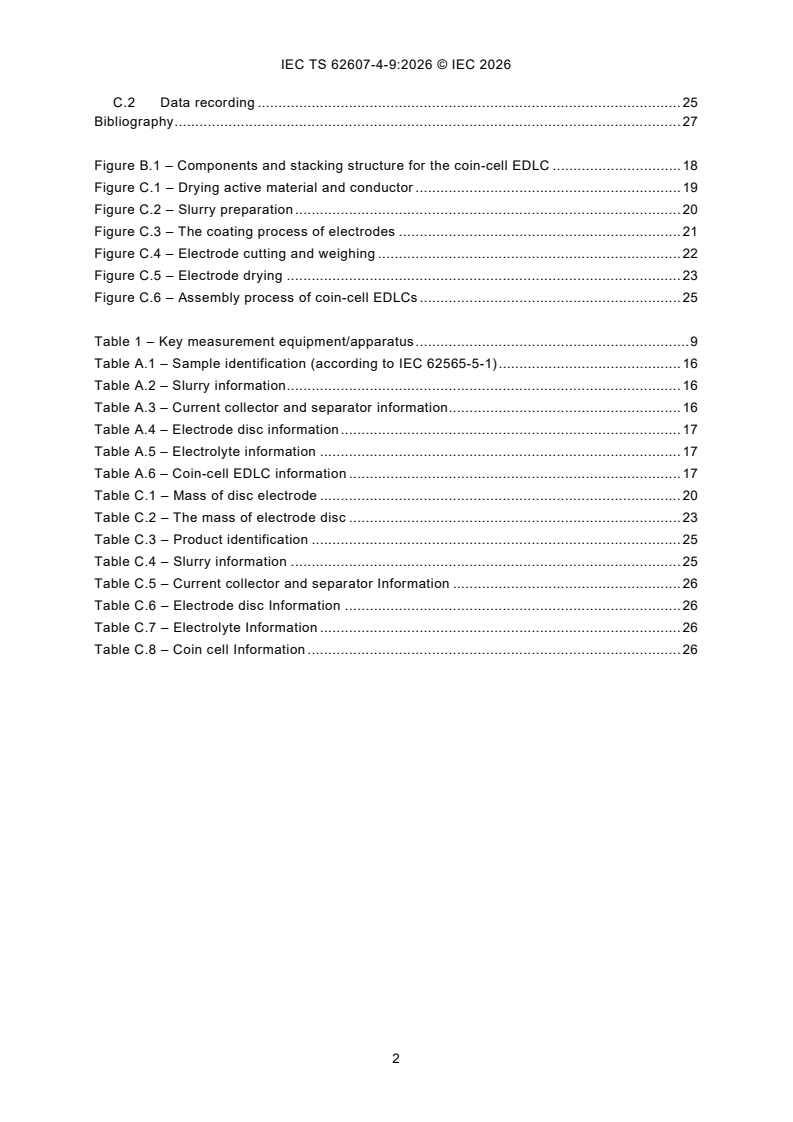
Table 1 – Key measurement equipment/apparatus . 9
Table A.1 – Sample identification (according to IEC 62565-5-1) . 16
Table A.2 – Slurry information . 16
Table A.3 – Current collector and separator information . 16
Table A.4 – Electrode disc information . 17
Table A.5 – Electrolyte information . 17
Table A.6 – Coin-cell EDLC information . 17
Table C.1 – Mass of disc electrode . 20
Table C.2 – The mass of electrode disc . 23
Table C.3 – Product identification . 25
Table C.4 – Slurry information . 25
Table C.5 – Current collector and separator Information . 26
Table C.6 – Electrode disc Information . 26
Table C.7 – Electrolyte Information . 26
Table C.8 – Coin cell Information . 26
INTERNATIONAL ELECTROTECHNICAL COMMISSION
____________
Nanomanufacturing - Key control characteristics -
Part 4-9: Nano-enabled energy storage - Electrochemical characteristics
of carbon nanomaterial for the electrodes of electric double-layer
capacitors: Coin cell preparation
FOREWORD
1) The International Electrotechnical Commission (IEC) is a worldwide organization for standardization comprising
all national electrotechnical committees (IEC National Committees). The object of IEC is to promote international
co-operation on all questions concerning standardization in the electrical and electronic fields. To this end and
in addition to other activities, IEC publishes International Standards, Technical Specifications, Technical Reports,
Publicly Available Specifications (PAS) and Guides (hereafter referred to as "IEC Publication(s)"). Their
preparation is entrusted to technical committees; any IEC National Committee interested in the subject dealt with
may participate in this preparatory work. International, governmental and non-governmental organizations liaising
with the IEC also participate in this preparation. IEC collaborates closely with the International Organization for
Standardization (ISO) in accordance with conditions determined by agreement between the two organizations.
2) The formal decisions or agreements of IEC on technical matters express, as nearly as possible, an international
consensus of opinion on the relevant subjects since each technical committee has representation from all
interested IEC National Committees.
3) IEC Publications have the form of recommendations for international use and are accepted by IEC National
Committees in that sense. While all reasonable efforts are made to ensure that the technical content of IEC
Publications is accurate, IEC cannot be held responsible for the way in which they are used or for any
misinterpretation by any end user.
4) In order to promote international uniformity, IEC National Committees undertake to apply IEC Publications
transparently to the maximum extent possible in their national and regional publications. Any divergence between
any IEC Publication and the corresponding national or regional publication shall be clearly indicated in the latter.
5) IEC itself does not provide any attestation of conformity. Independent certification bodies provide conformity
assessment services and, in some areas, access to IEC marks of conformity. IEC is not responsible for any
services carried out by independent certification bodies.
6) All users should ensure that they have the latest edition of this publication.
7) No liability shall attach to IEC or its directors, employees, servants or agents including individual experts and
members of its technical committees and IEC National Committees for any personal injury, property damage or
other damage of any nature whatsoever, whether direct or indirect, or for costs (including legal fees) and
expenses arising out of the publication, use of, or reliance upon, this IEC Publication or any other IEC
Publications.
8) Attention is drawn to the Normative references cited in this publication. Use of the referenced publications is
indispensable for the correct application of this publication.
9) IEC draws attention to the possibility that the implementation of this document may involve the use of (a)
patent(s). IEC takes no position concerning the evidence, validity or applicability of any claimed patent rights in
respect thereof. As of the date of publication of this document, IEC had not received notice of (a) patent(s), which
may be required to implement this document. However, implementers are cautioned that this may not represent
the latest information, which may be obtained from the patent database available at https://patents.iec.ch. IEC
shall not be held responsible for identifying any or all such patent rights.
IEC TS 62607-4-9 has been prepared by IEC technical committee 113: Nanotechnology for
electrotechnical products and systems. It is a Technical Specification.
The text of this Technical Specification is based on the following documents:
Draft Report on voting
113/960/DTS 113/984/RVDTS
Full information on the voting for its approval can be found in the report on voting indicated in
the above table.
The language used for the development of this Technical Specification is English.
This document was drafted in accordance with ISO/IEC Directives, Part 2, and developed in
accordance with ISO/IEC Directives, Part 1 and ISO/IEC Directives, IEC Supplement, available
at www.iec.ch/members_experts/refdocs. The main document types developed by IEC are
described in greater detail at www.iec.ch/publications.
A list of all parts of the IEC TS 62607 series, published under the general title
Nanomanufacturing - Key control characteristics, can be found on the IEC website.
The committee has decided that the contents of this document will remain unchanged until the
stability date indicated on the IEC website under webstore.iec.ch in the data related to the
specific document. At this date, the document will be
– reconfirmed,
– withdrawn, or
– revised.
INTRODUCTION
Electrochemical capacitors are widely used in electric vehicles, high-speed trains, aviation,
photovoltaics, wind power and electronics, due to their ultra-fast charge/discharge capability,
long cycle life, wide working temperature range, high safety and reliability and low maintenance
costs.
Electric double-layer capacitors (EDLCs) are a type of electrochemical capacitors. The
mechanism of energy storage for EDLCs relies on reversible ion adsorption at the active
material-electrolyte interface. Therefore, materials with large specific surface area – such as
nanoporous carbon materials – are commonly employed as active materials in EDLCs.
Additionally, to improve the electrode conductivity, high-conductivity materials (e.g. carbon
black, graphene, and carbon nanotubes/CNTs) serve as conductive agents in EDLCs. Thus,
carbon nanomaterials play an irreplaceable and critical role in EDLCs, directly determining their
electrochemical performance.
The electrochemical performance of carbon nanomaterials for EDLCs requires proper
electrochemical characterization. Prior to such measurements, the carbon nanomaterials will
be pre-assembled into devices such as coin cells, three-electrode cells, or cylindrical
cells. Coin-cell-based characterization offers advantages including low cost, versatility, and
high efficiency, making it widely used in both academic and industrial settings.
The assembly process of a coin-cell EDLC is time-consuming and complex, which typically
involves electrode slurry preparation, slurry coating onto current collectors, electrode rolling,
cutting the rolled electrodes into multiple electrode discs, and final EDLC assembly. Each step
contains numerous factors that can exert a significant impact on the accuracy of subsequent
electrochemical performance characterization of the materials. Therefore, standardizing the
coin-cell preparation process is an essential prerequisite for achieving accurate, highly
reproducible, and repeatable electrochemical performance determination.
This document introduces a standard method and process to assemble the coin-cell EDLCs of
carbon nanomaterials.
1 Scope
This part of IEC TS 62607 establishes a standardized method for assembling
– coin-cell EDLCs
in order to characterize the electrochemical key control characteristic of carbon nanomaterials.
The coin-cell EDLC is fabricated through sequential steps: electrode slurry preparation (mixing),
coating, rolling, cutting, weighing, and final assembly.
– The document specifies the assembly process and data recording.
– The document is applicable for carbon nanomaterials used in EDLC as active material or
conductive agents, such as nanoporous activated carbon, carbon aerogel, carbon nanotube,
carbon black, graphene, nano graphite sheet, vapour-grown carbon fibre and so on.
– Typical application areas of this method are research, manufacturer and downstream user
to guide material processing and quality control.
2 Normative references
The following documents are referred to in the text in such a way that some or all of their content
constitutes requirements of this document. For dated references, only the edition cited applies.
For undated references, the latest edition of the referenced document (including any
amendments) applies.
IEC TS 62565-5-1:2023, Nanomanufacturing - Product specifications - Part 5-1: Nanoporous
activated carbon - Blank detail specification: Electrochemical capacitors
3 Terms and definitions, acronyms and abbreviated terms
3.1 Terms and definitions
For the purposes of this document, the following terms and definitions apply.
ISO and IEC maintain terminology databases for use in standardization at the following
addresses:
– IEC Electropedia: available at https://www.electropedia.org/
– ISO Online browsing platform: available at https://www.iso.org/obp
3.1.1
electric double-layer capacitor
EDLC
device for electrostatic storage of electrical energy achieved by separation of charge in a double
layer
[SOURCE: ISO 18300:2016, 3.8]
3.1.2
coin cell
cell with a cylindrical shape in which the overall height is less than the diameter e.g. in the
shape of a button or a coin
Note 1 to entry: In practice, the term coin is used exclusively for non-aqueous lithium cells.
Note 2 to entry: Button cell is equivalent to coin cell.
[SOURCE: IEC 60050-482:2004, 482-02-40, modified – "button cell" has been moved to a
note 2 to entry.]
3.1.3
active material
material that can be used to store energy by electrochemical double-layer or pseudo
capacitance effect
Note 1 to entry: Typically, nonreactive carbon materials are electric double-layer capacitance active material,
including activated carbon, pure carbon nanotube and pure graphene.
Note 2 to entry: Typically, carbon composites and carbons embedded with heteroatoms are pseudo capacitance
active material.
[SOURCE: IEC TS 62565-5-2:2022, 3.3.1]
3.1.4
activated carbon
carbon, usually in the form of granules, treated to enhance its surface area and consequent
ability to adsorb and desorb the ions through a highly developed pore structure
Note 1 to entry: Activated charcoal is equivalent to activated carbon.
[SOURCE: IEC TS 62565-5-1:2023, 3.2.5, modified – "activated charcoal" has been moved to
a note 1 to entry.]
3.1.5
nanoporous activated carbon
activated carbon with nanopores
Note 1 to entry: The performance of such activated carbon application mainly depends on its nanoporous structure
[SOURCE: IEC TS 62565-5-1:2023, 3.2.6]
3.1.6
electrode
conductive part in electric contact with a medium of lower conductivity and intended to perform
one or more of the functions of emitting charge carriers to or receiving charge carriers from that
medium or to establish an electric field in that medium
[SOURCE: IEC 60050-151:2001, 151-13-01]
3.1.7
binder
resinous material which serves to bind the various component materials
3.1.8
current collector
conductive material in electrochemical capacitors that collects electron from the anode side or
conducts electrons to the cathode side
[SOURCE: IEC 60050-485:2020, 485-06-07, modified – "in a fuel cell" is modified for "in
electrochemical capacitors"]
3.1.9
carbonaceous coating aluminium foil
aluminium foil coated with carbon nanomaterial
3.1.10
etched aluminium foil
aluminium foil roughened by chemical or electrochemical methods
3.1.11
electrolyte
liquid or solid substance containing mobile ions which render it ionically conductive
Note 1 to entry: The electrolyte may be liquid, solid or a gel.
[SOURCE: IEC 60050-482:2004, 482-02-29]
3.1.12
separator
component of a cell, made up of material permeable for ions, which prevents electric contact
between cell plates of opposite polarity within a cell
[SOURCE: IEC 60050-482:2004, 482-02-11]
3.1.13
solid content
mass percentage of the remaining part of the slurry after drying under the specified conditions
3.1.14
surface density
at a given point on a two-dimensional domain of quasi-infinitesimal area dA, scalar quantity
equal to the mass dm within the domain divided by the area dA, thus ρ = dm/dA
A
[SOURCE: IEC 60050-113:2011, 113-03-10, modified – The note has been removed.]
3.1.15
thickness
shortest distance between two surfaces limiting a layer, when this distance can be considered
to be a constant over a region of a finite size
[SOURCE: IEC 60050-113:2011, 113-01-24]
3.2 Acronyms and abbreviated terms
AN Acetonitrile
CB Carbon black
CMC Sodium carboxymethyl cellulose
PC Propylene carbonate
PE Polyethylene
PP Polypropylene
PTFE Polytetrafluoroethylene
PVDF Polyvinylidene fluoride
SBP-BF Tetrafluoroborate spiro quaternary ammonium salt
SBR Butadiene styrene rubber
TEABF Tetraethylammonium tetrafluoroborate
4 General
4.1 Coin-cell EDLC preparation principle
The electrode materials are thoroughly mixed, coated onto a current collector, dried,
subsequently rolled and cut into electrode discs. The resulting electrode discs are assembled
into 20 mm-diameter, 3,2 mm-thickness coin-cell EDLCs, as shown in Annex C.
4.2 Description of measurement equipment/apparatus
The main laboratory apparatus and their corresponding requirements are as shown in Table 1:
Table 1 – Key measurement equipment/apparatus
No. Apparatus Name Function Requirements
Readability of 0,1 mg for
measuring the total mass of
Measuring the mass of
electrode discs and the mass of
1 Analytical balance electrode and electrode
electrode materials and 0,001 mg
materials
for measuring the mass of each
rolled electrode disc
Mixing the conductive paste Rotational speed of not less than
2 Mixing and dispersing machine
and electrode slurry 1 500 rpm
Coating the electrode slurry
onto the current collector with The scraper gap can adjust
3 Coater
known thickness and surface between (0,1 – 0,5) mm.
density
Drying the electrode laminate Maximum temperature is no less
4 Convection drying oven
to remove most of the solvent than 250 °C
Rolling the electrode laminate
5 Rolling press until the design thickness is Rolling gap range of (0 to 1,3) mm
reached
Cutting electrode discs and
Equipped with 10 mm, 12 mm,
6 Cutter separator discs with particular
14 mm and 19 mm cutting dies.
diameter
Vacuum level of no higher than
7 Vacuum oven Drying selected electrodes. 133 Pa and a maximum
temperature of no less than 150 °C
Pipette or electrolyte injection Injecting the electrolyte into the
8 Readability is 1 μL
system coin cell
Meas
...