

IEC 60695-11-10:2013
(Main)Fire hazard testing - Part 11-10: Test flames - 50 W horizontal and vertical flame test methods
General Information
- Abstract
IEC 60695-11-10:2013 specifies small-scale laboratory test procedures intended to compare the burning behaviour of different materials used in electrotechnical products when vertically or horizontally oriented test bar specimens are exposed to a small flame ignition source with a nominal thermal power of 50 W. These test methods determine either the linear burning rate or the self-extinguishing properties of materials. These test methods are applicable to solid and cellular materials that have an apparent density of more than 250 kg/m3, determined in accordance with ISO 845. Two test methods are described. Method A is a horizontal burning test and is intended to determine the linear burning rate of materials under specific test conditions. Method B is a vertical burning test and is intended to determine whether materials self-extinguish under specific test conditions. This second edition cancels and replaces the consolidated version of IEC 60695-11-10 published in 2003 and constitutes a technical revision. The main changes with respect to the first edition are listed below:
- Editorial changes have been made throughout the document for the purpose of aligning IEC 60695-11-10 with IEC 60695-11-20,
- Details on test specimen dimensions have been added to Clause 7,
- New Sublause 9.1.4 Conditioning of the cotton pad has been added,
- New Subclause 9.2.4 Evaluation of "burned to the holding clamp" has been added,
- New Annex C with examples of datasheets has been added,
- The Bibliography has been updated and references added.
This publication is to be read in conjunction with IEC 60695-11-4:2011.
Key words: Test flames, Fire hazard, Fire test
The contents of the corrigendum of September 2014 have been included in this copy.
- Status
- Published
- Publication Date
- 20-May-2013
- Technical Committee
- TC 89 - Fire hazard testing
- Drafting Committee
- WG 12 - TC 89/WG 12
- Current Stage
- PPUB - Publication issued
- Start Date
- 21-May-2013
- Completion Date
- 15-Jun-2013
Overview
IEC 60695-11-10:2013 is an international standard published by the International Electrotechnical Commission (IEC) that specifies small-scale laboratory test methods for evaluating the fire hazard properties of materials used in electrotechnical products. This standard focuses on test flames with a nominal thermal power of 50 watts applied in both horizontal and vertical orientations. It covers two key test methods aimed at determining how materials burn and whether they self-extinguish when exposed to a controlled ignition source.
This standard applies to solid and cellular materials having an apparent density greater than 250 kg/m³ as defined in ISO 845. It serves as an essential reference for manufacturers, safety engineers, and testing laboratories seeking to assess and compare the burning behavior of materials under standardized conditions.
Key Topics
Test Methods
- Method A (Horizontal Burning Test): Measures the linear burning rate of a material when exposed horizontally to a 50 W flame.
- Method B (Vertical Burning Test): Evaluates whether a material self-extinguishes when exposed vertically to a 50 W flame.
Test Specimen Requirements
Specimens must meet specific dimensional and conditioning criteria to ensure consistent test results, including details on preparation, thickness tolerances, and specimen orientation.Apparatus Specifications
Describes the necessary equipment such as laboratory fume hood, burner, support fixtures, timing devices, and conditioning ovens to maintain controlled testing environments.Conditioning Procedures
Guidance on pre-test conditioning for both specimens and auxiliary materials like cotton pads to ensure repeatability and accuracy.Classification and Reporting
Outlines classification criteria for test outcomes, including the linear burning rate percentages and afterflame times, as well as standardized reporting methods to document results comprehensively.
Applications
IEC 60695-11-10:2013 test methods are widely used in the electrotechnical industry for fire hazard assessments of components, materials, and assemblies. Key practical applications include:
Material Development and Selection
Enables design engineers to select materials with optimal fire performance characteristics for use in electrical and electronic devices.Quality Control and Regulatory Compliance
Assists manufacturers in meeting safety standards and regulatory requirements by providing benchmark test results for flammability.Safety Evaluation in Product Design
Facilitates risk assessment by determining materials’ burning behavior and self-extinguishing properties, critical for preventing fire incidents.Research and Development
Provides standardized test data essential for developing new flame-retardant materials and assessing the effectiveness of fire retardants.
Related Standards
To ensure comprehensive fire hazard assessment, IEC 60695-11-10:2013 should be used in conjunction with other related standards, including:
- IEC 60695-11-4:2011 - Test flames with different nominal power for assessing ignition sources.
- ISO 845 - Methods to determine apparent density of cellular plastics and materials, relevant for specimen preparation.
- IEC 60695 Series - A broader collection of standards covering various fire hazard testing methods in electrotechnical applications.
Understanding and implementing IEC 60695-11-10:2013 alongside these standards ensures rigorous fire safety evaluations and supports industry best practices in reducing fire risks associated with electrical and electronic products.
Keywords: IEC 60695-11-10, fire hazard testing, 50 W flame test, horizontal burning test, vertical burning test, self-extinguishing properties, electrotechnical materials, flammability testing, fire safety standard, material fire behavior
Relations
- Effective Date
- 25-Aug-2026
- Effective Date
- 25-Aug-2026
- Effective Date
- 25-Aug-2026
- Effective Date
- 25-Aug-2026
- Effective Date
- 25-Aug-2026
- Effective Date
- 25-Aug-2026
- Effective Date
- 25-Aug-2026
- Effective Date
- 25-Aug-2026
- Effective Date
- 25-Aug-2026
- Effective Date
- 25-Aug-2026
- Effective Date
- 25-Aug-2026
- Effective Date
- 25-Aug-2026
- Effective Date
- 25-Aug-2026
- Effective Date
- 25-Aug-2026
- Effective Date
- 25-Aug-2026
Get Certified
Connect with accredited certification bodies for this standard

IMQ S.p.A. (Certification)
Italian electrical product certification.

SLG Prüf- und Zertifizierungs GmbH
German testing and certification body.

UL Solutions
Global safety science company with testing, inspection and certification.
Sponsored listings
Frequently Asked Questions
IEC 60695-11-10:2013 is a standard published by the International Electrotechnical Commission (IEC). Its full title is "Fire hazard testing - Part 11-10: Test flames - 50 W horizontal and vertical flame test methods". This standard covers: IEC 60695-11-10:2013 specifies small-scale laboratory test procedures intended to compare the burning behaviour of different materials used in electrotechnical products when vertically or horizontally oriented test bar specimens are exposed to a small flame ignition source with a nominal thermal power of 50 W. These test methods determine either the linear burning rate or the self-extinguishing properties of materials. These test methods are applicable to solid and cellular materials that have an apparent density of more than 250 kg/m3, determined in accordance with ISO 845. Two test methods are described. Method A is a horizontal burning test and is intended to determine the linear burning rate of materials under specific test conditions. Method B is a vertical burning test and is intended to determine whether materials self-extinguish under specific test conditions. This second edition cancels and replaces the consolidated version of IEC 60695-11-10 published in 2003 and constitutes a technical revision. The main changes with respect to the first edition are listed below: - Editorial changes have been made throughout the document for the purpose of aligning IEC 60695-11-10 with IEC 60695-11-20, - Details on test specimen dimensions have been added to Clause 7, - New Sublause 9.1.4 Conditioning of the cotton pad has been added, - New Subclause 9.2.4 Evaluation of "burned to the holding clamp" has been added, - New Annex C with examples of datasheets has been added, - The Bibliography has been updated and references added. This publication is to be read in conjunction with IEC 60695-11-4:2011. Key words: Test flames, Fire hazard, Fire test The contents of the corrigendum of September 2014 have been included in this copy.
IEC 60695-11-10:2013 specifies small-scale laboratory test procedures intended to compare the burning behaviour of different materials used in electrotechnical products when vertically or horizontally oriented test bar specimens are exposed to a small flame ignition source with a nominal thermal power of 50 W. These test methods determine either the linear burning rate or the self-extinguishing properties of materials. These test methods are applicable to solid and cellular materials that have an apparent density of more than 250 kg/m3, determined in accordance with ISO 845. Two test methods are described. Method A is a horizontal burning test and is intended to determine the linear burning rate of materials under specific test conditions. Method B is a vertical burning test and is intended to determine whether materials self-extinguish under specific test conditions. This second edition cancels and replaces the consolidated version of IEC 60695-11-10 published in 2003 and constitutes a technical revision. The main changes with respect to the first edition are listed below: - Editorial changes have been made throughout the document for the purpose of aligning IEC 60695-11-10 with IEC 60695-11-20, - Details on test specimen dimensions have been added to Clause 7, - New Sublause 9.1.4 Conditioning of the cotton pad has been added, - New Subclause 9.2.4 Evaluation of "burned to the holding clamp" has been added, - New Annex C with examples of datasheets has been added, - The Bibliography has been updated and references added. This publication is to be read in conjunction with IEC 60695-11-4:2011. Key words: Test flames, Fire hazard, Fire test The contents of the corrigendum of September 2014 have been included in this copy.
IEC 60695-11-10:2013 is classified under the following ICS (International Classification for Standards) categories: 13.220.40 - Ignitability and burning behaviour of materials and products; 29.020 - Electrical engineering in general. The ICS classification helps identify the subject area and facilitates finding related standards.
IEC 60695-11-10:2013 has the following relationships with other standards: It is inter standard links to EN ISO 17855-2:2024, EN ISO 10350-1:2017, EN ISO 24025-2:2020, EN ISO 16396-2:2022, EN ISO 16396-2:2017, EN ISO 21309-2:2019, EN 4840-101:2018, EN ISO 20028-2:2017, EN ISO 19063-2:2020, EN ISO 20558-2:2019, EN ISO 17855-2:2016, EN ISO 10350-2:2020, EN ISO 20029-2:2018, EN ISO 11608-4:2022, EN ISO 14527-2:1999. Understanding these relationships helps ensure you are using the most current and applicable version of the standard.
IEC 60695-11-10:2013 is available in PDF format for immediate download after purchase. The document can be added to your cart and obtained through the secure checkout process. Digital delivery ensures instant access to the complete standard document.
Standards Content (Sample)
IEC 60695-11-10 ®
Edition 2.0 2013-05
INTERNATIONAL
STANDARD
NORME
INTERNATIONALE
colour
inside
BASIC SAFETY PUBLICATION
PUBLICATION FONDAMENTALE DE SÉCURITÉ
Fire hazard testing –
Part 11-10: Test flames – 50 W horizontal and vertical flame test methods
Essais relatifs aux risques du feu –
Partie 11-10: Flammes d'essai – Méthodes d'essai horizontal et vertical à la
flamme de 50 W
All rights reserved. Unless otherwise specified, no part of this publication may be reproduced or utilized in any form
or by any means, electronic or mechanical, including photocopying and microfilm, without permission in writing from
either IEC or IEC's member National Committee in the country of the requester.
If you have any questions about IEC copyright or have an enquiry about obtaining additional rights to this publication,
please contact the address below or your local IEC member National Committee for further information.
Droits de reproduction réservés. Sauf indication contraire, aucune partie de cette publication ne peut être reproduite ni
utilisée sous quelque forme que ce soit et par aucun procédé, électronique ou mécanique, y compris la photocopie et les
microfilms, sans l'accord écrit de la CEI ou du Comité national de la CEI du pays du demandeur.
Si vous avez des questions sur le copyright de la CEI ou si vous désirez obtenir des droits supplémentaires sur cette
publication, utilisez les coordonnées ci-après ou contactez le Comité national de la CEI de votre pays de résidence.
IEC Central Office Tel.: +41 22 919 02 11
3, rue de Varembé Fax: +41 22 919 03 00
CH-1211 Geneva 20 info@iec.ch
Switzerland www.iec.ch
About the IEC
The International Electrotechnical Commission (IEC) is the leading global organization that prepares and publishes
International Standards for all electrical, electronic and related technologies.
About IEC publications
The technical content of IEC publications is kept under constant review by the IEC. Please make sure that you have the
latest edition, a corrigenda or an amendment might have been published.
Useful links:
IEC publications search - www.iec.ch/searchpub Electropedia - www.electropedia.org
The advanced search enables you to find IEC publications The world's leading online dictionary of electronic and
by a variety of criteria (reference number, text, technical electrical terms containing more than 30 000 terms and
committee,…). definitions in English and French, with equivalent terms in
It also gives information on projects, replaced and additional languages. Also known as the International
withdrawn publications. Electrotechnical Vocabulary (IEV) on-line.
IEC Just Published - webstore.iec.ch/justpublished Customer Service Centre - webstore.iec.ch/csc
Stay up to date on all new IEC publications. Just Published If you wish to give us your feedback on this publication
details all new publications released. Available on-line and or need further assistance, please contact the
also once a month by email. Customer Service Centre: csc@iec.ch.
A propos de la CEI
La Commission Electrotechnique Internationale (CEI) est la première organisation mondiale qui élabore et publie des
Normes internationales pour tout ce qui a trait à l'électricité, à l'électronique et aux technologies apparentées.
A propos des publications CEI
Le contenu technique des publications de la CEI est constamment revu. Veuillez vous assurer que vous possédez
l’édition la plus récente, un corrigendum ou amendement peut avoir été publié.
Liens utiles:
Recherche de publications CEI - www.iec.ch/searchpub Electropedia - www.electropedia.org
La recherche avancée vous permet de trouver des Le premier dictionnaire en ligne au monde de termes
publications CEI en utilisant différents critères (numéro de électroniques et électriques. Il contient plus de 30 000
référence, texte, comité d’études,…). termes et définitions en anglais et en français, ainsi que
Elle donne aussi des informations sur les projets et les les termes équivalents dans les langues additionnelles.
publications remplacées ou retirées. Egalement appelé Vocabulaire Electrotechnique
International (VEI) en ligne.
Just Published CEI - webstore.iec.ch/justpublished
Service Clients - webstore.iec.ch/csc
Restez informé sur les nouvelles publications de la CEI.
Just Published détaille les nouvelles publications parues. Si vous désirez nous donner des commentaires sur
Disponible en ligne et aussi une fois par mois par email. cette publication ou si vous avez des questions
contactez-nous: csc@iec.ch.
IEC 60695-11-10 ®
Edition 2.0 2013-05
INTERNATIONAL
STANDARD
NORME
INTERNATIONALE
colour
inside
BASIC SAFETY PUBLICATION
PUBLICATION FONDAMENTALE DE SÉCURITÉ
Fire hazard testing –
Part 11-10: Test flames – 50 W horizontal and vertical flame test methods
Essais relatifs aux risques du feu –
Partie 11-10: Flammes d'essai – Méthodes d'essai horizontal et vertical à la
flamme de 50 W
INTERNATIONAL
ELECTROTECHNICAL
COMMISSION
COMMISSION
ELECTROTECHNIQUE
PRICE CODE
INTERNATIONALE
CODE PRIX W
ICS 13.220.40; 29.020 ISBN 978-2-83220-796-3
– 2 – 60695-11-10 © IEC:2013
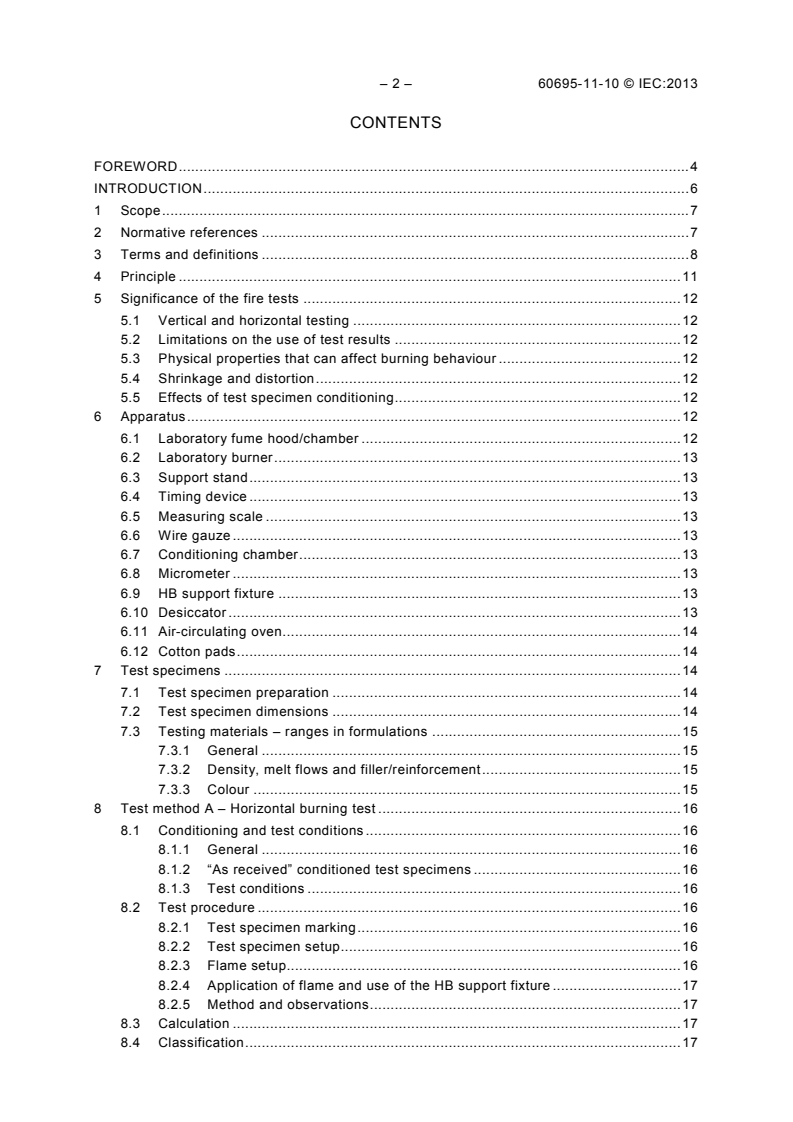
CONTENTS
FOREWORD . 4
INTRODUCTION . 6
1 Scope . 7
2 Normative references . 7
3 Terms and definitions . 8
4 Principle . 11
5 Significance of the fire tests . 12
5.1 Vertical and horizontal testing . 12
5.2 Limitations on the use of test results . 12
5.3 Physical properties that can affect burning behaviour . 12
5.4 Shrinkage and distortion . 12
5.5 Effects of test specimen conditioning . 12
6 Apparatus . 12
6.1 Laboratory fume hood/chamber . 12
6.2 Laboratory burner . 13
6.3 Support stand . 13
6.4 Timing device . 13
6.5 Measuring scale . 13
6.6 Wire gauze . 13
6.7 Conditioning chamber . 13
6.8 Micrometer . 13
6.9 HB support fixture . 13
6.10 Desiccator . 13
6.11 Air-circulating oven . 14
6.12 Cotton pads . 14
7 Test specimens . 14
7.1 Test specimen preparation . 14
7.2 Test specimen dimensions . 14
7.3 Testing materials – ranges in formulations . 15
7.3.1 General . 15
7.3.2 Density, melt flows and filler/reinforcement . 15
7.3.3 Colour . 15
8 Test method A – Horizontal burning test . 16
8.1 Conditioning and test conditions . 16
8.1.1 General . 16
8.1.2 “As received” conditioned test specimens . 16
8.1.3 Test conditions . 16
8.2 Test procedure . 16
8.2.1 Test specimen marking . 16
8.2.2 Test specimen setup . 16
8.2.3 Flame setup. 16
8.2.4 Application of flame and use of the HB support fixture . 17
8.2.5 Method and observations . 17
8.3 Calculation . 17
8.4 Classification . 17
60695-11-10 © IEC:2013 – 3 –
8.4.1 General . 17
8.4.2 HB classification . 18
8.4.3 HB40 classification . 18
8.4.4 HB75 classification . 18
8.5 Test report . 18
9 Test method B – Vertical burning test . 19
9.1 Conditioning and test conditions . 19
9.1.1 General . 19
9.1.2 “As received” conditioned test specimens . 19
9.1.3 Oven conditioned test specimens . 19
9.1.4 Conditioning of the cotton pads . 19
9.1.5 Test conditions . 19
9.2 Test procedure . 19
9.2.1 Test specimen setup . 19
9.2.2 Flame setup. 19
9.2.3 Flame application and observations . 20
9.2.4 Evaluation of “burned to the holding clamp” . 21
9.2.5 Criteria for retest . 21
9.3 Calculation of the total afterflame time, t . 21
f
9.4 Classification . 21
9.5 Test report . 22
Annex A (informative) Precision of test method A . 34
Annex B (informative) Precision of test method B . 35
Bibliography . 36
Figure 1 – Horizontal burning test apparatus . 23
Figure 2 – Flexible test specimen support fixture – method A . 24
Figure 3 – Vertical burning test apparatus – method B . 25
Figure 4 – Bar test specimen . 26
Figure 5 – Optional clearance gauge . 27
Figure 6 – Clearance gauge . 28
Figure 7 – Flame application . 29
Figure 8 – Flame application when there are molten drips . 30
Figure 9 – HB Specimen Gauge (Example) . 30
Figure 10 – V Specimen Gauge (Example) . 31
Figure 11 – Flame front position not classified as “burned to the holding clamp” . 32
Figure 12 – Flame front position classified as “burned to the holding clamp” . 33
Table 1 – Thickness tolerances . 15
Table 2 – Criteria for vertical burning classification . 21
Table A.1 – Linear burning rate . 34
Table B.1 – Afterflame time and afterflame plus afterglow times . 35
– 4 – 60695-11-10 © IEC:2013
INTERNATIONAL ELECTROTECHNICAL COMMISSION
____________
FIRE HAZARD TESTING –
Part 11-10: Test flames –
50 W horizontal and vertical flame test methods
FOREWORD
1) The International Electrotechnical Commission (IEC) is a worldwide organization for standardization comprising
all national electrotechnical committees (IEC National Committees). The object of IEC is to promote
international co-operation on all questions concerning standardization in the electrical and electronic fields. To
this end and in addition to other activities, IEC publishes International Standards, Technical Specifications,
Technical Reports, Publicly Available Specifications (PAS) and Guides (hereafter referred to as “IEC
Publication(s)”). Their preparation is entrusted to technical committees; any IEC National Committee interested
in the subject dealt with may participate in this preparatory work. International, governmental and non-
governmental organizations liaising with the IEC also participate in this preparation. IEC collaborates closely
with the International Organization for Standardization (ISO) in accordance with conditions determined by
agreement between the two organizations.
2) The formal decisions or agreements of IEC on technical matters express, as nearly as possible, an international
consensus of opinion on the relevant subjects since each technical committee has representation from all
interested IEC National Committees.
3) IEC Publications have the form of recommendations for international use and are accepted by IEC National
Committees in that sense. While all reasonable efforts are made to ensure that the technical content of IEC
Publications is accurate, IEC cannot be held responsible for the way in which they are used or for any
misinterpretation by any end user.
4) In order to promote international uniformity, IEC National Committees undertake to apply IEC Publications
transparently to the maximum extent possible in their national and regional publications. Any divergence
between any IEC Publication and the corresponding national or regional publication shall be clearly indicated in
the latter.
5) IEC itself does not provide any attestation of conformity. Independent certification bodies provide conformity
assessment services and, in some areas, access to IEC marks of conformity. IEC is not responsible for any
services carried out by independent certification bodies.
6) All users should ensure that they have the latest edition of this publication.
7) No liability shall attach to IEC or its directors, employees, servants or agents including individual experts and
members of its technical committees and IEC National Committees for any personal injury, property damage or
other damage of any nature whatsoever, whether direct or indirect, or for costs (including legal fees) and
expenses arising out of the publication, use of, or reliance upon, this IEC Publication or any other IEC
Publications.
8) Attention is drawn to the Normative references cited in this publication. Use of the referenced publications is
indispensable for the correct application of this publication.
9) Attention is drawn to the possibility that some of the elements of this IEC Publication may be the subject of
patent rights. IEC shall not be held responsible for identifying any or all such patent rights.
International Standard IEC 60695-11-10 has been prepared by IEC technical committee 89:
Fire hazard testing.
The text of this standard is based on the following documents:
FDIS Report on voting
89/1161/FDIS 89/1165/RVD
Full information on the voting for the approval of this standard can be found in the report on
voting indicated in the above table.
This publication has been drafted in accordance with the ISO/IEC Directives, Part 2.
60695-11-10 © IEC:2013 – 5 –
This second edition cancels and replaces the consolidated version of IEC 60695-11-10
published in 2003 and constitutes a technical revision.
The main changes with respect to the first edition are listed below:
– Editorial changes have been made throughout the document for the purpose of aligning
IEC 60695-11-10 with IEC 60695-11-20.
– Details on test specimen dimensions have been added to Clause 7.
– New Sublause 9.1.4 Conditioning of the cotton pad has been added.
– New Subclause 9.2.4 Evaluation of “burned to the holding clamp” has been added.
– The Bibliography has been updated and references added.
It has the status of a basic safety publication in accordance with IEC Guide 104 and
ISO/IEC Guide 51.
This International Standard is to be used in conjunction with IEC 60695-11-4.
A list of all the parts in the IEC 60695 series, under the general title Fire hazard testing, can
be found on the IEC website.
Part 11 consists of the following parts:
Part 11-2: Test flames – 1 kW nominal pre-mixed flame – Apparatus, confirmatory test
arrangement and guidance
Part 11-3: Test flames – 500 W flames – Apparatus and confirmational test methods
Part 11-4: Test flames – 50 W flame – Apparatus and confirmational test method
Part 11-5: Test flames – Needle-flame test method – Apparatus, confirmatory test
arrangement and guidance
Part 11-10: Test flames – 50 W horizontal and vertical flame test methods
Part 11-11: Test flames – Determination of the characteristic heat flux for ignition from a
non-contacting flame source
Part 11-20: Test flames – 500 W flame test methods
Part 11-30: Test flames – History and development from 1979 to 1999
Part 11-40: Test flames – Confirmatory tests – Guidance
The committee has decided that the contents of this publication will remain unchanged until
the stability date indicated on the IEC web site under "http://webstore.iec.ch" in the data
related to the specific publication. At this date, the publication will be
• reconfirmed,
• withdrawn,
• replaced by a revised edition, or
• amended.
The contents of the corrigendum of September 2014 have been included in this copy.
IMPORTANT – The 'colour inside' logo on the cover page of this publication indicates
that it contains colours which are considered to be useful for the correct
understanding of its contents. Users should therefore print this document using a
colour printer.
– 6 – 60695-11-10 © IEC:2013
INTRODUCTION
In the design of any electrotechnical product, the risk of fire and the potential hazards
associated with fire need to be considered. In this respect the objective of component, circuit,
and product design, as well as the choice of materials, is to reduce to acceptable levels the
potential risks of fire during normal operating conditions, reasonable foreseeable abnormal
use, malfunction, and/or failure. IEC Technical Committee 89 has developed IEC 60695-1-10,
together with its companion, IEC 60695-1-11, to provide guidance on how this is to be
accomplished.
The primary aims of IEC 60695-1-10 and IEC 60695-1-11 are to provide guidance on how:
a) to prevent ignition caused by an electrically energized component part, and
b) to confine any resulting fire within the bounds of the enclosure of the electrotechnical
product in the event of ignition.
Secondary aims of these documents include the minimization of any flame spread beyond the
product’s enclosure and the minimization of harmful effects of fire effluents such as heat,
smoke, toxicity and/or corrosivity.
Fires involving electrotechnical products can also be initiated from external non-electrical
sources. Considerations of this nature should be dealt with in the overall fire hazard
assessment.
This part of IEC 60695 describes the test procedures for small scale tests to be carried out on
materials used in electrotechnical equipment. A 50 W test flame is used as an ignition source.
The test methods described provide classifications which may be used for quality assurance,
the pre-selection of component materials of products, or to verify the required minimum
flammability classification of materials used in end products.
These test methods should not be used solely to describe or appraise the fire hazard or fire risk
of materials, products, or assemblies under actual fire conditions. However, results of these
test methods may be used as elements of a fire hazard assessment which takes into account
all of the factors which are pertinent to a particular end use.
This international standard may involve hazardous materials, operations, and equipment. It
does not purport to address all of the safety problems associated with its use. It is the
responsibility of the user of this international standard to establish appropriate safety and
health practices and determine the applicability of regulatory limitations prior to use.
60695-11-10 © IEC:2013 – 7 –
FIRE HAZARD TESTING –
Part 11-10: Test flames –
50 W horizontal and vertical flame test methods
1 Scope
This part of IEC 60695 specifies small-scale laboratory test procedures intended to compare
the burning behaviour of different materials used in electrotechnical products when vertically
or horizontally oriented test bar specimens are exposed to a small flame ignition source with a
nominal thermal power of 50 W. These test methods determine either the linear burning rate
or the self-extinguishing properties of materials.
These test methods are applicable to solid and cellular materials that have an apparent
density of more than 250 kg/m , determined in accordance with ISO 845.
Two test methods are described. Method A is a horizontal burning test and is intended to
determine the linear burning rate of materials under specific test conditions. Method B is a
vertical burning test and is intended to determine whether materials self-extinguish under
specific test conditions.
NOTE 1 ISO 9772 [8] describes a test method for the determination of the burning characteristics to be used for
materials with an apparent density of 250 kg/m or less. ISO 9773 describes a test method for the determination of
the burning behaviour to be used for materials that due to their thinness, either distort and/or are burned up to the
holding clamp using Method B of this standard.
The test methods described provide classifications (see 8.4 and 9.4), which may be used for
quality assurance, the pre-selection of component materials of products, or to verify the
required minimum flammability classification of materials used in end products.
NOTE 2 Guidance on pre-selection is given in IEC 60695-1-30.
This basic safety publication is intended for use by technical committees in the preparation of
standards in accordance with the principles laid down in IEC Guide 104 and
ISO/IEC Guide 51.
One of the responsibilities of a technical committee is, wherever applicable, to make use of
basic safety publications in the preparation of its publications. The requirements, test
methods or test conditions of this basic safety publication will not apply unless specifically
referred to or included in the relevant publications.
2 Normative references
The following documents, in whole or in part, are normatively referenced in this document and
are indispensable for its application. For dated references, only the edition cited applies. For
undated references, the latest edition of the referenced document (including any
amendments) applies.
IEC 60695-4, Fire hazard testing – Part 4: Terminology concerning fire tests for
electrotechnical products
___________
Figures in square brackets refer to the bibliography.
– 8 – 60695-11-10 © IEC:2013
IEC 60695-11-4, Fire hazard testing – Part 11-4: Test flames – 50 W flames – Apparatus and
confirmational test method
IEC Guide 104, The preparation of safety publications and the use of basic safety publications
and group safety publications
ISO/IEC Guide 51, Safety aspects – Guidelines for their inclusion in standards
ISO/IEC 13943:2008, Fire Safety – Vocabulary
ISO 291:2008, Plastics – Standard atmospheres for conditioning and testing
ISO 293, Plastics – Compression moulding of test specimens of thermoplastic materials
ISO 294, (all parts), Plastics – Injection moulding of test specimens of thermoplastic materials
ISO 295, Plastics – Compression moulding of test specimens of thermosetting materials
ISO 307, Plastics – Polyamides – Determination of viscosity number
ISO 9773, Plastics – Determination of burning behaviour of thin flexible vertical specimens in
contact with a small-flame ignition source
ISO 16012, Plastics – Determination of linear dimensions of test specimens
3 Terms and definitions
For the purposes of this document, the terms and definitions given in ISO/IEC 13943:2008
and IEC 60695-4, some of which are reproduced below for the user’s convenience, as well as
the following apply.
3.1
afterflame
flame that persists after the ignition source has been removed
[SOURCE: ISO/IEC 13943:2008, definition 4.6]
3.2
afterflame time
length of time for which an afterflame persists under specified test conditions
Note 1 to entry: Designated in Method B of this standard by the parameters t and t .
1 2
[SOURCE: ISO/IEC 13943:2008, definition 4.7]
3.3
afterglow
persistence of glowing combustion after both removal of the ignition source and the cessation
of any flaming combustion
[SOURCE: ISO/IEC 13943:2008, definition 4.8]
3.4
afterglow time
length of time which an afterglow persists under specified test conditions
60695-11-10 © IEC:2013 – 9 –
Note 1 to entry: Designated in Method B of this standard by the parameter t .
[SOURCE: ISO/IEC 13943:2008, definition 4.9]
3.5
“as received”
state of test specimens after a specified period of preconditioning at laboratory ambient
conditions
3.6
burn, intransitive verb
undergo combustion
[SOURCE: ISO/IEC 13943:2008, definition 4.28]
3.7
burning behaviour
〈fire tests〉 response of a test specimen, when it burns under specified conditions, to
examination of reaction to fire or fire resistance
[SOURCE: ISO/IEC 13943:2008, definition 4.32]
3.8
combustion
exothermic reaction of a substance with an oxidizing agent
Note to entry: Combustion generally emits fire effluent accompanied by flames and/or glowing.
[SOURCE: ISO/IEC 13943:2008, definition 4.46]
3.9
draught-free environment
space in which the results of experiments are not significantly affected by the local air speed
Note 1 to entry: A qualitative example is a space in which a wax candle flame remains essentially undisturbed.
–1 –1
Quantitative examples are small-scale fire tests in which a maximum air speed of 0,1 m × s or 0,2 m × s is
sometimes specified.
[SOURCE: ISO/IEC 13943:2008, definition 4.70]
3.10
enclosure
〈electrotechnical〉 external casing protecting the electrical and mechanical parts of apparatus
Note 1 to entry: The term excludes cables.
[SOURCE: ISO/IEC 13943:2008, definition 4.78]
3.11
fire hazard
physical object or condition with a potential for an undesirable consequence from fire
[SOURCE: ISO/IEC 13943:2008, definition 4.112]
3.12
fire hazard assessment
evaluation of the possible causes of fire, the possibility and nature of subsequent fire growth,
and the possible consequences of fire
– 10 – 60695-11-10 © IEC:2013
[SOURCE: IEC 60695-4, definition 3.2.10]
3.13
fire retardant
substance added, or a treatment applied, to a material in order to delay ignition or to reduce
the rate of combustion
Note 1 to entry: The use of a fire retardant does not necessarily suppress fire or terminate combustion.
[SOURCE: ISO/IEC 13943:2008, definition 4.123]
3.14
fire risk
probability of a fire combined with a quantified measure of its consequence
Note 1 to entry: It is often calculated as the product of probability and consequence.
[SOURCE: ISO/IEC 13943:2008, definition 4.124]
3.15
fire test
test that measures behaviour of a fire or exposes an item to the effects of a fire
Note 1 to entry: The results of a fire test can be used to quantify fire severity or determine the fire resistance or
reaction to fire of the test specimen.
[SOURCE: ISO/IEC 13943:2008, definition 4.132]
3.16
flame, verb
produce flame
[SOURCE: ISO/IEC 13943:2008, definition 4.134]
3.17
flame, noun
rapid, self-sustaining, sub-sonic propagation of combustion in a gaseous medium, usually with
emission of light
[SOURCE: ISO/IEC 13943:2008, definition 4.133]
3.18
flame front
boundary of flaming combustion at the surface of a material or propagating through a gaseous
mixture
[SOURCE: ISO/IEC 13943:2008, definition 4.136]
3.19
flame spread
propagation of a flame front
[SOURCE: ISO/IEC 13943:2008, definition 4.142]
___________
Proposed.
60695-11-10 © IEC:2013 – 11 –
3.20
flammability
ability of a material or product to burn with a flame under specified conditions
[SOURCE: ISO/IEC 13943:2008, definition 4.151]
3.21
ignition
DEPRECATED: sustained ignition
〈general〉 initiation of combustion
[SOURCE: ISO/IEC 13943:2008, definition 4.187]
3.22
ignition
DEPRECATED: sustained ignition
〈flaming combustion〉 initiation of sustained flame
[SOURCE: ISO/IEC 13943:2008, definition 4.188]
3.23
linear burning rate
DEPRECATED: burning rate
DEPRECATED: rate of burning
length of material burned per unit time under specified conditions
–1
Note 1 to entry: The typical units are metres per second (m × s ).
–1
Note 2 to entry: In this standard, units of millimetres per minute (mm × min ) are used.
[SOURCE: ISO/IEC 13943:2008, definition 4.214]
3.24
molten drip, noun
falling droplet of material that has been softened or liquefied by heat
Note 1 to entry: The droplets can be flaming or not flaming.
[SOURCE: ISO/IEC 13943:2008, definition 4.232]
3.25
self-extinguish, verb
DEPRECATED: self-extinguishing
cease combustion without being affected by an external agent
[SOURCE: ISO/IEC 13943:2008, definition 4.284]
4 Principle
A rectangular bar-shaped test specimen is supported horizontally or vertically by one end and
the free end is exposed to a specified test flame. The burning behaviour of the horizontally
supported bar under specific test conditions is assessed by measuring the linear burning rate.
The burning behaviour of the vertically supported bar under specific test conditions is
assessed by measuring the afterflame and afterglow times (observing whether the materials
self-extinguish), the extent of burning and the dripping of flaming particles.
– 12 – 60695-11-10 © IEC:2013
5 Significance of the fire tests
5.1 Vertical and horizontal testing
Fire tests made on a material under the conditions specified can be of considerable value
when comparing the relative burning behaviour of different materials, controlling
manufacturing processes or assessing any change in burning characteristics. The results
obtained from these fire test methods are dependent on the shape and orientation of the test
specimen, on the environment surrounding the test specimen, and on the conditions of
ignition.
The significant feature of these fire test methods is the arrangement of the test specimens in
either a horizontal or a vertical position. These testing arrangements make it possible to
distinguish between different classes of material flammability.
NOTE 1 The results obtained by the horizontal burning (HB) and vertical burning (V) methods are not equivalent.
NOTE 2 The results obtained by these methods (HB and V) are not equivalent to the 5VA and 5VB burning tests
specified in IEC 60695-11-20 [5] because the thermal power of the test flame in this method is 50 W whereas the
test flame in IEC 60695-11-20 [5] is 500 W.
5.2 Limitations on the use of test results
Results obtained in accordance with this standard shall not be used solely to describe or
appraise the fire hazard presented by a particular material under actual fire conditions.
Assessment of fire hazard also requires consideration of other such factors as fuel
contribution, intensity of burning (rate of heat release), products of combustion and
environmental factors, including the nature of the ignition source, the orientation of exposed
material and ventilation conditions.
5.3 Physical properties that can affect burning behaviour
Burning behaviour, as measured by these test methods, is affected by such factors as
density, any anisotropy of the material and the thickness of the test specimen.
5.4 Shrinkage and distortion
Certain test specimens may shrink from or be distorted by the applied flame without igniting.
In this event, additional test specimens at the same thickness will be required to obtain valid
results. If valid results at that thickness cannot be obtained, these materials at that specific
tested thickness are not suitable for evaluation by these test methods.
NOTE To be able to determine a flammability classification for thin flexible test specimens, and in cases where
more than one test specimen shrinks from the applied flame without igniting, ISO 9773 provides a suitable test
method.
5.5 Effects of test specimen conditioning
The burning behaviour of some plastic materials may change with time. It is accordingly
advisable to make tests before and after conditioning using an appropriate procedure. The
preferred oven conditioning is 168 h ± 2 h at 70 °C ± 2 °C. However, other conditioning times
and temperatures may be used by agreement between the interested parties, and, if used,
shall be noted in the test report.
6 Apparatus
6.1 Laboratory fume hood/chamber
The laboratory fume hood/chamber shall have an inside volume of at least 0,5 m . The
chamber shall permit observation of tests in progress and shall provide a draught-free
environment, whilst allowing normal thermal circulation of air past the test specimen during
60695-11-10 © IEC:2013 – 13 –
burning. The inside surfaces of the chamber shall be of a dark colour. When a light meter,
facing towards the rear of the chamber, is positioned in place of the test specimen, the
recorded light level shall be less than 20 lx. For safety and convenience, it is desirable that
this enclosure (which can be completely closed) is fitted with an extraction device, such as an
exhaust fan, to remove products of combustion which may be toxic. The extraction device, if
fitted, shall be turned off during the test and turned on immediately after the test to remove
the fire effluents. A positive closing damper may be needed.
NOTE Placing a mirror in the chamber to provide a rear view of the test specimen has been found to be useful.
6.2 Laboratory burner
The laboratory burner shall conform to IEC 60695-11-4.
6.3 Support stand
The support stand shall have clamps or the equivalent, adjustable for the positioning of the
test specimen (see Figures 1 and 3).
6.4 Timing device
The timing device shall have a resolution of 0,5 s or less.
NOTE Some laboratories have found it useful to utilize a sound activated timer as a means of counting the flame
application time.
6.5 Measuring scale
The measuring scale shall be graduated in millimetres.
6.6 Wire gauze
The wire gauze shall be 20 mesh (approximately 20 openings per 25 mm), made from steel
wire 0,40 mm to 0,45 mm in diameter and cut into approximately 125 mm squares.
6.7 Conditioning chamber
The conditioning chamber shall be maintained at 23 °C ± 2 °C and a relative humidity of
50 % ± 10 %.
NOTE Standard atmospheres for the conditioning and testing of plastic materials are described in ISO 291:2008.
6.8 Micrometer
The micrometer shall have a resolution of
a) 0,01 mm or less for test specimens with a thickness of 0,25 mm or greater, and
b) 0,001 mm or less for test specimens with a thickness less than 0,250 mm.
6.9 HB support fixture
The HB support fixture shall be used for testing specimens that are not self-supporting (see
Figure 2).
6.10 Desiccator
The desiccator shall contain anhydrous calcium chloride or other drying agent, which can be
maintained at 23 °C ± 2 °C and a relative humidity not exceeding 20 %.
– 14 – 60695-11-10 © IEC:2013
6.11 Air-circulating oven
The air-circulating oven shall provide a conditioning temperature of 70 °C ± 2 °C, unless
otherwise stated in the relevant specification, whilst providing not less than five air changes
per hour.
6.12 Cotton pads
The pads shall be made of absorbent cotton designated “100 % cotton” or “pure cotton”.
NOTE This is also referred to as “cotton wool”.
7 Test specimens
7.1 Test specimen preparation
Test specimens shall be fabricated by the appropriate ISO method, e.g. casting and injection
moulding in accordance with ISO 294, compression moulding in accordance with ISO 293 or
ISO 295, or transfer moulding to the necessary shape. Where this is not possible, the test
specimen shall be produced using the same fabrication process as would be normally used to
mould a part of a product; and where this is not possible, specimens are to be cut from a
representative sample of the moulded material taken from an end product.
NOTE If it is not possible to prepare test specimens by any of the methods outlined above, alternative fire test
methods may be used (such as IEC 60695-11-5).
After any cutting operation, care shall be taken to remove all dust and any particles from the
surface; cut edges shall be fine sanded to a smooth finish.
7.2 Test specimen dimensions
Bar test specimens shall measure 125 mm ± 5 mm long by 13,0 mm ± 0,5 mm wide, and shall
be provided in at least the minimum and maximum thickness for which the flame classification
is under consideration (see Figure 4). The preferred thickness values include 0,1 mm,
0,2 mm, 0,4 mm, 0,75 mm, 1,5 mm, 3,0 mm, 6,0 mm, and/or 12,0 mm.
NOTE 1 The gauges found in Figures 9 and 10 have been found useful for confirming proper specimen
dimensions
The thickness shall not exceed 13,0 mm. In addition, other thicknesses may be used by
agreement between the interested parties and, if so, shall be noted in the test report. Edges
shall be smooth, and the radius on the corners shall not exceed 1,3 mm.
A minimum of 6 bar test specimens for Method A and 20 test specimens for Method B shall be
prepared.
Thickness measurements shall be made using the measuring scale at the centre and at both
ends of the test specimen using a micrometer. The arithmetic mean of the three measured
values is taken as the value of the thickness of the test specimen.
For rigid specimens, thickness measurements shall be performed in accordance with
ISO 16012 as follows. Using a ratchet micrometer, close the micrometer at such a rate that
the change in reading on the scale or digital display can be easily followed. Continue the
closing motion until the ratchet clicks three times, the friction thimble slips, or the two contact
surfaces can be felt to be in full contact with the test specimen. Record the indicated reading.
For flexible, non-rigid, or elastic test specimens, a dial gauge micrometer may be used. The
closing motion shall be stopped when the pressure foot just contacts the test specimen.
60695-11-10 © IEC:2013 – 15 –
NOTE 2 Other measuring devices equivalent to a micrometer may be used to measure thickness if found to be
satisfactory.
In order for test specimens to accurately represent a nominal thickness, each measurement
and the overall average shall meet the tolerances given in Table 1.
Table 1 – Thickness tolerances
Thickness Tolerance
mm mm
< 0,02 ± 10 %
0,02 to < 0,05 ± 0,005
0,05 to < 0,1 ± 0,010
0,1 to < 0,2 ± 0,020
0,2 to < 0,3 ± 0,030
0,3 to < 0,5 ± 0,04
0,5 to < 0,6 ± 0,05
0,6 to < 3,0 ± 0,15
3,0 to < 6,0 ± 0,25
6,0 to < 13,0 ± 0,40
NOTE 3 For example, to represent a thickness of 1,5 mm, all tested specimens should measure between 1,35 mm
and 1,65 mm.
7.3 Testing materials – ranges in formulations
7.3.1 General
The results of tests carried out on test specimens of different colour, thickness, density,
molecular ma
...