


IEC TR 63424-1:2024
(Main)Validation of dynamic power control and exposure time-averaging algorithms - Part 1: Cellular network implementations for SAR at frequencies up to 6 GHz
Validation of dynamic power control and exposure time-averaging algorithms - Part 1: Cellular network implementations for SAR at frequencies up to 6 GHz
IEC TR 63424-1:2024 describes the methods for validating dynamic power control and (dynamic) exposure time-averaging (DPC-ETA) algorithms used in RF modem chipsets of wireless devices. The DPC-ETA implementations are exposure-based, where SAR is time-averaged according to power recorded by the RF modem. Time-averaging windows up to six minutes consistent with applicable SAR limits and regulatory policies are considered for frequencies up to 6 GHz. The DPC-ETA power control parameters are established based on SAR compliance results with all relevant design and operating tolerances taken into consideration. The device output power is controlled by DPC-ETA to maintain SAR compliance in real-time. While SAR compliance is evaluated independently by applying IEC/IEEE 62209-1528:2020 [1] , this document contains information for algorithm validation.
Quasi-static and dynamic power control test sequences are described in this document for algorithm validation. The test sequences are sent from a radio communication tester (RCT) and DPC-ETA responses are measured with conducted and radiated power measurement methods to confirm algorithm functionality. Test sequences for wireless configurations that need validation, including wireless mode transitions, call drop, handover, discontinuous transmission, and simultaneous transmission are described. Considerations for measurement automation to acquire time-aligned results for correlation with power changes in the test sequences are provided. DPC-ETA algorithms are validated by correlating the normalized power measurement results with the expected behaviours of an implementation for the applied test sequences. The procedures in this document also support algorithm validation of modular transmitters using an appropriate test platform. Guidance for using SAR methods in place of radiated power measurements and capacitive proximity sensor triggering with time-averaged detection are also included.
NOTE 1 A separate document will be considered to validate DPC-ETA implementations above 6 GHz, according to near-field millimetre-wave band power density exposure requirements. Substantially shorter time-averaging window durations, on the order of a few seconds, can be required to satisfy some national regulatory requirements.
NOTE 2 The scope of this document is limited to cellular network technologies that have RF modem transmission power dictated by a base station and therefore can be tested using RCT test sequences. Cellular network technologies (also referred to as wireless wide area networks (WWAN)) include Global System for Mobile Communications (GSM), Universal Mobile Telecommunication System (UMTS), Long-Term Evolution (LTE) and 5G New Radio (NR), including other related 2G, 3G, 4G, and 5G specifications, respectively. A separate document will be considered for validating DPC-ETA implementations for wireless local area network (WLAN) technologies, such as those based on the IEEE 802.11 standards series. With WLAN technologies, the transmit power is dictated independently by the RF modem and can be specific to each power control implementation, requiring different testing approaches.
NOTE 3 The procedures in this document can also be considered for 3GPP [2] 5G NR FR1 bands above 6 GHz.
NOTE 4 This document does not address algorithm validation for simultaneous transmission configurations involving transmitters that are not controlled by DPC-ETA operations in the RF modem. These are evaluated according to regulatory requirements.
General Information
- Status
- Published
- Publication Date
- 10-Dec-2024
- Technical Committee
- TC 106 - Methods for the assessment of electric, magnetic and electromagnetic fields associated with human exposure
- Drafting Committee
- JWG 13 - TC 106/JWG 13
- Current Stage
- PPUB - Publication issued
- Start Date
- 11-Dec-2024
- Completion Date
- 20-Dec-2024
Overview
IEC TR 63424-1:2024 provides methods to validate dynamic power control and exposure time‑averaging (DPC‑ETA) algorithms implemented in RF modem chipsets of wireless devices. The technical report focuses on cellular network implementations (GSM, UMTS, LTE, 5G NR and related WWANs) for SAR (specific absorption rate) compliance at frequencies up to 6 GHz. It specifies test sequences, measurement methods (conducted and radiated), and correlation procedures to confirm that DPC‑ETA maintains SAR compliance in real time. Time‑averaging windows up to six minutes and relevant design/operating tolerances are considered.
Key topics and technical requirements
- Scope and applicability
- Cellular (WWAN) technologies where transmit power is base‑station dictated and testable via a Radio Communication Tester (RCT).
- Excludes WLAN (IEEE 802.11) implementations and DPC‑ETA above 6 GHz (separate documents planned).
- Algorithm operation and parameters
- Description of DPC‑ETA algorithm behavior, configurable parameters and expected responses.
- Power control parameters derived from SAR compliance results using tolerances.
- Validation test methods
- Quasi‑static and dynamic power control test sequences sent from an RCT.
- Conducted and radiated power measurements with guidance for automation and time alignment.
- Test sequences covering mode transitions, call drop, handover, discontinuous transmission, simultaneous transmission and transmit diversity.
- Measurement and analysis
- Measurement rate, normalization of measured power, and correlation of normalized power with expected algorithm behavior.
- Considerations for modular transmitters, measurement system verification, and tolerance handling.
- Additional guidance
- Use of SAR methods in place of radiated power measurements and time‑averaged proximity sensors (TA‑PS) considerations.
- Acceptance criteria, observation points, and reporting requirements for validation results.
Practical applications and who uses this standard
IEC TR 63424-1:2024 is intended for:
- RF chipset and modem manufacturers validating DPC‑ETA implementations.
- Handset and device OEMs integrating RF modems and managing SAR compliance.
- Test laboratories and certification bodies performing algorithm validation, conducted and radiated power testing.
- Regulatory and compliance engineers interpreting time‑averaging windows and fail‑safe behaviors. Practical uses include establishing DPC‑ETA parameters to ensure real‑time SAR compliance, designing automated test sequences with an RCT, and validating modular transmitter platforms.
Related standards
- IEC/IEEE 62209‑1528:2020 - referenced for independent SAR compliance evaluation.
- 3GPP specifications (for 5G NR FR1 band considerations) and future IEC TR guidance for >6 GHz implementations.
Keywords: IEC TR 63424-1, DPC‑ETA, dynamic power control, exposure time‑averaging, SAR validation, 6 GHz, RF modem testing, radiated power, conducted power, RCT, 5G NR, LTE.
Frequently Asked Questions
IEC TR 63424-1:2024 is a technical report published by the International Electrotechnical Commission (IEC). Its full title is "Validation of dynamic power control and exposure time-averaging algorithms - Part 1: Cellular network implementations for SAR at frequencies up to 6 GHz". This standard covers: IEC TR 63424-1:2024 describes the methods for validating dynamic power control and (dynamic) exposure time-averaging (DPC-ETA) algorithms used in RF modem chipsets of wireless devices. The DPC-ETA implementations are exposure-based, where SAR is time-averaged according to power recorded by the RF modem. Time-averaging windows up to six minutes consistent with applicable SAR limits and regulatory policies are considered for frequencies up to 6 GHz. The DPC-ETA power control parameters are established based on SAR compliance results with all relevant design and operating tolerances taken into consideration. The device output power is controlled by DPC-ETA to maintain SAR compliance in real-time. While SAR compliance is evaluated independently by applying IEC/IEEE 62209-1528:2020 [1] , this document contains information for algorithm validation. Quasi-static and dynamic power control test sequences are described in this document for algorithm validation. The test sequences are sent from a radio communication tester (RCT) and DPC-ETA responses are measured with conducted and radiated power measurement methods to confirm algorithm functionality. Test sequences for wireless configurations that need validation, including wireless mode transitions, call drop, handover, discontinuous transmission, and simultaneous transmission are described. Considerations for measurement automation to acquire time-aligned results for correlation with power changes in the test sequences are provided. DPC-ETA algorithms are validated by correlating the normalized power measurement results with the expected behaviours of an implementation for the applied test sequences. The procedures in this document also support algorithm validation of modular transmitters using an appropriate test platform. Guidance for using SAR methods in place of radiated power measurements and capacitive proximity sensor triggering with time-averaged detection are also included. NOTE 1 A separate document will be considered to validate DPC-ETA implementations above 6 GHz, according to near-field millimetre-wave band power density exposure requirements. Substantially shorter time-averaging window durations, on the order of a few seconds, can be required to satisfy some national regulatory requirements. NOTE 2 The scope of this document is limited to cellular network technologies that have RF modem transmission power dictated by a base station and therefore can be tested using RCT test sequences. Cellular network technologies (also referred to as wireless wide area networks (WWAN)) include Global System for Mobile Communications (GSM), Universal Mobile Telecommunication System (UMTS), Long-Term Evolution (LTE) and 5G New Radio (NR), including other related 2G, 3G, 4G, and 5G specifications, respectively. A separate document will be considered for validating DPC-ETA implementations for wireless local area network (WLAN) technologies, such as those based on the IEEE 802.11 standards series. With WLAN technologies, the transmit power is dictated independently by the RF modem and can be specific to each power control implementation, requiring different testing approaches. NOTE 3 The procedures in this document can also be considered for 3GPP [2] 5G NR FR1 bands above 6 GHz. NOTE 4 This document does not address algorithm validation for simultaneous transmission configurations involving transmitters that are not controlled by DPC-ETA operations in the RF modem. These are evaluated according to regulatory requirements.
IEC TR 63424-1:2024 describes the methods for validating dynamic power control and (dynamic) exposure time-averaging (DPC-ETA) algorithms used in RF modem chipsets of wireless devices. The DPC-ETA implementations are exposure-based, where SAR is time-averaged according to power recorded by the RF modem. Time-averaging windows up to six minutes consistent with applicable SAR limits and regulatory policies are considered for frequencies up to 6 GHz. The DPC-ETA power control parameters are established based on SAR compliance results with all relevant design and operating tolerances taken into consideration. The device output power is controlled by DPC-ETA to maintain SAR compliance in real-time. While SAR compliance is evaluated independently by applying IEC/IEEE 62209-1528:2020 [1] , this document contains information for algorithm validation. Quasi-static and dynamic power control test sequences are described in this document for algorithm validation. The test sequences are sent from a radio communication tester (RCT) and DPC-ETA responses are measured with conducted and radiated power measurement methods to confirm algorithm functionality. Test sequences for wireless configurations that need validation, including wireless mode transitions, call drop, handover, discontinuous transmission, and simultaneous transmission are described. Considerations for measurement automation to acquire time-aligned results for correlation with power changes in the test sequences are provided. DPC-ETA algorithms are validated by correlating the normalized power measurement results with the expected behaviours of an implementation for the applied test sequences. The procedures in this document also support algorithm validation of modular transmitters using an appropriate test platform. Guidance for using SAR methods in place of radiated power measurements and capacitive proximity sensor triggering with time-averaged detection are also included. NOTE 1 A separate document will be considered to validate DPC-ETA implementations above 6 GHz, according to near-field millimetre-wave band power density exposure requirements. Substantially shorter time-averaging window durations, on the order of a few seconds, can be required to satisfy some national regulatory requirements. NOTE 2 The scope of this document is limited to cellular network technologies that have RF modem transmission power dictated by a base station and therefore can be tested using RCT test sequences. Cellular network technologies (also referred to as wireless wide area networks (WWAN)) include Global System for Mobile Communications (GSM), Universal Mobile Telecommunication System (UMTS), Long-Term Evolution (LTE) and 5G New Radio (NR), including other related 2G, 3G, 4G, and 5G specifications, respectively. A separate document will be considered for validating DPC-ETA implementations for wireless local area network (WLAN) technologies, such as those based on the IEEE 802.11 standards series. With WLAN technologies, the transmit power is dictated independently by the RF modem and can be specific to each power control implementation, requiring different testing approaches. NOTE 3 The procedures in this document can also be considered for 3GPP [2] 5G NR FR1 bands above 6 GHz. NOTE 4 This document does not address algorithm validation for simultaneous transmission configurations involving transmitters that are not controlled by DPC-ETA operations in the RF modem. These are evaluated according to regulatory requirements.
IEC TR 63424-1:2024 is classified under the following ICS (International Classification for Standards) categories: 13.280 - Radiation protection; 17.240 - Radiation measurements. The ICS classification helps identify the subject area and facilitates finding related standards.
You can purchase IEC TR 63424-1:2024 directly from iTeh Standards. The document is available in PDF format and is delivered instantly after payment. Add the standard to your cart and complete the secure checkout process. iTeh Standards is an authorized distributor of IEC standards.
Standards Content (Sample)
IEC TR 63424-1 ®
Edition 1.0 2024-12
TECHNICAL
REPORT
colour
inside
Validation of dynamic power control and exposure time-averaging algorithms –
Part 1: Cellular network implementations for SAR at frequencies up to 6 GHz
All rights reserved. Unless otherwise specified, no part of this publication may be reproduced or utilized in any form
or by any means, electronic or mechanical, including photocopying and microfilm, without permission in writing from
either IEC or IEC's member National Committee in the country of the requester. If you have any questions about IEC
copyright or have an enquiry about obtaining additional rights to this publication, please contact the address below or
your local IEC member National Committee for further information.
IEC Secretariat Tel.: +41 22 919 02 11
3, rue de Varembé info@iec.ch
CH-1211 Geneva 20 www.iec.ch
Switzerland
About the IEC
The International Electrotechnical Commission (IEC) is the leading global organization that prepares and publishes
International Standards for all electrical, electronic and related technologies.
About IEC publications
The technical content of IEC publications is kept under constant review by the IEC. Please make sure that you have the
latest edition, a corrigendum or an amendment might have been published.
IEC publications search - webstore.iec.ch/advsearchform IEC Products & Services Portal - products.iec.ch
The advanced search enables to find IEC publications by a Discover our powerful search engine and read freely all the
variety of criteria (reference number, text, technical publications previews, graphical symbols and the glossary.
committee, …). It also gives information on projects, replaced With a subscription you will always have access to up to date
and withdrawn publications. content tailored to your needs.
IEC Just Published - webstore.iec.ch/justpublished
Electropedia - www.electropedia.org
Stay up to date on all new IEC publications. Just Published
The world's leading online dictionary on electrotechnology,
details all new publications released. Available online and once
containing more than 22 500 terminological entries in English
a month by email.
and French, with equivalent terms in 25 additional languages.
Also known as the International Electrotechnical Vocabulary
IEC Customer Service Centre - webstore.iec.ch/csc
(IEV) online.
If you wish to give us your feedback on this publication or need
further assistance, please contact the Customer Service
Centre: sales@iec.ch.
IEC TR 63424-1 ®
Edition 1.0 2024-12
TECHNICAL
REPORT
colour
inside
Validation of dynamic power control and exposure time-averaging algorithms –
Part 1: Cellular network implementations for SAR at frequencies up to 6 GHz
INTERNATIONAL
ELECTROTECHNICAL
COMMISSION
ICS 13.280; 17.240 ISBN 978-2-8327-0056-3
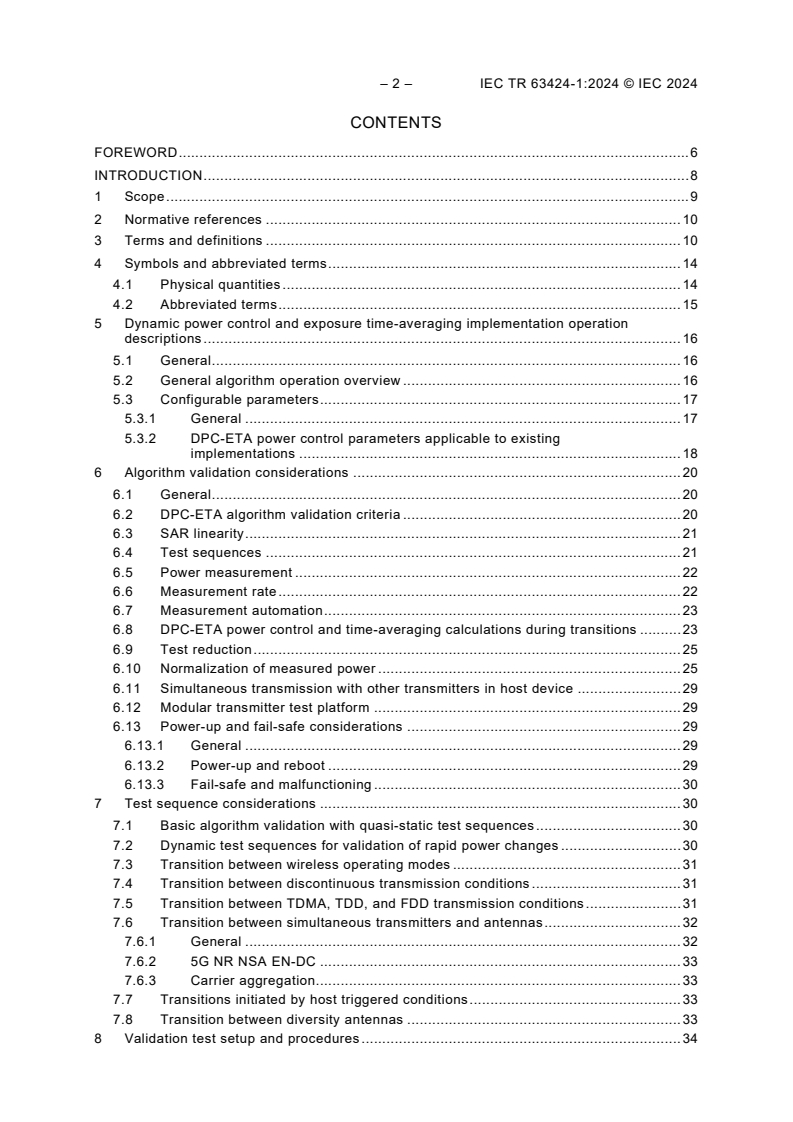
– 2 – IEC TR 63424-1:2024 © IEC 2024
CONTENTS
FOREWORD . 6
INTRODUCTION . 8
1 Scope . 9
2 Normative references . 10
3 Terms and definitions . 10
4 Symbols and abbreviated terms . 14
4.1 Physical quantities . 14
4.2 Abbreviated terms . 15
5 Dynamic power control and exposure time-averaging implementation operation
descriptions . 16
5.1 General . 16
5.2 General algorithm operation overview . 16
5.3 Configurable parameters . 17
5.3.1 General . 17
5.3.2 DPC-ETA power control parameters applicable to existing
implementations . 18
6 Algorithm validation considerations . 20
6.1 General . 20
6.2 DPC-ETA algorithm validation criteria . 20
6.3 SAR linearity . 21
6.4 Test sequences . 21
6.5 Power measurement . 22
6.6 Measurement rate . 22
6.7 Measurement automation . 23
6.8 DPC-ETA power control and time-averaging calculations during transitions . 23
6.9 Test reduction . 25
6.10 Normalization of measured power . 25
6.11 Simultaneous transmission with other transmitters in host device . 29
6.12 Modular transmitter test platform . 29
6.13 Power-up and fail-safe considerations . 29
6.13.1 General . 29
6.13.2 Power-up and reboot . 29
6.13.3 Fail-safe and malfunctioning . 30
7 Test sequence considerations . 30
7.1 Basic algorithm validation with quasi-static test sequences . 30
7.2 Dynamic test sequences for validation of rapid power changes . 30
7.3 Transition between wireless operating modes . 31
7.4 Transition between discontinuous transmission conditions . 31
7.5 Transition between TDMA, TDD, and FDD transmission conditions . 31
7.6 Transition between simultaneous transmitters and antennas . 32
7.6.1 General . 32
7.6.2 5G NR NSA EN-DC . 33
7.6.3 Carrier aggregation . 33
7.7 Transitions initiated by host triggered conditions . 33
7.8 Transition between diversity antennas . 33
8 Validation test setup and procedures . 34
8.1 General . 34
8.2 Conducted power measurement . 34
8.3 Radiated power measurement . 34
9 Post-processing and correlation of measurement results . 35
10 Validation and measurement tolerance considerations . 36
11 Acceptance criteria and algorithm validation requirements . 36
11.1 General . 36
11.2 Acceptance criteria . 37
11.3 Observation points . 38
12 Reporting of validation results . 39
Annex A (informative) Test sequence consideration details . 40
A.1 General . 40
A.2 General test sequence configuration and measurement considerations . 40
A.2.1 General . 40
A.2.2 Quasi-static and dynamic test sequences . 41
A.2.3 Power control parameters . 41
A.2.4 Power control segments . 41
A.2.5 Test sequence and measurement coordination . 42
A.2.6 Wireless mode test considerations . 43
A.2.7 Test sequence considerations . 44
A.2.8 TDD and TDMA measurement considerations . 44
A.2.9 Normalization of results . 44
A.2.10 Measurement automation . 45
A.3 Basic algorithm validation . 46
A.3.1 General . 46
A.3.2 Standalone wireless mode quasi-static test sequence. 46
A.3.3 User observations . 47
A.4 Dynamic and random power control test sequences, discontinuous
transmissions . 48
A.4.1 General . 48
A.4.2 Test sequence considerations . 48
A.4.3 Power measurement considerations . 49
A.4.4 Dynamic test sequence . 49
A.5 Transition between wireless operating modes and call drop conditions . 51
A.5.1 General . 51
A.5.2 Test sequence considerations . 51
A.5.3 Test sequence configuration . 52
A.6 GSM/GPRS configurations – duty factor, call drop, discontinuous
transmission, transition between GSM and UMTS . 54
A.6.1 General . 54
A.6.2 Test sequence considerations and configuration . 55
A.6.3 Power measurement considerations . 55
A.7 Simultaneous transmission and RAT specific considerations . 56
A.7.1 General . 56
A.7.2 Aggregate power requirements . 57
A.7.3 Power measurement and automation considerations . 57
A.7.4 Test sequence considerations . 58
A.8 Host device based external triggering transitions . 59
A.8.1 General . 59
– 4 – IEC TR 63424-1:2024 © IEC 2024
A.8.2 DPC-ETA algorithm validation considerations . 59
A.9 Transmit diversity and simultaneous transmission antenna configurations . 60
A.9.1 Diversity antennas . 60
A.9.2 Simultaneous transmission . 60
A.10 Illustrative example . 61
A.10.1 General . 61
A.10.2 DPC-ETA power control and operating parameters . 61
A.10.3 Correlating measured responses with expected DPC-ETA behaviour . 62
Annex B (informative) Power measurement test setup considerations . 71
B.1 General measurement considerations . 71
B.2 Single technology test setup . 72
B.3 Multiple or mixed technology test setup . 72
B.4 Simultaneous transmission . 73
B.5 Automation considerations . 73
B.6 Equipment settings and calibration considerations . 74
B.7 Measurement system verification . 74
B.8 Conducted power measurement setup options . 75
B.9 Radiated power measurement setup options . 78
B.9.1 General . 78
B.9.2 Anechoic chamber considerations. 79
Annex C (informative) Measurement system verification and tolerance considerations . 80
C.1 General . 80
C.2 Measurement system verification procedures . 80
C.3 Power measurement normalization tolerance . 81
Annex D (informative) Correlation between single-point SAR and radiated power
measurements . 82
D.1 Background . 82
D.2 Test results showing equivalency . 82
Annex E (informative) Time-averaged proximity sensors (TA-PS) . 85
E.1 Overview . 85
E.1.1 Background . 85
E.1.2 Various combinations of proximity sensors and time-averaging. 85
E.2 Scope and purpose of this annex . 87
E.3 Minimum implementation requirements . 87
E.3.1 General . 87
E.3.2 Threshold time criterion . 88
E.4 Specific test sequence and measurement considerations . 89
E.5 Quasi-static test sequence (TA-PS) . 89
E.5.1 General . 89
E.5.2 Example . 90
E.6 Dynamic test sequence (TA-PS) . 91
E.7 Transitions, transmit diversity and simultaneous transmission considerations . 93
Annex F (informative) Algorithm validation using SAR measurement . 94
F.1 General measurement considerations . 94
F.2 SAR measurement approaches . 95
F.2.1 General . 95
F.2.2 Single-point SAR method . 95
F.2.3 Multiple single-point SAR method . 96
F.2.4 Full-SAR measurement methods. 96
F.3 Testing procedures . 97
F.4 Additional considerations not applicable to Annex A . 98
F.4.1 Other time-averaging or DPC-ETA implementations. 98
F.4.2 Time-averaged proximity sensors . 98
F.4.3 SAR methods without access to manufacturer or test tools . 98
Bibliography . 99
Figure 1 – Illustration of the output power characteristics of a simple DPC-ETA
implementation . 19
Figure A.1 – Plot of simulated power control of quasi-static test sequence and
segments A through D . 67
Figure A.2 – Results of Figure A.1 normalized relative to SAR (not scaled by
target
SAR ) . 68
target,norm
Figure A.3 – Results of Figure A.1 normalized with respect to SAR limit . 69
Figure A.4 – Plot of normalized ratios relative to SAR and SAR limit of Figure A.2
target
and Figure A.3, respectively . 70
Figure B.1 – Typical single RAT power measurement configuration with optional band
pass filter for directional coupler cross-coupling isolation . 76
Figure B.2 – Typical single RAT power measurement configuration with separate RF
ports on the RCT for uplink-downlink isolation to reduce directional coupler cross-
coupling . 76
Figure B.3 – Typical multiple RAT or frequency band power measurement configuration
with separate RF ports on the RCT and antenna ports on DUT for independent power
measurements . 77
Figure B.4 – Typical radiated power measurement configuration for RAT with optional
conducted power connection for a second or additional RAT . 78
Figure D.1 – Normalization ratio and time-averaged normalization ratio results of
measured radiated power and single-point SAR . 84
Figure E.1 – Proximity sensor implementations versus DPC-ETA . 86
Figure E.2 – Proximity sensor implementations versus SAR and RF power . 86
Figure E.3 – Minimum implementation requirements overview . 88
Figure E.4 – Rationale behind T criterion . 89
thresh
Figure E.5 – Example of implementation response to quasi-static test sequence . 91
Table A.1 – Standalone wireless mode quasi-static test sequence . 46
Table A.2 – Power request time intervals calculated as a function of Tw and limited
avg
to 3 s (Min) to 25 s (Max) . 49
Table A.3 – Dynamic test sequence . 50
Table A.4 – Example test sequence for handover and call drop . 54
Table A.5 – Example test sequence for GSM/GPRS and transitional operations . 56
Table A.6 – Power control and operating parameters used in the illustrative example . 62
Table A.7 – Power request of test sequence from RCT (specified) and expected
steady-state power of DUT (measured) . 64
Table A.8 – First and last instance of power levels in each step of test sequence or
segments . 65
Table A.9 – Highest normalized ratio with respect to SAR and SAR . 66
target,norm target
Table E.1 – Quasi-static test sequence (TA-PS) . 90
Table E.2 – Dynamic test sequence (TA-PS) . 93
– 6 – IEC TR 63424-1:2024 © IEC 2024
INTERNATIONAL ELECTROTECHNICAL COMMISSION
____________
VALIDATION OF DYNAMIC POWER CONTROL
AND EXPOSURE TIME-AVERAGING ALGORITHMS –
Part 1: Cellular network implementations
for SAR at frequencies up to 6 GHz
FOREWORD
1) The International Electrotechnical Commission (IEC) is a worldwide organization for standardization comprising
all national electrotechnical committees (IEC National Committees). The object of IEC is to promote international
co-operation on all questions concerning standardization in the electrical and electronic fields. To this end and
in addition to other activities, IEC publishes International Standards, Technical Specifications, Technical Reports,
Publicly Available Specifications (PAS) and Guides (hereafter referred to as "IEC Publication(s)"). Their
preparation is entrusted to technical committees; any IEC National Committee interested in the subject dealt with
may participate in this preparatory work. International, governmental and non-governmental organizations liaising
with the IEC also participate in this preparation. IEC collaborates closely with the International Organization for
Standardization (ISO) in accordance with conditions determined by agreement between the two organizations.
2) The formal decisions or agreements of IEC on technical matters express, as nearly as possible, an international
consensus of opinion on the relevant subjects since each technical committee has representation from all
interested IEC National Committees.
3) IEC Publications have the form of recommendations for international use and are accepted by IEC National
Committees in that sense. While all reasonable efforts are made to ensure that the technical content of IEC
Publications is accurate, IEC cannot be held responsible for the way in which they are used or for any
misinterpretation by any end user.
4) In order to promote international uniformity, IEC National Committees undertake to apply IEC Publications
transparently to the maximum extent possible in their national and regional publications. Any divergence between
any IEC Publication and the corresponding national or regional publication shall be clearly indicated in the latter.
5) IEC itself does not provide any attestation of conformity. Independent certification bodies provide conformity
assessment services and, in some areas, access to IEC marks of conformity. IEC is not responsible for any
services carried out by independent certification bodies.
6) All users should ensure that they have the latest edition of this publication.
7) No liability shall attach to IEC or its directors, employees, servants or agents including individual experts and
members of its technical committees and IEC National Committees for any personal injury, property damage or
other damage of any nature whatsoever, whether direct or indirect, or for costs (including legal fees) and
expenses arising out of the publication, use of, or reliance upon, this IEC Publication or any other IEC
Publications.
8) Attention is drawn to the Normative references cited in this publication. Use of the referenced publications is
indispensable for the correct application of this publication.
9) IEC draws attention to the possibility that the implementation of this document may involve the use of (a)
patent(s). IEC takes no position concerning the evidence, validity or applicability of any claimed patent rights in
respect thereof. As of the date of publication of this document, IEC had not received notice of (a) patent(s), which
may be required to implement this document. However, implementers are cautioned that this may not represent
the latest information, which may be obtained from the patent database available at https://patents.iec.ch. IEC
shall not be held responsible for identifying any or all such patent rights.
IEC TR 63424-1 has been prepared by IEC technical committee 106: Methods for the
assessment of electric, magnetic and electromagnetic fields associated with human exposure.
It is a Technical Report.
The text of this Technical Report is based on the following documents:
Draft Report on voting
106/658/DTR 106/673/RVDTR
Full information on the voting for its approval can be found in the report on voting indicated in
the above table.
The language used for the development of this Technical Report is English.
This document was drafted in accordance with ISO/IEC Directives, Part 2, and developed in
accordance with ISO/IEC Directives, Part 1 and ISO/IEC Directives, IEC Supplement, available
at www.iec.ch/members_experts/refdocs. The main document types developed by IEC are
described in greater detail at www.iec.ch/publications.
A list of all parts in the IEC 63424 series, published under the general title Validation of dynamic
power control and exposure time-averaging algorithms, can be found on the IEC website.
The committee has decided that the contents of this document will remain unchanged until the
stability date indicated on the IEC website under webstore.iec.ch in the data related to the
specific document. At this date, the document will be
• reconfirmed,
• withdrawn, or
• revised.
IMPORTANT – The "colour inside" logo on the cover page of this document indicates
that it contains colours which are considered to be useful for the correct understanding
of its contents. Users should therefore print this document using a colour printer.
– 8 – IEC TR 63424-1:2024 © IEC 2024
INTRODUCTION
The concept of dynamic power control and exposure time-averaging (DPC-ETA) has been
introduced recently to enable wireless devices to maintain SAR compliance in real-time.
DPC-ETA enables a SAR assessment that is more representative of the user exposure. The
procedures in IEC/IEEE 62209-1528:2020 require device under test (DUT) to maintain a fixed
output power and transmission duty factor during SAR measurement to establish the correct
SAR distribution to determine SAR compliance. When devices are tested at a fixed maximum
output power and transmission duty factor for worst-case exposure and continuous use, a
reduction in maximum power is often necessary to satisfy SAR compliance. This can result in
undesirable device performance with poor link budget and low data throughput.
In DPC-ETA, SAR compliance is determined according to power recorded by the RF modem
and time-averaged over a specified window duration. Device output power control is based on
the linear SAR to power relationship established for a wireless operating mode and specific
exposure condition to maintain SAR compliance during actual use. When the maximum time-
averaged power is ensured by DPC-ETA, brief durations of higher instantaneous power can be
applied while the maximum time-averaged power is not exceeded.
NOTE 1 The time-averaging windows required by national regulations can be the same as those established for
SAR limits or can differ and vary with frequency.
The DPC-ETA algorithms are validated using power control test sequences with conducted and
radiated power measurement methods described in Annex A and Annex B. The criteria for
correlating power measurement results with expected DPC-ETA behaviour of the test
sequences are also described. The measurement system validation and system check
considerations are discussed in Annex C. The correlation of radiated power and single-point
SAR measurement is illustrated in Annex D. The SAR methods that can be applied instead of
radiated power measurement are described in Annex F. Guidance for validation of capacitive
proximity sensor triggering with time-averaged detection are provided in Annex E.
NOTE 2 For the purposes of this document, test laboratories and users are referred to as user(s). This document
provides recent information for users to address specific testing needs. It is possible that it is not able to provide
solutions to all issues that are being identified or explored. The improvements realized from experiences in applying
this document for DPC-ETA algorithm validation, including any adjustments needed to validate devices or
comprehensive uncertainty analyses, that need further considerations, can be addressed in a subsequent revision
of this document.
VALIDATION OF DYNAMIC POWER CONTROL
AND EXPOSURE TIME-AVERAGING ALGORITHMS –
Part 1: Cellular network implementations
for SAR at frequencies up to 6 GHz
1 Scope
This part of IEC 63424 describes the methods for validating dynamic power control and
(dynamic) exposure time-averaging (DPC-ETA) algorithms used in RF modem chipsets of
wireless devices. The DPC-ETA implementations are exposure-based, where SAR is time-
averaged according to power recorded by the RF modem. Time-averaging windows up to six
minutes consistent with applicable SAR limits and regulatory policies are considered for
frequencies up to 6 GHz. The DPC-ETA power control parameters are established based on
SAR compliance results with all relevant design and operating tolerances taken into
consideration. The device output power is controlled by DPC-ETA to maintain SAR compliance
in real-time. While SAR compliance is evaluated independently by applying IEC/IEEE 62209-
1528:2020 [1] , this document contains information for algorithm validation.
Quasi-static and dynamic power control test sequences are described in this document for
algorithm validation. The test sequences are sent from a radio communication tester (RCT) and
DPC-ETA responses are measured with conducted and radiated power measurement methods
to confirm algorithm functionality. Test sequences for wireless configurations that need
validation, including wireless mode transitions, call drop, handover, discontinuous transmission,
and simultaneous transmission are described. Considerations for measurement automation to
acquire time-aligned results for correlation with power changes in the test sequences are
provided. DPC-ETA algorithms are validated by correlating the normalized power measurement
results with the expected behaviours of an implementation for the applied test sequences. The
procedures in this document also support algorithm validation of modular transmitters using an
appropriate test platform. Guidance for using SAR methods in place of radiated power
measurements and capacitive proximity sensor triggering with time-averaged detection are also
included.
NOTE 1 A separate document will be considered to validate DPC-ETA implementations above 6 GHz, according to
near-field millimetre-wave band power density exposure requirements. Substantially shorter time-averaging window
durations, on the order of a few seconds, can be required to satisfy some national regulatory requirements.
NOTE 2 The scope of this document is limited to cellular network technologies that have RF modem transmission
power dictated by a base station and therefore can be tested using RCT test sequences. Cellular network
technologies (also referred to as wireless wide area networks (WWAN)) include Global System for Mobile
Communications (GSM), Universal Mobile Telecommunication System (UMTS), Long-Term Evolution (LTE) and 5G
New Radio (NR), including other related 2G, 3G, 4G, and 5G specifications, respectively. A separate document will
be considered for validating DPC-ETA implementations for wireless local area network (WLAN) technologies, such
as those based on the IEEE 802.11 standards series. With WLAN technologies, the transmit power is dictated
independently by the RF modem and can be specific to each power control implementation, requiring different testing
approaches.
NOTE 3 The procedures in this document can also be considered for 3GPP [2] 5G NR FR1 bands above 6 GHz.
NOTE 4 This document does not address algorithm validation for simultaneous transmission configurations
involving transmitters that are not controlled by DPC-ETA operations in the RF modem. These are evaluated
according to regulatory requirements.
___________
Numbers in square brackets refer to the Bibliography.
– 10 – IEC TR 63424-1:2024 © IEC 2024
2 Normative references
There are no normative references in this document.
3 Terms and definitions
For the purposes of this document, the following terms and definitions apply.
ISO and IEC maintain terminological databases for use in standardization at the following
addresses:
• IEC Electropedia: available at https://www.electropedia.org/
• ISO Online browsing platform: available at https://www.iso.org/obp
3.1
dynamic power control
DPC
power control algorithm used in RF modem chipset of wireless devices according to descriptions
in this document
Note 1 to entry: Transmitter power control is based on power measured and recorded by the RF modem according
to the linear SAR and power relationship of individual wireless mode configurations and exposure conditions to
maintain time-averaged power below a specified threshold for continuous exposure and SAR compliance.
3.2
exposure time-averaging
ETA
time-averaging algorithm used in RF modem chipset of wireless devices for calculating time-
averaged exposure according to measured and recorded power
Note 1 to entry: The recorded power is time-averaged over a specified time window according to the SAR limit or
regulatory requirements. The calculated time-averaged power is used in DPC-ETA implementations as feedback to
adjust transmitter power dynamically in real-time. For the purposes of algorithm validation, simple arithmetic
averaging, or other suitable types of averaging accepted by the regulator, are covered by the procedures in this
document.
3.3
dynamic power control and exposure time-averaging
DPC-ETA
algorithms used in RF modem chipset of wireless devices according to 3.1 and 3.2 to ensure
SAR compliance for continuous exposure based on time-averaged power over a specified time
window duration
3.4
RF modem
wireless transceiver incorporated in the chipset of wireless devices that supports the wireless
protocol and operations
Note 1 to entry: RF modems include, for example, GSM, UMTS, LTE, and 5G NR to support the wireless modes
specified by 3GPP protocols.
3.5
wireless operating mode
wireless operating configurations used in RF modems, according to parameters defined by
wireless protocols (e.g. 3GPP), for transmission within the wireless network and infrastructure
Note 1 to entry: The parameters include the RF channel frequency, channel bandwidth, signal modulation and other
transmission protocol specifications (e.g. power requirements, carrier aggregation, etc.) for communication with other
devices in the network.
3.6
proximity sensor
capacitive sensor or multiple capacitive sensors for detection of user proximity from the DUT,
for the purpose of limiting transmitter power in order to ensure conformity with RF exposure
limits
3.7
specific absorption rate
SAR
measure of the rate at which energy is absorbed by the human body when exposed to a radio
frequency electromagnetic field
3.8
output power
power at the output of the RF transmitter when the antenna, or a load with the same input
impedance as the antenna, is connected to it
3.9
conducted power
power delivered by the power amplifier of the device to 50 Ω matched load
Note 1 to entry: For the purposes of this document, conducted power is measured at the antenna port using
equipment with 50 Ω input impedance.
3.10
power control algorithm
DPC-ETA protocol used in a DUT to set and adjust the output power of the transmitter to satisfy
SAR compliance
3.11
radiated power
power measured with the DUT transmitting using its built-in antenna while operating in an
anechoic chamber, according to the DPC-ETA algorithm validation procedures described in this
document
3.12
time-averaging
averaging of power recorded by the RF modem or measured by test equipment over a specified
time window
Note 1 to entry: The calculated time-averaged power is used by the RF modem for power control to ensure a
maximum time-averaged power is not exceeded for continuous exposure.
3.13
maximum time-averaged output power
P
limit
maximum time-averaged power allowed for continuous exposure
Note 1 to entry: For the purposes of this document, a specified P includes all tolerances that are relevant to
limit
DPC-ETA operations, which corresponds to a not-to-exceed value. The P stored in the DUT is typically a nominal
limit
value without including the tolerance. The measured P can be higher or lower than the nominal value, but within
limit
the specified DPC-ETA tolerance and does not exceed the specified P .
limit
– 12 – IEC TR 63424-1:2024 © IEC 2024
3.14
time-averaging window
time window
Tw
avg
time interval used to calculate time-averaged power and determine time-averaged exposure
Note 1 to entry: For the purposes of this document, time-averaged exposure is determined according to the time-
averaging requirements specified by SAR limits and regulatory policies. A frequency-dependent time-averaging
window can be required by some national regulations.
3.15
maximum instantaneous output power
P
max
maximum output power a transmitter supports for the intended operations
Note 1 to entry: For algorithm validation, a specified P includes all tolerances relevant to DPC-ETA operations;
max
i.e. it is a not-to-exceed value. The P stored in a DUT is typically the nominal value without including the tolerance.
max
The measured P can be higher or lower than the nominal value, but within the specified DPC-ETA tolerance and
max
does not exceed the specified P .
max
Note 2 to entry: Compare with IEC 60050-192:2015, 192-13-05: "instantaneous value: value of a time dependent
variable at a given instant".
3.16
SAR target
SAR
target
peak spatial-average SAR value corresponding to the measured P of a wireless operating
limit
mode and exposure condition
Note 1 to entry: The tolerances for a measured P also apply to the SAR .
limit target
3.17
SAR reported
SAR
reported
peak spatial-average SAR value corresponding to the minimum (specified P , specified P )
limit max
obtained by scaling measured SAR associated with measured P of a wireless operating
target limit
mode and exposure condition.
3.18
optional output power threshold
P
ctrl
DPC-ETA power control parameter, in addition to P and P
max limit
Note 1 to entry: Depending on the DPC-ETA implementation, it can be used to specify a low power threshold for
power control or a minimum power level for power adjustment. This can be an internal parameter with no OEM access
or not required at all for some implementations.
3.19
power control test sequence
test sequence described in this document for DPC-ETA algorithm validation
Note 1 to entry: Quasi-static and dynamic test sequences are used to validate algorithm functionality and power
control continuity in steady-state and dynamic operating conditions. The test sequences are sent by the RCT under
program control of the automated measurement setup to enable time-aligned recording of measured responses and
power requests in the test sequences.
3.20
dynamic test sequence
test cycle where the requested power levels consist of many changes
...
Die Norm IEC TR 63424-1:2024 bietet eine umfassende Anleitung zur Validierung von dynamischen Leistungsregelungs- und (dynamischen) Expositionszeit-Averaging-Algorithmen (DPC-ETA) in der Telekommunikation. Sie ist besonders relevant für die Implementierung in mobilen Geräten, die Frequenzen von bis zu 6 GHz nutzen. Der Umfang dieser Norm umfasst die Methoden zur Validierung von DPC-ETA-Algorithmen, die auf RF-Modem-Chipsets basieren, und bietet spezifische Testverfahren für verschiedene kabellose Netzwerktechnologien, einschließlich GSM, UMTS, LTE und 5G. Ein wesentlicher Stärken dieser Norm ist ihre detaillierte Beschreibung der Quasi-statischen und dynamischen Leistungsregelungstestsequenzen, die von einem Radio Communication Tester (RCT) durchgeführt werden. Diese Testsequenzen ermöglichen eine präzise Validierung der Algorithmen durch Messung der DPC-ETA-Reaktionen und deren Korrelation mit den erwarteten Verhaltensweisen der Implementierung. Die Berücksichtigung der SAR-Konformitätsanforderungen durch zeitgemittelte Leistungsüberwachung gewährleistet, dass die Algorithmen realistisch und praxisnah getestet werden. Zudem bietet das Dokument wertvolle Informationen zur Automatisierung der Messung, um zeitlich abgestimmte Ergebnisse zu erhalten, die direkt mit den Leistungsänderungen in den Testsequenzen korrelieren. Dies ist besonders wichtig, um die Nachvollziehbarkeit der Testergebnisse zu maximieren und sicherzustellen, dass die DPC-ETA Algorithmen in der Praxis funktionieren. Die Norm ist relevant, da sie die Vorschriften zur SAR-Konformität unterstützt, die in vielen Ländern von großer Bedeutung sind. Sie wird nicht nur für die Validierung von Algorithmen innerhalb von Mobilfunknetzwerken genutzt, sondern bietet auch Anleitungen zur Validierung modularer Sender auf geeigneten Testplattformen. Darüber hinaus weist sie auf die Notwendigkeit hin, separate Dokumente für die Validierung von DPC-ETA-Implementierungen oberhalb von 6 GHz und für WLAN-Technologien zu erstellen, wodurch die Norm einen wertvollen Beitrag zur Entwicklung sicherer und konformer drahtloser Technologien leistet.
IEC TR 63424-1:2024 표준은 무선 장치의 RF 모뎀 칩셋에서 사용하는 동적 전력 제어 및 노출 시간 평균화(DPC-ETA) 알고리즘의 검증 방법을 상세히 설명하고 있습니다. 본 문서는 6GHz 이하의 주파수에서 SAR(Specific Absorption Rate) 기준을 준수하기 위해 RF 모뎀에서 기록된 전력에 따라 SAR이 시간 평균화되는 노출 기반 DPC-ETA 구현을 포함합니다. 이 표준은 최대 6분 동안의 시간 평균화 창을 고려하여, 모든 관련 설계 및 작동 공차를 반영하여 SAR 준수를 위한 DPC-ETA 전력 제어 매개변수를 설정합니다. 문서에서는 알고리즘 검증을 위한 준정적 및 동적 전력 제어 테스트 시퀀스가 설명되어 있으며, 이는 무선 통신 시험기(RCT)에서 전송되고 DPC-ETA의 반응은 측정된 전력 방법을 통해 측정됩니다. 이 표준은 무선 모드 전환, 통화 중단, 핸드오버, 불연속 전송 및 동시 전송과 같이 검증이 필요한 무선 구성에 대한 테스트 시퀀스를 포함하고 있습니다. 테스트 시퀀스의 전력 변화와의 상관관계 유지를 위해 측정을 자동화하여 시계열 정렬 결과를 확보하자는 고려사항도 제시됩니다. DPC-ETA 알고리즘은 적용된 테스트 시퀀스에 대한 구현의 예상 동작과 정규화된 전력 측정 결과를 상관시키는 방식으로 검증됩니다. 이 문서의 절차는 적절한 테스트 플랫폼을 사용하여 모듈형 송신기의 알고리즘 검증을 지원합니다. 또한, 방사 전력 측정 및 시간 평균 감지를 통한 정전용접 근접 센서 트리거링을 위한 SAR 방법 사용에 대한 지침도 포함되어 있습니다. 이 표준은 기지국에 의해 규정된 RF 모뎀 전송 전력으로 운영되는 이동통신 기술(셀룰러 네트워크 기술)에 한정되어 있습니다. 여기에는 GSM, UMTS, LTE 및 5G NR과 같은 다양한 세대의 기술이 포함되며, WLAN 기술에 대한 DPC-ETA 구현 검증은 별도의 문서로 고려될 것입니다. IEC TR 63424-1:2024는 RF 모뎀에서 DPC-ETA 작업으로 제어되지 않는 송신기와의 동시 전송 구성에 대한 알고리즘 검증은 다루지 않고 있으며, 이러한 구성은 규제 요구 사항에 따라 평가됩니다. 이 표준은 무선 통신 분야에서 SAR 관련 규정 준수와 전력 제어 알고리즘 검증을 위한 체계적 접근 방식을 제공하여, 해당 기술의 향상과 안전성을 높이는 데 기여합니다.
IEC TR 63424-1:2024は、無線デバイスのRFモデムチップセットに利用される動的電力制御および時間平均化アルゴリズム(DPC-ETA)の検証方法について詳細に記述しています。この標準は、6GHzまでの周波数範囲における特定のSAR(特定吸収率)限界および規制ポリシーに基づいて、時間平均化ウィンドウを最大6分まで考慮に入れています。このように、標準の適用範囲は非常に明確であり、特にセルラーネットワーク技術におけるRFモデムの出力電力の制御に重点を置いています。 このドキュメントの強みは、DPC-ETAアルゴリズムの機能を確認するために、無線通信テスター(RCT)から送信されるテストシーケンスを用いて行われるテスト手法の明確な定義です。これにより、無線モードの遷移、コールドロップ、ハンドオーバー、非連続送信、同時送信などのさまざまなワイヤレス構成が網羅され、実際の運用環境に即した検証を行うことができます。 また、計測自動化に関する配慮も含まれており、テストシーケンス中の電力変化との相関を持つ時間整合結果を取得する手法が提案されています。DPC-ETAアルゴリズムの検証は、正規化された電力測定結果を、適用されたテストシーケンスに対する実装の期待される挙動と相関させることで行われます。これにより、アルゴリズムの機能が実際の条件下で保証され、設計上の規制要件への適合性も検証されます。 重要な点として、この標準はDPC-ETA実装が6GHzを超える場合に関する検証については、別の文書が考慮されることになっており、ミリ波バンドの電力密度曝露要件に対応する必要があります。これにより、将来的な技術の進展に対応した柔軟性も確保されています。さらに、DPC-ETA操作に制御されない同時伝送構成に関するアルゴリズムの検証は、規制要件に従って評価されるため、使いやすさが向上しています。 全体として、IEC TR 63424-1:2024は、動的電力制御および時間平均化アルゴリズムの通信ネットワークにおける適用性と妥当性を考慮した、包括的で実用的なリソースを提供しています。これは、技術者、研究者、そして規制遵守を求める企業にとって、非常に価値のある文書と言えるでしょう。
La norme IEC TR 63424-1:2024 constitue un document essentiel pour la validation des algorithmes de contrôle dynamique de puissance et d'averaging du temps d'exposition, spécifiquement pour les mises en œuvre de réseaux cellulaires dans la bande de fréquence allant jusqu'à 6 GHz. Ce document se concentre sur les méthodes de validation des algorithmes DPC-ETA utilisés dans les chipsets de modems RF des dispositifs sans fil. L'un des principaux points forts de cette norme est son approche basée sur l'exposition, facilitant la détermination de la conformité du taux d'absorption spécifique (SAR) en fonction de la puissance mesurée par le modem RF. La norme intègre des fenêtres d'averaging pouvant atteindre six minutes, ce qui correspond aux limites SAR applicables et aux politiques réglementaires en vigueur. Cela permet une adaptation pratique aux exigences des dispositifs actuels, gérant la puissance de sortie en temps réel pour garantir la conformité au SAR. Le document présente des séquences de test quasi-statiques et dynamiques, envoyées par un testeur de communication radio (RCT), permettant de mesurer les réponses DPC-ETA par des méthodes de mesure de puissance conductrice et rayonnée. Ces séquences de test couvrent des configurations de validation détaillées, telles que les transitions de mode sans fil, les coupures d'appel, les transferts, et les transmissions simultanées, garantissant ainsi une large portée d'application pour les technologies cellulaires comme GSM, UMTS, LTE et 5G NR. Un autre aspect positif de cette norme est sa prise en compte des préoccupations de mesure automatisée, assurant des résultats temporellement alignés en corrélation avec les variations de puissance pendant les séquences de test. La validation des algorithmes DPC-ETA repose sur la corrélation des résultats normés de mesure de puissance avec le comportement attendu selon les séquences de test appliquées. De surcroît, le document aborde les recommandations concernant l'utilisation des méthodes SAR en lieu et place des mesures de puissance rayonnée, ainsi que la détection par capteur de proximité capacitif avec une détection moyenne au fil du temps. Cela élargit les axes d'analyse et de vérification des algorithmes DPC-ETA dans un cadre de validation rigoureux. En conclusion, la norme IEC TR 63424-1:2024 se révèle être un élément fondamental pour toute mise en œuvre de technologies de réseau cellulaire, offrant une approche systématique et exhaustive pour la validation des algorithmes de pouvoir et d'averaging du temps d'exposition, tout en répondant aux exigences de conformité SAR. Son importance est accentuée par la portée qu’elle couvre, avec une attention particulière à l’automatisation des mesures et la diversité des configurations sans fil à tester.
The IEC TR 63424-1:2024 standard provides a comprehensive framework for the validation of dynamic power control and exposure time-averaging algorithms (DPC-ETA) in cellular network implementations, specifically focusing on SAR (Specific Absorption Rate) assessments at frequencies up to 6 GHz. This document is pivotal for manufacturers and developers as it outlines the methodologies required to ensure compliance with SAR limits by employing time-averaged exposure data derived from RF modem chipsets in wireless devices. One of the significant strengths of IEC TR 63424-1:2024 lies in its detailed description of quasi-static and dynamic power control test sequences, which are crucial for validating DPC-ETA algorithms. By utilizing test sequences transmitted from a radio communication tester (RCT), the standard facilitates a systematic approach to measure the effectiveness of algorithms in real-time power control scenarios. The inclusion of specific test conditions, such as wireless mode transitions, call drops, handovers, and discontinuous transmission, exemplifies the document's relevance across various operational contexts. Furthermore, the document addresses the essential aspect of measurement automation, providing guidance for acquiring time-aligned results. This capability is particularly valuable for correlating power changes with algorithm responses, ensuring that the DPC-ETA implementations maintain SAR compliance in accordance with regulatory requirements. The support for modular transmitters within the validation procedures demonstrates versatility, making this standard applicable to a broad range of device configurations. Additionally, IEC TR 63424-1:2024 recognizes the ongoing evolution of wireless technologies by specifying that a separate document will address DPC-ETA implementations above 6 GHz. This forward-thinking approach underscores the standard's commitment to keeping pace with advancements in telecommunications, particularly in areas such as 5G NR. The clear delineation of scope regarding cellular technologies-including GSM, UMTS, LTE, and 5G-further solidifies the standard's importance for those in the industry, ensuring they are equipped to meet both current and future compliance challenges. In summary, the IEC TR 63424-1:2024 standard serves as an invaluable resource for the validation of dynamic power control and exposure time-averaging algorithms in cellular network technologies. Its thorough methodology, focus on real-world applicability, and adaptability to emerging wireless standards highlight its significance in ensuring safe and compliant device operation within the regulatory framework.
Questions, Comments and Discussion
Ask us and Technical Secretary will try to provide an answer. You can facilitate discussion about the standard in here.
Loading comments...