

IEC PAS 63446:2022
(Main)Conversion method of specific absorption rate to absorbed power density for the assessment of human exposure to radio frequency electromagnetic fields from wireless devices in close proximity to the head and body - Frequency range of 6 GHz to 10 GHz
General Information
- Abstract
IEC PAS 63446:2022, a Publicly Available Specification, provides the method to conservatively evaluate the area averaged electromagnetic (EM) power density entering the human body, i.e. the absorbed power density (APD), for communication devices intended to be used at a position near the human head or body, or mounted on the body, combined with other transmitters within a product, or embedded in garments. The device categories covered include but are not limited to mobile telephones, radio transmitters in personal computers, and desktop and laptop devices. The applicable frequency range is from 6 GHz to 10 GHz.
This document specifies:
conversion of the psSAR to the psAPD (Clause 6);
uncertainty estimation (Clause 7);
reporting requirements (Clause 8);
methods of validation and system check (Annex C)
- Status
- Published
- Publication Date
- 17-Oct-2022
- Current Stage
- PPUB - Publication issued
- Start Date
- 18-Oct-2022
- Completion Date
- 11-Nov-2022
Buy Documents
IEC PAS 63446:2022 - Conversion method of specific absorption rate to absorbed power density for the assessment of human exposure to radio frequency electromagnetic fields from wireless devices in close proximity to the head and body - Frequency range of 6 GHz to 10 GHz Released:10/18/2022
Overview
IEC PAS 63446:2022 defines a conservative, reproducible method to convert peak spatial-average specific absorption rate (psSAR) into peak spatial-average absorbed power density (psAPD) for assessing human exposure to radio‑frequency (RF) electromagnetic fields from wireless devices used close to the head and body. Applicable for the 6 GHz to 10 GHz frequency band, the PAS targets devices operated up to 200 mm from the body and covers single or multiple transmitters including mobile phones, radios in personal computers, desktop/laptop devices and body‑worn or garment‑embedded transmitters. The document includes conversion methods, uncertainty estimation, reporting requirements, and validation/system check procedures.
Key topics and requirements
- Conversion method (Clause 6): Procedure to convert measured or computed psSAR values into conservative psAPD values (area‑averaged absorbed power density entering tissue).
- Uncertainty estimation (Clause 7): Templates and guidance to quantify measurement and numerical uncertainties in psAPD assessments, including a suggested uncertainty budget.
- Reporting requirements (Clause 8): Minimum information to include in measurement and computational reports for reproducibility and regulatory review.
- Validation and system checks (Annex C): Normative reference dipoles, numerical models and target psAPD values for laboratory and simulation validation.
- Supplemental files (Annex D): Reference datasets and checksums to support validation and reproducibility.
- Physical basis and rationale (Annex A & B): Informative background on APD, penetration depth, and Poynting‑vector relationships used in the conversion.
Practical applications
- Demonstrating compliance with epithelial/absorbed power density limits in exposure guidelines (e.g., ICNIRP 2020; IEEE C95.1‑2019).
- Enabling conformity testing when device emissions are characterized as psSAR but comparison limits or basic restrictions are expressed as APD.
- Supporting product design, pre‑compliance testing, and regulatory submissions for wireless devices operating in the 6–10 GHz range.
- Providing standardized validation cases for EMC/RF test labs and computational RF safety groups.
Who should use this standard
- RF safety and compliance engineers
- Test laboratories and accreditation bodies
- Wireless device manufacturers (handheld, body‑worn, embedded)
- Regulatory agencies and certification bodies
- Computational dosimetry specialists
Related standards
- IEC/IEEE 62209‑1528 (psSAR measurement methods)
- IEC/IEEE 62704‑1 and 62704‑4 (computational SAR methods)
- IEC/IEEE 63195‑1 and 63195‑2 (incident power density methods; overlap 6–10 GHz)
- ICNIRP and IEEE exposure guidelines (limits and basic restrictions)
Keywords: IEC PAS 63446:2022, absorbed power density, APD, psSAR, psAPD, specific absorption rate, human exposure, 6 GHz to 10 GHz, wireless devices, RF safety, uncertainty estimation, validation.
Buy Documents
IEC PAS 63446:2022 - Conversion method of specific absorption rate to absorbed power density for the assessment of human exposure to radio frequency electromagnetic fields from wireless devices in close proximity to the head and body - Frequency range of 6 GHz to 10 GHz Released:10/18/2022
Get Certified
Connect with accredited certification bodies for this standard

BSMI (Bureau of Standards, Metrology and Inspection)
Taiwan's standards and inspection authority.
Sponsored listings
Frequently Asked Questions
IEC PAS 63446:2022 is a technical specification published by the International Electrotechnical Commission (IEC). Its full title is "Conversion method of specific absorption rate to absorbed power density for the assessment of human exposure to radio frequency electromagnetic fields from wireless devices in close proximity to the head and body - Frequency range of 6 GHz to 10 GHz". This standard covers: IEC PAS 63446:2022, a Publicly Available Specification, provides the method to conservatively evaluate the area averaged electromagnetic (EM) power density entering the human body, i.e. the absorbed power density (APD), for communication devices intended to be used at a position near the human head or body, or mounted on the body, combined with other transmitters within a product, or embedded in garments. The device categories covered include but are not limited to mobile telephones, radio transmitters in personal computers, and desktop and laptop devices. The applicable frequency range is from 6 GHz to 10 GHz. This document specifies: conversion of the psSAR to the psAPD (Clause 6); uncertainty estimation (Clause 7); reporting requirements (Clause 8); methods of validation and system check (Annex C)
IEC PAS 63446:2022, a Publicly Available Specification, provides the method to conservatively evaluate the area averaged electromagnetic (EM) power density entering the human body, i.e. the absorbed power density (APD), for communication devices intended to be used at a position near the human head or body, or mounted on the body, combined with other transmitters within a product, or embedded in garments. The device categories covered include but are not limited to mobile telephones, radio transmitters in personal computers, and desktop and laptop devices. The applicable frequency range is from 6 GHz to 10 GHz. This document specifies: conversion of the psSAR to the psAPD (Clause 6); uncertainty estimation (Clause 7); reporting requirements (Clause 8); methods of validation and system check (Annex C)
IEC PAS 63446:2022 is classified under the following ICS (International Classification for Standards) categories: 17.220.20 - Measurement of electrical and magnetic quantities. The ICS classification helps identify the subject area and facilitates finding related standards.
IEC PAS 63446:2022 is available in PDF format for immediate download after purchase. The document can be added to your cart and obtained through the secure checkout process. Digital delivery ensures instant access to the complete standard document.
Standards Content (Sample)
IEC PAS 63446 ®
Edition 1.0 2022-10
PUBLICLY AVAILABLE
SPECIFICATION
Conversion method of specific absorption rate to absorbed power density for
the assessment of human exposure to radio frequency electromagnetic fields
from wireless devices in close proximity to the head and body – Frequency
range of 6 GHz to 10 GHz
All rights reserved. Unless otherwise specified, no part of this publication may be reproduced or utilized in any form
or by any means, electronic or mechanical, including photocopying and microfilm, without permission in writing from
either IEC or IEC's member National Committee in the country of the requester. If you have any questions about IEC
copyright or have an enquiry about obtaining additional rights to this publication, please contact the address below or
your local IEC member National Committee for further information.
IEC Secretariat Tel.: +41 22 919 02 11
3, rue de Varembé info@iec.ch
CH-1211 Geneva 20 www.iec.ch
Switzerland
About the IEC
The International Electrotechnical Commission (IEC) is the leading global organization that prepares and publishes
International Standards for all electrical, electronic and related technologies.
About IEC publications
The technical content of IEC publications is kept under constant review by the IEC. Please make sure that you have the
latest edition, a corrigendum or an amendment might have been published.
IEC publications search - webstore.iec.ch/advsearchform IEC Products & Services Portal - products.iec.ch
The advanced search enables to find IEC publications by a Discover our powerful search engine and read freely all the
variety of criteria (reference number, text, technical publications previews. With a subscription you will always have
committee, …). It also gives information on projects, replaced access to up to date content tailored to your needs.
and withdrawn publications.
Electropedia - www.electropedia.org
IEC Just Published - webstore.iec.ch/justpublished
The world's leading online dictionary on electrotechnology,
Stay up to date on all new IEC publications. Just Published
containing more than 22 300 terminological entries in English
details all new publications released. Available online and once
and French, with equivalent terms in 19 additional languages.
a month by email.
Also known as the International Electrotechnical Vocabulary
(IEV) online.
IEC Customer Service Centre - webstore.iec.ch/csc
If you wish to give us your feedback on this publication or need
further assistance, please contact the Customer Service
Centre: sales@iec.ch.
IEC PAS 63446 ®
Edition 1.0 2022-10
PUBLICLY AVAILABLE
SPECIFICATION
Conversion method of specific absorption rate to absorbed power density for
the assessment of human exposure to radio frequency electromagnetic fields
from wireless devices in close proximity to the head and body – Frequency
range of 6 GHz to 10 GHz
INTERNATIONAL
ELECTROTECHNICAL
COMMISSION
ICS 17.220.20 ISBN 978-2-8322-5854-5
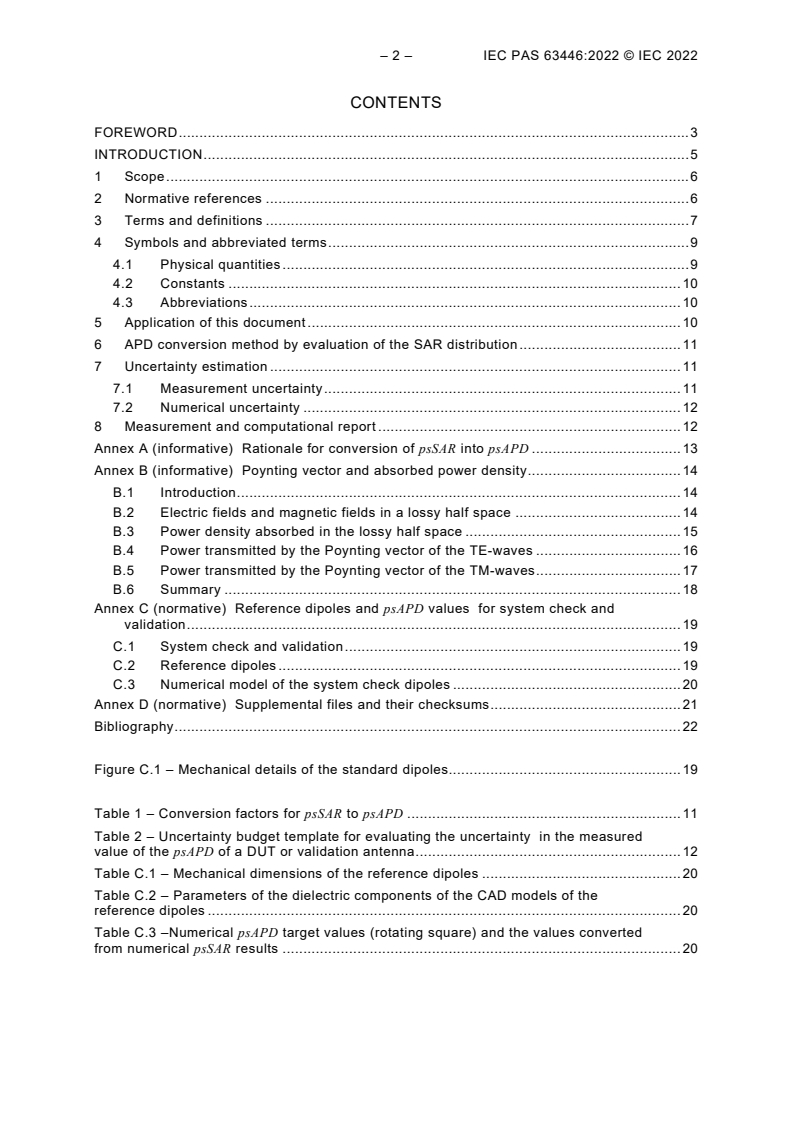
– 2 – IEC PAS 63446:2022 © IEC 2022
CONTENTS
FOREWORD . 3
INTRODUCTION . 5
1 Scope . 6
2 Normative references . 6
3 Terms and definitions . 7
4 Symbols and abbreviated terms . 9
4.1 Physical quantities . 9
4.2 Constants . 10
4.3 Abbreviations . 10
5 Application of this document . 10
6 APD conversion method by evaluation of the SAR distribution . 11
7 Uncertainty estimation . 11
7.1 Measurement uncertainty . 11
7.2 Numerical uncertainty . 12
8 Measurement and computational report . 12
Annex A (informative) Rationale for conversion of psSAR into psAPD . 13
Annex B (informative) Poynting vector and absorbed power density . 14
B.1 Introduction . 14
B.2 Electric fields and magnetic fields in a lossy half space . 14
B.3 Power density absorbed in the lossy half space . 15
B.4 Power transmitted by the Poynting vector of the TE-waves . 16
B.5 Power transmitted by the Poynting vector of the TM-waves . 17
B.6 Summary . 18
Annex C (normative) Reference dipoles and psAPD values for system check and
validation . 19
C.1 System check and validation . 19
C.2 Reference dipoles . 19
C.3 Numerical model of the system check dipoles . 20
Annex D (normative) Supplemental files and their checksums . 21
Bibliography . 22
Figure C.1 – Mechanical details of the standard dipoles. 19
Table 1 – Conversion factors for psSAR to psAPD . 11
Table 2 – Uncertainty budget template for evaluating the uncertainty in the measured
value of the psAPD of a DUT or validation antenna . 12
Table C.1 – Mechanical dimensions of the reference dipoles . 20
Table C.2 – Parameters of the dielectric components of the CAD models of the
reference dipoles . 20
Table C.3 –Numerical psAPD target values (rotating square) and the values converted
from numerical psSAR results . 20
INTERNATIONAL ELECTROTECHNICAL COMMISSION
____________
CONVERSION METHOD OF SPECIFIC ABSORPTION RATE TO ABSORBED
POWER DENSITY FOR THE ASSESSMENT OF HUMAN EXPOSURE TO
RADIO FREQUENCY ELECTROMAGNETIC FIELDS FROM WIRELESS
DEVICES IN CLOSE PROXIMITY TO THE HEAD AND BODY – FREQUENCY
RANGE OF 6 GHZ TO 10 GHZ
FOREWORD
1) The International Electrotechnical Commission (IEC) is a worldwide organization for standardization comprising
all national electrotechnical committees (IEC National Committees). The object of IEC is to promote international
co-operation on all questions concerning standardization in the electrical and electronic fields. To this end and
in addition to other activities, IEC publishes International Standards, Technical Specifications, Technical Reports,
Publicly Available Specifications (PAS) and Guides (hereafter referred to as "IEC Publication(s)"). Their
preparation is entrusted to technical committees; any IEC National Committee interested in the subject dealt with
may participate in this preparatory work. International, governmental and non-governmental organizations liaising
with the IEC also participate in this preparation. IEC collaborates closely with the International Organization for
Standardization (ISO) in accordance with conditions determined by agreement between the two organizations.
2) The formal decisions or agreements of IEC on technical matters express, as nearly as possible, an international
consensus of opinion on the relevant subjects since each technical committee has representation from all
interested IEC National Committees.
3) IEC Publications have the form of recommendations for international use and are accepted by IEC National
Committees in that sense. While all reasonable efforts are made to ensure that the technical content of IEC
Publications is accurate, IEC cannot be held responsible for the way in which they are used or for any
misinterpretation by any end user.
4) In order to promote international uniformity, IEC National Committees undertake to apply IEC Publications
transparently to the maximum extent possible in their national and regional publications. Any divergence between
any IEC Publication and the corresponding national or regional publication shall be clearly indicated in the latter.
5) IEC itself does not provide any attestation of conformity. Independent certification bodies provide conformity
assessment services and, in some areas, access to IEC marks of conformity. IEC is not responsible for any
services carried out by independent certification bodies.
6) All users should ensure that they have the latest edition of this publication.
7) No liability shall attach to IEC or its directors, employees, servants or agents including individual experts and
members of its technical committees and IEC National Committees for any personal injury, property damage or
other damage of any nature whatsoever, whether direct or indirect, or for costs (including legal fees) and
expenses arising out of the publication, use of, or reliance upon, this IEC Publication or any other IEC
Publications.
8) Attention is drawn to the Normative references cited in this publication. Use of the referenced publications is
indispensable for the correct application of this publication.
9) Attention is drawn to the possibility that some of the elements of this IEC Publication may be the subject of patent
rights. IEC shall not be held responsible for identifying any or all such patent rights.
A PAS is an intermediate specification made available to the public and needing a lower level
of consensus than an International Standard to be approved by vote (simple majority).
IEC PAS 63446 has been processed by IEC technical committee 106: Methods for the
assessment of electric, magnetic and electromagnetic fields associated with human exposure.
The text of this PAS is based on the This PAS was approved for
following document: publication by the P-members of the
committee concerned as indicated in
the following document
Draft PAS Report on voting
106/572/DPAS 106/580/RVDPAS
Following publication of this PAS, which is a pre-standard publication, the technical committee
or subcommittee concerned may transform it into an International Standard.
– 4 – IEC PAS 63446:2022 © IEC 2022
This PAS shall remain valid for an initial maximum period of 2 years starting from the publication
date. The validity may be extended for a single period up to a maximum of 2 years, at the end
of which it shall be published as another type of normative document, or shall be withdrawn.
This document contains supplemental files that are detailed in Annex D. These files can be
downloaded from https://www.iec.ch/tc106/supportingdocuments.
INTRODUCTION
This document provides the method to conservatively evaluate the area averaged
electromagnetic (EM) power density entering the human body, i.e. the absorbed power density
(APD), for communication devices intended to be used at a position near the human head or
body, or mounted on the body, combined with other transmitters within a product, or embedded
in garments. The device categories covered include but are not limited to mobile telephones,
radio transmitters in personal computers, and desktop and laptop devices. The applicable
frequency range is from 6 GHz to 10 GHz.
This document specifies:
• conversion of the psSAR to the psAPD (Clause 6);
• uncertainty estimation (Clause 7);
• reporting requirements (Clause 8);
• methods of validation and system check (Annex C)
The measurement and computational standards IEC/IEEE 63195-1:2022 [1] and
IEC/IEEE 63195-2:2022 [2] for incident power density (IPD) cover the frequency range from
6 GHz to 300 GHz. Hence there is a frequency overlap from 6 GHz to 10 GHz between this
document on APD and the IEC/IEEE standards addressing IPD. The committee was aware of
this fact and opted for enhanced flexibility by providing methods for basic restriction metric APD
in addition to reference level metric IPD.
___________
Numbers in square brackets refer to the Bibliography.
– 6 – IEC PAS 63446:2022 © IEC 2022
CONVERSION METHOD OF SPECIFIC ABSORPTION RATE TO ABSORBED
POWER DENSITY FOR THE ASSESSMENT OF HUMAN EXPOSURE TO
RADIO FREQUENCY ELECTROMAGNETIC FIELDS FROM WIRELESS
DEVICES IN CLOSE PROXIMITY TO THE HEAD AND BODY – FREQUENCY
RANGE OF 6 GHZ TO 10 GHZ
1 Scope
This document specifies a conversion method for the assessment of the peak spatial-average
absorbed power density (psAPD) in the human head and body due to exposure to radio
frequency (RF) electromagnetic fields (EMF) from wireless communication devices, with a
specified conversion uncertainty. This conversion method is based on specific absorption rate
(SAR) values and is specified with the objective to yield conservative and reproducible absorbed
power density values of the exposure for a significant majority of the population during the use
of hand-held, body-worn or any other RF transmitting communication devices that can operate
in close proximity to a human head or body. This conversion method applies for devices that
can feature single or multiple transmitters and/or antennas and can be operated with their
radiating structure(s) at distances up to 200 mm from a human head or body.
The conversion method of this document can be employed to determine conformity with
applicable absorbed power density or epithelial power density limits, such as those defined in
ICNIRP guidelines 2020 [3] and IEEE Std C95.1™-2019 [4], of different types of RF transmitting
communication devices being used in close proximity to the head and body. The assessment
of psAPD is based on the conversion of the peak spatial-average specific absorption rate
(psSAR) values assessed according to applicable international standards. The applicable
frequency range of the conversion method of this document is 6 GHz to 10 GHz.
NOTE Applicable international standards for the assessment of the psSAR are those accepted by the local
regulatory body or specified in the CENELEC product standards. Such international standards include, e.g. IEC/IEEE
62209-1528 and IEC 62209-3 [5] for measurement methods, and IEC/IEEE 62704-1 [6] and IEC/IEEE 62704-4 [7] for
computational methods. The frequency range of [5], [6] and [7] is limited up to 6 GHz. While the applicability of the
methods of [5] for the frequency range of this document may need further verification, the numerical standards [6]
and [7].may be applied for frequencies up to 10 GHz.
The categories of RF transmitting communication devices covered in this document include but
are not limited to mobile telephones, radio transmitters in personal computers, and desktop and
laptop devices or devices embedded in garments, using single or multiple transmitters and/or
antennas, when operating within the frequency range indicated above.
The conversion method of this document does not apply for EMF evaluation of exposure from
the devices or objects intended to be implanted in the body, such as active or passive implanted
medical devices.
2 Normative references
The following documents are referred to in the text in such a way that some or all of their content
constitutes requirements of this document. For dated references, only the edition cited applies.
For undated references, the latest edition of the referenced document (including any
amendments) applies.
IEC/IEEE 62209-1528:2020, Measurement procedure for the assessment of specific absorption
rate of human exposure to radio frequency fields from hand-held and body-mounted wireless
communication devices – Part 1528: Human models, instrumentation and procedures
(Frequency range of 4 MHz to 10 GHz)
3 Terms and definitions
For the purposes of this document, the following terms and definitions apply.
ISO and IEC maintain terminology databases for use in standardization at the following
addresses:
• IEC Electropedia: available at https://www.electropedia.org/
• ISO Online browsing platform: available at https://www.iso.org/obp
3.1
absorbed power density
locally absorbed power density
APD
power per skin surface unit area that is absorbed in the body
Note 1 to entry: APD is determined using Formula (1) and Formula (2):
z
max
APD dxdy ρ x,,yz SAR x,,yz dz PD
( ) ( ) (1)
∬
∫
δz
max
A
av
A 0+
av
and
−2/zδ
(2)
SAR x,,y z = SAR x,,y 0 e
( ) ( )
where
PD is the specific absorbed power density averaged over the area A at the phantom bottom (z = 0);
0 av
A is the averaging area;
av
δ is the penetration depth of the tissue equivalent medium (< 6 mm), which is much smaller than the
medium liquid depth z at any location of the phantom;
max
ρ(x,y,z) is the mass density of the tissue equivalent medium;
SAR(x,y,z) is the local specific absorption rate.
Note 2 to entry: The quantity APD is equivalent to the quantity S of Formula (23) of [3].
ab
Note 3 to entry: In IEEE Std C95.1 [4] the identical metric is called epithelial power density. Identical term
transmitted power density is used in some scientific publications.
Note 4 to entry: Power density is also referred to as power flux density.
Note 5 to entry: Further details can be found in Annex A and Annex B.
Note 6 to entry: Definition is valid for any surface and not limited to the flat phantom surface.
3.2
incident power density
power per unit area that impinges on the body surface
Note 1 to entry: The incident power density just outside the body surface is used to establish local exposure
reference levels, which apply at frequencies above 6 GHz in some jurisdictions.
==
– 8 – IEC PAS 63446:2022 © IEC 2022
3.3
spatial-average absorbed power density
sAPD(A )
av
APD averaged over a surface of an averaging area A
av
Note 1 to entry: The sAPD is a function of the location vector r. It is defined on the evaluation surface, except for
the edges where no averaging area can be constructed.
Note 2 to entry: For the frequency range from 6 GHz to 10 GHz the averaging area size specified in exposure limits
.
is 4 cm
3.4
peak spatial-average absorbed power density
psAPD(A )
av
global maximum value of sAPD (3.3) on the interface of the entire inner phantom surface and
the tissue equivalent medium
Note 1 to entry: psAPD is given by Formula (3):
psAPD = max sAPD r
{ ( )} (3)
where r is a point on the evaluation surface as defined in IEC/IEEE 63195-1:2022 [1].
Note 3 to entry: Other local maxima (i.e. secondary peak spatial-average power density values) can exist (see 3.5).
3.5
secondary peak spatial-average absorbed power density
other local maxima of the spatial-average power density (sAPD) values that are smaller than
the peak spatial-average power density (psAPD)
3.6
maximized peak spatial-average absorbed power density
mpsAPD
global maximum value of psAPD for all combinations of phasors that represent the input signal
to an antenna array
3.7
Poynting vector
S
vector product of the electric field strength E and the magnetic field strength H of the
electromagnetic field at a given point
Note 1 to entry: The flux of the Poynting vector through a closed surface is equal to the electromagnetic power
passing through this surface.
Note 2 to entry: For a periodic electromagnetic field, the time average of the Poynting vector is a vector, the
direction of which, with certain reservations, can be considered as the direction of the propagation of electromagnetic
energy and the magnitude can be considered as the average power flux density.
Note 3 to entry: For a sinusoidal wave of angular frequency ω, the complex Poynting vector is expressed by Formula
(4):
∗
S EH× (4)
where E and H are phasors and the asterisk denotes the complex conjugate.
Note 4 to entry: The Poynting vector has units of watt per square metre (W/m ).
[SOURCE: IEC 60050-121:2019, 121-11-66, modified – excerpts combined and rearranged,
Note 4 added.]
=
3.8
averaging area
A
av
nominal size of the area used for calculating sAPD (3.3)
1/2
Note 1 to entry: The shape of the averaging area is the cross section of a sphere (r = (A /π) ) with the centre on
av
1/2
the surface (circular in case of a planar surface) or the cross-section of a cube with side length of (A ) determined
av
according to IEC/IEEE 63195-2:2022 [2].
3.9
specific absorption rate
SAR
measure of the rate at which energy is absorbed per unit mass in a human body when exposed
to a radio frequency electromagnetic field
Note 1 to entry: This quantity is equal to specific energy absorption rate defined in ICNIRP 2020 guidelines [3].
3.10
spatial-average SAR
sSAR
SAR averaged within a local region based on a specific averaging mass
Note 1 to entry: Averaging masses 1 g and 10 g of tissue in the shape of a cube are considered for example in
IEC/IEEE 62209-1528:2020. In this document, 8 g of tissue in the shape of a cube is considered for determining
sAPD over a square 4 cm surface area of the body.
3.11
peak spatial-average SAR
psSAR
maximum SAR averaged within a local region based on a specific averaging mass
Note 1 to entry: Averaging masses 1 g and 10 g of tissue in the shape of a cube are considered for example in
IEC/IEEE 62209-1528:2020. In this document, 8 g of tissue in the shape of a cube is considered for determining
sAPD over a square 4 cm surface area of the body.
3.12
evaluation surface
interface at the inner surface of the phantom shell and the tissue equivalent medium where the
spatial-average power density (sAPD) is evaluated
4 Symbols and abbreviated terms
4.1 Physical quantities
The internationally accepted SI units are used throughout the document.
Symbol Quantity Unit Dimensions
A
area square metre m
av
APD absorbed power density watt per square metre
W/m
F
conversion factor kilogram per square metre
kg/m
APD
δ penetration depth of the tissue equivalent medium metre m
E electric field vector volt per metre V/m
𝜂𝜂 wave impedance of the tissue equivalent medium ohm Ω
ε
relative permittivity (real part) 1 1
r
H magnetic field vector ampere per metre A/m
k wave vector 1 per metre 1/m
– 10 – IEC PAS 63446:2022 © IEC 2022
k
wave number in a particular medium 1 per metre 1/m
λ wavelength metre m
λ
wavelength in air, or free-space wavelength metre m
ℓ
edge length of SAR averaging cube metre m
c
maximized peak spatial-average absorbed power
mpsAPD watt per square metre
W/m
density
ω angular frequency radian per second rad/s
psAPD peak spatial-average absorbed power density watt per square metre
W/m
psSAR peak spatial-average specific absorption rate watt per kilogram W/kg
r radius metre m
r location vector metre m
ρ mass density of the tissue equivalent medium kilogram per cubic metre kg/m
S Poynting vector watt per square metre W/m
σ electrical conductivity siemens per metre S/m
sAPD spatial-average absorbed power density watt per square metre
W/m
SAR specific absorption rate watt per kilogram W/kg
sSAR spatial-average specific absorption rate watt per kilogram W/kg
4.2 Constants
Symbol Physical constant Magnitude
–12
ε
permittivity in vacuum 8,854 × 10 F/m
–7
µ
permeability in vacuum 4π × 10 H/m
4.3 Abbreviations
CAD computer aided design
DUT device under test
EMF electromagnetic fields
PD power density
RF radiofrequency
SAM specific anthropomorphic mannequin
SAT standard ACIS text
TE transverse electric
TM transverse magnetic
5 Application of this document
This document describes the conversion method for assessing the peak spatial-averaged
absorbed power density or epithelial power density (psAPD) in the frequency range 6 GHz to
10 GHz. This method directly converts the measured or simulated peak spatial-averaged
specific absorption rate (psSAR) to the psAPD in the head and body of the use
...