

IEC SRD 63347-2:2026
(Main)Smart city use case collection and analysis - Managing public health emergencies in smart cities - Part 2 : Use case analysis
General Information
- Abstract
IEC SRD 63347-2:2026 describes and analyses a comprehensive set of high-level scenarios of how smart cities can best respond to public health emergencies, and strengthen their “Urban Immune System”, using evidence from as many countries as possible. It covers use cases related to the prevention, the control and the successful ending of public health emergencies, and to dealing with the longer-term harm that these may cause. It considers a wide range of different scenarios and reviews both the management challenges and the range of technology solutions, including the use of IoT, 5G, AI, Big Data, and Cloud Computing, available in each of them, in order to provide a comprehensive outline of the standardization requirements to develop an effective Urban Immune System. The public health emergencies envisaged are those relating to pandemics resulting from novel forms of disease, for which there is no natural immunity within the population and no tried and tested treatment. However, some of its provisions will be helpful to dealing with pandemics of existing diseases such as typhoid and cholera brought on through natural disasters or war. This document will provide useful information to International and national Standards Development Organizations and thus facilitate and promote the development of the smart city standards required.
- Status
- Published
- Publication Date
- 19-Apr-2026
- Technical Committee
- SyC Smart Cities - Electrotechnical aspects of Smart Cities
- Drafting Committee
- WG 2 - SyC Smart Cities/WG 2
- Current Stage
- PPUB - Publication issued
- Start Date
- 20-Apr-2026
- Completion Date
- 08-May-2026
Overview
IEC SRD 63347-2:2026, Smart city use case collection and analysis – Managing public health emergencies in smart cities – Part 2: Use case analysis, is an International Electrotechnical Commission (IEC) standard that provides in-depth analysis and scenario modelling for how smart cities can respond to public health emergencies. This reference deliverable aims to enhance city resilience, often referred to as the “Urban Immune System,” by collecting and analysing high-level use cases from diverse international contexts. The document offers guidance on leveraging digital technologies-such as the Internet of Things (IoT), 5G, Artificial Intelligence (AI), Big Data, and Cloud Computing-to respond to, manage, and recover from pandemics and similar crises. This analysis is critical for standards developers and city stakeholders as they plan and deploy integrated, standardized approaches for public health resilience in smart urban environments.
Key Topics
Comprehensive Use Case Database
IEC SRD 63347-2:2026 details a systematic approach to capturing user stories and creating a unified database of use cases. These use cases cover the prevention, control, and mitigation of public health emergencies, as well as long-term recovery.High-Level Scenarios for Public Health Emergency Response
The standard considers a wide array of public health emergency scenarios including new disease outbreaks, pandemics, and crises sparked by natural disasters or conflict.Integrated Stakeholder Analysis
Stakeholders include government bodies, healthcare institutions, businesses, research organizations, and the public. The standard maps interactions and responsibilities, ensuring all relevant actors are addressed in emergency planning.Technological Integration
The standard reviews challenges and solutions around integrating digital technology in emergency management. Implementation examples include widespread testing and tracking systems, digital supply chain management, and intelligent health platforms.Standardization Gaps and Recommendations
Through scenario analysis, the standard identifies key gaps and opportunities in the development of future smart city and urban health emergency standards.
Applications
IEC SRD 63347-2:2026 is designed for a broad range of practical applications in smart city management and public health emergency preparedness:
Urban Emergency Planning
City planners and governments can use the outlined use cases and analysis to design responsive, data-driven emergency systems that optimize resource allocation for testing, tracking, and treatment during a crisis.Technology Implementation
Solution providers and IT departments can refer to the technological requirements for deploying integrated platforms, such as IoT-based tracking or AI-driven epidemiological analysis, enhancing automation and decision support.Interdepartmental Coordination
The framework encourages effective information sharing and collaboration between health authorities, local agencies, and other urban stakeholders-an essential factor in rapid crisis response.Standards Development
The content supports international and national standards organizations in creating targeted, relevant standards for public health management in smart cities, ensuring interoperability and best practices.Resource Management
The use case analysis supports the development of robust workflows for medical supply chain management, ensuring timely and accurate distribution of critical resources in emergencies.
Related Standards
IEC SRD 63347-1
Smart city use case collection and analysis – Managing public health emergencies in smart cities – Part 1: High-level analysis
Provides the initial framework and high-level scenarios underpinning the more detailed use case analysis in Part 2.IEC 62559 Series
Describes the general methodology for use case collection and management, which is referenced throughout IEC SRD 63347-2 for standardizing use case format and approach.Relevant ISO Standards
ISO/TC 224 and ISO/TC 147 are cited as key committees whose work is informed by the use case and system requirements from this IEC document.
IEC SRD 63347-2:2026 is essential reading for professionals focused on smart city standards, digital health, urban planning, and emergency management. By using this framework, cities can fortify their public health response and accelerate the adoption of interoperable, technology-driven solutions in line with evolving international best practices.
Get Certified
Connect with accredited certification bodies for this standard

BSI Group
BSI (British Standards Institution) is the business standards company that helps organizations make excellence a habit.

Bureau Veritas
Bureau Veritas is a world leader in laboratory testing, inspection and certification services.

DNV
DNV is an independent assurance and risk management provider.
Sponsored listings
Frequently Asked Questions
IEC SRD 63347-2:2026 is a standardization document published by the International Electrotechnical Commission (IEC). Its full title is "Smart city use case collection and analysis - Managing public health emergencies in smart cities - Part 2 : Use case analysis". This standard covers: IEC SRD 63347-2:2026 describes and analyses a comprehensive set of high-level scenarios of how smart cities can best respond to public health emergencies, and strengthen their “Urban Immune System”, using evidence from as many countries as possible. It covers use cases related to the prevention, the control and the successful ending of public health emergencies, and to dealing with the longer-term harm that these may cause. It considers a wide range of different scenarios and reviews both the management challenges and the range of technology solutions, including the use of IoT, 5G, AI, Big Data, and Cloud Computing, available in each of them, in order to provide a comprehensive outline of the standardization requirements to develop an effective Urban Immune System. The public health emergencies envisaged are those relating to pandemics resulting from novel forms of disease, for which there is no natural immunity within the population and no tried and tested treatment. However, some of its provisions will be helpful to dealing with pandemics of existing diseases such as typhoid and cholera brought on through natural disasters or war. This document will provide useful information to International and national Standards Development Organizations and thus facilitate and promote the development of the smart city standards required.
IEC SRD 63347-2:2026 describes and analyses a comprehensive set of high-level scenarios of how smart cities can best respond to public health emergencies, and strengthen their “Urban Immune System”, using evidence from as many countries as possible. It covers use cases related to the prevention, the control and the successful ending of public health emergencies, and to dealing with the longer-term harm that these may cause. It considers a wide range of different scenarios and reviews both the management challenges and the range of technology solutions, including the use of IoT, 5G, AI, Big Data, and Cloud Computing, available in each of them, in order to provide a comprehensive outline of the standardization requirements to develop an effective Urban Immune System. The public health emergencies envisaged are those relating to pandemics resulting from novel forms of disease, for which there is no natural immunity within the population and no tried and tested treatment. However, some of its provisions will be helpful to dealing with pandemics of existing diseases such as typhoid and cholera brought on through natural disasters or war. This document will provide useful information to International and national Standards Development Organizations and thus facilitate and promote the development of the smart city standards required.
IEC SRD 63347-2:2026 is classified under the following ICS (International Classification for Standards) categories: 03.100.70 - Management systems. The ICS classification helps identify the subject area and facilitates finding related standards.
IEC SRD 63347-2:2026 is available in PDF format for immediate download after purchase. The document can be added to your cart and obtained through the secure checkout process. Digital delivery ensures instant access to the complete standard document.
Standards Content (Sample)
IEC SRD 63347-2 ®
Edition 1.0 2026-04
SYSTEMS REFERENCE
DELIVERABLE
Smart city use case collection and analysis - Managing public health
emergencies in smart cities -
Part 2: Use case analysis
ICS 03.100.70 ISBN 978-2-8327-1198-9
All rights reserved. Unless otherwise specified, no part of this publication may be reproduced or utilized in any form or
by any means, electronic or mechanical, including photocopying and microfilm, without permission in writing from either
IEC or IEC's member National Committee in the country of the requester. If you have any questions about IEC copyright
or have an enquiry about obtaining additional rights to this publication, please contact the address below or your local
IEC member National Committee for further information.
IEC Secretariat Tel.: +41 22 919 02 11
3, rue de Varembé info@iec.ch
CH-1211 Geneva 20 www.iec.ch
Switzerland
About the IEC
The International Electrotechnical Commission (IEC) is the leading global organization that prepares and publishes
International Standards for all electrical, electronic and related technologies.
About IEC publications
The technical content of IEC publications is kept under constant review by the IEC. Please make sure that you have the
latest edition, a corrigendum or an amendment might have been published.
IEC publications search - IEC Products & Services Portal - products.iec.ch
webstore.iec.ch/advsearchform Discover our powerful search engine and read freely all the
The advanced search enables to find IEC publications by a publications previews, graphical symbols and the glossary.
variety of criteria (reference number, text, technical With a subscription you will always have access to up to date
committee, …). It also gives information on projects, content tailored to your needs.
replaced and withdrawn publications.
Electropedia - www.electropedia.org
The world's leading online dictionary on electrotechnology,
IEC Just Published - webstore.iec.ch/justpublished
Stay up to date on all new IEC publications. Just Published containing more than 22 500 terminological entries in English
details all new publications released. Available online and and French, with equivalent terms in 25 additional languages.
once a month by email. Also known as the International Electrotechnical Vocabulary
(IEV) online.
IEC Customer Service Centre - webstore.iec.ch/csc
If you wish to give us your feedback on this publication or
need further assistance, please contact the Customer
Service Centre: sales@iec.ch.
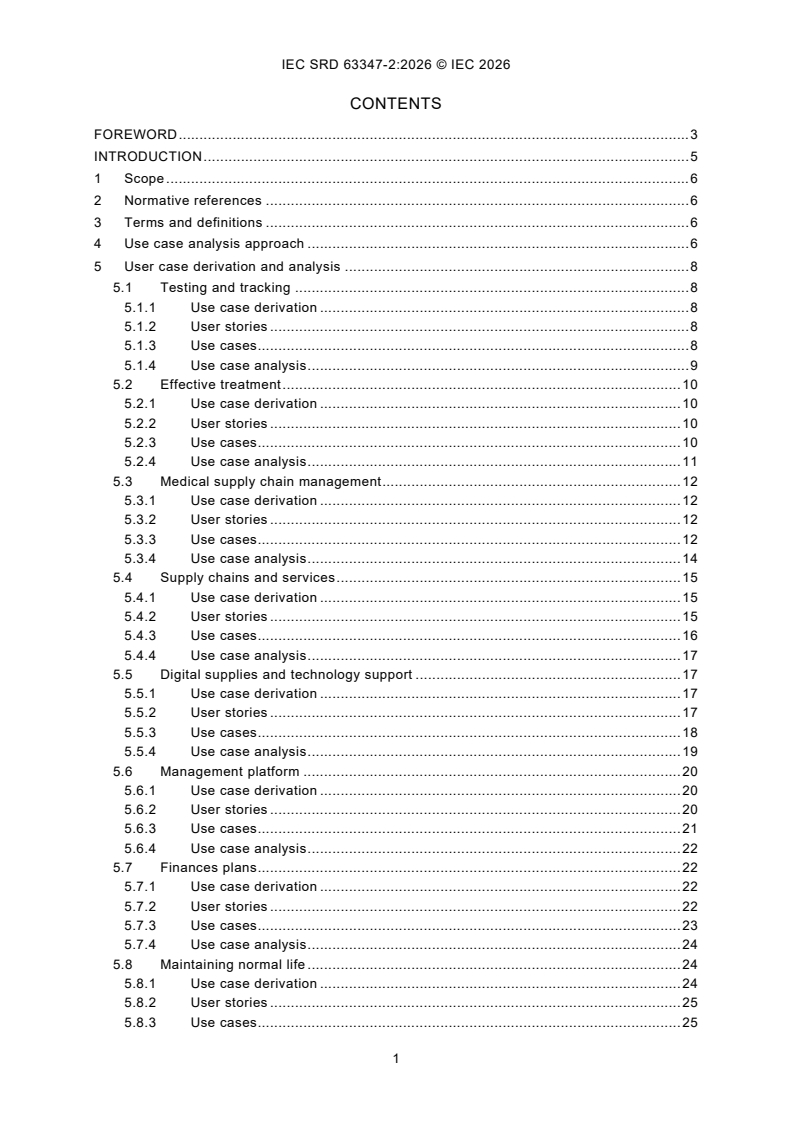
CONTENTS
FOREWORD . 3
INTRODUCTION . 5
1 Scope . 6
2 Normative references . 6
3 Terms and definitions . 6
4 Use case analysis approach . 6
5 User case derivation and analysis . 8
5.1 Testing and tracking . 8
5.1.1 Use case derivation . 8
5.1.2 User stories . 8
5.1.3 Use cases. 8
5.1.4 Use case analysis . 9
5.2 Effective treatment . 10
5.2.1 Use case derivation . 10
5.2.2 User stories . 10
5.2.3 Use cases. 10
5.2.4 Use case analysis . 11
5.3 Medical supply chain management . 12
5.3.1 Use case derivation . 12
5.3.2 User stories . 12
5.3.3 Use cases. 12
5.3.4 Use case analysis . 14
5.4 Supply chains and services . 15
5.4.1 Use case derivation . 15
5.4.2 User stories . 15
5.4.3 Use cases. 16
5.4.4 Use case analysis . 17
5.5 Digital supplies and technology support . 17
5.5.1 Use case derivation . 17
5.5.2 User stories . 17
5.5.3 Use cases. 18
5.5.4 Use case analysis . 19
5.6 Management platform . 20
5.6.1 Use case derivation . 20
5.6.2 User stories . 20
5.6.3 Use cases. 21
5.6.4 Use case analysis . 22
5.7 Finances plans . 22
5.7.1 Use case derivation . 22
5.7.2 User stories . 22
5.7.3 Use cases. 23
5.7.4 Use case analysis . 24
5.8 Maintaining normal life . 24
5.8.1 Use case derivation . 24
5.8.2 User stories . 25
5.8.3 Use cases. 25
5.8.4 Use case analysis . 26
5.9 City collaboration . 27
5.9.1 Use case derivation . 27
5.9.2 User stories . 27
5.9.3 Use cases. 28
5.9.4 Use case analysis . 29
6 Application of the analysis . 30
6.1 General . 30
6.2 Standard hierarchy. 30
6.2.1 General . 30
6.2.2 Business aspect . 30
6.2.3 Technology aspect . 30
6.2.4 Management aspect . 31
6.2.5 Servicing aspect . 31
Bibliography . 32
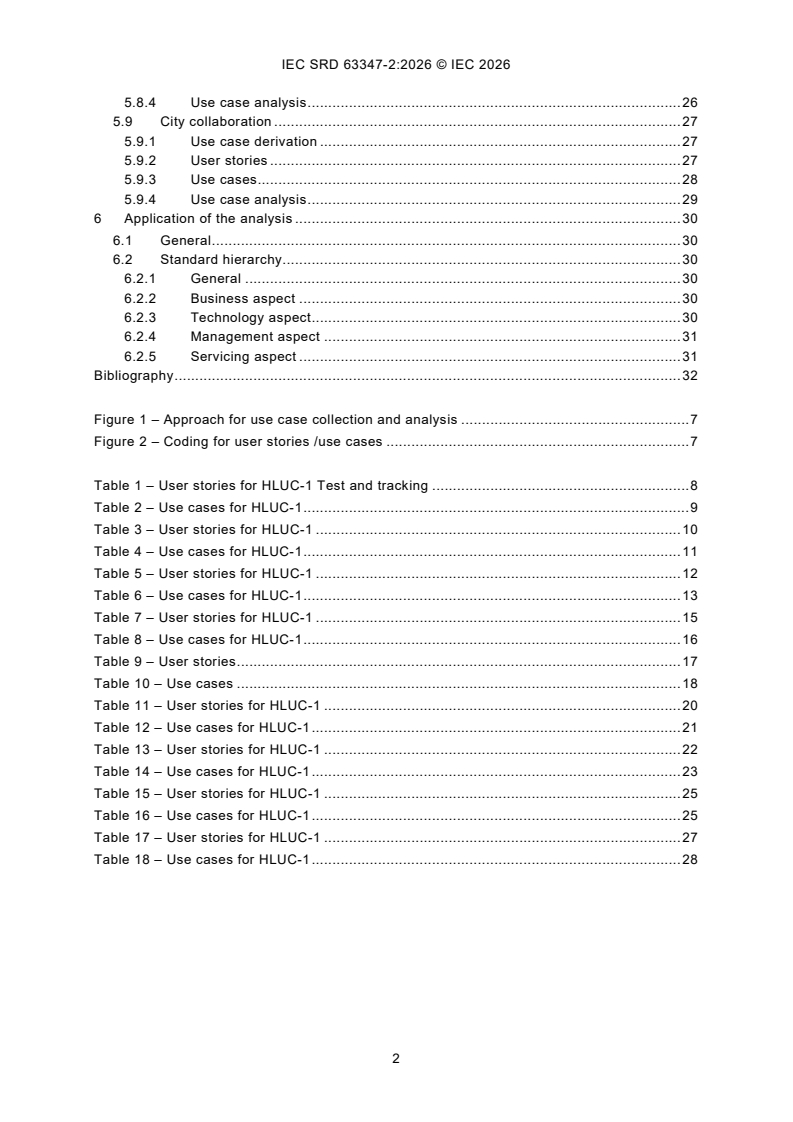
Figure 1 – Approach for use case collection and analysis . 7
Figure 2 – Coding for user stories /use cases . 7
Table 1 – User stories for HLUC-1 Test and tracking . 8
Table 2 – Use cases for HLUC-1 . 9
Table 3 – User stories for HLUC-1 . 10
Table 4 – Use cases for HLUC-1 . 11
Table 5 – User stories for HLUC-1 . 12
Table 6 – Use cases for HLUC-1 . 13
Table 7 – User stories for HLUC-1 . 15
Table 8 – Use cases for HLUC-1 . 16
Table 9 – User stories . 17
Table 10 – Use cases . 18
Table 11 – User stories for HLUC-1 . 20
Table 12 – Use cases for HLUC-1 . 21
Table 13 – User stories for HLUC-1 . 22
Table 14 – Use cases for HLUC-1 . 23
Table 15 – User stories for HLUC-1 . 25
Table 16 – Use cases for HLUC-1 . 25
Table 17 – User stories for HLUC-1 . 27
Table 18 – Use cases for HLUC-1 . 28
INTERNATIONAL ELECTROTECHNICAL COMMISSION
____________
Smart city use case collection and analysis -
Managing public health emergencies in smart cities -
Part 2 : Use case analysis
FOREWORD
1) The International Electrotechnical Commission (IEC) is a worldwide organization for standardization comprising
all national electrotechnical committees (IEC National Committees). The object of IEC is to promote international
co-operation on all questions concerning standardization in the electrical and electronic fields. To this end and
in addition to other activities, IEC publishes International Standards, Technical Specifications, Technical Reports,
Publicly Available Specifications (PAS) and Guides (hereafter referred to as "IEC Publication(s)"). Their
preparation is entrusted to technical committees; any IEC National Committee interested in the subject dealt with
may participate in this preparatory work. International, governmental and non-governmental organizations liaising
with the IEC also participate in this preparation. IEC collaborates closely with the International Organization for
Standardization (ISO) in accordance with conditions determined by agreement between the two organizations.
2) The formal decisions or agreements of IEC on technical matters express, as nearly as possible, an international
consensus of opinion on the relevant subjects since each technical committee has representation from all
interested IEC National Committees.
3) IEC Publications have the form of recommendations for international use and are accepted by IEC National
Committees in that sense. While all reasonable efforts are made to ensure that the technical content of IEC
Publications is accurate, IEC cannot be held responsible for the way in which they are used or for any
misinterpretation by any end user.
4) In order to promote international uniformity, IEC National Committees undertake to apply IEC Publications
transparently to the maximum extent possible in their national and regional publications. Any divergence between
any IEC Publication and the corresponding national or regional publication shall be clearly indicated in the latter.
5) IEC itself does not provide any attestation of conformity. Independent certification bodies provide conformity
assessment services and, in some areas, access to IEC marks of conformity. IEC is not responsible for any
services carried out by independent certification bodies.
6) All users should ensure that they have the latest edition of this publication.
7) No liability shall attach to IEC or its directors, employees, servants or agents including individual experts and
members of its technical committees and IEC National Committees for any personal injury, property damage or
other damage of any nature whatsoever, whether direct or indirect, or for costs (including legal fees) and
expenses arising out of the publication, use of, or reliance upon, this IEC Publication or any other IEC
Publications.
8) Attention is drawn to the Normative references cited in this publication. Use of the referenced publications is
indispensable for the correct application of this publication.
9) IEC draws attention to the possibility that the implementation of this document may involve the use of (a)
patent(s). IEC takes no position concerning the evidence, validity or applicability of any claimed patent rights in
respect thereof. As of the date of publication of this document, IEC had not received notice of (a) patent(s), which
may be required to implement this document. However, implementers are cautioned that this may not represent
the latest information, which may be obtained from the patent database available at https://patents.iec.ch. IEC
shall not be held responsible for identifying any or all such patent rights.
IEC SRD 63347-2 has been prepared by IEC systems committee Smart Cities: Electrotechnical
aspects of smart cities. It is a Systems Reference Deliverable.
The text of this Systems Reference Deliverable is based on the following documents:
Draft Report on voting
SyCSmartCities/403/DTS SyCSmartCities/428/RVDTS
Full information on the voting for its approval can be found in the report on voting indicated in
the above table.
The language used for the development of this Systems Reference Deliverable is English.
This document was drafted in accordance with ISO/IEC Directives, Part 2, and developed in
accordance with ISO/IEC Directives, Part 1 and ISO/IEC Directives, IEC Supplement, available
at www.iec.ch/members_experts/refdocs. The main document types developed by IEC are
described in greater detail at www.iec.ch/publications.
A list of all parts in the IEC 63347 series, published under the general title Smart city use case
collection and analysis - Managing public health emergencies in smart cities, can be found on
the IEC website.
The committee has decided that the contents of this document will remain unchanged until the
stability date indicated on the IEC website under webstore.iec.ch in the data related to the
specific document. At this date, the document will be
– reconfirmed,
– withdrawn, or
– revised.
INTRODUCTION
The construction of a smart city can create benefits for a society and its stakeholders. Tracking
infectious diseases, responding to public health emergency, maintaining social order and
recovering to normal life are critical to support urban long-term development and to keep good
health and well-being as UN 17 Sustainability Goals. Early testing, effective treatment, medical
supplies and related public services are important focal areas for IEC SyC Smart Cities.
This document focuses on leveraging Information and communication technology (ICT) to
enhance the management of public health emergencies in smart cities. As demonstrated by the
Covid 19 pandemic, technology simultaneously provides methods and approaches for achieving
high visibility of diseases and controlling them.
A gap exists in effective coordination and clear orientation across sectors, which hinder industry
and stakeholders' engagement.
Major stakeholders include citizens, the government sectors, healthcare facilities, business
entities, research institutes, global professional organization and financial services provider.
Each stakeholder has specific concerns and challenges on dealing with public health
emergency.
Modelling these complex interactions into a systems architecture is a valuable exercise in
understanding the issues, gaps and opportunities for sustainable development.
This document focuses on use case collection and analysis to refine requirements to support
technical committees such as ISO/TC 224 and ISO/TC 147 in preparing standards.
This document also seeks to inform IEC technical committees to enable them to provide the
technical standards needed.
The IEC SRD 63347 series contains two parts:
– IEC SRD 63347-1: Smart city use case collection and analysis - Managing public health
emergencies in smart cities - Part 1: High level analysis
– IEC SRD 63347-2: Smart city use case collection and analysis - Managing public health
emergencies in smart cities - Part 2: Use case analysis
This document aims to develop the list of user stories and the database of use cases, conduct
integrative analyses of the use cases, scope out the requirements about management of public
health emergencies system standards and provide recommendations for IEC and other standard
development organizations (SDOs).
1 Scope
This part of IEC SRD 63347 develops the list of user stories and the database of use cases,
conducts integrative analyses of the use cases, scopes out the requirements of management
of public health emergencies standards and provides recommendations for IEC and other
standard development organizations (SDOs).
2 Normative references
The following documents are referred to in the text in such a way that some or all of their content
constitutes requirements of this document. For dated references, only the edition cited applies.
For undated references, the latest edition of the referenced document (including any
amendments) applies.
IEC SRD 63347-1, Smart city use case collection and analysis - Managing public health
emergencies in smart cities - Part 1: High level analysis
3 Terms and definitions
For the purposes of this document, the terms and definitions given in IEC 63347-1 and the
following apply.
ISO and IEC maintain terminology databases for use in standardization at the following
addresses:
– IEC Electropedia: available at https://www.electropedia.org/
– ISO Online browsing platform: available at https://www.iso.org/obp
3.1
domain
area of knowledge or activity characterized by a set of concepts and terminology understood
by the practitioners in that area
EXAMPLE Taken from Smart Grid/energy system area: Generation, transmission, distribution, customer.
Note 1 to entry: Major area of similar technologies and organizational background, for the energy system some
domains are suggested in this document as examples throughout this document.
[SOURCE: ISO/IEC 19501:2005, Glossary, modified – Example and note to entry added.]
4 Use case analysis approach
A top-down approach is adopted in the process of use case collection and analysis concerned
in this document, following the general methodology set forth by the IEC 62559 series. See
Figure 1.
Figure 1 – Approach for use case collection and analysis
At the start of use case collection and analysis, a thorough study of management of public
health emergencies should be conducted, with the purpose of identifying sub-systems,
identifying basic stakeholder needs, and forming materials for sub-system analysis as use case
prototypes, as accomplished in IEC 63347-1. According to IEC 63347-1, this document
develops the list of user stories and the database of use cases, conducts integrative analyses
of the use cases, and scopes out the requirements of management of public health emergencies
standards.
Use case building starts from breaking down stakeholder needs, and developing use cases from
user stories which perform as the prototypes.
The user stories centers on a statement explaining what are the stakeholders supposed to do,
and what they need. Under certain circumstances, the structure is as follows:
"As a" (title), "when I am" (situation), "I need to" (motivation), "so that" (outcome).
Building on user stories, each use case follows the IEC short use case template laid out in
IEC TR 62559-1:2019, IEC 62559-2:2015 and IEC 62559-3:2017, which includes the name of
the use case, scope/objective, narrative, and list of actors. The actors include human and
non-human actors. The main stakeholder is the first actor in each use case.
Use stories and use cases are coded as shown in Figure 2, forming a use case database.
Figure 2 – Coding for user stories /use cases
Having arranged the use case database, integrative analysis can be made to give
recommendations and identify the standard gaps for public health emergencies, and scope out
a family of public health emergency standards.
5 User case derivation and analysis
5.1 Testing and tracking
5.1.1 Use case derivation
Testing and tracking, as the most important means of obtaining information for managing PHE,
require high reliability and accuracy. In the face of large-scale epidemics, it is often necessary
to conduct large-scale and high-frequency testing. Therefore, how to use limited resources to
achieve efficient and accurate execution and feedback is also an important issue. 5.1 selects
the three most important stages in sampling testing, namely planning, execution, and tracking,
as user stories for analysis.
5.1.2 User stories
Table 1 shows the user stories for HLUC-1Test and tracking.
Table 1 – User stories for HLUC-1 Test and tracking
No. Actors User story
As a CDC officer, when I face a public health emergency, I
Government (CDC), local need to oversee the epidemic outbreak in timely manner
PHE-US-TT-001
communities with limited resources, so that I develop a smart sampling
strategy and adjust it based on testing result in time.
As an officer in local community or entities like hospital,
when I receive sampling request from CDC, I need to
Local communities, entities, breakdown the request into executable tasks and cooperate
PHE-US-TT-002
testing agency, citizens with test agencies on samples and testing results, so that I
work with a system to manage the works both online and
offline
As a CDC officer, when I detect infected ones inbound or
outbound, I need to identity infected ones, to understand
Government (CDC), local
the trajectory to predicate spread trend and to control the
PHE-US-TT-003 communities, other
infect boundary, so that I share information across
government sectors
community and public sectors like traffic to keep effective
tracking.
5.1.3 Use cases
Based on user stories, the use cases can be established, see Table 2.
Table 2 – Use cases for HLUC-1
Actors
Name of Scope/
ID of UC Narrative (human and
UC objective
non-human)
Based on the collected trend of epidemic Government
infection, develop testing strategies and (CDC), local
Develop
plans, including areas for routine testing communities
efficient
in non-specific regions, testing targets (all
sampling
staff/key populations), testing frequency,
strategies and
etc.; Inspection strategies for specific
plans, grasp
locations such as hospitals, stations, and
the regional
Planning airports; Utilize information technology to
infection
predict epidemic trends based on
PHE-UC-TT-001 and
situation, and
monitoring feedback inspection results, tracking of
provide input
infected individuals, and other information,
for
adjust inspection strategies and plans in a
epidemiological
timely manner, and implement
research and
corresponding regional management
regional
strategies. Communities and entities at all
management
levels adjust their inspection strategies
based on the situation.
Implement Local
sampling According to the inspection strategy, form communities,
strategy to inspection tasks, organize and schedule entities,
ensure fast and resources (including social resources) for testing
accurate testing various particle sizes from agency,
sampling sampling to comprehensive testing, citizens
results, and coordinate the use of personnel, reagents
Sampling task
use the and other resources, combine the use of
management
Sampling sampling temperature guns, reagents and other
PHE-UC-TT-002
system,
and testing inspection means, execute sampling strategies, use
laboratory
results for health codes and other tools to ensure
information
precise comprehensive, fast and accurate
management
community collection of samples, and have the
system
epidemic testing agency conduct rapid testing on a
prevention and large number of samples. The sampling
epidemic results can correspond and be easily
tracking down traced.
to individuals
Using health Government
codes and (CDC), local
Tracking the trajectory of infected
identity communities,
individuals/populations requires the use of
information to other
traffic information and key location traffic
track the government
information (such as highway traffic
Tracking trajectory of sectors
information, facial recognition, etc.) to
PHE-UC-TT-003
and control infected
predict the spread trend; Manage infected
Tracking
patients, help
individuals and assist in effectively
systems
optimize
isolating and observing high-risk groups in
detection and
the community.
control
strategies
5.1.4 Use case analysis
Managing public health emergencies involve lots of stakeholders and nearly all citizens in a
given area. Smart planning and execution of sample testing are important for utilizing limited
resources, collect related accurate data, and help reduce resistance to the measures proposed.
These efforts involve a range of strategies and measures, including legal frameworks,
administrative policies, economic incentives, technological advancements, and educational
campaigns.
By analysing use cases collected in the process, several major points can be identified:
a) Task management (PHE-UC-TT-001, PHE-UC-TT-002)
1) Task breakdown and assignment.
2) Resources allocated, include human resources, medical resources and other support
items.
3) Test result.
4) Cooperation and coordination between communities and departments.
b) Interface across sectors and data sharing (PHE-UC-TT-002, PHE-UC-TT-003)
1) Epidemiology, sampling and test result.
2) Traffic information to track and manage movement of infected ones.
3) Treatment and recovery information.
Considering the result of testing and tracking is critical input for subsequent jobs, sharing
information while protecting privacy is also a major concern while collecting user stories. It
requires a collaborative effort from governments, communities, and individuals, and a
multilateral approach that addresses the issue comprehensively.
5.2 Effective treatment
5.2.1 Use case derivation
Effective treatment for public health emergency requires bringing together knowledge and
resources essential for treatment, both locally and from elsewhere to enable health service
facilities and staff to hand out treatment promptly and effectively to those in need. At least 3
use stories or use cases can be derived.
5.2.2 User stories
Table 3 shows user stories for HLUC-1.
Table 3 – User stories for HLUC-1
No. Actors User story
As a CDC officer, when I am responsible for organizing
wide-area treatments during public health emergencies, I
need effective means to inquire, analyse and utilize medical
PHE-US-ET-001 Government (CDC)
resources, so that I can maintain effective management
over the circulation of information and resource toward
effective treatment
As the health institution staff, when I am responsible for
undertaking treatment during public health emergency, I
PHE-US-ET-002 Health institutions need to collaborate with other sectors to make greatest use
of medical resources and knowledge to hand out effective
treatment for those in need.
As individuals and enterprise managers, when I am taking
care of myself and my employees during public health
PHE-US-ET-003 Individuals and enterprises emergency, I need to get timely information about treatment
available, so that I can make sure I can get access to
effective treatment readily.
5.2.3 Use cases
Based on user stories, the use cases can be established, see Table 4.
Table 4 – Use cases for HLUC-1
Scope/ Actors (human and
ID of UC Name of UC Narrative
objective non-human)
This use case describes how
the PHE governing bodies, like
CDC can be equipped with
efficient way of computation,
Government (CDC)
To prepare and communication and
Medical dispatch collaboration to inquire,
Health institutions
PHE-UC-ET- resource medical analyse and utilize medical
001 preparing and resources for resources in wider area
Local communities,
dispatching effective encompassing local
testing agencies,
communities, testing agencies,
treatment
health institutions
health institutions among
others, to organize effective
treatment during public health
emergency
This use case describes how
health institution can be better
supported to hand out effective
To foster good treatment to those affected in
conditions for public health emergency, which
Health institutions,
PHE-UC-ET- Collaborative collaborative can include medical resource
government (CDC)
002 treatment treatment sharing and remote diagnosis
Remote diagnosis
among health allowing medical experts from
institutions different regions conduct
diagnosis of patients'
conditions and formulate
treatment plans.
This use case describes how
Government (CDC)
individuals and enterprise can
To deliver be guided to get access to
PHE-UC-ET- Treatment Health institutions
treatment to effective treatment during
003 handout
those in need public health emergency,
Individuals and
through efficient testing and
enterprises
tracking, information broadcast.
5.2.4 Use case analysis
By analyzing use cases collected in the process, several major points that are concerned by
stakeholders can be identified as follows.
a) Information and resource sharing (PHE-UC-ET-001, PHE-UC-ET-002, PHE-UC-ET-003)
1) To establish a cross-sector, cross-regional, cross-institutional, cross-system information
sharing and exchange system for convenience and benefit of all pf the concerned
stakeholders.
2) To manage and dispatch resources to those needed in a more efficient way.
b) New technology-assisted treatment (PHE-UC-ET-002, PHE-UC-ET-003)
1) Application of remote diagnosis engaging medical experts from wide-area, as powered
by AI and ICT technologies.
2) To apply new medical technologies to assist effective treatment.
5.3 Medical supply chain management
5.3.1 Use case derivation
Medical supply chain management plays a critical role in responding to public health
emergencies by ensuring the timely allocation, distribution, and utilization of essential medical
supplies and facilities. It addresses challenges such as surging demand, supply chain
disruptions, and information asymmetry through a structured workflow that includes planning,
execution, and monitoring.Leveraging advanced technologies like 5G, Io T, and big data. An
emergency medical supplies and facilities information management platform enables real-time
tracking, intelligent decision-making, and efficient logistics. Stakeholders, including health
authorities, medical institutions, enterprises, research institutions, and the public, collaborate
to optimize resource allocation, improve emergency response mechanisms, and ensure
preparedness for future crises.Therefore, how to use limited resources to achieve efficient and
accurate execution and feedback is also an important issue. Subclause 5.3 selects the four
most important stages in initial outbreak stage ,mid-term develop stage, later ending stage and
the absence of a public health emergency as user stories for analysis.
5.3.2 User stories
Table 5 – User stories for HLUC-1
No. Actors User story
As an administrative department officer, I need to coordinate
Administrative stakeholders and establish a unified emergency command
PHE-US-MSCM-
department in charge of system so that I can ensure the efficient allocation and
health deployment of medical supplies during public health
emergencies.
As a material support department officer, I need to monitor
Material support
PHE-US-MSCM- inventory and manage the supply chain so that I can ensure the
department of medical
002 availability and quality of medical supplies for emergency
institutions
response.
As a material use department officer, I need to provide feedback
PHE-US-MSCM- Material use department
on the use of medical supplies and suggest improvements so
003 of medical institutions
that I can optimize the utilization of resources and avoid waste.
As a production and sales enterprise officer, I need to ensure
PHE-US-MSCM- Material production and the timely production, transportation, and delivery of medical
004 sales enterprises supplies so that I can meet the demand during public health
emergencies.
As a scientific research institution officer, I need to provide
PHE-US-MSCM- Scientific research
technical support and innovative solutions so that I can improve
005 institutions
the efficiency and effectiveness of medical supply management.
As a member of the public, I need to donate medical supplies
PHE-US-MSCM-
The public and participate in social donation efforts so that I can contribute
to the overall supply chain during public health emergencies.
5.3.3 Use cases
Based on user stories, the use cases can be established, see Table 6.
Table 6 – Use cases for HLUC-1
Name of Scope/ Actors (human and
ID of UC Narrative
UC objective non-human)
Medical supplies and facilities
are critical for responding to
public health emergencies. The
process involves continuously
improving the list of emergency
Human: administrative
To ensure the
reserves, establishing and
department in charge of
efficient
updating a list system, and
health, material support
allocation,
ensuring readiness for both
department of medical
distribution, and
routine and emergency
institutions, material
utilization of
demands. Routine demand is
production and sales
medical
met through cooperation
enterprise, scientific
Absence of supplies and
between hospitals and
research institutions, the
PHE-UC- a public facilities during
enterprises to balance security
public
MSCM-001 health public health
needs and cost reduction. For
emergency emergencies,
Non-human: emergency
public health emergencies,
addressing
medical supplies and
agreements between the
challenges such
facilities information
government and enterprises
as scarcity,
management platform,
ensure adequate supply, with
timeliness, and
IoT devices, big data
compensation provided to
information
analytic, emergency
enterprises. Regular checks of
asymmetry.
logistics systems
inventory environments and
emergency system
coordination ensure smooth
and rapid deployment of
supplies when needed.
Upon receiving the order, the
Human: administrative
To ensure the
management of medical
department in Charge of
rapid and
supplies and facilities reserves
health, material support
efficient
begins promptly. A specialized
department of medical
management of
person-responsible system and
institutions, material use
medical
dynamic management
department of medical
supplies and
Initial approach are employed to
institutions, material
facilities during
outbreak forecast demand accurately.
production and sales
the initial
PHE-UC- stage in the Coordination with enterprises
enterprises, scientific
outbreak stage
MSCM-002 public and research institutions
research institutions
of a public
health ensures the availability of
health
Non-human: emergency
emergency resources. The process also
emergency,
Medical supplies and
involves matching the supply
addressing
facilities information
and demand of donated items
sudden surges
management platform,
and providing emergency
in demand and
IoT devices, big data
logistics to deliver medical
ensuring timely
analytic , emergency
supplies and facilities to the
delivery.
logistics systems
required
To dynamically
adjust
During the mid-term
production
Human: Administrative
development stage of a public
capacity
department in charge of
health emergency, the focus
reserves and
health, material support
shifts to dynamically adjusting
monitor
department of medical
production capacity reserves
emergency
institutions, material
for medical supplies. Real-time
Mid-term logistics
production and sales
monitoring of emergency
develop operations in
enterprises, scientific
logistics operations is
PHE-UC- stage in the real time,
research institutions
implemented to ensure the
MSCM-003 public ensuring a
efficient allocation and delivery
Non-human: emergency
health scientific and
of resources. This stage
medical supplies and
emergency strategic
provides a scientific foundation
facilities information
approach to
for strategic decision-making,
management platform,
managing
enabling health authorities to
IoT Devices, big data
medical
respond effectively to the
analytic, emergency
supplies and
changing demands of the
logistics systems
facilities during
public health crisis.
evolving public
health events.
Name of Scope/ Actors (human and
ID of UC Narrative
UC objective non-human)
To improve and During the later ending stage
Human: administrative
optimize the of a public health emergency,
department in charge of
medical the focus is on improving and
health, material support
supplies and optimizing the medical supplies
department of medical
facilities and facilities reserve system.
institutions, material use
reserve system, This includes refining the
department of medical
Later enhance the operational mechanisms to
institutions, material
ending operational ensure better management and
production and sales
PHE-UC- stage in the mechanisms, coordination of resources.
enterprises, scientific
MSCM-004 public and strengthen Additionally, the information-
research institutions
health the information- sharing platform is enhanced
emergency sharing platform to facilitate seamless
Non-human: emergency
to ensure long- communication and data
medical supplies and
term exchange among stakeholders,
facilities information
preparedness ensuring preparedness for
management platform,
and efficiency future emergencies and
big data analytic, IoT
in public health improving the overall efficiency
devices
emergencies. of the system.
5.3.4 Use case analysis
Managing medical supply chains during public health emergencies involves numerous
stakeholders and impacts nearly all citizens in the affected area. Efficient planning, execution,
and monitoring are critical to ensuring the timely allocation, distribution, and utilization of
medical supplies and facilities. These efforts require a combination of strategies, including legal
frameworks, administrative policies, economic incentives, technological advancements, and
collaborative mechanisms.
By analyzing use cases collected during the process, several major points can be identified.
a) Task management (PHE-UC-MSCM-001)
Task management is essential for ensuring the efficient allocation and utilization of
resources during both routine operations and public health emergencies. Key aspects
include the following:
1) task breakdown and assignment: clearly defining roles and responsibilities for
stakeholders involved in the supply chain;
2) resource allocation: allocating human resources, medical supplies, and logistical support
to meet demand effectively;
3) inventory management: monitoring stock levels and ensuring readiness for both routine
and emergency needs;
4) coordination and collaboration: facilitating cooperation between government agencies,
healthcare institutions, enterprises, and communities to ensure smooth operations.
b) Interface across sectors and data sharing (PHE-UC-MSCM-002, PHE-UC-MSCM-003)
The integration of data and collaboration across sectors is critical for managing medical
supply chains effectively. Key aspects include the following:
1) demand forecasting: using epidemiological data and real-time monitoring to predict
demand for medical supplies
...