

IEC 60050-831:2025
(Main)International Electrotechnical Vocabulary (IEV) - Part 831: Smart city systems
General Information
- Abstract
IEC 60050-831:2025 gives the terms and definitions used in smart cities and smart city systems, as well as general terms pertaining to specific applications and associated technologies. This terminology is consistent with the terminology developed in the other specialized parts of the IEV. It has the status of a horizontal standard in accordance with IEC Guide 108.
- Status
- Published
- Publication Date
- 09-Mar-2025
- Technical Committee
- SyC Smart Cities - Electrotechnical aspects of Smart Cities
- Drafting Committee
- WG 1 - SyC Smart Cities/WG 1
- Current Stage
- PPUB - Publication issued
- Start Date
- 10-Mar-2025
- Completion Date
- 13-Mar-2025

Overview
IEC 60050-831:2025, titled International Electrotechnical Vocabulary (IEV) - Part 831: Smart city systems, is an essential horizontal standard developed by the International Electrotechnical Commission (IEC). This part of the IEV provides comprehensive and harmonized terminology for the field of smart cities and smart city systems. By defining core terms and concepts, the standard supports clarity, coherence, and global uniformity in the rapidly evolving landscape of smart city technologies. Its terminology aligns with other specialized IEV parts, making it a reliable reference for professionals, organizations, and technical committees engaged in smart city development, management, and standardization.
Key Topics
IEC 60050-831 covers a wide range of foundational concepts and terms relevant to smart city systems:
- Fundamental Concepts: Clearly defines terms such as "architecture," "capability," "city," and "community" as they pertain to smart cities.
- System Architecture: Describes the structuring of smart city systems, including the relationships, elements, and guiding principles of design and evolution.
- Performance and Capabilities: Addresses the ability of smart city systems and their components to deliver required functions at agreed levels of performance.
- Key Functions: Discusses various city functions-including facilities management, energy, water, waste, public safety, healthcare, mobility, education, social services, and environmental management.
- Community and Culture: Defines the roles of community, culture, shared values, and collective behaviors within the context of a smart city.
- Continuity and Resilience: Details the importance of maintaining operations at predefined acceptable levels in the event of disruptions.
- Economic Activities: Explores the scope of economic activities in smart city systems, including the management and distribution of goods and services.
The terminology is multilingual and consistent with entries available in English, French, Arabic, Japanese, Chinese, Korean, Polish, Portuguese, and Spanish, supporting international collaboration.
Applications
IEC 60050-831 is designed for broad practical use, enabling clear and consistent communication across multiple domains involved in smart city projects:
- Standard Development: Guides IEC and ISO technical committees in creating coherent standards for smart cities by providing standardized terms.
- Urban Planning and Policy: Ensures policymakers, city planners, and consultants have common understanding for effective planning and management of smart city initiatives.
- Technology Implementation: Supports engineers, system architects, and technology solution providers as they develop, integrate, and deploy digital and physical infrastructure in smart cities.
- Smart City Governance: Facilitates governance structures and public administration by offering precise definitions for diverse city functions and community roles.
- Research and Education: Serves as a valuable reference for academia and training programs focusing on smart sustainable cities, urban innovation, and related disciplines.
- International Collaboration: Helps bridge linguistic and conceptual gaps among stakeholders in multinational smart city projects.
Related Standards
IEC 60050-831 is part of the broader International Electrotechnical Vocabulary series developed by IEC. Related standards and references include:
- IEC 60050 (IEV) Series: General and specialized vocabularies across the electrotechnology field, supporting interdisciplinary consistency (visit Electropedia).
- ISO 37100:2016: Sustainable cities and communities - Vocabulary.
- ISO/IEC/IEEE 42010:2011: Systems and software engineering - Architecture description.
- Other Horizontal IEC Standards: Providing foundational terminology and guidance for application in a wide range of technical documents.
Keywords:
Smart city systems, IEC 60050-831, International Electrotechnical Vocabulary, smart cities terminology, urban systems, city functions, standardization, city architecture, community, sustainability, city management, smart infrastructure.
By using IEC 60050-831:2025, professionals and organizations can ensure precision, consistency, and international alignment in the development and operation of smart, sustainable cities.
Get Certified
Connect with accredited certification bodies for this standard

BSI Group
BSI (British Standards Institution) is the business standards company that helps organizations make excellence a habit.

Bureau Veritas
Bureau Veritas is a world leader in laboratory testing, inspection and certification services.

DNV
DNV is an independent assurance and risk management provider.
Sponsored listings
Frequently Asked Questions
IEC 60050-831:2025 is a standard published by the International Electrotechnical Commission (IEC). Its full title is "International Electrotechnical Vocabulary (IEV) - Part 831: Smart city systems". This standard covers: IEC 60050-831:2025 gives the terms and definitions used in smart cities and smart city systems, as well as general terms pertaining to specific applications and associated technologies. This terminology is consistent with the terminology developed in the other specialized parts of the IEV. It has the status of a horizontal standard in accordance with IEC Guide 108.
IEC 60050-831:2025 gives the terms and definitions used in smart cities and smart city systems, as well as general terms pertaining to specific applications and associated technologies. This terminology is consistent with the terminology developed in the other specialized parts of the IEV. It has the status of a horizontal standard in accordance with IEC Guide 108.
IEC 60050-831:2025 is classified under the following ICS (International Classification for Standards) categories: 01.040.01 - Generalities. Terminology. Standardization. Documentation (Vocabularies); 03.100.70 - Management systems; 13.020.20 - Environmental economics. Sustainability. The ICS classification helps identify the subject area and facilitates finding related standards.
IEC 60050-831:2025 is available in PDF format for immediate download after purchase. The document can be added to your cart and obtained through the secure checkout process. Digital delivery ensures instant access to the complete standard document.
Standards Content (Sample)
SLOVENSKI STANDARD
01-april-2026
Mednarodni elektrotehniški slovar (IEV) - 831. del: Sistemi za pametna mesta
International Electrotechnical Vocabulary (IEV) - Part 831: Smart city systems
Vocabulaire Électrotechnique International (IEV) - Partie 831: Systèmes pour villes
intelligentes
Ta slovenski standard je istoveten z: IEC 60050-831:2025
ICS:
01.040.01 Splošno. Terminologija. Generalities. Terminology.
Standardizacija. Standardization.
Dokumentacija (Slovarji) Documentation
(Vocabularies)
03.100.70 Sistemi vodenja Management systems
13.020.20 Okoljska ekonomija. Environmental economics.
Trajnostnost Sustainability
2003-01.Slovenski inštitut za standardizacijo. Razmnoževanje celote ali delov tega standarda ni dovoljeno.
IEC 60050-831 ®
Edition 1.0 2025-03
INTERNATIONAL
STANDARD
NORME
INTERNATIONALE
HORIZONTAL PUBLICATION
PUBLICATION HORIZONTALE
International Electrotechnical Vocabulary (IEV) –
Part 831: Smart city systems
Vocabulaire Electrotechnique International (IEV) –
Partie 831: Systèmes pour villes intelligentes
INTERNATIONAL
ELECTROTECHNICAL
COMMISSION
COMMISSION
ELECTROTECHNIQUE
INTERNATIONALE
ICS 01.040.01, 03.100.70, 13.020.20 ISBN 978-2-8327-0204-8
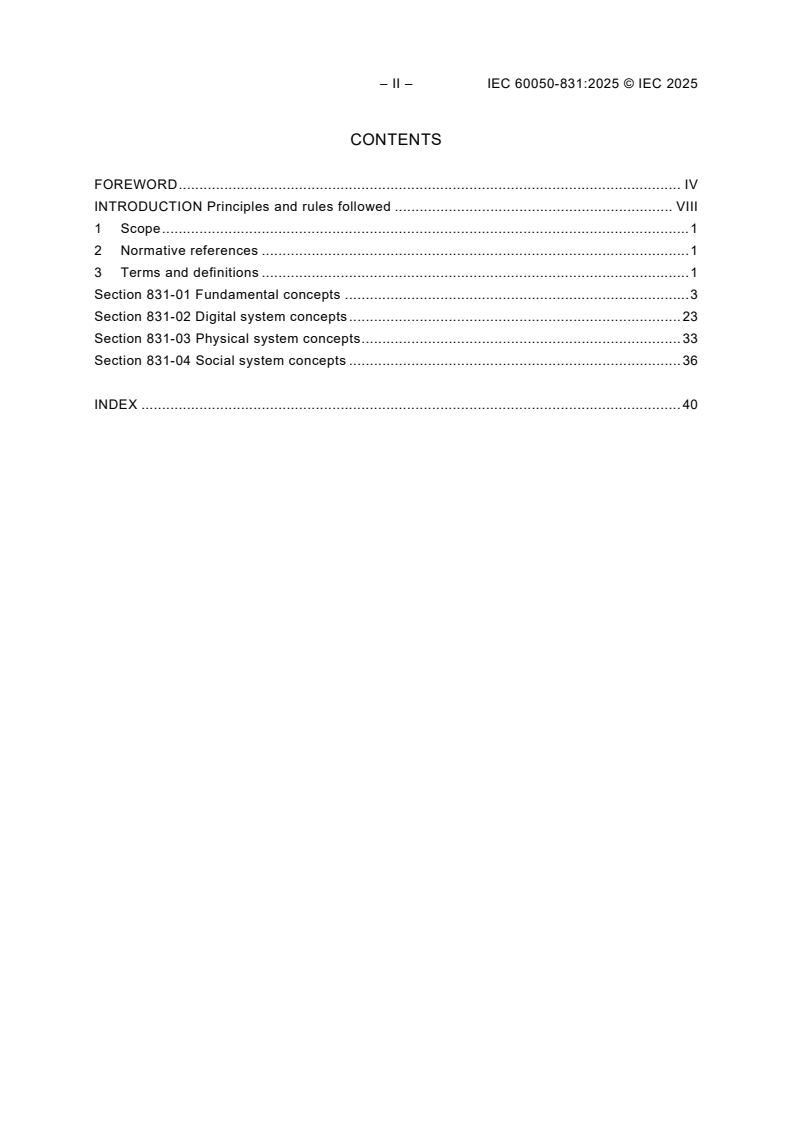
– II – IEC 60050-831:2025 © IEC 2025
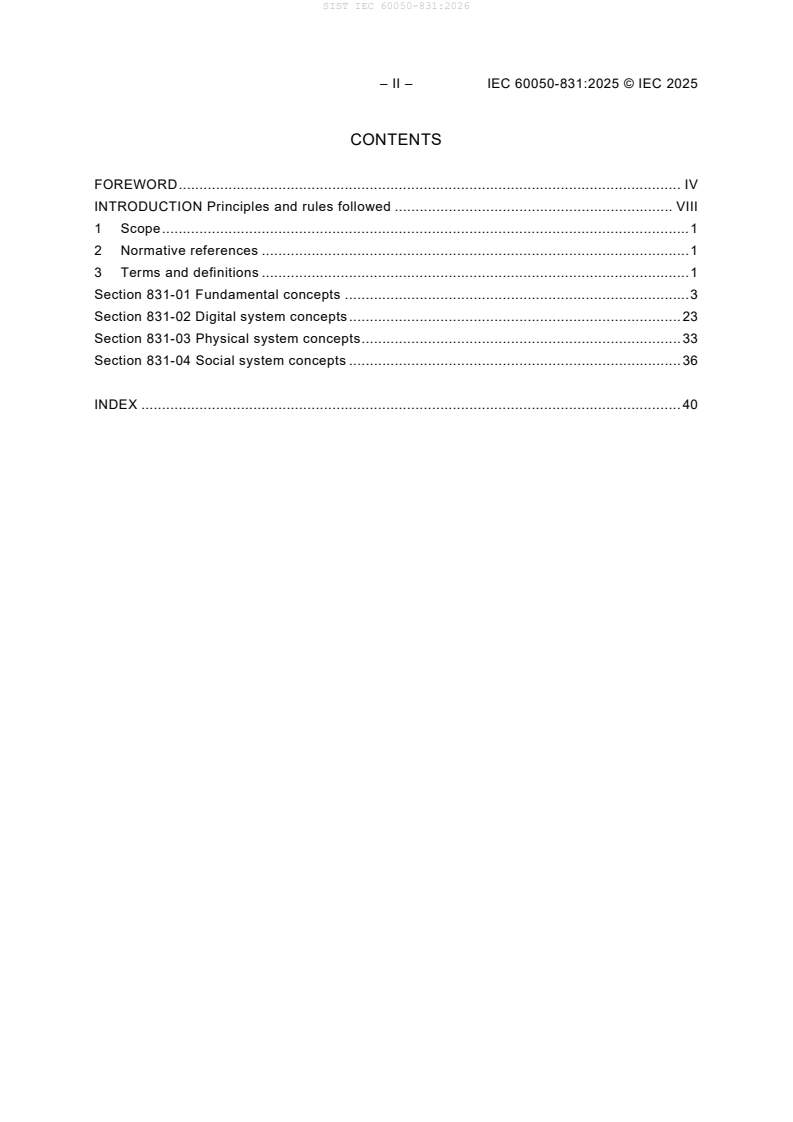
CONTENTS
FOREWORD . IV
INTRODUCTION Principles and rules followed . VIII
1 Scope . 1
2 Normative references . 1
3 Terms and definitions . 1
Section 831-01 Fundamental concepts . 3
Section 831-02 Digital system concepts . 23
Section 831-03 Physical system concepts . 33
Section 831-04 Social system concepts . 36
INDEX . 40
SOMMAIRE
AVANT-PROPOS . VI
INTRODUCTION Principes d'établissement et règles suivies . XI
1 Domaine d'application . 2
2 Références normatives . 2
3 Termes et définitions . 2
Section 831-01 Concepts fondamentaux . 3
Section 831-02 Concepts liés aux systèmes numériques . 23
Section 831-03 Concepts liés aux systèmes physiques . 33
Section 831-04 Concepts liés aux systèmes sociaux. 36
INDEX . 40
– IV – IEC 60050-831:2025 © IEC 2025
INTERNATIONAL ELECTROTECHNICAL COMMISSION
_______________
INTERNATIONAL ELECTROTECHNICAL VOCABULARY (IEV) –
Part 831: Smart city systems
FOREWORD
1) The International Electrotechnical Commission (IEC) is a worldwide organization for standardization comprising
all national electrotechnical committees (IEC National Committees). The object of IEC is to promote international
co-operation on all questions concerning standardization in the electrical and electronic fields. To this end and
in addition to other activities, IEC publishes International Standards, Technical Specifications, Technical Reports,
Publicly Available Specifications (PAS) and Guides (hereafter referred to as "IEC Publication(s)"). Their
preparation is entrusted to technical committees; any IEC National Committee interested in the subject dealt with
may participate in this preparatory work. International, governmental and non-governmental organizations liaising
with the IEC also participate in this preparation. IEC collaborates closely with the International Organization for
Standardization (ISO) in accordance with conditions determined by agreement between the two organizations.
2) The formal decisions or agreements of IEC on technical matters express, as nearly as possible, an international
consensus of opinion on the relevant subjects since each technical committee has representation from all
interested IEC National Committees.
3) IEC Publications have the form of recommendations for international use and are accepted by IEC National
Committees in that sense. While all reasonable efforts are made to ensure that the technical content of IEC
Publications is accurate, IEC cannot be held responsible for the way in which they are used or for any
misinterpretation by any end user.
4) In order to promote international uniformity, IEC National Committees undertake to apply IEC Publications
transparently to the maximum extent possible in their national and regional publications. Any divergence between
any IEC Publication and the corresponding national or regional publication shall be clearly indicated in the latter.
5) IEC itself does not provide any attestation of conformity. Independent certification bodies provide conformity
assessment services and, in some areas, access to IEC marks of conformity. IEC is not responsible for any
services carried out by independent certification bodies.
6) All users should ensure that they have the latest edition of this publication.
7) No liability shall attach to IEC or its directors, employees, servants or agents including individual experts and
members of its technical committees and IEC National Committees for any personal injury, property damage or
other damage of any nature whatsoever, whether direct or indirect, or for costs (including legal fees) and
expenses arising out of the publication, use of, or reliance upon, this IEC Publication or any other IEC
Publications.
8) Attention is drawn to the Normative references cited in this publication. Use of the referenced publications is
indispensable for the correct application of this publication.
9) Attention is drawn to the possibility that some of the elements of this IEC Publication may be the subject of patent
rights. IEC shall not be held responsible for identifying any or all such patent rights.
International Standard IEC 60050-831 has been prepared by IEC systems committee: Smart
Cities, under the responsibility of IEC technical committee 1: Terminology.
It has the status of a horizontal publication in accordance with IEC Guide 108.
The text of this standard is based on the following documents:
FDIS Report on voting
1/2614/FDIS 1/2621/RVD
Full information on the voting for the approval of this standard can be found in the report on
voting indicated in the above table.
This publication has been drafted in accordance with the ISO/IEC Directives, Part 2.
In this part of the IEV, the terms and definitions are provided in Arabic (ar), English (en), French
(fr) and Japanese (jp); in addition, the terms are given in Chinese (zh), Korean (ko), Polish (pl),
Portuguese (pt) and Spanish (es). A list of all parts of the IEC 60050 series, published under
the general title International Electrotechnical Vocabulary, can be found on the IEC website and
is available at www.electropedia.org.
– VI – IEC 60050-831:2025 © IEC 2025
COMMISSION ÉLECTROTECHNIQUE INTERNATIONALE
________________
VOCABULAIRE ÉLECTROTECHNIQUE INTERNATIONAL (IEV) –
Partie 831: Systèmes pour villes intelligentes
AVANT-PROPOS
1) La Commission Electrotechnique Internationale (IEC) est une organisation mondiale de normalisation composée
de l'ensemble des comités électrotechniques nationaux (Comités nationaux de l'IEC). L'IEC a pour objet de
favoriser la coopération internationale pour toutes les questions de normalisation dans les domaines de
l'électricité et de l'électronique. A cet effet, l'IEC – entre autres activités – publie des Normes internationales,
des Spécifications techniques, des Rapports techniques, des Spécifications accessibles au public (PAS) et des
Guides (ci-après dénommés "Publication(s) de l'IEC"). Leur élaboration est confiée à des comités d'études, aux
travaux desquels tout Comité national intéressé par le sujet traité peut participer. Les organisations
internationales, gouvernementales et non gouvernementales, en liaison avec l'IEC, participent également aux
travaux. L'IEC collabore étroitement avec l'Organisation Internationale de Normalisation (ISO), selon des
conditions fixées par accord entre les deux organisations.
2) Les décisions ou accords officiels de l'IEC concernant les questions techniques représentent, dans la mesure du
possible, un accord international sur les sujets étudiés, étant donné que les Comités nationaux de l'IEC intéressés
sont représentés dans chaque comité d'études.
3) Les Publications de l'IEC se présentent sous la forme de recommandations internationales et sont agréées
comme telles par les Comités nationaux de l'IEC. Tous les efforts raisonnables sont entrepris afin que l'IEC
s'assure de l'exactitude du contenu technique de ses publications; l'IEC ne peut pas être tenue responsable de
l'éventuelle mauvaise utilisation ou interprétation qui en est faite par un quelconque utilisateur final.
4) Dans le but d'encourager l'uniformité internationale, les Comités nationaux de l'IEC s'engagent, dans toute la
mesure possible, à appliquer de façon transparente les Publications de l'IEC dans leurs publications nationales
et régionales. Toutes divergences entre toutes Publications de l'IEC et toutes publications nationales ou
régionales correspondantes doivent être indiquées en termes clairs dans ces dernières.
5) L'IEC elle-même ne fournit aucune attestation de conformité. Des organismes de certification indépendants
fournissent des services d'évaluation de conformité et, dans certains secteurs, accèdent aux marques de
conformité de l'IEC. L'IEC n'est responsable d'aucun des services effectués par les organismes de certification
indépendants.
6) Tous les utilisateurs doivent s'assurer qu'ils sont en possession de la dernière édition de cette publication.
7) Aucune responsabilité ne doit être imputée à l'IEC, à ses administrateurs, employés, auxiliaires ou mandataires,
y compris ses experts particuliers et les membres de ses comités d'études et des Comités nationaux de l'IEC,
pour tout préjudice causé en cas de dommages corporels et matériels, ou de tout autre dommage de quelque
nature que ce soit, directe ou indirecte, ou pour supporter les coûts (y compris les frais de justice) et les dépenses
découlant de la publication ou de l'utilisation de cette Publication de l'IEC ou de toute autre Publication de l'IEC,
ou au crédit qui lui est accordé.
8) L'attention est attirée sur les références normatives citées dans cette publication. L'utilisation de publications
référencées est obligatoire pour une application correcte de la présente publication.
9) L'attention est attirée sur le fait que certains des éléments de la présente Publication de l'IEC peuvent faire l'objet
de droits de propriété intellectuelle ou de droits analogues. L'IEC ne saurait être tenue pour responsable de ne
pas avoir identifié de tels droits de propriété et de ne pas avoir signalé leur existence.
La Norme internationale IEC 60050-831 a été établie par le comité système de l'IEC: Aspects
Electrotechniques des Villes Intelligentes, sous la responsabilité du comité d'études 1 de l'IEC:
Terminologie.
Cette édition a le statut d'une publication horizontale conformément au Guide IEC 108.
Le texte de cette norme est issu des documents suivants:
FDIS Rapport de vote
1/2614/FDIS 1/2621/RVD
Le rapport de vote indiqué dans le tableau ci-dessus donne toute information sur le vote ayant
abouti à l'approbation de cette norme.
Cette publication a été rédigée selon les Directives ISO/IEC, Partie 2.
Dans la présente partie de l'IEV, les termes et définitions sont fournis en anglais (en), arabe
(ar), français (fr) et japonais (ja); de plus, les termes sont indiqués en chinois (zh), coréen (ko),
polonais (pl), portugais (pt) et espagnol (es).
Une liste de toutes les parties de la série IEC 60050, publiée sous le titre général Vocabulaire
Electrotechnique International, peut être consultée sur le site web de l'IEC et est disponible à
l'adresse www.electropedia.org.
– VIII – IEC 60050-831:2025 © IEC 2025
INTRODUCTION
Principles and rules followed
General
The IEV (IEC 60050, International Electrotechnical Vocabulary) is a general purpose
multilingual vocabulary covering the field of electrotechnology, electronics and
telecommunication (available at www.electropedia.org). It comprises about 22 600
terminological entries, each corresponding to a concept. These terminological entries are
distributed among about 97 parts, each part corresponding to a given field.
EXAMPLE
Part 161 (IEC 60050-161): Electromagnetic compatibility
Part 411 (IEC 60050-411): Rotating machinery
The terminological entries follow a hierarchical classification scheme part/section/concept;
within the sections, the terminological entries are organized in a systematic order.
The terms and definitions (and possibly non-verbal representations, examples, notes to entry
and sources) in the entries are given in two or more of the three IEC languages, that is to say
French, English and Russian (principal IEV languages).
In each terminological entry, the terms and definitions are also given in several of the additional
IEV languages [Arabic (ar), Chinese (zh), Croatian (hr), Czech (cs), Danish (da), Dutch (nl),
Dutch (Belgian) (nl BE), Finnish (fi), German (de), Italian (it), Japanese (ja), Korean (ko),
Mongolian (mn), Norwegian (no) [Bokmål (nb) and Nynorsk (nn)], Polish (pl), Portuguese (pt),
Russian (ru), Serbian (sr), Slovak (sk), Slovenian (sl), Spanish (es), Swedish (sv), Turkish (tr)
and Ukrainian (uk)].
Information regarding the IEV and the drafting and presentation of the terminological entries is
provided in the IEC Supplement to the ISO/IEC Directives, Annex SJ. The following constitutes
a summary of these rules.
Organization of a terminological entry
Each of the terminological entries corresponds to a concept, and comprises:
- an IEV number,
- possibly a letter symbol for the quantity or unit,
then, for the principal IEV languages present in the part:
- the term designating the concept, called "preferred term", possibly accompanied by
synonyms and abbreviations,
- the definition of the concept,
- possibly non-verbal representations, examples and notes to entry,
- possibly the source,
and finally, the terms and definitions are given in the additional IEV languages.
IEV number
The IEV number is comprised of three elements, separated by hyphens:
part number: 3 digits,
section number: 2 digits,
entry number: sequence of decimal digits in which leading zeroes are permissible but
redundant (e.g. 1 to 113, 01 to 99, 001 to 127).
EXAMPLE 845-27-003
Letter symbols for quantities and units
These symbols, which are language independent, are given on a separate line following the
IEV number.
EXAMPLE
131-12-04
R
resistance
Preferred term and synonyms
The preferred term is the term that heads a terminological entry in a given language; it can be
followed by synonyms. It is printed in boldface.
Synonyms:
The synonyms are printed on separate lines under the preferred term: preferred synonyms are
printed in boldface, and admitted and deprecated synonyms are printed in lightface. Deprecated
synonyms are prefixed by the text "DEPRECATED:".
Absence of an appropriate term:
When no appropriate term exists in a given language, the preferred term is replaced by five
dots, as follows:
.....
" " (and there are of course no synonyms).
Attributes
Each term (and synonym) can be followed by attributes giving additional information, and
printed in lightface on the same line as the corresponding term, following this term.
EXAMPLE
specific use of the term:
transmission line,
– X – IEC 60050-831:2025 © IEC 2025
national variant:
lift, GB
grammatical information:
quantize, verb
transient, noun
AC, adj
Definition
A definition shall contain all the characteristics of the concept necessary and sufficient to enable
the concept considered to be well understood and its boundaries to be defined.
EXAMPLE
131-11-19
non-linear, adj
qualifies a circuit element or a circuit for which not all relations between the integral
quantities are linear
Source
In some cases, it has been necessary to include in an IEV part a concept taken from another
IEV part, or from another authoritative terminology document (ISO/IEC Guide 99,
ISO/IEC 2382, etc.), either with or without modification to the definition (and possibly to the
term).
This is indicated by the mention of this source, printed in lightface, and placed at the end of the
terminological entry in each of the principal IEV languages present.
EXAMPLE SOURCE: IEC 60050-131:2002, 131-03-13, modified
Terms and definitions in additional IEV languages
These terms and definitions are placed following the terminological entries in the principal IEV
languages, on separate lines, preceded by the alpha-2 code for the language defined in
ISO 639-1, and in the alphabetic order of this code.
INTRODUCTION
Principes d'établissement et règles suivies
Généralités
L'IEV (IEC 60050 – Vocabulaire Electrotechnique International) est un vocabulaire multilingue
à usage général couvrant le champ de l'électrotechnique, de l'électronique et des
télécommunications (disponible à l'adresse www.electropedia.org). Il comprend environ 22 600
articles terminologiques correspondant chacun à un concept (une notion). Ces articles
terminologiques sont répartis dans environ 97 parties, chacune correspondant à un domaine
donné.
EXEMPLE
Partie 161 (IEC 60050-161): Compatibilité électromagnétique
Partie 411 (IEC 60050-411): Machines tournantes
Les articles terminologiques suivent un schéma de classification hiérarchique
partie/section/concept, les articles terminologiques étant, au sein des sections, classés dans
un ordre systématique.
Les termes et définitions (et éventuellement les représentations non verbales, exemples, notes
à l'article et sources) sont donnés dans deux des trois langues de l'IEC ou dans les trois, c'est-
à-dire en français, en anglais et en russe (langues principales de l'IEV).
Dans chaque article terminologique, les termes seuls sont également donnés dans plusieurs
des langues additionnelles de l'IEV [arabe (ar), chinois (zh), croate (hr), tchèque (cs), danois
(da), néerlandais (nl), néerlandais belge (nl BE), finnois (fi), allemand (de), italien (it), japonais
(ja), coréen (ko), mongol (mn), norvégien (no) [bokmål (nb) et nynorsk (nn)], polonais (pl),
portugais (pt), russe (ru), slovène (sl), serbe (sr), slovaque (sk), slovène (sl), espagnol (es),
suédois (sv), turc (tr) et ukrainien (uk)].
Des informations concernant l'IEV, la rédaction ainsi que la présentation des articles
terminologiques sont fournies dans le Supplément de l'IEC aux Directives ISO/IEC, à
l'Annexe SJ. Un résumé de ces règles est donné ci-dessous.
Constitution d'un article terminologique
Chacun des articles terminologique correspond à un concept, et comprend:
- un numéro IEV,
- éventuellement un symbole littéral de grandeur ou d'unité,
puis, pour chaque langue principale de l'IEV présente dans la partie:
- le terme désignant le concept, appelé "terme privilégié", éventuellement accompagné
de synonymes et d'abréviations,
- la définition du concept,
– XII – IEC 60050-831:2025 © IEC 2025
- éventuellement des représentations non verbales, des exemples et des notes à l'article,
- éventuellement la source,
et enfin, pour les termes et définitions sont fournis dans les langues additionnelles de l'IEV.
Numéro IEV
Le numéro IEV comprend trois éléments, séparés par des traits d'union:
numéro de partie: 3 chiffres,
numéro de section: 2 chiffres,
numéro d'article: série de chiffres décimaux dans laquelle les zéro initiaux sont permis
mais superflus (par exemple 1 à 113, 01 à 99, 001 à 127).
EXEMPLE 845-27-003
Symboles littéraux de grandeurs et d'unités
Ces symboles, indépendants de la langue, sont donnés sur une ligne séparée à la suite du
numéro IEV.
EXEMPLE
131-12-04
R
résistance, f
Terme privilégié et synonymes
Le terme privilégié est le terme qui figure en tête d'un article dans une langue donnée; il peut
être suivi par des synonymes. Il est imprimé en caractères gras.
Synonymes:
Les synonymes sont imprimés sur des lignes séparées sous le terme privilégié: les synonymes
privilégiés sont imprimés en caractères gras, et les synonymes admis et déconseillés sont
imprimés en caractères maigres. Les synonymes déconseillés sont précédés par le texte
"DÉCONSEILLÉ:".
Absence de terme approprié:
Lorsqu'il n'existe pas de terme approprié dans une langue, le terme privilégié est remplacé par
cinq points, comme ceci:
.....
" " (et il n'y a alors bien entendu pas de synonymes).
Attributs
Chaque terme (et synonyme) peut être suivi d'attributs donnant des informations
supplémentaires; ces attributs sont imprimés en caractères maigres, à la suite de ce terme, et
sur la même ligne.
EXEMPLE
spécificité d'utilisation du terme:
rang,
variante nationale:
unité de traitement, CA
catégorie grammaticale:
quantifier, verbe
électronique, f
électronique, adj
Définition
Une définition contient toutes les caractéristiques du concept nécessaires et suffisantes pour
permettre de bien comprendre le concept considéré et d'en définir les limites.
EXEMPLE
131-11-19
Non linéaire, qualificatif
qualifie un élément de circuit ou un circuit pour lequel les relations entre les grandeurs
intégrales ne sont pas toutes linéaires
Source
Dans certains cas, il a été nécessaire d'inclure dans une partie de l'IEV un concept pris dans
une autre partie de l'IEV, ou dans un autre document de terminologie faisant autorité
(Guide ISO/IEC 99, ISO/IEC 2382, etc.), avec ou sans modification de la définition (ou
éventuellement du terme).
Ceci est indiqué par la mention de cette source, imprimée en caractères maigres et placée à la
fin de l'article terminologique dans chacune des langues principales de l'IEV présentes.
EXEMPLE SOURCE: IEC 60050-131:2002, 131-03-13, modifié
Termes et définitions dans les langues additionnelles de l'IEV
– XIV – IEC 60050-831:2025 © IEC 2025
Ces termes et définitions sont placés à la fin des articles terminologiques dans les langues
principales de l'IEV, sur des lignes séparées, précédés par le code alpha-2 de la langue, défini
dans l'ISO 639-1, et dans l'ordre alphabétique de ce code.
– 1 – IEC 60050-831:2025 © IEC 2025
INTERNATIONAL ELECTROTECHNICAL VOCABULARY (IEV) –
Part 831: Smart city systems
1 Scope
This part of IEC 60050 gives the general terminology used in smart cities and smart city
systems, as well as general terms pertaining to specific applications and associated
technologies. It has the status of a horizontal publication in accordance with IEC Guide 108,
Guidelines for ensuring the coherence of IEC publications – Horizontal functions, horizontal
publications and their application.
This terminology is consistent with the terminology developed in the other specialized parts of
the IEV.
This horizontal publication is primarily intended for use by technical committees in the
preparation of IEC publications in accordance with the principles laid down in IEC Guide 108.
One of the responsibilities of a technical committee is, wherever applicable, to make use of
horizontal publications in the preparation of its publications.
At publication stage, for documents extracted from the Electropedia transfer the Clause 3
heading to page 1 and add the fixed text below.
2 Normative references
There are no normative references in this document.
3 Terms and definitions
The terms and definitions contained in this part of IEC 60050 were extracted from the
Electropedia (www.electropedia.org) (also known as the "IEV Online") – the world's most
comprehensive online terminology database covering the field of electrotechnology, electronics
and telecommunication.
VOCABULAIRE ÉLECTROTECHNIQUE INTERNATIONAL (IEV) –
Partie 831: Systèmes pour villes intelligentes
1 Domaine d'application
La présente partie de l'IEC 60050 donne la terminologie générale utilisée dans le domaine des
villes intelligentes et les systèmes pour villes intelligentes ainsi que les termes généraux relatifs
à des applications particulières et technologies associées. Elle a le statut de publication
horizontale conformément au Guide IEC 108, Lignes directrices pour assurer la cohérence des
publications de l'IEC – Fonctions horizontales, publications horizontales et leur application
(disponible en anglais seulement).
Cette terminologie est en accord avec la terminologie figurant dans les autres parties
spécialisées de l'IEV.
La présente publication horizontale est essentiellement destinée à l'usage des comités d'études
dans la préparation des publications de l'IEC, conformément aux principes établis dans le
Guide IEC 108.
L'une des responsabilités d'un comité d'études est d'utiliser, autant que possible, les
publications horizontales lors de la préparation de ses publications.
Au stade de publication, pour les documents extraits de l'Electropedia, transférer le titre de
l'Article 3 à la page 1 et rajouter le texte fixe ci-dessous.
2 Références normatives
Le présent document ne contient aucune référence normative.
3 Termes et définitions
Les termes et définitions contenus dans la présente partie de l'IEC 60050 ont été extraits de
l'Electropedia (www.electropedia.org) (également connue sous le nom "IEV Online") – la base
de données terminologique en ligne la plus complète couvrant le champ de l'électrotechnique,
de l'électronique et des télécommunications.
– 3 – IEC 60050-831:2025 © IEC 2025
831-01 Fundamental concepts
831-01 Concepts fondamentaux
831-01-01
architecture,
set of fundamental concepts or properties of the system in its environment, which is embodied by its
elements, relationships, and in the principles of its design and evolution
Note 1 to entry: This definition is derived from ISO/IEC/IEEE 42010:2011, 3.2.
Note 2 to entry: It is recommended that the set of fundamental concepts or properties of a system provides
necessary and sufficient information targeted to the purposes of the system.
SOURCE: IEV 741-01-03, modified – ‘embodied in’ has been changed to ‘which is embodied by’, Note 1
and Note 2 to entry have been added.
architecture, f
ensemble des concepts fondamentaux ou des propriétés d’un système dans son environnement qui est
exprimé par ses éléments, ses relations et dans les principes utilisés pour sa conception et son évolution
Note 1 à l’article: Cette définition est tirée de l’ISO/IEC/IEEE 42010:2011, 3.2.
Note 2 à l’article: Il est recommandé que l’ensemble des concepts fondamentaux ou des propriétés d’un
système fournisse des informations nécessaires et suffisantes (IEV 831-02-05) ciblées pour les besoins du
système en question.
SOURCE: IEV 741-01-03, modifié – « exprimé dans » a été modifié par « qui est exprimé par » Les Notes 1
et 2 à l’article ont été ajoutées.
ar
نﺎﯿﻨﺑ
هﺮﺻﺎﻨﻋ ﻲﻓ ﺪﺴﺠﺘﺗ ﻲﺘﻟوا ، (IEV 831-01-09) ﮫﺘﺌﯿﺑ ﻲﻓ (IEV 831-01-21) مﺎﻈﻨﻠﻟ ﺔﯿﺳﺎﺳﻷا ﺺﺋﺎﺼﺨﻟا أو ﻢﯿھﺎﻔﻤﻟا ﻦﻣ ﺔﻋﻮﻤﺠﻣ
ﻰﺻﻮﯾ: 2 ﺔﻈﺣﻼﻣ.ISO / IEC / IEEE 42010: 2011 ، 3.2 ﻦﻣ ﻒﯾﺮﻌﺘﻟا اﺬھ ﻖﺘﺸﻣ: 1 ﺔﻈﺣﻼﻣ رهﻮﻄﺗو ﮫﻤﯿﻤﺼﺗ دئﺎﺒﻣ ﻲﻓو ﮫﺗﺎﻗﻼﻋو
مﺎﻈﻨﻟا اضﺮﻏأ فﺪﮭﺘﺴﺗ (IEV 831-02-05) ﺔﯿﻓﺎﻛو ﺔﯾورﺮﺿ تﺎﻣﻮﻠﻌﻣ مﺎﻈﻨﻠﻟ ﺔﯿﺳﺎﺳﻷا ﺺﺋﺎﺼﺨﻟا أو ﻢﯿھﺎﻔﻤﻟا ﺔﻋﻮﻤﺠﻣ ﺮﻓﻮﺗ نﺄﺑ
es arquitectura, f
ja アーキテクチャ, <スマートシティシステム>
システムの環境における基本的な概念⼜は特性の集合であり、その要素、関係、及び設計と進化
との原則によって具体化される
注釈1: この定義はISO/IEC/IEEE 42010:2011の3.2による。
注釈2:システムの基本的な概念⼜は特性の集合は、システムの⽬的に的を絞った必要かつ⼗分な
情報を提供することが推奨される。
ko 아키텍처, <스마트 도시 시스템>
구조
pl architektura, f
pt arquitetura,
zh 架构, <智慧城市系统>
831-01-02
capability,
ability of an entity to do something at an agreed level of performance
Note 1 to entry: Examples of entities include cities and systems.
capacité, f
aptitude d’une entité à réaliser une action à un niveau de performance convenu
Note 1 à l’article: Les villes et les systèmes sont des exemples d’entités.
– 5 – IEC 60050-831:2025 © IEC 2025
ar
رةﺪﻘﻣ
IEV 831-) ﺔﻤﻈﻧﻷوا (IEV 831-01-03) نﺪﻤﻟا تﺎﻧﺎﯿﻜﻟا ﺔﻠﺜﻣأ ﻞﻤﺸﺗ: 1 ﺔﻈﺣﻼﻣداءﻷا ﻦﻣ ﮫﯿﻠﻋ ﻖﻔﺘﻣ ىﻮﺘﺴﻤﺑ ﺎﻣ ءﻲﺸﺑ مﺎﯿﻘﻠﻟ نﺎﯿﻜﻟا رةﺪﻗ
.(01-21
es capability, f
ja 能⼒, <スマートシティシステム>
合意されたパフォーマンス・レベルで実施するエンティティの能⼒
注釈1: エンティティの例には、都市、システムなどが含まれる。
ko 능력, <스마트 도시 시스템>
pl zdolność, f
pt capabilidade,
zh 能力, <智慧城市系统>
831-01-03
city,
built-up area or place with a name and defined geographical boundaries, considered together with its citizens
Note 1 to entry: A city can refer to a geographically located population of any size.
ville, f
zone bâtie ou endroit désigné par un nom et ayant des frontières géographiques définies, considéré
conjointement avec ses citoyens
Note 1 à l’article: Le terme "ville" peut désigner une population de toute taille, géographiquement localisée.
ar
<ﺔﯿﻛﺬﻟا ﺔﻨﯾﺪﻤﻟا مﺎﻈﻧ>, ﺔﻨﯾﺪﻣ
ﺐﺴﻨﺗ أن ﻦﻜﻤﯾ: 1 ﺔﻈﺣﻼﻣ(IEV 831-04-02) ﺎﮭﯿﻨاطﻮﻣ ﻊﻣ ﺎﻌﻣ ﺎﮭﯿﻓ ﺮﻈﻨﻟا ﻢﺘﯾ ، دةﺪﺤﻣ ﺔﯿﻓاﺮﻐﺠﻟا ودهﺪﺣو ﺎﻤﺳا ﻞﻤﺤﯾ ﺄﺸﻨﻣ نﺎﻜﻣ أو ﺔﻘﻄﻨﻣ
.ﻢﺠﺣ أي ﻦﻣ ﻲﻓاﺮﻐﺟ ﻊﻗﻮﻣ نﺎﻜﺳ ﻰﻟإ ﺔﻨﯾﺪﻤﻟا
es ciudad, f
ja 都市, <スマートシティシステム>
名前をもち、地理的な境界線で定義された、市⺠を含む、建物地域⼜は場所
注釈1: 都市とは、⼈⼝の多寡にかかわらず、地理的に位置するものをいう。
ko 도시, <스마트 도시 시스템>
pl miasto, n
pt cidade,
zh 城市, <智慧城市系统>
831-01-04
city function,
capability of a city to achieve a specified purpose or purposes
EXAMPLE Facilities and buildings management, energy management, water management, waste
management, public safety and security management, environment (nature) management, transportation
management, healthcare management, education management, social side management, economic
development management, culture and entertainment management.
fonction de ville, f
capacité d’une ville à atteindre un ou plusieurs objectifs spécifiés
EXEMPLE La gestion des installations et des bâtiments, la gestion de l’énergie, la gestion de l’eau, la
gestion des déchets, la gestion de la sûreté et de la sécurité du public, la gestion de l’environnement (nature),
la gestion des transports, la gestion de la santé, la gestion de l’éducation, la gestion sociale, la gestion du
développement économique, la gestion de la culture et des loisirs.
ar
<ﺔﯿﻛﺬﻟا ﺔﻨﯾﺪﻤﻟا مﺎﻈﻧ>, ﺔﻨﯾﺪﻤﻟا ﺔﻔﯿوظ
إدارة ، ﺔﻗﺎﻄﻟا إدارة ، ﻲﻧﺎﺒﻤﻟوا ﻖﻓاﺮﻤﻟا إدارة لﺎﺜﻣدةﺪﺤﻣ اضﺮﻏأ أو ضﺮﻏ ﻖﯿﻘﺤﺗ (IEV 831-01-03) ﺔﻨﯾﺪﻣ (IEV 831-01-02) رةﺪﻘﻣ
ﺐﻧﺎﺠﻟا إدارة ، ﻢﯿﻠﻌﺘﻟا إدارة ، ﺔﯿﺤﺼﻟا ﺔﯾﺎﻋﺮﻟا إدارة ، ﻞﻘﻨﻟا إدارة ، ﺔﺌﯿﺒﻟا إدارة ، ﻦﻣﻷوا ﺔﻣﺎﻌﻟا ﺔﻣﻼﺴﻟا إدارة ، تﺎﯾﺎﻔﻨﻟا إدارة ، هﺎﯿﻤﻟا
..ﮫﯿﻓﺮﺘﻟوا ﺔﻓﺎﻘﺜﻟا إدارة ، ﺔﯾدﺎﺼﺘﻗﻻا ﺔﯿﻤﻨﺘﻟا إدارة ، ﻲﻋﺎﻤﺘﺟﻻا
es función de la ciudad, f
ja 都市機能, <スマートシティシステム>
特定の⽬的⼜は⽬標を達成するための都市の能⼒
例 施設・建物管理、エネルギー管理、⽔管理、廃棄物管理、治安・安全管理、環境(⾃然)管
理、交通管理、医療管理、教育管理、社会⾯管理、経済発展管理、⽂化・娯楽管理
ko 도시 기능, <스마트 도시 시스템>
pl funkcjonalność miasta, f
pt função cidade,
zh 城市功能, <智慧城市系统>
831-01-05
community,
group of people with an arrangement of responsibilities, activities and relationships
Note 1 to entry: In many, but not all, contexts, a community has a defined geographical boundary.
Note 2 to entry: A city is a type of community.
SOURCE: ISO 37100:2016, 3.2.2
– 7 – IEC 60050-831:2025 © IEC 2025
communauté territoriale, f
ensemble de personnes avec des responsabilités, activités et relations
Note 1 à l’article: Dans de nombreux contextes, sans que cela soit universel, une communauté territoriale
possède une frontière géographique définie.
Note 2 à l’article: Une ville est un type de communauté territoriale.
SOURCE: ISO 37100:2016, 3.2.2
ar
ﻰﻠﺤﻣ ﻊﻤﺘﺠﻣ
ﻰﻠﺤﻤﻟا ﻊﻤﺘﺠﻤﻠﻟ نﻮﻜﯾ ،ﺎﮭﻠﻛ ﺲﯿﻟ ﻦﻜﻟو ت،ﺎﻗﺎﯿﺴﻟا ﻦﻣ ﺪﯾﺪﻌﻟا ﻲﻓ: 1 ﺔﻈﺣﻼﻤﺗﺎﻗﻼﻌﻟوا ﺔﻄﺸﻧﻷوا تﺎﯿﻟوﺆﺴﻤﻠﻟ ﺐﯿﺗﺮﺗ ﻊﻣ صﺎﺨﺷﻷا ﻦﻣ ﺔﻋﻮﻤﺠﻣ
.ﻰﻠﺤﻤﻟا ﻊﻤﺘﺠﻤﻟا ﻦﻣ عﻮﻧ ﻲھ (IEV 831-01-03) ﺔﻨﯾﺪﻤﻟا: 2 ﺔﻈﺣﻼﻣدةﺪﺤﻣ ﺔﯿﻓاﺮﻐﺟ ودﺪﺣ
es comunidad, f
ja コミュニティ, <スマートシティシステム>
責任、活動、及び関係性の取り決めをもつ⼈々の集団
注釈1: 全ての⽂脈に当てはまる訳ではないが、多くの場合、コミュニティは地理的な境界をも
つ。
注釈2 都市はコミュニティの⼀種である。
ko 공동체, <스마트 도시 시스템>
지역사회
pl społeczność, f
wspólnota, f
pt comunidade,
zh 社群, <智慧城市系统>
831-01-06
continuity,
ability of a service to respond to changing conditions, situations and events in order to continue operations at
an acceptable predefined level following a disruption
continuité, f
aptitude d’un service à répondre à des conditions, situations et événements changeants afin de poursuivre
l’exploitation à un niveau prédéfini acceptable après une interruption
ar
<ﺔﯿﻛﺬﻟا ﺔﻨﯾﺪﻤﻟا مﺎﻈﻧ>, ﺔﯾارﺮﻤﺘﺳا
دﺪﺤﻣ لﻮﺒﻘﻣ ىﻮﺘﺴﻣ ﺪﻨﻋ تﺎﯿﻠﻤﻌﻟا ﺔﻠﺻاﻮﻣ ﻞﺟأ ﻦﻣ ةﺮﯿﻐﺘﻤﻟا اثﺪﺣﻷوا ﻒﻗاﻮﻤﻟوا وفﺮﻈﻠﻟ ﺔﺑﺎﺠﺘﺳﻻا ﻰﻠﻋ (IEV 831-01-18)ﺔﻣﺪﺨﻟا رةﺪﻗ
عﺎﻄﻘﻧا وثﺪﺣ ﺪﻌﺑ ﺎًﻘﺒﺴﻣ
es continuidad, f
ja 継続性, <スマートシティシステム>
障害が発⽣した後、あらかじめ定義された許容可能なレベルで業務を継続するために、変化する
条件、状況、及び事象に対応するサービスの能⼒
ko 지속성, <스마트 도시 시스템>
연속성
pl ciągłość, f
pt continuidade,
zh 连续性, <智慧城市系统>
831-01-07
culture,
shared values, beliefs and behaviours of a community
SOURCE: ISO 56000:2020, 3.2.10, modified – “an organization or” has been deleted from the definition
culture, f
ensemble des valeurs, convictions et comportements partagés au sein d’une communauté territoriale
SOURCE: ISO 56000:2020, 3.2.10, modifié – "d’un organisme ou" a été supprimé de la définition
ar
<ﺔﯿﻛﺬﻟا ﺔﻨﯾﺪﻤﻟا مﺎﻈﻧ>, ﺔﻓﺎﻘﺛ
(IEV 831-01-05) ﻰﻠﺤﻤﻟا ﻊﻤﺘﺠﻤﻠﻟ ﺔﻛﺮﺘﺸﻤﻟا تﺎﯿﻛﻮﻠﺴﻟوا اتﺪﻘﺘﻌﻤﻟوا ﻢﯿﻘﻟا
es cultura, f
ja ⽂化, <スマートシティシステム>
コミュニティで共有される価値観、信念及び⾏動
ko 문화, <스마트 도시 시스템>
pl kultura, f
pt cultura,
zh 文化, <智慧城市系统>
– 9 – IEC 60050-831:2025 © IEC 2025
831-01-08
economy,
set of activities of a society comprising the production, distribution and trade, as well as consumption of
goods and services by different agents
Note 1 to entry: Understood in its broadest sense, the economy is defined as a social domain that emphasizes
the practices, discourses, and material expressions associated with the production, use, and management of
resources.
Note 2 to entry: The agents of the economy can be individuals, businesses, or governments.
Note 3 to entry: Economic transactions occur when two parties agree to the value or price of the transacted
good or service, commonly expressed in a certain currency. However, monetary transactions only account for
a small part of the economic domain.
économie, f
ensemble d’activités d’une société comprenant la production, la distribution et le commerce, ainsi que la
consommation de biens et de services par différents agents
Note 1 à l’article: Au sens le plus large, l’économie est définie comme un domaine social qui met l’accent sur
les pratiques, discours et expressions matérielles associés à la production, l’utilisation et la gestion des
ressources.
Note 2 à l’article: Les agents de l’économie peuvent être des individus, des entreprises ou des
administrations.
Note 3 à l’article: Des transactions économiques ont lieu lorsque deux parties s’accordent sur la valeur ou le
prix du bien ou service faisant l’objet d’une transaction, généralement exprimé dans une devise spécifique.
Cependant, les transactions monétaires ne représentent qu’une petite partie du domaine économique.
ar
دﺎﺼﺘﻗا
IEV 831-01-) تﺎﻣﺪﺨﻟوا ﻊﻠﺴﻟا كﻼﮭﺘﺳا ﻚﻟﺬﻛرة،وﺎﺠﺘﻟوا ﻊﯾزﻮﺘﻟوا جﺎﺘﻧﻹا ﻞﻤﺸﺗ ﻲﺘﻟا (IEV 831-04-04)ﻊﻤﺘﺠﻤﻟا ﺔﻄﺸﻧأ ﻦﻣ ﺔﻋﻮﻤﺠﻣ
اتﺮﯿﺒﻌﺘﻟوا تﺎﺑﺎﻄﺨﻟوا تﺎﺳرﺎﻤﻤﻟا ﻰﻠﻋ ﺰﻛﺮﯾ ﻲﻋﺎﻤﺘﺟا لﺎﺠﻣ ﮫﻧﺄﺑ ،ﻊﺳوﻷا هﺎﻨﻌﻤﺑ د،ﺎﺼﺘﻗﻻا فﱠﺮﻌُﯾ : 1 ﺔﻈﺣﻼﻣ ﻦﯿﻔﻠﺘﺨﻣ ءﻼﻛو ﻞﺒﻗ ﻦﻣ (18
:3 ﺔﻈﺣﻼﻣ.تﺎﻣﻮﻜﺣ أو تﺎﻛﺮﺷ أو ًداﺮﻓأ دﺎﺼﺘﻗﻻا ءﻼﻛو نﻮﻜﯾ أن ﻦﻜﻤﯾ: 2 ﺔﻈﺣﻼﻣ. ﺎﮭﺗوإدار ﺎﮭﻣاﺪﺨﺘﺳوا اردﻮﻤﻟا جﺎﺘﻧﺈﺑ ﺔﻄﺒﺗﺮﻤﻟا ﺔﯾدﺎﻤﻟا
ﻊﻣو ﺔﻨﯿﻌﻣ ﺔﻠﻤﻌﺑ ًةدﺎﻋ ﺎﮭﻨﻋ ﺮﯿﺒﻌﺘﻟا ﻢﺘﯾ ﻲﺘﻟوا ،ﺔﻣﺪﺨﻟا أو ﺔﻟاوﺪﺘﻤﻟا ﺔﻌﻠﺴﻟا ﺮﻌﺳ أو ﺔﻤﯿﻗ ﻰﻠﻋ نﺎﻓﺮﻄﻟا ﻖﻔﺘﯾ ﺎﻣﺪﻨﻋ ﺔﯾدﺎﺼﺘﻗﻻا تﻼﻣﺎﻌﻤﻟا ثﺪﺤﺗ
.ديﺎﺼﺘﻗﻻا لﺎﺠﻤﻟا ﻦﻣ ﺮﯿﻐﺻ ءﺰﺟ ىﻮﺳ ﻞﺜﻤﺗ ﻻ ﺔﯾﺪﻘﻨﻟا تﻼﻣﺎﻌﻤﻟا نﺈﻓ ،ﻚﻟذ
es economía, f
ja 経済, <スマートシティシステム>
さまざまな主体による商品及びサービスの⽣産、流通及び取引、消費からなる社会の⼀連の活動
の集合
注釈1: 最も広い意味で理解すると、経済とは、資源の⽣産、使⽤及び管理に関連する、慣⾏、⾔
説及び物質的表現に重きを置く社会的領域と定義される。
注釈2: 経済の主体は、個⼈、企業⼜は政府のいずれかである。
注釈3: 経済取引は、2つの当事者が取引される財⼜はサービスの価値⼜は価格に合意することで
発⽣する。しかし、⾦銭取引は経済領域のごく⼀部を占めるにすぎない。
ko 경제, <스마트 도시 시스템>
pl gospodarka, f
pt economia,
zh 经济, <智慧城市系统>
831-01-09
environment,
context determining the setting and circumstances of all influences upon the system
SOURCE: ISO/IEC/IEEE 24748-1:2018, 3.20
environnement, m
contexte déterminant le cadre et les circonstances de tous les facteurs ayant une influence sur un système
SOURCE: ISO/IEC/IEEE 24748-1:2018, 3.20
– 11 – IEC 60050-831:2025 © IEC 2025
ar
<ﺔﯿﻛﺬﻟا ﺔﻨﯾﺪﻤﻟا مﺎﻈﻧ>, ﺔﺌﯿﺑ
(IEV 831-01-21) مﺎﻈﻧ ﻰﻠﻋ اتﺮﯿﺛﺄﺘﻟا ﻊﯿﻤﺟ وفﺮوظ اداتﺪﻋإ دﺪﺤﯾ قﺎﯿﺳ
es medioambiente, m
ja 環境, <スマートシティシステム>
システムに及ぼすあらゆる影響の設定及び状況を決定する⽂脈
ko 환경, <스마트 도시 시스템>
pl środowisko, n
pt ambiente,
zh 环境, <智慧城市系统>
831-01-10
identifier,
information that unambiguously distinguishes one entity from other entities in a given identity context
SOURCE: IEV 741-01-21, modified – The concept “information” referred to in the definition is that in IEV
831-02-05 and not that in IEV 741-01-500
identificateur, m
information qui distingue sans aucune ambiguïté une entité d’autres entités dans un contexte d’identité donné
SOURCE: IEV 741-01-21, modifié – Le concept "information" auquel se réfère la définition est celui de
l’IEV 831-02-05, et non celui de l’IEV 741-01-500
ar
<ﺔﯿﻛﺬﻟا ﺔﻨﯾﺪﻤﻟا مﺎﻈﻧ>, فﺮﻌﻣ
ﻦﯿﻌﻣ نﺎﯿﻛ قﺎﯿﺳ ﻲﻓ ىﺮﺧﻷا تﺎﻧﺎﯿﻜﻟا ﻦﻋ (IEV 741-01-18) اًﺪﺣوا ﺎًﻧﺎﯿﻛ ﮫﯿﻓ ﺲﺒﻟ ﻻ ﻞﻜﺸﺑ ﺰﯿﻤﺗ ﻰﺘﻟا (IEV 831-02-05) تﺎﻣﻮﻠﻌﻤﻟا
(IEV 741-01-22)
es identificador, m
ja 識別⼦, <スマートシティシステム>
所定のアイデンティティコンテキスト内で 1 つのエンティティを他のエンティティから明確に区別
する情報
ko 식별자, <스마트 도시 시스템>
pl identyfikator, m
pt identificador,
zh 标识符, <智慧城市系统>
831-01-11
interoperability,
capability of diverse systems or system elements to work together for a specified purpose
interopérabilité, f
capacité de divers systèmes ou éléments de système à fonctionner ensemble dans un but spécifié
ar
<ﺔﯿﻛﺬﻟا ﺔﻨﯾﺪﻤﻟا مﺎﻈﻧ>, ،ﺔﯿﻘﻓاﻮﺗ
دﺪﺤﻣ ضﺮﻐﻟ ﺎﻌﻣ ﻞﻤﻌﺗ مﺎﻈﻧ ﺮﺻﺎﻨﻋ أو (IEV 831-01-21) ﺔﻋﻮﻨﺘﻣ ﺔﻤﻈﻧأ (IEC 831-01-02)رةﺪﻘﻣ
es interoperabilidad, f
ja 相互運⽤性, <スマートシティシステム>
特定の⽬的のために多様なシステム⼜はシステム要素が連携して動く能⼒
ko 상호 운용성, <스마트 도시 시스템>
pl zdolność do współdziałania, f
pt interoperabilidade,
zh 互操作性, <智慧城市系统>
831-01-12
life cycle,
See IEV 192-01-09
Note 1 to entry: The stages of a lifecycle can sometimes overlap or run in parallel.
cycle de vie, f
Voir IEV 192-01-09
Note 1 à l’article: Les étapes d’un cycle de vie peuvent parfois se chevaucher ou se dérouler en parallèle.
– 13 – IEC 60050-831:2025 © IEC 2025
ar
<ﺔﯿﻛﺬﻟا ﺔﻨﯾﺪﻤﻟا مﺎﻈﻧ>, ة،ﺎﯿﺤﻟا دورة
ازيﻮﺘﻟﺎﺑ ﻞﻤﻌﺗ أو ﺎًﻧﺎﯿﺣأ ةﺎﯿﺤﻟا دورة ﻞﺣاﺮﻣ ﻞﺧاﺪﺘﺗ ﺪﻗ: 1 ﺔﻈﺣﻼﻣ IEV 192-01-09 ﺮﻈﻧا
es ciclo de vida, m
ja ライフサイクル, <スマートシティシステム>
IEV 192-01-09参照
注記注釈1:ライフサイクルの各段階は、時に重複し、並⾏して実⾏される可能性がある。
ko 수명 주기, <스마트 도시 시스템>
pl cykl życia, m
pt ciclo de vida,
zh 生命周期, <智慧城市系统>
寿命周期
831-01-13
maintenance
See IEV 192-06-01
maintenance
Voir IEV 192-06-01
ar
<ﺔﯿﻛﺬﻟا ﺔﻨﯾﺪﻤﻟا مﺎﻈﻧ>, ،ﺔﻧﺎﯿﺻ
IEV 192-06-01 ﺮﻈﻧا
es mantenimiento, m
ja メンテナンス, <スマートシティシステム>
IEV 192-06-01参照
ko 유지 보수, <스마트 도시 시스템>
pl utrzymanie ruchu,
...
IEC 60050-831 ®
Edition 1.0 2025-03
INTERNATIONAL
STANDARD
NORME
INTERNATIONALE
HORIZONTAL PUBLICATION
PUBLICATION HORIZONTALE
International Electrotechnical Vocabulary (IEV) –
Part 831: Smart city systems
Vocabulaire Electrotechnique International (IEV) –
Partie 831: Systèmes pour villes intelligentes
All rights reserved. Unless otherwise specified, no part of this publication may be reproduced or utilized in any form
or by any means, electronic or mechanical, including photocopying and microfilm, without permission in writing from
either IEC or IEC's member National Committee in the country of the requester. If you have any questions about IEC
copyright or have an enquiry about obtaining additional rights to this publication, please contact the address below or
your local IEC member National Committee for further information.
Droits de reproduction réservés. Sauf indication contraire, aucune partie de cette publication ne peut être reproduite ni
utilisée sous quelque forme que ce soit et par aucun procédé, électronique ou mécanique, y compris la photocopie et
les microfilms, sans l'accord écrit de l'IEC ou du Comité national de l'IEC du pays du demandeur. Si vous avez des
questions sur le copyright de l'IEC ou si vous désirez obtenir des droits supplémentaires sur cette publication, utilisez
les coordonnées ci-après ou contactez le Comité national de l'IEC de votre pays de résidence.
IEC Secretariat Tel.: +41 22 919 02 11
3, rue de Varembé info@iec.ch
CH-1211 Geneva 20 www.iec.ch
Switzerland
About the IEC
The International Electrotechnical Commission (IEC) is the leading global organization that prepares and publishes
International Standards for all electrical, electronic and related technologies.
About IEC publications
The technical content of IEC publications is kept under constant review by the IEC. Please make sure that you have the
latest edition, a corrigendum or an amendment might have been published.
IEC publications search - webstore.iec.ch/advsearchform IEC Products & Services Portal - products.iec.ch
The advanced search enables to find IEC publications by a Discover our powerful search engine and read freely all the
variety of criteria (reference number, text, technical publications previews, graphical symbols and the glossary.
committee, …). It also gives information on projects, replaced With a subscription you will always have access to up to date
and withdrawn publications. content tailored to your needs.
IEC Just Published - webstore.iec.ch/justpublished
Electropedia - www.electropedia.org
Stay up to date on all new IEC publications. Just Published
The world's leading online dictionary on electrotechnology,
details all new publications released. Available online and once
containing more than 22 500 terminological entries in English
a month by email.
and French, with equivalent terms in 25 additional languages.
Also known as the International Electrotechnical Vocabulary
IEC Customer Service Centre - webstore.iec.ch/csc
(IEV) online.
If you wish to give us your feedback on this publication or need
further assistance, please contact the Customer Service
Centre: sales@iec.ch.
A propos de l'IEC
La Commission Electrotechnique Internationale (IEC) est la première organisation mondiale qui élabore et publie des
Normes internationales pour tout ce qui a trait à l'électricité, à l'électronique et aux technologies apparentées.
A propos des publications IEC
Le contenu technique des publications IEC est constamment revu. Veuillez vous assurer que vous possédez l’édition la
plus récente, un corrigendum ou amendement peut avoir été publié.
Recherche de publications IEC - IEC Products & Services Portal - products.iec.ch
webstore.iec.ch/advsearchform Découvrez notre puissant moteur de recherche et consultez
La recherche avancée permet de trouver des publications IEC gratuitement tous les aperçus des publications, symboles
en utilisant différents critères (numéro de référence, texte, graphiques et le glossaire. Avec un abonnement, vous aurez
comité d’études, …). Elle donne aussi des informations sur les toujours accès à un contenu à jour adapté à vos besoins.
projets et les publications remplacées ou retirées.
Electropedia - www.electropedia.org
IEC Just Published - webstore.iec.ch/justpublished
Le premier dictionnaire d'électrotechnologie en ligne au monde,
Restez informé sur les nouvelles publications IEC. Just
avec plus de 22 500 articles terminologiques en anglais et en
Published détaille les nouvelles publications parues.
français, ainsi que les termes équivalents dans 25 langues
Disponible en ligne et une fois par mois par email.
additionnelles. Egalement appelé Vocabulaire
Electrotechnique International (IEV) en ligne.
Service Clients - webstore.iec.ch/csc
Si vous désirez nous donner des commentaires sur cette
publication ou si vous avez des questions contactez-nous:
sales@iec.ch.
IEC 60050-831 ®
Edition 1.0 2025-03
INTERNATIONAL
STANDARD
NORME
INTERNATIONALE
HORIZONTAL PUBLICATION
PUBLICATION HORIZONTALE
International Electrotechnical Vocabulary (IEV) –
Part 831: Smart city systems
Vocabulaire Electrotechnique International (IEV) –
Partie 831: Systèmes pour villes intelligentes
INTERNATIONAL
ELECTROTECHNICAL
COMMISSION
COMMISSION
ELECTROTECHNIQUE
INTERNATIONALE
ICS 01.040.01, 03.100.70, 13.020.20 ISBN 978-2-8327-0204-8
– II – IEC 60050-831:2025 © IEC 2025
CONTENTS
FOREWORD . IV
INTRODUCTION Principles and rules followed . VIII
1 Scope . 1
2 Normative references . 1
3 Terms and definitions . 1
Section 831-01 Fundamental concepts . 3
Section 831-02 Digital system concepts . 23
Section 831-03 Physical system concepts . 33
Section 831-04 Social system concepts . 36
INDEX . 40
SOMMAIRE
AVANT-PROPOS . VI
INTRODUCTION Principes d'établissement et règles suivies . XI
1 Domaine d'application . 2
2 Références normatives . 2
3 Termes et définitions . 2
Section 831-01 Concepts fondamentaux . 3
Section 831-02 Concepts liés aux systèmes numériques . 23
Section 831-03 Concepts liés aux systèmes physiques . 33
Section 831-04 Concepts liés aux systèmes sociaux. 36
INDEX . 40
– IV – IEC 60050-831:2025 © IEC 2025
INTERNATIONAL ELECTROTECHNICAL COMMISSION
_______________
INTERNATIONAL ELECTROTECHNICAL VOCABULARY (IEV) –
Part 831: Smart city systems
FOREWORD
1) The International Electrotechnical Commission (IEC) is a worldwide organization for standardization comprising
all national electrotechnical committees (IEC National Committees). The object of IEC is to promote international
co-operation on all questions concerning standardization in the electrical and electronic fields. To this end and
in addition to other activities, IEC publishes International Standards, Technical Specifications, Technical Reports,
Publicly Available Specifications (PAS) and Guides (hereafter referred to as "IEC Publication(s)"). Their
preparation is entrusted to technical committees; any IEC National Committee interested in the subject dealt with
may participate in this preparatory work. International, governmental and non-governmental organizations liaising
with the IEC also participate in this preparation. IEC collaborates closely with the International Organization for
Standardization (ISO) in accordance with conditions determined by agreement between the two organizations.
2) The formal decisions or agreements of IEC on technical matters express, as nearly as possible, an international
consensus of opinion on the relevant subjects since each technical committee has representation from all
interested IEC National Committees.
3) IEC Publications have the form of recommendations for international use and are accepted by IEC National
Committees in that sense. While all reasonable efforts are made to ensure that the technical content of IEC
Publications is accurate, IEC cannot be held responsible for the way in which they are used or for any
misinterpretation by any end user.
4) In order to promote international uniformity, IEC National Committees undertake to apply IEC Publications
transparently to the maximum extent possible in their national and regional publications. Any divergence between
any IEC Publication and the corresponding national or regional publication shall be clearly indicated in the latter.
5) IEC itself does not provide any attestation of conformity. Independent certification bodies provide conformity
assessment services and, in some areas, access to IEC marks of conformity. IEC is not responsible for any
services carried out by independent certification bodies.
6) All users should ensure that they have the latest edition of this publication.
7) No liability shall attach to IEC or its directors, employees, servants or agents including individual experts and
members of its technical committees and IEC National Committees for any personal injury, property damage or
other damage of any nature whatsoever, whether direct or indirect, or for costs (including legal fees) and
expenses arising out of the publication, use of, or reliance upon, this IEC Publication or any other IEC
Publications.
8) Attention is drawn to the Normative references cited in this publication. Use of the referenced publications is
indispensable for the correct application of this publication.
9) Attention is drawn to the possibility that some of the elements of this IEC Publication may be the subject of patent
rights. IEC shall not be held responsible for identifying any or all such patent rights.
International Standard IEC 60050-831 has been prepared by IEC systems committee: Smart
Cities, under the responsibility of IEC technical committee 1: Terminology.
It has the status of a horizontal publication in accordance with IEC Guide 108.
The text of this standard is based on the following documents:
FDIS Report on voting
1/2614/FDIS 1/2621/RVD
Full information on the voting for the approval of this standard can be found in the report on
voting indicated in the above table.
This publication has been drafted in accordance with the ISO/IEC Directives, Part 2.
In this part of the IEV, the terms and definitions are provided in Arabic (ar), English (en), French
(fr) and Japanese (jp); in addition, the terms are given in Chinese (zh), Korean (ko), Polish (pl),
Portuguese (pt) and Spanish (es). A list of all parts of the IEC 60050 series, published under
the general title International Electrotechnical Vocabulary, can be found on the IEC website and
is available at www.electropedia.org.
– VI – IEC 60050-831:2025 © IEC 2025
COMMISSION ÉLECTROTECHNIQUE INTERNATIONALE
________________
VOCABULAIRE ÉLECTROTECHNIQUE INTERNATIONAL (IEV) –
Partie 831: Systèmes pour villes intelligentes
AVANT-PROPOS
1) La Commission Electrotechnique Internationale (IEC) est une organisation mondiale de normalisation composée
de l'ensemble des comités électrotechniques nationaux (Comités nationaux de l'IEC). L'IEC a pour objet de
favoriser la coopération internationale pour toutes les questions de normalisation dans les domaines de
l'électricité et de l'électronique. A cet effet, l'IEC – entre autres activités – publie des Normes internationales,
des Spécifications techniques, des Rapports techniques, des Spécifications accessibles au public (PAS) et des
Guides (ci-après dénommés "Publication(s) de l'IEC"). Leur élaboration est confiée à des comités d'études, aux
travaux desquels tout Comité national intéressé par le sujet traité peut participer. Les organisations
internationales, gouvernementales et non gouvernementales, en liaison avec l'IEC, participent également aux
travaux. L'IEC collabore étroitement avec l'Organisation Internationale de Normalisation (ISO), selon des
conditions fixées par accord entre les deux organisations.
2) Les décisions ou accords officiels de l'IEC concernant les questions techniques représentent, dans la mesure du
possible, un accord international sur les sujets étudiés, étant donné que les Comités nationaux de l'IEC intéressés
sont représentés dans chaque comité d'études.
3) Les Publications de l'IEC se présentent sous la forme de recommandations internationales et sont agréées
comme telles par les Comités nationaux de l'IEC. Tous les efforts raisonnables sont entrepris afin que l'IEC
s'assure de l'exactitude du contenu technique de ses publications; l'IEC ne peut pas être tenue responsable de
l'éventuelle mauvaise utilisation ou interprétation qui en est faite par un quelconque utilisateur final.
4) Dans le but d'encourager l'uniformité internationale, les Comités nationaux de l'IEC s'engagent, dans toute la
mesure possible, à appliquer de façon transparente les Publications de l'IEC dans leurs publications nationales
et régionales. Toutes divergences entre toutes Publications de l'IEC et toutes publications nationales ou
régionales correspondantes doivent être indiquées en termes clairs dans ces dernières.
5) L'IEC elle-même ne fournit aucune attestation de conformité. Des organismes de certification indépendants
fournissent des services d'évaluation de conformité et, dans certains secteurs, accèdent aux marques de
conformité de l'IEC. L'IEC n'est responsable d'aucun des services effectués par les organismes de certification
indépendants.
6) Tous les utilisateurs doivent s'assurer qu'ils sont en possession de la dernière édition de cette publication.
7) Aucune responsabilité ne doit être imputée à l'IEC, à ses administrateurs, employés, auxiliaires ou mandataires,
y compris ses experts particuliers et les membres de ses comités d'études et des Comités nationaux de l'IEC,
pour tout préjudice causé en cas de dommages corporels et matériels, ou de tout autre dommage de quelque
nature que ce soit, directe ou indirecte, ou pour supporter les coûts (y compris les frais de justice) et les dépenses
découlant de la publication ou de l'utilisation de cette Publication de l'IEC ou de toute autre Publication de l'IEC,
ou au crédit qui lui est accordé.
8) L'attention est attirée sur les références normatives citées dans cette publication. L'utilisation de publications
référencées est obligatoire pour une application correcte de la présente publication.
9) L'attention est attirée sur le fait que certains des éléments de la présente Publication de l'IEC peuvent faire l'objet
de droits de propriété intellectuelle ou de droits analogues. L'IEC ne saurait être tenue pour responsable de ne
pas avoir identifié de tels droits de propriété et de ne pas avoir signalé leur existence.
La Norme internationale IEC 60050-831 a été établie par le comité système de l'IEC: Aspects
Electrotechniques des Villes Intelligentes, sous la responsabilité du comité d'études 1 de l'IEC:
Terminologie.
Cette édition a le statut d'une publication horizontale conformément au Guide IEC 108.
Le texte de cette norme est issu des documents suivants:
FDIS Rapport de vote
1/2614/FDIS 1/2621/RVD
Le rapport de vote indiqué dans le tableau ci-dessus donne toute information sur le vote ayant
abouti à l'approbation de cette norme.
Cette publication a été rédigée selon les Directives ISO/IEC, Partie 2.
Dans la présente partie de l'IEV, les termes et définitions sont fournis en anglais (en), arabe
(ar), français (fr) et japonais (ja); de plus, les termes sont indiqués en chinois (zh), coréen (ko),
polonais (pl), portugais (pt) et espagnol (es).
Une liste de toutes les parties de la série IEC 60050, publiée sous le titre général Vocabulaire
Electrotechnique International, peut être consultée sur le site web de l'IEC et est disponible à
l'adresse www.electropedia.org.
– VIII – IEC 60050-831:2025 © IEC 2025
INTRODUCTION
Principles and rules followed
General
The IEV (IEC 60050, International Electrotechnical Vocabulary) is a general purpose
multilingual vocabulary covering the field of electrotechnology, electronics and
telecommunication (available at www.electropedia.org). It comprises about 22 600
terminological entries, each corresponding to a concept. These terminological entries are
distributed among about 97 parts, each part corresponding to a given field.
EXAMPLE
Part 161 (IEC 60050-161): Electromagnetic compatibility
Part 411 (IEC 60050-411): Rotating machinery
The terminological entries follow a hierarchical classification scheme part/section/concept;
within the sections, the terminological entries are organized in a systematic order.
The terms and definitions (and possibly non-verbal representations, examples, notes to entry
and sources) in the entries are given in two or more of the three IEC languages, that is to say
French, English and Russian (principal IEV languages).
In each terminological entry, the terms and definitions are also given in several of the additional
IEV languages [Arabic (ar), Chinese (zh), Croatian (hr), Czech (cs), Danish (da), Dutch (nl),
Dutch (Belgian) (nl BE), Finnish (fi), German (de), Italian (it), Japanese (ja), Korean (ko),
Mongolian (mn), Norwegian (no) [Bokmål (nb) and Nynorsk (nn)], Polish (pl), Portuguese (pt),
Russian (ru), Serbian (sr), Slovak (sk), Slovenian (sl), Spanish (es), Swedish (sv), Turkish (tr)
and Ukrainian (uk)].
Information regarding the IEV and the drafting and presentation of the terminological entries is
provided in the IEC Supplement to the ISO/IEC Directives, Annex SJ. The following constitutes
a summary of these rules.
Organization of a terminological entry
Each of the terminological entries corresponds to a concept, and comprises:
- an IEV number,
- possibly a letter symbol for the quantity or unit,
then, for the principal IEV languages present in the part:
- the term designating the concept, called "preferred term", possibly accompanied by
synonyms and abbreviations,
- the definition of the concept,
- possibly non-verbal representations, examples and notes to entry,
- possibly the source,
and finally, the terms and definitions are given in the additional IEV languages.
IEV number
The IEV number is comprised of three elements, separated by hyphens:
part number: 3 digits,
section number: 2 digits,
entry number: sequence of decimal digits in which leading zeroes are permissible but
redundant (e.g. 1 to 113, 01 to 99, 001 to 127).
EXAMPLE 845-27-003
Letter symbols for quantities and units
These symbols, which are language independent, are given on a separate line following the
IEV number.
EXAMPLE
131-12-04
R
resistance
Preferred term and synonyms
The preferred term is the term that heads a terminological entry in a given language; it can be
followed by synonyms. It is printed in boldface.
Synonyms:
The synonyms are printed on separate lines under the preferred term: preferred synonyms are
printed in boldface, and admitted and deprecated synonyms are printed in lightface. Deprecated
synonyms are prefixed by the text "DEPRECATED:".
Absence of an appropriate term:
When no appropriate term exists in a given language, the preferred term is replaced by five
dots, as follows:
.....
" " (and there are of course no synonyms).
Attributes
Each term (and synonym) can be followed by attributes giving additional information, and
printed in lightface on the same line as the corresponding term, following this term.
EXAMPLE
specific use of the term:
transmission line,
– X – IEC 60050-831:2025 © IEC 2025
national variant:
lift, GB
grammatical information:
quantize, verb
transient, noun
AC, adj
Definition
A definition shall contain all the characteristics of the concept necessary and sufficient to enable
the concept considered to be well understood and its boundaries to be defined.
EXAMPLE
131-11-19
non-linear, adj
qualifies a circuit element or a circuit for which not all relations between the integral
quantities are linear
Source
In some cases, it has been necessary to include in an IEV part a concept taken from another
IEV part, or from another authoritative terminology document (ISO/IEC Guide 99,
ISO/IEC 2382, etc.), either with or without modification to the definition (and possibly to the
term).
This is indicated by the mention of this source, printed in lightface, and placed at the end of the
terminological entry in each of the principal IEV languages present.
EXAMPLE SOURCE: IEC 60050-131:2002, 131-03-13, modified
Terms and definitions in additional IEV languages
These terms and definitions are placed following the terminological entries in the principal IEV
languages, on separate lines, preceded by the alpha-2 code for the language defined in
ISO 639-1, and in the alphabetic order of this code.
INTRODUCTION
Principes d'établissement et règles suivies
Généralités
L'IEV (IEC 60050 – Vocabulaire Electrotechnique International) est un vocabulaire multilingue
à usage général couvrant le champ de l'électrotechnique, de l'électronique et des
télécommunications (disponible à l'adresse www.electropedia.org). Il comprend environ 22 600
articles terminologiques correspondant chacun à un concept (une notion). Ces articles
terminologiques sont répartis dans environ 97 parties, chacune correspondant à un domaine
donné.
EXEMPLE
Partie 161 (IEC 60050-161): Compatibilité électromagnétique
Partie 411 (IEC 60050-411): Machines tournantes
Les articles terminologiques suivent un schéma de classification hiérarchique
partie/section/concept, les articles terminologiques étant, au sein des sections, classés dans
un ordre systématique.
Les termes et définitions (et éventuellement les représentations non verbales, exemples, notes
à l'article et sources) sont donnés dans deux des trois langues de l'IEC ou dans les trois, c'est-
à-dire en français, en anglais et en russe (langues principales de l'IEV).
Dans chaque article terminologique, les termes seuls sont également donnés dans plusieurs
des langues additionnelles de l'IEV [arabe (ar), chinois (zh), croate (hr), tchèque (cs), danois
(da), néerlandais (nl), néerlandais belge (nl BE), finnois (fi), allemand (de), italien (it), japonais
(ja), coréen (ko), mongol (mn), norvégien (no) [bokmål (nb) et nynorsk (nn)], polonais (pl),
portugais (pt), russe (ru), slovène (sl), serbe (sr), slovaque (sk), slovène (sl), espagnol (es),
suédois (sv), turc (tr) et ukrainien (uk)].
Des informations concernant l'IEV, la rédaction ainsi que la présentation des articles
terminologiques sont fournies dans le Supplément de l'IEC aux Directives ISO/IEC, à
l'Annexe SJ. Un résumé de ces règles est donné ci-dessous.
Constitution d'un article terminologique
Chacun des articles terminologique correspond à un concept, et comprend:
- un numéro IEV,
- éventuellement un symbole littéral de grandeur ou d'unité,
puis, pour chaque langue principale de l'IEV présente dans la partie:
- le terme désignant le concept, appelé "terme privilégié", éventuellement accompagné
de synonymes et d'abréviations,
- la définition du concept,
– XII – IEC 60050-831:2025 © IEC 2025
- éventuellement des représentations non verbales, des exemples et des notes à l'article,
- éventuellement la source,
et enfin, pour les termes et définitions sont fournis dans les langues additionnelles de l'IEV.
Numéro IEV
Le numéro IEV comprend trois éléments, séparés par des traits d'union:
numéro de partie: 3 chiffres,
numéro de section: 2 chiffres,
numéro d'article: série de chiffres décimaux dans laquelle les zéro initiaux sont permis
mais superflus (par exemple 1 à 113, 01 à 99, 001 à 127).
EXEMPLE 845-27-003
Symboles littéraux de grandeurs et d'unités
Ces symboles, indépendants de la langue, sont donnés sur une ligne séparée à la suite du
numéro IEV.
EXEMPLE
131-12-04
R
résistance, f
Terme privilégié et synonymes
Le terme privilégié est le terme qui figure en tête d'un article dans une langue donnée; il peut
être suivi par des synonymes. Il est imprimé en caractères gras.
Synonymes:
Les synonymes sont imprimés sur des lignes séparées sous le terme privilégié: les synonymes
privilégiés sont imprimés en caractères gras, et les synonymes admis et déconseillés sont
imprimés en caractères maigres. Les synonymes déconseillés sont précédés par le texte
"DÉCONSEILLÉ:".
Absence de terme approprié:
Lorsqu'il n'existe pas de terme approprié dans une langue, le terme privilégié est remplacé par
cinq points, comme ceci:
.....
" " (et il n'y a alors bien entendu pas de synonymes).
Attributs
Chaque terme (et synonyme) peut être suivi d'attributs donnant des informations
supplémentaires; ces attributs sont imprimés en caractères maigres, à la suite de ce terme, et
sur la même ligne.
EXEMPLE
spécificité d'utilisation du terme:
rang,
variante nationale:
unité de traitement, CA
catégorie grammaticale:
quantifier, verbe
électronique, f
électronique, adj
Définition
Une définition contient toutes les caractéristiques du concept nécessaires et suffisantes pour
permettre de bien comprendre le concept considéré et d'en définir les limites.
EXEMPLE
131-11-19
Non linéaire, qualificatif
qualifie un élément de circuit ou un circuit pour lequel les relations entre les grandeurs
intégrales ne sont pas toutes linéaires
Source
Dans certains cas, il a été nécessaire d'inclure dans une partie de l'IEV un concept pris dans
une autre partie de l'IEV, ou dans un autre document de terminologie faisant autorité
(Guide ISO/IEC 99, ISO/IEC 2382, etc.), avec ou sans modification de la définition (ou
éventuellement du terme).
Ceci est indiqué par la mention de cette source, imprimée en caractères maigres et placée à la
fin de l'article terminologique dans chacune des langues principales de l'IEV présentes.
EXEMPLE SOURCE: IEC 60050-131:2002, 131-03-13, modifié
Termes et définitions dans les langues additionnelles de l'IEV
– XIV – IEC 60050-831:2025 © IEC 2025
Ces termes et définitions sont placés à la fin des articles terminologiques dans les langues
principales de l'IEV, sur des lignes séparées, précédés par le code alpha-2 de la langue, défini
dans l'ISO 639-1, et dans l'ordre alphabétique de ce code.
– 1 – IEC 60050-831:2025 © IEC 2025
INTERNATIONAL ELECTROTECHNICAL VOCABULARY (IEV) –
Part 831: Smart city systems
1 Scope
This part of IEC 60050 gives the general terminology used in smart cities and smart city
systems, as well as general terms pertaining to specific applications and associated
technologies. It has the status of a horizontal publication in accordance with IEC Guide 108,
Guidelines for ensuring the coherence of IEC publications – Horizontal functions, horizontal
publications and their application.
This terminology is consistent with the terminology developed in the other specialized parts of
the IEV.
This horizontal publication is primarily intended for use by technical committees in the
preparation of IEC publications in accordance with the principles laid down in IEC Guide 108.
One of the responsibilities of a technical committee is, wherever applicable, to make use of
horizontal publications in the preparation of its publications.
At publication stage, for documents extracted from the Electropedia transfer the Clause 3
heading to page 1 and add the fixed text below.
2 Normative references
There are no normative references in this document.
3 Terms and definitions
The terms and definitions contained in this part of IEC 60050 were extracted from the
Electropedia (www.electropedia.org) (also known as the "IEV Online") – the world's most
comprehensive online terminology database covering the field of electrotechnology, electronics
and telecommunication.
VOCABULAIRE ÉLECTROTECHNIQUE INTERNATIONAL (IEV) –
Partie 831: Systèmes pour villes intelligentes
1 Domaine d'application
La présente partie de l'IEC 60050 donne la terminologie générale utilisée dans le domaine des
villes intelligentes et les systèmes pour villes intelligentes ainsi que les termes généraux relatifs
à des applications particulières et technologies associées. Elle a le statut de publication
horizontale conformément au Guide IEC 108, Lignes directrices pour assurer la cohérence des
publications de l'IEC – Fonctions horizontales, publications horizontales et leur application
(disponible en anglais seulement).
Cette terminologie est en accord avec la terminologie figurant dans les autres parties
spécialisées de l'IEV.
La présente publication horizontale est essentiellement destinée à l'usage des comités d'études
dans la préparation des publications de l'IEC, conformément aux principes établis dans le
Guide IEC 108.
L'une des responsabilités d'un comité d'études est d'utiliser, autant que possible, les
publications horizontales lors de la préparation de ses publications.
Au stade de publication, pour les documents extraits de l'Electropedia, transférer le titre de
l'Article 3 à la page 1 et rajouter le texte fixe ci-dessous.
2 Références normatives
Le présent document ne contient aucune référence normative.
3 Termes et définitions
Les termes et définitions contenus dans la présente partie de l'IEC 60050 ont été extraits de
l'Electropedia (www.electropedia.org) (également connue sous le nom "IEV Online") – la base
de données terminologique en ligne la plus complète couvrant le champ de l'électrotechnique,
de l'électronique et des télécommunications.
– 3 – IEC 60050-831:2025 © IEC 2025
831-01 Fundamental concepts
831-01 Concepts fondamentaux
831-01-01
architecture,
set of fundamental concepts or properties of the system in its environment, which is embodied by its
elements, relationships, and in the principles of its design and evolution
Note 1 to entry: This definition is derived from ISO/IEC/IEEE 42010:2011, 3.2.
Note 2 to entry: It is recommended that the set of fundamental concepts or properties of a system provides
necessary and sufficient information targeted to the purposes of the system.
SOURCE: IEV 741-01-03, modified – ‘embodied in’ has been changed to ‘which is embodied by’, Note 1
and Note 2 to entry have been added.
architecture, f
ensemble des concepts fondamentaux ou des propriétés d’un système dans son environnement qui est
exprimé par ses éléments, ses relations et dans les principes utilisés pour sa conception et son évolution
Note 1 à l’article: Cette définition est tirée de l’ISO/IEC/IEEE 42010:2011, 3.2.
Note 2 à l’article: Il est recommandé que l’ensemble des concepts fondamentaux ou des propriétés d’un
système fournisse des informations nécessaires et suffisantes (IEV 831-02-05) ciblées pour les besoins du
système en question.
SOURCE: IEV 741-01-03, modifié – « exprimé dans » a été modifié par « qui est exprimé par » Les Notes 1
et 2 à l’article ont été ajoutées.
ar
نﺎﯿﻨﺑ
هﺮﺻﺎﻨﻋ ﻲﻓ ﺪﺴﺠﺘﺗ ﻲﺘﻟوا ، (IEV 831-01-09) ﮫﺘﺌﯿﺑ ﻲﻓ (IEV 831-01-21) مﺎﻈﻨﻠﻟ ﺔﯿﺳﺎﺳﻷا ﺺﺋﺎﺼﺨﻟا أو ﻢﯿھﺎﻔﻤﻟا ﻦﻣ ﺔﻋﻮﻤﺠﻣ
ﻰﺻﻮﯾ: 2 ﺔﻈﺣﻼﻣ.ISO / IEC / IEEE 42010: 2011 ، 3.2 ﻦﻣ ﻒﯾﺮﻌﺘﻟا اﺬھ ﻖﺘﺸﻣ: 1 ﺔﻈﺣﻼﻣ رهﻮﻄﺗو ﮫﻤﯿﻤﺼﺗ دئﺎﺒﻣ ﻲﻓو ﮫﺗﺎﻗﻼﻋو
مﺎﻈﻨﻟا اضﺮﻏأ فﺪﮭﺘﺴﺗ (IEV 831-02-05) ﺔﯿﻓﺎﻛو ﺔﯾورﺮﺿ تﺎﻣﻮﻠﻌﻣ مﺎﻈﻨﻠﻟ ﺔﯿﺳﺎﺳﻷا ﺺﺋﺎﺼﺨﻟا أو ﻢﯿھﺎﻔﻤﻟا ﺔﻋﻮﻤﺠﻣ ﺮﻓﻮﺗ نﺄﺑ
es arquitectura, f
ja アーキテクチャ, <スマートシティシステム>
システムの環境における基本的な概念⼜は特性の集合であり、その要素、関係、及び設計と進化
との原則によって具体化される
注釈1: この定義はISO/IEC/IEEE 42010:2011の3.2による。
注釈2:システムの基本的な概念⼜は特性の集合は、システムの⽬的に的を絞った必要かつ⼗分な
情報を提供することが推奨される。
ko 아키텍처, <스마트 도시 시스템>
구조
pl architektura, f
pt arquitetura,
zh 架构, <智慧城市系统>
831-01-02
capability,
ability of an entity to do something at an agreed level of performance
Note 1 to entry: Examples of entities include cities and systems.
capacité, f
aptitude d’une entité à réaliser une action à un niveau de performance convenu
Note 1 à l’article: Les villes et les systèmes sont des exemples d’entités.
– 5 – IEC 60050-831:2025 © IEC 2025
ar
رةﺪﻘﻣ
IEV 831-) ﺔﻤﻈﻧﻷوا (IEV 831-01-03) نﺪﻤﻟا تﺎﻧﺎﯿﻜﻟا ﺔﻠﺜﻣأ ﻞﻤﺸﺗ: 1 ﺔﻈﺣﻼﻣداءﻷا ﻦﻣ ﮫﯿﻠﻋ ﻖﻔﺘﻣ ىﻮﺘﺴﻤﺑ ﺎﻣ ءﻲﺸﺑ مﺎﯿﻘﻠﻟ نﺎﯿﻜﻟا رةﺪﻗ
.(01-21
es capability, f
ja 能⼒, <スマートシティシステム>
合意されたパフォーマンス・レベルで実施するエンティティの能⼒
注釈1: エンティティの例には、都市、システムなどが含まれる。
ko 능력, <스마트 도시 시스템>
pl zdolność, f
pt capabilidade,
zh 能力, <智慧城市系统>
831-01-03
city,
built-up area or place with a name and defined geographical boundaries, considered together with its citizens
Note 1 to entry: A city can refer to a geographically located population of any size.
ville, f
zone bâtie ou endroit désigné par un nom et ayant des frontières géographiques définies, considéré
conjointement avec ses citoyens
Note 1 à l’article: Le terme "ville" peut désigner une population de toute taille, géographiquement localisée.
ar
<ﺔﯿﻛﺬﻟا ﺔﻨﯾﺪﻤﻟا مﺎﻈﻧ>, ﺔﻨﯾﺪﻣ
ﺐﺴﻨﺗ أن ﻦﻜﻤﯾ: 1 ﺔﻈﺣﻼﻣ(IEV 831-04-02) ﺎﮭﯿﻨاطﻮﻣ ﻊﻣ ﺎﻌﻣ ﺎﮭﯿﻓ ﺮﻈﻨﻟا ﻢﺘﯾ ، دةﺪﺤﻣ ﺔﯿﻓاﺮﻐﺠﻟا ودهﺪﺣو ﺎﻤﺳا ﻞﻤﺤﯾ ﺄﺸﻨﻣ نﺎﻜﻣ أو ﺔﻘﻄﻨﻣ
.ﻢﺠﺣ أي ﻦﻣ ﻲﻓاﺮﻐﺟ ﻊﻗﻮﻣ نﺎﻜﺳ ﻰﻟإ ﺔﻨﯾﺪﻤﻟا
es ciudad, f
ja 都市, <スマートシティシステム>
名前をもち、地理的な境界線で定義された、市⺠を含む、建物地域⼜は場所
注釈1: 都市とは、⼈⼝の多寡にかかわらず、地理的に位置するものをいう。
ko 도시, <스마트 도시 시스템>
pl miasto, n
pt cidade,
zh 城市, <智慧城市系统>
831-01-04
city function,
capability of a city to achieve a specified purpose or purposes
EXAMPLE Facilities and buildings management, energy management, water management, waste
management, public safety and security management, environment (nature) management, transportation
management, healthcare management, education management, social side management, economic
development management, culture and entertainment management.
fonction de ville, f
capacité d’une ville à atteindre un ou plusieurs objectifs spécifiés
EXEMPLE La gestion des installations et des bâtiments, la gestion de l’énergie, la gestion de l’eau, la
gestion des déchets, la gestion de la sûreté et de la sécurité du public, la gestion de l’environnement (nature),
la gestion des transports, la gestion de la santé, la gestion de l’éducation, la gestion sociale, la gestion du
développement économique, la gestion de la culture et des loisirs.
ar
<ﺔﯿﻛﺬﻟا ﺔﻨﯾﺪﻤﻟا مﺎﻈﻧ>, ﺔﻨﯾﺪﻤﻟا ﺔﻔﯿوظ
إدارة ، ﺔﻗﺎﻄﻟا إدارة ، ﻲﻧﺎﺒﻤﻟوا ﻖﻓاﺮﻤﻟا إدارة لﺎﺜﻣدةﺪﺤﻣ اضﺮﻏأ أو ضﺮﻏ ﻖﯿﻘﺤﺗ (IEV 831-01-03) ﺔﻨﯾﺪﻣ (IEV 831-01-02) رةﺪﻘﻣ
ﺐﻧﺎﺠﻟا إدارة ، ﻢﯿﻠﻌﺘﻟا إدارة ، ﺔﯿﺤﺼﻟا ﺔﯾﺎﻋﺮﻟا إدارة ، ﻞﻘﻨﻟا إدارة ، ﺔﺌﯿﺒﻟا إدارة ، ﻦﻣﻷوا ﺔﻣﺎﻌﻟا ﺔﻣﻼﺴﻟا إدارة ، تﺎﯾﺎﻔﻨﻟا إدارة ، هﺎﯿﻤﻟا
..ﮫﯿﻓﺮﺘﻟوا ﺔﻓﺎﻘﺜﻟا إدارة ، ﺔﯾدﺎﺼﺘﻗﻻا ﺔﯿﻤﻨﺘﻟا إدارة ، ﻲﻋﺎﻤﺘﺟﻻا
es función de la ciudad, f
ja 都市機能, <スマートシティシステム>
特定の⽬的⼜は⽬標を達成するための都市の能⼒
例 施設・建物管理、エネルギー管理、⽔管理、廃棄物管理、治安・安全管理、環境(⾃然)管
理、交通管理、医療管理、教育管理、社会⾯管理、経済発展管理、⽂化・娯楽管理
ko 도시 기능, <스마트 도시 시스템>
pl funkcjonalność miasta, f
pt função cidade,
zh 城市功能, <智慧城市系统>
831-01-05
community,
group of people with an arrangement of responsibilities, activities and relationships
Note 1 to entry: In many, but not all, contexts, a community has a defined geographical boundary.
Note 2 to entry: A city is a type of community.
SOURCE: ISO 37100:2016, 3.2.2
– 7 – IEC 60050-831:2025 © IEC 2025
communauté territoriale, f
ensemble de personnes avec des responsabilités, activités et relations
Note 1 à l’article: Dans de nombreux contextes, sans que cela soit universel, une communauté territoriale
possède une frontière géographique définie.
Note 2 à l’article: Une ville est un type de communauté territoriale.
SOURCE: ISO 37100:2016, 3.2.2
ar
ﻰﻠﺤﻣ ﻊﻤﺘﺠﻣ
ﻰﻠﺤﻤﻟا ﻊﻤﺘﺠﻤﻠﻟ نﻮﻜﯾ ،ﺎﮭﻠﻛ ﺲﯿﻟ ﻦﻜﻟو ت،ﺎﻗﺎﯿﺴﻟا ﻦﻣ ﺪﯾﺪﻌﻟا ﻲﻓ: 1 ﺔﻈﺣﻼﻤﺗﺎﻗﻼﻌﻟوا ﺔﻄﺸﻧﻷوا تﺎﯿﻟوﺆﺴﻤﻠﻟ ﺐﯿﺗﺮﺗ ﻊﻣ صﺎﺨﺷﻷا ﻦﻣ ﺔﻋﻮﻤﺠﻣ
.ﻰﻠﺤﻤﻟا ﻊﻤﺘﺠﻤﻟا ﻦﻣ عﻮﻧ ﻲھ (IEV 831-01-03) ﺔﻨﯾﺪﻤﻟا: 2 ﺔﻈﺣﻼﻣدةﺪﺤﻣ ﺔﯿﻓاﺮﻐﺟ ودﺪﺣ
es comunidad, f
ja コミュニティ, <スマートシティシステム>
責任、活動、及び関係性の取り決めをもつ⼈々の集団
注釈1: 全ての⽂脈に当てはまる訳ではないが、多くの場合、コミュニティは地理的な境界をも
つ。
注釈2 都市はコミュニティの⼀種である。
ko 공동체, <스마트 도시 시스템>
지역사회
pl społeczność, f
wspólnota, f
pt comunidade,
zh 社群, <智慧城市系统>
831-01-06
continuity,
ability of a service to respond to changing conditions, situations and events in order to continue operations at
an acceptable predefined level following a disruption
continuité, f
aptitude d’un service à répondre à des conditions, situations et événements changeants afin de poursuivre
l’exploitation à un niveau prédéfini acceptable après une interruption
ar
<ﺔﯿﻛﺬﻟا ﺔﻨﯾﺪﻤﻟا مﺎﻈﻧ>, ﺔﯾارﺮﻤﺘﺳا
دﺪﺤﻣ لﻮﺒﻘﻣ ىﻮﺘﺴﻣ ﺪﻨﻋ تﺎﯿﻠﻤﻌﻟا ﺔﻠﺻاﻮﻣ ﻞﺟأ ﻦﻣ ةﺮﯿﻐﺘﻤﻟا اثﺪﺣﻷوا ﻒﻗاﻮﻤﻟوا وفﺮﻈﻠﻟ ﺔﺑﺎﺠﺘﺳﻻا ﻰﻠﻋ (IEV 831-01-18)ﺔﻣﺪﺨﻟا رةﺪﻗ
عﺎﻄﻘﻧا وثﺪﺣ ﺪﻌﺑ ﺎًﻘﺒﺴﻣ
es continuidad, f
ja 継続性, <スマートシティシステム>
障害が発⽣した後、あらかじめ定義された許容可能なレベルで業務を継続するために、変化する
条件、状況、及び事象に対応するサービスの能⼒
ko 지속성, <스마트 도시 시스템>
연속성
pl ciągłość, f
pt continuidade,
zh 连续性, <智慧城市系统>
831-01-07
culture,
shared values, beliefs and behaviours of a community
SOURCE: ISO 56000:2020, 3.2.10, modified – “an organization or” has been deleted from the definition
culture, f
ensemble des valeurs, convictions et comportements partagés au sein d’une communauté territoriale
SOURCE: ISO 56000:2020, 3.2.10, modifié – "d’un organisme ou" a été supprimé de la définition
ar
<ﺔﯿﻛﺬﻟا ﺔﻨﯾﺪﻤﻟا مﺎﻈﻧ>, ﺔﻓﺎﻘﺛ
(IEV 831-01-05) ﻰﻠﺤﻤﻟا ﻊﻤﺘﺠﻤﻠﻟ ﺔﻛﺮﺘﺸﻤﻟا تﺎﯿﻛﻮﻠﺴﻟوا اتﺪﻘﺘﻌﻤﻟوا ﻢﯿﻘﻟا
es cultura, f
ja ⽂化, <スマートシティシステム>
コミュニティで共有される価値観、信念及び⾏動
ko 문화, <스마트 도시 시스템>
pl kultura, f
pt cultura,
zh 文化, <智慧城市系统>
– 9 – IEC 60050-831:2025 © IEC 2025
831-01-08
economy,
set of activities of a society comprising the production, distribution and trade, as well as consumption of
goods and services by different agents
Note 1 to entry: Understood in its broadest sense, the economy is defined as a social domain that emphasizes
the practices, discourses, and material expressions associated with the production, use, and management of
resources.
Note 2 to entry: The agents of the economy can be individuals, businesses, or governments.
Note 3 to entry: Economic transactions occur when two parties agree to the value or price of the transacted
good or service, commonly expressed in a certain currency. However, monetary transactions only account for
a small part of the economic domain.
économie, f
ensemble d’activités d’une société comprenant la production, la distribution et le commerce, ainsi que la
consommation de biens et de services par différents agents
Note 1 à l’article: Au sens le plus large, l’économie est définie comme un domaine social qui met l’accent sur
les pratiques, discours et expressions matérielles associés à la production, l’utilisation et la gestion des
ressources.
Note 2 à l’article: Les agents de l’économie peuvent être des individus, des entreprises ou des
administrations.
Note 3 à l’article: Des transactions économiques ont lieu lorsque deux parties s’accordent sur la valeur ou le
prix du bien ou service faisant l’objet d’une transaction, généralement exprimé dans une devise spécifique.
Cependant, les transactions monétaires ne représentent qu’une petite partie du domaine économique.
ar
دﺎﺼﺘﻗا
IEV 831-01-) تﺎﻣﺪﺨﻟوا ﻊﻠﺴﻟا كﻼﮭﺘﺳا ﻚﻟﺬﻛرة،وﺎﺠﺘﻟوا ﻊﯾزﻮﺘﻟوا جﺎﺘﻧﻹا ﻞﻤﺸﺗ ﻲﺘﻟا (IEV 831-04-04)ﻊﻤﺘﺠﻤﻟا ﺔﻄﺸﻧأ ﻦﻣ ﺔﻋﻮﻤﺠﻣ
اتﺮﯿﺒﻌﺘﻟوا تﺎﺑﺎﻄﺨﻟوا تﺎﺳرﺎﻤﻤﻟا ﻰﻠﻋ ﺰﻛﺮﯾ ﻲﻋﺎﻤﺘﺟا لﺎﺠﻣ ﮫﻧﺄﺑ ،ﻊﺳوﻷا هﺎﻨﻌﻤﺑ د،ﺎﺼﺘﻗﻻا فﱠﺮﻌُﯾ : 1 ﺔﻈﺣﻼﻣ ﻦﯿﻔﻠﺘﺨﻣ ءﻼﻛو ﻞﺒﻗ ﻦﻣ (18
:3 ﺔﻈﺣﻼﻣ.تﺎﻣﻮﻜﺣ أو تﺎﻛﺮﺷ أو ًداﺮﻓأ دﺎﺼﺘﻗﻻا ءﻼﻛو نﻮﻜﯾ أن ﻦﻜﻤﯾ: 2 ﺔﻈﺣﻼﻣ. ﺎﮭﺗوإدار ﺎﮭﻣاﺪﺨﺘﺳوا اردﻮﻤﻟا جﺎﺘﻧﺈﺑ ﺔﻄﺒﺗﺮﻤﻟا ﺔﯾدﺎﻤﻟا
ﻊﻣو ﺔﻨﯿﻌﻣ ﺔﻠﻤﻌﺑ ًةدﺎﻋ ﺎﮭﻨﻋ ﺮﯿﺒﻌﺘﻟا ﻢﺘﯾ ﻲﺘﻟوا ،ﺔﻣﺪﺨﻟا أو ﺔﻟاوﺪﺘﻤﻟا ﺔﻌﻠﺴﻟا ﺮﻌﺳ أو ﺔﻤﯿﻗ ﻰﻠﻋ نﺎﻓﺮﻄﻟا ﻖﻔﺘﯾ ﺎﻣﺪﻨﻋ ﺔﯾدﺎﺼﺘﻗﻻا تﻼﻣﺎﻌﻤﻟا ثﺪﺤﺗ
.ديﺎﺼﺘﻗﻻا لﺎﺠﻤﻟا ﻦﻣ ﺮﯿﻐﺻ ءﺰﺟ ىﻮﺳ ﻞﺜﻤﺗ ﻻ ﺔﯾﺪﻘﻨﻟا تﻼﻣﺎﻌﻤﻟا نﺈﻓ ،ﻚﻟذ
es economía, f
ja 経済, <スマートシティシステム>
さまざまな主体による商品及びサービスの⽣産、流通及び取引、消費からなる社会の⼀連の活動
の集合
注釈1: 最も広い意味で理解すると、経済とは、資源の⽣産、使⽤及び管理に関連する、慣⾏、⾔
説及び物質的表現に重きを置く社会的領域と定義される。
注釈2: 経済の主体は、個⼈、企業⼜は政府のいずれかである。
注釈3: 経済取引は、2つの当事者が取引される財⼜はサービスの価値⼜は価格に合意することで
発⽣する。しかし、⾦銭取引は経済領域のごく⼀部を占めるにすぎない。
ko 경제, <스마트 도시 시스템>
pl gospodarka, f
pt economia,
zh 经济, <智慧城市系统>
831-01-09
environment,
context determining the setting and circumstances
...