

IEC 62902:2025
(Main)Secondary cells and batteries - Marking symbols for identification of their chemistry
General Information
- Abstract
IEC 62902:2025 specifies methods for the clear identification of secondary cells, batteries, battery modules and monoblocs according to their chemistry (electrochemical storage technology).
The markings described in this document are applicable to
- secondary cells,
- batteries,
- battery modules, and
- monoblocs,
when they are placed on the market for end use and when their battery volume exceeds 900 cm3.
The chemistry marking is useful for the installation, operation and decommissioning phases in the battery's life cycle.
This document defines the conditions of use of the markings indicating the chemistry of these secondary batteries.
- Status
- Published
- Publication Date
- 25-Feb-2025
- Technical Committee
- TC 21 - Secondary cells and batteries
- Drafting Committee
- MT 62902 - TC 21/MT 62902
- Current Stage
- PPUB - Publication issued
- Start Date
- 26-Feb-2025
- Completion Date
- 21-Jan-2025
Buy Documents
IEC 62902:2025 RLV - Secondary cells and batteries - Marking symbols for identification of their chemistry Released:2/26/2025
IEC 62902:2025 - Secondary cells and batteries - Marking symbols for identification of their chemistry/26/2025
Overview
IEC 62902:2025 - "Secondary cells and batteries - Marking symbols for identification of their chemistry" (Edition 2.0, 2025) specifies standardized marking symbols and rules to identify the electrochemical chemistry of secondary cells, batteries, battery modules and monoblocs placed on the market for end use. The standard applies when the battery volume exceeds 900 cm³. Its intent is to improve safety and traceability across installation, operation and decommissioning phases by enabling clear visual identification of battery chemistry (e.g., lead‑acid, Ni‑Cd, Ni‑MH, Li‑ion, lithium metal).
Key Topics
- Scope & applicability: Marks required for cells, batteries, modules and monoblocs >900 cm³ when placed on the market for end use.
- Marking types: Defined symbols and text for markings with and without an optional recycling symbol.
- Chemistries covered: Lead‑acid, nickel‑cadmium (Ni‑Cd), nickel metal hydride (Ni‑MH), lithium‑ion (Li‑ion) and lithium metal; scheme extensible as other chemistries gain market share.
- Design rules: Dimensions, character design, frame/contrast and background‑colour guidance (including exemptions and clarifications).
- Adaptive size: Rules for sizing markings to fit varying battery surfaces.
- Durability & permanence: Test procedures and acceptance criteria for resistance to water, cleaning agents, electrolytes and neutralizing solutions to ensure markings remain legible throughout life cycle.
- Battery volume calculation: Added method for consistent determination of the 900 cm³ threshold.
- Additional Li‑ion details: Extra chemistry information options for Li‑ion batteries to aid sorting and recycling.
Applications
Who uses IEC 62902:2025 and why:
- Battery manufacturers & OEMs: Apply uniform chemistry markings to new products for market compliance.
- Recyclers & waste‑management facilities: Rapidly identify chemistries to prevent improper processing (reducing fire/explosion risk).
- Transporters & storage operators: Support safe handling and segregation by chemistry.
- Installers & maintenance teams: Ensure correct system integration and end‑of‑life procedures.
- Regulators & procurement specialists: Reference in procurement specs, labeling legislation, and conformity schemes.
Practical benefits include safer recycling/sorting workflows, reduced accidental mixing of incompatible chemistries (notably Li‑ion in lead‑acid streams), and improved lifecycle traceability.
Related standards
- IEC 62902:2025 is maintained by IEC TC 21 (Secondary cells and batteries). For full implementation consult the normative references cited in the standard and applicable transport, waste‑management and national labeling regulations (e.g., UN transport regulations and local recycling laws) as relevant to your region.
Relations
- Effective Date
- 05-Sep-2023
Buy Documents
IEC 62902:2025 RLV - Secondary cells and batteries - Marking symbols for identification of their chemistry Released:2/26/2025
IEC 62902:2025 - Secondary cells and batteries - Marking symbols for identification of their chemistry/26/2025
Get Certified
Connect with accredited certification bodies for this standard

IMQ S.p.A. (Certification)
Italian electrical product certification.

SLG Prüf- und Zertifizierungs GmbH
German testing and certification body.

UL Solutions
Global safety science company with testing, inspection and certification.
Sponsored listings
Frequently Asked Questions
IEC 62902:2025 is a standard published by the International Electrotechnical Commission (IEC). Its full title is "Secondary cells and batteries - Marking symbols for identification of their chemistry". This standard covers: IEC 62902:2025 specifies methods for the clear identification of secondary cells, batteries, battery modules and monoblocs according to their chemistry (electrochemical storage technology). The markings described in this document are applicable to - secondary cells, - batteries, - battery modules, and - monoblocs, when they are placed on the market for end use and when their battery volume exceeds 900 cm3. The chemistry marking is useful for the installation, operation and decommissioning phases in the battery's life cycle. This document defines the conditions of use of the markings indicating the chemistry of these secondary batteries.
IEC 62902:2025 specifies methods for the clear identification of secondary cells, batteries, battery modules and monoblocs according to their chemistry (electrochemical storage technology). The markings described in this document are applicable to - secondary cells, - batteries, - battery modules, and - monoblocs, when they are placed on the market for end use and when their battery volume exceeds 900 cm3. The chemistry marking is useful for the installation, operation and decommissioning phases in the battery's life cycle. This document defines the conditions of use of the markings indicating the chemistry of these secondary batteries.
IEC 62902:2025 is classified under the following ICS (International Classification for Standards) categories: 29.220.20 - Acid secondary cells and batteries; 29.220.30 - Alkaline secondary cells and batteries. The ICS classification helps identify the subject area and facilitates finding related standards.
IEC 62902:2025 has the following relationships with other standards: It is inter standard links to IEC 62902:2019. Understanding these relationships helps ensure you are using the most current and applicable version of the standard.
IEC 62902:2025 is available in PDF format for immediate download after purchase. The document can be added to your cart and obtained through the secure checkout process. Digital delivery ensures instant access to the complete standard document.
Standards Content (Sample)
IEC 62902 ®
Edition 2.0 2025-02
REDLINE VERSION
INTERNATIONAL
STANDARD
colour
inside
Secondary cells and batteries – Marking symbols for identification of their
chemistry
All rights reserved. Unless otherwise specified, no part of this publication may be reproduced or utilized in any form
or by any means, electronic or mechanical, including photocopying and microfilm, without permission in writing from
either IEC or IEC's member National Committee in the country of the requester. If you have any questions about IEC
copyright or have an enquiry about obtaining additional rights to this publication, please contact the address below or
your local IEC member National Committee for further information.
IEC Secretariat Tel.: +41 22 919 02 11
3, rue de Varembé info@iec.ch
CH-1211 Geneva 20 www.iec.ch
Switzerland
About the IEC
The International Electrotechnical Commission (IEC) is the leading global organization that prepares and publishes
International Standards for all electrical, electronic and related technologies.
About IEC publications
The technical content of IEC publications is kept under constant review by the IEC. Please make sure that you have the
latest edition, a corrigendum or an amendment might have been published.
IEC publications search - webstore.iec.ch/advsearchform IEC Products & Services Portal - products.iec.ch
The advanced search enables to find IEC publications by a Discover our powerful search engine and read freely all the
variety of criteria (reference number, text, technical publications previews, graphical symbols and the glossary.
committee, …). It also gives information on projects, replaced With a subscription you will always have access to up to date
and withdrawn publications. content tailored to your needs.
IEC Just Published - webstore.iec.ch/justpublished
Electropedia - www.electropedia.org
Stay up to date on all new IEC publications. Just Published
The world's leading online dictionary on electrotechnology,
details all new publications released. Available online and once
containing more than 22 500 terminological entries in English
a month by email.
and French, with equivalent terms in 25 additional languages.
Also known as the International Electrotechnical Vocabulary
IEC Customer Service Centre - webstore.iec.ch/csc
(IEV) online.
If you wish to give us your feedback on this publication or need
further assistance, please contact the Customer Service
Centre: sales@iec.ch.
IEC 62902 ®
Edition 2.0 2025-02
REDLINE VERSION
INTERNATIONAL
STANDARD
colour
inside
Secondary cells and batteries – Marking symbols for identification of their
chemistry
INTERNATIONAL
ELECTROTECHNICAL
COMMISSION
ICS 29.220.20; 29.220.30 ISBN 978-2-8327-0287-1
– 2 – IEC 62902:2025 RLV © IEC 2025
CONTENTS
FOREWORD . 4
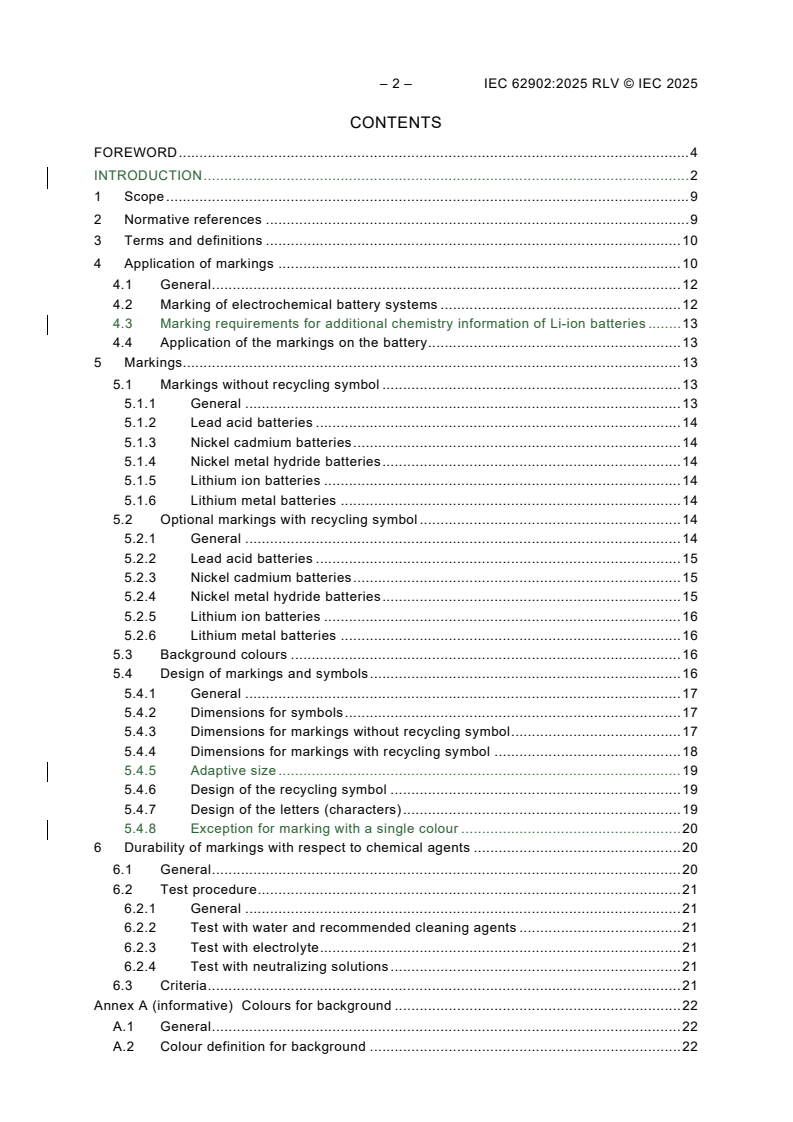
INTRODUCTION . 2
1 Scope . 9
2 Normative references . 9
3 Terms and definitions . 10
4 Application of markings . 10
4.1 General . 12
4.2 Marking of electrochemical battery systems . 12
4.3 Marking requirements for additional chemistry information of Li-ion batteries . 13
4.4 Application of the markings on the battery . 13
5 Markings. 13
5.1 Markings without recycling symbol . 13
5.1.1 General . 13
5.1.2 Lead acid batteries . 14
5.1.3 Nickel cadmium batteries . 14
5.1.4 Nickel metal hydride batteries . 14
5.1.5 Lithium ion batteries . 14
5.1.6 Lithium metal batteries . 14
5.2 Optional markings with recycling symbol . 14
5.2.1 General . 14
5.2.2 Lead acid batteries . 15
5.2.3 Nickel cadmium batteries . 15
5.2.4 Nickel metal hydride batteries . 15
5.2.5 Lithium ion batteries . 16
5.2.6 Lithium metal batteries . 16
5.3 Background colours . 16
5.4 Design of markings and symbols . 16
5.4.1 General . 17
5.4.2 Dimensions for symbols . 17
5.4.3 Dimensions for markings without recycling symbol . 17
5.4.4 Dimensions for markings with recycling symbol . 18
5.4.5 Adaptive size . 19
5.4.6 Design of the recycling symbol . 19
5.4.7 Design of the letters (characters) . 19
5.4.8 Exception for marking with a single colour . 20
6 Durability of markings with respect to chemical agents . 20
6.1 General . 20
6.2 Test procedure . 21
6.2.1 General . 21
6.2.2 Test with water and recommended cleaning agents . 21
6.2.3 Test with electrolyte . 21
6.2.4 Test with neutralizing solutions . 21
6.3 Criteria . 21
Annex A (informative) Colours for background . 22
A.1 General . 22
A.2 Colour definition for background . 22
Annex B (informative) Calculation method for the battery volume . 23
Bibliography . 24
Figure 1 – Example of marking for lead acid batteries . 14
Figure 2 – Example of marking for nickel cadmium batteries . 14
Figure 3 – Example of marking for nickel metal hydride batteries . 14
Figure 4 – Example of marking for lithium ion batteries . 14
Figure 5 – Example of marking for lithium metal batteries . 14
Figure 6 – Example of marking with recycling symbol for lead acid batteries . 15
Figure 7 – Example of marking with recycling symbol for nickel cadmium batteries . 15
Figure 8 – Example of marking with recycling symbol for nickel metal hydride batteries . 15
Figure 9 – Example of marking with recycling symbol for lithium ion batteries . 16
Figure 10 – Example of marking with recycling symbol for lithium metal batteries . 16
Figure 11 – Size of marking without recycling symbol . 17
Figure 12 – Size of marking with recycling symbol . 18
Figure 13 – Design of recycling symbol . 19
Figure 14 – Design of letters . 19
Figure 15 – Examples for markings with frames of a contrasting colour . 20
Table 1 – Recycling and ecolabels regarding batteries . 7
Table 2 – List of dimensions for symbols . 17
Table 3 – Test matrix for durability test of markings . 20
Table A.1 – Colour references . 22
– 4 – IEC 62902:2025 RLV © IEC 2025
INTERNATIONAL ELECTROTECHNICAL COMMISSION
____________
SECONDARY CELLS AND BATTERIES –
MARKING SYMBOLS FOR IDENTIFICATION OF THEIR CHEMISTRY
FOREWORD
1) The International Electrotechnical Commission (IEC) is a worldwide organization for standardization comprising
all national electrotechnical committees (IEC National Committees). The object of IEC is to promote international
co-operation on all questions concerning standardization in the electrical and electronic fields. To this end and
in addition to other activities, IEC publishes International Standards, Technical Specifications, Technical Reports,
Publicly Available Specifications (PAS) and Guides (hereafter referred to as "IEC Publication(s)"). Their
preparation is entrusted to technical committees; any IEC National Committee interested in the subject dealt with
may participate in this preparatory work. International, governmental and non-governmental organizations liaising
with the IEC also participate in this preparation. IEC collaborates closely with the International Organization for
Standardization (ISO) in accordance with conditions determined by agreement between the two organizations.
2) The formal decisions or agreements of IEC on technical matters express, as nearly as possible, an international
consensus of opinion on the relevant subjects since each technical committee has representation from all
interested IEC National Committees.
3) IEC Publications have the form of recommendations for international use and are accepted by IEC National
Committees in that sense. While all reasonable efforts are made to ensure that the technical content of IEC
Publications is accurate, IEC cannot be held responsible for the way in which they are used or for any
misinterpretation by any end user.
4) In order to promote international uniformity, IEC National Committees undertake to apply IEC Publications
transparently to the maximum extent possible in their national and regional publications. Any divergence between
any IEC Publication and the corresponding national or regional publication shall be clearly indicated in the latter.
5) IEC itself does not provide any attestation of conformity. Independent certification bodies provide conformity
assessment services and, in some areas, access to IEC marks of conformity. IEC is not responsible for any
services carried out by independent certification bodies.
6) All users should ensure that they have the latest edition of this publication.
7) No liability shall attach to IEC or its directors, employees, servants or agents including individual experts and
members of its technical committees and IEC National Committees for any personal injury, property damage or
other damage of any nature whatsoever, whether direct or indirect, or for costs (including legal fees) and
expenses arising out of the publication, use of, or reliance upon, this IEC Publication or any other IEC
Publications.
8) Attention is drawn to the Normative references cited in this publication. Use of the referenced publications is
indispensable for the correct application of this publication.
9) IEC draws attention to the possibility that the implementation of this document may involve the use of (a)
patent(s). IEC takes no position concerning the evidence, validity or applicability of any claimed patent rights in
respect thereof. As of the date of publication of this document, IEC had not received notice of (a) patent(s), which
may be required to implement this document. However, implementers are cautioned that this may not represent
the latest information, which may be obtained from the patent database available at https://patents.iec.ch. IEC
shall not be held responsible for identifying any or all such patent rights.
This redline version of the official IEC Standard allows the user to identify the changes
made to the previous edition IEC 62902:2019. A vertical bar appears in the margin
wherever a change has been made. Additions are in green text, deletions are in
strikethrough red text.
IEC 62902 has been prepared by IEC technical committee 21: Secondary cells and batteries. It
is an International Standard.
This second edition cancels and replaces the first edition published in 2019. This edition
constitutes a technical revision.
This edition includes the following significant technical changes with respect to the previous
edition:
a) Addition of an Introduction;
b) Addition of exemptions and clarifications for the marking background colour requirement;
c) Addition of a calculation method for the battery volume;
d) Addition of a new note to the Scope;
e) Addition of a term and definition for the principal display panel;
f) Addition of further chemistry information for Li-ion batteries;
g) Addition of a new subclause on adaptive size;
h) Clarification of the test methods for durability and permanence of the marking.
The text of this International Standard is based on the following documents:
Draft Report on voting
21/1195/CDV 21/1208/RVC
Full information on the voting for its approval can be found in the report on voting indicated in
the above table.
The language used for the development of this International Standard is English.
This document was drafted in accordance with ISO/IEC Directives, Part 2, and developed in
accordance with ISO/IEC Directives, Part 1 and ISO/IEC Directives, IEC Supplement, available
at www.iec.ch/members_experts/refdocs. The main document types developed by IEC are
described in greater detail at www.iec.ch/publications.
The committee has decided that the contents of this document will remain unchanged until the
stability date indicated on the IEC website under webstore.iec.ch in the data related to the
specific document. At this date, the document will be
• reconfirmed,
• withdrawn, or
• revised.
IMPORTANT – The "colour inside" logo on the cover page of this document indicates
that it contains colours which are considered to be useful for the correct understanding
of its contents. Users should therefore print this document using a colour printer.
– 6 – IEC 62902:2025 RLV © IEC 2025
INTRODUCTION
This document introduces uniform marking symbols for the identification of the secondary
battery chemistries prevailing on the market. A primary reason is that lead smelters around the
world are reporting increasing numbers of lithium ion batteries finding their way into the lead-
acid battery waste stream. Because the shape and design of these batteries sometimes is very
similar, it can be difficult for sorting facilities and battery smelters to distinguish one technology
from the other if there is no clear identification of the battery chemistry by marking symbols.
Processing lithium ion batteries within a lead smelter, e-waste facility, or municipal waste
sorting facility, can result in fire or explosions, with numerous accidents or near-accidents
already reported in European and US recycling facilities.
Besides lead-acid and lithium ion batteries, the labelling scheme should also apply to other
battery chemistries with a significant market share, such as nickel metal hydride and nickel
cadmium. Other batteries, such as sodium ion batteries, should be included in the marking
scheme when their market share becomes significant.
A clear identification of the battery chemistry would be helpful throughout the entire battery
lifetime, i.e. from the selection and purchase of a new battery (e.g. by economic operators as
well as end users), to transportation, installation and use of the battery and then to waste battery
collection, sorting, storage and treatment.
The following standards and recommendations were considered during the development of this
document.
The Battery Association of Japan (BAJ) has issued "Guidelines for Recycle Mark on
rechargeable cells and batteries for portable applications" which include an optional colour code
system for identifying major (rechargeable) battery chemistries: Pb, Ni-Cd, Ni-MH, and Li-ion.
These guidelines also distinguish different cathode materials as well as important impurities
(mostly from the anode material) .
Call2Recycle has introduced in Canada and the United States of America a licensed labelling
program for batteries. It is a non-profit organization that collects and recycles batteries on behalf
of companies that pay a fee to license the label.
The recycling symbol required on batteries within the scope of this document is the general
symbol for recovery/recyclable as standardised in ISO 7000-1135:2004-01, see item 1 in
Table 1. It is worth noting the information that ISO provides for this symbol: Function/description:
to indicate that the marked item or its material is part of a recovery or recycling process.
Additional information: the symbol is applicable only to those products or materials for which at
the end of life there is a well-established collection route and recycling process, and which does
not significantly impair the effectiveness of other recycling schemes.
Battery marking can also be subject to regional legislation. One example being the crossed-out
wheeled bin used in the European Union (EU) and in some other countries to make consumers
aware of their obligation to make their batteries available for separate collection. Some other
regulations, e.g. Regulation (EU) 2023/1542 on batteries and waste batteries, can require the
use of additional symbols for substances of very high concern (SVHC), namely cadmium (Cd)
and lead (Pb) exceeding certain concentration levels .
___________
For more information see the document referred to under "Source reference" for item 5 in Table 1.
Regulation EU 2023/1542 does not require the addition of the Hg symbol to the separate collection symbol.
However, there is a requirement for max. 0,0005 % Hg for all batteries in Annex I Restriction on substances of
the Batteries Regulation.
In a comment submitted by Battery Council International (BCI) on a request by the
Environmental Protection Agency (USA) for information regarding the development of best
practices for the collection of batteries to be recycled and voluntary battery labelling guidelines,
it was suggested that battery labels should have a consistent and simple marking (e.g. a colour
code) across all battery chemistries to encourage and aid appropriate handling which should,
at a minimum, address three primary goals – in descending order of priority:
1) inform and educate consumers to keep batteries out of the trash and curbside recycling,
and direct batteries to dedicated battery recycling networks where available;
2) provide consumers and recycling network employees with human-readable information to
enable sorting of used batteries among major chemistry families (e.g. Pb, Li-ion, Ni-Cd, Ni-
MH, and Li-metal);
3) if appropriate within a chemistry family, inform recyclers of the unique features, components
or constituents or both, for recovery (e.g. cathode material).
Table 1 contains a list of recycling and ecolabels that can be expected on batteries.
Table 1 – Recycling and ecolabels regarding batteries
No. Symbol Official name Alternative Purpose Source reference
information
1 General symbol for Möbius loop, To indicate that the ISO 7000-1135:2004-01
recovery/recyclable three curved marked item or its
www.iso.org/obp
arrows material is part of a
recovery or recycling
process.
2 4 in 1 symbol The white interior Environmental Protection
shows 4 arrows Administration of Taiwan
pointing outwards (Province of China)
3 Crossed-out wheeled To indicate "separate Regulation (EU)
bin collection" for all 2023/1542
batteries and
accumulators
4 Call 2 Recycle battery Private recycling Battery recycling
seal program in the USA and
Seal usage standards
Canada
5 Recycling symbol and Guidelines for Compliance with the Tecchio, P. el al.,
a
recycle mark on Japanese Law for the Analysis of material
chemistry for batteries
batteries Promotion of Effective efficiency aspects of
Utilization of Resources personal computers
product group, JRC
Report EUR 28394 EN
(2018), page 60
b c
6 U.S. Mercury-Contain- 42 U.S.C. § 14322(b)
See footnote See footnote
ing and Rechargeable
Battery Recycling Act
symbol (Battery Council
International model)
a
The symbol has two placeholders after "Li-ion" where codes for details of the chemistry are entered.
b
Three chasing arrows or a comparable recycling symbol. For nickel-cadmium batteries, the symbol must also
state "Ni-Cd" and the phrase "BATTERY MUST BE RECYCLED OR DISPOSED OF PROPERLY." For lead acid
batteries, the symbol must also state "Pb" or the words "LEAD", "RETURN", and "RECYCLE" and if the regulated
battery is sealed, the phrase "BATTERY MUST BE RECYCLED."
c
Model symbol developed by Battery Council International for Small Sealed Lead Acid (SSLA) batteries in
compliance with the U.S. Mercury-Containing and Rechargeable Battery Recycling Act. Variations allowed.
– 8 – IEC 62902:2025 RLV © IEC 2025
During the preparation of the second edition, the Scope of this document was subject to
intensive discussions. One of the subjects that were discussed, was the inclusion of a battery's
energy content. Some experts thought that a limit like the 100 Wh limit used in dangerous goods
transportation regulations to distinguish between "fully regulated" and "exempted" when offering
batteries for transport under UN numbers 3480 and 3481 could be suitable to distinguish
between the different levels of labelling requirements. However, these thoughts were not
pursued as they applied only to lithium ion batteries and could hardly be translated into a
technology agnostic language. No generally acceptable calculation method was found that
would enable the transfer of the energy limit from lithium ion batteries to other chemistries.
A limit of 100 Wh for lithium ion spare batteries in the Federal Aviation Administration (FAA) (of
the United States) and International Air Transport Association (IATA) regulations for carry-on
baggage on board of passenger aircraft was not considered to be suitable for consideration for
similar reasons. The same applied even more to a mass limit of 500 g applicable during the
collection of lithium batteries according to UNECE, Special Provision 636 of the Agreement for
the carriage of Dangerous goods by Road (ADR).
Other suggestions were made to limit the Scope to batteries with one or more dimension(s)
exceeding 5 cm or, in a different proposal, 100 mm. However, it could not be shown how these
and why they would
limits would correlate with each other and with the volume limit of 900 cm
be more suitable than the volume limit.
It was also discussed to add the following recommendation: "In addition, the markings may be
used also on secondary battery packaging and in accompanying documents when secondary
batteries are placed on the market".
SECONDARY CELLS AND BATTERIES –
MARKING SYMBOLS FOR IDENTIFICATION OF THEIR CHEMISTRY
1 Scope
This document specifies methods for the clear identification of secondary cells, batteries,
battery modules and monoblocs according to their chemistry (electrochemical storage
technology).
The markings described in this document are applicable for secondary cells,batteries,battery
modules andmonoblocs with a volume of more than 900 cm .
The marking of the chemistry is useful for the installation, operation and decommissioning
phases of battery life.
The markings described in this document are applicable to
– secondary cells,
– batteries,
– battery modules, and
– monoblocs,
when they are placed on the market for end use and when their battery volume exceeds 900 cm .
The chemistry marking is useful for the installation, operation and decommissioning phases in
the battery's life cycle.
Many recycling processes are chemistry specific, thus undesired events can occur when a
battery which is not of the appropriate chemistry enters a given recycling process. Therefore,
the battery is marked so as to identify its chemistry to ensure safe handling during sorting and
recycling processes.
This document defines the conditions of use of the markings indicating the chemistry of these
secondary batteries.
The details of markings and their application are defined in this document.
NOTE Nothing in this document precludes the marking of batteries with recycling and chemistry symbols required
by state, federal, national or regional laws or regulations or with a seal under license by a national recycling program.
NOTE The 900 cm limit has been chosen because it is a reasonable compromise between larger format batteries
and small batteries. On small batteries, the space for additional labels is limited which can result in a readability
conflict.
2 Normative references
The following documents are referred to in the text in such a way that some or all of their content
constitutes requirements of this document. For dated references, only the edition cited applies.
For undated references, the latest edition of the referenced document (including any
amendments) applies.
IEC 60896-21:2004, Stationary lead-acid batteries – Part 21: Valve regulated types – Methods
of test
– 10 – IEC 62902:2025 RLV © IEC 2025
IEC 60896-22:2004, Stationary lead-acid batteries – Part 22: Valve regulated types –
Requirements
IEC 61960-3:2017, Secondary cells and batteries containing alkaline or other non-acid
electrolytes – Secondary lithium cells and batteries for portable applications – Part 3: Prismatic
and cylindrical lithium secondary cells and batteries made from them
ISO 7000, Graphical symbols for use on equipment (available at http://www.graphical-
symbols.info/equipment)
3 Terms and definitions
For the purposes of this document, the following terms and definitions apply.
ISO and IEC maintain terminological databases for use in standardization at the following
addresses:
• IEC Electropedia: available at http://www.electropedia.org/
• ISO Online browsing platform: available at http://www.iso.org/obp
3.1
cell
basic functional unit, consisting of an assembly of electrodes, electrolyte, container, terminals
and usually separators that is a source of electric energy obtained by direct conversion of
chemical energy
[SOURCE: IEC 60050-482:2004, 482-01-01, modified – The Note to entry has been omitted
deleted.]
3.2
secondary cell
cell which is designated to be electrically recharged
[SOURCE: IEC 60050-482:2004, 482-01-03, modified – The Note to entry has been deleted.]
3.3
battery
one or more cells fitted with devices necessary for use, for example case, terminals, marking
and protective devices
[SOURCE: IEC 60050-482:2004, 482-01-04]
3.4
battery volume
displacement of the battery
Note 1 to entry: Refer to Annex B for a method for the calculation of the displacement of a battery.
3.5
battery module
group of cells connected together either in a series and/or parallel configuration with or without
protective devices (e.g. fuse or positive temperature coefficient, PTC) and monitoring circuitry
[SOURCE: IEC 62620:20142023, 3.8, modified – The word "battery" has been added to the
term, and "positive temperature coefficient" to the definition.]
3.6
secondary lithium battery
lithium battery which is designed to be electrically recharged
Note 1 to entry: The recharge is accomplished by way of a reversible chemical reaction.
[SOURCE: IEC 60050-482:2004, 482-01-03, modified – The term has been changed from
"secondary cell" to "secondary lithium battery". In the definition, "cell" has become "lithium
battery".]
3.6
monobloc battery
battery, with multiple separate but electrically connected cell compartments each of which is
designed to house an assembly of electrodes, electrolyte, terminals or intercell connections and
possible separators
[SOURCE: IEC 60050-482:2004, 482-02-17, modified –The word "interconnections" has been
replaced with "intercell connections" in the definition and the Note to entry has been deleted.]
3.7
lead acid battery
secondary battery with aqueous electrolyte based on dilute sulfuric acid, a positive electrode of
lead dioxide and a negative electrode of lead
[SOURCE: IEC 60050-482:2004, 482-05-01, modified – The term has been changed from "lead
dioxide lead battery" to "lead acid battery", and the Note to entry has been deleted.]
3.8
valve regulated lead acid battery
VRLA battery
secondary battery in which cells are closed but have a valve which allows the escape of gas if
the internal pressure exceeds a predetermined value
Note 1 to entry: The cell or battery cannot normally receive additions to the electrolyte.
Note 2 to entry: This note only applies to the French language.
[SOURCE: IEC 60050-482:2004, 482-05-15, modified – Note 2 to entry has been added.]
3.9
lithium ion battery
secondary battery with an organic solvent electrolyte and positive and negative electrodes
which utilize an intercalation compound in which lithium is stored
Note 1 to entry: A lithium ion battery does not contain lithium metal.
[SOURCE: IEC 60050-482:2004, 482-05-07]
3.10
lithium metal battery
battery which incorporates one or more lithium cells with an organic solvent electrolyte or a
solid electrolyte, a positive electrode and a negative electrode composed of lithium metal
3.11
nickel cadmium battery
secondary battery with an alkaline electrolyte, a positive electrode containing nickel oxide and
a negative electrode of cadmium
– 12 – IEC 62902:2025 RLV © IEC 2025
[SOURCE: IEC 60050-482:2004, 482-05-02, modified – The first preferred term "nickel oxide
cadmium battery" has been omitted deleted.]
3.12
nickel metal hydride battery
secondary battery with an electrolyte of aqueous potassium hydroxide, a positive electrode
containing nickel as nickel hydroxide and a negative electrode of hydrogen in the form of a
metal hydride
[SOURCE: IEC 60050-482:2004, 482-05-08]
3.13
marking
line, shape, pattern, letter or symbol on the surface, which helps to identify features of the
marked product or material
3.14
symbol
written character or mark used to represent information
EXAMPLE The recycling symbol represents the information that the battery is to be recycled.
3.15
label
sheet with an adhesive layer containing information for application on products
3.16
principal display panel
portion of a battery's surface bearing the markings designed to be most prominently displayed,
shown, presented, or examined under conditions of retail sale, handling, sorting, and inspection
4 Application of markings
4.1 General
Markings defined in Clause 5 are applicable to all products according to their size and
configuration as defined in the scope of this document.
Each end product in accordance with this document shall be marked in accordance with this
Clause 4 before being placed on the market. For the purposes of this document, cells made
available on the market for end use, are designated as batteries.
In case of dismantling the batteries into monoblocs and modules for the purpose of reuse of the
monoblocs and modules, additional marking of these monoblocs or batteries shall be carried
out in accordance with this document.
Single cells should not be marked if they are fitted into batteries or modules.
4.2 Marking of electrochemical battery systems
This marking is only applicable to secondary cells and batteries of the following chemistries:
a) lead acid (Pb),
b) nickel cadmium (Ni-Cd),
c) nickel metal hydride (Ni-MH),
d) lithium ion (Li-ion),
e) lithium metal (Li-metal).
Batteries or modules applying more than one of these chemistries shall be marked for all applied
chemistries.
This marking is not applicable for batteries of other chemistries and technologies such as:
f) flow batteries,
g) sodium-sulfur high temperature batteries,
h) Na-NiCl high temperature batteries, and
i) all other chemistries not listed here.
ISO/IEC Guide 71:2014, Guide for addressing accessibility in standards, should be consulted
when additional colours are standardized for marking of more electrochemical systems.
4.3 Marking requirements for additional chemistry information of Li-ion batteries
If applicable, for lithium ion batteries, codes A1 and A2 designating the basic materials of the
negative and positive electrodes as specified in IEC 61960-3:2017, 5.1 shall be applied on the
battery. These codes shall follow after "Li-ion", separated by a space.
EXAMPLE The required text of the marking for a Lithium ion battery with a negative electrode based on carbon and
a positive electrode based on cobalt is: Li-ion IC.
4.4 Application of the markings on the battery
The markings can be fixed on the battery either by:
a) printing, or
b) labelling, or
c) other methods.
The markings shall be applied on the battery or modules before these are placed on the market.
The markings shall be visible, legible and indelible over the expected life of the batteries.
The markings with the design described in Clause 5 may be integrated into existing printings or
labels.
The marking shall be placed on the displayed side, which is the side on which the battery
information is placed, the principal display panel to achieve good visibility.
If, for design reasons or because of customer requirements, the marking cannot be placed on
the displayed side principal display panel, the size of the marking shall nevertheless be as
defined in 5.4.
5 Markings
5.1 Markings without recycling symbol
5.1.1 General
Markings shown in Figure 1 to Figure 5 shall be used if the recycling symbol is applied in other
markings or if it is not necessary or if it is not possible to declare a recycling symbol does not
need to be declared or cannot be declared.
– 14 – IEC 62902:2025 RLV © IEC 2025
5.1.2 Lead acid batteries
Figure 1 – Example of marking for lead acid batteries
5.1.3 Nickel cadmium batteries
Figure 2 – Example of marking for nickel cadmium batteries
5.1.4 Nickel metal hydride batteries
Figure 3 – Example of marking for nickel metal hydride batteries
5.1.5 Lithium ion batteries
Figure 4 – Example of marking for lithium ion batteries
5.1.6 Lithium metal batteries
Figure 5 – Example of marking for lithium metal batteries
5.2 Optional markings with recycling symbol
5.2.1 General
The markings shown in Figure 6 to Figure 10 with the recycling symbol in accordance with
ISO 7000-1135:2004-01 shall be used in the event that the recycling symbol is not applied in
other markings and if it is necessary to declare a recycling symbol needs to be declared.
NOTE The applicability and meaning of the recycling symbol can vary by country.
5.2.2 Lead acid batteries
Figure 6 – Example of marking with recycling symbol for lead acid batteries
5.2.3 Nickel cadmium batteries
Figure 7 – Example of marking with recycling symbol
for nickel cadmium batteries
5.2.4 Nickel metal hydride batteries
Figure 8 – Example of marking with recycling symbol
for nickel metal hydride batteries
– 16 – IEC 62902:2025 RLV © IEC 2025
5.2.5 Lithium ion batteries
Figure 9 – Example of marking with recycling symbol
for lithium ion batteries
5.2.6 Lithium metal batteries
Figure 10 – Example of marking with recycling symbol
for lithium metal batteries
5.3 Background colours
Except as described in 5.4.8, the following colours shall be used for the background within the
marking area defined in 5.4.3 or 5.4.4, as applicable, and may also be used for the label and/or
the casings or sleeves of battery cell blocks, battery modules, or cells.
a) Pb silver grey, grey, or white
b) Ni-Cd light green
c) Ni-MH orange
d) Li-ion blue
e) Li-metal blue
The background colour of the marking or the frame, if any, shall be different from the colour of
the battery case.
A reference for the specified colours in accordance with established colour systems is listed in
informative Annex A.
See Annex A for a definition of these colours with reference to some colour systems.
5.4 Design of markings and symbols
5.4.1 General
The size of marking is defined by the largest side of the battery principal display panel. If the
battery manufacturer and the device manufacturer are in agreement, the size of marking can
be defined by the displayed side which is defined in 4.3.
5.4.2 Dimensions for symbols
The symbols used for the dimensions of the marking are listed in Table 2.
Table 2 – List of dimensions for symbols
Symbol Definition See
a Width of the recycling symbol Figure 13
Figure 11
R Width of the marking Figure 12
Figure 13
h Height of the marking without recycling symbol Figure 11
H Height of the marking with recycling symbol Figure 12
b Height of the letters Figure 14
l Line thickness of the letters Figure 14
S Size of the marking 5.4.3 and 5.4.4
k Ratio between b and R 5.4.7
5.4.3 Dimensions for markings without recycling symbol
The dimensions specified in this subclause apply to all markings in accordance with 5.1, the
marking for Ni-MH being used as an example.
For prismatic non-round batteries, the markings without recycling symbol should have a size of
at least 2 % of the surface area of the largest side principal display panel of the battery.
For non-prismatic round batteries, the markings without recycling symbol should have a size of
at least 1 % of the surface area of the principal display panel of the battery.
The size of the marking without recycling symbol is the product of width R and height h as shown
in Figure 11.
Figure 11 – Size of marking without recycling symbol
Height h is of width R.
The size of the marking shall be not less than 1,9 cm .
– 18 – IEC 62902:2025 RLV © IEC 2025
The minimum dimensions are:
Width: R min. 24 mm
Height: hR× min. 8 mm
Size of the marking: S = R × h min. 1,9 cm
For markings without recycling symbol, it is not necessary to apply a size larger than 12 cm ,
corresponding to a width R of 60 mm, even if the calculated size S would be larger than 12 cm .
The marking can optionally have a black frame so as to achieve a better contrast against the
outside wall or label.
5.4.4 Dimensions for markings with recycling symbol
The dimensions specified in this subclause apply to all markings in accordance with 5.2, the
marking for Ni-MH being used as an example.
For prismatic non-round batteries, the markings with recycling symbol should have a size of at
least 3 % of the surface area of the largest side principal display panel of the battery.
For non-prismatic round batteries, the markings with recycling symbol should have a size at
least 1,5 % of the surface area of the principal display panel of the battery.
The size of marking with recycling symbol is the product of width R and height H as shown in
Figure 12.
Figure 12 – Size of marking with recycling symbol
Height H is of width R.
The size of the marking shall be not less than 3 cm .
Minimum dimensions are:
Width: R min. 15 mm
Height: H = × R min. 20 mm
Size of the marking: S = R × H min. 3 cm
For markings with recycling symbol, it is not necessary to apply a size larger than 17 cm ,
corresponding to a width R of 36 mm, even if the calculated size S would be larger than 17 cm .
=
The marking can optionally have a black frame so as to achieve a better contrast against the
outside wall or label.
5.4.5 Adaptive size
If the specific outer contour of the battery housing (outer shape of the battery pack) requires
the marking to be of a slightly smaller size (10 % of the size as required in 5.4.3 and 5.4.4,
respectively), the size of the symbol may be reduced by up to 10 % of the required size, given
that the symbol legibility is not impaired.
5.4.6 Design of the recycling symbol
Figure 13 shows the recycling symbol. It is in accordance with ISO 7000-1135:2004-01.
Figure 13 – Design of recycling symbol
The following formula describes the dimensions of the recycling symbol:
a = R
where
R is the width of the marking shown in Figure 12;
a is the width of the recycling symbol.
Except as described in 5.4.8, the colour of the recycling symbol shall be black.
5.4.7 Design of the letters (charact
...
IEC 62902 ®
Edition 2.0 2025-02
INTERNATIONAL
STANDARD
NORME
INTERNATIONALE
Secondary cells and batteries – Marking symbols for identification of their
chemistry
Batteries d’accumulateurs – Symboles de marquage pour l’identification de leur
caractéristique chimique
All rights reserved. Unless otherwise specified, no part of this publication may be reproduced or utilized in any form
or by any means, electronic or mechanical, including photocopying and microfilm, without permission in writing from
either IEC or IEC's member National Committee in the country of the requester. If you have any questions about IEC
copyright or have an enquiry about obtaining additional rights to this publication, please contact the address below or
your local IEC member National Committee for further information.
Droits de reproduction réservés. Sauf indication contraire, aucune partie de cette publication ne peut être reproduite ni
utilisée sous quelque forme que ce soit et par aucun procédé, électronique ou mécanique, y compris la photocopie et
les microfilms, sans l'accord écrit de l'IEC ou du Comité national de l'IEC du pays du demandeur. Si vous avez des
questions sur le copyright de l'IEC ou si vous désirez obtenir des droits supplémentaires sur cette publication, utilisez
les coordonnées ci-après ou contactez le Comité national de l'IEC de votre pays de résidence.
IEC Secretariat Tel.: +41 22 919 02 11
3, rue de Varembé info@iec.ch
CH-1211 Geneva 20 www.iec.ch
Switzerland
About the IEC
The International Electrotechnical Commission (IEC) is the leading global organization that prepares and publishes
International Standards for all electrical, electronic and related technologies.
About IEC publications
The technical content of IEC publications is kept under constant review by the IEC. Please make sure that you have the
latest edition, a corrigendum or an amendment might have been published.
IEC publications search - webstore.iec.ch/advsearchform IEC Products & Services Portal - products.iec.ch
The advanced search enables to find IEC publications by a Discover our powerful search engine and read freely all the
variety of criteria (reference number, text, technical publications previews, graphical symbols and the glossary.
committee, …). It also gives information on projects, replaced With a subscription you will always have access to up to date
and withdrawn publications. content tailored to your needs.
IEC Just Published - webstore.iec.ch/justpublished
Electropedia - www.electropedia.org
Stay up to date on all new IEC publications. Just Published
The world's leading online dictionary on electrotechnology,
details all new publications released. Available online and once
containing more than 22 500 terminological entries in English
a month by email.
and French, with equivalent terms in 25 additional languages.
Also known as the International Electrotechnical Vocabulary
IEC Customer Service Centre - webstore.iec.ch/csc
(IEV) online.
If you wish to give us your feedback on this publication or need
further assistance, please contact the Customer Service
Centre: sales@iec.ch.
A propos de l'IEC
La Commission Electrotechnique Internationale (IEC) est la première organisation mondiale qui élabore et publie des
Normes internationales pour tout ce qui a trait à l'électricité, à l'électronique et aux technologies apparentées.
A propos des publications IEC
Le contenu technique des publications IEC est constamment revu. Veuillez vous assurer que vous possédez l’édition la
plus récente, un corrigendum ou amendement peut avoir été publié.
Recherche de publications IEC - IEC Products & Services Portal - products.iec.ch
webstore.iec.ch/advsearchform Découvrez notre puissant moteur de recherche et consultez
La recherche avancée permet de trouver des publications IEC gratuitement tous les aperçus des publications, symboles
en utilisant différents critères (numéro de référence, texte, graphiques et le glossaire. Avec un abonnement, vous aurez
comité d’études, …). Elle donne aussi des informations sur les toujours accès à un contenu à jour adapté à vos besoins.
projets et les publications remplacées ou retirées.
Electropedia - www.electropedia.org
IEC Just Published - webstore.iec.ch/justpublished
Le premier dictionnaire d'électrotechnologie en ligne au monde,
Restez informé sur les nouvelles publications IEC. Just
avec plus de 22 500 articles terminologiques en anglais et en
Published détaille les nouvelles publications parues.
français, ainsi que les termes équivalents dans 25 langues
Disponible en ligne et une fois par mois par email.
additionnelles. Egalement appelé Vocabulaire
Electrotechnique International (IEV) en ligne.
Service Clients - webstore.iec.ch/csc
Si vous désirez nous donner des commentaires sur cette
publication ou si vous avez des questions contactez-nous:
sales@iec.ch.
IEC 62902 ®
Edition 2.0 2025-02
INTERNATIONAL
STANDARD
NORME
INTERNATIONALE
Secondary cells and batteries – Marking symbols for identification of their
chemistry
Batteries d’accumulateurs – Symboles de marquage pour l’identification de leur
caractéristique chimique
INTERNATIONAL
ELECTROTECHNICAL
COMMISSION
COMMISSION
ELECTROTECHNIQUE
INTERNATIONALE
ICS 29.220.20; 29.220.30 ISBN 978-2-8327-0098-3
– 2 – IEC 62902:2025 © IEC 2025
CONTENTS
FOREWORD . 4
INTRODUCTION . 6
1 Scope . 9
2 Normative references . 9
3 Terms and definitions . 10
4 Application of markings . 12
4.1 General . 12
4.2 Marking of electrochemical battery systems . 12
4.3 Marking requirements for additional chemistry information of Li-ion batteries . 13
4.4 Application of the markings on the battery . 13
5 Markings. 13
5.1 Markings without recycling symbol . 13
5.1.1 General . 13
5.1.2 Lead acid batteries . 13
5.1.3 Nickel cadmium batteries . 13
5.1.4 Nickel metal hydride batteries . 14
5.1.5 Lithium ion batteries . 14
5.1.6 Lithium metal batteries . 14
5.2 Optional markings with recycling symbol . 14
5.2.1 General . 14
5.2.2 Lead acid batteries . 14
5.2.3 Nickel cadmium batteries . 15
5.2.4 Nickel metal hydride batteries . 15
5.2.5 Lithium ion batteries . 15
5.2.6 Lithium metal batteries . 16
5.3 Background colours . 16
5.4 Design of markings and symbols . 16
5.4.1 General . 16
5.4.2 Dimensions for symbols . 16
5.4.3 Dimensions for markings without recycling symbol . 17
5.4.4 Dimensions for markings with recycling symbol . 18
5.4.5 Adaptive size . 18
5.4.6 Design of the recycling symbol . 19
5.4.7 Design of the letters (characters) . 19
5.4.8 Exception for marking with a single colour . 20
6 Durability of markings with respect to chemical agents . 20
6.1 General . 20
6.2 Test procedure . 21
6.2.1 General . 21
6.2.2 Test with water and recommended cleaning agents . 21
6.2.3 Test with electrolyte . 21
6.2.4 Test with neutralizing solutions . 21
6.3 Criteria . 21
Annex A (informative) Colours for background . 22
A.1 General . 22
A.2 Colour definition for background . 22
Annex B (informative) Calculation method for the battery volume . 23
Bibliography . 24
Figure 1 – Example of marking for lead acid batteries . 13
Figure 2 – Example of marking for nickel cadmium batteries . 13
Figure 3 – Example of marking for nickel metal hydride batteries . 14
Figure 4 – Example of marking for lithium ion batteries . 14
Figure 5 – Example of marking for lithium metal batteries . 14
Figure 6 – Example of marking with recycling symbol for lead acid batteries . 14
Figure 7 – Example of marking with recycling symbol for nickel cadmium batteries . 15
Figure 8 – Example of marking with recycling symbol for nickel metal hydride batteries . 15
Figure 9 – Example of marking with recycling symbol for lithium ion batteries . 15
Figure 10 – Example of marking with recycling symbol for lithium metal batteries . 16
Figure 11 – Size of marking without recycling symbol . 17
Figure 12 – Size of marking with recycling symbol . 18
Figure 13 – Design of recycling symbol . 19
Figure 14 – Design of letters . 19
Figure 15 – Examples for markings with frames of a contrasting colour . 20
Table 1 – Recycling and ecolabels regarding batteries . 7
Table 2 – List of dimensions for symbols . 17
Table 3 – Test matrix for durability test of markings . 20
Table A.1 – Colour references . 22
– 4 – IEC 62902:2025 © IEC 2025
INTERNATIONAL ELECTROTECHNICAL COMMISSION
____________
SECONDARY CELLS AND BATTERIES –
MARKING SYMBOLS FOR IDENTIFICATION OF THEIR CHEMISTRY
FOREWORD
1) The International Electrotechnical Commission (IEC) is a worldwide organization for standardization comprising
all national electrotechnical committees (IEC National Committees). The object of IEC is to promote international
co-operation on all questions concerning standardization in the electrical and electronic fields. To this end and
in addition to other activities, IEC publishes International Standards, Technical Specifications, Technical Reports,
Publicly Available Specifications (PAS) and Guides (hereafter referred to as "IEC Publication(s)"). Their
preparation is entrusted to technical committees; any IEC National Committee interested in the subject dealt with
may participate in this preparatory work. International, governmental and non-governmental organizations liaising
with the IEC also participate in this preparation. IEC collaborates closely with the International Organization for
Standardization (ISO) in accordance with conditions determined by agreement between the two organizations.
2) The formal decisions or agreements of IEC on technical matters express, as nearly as possible, an international
consensus of opinion on the relevant subjects since each technical committee has representation from all
interested IEC National Committees.
3) IEC Publications have the form of recommendations for international use and are accepted by IEC National
Committees in that sense. While all reasonable efforts are made to ensure that the technical content of IEC
Publications is accurate, IEC cannot be held responsible for the way in which they are used or for any
misinterpretation by any end user.
4) In order to promote international uniformity, IEC National Committees undertake to apply IEC Publications
transparently to the maximum extent possible in their national and regional publications. Any divergence between
any IEC Publication and the corresponding national or regional publication shall be clearly indicated in the latter.
5) IEC itself does not provide any attestation of conformity. Independent certification bodies provide conformity
assessment services and, in some areas, access to IEC marks of conformity. IEC is not responsible for any
services carried out by independent certification bodies.
6) All users should ensure that they have the latest edition of this publication.
7) No liability shall attach to IEC or its directors, employees, servants or agents including individual experts and
members of its technical committees and IEC National Committees for any personal injury, property damage or
other damage of any nature whatsoever, whether direct or indirect, or for costs (including legal fees) and
expenses arising out of the publication, use of, or reliance upon, this IEC Publication or any other IEC
Publications.
8) Attention is drawn to the Normative references cited in this publication. Use of the referenced publications is
indispensable for the correct application of this publication.
9) IEC draws attention to the possibility that the implementation of this document may involve the use of (a)
patent(s). IEC takes no position concerning the evidence, validity or applicability of any claimed patent rights in
respect thereof. As of the date of publication of this document, IEC had not received notice of (a) patent(s), which
may be required to implement this document. However, implementers are cautioned that this may not represent
the latest information, which may be obtained from the patent database available at https://patents.iec.ch. IEC
shall not be held responsible for identifying any or all such patent rights.
IEC 62902 has been prepared by IEC technical committee 21: Secondary cells and batteries. It
is an International Standard.
This second edition cancels and replaces the first edition published in 2019. This edition
constitutes a technical revision.
This edition includes the following significant technical changes with respect to the previous
edition:
a) Addition of an Introduction;
b) Addition of exemptions and clarifications for the marking background colour requirement;
c) Addition of a calculation method for the battery volume;
d) Addition of a new note to the Scope;
e) Addition of a term and definition for the principal display panel;
f) Addition of further chemistry information for Li-ion batteries;
g) Addition of a new subclause on adaptive size;
h) Clarification of the test methods for durability and permanence of the marking.
The text of this International Standard is based on the following documents:
Draft Report on voting
21/1195/CDV 21/1208/RVC
Full information on the voting for its approval can be found in the report on voting indicated in
the above table.
The language used for the development of this International Standard is English.
This document was drafted in accordance with ISO/IEC Directives, Part 2, and developed in
accordance with ISO/IEC Directives, Part 1 and ISO/IEC Directives, IEC Supplement, available
at www.iec.ch/members_experts/refdocs. The main document types developed by IEC are
described in greater detail at www.iec.ch/publications.
The committee has decided that the contents of this document will remain unchanged until the
stability date indicated on the IEC website under webstore.iec.ch in the data related to the
specific document. At this date, the document will be
• reconfirmed,
• withdrawn, or
• revised.
IMPORTANT – The "colour inside" logo on the cover page of this document indicates
that it contains colours which are considered to be useful for the correct understanding
of its contents. Users should therefore print this document using a colour printer.
– 6 – IEC 62902:2025 © IEC 2025
INTRODUCTION
This document introduces uniform marking symbols for the identification of the secondary
battery chemistries prevailing on the market. A primary reason is that lead smelters around the
world are reporting increasing numbers of lithium ion batteries finding their way into the lead-
acid battery waste stream. Because the shape and design of these batteries sometimes is very
similar, it can be difficult for sorting facilities and battery smelters to distinguish one technology
from the other if there is no clear identification of the battery chemistry by marking symbols.
Processing lithium ion batteries within a lead smelter, e-waste facility, or municipal waste
sorting facility, can result in fire or explosions, with numerous accidents or near-accidents
already reported in European and US recycling facilities.
Besides lead-acid and lithium ion batteries, the labelling scheme should also apply to other
battery chemistries with a significant market share, such as nickel metal hydride and nickel
cadmium. Other batteries, such as sodium ion batteries, should be included in the marking
scheme when their market share becomes significant.
A clear identification of the battery chemistry would be helpful throughout the entire battery
lifetime, i.e. from the selection and purchase of a new battery (e.g. by economic operators as
well as end users), to transportation, installation and use of the battery and then to waste battery
collection, sorting, storage and treatment.
The following standards and recommendations were considered during the development of this
document.
The Battery Association of Japan (BAJ) has issued "Guidelines for Recycle Mark on
rechargeable cells and batteries for portable applications" which include an optional colour code
system for identifying major (rechargeable) battery chemistries: Pb, Ni-Cd, Ni-MH, and Li-ion.
These guidelines also distinguish different cathode materials as well as important impurities
(mostly from the anode material) .
Call2Recycle has introduced in Canada and the United States of America a licensed labelling
program for batteries. It is a non-profit organization that collects and recycles batteries on behalf
of companies that pay a fee to license the label.
The recycling symbol required on batteries within the scope of this document is the general
symbol for recovery/recyclable as standardised in ISO 7000-1135:2004-01, see item 1 in
Table 1. It is worth noting the information that ISO provides for this symbol: Function/description:
to indicate that the marked item or its material is part of a recovery or recycling process.
Additional information: the symbol is applicable only to those products or materials for which at
the end of life there is a well-established collection route and recycling process, and which does
not significantly impair the effectiveness of other recycling schemes.
Battery marking can also be subject to regional legislation. One example being the crossed-out
wheeled bin used in the European Union (EU) and in some other countries to make consumers
aware of their obligation to make their batteries available for separate collection. Some other
regulations, e.g. Regulation (EU) 2023/1542 on batteries and waste batteries, can require the
use of additional symbols for substances of very high concern (SVHC), namely cadmium (Cd)
and lead (Pb) exceeding certain concentration levels .
___________
For more information see the document referred to under "Source reference" for item 5 in Table 1.
Regulation EU 2023/1542 does not require the addition of the Hg symbol to the separate collection symbol.
However, there is a requirement for max. 0,0005 % Hg for all batteries in Annex I Restriction on substances of
the Batteries Regulation.
In a comment submitted by Battery Council International (BCI) on a request by the
Environmental Protection Agency (USA) for information regarding the development of best
practices for the collection of batteries to be recycled and voluntary battery labelling guidelines,
it was suggested that battery labels should have a consistent and simple marking (e.g. a colour
code) across all battery chemistries to encourage and aid appropriate handling which should,
at a minimum, address three primary goals – in descending order of priority:
1) inform and educate consumers to keep batteries out of the trash and curbside recycling,
and direct batteries to dedicated battery recycling networks where available;
2) provide consumers and recycling network employees with human-readable information to
enable sorting of used batteries among major chemistry families (e.g. Pb, Li-ion, Ni-Cd, Ni-
MH, and Li-metal);
3) if appropriate within a chemistry family, inform recyclers of the unique features, components
or constituents or both, for recovery (e.g. cathode material).
Table 1 contains a list of recycling and ecolabels that can be expected on batteries.
Table 1 – Recycling and ecolabels regarding batteries
No. Symbol Official name Alternative Purpose Source reference
information
1 General symbol for Möbius loop, To indicate that the ISO 7000-1135:2004-01
recovery/recyclable three curved marked item or its
www.iso.org/obp
arrows material is part of a
recovery or recycling
process.
2 4 in 1 symbol The white interior Environmental Protection
shows 4 arrows Administration of Taiwan
pointing outwards (Province of China)
3 Crossed-out wheeled To indicate "separate Regulation (EU)
bin collection" for all 2023/1542
batteries and
accumulators
4 Call 2 Recycle battery Private recycling Battery recycling
seal program in the USA and
Seal usage standards
Canada
5 Recycling symbol and Guidelines for Compliance with the Tecchio, P. el al.,
a
recycle mark on Japanese Law for the Analysis of material
chemistry for batteries
batteries Promotion of Effective efficiency aspects of
Utilization of Resources personal computers
product group, JRC
Report EUR 28394 EN
(2018), page 60
b c
6 U.S. Mercury-Contain- 42 U.S.C. § 14322(b)
See footnote See footnote
ing and Rechargeable
Battery Recycling Act
symbol (Battery Council
International model)
a
The symbol has two placeholders after "Li-ion" where codes for details of the chemistry are entered.
b
Three chasing arrows or a comparable recycling symbol. For nickel-cadmium batteries, the symbol must also
state "Ni-Cd" and the phrase "BATTERY MUST BE RECYCLED OR DISPOSED OF PROPERLY." For lead acid
batteries, the symbol must also state "Pb" or the words "LEAD", "RETURN", and "RECYCLE" and if the regulated
battery is sealed, the phrase "BATTERY MUST BE RECYCLED."
c
Model symbol developed by Battery Council International for Small Sealed Lead Acid (SSLA) batteries in
compliance with the U.S. Mercury-Containing and Rechargeable Battery Recycling Act. Variations allowed.
– 8 – IEC 62902:2025 © IEC 2025
During the preparation of the second edition, the Scope of this document was subject to
intensive discussions. One of the subjects that were discussed, was the inclusion of a battery's
energy content. Some experts thought that a limit like the 100 Wh limit used in dangerous goods
transportation regulations to distinguish between "fully regulated" and "exempted" when offering
batteries for transport under UN numbers 3480 and 3481 could be suitable to distinguish
between the different levels of labelling requirements. However, these thoughts were not
pursued as they applied only to lithium ion batteries and could hardly be translated into a
technology agnostic language. No generally acceptable calculation method was found that
would enable the transfer of the energy limit from lithium ion batteries to other chemistries.
A limit of 100 Wh for lithium ion spare batteries in the Federal Aviation Administration (FAA) (of
the United States) and International Air Transport Association (IATA) regulations for carry-on
baggage on board of passenger aircraft was not considered to be suitable for consideration for
similar reasons. The same applied even more to a mass limit of 500 g applicable during the
collection of lithium batteries according to UNECE, Special Provision 636 of the Agreement for
the carriage of Dangerous goods by Road (ADR).
Other suggestions were made to limit the Scope to batteries with one or more dimension(s)
exceeding 5 cm or, in a different proposal, 100 mm. However, it could not be shown how these
and why they would
limits would correlate with each other and with the volume limit of 900 cm
be more suitable than the volume limit.
It was also discussed to add the following recommendation: "In addition, the markings may be
used also on secondary battery packaging and in accompanying documents when secondary
batteries are placed on the market".
SECONDARY CELLS AND BATTERIES –
MARKING SYMBOLS FOR IDENTIFICATION OF THEIR CHEMISTRY
1 Scope
This document specifies methods for the clear identification of secondary cells, batteries,
battery modules and monoblocs according to their chemistry (electrochemical storage
technology).
The markings described in this document are applicable to
– secondary cells,
– batteries,
– battery modules, and
– monoblocs,
when they are placed on the market for end use and when their battery volume exceeds 900 cm .
The chemistry marking is useful for the installation, operation and decommissioning phases in
the battery's life cycle.
Many recycling processes are chemistry specific, thus undesired events can occur when a
battery which is not of the appropriate chemistry enters a given recycling process. Therefore,
the battery is marked so as to identify its chemistry to ensure safe handling during sorting and
recycling processes.
This document defines the conditions of use of the markings indicating the chemistry of these
secondary batteries.
The details of markings and their application are defined in this document.
NOTE The 900 cm limit has been chosen because it is a reasonable compromise between larger format batteries
and small batteries. On small batteries, the space for additional labels is limited which can result in a readability
conflict.
2 Normative references
The following documents are referred to in the text in such a way that some or all of their content
constitutes requirements of this document. For dated references, only the edition cited applies.
For undated references, the latest edition of the referenced document (including any
amendments) applies.
IEC 60896-21:2004, Stationary lead-acid batteries – Part 21: Valve regulated types – Methods
of test
IEC 60896-22:2004, Stationary lead-acid batteries – Part 22: Valve regulated types –
Requirements
IEC 61960-3:2017, Secondary cells and batteries containing alkaline or other non-acid
electrolytes – Secondary lithium cells and batteries for portable applications – Part 3: Prismatic
and cylindrical lithium secondary cells and batteries made from them
– 10 – IEC 62902:2025 © IEC 2025
ISO 7000, Graphical symbols for use on equipment (available at http://www.graphical-
symbols.info/equipment)
3 Terms and definitions
For the purposes of this document, the following terms and definitions apply.
ISO and IEC maintain terminological databases for use in standardization at the following
addresses:
• IEC Electropedia: available at http://www.electropedia.org/
• ISO Online browsing platform: available at http://www.iso.org/obp
3.1
cell
basic functional unit, consisting of an assembly of electrodes, electrolyte, container, terminals
and usually separators that is a source of electric energy obtained by direct conversion of
chemical energy
[SOURCE: IEC 60050-482:2004, 482-01-01, modified – The Note to entry has been deleted.]
3.2
secondary cell
cell which is designated to be electrically recharged
[SOURCE: IEC 60050-482:2004, 482-01-03, modified – The Note to entry has been deleted.]
3.3
battery
one or more cells fitted with devices necessary for use, for example case, terminals, marking
and protective devices
[SOURCE: IEC 60050-482:2004, 482-01-04]
3.4
battery volume
displacement of the battery
Note 1 to entry: Refer to Annex B for a method for the calculation of the displacement of a battery.
3.5
battery module
group of cells connected together either in a series and/or parallel configuration with or without
protective devices (e.g. fuse or positive temperature coefficient, PTC) and monitoring circuitry
[SOURCE: IEC 62620:2023, 3.8, modified – The word "battery" has been added to the term,
and "positive temperature coefficient" to the definition.]
3.6
monobloc battery
battery, with multiple separate but electrically connected cell compartments each of which is
designed to house an assembly of electrodes, electrolyte, terminals or intercell connections and
possible separators
[SOURCE: IEC 60050-482:2004, 482-02-17, modified –The word "interconnections" has been
replaced with "intercell connections" in the definition and the Note to entry has been deleted.]
3.7
lead acid battery
secondary battery with aqueous electrolyte based on dilute sulfuric acid, a positive electrode of
lead dioxide and a negative electrode of lead
[SOURCE: IEC 60050-482:2004, 482-05-01, modified – The term has been changed from "lead
dioxide lead battery" to "lead acid battery", and the Note to entry has been deleted.]
3.8
valve regulated lead acid battery
VRLA battery
secondary battery in which cells are closed but have a valve which allows the escape of gas if
the internal pressure exceeds a predetermined value
Note 1 to entry: The cell or battery cannot normally receive additions to the electrolyte.
Note 2 to entry: This note only applies to the French language.
[SOURCE: IEC 60050-482:2004, 482-05-15, modified – Note 2 to entry has been added.]
3.9
lithium ion battery
secondary battery with an organic solvent electrolyte and positive and negative electrodes
which utilize an intercalation compound in which lithium is stored
Note 1 to entry: A lithium ion battery does not contain lithium metal.
[SOURCE: IEC 60050-482:2004, 482-05-07]
3.10
lithium metal battery
battery which incorporates one or more lithium cells with an organic solvent electrolyte or a
solid electrolyte, a positive electrode and a negative electrode composed of lithium metal
3.11
nickel cadmium battery
secondary battery with an alkaline electrolyte, a positive electrode containing nickel oxide and
a negative electrode of cadmium
[SOURCE: IEC 60050-482:2004, 482-05-02, modified – The first preferred term "nickel oxide
cadmium battery" has been deleted.]
3.12
nickel metal hydride battery
secondary battery with an electrolyte of aqueous potassium hydroxide, a positive electrode
containing nickel as nickel hydroxide and a negative electrode of hydrogen in the form of a
metal hydride
[SOURCE: IEC 60050-482:2004, 482-05-08]
3.13
marking
line, shape, pattern, letter or symbol on the surface, which helps to identify features of the
marked product or material
– 12 – IEC 62902:2025 © IEC 2025
3.14
symbol
written character or mark used to represent information
EXAMPLE The recycling symbol represents the information that the battery is to be recycled.
3.15
label
sheet with an adhesive layer containing information for application on products
3.16
principal display panel
portion of a battery's surface bearing the markings designed to be most prominently displayed,
shown, presented, or examined under conditions of retail sale, handling, sorting, and inspection
4 Application of markings
4.1 General
Markings defined in Clause 5 are applicable to all products according to their size and
configuration as defined in the scope of this document.
Each end product in accordance with this document shall be marked before being placed on
the market. For the purposes of this document, cells made available on the market for end use,
are designated as batteries.
In case of dismantling the batteries into monoblocs and modules for the purpose of reuse of the
monoblocs and modules, additional marking of these monoblocs or batteries shall be carried
out in accordance with this document.
Single cells should not be marked if they are fitted into batteries or modules.
4.2 Marking of electrochemical battery systems
This marking is only applicable to secondary cells and batteries of the following chemistries:
a) lead acid (Pb),
b) nickel cadmium (Ni-Cd),
c) nickel metal hydride (Ni-MH),
d) lithium ion (Li-ion),
e) lithium metal (Li-metal).
Batteries or modules applying more than one of these chemistries shall be marked for all applied
chemistries.
This marking is not applicable for batteries of other chemistries and technologies such as:
f) flow batteries,
g) Na-NiCl high temperature batteries, and
h) all other chemistries not listed here.
ISO/IEC Guide 71:2014, Guide for addressing accessibility in standards, should be consulted
when additional colours are standardized for marking of more electrochemical systems.
4.3 Marking requirements for additional chemistry information of Li-ion batteries
If applicable, for lithium ion batteries, codes A1 and A2 designating the basic materials of the
negative and positive electrodes as specified in IEC 61960-3:2017, 5.1 shall be applied on the
battery. These codes shall follow after "Li-ion", separated by a space.
EXAMPLE The required text of the marking for a Lithium ion battery with a negative electrode based on carbon and
a positive electrode based on cobalt is: Li-ion IC.
4.4 Application of the markings on the battery
The markings can be fixed on the battery either by:
a) printing, or
b) labelling, or
c) other methods.
The markings shall be visible, legible and indelible over the expected life of the batteries.
The markings with the design described in Clause 5 may be integrated into existing printings or
labels.
The marking shall be placed on the principal display panel to achieve good visibility.
If, for design reasons or because of customer requirements, the marking cannot be placed on
the principal display panel, the size of the marking shall nevertheless be as defined in 5.4.
5 Markings
5.1 Markings without recycling symbol
5.1.1 General
Markings shown in Figure 1 to Figure 5 shall be used if the recycling symbol is applied in other
markings or if it is not necessary or if it is not possible to declare a recycling symbol.
5.1.2 Lead acid batteries
Figure 1 – Example of marking for lead acid batteries
5.1.3 Nickel cadmium batteries
Figure 2 – Example of marking for nickel cadmium batteries
– 14 – IEC 62902:2025 © IEC 2025
5.1.4 Nickel metal hydride batteries
Figure 3 – Example of marking for nickel metal hydride batteries
5.1.5 Lithium ion batteries
Figure 4 – Example of marking for lithium ion batteries
5.1.6 Lithium metal batteries
Figure 5 – Example of marking for lithium metal batteries
5.2 Optional markings with recycling symbol
5.2.1 General
The markings shown in Figure 6 to Figure 10 with the recycling symbol in accordance with
ISO 7000-1135:2004-01 shall be used in the event that the recycling symbol is not applied in
other markings and if it is necessary to declare a recycling symbol.
NOTE The applicability and meaning of the recycling symbol can vary by country.
5.2.2 Lead acid batteries
Figure 6 – Example of marking with recycling symbol for lead acid batteries
5.2.3 Nickel cadmium batteries
Figure 7 – Example of marking with recycling symbol
for nickel cadmium batteries
5.2.4 Nickel metal hydride batteries
Figure 8 – Example of marking with recycling symbol
for nickel metal hydride batteries
5.2.5 Lithium ion batteries
Figure 9 – Example of marking with recycling symbol
for lithium ion batteries
– 16 – IEC 62902:2025 © IEC 2025
5.2.6 Lithium metal batteries
Figure 10 – Example of marking with recycling symbol
for lithium metal batteries
5.3 Background colours
Except as described in 5.4.8, the following colours shall be used for the background within the
marking area defined in 5.4.3 or 5.4.4, as applicable, and may also be used for the label or the
casings or sleeves of cell blocks, battery modules, or cells.
a) Pb silver grey, grey, or white
b) Ni-Cd light green
c) Ni-MH orange
d) Li-ion blue
e) Li-metal blue
The background colour of the marking or the frame, if any, shall be different from the colour of
the battery case.
See Annex A for a definition of these colours with reference to some colour systems.
5.4 Design of markings and symbols
5.4.1 General
The size of marking is defined by the principal display panel.
5.4.2 Dimensions for symbols
The symbols used for the dimensions of the marking are listed in Table 2.
Table 2 – List of dimensions for symbols
Symbol Definition See
a Width of the recycling symbol Figure 13
Figure 11
R Width of the marking Figure 12
Figure 13
h Height of the marking without recycling symbol Figure 11
H Height of the marking with recycling symbol Figure 12
b Height of the letters Figure 14
l Line thickness of the letters Figure 14
S Size of the marking 5.4.3 and 5.4.4
k Ratio between b and R 5.4.7
5.4.3 Dimensions for markings without recycling symbol
The dimensions specified in this subclause apply to all markings in accordance with 5.1, the
marking for Ni-MH being used as an example.
For non-round batteries, the markings without recycling symbol should have a size of at least
2 % of the surface area of the principal display panel of the battery.
For round batteries, the markings without recycling symbol should have a size of at least 1 %
of the surface area of the principal display panel of the battery.
The size of the marking without recycling symbol is the product of width R and height h as shown
in Figure 11.
Figure 11 – Size of marking without recycling symbol
Height h is of width R.
The size of the marking shall be not less than 1,9 cm .
The minimum dimensions are:
Width: R min. 24 mm
Height: min. 8 mm
hR×
Size of the marking: S = R × h min. 1,9 cm
For markings without recycling symbol, it is not necessary to apply a size larger than 12 cm ,
corresponding to a width R of 60 mm, even if the calculated size S would be larger than 12 cm .
=
– 18 – IEC 62902:2025 © IEC 2025
5.4.4 Dimensions for markings with recycling symbol
The dimensions specified in this subclause apply to all markings in accordance with 5.2, the
marking for Ni-MH being used as an example.
For non-round batteries, the markings with recycling symbol should have a size of at least 3 %
of the surface area of the principal display panel of the battery.
For round batteries, the markings with recycling symbol should have a size at least 1,5 % of the
surface area of the principal display panel of the battery.
The size of marking with recycling symbol is the product of width R and height H as shown in
Figure 12.
Figure 12 – Size of marking with recycling symbol
Height H is of width R.
The size of the marking shall be not less than 3 cm .
Minimum dimensions are:
Width: R min. 15 mm
Height: H = × R min. 20 mm
Size of the marking: S = R × H min. 3 cm
For markings with recycling symbol, it is not necessary to apply a size larger than 17 cm ,
corresponding to a width R of 36 mm, even if the calculated size S would be larger than 17 cm .
5.4.5 Adaptive size
If the specific outer contour of the battery housing (outer shape of the battery pack) requires
the marking to be of a slightly smaller size (10 % of the size as required in 5.4.3 and 5.4.4,
respectively), the size of the symbol ma
...