

IEC 60598-1:2003
(Main)Luminaires - Part 1: General requirements and tests
General Information
- Abstract
This Part 1 of International Standard IEC 60598 specifies general requirements for luminaires, incorporating electric light sources for operation from supply voltages up to 1 000 V. The requirements and related tests of this standard cover: classification, marking, mechanical construction and electrical construction.
- Status
- Published
- Publication Date
- 26-Sep-2006
- Technical Committee
- SC 34D - Luminaires
- Current Stage
- DELPUB - Deleted Publication
- Start Date
- 16-Apr-2008
- Completion Date
- 28-Aug-2026
Buy Documents
IEC 60598-1:2003+AMD1:2006 CSV - Luminaires - Part 1: General requirements and tests Released:9/27/2006
IEC 60598-1:2003 - Luminaires - Part 1: General requirements and tests Released:10/30/2003
IEC 60598-1:2003+AMD1:2006 CSV - Luminaires - Partie 1: Prescriptions générales et essais Released:9/27/2006
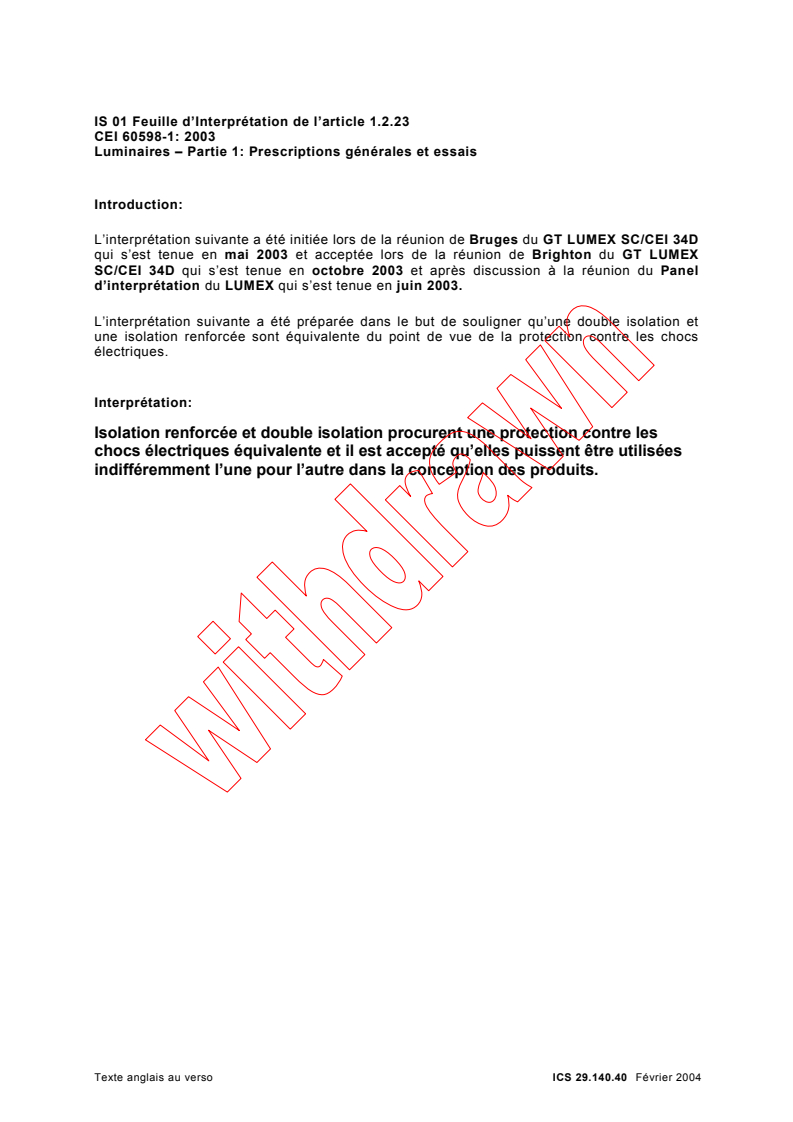
IEC 60598-1:2003 - Luminaires - Partie 1: Prescriptions générales et essais Released:10/30/2003
IEC 60598-1:2003+AMD1:2006 CSV - Luminaires - Part 1: General requirements and tests Released:9/27/2006
IEC 60598-1:2003 - Luminaires - Part 1: General requirements and tests Released:10/30/2003
Overview
IEC 60598-1:2003 (Edition 6.1, 2006) - "Luminaires - Part 1: General requirements and tests" is the foundational IEC standard that specifies safety, construction and testing requirements for luminaires (fixtures incorporating electric light sources) intended for supply voltages up to 1 000 V. It defines general requirements covering classification, marking, mechanical and electrical construction, and a comprehensive suite of verification tests.
Key topics and requirements
- Scope and classification
- Applicability to luminaires up to 1 000 V and classification by protection against electric shock, ingress (IP), mounting surface and application.
- Marking and documentation
- Requirements for durable marking on luminaires and additional information required for safe installation and operation.
- Mechanical and electrical construction
- Rules for replaceable components, lampholders, starters, terminals, glands, screws, suspensions and materials (including flammability and corrosion resistance).
- Wiring, terminals and earthing
- External/internal wiring rules, terminal types (screw and screwless), terminal mechanical and electrical tests, and earthing provisions.
- Protection against electric shock
- Use of protective measures including double and reinforced insulation (IEC interpretation confirms they offer equivalent protection).
- Ingress of dust, solid objects and moisture
- Tests and guidance for IP levels and humidity resistance.
- Insulation, creepage and clearances
- Requirements and tests for insulation resistance, electric strength, creepage distances and clearances.
- Thermal and endurance testing
- Endurance and thermal tests for normal, abnormal and fault conditions; provisions for thermoplastic luminaires.
- Resistance to heat, fire and tracking
- Requirements for resistance to ignition, tracking and heat stress.
- Annexes
- Normative and informative annexes cover test lamps, abnormal circuit conditions, IP number explanation, temperature measurement, design guidance and conformity testing.
Practical applications and users
IEC 60598-1 is used by:
- Luminaire manufacturers - design, type testing, production conformity and marking.
- Test laboratories - to perform standardized safety and performance tests.
- Design engineers and product safety teams - to ensure compliance with electrical safety, thermal limits and mechanical robustness.
- Regulators, procurement and certification bodies - for product approval, market surveillance and compliance checking.
- Installers and specifiers - to interpret marking, IP ratings and installation constraints.
Related standards (if applicable)
- Other parts of IEC 60598 series (part 2: particular requirements) that address specific luminaire types and additional tests.
- Standards referenced in IEC 60598-1 for components, insulation, and testing methods (see normative references in the standard).
Keywords: IEC 60598-1, luminaires standard, luminaire safety, general requirements and tests, IP rating, thermal testing, creepage distances, insulation, electric shock protection.
Relations
- Effective Date
- 25-Aug-2026
- Amended By
IEC 60598-1:2003/AMD1:2006 - Amendment 1 - Luminaires - Part 1: General requirements and tests - Effective Date
- 05-Sep-2023
- Effective Date
- 05-Sep-2023
- Effective Date
- 05-Sep-2023
- Effective Date
- 05-Sep-2023
- Effective Date
- 05-Sep-2023
- Effective Date
- 05-Sep-2023
- Effective Date
- 05-Sep-2023
- Effective Date
- 05-Sep-2023
Buy Documents
IEC 60598-1:2003+AMD1:2006 CSV - Luminaires - Part 1: General requirements and tests Released:9/27/2006
IEC 60598-1:2003 - Luminaires - Part 1: General requirements and tests Released:10/30/2003
IEC 60598-1:2003+AMD1:2006 CSV - Luminaires - Partie 1: Prescriptions générales et essais Released:9/27/2006
IEC 60598-1:2003 - Luminaires - Partie 1: Prescriptions générales et essais Released:10/30/2003
IEC 60598-1:2003+AMD1:2006 CSV - Luminaires - Part 1: General requirements and tests Released:9/27/2006
IEC 60598-1:2003 - Luminaires - Part 1: General requirements and tests Released:10/30/2003
Get Certified
Connect with accredited certification bodies for this standard

IMQ S.p.A. (Certification)
Italian electrical product certification.

SLG Prüf- und Zertifizierungs GmbH
German testing and certification body.

UL Solutions
Global safety science company with testing, inspection and certification.
Sponsored listings
Frequently Asked Questions
IEC 60598-1:2003 is a standard published by the International Electrotechnical Commission (IEC). Its full title is "Luminaires - Part 1: General requirements and tests". This standard covers: This Part 1 of International Standard IEC 60598 specifies general requirements for luminaires, incorporating electric light sources for operation from supply voltages up to 1 000 V. The requirements and related tests of this standard cover: classification, marking, mechanical construction and electrical construction.
This Part 1 of International Standard IEC 60598 specifies general requirements for luminaires, incorporating electric light sources for operation from supply voltages up to 1 000 V. The requirements and related tests of this standard cover: classification, marking, mechanical construction and electrical construction.
IEC 60598-1:2003 is classified under the following ICS (International Classification for Standards) categories: 29.140.40 - Luminaires. The ICS classification helps identify the subject area and facilitates finding related standards.
IEC 60598-1:2003 has the following relationships with other standards: It is inter standard links to EN ISO 9680:2007, IEC 60598-1:2003/AMD1:2006, IEC 60598-1:2008, IEC 60598-1:1999/ISH1:2001, IEC 60598-1:1999, IEC 60598-1:2003/ISH1:2004, IEC 60598-1:1999/ISH27:2001, IEC 60598-1:1999/ISH25:2001, IEC 60598-1:1999/ISH26:2001. Understanding these relationships helps ensure you are using the most current and applicable version of the standard.
IEC 60598-1:2003 is available in PDF format for immediate download after purchase. The document can be added to your cart and obtained through the secure checkout process. Digital delivery ensures instant access to the complete standard document.
Standards Content (Sample)
INTERNATIONAL IEC
STANDARD 60598-1
Edition 6.1
2006-09
Edition 6:2003 consolidated with amendment 1:2006
Luminaires –
Part 1:
General requirements and tests
This English-language version is derived from the original
bilingual publication by leaving out all French-language
pages. Missing page numbers correspond to the French-
language pages.
Reference number
Publication numbering
As from 1 January 1997 all IEC publications are issued with a designation in the
60000 series. For example, IEC 34-1 is now referred to as IEC 60034-1.
Consolidated editions
The IEC is now publishing consolidated versions of its publications. For example,
edition numbers 1.0, 1.1 and 1.2 refer, respectively, to the base publication, the base
publication incorporating amendment 1 and the base publication incorporating
amendments 1 and 2.
Further information on IEC publications
The technical content of IEC publications is kept under constant review by the IEC,
thus ensuring that the content reflects current technology. Information relating to this
publication, including its validity, is available in the IEC Catalogue of publications
(see below) in addition to new editions, amendments and corrigenda. Information on
the subjects under consideration and work in progress undertaken by the technical
committee which has prepared this publication, as well as the list of publications
issued, is also available from the following:
• IEC Web Site (www.iec.ch)
• Catalogue of IEC publications
The on-line catalogue on the IEC web site (www.iec.ch/searchpub) enables you to
search by a variety of criteria including text searches, technical committees and
date of publication. On-line information is also available on recently issued
publications, withdrawn and replaced publications, as well as corrigenda.
• IEC Just Published
This summary of recently issued publications (www.iec.ch/online_news/ justpub) is
also available by email. Please contact the Customer Service Centre (see below)
for further information.
• Customer Service Centre
If you have any questions regarding this publication or need further assistance,
please contact the Customer Service Centre:
Email: custserv@iec.ch
Tel: +41 22 919 02 11
Fax: +41 22 919 03 00
INTERNATIONAL IEC
STANDARD 60598-1
Edition 6.1
2006-09
Edition 6:2003 consolidated with amendment 1:2006
Luminaires –
Part 1:
General requirements and tests
© IEC 2006 Copyright - all rights reserved
No part of this publication may be reproduced or utilized in any form or by any means, electronic or mechanical,
including photocopying and microfilm, without permission in writing from the publisher.
International Electrotechnical Commission, 3, rue de Varembé, PO Box 131, CH-1211 Geneva 20, Switzerland
Telephone: +41 22 919 02 11 Telefax: +41 22 919 03 00 E-mail: inmail@iec.ch Web: www.iec.ch
PRICE CODE
CS
Commission Electrotechnique Internationale
International Electrotechnical Commission
МеждународнаяЭлектротехническаяКомиссия
For price, see current catalogue
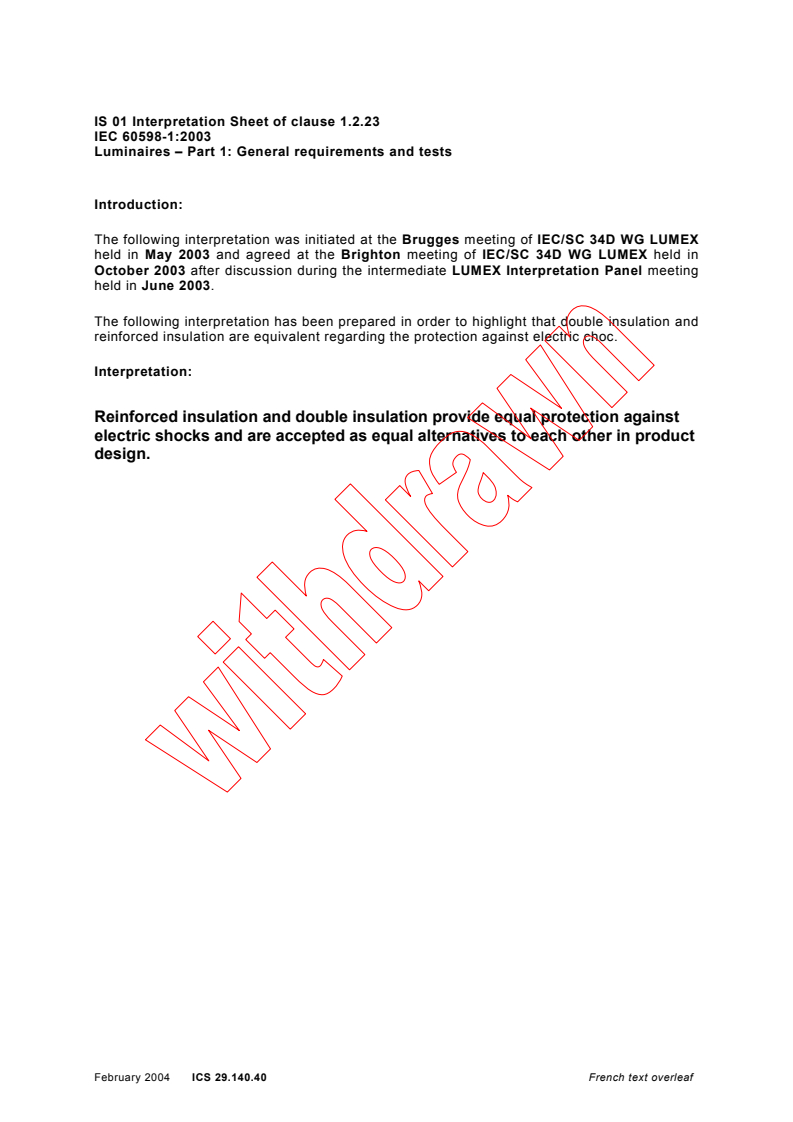
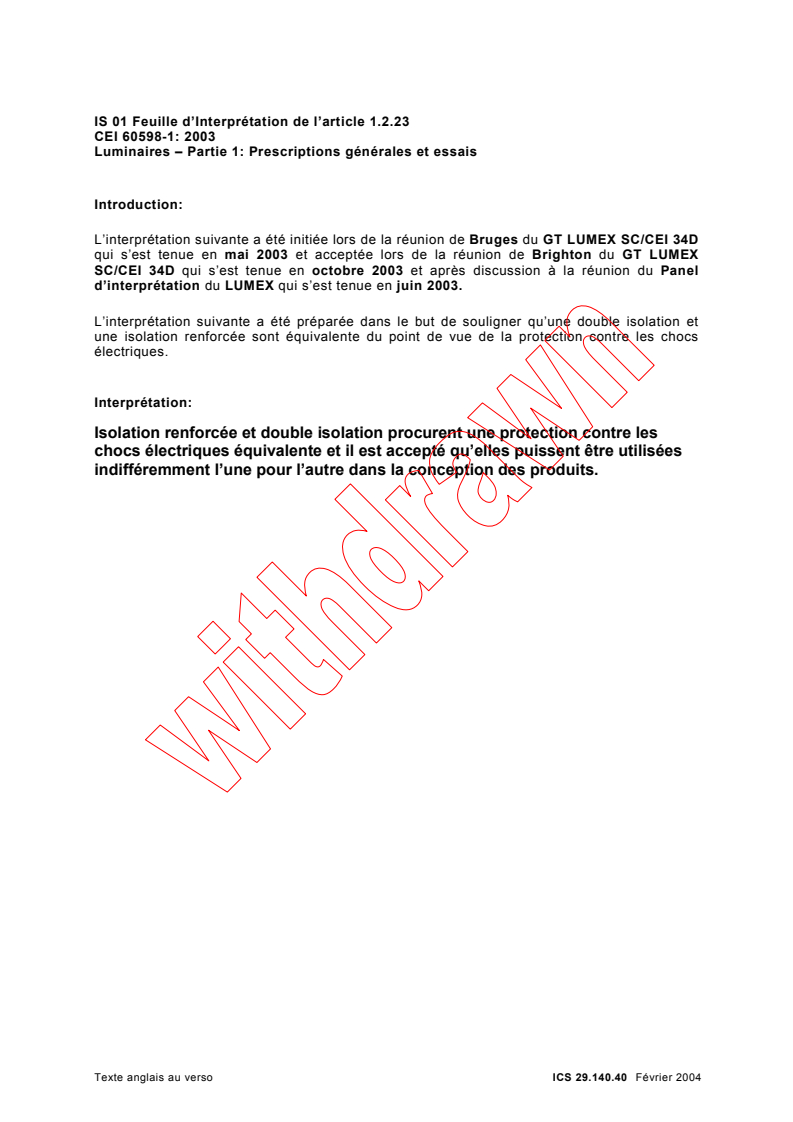
IS 01 Interpretation Sheet of clause 1.2.23
Luminaires – Part 1: General requirements and tests
Introduction:
The following interpretation was initiated at the Brugges meeting of IEC/SC 34D WG LUMEX
held in May 2003 and agreed at the Brighton meeting of IEC/SC 34D WG LUMEX held in
October 2003 after discussion during the intermediate LUMEX Interpretation Panel meeting
held in June 2003.
The following interpretation has been prepared in order to highlight that double insulation and
reinforced insulation are equivalent regarding the protection against electric choc.
Interpretation:
Reinforced insulation and double insulation provide equal protection against
electric shocks and are accepted as equal alternatives to each other in product
design.
February 2004 ICS 29.140.40 French text overleaf
60598-1 IEC:2003+A1:2006 – 3 –
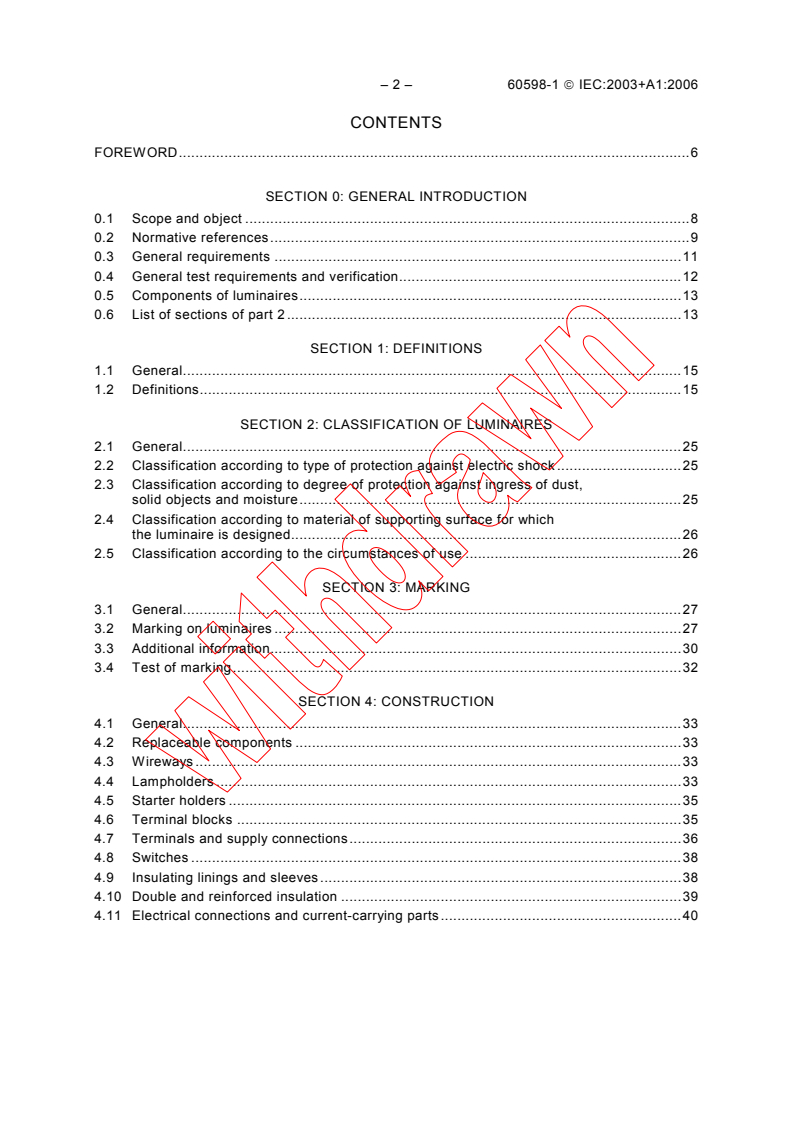
CONTENTS
FOREWORD.11
SECTION 0: GENERAL INTRODUCTION
0.1 Scope and object .15
0.2 Normative references.17
0.3 General requirements.21
0.4 General test requirements and verification.23
0.5 Components of luminaires.25
0.6 List of sections of part 2 .25
SECTION 1: DEFINITIONS
1.1 General.29
1.2 Definitions.29
SECTION 2: CLASSIFICATION OF LUMINAIRES
2.1 General.49
2.2 Classification according to type of protection against electric shock .49
2.3 Classification according to degree of protection against ingress of dust,
solid objects and moisture.49
2.4 Classification according to material of supporting surface for which
the luminaire is designed.51
2.5 Classification according to the circumstances of use .51
SECTION 3: MARKING
3.1 General.53
3.2 Marking on luminaires .53
3.3 Additional information.59
3.4 Test of marking.63
SECTION 4: CONSTRUCTION
4.1 General.65
4.2 Replaceable components .65
4.3 Wireways.65
4.4 Lampholders .65
4.5 Starter holders .69
4.6 Terminal blocks .69
4.7 Terminals and supply connections.71
4.8 Switches .75
4.9 Insulating linings and sleeves.75
4.10 Double and reinforced insulation .77
4.11 Electrical connections and current-carrying parts.79
60598-1 IEC:2003+A1:2006 – 5 –
4.12 Screws and connections (mechanical) and glands .83
4.13 Mechanical strength .87
4.14 Suspensions and adjusting devices .95
4.15 Flammable materials.101
F
4.16 Luminaires marked with symbol. 103
4.17 Drain holes . 105
4.18 Resistance to corrosion. 107
4.19 Ignitors. 107
4.20 Rough service luminaires – Vibration requirements. 107
4.21 Protective shield (tungsten halogen lamps). 109
4.22 Attachments to lamps. 109
4.23 Semi-luminaires . 111
4.24 UV radiation. 111
4.25 Mechanical hazard . 111
4.26 Short-circuit protection . 111
SECTION 5: EXTERNAL AND INTERNAL WIRING
5.1 General. 113
5.2 Supply connection and other external wiring . 113
5.3 Internal wiring.121
SECTION 6: Not used
SECTION 7: PROVISION FOR EARTHING
7.1 General. 129
7.2 Provision for earthing . 129
SECTION 8: PROTECTION AGAINST ELECTRIC SHOCK
8.1 General. 135
8.2 Protection against electric shock . 135
SECTION 9: RESISTANCE TO DUST, SOLID OBJECTS AND MOISTURE
9.1 General. 141
9.2 Tests for ingress of dust, solid objects and moisture. 141
9.3 Humidity test.149
SECTION 10: INSULATION RESISTANCE AND ELECTRIC STRENGTH
10.1 General. 151
10.2 Insulation resistance and electric strength . 151
10.3 Leakage current. 157
SECTION 11: CREEPAGE DISTANCES AND CLEARANCES
11.1 General. 159
11.2 Creepage distances and clearances . 159
60598-1 IEC:2003+A1:2006 – 7 –
SECTION 12: ENDURANCE TEST AND THERMAL TEST
12.1 General. 165
12.2 Selection of lamps and ballasts . 165
12.3 Endurance test. 165
12.4 Thermal test (normal operation) . 167
12.5 Thermal test (abnormal operation). 181
12.6 Thermal test (failed lamp controlgear conditions). 189
12.7 Thermal test for thermoplastic luminaires in regard to fault conditions in lamp
controlgear or electronic devices . 191
SECTION 13: RESISTANCE TO HEAT, FIRE AND TRACKING
13.1 General. 201
13.2 Resistance to heat . 201
13.3 Resistance to flame and ignition. 201
13.4 Resistance to tracking. 203
SECTION 14: SCREW TERMINALS
14.1 General. 205
14.2 Definitions. 205
14.3 General requirements and basic principles . 207
14.4 Mechanical tests . 211
SECTION 15: SCREWLESS TERMINALS AND ELECTRICAL CONNECTIONS
15.1 General. 219
15.2 Definitions. 219
15.3 General requirements . 221
15.4 General instructions on tests . 223
TERMINALS AND CONNECTIONS FOR INTERNAL WIRING
15.5 Mechanical tests . 225
15.6 Electrical tests . 227
TERMINALS AND CONNECTIONS FOR EXTERNAL WIRING
15.7 Conductors. 231
15.8 Mechanical tests . 231
15.9 Electrical tests . 233
Figures . 237
60598-1 IEC:2003+A1:2006 – 9 –
Annex A (normative) Test to establish whether a conductive part may cause
an electric shock . 289
Annex B (normative) Test lamps .291
Annex C (normative) Abnormal circuit conditions.297
Annex D (normative) Draught-proof enclosure .303
Annex E (normative) Determination of winding temperature rises by the increase-in-
resistance method.311
Annex F (normative) Test for resistance to stress corrosion of copper and copper alloys .313
Annex G (deleted) .317
Annex H (deleted) .319
Annex I (void) .321
Annex J (informative) Explanation of IP numbers for degrees of protection .321
Annex K (informative) Temperature measurement.327
Annex L (informative) Guide to good practice in luminaire design .333
Annex M (normative) Conversion guide for Table IX of IEC 60598-1
(2nd edition) to Table 11.1 – Determination of creepage distances and clearances .341
F
Annex N (informative) Explanation to luminaire marking .343
Annes O (void).343
Annex P (normative) Requirements for the protective shield to be fitted to luminaires
using metal halide lamps for protective measures against UV radiation.349
Annex Q (informative) Conformity testing during manufacture.355
Annex R (informative) Bibliography .359
Annex S (normative) Schedule of amended subclauses containing more serious/critical
requirements which require products to be retested .363
Annex T (normative) Requirements for the identification of a family or range
of luminaires for type testing .365
Annex U (informative) Reference to Class 0 . 367
Annex V (normative) Alternative thermal test for thermoplastic luminaires. 369
60598-1 © IEC:2003+A1:2006 – 11 –
INTERNATIONAL ELECTROTECHNICAL COMMISSION
_________
LUMINAIRES –
Part 1: General requirements and tests
FOREWORD
1) The International Electrotechnical Commission (IEC) is a worldwide organization for standardization comprising
all national electrotechnical committees (IEC National Committees). The object of IEC is to promote
international co-operation on all questions concerning standardization in the electrical and electronic fields. To
this end and in addition to other activities, IEC publishes International Standards, Technical Specifications,
Technical Reports, Publicly Available Specifications (PAS) and Guides (hereafter referred to as “IEC
Publication(s)”). Their preparation is entrusted to technical committees; any IEC National Committee interested
in the subject dealt with may participate in this preparatory work. International, governmental and non-
governmental organizations liaising with the IEC also participate in this preparation. IEC collaborates closely
with the International Organization for Standardization (ISO) in accordance with conditions determined by
agreement between the two organizations.
2) The formal decisions or agreements of IEC on technical matters express, as nearly as possible, an international
consensus of opinion on the relevant subjects since each technical committee has representation from all
interested IEC National Committees.
3) IEC Publications have the form of recommendations for international use and are accepted by IEC National
Committees in that sense. While all reasonable efforts are made to ensure that the technical content of IEC
Publications is accurate, IEC cannot be held responsible for the way in which they are used or for any
misinterpretation by any end user.
4) In order to promote international uniformity, IEC National Committees undertake to apply IEC Publications
transparently to the maximum extent possible in their national and regional publications. Any divergence
between any IEC Publication and the corresponding national or regional publication shall be clearly indicated in
the latter.
5) IEC provides no marking procedure to indicate its approval and cannot be rendered responsible for any
equipment declared to be in conformity with an IEC Publication.
6) All users should ensure that they have the latest edition of this publication.
7) No liability shall attach to IEC or its directors, employees, servants or agents including individual experts and
members of its technical committees and IEC National Committees for any personal injury, property damage or
other damage of any nature whatsoever, whether direct or indirect, or for costs (including legal fees) and
expenses arising out of the publication, use of, or reliance upon, this IEC Publication or any other IEC
Publications.
8) Attention is drawn to the Normative references cited in this publication. Use of the referenced publications is
indispensable for the correct application of this publication.
9) Attention is drawn to the possibility that some of the elements of this IEC Publication may be the subject of
patent rights. IEC shall not be held responsible for identifying any or all such patent rights.
International Standard IEC 60598 has been prepared by subcommittee 34D: Luminaires, of IEC
technical committee 34: Lamps and related equipment.
This consolidated version of IEC 60598-1 consists of the sixth edition (2003) [documents
34D/788/FDIS and 34D/794/RVD] and its amendment 1 (2006) [documents 34D/857/FDIS and
34D/864/RVD].
The technical content is therefore identical to the base edition and its amendment and has
been prepared for user convenience.
It bears the edition number 6.1.
A vertical line in the margin shows where the base publication has been modified by
amendment 1.
Annex S shows where a new text has been included which contains more serious/critical
requirements requiring products to be re-tested.
60598-1 IEC:2003+A1:2006 – 13 –
The committee has decided that the contents of the base publication and its amendments will
remain unchanged until the maintenance result date indicated on the IEC web site under
"http://webstore.iec.ch" in the data related to the specific publication. At this date,
the publication will be
• reconfirmed,
• withdrawn,
• replaced by a revised edition, or
• amended.
60598-1 IEC:2003+A1:2006 – 15 –
LUMINAIRES –
Part 1: General requirements and tests
0 SECTION 0: GENERAL INTRODUCTION
0.1 Scope and object
This Part 1 of International Standard IEC 60598 specifies general requirements for luminaires,
incorporating electric light sources for operation from supply voltages up to 1 000 V. The
requirements and related tests of this standard cover: classification, marking, mechanical
construction and electrical construction.
Each section of this Part 1 should be read in conjunction with this section 0 and with other
relevant sections to which reference is made.
Each section of IEC 60598-2 details requirements for a particular type of luminaire or group of
luminaires on supply voltages not exceeding 1 000 V. These sections are published separately
for ease of revision and additional sections will be added as and when a need for them is
recognized.
Attention is drawn to the fact that this Part 1 covers all aspects of safety (electrical, thermal
and mechanical).
The presentation of photometric data for luminaires is under consideration by the International
Commission on Illumination (CIE) and is not, therefore, included in this Part 1.
Requirements are included in this Part 1 for luminaires incorporating ignitors with nominal peak
values of the voltage pulse not exceeding those of Table 11.3. The requirements apply to
luminaires with ignitors built into ballasts and to luminaires with ignitors separate from ballasts.
For luminaires with ignitors built into lamps, the requirements are under consideration.
Requirements for semi-luminaires are included in this Part 1.
In general this Part 1 covers safety requirements for luminaires. The object of this Part 1 is to
provide a set of requirements and tests which are considered to be generally applicable to
most types of luminaires and which can be called up as required by the detail specifications of
IEC 60598-2. This Part 1 is thus not to be regarded as a specification in itself for any type of
luminaire, and its provisions apply only to particular types of luminaires to the extent
determined by the appropriate section of part 2.
The sections of part 2, in making reference to any of the sections of Part 1, specify the extent
to which that section is applicable and the order in which the tests are to be performed; they
also include additional requirements as necessary.
The order in which the sections of Part 1 are numbered has no particular significance as the
order in which their provisions apply is determined for each type of luminaire or group of
luminaires by the appropriate section of part 2. All sections of part 2 are self-contained and
therefore do not contain references to other sections of part 2.
60598-1 IEC:2003+A1:2006 – 17 –
Where the requirements of any of the sections of Part 1 are referred to in the sections of part 2
by the phrase "The requirements of section . of IEC 60598-1 apply", this phrase is to be
interpreted as meaning that all the requirements of that section of Part 1 apply except those
which are clearly inapplicable to the particular type of luminaire covered by that section of
part 2.
For explosion proof luminaires, as covered by IEC 60079, the requirements of IEC 60598
(selecting the appropriate parts 2) are applied in addition to the requirements of IEC 60079. In
the event of any conflict between IEC 60598 and IEC 60079, the requirements of IEC 60079
take priority.
In accordance with IEC guidelines, new IEC standards are divided into those covering either
safety or performance. In the lamp safety standards, “information for luminaire design” is given
for the safe operation of lamps; this should be regarded as normative when testing luminaires
to this standard.
Attention is drawn to lamp performance standards which contain “information for luminaire
design”; this should be followed for proper lamp operation; however, this standard does not
require the testing of lamps performance as part of the type test approval for luminaires.
Improvements in safety to take account of the state of the art technology are incorporated in
the standards with revisions and amendments on an ongoing basis. Regional standardisation
bodies may include statements in their derived standards to cover products which have
complied with the previous document as shown by the manufacturer or standardization body.
The statements may require that for such products the previous standard may continue to
apply to production until a defined date after which the new standard shall apply.
0.2 Normative references
The following referenced documents are indispensable for the application of this document. For
dated references, only the edition cited applies. For undated references, the latest edition of
the referenced document (including any amendments) applies.
IEC 60061-2, Lamp caps and holders together with gauges for the control of interchangeability
and safety – Part 2: Lampholders
IEC 60061-3, Lamp caps and holders together with gauges for the control of interchangeability
and safety – Part 3: Gauges
IEC 60065:2001, Audio, video and similar electronic apparatus – Safety requirements
IEC 60068-2-75, Environmental testing – Part 2-75: Tests – Test Eh: Hammer tests
IEC 60079 (all parts), Electrical apparatus for explosive gas atmospheres
IEC 60083, Plugs and socket-outlets for domestic and similar general use standardized in
member countries of IEC
IEC 60085, Thermal evaluation and classification of electrical insulation
IEC 60112:2003, Method for the determination of the proof and the comparative tracking
indices of solid insulating materials
IEC 60155, Glow-starters for fluorescent lamps
60598-1 IEC:2003+A1:2006 – 19 –
IEC 60227(all parts), Polyvinyl chloride insulated cables of rated voltages up to and including
450/750 V
IEC 60238:1998, Edison screw lampholders
IEC 60245 (all parts), Rubber insulated cables – Rated voltages up to and including 450/750 V
IEC 60320 (all parts), Appliance couplers for household and similar general purposes
IEC 60357, Tungsten halogen lamps (non-vehicle) – Performance specifications
IEC 60360, Standard method of measurement of lamp cap temperature rise
IEC 60384-14, Fixed capacitors for use in electronic equipment – Part 14: Sectional
specification: Fixed capacitors for electromagnetic interference suppression and connection to
the supply mains
IEC 60400, Lampholders for tubular fluorescent lamps and starter-holders
1)
IEC 60417-DB:2002,* Graphical symbols for use on equipment
IEC 60432-1:1999, Incandescent lamps – Safety specifications – Part 1: Tungsten filament
lamps for domestic and similar general lighting purposes
IEC 60432-2, Incandescent lamps – Safety specifications – Part 2: Tungsten halogen lamps for
domestic and similar general lighting purposes
IEC 60432-3, Incandescent lamps – Safety specifications – Part 3: Tungsten halogen lamps
(non-vehicle)
IEC 60529:1989, Degrees of protection provided by enclosures (IP Code)
IEC 60570:2003, Electrical supply track systems for luminaires
IEC 60598-2 (all parts), Luminaires – Part 2: Particular requirements
IEC 60598-2-4:1997, Luminaires – Part 2: Particular requirements – Section 4: Portable
general purpose luminaires
IEC 60634, Heat test source (H.T.S.) lamps for carrying out heating tests on luminaires
IEC 60662, High pressure sodium vapour lamps
IEC 60664-1, Insulation coordination for equipment within low-voltage systems – Part 1:
Principles, requirements and tests
IEC 60684 (all parts), Flexible insulating sleeving
IEC 60695-2 (all parts), Fire hazard testing – Part 2: Test methods
IEC 60695-2-2, Fire hazard testing – Part 2: Test methods – Section 2: Needle-flame test
IEC 60695-2-10, Fire hazard testing – Part 2-10: Glowing/hot-wire based test methods – Glow-
wire apparatus and common test procedure
IEC 60838 (all parts), Miscellaneous lampholders
––––––––––
1)
"DB" refers to the IEC on-line database.
60598-1 IEC:2003+A1:2006 – 21 –
IEC 60901, Single-capped fluorescent lamps – Performance specifications
IEC 60989, Separating transformers, autotransformers, variable transformers and reactors
IEC 60990:1999, Methods of measurement of touch current and protective conductor current
IEC 61032:1997, Protection of persons and equipment by enclosures – Probes for verification
IEC 61058-1:2000 Switches for appliances – Part 1: General requirements
IEC 61184: Bayonet lampholders
IEC 61195: Double-capped fluorescent lamps – Safety specifications
IEC 61199:1999, Single-capped fluorescent lamps – Safety specifications
IEC 61347 (all parts), Lamp controlgear
IEC 61347-2-9, Lamp controlgear – Part 2-9: Particular requirements for ballasts for discharge
lamps (excluding fluorescent lamps)
IEC 61558-1:2005, Safety of power transformers, power supplies, reactors and similar products –
Part 1: General requirements and tests
IEC 61558-2 (all parts), Safety of power transformers, power supply units and similar – Part 2:
Particular requirements
IEC 61558-2-5, Safety of power transformers, power supply units and similar – Part 2-5:
Particular requirements for shaver transformers and shaver supply units
IEC 62035: Discharge lamps (excluding fluorescent lamps) – Safety specifications
IEC 80416-1: Basic principles for graphical symbols for use on equipment – Part 1: Creation of
symbol originals
ISO 75-2:1993, Plastics – Determination of temperature of deflection under load – Plastics and
ebonite
ISO 4046-4:2002, Paper, board, pulp and related terms – Vocabulary – Part 4: Paper and
board grades and converted products
0.3 General requirements
Luminaires shall be so designed and constructed that in normal use they function safely and
cause no danger to persons or surroundings. In general, compliance is checked by carrying out
all the tests specified.
0.3.1 A luminaire shall comply with a section of part 2. If, however, an appropriate section of
part 2 does not exist for a particular luminaire or group of luminaires, the nearest applicable
section of part 2 may be used as a guide to the requirements and tests.
Where the design of a luminaire is such that two or more sections of part 2 are applicable, the
luminaire shall comply with both or all of the appropriate sections.
0.3.2 Semi-luminaires should be regarded as luminaires for test purposes.
60598-1 IEC:2003+A1:2006 – 23 –
0.4 General test requirements and verification
0.4.1 Tests according to this standard are type tests. For the definition of a "type test", see
section 1 of this Part 1.
NOTE The requirements and tolerances permitted by this standard are related to testing of a type test sample
submitted for that purpose. Compliance of the type test sample does not ensure compliance of the whole production
of a manufacturer. Compliance for production is the responsibility of the manufacturer and may include routine tests
and quality assurance in addition to type testing.
0.4.2 Except where otherwise specified in the sections of Part 1 or part 2, luminaires shall be
tested in an ambient temperature of between 10 °C and 30 °C. Luminaires shall be tested as
delivered, and installed as in normal use, having regard to the manufacturer's installation
instructions. The lamp (or lamps) is (are) not included except where essential for the test.
Luminaires cannot be regarded as meeting the requirements of this Part 1 unless all internal
wiring is complete.
In general, the tests are made on a single sample luminaire or, where a range of similar
luminaires is involved, on a single luminaire of each rated wattage in the range or on a
representative selection from the range as agreed with the manufacturer (see Annex T). This
selection shall include the luminaire, together with any attachments, which represents the most
unfavourable combination from a testing point of view.
Each sample luminaire shall comply with all the relevant tests. In order to reduce the time of
testing and to allow for any tests which may be destructive, the manufacturer may submit
additional luminaires or parts of luminaires provided that these are of the same materials and
design as the original luminaire and that the results of the test are the same as if carried out on
an identical luminaire. Where the test for compliance is shown as being "by inspection" this
shall include any necessary handling.
For track-mounted luminaires the manufacturer shall provide, together with the luminaire, a
sample of the appropriate track, connector and adaptors for the luminaire to be connected.
Combination luminaires are tested for safety requirements with that assemblage of parts which
gives the most unfavourable result.
Certain parts of luminaires, such as joints, raising and lowering devices, may be tested
separately provided that the design of these parts is such that their performance is not
dependent upon the other parts of the luminaires.
Luminaires intended to be used with non-detachable flexible cables or cords are tested with the
flexible cable or cord connected to the luminaire.
For luminaires intended to be used with but not normally supplied with a shade, the luminaire
manufacturer shall provide a shade, typical of the type that might be used with the luminaire.
0.4.3 Verification and tests
Luminaires for testing to the requirements of this standard may have earlier test reports
updated in accordance with this edition by submitting a new sample for test together with the
previous test reports.
60598-1 IEC:2003+A1:2006 – 25 –
Full type testing need not generally be necessary and the product and the previous test results
shall be reviewed only against any amended clauses marked ‘R’ and scheduled in Annex S.
NOTE Clauses marked ‘R’ and scheduled in Annex S will be included in future amendments/editions.
0.5 Components of luminaires
0.5.1 Components, other than integral components, shall comply with the requirements of the
relevant IEC standards, if any.
Components which comply with the requirements of the relevant IEC standard and are marked
with individual ratings are checked to establish that they suit the conditions which may occur in
use. Aspects of use not covered by the respective standard shall require them to satisfy the
additional relevant requirements of this standard.
Compliance is checked by inspection and the relevant tests.
Integral components shall comply as far as is reasonable with the IEC component standards,
as part of the luminaire.
NOTE 1 This does not imply that components need to be separately tested before approval of the luminaire.
NOTE 2 Guidance for selection of components in different kinds of luminaires can be found in Annex L.
Internal wiring of a luminaire shall comply with the requirements in 5.3.
NOTE This does not exclude the use of standardized cables.
0.5.2 Components complying with the requirements of their own standard and used in
accordance with their intended use, shall only be tested to the requirements of this standard
where there are no requirements in the component standard (covering the requirement heading
of this standard).
NOTE A valid test report should be considered adequate to show compliance.
Lampholders and starterholders shall additionally comply with the gauging and inter-
changeability requirements of the appropriate IEC component standard where applicable after
building into the luminaire.
0.5.3 Components for which no appropriate IEC standard exists shall satisfy the relevant
requirements of this luminaire standard as part of the luminaire. Lampholders and
starterholders shall additionally comply with the gauging and interchangeability requirements of
the appropriate IEC component standard where applicable.
NOTE Examples of components are lampholders, switches, transformers, ballasts, flexible cables and cords and
plugs.
0.5.4 Compliance with this standard can only be assured if protective shields of identical
specification are used.
0.6 List of sections of part 2
1. Fixed general purpose luminaires.
2. Recessed luminaires.
3. Luminaires for road and street lighting.
4. Portable general purpose luminaires.
5. Floodlights.
60598-1 IEC:2003+A1:2006 – 27 –
6. Luminaires with built-in transformers for tungsten filament lamps.
7. Portable luminaires for garden use.
8. Handlamps.
9. Photo and film luminaires (non-professional).
10. Portable child-appealing luminaires.
11. Not used at present.
12. Not used at present.
13. Not used at present.
14. Not used at present.
15. Not used at present.
16. Not used at present.
17. Luminaires for stage lighting, television and film studios (outdoor and indoor).
18. Luminaires for swimming-pools and similar applications.
19. Air-handling luminaires (safety requirements).
20. Lighting chains.
21. Not used at present.
22. Luminaires for emergency lighting.
23. Extra low voltage lighting systems for filament lamps.
24. Luminaires with limited surface temperatures.
25. Luminaires for use in clinical areas of hospitals and health care buildings.
60598-1 IEC:2003+A1:2006 – 29 –
1 SECTION 1: DEFINITIONS
1.1 General
This section gives general definitions applicable to luminaires.
1.2 Definitions
For the purpose of all sections of this Part 1, the following definitions apply; other definitions
related to lamps are to be found in the relevant lamp standards.
Where the terms "voltage" and "current" are used, they imply the r.m.s. values unless
otherwise stated.
1.2.1
luminaire
apparatus which distributes, filters or transforms the light transmitted from one or more lamps
and which includes all the parts necessary for supporting, fixing and protecting the lamps, but
not the lamps themselves, and where necessary circuit auxiliaries together with the means for
connecting them to the supply.
NOTE A luminaire with integral non-replaceable lamps is regarded as a luminaire except that the tests are not
applied to the integral lamp or integral self ballasted lamp.
1.2.2
main part (of luminaire)
that which is fixed to the mounting surface or is directly suspended from it or standing on it
(it may or may not carry the lamps, lampholders and auxiliary gear).
NOTE In luminaires for tungsten filament lamps, the part carrying the lampholder is normally the main part.
1.2.3
ordinary luminaire
luminaire providing protection against accidental contact with live parts but without any other
special protection against dust, solid objects or moisture.
1.2.4
general purpose luminaire
luminaire which is not designed for a special purpose.
NOTE Examples of general purpose luminaires include pendants, some spotlights and certain fixed luminaires for
surface or recessed mounting. Examples of special purpose luminaires are those for rough usage, photo and film
applications and swimming-pools.
1.2.5
adjustable luminaire
luminaire, the main part of which can be turned or moved by means of joints, raising and
lowering devices, telescopic tubes or similar devices.
NOTE An adjustable luminaire may be fixed or portable.
1.2.6
basic luminaire
smallest number of assembled parts that can satisfy the requirements of any of the sections of
part 2 of IEC 60598.
60598-1 IEC:2003+A1:2006 – 31 –
1.2.7
combination luminaire
luminaire consisting of a basic luminaire in combination with one or more parts which may be
replaced by other parts, or used in a different combination with other parts and changed either
by hand or with the use of tools.
1.2.8
fixed luminaire
luminaire which cannot easily be moved from one place to another, either because the fixing is
such that the luminaire can only be removed with the aid of a tool, or because it is intended for
use out of easy reach.
NOTE In general, fixed luminaires are designed for permanent connection to the supply, but connection may also
be made by means of a
...
INTERNATIONAL IEC
STANDARD
60598-1
Sixth edition
2003-10
Luminaires –
Part 1:
General requirements and tests
This English-language version is derived from the original
bilingual publication by leaving out all French-language
pages. Missing page numbers correspond to the French-
language pages.
Reference number
Publication numbering
As from 1 January 1997 all IEC publications are issued with a designation in the
60000 series. For example, IEC 34-1 is now referred to as IEC 60034-1.
Consolidated editions
The IEC is now publishing consolidated versions of its publications. For example,
edition numbers 1.0, 1.1 and 1.2 refer, respectively, to the base publication, the
base publication incorporating amendment 1 and the base publication incorporating
amendments 1 and 2.
Further information on IEC publications
The technical content of IEC publications is kept under constant review by the IEC,
thus ensuring that the content reflects current technology. Information relating to
this publication, including its validity, is available in the IEC Catalogue of
publications (see below) in addition to new editions, amendments and corrigenda.
Information on the subjects under consideration and work in progress undertaken
by the technical committee which has prepared this publication, as well as the list
of publications issued, is also available from the following:
• IEC Web Site (www.iec.ch)
• Catalogue of IEC publications
The on-line catalogue on the IEC web site (http://www.iec.ch/searchpub/cur_fut.htm)
enables you to search by a variety of criteria including text searches, technical
committees and date of publication. On-line information is also available on
recently issued publications, withdrawn and replaced publications, as well as
corrigenda.
• IEC Just Published
This summary of recently issued publications (http://www.iec.ch/online_news/
justpub/jp_entry.htm) is also available by email. Please contact the Customer
Service Centre (see below) for further information.
• Customer Service Centre
If you have any questions regarding this publication or need further assistance,
please contact the Customer Service Centre:
Email: custserv@iec.ch
Tel: +41 22 919 02 11
Fax: +41 22 919 03 00
INTERNATIONAL IEC
STANDARD
60598-1
Sixth edition
2003-10
Luminaires –
Part 1:
General requirements and tests
IEC 2003 Copyright - all rights reserved
No part of this publication may be reproduced or utilized in any form or by any means, electronic or mechanical,
including photocopying and microfilm, without permission in writing from the publisher.
International Electrotechnical Commission, 3, rue de Varembé, PO Box 131, CH-1211 Geneva 20, Switzerland
Telephone: +41 22 919 02 11 Telefax: +41 22 919 03 00 E-mail: inmail@iec.ch Web: www.iec.ch
PRICE CODE
XJ
Commission Electrotechnique Internationale
International Electrotechnical Commission
Международная Электротехническая Комиссия
For price, see current catalogue
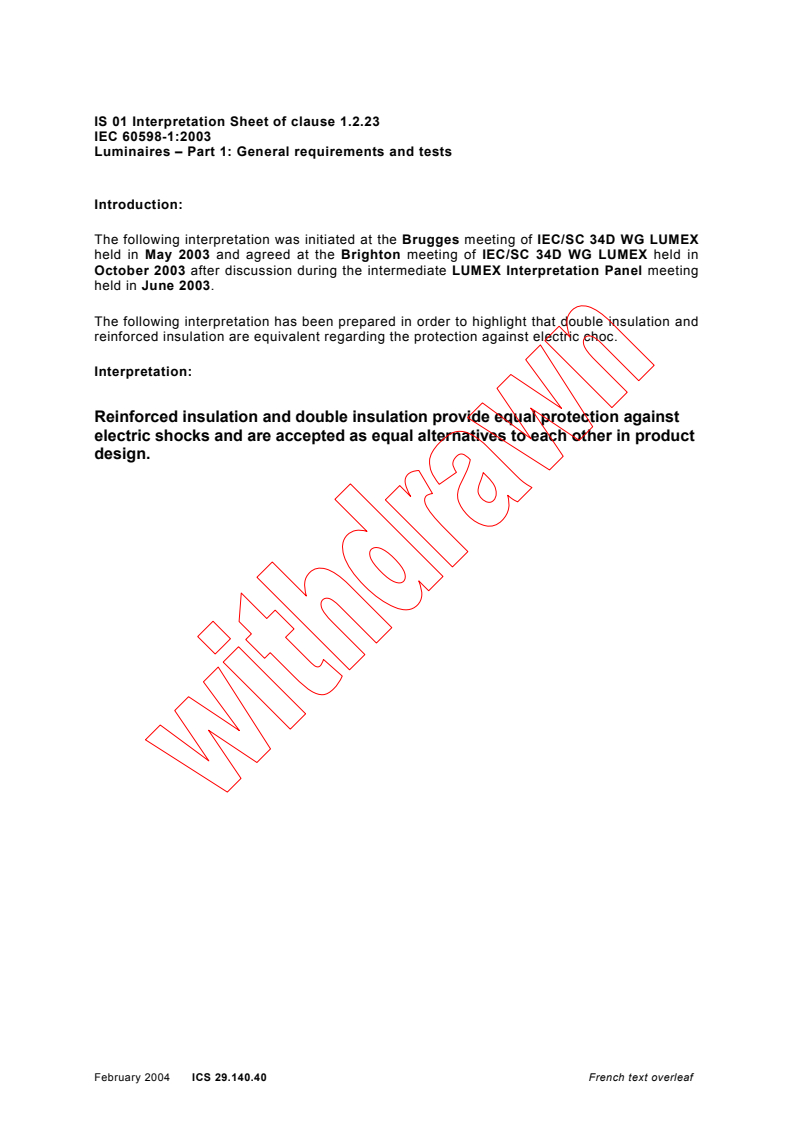
IS 01 Interpretation Sheet of clause 1.2.23
Luminaires – Part 1: General requirements and tests
Introduction:
The following interpretation was initiated at the Brugges meeting of IEC/SC 34D WG LUMEX
held in May 2003 and agreed at the Brighton meeting of IEC/SC 34D WG LUMEX held in
October 2003 after discussion during the intermediate LUMEX Interpretation Panel meeting
held in June 2003.
The following interpretation has been prepared in order to highlight that double insulation and
reinforced insulation are equivalent regarding the protection against electric choc.
Interpretation:
Reinforced insulation and double insulation provide equal protection against
electric shocks and are accepted as equal alternatives to each other in product
design.
February 2004 ICS 29.140.40 French text overleaf
60598-1 IEC:2003 – 3 –
CONTENTS
FOREWORD .11
SECTION 0: GENERAL INTRODUCTION
0.1 Scope and object.15
0.2 Normative references .17
0.3 General requirements.21
0.4 General test requirements and verification.23
0.5 Components of luminaires .25
0.6 List of sections of part 2 .25
SECTION 1: DEFINITIONS
1.1 General.29
1.2 Definitions.29
SECTION 2: CLASSIFICATION OF LUMINAIRES
2.1 General.49
2.2 Classification according to type of protection against electric shock .49
2.3 Classification according to degree of protection against ingress of dust,
solid objects and moisture .49
2.4 Classification according to material of supporting surface for which
the luminaire is designed.51
2.5 Classification according to the circumstances of use.51
SECTION 3: MARKING
3.1 General.53
3.2 Marking on luminaires .53
3.3 Additional information.59
3.4 Test of marking .63
SECTION 4: CONSTRUCTION
4.1 General.65
4.2 Replaceable components .65
4.3 Wireways .65
4.4 Lampholders .65
4.5 Starter holders .69
4.6 Terminal blocks.69
4.7 Terminals and supply connections .71
4.8 Switches .75
4.9 Insulating linings and sleeves .75
4.10 Double and reinforced insulation.77
4.11 Electrical connections and current-carrying parts .79
60598-1 IEC:2003 – 5 –
4.12 Screws and connections (mechanical) and glands .83
4.13 Mechanical strength .87
4.14 Suspensions and adjusting devices .95
4.15 Flammable materials .101
F
4.16 Luminaires marked with symbol .103
4.17 Drain holes.105
4.18 Resistance to corrosion .107
4.19 Ignitors.107
4.20 Rough service luminaires – Vibration requirements.107
4.21 Protective shield (tungsten halogen lamps) .109
4.22 Attachments to lamps .109
4.23 Semi-luminaires .111
4.24 UV radiation .111
4.25 Mechanical hazard .111
4.26 Short-circuit protection .111
SECTION 5: EXTERNAL AND INTERNAL WIRING
5.1 General.113
5.2 Supply connection and other external wiring .113
5.3 Internal wiring.121
SECTION 6: Not used
SECTION 7: PROVISION FOR EARTHING
7.1 General.129
7.2 Provision for earthing .129
SECTION 8: PROTECTION AGAINST ELECTRIC SHOCK
8.1 General.135
8.2 Protection against electric shock .135
SECTION 9: RESISTANCE TO DUST, SOLID OBJECTS AND MOISTURE
9.1 General.141
9.2 Tests for ingress of dust, solid objects and moisture .141
9.3 Humidity test .149
SECTION 10: INSULATION RESISTANCE AND ELECTRIC STRENGTH
10.1 General.151
10.2 Insulation resistance and electric strength .151
10.3 Leakage current .157
SECTION 11: CREEPAGE DISTANCES AND CLEARANCES
11.1 General.159
11.2 Creepage distances and clearances .159
60598-1 IEC:2003 – 7 –
SECTION 12: ENDURANCE TEST AND THERMAL TEST
12.1 General.165
12.2 Selection of lamps and ballasts .165
12.3 Endurance test .165
12.4 Thermal test (normal operation).167
12.5 Thermal test (abnormal operation).181
12.6 Thermal test (failed lamp controlgear conditions) .189
12.7 Thermal test in regard to fault conditions in lamp controlgear or electronic devices
in plastic luminaires.193
SECTION 13: RESISTANCE TO HEAT, FIRE AND TRACKING
13.1 General.197
13.2 Resistance to heat.197
13.3 Resistance to flame and ignition .197
13.4 Resistance to tracking .199
SECTION 14: SCREW TERMINALS
14.1 General.201
14.2 Definitions.201
14.3 General requirements and basic principles .203
14.4 Mechanical tests .207
SECTION 15: SCREWLESS TERMINALS AND ELECTRICAL CONNECTIONS
15.1 General.215
15.2 Definitions.215
15.3 General requirements.217
15.4 General instructions on tests .219
TERMINALS AND CONNECTIONS FOR INTERNAL WIRING
15.5 Mechanical tests .221
15.6 Electrical tests.223
TERMINALS AND CONNECTIONS FOR EXTERNAL WIRING
15.7 Conductors.227
15.8 Mechanical tests .227
15.9 Electrical tests.229
Figures.233
60598-1 IEC:2003 – 9 –
Annex A (normative) Test to establish whether a conductive part may cause
an electric shock .285
Annex B (normative) Test lamps. 287
Annex C (normative) Abnormal circuit conditions . 293
Annex D (normative) Draught-proof enclosure . 299
Annex E (normative) Determination of winding temperature rises by the increase-in-
resistance method . 307
Annex F (normative) Test for resistance to stress corrosion of copper and copper alloys. 309
Annex G (deleted) . 313
Annex H (deleted) . 315
Annex J (informative) Explanation of IP numbers for degrees of protection . 317
Annex K (informative) Temperature measurement . 323
Annex L (informative) Guide to good practice in luminaire design. 329
Annex M (normative) Conversion guide for Table IX of IEC 60598-1
(2nd edition) to Table 11.1 – Determination of creepage distances and clearances. 337
F
marking. 339
Annex N (informative) Explanation to luminaire
Annex P (normative) Requirements for the protective shield to be fitted to luminaires
using metal halide lamps for protective measures against UV radiation . 345
Annex Q (informative) Conformity testing during manufacture . 351
Annex R (informative) Bibliography. 355
Annex S (normative) Schedule of amended subclauses containing more serious/critical
requirements which require products to be retested . 359
Annex T (normative) Requirements for the identification of a family or range
of luminaires for type testing. 361
Annex U (informative) Reference to Class 0.363
60598-1 IEC:2003 – 11 –
INTERNATIONAL ELECTROTECHNICAL COMMISSION
_________
LUMINAIRES –
Part 1: General requirements and tests
FOREWORD
1) The International Electrotechnical Commission (IEC) is a worldwide organization for standardization comprising
all national electrotechnical committees (IEC National Committees). The object of IEC is to promote
international co-operation on all questions concerning standardization in the electrical and electronic fields. To
this end and in addition to other activities, IEC publishes International Standards, Technical Specifications,
Technical Reports, Publicly Available Specifications (PAS) and Guides (hereafter referred to as “IEC
Publication(s)”). Their preparation is entrusted to technical committees; any IEC National Committee interested
in the subject dealt with may participate in this preparatory work. International, governmental and non-
governmental organizations liaising with the IEC also participate in this preparation. IEC collaborates closely
with the International Organization for Standardization (ISO) in accordance with conditions determined by
agreement between the two organizations.
2) The formal decisions or agreements of IEC on technical matters express, as nearly as possible, an international
consensus of opinion on the relevant subjects since each technical committee has representation from all
interested IEC National Committees.
3) IEC Publications have the form of recommendations for international use and are accepted by IEC National
Committees in that sense. While all reasonable efforts are made to ensure that the technical content of IEC
Publications is accurate, IEC cannot be held responsible for the way in which they are used or for any
misinterpretation by any end user.
4) In order to promote international uniformity, IEC National Committees undertake to apply IEC Publications
transparently to the maximum extent possible in their national and regional publications. Any divergence
between any IEC Publication and the corresponding national or regional publication shall be clearly indicated in
the latter.
5) IEC provides no marking procedure to indicate its approval and cannot be rendered responsible for any
equipment declared to be in conformity with an IEC Publication.
6) All users should ensure that they have the latest edition of this publication.
7) No liability shall attach to IEC or its directors, employees, servants or agents including individual experts and
members of its technical committees and IEC National Committees for any personal injury, property damage or
other damage of any nature whatsoever, whether direct or indirect, or for costs (including legal fees) and
expenses arising out of the publication, use of, or reliance upon, this IEC Publication or any other IEC
Publications.
8) Attention is drawn to the Normative references cited in this publication. Use of the referenced publications is
indispensable for the correct application of this publication.
9) Attention is drawn to the possibility that some of the elements of this IEC Publication may be the subject of
patent rights. IEC shall not be held responsible for identifying any or all such patent rights.
International Standard IEC 60598 has been prepared by subcommittee 34D: Luminaires, of IEC
technical committee 34: Lamps and related equipment.
This sixth edition cancels and replaces the fifth edition published in 1999. It constitutes a
technical revision.
The text of this standard is based on the following documents:
FDIS Report on voting
34D/788/FDIS 34D/794/RVD
Full information on the voting for the approval of this standard can be found in the report on
voting indicated in the above table.
60598-1 IEC:2003 – 13 –
Annex S shows where a new text has been included which contains more serious/critical
requirements requiring products to be re-tested.
The committee has decided that the contents of this publication will remain unchanged until
2005-08. At this date, the publication will be
• reconfirmed;
• withdrawn;
• replaced by a revised edition, or
• amended.
60598-1 IEC:2003 – 15 –
LUMINAIRES –
Part 1: General requirements and tests
0 SECTION 0: GENERAL INTRODUCTION
0.1 Scope and object
This Part 1 of International Standard IEC 60598 specifies general requirements for luminaires,
incorporating electric light sources for operation from supply voltages up to 1 000 V. The
requirements and related tests of this standard cover: classification, marking, mechanical
construction and electrical construction.
Each section of this Part 1 should be read in conjunction with this section 0 and with other
relevant sections to which reference is made.
Each section of IEC 60598-2 details requirements for a particular type of luminaire or group of
luminaires on supply voltages not exceeding 1 000 V. These sections are published separately
for ease of revision and additional sections will be added as and when a need for them is
recognized.
Attention is drawn to the fact that this Part 1 covers all aspects of safety (electrical, thermal
and mechanical).
The presentation of photometric data for luminaires is under consideration by the International
Commission on Illumination (CIE) and is not, therefore, included in this Part 1.
Requirements are included in this Part 1 for luminaires incorporating ignitors with nominal peak
values of the voltage pulse not exceeding those of Table 11.3. The requirements apply to
luminaires with ignitors built into ballasts and to luminaires with ignitors separate from ballasts.
For luminaires with ignitors built into lamps, the requirements are under consideration.
Requirements for semi-luminaires are included in this Part 1.
In general this Part 1 covers safety requirements for luminaires. The object of this Part 1 is to
provide a set of requirements and tests which are considered to be generally applicable to
most types of luminaires and which can be called up as required by the detail specifications of
IEC 60598-2. This Part 1 is thus not to be regarded as a specification in itself for any type of
luminaire, and its provisions apply only to particular types of luminaires to the extent
determined by the appropriate section of part 2.
The sections of part 2, in making reference to any of the sections of Part 1, specify the extent
to which that section is applicable and the order in which the tests are to be performed; they
also include additional requirements as necessary.
The order in which the sections of Part 1 are numbered has no particular significance as the
order in which their provisions apply is determined for each type of luminaire or group of
luminaires by the appropriate section of part 2. All sections of part 2 are self-contained and
therefore do not contain references to other sections of part 2.
60598-1 IEC:2003 – 17 –
Where the requirements of any of the sections of Part 1 are referred to in the sections of part 2
by the phrase "The requirements of section . of IEC 60598-1 apply", this phrase is to be
interpreted as meaning that all the requirements of that section of Part 1 apply except those
which are clearly inapplicable to the particular type of luminaire covered by that section of
part 2.
For explosion proof luminaires, as covered by IEC 60079, the requirements of IEC 60598
(selecting the appropriate parts 2) are applied in addition to the requirements of IEC 60079. In
the event of any conflict between IEC 60598 and IEC 60079, the requirements of IEC 60079
take priority.
In accordance with IEC guidelines, new IEC standards are divided into those covering either
safety or performance. In the lamp safety standards, “information for luminaire design” is given
for the safe operation of lamps; this should be regarded as normative when testing luminaires
to this standard.
Attention is drawn to lamp performance standards which contain “information for luminaire
design”; this should be followed for proper lamp operation; however, this standard does not
require the testing of lamps performance as part of the type test approval for luminaires.
Improvements in safety to take account of the state of the art technology are incorporated in
the standards with revisions and amendments on an ongoing basis. Regional standardisation
bodies may include statements in their derived standards to cover products which have
complied with the previous document as shown by the manufacturer or standardization body.
The statements may require that for such products the previous standard may continue to
apply to production until a defined date after which the new standard shall apply.
0.2 Normative references
The following referenced documents are indispensable for the application of this document. For
dated references, only the edition cited applies. For undated references, the latest edition of
the referenced document (including any amendments) applies.
IEC 60061-2, Lamp caps and holders together with gauges for the control of interchangeability
and safety – Part 2: Lampholders
IEC 60061-3, Lamp caps and holders together with gauges for the control of interchangeability
and safety – Part 3: Gauges
IEC 60065:2001, Audio, video and similar electronic apparatus – Safety requirements
IEC 60068-2-75, Environmental testing – Part 2-75: Tests – Test Eh: Hammer tests
IEC 60079 (all parts), Electrical apparatus for explosive gas atmospheres
IEC 60083, Plugs and socket-outlets for domestic and similar general use standardized in
member countries of IEC
IEC 60085, Thermal evaluation and classification of electrical insulation
IEC 60112:2003, Method for the determination of the proof and the comparative tracking
indices of solid insulating materials
IEC 60155, Glow-starters for fluorescent lamps
60598-1 IEC:2003 – 19 –
IEC 60227(all parts), Polyvinyl chloride insulated cables of rated voltages up to and including
450/750 V
IEC 60238:1998, Edison screw lampholders
IEC 60245 (all parts), Rubber insulated cables – Rated voltages up to and including 450/750 V
IEC 60320 (all parts), Appliance couplers for household and similar general purposes
IEC 60357, Tungsten halogen lamps (non-vehicle) – Performance specifications
IEC 60360, Standard method of measurement of lamp cap temperature rise
IEC 60384-14, Fixed capacitors for use in electronic equipment – Part 14: Sectional
specification: Fixed capacitors for electromagnetic interference suppression and connection to
the supply mains
IEC 60400, Lampholders for tubular fluorescent lamps and starter-holders
1)
IEC 60417-DB:2002,* Graphical symbols for use on equipment
IEC 60432-1:1999, Incandescent lamps – Safety specifications – Part 1: Tungsten filament
lamps for domestic and similar general lighting purposes
IEC 60432-2, Incandescent lamps – Safety specifications – Part 2: Tungsten halogen lamps for
domestic and similar general lighting purposes
IEC 60432-3, Incandescent lamps – Safety specifications – Part 3: Tungsten halogen lamps
(non-vehicle)
IEC 60529:1989, Degrees of protection provided by enclosures (IP Code)
IEC 60570:2003, Electrical supply track systems for luminaires
IEC 60598-2 (all parts), Luminaires – Part 2: Particular requirements
IEC 60598-2-4:1997, Luminaires – Part 2: Particular requirements – Section 4: Portable
general purpose luminaires
IEC 60634, Heat test source (H.T.S.) lamps for carrying out heating tests on luminaires
IEC 60662, High pressure sodium vapour lamps
IEC 60664-1, Insulation coordination for equipment within low-voltage systems – Part 1:
Principles, requirements and tests
IEC 60684 (all parts), Flexible insulating sleeving
IEC 60695-2 (all parts), Fire hazard testing – Part 2: Test methods
IEC 60695-2-2, Fire hazard testing – Part 2: Test methods – Section 2: Needle-flame test
IEC 60695-2-10, Fire hazard testing – Part 2-10: Glowing/hot-wire based test methods – Glow-
wire apparatus and common test procedure
IEC 60838 (all parts), Miscellaneous lampholders
––––––––––
1)
"DB" refers to the IEC on-line database.
60598-1 IEC:2003 – 21 –
IEC 60901, Single-capped fluorescent lamps – Performance specifications
IEC 60989, Separating transformers, autotransformers, variable transformers and reactors
IEC 60990:1999, Methods of measurement of touch current and protective conductor current
IEC 61032:1997, Protection of persons and equipment by enclosures – Probes for verification
IEC 61058-1:2000 Switches for appliances – Part 1: General requirements
IEC 61184: Bayonet lampholders
IEC 61195: Double-capped fluorescent lamps – Safety specifications
IEC 61199:1999, Single-capped fluorescent lamps – Safety specifications
IEC 61347 (all parts), Lamp controlgear
IEC 61347-2-9, Lamp controlgear – Part 2-9: Particular requirements for ballasts for discharge
lamps (excluding fluorescent lamps)
IEC 61558-2 (all parts), Safety of power transformers, power supply units and similar – Part 2:
Particular requirements
IEC 61558-2-5, Safety of power transformers, power supply units and similar – Part 2-5:
Particular requirements for shaver transformers and shaver supply units
IEC 62035: Discharge lamps (excluding fluorescent lamps) – Safety specifications
IEC 80416-1: Basic principles for graphical symbols for use on equipment – Part 1: Creation of
symbol originals
ISO 75-2:1993, Plastics – Determination of temperature of deflection under load – Plastics and
ebonite
ISO 4046-4:2002, Paper, board, pulp and related terms – Vocabulary – Part 4: Paper and
board grades and converted products
0.3 General requirements
Luminaires shall be so designed and constructed that in normal use they function safely and
cause no danger to persons or surroundings. In general, compliance is checked by carrying out
all the tests specified.
0.3.1 A luminaire shall comply with a section of part 2. If, however, an appropriate section of
part 2 does not exist for a particular luminaire or group of luminaires, the nearest applicable
section of part 2 may be used as a guide to the requirements and tests.
Where the design of a luminaire is such that two or more sections of part 2 are applicable, the
luminaire shall comply with both or all of the appropriate sections.
0.3.2 Semi-luminaires should be regarded as luminaires for test purposes.
60598-1 IEC:2003 – 23 –
0.4 General test requirements and verification
0.4.1 Tests according to this standard are type tests. For the definition of a "type test", see
section 1 of this Part 1.
NOTE The requirements and tolerances permitted by this standard are related to testing of a type test sample
submitted for that purpose. Compliance of the type test sample does not ensure compliance of the whole production
of a manufacturer. Compliance for production is the responsibility of the manufacturer and may include routine tests
and quality assurance in addition to type testing.
0.4.2 Except where otherwise specified in the sections of Part 1 or part 2, luminaires shall be
tested in an ambient temperature of between 10 °C and 30 °C. Luminaires shall be tested as
delivered, and installed as in normal use, having regard to the manufacturer's installation
instructions. The lamp (or lamps) is (are) not included except where essential for the test.
Luminaires cannot be regarded as meeting the requirements of this Part 1 unless all internal
wiring is complete.
In general, the tests are made on a single sample luminaire or, where a range of similar
luminaires is involved, on a single luminaire of each rated wattage in the range or on a
representative selection from the range as agreed with the manufacturer (see Annex T). This
selection shall include the luminaire, together with any attachments, which represents the most
unfavourable combination from a testing point of view.
Each sample luminaire shall comply with all the relevant tests. In order to reduce the time of
testing and to allow for any tests which may be destructive, the manufacturer may submit
additional luminaires or parts of luminaires provided that these are of the same materials and
design as the original luminaire and that the results of the test are the same as if carried out on
an identical luminaire. Where the test for compliance is shown as being "by inspection" this
shall include any necessary handling.
For track-mounted luminaires the manufacturer shall provide, together with the luminaire, a
sample of the appropriate track, connector and adaptors for the luminaire to be connected.
Combination luminaires are tested for safety requirements with that assemblage of parts which
gives the most unfavourable result.
Certain parts of luminaires, such as joints, raising and lowering devices, may be tested
separately provided that the design of these parts is such that their performance is not
dependent upon the other parts of the luminaires.
Luminaires intended to be used with non-detachable flexible cables or cords are tested with the
flexible cable or cord connected to the luminaire.
For luminaires intended to be used with but not normally supplied with a shade, the luminaire
manufacturer shall provide a shade, typical of the type that might be used with the luminaire.
0.4.3 Verification and tests
Luminaires for testing to the requirements of this standard may have earlier test reports
updated in accordance with this edition by submitting a new sample for test together with the
previous test reports.
60598-1 IEC:2003 – 25 –
Full type testing need not generally be necessary and the product and the previous test results
shall be reviewed only against any amended clauses marked ‘R’ and scheduled in Annex S.
NOTE Clauses marked ‘R’ and scheduled in Annex S will be included in future amendments/editions.
0.5 Components of luminaires
0.5.1 Components, other than integral components, shall comply with the requirements of the
relevant IEC standards, if any.
Components which comply with the requirements of the relevant IEC standard and are marked
with individual ratings are checked to establish that they suit the conditions which may occur in
use. Aspects of use not covered by the respective standard shall require them to satisfy the
additional relevant requirements of this standard.
Compliance is checked by inspection and the relevant tests.
Integral components shall comply as far as is reasonable with the IEC component standards,
as part of the luminaire.
NOTE 1 This does not imply that components need to be separately tested before approval of the luminaire.
NOTE 2 Guidance for selection of components in different kinds of luminaires can be found in Annex L.
Internal wiring of a luminaire shall comply with the requirements in 5.3.
NOTE This does not exclude the use of standardized cables.
0.5.2 Components complying with the requirements of their own standard and used in
accordance with their intended use, shall only be tested to the requirements of this standard
where there are no requirements in the component standard (covering the requirement heading
of this standard).
NOTE A valid test report should be considered adequate to show compliance.
Lampholders and starterholders shall additionally comply with the gauging and inter-
changeability requirements of the appropriate IEC component standard where applicable after
building into the luminaire.
0.5.3 Components for which no appropriate IEC standard exists shall satisfy the relevant
requirements of this luminaire standard as part of the luminaire. Lampholders and
starterholders shall additionally comply with the gauging and interchangeability requirements of
the appropriate IEC component standard where applicable.
NOTE Examples of components are lampholders, switches, transformers, ballasts, flexible cables and cords and
plugs.
0.5.4 Compliance with this standard can only be assured if protective shields of identical
specification are used.
0.6 List of sections of part 2
1. Fixed general purpose luminaires.
2. Recessed luminaires.
3. Luminaires for road and street lighting.
4. Portable general purpose luminaires.
5. Floodlights.
60598-1 IEC:2003 – 27 –
6. Luminaires with built-in transformers for tungsten filament lamps.
7. Portable luminaires for garden use.
8. Handlamps.
9. Photo and film luminaires (non-professional).
10. Portable child-appealing luminaires.
11. Not used at present.
12. Not used at present.
13. Not used at present.
14. Not used at present.
15. Not used at present.
16. Not used at present.
17. Luminaires for stage lighting, television and film studios (outdoor and indoor).
18. Luminaires for swimming-pools and similar applications.
19. Air-handling luminaires (safety requirements).
20. Lighting chains.
21. Not used at present.
22. Luminaires for emergency lighting.
23. Extra low voltage lighting systems for filament lamps.
24. Luminaires with limited surface temperatures.
25. Luminaires for use in clinical areas of hospitals and health care buildings.
60598-1 IEC:2003 – 29 –
1 SECTION 1: DEFINITIONS
1.1 General
This section gives general definitions applicable to luminaires.
1.2 Definitions
For the purpose of all sections of this Part 1, the following definitions apply; other definitions
related to lamps are to be found in the relevant lamp standards.
Where the terms "voltage" and "current" are used, they imply the r.m.s. values unless
otherwise stated.
1.2.1
luminaire
apparatus which distributes, filters or transforms the light transmitted from one or more lamps
and which includes all the parts necessary for supporting, fixing and protecting the lamps, but
not the lamps themselves, and where necessary circuit auxiliaries together with the means for
connecting them to the supply.
NOTE A luminaire with integral non-replaceable lamps is regarded as a luminaire except that the tests are not
applied to the integral lamp or integral self ballasted lamp.
1.2.2
main part (of luminaire)
that which is fixed to the mounting surface or is directly suspended from it or standing on it
(it may or may not carry the lamps, lampholders and auxiliary gear).
NOTE In luminaires for tungsten filament lamps, the part carrying the lampholder is normally the main part.
1.2.3
ordinary luminaire
luminaire providing protection against accidental contact with live parts but without any other
special protection against dust, solid objects or moisture.
1.2.4
general purpose luminaire
luminaire which is not designed for a special purpose.
NOTE Examples of general purpose luminaires include pendants, some spotlights and certain fixed luminaires for
surface or recessed mounting. Examples of special purpose luminaires are those for rough usage, photo and film
applications and swimming-pools.
1.2.5
adjustable luminaire
luminaire, the main part of which can be turned or moved by means of joints, raising and
lowering devices, telescopic tubes or similar devices.
NOTE An adjustable luminaire may be fixed or portable.
1.2.6
basic luminaire
smallest number of assembled parts that can satisfy the requirements of any of the sections of
part 2 of IEC 60598.
60598-1 IEC:2003 – 31 –
1.2.7
combination luminaire
luminaire consisting of a basic luminaire in combination with one or more parts which may be
replaced by other parts, or used in a different combination with other parts and changed either
by hand or with the use of tools.
1.2.8
fixed luminaire
luminaire which cannot easily be moved from one place to another, either because the fixing is
such that the luminaire can only be removed with the aid of a tool, or because it is intended for
use out of easy reach.
NOTE In general, fixed luminaires are designed for permanent connection to the supply, but connection may also
be made by means of a plug or similar device.
Examples of luminaires intended for use out of easy reach are pendants and luminaires
designed for fixing to a ceiling.
1.2.9
portable luminaire
luminaire which, in normal use, can be moved from one place to another while connected to the
supply.
NOTE Luminaires for wall mounting provided with a non-detachable flexible cable or cord for connection to a plug
and luminaires which may be fixed to their support by means of a wing screw, a clip or a hook so that they can
easily be removed from their support by hand, are considered to be portable luminaires.
1.2.10
recessed luminaire
luminaire intended by the manufacturer to be fully or partly recessed into a mounting surface.
NOTE The term applies both to luminaires for operation in enclosed cavities and to luminaires for mounting
through a surface such as a suspended ceiling.
1.2.11
rated voltage
supply voltage or voltages assigned to the luminaire by the manufacturer.
1.2.12
supply current
current at the supply terminals when the luminaire has stabilized in normal use at the rated
voltage and frequency.
1.2.13
rated wattage
number and rated wattage of the lamps for which the luminaire is designed.
1.2.14
non-detachable flexible cable or cord
flexible cable or cord which can only be removed from the luminaire with the aid of a tool.
NOTE Luminaires may be provided with non-detachable flexible cables and cords or designed for use with non-
detachable flexible cables or cords e.g. types X, Y or Z attachments.
60598-1 IEC:2003 – 33 –
...
NORME CEI
INTERNATIONALE 60598-1
Edition 6.1
2006-09
Edition 6:2003 consolidée par l’amendement 1:2006
Luminaires –
Partie 1:
Prescriptions générales et essais
Cette version française découle de la publication d’origine
bilingue dont les pages anglaises ont été supprimées.
Les numéros de page manquants sont ceux des pages
supprimées.
Numéro de référence
CEI 60598-1:2003+A1:2006(F)
Numérotation des publications
Depuis le 1er janvier 1997, les publications de la CEI sont numérotées à partir de
60000. Ainsi, la CEI 34-1 devient la CEI 60034-1.
Editions consolidées
Les versions consolidées de certaines publications de la CEI incorporant les
amendements sont disponibles. Par exemple, les numéros d’édition 1.0, 1.1 et 1.2
indiquent respectivement la publication de base, la publication de base incorporant
l’amendement 1, et la publication de base incorporant les amendements 1 et 2.
Informations supplémentaires
sur les publications de la CEI
Le contenu technique des publications de la CEI est constamment revu par la CEI
afin qu'il reflète l'état actuel de la technique. Des renseignements relatifs à cette
publication, y compris sa validité, sont disponibles dans le Catalogue des
publications de la CEI (voir ci-dessous) en plus des nouvelles éditions, amende-
ments et corrigenda. Des informations sur les sujets à l’étude et l’avancement des
travaux entrepris par le comité d’études qui a élaboré cette publication, ainsi que la
liste des publications parues, sont également disponibles par l’intermédiaire de:
• Site web de la CEI (www.iec.ch)
• Catalogue des publications de la CEI
Le catalogue en ligne sur le site web de la CEI (www.iec.ch/searchpub) vous permet
de faire des recherches en utilisant de nombreux critères, comprenant des
recherches textuelles, par comité d’études ou date de publication. Des informations
en ligne sont également disponibles sur les nouvelles publications, les publications
remplacées ou retirées, ainsi que sur les corrigenda.
• IEC Just Published
Ce résumé des dernières publications parues (www.iec.ch/online_news/justpub)
est aussi disponible par courrier électronique. Veuillez prendre contact avec le
Service client (voir ci-dessous) pour plus d’informations.
• Service clients
Si vous avez des questions au sujet de cette publication ou avez besoin de
renseignements supplémentaires, prenez contact avec le Service clients:
Email: custserv@iec.ch
Tél: +41 22 919 02 11
Fax: +41 22 919 03 00
NORME CEI
INTERNATIONALE 60598-1
Edition 6.1
2006-09
Edition 6:2003 consolidée par l’amendement 1:2006
Luminaires –
Partie 1:
Prescriptions générales et essais
© IEC 2006 Droits de reproduction réservés
Aucune partie de cette publication ne peut être reproduite ni utilisée sous quelque forme que ce soit et par aucun
procédé, électronique ou mécanique, y compris la photocopie et les microfilms, sans l'accord écrit de l'éditeur.
International Electrotechnical Commission, 3, rue de Varembé, PO Box 131, CH-1211 Geneva 20, Switzerland
Telephone: +41 22 919 02 11 Telefax: +41 22 919 03 00 E-mail: inmail@iec.ch Web: www.iec.ch
CODE PRIX
CS
Commission Electrotechnique Internationale
International Electrotechnical Commission
МеждународнаяЭлектротехническаяКомиссия
Pour prix, voir catalogue en vigueur
IS 01 Feuille d’Interprétation de l’article 1.2.23
CEI 60598-1: 2003
Luminaires – Partie 1: Prescriptions générales et essais
Introduction:
L’interprétation suivante a été initiée lors de la réunion de Bruges du GT LUMEX SC/CEI 34D
qui s’est tenue en mai 2003 et acceptée lors de la réunion de Brighton du GT LUMEX
SC/CEI 34D qui s’est tenue en octobre 2003 et après discussion à la réunion du Panel
d’interprétation du LUMEX qui s’est tenue en juin 2003.
L’interprétation suivante a été préparée dans le but de souligner qu’une double isolation et
une isolation renforcée sont équivalente du point de vue de la protection contre les chocs
électriques.
Interprétation:
Isolation renforcée et double isolation procurent une protection contre les
chocs électriques équivalente et il est accepté qu’elles puissent être utilisées
indifféremment l’une pour l’autre dans la conception des produits.
Texte anglais au verso ICS 29.140.40 Février 2004
– 2 – 60598-1 CEI:2003+A1:2006
SOMMAIRE
AVANT-PROPOS .10
SECTION 0: INTRODUCTION GÉNÉRALE
0.1 Domaine d'application et objet.14
0.2 Références normatives.16
0.3 Prescriptions générales.20
0.4 Généralités sur les essais et le contrôle .22
0.5 Eléments constitutifs des luminaires.24
0.6 Liste des sections de la partie 2 .24
SECTION 1: DÉFINITIONS
1.1 Généralités .28
1.2 Définitions.28
SECTION 2: CLASSIFICATION DES LUMINAIRES
2.1 Généralités .48
2.2 Classification en fonction du type de protection contre les chocs électriques.48
2.3 Classification en fonction du degré de protection contre la pénétration
des poussières, des corps solides et de l'humidité.48
2.4 Classification selon le matériau de la surface d'appui pour laquelle
le luminaire est conçu .50
2.5 Classification selon les conditions d’emploi .50
SECTION 3: MARQUAGE
3.1 Généralités .52
3.2 Marquage sur les luminaires .52
3.3 Renseignements complémentaires .58
3.4 Vérification du marquage .62
SECTION 4: CONSTRUCTION
4.1 Généralités .64
4.2 Composants remplaçables.64
4.3 Passages de fils.64
4.4 Douilles .64
4.5 Douilles de starters .68
4.6 Blocs de jonction.68
4.7 Bornes et raccordement au réseau.70
4.8 Interrupteurs.74
4.9 Recouvrements et manchons isolants .74
4.10 Isolation double et isolation renforcée .76
4.11 Connexions électriques et parties conductrices .78
– 4 – 60598-1 CEI:2003+A1:2006
4.12 Vis et connexions (mécaniques) et presse-étoupe .82
4.13 Résistance mécanique.86
4.14 Suspensions et dispositifs de réglage.94
4.15 Matériaux inflammables . 100
F
4.16 Luminaires marqués du symbole . 102
4.17 Trous de vidange . 104
4.18 Résistance à la corrosion . 106
4.19 Amorceurs.106
4.20 Luminaires pour conditions sévères d'emploi – Prescriptions concernant
la résistance aux vibrations . 106
4.21 Ecran de protection (lampes tungstène halogène) . 108
4.22 Accessoires fixés aux lampes . 108
4.23 Semi-luminaires . 110
4.24 Rayonnement UV.110
4.25 Risques mécaniques.110
4.26 Protection contre les courts-circuits. 110
SECTION 5: CÂBLAGE EXTERNE ET INTERNE
5.1 Généralités .112
5.2 Raccordement au réseau et autres câblages externes . 112
5.3 Câblage interne. 120
SECTION 6: Non utilisée
SECTION 7: DISPOSITIONS EN VUE DE LA MISE À LA TERRE
7.1 Généralités .128
7.2 Dispositions en vue de la mise à la terre . 128
SECTION 8: PROTECTION CONTRE LES CHOCS ÉLECTRIQUES
8.1 Généralités .134
8.2 Protection contre les chocs électriques. 134
SECTION 9: RÉSISTANCE AUX POUSSIÈRES, AUX CORPS SOLIDES ET À L'HUMIDITÉ
9.1 Généralités .140
9.2 Essais de protection contre la pénétration des poussières, des corps solides
et de l'humidité. 140
9.3 Essai d'humidité. 148
SECTION 10: RÉSISTANCE D'ISOLEMENT ET RIGIDITÉ DIÉLECTRIQUE
10.1 Généralités . 150
10.2 Résistance d'isolement et rigidité diélectrique. 150
10.3 Courant de fuite . 156
SECTION 11: LIGNES DE FUITE ET DISTANCES DANS L'AIR
11.1 Généralités . 158
11.2 Lignes de fuite et distances dans l'air . 158
– 6 – 60598-1 CEI:2003+A1:2006
SECTION 12: ESSAIS D'ENDURANCE ET D'ÉCHAUFFEMENT
12.1 Généralités . 164
12.2 Prélèvement des lampes et ballasts . 164
12.3 Essai d'endurance. 164
12.4 Essai d'échauffement (fonctionnement normal) . 166
12.5 Essai d'échauffement (fonctionnement anormal). 180
12.6 Essai d'échauffement (conditions de défaillance de l'appareillage d'alimentation). 188
12.7 Essai d'échauffement des luminaires en matière thermoplastique, en rapport avec
des conditions défectueuses dans les appareillages d'alimentation ou les
dispositifs électroniques incorporés. 192
SECTION 13: RÉSISTANCE À LA CHALEUR, AU FEU
ET AUX COURANTS DE CHEMINEMENT
13.1 Généralités . 200
13.2 Résistance à la chaleur . 200
13.3 Résistance à la flamme et à l'inflammation . 200
13.4 Résistance aux courants de cheminement. 202
SECTION 14: BORNES À VIS
14.1 Généralités . 204
14.2 Définitions. 204
14.3 Règles générales et principes fondamentaux. 206
14.4 Essais mécaniques . 210
SECTION 15: BORNES SANS VIS ET CONNEXIONS ÉLECTRIQUES
15.1 Généralités . 218
15.2 Définitions. 218
15.3 Règles générales . 220
15.4 Généralités sur les essais . 222
BORNES ET CONNEXIONS POUR CÂBLAGE INTERNE
15.5 Essais mécaniques . 224
15.6 Essais électriques . 226
BORNES ET CONNEXIONS POUR CÂBLAGE EXTERNE
15.7 Conducteurs.230
15.8 Essais mécaniques . 230
15.9 Essais électriques . 232
Figures . 236
– 8 – 60598-1 CEI:2003+A1:2006
Annexe A (normative) Essai destiné à déterminer si une partie conductrice
est susceptible de provoquer un choc électrique.288
Annexe B (normative) Lampes d'essai.290
Annexe C (normative) Conditions de fonctionnement anormal .296
Annexe D (normative) Enceinte à air calme .302
Annexe E (normative) Détermination des échauffements des enroulements
par la méthode de variation de résistance.310
Annexe F (normative) Contrôle de la résistance aux contraintes dues à la corrosion
du cuivre et des alliages de cuivre.312
Annexe G (supprimée) .316
Annexe H (supprimée).318
Annexe I (vide).320
Annexe J (informative) Explication des chiffres IP des degrés de protection .320
Annexe K (informative) Mesure des températures .326
Annexe L (informative) Guide de bonne pratique pour la conception des luminaires.332
Annexe M (informative) Guide de conversion entre le Tableau IX de la CEI 60598-1
e
(2 édition) et le Tableau 11.1 – Détermination des lignes de fuite et distances dans l'air.340
F
Annexe N (informative) Explication sur le marquage des luminaires.342
Annexe O (vide) .348
Annexe P (normative) Prescriptions concernant les mesures de protection, contre
le rayonnement UV, pour les écrans de protection destinés à équiper les luminaires
utilisant des lampes aux halogénures métalliques.350
Annexe Q (informative) Essai de conformité en fabrication .354
Annexe R (informative) Bibliographie .358
Annexe S (normative) Récapitulatif des articles modifiés contenant des
prescriptions particulièrement importantes/critiques qui nécessitent de refaire
les essais sur les produits .362
Annexe T (normative) Prescriptions pour l’identification d’une famille ou d'une gamme
de luminaires pour les essais de type .364
Annexe U (informative) Référence à la classe 0 . 366
Annexe V (normative) Essai alternatif d’échauffement pour luminaires réalisé
avec des matériaux thermoplastiques. 368
– 10 – 60598-1 © CEI:2003+A1:2006
COMMISSION ÉLECTROTECHNIQUE INTERNATIONALE
_________
LUMINAIRES –
Partie 1: Prescriptions générales et essais
AVANT-PROPOS
1) La Commission Electrotechnique Internationale (CEI) est une organisation mondiale de normalisation composée
de l'ensemble des comités électrotechniques nationaux (Comités nationaux de la CEI). La CEI a pour objet de
favoriser la coopération internationale pour toutes les questions de normalisation dans les domaines de
l'électricité et de l'électronique. A cet effet, la CEI – entre autres activités – publie des Normes internationales,
des Spécifications techniques, des Rapports techniques, des Spécifications accessibles au public (PAS) et des
Guides (ci-après dénommés "Publication(s) de la CEI"). Leur élaboration est confiée à des comités d'études,
aux travaux desquels tout Comité national intéressé par le sujet traité peut participer. Les organisations
internationales, gouvernementales et non gouvernementales, en liaison avec la CEI, participent également aux
travaux. La CEI collabore étroitement avec l'Organisation Internationale de Normalisation (ISO), selon des
conditions fixées par accord entre les deux organisations.
2) Les décisions ou accords officiels de la CEI concernant les questions techniques représentent, dans la mesure
du possible, un accord international sur les sujets étudiés, étant donné que les Comités nationaux de la CEI
intéressés sont représentés dans chaque comité d’études.
3) Les Publications de la CEI se présentent sous la forme de recommandations internationales et sont agréées
comme telles par les Comités nationaux de la CEI. Tous les efforts raisonnables sont entrepris afin que la CEI
s'assure de l'exactitude du contenu technique de ses publications; la CEI ne peut pas être tenue responsable de
l'éventuelle mauvaise utilisation ou interprétation qui en est faite par un quelconque utilisateur final.
4) Dans le but d'encourager l'uniformité internationale, les Comités nationaux de la CEI s'engagent, dans toute la
mesure possible, à appliquer de façon transparente les Publications de la CEI dans leurs publications
nationales et régionales. Toutes divergences entre toutes Publications de la CEI et toutes publications
nationales ou régionales correspondantes doivent être indiquées en termes clairs dans ces dernières.
5) La CEI n’a prévu aucune procédure de marquage valant indication d’approbation et n'engage pas sa
responsabilité pour les équipements déclarés conformes à une de ses Publications.
6) Tous les utilisateurs doivent s'assurer qu'ils sont en possession de la dernière édition de cette publication.
7) Aucune responsabilité ne doit être imputée à la CEI, à ses administrateurs, employés, auxiliaires ou
mandataires, y compris ses experts particuliers et les membres de ses comités d'études et des Comités
nationaux de la CEI, pour tout préjudice causé en cas de dommages corporels et matériels, ou de tout autre
dommage de quelque nature que ce soit, directe ou indirecte, ou pour supporter les coûts (y compris les frais
de justice) et les dépenses découlant de la publication ou de l'utilisation de cette Publication de la CEI ou de
toute autre Publication de la CEI, ou au crédit qui lui est accordé.
8) L'attention est attirée sur les références normatives citées dans cette publication. L'utilisation de publications
référencées est obligatoire pour une application correcte de la présente publication.
9) L’attention est attirée sur le fait que certains des éléments de la présente Publication de la CEI peuvent faire
l’objet de droits de propriété intellectuelle ou de droits analogues. La CEI ne saurait être tenue pour
responsable de ne pas avoir identifié de tels droits de propriété et de ne pas avoir signalé leur existence.
La Norme internationale CEI 60598 a été établie par le sous-comité 34D: Luminaires, du
comité d'études 34 de la CEI: Lampes et équipements associés.
La présente version consolidée de la CEI 60598-1 comprend la sixième édition (2003)
[documents 34D/788/FDIS et 34D/794/RVD] et son amendement 1 (2006) [documents
34D/857/FDIS et 34D/864/RVD].
Le contenu technique de cette version consolidée est donc identique à celui de l'édition de
base et à son amendement; cette version a été préparée par commodité pour l'utilisateur.
Elle porte le numéro d'édition 6.1.
Une ligne verticale dans la marge indique où la publication de base a été modifiée par
l'amendement 1.
L'annexe S indique où un nouveau texte a été introduit comportant des prescriptions majeures/
critiques nécessitant que le produit soit retesté.
– 12 – 60598-1 CEI:2003+A1:2006
Le comité a décidé que le contenu de la publication de base et de ses amendements ne sera
pas modifié avant la date de maintenance indiquée sur le site web de la CEI sous
"http://webstore.iec.ch" dans les données relatives à la publication recherchée. A cette date,
la publication sera
• reconduite,
• supprimée,
• remplacée par une édition révisée, ou
• amendée.
– 14 – 60598-1 CEI:2003+A1:2006
LUMINAIRES –
Partie 1: Prescriptions générales et essais
0 SECTION 0: INTRODUCTION GÉNÉRALE
0.1 Domaine d'application et objet
La présente partie 1 de la Norme internationale CEI 60598 spécifie pour les luminaires
incorporant des sources lumineuses électriques, les prescriptions générales pour le fonction-
nement à des tensions d'alimentation jusqu'à 1 000 V. Les prescriptions et les essais
correspondants de cette norme concernent: la classification, le marquage, la construction
mécanique et électrique.
Chacune des sections de la présente partie 1 doit être lue conjointement avec la présente
Section 0 et avec les autres sections correspondantes auxquelles il est fait référence.
Chaque section de la CEI 60598-2 détaille les prescriptions applicables à un type particulier de
luminaire ou groupe de luminaires alimentés sous des tensions ne dépassant pas 1 000 V. Ces
sections sont publiées séparément pour faciliter leur révision et permettre l'addition de
nouvelles sections, au fur et à mesure de la nécessité de la parution de ces dernières.
L'attention est attirée sur le fait que cette partie 1 s'applique à tous les aspects de la sécurité
(électriques, thermiques et mécaniques).
La présentation des données photométriques relatives aux luminaires est en cours d'étude à la
Commission Internationale de l'Eclairage (CIE); ces données ne sont, par conséquent, pas
incluses dans la présente partie 1.
Les règles pour les luminaires contenant des amorceurs avec une impulsion de tension d'une
valeur de crête nominale ne dépassant pas celles du Tableau 11.3 sont incluses dans cette
partie 1. Ces règles sont applicables aux luminaires avec amorceurs incorporés dans les
ballasts, ainsi qu'aux luminaires dont les amorceurs sont séparés des ballasts. Les règles sont
à l'étude pour les luminaires dont les amorceurs sont incorporés dans les lampes.
Les prescriptions relatives aux semi-luminaires sont incluses dans cette partie 1.
De manière générale, la présente partie 1 traite de règles de sécurité applicables aux
luminaires. L'objet de cette partie 1 est de fournir un ensemble de règles et d'essais générale-
ment considérés comme applicables à la plupart des types de luminaires et susceptibles d'être
prescrits dans les spécifications particulières de la CEI 60598-2. Cette partie 1 ne doit donc
pas être considérée comme une spécification en soi pour un type quelconque de luminaire,
mais ses dispositions ne s'appliquent qu'à des types particuliers de luminaires, dans la limite
définie par une section appropriée de la partie 2.
Les sections de la partie 2, en se référant à l'une quelconque des sections de la partie 1,
définissent la limite dans laquelle cette section est applicable et l'ordre dans lequel les essais
doivent être exécutés; elles comportent également des prescriptions complémentaires si
besoin est.
L'ordre dans lequel les sections de la partie 1 sont numérotées n'a aucune signification
particulière, parce que l'ordre dans lequel leurs dispositions s'appliquent est déterminé, pour
chaque type de luminaire ou groupe de luminaires, par la section appropriée de la partie 2.
Toutes les sections de la partie 2 sont indépendantes et, par conséquent, ne comportent
aucune référence aux autres sections de la partie 2.
– 16 – 60598-1 CEI:2003+A1:2006
Lorsque les dispositions d'une des sections de la partie 1 sont évoquées dans les sections de
la partie 2 au moyen de la phrase «Les dispositions de la section . de la CEI 60598-1 sont
applicables», cela signifie que toutes les dispositions de cette section de la partie 1 sont
applicables, à l'exception de celles qui sont clairement inapplicables au type particulier de
luminaire visé par cette section de la partie 2.
Dans le cas des luminaires pour atmosphère explosive, spécifiée dans les normes CEI de la
série 60079, les prescriptions de la CEI 60598 (en sélectionnant les parties 2) appropriées)
s’appliquent avec les prescriptions de la CEI 60079. En cas d’incompatibilité entre la
CEI 60598 et la CEI 60079, les prescriptions de la CEI 60079 ont la préséance.
Conformément aux directives de la CEI, les nouvelles normes CEI sont séparées afin de
couvrir soit la sécurité soit la performance. Dans les normes de sécurité sur les lampes, des
«indications sur la conception des luminaires» sont données pour un fonctionnement sûr des
lampes; il convient que cela soit considéré comme normatif lors de l'essai des luminaires selon
la présente norme.
L'attention est attirée sur les normes de performance des lampes qui contiennent des
«indications pour la conception des luminaires», il convient de les suivre pour le bon
fonctionnement des lampes; cependant la présente norme ne nécessite pas le contrôle de la
performance des lampes, comme faisant partie de l'acceptation de l'essai de type pour les
luminaires.
Les améliorations de la sécurité prenant en compte l’état de l’art de la technologie sont
incorporées dans les normes, sur une base continue, au moyen de révisions et d’amende-
ments. Il est admis que les organismes de normalisation régionaux, incorporent des énoncés
dans leurs normes dérivées, afin de couvrir les produits, qui ont satisfait au document
précédent, comme indiqué par le fabricant ou l’organisme de normalisation. Il est admis que
les énoncés établissent que, pour de tels produits, la norme précédente puisse continuer à
s’appliquer, en ce qui concerne la production jusqu’à une date définie, après laquelle la
nouvelle norme doit s’appliquer.
0.2 Références normatives
Les documents de référence suivants sont indispensables pour l'application du présent
document. Pour les références datées, seule l'édition citée s'applique. Pour les références non
datées, la dernière édition du document de référence s'applique (y compris les éventuels
amendements).
CEI 60061-2, Culots de lampes et douilles ainsi que calibres pour le contrôle de
l'interchangeabilité et de la sécurité – Partie 2: Douilles
CEI 60061-3, Culots de lampes et douilles ainsi que calibres pour le contrôle de
l'interchangeabilité et de la sécurité – Partie 3: Calibres
CEI 60065:2001, Appareils audio, vidéo et appareils électroniques analogues – Exigences de
sécurité
CEI 60068-2-75, Essais d'environnement – Partie 2-75: Essais – Essai Eh: Essais aux marteaux
CEI 60079 (toutes les parties), Matériel électrique pour atmosphères explosives gazeuse
CEI 60083, Prises de courant pour usages domestiques et analogues, normalisées par les pays
membres de la CEI
CEI 60085, Evaluation et classification thermiques de l’isolation électrique
CEI 60112:2003, Méthode de détermination des indices de résistance et de tenue au
cheminement des matériaux isolants solides
CEI 60155, Interrupteurs d'amorçage à lueur pour lampes à fluorescence (starters)
– 18 – 60598-1 CEI:2003+A1:2006
CEI 60227 (toutes les parties), Conducteurs et câbles isolés au polychlorure de vinyle, de
tension nominale au plus égale à 450/750 V
CEI 60238: 1998, Douilles à vis Edison pour lampes
CEI 60245 (toutes les parties), Conducteurs et câbles isolés au caoutchouc – Tension
assignée au plus égale à 450/750 V
CEI 60320 (toutes les parties), Connecteurs pour usages domestiques et usages généraux
analogues
CEI 60357, Lampes tungstène-halogène (véhicules exceptés) – Prescription de performances
CEI 60360, Méthode normalisée de mesure de l'échauffement d'un culot de lampe
CEI 60384-14, Conducteurs fixes utilisés dans les équipements électroniques – Partie 14:
Spécification intermédiaire: Condensateurs fixes d’antiparasitage et raccordement à
l'alimentation
CEI 60400, Douilles pour lampes tubulaires à fluorescence et douilles pour starters
1)
CEI 60417-DB: 2002, Symboles graphiques utilisables sur le matériel
CEI 60432-1:1999, Lampes à incandescence – Prescriptions de sécurité – Partie 1: Lampes à
filament de tungstène pour usage domestique et éclairage général similaire
CEI 60432-2, Lampes à incandescence– Prescriptions de sécurité – Partie 2: Lampes
tungstène-halogène pour usage domestique et éclairage général similaire
CEI 60432-3, Lampes à incandescence– Prescriptions de sécurité – Partie 3: Lampes
tungstène-halogène (véhicules exceptées)
CEI 60529:1989, Degrés de protection procurés par les enveloppes (Code IP)
CEI 60570: 2003, Systèmes d'alimentation électrique par rail pour luminaires
CEI 60598-2 (toutes les parties), Luminaires – Partie 2: Règles particulières
CEI 60598-2-4:1997, Luminaires – Partie 2: Règles particulières – Section 4: Luminaires
portatifs à usage général
CEI 60634, Lampes étalons pour essais d'échauffement (E.E.E.) à exécuter sur les luminaires
CEI 60662, Lampes à vapeur de sodium à haute pression
CEI 60664-1, Coordination de l'isolement des matériels dans les systèmes (réseaux) à basse
tension – Partie 1: Principes, prescriptions et essais
CEI 60684 (toutes les parties), Gaines isolantes souples
CEI 60695-2 (toutes les parties), Essais relatifs aux risques du feu – Partie 2: Méthodes
d’essai
CEI 60695-2-2, Essais relatifs aux risques du feu – Partie 2: Méthodes d'essai – Section 2:
Essai au brûleur-aiguille
CEI 60695-2-10, Essais relatifs aux risques du feu – Partie 2-10: Essais au fil incandescent/
chauffant – Appareillage et méthode commune d'essai
CEI 60838 (toutes les parties), Douilles diverses pour lampes
––––––––––
1)
"DB" se réfère à la base de données "on-line" de la CEI.
– 20 – 60598-1 CEI:2003+A1:2006
CEI 60901, Lampes à fluorescence à culot unique – Prescriptions de performances
CEI 60989, Transformateurs d'isolement à enroulements séparés, autotransformateurs,
transformateurs variables et bobines d'inductance
CEI 60990: 1999, Méthodes de mesure du courant de contact et du courant dans le conducteur
de protection
CEI 61032:1997, Protection des personnes et des matériels par les enveloppes – Calibres
d'essai pour la vérification
CEI 61058-1: 2000, Interrupteurs pour appareils – Partie 1: Règles générales
CEI 61184, Douilles à baïonnette
CEI 61195, Lampes à fluorescence à deux culots – Prescriptions de sécurité
CEI 61199:1999, Lampes à fluorescence à culot unique – Prescriptions de sécurité
CEI 61347 (toutes les parties), Appareillages de lampes
CEI 61347-2-9, Appareillages de lampes – Partie 2-9: Prescriptions particulières pour les
ballasts pour lampes à décharge (à l’exclusion des lampes fluorescentes)
CEI 61558-1:2005, Sécurité des transformateurs, alimentations, bobines d’inductance et
produits analogues – Partie 1: Exigences générales et essais
CEI 61558-2 (toutes les parties), Appareillages de lampes – Partie 2: Prescriptions
particulières
CEI 61558-2-5, Appareillages de lampes – Partie 2-5: Règles particulières pour les
transformateurs et les blocs d'alimentation pour rasoirs
CEI 62035, Lampes à décharge (à l’exclusion des lampes fluorescentes) – Prescriptions de
sécurité
CEI 80416-1, Principes de base pour les symboles graphiques utilisables sur le matériel –
Partie 1: Création des dessins originaux de symboles
ISO 75-2: 1993, Plastiques – Détermination de la température de fléchissement sous charge –
Partie 2: Plastiques et ébonite
ISO 4046-4: 2002, Papier, carton, pâtes et termes connexes – Vocabulaire – Partie 4:
Catégories et produits transformés de papier et de carton
0.3 Prescriptions générales
Le luminaire doit être conçu et construit de manière telle qu'en utilisation normale il fonctionne
sans compromettre la sécurité, et sans créer aucun danger pour les personnes et
l'environnement. En général, la conformité est vérifiée en réalisant tous les contrôles spécifiés.
0.3.1 Un luminaire doit être conforme à une section de la partie 2. Si cependant, une section
appropriée de la partie 2 n'existe pas pour un luminaire donné ou un groupe de luminaires, les
sections applicables les plus proches de la partie 2 peuvent être utilisées comme guide pour
les prescriptions et les essais.
Lorsque la conception d'un luminaire est telle que deux sections ou plus de la partie 2 sont
applicables, le luminaire doit être conforme aux deux ou à toutes les sections appropriées.
0.3.2 En ce qui concerne les essais, les semi-luminaires doivent être considérés comme des
luminaires.
– 22 – 60598-1 CEI:2003+A1:2006
0.4 Généralités sur les essais et le contrôle
0.4.1 Les essais mentionnés dans la présente partie sont des essais de type. Pour la
définition de l'«essai de type», se reporter à la Section 1 de cette partie 1.
NOTE Les prescriptions et tolérances admises dans la présente norme concernent le contrôle d'un échantillon
d'essai de type soumis à cette vérification. La conformité de l'échantillon d'essai de type ne préjuge pas de celle de
la production totale du fabricant. La conformité de production est de la responsabilité du fabricant, et peut
comporter des essais systématiques et d'assurance qualité, en complément des essais de type.
0.4.2 Sauf spécifications contraires mentionnées dans les sections de la partie 1 ou de la
partie 2, les luminaires doivent être essayés à une température ambiante comprise entre 10 °C
et 30 °C. Les luminaires doivent être mis à l'essai en l'état de livraison et installés comme en
usage normal en tenant compte des instructions d'installation du fabricant. La lampe (ou les
lampes) n'est (ne sont) pas montée(s), sauf si cela est essentiel pour l'essai.
Les luminaires ne peuvent pas être considérés comme conformes aux prescriptions de la
présente partie 1 si leur câblage interne n'est pas complet.
En général, les essais sont effectués sur un seul échantillon de luminaire ou, si une gamme de
luminaires semblables est concernée, sur un seul luminaire de chaque puissance nominale de
la gamme ou sur une sélection représentative de la gamme acceptée en accord avec le
fabricant (voir Annexe T). Cette sélection doit comprendre le luminaire ainsi que tous ses
accessoires de fixation, constituant la combinaison la plus défavorable du point de vue des
essais.
Chaque échantillon de luminaire doit satisfaire à tous les essais qui lui sont applicables. Afin
de réduire le temps d'essai et pour tenir compte de certains essais qui peuvent être destructifs,
le fabricant peut soumettre des luminaires supplémentaires, ou des parties de luminaires,
pourvu que ceux-ci soient constitués des mêmes matériaux, et soient de la même conception
que le luminaire original et que les résultats des essais soient les mêmes que s'ils étaient
effectués sur un luminaire identique. Dans le cas où l'essai de conformité est spécifié comme
devant être «par examen» celui-ci doit comporter toutes les manipulations nécessaires.
Dans le cas des luminaires montés sur rail, le fabricant des luminaires doit fournir avec le
luminaire un échantillon de rail, de connecteur et d'adaptateurs appropriés au moyen desquels
le luminaire peut être connecté.
Les luminaires composés sont soumis aux essais de sécurité après avoir été assemblés de
façon à donner les résultats les plus défavorables.
Certains éléments des luminaires, par exemple les articulations, les dispositifs à contrepoids
ou les organes similaires, peuvent être essayés séparément pourvu que leur conception soit
telle que leurs performances ne dépendent pas des autres éléments du luminaire.
Les luminaires destinés à être utilisés avec un câble ou un cordon souple fixé à demeure sont
essayés avec le câble ou le cordon souple connecté au luminaire.
Pour les luminaires prévus pour être utilisés avec un abat-jour, mais qui n'en sont pas
normalement équipés, le fabricant de luminaires doit fournir un abat-jour représentatif du type
qui doit être utilisé avec le luminaire.
0.4.3 Contrôle et essais
Il est permis de réactualiser des rapports d’essai antérieurs en conformité avec cette norme
pour des essais de luminaires selon les prescriptions de cette édition, en soumettant un nouvel
échantillon en même temps que les rapports d’essais précédents.
– 24 – 60598-1 CEI:2003+A1:2006
Il n’est généralement pas nécessaire de réaliser un essai de type complet, seul l’échantillon
ainsi que les précédents résultats d’essais doivent être revus pour toutes les sections
modifiées marquées «R» et répertoriées dans l’Annexe S.
NOTE Les articles identifiés «R» et répertoriés dans l’Annexe S seront inclus dans les futurs amendements/
éditions.
0.5 Eléments constitutifs des luminaires
0.5.1 Les composants autres que les composants intégrés doivent satisfaire aux prescriptions
des normes correspondantes de la CEI, si elles existent.
Les composants qui satisfont aux prescriptions de la norme CEI correspondante, et qui sont
marqués avec des valeurs individuelles, sont contrôlés, afin d'établir qu'ils remplissent les
conditions qui peuvent survenir lors de l'utilisation. Les aspects d’une utilisation qui ne seraient
pas couverts par leur norme respective doivent satisfaire aux spécifications additionnelles
correspondantes de cette norme.
La conformité est vérifiée par examen et par les essais correspondants.
Les composants intégrés doivent être, en tant que parties des luminaires, conformes, dans
toute la mesure du possible, aux normes de la CEI relatives aux composants.
NOTE 1 Cela n'implique pas que les composants doivent être contrôlés séparément avant l'acceptation du luminaire.
NOTE 2 Un guide pour la sélection des composants dans différents types de luminaires figure en Annexe L.
Le câblage interne d'un luminaire doit être conforme aux prescriptions de 5.3.
NOTE Cela n'exclut pas l'utilisation de câbles normalisés.
0.5.2 Les composants satisfaisant aux prescriptions de leur propre norme et utilisés selon
l'usage prévu ne doivent être seulement contrôlés que pour les prescriptions de la présente
norme pour lesquelles il n'y a pas de prescriptions dans la norme «composants» (couvrant les
prescriptions indiquées en tête de la norme).
NOTE Il convient de considérer un rapport d'essai valable comme suffisant pour prouver la conformité.
suffisant pour prouver la conformité.
Les douilles de lampes et les douilles de starters doivent, en outre, satisfaire aux prescriptions
des essais de calibrage et d'interchangeabilité de la norme «composants» appropriée de la CEI
lorsqu'elle leur est applicable après leur incorporation dans les luminaires.
0.5.3 Les composants pour lesquels il n'existe pas de normes CEI doivent, en tant que partie
du luminaire, satisfaire aux prescriptions de la présente norme «Luminaires». Les douilles et
porte-starters doivent, de plus, être conformes aux prescriptions de calibrage et
d'interchangeabilité de leurs propres normes CEI, là où elles s'appliquent.
NOTE Les douilles, interrupteurs, transformateurs, ballasts, câbles, cordons souples et fiches sont des exemples
de composants.
0.5.4 La conformité avec la présente norme ne peut être assurée, que si des écrans de
protection
...
NORME CEI
INTERNATIONALE
60598-1
Sixième édition
2003-10
Luminaires –
Partie 1:
Prescriptions générales et essais
Cette version française découle de la publication d’origine
bilingue dont les pages anglaises ont été supprimées.
Les numéros de page manquants sont ceux des pages
supprimées.
Numéro de référence
CEI 60598-1:2003(F)
Numérotation des publications
Depuis le 1er janvier 1997, les publications de la CEI sont numérotées à partir de
60000. Ainsi, la CEI 34-1 devient la CEI 60034-1.
Editions consolidées
Les versions consolidées de certaines publications de la CEI incorporant les
amendements sont disponibles. Par exemple, les numéros d’édition 1.0, 1.1 et 1.2
indiquent respectivement la publication de base, la publication de base incorporant
l’amendement 1, et la publication de base incorporant les amendements 1 et 2
Informations supplémentaires sur les publications de la CEI
Le contenu technique des publications de la CEI est constamment revu par la CEI
afin qu'il reflète l'état actuel de la technique. Des renseignements relatifs à cette
publication, y compris sa validité, sont disponibles dans le Catalogue des
publications de la CEI (voir ci-dessous) en plus des nouvelles éditions, amende-
ments et corrigenda. Des informations sur les sujets à l’étude et l’avancement des
travaux entrepris par le comité d’études qui a élaboré cette publication, ainsi que la
liste des publications parues, sont également disponibles par l’intermédiaire de:
• Site web de la CEI (www.iec.ch)
• Catalogue des publications de la CEI
Le catalogue en ligne sur le site web de la CEI (www.iec.ch/searchpub) vous permet
de faire des recherches en utilisant de nombreux critères, comprenant des
recherches textuelles, par comité d’études ou date de publication. Des informations
en ligne sont également disponibles sur les nouvelles publications, les publications
remplacées ou retirées, ainsi que sur les corrigenda.
• IEC Just Published
Ce résumé des dernières publications parues (www.iec.ch/online_news/justpub)
est aussi disponible par courrier électronique. Veuillez prendre contact avec le
Service client (voir ci-dessous) pour plus d’informations.
• Service clients
Si vous avez des questions au sujet de cette publication ou avez besoin de
renseignements supplémentaires, prenez contact avec le Service clients:
Email: custserv@iec.ch
Tél: +41 22 919 02 11
Fax: +41 22 919 03 00
NORME CEI
INTERNATIONALE
60598-1
Sixième édition
2003-10
Luminaires –
Partie 1:
Prescriptions générales et essais
IEC 2003 Droits de reproduction réservés
Aucune partie de cette publication ne peut être reproduite ni utilisée sous quelque forme que ce soit et par aucun
procédé, électronique ou mécanique, y compris la photocopie et les microfilms, sans l'accord écrit de l'éditeur.
International Electrotechnical Commission, 3, rue de Varembé, PO Box 131, CH-1211 Geneva 20, Switzerland
Telephone: +41 22 919 02 11 Telefax: +41 22 919 03 00 E-mail: inmail@iec.ch Web: www.iec.ch
CODE PRIX
XJ
Commission Electrotechnique Internationale
International Electrotechnical Commission
Международная Электротехническая Комиссия
Pour prix, voir catalogue en vigueur
IS 01 Feuille d’Interprétation de l’article 1.2.23
CEI 60598-1: 2003
Luminaires – Partie 1: Prescriptions générales et essais
Introduction:
L’interprétation suivante a été initiée lors de la réunion de Bruges du GT LUMEX SC/CEI 34D
qui s’est tenue en mai 2003 et acceptée lors de la réunion de Brighton du GT LUMEX
SC/CEI 34D qui s’est tenue en octobre 2003 et après discussion à la réunion du Panel
d’interprétation du LUMEX qui s’est tenue en juin 2003.
L’interprétation suivante a été préparée dans le but de souligner qu’une double isolation et
une isolation renforcée sont équivalente du point de vue de la protection contre les chocs
électriques.
Interprétation:
Isolation renforcée et double isolation procurent une protection contre les
chocs électriques équivalente et il est accepté qu’elles puissent être utilisées
indifféremment l’une pour l’autre dans la conception des produits.
Texte anglais au verso ICS 29.140.40 Février 2004
– 2 – 60598-1 CEI:2003
SOMMAIRE
AVANT-PROPOS .10
SECTION 0: INTRODUCTION GÉNÉRALE
0.1 Domaine d'application et objet .14
0.2 Références normatives.16
0.3 Prescriptions générales .20
0.4 Généralités sur les essais et le contrôle.22
0.5 Eléments constitutifs des luminaires .24
0.6 Liste des sections de la partie 2.24
SECTION 1: DÉFINITIONS
1.1 Généralités .28
1.2 Définitions.28
SECTION 2: CLASSIFICATION DES LUMINAIRES
2.1 Généralités .48
2.2 Classification en fonction du type de protection contre les chocs électriques .48
2.3 Classification en fonction du degré de protection contre la pénétration des
poussières,
des corps solides et de l'humidité .48
2.4 Classification selon le matériau de la surface d'appui pour laquelle
le luminaire est conçu.50
2.5 Classification selon les conditions d’emploi.50
SECTION 3: MARQUAGE
3.1 Généralités .52
3.2 Marquage sur les luminaires.52
3.3 Renseignements complémentaires .58
3.4 Vérification du marquage.62
SECTION 4: CONSTRUCTION
4.1 Généralités .64
4.2 Composants remplaçables .64
4.3 Passages de fils .64
4.4 Douilles.64
4.5 Douilles de starters .68
4.6 Blocs de jonction .68
4.7 Bornes et raccordement au réseau .70
4.8 Interrupteurs .74
4.9 Recouvrements et manchons isolants.74
4.10 Isolation double et isolation renforcée.76
4.11 Connexions électriques et parties conductrices.78
– 4 – 60598-1 CEI:2003
4.12 Vis et connexions (mécaniques) et presse-étoupe .82
4.13 Résistance mécanique .86
4.14 Suspensions et dispositifs de réglage .94
4.15 Matériaux inflammables.100
F
4.16 Luminaires marqués du symbole .102
4.17 Trous de vidange.104
4.18 Résistance à la corrosion .106
4.19 Amorceurs .106
4.20 Luminaires pour conditions sévères d'emploi – Prescriptions concernant la
résistance aux vibrations .106
4.21 Ecran de protection (lampes tungstène halogène).108
4.22 Accessoires fixés aux lampes.108
4.23 Semi-luminaires .110
4.24 Rayonnement UV .110
4.25 Risques mécaniques .110
4.26 Protection contre les courts-circuits .110
SECTION 5: CÂBLAGE EXTERNE ET INTERNE
5.1 Généralités .112
5.2 Raccordement au réseau et autres câblages externes .112
5.3 Câblage interne.120
SECTION 6: Non utilisée
SECTION 7: DISPOSITIONS EN VUE DE LA MISE À LA TERRE
7.1 Généralités .128
7.2 Dispositions en vue de la mise à la terre.128
SECTION 8: PROTECTION CONTRE LES CHOCS ÉLECTRIQUES
8.1 Généralités .134
8.2 Protection contre les chocs électriques.134
SECTION 9: RÉSISTANCE AUX POUSSIÈRES, AUX CORPS SOLIDES ET À L'HUMIDITÉ
9.1 Généralités .140
9.2 Essais de protection contre la pénétration des poussières, des corps solides
et de l'humidité.140
9.3 Essai d'humidité .148
SECTION 10: RÉSISTANCE D'ISOLEMENT ET RIGIDITÉ DIÉLECTRIQUE
10.1 Généralités .150
10.2 Résistance d'isolement et rigidité diélectrique.150
10.3 Courant de fuite .156
SECTION 11: LIGNES DE FUITE ET DISTANCES DANS L'AIR
11.1 Généralités .158
11.2 Lignes de fuite et distances dans l'air .158
– 6 – 60598-1 CEI:2003
SECTION 12: ESSAIS D'ENDURANCE ET D'ÉCHAUFFEMENT
12.1 Généralités .164
12.2 Prélèvement des lampes et ballasts.164
12.3 Essai d'endurance.164
12.4 Essai d'échauffement (fonctionnement normal).166
12.5 Essai d'échauffement (fonctionnement anormal) .180
12.6 Essai d'échauffement (conditions de défaillance de l'appareillage d'alimentation).188
12.7 Essai d'échauffement des luminaires en matière plastique, en rapport avec des
conditions défectueuses dans les appareillages d'alimentation ou les dispositifs
électroniques.192
SECTION 13: RÉSISTANCE À LA CHALEUR, AU FEU
ET AUX COURANTS DE CHEMINEMENT
13.1 Généralités .196
13.2 Résistance à la chaleur .196
13.3 Résistance à la flamme et à l'inflammation .196
13.4 Résistance aux courants de cheminement .198
SECTION 14: BORNES À VIS
14.1 Généralités .200
14.2 Définitions.200
14.3 Règles générales et principes fondamentaux .202
14.4 Essais mécaniques .206
SECTION 15: BORNES SANS VIS ET CONNEXIONS ÉLECTRIQUES
15.1 Généralités .214
15.2 Définitions.214
15.3 Règles générales .216
15.4 Généralités sur les essais .218
BORNES ET CONNEXIONS POUR CÂBLAGE INTERNE
15.5 Essais mécaniques .220
15.6 Essais électriques .222
BORNES ET CONNEXIONS POUR CÂBLAGE EXTERNE
15.7 Conducteurs.226
15.8 Essais mécaniques .226
15.9 Essais électriques .228
Figures.232
– 8 – 60598-1 CEI:2003
Annexe A (normative) Essai destiné à déterminer si une partie conductrice
est susceptible de provoquer un choc électrique . 284
Annexe B (normative) Lampes d'essai . 286
Annexe C (normative) Conditions de fonctionnement anormal. 292
Annexe D (normative) Enceinte à air calme . 298
Annexe E (normative) Détermination des échauffements des enroulements
par la méthode de variation de résistance. 306
Annexe F (normative) Contrôle de la résistance aux contraintes dues à la corrosion
du cuivre et des alliages de cuivre . 308
Annexe G (supprimée. 312
Annexe H (supprimée). 314
Annexe J (informative) Explication des chiffres IP des degrés de protection. 316
Annexe K (informative) Mesure des températures. 322
Annexe L (informative) Guide de bonne pratique pour la conception des luminaires . 328
Annexe M (informative) Guide de conversion entre le Tableau IX de la CEI 60598-1
e
(2 édition) et le Tableau 11.1 – Détermination des lignes de fuite et distances dans l'air . 336
F
Annexe N (informative) Explication sur le marquage des luminaires . 338
Annexe P (normative) Prescriptions concernant les mesures de protection, contre
le rayonnement UV, pour les écrans de protection destinés à équiper les luminaires
utilisant des lampes aux halogénures métalliques . 344
Annexe Q (informative) Essai de conformité en fabrication . 350
Annexe R (informative) Bibliographie. 354
Annexe S (normative) Récapitulatif des articles modifiés contenant des
prescriptions particulièrement importantes/critiques qui nécessitent de refaire
les essais sur les produits . 358
Annexe T (normative) Prescriptions pour l’identification d’une famille ou d'une gamme
de luminaires pour les essais de type . 360
Annexe U (informative) Référence à la classe 0.362
– 10 – 60598-1 CEI:2003
COMMISSION ÉLECTROTECHNIQUE INTERNATIONALE
_________
LUMINAIRES –
Partie 1: Prescriptions générales et essais
AVANT-PROPOS
1) La Commission Electrotechnique Internationale (CEI) est une organisation mondiale de normalisation composée
de l'ensemble des comités électrotechniques nationaux (Comités nationaux de la CEI). La CEI a pour objet de
favoriser la coopération internationale pour toutes les questions de normalisation dans les domaines de
l'électricité et de l'électronique. A cet effet, la CEI – entre autres activités – publie des Normes internationales,
des Spécifications techniques, des Rapports techniques, des Spécifications accessibles au public (PAS) et des
Guides (ci-après dénommés "Publication(s) de la CEI"). Leur élaboration est confiée à des comités d'études,
aux travaux desquels tout Comité national intéressé par le sujet traité peut participer. Les organisations
internationales, gouvernementales et non gouvernementales, en liaison avec la CEI, participent également aux
travaux. La CEI collabore étroitement avec l'Organisation Internationale de Normalisation (ISO), selon des
conditions fixées par accord entre les deux organisations.
2) Les décisions ou accords officiels de la CEI concernant les questions techniques représentent, dans la mesure
du possible, un accord international sur les sujets étudiés, étant donné que les Comités nationaux de la CEI
intéressés sont représentés dans chaque comité d’études.
3) Les Publications de la CEI se présentent sous la forme de recommandations internationales et sont agréées
comme telles par les Comités nationaux de la CEI. Tous les efforts raisonnables sont entrepris afin que la CEI
s'assure de l'exactitude du contenu technique de ses publications; la CEI ne peut pas être tenue responsable de
l'éventuelle mauvaise utilisation ou interprétation qui en est faite par un quelconque utilisateur final.
4) Dans le but d'encourager l'uniformité internationale, les Comités nationaux de la CEI s'engagent, dans toute la
mesure possible, à appliquer de façon transparente les Publications de la CEI dans leurs publications
nationales et régionales. Toutes divergences entre toutes Publications de la CEI et toutes publications
nationales ou régionales correspondantes doivent être indiquées en termes clairs dans ces dernières.
5) La CEI n’a prévu aucune procédure de marquage valant indication d’approbation et n'engage pas sa
responsabilité pour les équipements déclarés conformes à une de ses Publications.
6) Tous les utilisateurs doivent s'assurer qu'ils sont en possession de la dernière édition de cette publication.
7) Aucune responsabilité ne doit être imputée à la CEI, à ses administrateurs, employés, auxiliaires ou
mandataires, y compris ses experts particuliers et les membres de ses comités d'études et des Comités
nationaux de la CEI, pour tout préjudice causé en cas de dommages corporels et matériels, ou de tout autre
dommage de quelque nature que ce soit, directe ou indirecte, ou pour supporter les coûts (y compris les frais
de justice) et les dépenses découlant de la publication ou de l'utilisation de cette Publication de la CEI ou de
toute autre Publication de la CEI, ou au crédit qui lui est accordé.
8) L'attention est attirée sur les références normatives citées dans cette publication. L'utilisation de publications
référencées est obligatoire pour une application correcte de la présente publication.
9) L’attention est attirée sur le fait que certains des éléments de la présente Publication de la CEI peuvent faire
l’objet de droits de propriété intellectuelle ou de droits analogues. La CEI ne saurait être tenue pour
responsable de ne pas avoir identifié de tels droits de propriété et de ne pas avoir signalé leur existence.
La Norme internationale CEI 60598 a été établie par le sous-comité 34D: Luminaires, du
comité d'études 34 de la CEI: Lampes et équipements associés.
Cette sixième édition annule et remplace la cinquième édition parue en 1999. Cette édition
constitue une révision technique.
Le texte de cette norme est issu des documents suivants:
FDIS Rapport de vote
34D/788/FDIS 34D/794/RVD
Le rapport de vote indiqué dans le tableau ci-dessus donne toute information sur le vote ayant
abouti à l'approbation de cette norme.
– 12 – 60598-1 CEI:2003
L'annexe S indique où un nouveau texte a été introduit comportant des prescriptions majeures/
critiques nécessitant que le produit soit retesté.
Le comité a décidé que le contenu de cette publication ne sera pas modifié avant 2005-08.
A cette date, la publication sera
• reconduite;
• supprimée;
• remplacée par une édition révisée, ou
• amendée.
– 14 – 60598-1 CEI:2003
LUMINAIRES –
Partie 1: Prescriptions générales et essais
0 SECTION 0: INTRODUCTION GÉNÉRALE
0.1 Domaine d'application et objet
La présente partie 1 de la Norme internationale CEI 60598 spécifie pour les luminaires
incorporant des sources lumineuses électriques, les prescriptions générales pour le fonction-
nement à des tensions d'alimentation jusqu'à 1 000 V. Les prescriptions et les essais
correspondants de cette norme concernent: la classification, le marquage, la construction
mécanique et électrique.
Chacune des sections de la présente partie 1 doit être lue conjointement avec la présente
Section 0 et avec les autres sections correspondantes auxquelles il est fait référence.
Chaque section de la CEI 60598-2 détaille les prescriptions applicables à un type particulier de
luminaire ou groupe de luminaires alimentés sous des tensions ne dépassant pas 1 000 V. Ces
sections sont publiées séparément pour faciliter leur révision et permettre l'addition de
nouvelles sections, au fur et à mesure de la nécessité de la parution de ces dernières.
L'attention est attirée sur le fait que cette partie 1 s'applique à tous les aspects de la sécurité
(électriques, thermiques et mécaniques).
La présentation des données photométriques relatives aux luminaires est en cours d'étude à la
Commission Internationale de l'Eclairage (CIE); ces données ne sont, par conséquent, pas
incluses dans la présente partie 1.
Les règles pour les luminaires contenant des amorceurs avec une impulsion de tension d'une
valeur de crête nominale ne dépassant pas celles du Tableau 11.3 sont incluses dans cette
partie 1. Ces règles sont applicables aux luminaires avec amorceurs incorporés dans les
ballasts, ainsi qu'aux luminaires dont les amorceurs sont séparés des ballasts. Les règles sont
à l'étude pour les luminaires dont les amorceurs sont incorporés dans les lampes.
Les prescriptions relatives aux semi-luminaires sont incluses dans cette partie 1.
De manière générale, la présente partie 1 traite de règles de sécurité applicables aux
luminaires. L'objet de cette partie 1 est de fournir un ensemble de règles et d'essais générale-
ment considérés comme applicables à la plupart des types de luminaires et susceptibles d'être
prescrits dans les spécifications particulières de la CEI 60598-2. Cette partie 1 ne doit donc
pas être considérée comme une spécification en soi pour un type quelconque de luminaire,
mais ses dispositions ne s'appliquent qu'à des types particuliers de luminaires, dans la limite
définie par une section appropriée de la partie 2.
Les sections de la partie 2, en se référant à l'une quelconque des sections de la partie 1,
définissent la limite dans laquelle cette section est applicable et l'ordre dans lequel les essais
doivent être exécutés; elles comportent également des prescriptions complémentaires si
besoin est.
L'ordre dans lequel les sections de la partie 1 sont numérotées n'a aucune signification
particulière, parce que l'ordre dans lequel leurs dispositions s'appliquent est déterminé, pour
chaque type de luminaire ou groupe de luminaires, par la section appropriée de la partie 2.
Toutes les sections de la partie 2 sont indépendantes et, par conséquent, ne comportent
aucune référence aux autres sections de la partie 2.
– 16 – 60598-1 CEI:2003
Lorsque les dispositions d'une des sections de la partie 1 sont évoquées dans les sections de
la partie 2 au moyen de la phrase «Les dispositions de la section . de la CEI 60598-1 sont
applicables», cela signifie que toutes les dispositions de cette section de la partie 1 sont
applicables, à l'exception de celles qui sont clairement inapplicables au type particulier de
luminaire visé par cette section de la partie 2.
Dans le cas des luminaires pour atmosphère explosive, spécifiée dans les normes CEI de la
série 60079, les prescriptions de la CEI 60598 (en sélectionnant les parties 2) appropriées)
s’appliquent avec les prescriptions de la CEI 60079. En cas d’incompatibilité entre la
CEI 60598 et la CEI 60079, les prescriptions de la CEI 60079 ont la préséance.
Conformément aux directives de la CEI, les nouvelles normes CEI sont séparées afin de
couvrir soit la sécurité soit la performance. Dans les normes de sécurité sur les lampes, des
«indications sur la conception des luminaires» sont données pour un fonctionnement sûr des
lampes; il convient que cela soit considéré comme normatif lors de l'essai des luminaires selon
la présente norme.
L'attention est attirée sur les normes de performance des lampes qui contiennent des
«indications pour la conception des luminaires», il convient de les suivre pour le bon
fonctionnement des lampes; cependant la présente norme ne nécessite pas le contrôle de la
performance des lampes, comme faisant partie de l'acceptation de l'essai de type pour les
luminaires.
Les améliorations de la sécurité prenant en compte l’état de l’art de la technologie sont
incorporées dans les normes, sur une base continue, au moyen de révisions et d’amende-
ments. Il est admis que les organismes de normalisation régionaux, incorporent des énoncés
dans leurs normes dérivées, afin de couvrir les produits, qui ont satisfait au document
précédent, comme indiqué par le fabricant ou l’organisme de normalisation. Il est admis que
les énoncés établissent que, pour de tels produits, la norme précédente puisse continuer à
s’appliquer, en ce qui concerne la production jusqu’à une date définie, après laquelle la
nouvelle norme doit s’appliquer.
0.2 Références normatives
Les documents de référence suivants sont indispensables pour l'application du présent
document. Pour les références datées, seule l'édition citée s'applique. Pour les références non
datées, la dernière édition du document de référence s'applique (y compris les éventuels
amendements).
CEI 60061-2, Culots de lampes et douilles ainsi que calibres pour le contrôle de
l'interchangeabilité et de la sécurité – Partie 2: Douilles
CEI 60061-3, Culots de lampes et douilles ainsi que calibres pour le contrôle de
l'interchangeabilité et de la sécurité – Partie 3: Calibres
CEI 60065:2001, Appareils audio, vidéo et appareils électroniques analogues – Exigences de
sécurité
CEI 60068-2-75, Essais d'environnement – Partie 2-75: Essais – Essai Eh: Essais aux marteaux
CEI 60079 (toutes les parties), Matériel électrique pour atmosphères explosives gazeuse
CEI 60083, Prises de courant pour usages domestiques et analogues, normalisées par les pays
membres de la CEI
CEI 60085, Evaluation et classification thermiques de l’isolation électrique
CEI 60112:2003, Méthode de détermination des indices de résistance et de tenue au
cheminement des matériaux isolants solides
CEI 60155, Interrupteurs d'amorçage à lueur pour lampes à fluorescence (starters)
– 18 – 60598-1 CEI:2003
CEI 60227 (toutes les parties), Conducteurs et câbles isolés au polychlorure de vinyle, de
tension nominale au plus égale à 450/750 V
CEI 60238: 1998, Douilles à vis Edison pour lampes
CEI 60245 (toutes les parties), Conducteurs et câbles isolés au caoutchouc – Tension
assignée au plus égale à 450/750 V
CEI 60320 (toutes les parties), Connecteurs pour usages domestiques et usages généraux
analogues
CEI 60357, Lampes tungstène-halogène (véhicules exceptés) – Prescription de performances
CEI 60360, Méthode normalisée de mesure de l'échauffement d'un culot de lampe
CEI 60384-14, Conducteurs fixes utilisés dans les équipements électroniques – Partie 14:
Spécification intermédiaire: Condensateurs fixes d’antiparasitage et raccordement à
l'alimentation
CEI 60400, Douilles pour lampes tubulaires à fluorescence et douilles pour starters
1)
CEI 60417-DB: 2002, Symboles graphiques utilisables sur le matériel
CEI 60432-1:1999, Lampes à incandescence – Prescriptions de sécurité – Partie 1: Lampes à
filament de tungstène pour usage domestique et éclairage général similaire
CEI 60432-2, Lampes à incandescence– Prescriptions de sécurité – Partie 2: Lampes
tungstène-halogène pour usage domestique et éclairage général similaire
CEI 60432-3, Lampes à incandescence– Prescriptions de sécurité – Partie 3: Lampes
tungstène-halogène (véhicules exceptées)
CEI 60529:1989, Degrés de protection procurés par les enveloppes (Code IP)
CEI 60570: 2003, Systèmes d'alimentation électrique par rail pour luminaires
CEI 60598-2 (toutes les parties), Luminaires – Partie 2: Règles particulières
CEI 60598-2-4:1997, Luminaires – Partie 2: Règles particulières – Section 4: Luminaires
portatifs à usage général
CEI 60634, Lampes étalons pour essais d'échauffement (E.E.E.) à exécuter sur les luminaires
CEI 60662, Lampes à vapeur de sodium à haute pression
CEI 60664-1, Coordination de l'isolement des matériels dans les systèmes (réseaux) à basse
tension – Partie 1: Principes, prescriptions et essais
CEI 60684 (toutes les parties), Gaines isolantes souples
CEI 60695-2 (toutes les parties), Essais relatifs aux risques du feu – Partie 2: Méthodes
d’essai
CEI 60695-2-2, Essais relatifs aux risques du feu – Partie 2: Méthodes d'essai – Section 2:
Essai au brûleur-aiguille
CEI 60695-2-10, Essais relatifs aux risques du feu – Partie 2-10: Essais au fil incandescent/
chauffant – Appareillage et méthode commune d'essai
CEI 60838 (toutes les parties), Douilles diverses pour lampes
––––––––––
1)
"DB" se réfère à la base de données "on-line" de la CEI.
– 20 – 60598-1 CEI:2003
CEI 60901, Lampes à fluorescence à culot unique – Prescriptions de performances
CEI 60989, Transformateurs d'isolement à enroulements séparés, autotransformateurs,
transformateurs variables et bobines d'inductance
CEI 60990: 1999, Méthodes de mesure du courant de contact et du courant dans le conducteur
de protection
CEI 61032:1997, Protection des personnes et des matériels par les enveloppes – Calibres
d'essai pour la vérification
CEI 61058-1: 2000, Interrupteurs pour appareils – Partie 1: Règles générales
CEI 61184, Douilles à baïonnette
CEI 61195, Lampes à fluorescence à deux culots – Prescriptions de sécurité
CEI 61199:1999, Lampes à fluorescence à culot unique – Prescriptions de sécurité
CEI 61347 (toutes les parties), Appareillages de lampes
CEI 61347-2-9, Appareillages de lampes – Partie 2-9: Prescriptions particulières pour les
ballasts pour lampes à décharge (à l’exclusion des lampes fluorescentes)
CEI 61558-2 (toutes les parties), Appareillages de lampes – Partie 2: Prescriptions
particulières
CEI 61558-2-5, Appareillages de lampes – Partie 2-5: Règles particulières pour les
transformateurs et les blocs d'alimentation pour rasoirs
CEI 62035, Lampes à décharge (à l’exclusion des lampes fluorescentes) – Prescriptions de
sécurité
CEI 80416-1, Principes de base pour les symboles graphiques utilisables sur le matériel –
Partie 1: Création des dessins originaux de symboles
ISO 75-2: 1993, Plastiques – Détermination de la température de fléchissement sous charge –
Partie 2: Plastiques et ébonite
ISO 4046-4: 2002, Papier, carton, pâtes et termes connexes – Vocabulaire – Partie 4:
Catégories et produits transformés de papier et de carton
0.3 Prescriptions générales
Le luminaire doit être conçu et construit de manière telle qu'en utilisation normale il fonctionne
sans compromettre la sécurité, et sans créer aucun danger pour les personnes et
l'environnement. En général, la conformité est vérifiée en réalisant tous les contrôles spécifiés.
0.3.1 Un luminaire doit être conforme à une section de la partie 2. Si cependant, une section
appropriée de la partie 2 n'existe pas pour un luminaire donné ou un groupe de luminaires, les
sections applicables les plus proches de la partie 2 peuvent être utilisées comme guide pour
les prescriptions et les essais.
Lorsque la conception d'un luminaire est telle que deux sections ou plus de la partie 2 sont
applicables, le luminaire doit être conforme aux deux ou à toutes les sections appropriées.
0.3.2 En ce qui concerne les essais, les semi-luminaires doivent être considérés comme des
luminaires.
– 22 – 60598-1 CEI:2003
0.4 Généralités sur les essais et le contrôle
0.4.1 Les essais mentionnés dans la présente partie sont des essais de type. Pour la
définition de l'«essai de type», se reporter à la Section 1 de cette partie 1.
NOTE Les prescriptions et tolérances admises dans la présente norme concernent le contrôle d'un échantillon
d'essai de type soumis à cette vérification. La conformité de l'échantillon d'essai de type ne préjuge pas de celle de
la production totale du fabricant. La conformité de production est de la responsabilité du fabricant, et peut
comporter des essais systématiques et d'assurance qualité, en complément des essais de type.
0.4.2 Sauf spécifications contraires mentionnées dans les sections de la partie 1 ou de la
partie 2, les luminaires doivent être essayés à une température ambiante comprise entre 10 °C
et 30 °C. Les luminaires doivent être mis à l'essai en l'état de livraison et installés comme en
usage normal en tenant compte des instructions d'installation du fabricant. La lampe (ou les
lampes) n'est (ne sont) pas montée(s), sauf si cela est essentiel pour l'essai.
Les luminaires ne peuvent pas être considérés comme conformes aux prescriptions de la
présente partie 1 si leur câblage interne n'est pas complet.
En général, les essais sont effectués sur un seul échantillon de luminaire ou, si une gamme de
luminaires semblables est concernée, sur un seul luminaire de chaque puissance nominale de
la gamme ou sur une sélection représentative de la gamme acceptée en accord avec le
fabricant (voir Annexe T). Cette sélection doit comprendre le luminaire ainsi que tous ses
accessoires de fixation, constituant la combinaison la plus défavorable du point de vue des
essais.
Chaque échantillon de luminaire doit satisfaire à tous les essais qui lui sont applicables. Afin
de réduire le temps d'essai et pour tenir compte de certains essais qui peuvent être destructifs,
le fabricant peut soumettre des luminaires supplémentaires, ou des parties de luminaires,
pourvu que ceux-ci soient constitués des mêmes matériaux, et soient de la même conception
que le luminaire original et que les résultats des essais soient les mêmes que s'ils étaient
effectués sur un luminaire identique. Dans le cas où l'essai de conformité est spécifié comme
devant être «par examen» celui-ci doit comporter toutes les manipulations nécessaires.
Dans le cas des luminaires montés sur rail, le fabricant des luminaires doit fournir avec le
luminaire un échantillon de rail, de connecteur et d'adaptateurs appropriés au moyen desquels
le luminaire peut être connecté.
Les luminaires composés sont soumis aux essais de sécurité après avoir été assemblés de
façon à donner les résultats les plus défavorables.
Certains éléments des luminaires, par exemple les articulations, les dispositifs à contrepoids
ou les organes similaires, peuvent être essayés séparément pourvu que leur conception soit
telle que leurs performances ne dépendent pas des autres éléments du luminaire.
Les luminaires destinés à être utilisés avec un câble ou un cordon souple fixé à demeure sont
essayés avec le câble ou le cordon souple connecté au luminaire.
Pour les luminaires prévus pour être utilisés avec un abat-jour, mais qui n'en sont pas
normalement équipés, le fabricant de luminaires doit fournir un abat-jour représentatif du type
qui doit être utilisé avec le luminaire.
0.4.3 Contrôle et essais
Il est permis de réactualiser des rapports d’essai antérieurs en conformité avec cette norme
pour des essais de luminaires selon les prescriptions de cette édition, en soumettant un nouvel
échantillon en même temps que les rapports d’essais précédents.
– 24 – 60598-1 CEI:2003
Il n’est généralement pas nécessaire de réaliser un essai de type complet, seul l’échantillon
ainsi que les précédents résultats d’essais doivent être revus pour toutes les sections
modifiées marquées «R» et répertoriées dans l’Annexe S.
NOTE Les articles identifiés «R» et répertoriés dans l’Annexe S seront inclus dans les futurs amendements/
éditions.
0.5 Eléments constitutifs des luminaires
0.5.1 Les composants autres que les composants intégrés doivent satisfaire aux prescriptions
des normes correspondantes de la CEI, si elles existent.
Les composants qui satisfont aux prescriptions de la norme CEI correspondante, et qui sont
marqués avec des valeurs individuelles, sont contrôlés, afin d'établir qu'ils remplissent les
conditions qui peuvent survenir lors de l'utilisation. Les aspects d’une utilisation qui ne seraient
pas couverts par leur norme respective doivent satisfaire aux spécifications additionnelles
correspondantes de cette norme.
La conformité est vérifiée par examen et par les essais correspondants.
Les composants intégrés doivent être, en tant que parties des luminaires, conformes, dans
toute la mesure du possible, aux normes de la CEI relatives aux composants.
NOTE 1 Cela n'implique pas que les composants doivent être contrôlés séparément avant l'acceptation du luminaire.
NOTE 2 Un guide pour la sélection des composants dans différents types de luminaires figure en Annexe L.
Le câblage interne d'un luminaire doit être conforme aux prescriptions de 5.3.
NOTE Cela n'exclut pas l'utilisation de câbles normalisés.
0.5.2 Les composants satisfaisant aux prescriptions de leur propre norme et utilisés selon
l'usage prévu ne doivent être seulement contrôlés que pour les prescriptions de la présente
norme pour lesquelles il n'y a pas de prescriptions dans la norme «composants» (couvrant les
prescriptions indiquées en tête de la norme).
NOTE Il convient de considérer un rapport d'essai valable comme ssuuffffiissaanntt ppoouurr pprroouuvveerr llaa ccoonnffoorrmmiittéé.
Les douilles de lampes et les douilles de starters doivent, en outre, satisfaire aux prescriptions
des essais de calibrage et d'interchangeabilité de la norme «composants» appropriée de la CEI
lorsqu'elle leur est applicable après leur incorporation dans les luminaires.
0.5.3 Les composants pour lesquels il n'existe pas de normes CEI doivent, en tant que partie
du luminaire, satisfaire aux prescriptions de la présente norme «Luminaires». Les douilles et
porte-starters doivent, de plus, être conformes aux prescriptions de calibrage et
d'interchangeabilité de leurs propres normes CEI, là où elles s'appliquent.
NOTE Les douilles, interrupteurs, transformateurs, ballasts, câbles, cordons souples et fiches sont des exemples
de composants.
0.5.4 La conformité avec la présente norme ne peut être assurée, que si des écrans de
protection, de spécification identique, sont utilisés
0.6 Liste des sections de la partie 2
1. Luminaires fixes à usage général.
2. Luminaires encastrés.
3. Luminaires d'éclairage public.
4. Luminaires portatifs à usage général.
5. Projecteurs.
– 26 – 60598-1 CEI:2003
6. Luminaires à transformateur intégré pour lampes à filament de tungstène.
7. Luminaires portatifs pour les jardins.
8. Baladeuses.
9. Luminaires pour prises de vues photographiques et cinématographiques
(non professionnels).
10. Luminaires portatifs attirants pour les enfants.
11. Pas de règle actuellement.
12. Pas de règle actuellement.
13. Pas de règle actuellement.
14. Pas de règle actuellement.
15. Pas de règle actuellement.
16. Pas de règle actuellement.
17. Luminaires pour l'éclairage des scènes de théâtre, pour prises de vue de télévision et
de cinéma (à l'extérieur et à l'intérieur).
18. Luminaires pour piscines et usages analogues.
19. Luminaires à circulation d'air (règles de sécurité).
20. Guirlandes lumineuses.
21. Pas de règle actuellement.
22. Luminaires pour éclairages de secours.
23. Systèmes d’éclairage à très basse tension pour lampes à filament.
24. Luminaires avec surfaces à températures limitées.
25. Luminaires pour les unités de soins des hôpitaux et les maisons de santé.
– 28 – 60598-1 CEI:2003
1 SECTION 1: DÉFINITIONS
1.1 Généralités
La présente section fournit les définitions générales applicables aux luminaires.
1.2 Définitions
Les définitions ci-après s'appliquent à toutes les sections de cett
...
IEC 60598-1
Edition 6.1 2006-09
INTERNATIONAL
STANDARD
NORME
INTERNATIONALE
Luminaires –
Part 1: General requirements and tests
Luminaires –
Partie 1: Prescriptions générales et essais
All rights reserved. Unless otherwise specified, no part of this publication may be reproduced or utilized in any form or by
any means, electronic or mechanical, including photocopying and microfilm, without permission in writing from either IEC or
IEC's member National Committee in the country of the requester.
If you have any questions about IEC copyright or have an enquiry about obtaining additional rights to this publication,
please contact the address below or your local IEC member National Committee for further information.
Droits de reproduction réservés. Sauf indication contraire, aucune partie de cette publication ne peut être reproduite
ni utilisée sous quelque forme que ce soit et par aucun procédé, électronique ou mécanique, y compris la photocopie
et les microfilms, sans l'accord écrit de la CEI ou du Comité national de la CEI du pays du demandeur.
Si vous avez des questions sur le copyright de la CEI ou si vous désirez obtenir des droits supplémentaires sur cette
publication, utilisez les coordonnées ci-après ou contactez le Comité national de la CEI de votre pays de résidence.
IEC Central Office
3, rue de Varembé
CH-1211 Geneva 20
Switzerland
Email: inmail@iec.ch
Web: www.iec.ch
About the IEC
The International Electrotechnical Commission (IEC) is the leading global organization that prepares and publishes
International Standards for all electrical, electronic and related technologies.
About IEC publications
The technical content of IEC publications is kept under constant review by the IEC. Please make sure that you have the
latest edition, a corrigenda or an amendment might have been published.
ƒ Catalogue of IEC publications: www.iec.ch/searchpub
The IEC on-line Catalogue enables you to search by a variety of criteria (reference number, text, technical committee,…).
It also gives information on projects, withdrawn and replaced publications.
ƒ IEC Just Published: www.iec.ch/online_news/justpub
Stay up to date on all new IEC publications. Just Published details twice a month all new publications released. Available
on-line and also by email.
ƒ Electropedia: www.electropedia.org
The world's leading online dictionary of electronic and electrical terms containing more than 20 000 terms and definitions
in English and French, with equivalent terms in additional languages. Also known as the International Electrotechnical
Vocabulary online.
ƒ Customer Service Centre: www.iec.ch/webstore/custserv
If you wish to give us your feedback on this publication or need further assistance, please visit the Customer Service
Centre FAQ or contact us:
Email: csc@iec.ch
Tel.: +41 22 919 02 11
Fax: +41 22 919 03 00
A propos de la CEI
La Commission Electrotechnique Internationale (CEI) est la première organisation mondiale qui élabore et publie des
normes internationales pour tout ce qui a trait à l'électricité, à l'électronique et aux technologies apparentées.
A propos des publications CEI
Le contenu technique des publications de la CEI est constamment revu. Veuillez vous assurer que vous possédez
l’édition la plus récente, un corrigendum ou amendement peut avoir été publié.
ƒ Catalogue des publications de la CEI: www.iec.ch/searchpub/cur_fut-f.htm
Le Catalogue en-ligne de la CEI vous permet d’effectuer des recherches en utilisant différents critères (numéro de référence,
texte, comité d’études,…). Il donne aussi des informations sur les projets et les publications retirées ou remplacées.
ƒ Just Published CEI: www.iec.ch/online_news/justpub
Restez informé sur les nouvelles publications de la CEI. Just Published détaille deux fois par mois les nouvelles
publications parues. Disponible en-ligne et aussi par email.
ƒ Electropedia: www.electropedia.org
Le premier dictionnaire en ligne au monde de termes électroniques et électriques. Il contient plus de 20 000 termes et
définitions en anglais et en français, ainsi que les termes équivalents dans les langues additionnelles. Egalement appelé
Vocabulaire Electrotechnique International en ligne.
ƒ Service Clients: www.iec.ch/webstore/custserv/custserv_entry-f.htm
Si vous désirez nous donner des commentaires sur cette publication ou si vous avez des questions, visitez le FAQ du
Service clients ou contactez-nous:
Email: csc@iec.ch
Tél.: +41 22 919 02 11
Fax: +41 22 919 03 00
IEC 60598-1
Edition 6.1 2006-09
INTERNATIONAL
STANDARD
NORME
INTERNATIONALE
Luminaires –
Part 1: General requirements and tests
Luminaires –
Partie 1: Prescriptions générales et essais
INTERNATIONAL
ELECTROTECHNICAL
COMMISSION
COMMISSION
ELECTROTECHNIQUE
PRICE CODE
INTERNATIONALE
CS
CODE PRIX
ICS 29.140.40 ISBN 2-8318-8784-4
– 2 – 60598-1 © IEC:2003+A1:2006
CONTENTS
FOREWORD.6
SECTION 0: GENERAL INTRODUCTION
0.1 Scope and object .8
0.2 Normative references.9
0.3 General requirements.11
0.4 General test requirements and verification.12
0.5 Components of luminaires.
0.6 List of sections of part 2 .13
SECTION 1: DEFINITIONS
1.1 General.15
1.2 Definitions.15
SECTION 2: CLASSIFICATION OF LUMINAIRES
2.1 General.25
2.2 Classification according to type of protection against electric shock .25
2.3 Classification according to degree of protection against ingress of dust,
solid objects and moisture.25
2.4 Classification according to material of supporting surface for which
the luminaire is designed.26
2.5 Classification according to the circumstances of use .26
SECTION 3: MARKING
3.1 General.27
3.2 Marking on luminaires .27
3.3 Additional information.30
3.4 Test of marking.32
SECTION 4: CONSTRUCTION
4.1 General.33
4.2 Replaceable components.33
4.3 Wireways.33
4.4 Lampholders .33
4.5 Starter holders .35
4.6 Terminal blocks .35
4.7 Terminals and supply connections.36
4.8 Switches .38
4.9 Insulating linings and sleeves.38
4.10 Double and reinforced insulation .39
4.11 Electrical connections and current-carrying parts.40
60598-1 © IEC:2003+A1:2006 – 3 –
4.12 Screws and connections (mechanical) and glands .42
4.13 Mechanical strength .44
4.14 Suspensions and adjusting devices .48
4.15 Flammable materials.51
F
4.16 Luminaires marked with symbol. 103
4.17 Drain holes .53
4.18 Resistance to corrosion.54
4.19 Ignitors.54
4.20 Rough service luminaires – Vibration requirements.54
4.21 Protective shield (tungsten halogen lamps).55
4.22 Attachments to lamps.55
4.23 Semi-luminaires .56
4.24 UV radiation.56
4.25 Mechanical hazard .56
4.26 Short-circuit protection .56
SECTION 5: EXTERNAL AND INTERNAL WIRING
5.1 General.57
5.2 Supply connection and other external wiring .57
5.3 Internal wiring.61
SECTION 6: Not used
SECTION 7: PROVISION FOR EARTHING
7.1 General.65
7.2 Provision for earthing .65
SECTION 8: PROTECTION AGAINST ELECTRIC SHOCK
8.1 General.68
8.2 Protection against electric shock .68
SECTION 9: RESISTANCE TO DUST, SOLID OBJECTS AND MOISTURE
9.1 General.71
9.2 Tests for ingress of dust, solid objects and moisture.71
9.3 Humidity test.75
SECTION 10: INSULATION RESISTANCE AND ELECTRIC STRENGTH
10.1 General.76
10.2 Insulation resistance and electric strength .76
10.3 Leakage current.79
SECTION 11: CREEPAGE DISTANCES AND CLEARANCES
11.1 General.80
11.2 Creepage distances and clearances .80
– 4 – 60598-1 © IEC:2003+A1:2006
SECTION 12: ENDURANCE TEST AND THERMAL TEST
12.1 General.83
12.2 Selection of lamps and ballasts .83
12.3 Endurance test.83
12.4 Thermal test (normal operation) .84
12.5 Thermal test (abnormal operation).91
12.6 Thermal test (failed lamp controlgear conditions).95
12.7 Thermal test for thermoplastic luminaires in regard to fault conditions in lamp
controlgear or electronic devices .96
SECTION 13: RESISTANCE TO HEAT, FIRE AND TRACKING
13.1 General. 101
13.2 Resistance to heat .101
13.3 Resistance to flame and ignition. 101
13.4 Resistance to tracking.
SECTION 14: SCREW TERMINALS
14.1 General. 103
14.2 Definitions. 103
14.3 General requirements and basic principles . 104
14.4 Mechanical tests . 106
SECTION 15: SCREWLESS TERMINALS AND ELECTRICAL CONNECTIONS
15.1 General. 110
15.2 Definitions. 110
15.3 General requirements.111
15.4 General instructions on tests .112
TERMINALS AND CONNECTIONS FOR INTERNAL WIRING
15.5 Mechanical tests . 113
15.6 Electrical tests . 114
TERMINALS AND CONNECTIONS FOR EXTERNAL WIRING
15.7 Conductors. 116
15.8 Mechanical tests . 116
15.9 Electrical tests . 117
Figures . 119
60598-1 © IEC:2003+A1:2006 – 5 –
Annex A (normative) Test to establish whether a conductive part may cause
an electric shock . 145
Annex B (normative) Test lamps .146
Annex C (normative) Abnormal circuit conditions.149
Annex D (normative) Draught-proof enclosure .152
Annex E (normative) Determination of winding temperature rises by the increase-in-
resistance method.156
Annex F (normative) Test for resistance to stress corrosion of copper and copper alloys .157
Annex G (deleted) .159
Annex H (deleted) .160
Annex I (void) .161
Annex J (informative) Explanation of IP numbers for degrees of protection .161
Annex K (informative) Temperature measurement.164
Annex L (informative) Guide to good practice in luminaire design .167
Annex M (normative) Conversion guide for Table IX of IEC 60598-1
(2nd edition) to Table 11.1 – Determination of creepage distances and clearances .171
F
Annex N (informative) Explanation to luminaire marking .172
Annes O (void).175
Annex P (normative) Requirements for the protective shield to be fitted to luminaires
using metal halide lamps for protective measures against UV radiation.175
Annex Q (informative) Conformity testing during manufacture.178
Annex R (informative) Bibliography .180
Annex S (normative) Schedule of amended subclauses containing more serious/critical
requirements which require products to be retested .182
Annex T (normative) Requirements for the identification of a family or range
of luminaires for type testing .183
Annex U (informative) Reference to Class 0 . 184
Annex V (normative) Alternative thermal test for thermoplastic luminaires . 185
– 6 – 60598-1 © IEC:2003+A1:2006
INTERNATIONAL ELECTROTECHNICAL COMMISSION
_________
LUMINAIRES –
Part 1: General requirements and tests
FOREWORD
1) The International Electrotechnical Commission (IEC) is a worldwide organization for standardization comprising
all national electrotechnical committees (IEC National Committees). The object of IEC is to promote
international co-operation on all questions concerning standardization in the electrical and electronic fields. To
this end and in addition to other activities, IEC publishes International Standards, Technical Specifications,
Technical Reports, Publicly Available Specifications (PAS) and Guides (hereafter referred to as “IEC
Publication(s)”). Their preparation is entrusted to technical committees; any IEC National Committee interested
in the subject dealt with may participate in this preparatory work. International, governmental and non-
governmental organizations liaising with the IEC also participate in this preparation. IEC collaborates closely
with the International Organization for Standardization (ISO) in accordance with conditions determined by
agreement between the two organizations.
2) The formal decisions or agreements of IEC on technical matters express, as nearly as possible, an international
consensus of opinion on the relevant subjects since each technical committee has representation from all
interested IEC National Committees.
3) IEC Publications have the form of recommendations for international use and are accepted by IEC National
Committees in that sense. While all reasonable efforts are made to ensure that the technical content of IEC
Publications is accurate, IEC cannot be held responsible for the way in which they are used or for any
misinterpretation by any end user.
4) In order to promote international uniformity, IEC National Committees undertake to apply IEC Publications
transparently to the maximum extent possible in their national and regional publications. Any divergence
between any IEC Publication and the corresponding national or regional publication shall be clearly indicated in
the latter.
5) IEC provides no marking procedure to indicate its approval and cannot be rendered responsible for any
equipment declared to be in conformity with an IEC Publication.
6) All users should ensure that they have the latest edition of this publication.
7) No liability shall attach to IEC or its directors, employees, servants or agents including individual experts and
members of its technical committees and IEC National Committees for any personal injury, property damage or
other damage of any nature whatsoever, whether direct or indirect, or for costs (including legal fees) and
expenses arising out of the publication, use of, or reliance upon, this IEC Publication or any other IEC
Publications.
8) Attention is drawn to the Normative references cited in this publication. Use of the referenced publications is
indispensable for the correct application of this publication.
9) Attention is drawn to the possibility that some of the elements of this IEC Publication may be the subject of
patent rights. IEC shall not be held responsible for identifying any or all such patent rights.
International Standard IEC 60598 has been prepared by subcommittee 34D: Luminaires, of IEC
technical committee 34: Lamps and related equipment.
This consolidated version of IEC 60598-1 consists of the sixth edition (2003) [documents
34D/788/FDIS and 34D/794/RVD] and its amendment 1 (2006) [documents 34D/857/FDIS and
34D/864/RVD].
The technical content is therefore identical to the base edition and its amendment and has
been prepared for user convenience.
It bears the edition number 6.1.
A vertical line in the margin shows where the base publication has been modified by
amendment 1.
Annex S shows where a new text has been included which contains more serious/critical
requirements requiring products to be re-tested.
60598-1 © IEC:2003+A1:2006 – 7 –
The committee has decided that the contents of the base publication and its amendments will
remain unchanged until the maintenance result date indicated on the IEC web site under
"http://webstore.iec.ch" in the data related to the specific publication. At this date,
the publication will be
• reconfirmed,
• withdrawn,
• replaced by a revised edition, or
• amended.
– 8 – 60598-1 © IEC:2003+A1:2006
LUMINAIRES –
Part 1: General requirements and tests
0 SECTION 0: GENERAL INTRODUCTION
0.1 Scope and object
This Part 1 of International Standard IEC 60598 specifies general requirements for luminaires,
incorporating electric light sources for operation from supply voltages up to 1 000 V. The
requirements and related tests of this standard cover: classification, marking, mechanical
construction and electrical construction.
Each section of this Part 1 should be read in conjunction with this section 0 and with other
relevant sections to which reference is made.
Each section of IEC 60598-2 details requirements for a particular type of luminaire or group of
luminaires on supply voltages not exceeding 1 000 V. These sections are published separately
for ease of revision and additional sections will be added as and when a need for them is
recognized.
Attention is drawn to the fact that this Part 1 covers all aspects of safety (electrical, thermal
and mechanical).
The presentation of photometric data for luminaires is under consideration by the International
Commission on Illumination (CIE) and is not, therefore, included in this Part 1.
Requirements are included in this Part 1 for luminaires incorporating ignitors with nominal peak
values of the voltage pulse not exceeding those of Table 11.3. The requirements apply to
luminaires with ignitors built into ballasts and to luminaires with ignitors separate from ballasts.
For luminaires with ignitors built into lamps, the requirements are under consideration.
Requirements for semi-luminaires are included in this Part 1.
In general this Part 1 covers safety requirements for luminaires. The object of this Part 1 is to
provide a set of requirements and tests which are considered to be generally applicable to
most types of luminaires and which can be called up as required by the detail specifications of
IEC 60598-2. This Part 1 is thus not to be regarded as a specification in itself for any type of
luminaire, and its provisions apply only to particular types of luminaires to the extent
determined by the appropriate section of part 2.
The sections of part 2, in making reference to any of the sections of Part 1, specify the extent
to which that section is applicable and the order in which the tests are to be performed; they
also include additional requirements as necessary.
The order in which the sections of Part 1 are numbered has no particular significance as the
order in which their provisions apply is determined for each type of luminaire or group of
luminaires by the appropriate section of part 2. All sections of part 2 are self-contained and
therefore do not contain references to other sections of part 2.
60598-1 © IEC:2003+A1:2006 – 9 –
Where the requirements of any of the sections of Part 1 are referred to in the sections of part 2
by the phrase "The requirements of section . of IEC 60598-1 apply", this phrase is to be
interpreted as meaning that all the requirements of that section of Part 1 apply except those
which are clearly inapplicable to the particular type of luminaire covered by that section of
part 2.
For explosion proof luminaires, as covered by IEC 60079, the requirements of IEC 60598
(selecting the appropriate parts 2) are applied in addition to the requirements of IEC 60079. In
the event of any conflict between IEC 60598 and IEC 60079, the requirements of IEC 60079
take priority.
In accordance with IEC guidelines, new IEC standards are divided into those covering either
safety or performance. In the lamp safety standards, “information for luminaire design” is given
for the safe operation of lamps; this should be regarded as normative when testing luminaires
to this standard.
Attention is drawn to lamp performance standards which contain “information for luminaire
design”; this should be followed for proper lamp operation; however, this standard does not
require the testing of lamps performance as part of the type test approval for luminaires.
Improvements in safety to take account of the state of the art technology are incorporated in
the standards with revisions and amendments on an ongoing basis. Regional standardisation
bodies may include statements in their derived standards to cover products which have
complied with the previous document as shown by the manufacturer or standardization body.
The statements may require that for such products the previous standard may continue to
apply to production until a defined date after which the new standard shall apply.
0.2 Normative references
The following referenced documents are indispensable for the application of this document. For
dated references, only the edition cited applies. For undated references, the latest edition of
the referenced document (including any amendments) applies.
IEC 60061-2, Lamp caps and holders together with gauges for the control of interchangeability
and safety – Part 2: Lampholders
IEC 60061-3, Lamp caps and holders together with gauges for the control of interchangeability
and safety – Part 3: Gauges
IEC 60065:2001, Audio, video and similar electronic apparatus – Safety requirements
IEC 60068-2-75, Environmental testing – Part 2-75: Tests – Test Eh: Hammer tests
IEC 60079 (all parts), Electrical apparatus for explosive gas atmospheres
IEC 60083, Plugs and socket-outlets for domestic and similar general use standardized in
member countries of IEC
IEC 60085, Thermal evaluation and classification of electrical insulation
IEC 60112:2003, Method for the determination of the proof and the comparative tracking
indices of solid insulating materials
IEC 60155, Glow-starters for fluorescent lamps
– 10 – 60598-1 © IEC:2003+A1:2006
IEC 60227(all parts), Polyvinyl chloride insulated cables of rated voltages up to and including
450/750 V
IEC 60238:1998, Edison screw lampholders
IEC 60245 (all parts), Rubber insulated cables – Rated voltages up to and including 450/750 V
IEC 60320 (all parts), Appliance couplers for household and similar general purposes
IEC 60357, Tungsten halogen lamps (non-vehicle) – Performance specifications
IEC 60360, Standard method of measurement of lamp cap temperature rise
IEC 60384-14, Fixed capacitors for use in electronic equipment – Part 14: Sectional
specification: Fixed capacitors for electromagnetic interference suppression and connection to
the supply mains
IEC 60400, Lampholders for tubular fluorescent lamps and starter-holders
1)
IEC 60417-DB:2002,* Graphical symbols for use on equipment
IEC 60432-1:1999, Incandescent lamps – Safety specifications – Part 1: Tungsten filament
lamps for domestic and similar general lighting purposes
IEC 60432-2, Incandescent lamps – Safety specifications – Part 2: Tungsten halogen lamps for
domestic and similar general lighting purposes
IEC 60432-3, Incandescent lamps – Safety specifications – Part 3: Tungsten halogen lamps
(non-vehicle)
IEC 60529:1989, Degrees of protection provided by enclosures (IP Code)
IEC 60570:2003, Electrical supply track systems for luminaires
IEC 60598-2 (all parts), Luminaires – Part 2: Particular requirements
IEC 60598-2-4:1997, Luminaires – Part 2: Particular requirements – Section 4: Portable
general purpose luminaires
IEC 60634, Heat test source (H.T.S.) lamps for carrying out heating tests on luminaires
IEC 60662, High pressure sodium vapour lamps
IEC 60664-1, Insulation coordination for equipment within low-voltage systems – Part 1:
Principles, requirements and tests
IEC 60684 (all parts), Flexible insulating sleeving
IEC 60695-2 (all parts), Fire hazard testing – Part 2: Test methods
IEC 60695-2-2, Fire hazard testing – Part 2: Test methods – Section 2: Needle-flame test
IEC 60695-2-10, Fire hazard testing – Part 2-10: Glowing/hot-wire based test methods – Glow-
wire apparatus and common test procedure
IEC 60838 (all parts), Miscellaneous lampholders
––––––––––
1)
"DB" refers to the IEC on-line database.
60598-1 © IEC:2003+A1:2006 – 11 –
IEC 60901, Single-capped fluorescent lamps – Performance specifications
IEC 60989, Separating transformers, autotransformers, variable transformers and reactors
IEC 60990:1999, Methods of measurement of touch current and protective conductor current
IEC 61032:1997, Protection of persons and equipment by enclosures – Probes for verification
IEC 61058-1:2000 Switches for appliances – Part 1: General requirements
IEC 61184: Bayonet lampholders
IEC 61195: Double-capped fluorescent lamps – Safety specifications
IEC 61199:1999, Single-capped fluorescent lamps – Safety specifications
IEC 61347 (all parts), Lamp controlgear
IEC 61347-2-9, Lamp controlgear – Part 2-9: Particular requirements for ballasts for discharge
lamps (excluding fluorescent lamps)
IEC 61558-1:2005, Safety of power transformers, power supplies, reactors and similar products –
Part 1: General requirements and tests
IEC 61558-2 (all parts), Safety of power transformers, power supply units and similar – Part 2:
Particular requirements
IEC 61558-2-5, Safety of power transformers, power supply units and similar – Part 2-5:
Particular requirements for shaver transformers and shaver supply units
IEC 62035: Discharge lamps (excluding fluorescent lamps) – Safety specifications
IEC 80416-1: Basic principles for graphical symbols for use on equipment – Part 1: Creation of
symbol originals
ISO 75-2:1993, Plastics – Determination of temperature of deflection under load – Plastics and
ebonite
ISO 4046-4:2002, Paper, board, pulp and related terms – Vocabulary – Part 4: Paper and
board grades and converted products
0.3 General requirements
Luminaires shall be so designed and constructed that in normal use they function safely and
cause no danger to persons or surroundings. In general, compliance is checked by carrying out
all the tests specified.
0.3.1 A luminaire shall comply with a section of part 2. If, however, an appropriate section of
part 2 does not exist for a particular luminaire or group of luminaires, the nearest applicable
section of part 2 may be used as a guide to the requirements and tests.
Where the design of a luminaire is such that two or more sections of part 2 are applicable, the
luminaire shall comply with both or all of the appropriate sections.
0.3.2 Semi-luminaires should be regarded as luminaires for test purposes.
– 12 – 60598-1 © IEC:2003+A1:2006
0.4 General test requirements and verification
0.4.1 Tests according to this standard are type tests. For the definition of a "type test", see
section 1 of this Part 1.
NOTE The requirements and tolerances permitted by this standard are related to testing of a type test sample
submitted for that purpose. Compliance of the type test sample does not ensure compliance of the whole production
of a manufacturer. Compliance for production is the responsibility of the manufacturer and may include routine tests
and quality assurance in addition to type testing.
0.4.2 Except where otherwise specified in the sections of Part 1 or part 2, luminaires shall be
tested in an ambient temperature of between 10 °C and 30 °C. Luminaires shall be tested as
delivered, and installed as in normal use, having regard to the manufacturer's installation
instructions. The lamp (or lamps) is (are) not included except where essential for the test.
Luminaires cannot be regarded as meeting the requirements of this Part 1 unless all internal
wiring is complete.
In general, the tests are made on a single sample luminaire or, where a range of similar
luminaires is involved, on a single luminaire of each rated wattage in the range or on a
representative selection from the range as agreed with the manufacturer (see Annex T). This
selection shall include the luminaire, together with any attachments, which represents the most
unfavourable combination from a testing point of view.
Each sample luminaire shall comply with all the relevant tests. In order to reduce the time of
testing and to allow for any tests which may be destructive, the manufacturer may submit
additional luminaires or parts of luminaires provided that these are of the same materials and
design as the original luminaire and that the results of the test are the same as if carried out on
an identical luminaire. Where the test for compliance is shown as being "by inspection" this
shall include any necessary handling.
For track-mounted luminaires the manufacturer shall provide, together with the luminaire, a
sample of the appropriate track, connector and adaptors for the luminaire to be connected.
Combination luminaires are tested for safety requirements with that assemblage of parts which
gives the most unfavourable result.
Certain parts of luminaires, such as joints, raising and lowering devices, may be tested
separately provided that the design of these parts is such that their performance is not
dependent upon the other parts of the luminaires.
Luminaires intended to be used with non-detachable flexible cables or cords are tested with the
flexible cable or cord connected to the luminaire.
For luminaires intended to be used with but not normally supplied with a shade, the luminaire
manufacturer shall provide a shade, typical of the type that might be used with the luminaire.
0.4.3 Verification and tests
Luminaires for testing to the requirements of this standard may have earlier test reports
updated in accordance with this edition by submitting a new sample for test together with the
previous test reports.
60598-1 © IEC:2003+A1:2006 – 13 –
Full type testing need not generally be necessary and the product and the previous test results
shall be reviewed only against any amended clauses marked ‘R’ and scheduled in Annex S.
NOTE Clauses marked ‘R’ and scheduled in Annex S will be included in future amendments/editions.
0.5 Components of luminaires
0.5.1 Components, other than integral components, shall comply with the requirements of the
relevant IEC standards, if any.
Components which comply with the requirements of the relevant IEC standard and are marked
with individual ratings are checked to establish that they suit the conditions which may occur in
use. Aspects of use not covered by the respective standard shall require them to satisfy the
additional relevant requirements of this standard.
Compliance is checked by inspection and the relevant tests.
Integral components shall comply as far as is reasonable with the IEC component standards,
as part of the luminaire.
NOTE 1 This does not imply that components need to be separately tested before approval of the luminaire.
NOTE 2 Guidance for selection of components in different kinds of luminaires can be found in Annex L.
Internal wiring of a luminaire shall comply with the requirements in 5.3.
NOTE This does not exclude the use of standardized cables.
0.5.2 Components complying with the requirements of their own standard and used in
accordance with their intended use, shall only be tested to the requirements of this standard
where there are no requirements in the component standard (covering the requirement heading
of this standard).
NOTE A valid test report should be considered adequate to show compliance.
Lampholders and starterholders shall additionally comply with the gauging and inter-
changeability requirements of the appropriate IEC component standard where applicable after
building into the luminaire.
0.5.3 Components for which no appropriate IEC standard exists shall satisfy the relevant
requirements of this luminaire standard as part of the luminaire. Lampholders and
starterholders shall additionally comply with the gauging and interchangeability requirements of
the appropriate IEC component standard where applicable.
NOTE Examples of components are lampholders, switches, transformers, ballasts, flexible cables and cords and
plugs.
0.5.4 Compliance with this standard can only be assured if protective shields of identical
specification are used.
0.6 List of sections of part 2
1. Fixed general purpose luminaires.
2. Recessed luminaires.
3. Luminaires for road and street lighting.
4. Portable general purpose luminaires.
5. Floodlights.
– 14 – 60598-1 © IEC:2003+A1:2006
6. Luminaires with built-in transformers for tungsten filament lamps.
7. Portable luminaires for garden use.
8. Handlamps.
9. Photo and film luminaires (non-professional).
10. Portable child-appealing luminaires.
11. Not used at present.
12. Not used at present.
13. Not used at present.
14. Not used at present.
15. Not used at present.
16. Not used at present.
17. Luminaires for stage lighting, television and film studios (outdoor and indoor).
18. Luminaires for swimming-pools and similar applications.
19. Air-handling luminaires (safety requirements).
20. Lighting chains.
21. Not used at present.
22. Luminaires for emergency lighting.
23. Extra low voltage lighting systems for filament lamps.
24. Luminaires with limited surface temperatures.
25. Luminaires for use in clinical areas of hospitals and health care buildings.
60598-1 © IEC:2003+A1:2006 – 15 –
1 SECTION 1: DEFINITIONS
1.1 General
This section gives general definitions applicable to luminaires.
1.2 Definitions
For the purpose of all sections of this Part 1, the following definitions apply; other definitions
related to lamps are to be found in the relevant lamp standards.
Where the terms "voltage" and "current" are used, they imply the r.m.s. values unless
otherwise stated.
1.2.1
luminaire
apparatus which distributes, filters or transforms the light transmitted from one or more lamps
and which includes all the parts necessary for supporting, fixing and protecting the lamps, but
not the lamps themselves, and where necessary circuit auxiliaries together with the means for
connecting them to the supply.
NOTE A luminaire with integral non-replaceable lamps is regarded as a luminaire except that the tests are not
applied to the integral lamp or integral self ballasted lamp.
1.2.2
main part (of luminaire)
that which is fixed to the mounting surface or is directly suspended from it or standing on it
(it may or may not carry the lamps, lampholders and auxiliary gear).
NOTE In luminaires for tungsten filament lamps, the part carrying the lampholder is normally the main part.
1.2.3
ordinary luminaire
luminaire providing protection against accidental contact with live parts but without any other
special protection against dust, solid objects or moisture.
1.2.4
general purpose luminaire
luminaire which is not designed for a special purpose.
NOTE Examples of general purpose luminaires include pendants, some spotlights and certain fixed luminaires for
surface or recessed mounting. Examples of special purpose luminaires are those for rough usage, photo and film
applications and swimming-pools.
1.2.5
adjustable luminaire
luminaire, the main part of which can be turned or moved by means of joints, raising and
lowering devices, telescopic tubes or similar devices.
NOTE An adjustable luminaire may be fi
...
NORME CEI
INTERNATIONALE IEC
60598-1
INTERNATIONAL
Sixième édition
STANDARD
Sixth edition
2003-10
Luminaires –
Partie 1:
Prescriptions générales et essais
Luminaires –
Part 1:
General requirements and tests
Numéro de référence
Reference number
CEI/IEC 60598-1:2003
Numérotation des publications Publication numbering
Depuis le 1er janvier 1997, les publications de la CEI As from 1 January 1997 all IEC publications are
sont numérotées à partir de 60000. Ainsi, la CEI 34-1 issued with a designation in the 60000 series. For
devient la CEI 60034-1. example, IEC 34-1 is now referred to as IEC 60034-1.
Editions consolidées Consolidated editions
Les versions consolidées de certaines publications de la The IEC is now publishing consolidated versions of its
CEI incorporant les amendements sont disponibles. Par publications. For example, edition numbers 1.0, 1.1
exemple, les numéros d’édition 1.0, 1.1 et 1.2 indiquent and 1.2 refer, respectively, to the base publication,
respectivement la publication de base, la publication de the base publication incorporating amendment 1 and
base incorporant l’amendement 1, et la publication de the base publication incorporating amendments 1
base incorporant les amendements 1 et 2. and 2.
Informations supplémentaires Further information on IEC publications
sur les publications de la CEI
Le contenu technique des publications de la CEI est The technical content of IEC publications is kept
constamment revu par la CEI afin qu'il reflète l'état under constant review by the IEC, thus ensuring that
actuel de la technique. Des renseignements relatifs à the content reflects current technology. Information
cette publication, y compris sa validité, sont dispo- relating to this publication, including its validity, is
nibles dans le Catalogue des publications de la CEI available in the IEC Catalogue of publications
(voir ci-dessous) en plus des nouvelles éditions, (see below) in addition to new editions, amendments
amendements et corrigenda. Des informations sur les and corrigenda. Information on the subjects under
sujets à l’étude et l’avancement des travaux entrepris consideration and work in progress undertaken by the
par le comité d’études qui a élaboré cette publication, technical committee which has prepared this
ainsi que la liste des publications parues, sont publication, as well as the list of publications issued,
également disponibles par l’intermédiaire de: is also available from the following:
• Site web de la CEI (www.iec.ch) • IEC Web Site (www.iec.ch)
• Catalogue des publications de la CEI • Catalogue of IEC publications
Le catalogue en ligne sur le site web de la CEI The on-line catalogue on the IEC web site
(www.iec.ch/searchpub) vous permet de faire des (www.iec.ch/searchpub) enables you to search by a
recherches en utilisant de nombreux critères, variety of criteria including text searches,
comprenant des recherches textuelles, par comité technical committees and date of publication. On-
d’études ou date de publication. Des informations en line information is also available on recently
ligne sont également disponibles sur les nouvelles issued publications, withdrawn and replaced
publications, les publications remplacées ou retirées, publications, as well as corrigenda.
ainsi que sur les corrigenda.
• IEC Just Published • IEC Just Published
Ce résumé des dernières publications parues This summary of recently issued publications
(www.iec.ch/online_news/justpub) est aussi dispo- (www.iec.ch/online_news/justpub) is also available
nible par courrier électronique. Veuillez prendre by email. Please contact the Customer Service
contact avec le Service client (voir ci-dessous) Centre (see below) for further information.
pour plus d’informations.
• Service clients • Customer Service Centre
Si vous avez des questions au sujet de cette If you have any questions regarding this
publication ou avez besoin de renseignements publication or need further assistance, please
supplémentaires, prenez contact avec le Service contact the Customer Service Centre:
clients:
Email: custserv@iec.ch Email: custserv@iec.ch
Tél: +41 22 919 02 11 Tel: +41 22 919 02 11
Fax: +41 22 919 03 00 Fax: +41 22 919 03 00
.
NORME CEI
INTERNATIONALE IEC
60598-1
INTERNATIONAL
Sixième édition
STANDARD
Sixth edition
2003-10
Luminaires –
Partie 1:
Prescriptions générales et essais
Luminaires –
Part 1:
General requirements and tests
© IEC 2003 Droits de reproduction réservés Copyright - all rights reserved
Aucune partie de cette publication ne peut être reproduite ni No part of this publication may be reproduced or utilized in any
utilisée sous quelque forme que ce soit et par aucun procédé, form or by any means, electronic or mechanical, including
électronique ou mécanique, y compris la photocopie et les photocopying and microfilm, without permission in writing from
microfilms, sans l'accord écrit de l'éditeur. the publisher.
International Electrotechnical Commission, 3, rue de Varembé, PO Box 131, CH-1211 Geneva 20, Switzerland
Telephone: +41 22 919 02 11 Telefax: +41 22 919 03 00 E-mail: inmail@iec.ch Web: www.iec.ch
CODE PRIX
Commission Electrotechnique Internationale PRICE CODE XH
International Electrotechnical Commission
Международная Электротехническая Комиссия
Pour prix, voir catalogue en vigueur
For price, see current catalogue
IS 01 Feuille d’Interprétation de l’article 1.2.23
CEI 60598-1: 2003
Luminaires – Partie 1: Prescriptions générales et essais
Introduction:
L’interprétation suivante a été initiée lors de la réunion de Bruges du GT LUMEX SC/CEI 34D
qui s’est tenue en mai 2003 et acceptée lors de la réunion de Brighton du GT LUMEX
SC/CEI 34D qui s’est tenue en octobre 2003 et après discussion à la réunion du Panel
d’interprétation du LUMEX qui s’est tenue en juin 2003.
L’interprétation suivante a été préparée dans le but de souligner qu’une double isolation et
une isolation renforcée sont équivalente du point de vue de la protection contre les chocs
électriques.
Interprétation:
Isolation renforcée et double isolation procurent une protection contre les
chocs électriques équivalente et il est accepté qu’elles puissent être utilisées
indifféremment l’une pour l’autre dans la conception des produits.
Texte anglais au verso ICS 29.140.40 Février 2004
IS 01 Interpretation Sheet of clause 1.2.23
Luminaires – Part 1: General requirements and tests
Introduction:
The following interpretation was initiated at the Brugges meeting of IEC/SC 34D WG LUMEX
held in May 2003 and agreed at the Brighton meeting of IEC/SC 34D WG LUMEX held in
October 2003 after discussion during the intermediate LUMEX Interpretation Panel meeting
held in June 2003.
The following interpretation has been prepared in order to highlight that double insulation and
reinforced insulation are equivalent regarding the protection against electric choc.
Interpretation:
Reinforced insulation and double insulation provide equal protection against
electric shocks and are accepted as equal alternatives to each other in product
design.
February 2004 ICS 29.140.40 French text overleaf
– 2 – 60598-1 CEI:2003
SOMMAIRE
AVANT-PROPOS .10
SECTION 0: INTRODUCTION GÉNÉRALE
0.1 Domaine d'application et objet .14
0.2 Références normatives.16
0.3 Prescriptions générales .20
0.4 Généralités sur les essais et le contrôle.22
0.5 Eléments constitutifs des luminaires .24
0.6 Liste des sections de la partie 2.24
SECTION 1: DÉFINITIONS
1.1 Généralités .28
1.2 Définitions.28
SECTION 2: CLASSIFICATION DES LUMINAIRES
2.1 Généralités .48
2.2 Classification en fonction du type de protection contre les chocs électriques .48
2.3 Classification en fonction du degré de protection contre la pénétration des
poussières,
des corps solides et de l'humidité .48
2.4 Classification selon le matériau de la surface d'appui pour laquelle
le luminaire est conçu.50
2.5 Classification selon les conditions d’emploi.50
SECTION 3: MARQUAGE
3.1 Généralités .52
3.2 Marquage sur les luminaires.52
3.3 Renseignements complémentaires .58
3.4 Vérification du marquage.62
SECTION 4: CONSTRUCTION
4.1 Généralités .64
4.2 Composants remplaçables .64
4.3 Passages de fils .64
4.4 Douilles.64
4.5 Douilles de starters .68
4.6 Blocs de jonction .68
4.7 Bornes et raccordement au réseau .70
4.8 Interrupteurs .74
4.9 Recouvrements et manchons isolants.74
4.10 Isolation double et isolation renforcée.76
4.11 Connexions électriques et parties conductrices.78
60598-1 IEC:2003 – 3 –
CONTENTS
FOREWORD .11
SECTION 0: GENERAL INTRODUCTION
0.1 Scope and object.15
0.2 Normative references .17
0.3 General requirements.21
0.4 General test requirements and verification.23
0.5 Components of luminaires .25
0.6 List of sections of part 2 .25
SECTION 1: DEFINITIONS
1.1 General.29
1.2 Definitions.29
SECTION 2: CLASSIFICATION OF LUMINAIRES
2.1 General.49
2.2 Classification according to type of protection against electric shock .49
2.3 Classification according to degree of protection against ingress of dust,
solid objects and moisture .49
2.4 Classification according to material of supporting surface for which
the luminaire is designed.51
2.5 Classification according to the circumstances of use.51
SECTION 3: MARKING
3.1 General.53
3.2 Marking on luminaires .53
3.3 Additional information.59
3.4 Test of marking .63
SECTION 4: CONSTRUCTION
4.1 General.65
4.2 Replaceable components .65
4.3 Wireways .65
4.4 Lampholders .65
4.5 Starter holders .69
4.6 Terminal blocks.69
4.7 Terminals and supply connections .71
4.8 Switches .75
4.9 Insulating linings and sleeves .75
4.10 Double and reinforced insulation.77
4.11 Electrical connections and current-carrying parts .79
– 4 – 60598-1 CEI:2003
4.12 Vis et connexions (mécaniques) et presse-étoupe .82
4.13 Résistance mécanique .86
4.14 Suspensions et dispositifs de réglage .94
4.15 Matériaux inflammables.100
F
4.16 Luminaires marqués du symbole .102
4.17 Trous de vidange.104
4.18 Résistance à la corrosion .106
4.19 Amorceurs .106
4.20 Luminaires pour conditions sévères d'emploi – Prescriptions concernant la
résistance aux vibrations .106
4.21 Ecran de protection (lampes tungstène halogène).108
4.22 Accessoires fixés aux lampes.108
4.23 Semi-luminaires .110
4.24 Rayonnement UV .110
4.25 Risques mécaniques .110
4.26 Protection contre les courts-circuits .110
SECTION 5: CÂBLAGE EXTERNE ET INTERNE
5.1 Généralités .112
5.2 Raccordement au réseau et autres câblages externes .112
5.3 Câblage interne.120
SECTION 6: Non utilisée
SECTION 7: DISPOSITIONS EN VUE DE LA MISE À LA TERRE
7.1 Généralités .128
7.2 Dispositions en vue de la mise à la terre.128
SECTION 8: PROTECTION CONTRE LES CHOCS ÉLECTRIQUES
8.1 Généralités .134
8.2 Protection contre les chocs électriques.134
SECTION 9: RÉSISTANCE AUX POUSSIÈRES, AUX CORPS SOLIDES ET À L'HUMIDITÉ
9.1 Généralités .140
9.2 Essais de protection contre la pénétration des poussières, des corps solides
et de l'humidité.140
9.3 Essai d'humidité .148
SECTION 10: RÉSISTANCE D'ISOLEMENT ET RIGIDITÉ DIÉLECTRIQUE
10.1 Généralités .150
10.2 Résistance d'isolement et rigidité diélectrique.150
10.3 Courant de fuite .156
SECTION 11: LIGNES DE FUITE ET DISTANCES DANS L'AIR
11.1 Généralités .158
11.2 Lignes de fuite et distances dans l'air .158
60598-1 IEC:2003 – 5 –
4.12 Screws and connections (mechanical) and glands .83
4.13 Mechanical strength .87
4.14 Suspensions and adjusting devices .95
4.15 Flammable materials .101
F
4.16 Luminaires marked with symbol .103
4.17 Drain holes.105
4.18 Resistance to corrosion .107
4.19 Ignitors.107
4.20 Rough service luminaires – Vibration requirements.107
4.21 Protective shield (tungsten halogen lamps) .109
4.22 Attachments to lamps .109
4.23 Semi-luminaires .111
4.24 UV radiation .111
4.25 Mechanical hazard .111
4.26 Short-circuit protection .111
SECTION 5: EXTERNAL AND INTERNAL WIRING
5.1 General.113
5.2 Supply connection and other external wiring .113
5.3 Internal wiring.121
SECTION 6: Not used
SECTION 7: PROVISION FOR EARTHING
7.1 General.129
7.2 Provision for earthing .129
SECTION 8: PROTECTION AGAINST ELECTRIC SHOCK
8.1 General.135
8.2 Protection against electric shock .135
SECTION 9: RESISTANCE TO DUST, SOLID OBJECTS AND MOISTURE
9.1 General.141
9.2 Tests for ingress of dust, solid objects and moisture .141
9.3 Humidity test .149
SECTION 10: INSULATION RESISTANCE AND ELECTRIC STRENGTH
10.1 General.151
10.2 Insulation resistance and electric strength .151
10.3 Leakage current .157
SECTION 11: CREEPAGE DISTANCES AND CLEARANCES
11.1 General.159
11.2 Creepage distances and clearances .159
– 6 – 60598-1 CEI:2003
SECTION 12: ESSAIS D'ENDURANCE ET D'ÉCHAUFFEMENT
12.1 Généralités .164
12.2 Prélèvement des lampes et ballasts.164
12.3 Essai d'endurance.164
12.4 Essai d'échauffement (fonctionnement normal).166
12.5 Essai d'échauffement (fonctionnement anormal) .180
12.6 Essai d'échauffement (conditions de défaillance de l'appareillage d'alimentation).188
12.7 Essai d'échauffement des luminaires en matière plastique, en rapport avec des
conditions défectueuses dans les appareillages d'alimentation ou les dispositifs
électroniques.192
SECTION 13: RÉSISTANCE À LA CHALEUR, AU FEU
ET AUX COURANTS DE CHEMINEMENT
13.1 Généralités .196
13.2 Résistance à la chaleur .196
13.3 Résistance à la flamme et à l'inflammation .196
13.4 Résistance aux courants de cheminement .198
SECTION 14: BORNES À VIS
14.1 Généralités .200
14.2 Définitions.200
14.3 Règles générales et principes fondamentaux .202
14.4 Essais mécaniques .206
SECTION 15: BORNES SANS VIS ET CONNEXIONS ÉLECTRIQUES
15.1 Généralités .214
15.2 Définitions.214
15.3 Règles générales .216
15.4 Généralités sur les essais .218
BORNES ET CONNEXIONS POUR CÂBLAGE INTERNE
15.5 Essais mécaniques .220
15.6 Essais électriques .222
BORNES ET CONNEXIONS POUR CÂBLAGE EXTERNE
15.7 Conducteurs.226
15.8 Essais mécaniques .226
15.9 Essais électriques .228
Figures.232
60598-1 IEC:2003 – 7 –
SECTION 12: ENDURANCE TEST AND THERMAL TEST
12.1 General.165
12.2 Selection of lamps and ballasts .165
12.3 Endurance test .165
12.4 Thermal test (normal operation).167
12.5 Thermal test (abnormal operation).181
12.6 Thermal test (failed lamp controlgear conditions) .189
12.7 Thermal test in regard to fault conditions in lamp controlgear or electronic devices
in plastic luminaires.193
SECTION 13: RESISTANCE TO HEAT, FIRE AND TRACKING
13.1 General.197
13.2 Resistance to heat.197
13.3 Resistance to flame and ignition .197
13.4 Resistance to tracking .199
SECTION 14: SCREW TERMINALS
14.1 General.201
14.2 Definitions.201
14.3 General requirements and basic principles .203
14.4 Mechanical tests .207
SECTION 15: SCREWLESS TERMINALS AND ELECTRICAL CONNECTIONS
15.1 General.215
15.2 Definitions.215
15.3 General requirements.217
15.4 General instructions on tests .219
TERMINALS AND CONNECTIONS FOR INTERNAL WIRING
15.5 Mechanical tests .221
15.6 Electrical tests.223
TERMINALS AND CONNECTIONS FOR EXTERNAL WIRING
15.7 Conductors.227
15.8 Mechanical tests .227
15.9 Electrical tests.229
Figures.233
– 8 – 60598-1 CEI:2003
Annexe A (normative) Essai destiné à déterminer si une partie conductrice
est susceptible de provoquer un choc électrique . 284
Annexe B (normative) Lampes d'essai . 286
Annexe C (normative) Conditions de fonctionnement anormal. 292
Annexe D (normative) Enceinte à air calme . 298
Annexe E (normative) Détermination des échauffements des enroulements
par la méthode de variation de résistance. 306
Annexe F (normative) Contrôle de la résistance aux contraintes dues à la corrosion
du cuivre et des alliages de cuivre . 308
Annexe G (supprimée. 312
Annexe H (supprimée). 314
Annexe J (informative) Explication des chiffres IP des degrés de protection. 316
Annexe K (informative) Mesure des températures. 322
Annexe L (informative) Guide de bonne pratique pour la conception des luminaires . 328
Annexe M (informative) Guide de conversion entre le Tableau IX de la CEI 60598-1
e
(2 édition) et le Tableau 11.1 – Détermination des lignes de fuite et distances dans l'air . 336
F
Annexe N (informative) Explication sur le marquage des luminaires . 338
Annexe P (normative) Prescriptions concernant les mesures de protection, contre
le rayonnement UV, pour les écrans de protection destinés à équiper les luminaires
utilisant des lampes aux halogénures métalliques . 344
Annexe Q (informative) Essai de conformité en fabrication . 350
Annexe R (informative) Bibliographie. 354
Annexe S (normative) Récapitulatif des articles modifiés contenant des
prescriptions particulièrement importantes/critiques qui nécessitent de refaire
les essais sur les produits . 358
Annexe T (normative) Prescriptions pour l’identification d’une famille ou d'une gamme
de luminaires pour les essais de type . 360
Annexe U (informative) Référence à la classe 0.362
60598-1 IEC:2003 – 9 –
Annex A (normative) Test to establish whether a conductive part may cause
an electric shock .285
Annex B (normative) Test lamps. 287
Annex C (normative) Abnormal circuit conditions . 293
Annex D (normative) Draught-proof enclosure . 299
Annex E (normative) Determination of winding temperature rises by the increase-in-
resistance method . 307
Annex F (normative) Test for resistance to stress corrosion of copper and copper alloys. 309
Annex G (deleted) . 313
Annex H (deleted) . 315
Annex J (informative) Explanation of IP numbers for degrees of protection . 317
Annex K (informative) Temperature measurement . 323
Annex L (informative) Guide to good practice in luminaire design. 329
Annex M (normative) Conversion guide for Table IX of IEC 60598-1
(2nd edition) to Table 11.1 – Determination of creepage distances and clearances. 337
F
marking. 339
Annex N (informative) Explanation to luminaire
Annex P (normative) Requirements for the protective shield to be fitted to luminaires
using metal halide lamps for protective measures against UV radiation . 345
Annex Q (informative) Conformity testing during manufacture . 351
Annex R (informative) Bibliography. 355
Annex S (normative) Schedule of amended subclauses containing more serious/critical
requirements which require products to be retested . 359
Annex T (normative) Requirements for the identification of a family or range
of luminaires for type testing. 361
Annex U (informative) Reference to Class 0.363
– 10 – 60598-1 CEI:2003
COMMISSION ÉLECTROTECHNIQUE INTERNATIONALE
_________
LUMINAIRES –
Partie 1: Prescriptions générales et essais
AVANT-PROPOS
1) La Commission Electrotechnique Internationale (CEI) est une organisation mondiale de normalisation composée
de l'ensemble des comités électrotechniques nationaux (Comités nationaux de la CEI). La CEI a pour objet de
favoriser la coopération internationale pour toutes les questions de normalisation dans les domaines de
l'électricité et de l'électronique. A cet effet, la CEI – entre autres activités – publie des Normes internationales,
des Spécifications techniques, des Rapports techniques, des Spécifications accessibles au public (PAS) et des
Guides (ci-après dénommés "Publication(s) de la CEI"). Leur élaboration est confiée à des comités d'études,
aux travaux desquels tout Comité national intéressé par le sujet traité peut participer. Les organisations
internationales, gouvernementales et non gouvernementales, en liaison avec la CEI, participent également aux
travaux. La CEI collabore étroitement avec l'Organisation Internationale de Normalisation (ISO), selon des
conditions fixées par accord entre les deux organisations.
2) Les décisions ou accords officiels de la CEI concernant les questions techniques représentent, dans la mesure
du possible, un accord international sur les sujets étudiés, étant donné que les Comités nationaux de la CEI
intéressés sont représentés dans chaque comité d’études.
3) Les Publications de la CEI se présentent sous la forme de recommandations internationales et sont agréées
comme telles par les Comités nationaux de la CEI. Tous les efforts raisonnables sont entrepris afin que la CEI
s'assure de l'exactitude du contenu technique de ses publications; la CEI ne peut pas être tenue responsable de
l'éventuelle mauvaise utilisation ou interprétation qui en est faite par un quelconque utilisateur final.
4) Dans le but d'encourager l'uniformité internationale, les Comités nationaux de la CEI s'engagent, dans toute la
mesure possible, à appliquer de façon transparente les Publications de la CEI dans leurs publications
nationales et régionales. Toutes divergences entre toutes Publications de la CEI et toutes publications
nationales ou régionales correspondantes doivent être indiquées en termes clairs dans ces dernières.
5) La CEI n’a prévu aucune procédure de marquage valant indication d’approbation et n'engage pas sa
responsabilité pour les équipements déclarés conformes à une de ses Publications.
6) Tous les utilisateurs doivent s'assurer qu'ils sont en possession de la dernière édition de cette publication.
7) Aucune responsabilité ne doit être imputée à la CEI, à ses administrateurs, employés, auxiliaires ou
mandataires, y compris ses experts particuliers et les membres de ses comités d'études et des Comités
nationaux de la CEI, pour tout préjudice causé en cas de dommages corporels et matériels, ou de tout autre
dommage de quelque nature que ce soit, directe ou indirecte, ou pour supporter les coûts (y compris les frais
de justice) et les dépenses découlant de la publication ou de l'utilisation de cette Publication de la CEI ou de
toute autre Publication de la CEI, ou au crédit qui lui est accordé.
8) L'attention est attirée sur les références normatives citées dans cette publication. L'utilisation de publications
référencées est obligatoire pour une application correcte de la présente publication.
9) L’attention est attirée sur le fait que certains des éléments de la présente Publication de la CEI peuvent faire
l’objet de droits de propriété intellectuelle ou de droits analogues. La CEI ne saurait être tenue pour
responsable de ne pas avoir identifié de tels droits de propriété et de ne pas avoir signalé leur existence.
La Norme internationale CEI 60598 a été établie par le sous-comité 34D: Luminaires, du
comité d'études 34 de la CEI: Lampes et équipements associés.
Cette sixième édition annule et remplace la cinquième édition parue en 1999. Cette édition
constitue une révision technique.
Le texte de cette norme est issu des documents suivants:
FDIS Rapport de vote
34D/788/FDIS 34D/794/RVD
Le rapport de vote indiqué dans le tableau ci-dessus donne toute information sur le vote ayant
abouti à l'approbation de cette norme.
60598-1 IEC:2003 – 11 –
INTERNATIONAL ELECTROTECHNICAL COMMISSION
_________
LUMINAIRES –
Part 1: General requirements and tests
FOREWORD
1) The International Electrotechnical Commission (IEC) is a worldwide organization for standardization comprising
all national electrotechnical committees (IEC National Committees). The object of IEC is to promote
international co-operation on all questions concerning standardization in the electrical and electronic fields. To
this end and in addition to other activities, IEC publishes International Standards, Technical Specifications,
Technical Reports, Publicly Available Specifications (PAS) and Guides (hereafter referred to as “IEC
Publication(s)”). Their preparation is entrusted to technical committees; any IEC National Committee interested
in the subject dealt with may participate in this preparatory work. International, governmental and non-
governmental organizations liaising with the IEC also participate in this preparation. IEC collaborates closely
with the International Organization for Standardization (ISO) in accordance with conditions determined by
agreement between the two organizations.
2) The formal decisions or agreements of IEC on technical matters express, as nearly as possible, an international
consensus of opinion on the relevant subjects since each technical committee has representation from all
interested IEC National Committees.
3) IEC Publications have the form of recommendations for international use and are accepted by IEC National
Committees in that sense. While all reasonable efforts are made to ensure that the technical content of IEC
Publications is accurate, IEC cannot be held responsible for the way in which they are used or for any
misinterpretation by any end user.
4) In order to promote international uniformity, IEC National Committees undertake to apply IEC Publications
transparently to the maximum extent possible in their national and regional publications. Any divergence
between any IEC Publication and the corresponding national or regional publication shall be clearly indicated in
the latter.
5) IEC provides no marking procedure to indicate its approval and cannot be rendered responsible for any
equipment declared to be in conformity with an IEC Publication.
6) All users should ensure that they have the latest edition of this publication.
7) No liability shall attach to IEC or its directors, employees, servants or agents including individual experts and
members of its technical committees and IEC National Committees for any personal injury, property damage or
other damage of any nature whatsoever, whether direct or indirect, or for costs (including legal fees) and
expenses arising out of the publication, use of, or reliance upon, this IEC Publication or any other IEC
Publications.
8) Attention is drawn to the Normative references cited in this publication. Use of the referenced publications is
indispensable for the correct application of this publication.
9) Attention is drawn to the possibility that some of th
...