

IEC 62688:2017
(Main)Concentrator photovoltaic (CPV) modules and assemblies - Safety qualification
General Information
- Abstract
IEC 62688:2017 describes the fundamental construction and testing requirements for Concentrator Photovoltaic (CPV) modules and assemblies in order to provide safe electrical and mechanical operation during their expected lifetime. Specific topics are provided to assess the prevention of electrical shock, fire hazards, and personal injury due to mechanical and environmental stresses. This document attempts to define the basic requirements for various application classes of concentrator photovoltaic modules and assemblies, but does not encompass all national and regional codes. This document is designed so that its test sequence can coordinate with those of IEC 62108, so that a single set of samples may be used to perform both the safety and performance evaluation of a CPV module and assembly.
- Status
- Published
- Publication Date
- 14-Sep-2017
- Technical Committee
- TC 82 - Solar photovoltaic energy systems
- Drafting Committee
- WG 7 - TC 82/WG 7
- Current Stage
- PPUB - Publication issued
- Start Date
- 15-Sep-2017
- Completion Date
- 16-Sep-2017
Buy Documents
IEC 62688:2017 - Concentrator photovoltaic (CPV) modules and assemblies - Safety qualification Released:9/15/2017
IEC 62688:2017 - Concentrator photovoltaic (CPV) modules and assemblies - Safety qualification Released:1/17/2019
Overview
IEC 62688:2017 - Concentrator photovoltaic (CPV) modules and assemblies – Safety qualification - defines fundamental construction and testing requirements to ensure safe electrical and mechanical operation of CPV modules and assemblies over their expected lifetime. The standard focuses on prevention of electrical shock, fire hazards, and personal injury from mechanical and environmental stresses. It is intended to cover basic requirements for multiple CPV application classes while recognizing that it does not replace all national or regional codes. IEC 62688:2017 is designed to coordinate its test sequence with IEC 62108, allowing the same sample set to be used for both safety and performance evaluations.
Key Topics and Requirements
- Scope & Sampling: rules for sample selection, nameplate marking and hazard labeling (e.g., high-intensity light, field connections, hot surfaces).
- Application classes & construction: classification of CPV modules/assemblies (various classes addressing access, insulation and protection levels) and construction-related requirements.
- Polymers & materials: guidance for polymeric materials used in optics, encapsulants, seals, frames and enclosures, including exposure to concentrated sunlight.
- Electrical protection: requirements for internal wiring, splices, connectors, output leads, overcurrent protection, creepage and clearance distances, and degrees of pollution.
- Bonding, grounding & lightning protection: continuity testing and requirements for safe earthing of metallic parts and lightning measures.
- Field interfaces: requirements for field wiring compartments, strain relief, conduit applications, and accessible terminals.
- Fire and mechanical safety: assessment of fire hazards, metal corrosion protection, edge protection and mechanical securement.
- Testing program: defined test categories and procedures including visual inspection, accessibility tests, dielectric voltage withstand, wet insulation, reverse-current overload, thermal cycling, grounding/bonding continuity and other mechanical/environmental tests.
Practical Applications and Users
Who should use IEC 62688:2017:
- CPV module and assembly manufacturers - for product design, material selection and factory QA.
- Test laboratories and certification bodies - to perform safety qualification and verify compliance.
- System integrators and design engineers - to ensure safe integration of CPV modules into field systems.
- Regulators and safety auditors - to assess conformity with internationally recognized CPV safety practices.
Practical benefits:
- Reduces risk of shock, fire and mechanical failure in CPV deployments.
- Streamlines testing by aligning safety qualification with IEC 62108 performance tests.
- Provides clear guidance for materials, field connections and lifetime stress testing.
Related standards
- IEC 62108 (performance testing of CPV modules/assemblies) - specifically referenced for coordinated test sequencing.
- National and regional electrical and building codes (not superseded by IEC 62688:2017).
Buy Documents
IEC 62688:2017 - Concentrator photovoltaic (CPV) modules and assemblies - Safety qualification Released:9/15/2017
IEC 62688:2017 - Concentrator photovoltaic (CPV) modules and assemblies - Safety qualification Released:1/17/2019
Get Certified
Connect with accredited certification bodies for this standard

DNV
DNV is an independent assurance and risk management provider.

Lloyd's Register
Lloyd's Register is a global professional services organisation specialising in engineering and technology.
DNV Energy Systems
Energy and renewable energy certification.
Sponsored listings
Frequently Asked Questions
IEC 62688:2017 is a standard published by the International Electrotechnical Commission (IEC). Its full title is "Concentrator photovoltaic (CPV) modules and assemblies - Safety qualification". This standard covers: IEC 62688:2017 describes the fundamental construction and testing requirements for Concentrator Photovoltaic (CPV) modules and assemblies in order to provide safe electrical and mechanical operation during their expected lifetime. Specific topics are provided to assess the prevention of electrical shock, fire hazards, and personal injury due to mechanical and environmental stresses. This document attempts to define the basic requirements for various application classes of concentrator photovoltaic modules and assemblies, but does not encompass all national and regional codes. This document is designed so that its test sequence can coordinate with those of IEC 62108, so that a single set of samples may be used to perform both the safety and performance evaluation of a CPV module and assembly.
IEC 62688:2017 describes the fundamental construction and testing requirements for Concentrator Photovoltaic (CPV) modules and assemblies in order to provide safe electrical and mechanical operation during their expected lifetime. Specific topics are provided to assess the prevention of electrical shock, fire hazards, and personal injury due to mechanical and environmental stresses. This document attempts to define the basic requirements for various application classes of concentrator photovoltaic modules and assemblies, but does not encompass all national and regional codes. This document is designed so that its test sequence can coordinate with those of IEC 62108, so that a single set of samples may be used to perform both the safety and performance evaluation of a CPV module and assembly.
IEC 62688:2017 is classified under the following ICS (International Classification for Standards) categories: 27.160 - Solar energy engineering; 29.080.10 - Insulators; 29.240.20 - Power transmission and distribution lines. The ICS classification helps identify the subject area and facilitates finding related standards.
IEC 62688:2017 is available in PDF format for immediate download after purchase. The document can be added to your cart and obtained through the secure checkout process. Digital delivery ensures instant access to the complete standard document.
Standards Content (Sample)
IEC 62688 ®
Edition 1.0 2017-09
INTERNATIONAL
STANDARD
colour
inside
Concentrator photovoltaic (CPV) modules and assemblies – Safety qualification
All rights reserved. Unless otherwise specified, no part of this publication may be reproduced or utilized in any form
or by any means, electronic or mechanical, including photocopying and microfilm, without permission in writing from
either IEC or IEC's member National Committee in the country of the requester. If you have any questions about IEC
copyright or have an enquiry about obtaining additional rights to this publication, please contact the address below or
your local IEC member National Committee for further information.
IEC Central Office Tel.: +41 22 919 02 11
3, rue de Varembé Fax: +41 22 919 03 00
CH-1211 Geneva 20 info@iec.ch
Switzerland www.iec.ch
About the IEC
The International Electrotechnical Commission (IEC) is the leading global organization that prepares and publishes
International Standards for all electrical, electronic and related technologies.
About IEC publications
The technical content of IEC publications is kept under constant review by the IEC. Please make sure that you have the
latest edition, a corrigenda or an amendment might have been published.
IEC Catalogue - webstore.iec.ch/catalogue Electropedia - www.electropedia.org
The stand-alone application for consulting the entire The world's leading online dictionary of electronic and
bibliographical information on IEC International Standards, electrical terms containing 20 000 terms and definitions in
Technical Specifications, Technical Reports and other English and French, with equivalent terms in 16 additional
documents. Available for PC, Mac OS, Android Tablets and languages. Also known as the International Electrotechnical
iPad. Vocabulary (IEV) online.
IEC publications search - www.iec.ch/searchpub IEC Glossary - std.iec.ch/glossary
The advanced search enables to find IEC publications by a 65 000 electrotechnical terminology entries in English and
variety of criteria (reference number, text, technical French extracted from the Terms and Definitions clause of
committee,…). It also gives information on projects, replaced IEC publications issued since 2002. Some entries have been
and withdrawn publications. collected from earlier publications of IEC TC 37, 77, 86 and
CISPR.
IEC Just Published - webstore.iec.ch/justpublished
Stay up to date on all new IEC publications. Just Published IEC Customer Service Centre - webstore.iec.ch/csc
details all new publications released. Available online and If you wish to give us your feedback on this publication or
also once a month by email. need further assistance, please contact the Customer Service
Centre: csc@iec.ch.
IEC 62688 ®
Edition 1.0 2017-09
INTERNATIONAL
STANDARD
colour
inside
Concentrator photovoltaic (CPV) modules and assemblies – Safety qualification
INTERNATIONAL
ELECTROTECHNICAL
COMMISSION
ICS 27.160 ISBN 978-2-8322-4719-8
– 2 – IEC 62688:2017 © IEC 2017
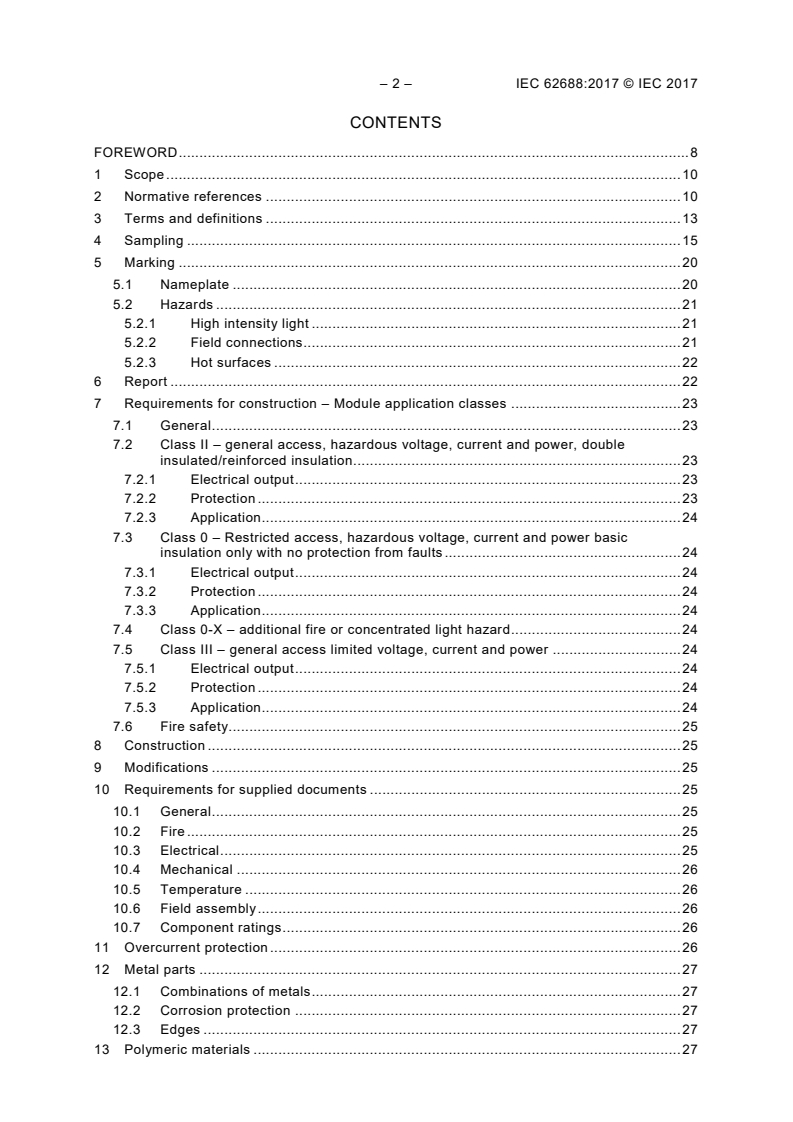
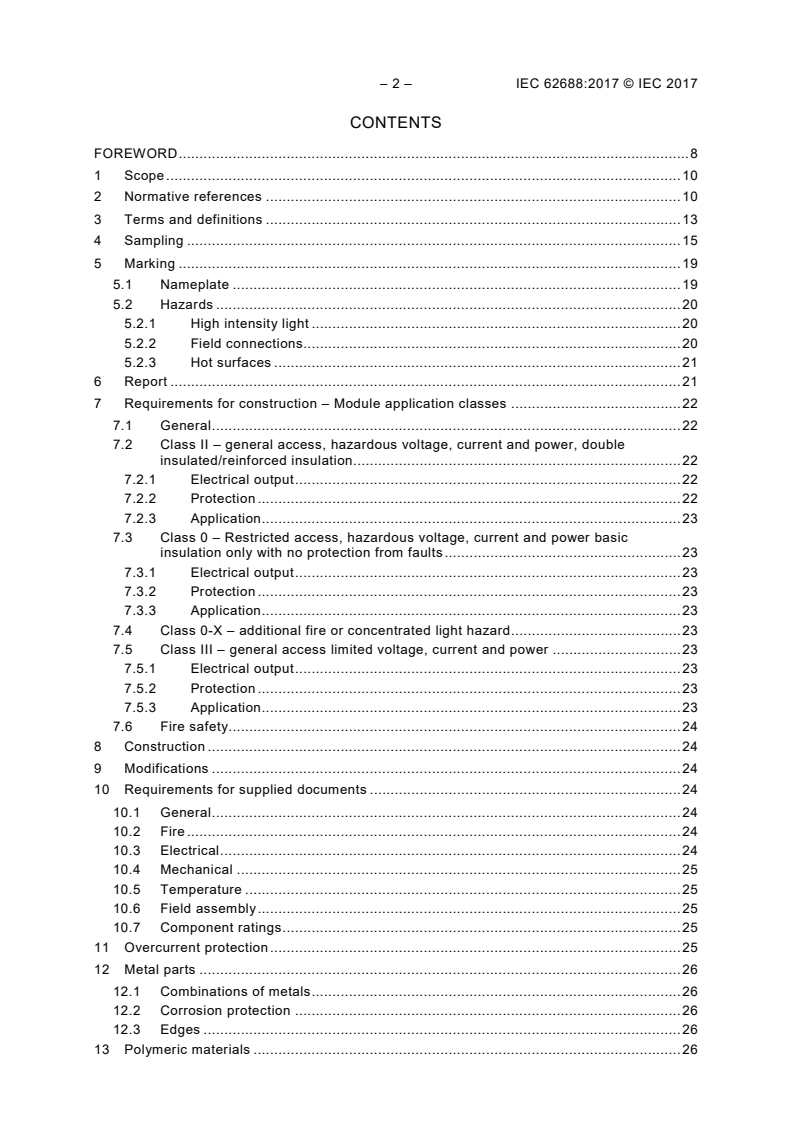
CONTENTS
FOREWORD . 8
1 Scope . 10
2 Normative references . 10
3 Terms and definitions . 13
4 Sampling . 15
5 Marking . 20
5.1 Nameplate . 20
5.2 Hazards . 21
5.2.1 High intensity light . 21
5.2.2 Field connections. 21
5.2.3 Hot surfaces . 22
6 Report . 22
7 Requirements for construction – Module application classes . 23
7.1 General . 23
7.2 Class II – general access, hazardous voltage, current and power, double
insulated/reinforced insulation. 23
7.2.1 Electrical output . 23
7.2.2 Protection . 23
7.2.3 Application . 24
7.3 Class 0 – Restricted access, hazardous voltage, current and power basic
insulation only with no protection from faults . 24
7.3.1 Electrical output . 24
7.3.2 Protection . 24
7.3.3 Application . 24
7.4 Class 0-X – additional fire or concentrated light hazard . 24
7.5 Class III – general access limited voltage, current and power . 24
7.5.1 Electrical output . 24
7.5.2 Protection . 24
7.5.3 Application . 24
7.6 Fire safety. 25
8 Construction . 25
9 Modifications . 25
10 Requirements for supplied documents . 25
10.1 General . 25
10.2 Fire . 25
10.3 Electrical . 25
10.4 Mechanical . 26
10.5 Temperature . 26
10.6 Field assembly . 26
10.7 Component ratings . 26
11 Overcurrent protection . 26
12 Metal parts . 27
12.1 Combinations of metals . 27
12.2 Corrosion protection . 27
12.3 Edges . 27
13 Polymeric materials . 27
13.1 General . 27
13.1.1 Overview . 27
13.1.2 Solid insulation and cemented joints . 27
13.1.3 Requirements for polymers . 28
13.1.4 Operational categories for CPV modules and assemblies . 29
13.2 Polymers serving as an enclosure for live parts (such as a junction box,
connector, or plug) . 30
13.3 Polymers serving in direct support of live parts (such as integrated terminals
and potting compounds) . 30
13.4 Polymers serving as an outer surface of a receiver (such as a front sheet or
back sheet on a flat-plate profile receiver in a medium-X assembly). 30
13.5 Polymers serving as an internal electrical barrier providing the sole
insulation between live parts . 31
13.6 Polymers serving as encapsulants . 31
13.7 Polymers serving as adhesives for attachment (such as for a junction box) . 31
13.8 Polymers serving as moisture barriers (such as edge sealants) . 31
13.9 Polymers serving as gaskets or seals (such as with front glass) . 31
13.10 Polymers serving as frames (such as with flat-plate profile medium-
concentration receivers) . 32
13.11 Polymers serving as CPV optics . 32
13.12 Polymers exposed to sunlight, serving as a mechanical support, not
functioning in categories 13.2 to 13.11 . 32
13.13 Polymers exposed to concentrated sunlight . 32
14 Internal wiring and current-carrying parts . 32
14.1 General . 32
14.2 Internal wiring . 32
14.3 Splices . 32
14.4 Mechanical securement . 33
15 Connections . 33
15.1 Field connections – general requirements . 33
15.2 Field wiring terminals . 33
15.3 Connectors . 34
15.4 Output lead or cables . 34
16 Bonding and grounding . 34
16.1 General . 34
16.2 Lightning protection . 35
17 Protection against electric shock and energy hazards . 35
17.1 General . 35
17.2 Fault conditions . 35
17.3 Protection against electric shock . 36
17.3.1 General . 36
17.3.2 Module classification . 36
17.3.3 Creepage and clearance distances . 37
17.3.4 Degrees of pollution in the micro-environment . 40
17.3.5 Cemented joints . 40
18 Field wiring compartments with covers . 42
18.1 General . 42
18.2 Strain relief . 42
18.3 Sharp edges . 42
18.4 Conduit applications – Metallic . 42
– 4 – IEC 62688:2017 © IEC 2017
18.5 Conduit applications – Non-metallic . 42
19 Requirements for testing – Test categories . 43
19.1 General . 43
19.2 Preconditioning tests . 43
19.3 General inspection . 44
19.4 Electrical shock hazard . 44
19.5 Fire hazard . 44
19.6 Mechanical stress . 45
20 Testing . 45
20.1 General . 45
20.2 Visual inspection . 50
20.2.1 General . 50
20.2.2 Requirements . 50
20.3 Accessibility test . 51
20.3.1 Purpose . 51
20.3.2 Apparatus . 51
20.3.3 Procedure . 51
20.3.4 Requirements . 51
20.4 Grounding/Bonding path continuity test . 51
20.4.1 Purpose . 51
20.4.2 Procedure . 51
20.4.3 Requirements . 51
20.5 Dielectric voltage withstand test . 51
20.5.1 Purpose . 51
20.5.2 Procedure . 52
20.5.3 Requirements . 52
20.6 Wet insulation test . 52
20.6.1 Purpose . 52
20.6.2 Procedure . 52
20.6.3 Requirements . 52
20.7 Reverse current overload . 53
20.7.1 Purpose . 53
20.7.2 Procedure . 53
20.7.3 Requirements . 53
20.8 Thermal cycling. 53
20.8.1 General . 53
20.8.2 Purpose . 54
20.8.3 Procedure . 54
20.8.4 Requirements . 54
20.9 Humidity freeze . 54
20.9.1 General . 54
20.9.2 Purpose . 54
20.9.3 Procedure . 54
20.9.4 Requirements . 54
20.10 Damp heat . 54
20.10.1 General . 54
20.10.2 Purpose . 54
20.10.3 Procedure . 55
20.10.4 Requirements . 55
20.11 Bypass diode thermal. 55
20.11.1 Purpose . 55
20.11.2 Special test sample . 55
20.11.3 Procedure . 55
20.11.4 Requirements . 55
20.12 Hot spot endurance . 55
20.12.1 General . 55
20.12.2 Procedure . 56
20.12.3 Requirements . 56
20.13 Off-axis beam damage . 56
20.13.1 General . 56
20.13.2 Purpose . 56
20.13.3 Special case . 56
20.13.4 Procedure . 56
20.13.5 Requirements . 56
20.14 Water spray . 57
20.14.1 General . 57
20.14.2 Purpose . 57
20.14.3 Procedure . 57
20.14.4 Requirements . 57
20.15 Mechanical load . 57
20.15.1 Purpose . 57
20.15.2 Procedure . 58
20.15.3 Requirements . 58
20.16 Robustness of terminations . 58
20.16.1 Purpose . 58
20.16.2 Types of terminations . 58
20.16.3 Procedure . 58
20.16.4 Requirements . 58
20.17 Impulse voltage. 58
20.17.1 Purpose . 58
20.17.2 Requirements . 60
20.18 CPV temperature test. 60
20.18.1 Purpose . 60
20.18.2 Test apparatus . 60
20.18.3 Procedure . 60
20.18.4 Requirements . 61
20.19 Fire test recommendation for CPV modules . 62
20.19.1 General . 62
20.19.2 Burning brand fire tests . 62
20.20 CPV electrical parameters . 64
20.20.1 General . 64
20.20.2 Maximum open-circuit voltage . 64
20.20.3 Maximum short-circuit current . 64
20.20.4 The procedure for calculating maximum power (Max P) is to be in
accordance with the following: . 65
20.21 Outdoor exposure . 65
20.21.1 General . 65
20.21.2 Purpose . 65
– 6 – IEC 62688:2017 © IEC 2017
20.21.3 Procedure . 65
20.21.4 Requirements . 65
20.22 Sharp edge test . 66
20.22.1 General . 66
20.22.2 Purpose . 66
20.22.3 Procedure . 66
20.22.4 Requirements . 66
20.23 Blocked heat sink test . 66
20.23.1 Purpose . 66
20.23.2 Procedure . 67
20.23.3 Requirements . 67
20.24 Locked rotor test . 67
20.24.1 Purpose . 67
20.24.2 Procedure . 67
20.24.3 Requirements . 68
Annex A (informative) Bimetallic junction . 69
Annex B (normative) Recommendations for testing of modules from production . 70
B.1 General . 70
B.2 Module output power. 70
B.3 Insulation test . 70
B.4 Wet insulation test . 70
B.5 Visual inspection . 71
B.6 Cable connections . 71
B.7 Bypass diodes . 71
B.8 Ground continuity . 71
Annex C (normative) Alternative test method to electricity safety of CPV receivers . 72
C.1 General . 72
C.2 Specifications for the proposed test method . 72
C.3 Test method . 73
C.3.1 Overview . 73
C.3.2 Product identity . 73
C.3.3 Manufacturer . 73
C.3.4 System number. 73
C.4 Test procedure . 73
C.4.1 Physical background . 73
C.4.2 Sampling . 74
C.4.3 Marking . 74
C.4.4 Test procedure . 75
C.4.5 Pass criteria . 76
Bibliography . 77
Figure 1 – Schematic of a point focus dish PV concentrator . 17
Figure 2 – Schematic of a linear focus trough PV concentrator . 18
Figure 3 – Schematic of a point focus Fresnel lens PV concentrator . 19
Figure 4 – Schematic of a linear focus Fresnel lens PV concentrator . 20
Figure 5 – Field connection warning label . 21
Figure 6 – Symbol for hot surface can be used . 22
Figure 7 – IEC 62688 safety test plan for CPV modules (IEC 62108:2016) . 47
Figure 8 – Combined IEC 62108:2016 and IEC 62688 test plan for CPV modules . 48
Figure 9 – IEC 62688 safety test plan for CPV assemblies (IEC 62108:2016) . 49
Figure 10 – Combined IEC 62108:2016 and IEC 62688 test plan for CPV assemblies . 50
Figure 11 – Waveform of the impulse voltage test . 59
Figure C.1 – Decision chart of the alternative test . 73
Figure C.2 – Formula (C.1) . 73
Figure C.3 – Example of the acceleration of the breakdown voltage degradation by the
voltage stress . 74
Figure C.4 – Fitting to the power function in the double logarithmic chart . 76
Table 1 – Touch temperature limits . 22
Table 2 – Sizes of terminals for supply conductors. 34
Table 3 – Minimum acceptable clearance distances . 38
Table 4 – Multiplication factors for clearances of equipment rated for operation at
altitudes up to 5 000 m . 38
Table 5 – Minimum creepage distances for basic insulation . 39
Table 6 – Minimum creepage distances for reinforced insulation . 39
Table 7 – Rated impulse voltage . 40
Table 8 – Wall thickness of polymeric boxes intended for conduit . 43
Table 9 – Preconditioning tests . 43
Table 10 – General inspection tests . 44
Table 11 – Electrical shock hazard tests . 44
Table 12 – Fire hazard tests . 44
Table 13 – Fire hazard test applicability . 45
Table 14 – Mechanical stress tests . 45
Table 15 – Impulse voltage versus maximum system voltage . 59
Table 16 – Brand size and its number . 62
Table A.1 – Voltages developed on bimetallic junction (IEC 60943:1998, Table 3) . 69
Table C.1 – Maximum acceptable testing time . 75
– 8 – IEC 62688:2017 © IEC 2017
INTERNATIONAL ELECTROTECHNICAL COMMISSION
____________
CONCENTRATOR PHOTOVOLTAIC (CPV)
MODULES AND ASSEMBLIES – SAFETY QUALIFICATION
FOREWORD
1) The International Electrotechnical Commission (IEC) is a worldwide organization for standardization comprising
all national electrotechnical committees (IEC National Committees). The object of IEC is to promote
international co-operation on all questions concerning standardization in the electrical and electronic fields. To
this end and in addition to other activities, IEC publishes International Standards, Technical Specifications,
Technical Reports, Publicly Available Specifications (PAS) and Guides (hereafter referred to as “IEC
Publication(s)”). Their preparation is entrusted to technical committees; any IEC National Committee interested
in the subject dealt with may participate in this preparatory work. International, governmental and non-
governmental organizations liaising with the IEC also participate in this preparation. IEC collaborates closely
with the International Organization for Standardization (ISO) in accordance with conditions determined by
agreement between the two organizations.
2) The formal decisions or agreements of IEC on technical matters express, as nearly as possible, an international
consensus of opinion on the relevant subjects since each technical committee has representation from all
interested IEC National Committees.
3) IEC Publications have the form of recommendations for international use and are accepted by IEC National
Committees in that sense. While all reasonable efforts are made to ensure that the technical content of IEC
Publications is accurate, IEC cannot be held responsible for the way in which they are used or for any
misinterpretation by any end user.
4) In order to promote international uniformity, IEC National Committees undertake to apply IEC Publications
transparently to the maximum extent possible in their national and regional publications. Any divergence
between any IEC Publication and the corresponding national or regional publication shall be clearly indicated in
the latter.
5) IEC itself does not provide any attestation of conformity. Independent certification bodies provide conformity
assessment services and, in some areas, access to IEC marks of conformity. IEC is not responsible for any
services carried out by independent certification bodies.
6) All users should ensure that they have the latest edition of this publication.
7) No liability shall attach to IEC or its directors, employees, servants or agents including individual experts and
members of its technical committees and IEC National Committees for any personal injury, property damage or
other damage of any nature whatsoever, whether direct or indirect, or for costs (including legal fees) and
expenses arising out of the publication, use of, or reliance upon, this IEC Publication or any other IEC
Publications.
8) Attention is drawn to the Normative references cited in this publication. Use of the referenced publications is
indispensable for the correct application of this publication.
9) Attention is drawn to the possibility that some of the elements of this IEC Publication may be the subject of
patent rights. IEC shall not be held responsible for identifying any or all such patent rights.
International Standard IEC 62688 has been prepared by IEC technical committee 82: Solar
photovoltaic energy systems.
The text of this International Standard is based on the following documents:
FDIS Report on voting
82/1299/FDIS 82/1323/RVD
Full information on the voting for the approval of this International Standard can be found in
the report on voting indicated in the above table.
This document has been drafted in accordance with the ISO/IEC Directives, Part 2.
The committee has decided that the contents of this document will remain unchanged until the
stability date indicated on the IEC website under "http://webstore.iec.ch" in the data related to
the specific document. At this date, the document will be
• reconfirmed,
• withdrawn,
• replaced by a revised edition, or
• amended.
A bilingual version of this publication may be issued at a later date.
IMPORTANT – The 'colour inside' logo on the cover page of this publication indicates
that it contains colours which are considered to be useful for the correct
understanding of its contents. Users should therefore print this document using a
colour printer.
– 10 – IEC 62688:2017 © IEC 2017
CONCENTRATOR PHOTOVOLTAIC (CPV)
MODULES AND ASSEMBLIES – SAFETY QUALIFICATION
1 Scope
This document describes the fundamental construction and testing requirements for
Concentrator Photovoltaic (CPV) modules and assemblies in order to provide safe electrical
and mechanical operation during their expected lifetime. Specific topics are provided to
assess the prevention of electrical shock, fire hazards, and personal injury due to mechanical
and environmental stresses.
This document attempts to define the basic requirements for various application classes of
concentrator photovoltaic modules and assemblies, but it cannot be considered to encompass
all national and regional codes.
This document is designed so that its test sequence can coordinate with those of IEC 62108,
so that a single set of samples may be used to perform both the safety and performance
evaluation of a CPV module and assembly.
CPV modules that are constructed in the flat plate module format and operate at 3X and less
geometric concentration ratio are considered for evaluation to IEC 61730-1 and IEC 61730-2.
2 Normative references
The following documents are referred to in the text in such a way that some or all of their
content constitutes requirements of this document. For dated references, only the edition
cited applies. For undated references, the latest edition of the referenced document (including
any amendments) applies.
IEC 60060-1, High-voltage test techniques – Part 1: General definitions and test requirements
IEC 60065, Audio, video and similar electronic apparatus – Safety requirements
IEC 60112, Method for the determination of the proof and the comparative tracking indices of
solid insulating materials
IEC 60216-5, Electrical insulating materials – Thermal endurance properties – Part 5:
Determination of relative thermal endurance index (RTE) of an insulating material
IEC 60243-2, Electric strength of insulating materials – Test methods – Part 2: Additional
requirements for tests using direct voltage
IEC 60417, Graphical symbols for use on equipment – 12-month subscription to regularly
updated online database comprising all graphical symbols published in IEC 60417
IEC 60529, Degrees of protection provided by enclosures (IP Code)
IEC 60664-1:2007, Insulation co-ordination for equipment within low-voltage systems – Part 1:
Principles, requirements and tests
IEC TR 60664-2-1:2011, Insulation coordination for equipment within low-voltage systems –
Part 2-1: Application guide – Explanation of the application of the IEC 60664 series,
dimensioning examples and dielectric testing
IEC 60664-3:2016, Insulation coordination for equipment within low-voltage systems – Part 3:
Use of coating, potting or moulding for protection against pollution
IEC 60695-1-10, Fire hazard testing – Part 1-10: Guidance for assessing the fire hazard of
electrotechnical products – General guidelines
IEC 60695-1-11, Fire hazard testing – Part 1-11: Guidance for assessing the fire hazard of
electrotechnical products – Fire hazard assessment
IEC 60695-2-10, Fire hazard testing – Part 2-10: Glowing/hot-wire based test methods –
Glow-wire apparatus and common test procedure
IEC 60695-11-20, Fire hazard testing – Part 11-20: Test flames – 500 W flame test method
IEC 60904-3, Photovoltaic devices – Part 3: Measurement principles for terrestrial
photovoltaic (PV) solar devices with reference spectral irradiance data
IEC 60947-1, Low-voltage switchgear and control gear – Part 1: General rules
IEC 60950-1:2005, Informa
...
IEC 62688 ®
Edition 1.0 2017-09
INTERNATIONAL
STANDARD
NORME
INTERNATIONALE
colour
inside
Concentrator photovoltaic (CPV) modules and assemblies – Safety qualification
Modules et ensembles photovoltaïques à concentration (CPV) – Qualification
pour la sûreté de fonctionnement
All rights reserved. Unless otherwise specified, no part of this publication may be reproduced or utilized in any form
or by any means, electronic or mechanical, including photocopying and microfilm, without permission in writing from
either IEC or IEC's member National Committee in the country of the requester. If you have any questions about IEC
copyright or have an enquiry about obtaining additional rights to this publication, please contact the address below or
your local IEC member National Committee for further information.
Droits de reproduction réservés. Sauf indication contraire, aucune partie de cette publication ne peut être reproduite
ni utilisée sous quelque forme que ce soit et par aucun procédé, électronique ou mécanique, y compris la photocopie
et les microfilms, sans l'accord écrit de l'IEC ou du Comité national de l'IEC du pays du demandeur. Si vous avez des
questions sur le copyright de l'IEC ou si vous désirez obtenir des droits supplémentaires sur cette publication, utilisez
les coordonnées ci-après ou contactez le Comité national de l'IEC de votre pays de résidence.
IEC Central Office Tel.: +41 22 919 02 11
3, rue de Varembé info@iec.ch
CH-1211 Geneva 20 www.iec.ch
Switzerland
About the IEC
The International Electrotechnical Commission (IEC) is the leading global organization that prepares and publishes
International Standards for all electrical, electronic and related technologies.
About IEC publications
The technical content of IEC publications is kept under constant review by the IEC. Please make sure that you have the
latest edition, a corrigenda or an amendment might have been published.
IEC Catalogue - webstore.iec.ch/catalogue Electropedia - www.electropedia.org
The stand-alone application for consulting the entire The world's leading online dictionary of electronic and
bibliographical information on IEC International Standards, electrical terms containing 21 000 terms and definitions in
Technical Specifications, Technical Reports and other English and French, with equivalent terms in 16 additional
documents. Available for PC, Mac OS, Android Tablets and languages. Also known as the International Electrotechnical
iPad. Vocabulary (IEV) online.
IEC publications search - webstore.iec.ch/advsearchform IEC Glossary - std.iec.ch/glossary
The advanced search enables to find IEC publications by a 67 000 electrotechnical terminology entries in English and
variety of criteria (reference number, text, technical French extracted from the Terms and Definitions clause of
committee,…). It also gives information on projects, replaced IEC publications issued since 2002. Some entries have been
and withdrawn publications. collected from earlier publications of IEC TC 37, 77, 86 and
CISPR.
IEC Just Published - webstore.iec.ch/justpublished
Stay up to date on all new IEC publications. Just Published IEC Customer Service Centre - webstore.iec.ch/csc
details all new publications released. Available online and If you wish to give us your feedback on this publication or
also once a month by email. need further assistance, please contact the Customer Service
Centre: sales@iec.ch.
A propos de l'IEC
La Commission Electrotechnique Internationale (IEC) est la première organisation mondiale qui élabore et publie des
Normes internationales pour tout ce qui a trait à l'électricité, à l'électronique et aux technologies apparentées.
A propos des publications IEC
Le contenu technique des publications IEC est constamment revu. Veuillez vous assurer que vous possédez l’édition la
plus récente, un corrigendum ou amendement peut avoir été publié.
Catalogue IEC - webstore.iec.ch/catalogue Electropedia - www.electropedia.org
Application autonome pour consulter tous les renseignements
Le premier dictionnaire en ligne de termes électroniques et
bibliographiques sur les Normes internationales,
électriques. Il contient 21 000 termes et définitions en anglais
Spécifications techniques, Rapports techniques et autres
et en français, ainsi que les termes équivalents dans 16
documents de l'IEC. Disponible pour PC, Mac OS, tablettes
langues additionnelles. Egalement appelé Vocabulaire
Android et iPad.
Electrotechnique International (IEV) en ligne.
Recherche de publications IEC -
Glossaire IEC - std.iec.ch/glossary
webstore.iec.ch/advsearchform
67 000 entrées terminologiques électrotechniques, en anglais
La recherche avancée permet de trouver des publications IEC et en français, extraites des articles Termes et Définitions des
en utilisant différents critères (numéro de référence, texte, publications IEC parues depuis 2002. Plus certaines entrées
comité d’études,…). Elle donne aussi des informations sur les antérieures extraites des publications des CE 37, 77, 86 et
projets et les publications remplacées ou retirées. CISPR de l'IEC.
IEC Just Published - webstore.iec.ch/justpublished Service Clients - webstore.iec.ch/csc
Restez informé sur les nouvelles publications IEC. Just Si vous désirez nous donner des commentaires sur cette
Published détaille les nouvelles publications parues. publication ou si vous avez des questions contactez-nous:
Disponible en ligne et aussi une fois par mois par email. sales@iec.ch.
IEC 62688 ®
Edition 1.0 2017-09
INTERNATIONAL
STANDARD
NORME
INTERNATIONALE
colour
inside
Concentrator photovoltaic (CPV) modules and assemblies – Safety qualification
Modules et ensembles photovoltaïques à concentration (CPV) – Qualification
pour la sûreté de fonctionnement
INTERNATIONAL
ELECTROTECHNICAL
COMMISSION
COMMISSION
ELECTROTECHNIQUE
INTERNATIONALE
ICS 27.160 ISBN 978-2-8322-6110-1
– 2 – IEC 62688:2017 © IEC 2017
CONTENTS
FOREWORD . 8
1 Scope . 10
2 Normative references . 10
3 Terms and definitions . 13
4 Sampling . 15
5 Marking . 19
5.1 Nameplate . 19
5.2 Hazards . 20
5.2.1 High intensity light . 20
5.2.2 Field connections. 20
5.2.3 Hot surfaces . 21
6 Report . 21
7 Requirements for construction – Module application classes . 22
7.1 General . 22
7.2 Class II – general access, hazardous voltage, current and power, double
insulated/reinforced insulation. 22
7.2.1 Electrical output . 22
7.2.2 Protection . 22
7.2.3 Application . 23
7.3 Class 0 – Restricted access, hazardous voltage, current and power basic
insulation only with no protection from faults . 23
7.3.1 Electrical output . 23
7.3.2 Protection . 23
7.3.3 Application . 23
7.4 Class 0-X – additional fire or concentrated light hazard . 23
7.5 Class III – general access limited voltage, current and power . 23
7.5.1 Electrical output . 23
7.5.2 Protection . 23
7.5.3 Application . 23
7.6 Fire safety. 24
8 Construction . 24
9 Modifications . 24
10 Requirements for supplied documents . 24
10.1 General . 24
10.2 Fire . 24
10.3 Electrical . 24
10.4 Mechanical . 25
10.5 Temperature . 25
10.6 Field assembly . 25
10.7 Component ratings . 25
11 Overcurrent protection . 25
12 Metal parts . 26
12.1 Combinations of metals . 26
12.2 Corrosion protection . 26
12.3 Edges . 26
13 Polymeric materials . 26
13.1 General . 26
13.1.1 Overview . 26
13.1.2 Solid insulation and cemented joints . 26
13.1.3 Requirements for polymers . 27
13.1.4 Operational categories for CPV modules and assemblies . 28
13.2 Polymers serving as an enclosure for live parts (such as a junction box,
connector, or plug) . 29
13.3 Polymers serving in direct support of live parts (such as integrated terminals
and potting compounds) . 29
13.4 Polymers serving as an outer surface of a receiver (such as a front sheet or
back sheet on a flat-plate profile receiver in a medium-X assembly). 29
13.5 Polymers serving as an internal electrical barrier providing the sole
insulation between live parts . 30
13.6 Polymers serving as encapsulants . 30
13.7 Polymers serving as adhesives for attachment (such as for a junction box) . 30
13.8 Polymers serving as moisture barriers (such as edge sealants) . 30
13.9 Polymers serving as gaskets or seals (such as with front glass) . 30
13.10 Polymers serving as frames (such as with flat-plate profile medium-
concentration receivers) . 31
13.11 Polymers serving as CPV optics . 31
13.12 Polymers exposed to sunlight, serving as a mechanical support, not
functioning in categories 13.2 to 13.11 . 31
13.13 Polymers exposed to concentrated sunlight . 31
14 Internal wiring and current-carrying parts . 31
14.1 General . 31
14.2 Internal wiring . 31
14.3 Splices . 31
14.4 Mechanical securement . 32
15 Connections . 32
15.1 Field connections – general requirements . 32
15.2 Field wiring terminals . 32
15.3 Connectors . 33
15.4 Output lead or cables . 33
16 Bonding and grounding . 33
16.1 General . 33
16.2 Lightning protection . 34
17 Protection against electric shock and energy hazards . 34
17.1 General . 34
17.2 Fault conditions . 34
17.3 Protection against electric shock . 35
17.3.1 General . 35
17.3.2 Module classification . 35
17.3.3 Creepage and clearance distances . 36
17.3.4 Degrees of pollution in the micro-environment . 39
17.3.5 Cemented joints . 39
18 Field wiring compartments with covers . 40
18.1 General . 41
18.2 Strain relief . 41
18.3 Sharp edges . 41
18.4 Conduit applications – Metallic . 41
– 4 – IEC 62688:2017 © IEC 2017
18.5 Conduit applications – Non-metallic . 41
19 Requirements for testing – Test categories . 42
19.1 General . 42
19.2 Preconditioning tests . 42
19.3 General inspection . 43
19.4 Electrical shock hazard . 43
19.5 Fire hazard . 43
19.6 Mechanical stress . 44
20 Testing . 44
20.1 General . 44
20.2 Visual inspection . 49
20.2.1 General . 49
20.2.2 Requirements . 49
20.3 Accessibility test . 50
20.3.1 Purpose . 50
20.3.2 Apparatus . 50
20.3.3 Procedure . 50
20.3.4 Requirements . 50
20.4 Grounding/Bonding path continuity test . 50
20.4.1 Purpose . 50
20.4.2 Procedure . 50
20.4.3 Requirements . 50
20.5 Dielectric voltage withstand test . 50
20.5.1 Purpose . 50
20.5.2 Procedure . 51
20.5.3 Requirements . 51
20.6 Wet insulation test . 51
20.6.1 Purpose . 51
20.6.2 Procedure . 51
20.6.3 Requirements . 51
20.7 Reverse current overload . 52
20.7.1 Purpose . 52
20.7.2 Procedure . 52
20.7.3 Requirements . 52
20.8 Thermal cycling. 52
20.8.1 General . 52
20.8.2 Purpose . 52
20.8.3 Procedure . 53
20.8.4 Requirements . 53
20.9 Humidity freeze . 53
20.9.1 General . 53
20.9.2 Purpose . 53
20.9.3 Procedure . 53
20.9.4 Requirements . 53
20.10 Damp heat . 53
20.10.1 General . 53
20.10.2 Purpose . 53
20.10.3 Procedure . 53
20.10.4 Requirements . 54
20.11 Bypass diode thermal. 54
20.11.1 Purpose . 54
20.11.2 Special test sample . 54
20.11.3 Procedure . 54
20.11.4 Requirements . 54
20.12 Hot spot endurance . 54
20.12.1 General . 54
20.12.2 Procedure . 54
20.12.3 Requirements . 55
20.13 Off-axis beam damage . 55
20.13.1 General . 55
20.13.2 Purpose . 55
20.13.3 Special case . 55
20.13.4 Procedure . 55
20.13.5 Requirements . 55
20.14 Water spray . 55
20.14.1 General . 55
20.14.2 Purpose . 55
20.14.3 Procedure . 56
20.14.4 Requirements . 56
20.15 Mechanical load . 56
20.15.1 Purpose . 56
20.15.2 Procedure . 56
20.15.3 Requirements . 56
20.16 Robustness of terminations . 57
20.16.1 Purpose . 57
20.16.2 Types of terminations . 57
20.16.3 Procedure . 57
20.16.4 Requirements . 57
20.17 Impulse voltage. 57
20.17.1 Purpose . 57
20.17.2 Requirements . 58
20.18 CPV temperature test. 59
20.18.1 Purpose . 59
20.18.2 Test apparatus . 59
20.18.3 Procedure . 59
20.18.4 Requirements . 60
20.19 Fire test recommendation for CPV modules . 60
20.19.1 General . 60
20.19.2 Burning brand fire tests . 61
20.20 CPV electrical parameters . 63
20.20.1 General . 63
20.20.2 Maximum open-circuit voltage . 63
20.20.3 Maximum short-circuit current . 63
20.20.4 The procedure for calculating maximum power (Max P) is to be in
accordance with the following: . 64
20.21 Outdoor exposure . 64
20.21.1 General . 64
20.21.2 Purpose . 64
– 6 – IEC 62688:2017 © IEC 2017
20.21.3 Procedure . 64
20.21.4 Requirements . 64
20.22 Sharp edge test . 64
20.22.1 General . 64
20.22.2 Purpose . 65
20.22.3 Procedure . 65
20.22.4 Requirements . 65
20.23 Blocked heat sink test . 65
20.23.1 Purpose . 65
20.23.2 Procedure . 65
20.23.3 Requirements . 66
20.24 Locked rotor test . 66
20.24.1 Purpose . 66
20.24.2 Procedure . 66
20.24.3 Requirements . 66
Annex A (informative) Bimetallic junction . 68
Annex B (normative) Recommendations for testing of modules from production . 69
B.1 General . 69
B.2 Module output power. 69
B.3 Insulation test . 69
B.4 Wet insulation test . 69
B.5 Visual inspection . 70
B.6 Cable connections . 70
B.7 Bypass diodes . 70
B.8 Ground continuity . 70
Annex C (normative) Alternative test method for electricity safety of CPV receivers . 71
C.1 General . 71
C.2 Specifications for the proposed test method . 71
C.3 Test method . 72
C.3.1 Overview . 72
C.3.2 Product identity . 72
C.3.3 Manufacturer . 72
C.3.4 System number. 72
C.4 Test procedure . 72
C.4.1 Physical background . 72
C.4.2 Sampling . 73
C.4.3 Marking . 73
C.4.4 Test procedure . 74
C.4.5 Pass criteria . 75
Bibliography . 76
Figure 1 – Schematic of a point focus dish PV concentrator . 16
Figure 2 – Schematic of a linear focus trough PV concentrator . 17
Figure 3 – Schematic of a point focus Fresnel lens PV concentrator . 18
Figure 4 – Schematic of a linear focus Fresnel lens PV concentrator . 19
Figure 5 – Field connection warning label . 20
Figure 6 – Symbol for hot surface that can be used . 21
Figure 7 – IEC 62688 safety test plan for CPV modules (IEC 62108:2016) . 46
Figure 8 – Combined IEC 62108:2016 and IEC 62688 test plan for CPV modules . 47
Figure 9 – IEC 62688 safety test plan for CPV assemblies (IEC 62108:2016) . 48
Figure 10 – Combined IEC 62108:2016 and IEC 62688 test plan for CPV assemblies . 49
Figure 11 – Waveform of the impulse voltage test . 58
Figure C.1 – Decision chart of the alternative test . 72
Figure C.2 – Formula (C.1) . 72
Figure C.3 – Example of the acceleration of the breakdown voltage degradation by the
voltage stress . 73
Figure C.4 – Fitting to the power function in the double logarithmic chart . 75
Table 1 – Touch temperature limits . 21
Table 2 – Sizes of terminals for supply conductors. 33
Table 3 – Minimum acceptable clearance distances . 37
Table 4 – Multiplication factors for clearances of equipment rated for operation at
altitudes up to 5 000 m . 37
Table 5 – Minimum creepage distances for basic insulation . 38
Table 6 – Minimum creepage distances for reinforced insulation . 38
Table 7 – Rated impulse voltage . 39
Table 8 – Wall thickness of polymeric boxes intended for conduit . 42
Table 9 – Preconditioning tests . 42
Table 10 – General inspection tests . 43
Table 11 – Electrical shock hazard tests . 43
Table 12 – Fire hazard tests . 43
Table 13 – Fire hazard test applicability . 44
Table 14 – Mechanical stress tests . 44
Table 15 – Impulse voltage versus maximum system voltage . 58
Table 16 – Brand size and its number . 61
Table A.1 – Voltages developed on bimetallic junction (IEC 60943:1998, Table 3) . 68
Table C.1 – Maximum acceptable testing time . 74
– 8 – IEC 62688:2017 © IEC 2017
INTERNATIONAL ELECTROTECHNICAL COMMISSION
____________
CONCENTRATOR PHOTOVOLTAIC (CPV)
MODULES AND ASSEMBLIES – SAFETY QUALIFICATION
FOREWORD
1) The International Electrotechnical Commission (IEC) is a worldwide organization for standardization comprising
all national electrotechnical committees (IEC National Committees). The object of IEC is to promote international
co-operation on all questions concerning standardization in the electrical and electronic fields. To this end and
in addition to other activities, IEC publishes International Standards, Technical Specifications, Technical Reports,
Publicly Available Specifications (PAS) and Guides (hereafter referred to as “IEC Publication(s)”). Their
preparation is entrusted to technical committees; any IEC National Committee interested in the subject dealt with
may participate in this preparatory work. International, governmental and non-governmental organizations liaising
with the IEC also participate in this preparation. IEC collaborates closely with the International Organization for
Standardization (ISO) in accordance with conditions determined by agreement between the two organizations.
2) The formal decisions or agreements of IEC on technical matters express, as nearly as possible, an international
consensus of opinion on the relevant subjects since each technical committee has representation from all
interested IEC National Committees.
3) IEC Publications have the form of recommendations for international use and are accepted by IEC National
Committees in that sense. While all reasonable efforts are made to ensure that the technical content of IEC
Publications is accurate, IEC cannot be held responsible for the way in which they are used or for any
misinterpretation by any end user.
4) In order to promote international uniformity, IEC National Committees undertake to apply IEC Publications
transparently to the maximum extent possible in their national and regional publications. Any divergence between
any IEC Publication and the corresponding national or regional publication shall be clearly indicated in the latter.
5) IEC itself does not provide any attestation of conformity. Independent certification bodies provide conformity
assessment services and, in some areas, access to IEC marks of conformity. IEC is not responsible for any
services carried out by independent certification bodies.
6) All users should ensure that they have the latest edition of this publication.
7) No liability shall attach to IEC or its directors, employees, servants or agents including individual experts and
members of its technical committees and IEC National Committees for any personal injury, property damage or
other damage of any nature whatsoever, whether direct or indirect, or for costs (including legal fees) and
expenses arising out of the publication, use of, or reliance upon, this IEC Publication or any other IEC Publications.
8) Attention is drawn to the Normative references cited in this publication. Use of the referenced publications is
indispensable for the correct application of this publication.
9) Attention is drawn to the possibility that some of the elements of this IEC Publication may be the subject of patent
rights. IEC shall not be held responsible for identifying any or all such patent rights.
International Standard IEC 62688 has been prepared by IEC technical committee 82: Solar
photovoltaic energy systems.
This bilingual version (2019-01) corresponds to the English version, published in 2017-09.
The text of this International Standard is based on the following documents:
FDIS Report on voting
82/1299/FDIS 82/1323/RVD
Full information on the voting for the approval of this International Standard can be found in the
report on voting indicated in the above table.
This document has been drafted in accordance with the ISO/IEC Directives, Part 2.
The French version of this standard has not been voted upon.
The committee has decided that the contents of this document will remain unchanged until the
stability date indicated on the IEC website under "http://webstore.iec.ch" in the data related to
the specific document. At this date, the document will be
• reconfirmed,
• withdrawn,
• replaced by a revised edition, or
• amended.
IMPORTANT – The 'colour inside' logo on the cover page of this publication indicates
that it contains colours which are considered to be useful for the correct understanding
of its contents. Users should therefore print this document using a colour printer.
– 10 – IEC 62688:2017 © IEC 2017
CONCENTRATOR PHOTOVOLTAIC (CPV)
MODULES AND ASSEMBLIES – SAFETY QUALIFICATION
1 Scope
This document describes the fundamental construction and testing requirements for
Concentrator Photovoltaic (CPV) modules and assemblies in order to provide safe electrical
and mechanical operation during their expected lifetime. Specific topics are provided to assess
the prevention of electrical shock, fire hazards, and personal injury due to mechanical and
...