


IEC 62474:2018
(Main)Material declaration for products of and for the electrotechnical industry
Material declaration for products of and for the electrotechnical industry
IEC 62474:2018 specifies the procedure, content, and form relating to material declarations for products of companies operating in and supplying the electrotechnical industry. Process chemicals and emissions during product use are not in the scope of this International Standard. It provides data to downstream manufacturers that:
- allows them to assess products against substance restriction compliance requirements;
- they can use in their environmentally conscious design process and across all product life cycle phases. A database associated with this document is available at http://std.iec.ch/iec62474. It contains the list of:
- Declarable substance groups and declarable substances;
- Reference Substances;
- Material classes;
- XML schema for data format and exchange and the accompanying developer table.
IEC 62474:2018 cancels and replaces the first edition published in 2012. This edition constitutes a technical revision.
IEC 62474:2018 includes the following significant technical changes with respect to the previous edition:
a) The material classes and exemption lists capabilities have been improved.
b) The introduction and scope have new diagrams and information to give a better overview of the standard and identify what information is mandatory, optional or conditionally mandatory.
c) Definitions have been added. Minimum requirements to be in conformance with the IEC 62474 standard are defined, including XML format as the officially accepted format. By defining an authority, list identity and list version, the standard format could be used for lists other than the IEC 62474 database.
d) Terms have been aligned for consistency throughout the document. For example, the “IEC 62474 database” was previously referred to as “IEC 62474 database”, “IEC 62474”, “IEC 62474 Database”, “IEC 62474 DB”.
e) The annexes have been removed as they are now contained within documents managed by the validation team 62474 (VT 62474). Annex A (Annex B in the previous edition) is provided for non-XML users as a reference only.
Déclaration de matières pour des produits de et pour l'industrie électrotechnique
La CEI 62474:2018 décrit la procédure, le contenu et la forme des déclarations de matières pour les produits des entreprises et des fournisseurs de l'industrie électrotechnique. Les produits chimiques et les émissions du processus pendant l'utilisation du produit n'entrent pas dans le domaine d'application de la présente Norme internationale. Elle fournit aux fabricants situés en aval des données qui:
- leur permettent d'évaluer des produits au vu des exigences de conformité et de restriction de substances;
- peuvent être utilisées dans le cadre de leur processus d'écoconception et dans toutes les phases du cycle de vie du produit. Une base de données associée au présent document est disponible à l'adresse http://std.iec.ch/iec62474. Elle contient la liste des:
- groupes de substances déclarables et les substances déclarables;
- substances de référence;
- classes de matières;
- schémas XML pour le format et l'échange de données et le tableau développeurs d'accompagnement.
IEC 62474:2018 annule et remplace la première édition parue en 2012. Cette édition constitue une révision technique.
IEC 62474:2018 inclut les modifications techniques majeures suivantes par rapport à l'édition précédente:
a) Les possibilités des classes de matières et listes d’exemptions ont été améliorées.
b) L’introduction et le domaine d’application comportent de nouveaux schémas et de nouvelles informations permettant de donner un meilleur aperçu de la norme et d’identifier les informations obligatoires, facultatives ou obligatoires sous conditions.
c) Des définitions ont été ajoutées. Des exigences minimales devant être conformes à la norme IEC 62474 sont définies. Elles comprennent le format XML, considéré comme le format officiellement reconnu. En définissant une autorité, un identifiant et une version de liste, le format de la norme peut être utilisé pour des listes autres que celles de la base de données de l’IEC 62474.
d) Le document a été amélioré dans un souci d’homogénéisation des termes utilisés. Par exemple, la “base de données de l’IEC 62474” était référencée de différentes manières telles que “base de données de l’IEC 62474”, “IEC 62474”, “Base de données de l’IEC 62474”, “BD IEC 62474”.
e) Les annexes ont été supprimées car elles sont contenues dans des documents gérés par l’équipe de validation 62474 (VT 62474). L’Annexe A (Annexe B de l'édition précédente) est destinée aux utilisateurs non XML, comme référence seulement.
General Information
- Status
- Published
- Publication Date
- 29-Nov-2018
- Technical Committee
- TC 111 - Environmental standardization for electrical and electronic products and systems
- Drafting Committee
- WG 19 - TC 111/WG 19
- Current Stage
- PPUB - Publication issued
- Start Date
- 30-Nov-2018
- Completion Date
- 14-Dec-2018
Relations
- Effective Date
- 05-Sep-2023
- Effective Date
- 05-Sep-2023
Overview
IEC 62474:2018 - Material declaration for products of and for the electrotechnical industry defines the procedure, required content and format for material declarations used across the electrotechnical supply chain. The standard helps suppliers and downstream manufacturers exchange consistent material- and substance-related data needed to assess products against substance restriction compliance requirements and to support environmentally conscious design across product life‑cycle phases. Process chemicals and emissions during product use are explicitly out of scope. An associated, maintained database and the official XML schema are available at http://std.iec.ch/iec62474.
Key topics and requirements
- Declaration scope and structure: Specifies base (mandatory) and additional (optional or conditionally mandatory) data elements covering business information, product and product‑part details, materials, and substances.
- Declarable substances and material classes: Lists in the IEC 62474 database include declarable substance groups (DSGs), declarable substances (DSs), reference substances and defined material classes.
- Reporting thresholds and criteria: Defines criteria, thresholds and reportable applications for DSs/DSGs and thresholds for material classes to determine when reporting is required.
- Composition and compliance declarations: Data models and required fields for composition declarations and declarations intended to demonstrate compliance with restriction rules.
- Data format and exchange: The officially accepted exchange format is XML. The standard includes an XML schema and developer guidance to enable consistent data exchange (one‑way and two‑way).
- Database maintenance and governance: Procedures and roles (validation team VT 62474) for maintaining the IEC 62474 database, exemption lists and data format, including list identity/versioning and authority metadata so the format can be used beyond the IEC database.
- Edition changes (2018): Technical revision from the 2012 edition - improved material class/exemption capabilities, clearer mandatory/optional information diagrams, added definitions and conformance minimums, aligned terminology, and annex management moved under VT 62474.
Applications and users
IEC 62474:2018 is practical for:
- Manufacturers and suppliers in the electrotechnical sector preparing and exchanging material declarations.
- Downstream manufacturers who need reliable data to assess supplier parts against substance-restriction regimes.
- Ecodesign and product‑lifecycle teams integrating material/substance data into design decisions.
- Compliance, procurement and supply‑chain managers responsible for sourcing, reporting and regulatory readiness.
Related standards (context)
IEC 62474 provides interoperable material‑declaration infrastructure for industry compliance and EHS reporting. It is commonly used alongside regional and national substance‑restriction regulations and organizational EHS reporting programs. For authoritative database access and XML resources, see http://std.iec.ch/iec62474.
IEC 62474:2018 RLV - Material declaration for products of and for the electrotechnical industry Released:11/30/2018 Isbn:9782832263389
IEC 62474:2018 - Material declaration for products of and for the electrotechnical industry

IEC 62474:2018+AMD1:2020 CSV - Material declaration for products of and for the electrotechnical industry Released:12/7/2020
Frequently Asked Questions
IEC 62474:2018 is a standard published by the International Electrotechnical Commission (IEC). Its full title is "Material declaration for products of and for the electrotechnical industry". This standard covers: IEC 62474:2018 specifies the procedure, content, and form relating to material declarations for products of companies operating in and supplying the electrotechnical industry. Process chemicals and emissions during product use are not in the scope of this International Standard. It provides data to downstream manufacturers that: - allows them to assess products against substance restriction compliance requirements; - they can use in their environmentally conscious design process and across all product life cycle phases. A database associated with this document is available at http://std.iec.ch/iec62474. It contains the list of: - Declarable substance groups and declarable substances; - Reference Substances; - Material classes; - XML schema for data format and exchange and the accompanying developer table. IEC 62474:2018 cancels and replaces the first edition published in 2012. This edition constitutes a technical revision. IEC 62474:2018 includes the following significant technical changes with respect to the previous edition: a) The material classes and exemption lists capabilities have been improved. b) The introduction and scope have new diagrams and information to give a better overview of the standard and identify what information is mandatory, optional or conditionally mandatory. c) Definitions have been added. Minimum requirements to be in conformance with the IEC 62474 standard are defined, including XML format as the officially accepted format. By defining an authority, list identity and list version, the standard format could be used for lists other than the IEC 62474 database. d) Terms have been aligned for consistency throughout the document. For example, the “IEC 62474 database” was previously referred to as “IEC 62474 database”, “IEC 62474”, “IEC 62474 Database”, “IEC 62474 DB”. e) The annexes have been removed as they are now contained within documents managed by the validation team 62474 (VT 62474). Annex A (Annex B in the previous edition) is provided for non-XML users as a reference only.
IEC 62474:2018 specifies the procedure, content, and form relating to material declarations for products of companies operating in and supplying the electrotechnical industry. Process chemicals and emissions during product use are not in the scope of this International Standard. It provides data to downstream manufacturers that: - allows them to assess products against substance restriction compliance requirements; - they can use in their environmentally conscious design process and across all product life cycle phases. A database associated with this document is available at http://std.iec.ch/iec62474. It contains the list of: - Declarable substance groups and declarable substances; - Reference Substances; - Material classes; - XML schema for data format and exchange and the accompanying developer table. IEC 62474:2018 cancels and replaces the first edition published in 2012. This edition constitutes a technical revision. IEC 62474:2018 includes the following significant technical changes with respect to the previous edition: a) The material classes and exemption lists capabilities have been improved. b) The introduction and scope have new diagrams and information to give a better overview of the standard and identify what information is mandatory, optional or conditionally mandatory. c) Definitions have been added. Minimum requirements to be in conformance with the IEC 62474 standard are defined, including XML format as the officially accepted format. By defining an authority, list identity and list version, the standard format could be used for lists other than the IEC 62474 database. d) Terms have been aligned for consistency throughout the document. For example, the “IEC 62474 database” was previously referred to as “IEC 62474 database”, “IEC 62474”, “IEC 62474 Database”, “IEC 62474 DB”. e) The annexes have been removed as they are now contained within documents managed by the validation team 62474 (VT 62474). Annex A (Annex B in the previous edition) is provided for non-XML users as a reference only.
IEC 62474:2018 is classified under the following ICS (International Classification for Standards) categories: 01.110 - Technical product documentation; 13.020.01 - Environment and environmental protection in general; 29.100 - Components for electrical equipment. The ICS classification helps identify the subject area and facilitates finding related standards.
IEC 62474:2018 has the following relationships with other standards: It is inter standard links to IEC 62474:2018/AMD1:2020, IEC 62474:2012. Understanding these relationships helps ensure you are using the most current and applicable version of the standard.
You can purchase IEC 62474:2018 directly from iTeh Standards. The document is available in PDF format and is delivered instantly after payment. Add the standard to your cart and complete the secure checkout process. iTeh Standards is an authorized distributor of IEC standards.
Standards Content (Sample)
IEC 62474 ®
Edition 2.0 2018-11
REDLINE VERSION
INTERNATIONAL
STANDARD
colour
inside
Material declaration for products of and for the electrotechnical industry
All rights reserved. Unless otherwise specified, no part of this publication may be reproduced or utilized in any form
or by any means, electronic or mechanical, including photocopying and microfilm, without permission in writing from
either IEC or IEC's member National Committee in the country of the requester. If you have any questions about IEC
copyright or have an enquiry about obtaining additional rights to this publication, please contact the address below or
your local IEC member National Committee for further information.
IEC Central Office Tel.: +41 22 919 02 11
3, rue de Varembé Fax: +41 22 919 03 00
CH-1211 Geneva 20 info@iec.ch
Switzerland www.iec.ch
About the IEC
The International Electrotechnical Commission (IEC) is the leading global organization that prepares and publishes
International Standards for all electrical, electronic and related technologies.
About IEC publications
The technical content of IEC publications is kept under constant review by the IEC. Please make sure that you have the
latest edition, a corrigenda or an amendment might have been published.
IEC Catalogue - webstore.iec.ch/catalogue Electropedia - www.electropedia.org
The stand-alone application for consulting the entire The world's leading online dictionary of electronic and
bibliographical information on IEC International Standards, electrical terms containing 20 000 terms and definitions in
Technical Specifications, Technical Reports and other English and French, with equivalent terms in 16 additional
documents. Available for PC, Mac OS, Android Tablets and languages. Also known as the International Electrotechnical
iPad. Vocabulary (IEV) online.
IEC publications search - www.iec.ch/searchpub IEC Glossary - std.iec.ch/glossary
The advanced search enables to find IEC publications by a 65 000 electrotechnical terminology entries in English and
variety of criteria (reference number, text, technical French extracted from the Terms and Definitions clause of
committee,…). It also gives information on projects, replaced IEC publications issued since 2002. Some entries have been
and withdrawn publications. collected from earlier publications of IEC TC 37, 77, 86 and
CISPR.
IEC Just Published - webstore.iec.ch/justpublished
Stay up to date on all new IEC publications. Just Published IEC Customer Service Centre - webstore.iec.ch/csc
details all new publications released. Available online and If you wish to give us your feedback on this publication or
also once a month by email. need further assistance, please contact the Customer Service
Centre: csc@iec.ch.
IEC 62474 ®
Edition 2.0 2018-11
REDLINE VERSION
INTERNATIONAL
STANDARD
colour
inside
Material declaration for products of and for the electrotechnical industry
INTERNATIONAL
ELECTROTECHNICAL
COMMISSION
ICS 01.110; 13.020.01; 29.100 ISBN 978-2-8322-6338-9
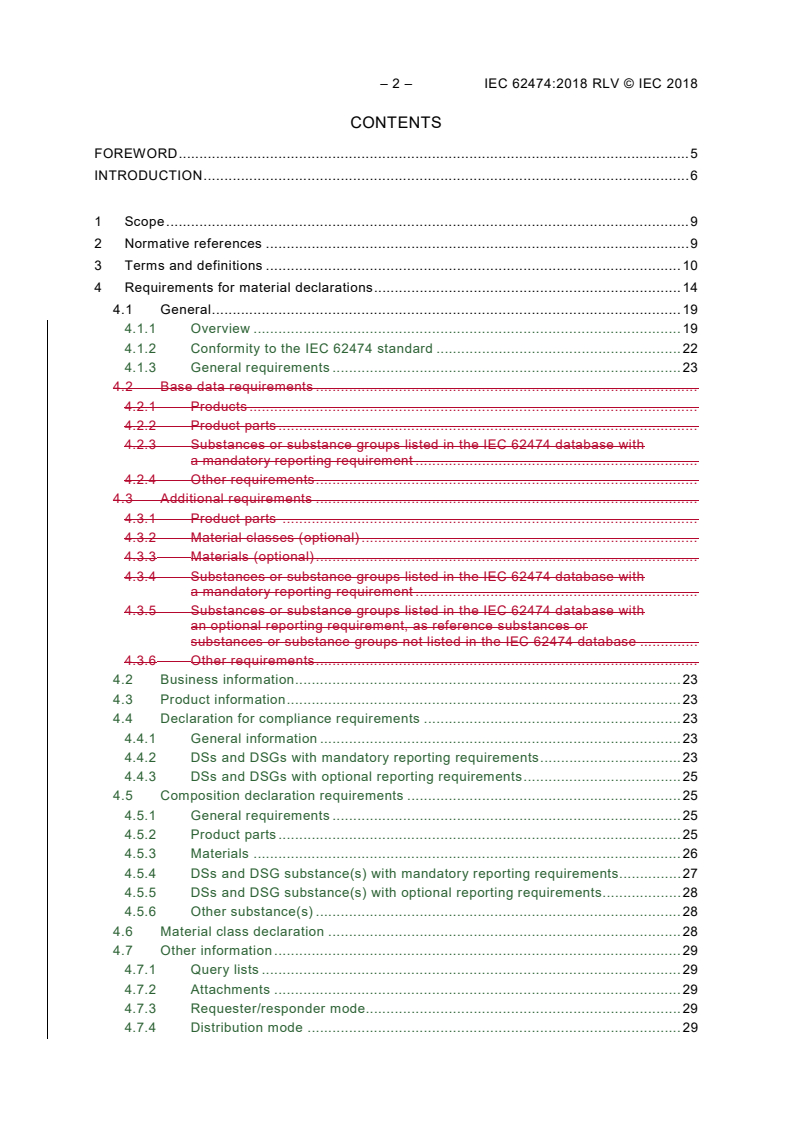
– 2 – IEC 62474:2018 RLV © IEC 2018
CONTENTS
FOREWORD . 5
INTRODUCTION . 6
1 Scope . 9
2 Normative references . 9
3 Terms and definitions . 10
4 Requirements for material declarations . 14
4.1 General . 19
4.1.1 Overview . 19
4.1.2 Conformity to the IEC 62474 standard . 22
4.1.3 General requirements . 23
4.2 Base data requirements .
4.2.1 Products .
4.2.2 Product parts .
4.2.3 Substances or substance groups listed in the IEC 62474 database with
a mandatory reporting requirement .
4.2.4 Other requirements .
4.3 Additional requirements .
4.3.1 Product parts .
4.3.2 Material classes (optional) .
4.3.3 Materials (optional) .
4.3.4 Substances or substance groups listed in the IEC 62474 database with
a mandatory reporting requirement .
4.3.5 Substances or substance groups listed in the IEC 62474 database with
an optional reporting requirement, as reference substances or
substances or substance groups not listed in the IEC 62474 database .
4.3.6 Other requirements .
4.2 Business information . 23
4.3 Product information . 23
4.4 Declaration for compliance requirements . 23
4.4.1 General information . 23
4.4.2 DSs and DSGs with mandatory reporting requirements . 23
4.4.3 DSs and DSGs with optional reporting requirements . 25
4.5 Composition declaration requirements . 25
4.5.1 General requirements . 25
4.5.2 Product parts . 25
4.5.3 Materials . 26
4.5.4 DSs and DSG substance(s) with mandatory reporting requirements. 27
4.5.5 DSs and DSG substance(s) with optional reporting requirements . 28
4.5.6 Other substance(s) . 28
4.6 Material class declaration . 28
4.7 Other information . 29
4.7.1 Query lists . 29
4.7.2 Attachments . 29
4.7.3 Requester/responder mode. 29
4.7.4 Distribution mode . 29
5 Criteria and thresholds for substances DSs, DSGs and material classes in the
IEC 62474 database . 19
5.1 General . 29
5.2 Declarable substances DSs and DSGs criteria . 29
5.3 Material class criteria . 31
5.4 Reporting threshold levels and reportable applications for declarable
substance groups and declarable substances DSs and DSGs . 31
5.5 Threshold levels for material classes . 31
5.6 Reference substances in the IEC 62474 database . 31
6 Criteria for exemption lists in the IEC 62474 database . 32
7 IEC 62474 database data format and exchange . 32
7.1 General . 32
7.2 Data exchange format . 32
7.3 Data exchange . 33
7.3.1 Two-way and one-way data exchange . 33
7.3.2 Data exchange specification in the IEC 62474 database . 33
7.3.3 Additional data exchange requirements . 33
7.3.4 XML file . 33
7.4 Criteria for the IEC 62474 database maintenance of data format and
exchange information format . 34
8 IEC 62474 database maintenance . 34
8.1 General . 34
8.2 IEC 62474 database update process . 34
8.3 Reclassification and removal of substance groups and substances DSs and
DSGs from the IEC 62474 database DSL . 35
8.4 Maintenance of exemption lists in the IEC 62474 database . 35
8.5 Maintenance of data format part exchange format of the IEC 62474
database . 36
Annex A (informative) Examples corresponding to Clause 4 – Requirements for
material declaration .
Annex B (informative) Examples corresponding to Clause 6 – Data format and
exchange .
Annex C (informative) Examples corresponding to Clause 7 – IEC 62474 database
management .
Annex D (informative) Additional information .
Annex E (informative) Declaration examples as XML files .
Annex A (informative) Simplified representation of data exchange format . 48
Bibliography . 72
Figure 1 – Conceptual diagram for base requirements .
Figure 2 – Conceptual diagram for additional requirements .
Figure A.1 – Schematic representation of products versus product parts along the
supply chain .
Figure C.1 – Guidance to validation team on C-1 substance/ substance group change
request review .
– 4 – IEC 62474:2018 RLV © IEC 2018
Figure 1 – IEC 62474 principles . 8
Figure 2 – Material declaration capabilities . 20
Figure 3 – Material declaration structure . 21
Figure 4 – Data model for a declaration for compliance . 21
Figure 5 – Data model for a composition declaration . 22
Table A.1 – Base data requirements – Business information .
Table A.2 – Example 1 – base data requirements – Substance/substance group
information .
Table A.3 – Additional requirements – Business information .
Table A.4 – Additional requirements – Product part/material/substance
group/substance information .
Table A.5 – Additional requirements – Material class information .
Table A.6 – Base data requirements – Business information .
Table A.7 – Example 2 – Base data requirements – Substance/substance group
information .
Table A.8 – Additional requirements – Business information .
Table A.9 – Additional requirements – Product part/material/substance
group/substance information .
Table A.10 – Additional Requirements – Material class information .
Table A.11 – Additional requirements – Business information .
Table A.12 – Additional requirements – Product part/material/substance
group/substance information .
Table A.13 – Additional requirements – material class information .
Table D.1 – Comparison of IEC 62474 material classes to automotive industry material
classes .
Table 1 – Declarable substances DSs and DSGs criteria . 30
Table B.1 A.1 – Data element types of a material declaration . 49
INTERNATIONAL ELECTROTECHNICAL COMMISSION
____________
MATERIAL DECLARATION FOR PRODUCTS OF
AND FOR THE ELECTROTECHNICAL INDUSTRY
FOREWORD
1) The International Electrotechnical Commission (IEC) is a worldwide organization for standardization comprising
all national electrotechnical committees (IEC National Committees). The object of IEC is to promote
international co-operation on all questions concerning standardization in the electrical and electronic fields. To
this end and in addition to other activities, IEC publishes International Standards, Technical Specifications,
Technical Reports, Publicly Available Specifications (PAS) and Guides (hereafter referred to as “IEC
Publication(s)”). Their preparation is entrusted to technical committees; any IEC National Committee interested
in the subject dealt with may participate in this preparatory work. International, governmental and non-
governmental organizations liaising with the IEC also participate in this preparation. IEC collaborates closely
with the International Organization for Standardization (ISO) in accordance with conditions determined by
agreement between the two organizations.
2) The formal decisions or agreements of IEC on technical matters express, as nearly as possible, an international
consensus of opinion on the relevant subjects since each technical committee has representation from all
interested IEC National Committees.
3) IEC Publications have the form of recommendations for international use and are accepted by IEC National
Committees in that sense. While all reasonable efforts are made to ensure that the technical content of IEC
Publications is accurate, IEC cannot be held responsible for the way in which they are used or for any
misinterpretation by any end user.
4) In order to promote international uniformity, IEC National Committees undertake to apply IEC Publications
transparently to the maximum extent possible in their national and regional publications. Any divergence
between any IEC Publication and the corresponding national or regional publication shall be clearly indicated in
the latter.
5) IEC itself does not provide any attestation of conformity. Independent certification bodies provide conformity
assessment services and, in some areas, access to IEC marks of conformity. IEC is not responsible for any
services carried out by independent certification bodies.
6) All users should ensure that they have the latest edition of this publication.
7) No liability shall attach to IEC or its directors, employees, servants or agents including individual experts and
members of its technical committees and IEC National Committees for any personal injury, property damage or
other damage of any nature whatsoever, whether direct or indirect, or for costs (including legal fees) and
expenses arising out of the publication, use of, or reliance upon, this IEC Publication or any other IEC
Publications.
8) Attention is drawn to the Normative references cited in this publication. Use of the referenced publications is
indispensable for the correct application of this publication.
9) Attention is drawn to the possibility that some of the elements of this IEC Publication may be the subject of
patent rights. IEC shall not be held responsible for identifying any or all such patent rights.
This redline version of the official IEC Standard allows the user to identify the changes
made to the previous edition. A vertical bar appears in the margin wherever a change
has been made. Additions are in green text, deletions are in strikethrough red text.
– 6 – IEC 62474:2018 RLV © IEC 2018
International Standard IEC 62474 has been prepared by IEC Technical Committee 111:
Environmental standardization for electrical and electronic products and systems.
This second edition cancels and replaces the first edition published in 2012. This edition
constitutes a technical revision.
This edition includes the following significant technical changes with respect to the previous
edition:
a) The material classes and exemption lists capabilities have been improved.
b) The introduction and scope have new diagrams and information to give a better overview
of the standard and identify what information is mandatory, optional or conditionally
mandatory.
c) Definitions have been added. Minimum requirements to be in conformance with the
IEC 62474 standard are defined, including XML format as the officially accepted format.
By defining an authority, list identity and list version, the standard format could be used
for lists other than the IEC 62474 database.
d) Terms have been aligned for consistency throughout the document. For example, the
“IEC 62474 database” was previously referred to as “IEC 62474 database”, “IEC 62474”,
“IEC 62474 Database”, “IEC 62474 DB”.
e) The annexes have been removed as they are now contained within documents managed
by the validation team 62474 (VT 62474). Annex A (Annex B in the previous edition) is
provided for non-XML users as a reference only.
The text of this International Standard is based on the following documents:
FDIS Report on voting
111/498/FDIS 111/503/RVD
Full information on the voting for the approval of this International Standard can be found in
the report on voting indicated in the above table.
This document has been drafted in accordance with the ISO/IEC Directives, Part 2.
A list of all parts in the IEC 62474 series, published under the general title Material
declaration for products of and for the electrotechnical industry, can be found on the IEC
website.
The committee has decided that the contents of this document will remain unchanged until the
stability date indicated on the IEC website under "http://webstore.iec.ch" in the data related to
the specific document. At this date, the document will be
• reconfirmed,
• withdrawn,
• replaced by a revised edition, or
• amended.
IMPORTANT – The 'colour inside' logo on the cover page of this publication indicates
that it contains colours which are considered to be useful for the correct
understanding of its contents. Users should therefore print this document using a
colour printer.
INTRODUCTION
The electrotechnical industry tracks and declares specific information about the material
composition of its products for compliance and environmentally conscious design
requirements. The electrotechnical industry needs to gather information about the composition
of products and product parts that are purchased from suppliers for incorporation into their
products. Currently material declarations are driven by individual product manufacturer’s
specifications and there is no internationally accepted standardization. This results in
economic inefficiencies. To simplify requirements across the supply chain and to improve
economic efficiencies, it is necessary to standardize the exchange of material composition
data and provide requirements for material declarations.
This International Standard benefits the electrotechnical industry by establishing requirements
for reporting of substances and materials, standardizing protocols, and facilitating transfer
and processing of data.
This document benefits the electrotechnical industry by establishing requirements for
reporting of material declaration data, standardizing protocols, and facilitating the transfer and
processing of data. Material declarations are used by the electrotechnical industry to track
and declare specific product information used for compliance and/or environmentally
conscious design (ECD) considerations. To simplify requirements across the supply chain and
to improve economic efficiencies, it is important to standardize the exchange of product,
product part, material and substance data, and provide requirements within material
declarations.
IEC 62474 is made of two parts: this document, which contains requirements for material
declarations and a database containing information such as a declarable substance list (DSL),
exemption list and data exchange format (see Clause 8).
This document defines the two most common types of material declarations and their
requirements:
1) Declaration for compliance – is always at a product level in reference to the list of
declarable substances and declarable substance groups within the IEC 62474 declarable
substance list (DSL).
2) Composition declaration – is the much more detailed product part level reporting down to
individual substances contained within the IEC 62474 DSL.
The IEC 62474 database is maintained by the validation team (VT 62474) which updates
information in the IEC 62474 database based on requirements specified in the IEC 62474
standard (see Clause 8).
By fulfilling the requirements of the IEC 62474 standard and based on the information from
the IEC 62474 database, two types of declaration can be created as shown in Figure 1 below.
• a declaration for compliance which is the information required to determine product
compliance with substance regulations and market needs (see 4.4);
• a composition declaration that is the information required to assess where declarable
substances above threshold are contained in the product (see 4.5).
The transmission of information in the supply chain can be done in two modes:
• Distribution mode: The supplier provides material declaration data about their product(s)
to a recipient.
• Requester/responder mode: The requester determines the type of material declaration(s)
the responder will provide.
– 8 – IEC 62474:2018 RLV © IEC 2018
•
Figure 1 – IEC 62474 principles
The IEC 62474 principles are determined in the following clauses:
• Clause 4 specifies requirements for material declarations.
• Clause 5 specifies the criteria and thresholds for declarable substances (DSs), declarable
substance groups (DSGs) and material classes in the IEC 62474 database.
• Clause 6 specifies the criteria for exemption lists in the IEC 62474 database.
• Clause 7 specifies the IEC 62474 database data format and exchange requirements with
further information in Annex A (informative).
• Clause 8 specifies the IEC 62474 database maintenance process.
MATERIAL DECLARATION FOR PRODUCTS OF
AND FOR THE ELECTROTECHNICAL INDUSTRY
1 Scope
This document specifies the procedure, content, and form relating to material declarations for
products and accessories of companies organizations operating in and supplying to the
electrotechnical industry. Process chemicals, emissions during product use and product
packaging material are not in the scope of this document.
The main intended use of this document is to provide data to downstream manufacturers up
and down the supply chain that:
• allows them organizations to assess products against substance restriction compliance
requirements,
• they can use allows organizations to use this information in their environmentally
conscious design process and across all product life cycle phases.
Clause 4 specifies requirements for a material declaration.
Clause 5 specifies the criteria for declarable substances and material classes in the
IEC 62474 database associated with this standard.
Clause 6 specifies the data format and exchange requirements to be included in the
IEC 62474 database.
Clause 7 specifies the process to regularly update and maintain the IEC 62474 database.
Although this International Standard specifies base requirements, it offers flexibility to product
manufacturers and suppliers in the selection of additional requirements or information.
This document specifies mandatory declaration requirements and also provides optional
declaration requirements.
This document does not provide suggest any specific method or process to capture material
composition data declaration data in the supply chain. However, it provides a data format
used to transfer information within the supply chain. Organizations have the flexibility to
determine the most appropriate method to capture material composition declaration data
without compromising data utility and quality. This document is intended to allow reporting
based on engineering judgement, supplier material declarations, and/or on sampling and
testing.
2 Normative references
The following documents are referred to in the text in such a way that some or all of their
content constitutes requirements of this document. For dated references, only the edition
cited applies. For undated references, the latest edition of the referenced document (including
any amendments) applies.
IEC 61360-1, Standard data element types with associated classification scheme for electric
items – Part 1: Definitions – Principles and methods
– 10 – IEC 62474:2018 RLV © IEC 2018
IEC 61360-2, Standard data element types with associated classification scheme for electric
components – Part 2: EXPRESS dictionary schema
IEC 61360-5, Standard data element types with associated classification scheme for electric
components – Part 5: Extensions to the EXPRESS dictionary schema
ISO/IEC Directives, IEC Supplement: 2011, Procedures specific to IEC
3 Terms and definitions
For the purposes of this document, the following terms and definitions apply.
ISO and IEC maintain terminological databases for use in standardization at the following
addresses:
• IEC Electropedia: available at http://www.electropedia.org/
• ISO Online browsing platform: available at http://www.iso.org/obp
3.1
absence declaration
negative declaration
statement that materials, substances or substance groups are not present in the
product above their respective, specified threshold
3.3
homogeneous material
one material of uniform composition throughout or a material, consisting of a combination of
materials, that cannot be disjointed or separated into different materials by mechanical
actions, such as unscrewing, cutting, crushing, grinding and abrasive processes
3.1
article
object which during production is given a special shape, surface or design which determines
its function to a greater degree than does its chemical composition
[SOURCE: EU REACH Regulation (EC) No.1907/2006, Article 3]
3.2
composition declaration
quantitative declaration of substances contained within a product, product part, or material as
applicable
3.3
data exchange format
data elements and attributes specified in an XML schema and developer’s table to support a
material declaration exchange
3.4
declaration for compliance
declaration regarding the presence or absence of declarable substances and declarable
substance groups with mandatory reporting requirements in the IEC 62474 declarable
substance list relative to a reporting threshold level for a defined reportable application
3.2
declarable substance and declarable substance group
substance and substance group that meet the criteria stated in this International Standard and
are specified in the IEC 62474 database
Note 1 to entry Such substances and substance groups are listed in the IEC 62474 database with either a
mandatory or optional reporting requirement above the specified threshold in the IEC 62474 database.
3.5
declarable substance
DS
substance that meets specified criteria for reporting
Note 1 to entry: Criteria for declarable substances within the IEC 62474 DSL are specified in Clause 5.
Note 2 to entry: This note applies to the French language only.
3.6
declarable substance group
DSG
substance group that meets specified criteria for reporting
EXAMPLE Chromium (VI) compounds.
Note 1 to entry: Criteria for declarable substance groups within the IEC 62474 DSL are specified in Clause 5.
Note 2 to entry: This note applies to the French language only.
3.7
declarable substance group substance(s)
DSG substance(s)
substance(s) that belongs to a declarable substance group
3.8
declarable substance list
DSL
list of declarable substances and/or declarable substance groups each with a reporting
threshold for a reportable application(s) which has a mandatory or optional reporting
requirement when contained at or above its maximum threshold value within a product,
product part or material
Note 1 to entry: This note applies to the French language only.
3.9
declaration hierarchy
tree-like structure containing one or more branches that represents the relationship between
product, product part(s), material(s) and/or substance(s) within a material declaration
Note 1 to entry: Figure 5 demonstrates a declaration hierarchy with a single branch
3.10
exemption
allowance for the use of regulated declarable substances or declarable substance groups
above their threshold(s) as defined in laws or regulations
3.11
list authority
designated owner of a list
Note 1 to entry: The list authority is used in conjunction with the list identity and list version.
3.12
list entry identity
parameter used to identify a specific entry within a defined list
Note 1 to entry: The IEC 62474 DSL entry identity would be used to identify a specific declarable substance or
declarable substance group within its list.
– 12 – IEC 62474:2018 RLV © IEC 2018
3.13
list identity
parameter used to identify a specific list
Note 1 to entry: The list identity is used in conjunction with the list authority and list version.
3.14
list version
parameter used to identify a specific version of a list
Note 1 to entry: The list version is used in conjunction with the list authority and list identity.
3.13.15
material
substance or mixture of substances within a product or product part
3.23.16
material class
defined classification of materials that are established in the referenced IEC 62474 database
for purposes of inventorying aspects of a product, such that no two classes contain the same
materials
Note 1 to entry: If a material falls under multiple material classes, such as copper zinc alloy which can fall under
copper and its alloys or zinc and its alloys, the substance with the largest mass within the material should take
precedence.
3.17
material declaration
declaration of certain substances and/or substance groups contained within a product,
product part, or material as applicable
Note 1 to entry: The declaration might be a composition declaration, where the amount of the declared substance
or substance group is provided or it might be a declaration for compliance, where only the presence or absence of
the declared substance or substance group is provided.
3.33.18
mixture
preparation
mixture composite or solution composed of two or more substances in which they do not react
Note 1 to entry: An alloy is treated as a mixture.
3.43.19
product
any goods or service
Note 1 to entry: This general definition of product is, in the context of this document, limited to any product of the
product category “hardware” according to ISO 9000:2005, No. 3.4.22015, 3.7.6 of and for the electrotechnical and
electronic industry (E&E).
Note 2 to entry: This general definition of product(s) used in Clause 4 specifies any goods or service of the
responder.
3.53.20
product family
group of products each of which contains the same substances or material at a similar
concentration level
Note 1 to entry: A common case would be an electrical component supplier having many products of the same
substance content that have different electrical values, such as a capacitor, resistor, inductor or an integrated
circuit.
3.63.21
product part
sub-unit of a product or another (product) part
Note 1 to entry: This is a recursive definition.
Note 1 to entry: A product part can be a sub-unit of another product part.
Note 2 to entry: If a standard product part e.g. a cable of 1 m length is declared as product part, only portions of it
might be physically present in the product.
3.73.22
reference substance
individual substance designated as "reference" in the IEC 62474 database entry within the
reference substance list
3.23
reference substance list
RSL
list of substances belonging to declarable substance groups in the declarable substance list
Note 1 to entry: The list of substances in the RSL for a DSG may or may not be a complete or exhaustive list.
Note 2 to entry: This note applies to the French language only.
3.83.24
reportable application
intended use of a declarable substance or declarable substance group which determines its
relevance to a given scope and the threshold for disclosure
Note 1 to entry: This use is defined in the scope of the underlying law or industry standard. Examples are
batteries, textiles and wood.
Note 1 to entry: The use of reportable applications may be applicable to declarable substances, declarable
substance groups, product parts and materials. Examples of product parts and materials are batteries, textiles and
wood.
Note 2 to entry: As legislations have different scopes for some declarable substances, declarable substance
groups, product parts or materials, more than one reportable applications are provided in the IEC 62474 database.
This information supports the downstream manufacturer in the assessment against declarable substance
compliance requirements.
3.93.25
reporting threshold level
concentration limit at or above which the presence of a declarable substance in a material,
product part or product is declared if declaration of the substance is mandatory according to
the IEC 62474 database, or if it is agreed on to be declared
3.26
requester
organization or individual that requests a material declaration
Note 1 to entry: The requester is sometimes referred to as the manufacturer.
3.27
responder
organization or individual that provides a material declaration
Note 1 to entry: The responder is sometimes referred to as the supplier.
3.103.28
substance
a chemical elements and its their compounds in the natural state or obtained by any
manufacturing production process, including any additive necessary to preserve its the
– 14 – IEC 62474:2018 RLV © IEC 2018
stability of the product and any impurities deriving from the process used, but excluding any
solvent which may be separated without affecting the stability of the substance or changing its
composition
[SOURCE: Globally Harmonized System of Classification and Labelling (GHS):20032017,
Chapter 1.2, Definitions and Abbreviations]
3.113.29
substance group
one two or more substances, where in the case of multiple substances they that share at least
one chemical sub-structure, or chemical or physical property under a generic name
3.123.30
validation team 62474
VT 62474
permanent, “executive”, group of experts appointed by and acting as delegates on behalf of
their National Committees to validate proposed items and vote for their release as part of a
database standard validation team for maintenance of the IEC 62474 database
Note 1 to entry All P-members have the right and duty to appoint their own member of the team. The validation
team evaluates proposals and votes, using the normal database procedure, on items on behalf of their National
Committees. The validation team reports to the technical committee or subcommittee.
Note 2 to entry The described procedure asks for very short response times from the validation team members.
For this reason, the National Committees should appoint one or more deputies that can take over the task when the
designated person, for any reason, is absent (travel, business, etc.).
Note 3 to entry It is up to the National Committee to decide for how long time a member should be appointed, and
also to organize the possible supporting network of experts on National level.
Note 4 to entry The secretariat manages the validation team.
[SOURCE:ISO/IEC Directives Supplement:2011, Annex J]
Note 1 to entry: The validation team (VT 62474) is a permanent, “executive” group of experts appointed by and
acting as delegates on behalf of their National Committees to validate proposed items and vote for their release as
part of a database standard.
Note 2 to entry: See ISO/IEC Directives, IEC Supplement.
Note 3 to entry: This note applies to the French language only.
4 Requirements for material declarations
4.1 General
This clause describes the base requirements and additional requirements for a material
declaration. Subclause 4.2 describes the base data requirements and Subclause 4.3
describes additional requirements, should the manufacturer and supplier agree to declare
more.
Clause 4 is organized in the order of the conceptual diagrams (see Figures 1 and 2) for ease
of understanding. Required information is shown with solid boxes and arrows. Options are
shown within dotted boxes. Product, substance groups or substances with a mandatory
reporting requirement in the IEC 62474 database are mandatory objects in this approach.
Product parts, material classes, materials, and substance groups or substances without a
mandatory reporting requirement in the IEC 62474 database are optional objects in this
approach. Substance groups and substances not listed in the IEC 62474 database are also
optional objects. Further mandatory requirements apply without being displayed in the
diagrams (e.g. mass or mass percent).
See informative Annex A for examples related to requirements for material declaration.
Substance
with mandatory reporting
requirement in IEC DB62474
And/Or
Product
Substance
Substance group
with mandatory reporting
with mandatory reporting
requirement in IEC DB62474
requirement in IEC DB62474
IEC 235/12
Figure 1 – Conceptual diagram for base requirements
Substance
Substance group
Substance
with mandatory reporting
requirement in IEC DB62474
Product
Material And/Or
Product
part
requirement in IEC DB62474
Substance
Substance group
with mandatory reporting
Substance
requirement in IEC DB62474
with mandatory reporting
requirement in IEC DB62474
Material class
IEC 236/12
NOTE The arrow around the product part indicates that any product part could be broken down into further
product parts and thus it indicates that the product assembly is not just limited to two levels (product – product part)
as displayed in this conceptual diagram.
Figure 2 – Conceptual diagram for additional requirements
4.2 Base data requirements
4.2.1 Products
The following requirements shall apply to products:
a) A material declaration shall be provided for a product or product family.
NOTE 1 Only the supplier is likely to know the appropriate product family groupings for material declaration
purposes based on their technical knowledge of product material content.
b) The product shall have an identification and a mass assigned. In the case of a product
family, the identification and mass of each product within the product family shall be
specified.
NOTE 2 When each product in the product family has the same mass, it is sufficient to provide this mass just
once.
4.2.2 Product parts
Product parts shall be declared if a substance group or substance in the IEC 62474 database
refers to this part in the reporting threshold level and its reporting threshold level is exceeded.
NOTE Examples for such product parts are when batteri
...
IEC 62474 ®
Edition 2.0 2018-11
INTERNATIONAL
STANDARD
NORME
INTERNATIONALE
colour
inside
Material declaration for products of and for the electrotechnical industry
Déclaration de matières pour des produits de et pour l’industrie
électrotechnique
All rights reserved. Unless otherwise specified, no part of this publication may be reproduced or utilized in any form
or by any means, electronic or mechanical, including photocopying and microfilm, without permission in writing from
either IEC or IEC's member National Committee in the country of the requester. If you have any questions about IEC
copyright or have an enquiry about obtaining additional rights to this publication, please contact the address below or
your local IEC member National Committee for further information.
Droits de reproduction réservés. Sauf indication contraire, aucune partie de cette publication ne peut être reproduite
ni utilisée sous quelque forme que ce soit et par aucun procédé, électronique ou mécanique, y compris la photocopie
et les microfilms, sans l'accord écrit de l'IEC ou du Comité national de l'IEC du pays du demandeur. Si vous avez des
questions sur le copyright de l'IEC ou si vous désirez obtenir des droits supplémentaires sur cette publication, utilisez
les coordonnées ci-après ou contactez le Comité national de l'IEC de votre pays de résidence.
IEC Central Office Tel.: +41 22 919 02 11
3, rue de Varembé info@iec.ch
CH-1211 Geneva 20 www.iec.ch
Switzerland
About the IEC
The International Electrotechnical Commission (IEC) is the leading global organization that prepares and publishes
International Standards for all electrical, electronic and related technologies.
About IEC publications
The technical content of IEC publications is kept under constant review by the IEC. Please make sure that you have the
latest edition, a corrigenda or an amendment might have been published.
IEC Catalogue - webstore.iec.ch/catalogue Electropedia - www.electropedia.org
The stand-alone application for consulting the entire The world's leading online dictionary of electronic and
bibliographical information on IEC International Standards, electrical terms containing 21 000 terms and definitions in
Technical Specifications, Technical Reports and other English and French, with equivalent terms in 16 additional
documents. Available for PC, Mac OS, Android Tablets and languages. Also known as the International Electrotechnical
iPad. Vocabulary (IEV) online.
IEC publications search - webstore.iec.ch/advsearchform IEC Glossary - std.iec.ch/glossary
The advanced search enables to find IEC publications by a 67 000 electrotechnical terminology entries in English and
variety of criteria (reference number, text, technical French extracted from the Terms and Definitions clause of
committee,…). It also gives information on projects, replaced IEC publications issued since 2002. Some entries have been
and withdrawn publications. collected from earlier publications of IEC TC 37, 77, 86 and
CISPR.
IEC Just Published - webstore.iec.ch/justpublished
Stay up to date on all new IEC publications. Just Published IEC Customer Service Centre - webstore.iec.ch/csc
details all new publications released. Available online and If you wish to give us your feedback on this publication or
also once a month by email. need further assistance, please contact the Customer Service
Centre: sales@iec.ch.
A propos de l'IEC
La Commission Electrotechnique Internationale (IEC) est la première organisation mondiale qui élabore et publie des
Normes internationales pour tout ce qui a trait à l'électricité, à l'électronique et aux technologies apparentées.
A propos des publications IEC
Le contenu technique des publications IEC est constamment revu. Veuillez vous assurer que vous possédez l’édition la
plus récente, un corrigendum ou amendement peut avoir été publié.
Catalogue IEC - webstore.iec.ch/catalogue Electropedia - www.electropedia.org
Application autonome pour consulter tous les renseignements
Le premier dictionnaire en ligne de termes électroniques et
bibliographiques sur les Normes internationales,
électriques. Il contient 21 000 termes et définitions en anglais
Spécifications techniques, Rapports techniques et autres
et en français, ainsi que les termes équivalents dans 16
documents de l'IEC. Disponible pour PC, Mac OS, tablettes
langues additionnelles. Egalement appelé Vocabulaire
Android et iPad.
Electrotechnique International (IEV) en ligne.
Recherche de publications IEC -
Glossaire IEC - std.iec.ch/glossary
webstore.iec.ch/advsearchform
67 000 entrées terminologiques électrotechniques, en anglais
La recherche avancée permet de trouver des publications IEC et en français, extraites des articles Termes et Définitions des
en utilisant différents critères (numéro de référence, texte, publications IEC parues depuis 2002. Plus certaines entrées
comité d’études,…). Elle donne aussi des informations sur les antérieures extraites des publications des CE 37, 77, 86 et
projets et les publications remplacées ou retirées. CISPR de l'IEC.
IEC Just Published - webstore.iec.ch/justpublished Service Clients - webstore.iec.ch/csc
Restez informé sur les nouvelles publications IEC. Just Si vous désirez nous donner des commentaires sur cette
Published détaille les nouvelles publications parues. publication ou si vous avez des questions contactez-nous:
Disponible en ligne et aussi une fois par mois par email. sales@iec.ch.
IEC 62474 ®
Edition 2.0 2018-11
INTERNATIONAL
STANDARD
NORME
INTERNATIONALE
colour
inside
Material declaration for products of and for the electrotechnical industry
Déclaration de matières pour des produits de et pour l’industrie
électrotechnique
INTERNATIONAL
ELECTROTECHNICAL
COMMISSION
COMMISSION
ELECTROTECHNIQUE
INTERNATIONALE
ICS 01.110; 13.020.01; 29.100 ISBN 978-2-8322-6287-0
– 2 – IEC 62474:2018 © IEC 2018
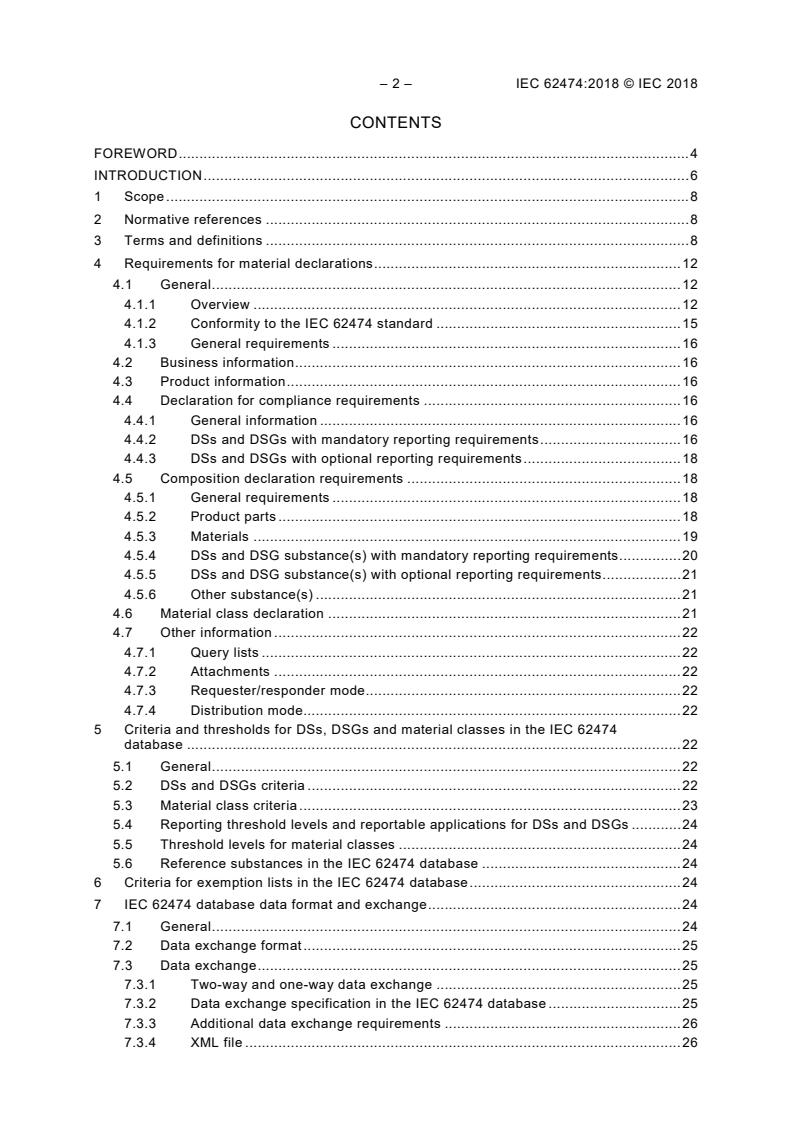
CONTENTS
FOREWORD . 4
INTRODUCTION . 6
1 Scope . 8
2 Normative references . 8
3 Terms and definitions . 8
4 Requirements for material declarations . 12
4.1 General . 12
4.1.1 Overview . 12
4.1.2 Conformity to the IEC 62474 standard . 15
4.1.3 General requirements . 16
4.2 Business information . 16
4.3 Product information . 16
4.4 Declaration for compliance requirements . 16
4.4.1 General information . 16
4.4.2 DSs and DSGs with mandatory reporting requirements . 16
4.4.3 DSs and DSGs with optional reporting requirements . 18
4.5 Composition declaration requirements . 18
4.5.1 General requirements . 18
4.5.2 Product parts . 18
4.5.3 Materials . 19
4.5.4 DSs and DSG substance(s) with mandatory reporting requirements . 20
4.5.5 DSs and DSG substance(s) with optional reporting requirements . 21
4.5.6 Other substance(s) . 21
4.6 Material class declaration . 21
4.7 Other information . 22
4.7.1 Query lists . 22
4.7.2 Attachments . 22
4.7.3 Requester/responder mode . 22
4.7.4 Distribution mode. 22
5 Criteria and thresholds for DSs, DSGs and material classes in the IEC 62474
database . 22
5.1 General . 22
5.2 DSs and DSGs criteria . 22
5.3 Material class criteria . 23
5.4 Reporting threshold levels and reportable applications for DSs and DSGs . 24
5.5 Threshold levels for material classes . 24
5.6 Reference substances in the IEC 62474 database . 24
6 Criteria for exemption lists in the IEC 62474 database . 24
7 IEC 62474 database data format and exchange . 24
7.1 General . 24
7.2 Data exchange format . 25
7.3 Data exchange . 25
7.3.1 Two-way and one-way data exchange . 25
7.3.2 Data exchange specification in the IEC 62474 database . 25
7.3.3 Additional data exchange requirements . 26
7.3.4 XML file . 26
7.4 Criteria for the IEC 62474 database maintenance of data exchange format . 26
8 IEC 62474 database maintenance . 26
8.1 General . 26
8.2 IEC 62474 database update process . 26
8.3 Reclassification and removal of DSs and DSGs from the IEC 62474 DSL. 27
8.4 Maintenance of exemption lists in the IEC 62474 database . 27
8.5 Maintenance of data exchange format . 28
Annex A (informative) Simplified representation of data exchange format . 29
Bibliography . 35
Figure 1 – IEC 62474 principles . 7
Figure 2 – Material declaration capabilities . 13
Figure 3 – Material declaration structure . 14
Figure 4 – Data model for a declaration for compliance . 14
Figure 5 – Data model for a composition declaration . 15
Table 1 – DSs and DSGs criteria . 23
Table A.1 – Data element types of a material declaration . 30
– 4 – IEC 62474:2018 © IEC 2018
INTERNATIONAL ELECTROTECHNICAL COMMISSION
____________
MATERIAL DECLARATION FOR PRODUCTS OF
AND FOR THE ELECTROTECHNICAL INDUSTRY
FOREWORD
1) The International Electrotechnical Commission (IEC) is a worldwide organization for standardization comprising
all national electrotechnical committees (IEC National Committees). The object of IEC is to promote
international co-operation on all questions concerning standardization in the electrical and electronic fields. To
this end and in addition to other activities, IEC publishes International Standards, Technical Specifications,
Technical Reports, Publicly Available Specifications (PAS) and Guides (hereafter referred to as “IEC
Publication(s)”). Their preparation is entrusted to technical committees; any IEC National Committee interested
in the subject dealt with may participate in this preparatory work. International, governmental and non-
governmental organizations liaising with the IEC also participate in this preparation. IEC collaborates closely
with the International Organization for Standardization (ISO) in accordance with conditions determined by
agreement between the two organizations.
2) The formal decisions or agreements of IEC on technical matters express, as nearly as possible, an international
consensus of opinion on the relevant subjects since each technical committee has representation from all
interested IEC National Committees.
3) IEC Publications have the form of recommendations for international use and are accepted by IEC National
Committees in that sense. While all reasonable efforts are made to ensure that the technical content of IEC
Publications is accurate, IEC cannot be held responsible for the way in which they are used or for any
misinterpretation by any end user.
4) In order to promote international uniformity, IEC National Committees undertake to apply IEC Publications
transparently to the maximum extent possible in their national and regional publications. Any divergence
between any IEC Publication and the corresponding national or regional publication shall be clearly indicated in
the latter.
5) IEC itself does not provide any attestation of conformity. Independent certification bodies provide conformity
assessment services and, in some areas, access to IEC marks of conformity. IEC is not responsible for any
services carried out by independent certification bodies.
6) All users should ensure that they have the latest edition of this publication.
7) No liability shall attach to IEC or its directors, employees, servants or agents including individual experts and
members of its technical committees and IEC National Committees for any personal injury, property damage or
other damage of any nature whatsoever, whether direct or indirect, or for costs (including legal fees) and
expenses arising out of the publication, use of, or reliance upon, this IEC Publication or any other IEC
Publications.
8) Attention is drawn to the Normative references cited in this publication. Use of the referenced publications is
indispensable for the correct application of this publication.
9) Attention is drawn to the possibility that some of the elements of this IEC Publication may be the subject of
patent rights. IEC shall not be held responsible for identifying any or all such patent rights.
International Standard IEC 62474 has been prepared by IEC Technical Committee 111:
Environmental standardization for electrical and electronic products and systems.
This second edition cancels and replaces the first edition published in 2012. This edition
constitutes a technical revision.
This edition includes the following significant technical changes with respect to the previous
edition:
a) The material classes and exemption lists capabilities have been improved.
b) The introduction and scope have new diagrams and information to give a better overview
of the standard and identify what information is mandatory, optional or conditionally
mandatory.
c) Definitions have been added. Minimum requirements to be in conformance with the
IEC 62474 standard are defined, including XML format as the officially accepted format.
By defining an authority, list identity and list version, the standard format could be used
for lists other than the IEC 62474 database.
d) Terms have been aligned for consistency throughout the document. For example, the
“IEC 62474 database” was previously referred to as “IEC 62474 database”, “IEC 62474”,
“IEC 62474 Database”, “IEC 62474 DB”.
e) The annexes have been removed as they are now contained within documents managed
by the validation team 62474 (VT 62474). Annex A (Annex B in the previous edition) is
provided for non-XML users as a reference only.
The text of this International Standard is based on the following documents:
FDIS Report on voting
111/498/FDIS 111/503/RVD
Full information on the voting for the approval of this International Standard can be found in
the report on voting indicated in the above table.
This document has been drafted in accordance with the ISO/IEC Directives, Part 2.
A list of all parts in the IEC 62474 series, published under the general title Material
declaration for products of and for the electrotechnical industry, can be found on the IEC
website.
The committee has decided that the contents of this document will remain unchanged until the
stability date indicated on the IEC website under "http://webstore.iec.ch" in the data related to
the specific document. At this date, the document will be
• reconfirmed,
• withdrawn,
• replaced by a revised edition, or
• amended.
IMPORTANT – The 'colour inside' logo on the cover page of this publication indicates
that it contains colours which are considered to be useful for the correct
understanding of its contents. Users should therefore print this document using a
colour printer.
– 6 – IEC 62474:2018 © IEC 2018
INTRODUCTION
This document benefits the electrotechnical industry by establishing requirements for
reporting of material declaration data, standardizing protocols, and facilitating the transfer and
processing of data. Material declarations are used by the electrotechnical industry to track
and declare specific product information used for compliance and/or environmentally
conscious design (ECD) considerations. To simplify requirements across the supply chain and
to improve economic efficiencies, it is important to standardize the exchange of product,
product part, material and substance data, and provide requirements within material
declarations.
IEC 62474 is made of two parts: this document, which contains requirements for material
declarations and a database containing information such as a declarable substance list (DSL),
exemption list and data exchange format (see Clause 8).
This document defines the two most common types of material declarations and their
requirements:
1) Declaration for compliance – is always at a product level in reference to the list of
declarable substances and declarable substance groups within the IEC 62474 declarable
substance list (DSL).
2) Composition declaration – is the much more detailed product part level reporting down to
individual substances contained within the IEC 62474 DSL.
The IEC 62474 database is maintained by the validation team (VT 62474) which updates
information in the IEC 62474 database based on requirements specified in the IEC 62474
standard (see Clause 8).
By fulfilling the requirements of the IEC 62474 standard and based on the information from
the IEC 62474 database, two types of declaration can be created as shown in Figure 1 below.
• a declaration for compliance which is the information required to determine product
compliance with substance regulations and market needs (see 4.4);
• a composition declaration that is the information required to assess where declarable
substances above threshold are contained in the product (see 4.5).
The transmission of information in the supply chain can be done in two modes:
• Distribution mode: The supplier provides material declaration data about their product(s)
to a recipient.
• Requester/responder mode: The requester determines the type of material declaration(s)
the responder will provide.
Figure 1 – IEC 62474 principles
The IEC 62474 principles are determined in the following clauses:
• Clause 4 specifies requirements for material declarations.
• Clause 5 specifies the criteria and thresholds for declarable substances (DSs), declarable
substance groups (DSGs) and material classes in the IEC 62474 database.
• Clause 6 specifies the criteria for exemption lists in the IEC 62474 database.
• Clause 7 specifies the IEC 62474 database data format and exchange requirements with
further information in Annex A (informative).
• Clause 8 specifies the IEC 62474 database maintenance process.
– 8 – IEC 62474:2018 © IEC 2018
MATERIAL DECLARATION FOR PRODUCTS OF
AND FOR THE ELECTROTECHNICAL INDUSTRY
1 Scope
This document specifies the procedure, content, and form relating to material declarations for
products and accessories of organizations operating in and supplying to the electrotechnical
industry. Process chemicals, emissions during product use and product packaging material
are not in the scope of this document.
The main intended use of this document is to provide data up and down the supply chain that:
• allows organizations to assess products against substance compliance requirements,
• allows organizations to use this information in their environmentally conscious design
process and across all product life cycle phases.
This document specifies mandatory declaration requirements and also provides optional
declaration requirements.
This document does not suggest any specific method or process to capture material
declaration data in the supply chain. However, it provides a data format used to transfer
information within the supply chain. Organizations have the flexibility to determine the most
appropriate method to capture material declaration data without compromising data utility and
quality. This document is intended to allow reporting based on engineering judgement,
supplier material declarations, and/or sampling and testing.
2 Normative references
The following documents are referred to in the text in such a way that some or all of their
content constitutes requirements of this document. For dated references, only the edition
cited applies. For undated references, the latest edition of the referenced document (including
any amendments) applies.
IEC 61360-1, Standard data element types with associated classification scheme – Part 1:
Definitions – Principles and methods
IEC 61360-2, Standard data element types with associated classification scheme for electric
components – Part 2: EXPRESS dictionary schema
ISO/IEC Directives, IEC Supplement, Procedures specific to IEC
3 Terms and definitions
For the purposes of this document, the following terms and definitions apply.
ISO and IEC maintain terminological databases for use in standardization at the following
addresses:
• IEC Electropedia: available at http://www.electropedia.org/
• ISO Online browsing platform: available at http://www.iso.org/obp
3.1
article
object which during production is given a special shape, surface or design which determines
its function to a greater degree than does its chemical composition
[SOURCE: EU REACH Regulation (EC) No.1907/2006, Article 3]
3.2
composition declaration
quantitative declaration of substances contained within a product, product part, or material as
applicable
3.3
data exchange format
data elements and attributes specified in an XML schema and developer’s table to support a
material declaration exchange
3.4
declaration for compliance
declaration regarding the presence or absence of declarable substances and declarable
substance groups with mandatory reporting requirements in the IEC 62474 declarable
substance list relative to a reporting threshold level for a defined reportable application
3.5
declarable substance
DS
substance that meets specified criteria for reporting
Note 1 to entry: Criteria for declarable substances within the IEC 62474 DSL are specified in Clause 5.
Note 2 to entry: This note applies to the French language only.
3.6
declarable substance group
DSG
substance group that meets specified criteria for reporting
EXAMPLE Chromium (VI) compounds.
Note 1 to entry: Criteria for declarable substance groups within the IEC 62474 DSL are specified in Clause 5.
Note 2 to entry: This note applies to the French language only.
3.7
declarable substance group substance(s)
DSG substance(s)
substance(s) that belongs to a declarable substance group
3.8
declarable substance list
DSL
list of declarable substances and/or declarable substance groups each with a reporting
threshold for a reportable application(s) which has a mandatory or optional reporting
requirement when contained at or above its maximum threshold value within a product,
product part or material
Note 1 to entry: This note applies to the French language only.
– 10 – IEC 62474:2018 © IEC 2018
3.9
declaration hierarchy
tree-like structure containing one or more branches that represents the relationship between
product, product part(s), material(s) and/or substance(s) within a material declaration
Note 1 to entry: Figure 5 demonstrates a declaration hierarchy with a single branch
3.10
exemption
allowance for the use of regulated declarable substances or declarable substance groups
above their threshold(s) as defined in laws or regulations
3.11
list authority
designated owner of a list
Note 1 to entry: The list authority is used in conjunction with the list identity and list version.
3.12
list entry identity
parameter used to identify a specific entry within a defined list
Note 1 to entry: The IEC 62474 DSL entry identity would be used to identify a specific declarable substance or
declarable substance group within its list.
3.13
list identity
parameter used to identify a specific list
Note 1 to entry: The list identity is used in conjunction with the list authority and list version.
3.14
list version
parameter used to identify a specific version of a list
Note 1 to entry: The list version is used in conjunction with the list authority and list identity.
3.15
material
substance or mixture of substances within a product or product part
3.16
material class
defined classification of materials that are established in the referenced IEC 62474 database
for purposes of inventorying aspects of a product, such that no two classes contain the same
materials
Note 1 to entry: If a material falls under multiple material classes, such as copper zinc alloy which can fall under
copper and its alloys or zinc and its alloys, the substance with the largest mass within the material should take
precedence.
3.17
material declaration
declaration of certain substances and/or substance groups contained within a product,
product part, or material as applicable
Note 1 to entry: The declaration might be a composition declaration, where the amount of the declared substance
or substance group is provided or it might be a declaration for compliance, where only the presence or absence of
the declared substance or substance group is provided.
3.18
mixture
composite or solution composed of two or more substances in which they do not react
Note 1 to entry: An alloy is treated as a mixture.
3.19
product
any goods or service
Note 1 to entry: This general definition of product is, in the context of this document, limited to any product of the
product category “hardware” according to ISO 9000:2015, 3.7.6 of and for the electrotechnical and electronic
industry (E&E).
Note 2 to entry: This general definition of product(s) used in Clause 4 specifies any goods or service of the
responder.
3.20
product family
group of products each of which contains the same substances or material at a similar
concentration level
Note 1 to entry: A common case would be an electrical component supplier having many products of the same
substance content that have different electrical values, such as a capacitor, resistor, inductor or an integrated
circuit.
3.21
product part
sub-unit of a product
Note 1 to entry: A product part can be a sub-unit of another product part.
Note 2 to entry: If a standard product part e.g. a cable of 1 m length is declared as product part, only portions of it
might be physically present in the product.
3.22
reference substance
individual substance entry within the reference substance list
3.23
reference substance list
RSL
list of substances belonging to declarable substance groups in the declarable substance list
Note 1 to entry: The list of substances in the RSL for a DSG may or may not be a complete or exhaustive list.
Note 2 to entry: This note applies to the French language only.
3.24
reportable application
intended use of a declarable substance or declarable substance group which determines its
relevance for disclosure
Note 1 to entry: The use of reportable applications may be applicable to declarable substances, declarable
substance groups, product parts and materials. Examples of product parts and materials are batteries, textiles and
wood.
Note 2 to entry: As legislations have different scopes for some declarable substances, declarable substance
groups, product parts or materials, more than one reportable applications are provided in the IEC 62474 database.
This information supports the downstream manufacturer in the assessment against declarable substance
compliance requirements.
– 12 – IEC 62474:2018 © IEC 2018
3.25
reporting threshold level
concentration limit at or above which the presence of a declarable substance in a material,
product part or product is declared
3.26
requester
organization or individual that requests a material declaration
Note 1 to entry: The requester is sometimes referred to as the manufacturer.
3.27
responder
organization or individual that provides a material declaration
Note 1 to entry: The responder is sometimes referred to as the supplier.
3.28
substance
chemical elements and their compounds in the natural state or obtained by any production
process, including any additive necessary to preserve the stability of the product and any
impurities deriving from the process used, but excluding any solvent which may be separated
without affecting the stability of the substance or changing its composition
[SOURCE: Globally Harmonized System of Classification and Labelling (GHS):2017,
Chapter 1.2, Definitions and Abbreviations]
3.29
substance group
two or more substances, that share at least one chemical sub-structure, or chemical or
physical property under a generic name
3.30
validation team 62474
VT 62474
validation team for maintenance of the IEC 62474 database
Note 1 to entry: The validation team (VT 62474) is a permanent, “executive” group of experts appointed by and
acting as delegates on behalf of their National Committees to validate proposed items and vote for their release as
part of a database standard.
Note 2 to entry: See ISO/IEC Directives, IEC Supplement.
Note 3 to entry: This note applies to the French language only.
4 Requirements for material declarations
4.1 General
4.1.1 Overview
Clause 4 describes the requirements for material declarations as specified in 4.1 through 4.7.
Figure 2 below shows the concept of material declaration capabilities. Some subclauses, such
as business information, are required while other subclauses, such as material classes, are
optional. The material declaration shall include a declaration for compliance (4.4) or a
composition declaration (4.5). It may also include both.
Figure 2 – Material declaration capabilities
• Material declaration: specifies the basic rules for a material declaration (4.1).
• Business information: specifies the business information, such as company name and
contact information (4.2).
• Product information: specifies the product and its attributes associated with the material
declaration (4.3).
• Declaration for compliance: specifies the information required to assess product
compliance (4.4).
• Composition declaration: specifies the information about substances, materials, and/or
product parts contained in the product (4.5).
• Material class declaration: specifies the information required for an optional material class
declaration (4.6).
• Query list: specifies a list of statements with true/false responses (4.7.1).
• Attachments: specifies the capability to include supporting documents within a material
declaration (4.7.2).
Figure 3 summarizes what elements are mandatory, optional, or conditional in a declaration
for compliance and a composition declaration.
– 14 – IEC 62474:2018 © IEC 2018
Figure 3 – Material declaration structure
The conceptual diagrams (see Figure 4 and Figure 5) are high level views of the declaration
for compliance (Figure 4) and composition declaration models (Figure 5). In both figures,
required information is shown with solid boxes and arrows. Optional information is shown
within dotted boxes.
Figure 4 – Data model for a declaration for compliance
A declaration for compliance provides data at the product level. Product, DSs and DSGs with
mandatory reporting requirements in the IEC 62474 DSL are mandatory objects in the
declaration for compliance (see 4.4 and Figure 4).
Figure 5 – Data model for a composition declaration
A composition declaration provides substance data at a material and/or product part and/or
product level. This data can also be used to verify compliance of a product.
For simplicity, not all of the mandatory requirements are displayed in the diagrams (e.g. mass
or mass percent information or mandatory declaration of certain product parts or materials in
the composition declaration when the reporting threshold level refers to such product parts or
materials and the reporting threshold level is exceeded) (see 4.5 for details).
The developer’s table within the IEC 62474 database contains a full description of mandatory
and optional requirements. Annex A provides an informative reference for mandatory and
optional information. However, if there is a discrepancy between the IEC 62474 database and
Annex A, the IEC 62474 database shall take precedence.
4.1.2 Conformity to the IEC 62474 standard
For a material declaration to conform to the IEC 62474 standard, it shall utilize the IEC 62474
database consisting of the DSL, material class list and the data exchange format and meet
the requirements specified in this document. The material declaration shall specify the
declarable substance list authority as “IEC62474” and the list identity and list version as
specified within the IEC 62474 database.
This document enables the declaration against other lists. If a list contains, at minimum, the
IEC 62474 DSL, utilizes the IEC 62474 data exchange format, and meets the requirements
specified in the standard, it is in conformity with the standard. If other lists are used, they
shall contain a list authority, list identity and list version and should be based on industry
standard requirements. If a list does not contain at minimum the IEC 62474 DSL, it is not in
conformity with this document.
– 16 – IEC 62474:2018 © IEC 2018
4.1.3 General requirements
a) In the case where the requester requests more than the mandatory requirements of a
material declaration as specified in this document and the IEC 62474 database, the
contracting parties should agree to details, such as safeguards protecting supplier trade
secrets at the request of the supplier.
b) The International System of Units (SI) shall be used.
4.2 Business information
Business information shall include company information, contact information and date, as well
as other data specified in the data exchange format in the IEC 62474 database. The transfer
of material declaration information uses either the distribution mode, where only the
responder’s business information shall be provided or the requester/responder mode, where
both the requester’s and the responder’s business information shall be provided.
4.3 Product information
The following requirements shall apply to products:
a) A declaration for compliance or a composition declaration shall be provided for a product
or product family.
NOTE 1 Only the supplier is likely to know the appropriate product family groupings for material declaration
purposes based on their technical knowledge of product material content.
b) The product shall have an identification and a mass assigned. In the case of a product
family, the identification and mass of each product within the product family shall be
specified.
NOTE 2 When each product in the product family has the same mass, it is sufficient to provide this mass just
once.
c) If a product contains a DS or DSG substance(s) that:
– has a reporting threshold level based on ‘article’,
– is present at or above the reporting threshold level for a reportable application, and
– is within the declaration of the product,
then the product shall be identified as an article.
4.4 Declaration for compliance requirements
4.4.1 General information
A declaration for compliance provides information about the presence or absence of DSs and
DSGs as listed in the DSL for a product. Each DS and DSG entry within the DSL requires a
positive (“true”) or negative (“false”) response. This information allows the requester to assess
their product compliance with substance regulations and market needs at a product level.
4.4.2 DSs and DSGs with mandatory reporting requirements
DSs or DSGs with a mandatory reporting requirement in the IEC 62474 DSL shall be reported.
When reporting DSs or DSGs with a mandatory reporting requirement, the following
requirements apply:
a) The DSs and DSGs listed in the IEC 62474 DSL shall be assigned to the product.
b) Each such DS and DSG shall be named as given in the IEC 62474 DSL and shall include
the reportable application and the reporting threshold level. The DSL entry identity
associated with the DS or DSG entry in the DSL should be declared. Other identity(s)
such as the CAS Registry Number may also be declared.
c) A declaration on the presence of DSs and DSGs at or above the reporting threshold level
for an applicable reportable application provided in the IEC 62474 DSL shall have a
positive (“true”) response for all such DSs or DSGs.
d) A declaration on the absence of DSs and DSGs shall have a negative (“false”) response
for DSs or DSGs provided in the IEC 62474 DSL that are:
– not present, or
– present below the reporting threshold level for an applicable reportable application, or
– present and the reportable application is not applicable.
e) The presence of DSs or DSGs shall be quantified if they are present in the product at or
above the reporting threshold level for an applicable reportable application given in the
IEC 62474 DSL.
– The mass percent of each DS or DSG within the product shall be provided.
– The mass percent shall be calculated based on the reporting threshold relative to the
reporting threshold level (e.g. product part or material) as specified in mass
information requirements in the IEC 62474 DSL.
• If such DSs or DSGs have reporting threshold levels specified in the IEC 62474
DSL referring to the product part, the declaration of the DS or DSG shall include
the mass percent of the product part.
• If DSs or DSGs have reporting threshold levels specified in the IEC 62474 DSL that
refer to the material, the declaration of the DS or DSG shall include the material
mass percent. The material mass percent is the percentage of the DS or DSG in
the material.
• If the mass percent of a DS and/or DSG can occur within a range of values, then
the maximum (worst case) value shall be declared.
NOTE 1 If the mass percent of a declarable substance can range from 1,1 % to 1,2 %, then a value
of 1,2 % is declared.
NOTE 2 The IEC 62474 DSL lists some DSs and DSGs that require reporting as percentage of the
material mass.
NOTE 3 The reporting requirement as percentage of the material mass can differ, e.g. the numerator
for this percentage can be the sum of the masses of all DSs belonging to this DSG present or just the
mass of a specific element. Details are given in the IEC 62474 DSL.
– If the DSs or DSGs have a mass reporting requirement specified in the mass
information requirements field of the IEC 62474 DSL, then the mass of the DSs or
DSGs shall be declared.
NOTE 4 The declaration of mass is in addition to the requirements specified to declare mass percent.
NOTE 5 The mass of DSs and/or DSGs in the product is sometimes necessary to meet regulatory
requirements and can be used to assess recyclability of a product.
– If the responder (supplier) is uncertain on the applicability of the reportable application
to the product, then the DSs or DSGs shall be declared if they are present at or above
the reporting threshold level in the supplied product.
– If the declaration of a DS or DSG includes a mass percent, identification of the
material, product part or product that represents the denominator of such mass percent
may be provided and included in the material declaration that is passed through the
supply chain.
f) In general, if there is more than one occurrence of a DS or DSG within a reportable
application that is present at or above the reporting threshold within the product, the
occurrence with the highes
...
IEC 62474 ®
Edition 2.1 2020-12
CONSOLIDATED VERSION
INTERNATIONAL
STANDARD
NORME
INTERNATIONALE
colour
inside
Material declaration for products of and for the electrotechnical industry
Déclaration de matières pour des produits de et pour l’industrie
électrotechnique
All rights reserved. Unless otherwise specified, no part of this publication may be reproduced or utilized in any form
or by any means, electronic or mechanical, including photocopying and microfilm, without permission in writing from
either IEC or IEC's member National Committee in the country of the requester. If you have any questions about IEC
copyright or have an enquiry about obtaining additional rights to this publication, please contact the address below or
your local IEC member National Committee for further information.
Droits de reproduction réservés. Sauf indication contraire, aucune partie de cette publication ne peut être reproduite
ni utilisée sous quelque forme que ce soit et par aucun procédé, électronique ou mécanique, y compris la photocopie
et les microfilms, sans l'accord écrit de l'IEC ou du Comité national de l'IEC du pays du demandeur. Si vous avez des
questions sur le copyright de l'IEC ou si vous désirez obtenir des droits supplémentaires sur cette publication, utilisez
les coordonnées ci-après ou contactez le Comité national de l'IEC de votre pays de résidence.
IEC Central Office Tel.: +41 22 919 02 11
3, rue de Varembé info@iec.ch
CH-1211 Geneva 20 www.iec.ch
Switzerland
About the IEC
The International Electrotechnical Commission (IEC) is the leading global organization that prepares and publishes
International Standards for all electrical, electronic and related technologies.
About IEC publications
The technical content of IEC publications is kept under constant review by the IEC. Please make sure that you have the
latest edition, a corrigendum or an amendment might have been published.
IEC publications search - webstore.iec.ch/advsearchform Electropedia - www.electropedia.org
The advanced search enables to find IEC publications by a The world's leading online dictionary on electrotechnology,
variety of criteria (reference number, text, technical containing more than 22 000 terminological entries in English
committee,…). It also gives information on projects, replaced and French, with equivalent terms in 16 additional languages.
and withdrawn publications. Also known as the International Electrotechnical Vocabulary
(IEV) online.
IEC Just Published - webstore.iec.ch/justpublished
Stay up to date on all new IEC publications. Just Published IEC Glossary - std.iec.ch/glossary
details all new publications released. Available online and 67 000 electrotechnical terminology entries in English and
once a month by email. French extracted from the Terms and definitions clause of
IEC publications issued between 2002 and 2015. Some
IEC Customer Service Centre - webstore.iec.ch/csc entries have been collected from earlier publications of IEC
If you wish to give us your feedback on this publication or TC 37, 77, 86 and CISPR.
need further assistance, please contact the Customer Service
Centre: sales@iec.ch.
A propos de l'IEC
La Commission Electrotechnique Internationale (IEC) est la première organisation mondiale qui élabore et publie des
Normes internationales pour tout ce qui a trait à l'électricité, à l'électronique et aux technologies apparentées.
A propos des publications IEC
Le contenu technique des publications IEC est constamment revu. Veuillez vous assurer que vous possédez l’édition la
plus récente, un corrigendum ou amendement peut avoir été publié.
Recherche de publications IEC - Electropedia - www.electropedia.org
webstore.iec.ch/advsearchform Le premier dictionnaire d'électrotechnologie en ligne au
La recherche avancée permet de trouver des publications IEC monde, avec plus de 22 000 articles terminologiques en
en utilisant différents critères (numéro de référence, texte, anglais et en français, ainsi que les termes équivalents dans
comité d’études,…). Elle donne aussi des informations sur les 16 langues additionnelles. Egalement appelé Vocabulaire
projets et les publications remplacées ou retirées. Electrotechnique International (IEV) en ligne.
IEC Just Published - webstore.iec.ch/justpublished Glossaire IEC - std.iec.ch/glossary
Restez informé sur les nouvelles publications IEC. Just 67 000 entrées terminologiques électrotechniques, en anglais
Published détaille les nouvelles publications parues. et en français, extraites des articles Termes et définitions des
Disponible en ligne et une fois par mois par email. publications IEC parues entre 2002 et 2015. Plus certaines
entrées antérieures extraites des publications des CE 37, 77,
Service Clients - webstore.iec.ch/csc 86 et CISPR de l'IEC.
Si vous désirez nous donner des commentaires sur cette
publication ou si vous avez des questions contactez-nous:
sales@iec.ch.
IEC 62474 ®
Edition 2.1 2020-12
CONSOLIDATED VERSION
INTERNATIONAL
STANDARD
NORME
INTERNATIONALE
colour
inside
Material declaration for products of and for the electrotechnical industry
Déclaration de matières pour des produits de et pour l’industrie
électrotechnique
INTERNATIONAL
ELECTROTECHNICAL
COMMISSION
COMMISSION
ELECTROTECHNIQUE
INTERNATIONALE
ICS 01.110; 13.020.01; 29.100 ISBN 978-2-8322-9169-6
colour
inside
IEC 62474 ®
Edition 2.1 2020-12
CONSOLIDATED VERSION
REDLINE VERSION
VERSION REDLINE
colour
inside
Material declaration for products of and for the electrotechnical industry
Déclaration de matières pour des produits de et pour l’industrie
électrotechnique
– 2 – IEC 62474:2018+AMD1:2020 CSV
© IEC 2020
CONTENTS
FOREWORD . 4
INTRODUCTION . 6
1 Scope . 8
2 Normative references . 8
3 Terms and definitions . 8
4 Requirements for material declarations . 12
4.1 General . 12
4.1.1 Overview . 12
4.1.2 Conformity to the IEC 62474 standard . 15
4.1.3 General requirements . 16
4.2 Business information . 16
4.3 Product information . 16
4.4 Declaration for compliance requirements . 16
4.4.1 General information . 16
4.4.2 DSs and DSGs with mandatory reporting requirements . 17
4.4.3 DSs and DSGs with optional reporting requirements . 18
4.5 Composition declaration requirements . 18
4.5.1 General requirements . 18
4.5.2 Product parts . 19
4.5.3 Materials . 19
4.5.4 DSs and DSG substance(s) with mandatory reporting requirements . 20
4.5.5 DSs and DSG substance(s) with optional reporting requirements . 21
4.5.6 Other substance(s) . 21
4.6 Material class declaration . 21
4.7 Other information . 22
4.7.1 Query lists . 22
4.7.2 Attachments . 22
4.7.3 Requester/responder mode . 22
4.7.4 Distribution mode. 22
5 Criteria and thresholds for DSs, DSGs and material classes in the IEC 62474
database . 23
5.1 General . 23
5.2 DSs and DSGs criteria . 23
5.3 Material class criteria . 24
5.4 Reporting threshold levels and reportable applications for DSs and DSGs . 24
5.5 Threshold levels for material classes . 24
5.6 Reference substances in the IEC 62474 database . 24
6 Criteria for exemption lists in the IEC 62474 database . 25
7 IEC 62474 database data format and exchange . 25
7.1 General . 25
7.2 Data exchange format . 25
7.3 Data exchange . 26
7.3.1 Two-way and one-way data exchange . 26
7.3.2 Data exchange specification in the IEC 62474 database . 26
7.3.3 Additional data exchange requirements . 26
7.3.4 XML file . 26
© IEC 2020
7.4 Criteria for the IEC 62474 database maintenance of data exchange format . 26
8 IEC 62474 database maintenance . 27
8.1 General . 27
8.2 IEC 62474 database update process . 27
8.3 Reclassification and removal of DSs and DSGs from the IEC 62474 DSL. 27
8.4 Maintenance of exemption lists in the IEC 62474 database . 28
8.5 Maintenance of data exchange format . 28
Annex A (informative) Simplified representation of data exchange format . 29
Bibliography . 35
Figure 1 – IEC 62474 principles . 7
Figure 2 – Material declaration capabilities . 13
Figure 3 – Material declaration structure . 14
Figure 4 – Data model for a declaration for compliance . 14
Figure 5 – Data model for a composition declaration . 15
Table 1 – DSs and DSGs criteria . 23
Table A.1 – Data element types of a material declaration . 30
– 4 – IEC 62474:2018+AMD1:2020 CSV
© IEC 2020
INTERNATIONAL ELECTROTECHNICAL COMMISSION
____________
MATERIAL DECLARATION FOR PRODUCTS OF
AND FOR THE ELECTROTECHNICAL INDUSTRY
FOREWORD
1) The International Electrotechnical Commission (IEC) is a worldwide organization for standardization comprising
all national electrotechnical committees (IEC National Committees). The object of IEC is to promote
international co-operation on all questions concerning standardization in the electrical and electronic fields. To
this end and in addition to other activities, IEC publishes International Standards, Technical Specifications,
Technical Reports, Publicly Available Specifications (PAS) and Guides (hereafter referred to as “IEC
Publication(s)”). Their preparation is entrusted to technical committees; any IEC National Committee interested
in the subject dealt with may participate in this preparatory work. International, governmental and non-
governmental organizations liaising with the IEC also participate in this preparation. IEC collaborates closely
with the International Organization for Standardization (ISO) in accordance with conditions determined by
agreement between the two organizations.
2) The formal decisions or agreements of IEC on technical matters express, as nearly as possible, an international
consensus of opinion on the relevant subjects since each technical committee has representation from all
interested IEC National Committees.
3) IEC Publications have the form of recommendations for international use and are accepted by IEC National
Committees in that sense. While all reasonable efforts are made to ensure that the technical content of IEC
Publications is accurate, IEC cannot be held responsible for the way in which they are used or for any
misinterpretation by any end user.
4) In order to promote international uniformity, IEC National Committees undertake to apply IEC Publications
transparently to the maximum extent possible in their national and regional publications. Any divergence
between any IEC Publication and the corresponding national or regional publication shall be clearly indicated in
the latter.
5) IEC itself does not provide any attestation of conformity. Independent certification bodies provide conformity
assessment services and, in some areas, access to IEC marks of conformity. IEC is not responsible for any
services carried out by independent certification bodies.
6) All users should ensure that they have the latest edition of this publication.
7) No liability shall attach to IEC or its directors, employees, servants or agents including individual experts and
members of its technical committees and IEC National Committees for any personal injury, property damage or
other damage of any nature whatsoever, whether direct or indirect, or for costs (including legal fees) and
expenses arising out of the publication, use of, or reliance upon, this IEC Publication or any other IEC
Publications.
8) Attention is drawn to the Normative references cited in this publication. Use of the referenced publications is
indispensable for the correct application of this publication.
9) Attention is drawn to the possibility that some of the elements of this IEC Publication may be the subject of
patent rights. IEC shall not be held responsible for identifying any or all such patent rights.
This consolidated version of the official IEC Standard and its amendment has been
prepared for user convenience.
IEC 62474 edition 2.1 contains the second edition (2018-11) [documents 111/498/FDIS
and 111/503/RVD] and its amendment 1 (2020-12) [documents 111/511/CDV and
111/561/RVC].
In this Redline version, a vertical line in the margin shows where the technical content
is modified by amendment 1. Additions are in green text, deletions are in strikethrough
red text. A separate Final version with all changes accepted is available in this
publication.
© IEC 2020
International Standard IEC 62474 has been prepared by IEC Technical Committee 111:
Environmental standardization for electrical and electronic products and systems.
This second edition constitutes a technical revision.
This edition includes the following significant technical changes with respect to the previous
edition:
a) The material classes and exemption lists capabilities have been improved.
b) The introduction and scope have new diagrams and information to give a better overview
of the standard and identify what information is mandatory, optional or conditionally
mandatory.
c) Definitions have been added. Minimum requirements to be in conformance with the
IEC 62474 standard are defined, including XML format as the officially accepted format.
By defining an authority, list identity and list version, the standard format could be used
for lists other than the IEC 62474 database.
d) Terms have been aligned for consistency throughout the document. For example, the
“IEC 62474 database” was previously referred to as “IEC 62474 database”, “IEC 62474”,
“IEC 62474 Database”, “IEC 62474 DB”.
e) The annexes have been removed as they are now contained within documents managed
by the validation team 62474 (VT 62474). Annex A (Annex B in the previous edition) is
provided for non-XML users as a reference only.
f) Two types of material declarations, declaration for compliance and composition
declaration, and their requirements are defined.
This document has been drafted in accordance with the ISO/IEC Directives, Part 2.
A list of all parts in the IEC 62474 series, published under the general title Material
declaration for products of and for the electrotechnical industry, can be found on the IEC
website.
The committee has decided that the contents of the base publication and its amendment will
remain unchanged until the stability date indicated on the IEC web site under
"http://webstore.iec.ch" in the data related to the specific publication. At this date, the
publication will be
• reconfirmed,
• withdrawn,
• replaced by a revised edition, or
• amended.
IMPORTANT – The 'colour inside' logo on the cover page of this publication indicates
that it contains colours which are considered to be useful for the correct
understanding of its contents. Users should therefore print this document using a
colour printer.
– 6 – IEC 62474:2018+AMD1:2020 CSV
© IEC 2020
INTRODUCTION
This document benefits the electrotechnical industry by establishing requirements for
reporting of material declaration data, standardizing protocols, and facilitating the transfer and
processing of data. Material declarations are used by the electrotechnical industry to track
and declare specific product information used for compliance and/or environmentally
conscious design (ECD) considerations. To simplify requirements across the supply chain and
to improve economic efficiencies, it is important to standardize the exchange of product,
product part, material and substance data, and provide requirements within material
declarations.
IEC 62474 is made of two parts: this document, which contains requirements for material
declarations and a database containing information such as a declarable substance list (DSL),
exemption list and data exchange format (see Clause 8).
This document defines the two most common types of material declarations and their
requirements:
1) Declaration for compliance – is always at a product level in reference to the list of
declarable substances and declarable substance groups within the IEC 62474 declarable
substance list (DSL).
2) Composition declaration – is the much more detailed product part level reporting down to
individual substances contained within the IEC 62474 DSL.
The standard contains the IEC 62474 data exchange format and IEC 62474 lists, including the
declarable substance list (DSL), material class list (MCL) and exemption list. IEC 62474
allows other lists to be used with the IEC 62474 data exchange format.
The IEC 62474 database is maintained by the validation team (VT 62474) which updates
information in the IEC 62474 database based on requirements specified in the IEC 62474
standard (see Clause 8).
By fulfilling the requirements of the IEC 62474 standard and based on the information from
the IEC 62474 database, two types of declaration can be created as shown in Figure 1 below.
• a declaration for compliance which is the information required to determine product
compliance with substance regulations and market needs (see 4.4);
• a composition declaration that is the information required to assess where declarable
substances above threshold are contained in the product (see 4.5).
The transmission of information in the supply chain can be done in two modes:
• Distribution mode: The supplier provides material declaration data about their product(s)
to a recipient.
• Requester/responder mode: The requester determines the type of material declaration(s)
the responder will provide.
© IEC 2020
Figure 1 – IEC 62474 principles
The IEC 62474 principles are determined in the following clauses:
• Clause 4 specifies requirements for material declarations.
• Clause 5 specifies the criteria and thresholds for declarable substances (DSs), declarable
substance groups (DSGs) and material classes in the IEC 62474 database.
• Clause 6 specifies the criteria for exemption lists in the IEC 62474 database.
• Clause 7 specifies the IEC 62474 database data format and exchange requirements with
further information in Annex A (informative).
• Clause 8 specifies the IEC 62474 database maintenance process.
– 8 – IEC 62474:2018+AMD1:2020 CSV
© IEC 2020
MATERIAL DECLARATION FOR PRODUCTS OF
AND FOR THE ELECTROTECHNICAL INDUSTRY
1 Scope
This document specifies the procedure, content, and form relating to material declarations for
products and accessories of organizations operating in and supplying to the electrotechnical
industry. Process chemicals, emissions during product use and product packaging material
are not in the scope of this document.
The main intended use of this document is to provide data up and down the supply chain that:
• allows organizations to assess products against substance compliance requirements,
• allows organizations to use this information in their environmentally conscious design
process and across all product life cycle phases.
This document specifies mandatory declaration requirements and also provides optional
declaration requirements.
This document does not suggest any specific method or process to capture material
declaration data in the supply chain. However, it provides a data format used to transfer
information within the supply chain. Organizations have the flexibility to can determine the
most appropriate method to capture material declaration data without compromising data
utility and quality. This document is intended to allow reporting based on engineering
judgement, supplier material declarations, and/or sampling and testing.
2 Normative references
The following documents are referred to in the text in such a way that some or all of their
content constitutes requirements of this document. For dated references, only the edition
cited applies. For undated references, the latest edition of the referenced document (including
any amendments) applies.
IEC 61360-1, Standard data element types with associated classification scheme – Part 1:
Definitions – Principles and methods
IEC 61360-2, Standard data element types with associated classification scheme for electric
components – Part 2: EXPRESS dictionary schema
ISO/IEC Directives, IEC Supplement, Procedures specific to IEC
3 Terms and definitions
For the purposes of this document, the following terms and definitions apply.
ISO and IEC maintain terminological databases for use in standardization at the following
addresses:
• IEC Electropedia: available at http://www.electropedia.org/
• ISO Online browsing platform: available at http://www.iso.org/obp
© IEC 2020
3.1
article
object which during production is given a special shape, surface or design which determines
its function to a greater degree than does its chemical composition
[SOURCE: EU REACH Regulation (EC) No.1907/2006, Article 3]
3.2
composition declaration
quantitative declaration of substances contained within a product, product part, or material as
applicable
3.3
data exchange format
data elements and attributes specified in an XML schema and developer’s table to support a
material declaration exchange
3.4
declaration for compliance
declaration regarding the presence or absence of declarable substances and declarable
substance groups with mandatory reporting requirements in the IEC 62474 declarable
substance list relative to a reporting threshold level for a defined reportable application
3.5
declarable substance
DS
substance that meets specified criteria for reporting
Note 1 to entry: Criteria for declarable substances within the IEC 62474 DSL are specified in Clause 5.
Note 2 to entry: This note applies to the French language only.
3.6
declarable substance group
DSG
substance group that meets specified criteria for reporting
EXAMPLE Chromium (VI) compounds.
Note 1 to entry: Criteria for declarable substance groups within the IEC 62474 DSL are specified in Clause 5.
Note 2 to entry: This note applies to the French language only.
3.7
declarable substance group substance(s)
DSG substance(s)
substance(s) that belongs to a declarable substance group
3.8
declarable substance list
DSL
list of declarable substances and/or declarable substance groups each with a reporting
threshold for a reportable application(s) which has a mandatory or optional reporting
requirement when contained at or above its maximum threshold value within a product,
product part or material
Note 1 to entry: This note applies to the French language only.
– 10 – IEC 62474:2018+AMD1:2020 CSV
© IEC 2020
3.9
declaration hierarchy
tree-like structure containing one or more branches that represents the relationship between
product, product part(s), material(s) and/or substance(s) within a material declaration
Note 1 to entry: Figure 5 demonstrates a declaration hierarchy with a single branch
3.10
exemption
allowance for the use of regulated declarable substances or declarable substance groups
above their threshold(s) as defined in laws or regulations
3.11
list authority
designated owner of a list
Note 1 to entry: The list authority is used in conjunction with the list identity and list version.
3.12
list entry identity
parameter used to identify a specific entry within a defined list
Note 1 to entry: For example, the IEC 62474 DSL entry identity would be used to identify a specific declarable
substance or declarable substance group within its list.
3.13
list identity
parameter used to identify a specific list
Note 1 to entry: The list identity is used in conjunction with the list authority and list version.
3.14
list version
parameter used to identify a specific version of a list
Note 1 to entry: The list version is used in conjunction with the list authority and list identity.
3.15
material
substance or mixture of substances within a product or product part
3.16
material class
defined classification of materials that are established in the referenced IEC 62474 database
for purposes of inventorying aspects of a product, such that no two classes contain the same
materials
Note 1 to entry: If a material falls under multiple material classes, such as copper zinc alloy which can fall under
copper and its alloys or zinc and its alloys, the substance with the largest mass within the material should take
precedence.
3.17
material declaration
declaration of certain substances and/or substance groups contained within a product,
product part, or material as applicable
Note 1 to entry: The declaration might be a composition declaration, where the amount of the declared substance
or substance group is provided or it might be a declaration for compliance, where only the presence or absence of
the declared substance or substance group is provided.
© IEC 2020
3.18
mixture
composite or solution composed of two or more substances in which they do not react
Note 1 to entry: An alloy is treated as a mixture.
Void
3.19
product
any goods or service
Note 1 to entry: This general definition of product is, in the context of this document, limited to any product of the
product category “hardware” according to ISO 9000:2015, 3.7.6 of and for the electrotechnical and electronic
industry (E&E).
Note 2 to entry: This general definition of product(s) used in Clause 4 specifies any goods or service of the
responder.
3.20
product family
group of products each of which contains the same substances or material at a similar
concentration level
Note 1 to entry: A common case would be an electrical component supplier having many products of the same
substance content that have different electrical values, such as a capacitor, resistor, inductor or an integrated
circuit.
3.21
product part
sub-unit of a product
Note 1 to entry: A product part can be a sub-unit of another product part.
Note 2 to entry: If a standard product part e.g. a cable of 1 m length is declared as product part, only portions of it
might be physically present in the product.
3.22
reference substance
individual substance entry within the reference substance list
3.23
reference substance list
RSL
list of substances belonging to declarable substance groups in the declarable substance list
Note 1 to entry: The list of substances in the RSL for a DSG may or may not be a complete or exhaustive list.
Note 2 to entry: This note applies to the French language only.
3.24
reportable application
intended use of a declarable substance or declarable substance group which determines its
relevance for disclosure
Note 1 to entry: The use of reportable applications may be applicable to declarable substances, declarable
substance groups, product parts and materials. Examples of product parts and materials are batteries, textiles and
wood.
Note 2 to entry: As legislations have different scopes for some declarable substances, declarable substance
groups, product parts or materials, more than one reportable applications are provided in the IEC 62474 database.
This information supports the downstream manufacturer in the assessment against declarable substance
compliance of conformity with requirements.
– 12 – IEC 62474:2018+AMD1:2020 CSV
© IEC 2020
3.25
reporting threshold level
concentration limit at or above which the presence of a declarable substance in a material,
product part or product is declared
3.26
requester
organization or individual that requests a material declaration
Note 1 to entry: The requester is sometimes referred to as the manufacturer.
3.27
responder
organization or individual that provides a material declaration
Note 1 to entry: The responder is sometimes referred to as the supplier.
3.28
substance
chemical elements and their compounds in the natural state or obtained by any production
process, including any additive necessary to preserve the stability of the product and any
impurities deriving from the process used, but excluding any solvent which may be separated
without affecting the stability of the substance or changing its composition
[SOURCE: Globally Harmonized System of Classification and Labelling (GHS):2017,
Chapter 1.2, Definitions and Abbreviations]
3.29
substance group
two or more substances, that share at least one chemical sub-structure, or chemical or
physical property under a generic name
3.30
validation team 62474
VT 62474
validation team for maintenance of the IEC 62474 database
Note 1 to entry: The validation team (VT 62474) is a permanent, “executive” group of experts appointed by and
acting as delegates on behalf of their National Committees to validate proposed items and vote for their release as
part of a database standard.
Note 2 to entry: See ISO/IEC Directives, IEC Supplement.
Note 3 to entry: This note applies to the French language only.
4 Requirements for material declarations
4.1 General
4.1.1 Overview
Clause 4 describes the requirements for material declarations as specified in 4.1 through 4.7.
Figure 2 below shows the concept of material declaration capabilities. Some subclauses, such
as business information, are required while other subclauses, such as material classes, are
optional. The material declaration shall include a declaration for compliance (4.4) or a
composition declaration (4.5). It may also include both.
© IEC 2020
Figure 2 – Material declaration capabilities
• Material declaration: specifies the basic rules for a material declaration (4.1).
• Business information: specifies the business information, such as company name and
contact information (4.2).
• Product information: specifies the product and its attributes associated with the material
declaration (4.3).
• Declaration for compliance: specifies the information required to assess product
compliance (4.4).
• Composition declaration: specifies the information about substances, materials, and/or
product parts contained in the product (4.5).
• Material class declaration: specifies the information required for an optional material class
declaration (4.6).
• Query list: specifies a list of statements with true/false responses (4.7.1).
• Attachments: specifies the capability to include supporting documents within a material
declaration (4.7.2).
Figure 3 summarizes what elements are mandatory, optional, or conditional in a declaration
for compliance and a composition declaration.
– 14 – IEC 62474:2018+AMD1:2020 CSV
© IEC 2020
Figure 3 – Material declaration structure
The conceptual diagrams (see Figure 4 and Figure 5) are high level views of the declaration
for compliance (Figure 4) and composition declaration models (Figure 5). In both figures,
required information is shown with solid boxes and arrows. Optional information is shown
within dotted boxes.
Figure 4 – Data model for a declaration for compliance
A declaration for compliance provides data at the product level. Product, DSs and DSGs with
mandatory reporting requirements in the IEC 62474 DSL are mandatory objects in the
declaration for compliance (see 4.4 and Figure 4).
© IEC 2020
Figure 5 – Data model for a composition declaration
A composition declaration provides substance data at a material and/or product part and/or
product level. This data can also be used to verify compliance of a product.
For simplicity, not all of the mandatory requirements are displayed in the diagrams (e.g. mass
or mass percent information or mandatory declaration of certain product parts or materials in
the composition declaration when the reporting threshold level refers to such product parts or
materials and the reporting threshold level is exceeded) (see 4.5 for details).
The developer’s table within the IEC 62474 database contains a full description of mandatory
and optional requirements. Annex A provides an informative reference for mandatory and
optional information. However, if there is a discrepancy between the IEC 62474 database and
Annex A, the IEC 62474 database shall take precedence.
4.1.2 Conformity to the IEC 62474 standard
For a material declaration to conform to the IEC 62474 standard, it shall utilize the IEC 62474
database consisting of the DSL, material class list and the data exchange format and meet
the requirements specified in this document. The material declaration shall specify the
declarable substance list authority as “IEC62474” and the list identity and list version as
specified within the IEC 62474 database.
Acceptable statements of IEC 62474 conformance are also:
• conformance to the "IEC 62474 data exchange format";
• conformance to the "IEC 62474 DSL".
– 16 – IEC 62474:2018+AMD1:2020 CSV
© IEC 2020
This document enables the declaration against other lists. If a list contains, at minimum, the
IEC 62474 DSL, utilizes the IEC 62474 data exchange format, and meets the requirements
specified in the standard this document, it is in conformity with the standard this document. If
other lists are used, they shall contain a list authority, list identity and list version and should
be based on industry standard requirements. If a list does not contain at minimum the
IEC 62474 DSL, it is not in conformity with this document.
However, if the material declaration meets the requirements of the IEC 62474 data exchange
format, but utilizes an alternate DSL, the material declaration can be claimed to conform to
the "IEC 62474 data exchange format".
4.1.3 General requirements
a) In the case where the requester requests more than the mandatory requirements of a
material declaration as specified in this document and the IEC 62474 database, the
contracting parties should agree to details, such as safeguards protecting supplier trade
secrets at the request of the supplier.
b) The International System of Units (SI) shall be used.
4.2 Business information
Business information shall include company information, contact information and date, as well
as other data specified in the data exchange format in the IEC 62474 database. The transfer
of material declaration information uses either the distribution mode, where only the
responder’s business information shall be provided or the requester/responder mode, where
both the requester’s and the responder’s business information shall be provided.
4.3 Product information
The following requirements shall apply to products:
a) A declaration for compliance or a composition declaration shall be provided for a product
or product family.
NOTE 1 Only the supplier is likely to know the appropriate product family groupings for material declaration
purposes based on their technical knowledge of product material content.
b) The product shall have an identification and a mass assigned. In the case of a product
family, the identification and mass of each product within the product family shall be
specified.
NOTE 2 When each product in the product family has the same mass, it is sufficient to provide this mass just
once.
c) If a product contains a DS or DSG substance(s) that:
– has a reporting threshold level based on ‘article’,
– is present at or above the reporting threshold level for a reportable application, and
– is within the declaration of the product,
then the product shall be identified as an article.
4.4 Declaration for compliance requirements
4.4.1 General information
A declaration for compliance provides information about the presence or absence of DSs and
DSGs as listed in the DSL for a product. Each DS and DSG entry within the DSL requires a
positive (“true”) or negative (“false”) response. This information allows the requester to assess
their product compliance with substance regulations and market needs at a product level.
© IEC 2020
4.4.2 DSs and DSGs with mandatory reporting requirements
DSs or DSGs with a mandatory reporting requirement in the IEC 62474 DSL shall be reported.
When reporting DSs or DSGs with a mandatory reporting requirement, the following
requirements apply:
a) The DSs and DSGs listed in the IEC 62474 DSL shall be assigned to the product.
b) Each such DS and DSG shall be named as given in the IEC 62474 DSL and shall include
the reportable application and the reporting threshold level. The DSL entry identity
associated with the DS or DSG entry in the DSL should be declared. Other identity(s)
such as the CAS Registry Number may also be declared.
c) A declaration on the presence of DSs and DSGs at or above the reporting threshold level
for an applicable reportable application provided in the IEC 62474 DSL shall have a
positive (“true”) response for all such DSs or DSGs.
d) A declaration on the absence of DSs and DSGs shall have a negative (“false”) response
for DSs or DSGs provided in the IEC 62474 DSL that are:
– not present, or
– present below the reporting threshold level for an applicable reportable application, or
– present and the reportable application is not applicable.
e) The presence of DSs or DSGs shall be quantified if they are present in the product at or
above the reporting threshold level for an applicable reportable application given in the
IEC 62474 DSL.
– The mass percent of each DS or DSG within the product shall be provided.
– The mass percent shall be calculated based on the reporting threshold relative to the
reporting threshold level (e.g. product part or material) as specified in mass
information requirements in the IEC 62474 DSL.
• If such DSs or DSGs have reporting threshold levels specified in the IEC 62474
DSL referring to the product part, the declaration of the DS or DSG shall include
the mass percent of the product part.
• If DSs or DSGs have reporting threshold levels specified in the IEC 62474 DSL that
refer to the material, the declaration of the DS or DSG shall include the material
mass percent. The material mass percent is the percentage of the DS or DSG in
the material.
• If the mass percent of a DS and/or DSG can occur within a range of values, then
the maximum (worst case) value shall be declared.
NOTE 1 If the mass percent of a declarable substance can range from 1,1 % to 1,2 %, then a value
of 1,2 % is declared.
NOTE 2 The IEC 62474 DSL lists can list some DSs and DSGs that require reporting as percentage
of the material mass.
NOTE 3 The reporting requirement as percentage of the material mass can differ, e.g. the numerator
for this percenta
...
Die Norm IEC 62474:2018 stellt eine bedeutende Weiterentwicklung im Bereich der Materialdeklaration für Produkte der Elektrotechnischen Industrie dar. Der Umfang dieser Norm ist klar definiert; sie regelt die Verfahren, Inhalte und Formate von Materialdeklarationen, die von Unternehmen bereitgestellt werden, die in dieser Branche tätig sind. Es ist wichtig zu beachten, dass chemische Prozesse und Emissionen während der Nutzung des Produkts nicht in den Geltungsbereich dieser internationalen Norm fallen. Ein wesentliches Merkmal der IEC 62474:2018 ist die Bereitstellung von Daten für nachgelagerte Hersteller, die es diesen ermöglicht, Produkte im Hinblick auf die Einhaltung von Substanzbeschränkungen zu bewerten. Dies ist besonders relevant im Kontext des umweltbewussten Designs, da die Norm in allen Lebensphasen eines Produkts genutzt werden kann. Diese Relevanz zeigt sich auch in der begleitenden Datenbank unter http://std.iec.ch/iec62474, die eine Liste von deklarierbaren Stoffgruppen, deklarierbaren Stoffen, Referenzsubstanzen und Materialklassen enthält sowie ein XML-Schema für den Datenaustausch. Zudem bringt die Norm eine technische Überarbeitung mit sich, die wesentliche Verbesserungen im Vergleich zur ersten Ausgabe von 2012 umfasst. Die Fähigkeiten der Materialklassen und der Ausnahmelisten wurden erheblich verbessert. Die Einleitung und der Geltungsbereich enthalten nun neue Diagramme und Informationen, die einen besseren Überblick über die Norm bieten und klären, welche Informationen obligatorisch, optional oder bedingt obligatorisch sind. Eine weitere Stärke der IEC 62474:2018 liegt in der Einführung von Definitionen und der Festlegung von Mindestanforderungen, um die Konformität mit der Norm zu gewährleisten. Der XML-Formatstandard wird als offiziell anerkannt, was die Kompatibilität und den Austausch von Informationen über Listen, die über die Datenbank der IEC 62474 hinausgehen, ermöglicht. Die Norm hat zudem eine Konsistenz in der Terminologie geschaffen, indem Begriffe throughout das Dokument harmonisiert wurden. Beispielsweise wurde die frühere Bezugnahme auf die "IEC 62474-Datenbank" jetzt einheitlich als solche verwendet. Die Streichung der Anhänge, die jetzt in Dokumenten des Validierungsteams 62474 enthalten sind, trägt ebenfalls zur Klarheit und Verständlichkeit der Norm bei. Insgesamt bietet die IEC 62474:2018 eine robuste und benutzerfreundliche Grundlage für Unternehmen der Elektrotechnischen Industrie, um sicherzustellen, dass ihre Produkte umwelt- und verbraucherfreundlich sind. Die Norm ist daher von erheblicher Bedeutung für die zukünftige Produktentwicklung in der Branche und stellt sicher, dass Unternehmen in der Lage sind, den Anforderungen an Materialdeklarationen gerecht zu werden.
IEC 62474:2018 표준 문서는 전기기술 산업의 제품에 대한 재료 선언 과정을 명확하게 규정하고 있습니다. 이 문서는 관련 기업들이 제공하는 제품의 재료 선언 내용과 형식에 대한 지침을 제시하며, 제품의 사용 중 발생하는 프로세스 화학물질 및 배출물은 적용 범위에서 제외됩니다. 이 표준의 주요 강점은 공급망의 하류 제조업체들에게 유용한 데이터를 제공하여, 제품이 물질 제한 규정 준수 요구사항에 적합한지를 평가할 수 있게 해준다는 점입니다. 또한, 환경을 고려한 디자인 과정 및 제품 생애 주기 전반에 걸쳐 이 데이터를 활용할 수 있도록 지원합니다. 문서와 관련된 데이터베이스는 http://std.iec.ch/iec62474 에서 확인할 수 있으며, 여기에는 선언 가능한 물질 그룹과 물질, 참고 물질, 재료 클래스, 데이터 형식 및 교환을 위한 XML 스키마와 관련된 개발자 테이블이 포함되어 있습니다. IEC 62474:2018 버전은 2012년에 발행된 첫 번째 판을 대체하며, 이 최신 판에서는 여러 가지 기술적 수정이 이루어졌습니다. 주요 변경 사항으로는 재료 클래스 및 면제 리스트 기능이 개선되었고, 표준의 개요와 필수 정보, 선택적 정보 및 조건부 필수 정보를 더 잘 식별할 수 있도록 새로운 다이어그램과 정보가 포함되었습니다. 또한, IEC 62474 표준의 준수 최소 요구 사항이 정의되어 XML 형식이 공식적으로 수용되는 형식으로 지정되었습니다. 이를 통해 표준 형식이 IEC 62474 데이터베이스 이외의 리스트에도 사용될 수 있도록 했습니다. 문서 전반에 걸쳐 용어의 일관성을 높이기 위한 정렬이 이루어졌고, 이전에 “IEC 62474 데이터베이스”라는 용어로 언급되었던 부분이 통합되었습니다. 마지막으로, 부록은 검증 팀 62474(VT 62474)에서 관리하는 문서에 포함되어 있어 별도의 부록을 제거했습니다. 단, 비XML 사용자들을 위한 부록 A는 참고용으로 제공됩니다. 이렇게 IEC 62474:2018 표준은 전기 기술 산업에서의 재료 선언을 효과적으로 지원하고, 환경 친화적인 제품 설계를 장려하는 데 매우 중요한 문서입니다.
IEC 62474:2018 sets a crucial framework for material declaration in the electrotechnical industry, emphasizing the importance of transparency in product composition. The standard meticulously outlines the procedure, content, and form required for material declarations, facilitating compliance with substance restriction regulations. One of its primary strengths lies in its capability to provide downstream manufacturers with essential data that supports environmentally conscious design initiatives throughout the product lifecycle. The relevance of IEC 62474:2018 is amplified by its comprehensive database, accessible online, which includes declarable substance groups, reference substances, and material classes. This resource significantly enhances the usability of the standard, allowing companies to align their materials with regulatory requirements efficiently. Notably, the technical revisions in the 2018 edition enhance the standard’s usability. Improvements in material classes and exemption list capabilities allow for more streamlined compliance processes. The introduction of diagrams to clarify the scope and mandatory information requirements aids organizations in navigating the complexities of material declarations. Furthermore, the addition of standardized definitions and the delineation of minimum compliance requirements-including adherence to the XML format-ensure a uniform approach to data exchange. The consistency achieved through aligned terminology across the document, as well as the restructuring that removed outdated annexes, strengthens the overall coherence of IEC 62474:2018. These enhancements not only modernize the framework but also ensure that it meets current industry needs effectively. The standard remains a pivotal tool for manufacturers in the electrotechnical industry, highlighting its enduring relevance in an evolving regulatory landscape.
IEC 62474:2018 provides a comprehensive framework for material declaration within the electrotechnical industry, ensuring that manufacturers can supply critical information regarding the materials used in their products. The scope of the standard is targeted specifically at the electrotechnical sector, assisting companies in understanding and complying with substance restriction requirements. By specifying the procedure, content, and form for material declarations, IEC 62474:2018 is invaluable for downstream manufacturers looking to perform assessments and integrate material compliance within their environmentally conscious design processes across all product life cycle phases. One of the primary strengths of IEC 62474:2018 is its enhanced capabilities concerning material classes and exemption lists, which have been refined compared to the previous edition. This improvement reflects the standard's responsiveness to the evolving needs of the industry and enhances its applicability by streamlining the classification process. Additionally, the inclusion of new diagrams and information in the introduction and scope provides users with a clearer overview of mandatory versus optional information. This visual representation aids manufacturers in navigating the requirements more effectively. Moreover, the standard establishes minimum conformity requirements, particularly emphasizing the importance of the XML format for data exchange and its use in standardizing material declarations across different platforms. By clearly defining the parameters for list identity and versioning, IEC 62474:2018 facilitates interoperability, making it easier for manufacturers to share data while maintaining consistency and compliance. The alignment of terminology throughout the document strengthens its usability and clarity, eliminating potential confusion that may arise from varying terms previously used. With the removal of annexes that are now managed by the validation team 62474, the standard has become more streamlined, ensuring that users have access to the most relevant and updated information. This restructuring further enhances the document's relevance to current industry practices. In conclusion, IEC 62474:2018 stands out as an essential standard for the electrotechnical industry, providing a clearly defined and structured approach to material declarations. Its emphasis on compliance, improved classifications, and user-friendly presentation makes it a vital tool for manufacturers aiming to enhance sustainability and regulatory adherence within their products.
Die IEC 62474:2018 ist ein wegweisender Standard, der spezifische Verfahren, Inhalte und Formate für Materialdeklarationen in der elektrotechnischen Industrie festlegt. Dieser Standard ist von großer Relevanz, da er Unternehmen ermöglicht, die Einhaltung von Substanzbeschränkungen in ihren Produkten zu bewerten und umweltbewusste Designprozesse über alle Phasen des Produktlebenszyklus hinweg zu unterstützen. Die Definition von deklarierbaren Stoffgruppen, Bezugssubstanzen und Materialklassen bietet eine solide Grundlage für die kontinuierliche Verbesserung der Produktverantwortung in der Branche. Ein erheblicher Stärke der IEC 62474:2018 ist die verbesserte Handhabung von Materialklassen und Ausnahmelisten, was die Anwendbarkeit des Standards für verschiedene Produkte erhöht. Durch die neuen Diagramme und Informationen im Einleitungsteil wird die Benutzerfreundlichkeit des Standards maßgeblich gesteigert, indem klar zwischen obligatorischen und optionalen Informationen unterschieden wird. Dies ermöglicht Herstellern eine schnellere und genauere Umsetzung. Zusätzlich beinhaltet der Standard jetzt klare Definitionen, die die Mindestanforderungen zur Konformität definieren. Der Standard anerkennt das XML-Format als das offiziell akzeptierte Format für den Datenaustausch, was die Interoperabilität zwischen verschiedenen Systemen verbessert. Die Harmonisierung der Begriffe im gesamten Dokument trägt zu einer einheitlichen Anwendung und Kommunikation bei, was für die internationale Zusammenarbeit von großer Bedeutung ist. Die Streichung der Anhänge, die nun in den von der Validierungsteam 62474 verwalteten Dokumenten enthalten sind, zeigt die Effizienzsteigerung des Standards, da dies redundante Informationen vermeidet und die Klarheit fördert. Der Zugang zu einer umfassenden Datenbank, die auf http://std.iec.ch/iec62474 verfügbar ist, erweitert die Möglichkeiten für Unternehmen, sicherzustellen, dass sie den Anforderungen des IEC 62474-Standards gerecht werden, indem sie sich auf relevante Daten stützen können. Insgesamt stellt die IEC 62474:2018 eine technische Überarbeitung dar, die nicht nur die Praktikabilität und Zugänglichkeit für die Anwender verbessert, sondern auch die Umweltverantwortung in der elektrotechnischen Industrie vorantreibt.
IEC 62474:2018は、電気技術産業における製品の材料宣言に関する国際標準であり、関連する手続き、内容、および形式を明確に規定しています。この標準は、電気技術産業で事業を行う企業にとって重要な資料を提供し、下流の製造業者が物質制限の遵守要件に基づいて製品を評価できるよう支援します。 この標準の強みは、その明確な範囲にあります。IEC 62474:2018は、プロセス化学や製品使用中の排出に関する情報は含まれていないことを明示しており、製品ライフサイクルのすべてのフェーズにわたる環境に配慮した設計プロセスに役立つデータを提供しています。また、関連するデータベース(http://std.iec.ch/iec62474)には、宣言可能な物質グループ、宣言可能な物質、参照物質、材料クラス、およびデータ形式や交換のためのXMLスキーマが含まれており、非常に実用的なリソースとなっています。 IEC 62474:2018は2012年に発行された最初の版をキャンセルし、技術的な改訂を行っています。特に、材料クラスと免除リストの機能が向上し、標準の概要や必須、任意、条件付き必須情報の識別を容易にするための新しい図や情報が追加されています。用語の整合性も向上しており、全体を通じて一貫した用語が使用されています。 さらに、IEC 62474標準に準拠するための最低要件が定義されており、XML形式が公式に受け入れられている形式として位置付けられています。これにより、IEC 62474データベース以外のリストにも標準フォーマットを使用できる基盤が提供されています。附属書が改訂され、検証チームによって管理される文書に統合されたことで、利用者がよりアクセスしやすくなっています。 このように、IEC 62474:2018は、電気技術産業における材料宣言のための重要な標準であり、その強固な構造と実用性は、環境に配慮した製品開発を推進するための不可欠なガイドラインとして機能します。
IEC 62474:2018は、電気工業における製品の材料宣言に関する国際標準であり、そのスコープは電気業界で活動する企業製品の材料情報の取得に特化しています。この標準は、下流メーカーが物質制限の遵守要件に対して製品を評価するのを可能にし、環境に配慮した設計プロセスや製品ライフサイクルの各フェーズで利用できるデータを提供します。 本標準の強みは、多数のデクララブル物質群やデクララブル物質、参照物質、材料クラス、データフォーマットと交換のためのXMLスキーマを網羅している点です。特に、IEC 62474データベースへのアクセスにより、利用者は標準に準拠した情報を容易に取得できます。このデータベースは、標準の実施や適合性確保において重要なリソースとなっています。 新しい技術的変更点としては、材料クラスや免除リストの機能が強化されたこと、導入部およびスコープに新しい図や情報が追加され、標準の全体像をより明確に把握できるようになっています。また、定義が追加され、IEC 62474標準に準拠するための最低要件が明確に定義されていることも特筆すべき点です。 さらに、文書全体で用語が整合性を持って修正されており、以前は異なる表記であった「IEC 62474データベース」が統一されているため、ユーザーにとって理解しやすくなっています。附属書が削除され、バリデーションチーム62474によって管理される文書に含まれるようになった点も、運用面での効率化を図っています。 IEC 62474:2018の改訂により、電気工業における材料情報の標準化が進み、企業の持続可能な設計や環境への配慮が一層促進されることが期待されます。この標準は、業界全体にとって不可欠なリファレンスとなるでしょう。
La norme IEC 62474:2018, intitulée "Déclaration de matériaux pour les produits de l'industrie électrotechnique", joue un rôle crucial dans la structuration et la transparence des informations relatives aux matériaux utilisés dans le secteur électrotechnique. Sa portée précise permet d'établir des déclarations de matériaux de manière uniforme pour les produits fabriqués par les entreprises de ce secteur. Il est important de noter que les produits chimiques de processus et les émissions lors de l'utilisation des produits ne sont pas inclus dans le périmètre de cette norme internationale, ce qui permet de se concentrer sur les éléments essentiels. Une des forces majeures de la norme IEC 62474:2018 réside dans sa capacité à fournir des données exploitables aux fabricants en aval. Ces informations leur permettent d'évaluer la conformité des produits par rapport aux exigences de restriction des substances, favorisant ainsi des processus de conception respectueux de l'environnement à travers toutes les phases du cycle de vie des produits. La mise à disposition d'une base de données associée, accessible sur http://std.iec.ch/iec62474, enrichit considérablement l'application pratique de cette norme. Les modifications techniques significatives apportées par rapport à l'édition précédente de 2012 renforcent sa pertinence. Par exemple, les capacités relatives aux classes de matériaux et aux listes d'exemption ont été considérablement améliorées, et de nouveaux diagrammes ont été intégrés pour donner une vue d'ensemble claire de la norme. En ajoutant des définitions et en établissant des exigences minimales pour être conforme à la norme IEC 62474, cette édition assure également une meilleure uniformité dans l'utilisation des terminologies. De plus, l'alignement des termes tout au long du document garantit une compréhension cohérente et facilite la navigation dans les exigences. L'élimination des annexes et leur intégration dans des documents gérés par l'équipe de validation 62474 (VT 62474) simplifie également l'accès à l'information pertinente. En résumé, la norme IEC 62474:2018 s'affirme comme un outil indispensable pour les acteurs de l'industrie électrotechnique, en favorisant l'innovation et la durabilité au travers d'une standardisation rigoureuse des déclarations de matériaux.
IEC 62474:2018 문서는 전기 기술 산업에 대한 제품의 자재 신고 프로세스, 내용 및 형식을 명확히 지정하고 있으며, 이 표준은 제품의 자재에 대한 투명성을 제공합니다. 이 표준의 주요 범위는 전기 기술 산업에서 운영하고 공급하는 기업의 제품에 대한 자재 선언과 관련된 절차 및 요구 사항입니다. 또한, 이 문서는 하류 제조업체에게 물질 제한 준수 요구 사항을 평가할 수 있는 정보를 제공하며, 환경 친화적인 설계 과정과 제품 수명 주기 전반에 걸쳐 활용될 수 있는 데이터를 포함합니다. IEC 62474:2018의 강점 중 하나는 개선된 자재 클래스 및 면제 목록 기능입니다. 이는 사용자에게 더 나은 데이터 관리 및 보기를 제공하여, 제품 개발과 관련된 자재에 대한 더 나은 이해를 돕습니다. 새로운 다이어그램과 정보를 통해서는 이 표준의 필수, 선택적 또는 조건부 필수 정보에 대한 명확한 개요를 제공합니다. 또한, XML 형식이 공식적으로 승인된 형식으로 정의됨으로써, 이 표준은 IEC 62474 데이터베이스 외의 목록에서도 적용될 수 있는 권한, 목록 정체성 및 목록 버전을 명확히 하였습니다. 또한, 문서 전반에 걸쳐 용어들이 일관되도록 정리되어 있어, 사용자들이 정보에 쉽게 접근하고 이해할 수 있도록 돕습니다. 예를 들어, 이전에 "IEC 62474 데이터베이스"라고 언급되었던 용어들이 일관되게 통일되었습니다. 부록이 제거되고 유효성 검증 팀에서 관리하는 문서로 이전됨에 따라 정보의 구성이 더욱 체계화되었습니다. IEC 62474:2018 표준은 전기 기술 산업의 자재 선언을 위한 전체적인 관리 시스템을 제공하며, 환경 친화적인 제품 설계를 도모하는 데 필수적인 자료로 기능합니다. 이 표준은 자재에 대한 투명성을 높이고, 관련 기업들이 환경 규제 및 소비자 요구에 보다 효과적으로 대응할 수 있도록 돕는 매우 중요한 기준으로 자리잡고 있습니다.
La norme IEC 62474:2018, intitulée "Déclaration de matériaux pour les produits de l'industrie électrotechnique", constitue un document essentiel pour les entreprises de ce secteur. Elle précise les procédures, le contenu et la forme des déclarations de matériaux, permettant ainsi aux fabricants de respecter les exigences de conformité en matière de substances interdites. L'étendue de la norme est clairement définie, excluant les produits chimiques de processus et les émissions durant l'utilisation des produits. Son principal objectif est de fournir aux producteurs en aval des données cruciales qui les aideront à évaluer leurs produits par rapport aux réglementations environnementales. Cela est particulièrement pertinent dans le cadre d'une conception respectueuse de l'environnement et tout au long des phases du cycle de vie du produit. Parmi les points forts de la norme IEC 62474:2018, on note l'amélioration des capacités relatives aux classes de matériaux et aux listes d'exemption, tropicalisant ainsi les processus de déclaration de manière plus efficace. La norme présente également des diagrammes et des informations récentes qui facilitent la compréhension des exigences, en distinguant clairement ce qui est obligatoire, optionnel ou conditionnellement obligatoire. Une autre force notoire est l’ajout de définitions précises qui clarifient les exigences minimales pour être conforme à la norme IEC 62474. Le format XML, désormais reconnu comme le format officiellement accepté, renforce la standardisation et l'échange de données. De plus, l'harmonisation des termes tout au long du document assure une cohérence indispensable pour les utilisateurs. Il est aussi significatif que les annexes aient été retirées de cette édition, car les informations concernées sont désormais gérées par l'équipe de validation 62474, ce qui témoigne d'une rationalisation du processus de suivi et de mise à jour des données. L'édition de 2018 annule et remplace la première édition publiée en 2012, marquant ainsi une révision technique importante qui positionne la norme comme un guide moderne pour la dématérialisation des produits dans l'industrie électrotechnique. En conclusion, la norme IEC 62474:2018 s'avère non seulement pertinente mais également cruciale pour la conformité et la durabilité au sein de l'industrie électrotechnique, en fournissant des directives claires et structurées pour les déclarations de matériaux.
Questions, Comments and Discussion
Ask us and Technical Secretary will try to provide an answer. You can facilitate discussion about the standard in here.
Loading comments...