


IEC TS 60079-43:2017
(Main)Explosive atmospheres - Part 43: Equipment in adverse service conditions
Explosive atmospheres - Part 43: Equipment in adverse service conditions
IEC TS 60079-43:2017(E) which is a Technical Specification, provides guidance for equipment for use in explosive atmospheres in environments which may include ambient temperatures below -20 °С, and additional adverse conditions, including maritime applications. The purpose of this document is to provide recommendations to be considered for the design, manufacture and use of equipment. It is intended that this document be used for equipment operating within the environmental range specified on the certificate for the equipment. This document is intended to be used in conjunction with the IEC 60079 series and the ISO/IEC 80079 series.
Keywords: electrical equipment for use in explosive atmospheres
General Information
- Status
- Published
- Publication Date
- 12-Nov-2017
- Technical Committee
- TC 31 - Equipment for explosive atmospheres
- Drafting Committee
- WG 39 - TC 31/WG 39
- Current Stage
- PPUB - Publication issued
- Start Date
- 13-Nov-2017
- Completion Date
- 06-Dec-2017
Overview
IEC TS 60079-43:2017 - Explosive atmospheres - Part 43: Equipment in adverse service conditions - is a Technical Specification from IEC that gives guidance for electrical equipment for use in explosive atmospheres exposed to adverse environments. It focuses on conditions outside the standard ambient envelope (notably temperatures below −20 °C) and other challenges such as maritime exposure, snow, ice and solar radiation. This TS is intended as guidance for design, manufacture, selection, installation, inspection and use of equipment within the environmental range specified on equipment certificates and is to be used alongside the IEC 60079 and ISO/IEC 80079 series.
Key topics and technical coverage
- Scope and intent: Guidance for equipment considered “special” under IEC 60079-0 when operating in low temperatures and other adverse service conditions.
- Environmental effects: Low temperature impacts, salt/chloride corrosion, snow build-up, icing from spray, solar heating and rapid cooling.
- Design recommendations: Material choices, mechanical integrity, winterization measures and protective coatings (Annex A provides material recommendations).
- Impact on protection types: How adverse conditions affect protection concepts such as intrinsic safety (“i”), flameproof enclosures (“d”), pressurized enclosures (“p”) and liquid immersion (“o”).
- Selection & installation: Considerations for limited functionality at low temperatures, cable and gland performance, seals and sealing materials.
- Maintenance & operation: Inspection intervals, winterization maintenance and serviceability in extreme climates.
- Special equipment guidance: Informative annexes on solar radiation effects and electric motor considerations in low temperatures (Annex B and Annex C).
- Reference standards: Cross-references to IEC 60079 series, IEC 60068 (environmental testing), IEC 60721 (climate classification), IEC 60529/60034-5 (IP/degree of protection).
Practical applications and who uses it
This TS is practical for:
- Equipment manufacturers designing products for Arctic, polar, high-latitude or maritime installations.
- Design engineers specifying explosion-protected electrical equipment for oil & gas, petrochemical, offshore platforms, LNG terminals, utilities and cold-climate mining.
- Installation and commissioning teams selecting certified equipment to match certificate-specified environmental ranges.
- Inspection and maintenance personnel responsible for winterization, corrosion control and ongoing safety of hazardous-area installations.
- Certification bodies and conformity assessors evaluating special-purpose equipment claims against appropriate guidance.
Related standards
- IEC 60079 series (equipment protection and selection)
- IEC 60079-0, -11, -14, -17 (general, intrinsic safety, installation, maintenance)
- IEC 60068 and IEC 60721 (environmental testing and classification)
- ISO/IEC 80079 series (non-electrical explosive atmospheres guidance)
Keywords: electrical equipment for use in explosive atmospheres, explosive atmospheres, adverse service conditions, low temperature equipment, winterization, IEC TS 60079-43.

Get Certified
Connect with accredited certification bodies for this standard

Intertek Testing Services NA Inc.
Intertek certification services in North America.

UL Solutions
Global safety science company with testing, inspection and certification.

ANCE
Mexican certification and testing association.
Sponsored listings
Frequently Asked Questions
IEC TS 60079-43:2017 is a technical specification published by the International Electrotechnical Commission (IEC). Its full title is "Explosive atmospheres - Part 43: Equipment in adverse service conditions". This standard covers: IEC TS 60079-43:2017(E) which is a Technical Specification, provides guidance for equipment for use in explosive atmospheres in environments which may include ambient temperatures below -20 °С, and additional adverse conditions, including maritime applications. The purpose of this document is to provide recommendations to be considered for the design, manufacture and use of equipment. It is intended that this document be used for equipment operating within the environmental range specified on the certificate for the equipment. This document is intended to be used in conjunction with the IEC 60079 series and the ISO/IEC 80079 series. Keywords: electrical equipment for use in explosive atmospheres
IEC TS 60079-43:2017(E) which is a Technical Specification, provides guidance for equipment for use in explosive atmospheres in environments which may include ambient temperatures below -20 °С, and additional adverse conditions, including maritime applications. The purpose of this document is to provide recommendations to be considered for the design, manufacture and use of equipment. It is intended that this document be used for equipment operating within the environmental range specified on the certificate for the equipment. This document is intended to be used in conjunction with the IEC 60079 series and the ISO/IEC 80079 series. Keywords: electrical equipment for use in explosive atmospheres
IEC TS 60079-43:2017 is classified under the following ICS (International Classification for Standards) categories: 01 - GENERALITIES. TERMINOLOGY. STANDARDIZATION. DOCUMENTATION; 29.260.20 - Electrical apparatus for explosive atmospheres. The ICS classification helps identify the subject area and facilitates finding related standards.
IEC TS 60079-43:2017 is available in PDF format for immediate download after purchase. The document can be added to your cart and obtained through the secure checkout process. Digital delivery ensures instant access to the complete standard document.
Standards Content (Sample)
IEC TS 60079-43 ®
Edition 1.0 2017-11
TECHNICAL
SPECIFICATION
Explosive atmospheres –
Part 43: Equipment in adverse service conditions
All rights reserved. Unless otherwise specified, no part of this publication may be reproduced or utilized in any form
or by any means, electronic or mechanical, including photocopying and microfilm, without permission in writing from
either IEC or IEC's member National Committee in the country of the requester. If you have any questions about IEC
copyright or have an enquiry about obtaining additional rights to this publication, please contact the address below or
your local IEC member National Committee for further information.
IEC Central Office Tel.: +41 22 919 02 11
3, rue de Varembé Fax: +41 22 919 03 00
CH-1211 Geneva 20 info@iec.ch
Switzerland www.iec.ch
About the IEC
The International Electrotechnical Commission (IEC) is the leading global organization that prepares and publishes
International Standards for all electrical, electronic and related technologies.
About IEC publications
The technical content of IEC publications is kept under constant review by the IEC. Please make sure that you have the
latest edition, a corrigenda or an amendment might have been published.
IEC Catalogue - webstore.iec.ch/catalogue Electropedia - www.electropedia.org
The stand-alone application for consulting the entire The world's leading online dictionary of electronic and
bibliographical information on IEC International Standards, electrical terms containing 20 000 terms and definitions in
Technical Specifications, Technical Reports and other English and French, with equivalent terms in 16 additional
documents. Available for PC, Mac OS, Android Tablets and languages. Also known as the International Electrotechnical
iPad. Vocabulary (IEV) online.
IEC publications search - www.iec.ch/searchpub IEC Glossary - std.iec.ch/glossary
The advanced search enables to find IEC publications by a 65 000 electrotechnical terminology entries in English and
variety of criteria (reference number, text, technical French extracted from the Terms and Definitions clause of
committee,…). It also gives information on projects, replaced IEC publications issued since 2002. Some entries have been
and withdrawn publications. collected from earlier publications of IEC TC 37, 77, 86 and
CISPR.
IEC Just Published - webstore.iec.ch/justpublished
Stay up to date on all new IEC publications. Just Published IEC Customer Service Centre - webstore.iec.ch/csc
details all new publications released. Available online and If you wish to give us your feedback on this publication or
also once a month by email. need further assistance, please contact the Customer Service
Centre: csc@iec.ch.
IEC TS 60079-43 ®
Edition 1.0 2017-11
TECHNICAL
SPECIFICATION
Explosive atmospheres –
Part 43: Equipment in adverse service conditions
INTERNATIONAL
ELECTROTECHNICAL
COMMISSION
ICS 29.260.20 ISBN 978-2-8322-5011-2
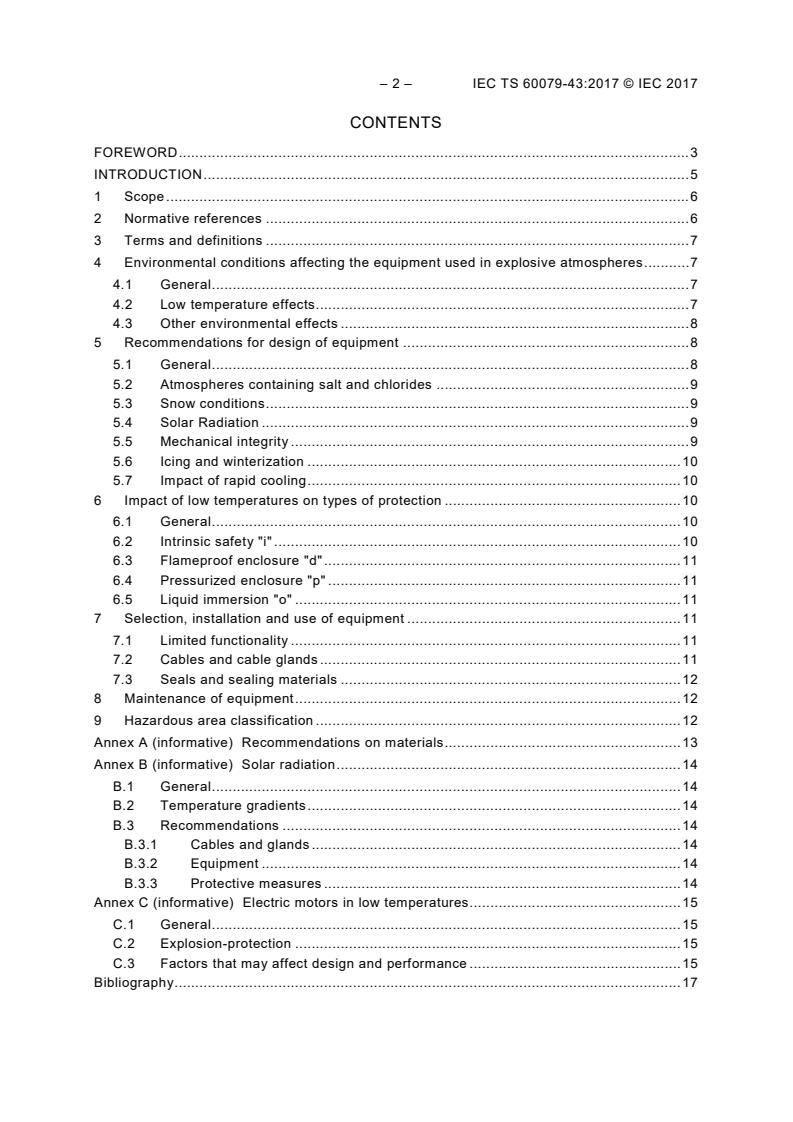
– 2 – IEC TS 60079-43:2017 © IEC 2017
CONTENTS
FOREWORD . 3
INTRODUCTION . 5
1 Scope . 6
2 Normative references . 6
3 Terms and definitions . 7
4 Environmental conditions affecting the equipment used in explosive atmospheres . 7
4.1 General . 7
4.2 Low temperature effects . 7
4.3 Other environmental effects . 8
5 Recommendations for design of equipment . 8
5.1 General . 8
5.2 Atmospheres containing salt and chlorides . 9
5.3 Snow conditions . 9
5.4 Solar Radiation . 9
5.5 Mechanical integrity . 9
5.6 Icing and winterization . 10
5.7 Impact of rapid cooling . 10
6 Impact of low temperatures on types of protection . 10
6.1 General . 10
6.2 Intrinsic safety "i" . 10
6.3 Flameproof enclosure "d" . 11
6.4 Pressurized enclosure "p" . 11
6.5 Liquid immersion "o" . 11
7 Selection, installation and use of equipment . 11
7.1 Limited functionality . 11
7.2 Cables and cable glands . 11
7.3 Seals and sealing materials . 12
8 Maintenance of equipment . 12
9 Hazardous area classification . 12
Annex A (informative) Recommendations on materials . 13
Annex B (informative) Solar radiation . 14
B.1 General . 14
B.2 Temperature gradients . 14
B.3 Recommendations . 14
B.3.1 Cables and glands . 14
B.3.2 Equipment . 14
B.3.3 Protective measures . 14
Annex C (informative) Electric motors in low temperatures . 15
C.1 General . 15
C.2 Explosion-protection . 15
C.3 Factors that may affect design and performance . 15
Bibliography . 17
INTERNATIONAL ELECTROTECHNICAL COMMISSION
____________
EXPLOSIVE ATMOSPHERES –
Part 43: Equipment in adverse service conditions
FOREWORD
1) The International Electrotechnical Commission (IEC) is a worldwide organization for standardization comprising
all national electrotechnical committees (IEC National Committees). The object of IEC is to promote
international co-operation on all questions concerning standardization in the electrical and electronic fields. To
this end and in addition to other activities, IEC publishes International Standards, Technical Specifications,
Technical Reports, Publicly Available Specifications (PAS) and Guides (hereafter referred to as “IEC
Publication(s)”). Their preparation is entrusted to technical committees; any IEC National Committee interested
in the subject dealt with may participate in this preparatory work. International, governmental and
non-governmental organizations liaising with the IEC also participate in this preparation. IEC collaborates
closely with the International Organization for Standardization (ISO) in accordance with conditions determined
by agreement between the two organizations.
2) The formal decisions or agreements of IEC on technical matters express, as nearly as possible, an international
consensus of opinion on the relevant subjects since each technical committee has representation from all
interested IEC National Committees.
3) IEC Publications have the form of recommendations for international use and are accepted by IEC National
Committees in that sense. While all reasonable efforts are made to ensure that the technical content of IEC
Publications is accurate, IEC cannot be held responsible for the way in which they are used or for any
misinterpretation by any end user.
4) In order to promote international uniformity, IEC National Committees undertake to apply IEC Publications
transparently to the maximum extent possible in their national and regional publications. Any divergence
between any IEC Publication and the corresponding national or regional publication shall be clearly indicated in
the latter.
5) IEC itself does not provide any attestation of conformity. Independent certification bodies provide conformity
assessment services and, in some areas, access to IEC marks of conformity. IEC is not responsible for any
services carried out by independent certification bodies.
6) All users should ensure that they have the latest edition of this publication.
7) No liability shall attach to IEC or its directors, employees, servants or agents including individual experts and
members of its technical committees and IEC National Committees for any personal injury, property damage or
other damage of any nature whatsoever, whether direct or indirect, or for costs (including legal fees) and
expenses arising out of the publication, use of, or reliance upon, this IEC Publication or any other IEC
Publications.
8) Attention is drawn to the Normative references cited in this publication. Use of the referenced publications is
indispensable for the correct application of this publication.
9) Attention is drawn to the possibility that some of the elements of this IEC Publication may be the subject of
patent rights. IEC shall not be held responsible for identifying any or all such patent rights.
The main task of IEC technical committees is to prepare International Standards. In
exceptional circumstances, a technical committee may propose the publication of a technical
specification when
• the required support cannot be obtained for the publication of an International Standard,
despite repeated efforts, or
• the subject is still under technical development or where, for any other reason, there is the
future but no immediate possibility of an agreement on an International Standard.
Technical specifications are subject to review within three years of publication to decide
whether they can be transformed into International Standards.
IEC TS 60079-43, which is a technical specification, has been prepared by IEC Technical
committee 31: Equipment for explosive atmospheres.
– 4 – IEC TS 60079-43:2017 © IEC 2017
The text of this technical specification is based on the following documents:
Enquiry draft Report on voting
31/1311/DTS 31/1328A/RVDTS
Full information on the voting for the approval of this technical specification can be found in
the report on voting indicated in the above table.
This document has been drafted in accordance with the ISO/IEC Directives, Part 2.
A list of all parts in the IEC 60079 series, published under the general title Explosive
atmospheres, can be found on the IEC website.
The committee has decided that the contents of this document will remain unchanged until the
stability date indicated on the IEC website under "http://webstore.iec.ch" in the data related to
the specific document. At this date, the document will be
• reconfirmed,
• withdrawn,
• replaced by a revised edition, or
• amended.
A bilingual version of this publication may be issued at a later date.
INTRODUCTION
IEC 60079-0 specifies the requirements for electrical equipment intended for use in explosive
atmospheres at standard atmospheric conditions:
• temperature –20 °C to +60 °C;
• pressure 80 kPa (0,8 bar) to 110 kPa (1,1 bar); and
• air with normal oxygen content, typically 21 % v/v.
In some cases, other parts of the IEC 60079 series also specify conditions outside the above
range, for example in IEC 60079-1.
IEC 60079-0 states the normal ambient temperature range as –20 °C to +40 °C and states
that electrical equipment designed for use in other than this normal ambient temperature
range is considered to be special and includes additional marking to communicate this to the
user.
IEC 60079-14 includes requirements for users to select and install equipment so that it is
suitable for the environmental conditions, but does not provide any specific guidance for
installations outside of the standard atmospheric conditions or for other adverse
environmental conditions.
Extreme climate conditions in Polar environments are challenging to explosion protection
technology and solutions. Conditions such as snow build-up, icing from spray and freezing of
precipitation can negatively affect the operation and safety of equipment. Extreme low
temperatures and weather conditions make it difficult to process hydrocarbons in open
outdoor process areas and it can also be challenging for equipment operation. Measures to
deal with these challenges are often called 'winterization'.
This document is a guide for equipment subject to adverse service conditions, for example
equipment considered as 'special' in IEC 60079-0. It is applicable to the design, manufacture,
installation, inspection and use of such equipment. Annex A gives recommendations on
materials and Annex C gives information on electric motors in low temperatures. It is possible
that some details in this technical specification will be relocated to relevant parts of the
IEC 60079 series at the next edition of each of those relevant parts as guidance material.
This technical specification does not at this time address other environmental conditions such
as high temperatures, which will be explored further at a later date.
– 6 – IEC TS 60079-43:2017 © IEC 2017
EXPLOSIVE ATMOSPHERES –
Part 43: Equipment in adverse service conditions
1 Scope
This part of IEC 60079, which is a Technical Specification, provides guidance for equipment
for use in explosive atmospheres in environments which may include ambient temperatures
below –20 °С, and additional adverse conditions, including maritime applications.
The purpose of this document is to provide recommendations to be considered for the design,
manufacture and use of equipment. It is intended that this document be used for equipment
operating within the environmental range specified on the certificate for the equipment.
NOTE For detailed classification of climate conditions refer to IEC 60721 series and IEC 60068-1.
This document is intended to be used in conjunction with the IEC 60079 series and the
ISO/IEC 80079 series.
2 Normative references
The following documents are referred to in the text in such a way that some or all of their
content constitutes requirements of this document. For dated references, only the edition
cited applies. For undated references, the latest edition of the referenced document (including
any amendments) applies.
IEC 60034-5, Rotating electrical machines - Part 5: Degrees of protection provided by the
integral design of rotating electrical machines (IP code) - Classification
IEC 60068 (all parts), Environmental testing
IEC 60079-0, Explosive atmospheres - Part 0: Equipment - General requirements
IEC 60079-11, Explosive atmospheres - Part 11: Equipment protection by intrinsic safety "i"
IEC 60079-14, Explosive atmospheres - Part 14: Electrical installations design, selection and
erection
IEC 60079-17, Explosive atmospheres - Part 17: Electrical installations inspection and
maintenance
IEC 60529, Degrees of protection provided by enclosures (IP Code)
IEC 60721-1, Classification of environmental conditions - Part 1: Environmental parameters
and their severities
IEC 60721-2-1, Classification of environmental conditions - Part 2-1: Environmental conditions
appearing in nature - Temperature and humidity
IEC TR 60721-4 (all parts), Classification of environmental conditions
3 Terms and definitions
For the purposes of this document, the terms and definitions given in IEC 60079-0 apply.
NOTE Additional definitions applicable to explosive atmospheres can be found in IEC 60050-426, International
Electrotechnical Vocabulary – Part 426: Equipment for explosive atmospheres.
ISO and IEC maintain terminological databases for use in standardization at the following
addresses:
• IEC Electropedia: available at http://www.electropedia.org/
• ISO Online browsing platform: available at http://www.iso.org/obp
4 Environmental conditions affecting the equipment used in explosive
atmospheres
4.1 General
For the purposes of this document, the environmental conditions and specific operating
parameters are considered to the extent that they can cause failure of the equipment or its
parts related to explosion protection properties.
Useful information on climate classifications can be found in the IEC 60721 series. These
documents provide for five classifications of Tropical, Arid, Temperate, Cold and Polar. If a
manufacturer wishes to reference equipment as conforming to one of those classifications, it
is recommended the temperatures shown in the specific part of IEC 60721 be used, for
example in establishing the temperatures to be applied for the thermal endurance to heat and
cold tests in IEC 60079-0.
The main environmental factors which may affect the equipment addressed by this document
individually or in combination, include:
– low temperature;
– humidity;
– corrosive media;
– powder snow;
– precipitation;
– spray from waves;
– high winds;
– solar radiation; and
– mechanical effects.
The effect of these factors can be significant, particularly if they arise jointly. Information on
these effects is provided below.
4.2 Low temperature effects
For low temperatures, the following may be relevant and should be considered:
– electrochemical capacitors may freeze and fail;
– battery units may discharge;
– wax and protective compounds may become solid and crack;
– rubber materials may lose elasticity and fail;
– greases may freeze affecting parts such as hinges and shafts;
– 8 – IEC TS 60079-43:2017 © IEC 2017
– relays may malfunction;
– amplifying properties of transistors may decrease;
– loss of ductility or embrittlement of materials or welded joints may occur;
– differential expansion or contraction of materials may have an impact on correct fitting of
components;
– oil viscosity increases, and flow may be restricted or cease, which may cause loss of
protection, or failure of mechanical systems;
– oil as dielectric insulation in aged electrical equipment may contain higher water content
which may reduce its dielectric strength or even cause dielectric failure.
4.3 Other environmental effects
High humidity can occur due to changes in temperature, for example, in maritime conditions.
In these cases, the following may be relevant and should be considered:
– dielectric permeability of insulation materials may increase;
– surface resistance of insulation materials may decrease;
– permittivity of air gaps may decrease;
– auxiliary physical-chemical processes in dielectrics and metals may occur, for example
corrosion or biological changes.
These conditions may cause undesirable changes in the capacitance of capacitors, decrease
in insulation resistance, swelling and peeling of dielectrics, metal corrosion, or formation of
mould inside the equipment.
Salt or other contaminants may exacerbate many of the problems that humidity creates, such
as reduced insulating properties and increased corrosion.
5 Recommendations for design of equipment
5.1 General
IEC 60079-0 requires equipment to be constructed in accordance with the applicable safety
requirements of relevant industrial standards. Such standards can i
...
Questions, Comments and Discussion
Ask us and Technical Secretary will try to provide an answer. You can facilitate discussion about the standard in here.
Loading comments...