


ISO/TS 11669:2012
(Main)Translation projects — General guidance
Translation projects — General guidance
This Technical Specification provides general guidance for all phases of a translation project. Its main purpose is to facilitate communication among the parties involved in a project. It is intended for use by all stakeholders of the translation project, including those who request translation services, those who provide the services and those who make use of the results of the project — in particular, the translation product. It applies to multiple sectors, including the commercial and government sectors, and non-profit organizations. It provides a framework for developing structured specifications for translation projects, but does not cover legally binding contracts between parties involved in a translation project. It addresses quality assurance and provides the basis for qualitative assessment, but does not provide procedures for quantitative measures of the quality of a translation product. It is not applicable to interpreting services.
Projets de traduction — Lignes directrices générales
La présente Spécification technique fournit des lignes directrices générales pour toutes les phases d'un projet de traduction. Elle a pour principal objet de faciliter la communication entre les parties impliquées dans un projet. Elle s'adresse à toutes les parties prenantes d'un projet de traduction, notamment les personnes qui demandent le service, celles qui l'assurent et celles qui utilisent les résultats du projet, en l'occurrence le produit de la traduction. Elle est applicable à différents secteurs, y compris le secteur commercial, le secteur des administrations publiques et les organisations à but non lucratif. La présente Spécification technique offre un cadre de développement de spécifications structurées des projets de traduction, sans couvrir les contrats exécutoires conclus entre les parties concernées par le projet de traduction. Elle aborde l'assurance qualité et fournit la base d'une évaluation qualitative, sans préciser les procédures de mesure quantitative de la qualité d'un produit de la traduction. La présente Spécification technique n'est pas applicable aux services d'interprétation.
Prevajalski projekti - Splošna navodila
Ta tehnična specifikacija podaja splošne smernice za vse faze prevajalskega projekta. Njen glavni namen je, da olajša komunikacijo med strankami, ki sodelujejo v projektu. Uporabljajo jo lahko vse zainteresirane strani, ki so vključene v prevajalski projekt, vključno s tistimi, ki potrebujejo ali ponujajo prevajalske storitve in tistimi, ki uporabljajo rezultate projekta (predvsem prevajalski izdelek). Uporablja se za več sektorjev, vključno z gospodarskim in vladnim, in za neprofitne organizacije. Podaja okvir za razvoj strukturiranih specifikacij za prevajalske projekte, vendar ne vključuje pravnozavezujočih pogodb med strankami, ki so vključene v prevajalski projekt. Obravnava zagotavljanje kakovosti in podaja osnovo za oceno kakovosti, vendar ne podaja postopkov za kvantitativna merila kakovosti prevajalskega izdelka. Ne velja za storitve tolmačenja.
General Information
- Status
- Withdrawn
- Publication Date
- 15-May-2012
- Technical Committee
- ISO/TC 37/SC 5 - Translation, interpreting and related technology
- Drafting Committee
- ISO/TC 37/SC 5 - Translation, interpreting and related technology
- Current Stage
- 9599 - Withdrawal of International Standard
- Start Date
- 14-Mar-2024
- Completion Date
- 12-Feb-2026
Relations
- Effective Date
- 23-Apr-2020



ISO/TS 11669:2012 - Translation projects — General guidance Released:5/16/2012

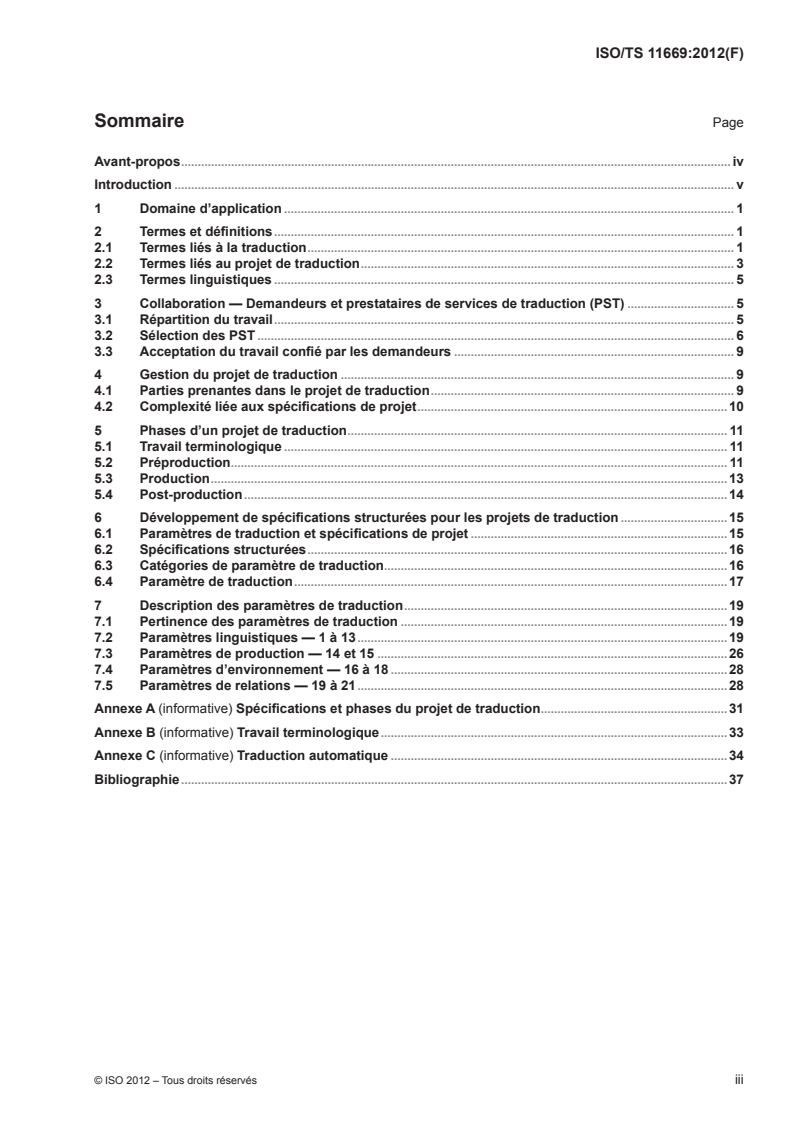
ISO/TS 11669:2012 - Projets de traduction — Lignes directrices générales Released:5/16/2012


ISO/TS 11669:2012 - Translation projects — General guidance Released:8/20/2014
Frequently Asked Questions
ISO/TS 11669:2012 is a standard published by the International Organization for Standardization (ISO). Its full title is "Translation projects — General guidance". This standard covers: This Technical Specification provides general guidance for all phases of a translation project. Its main purpose is to facilitate communication among the parties involved in a project. It is intended for use by all stakeholders of the translation project, including those who request translation services, those who provide the services and those who make use of the results of the project — in particular, the translation product. It applies to multiple sectors, including the commercial and government sectors, and non-profit organizations. It provides a framework for developing structured specifications for translation projects, but does not cover legally binding contracts between parties involved in a translation project. It addresses quality assurance and provides the basis for qualitative assessment, but does not provide procedures for quantitative measures of the quality of a translation product. It is not applicable to interpreting services.
This Technical Specification provides general guidance for all phases of a translation project. Its main purpose is to facilitate communication among the parties involved in a project. It is intended for use by all stakeholders of the translation project, including those who request translation services, those who provide the services and those who make use of the results of the project — in particular, the translation product. It applies to multiple sectors, including the commercial and government sectors, and non-profit organizations. It provides a framework for developing structured specifications for translation projects, but does not cover legally binding contracts between parties involved in a translation project. It addresses quality assurance and provides the basis for qualitative assessment, but does not provide procedures for quantitative measures of the quality of a translation product. It is not applicable to interpreting services.
ISO/TS 11669:2012 is classified under the following ICS (International Classification for Standards) categories: 01.020 - Terminology (principles and coordination). The ICS classification helps identify the subject area and facilitates finding related standards.
ISO/TS 11669:2012 has the following relationships with other standards: It is inter standard links to ISO 11669:2024. Understanding these relationships helps ensure you are using the most current and applicable version of the standard.
ISO/TS 11669:2012 is available in PDF format for immediate download after purchase. The document can be added to your cart and obtained through the secure checkout process. Digital delivery ensures instant access to the complete standard document.
Standards Content (Sample)
SLOVENSKI STANDARD
01-julij-2013
Prevajalski projekti - Splošna navodila
Translation projects -- General guidance
Projets de traduction -- Lignes directrices générales
Ta slovenski standard je istoveten z: ISO/TS 11669:2012
ICS:
01.020 Terminologija (načela in Terminology (principles and
koordinacija) coordination)
03.080.99 Druge storitve Other services
2003-01.Slovenski inštitut za standardizacijo. Razmnoževanje celote ali delov tega standarda ni dovoljeno.
TECHNICAL ISO/TS
SPECIFICATION 11669
First edition
2012-05-15
Translation projects — General guidance
Projets de traduction — Lignes directrices générales
Reference number
©
ISO 2012
All rights reserved. Unless otherwise specified, no part of this publication may be reproduced or utilized in any form or by any means,
electronic or mechanical, including photocopying and microfilm, without permission in writing from either ISO at the address below or ISO’s
member body in the country of the requester.
ISO copyright office
Case postale 56 • CH-1211 Geneva 20
Tel. + 41 22 749 01 11
Fax + 41 22 749 09 47
E-mail copyright@iso.org
Web www.iso.org
Published in Switzerland
ii © ISO 2012 – All rights reserved
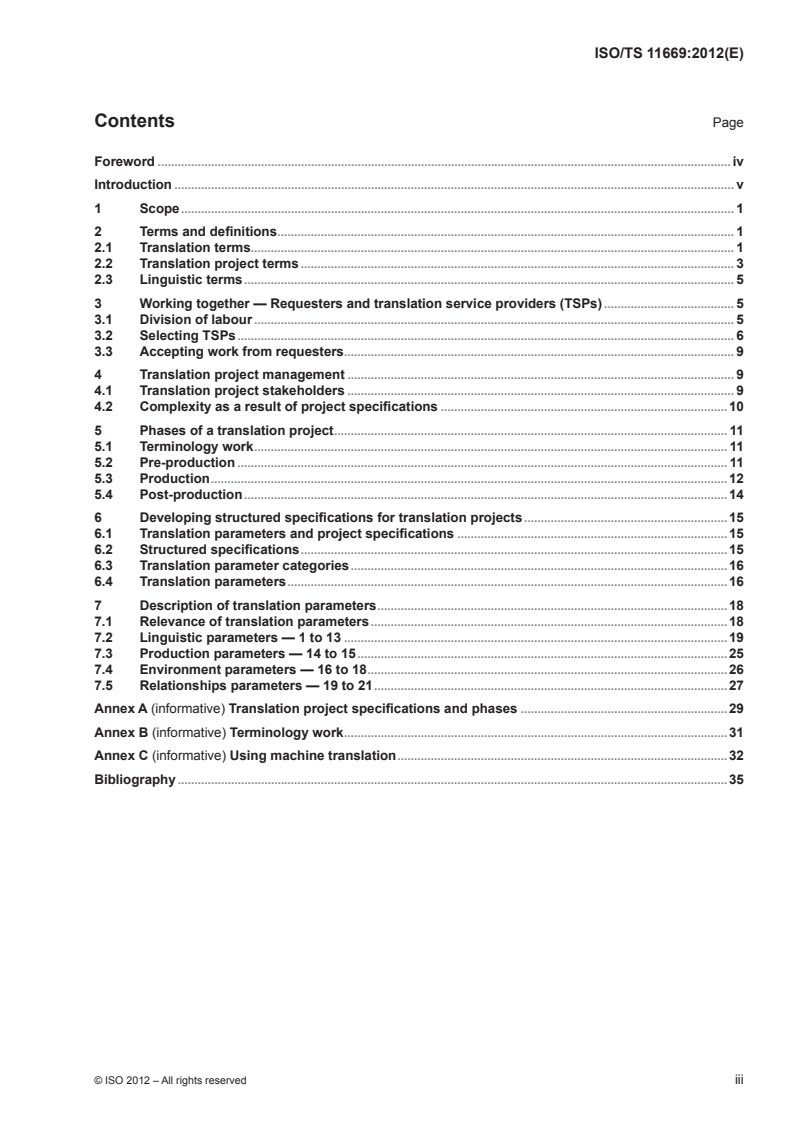
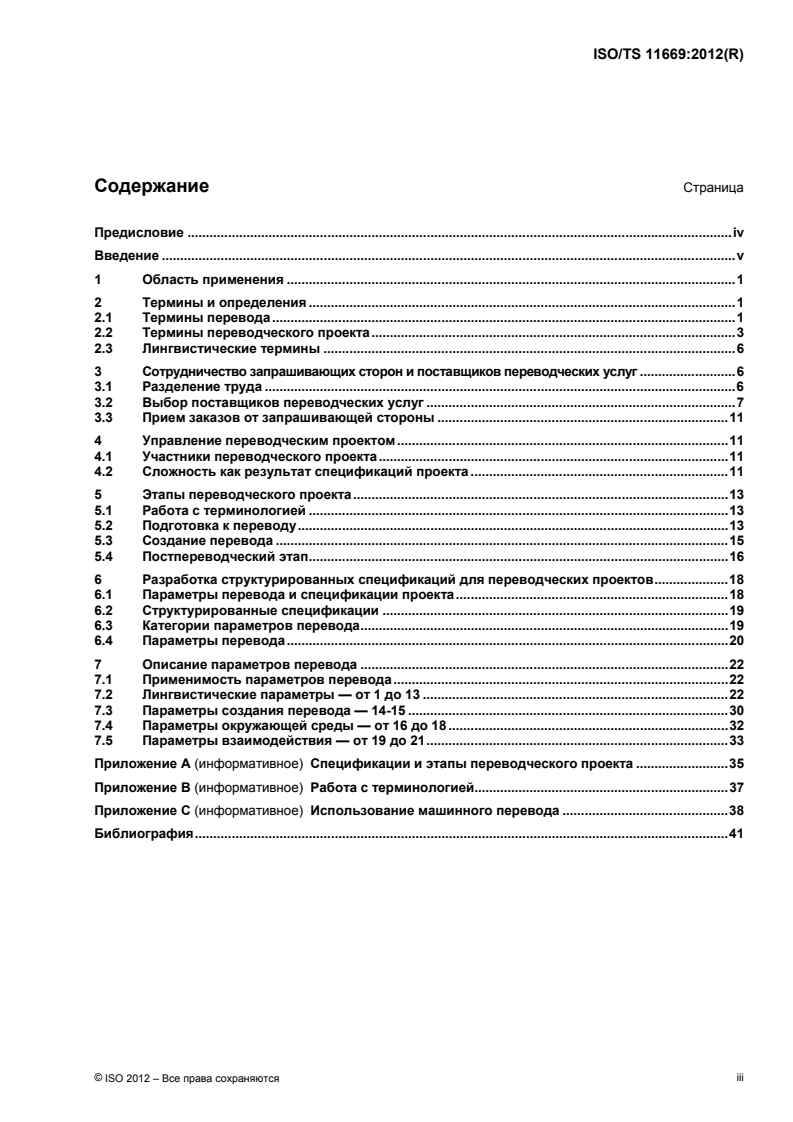
Contents Page
Foreword .iv
Introduction . v
1 Scope . 1
2 Terms and definitions . 1
2.1 Translation terms . 1
2.2 Translation project terms . 3
2.3 Linguistic terms . 5
3 Working together — Requesters and translation service providers (TSPs) . 5
3.1 Division of labour . 5
3.2 Selecting TSPs . 6
3.3 Accepting work from requesters . 9
4 Translation project management . 9
4.1 Translation project stakeholders . 9
4.2 Complexity as a result of project specifications .10
5 Phases of a translation project . 11
5.1 Terminology work . 11
5.2 Pre-production . 11
5.3 Production .12
5.4 Post-production .14
6 Developing structured specifications for translation projects .15
6.1 Translation parameters and project specifications .15
6.2 Structured specifications .15
6.3 Translation parameter categories .16
6.4 Translation parameters .16
7 Description of translation parameters .18
7.1 Relevance of translation parameters .18
7.2 Linguistic parameters — 1 to 13 .19
7.3 Production parameters — 14 to 15 .25
7.4 Environment parameters — 16 to 18 .26
7.5 Relationships parameters — 19 to 21 .27
Annex A (informative) Translation project specifications and phases .29
Annex B (informative) Terminology work .31
Annex C (informative) Using machine translation .32
Bibliography .35
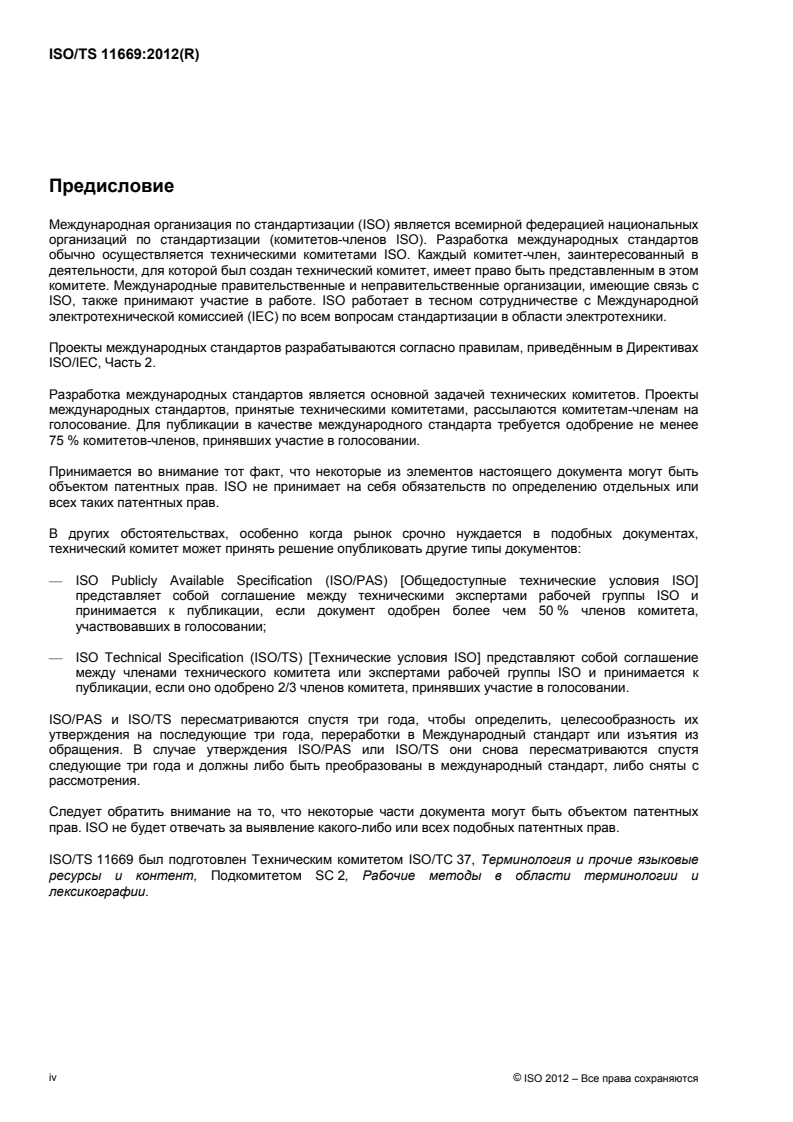
Foreword
ISO (the International Organization for Standardization) is a worldwide federation of national standards bodies
(ISO member bodies). The work of preparing International Standards is normally carried out through ISO
technical committees. Each member body interested in a subject for which a technical committee has been
established has the right to be represented on that committee. International organizations, governmental and
non-governmental, in liaison with ISO, also take part in the work. ISO collaborates closely with the International
Electrotechnical Commission (IEC) on all matters of electrotechnical standardization.
International Standards are drafted in accordance with the rules given in the ISO/IEC Directives, Part 2.
The main task of technical committees is to prepare International Standards. Draft International Standards
adopted by the technical committees are circulated to the member bodies for voting. Publication as an
International Standard requires approval by at least 75 % of the member bodies casting a vote.
In other circumstances, particularly when there is an urgent market requirement for such documents, a technical
committee may decide to publish other types of document:
— an ISO Publicly Available Specification (ISO/PAS) represents an agreement between technical experts in
an ISO working group and is accepted for publication if it is approved by more than 50 % of the members
of the parent committee casting a vote;
— an ISO Technical Specification (ISO/TS) represents an agreement between the members of a technical
committee and is accepted for publication if it is approved by 2/3 of the members of the committee
casting a vote.
An ISO/PAS or ISO/TS is reviewed after three years in order to decide whether it will be confirmed for a further
three years, revised to become an International Standard, or withdrawn. If the ISO/PAS or ISO/TS is confirmed,
it is reviewed again after a further three years, at which time it must either be transformed into an International
Standard or be withdrawn.
Attention is drawn to the possibility that some of the elements of this document may be the subject of patent
rights. ISO shall not be held responsible for identifying any or all such patent rights.
ISO/TS 11669 was prepared by Technical Committee ISO/TC 37, Terminology and other language and content
resources, Subcommittee SC 2, Terminographical and lexicographical working methods.
iv © ISO 2012 – All rights reserved
Introduction
This Technical Specification reflects the variety of projects that translation service providers (TSPs) carry out.
It provides guidance concerning best practices for all phases of a translation project. It will also be useful to
institutions that train and educate translators. It is not meant to compete with current regional and national
standards, but is intended to improve communication among all relevant stakeholders in a translation project,
including the persons requesting the translation service, those providing the service and those who make use
[7]
of the resulting translation product. It is based in part on translation service standards adopted in Canada ,
[8] [9] [5] [6]
China , Europe and the United States .
An organizing principle of this Technical Specification is the importance of structured specifications in translation
projects (as elaborated in Clauses 6 and 7). A system is described for making decisions about how translation
projects are to be carried out. Those decisions — project specifications — then become a resource for both
the requester (the party that requests a translation product, sometimes called the client or customer) and the
translation service provider throughout all phases of a translation project. Translation project specifications
can be attached to a legally binding contract to define the work to be done. In the absence of a contract, they
can be attached to a purchase order or other document supporting the request. Project specifications can be
developed and used both within and outside commercial customer-vendor relationships.
A basic and implicit translation project specification is that the target content be readable in the target language
and correspond in some way to the source content. However, the nature of the correspondence between
the source and target contents will vary according to the needs of the project, as determined by the project
specifications.
In practice, requesters do not always provide project specifications. However, that is not best practice.
Requesters and TSPs should work together to determine project specifications. Those who do so are more
likely to be satisfied with both the translation project and the final translation product. When both requesters
and TSPs agree on project specifications, the quality of a translation — from a workflow and final delivery
perspective — can be determined by the degree to which the target content adheres to the predetermined
specifications. All parties involved in the production of a translation product should have access to the
necessary project specifications.
After the requester receives the final translation product, the role of the project specifications does not end; they
are the starting point for all assessments, both qualitative and quantitative. Any assessment standards would
therefore benefit from taking into account the system of structured specifications presented in this Technical
Specification. Keeping the translation product and the project specifications together provides a uniform basis
for assessment. The project specifications can be used to guide assessments made by either the TSP or the
end user. The use of the same specifications by all parties avoids assessment based on personal opinions
of how source content should be translated. In some cases, the specifications themselves will be found to
be unclear or ill-advised. In other cases, it will be determined that the specifications were not followed. In all
cases, the use of project specifications can improve communication within the document production chain and
promote ongoing improvement.
In summary, quality translation projects and quality translation products result from developing and following
appropriate project specifications.
TECHNICAL SPECIFICATION ISO/TS 11669:2012(E)
Translation projects — General guidance
1 Scope
This Technical Specification provides general guidance for all phases of a translation project. Its main purpose
is to facilitate communication among the parties involved in a project. It is intended for use by all stakeholders
of the translation project, including those who request translation services, those who provide the services and
those who make use of the results of the project — in particular, the translation product. It applies to multiple
sectors, including the commercial and government sectors, and non-profit organizations.
It provides a framework for developing structured specifications for translation projects, but does not cover
legally binding contracts between parties involved in a translation project. It addresses quality assurance and
provides the basis for qualitative assessment, but does not provide procedures for quantitative measures of
the quality of a translation product.
It is not applicable to interpreting services.
2 Terms and definitions
For the purposes of this document, the following terms and definitions apply.
2.1 Translation terms
2.1.1
translate
render information in the source language (2.1.2) into the target language (2.1.3) in written form
2.1.2
source language
language from which content is translated into the target language (2.1.3)
2.1.3
target language
language into which content is translated from the source language (2.1.2)
2.1.4
source content
text and other content to be translated (2.1.1)
Note to entry: The source content for a translation project can, for example, range in size and complexity from a single
road sign to a one-page document, set of large documents or user interface for a complex software system.
2.1.5
target content
text and other content translated from the source content (2.1.4)
Note to entry: Target content and translation product (2.1.9) are related terms. Translation product generally refers to
content at a late stage or at the end of a translation project, after the content has undergone translation and other translation
services such as revision (2.2.2.2) or review (2.2.2.3). Target content generally refers to content as it is undergoing
translation and translation services.
2.1.6
A-language
native language, or language that is equivalent to a native language, into which the translator typically translates
from his or her B-language (2.1.7) and/or C-language (2.1.8)
Note to entry: The A-language is generally the language of education and daily life for a translator.
2.1.7
B-language
language, other than a translator’s native language, of which the translator has an excellent command and from
which the translator typically translates into his or her A-language (2.1.6)
2.1.8
C-language
language of which a translator has a complete understanding and from which the translator sometimes
translates into his or her A-language (2.1.8)
Note to entry: A translator can have several C-languages.
2.1.9
translation product
content created through the process of translation (2.2.2.1) and other translation services
Note to entry: Translation product and target content (2.1.5) are related terms. Translation product generally refers to
content at a late stage or at the end of a translation project, after the content has undergone translation and other translation
services such as revision (2.2.2.2) or review (2.2.2.3). Target content generally refers to content as it is undergoing
translation and translation services.
2.1.10
locale
value that reflects the language, local conventions and culture of a geographic region
Note to entry: Local conventions can include specific formatting rules for dates, times and numbers, as well as other
conventions and preferences.
EXAMPLE French Canada (fr-CA), Chinese Singapore (zh-SG).
2.1.11
overt translation
type of translation (2.2.2.1) in which aspects of the source language (2.1.2) and source culture are
intentionally left visible
2.1.12
covert translation
type of translation (2.2.2.1) intended to make the translation product (2.1.9) appear as though it had been
authored originally in the target language (2.1.3) and target culture
2.1.13
translation memory
electronic collection of source- and target-language segment pairs
Note 1 to entry: A segment is typically a sentence, bullet point, or header.
Note 2 to entry: The purpose of a translation memory is to facilitate the retrieval and use of previously translated content.
2.1.14
bi-text
text segmented and linked to corresponding segments of target text
2.1.15
competence
ability to apply knowledge and skills to achieve intended results
2 © ISO 2012 – All rights reserved
2.2 Translation project terms
2.2.1 Terms related to stakeholders
2.2.1.1
requester
person or organization requesting a translation service from a TSP (2.2.1.2) or language service provider (2.2.1.3)
Note 1 to entry: The requester is usually the person or organization that asks for, and receives, the translation product
(2.1.9) on behalf of the end users, and that usually directly or indirectly determines the TSP’s compensation for rendering the
translation service. In the case of government or non-profit organizations, pro-bono transactions, or in-house translation
within a company, there is sometimes no monetary compensation for translation services.
Note 2 to entry: In the commercial sector, the requester is sometimes called the client or customer. These terms,
however, are ambiguous and could refer to the end user (2.2.1.6). For this reason, requester is the preferred term.
2.2.1.2
TSP
translation service provider
person or organization supplying a translation service
EXAMPLE Translation companies, translation agencies, freelance translators, in-house translators, revisers,
reviewers, translation organizations (profit, non-profit or governmental).
Note 1 to entry: The concepts of TSP and language service provider (2.2.1.3) are connected by a generic relation, with
language service provider being the generic concept and TSP the specific concept. TSPs generally provide only translation
services, which can include revision (2.2.2.2) or review (2.2.2.3). Depending on their qualifications and abilities, TSPs can
provide other services.
Note 2 to entry: Often a larger TSP asks several smaller TSPs to each take care of part of a translation project — for
example, translation into one target language each. There can be even more than two levels of providers. However, in such
cases, each TSP is considered to be a provider, not a requester (2.2.1.1). Only the person or organization making the initial
request to the highest-level TSP is called the requester in this document.
2.2.1.3
language service provider
LSP
person or organization that provides translation, interpreting and/or other language-related services such as
transcription, terminology management or voice-overs
Note 1 to entry: The concepts of language service provider and TSP (2.2.1.2) are connected by a generic relation,
with language service provider being the generic concept and TSP the specific concept. TSPs generally provide only
translation services, which can include revision (2.2.2.2) or review (2.2.2.3). In some cases, language service providers
provide mainly translation services but in many languages.
Note 2 to entry: LSP is also an abbreviation for “Language for specific purposes”; in this Technical Specification, however,
LSP refers only to language service provider.
2.2.1.4
translator
person who translates (2.1.1)
2.2.1.5
freelance translator
translator (2.2.1.4) who typically provides outside services for several requesters directly or several TSPs
(2.2.1.2) or a combination of the two, on a per project basis
2.2.1.6
end user
person or group of persons who ultimately make use of the translation product (2.1.9)
Note to entry: The end user is often not the same entity as the requester (2.2.1.1).
2.2.1.7
reviser
person who performs revision (2.2.2.2)
2.2.1.8
reviewer
person who performs review (2.2.2.3)
2.2.2 Terms related to translation project tasks
2.2.2.1
translation
process of translating (2.1.1)
2.2.2.2
revision
bilingual editing of target content (2.1.5) based on a comparison between the source content (2.15) and the
target content
2.2.2.3
review
monolingual editing of target content (2.1.5) with respect to the conventions of the subject field(s) (2.3.2) to
which the target content belongs
2.2.2.4
localization
process of adapting products and services for distinct locales (2.1.10)
Note to entry: Localization consists of 1) the translation of textual materials according to the target locale, and 2)
adaptation of non-textual materials to the same locale. It includes input, output and delivery mechanisms.
2.2.2.5
back translation
translation (2.2.2.1) of the target content (2.1.5) back into the source language (2.1.2)
Note to entry: Back translation can be misunderstood or misused. See discussion of back translation in 7.3.2 for details.
2.2.2.6
machine translation
process in which source content (2.1.4) is given to a computer system and target content (2.1.5) is produced
without human intervention
2.2.2.7
raw machine translation
output of machine translation (2.2.2.6) prior to post-editing (2.2.2.8)
2.2.2.8
post-editing
revising raw machine translation (2.2.2.7)
2.2.3 Terms related to project specification framework
2.2.3.1
project specification
value for a translation parameter (2.2.3.2) relative to a particular translation project
4 © ISO 2012 – All rights reserved
2.2.3.2
translation parameter
one of a set of key factors, activities, elements and attributes of a given project used for creating project
specifications (2.2.3.1)
Note 1 to entry: The set of translation parameters as enumerated in 7.2 is applicable to all translation projects and the
translation parameters’ values (project specifications) are to be determined for each project to fully define the conditions
and output of translation (2.2.2.1).
Note 2 to entry: There are multiple categories of translation parameters, including linguistic parameters, production
parameters and environment parameters.
Note 3 to entry: In the context of translation projects, the term translation parameter is often referred to simply as
“parameter” for practicality.
2.2.3.3
translation sub-parameter
subdivision of a translation parameter (2.2.3.2)
EXAMPLE Sub-parameter 19a: Copyright.
2.3 Linguistic terms
2.3.1
text type
class to which content is assigned based on its function, format or the intention of the author with respect to
the target audience
2.3.2
subject field
domain
field of activity characterized by a specific body of knowledge, terminology and phraseology
2.3.3
register
usage register
set of properties that is characteristic of a particular type of content, and which takes into account the nature of
the relationship between the creator and audience, the subject treated and the degree of formality or familiarity
of the content
2.3.4
interpreting
rendering of the spoken or signed information in a source language (2.1.2) into a target language (2.1.3) in oral
or signed form
3 Working together — Requesters and translation service providers (TSPs)
3.1 Division of labour
This clause provides requesters with suggestions on how to identify an appropriate TSP for translation projects.
Additionally, TSPs can review it to determine the conditions under which they should or should not accept work
that is offered by requesters.
The division of labour between the requester and the TSP can vary widely; many tasks can be performed by
either the requester or the TSP. For this reason, the division of labour should be determined and formalized in
the project specifications (see Clause 6).
3.2 Selecting TSPs
3.2.1 Different types of TSPs
3.2.1.1 In-house TSPs
When applicable, requesters can select TSPs from within their own organizations. Otherwise, requesters can
choose to outsource their content to TSPs.
When applicable, TSPs can choose in-house staff to translate the requester’s content. The TSP also has the
option to outsource the content to other TSPs.
3.2.1.2 Multi-person TSPs
Multi-person TSPs are often translation companies. They often have a larger translation capacity than
freelance translators.
Multi-person TSPs can employ other TSPs, including freelance translators. Often a larger TSP, sometimes
called a language service provider, asks several smaller TSPs to each take care of part of a translation
project — for example, translation into one target language each. There can be even more than two levels of
providers. However, in such cases, each TSP is considered to be a provider, not a requester.
3.2.1.3 Freelance translators
A freelance translator is a TSP acting as an individual.
When requesters work directly with freelance translators, a project manager should be designated who will
assume responsibility for developing the project specifications based on the initial requirements of the requester
(see 5.2). The project manager should also ensure that the specifications are adhered to throughout the project,
particularly in the production and post-production phases (details given in 5.3 and 5.4, respectively).
When the agreed-upon project specifications call for a translation to be revised, the revision should be performed
by someone other than the translator. The exception to this practice is when there is no one available who
is more qualified than the translator to revise the translation product; in that case, the translator should do a
thorough revision of his or her own work. However, requesters and TSPs should be aware that some regional
and national translation standards require, with limited exceptions, that someone other than the translator
revise every translation. Freelance translators can fulfil this requirement by making arrangements with other
TSPs to revise their work.
3.2.2 Selecting an appropriate TSP
Before selecting a TSP, requesters should first define the preliminary project specifications (see 5.2.3), which
will aid them in determining the best types of TSPs for a project (i.e. whether to outsource the translation project
and to whom, or to keep the project in-house).
It is the responsibility of the requester to choose an appropriate TSP that meets the needs of the project. The
requester should search for and select a TSP that applies a structured specification approach to translation
projects (see Clauses 6 and 7). Requesters should also select TSPs that have the necessary competences as
described in 3.2.3 to 3.2.4.
Providing specific measures of competence (i.e. scores and numbers) for individuals is beyond the scope of
this document because of its international reach and because each translation project has unique needs and
specifications.
Upon request, TSPs should provide any desired information to the requester for evaluation.
6 © ISO 2012 – All rights reserved
3.2.3 Competences of translators and revisers
3.2.3.1 Source- and target-language competence
For a translator, the ability to read the source language and the ability to write in the target language are both
critical, but those qualifications alone are not sufficient for either translators or revisers. Indications of true
source and target language competence include
— length of experience providing professional translation services in the relevant language combination and
subject field,
— amount of university-level study in source language or target language,
— amount of university-level specialization in relevant subject fields,
— scores on standardized language proficiency tests, and
— period of language immersion or residence in a country or region where either language is the
dominant language.
When relevant, a translator should demonstrate competence in the necessary language variants (i.e. Arabic
Egypt), especially in the target language.
3.2.3.2 Translation competence
In addition to demonstrating language competence, translators and revisers should demonstrate translation
competence in the given language pair and direction. For example, French-to-English and English-to-French
are the two directions of the language pair French and English. Considerations for determining whether a
translator or reviser is competent in translation include, among others,
— a degree in translation from a university or college,
— length of experience providing professional translation services in the relevant combination of languages,
— certification from an official translation industry body or an internationally recognized translator association
umbrella organization,
— references from previous work, and
— when possible, and without violating confidentiality, samples of previous work.
3.2.3.3 Other competences
Revisers should have additional competences to those of a translator (see 3.2.4).
In addition to language, subject field and translation competence, translators and revisers should have
competence in the following additional areas:
— prior translation experience with the given project’s text type (patent, corporate annual report, software
user interface, etc.),
— understanding of the translation project phases and the structured specification approach as described in
this Technical Specification,
— proficiency in using the technology that is required by the project specifications,
— research skills in finding both subject-field information and target-language terminology that are relevant
to the given project,
— understanding of the source and target cultures,
— social skills needed to function effectively on a translation team, and interact with stakeholders in the
translation process, and
— evidence of ongoing professional development in translation and relevant subject fields.
According to the demands of the translation project and as time permits, a translator’s research competence
can sometimes substitute for previous knowledge and experience with the text type, technology, etc.
Specific genres of the source content can require additional types of competence.
EXAMPLE A translator hired to translate a marketing brochure has creative writing competence (the ability to identify
stylistic devices and expressive means in the source content and to render them clearly in the target language, etc.).
As with other competences, the degree of competence necessary is unique to each translation project and is
not discussed here.
3.2.3.4 Translation direction — A-, B- and C-languages
Requesters should be aware of the differences between a translator’s A-, B-, and C-languages, and translators
should be forthcoming about their own translation strengths in their A-, B-, and C-languages. Translators
sometimes have more than one A- or B-language, and often have several C-languages.
Generally, a translator’s A-language is the one that he or she grew up speaking at home, at school, in the
community, and which was the language of post-secondary instruction. When not all these conditions apply,
determining a person’s A-language can be less obvious. Factors beyond speaking a language in one’s infancy
and childhood can influence the designation of one’s A- and B-languages. A translator’s native language is
often designated as his or her A-language, but that is not always the case; likewise, an acquired language is
often designated as the B-language, but the B-language is not necessarily an acquired language. For example,
if the translator grew up speaking his or her native language in the home but another language in the community
and in education, he or she may have a higher proficiency in the second language; the second language is
therefore the speaker’s A-language, and, depending on the speaker’s proficiency, the native language may
take the place of an A- or B-language.
NOTE 1 Individuals who grew up speaking their native language at home but a different language in community and
educational environments are often called “legacy” or “heritage” language speakers. Their native language is often not
their A-language.
Generally, translators should translate from their B- or C-languages. Ideally, translators should always translate
into their A-language, but if the agreed-upon project specifications call for a translation with a lower degree of
target-language proficiency, translators may translate into their B-language. Translators should not translate
into their C-language.
For many types of projects, it is essential for a translator to have excellent writing skills in his or her A-language.
NOTE 2 Occasionally, TSPs are asked to have their staff revise translations from their A-language into their B-language
because the source content is so difficult that a reviser for whom the source is a B- or C-language may not be able to fully
understand it.
The following are combinations of A-, B- and C-languages that are used in practice:
B → A
C → A
A → B
C → B
3.2.4 Competences of revisers and reviewers
Revisers and reviewers should
— have a high degree of proficiency in the target language,
— have access to and understand the same project specifications followed by the translator (see Clauses
6 and 7), and
8 © ISO 2012 – All rights reserved
— have an extensive knowledge of the subject field.
When it is not feasible that both the reviser and reviewer have knowledge of the subject field, at least the
reviewer should have this knowledge.
In addition, revisers should
— have the competence of a translator,
— be able to read and fully understand the source language, and
— have at least as much translation experience as the translator.
3.2.5 Competences of project managers
Project managers working in translation projects should have
— skills in the use of translation tools and other relevant software, and
— an understanding of the translation process and terminology management concepts.
In addition, proficiency in a second language and previous experience in translation, revision and/or review
is desirable.
Translation project managers can increase their effectiveness by additionally turning to principles and practices
defined as good practice by the project management profession (e.g. see ISO 21500).
NOTE A project manager can be someone working for the TSP who specializes in project management, someone
working for the requester, or the translator, as designated by the project specifications (see Clauses 6 and 7).
3.3 Accepting work from requesters
Before the production phase begins (see 5.3), TSPs should ensure that the project specifications have been
finalized (see Clauses 6 and 7) and that both the requester and the TSP have officially approved the project
(see 5.2.6). TSPs should not accept work when the project specifications are unclear.
TSPs should not accept work that they will be unable to complete in accordance with the agreed-upon project
specifications.
4 Translation project management
4.1 Translation project stakeholders
Stakeholders in a translation project include
— requesters (see Clause 3);
— TSPs, comprising
1) project managers (see 3.2.5),
2) translators (see 3.2.3),
3) revisers (see3.2.3 and 3.2.4),
4) reviewers (see 3.2.4), and
— end users
Other possible participants include authors, desktop publishers and proofreaders; however, the involvement of
such parties is beyond the scope of this clause.
4.2 Complexity as a result of project specifications
Translation projects can range from very simple to very complex. With ongoing innovations and increasing
availability of technology, requesters and TSPs can effectively manage projects of all types and sizes.
Examples of translation projects
Translation projects can require the TSP to translate
— only one or two documents into a single target language using only a word processing application,
— a large number of source content files in a variety of file formats into multiple target languages and
according to multiple locales requiring specialized formatting, or
— source documents from several source languages into one target language purely for
informational purposes.
A TSP can be involved in a highly complex project that involves content
— from multiple source languages,
— provided in a great variety of file formats (including audio, video, and more complex digital formats
or databases),
— to be translated into multiple target languages,
— to be delivered according to a complex schedule and in many separate packages,
— requiring significant communication between requester, TSP and third-party stakeholders, and/or
— to be tested before the translation product is released to the end users.
A large project such as this can take months to complete.
The structured specification approach (see Clauses 6 and 7) helps the requester and the TSP identify the
relevant aspects that influence the complexity of a translation project and its management. When requesters
and TSPs understand these aspects, they can make informed decisions that will guide the overall management
of the translation project and influence the project’s outcome.
Requesters and TSPs should be aware that certain aspects of the project specifications can greatly increase
the complexity of a translation project and its management. These factors include
— multiple target languages and language variants requested,
— uncommon combinations of source language and target language,
— need for the creation of a terminology database,
— target audience for the target content that is different from that of the source content,
— purpose of the target content that is different from that of the source content,
— budgetary restrictions,
— tight deadlines given the volume of the source content,
— multiple source content files to be translated,
— source content in file formats that are difficult to edit,
— source content files that have complex formats,
— special formatting of the target content, and
10 © ISO 2012 – All rights reserved
— limited access to confidential content.
When the requester provides multiple source contents or requests multiple language combinations, or both,
the set of project specifications sometimes needs to be tailored for each of the source contents and language
combinations.
See also 7.2.1.4 for the complexity and challenges of a project.
See Clause 5 for translation project phases.
5 Phases of a translation project
5.1 Terminology work
Terminology work applies to all stages of a translation project. For this reason, references to tasks in terminology
work appear throughout this Technical Specification. See Annex B for a compilation of statements about
terminology work.
NOTE For the purpose of this Technical Specification, phraseology is understood to be included in terminology work.
Sometimes terminology tasks (identifying terminology, harmonizing terms within a terminology database, and
ensuring consistency) are neglected as separate tasks in a translation project, and terms are simply dealt with
as they are encountered. The consequences of this neglect vary according to factors such as the volume of
the source content and the number of translators involved in the project. A relevant glossary or terminology
database, however, helps prevent terminology errors and inconsistencies, particularly when large project
teams or large volumes of source content are involved.
Terminology work is crucial to nearly all translation projects and at all stages of the translation project.
5.2 Pre-production
5.2.1 Extent of pre-production
The pre-production phase begins when the requester selects source content for translation; the phase ends
when both the requester and the TSP have agreed upon the final project specifications.
5.2.2 Source content identification and preparation
The requester should identify the source content that requires translation. The requester should also examine
the reasons for translating the source content. The obvious assumption is that the requester has decided to
have the source content translated rather than have it delivered in its original language to the end user.
In order to best utilize resources, the requester should perform a search to determine whether the source
content has previously been translated. If it is determined that the source content has previously been translated,
the requester should first ensure that the quality of the translation product is acceptable and address any
intellectual property issues before using the translation product.
When applicable, source content can be adapted during this phase in order to facilitate translation. In particular,
when it is known beforehand that a document will be translated, authors should consider eliminating as many
obstacles as possible by optimizing the source content for clarity, conciseness and consistency in order to
make the translation process more efficient and less costly (see 5.2 and 8.2.1.5). Also, decisions should be
made as to whether to avoid references to source-culture concepts that may not have equivalents in the target
culture. Changes to the register in the source text should also be considered at this point.
When applicable, the source content should be checked and prepared for any specific software (i.e. a translation
memory system) required for the translation project.
5.2.3 Preliminary project specifications
The requester should prepare the preliminary project specifications and determine the date on which the final
translation should be delivered. Whenever possible, the preliminary project specifications should cover many
of the linguistic translation parameters 1–13 (see 7.2), specifically:
— 1–5: source content information, including source language, text type, audience and purpose, subject
field, volume, known complexity and challenges, and origin (see 7.
...
TECHNICAL ISO/TS
SPECIFICATION 11669
First edition
2012-05-15
Translation projects — General guidance
Projets de traduction — Lignes directrices générales
Reference number
©
ISO 2012
All rights reserved. Unless otherwise specified, no part of this publication may be reproduced or utilized in any form or by any means,
electronic or mechanical, including photocopying and microfilm, without permission in writing from either ISO at the address below or ISO’s
member body in the country of the requester.
ISO copyright office
Case postale 56 • CH-1211 Geneva 20
Tel. + 41 22 749 01 11
Fax + 41 22 749 09 47
E-mail copyright@iso.org
Web www.iso.org
Published in Switzerland
ii © ISO 2012 – All rights reserved
Contents Page
Foreword .iv
Introduction . v
1 Scope . 1
2 Terms and definitions . 1
2.1 Translation terms . 1
2.2 Translation project terms . 3
2.3 Linguistic terms . 5
3 Working together — Requesters and translation service providers (TSPs) . 5
3.1 Division of labour . 5
3.2 Selecting TSPs . 6
3.3 Accepting work from requesters . 9
4 Translation project management . 9
4.1 Translation project stakeholders . 9
4.2 Complexity as a result of project specifications .10
5 Phases of a translation project . 11
5.1 Terminology work . 11
5.2 Pre-production . 11
5.3 Production .12
5.4 Post-production .14
6 Developing structured specifications for translation projects .15
6.1 Translation parameters and project specifications .15
6.2 Structured specifications .15
6.3 Translation parameter categories .16
6.4 Translation parameters .16
7 Description of translation parameters .18
7.1 Relevance of translation parameters .18
7.2 Linguistic parameters — 1 to 13 .19
7.3 Production parameters — 14 to 15 .25
7.4 Environment parameters — 16 to 18 .26
7.5 Relationships parameters — 19 to 21 .27
Annex A (informative) Translation project specifications and phases .29
Annex B (informative) Terminology work .31
Annex C (informative) Using machine translation .32
Bibliography .35
Foreword
ISO (the International Organization for Standardization) is a worldwide federation of national standards bodies
(ISO member bodies). The work of preparing International Standards is normally carried out through ISO
technical committees. Each member body interested in a subject for which a technical committee has been
established has the right to be represented on that committee. International organizations, governmental and
non-governmental, in liaison with ISO, also take part in the work. ISO collaborates closely with the International
Electrotechnical Commission (IEC) on all matters of electrotechnical standardization.
International Standards are drafted in accordance with the rules given in the ISO/IEC Directives, Part 2.
The main task of technical committees is to prepare International Standards. Draft International Standards
adopted by the technical committees are circulated to the member bodies for voting. Publication as an
International Standard requires approval by at least 75 % of the member bodies casting a vote.
In other circumstances, particularly when there is an urgent market requirement for such documents, a technical
committee may decide to publish other types of document:
— an ISO Publicly Available Specification (ISO/PAS) represents an agreement between technical experts in
an ISO working group and is accepted for publication if it is approved by more than 50 % of the members
of the parent committee casting a vote;
— an ISO Technical Specification (ISO/TS) represents an agreement between the members of a technical
committee and is accepted for publication if it is approved by 2/3 of the members of the committee
casting a vote.
An ISO/PAS or ISO/TS is reviewed after three years in order to decide whether it will be confirmed for a further
three years, revised to become an International Standard, or withdrawn. If the ISO/PAS or ISO/TS is confirmed,
it is reviewed again after a further three years, at which time it must either be transformed into an International
Standard or be withdrawn.
Attention is drawn to the possibility that some of the elements of this document may be the subject of patent
rights. ISO shall not be held responsible for identifying any or all such patent rights.
ISO/TS 11669 was prepared by Technical Committee ISO/TC 37, Terminology and other language and content
resources, Subcommittee SC 2, Terminographical and lexicographical working methods.
iv © ISO 2012 – All rights reserved
Introduction
This Technical Specification reflects the variety of projects that translation service providers (TSPs) carry out.
It provides guidance concerning best practices for all phases of a translation project. It will also be useful to
institutions that train and educate translators. It is not meant to compete with current regional and national
standards, but is intended to improve communication among all relevant stakeholders in a translation project,
including the persons requesting the translation service, those providing the service and those who make use
[7]
of the resulting translation product. It is based in part on translation service standards adopted in Canada ,
[8] [9] [5] [6]
China , Europe and the United States .
An organizing principle of this Technical Specification is the importance of structured specifications in translation
projects (as elaborated in Clauses 6 and 7). A system is described for making decisions about how translation
projects are to be carried out. Those decisions — project specifications — then become a resource for both
the requester (the party that requests a translation product, sometimes called the client or customer) and the
translation service provider throughout all phases of a translation project. Translation project specifications
can be attached to a legally binding contract to define the work to be done. In the absence of a contract, they
can be attached to a purchase order or other document supporting the request. Project specifications can be
developed and used both within and outside commercial customer-vendor relationships.
A basic and implicit translation project specification is that the target content be readable in the target language
and correspond in some way to the source content. However, the nature of the correspondence between
the source and target contents will vary according to the needs of the project, as determined by the project
specifications.
In practice, requesters do not always provide project specifications. However, that is not best practice.
Requesters and TSPs should work together to determine project specifications. Those who do so are more
likely to be satisfied with both the translation project and the final translation product. When both requesters
and TSPs agree on project specifications, the quality of a translation — from a workflow and final delivery
perspective — can be determined by the degree to which the target content adheres to the predetermined
specifications. All parties involved in the production of a translation product should have access to the
necessary project specifications.
After the requester receives the final translation product, the role of the project specifications does not end; they
are the starting point for all assessments, both qualitative and quantitative. Any assessment standards would
therefore benefit from taking into account the system of structured specifications presented in this Technical
Specification. Keeping the translation product and the project specifications together provides a uniform basis
for assessment. The project specifications can be used to guide assessments made by either the TSP or the
end user. The use of the same specifications by all parties avoids assessment based on personal opinions
of how source content should be translated. In some cases, the specifications themselves will be found to
be unclear or ill-advised. In other cases, it will be determined that the specifications were not followed. In all
cases, the use of project specifications can improve communication within the document production chain and
promote ongoing improvement.
In summary, quality translation projects and quality translation products result from developing and following
appropriate project specifications.
TECHNICAL SPECIFICATION ISO/TS 11669:2012(E)
Translation projects — General guidance
1 Scope
This Technical Specification provides general guidance for all phases of a translation project. Its main purpose
is to facilitate communication among the parties involved in a project. It is intended for use by all stakeholders
of the translation project, including those who request translation services, those who provide the services and
those who make use of the results of the project — in particular, the translation product. It applies to multiple
sectors, including the commercial and government sectors, and non-profit organizations.
It provides a framework for developing structured specifications for translation projects, but does not cover
legally binding contracts between parties involved in a translation project. It addresses quality assurance and
provides the basis for qualitative assessment, but does not provide procedures for quantitative measures of
the quality of a translation product.
It is not applicable to interpreting services.
2 Terms and definitions
For the purposes of this document, the following terms and definitions apply.
2.1 Translation terms
2.1.1
translate
render information in the source language (2.1.2) into the target language (2.1.3) in written form
2.1.2
source language
language from which content is translated into the target language (2.1.3)
2.1.3
target language
language into which content is translated from the source language (2.1.2)
2.1.4
source content
text and other content to be translated (2.1.1)
Note to entry: The source content for a translation project can, for example, range in size and complexity from a single
road sign to a one-page document, set of large documents or user interface for a complex software system.
2.1.5
target content
text and other content translated from the source content (2.1.4)
Note to entry: Target content and translation product (2.1.9) are related terms. Translation product generally refers to
content at a late stage or at the end of a translation project, after the content has undergone translation and other translation
services such as revision (2.2.2.2) or review (2.2.2.3). Target content generally refers to content as it is undergoing
translation and translation services.
2.1.6
A-language
native language, or language that is equivalent to a native language, into which the translator typically translates
from his or her B-language (2.1.7) and/or C-language (2.1.8)
Note to entry: The A-language is generally the language of education and daily life for a translator.
2.1.7
B-language
language, other than a translator’s native language, of which the translator has an excellent command and from
which the translator typically translates into his or her A-language (2.1.6)
2.1.8
C-language
language of which a translator has a complete understanding and from which the translator sometimes
translates into his or her A-language (2.1.8)
Note to entry: A translator can have several C-languages.
2.1.9
translation product
content created through the process of translation (2.2.2.1) and other translation services
Note to entry: Translation product and target content (2.1.5) are related terms. Translation product generally refers to
content at a late stage or at the end of a translation project, after the content has undergone translation and other translation
services such as revision (2.2.2.2) or review (2.2.2.3). Target content generally refers to content as it is undergoing
translation and translation services.
2.1.10
locale
value that reflects the language, local conventions and culture of a geographic region
Note to entry: Local conventions can include specific formatting rules for dates, times and numbers, as well as other
conventions and preferences.
EXAMPLE French Canada (fr-CA), Chinese Singapore (zh-SG).
2.1.11
overt translation
type of translation (2.2.2.1) in which aspects of the source language (2.1.2) and source culture are
intentionally left visible
2.1.12
covert translation
type of translation (2.2.2.1) intended to make the translation product (2.1.9) appear as though it had been
authored originally in the target language (2.1.3) and target culture
2.1.13
translation memory
electronic collection of source- and target-language segment pairs
Note 1 to entry: A segment is typically a sentence, bullet point, or header.
Note 2 to entry: The purpose of a translation memory is to facilitate the retrieval and use of previously translated content.
2.1.14
bi-text
text segmented and linked to corresponding segments of target text
2.1.15
competence
ability to apply knowledge and skills to achieve intended results
2 © ISO 2012 – All rights reserved
2.2 Translation project terms
2.2.1 Terms related to stakeholders
2.2.1.1
requester
person or organization requesting a translation service from a TSP (2.2.1.2) or language service provider (2.2.1.3)
Note 1 to entry: The requester is usually the person or organization that asks for, and receives, the translation product
(2.1.9) on behalf of the end users, and that usually directly or indirectly determines the TSP’s compensation for rendering the
translation service. In the case of government or non-profit organizations, pro-bono transactions, or in-house translation
within a company, there is sometimes no monetary compensation for translation services.
Note 2 to entry: In the commercial sector, the requester is sometimes called the client or customer. These terms,
however, are ambiguous and could refer to the end user (2.2.1.6). For this reason, requester is the preferred term.
2.2.1.2
TSP
translation service provider
person or organization supplying a translation service
EXAMPLE Translation companies, translation agencies, freelance translators, in-house translators, revisers,
reviewers, translation organizations (profit, non-profit or governmental).
Note 1 to entry: The concepts of TSP and language service provider (2.2.1.3) are connected by a generic relation, with
language service provider being the generic concept and TSP the specific concept. TSPs generally provide only translation
services, which can include revision (2.2.2.2) or review (2.2.2.3). Depending on their qualifications and abilities, TSPs can
provide other services.
Note 2 to entry: Often a larger TSP asks several smaller TSPs to each take care of part of a translation project — for
example, translation into one target language each. There can be even more than two levels of providers. However, in such
cases, each TSP is considered to be a provider, not a requester (2.2.1.1). Only the person or organization making the initial
request to the highest-level TSP is called the requester in this document.
2.2.1.3
language service provider
LSP
person or organization that provides translation, interpreting and/or other language-related services such as
transcription, terminology management or voice-overs
Note 1 to entry: The concepts of language service provider and TSP (2.2.1.2) are connected by a generic relation,
with language service provider being the generic concept and TSP the specific concept. TSPs generally provide only
translation services, which can include revision (2.2.2.2) or review (2.2.2.3). In some cases, language service providers
provide mainly translation services but in many languages.
Note 2 to entry: LSP is also an abbreviation for “Language for specific purposes”; in this Technical Specification, however,
LSP refers only to language service provider.
2.2.1.4
translator
person who translates (2.1.1)
2.2.1.5
freelance translator
translator (2.2.1.4) who typically provides outside services for several requesters directly or several TSPs
(2.2.1.2) or a combination of the two, on a per project basis
2.2.1.6
end user
person or group of persons who ultimately make use of the translation product (2.1.9)
Note to entry: The end user is often not the same entity as the requester (2.2.1.1).
2.2.1.7
reviser
person who performs revision (2.2.2.2)
2.2.1.8
reviewer
person who performs review (2.2.2.3)
2.2.2 Terms related to translation project tasks
2.2.2.1
translation
process of translating (2.1.1)
2.2.2.2
revision
bilingual editing of target content (2.1.5) based on a comparison between the source content (2.15) and the
target content
2.2.2.3
review
monolingual editing of target content (2.1.5) with respect to the conventions of the subject field(s) (2.3.2) to
which the target content belongs
2.2.2.4
localization
process of adapting products and services for distinct locales (2.1.10)
Note to entry: Localization consists of 1) the translation of textual materials according to the target locale, and 2)
adaptation of non-textual materials to the same locale. It includes input, output and delivery mechanisms.
2.2.2.5
back translation
translation (2.2.2.1) of the target content (2.1.5) back into the source language (2.1.2)
Note to entry: Back translation can be misunderstood or misused. See discussion of back translation in 7.3.2 for details.
2.2.2.6
machine translation
process in which source content (2.1.4) is given to a computer system and target content (2.1.5) is produced
without human intervention
2.2.2.7
raw machine translation
output of machine translation (2.2.2.6) prior to post-editing (2.2.2.8)
2.2.2.8
post-editing
revising raw machine translation (2.2.2.7)
2.2.3 Terms related to project specification framework
2.2.3.1
project specification
value for a translation parameter (2.2.3.2) relative to a particular translation project
4 © ISO 2012 – All rights reserved
2.2.3.2
translation parameter
one of a set of key factors, activities, elements and attributes of a given project used for creating project
specifications (2.2.3.1)
Note 1 to entry: The set of translation parameters as enumerated in 7.2 is applicable to all translation projects and the
translation parameters’ values (project specifications) are to be determined for each project to fully define the conditions
and output of translation (2.2.2.1).
Note 2 to entry: There are multiple categories of translation parameters, including linguistic parameters, production
parameters and environment parameters.
Note 3 to entry: In the context of translation projects, the term translation parameter is often referred to simply as
“parameter” for practicality.
2.2.3.3
translation sub-parameter
subdivision of a translation parameter (2.2.3.2)
EXAMPLE Sub-parameter 19a: Copyright.
2.3 Linguistic terms
2.3.1
text type
class to which content is assigned based on its function, format or the intention of the author with respect to
the target audience
2.3.2
subject field
domain
field of activity characterized by a specific body of knowledge, terminology and phraseology
2.3.3
register
usage register
set of properties that is characteristic of a particular type of content, and which takes into account the nature of
the relationship between the creator and audience, the subject treated and the degree of formality or familiarity
of the content
2.3.4
interpreting
rendering of the spoken or signed information in a source language (2.1.2) into a target language (2.1.3) in oral
or signed form
3 Working together — Requesters and translation service providers (TSPs)
3.1 Division of labour
This clause provides requesters with suggestions on how to identify an appropriate TSP for translation projects.
Additionally, TSPs can review it to determine the conditions under which they should or should not accept work
that is offered by requesters.
The division of labour between the requester and the TSP can vary widely; many tasks can be performed by
either the requester or the TSP. For this reason, the division of labour should be determined and formalized in
the project specifications (see Clause 6).
3.2 Selecting TSPs
3.2.1 Different types of TSPs
3.2.1.1 In-house TSPs
When applicable, requesters can select TSPs from within their own organizations. Otherwise, requesters can
choose to outsource their content to TSPs.
When applicable, TSPs can choose in-house staff to translate the requester’s content. The TSP also has the
option to outsource the content to other TSPs.
3.2.1.2 Multi-person TSPs
Multi-person TSPs are often translation companies. They often have a larger translation capacity than
freelance translators.
Multi-person TSPs can employ other TSPs, including freelance translators. Often a larger TSP, sometimes
called a language service provider, asks several smaller TSPs to each take care of part of a translation
project — for example, translation into one target language each. There can be even more than two levels of
providers. However, in such cases, each TSP is considered to be a provider, not a requester.
3.2.1.3 Freelance translators
A freelance translator is a TSP acting as an individual.
When requesters work directly with freelance translators, a project manager should be designated who will
assume responsibility for developing the project specifications based on the initial requirements of the requester
(see 5.2). The project manager should also ensure that the specifications are adhered to throughout the project,
particularly in the production and post-production phases (details given in 5.3 and 5.4, respectively).
When the agreed-upon project specifications call for a translation to be revised, the revision should be performed
by someone other than the translator. The exception to this practice is when there is no one available who
is more qualified than the translator to revise the translation product; in that case, the translator should do a
thorough revision of his or her own work. However, requesters and TSPs should be aware that some regional
and national translation standards require, with limited exceptions, that someone other than the translator
revise every translation. Freelance translators can fulfil this requirement by making arrangements with other
TSPs to revise their work.
3.2.2 Selecting an appropriate TSP
Before selecting a TSP, requesters should first define the preliminary project specifications (see 5.2.3), which
will aid them in determining the best types of TSPs for a project (i.e. whether to outsource the translation project
and to whom, or to keep the project in-house).
It is the responsibility of the requester to choose an appropriate TSP that meets the needs of the project. The
requester should search for and select a TSP that applies a structured specification approach to translation
projects (see Clauses 6 and 7). Requesters should also select TSPs that have the necessary competences as
described in 3.2.3 to 3.2.4.
Providing specific measures of competence (i.e. scores and numbers) for individuals is beyond the scope of
this document because of its international reach and because each translation project has unique needs and
specifications.
Upon request, TSPs should provide any desired information to the requester for evaluation.
6 © ISO 2012 – All rights reserved
3.2.3 Competences of translators and revisers
3.2.3.1 Source- and target-language competence
For a translator, the ability to read the source language and the ability to write in the target language are both
critical, but those qualifications alone are not sufficient for either translators or revisers. Indications of true
source and target language competence include
— length of experience providing professional translation services in the relevant language combination and
subject field,
— amount of university-level study in source language or target language,
— amount of university-level specialization in relevant subject fields,
— scores on standardized language proficiency tests, and
— period of language immersion or residence in a country or region where either language is the
dominant language.
When relevant, a translator should demonstrate competence in the necessary language variants (i.e. Arabic
Egypt), especially in the target language.
3.2.3.2 Translation competence
In addition to demonstrating language competence, translators and revisers should demonstrate translation
competence in the given language pair and direction. For example, French-to-English and English-to-French
are the two directions of the language pair French and English. Considerations for determining whether a
translator or reviser is competent in translation include, among others,
— a degree in translation from a university or college,
— length of experience providing professional translation services in the relevant combination of languages,
— certification from an official translation industry body or an internationally recognized translator association
umbrella organization,
— references from previous work, and
— when possible, and without violating confidentiality, samples of previous work.
3.2.3.3 Other competences
Revisers should have additional competences to those of a translator (see 3.2.4).
In addition to language, subject field and translation competence, translators and revisers should have
competence in the following additional areas:
— prior translation experience with the given project’s text type (patent, corporate annual report, software
user interface, etc.),
— understanding of the translation project phases and the structured specification approach as described in
this Technical Specification,
— proficiency in using the technology that is required by the project specifications,
— research skills in finding both subject-field information and target-language terminology that are relevant
to the given project,
— understanding of the source and target cultures,
— social skills needed to function effectively on a translation team, and interact with stakeholders in the
translation process, and
— evidence of ongoing professional development in translation and relevant subject fields.
According to the demands of the translation project and as time permits, a translator’s research competence
can sometimes substitute for previous knowledge and experience with the text type, technology, etc.
Specific genres of the source content can require additional types of competence.
EXAMPLE A translator hired to translate a marketing brochure has creative writing competence (the ability to identify
stylistic devices and expressive means in the source content and to render them clearly in the target language, etc.).
As with other competences, the degree of competence necessary is unique to each translation project and is
not discussed here.
3.2.3.4 Translation direction — A-, B- and C-languages
Requesters should be aware of the differences between a translator’s A-, B-, and C-languages, and translators
should be forthcoming about their own translation strengths in their A-, B-, and C-languages. Translators
sometimes have more than one A- or B-language, and often have several C-languages.
Generally, a translator’s A-language is the one that he or she grew up speaking at home, at school, in the
community, and which was the language of post-secondary instruction. When not all these conditions apply,
determining a person’s A-language can be less obvious. Factors beyond speaking a language in one’s infancy
and childhood can influence the designation of one’s A- and B-languages. A translator’s native language is
often designated as his or her A-language, but that is not always the case; likewise, an acquired language is
often designated as the B-language, but the B-language is not necessarily an acquired language. For example,
if the translator grew up speaking his or her native language in the home but another language in the community
and in education, he or she may have a higher proficiency in the second language; the second language is
therefore the speaker’s A-language, and, depending on the speaker’s proficiency, the native language may
take the place of an A- or B-language.
NOTE 1 Individuals who grew up speaking their native language at home but a different language in community and
educational environments are often called “legacy” or “heritage” language speakers. Their native language is often not
their A-language.
Generally, translators should translate from their B- or C-languages. Ideally, translators should always translate
into their A-language, but if the agreed-upon project specifications call for a translation with a lower degree of
target-language proficiency, translators may translate into their B-language. Translators should not translate
into their C-language.
For many types of projects, it is essential for a translator to have excellent writing skills in his or her A-language.
NOTE 2 Occasionally, TSPs are asked to have their staff revise translations from their A-language into their B-language
because the source content is so difficult that a reviser for whom the source is a B- or C-language may not be able to fully
understand it.
The following are combinations of A-, B- and C-languages that are used in practice:
B → A
C → A
A → B
C → B
3.2.4 Competences of revisers and reviewers
Revisers and reviewers should
— have a high degree of proficiency in the target language,
— have access to and understand the same project specifications followed by the translator (see Clauses
6 and 7), and
8 © ISO 2012 – All rights reserved
— have an extensive knowledge of the subject field.
When it is not feasible that both the reviser and reviewer have knowledge of the subject field, at least the
reviewer should have this knowledge.
In addition, revisers should
— have the competence of a translator,
— be able to read and fully understand the source language, and
— have at least as much translation experience as the translator.
3.2.5 Competences of project managers
Project managers working in translation projects should have
— skills in the use of translation tools and other relevant software, and
— an understanding of the translation process and terminology management concepts.
In addition, proficiency in a second language and previous experience in translation, revision and/or review
is desirable.
Translation project managers can increase their effectiveness by additionally turning to principles and practices
defined as good practice by the project management profession (e.g. see ISO 21500).
NOTE A project manager can be someone working for the TSP who specializes in project management, someone
working for the requester, or the translator, as designated by the project specifications (see Clauses 6 and 7).
3.3 Accepting work from requesters
Before the production phase begins (see 5.3), TSPs should ensure that the project specifications have been
finalized (see Clauses 6 and 7) and that both the requester and the TSP have officially approved the project
(see 5.2.6). TSPs should not accept work when the project specifications are unclear.
TSPs should not accept work that they will be unable to complete in accordance with the agreed-upon project
specifications.
4 Translation project management
4.1 Translation project stakeholders
Stakeholders in a translation project include
— requesters (see Clause 3);
— TSPs, comprising
1) project managers (see 3.2.5),
2) translators (see 3.2.3),
3) revisers (see3.2.3 and 3.2.4),
4) reviewers (see 3.2.4), and
— end users
Other possible participants include authors, desktop publishers and proofreaders; however, the involvement of
such parties is beyond the scope of this clause.
4.2 Complexity as a result of project specifications
Translation projects can range from very simple to very complex. With ongoing innovations and increasing
availability of technology, requesters and TSPs can effectively manage projects of all types and sizes.
Examples of translation projects
Translation projects can require the TSP to translate
— only one or two documents into a single target language using only a word processing application,
— a large number of source content files in a variety of file formats into multiple target languages and
according to multiple locales requiring specialized formatting, or
— source documents from several source languages into one target language purely for
informational purposes.
A TSP can be involved in a highly complex project that involves content
— from multiple source languages,
— provided in a great variety of file formats (including audio, video, and more complex digital formats
or databases),
— to be translated into multiple target languages,
— to be delivered according to a complex schedule and in many separate packages,
— requiring significant communication between requester, TSP and third-party stakeholders, and/or
— to be tested before the translation product is released to the end users.
A large project such as this can take months to complete.
The structured specification approach (see Clauses 6 and 7) helps the requester and the TSP identify the
relevant aspects that influence the complexity of a translation project and its management. When requesters
and TSPs understand these aspects, they can make informed decisions that will guide the overall management
of the translation project and influence the project’s outcome.
Requesters and TSPs should be aware that certain aspects of the project specifications can greatly increase
the complexity of a translation project and its management. These factors include
— multiple target languages and language variants requested,
— uncommon combinations of source language and target language,
— need for the creation of a terminology database,
— target audience for the target content that is different from that of the source content,
— purpose of the target content that is different from that of the source content,
— budgetary restrictions,
— tight deadlines given the volume of the source content,
— multiple source content files to be translated,
— source content in file formats that are difficult to edit,
— source content files that have complex formats,
— special formatting of the target content, and
10 © ISO 2012 – All rights reserved
— limited access to confidential content.
When the requester provides multiple source contents or requests multiple language combinations, or both,
the set of project specifications sometimes needs to be tailored for each of the source contents and language
combinations.
See also 7.2.1.4 for the complexity and challenges of a project.
See Clause 5 for translation project phases.
5 Phases of a translation project
5.1 Terminology work
Terminology work applies to all stages of a translation project. For this reason, references to tasks in terminology
work appear throughout this Technical Specification. See Annex B for a compilation of statements about
terminology work.
NOTE For the purpose of this Technical Specification, phraseology is understood to be included in terminology work.
Sometimes terminology tasks (identifying terminology, harmonizing terms within a terminology database, and
ensuring consistency) are neglected as separate tasks in a translation project, and terms are simply dealt with
as they are encountered. The consequences of this neglect vary according to factors such as the volume of
the source content and the number of translators involved in the project. A relevant glossary or terminology
database, however, helps prevent terminology errors and inconsistencies, particularly when large project
teams or large volumes of source content are involved.
Terminology work is crucial to nearly all translation projects and at all stages of the translation project.
5.2 Pre-production
5.2.1 Extent of pre-production
The pre-production phase begins when the requester selects source content for translation; the phase ends
when both the requester and the TSP have agreed upon the final project specifications.
5.2.2 Source content identification and preparation
The requester should identify the source content that requires translation. The requester should also examine
the reasons for translating the source content. The obvious assumption is that the requester has decided to
have the source content translated rather than have it delivered in its original language to the end user.
In order to best utilize resources, the requester should perform a search to determine whether the source
content has previously been translated. If it is determined that the source content has previously been translated,
the requester should first ensure that the quality of the translation product is acceptable and address any
intellectual property issues before using the translation product.
When applicable, source content can be adapted during this phase in order to facilitate translation. In particular,
when it is known beforehand that a document will be translated, authors should consider eliminating as many
obstacles as possible by optimizing the source content for clarity, conciseness and consistency in order to
make the translation process more efficient and less costly (see 5.2 and 8.2.1.5). Also, decisions should be
made as to whether to avoid references to source-culture concepts that may not have equivalents in the target
culture. Changes to the register in the source text should also be considered at this point.
When applicable, the source content should be checked and prepared for any specific software (i.e. a translation
memory system) required for the translation project.
5.2.3 Preliminary project specifications
The requester should prepare the preliminary project specifications and determine the date on which the final
translation should be delivered. Whenever possible, the preliminary project specifications should cover many
of the linguistic translation parameters 1–13 (see 7.2), specifically:
— 1–5: source content information, including source language, text type, audience and purpose, subject
field, volume, known complexity and challenges, and origin (see 7.2.1);
— 6–8: target language, audience, and purpose, as well as whether the target audience or purpose of the
target content is different from that of the source content (see 7.2.2.1 and 7.2.2.2); and
— 11: file format (see 7.2.2.5); and, when applicable,
— 16: technology (see 7.4.1).
The preliminary project specifications should also include the following, if applicable:
— 20: qualifications for TSP selection (7.5.2).
When the source content is to be translated into multiple languages, the set of project specifications sometimes
needs to be tailored for each language combination.
5.2.4 TSP selection
The requester should select a TSP that will meet the requirements of the project (see 3.2.1 and 7.5.2). The
requester should provide the preliminary project specifications to the TSP.
The TSP should review the preliminary project specifications before agreeing to do a project. The complexity
of the project and capacity of the TSP can be grounds for discussing daily capacity with the requester or
negotiating the deadline or both. Once the preliminary project specifications have been analysed, the TSP and
requester should include compensation in the specifications.
5.2.5 Final sp
...
SPÉCIFICATION ISO/TS
TECHNIQUE 11669
Première édition
2012-05-15
Projets de traduction — Lignes
directrices générales
Translation projects — General guidance
Numéro de référence
©
ISO 2012
DOCUMENT PROTÉGÉ PAR COPYRIGHT
Droits de reproduction réservés. Sauf prescription différente, aucune partie de cette publication ne peut être reproduite ni utilisée sous
quelque forme que ce soit et par aucun procédé, électronique ou mécanique, y compris la photocopie et les microfilms, sans l’accord écrit
de l’ISO à l’adresse ci-après ou du comité membre de l’ISO dans le pays du demandeur.
ISO copyright office
Case postale 56 • CH-1211 Geneva 20
Tel. + 41 22 749 01 11
Fax + 41 22 749 09 47
E-mail copyright@iso.org
Web www.iso.org
Publié en Suisse
ii © ISO 2012 – Tous droits réservés
Sommaire Page
Avant-propos .iv
Introduction . v
1 Domaine d’application . 1
2 Termes et définitions . 1
2.1 Termes liés à la traduction . 1
2.2 Termes liés au projet de traduction . 3
2.3 Termes linguistiques . 5
3 Collaboration — Demandeurs et prestataires de services de traduction (PST) . 5
3.1 Répartition du travail . 5
3.2 Sélection des PST . 6
3.3 Acceptation du travail confié par les demandeurs . 9
4 Gestion du projet de traduction . 9
4.1 Parties prenantes dans le projet de traduction . 9
4.2 Complexité liée aux spécifications de projet .10
5 Phases d’un projet de traduction . 11
5.1 Travail terminologique . 11
5.2 Préproduction . 11
5.3 Production .13
5.4 Post-production .14
6 Développement de spécifications structurées pour les projets de traduction .15
6.1 Paramètres de traduction et spécifications de projet .15
6.2 Spécifications structurées .16
6.3 Catégories de paramètre de traduction .16
6.4 Paramètre de traduction .17
7 Description des paramètres de traduction .19
7.1 Pertinence des paramètres de traduction .19
7.2 Paramètres linguistiques — 1 à 13 .19
7.3 Paramètres de production — 14 et 15 .26
7.4 Paramètres d’environnement — 16 à 18 .28
7.5 Paramètres de relations — 19 à 21 .28
Annexe A (informative) Spécifications et phases du projet de traduction .31
Annexe B (informative) Travail terminologique .33
Annexe C (informative) Traduction automatique .34
Bibliographie .37
Avant-propos
L’ISO (Organisation internationale de normalisation) est une fédération mondiale d’organismes nationaux de
normalisation (comités membres de l’ISO). L’élaboration des Normes internationales est en général confiée aux
comités techniques de l’ISO. Chaque comité membre intéressé par une étude a le droit de faire partie du comité
technique créé à cet effet. Les organisations internationales, gouvernementales et non gouvernementales,
en liaison avec l’ISO participent également aux travaux. L’ISO collabore étroitement avec la Commission
électrotechnique internationale (CEI) en ce qui concerne la normalisation électrotechnique.
Les Normes internationales sont rédigées conformément aux règles données dans les Directives ISO/CEI, Partie 2.
La tâche principale des comités techniques est d’élaborer les Normes internationales. Les projets de Normes
internationales adoptés par les comités techniques sont soumis aux comités membres pour vote. Leur publication
comme Normes internationales requiert l’approbation de 75 % au moins des comités membres votants.
Dans d’autres circonstances, en particulier lorsqu’il existe une demande urgente du marché, un comité
technique peut décider de publier d’autres types de documents:
— une Spécification publiquement disponible ISO (ISO/PAS) représente un accord entre les experts dans un
groupe de travail ISO et est acceptée pour publication si elle est approuvée par plus de 50 % des membres
votants du comité dont relève le groupe de travail;
— une Spécification technique ISO (ISO/TS) représente un accord entre les membres d’un comité technique
et est acceptée pour publication si elle est approuvée par 2/3 des membres votants du comité.
Une ISO/PAS ou ISO/TS fait l’objet d’un examen après trois ans afin de décider si elle est confirmée pour trois
nouvelles années, révisée pour devenir une Norme internationale, ou annulée. Lorsqu’une ISO/PAS ou ISO/TS
a été confirmée, elle fait l’objet d’un nouvel examen après trois ans qui décidera soit de sa transformation en
Norme internationale soit de son annulation.
L’attention est appelée sur le fait que certains des éléments du présent document peuvent faire l’objet de droits
de propriété intellectuelle ou de droits analogues. L’ISO ne saurait être tenue pour responsable de ne pas avoir
identifié de tels droits de propriété et averti de leur existence.
L’ISO/TS 11669 a été élaborée par le comité technique ISO/TC 37, Terminologie et autres ressources langagières
et ressources de contenu, sous-comité SC 2, Méthodes de travail terminographiques et lexicographiques.
iv © ISO 2012 – Tous droits réservés
Introduction
La présente Spécification technique reflète l’éventail de projets assurés par les prestataires de services de
traduction (PST). Elle fournit des lignes directrices relatives aux bonnes pratiques pour toutes les phases
d’un projet de traduction. Elle sera également utile pour les institutions qui forment les traducteurs. Elle n’est
pas censée faire concurrence aux normes régionales et nationales en vigueur, mais a pour objet d’améliorer
la communication entre toutes les parties prenantes concernées dans le cadre d’un projet de traduction,
notamment les personnes qui demandent le service de traduction, celles qui assurent le service et celles
qui utilisent le produit de la traduction. Elle repose sur les normes de services de traduction adoptées par le
[7] [8], [9] [5] [6]
Canada , la Chine , l’Europe (29 pays) et les États-Unis .
Un principe d’organisation de la présente Spécification technique est l’importance des spécifications structurées
des projets de traduction (telles qu’élaborées dans les Articles 6 et 7). Un système de prise de décision quant
à la manière de gérer les projets de traduction y est décrit. Ces décisions (spécifications de projet) deviennent
alors une ressource pour le demandeur (partie qui demande le produit d’une traduction, parfois appelée
«client») et le prestataire de services de traduction, tout au long d’un projet de traduction. Les spécifications
de projet peuvent être associées à un contrat exécutoire visant à définir le travail à réaliser. En l’absence de
contrat, il est possible de les associer à un bon de commande ou autre document de prise en charge de la
requête. Les spécifications de projet peuvent être développées et utilisées dans le cadre ou hors du cadre des
relations commerciales entre le client et le prestataire.
Une spécification implicite et essentielle de projet de traduction est que le contenu de la traduction soit
lisible dans la langue cible et corresponde, d’une certaine manière, au texte source. Toutefois, la nature de
la correspondance entre la source et la cible varie en fonction des besoins du projet, déterminés par les
spécifications de projet.
Dans la pratique, les demandeurs ne fournissent pas toujours les spécifications de projet. Toutefois, il ne s’agit
pas de la meilleure pratique. Il convient que les demandeurs et les PST établissent ensemble les spécifications
de projet. Ceux qui procèdent ainsi sont susceptibles d’être plus satisfaits par le projet de traduction et par le
produit de la traduction final. Si les demandeurs et les PST s’accordent sur des spécifications de projet, la qualité
d’une traduction (du point de vue du flux de travail et de la livraison finale) peut être déterminée par le degré de
correspondance du texte cible aux spécifications préalablement déterminées. Il convient que toutes les parties
concernées par la production d’une traduction puissent accéder aux spécifications de projet nécessaires.
Dès que le demandeur a reçu le produit de la traduction final, le rôle des spécifications de projet ne s’arrête
pas; elles constituent le point de départ de toute évaluation, qualitative et quantitative. Par conséquent, il serait
avantageux, pour toute norme d’évaluation, de prendre en compte le système de spécifications structurées
présenté dans la présente Spécification technique. L’association du produit de la traduction et des spécifications
de projet constitue le socle uniforme de l’évaluation. Les spécifications de projet peuvent être utilisées pour
orienter les évaluations réalisées par le PST ou l’utilisateur final. L’utilisation des mêmes spécifications par
toutes les parties évite de procéder à des évaluations reposant sur des opinions personnelles quant à la manière
dont il convient de traduire le texte source. Dans certains cas, les spécifications elles-mêmes apparaissent
obscures ou mal définies. Dans d’autres cas, il est déterminé que les spécifications n’ont pas été respectées.
Dans tous les cas, l’utilisation des spécifications de projet peut améliorer la communication dans la chaîne de
production de documents et favoriser l’amélioration permanente.
En résumé, la qualité des projets et des produits de la traduction résulte de l’élaboration et du respect de
spécifications de projet appropriées.
SPÉCIFICATION TECHNIQUE ISO/TS 11669:2012(F)
Projets de traduction — Lignes directrices générales
1 Domaine d’application
La présente Spécification technique fournit des lignes directrices générales pour toutes les phases d’un projet
de traduction. Elle a pour principal objet de faciliter la communication entre les parties impliquées dans un
projet. Elle s’adresse à toutes les parties prenantes d’un projet de traduction, notamment les personnes qui
demandent le service, celles qui l’assurent et celles qui utilisent les résultats du projet, en l’occurrence le
produit de la traduction. Elle est applicable à différents secteurs, y compris le secteur commercial, le secteur
des administrations publiques et les organisations à but non lucratif.
La présente Spécification technique offre un cadre de développement de spécifications structurées des projets
de traduction, sans couvrir les contrats exécutoires conclus entre les parties concernées par le projet de
traduction. Elle aborde l’assurance qualité et fournit la base d’une évaluation qualitative, sans préciser les
procédures de mesure quantitative de la qualité d’un produit de la traduction.
La présente Spécification technique n’est pas applicable aux services d’interprétation.
2 Termes et définitions
Pour les besoins du présent document, les termes et définitions suivants s’appliquent.
2.1 Termes liés à la traduction
2.1.1
traduire
transposer une information de la langue source (2.1.2) dans la langue cible (2.1.3) sous forme écrite
2.1.2
langue source
langue de départ du texte traduit dans la langue cible (2.1.3)
2.1.3
langue cible
langue d’arrivée du texte traduit à partir de la langue source (2.1.2)
2.1.4
texte source
texte et autre contenu à traduire (2.1.1)
Note à l’article: La taille et la complexité du texte source d’un projet de traduction peuvent être variables; il peut s’agir
par exemple d’un panneau de signalisation, d’un document d’une seule page, d’un ensemble de documents volumineux
ou de l’interface utilisateur d’un système logiciel complexe.
2.1.5
texte cible
texte et autre contenu traduit à partir du texte source (2.1.4)
Note à l’article: Le texte cible et le produit de la traduction (2.1.9) sont des concepts associés. En règle générale, le
produit de la traduction fait référence à la dernière étape ou à la fin d’un projet de traduction, après que le contenu a été
traduit ou a fait l’objet d’autres services de traduction, tels que la révision (2.2.2.2) ou la relecture d’expert (2.2.2.3). En
règle générale, le texte cible fait référence au texte tel qu’il se présente lorsqu’il fait l’objet de la traduction et des services
de traduction.
2.1.6
langue A
langue maternelle, ou langue équivalente à une langue maternelle, dans laquelle le traducteur traduit à partir
de sa langue B (2.1.7) et/ou langue C (2.1.8)
Note à l’article: En règle générale, la langue A est celle de la vie quotidienne du traducteur.
2.1.7
langue B
langue, différente de la langue maternelle, que le traducteur maîtrise parfaitement et à partir de laquelle il
traduit dans sa langue A (2.1.6)
2.1.8
langue C
langue qu’un traducteur maîtrise bien et à partir de laquelle il traduit parfois dans sa langue A (2.1.8)
Note à l’article: Les traducteurs maîtrisent parfois plusieurs langues C.
2.1.9
produit de la traduction
contenu créé dans le cadre du processus de traduction (2.2.2.1) et d’autres services de traduction
Note à l’article: Le produit de la traduction et le texte cible (2.1.5) sont des concepts associés. En règle générale, le
produit de la traduction fait référence à la dernière étape ou à la fin d’un projet de traduction, après que le contenu a été
traduit ou a fait l’objet d’autres services de traduction, tels que la révision (2.2.2.2) ou la relecture d’expert (2.2.2.3). En
règle générale, le texte cible fait référence au texte tel qu’il se présente lorsqu’il fait l’objet de la traduction et des services
de traduction.
2.1.10
particularité locale
valeur qui reflète la langue, les conventions locales et la culture propre à une région géographique
Note à l’article: Les conventions locales peuvent inclure les règles de mise en forme des dates, des heures et des
nombres, ainsi que d’autres conventions et préférences.
EXEMPLE Français Canada (fr-CA), chinois Singapour (zh-SG).
2.1.11
traduction explicite
type de traduction (2.2.2.1) dans lequel les aspects de la langue source (2.1.2) et de la culture source sont
intentionnellement laissés visibles
2.1.12
traduction implicite
type de traduction (2.2.2.1) destiné à faire apparaître le produit de la traduction (2.1.9) comme s’il avait été à
l’origine créé dans la langue cible (2.1.3) et dans la culture cible
2.1.13
mémoire de traduction
ensemble électronique de paires de segments en langue source et en langue cible
Note 1 à l’article: En général, un segment est une phrase, l’élément d’une énumération ou un en-tête.
Note 2 à l’article: La mémoire de traduction vise à faciliter l’extraction et l’utilisation d’un contenu déjà traduit.
2.1.14
bitexte
texte segmenté et lié aux segments correspondants du texte cible
2.1.15
compétence
aptitude à mettre en œuvre des connaissances et un savoir-faire afin d’obtenir les résultats attendus
2 © ISO 2012 – Tous droits réservés
2.2 Termes liés au projet de traduction
2.2.1 Termes relatifs aux parties prenantes
2.2.1.1
demandeur
personne ou organisation qui demande un service de traduction à un PST (2.2.1.2) ou à un prestataire de
services linguistiques (2.2.1.3)
Note 1 à l’article: En règle générale, le demandeur est la personne ou l’organisation qui demande et reçoit le produit de
la traduction (2.1.9) au nom des utilisateurs finals, et qui détermine directement ou indirectement la rémunération du PST
pour ce service. Dans le cas d’organisations gouvernementales ou à but non lucratif, de transactions à titre bénévole ou
de traductions en interne dans une société, il n’est parfois prévu aucune rémunération.
Note 2 à l’article: Dans le secteur commercial, le demandeur est parfois appelé client. Toutefois, ces termes sont ambigus
et peuvent faire référence à l’utilisateur final (2.2.1.6). C’est la raison pour laquelle le terme «demandeur» est préféré.
2.2.1.2
PST
prestataire de services de traduction
personne ou entité fournissant un service de traduction
EXEMPLE Les sociétés de traduction, les agences de traduction, les traducteurs indépendants, les traducteurs
internes, les réviseurs, les relecteurs-experts, les organisations de traduction (à but lucratif, à but non lucratif,
gouvernementales).
Note 1 à l’article: Les concepts de prestataire de services de traduction et prestataire de services linguistiques (2.2.1.3)
sont liés par une relation générique, prestataire de services linguistiques étant le concept générique et prestataire de
services de traduction le concept spécifique. En général, les PST ne proposent que des services de traduction, pouvant
inclure la révision (2.2.2.2) ou la relecture d’expert (2.2.2.3). Selon leurs qualifications et aptitudes, les PST peuvent
proposer d’autres services.
Note 2 à l’article: Souvent, un PST de taille importante demande à plusieurs PST de taille plus petite d’assurer chacun
une partie d’un projet de traduction (la traduction vers une langue cible chacun, par exemple). Il peut même exister plus
de deux niveaux de prestataires. Toutefois, dans ces cas-là, chaque PST est considéré comme un prestataire, et non
comme un demandeur (2.2.1.1). Seule la personne ou l’entité à l’origine de la requête initiale adressée au PST est appelée
«demandeur» dans le présent document.
2.2.1.3
prestataire de services linguistiques
PSL
personne ou entité qui propose des services de traduction, d’interprétation et/ou d’autres services linguistiques,
tels que de transcription, de gestion terminologique ou de voix hors champ
Note 1 à l’article: Les concepts de prestataire de services linguistiques et prestataire de services de traduction (2.2.1.2)
sont liés par une relation générique, prestataire de services linguistiques étant le concept générique et prestataire de
services de traduction le concept spécifique. En général, les PST ne proposent que des services de traduction, pouvant
inclure la révision (2.2.2.2) ou la relecture d’expert (2.2.2.3). Dans certains cas, les prestataires de services linguistiques
proposent essentiellement des services de traduction, mais en plusieurs langues.
Note 2 à l’article: En anglais, LSP est le terme abrégé de language service provider (prestataire de services linguistiques)
et de language for specific purposes (langue de spécialité). Toutefois, dans la version anglaise de la présente Spécification
technique, LSP fait uniquement référence au prestataire de services linguistiques.
2.2.1.4
traducteur
personne qui traduit (2.1.1)
2.2.1.5
traducteur indépendant
traducteur (2.2.1.4) qui propose des services externes à plusieurs demandeurs directement et/ou à plusieurs
PST (2.2.1.2), ou une combinaison des deux, dans le cadre de projets
2.2.1.6
utilisateur final
personne ou groupe de personnes qui utilise en dernier le produit de la traduction (2.1.9)
Note à l’article: L’utilisateur final est souvent différent du demandeur (2.2.1.1).
2.2.1.7
réviseur
personne qui procède à la révision (2.2.2.2)
2.2.1.8
relecteur-expert
personne qui procède à la relecture d’expert (2.2.2.3)
2.2.2 Termes relatifs aux tâches du projet de traduction
2.2.2.1
traduction
processus consistant à traduire (2.1.1)
2.2.2.2
révision
correction bilingue du texte cible (2.1.5) reposant sur la comparaison entre le texte source (2.1.4) et le texte cible
2.2.2.3
relecture d’expert
correction monolingue du texte cible (2.1.5) en fonction des conventions liées au ou aux domaines (2.3.2)
auxquels appartient le texte cible
2.2.2.4
localisation
processus d’adaptation des produits et services aux différentes particularités locales (2.1.10)
Note à l’article: La localisation consiste en 1) la traduction de matériaux textuels en fonction des particularités locales
cibles et 2) l’adaptation de matériaux non textuels en fonction des mêmes particularités. La localisation inclut les
mécanismes d’entrée, de sortie et de livraison.
2.2.2.5
traduction inverse
retraduction du texte cible (2.1.5) vers la langue source (2.1.2)
Note à l’article: La traduction inverse peut être mal comprise ou mal utilisée. Pour plus de détails, voir en 7.3.2 la
discussion sur la traduction inverse.
2.2.2.6
traduction automatique
processus au cours duquel le texte source (2.1.4) est fourni à un système informatique qui va générer le texte
cible (2.1.5) sans intervention humaine
2.2.2.7
traduction automatique brute
résultat de la traduction automatique (2.2.2.6) avant post-édition (2.2.2.8)
2.2.2.8
post-édition
révision d’une traduction automatique brute (2.2.2.7)
2.2.3 Termes relatifs au cadre des spécifications de projet
2.2.3.1
spécification de projet
valeur d’un paramètre de traduction (2.2.3.2) en fonction d’un projet de traduction particulier
4 © ISO 2012 – Tous droits réservés
2.2.3.2
paramètre de traduction
l’un des ensembles de facteurs, d’activités, d’éléments et d’attributs essentiels d’un projet donné utilisé pour
créer des spécifications de projet (2.2.3.1)
Note 1 à l’article: L’ensemble des paramètres de traduction énumérés en 7.2 s’applique à tous les projets de traduction;
les valeurs des paramètres (spécifications de projet) sont déterminées pour chaque projet afin de définir complètement les
conditions et le résultat de la traduction (2.2.2.1).
Note 2 à l’article: Il existe plusieurs catégories de paramètres de traduction, notamment les paramètres linguistiques, les
paramètres de production, les paramètres d’environnement, etc.
Note 3 à l’article: Dans le contexte des projets de traduction, le terme paramètre de traduction est souvent appelé
«paramètre» pour des raisons pratiques.
2.2.3.3
sous-paramètre de traduction
sous-division d’un paramètre de traduction (2.2.3.2)
EXEMPLE Sous-paramètre 19a: Droits d’auteur.
2.3 Termes linguistiques
2.3.1
type de texte
classe à laquelle est attribué le contenu selon sa fonction, son format ou l’intention de l’auteur en fonction
du public visé
2.3.2
domaine
domaine d’activité caractérisé par un corpus cognitif, terminologique et phraséologique particulier
2.3.3
registre
registre d’utilisation
ensemble des propriétés caractéristiques d’un type particulier de contenu, qui tient compte de la nature de la
relation entre le créateur et le public visé, du sujet traité et du degré de formalité ou de familiarité du contenu
2.3.4
interprétation
transposition de l’information verbale ou signée d’une langue source (2.1.2) dans une langue cible (2.1.3) sous
forme orale ou signée
3 Collaboration — Demandeurs et prestataires de services de traduction (PST)
3.1 Répartition du travail
Le présent article propose aux demandeurs des suggestions quant à la manière d’identifier un PST compétent
pour des projets de traduction. De plus, les PST peuvent consulter l’article pour déterminer les conditions dans
lesquelles il convient ou pas d’accepter le travail proposé par les demandeurs.
La répartition du travail entre le demandeur et le PST peut considérablement varier, la plupart des tâches
pouvant être effectuées par l’un ou par l’autre. C’est la raison pour laquelle il convient de déterminer et de
formaliser la répartition du travail dans les spécifications de projet (voir l’Article 6).
3.2 Sélection des PST
3.2.1 Différents types de PST
3.2.1.1 PST internes
Le cas échéant, les demandeurs peuvent sélectionner les PST au sein de leur organisation. Sinon, ils peuvent
choisir d’externaliser leur contenu à des PST.
Le cas échéant, les PST peuvent choisir du personnel en interne pour traduire le contenu du demandeur. Ils
ont également la possibilité d’externaliser le contenu à d’autres PST.
3.2.1.2 PST à plusieurs personnes
Les PST à plusieurs personnes sont souvent des sociétés de traduction. Ils ont souvent une capacité de
traduction plus importante que des traducteurs indépendants.
Les PST à plusieurs personnes peuvent en employer d’autres, y compris des traducteurs indépendants.
Souvent, un PST de taille importante (parfois appelé prestataire de services linguistiques) demande à plusieurs
PST de taille plus petite d’assurer chacun une partie d’un projet de traduction (la traduction vers une langue
cible chacun, par exemple). Il peut même exister plus de deux niveaux de prestataires. Toutefois, dans ces
cas-là, chaque PST est considéré comme un prestataire, et pas comme un demandeur.
3.2.1.3 Traducteurs indépendants
Un traducteur indépendant est un PST officiant pour son propre compte.
Si les demandeurs travaillent directement avec un traducteur indépendant, il convient de désigner un chef de
projet qui va développer les spécifications de projet en fonction des exigences initiales du demandeur (voir 5.2).
Il convient que le chef de projet assure le respect des spécifications tout au long du projet, particulièrement lors
des phases de production et de post-production (voir les détails en 5.3 et 5.4, respectivement).
Si les spécifications de projet convenues prévoient de réviser la traduction, il convient qu’une personne autre
que le traducteur s’en charge. La seule exception à cette pratique est l’absence d’une personne plus qualifiée
que le traducteur pour réviser le produit de la traduction, auquel cas il convient que le traducteur procède
lui-même à une révision approfondie de son travail. Toutefois, il convient que les demandeurs et les PST
n’oublient pas que certaines normes régionales et nationales en matière de traduction exigent, avec certaines
exceptions, qu’une personne autre que le traducteur révise chaque traduction. Les traducteurs indépendants
peuvent satisfaire à cette exigence en s’arrangeant avec d’autres PST pour réviser leur travail.
3.2.2 Sélection d’un PST compétent
Avant de choisir un PST, il convient que les demandeurs définissent en premier lieu les spécifications de projet
préliminaires (voir 5.2.3) qui vont les aider à déterminer les meilleurs PST pour un projet (c’est-à-dire externaliser
le projet de traduction et déterminer la personne qui va le traiter en externe, ou choisir de le traiter en interne).
Il revient au demandeur de choisir un PST compétent répondant aux besoins du projet. Il convient que le
demandeur recherche et sélectionne un PST appliquant une approche de spécification structurée aux projets
de traduction [voir les Articles 6 et 7] et ayant les compétences nécessaires (voir 3.2.3 et 3.2.4).
Les mesures de compétence spécifiques (c’est-à-dire scores et chiffres) des individus n’entrent pas dans le
domaine d’application de la présente Spécification technique en raison de sa dimension internationale et des
besoins et des spécifications uniques de chaque projet de traduction.
Il convient que les PST fournissent au demandeur, à sa demande, les informations souhaitées pour évaluation.
6 © ISO 2012 – Tous droits réservés
3.2.3 Compétences des traducteurs et des réviseurs
3.2.3.1 Compétence dans les langues source et cible
Pour un traducteur, l’aptitude à lire la langue source et à écrire dans la langue cible est un élément essentiel,
mais ces qualifications seules ne suffisent pas pour les traducteurs et les réviseurs. Les indications d’une
véritable compétence dans les langues source et cible sont les suivantes:
— l’expérience dans la prestation de services de traduction professionnels dans la combinaison de langues
et le domaine concernés,
— le niveau d’étude universitaire dans les langues source et cible,
— le niveau de spécialisation universitaire dans les domaines concernés,
— les scores suite à des essais d’aptitude linguistique normalisés, et
— la période d’immersion linguistique ou de résidence dans un pays ou une région de l’une des langues de travail.
Le cas échéant, il convient qu’un traducteur prouve ses compétences dans les variantes linguistiques
nécessaires (le français canadien, par exemple), particulièrement dans la langue cible.
3.2.3.2 Compétences en matière de traduction
Outre leurs compétences linguistiques, il convient que les traducteurs et réviseurs démontrent leurs compétences
en matière de traduction dans la paire de langues et le sens de traduction donnés. Par exemple, «de l’anglais
vers le français» et «du français vers l’anglais» sont les deux sens de la paire de langues français/anglais. Les
considérations permettant de déterminer les compétences d’un traducteur ou d’un réviseur sont, entre autres:
— un diplôme universitaire en traduction,
— l’expérience dans la prestation de services de traduction professionnels dans la combinaison de
langues concernée,
— une certification délivrée par un organisme officiel du secteur de la traduction ou une fédération
d’associations de traducteurs reconnue au niveau international,
— des références issues de travaux déjà réalisés, et
— si possible, et sans enfreindre la confidentialité, des échantillons de travaux déjà réalisés.
3.2.3.3 Autres compétences
Il convient que les réviseurs présentent des compétences supplémentaires à celle d’un traducteur (voir 3.2.4).
Outre les compétences liées à la langue, au domaine et à la traduction, il convient que les traducteurs et
réviseurs présentent des compétences dans les domaines supplémentaires suivants:
— une expérience préalable dans le domaine correspondant au projet donné (brevet, rapport annuel,
interface utilisateur, etc.),
— la compréhension des différentes phases du projet de traduction et de l’approche de spécification
structurée décrites dans la présente Spécification technique,
— la maîtrise de la technologie requise par les spécifications de projet,
— la capacité à effectuer des recherches pertinentes sur le domaine et la terminologie en langue cible liées
au projet donné,
— la compréhension des cultures source et cible,
— les aptitudes sociales nécessaires au travail en équipe et à la collaboration avec les différentes parties
prenantes d’un processus de traduction, et
— la preuve d’un développement professionnel continu en matière de traduction et dans les domaines concernés.
En fonction des exigences du projet de traduction et du temps imparti, les compétences d’un traducteur en
matière de recherche peuvent parfois remplacer les connaissances et l’expérience liées au type de texte, à la
technologie, etc.
Des genres particuliers de texte source peuvent nécessiter d’autres types de compétence.
EXEMPLE Un traducteur chargé de la traduction d’une brochure commerciale fait preuve de créativité dans l’écriture
(aptitude à identifier les figures de style et les moyens d’expression du texte source et à les rendre clairement dans la
langue cible, etc.).
Comme pour les autres compétences, le niveau de compétence nécessaire est propre à chaque projet de
traduction et n’est pas abordé ici.
3.2.3.4 Sens de traduction — Langues A, B et C
Il convient que les demandeurs prennent conscience des différences entre les langues A, B et C du traducteur,
et que les traducteurs soient disposés à donner des informations sur leurs compétences en matière de
traduction dans ces mêmes langues. Les traducteurs proposent parfois plusieurs langues A ou B, et souvent
plusieurs langues C.
En règle générale, la langue A d’un traducteur est celle qu’il utilise chez lui, à l’école et en société, et qui était la
langue utilisée dans l’enseignement supérieur. Si toutes ces conditions ne s’appliquent pas, il peut être moins
évident de déterminer la langue A d’une personne. Des facteurs indépendants de l’utilisation d’une langue
dans la petite enfance et l’enfance peuvent influencer la désignation des langues A et B d’une personne. La
langue maternelle d’un traducteur est souvent considérée comme étant sa langue A, mais ce n’est pas toujours
le cas. De même, une langue apprise est souvent considérée comme étant la langue B, mais ce n’est pas non
plus nécessairement le cas. Par exemple, si le traducteur a grandi en parlant sa langue maternelle chez lui,
mais qu’une autre langue est utilisée en société ou à l’école, il peut présenter de meilleures aptitudes dans la
deuxième langue. Par conséquent, cette deuxième langue est la langue A du locuteur et, selon la maîtrise qu’il
en a, la langue maternelle peut être une langue A ou B.
NOTE 1 Les personnes qui ont grandi en parlant leur langue maternelle à la maison, mais qui parlaient une autre
langue en société ou à l’école sont souvent appelées «locuteurs de la langue d’origine». Souvent, leur langue maternelle
n’est pas leur langue A.
En règle générale, il convient que les traducteurs traduisent à partir de leur langue B ou C. Dans l’idéal, il
convient de toujours traduire vers la langue A, mais si les spécifications de projet convenues prévoient une
traduction selon un niveau inférieur d’aptitude dans la langue cible, les traducteurs peuvent traduire vers leur
langue B. Il convient de ne pas traduire vers la langue C.
Pour la plupart des projets, il est essentiel qu’un traducteur présente d’excellentes aptitudes à l’écriture
dans sa langue A.
NOTE 2 Il peut être occasionnellement demandé au PST de réviser la traduction d’un texte de la langue A vers la
langue B, la difficulté du texte source ne permettant pas à un réviseur pour lequel il s’agit de sa langue B ou C de le
comprendre intégralement.
Dans la pratique, les combinaisons de langues A, B et C utilisées sont les suivantes.
B → A
C → A
A → B
C → B
8 © ISO 2012 – Tous droits réservés
3.2.4 Compétences des réviseurs et des relecteurs-experts
Il convient que les réviseurs et les relecteurs-experts:
— maîtrisent très bien la langue cible,
— fassent l’objet des mêmes spécifications de projet que le traducteur et soient en mesure de bien les
comprendre (voir les Articles 6 et 7), et
— aient une connaissance approfondie du domaine.
S’il s’avère impossible que le réviseur et le relecteur-expert puissent connaître le domaine, il convient que le
relecteur-expert au moins ait ces connaissances.
De plus, il convient que les réviseurs:
— aient les mêmes compétences qu’un traducteur,
— soient en mesure de lire et de comprendre parfaitement la langue source, et
— aient au moins autant d’expérience que le traducteur en la matière.
3.2.5 Compétences des chefs de projet
Il convient que les chefs de projet qui gèrent un projet de traduction aient les compétences suivantes:
— aptitudes à utiliser les outils de traduction et d’autres logiciels pertinents, et
— compréhension du processus de traduction et des concepts de gestion terminologique.
De plus, la maîtrise d’une deuxième langue et une expérience de la traduction, la révision et/ou la relecture
d’expert est souhaitée.
Les chefs de projet peuvent accroître leur efficacité en s’appuyant sur les principes et pratiques définis comme
étant les meilleurs par les professionnels de la gestion de projet (voir l’ISO 21500, par exemple).
NOTE Un chef de projet peut être une personne travaillant pour le PST spécialisée dans la gestion de projet, une
personne travaillant pour le demandeur ou le traducteur, selon les termes des spécifications de projet (voir les Articles 6 et 7).
3.3 Acceptation du travail confié par les demandeurs
Avant que ne commence la phase de production (voir 5.3), il convient que les PST vérifient que les spécifications
de projet ont été finalisées (voir les Articles 6 et 7) et s’assurent d’avoir officiellement approuvé le projet avec
le demandeur (voir 5.2.6). Il convient que les PST n’acceptent pas le travail si les spécifications de projet ne
sont pas claires.
Il convient que les PST n’acceptent pas un travail qu’ils ne sont pas en mesure d’exécuter conformément aux
spécifications de projet convenues.
4 Gestion du projet de traduction
4.1 Parties prenantes dans le projet de traduction
Les parties prenantes d’un projet de traduction sont:
— les demandeurs (voir l’Article 3);
— les PST, notamment:
1) les chefs de projet (voir 3.2.5),
2) les traducteurs (voir 3.2.3),
3) les réviseurs (voir 3.2.3 et 3.2.4),
4) les relecteurs-experts (voir 3.2.4); et
— les utilisateurs.
Les autres parties prenantes possibles sont les auteurs, les micro-éditeurs et les correcteurs d’épreuves.
Toutefois, l’implication de ces parties n’entre pas dans le domaine d’application du présent article.
4.2 Complexité liée aux spécifications de projet
Les projets de traduction peuvent aller du plus simple au plus complexe. Avec les innovations en cours et la
disponibilité croissante de la technologie, les demandeurs et les PST peuvent gérer de manière efficace des
projets de tous types et de toutes tailles.
Exemples de projets de traduction
Les projets de traduction peuvent amener le PST à traduire:
— uniquement un ou deux documents dans une langue cible à l’aide d’une seule application de
traitement de texte;
— un grand nombre de fichiers sources dans un large éventail de formats de fichier qui doivent
être traduits en plusieurs langues cibles et en fonction de plusieurs particularités locales, et qui
nécessitent une mise en forme particulière;
— des documents sources en plusieurs langues vers une langue cible à titre informatif uniquement.
Un PST peut être amené à participer à un projet très complexe dont le contenu:
— provient de plusieurs langues sources;
— est fourni dans un large éventail de formats de fichier (y compris audio, vidéo et formats ou bases
de données numériques plus complexes);
— doit être traduit en plusieurs langues cibles;
— doit être livré selon une planification complexe et dans des modules distincts;
— requiert une communication significative entre le demandeur, le PST et les parties prenantes;
— doit être soumis à essai avant de transmettre le produit de la traduction aux utilisateurs.
Souvent, un projet volumineux tel que celui-là peut durer des mois.
L’approche de spécification structurée (voir Articles 6 et 7) permet au demandeur et au PST d’identifier les
différents aspects pertinents qui ont une influence sur la complexité d’un projet de traduction et sur sa gestion.
Lorsque les demandeurs et les PST ont bien cerné ces aspects, ils peuvent prendre des décisions avisées qui
vont orienter l’ensemble de la gestion du projet de traduction et influencer le résultat du projet.
Il convient que les demandeurs et les PST comprennent bien que les spécifications de projet peuvent augmenter
de manière significative la complexité d’un projet de traduction et de sa gestion. Ces facteurs comprennent:
— plusieurs langues cibles et variantes linguistiques demandées,
— des combinaisons inhabituelles de langue source et de langue cible,
— la nécessité de créer une base de données terminologique,
— le public visé du texte cible, qui diffère de celui du texte source,
— l’objet du texte cible, qui diffère de celui du texte source,
10 © ISO 2012 – Tous droits réservés
— les restrictions budgétaires,
— les délais serrés compte tenu du volume du texte source,
— plusieurs fichiers sources à traduire,
— les formats de fichier du texte source difficiles à éditer,
— les formats complexes des fichiers sources,
— la mise en forme particulière du texte cible, et
— l‘accès limité au contenu confidentiel.
Si le demandeur fournit plusieurs textes sources et/ou demande plusieurs combinaisons de langues, il s’avère parfois
nécessaire d’adapter l’ensemble des spécifications de projet à chaque texte source et combinaison de langues.
Voir également 7.2.1.4 pour connaître la complexité et les défis liés à un projet.
Voir l’Article 5 pour connaître les phases d’un projet de traduction.
5 Phases d’un projet de traduction
5.1 Travail terminologique
Le travail terminologique s’applique à tous les stades d’un projet de traduction. C’est la raison pour laquelle
des références aux tâches de travail terminologique apparaissent tout au long de la présente Spécification
technique. Voir l’Annexe B pour une compilation des instructions relatives au travail terminologique.
NOTE Pour les besoins de la présente Spécification technique, la phraséologie est censée être incluse dans le travail
terminologique.
Les tâches terminologiques (identification de la terminologie, harmonisation des termes dans une base de
données terminologique et cohérence) sont parfois reléguées au second plan dans un projet de traduction, et les
termes sont simplement traités au moment où ils apparaissent. Les conséquences varient en fonction de facteurs,
tels que le volume du texte source et le nombre de traducteurs participant au projet. Un glossaire ou une base de
données term
...
ТЕХНИЧЕСКИЕ ISO/TS
УСЛОВИЯ 11669
Первое издание
2012-05-15
Переводческие проекты. Общие
рекомендации
Translation projects — General guidance
Ответственность за подготовку русской версии несёт GOST R
(Российская Федерация) в соответствии со статьёй 18.1 Устава ISO
Ссылочный номер
©
ISO 2012
ДОКУМЕНТ ЗАЩИЩЕН АВТОРСКИМ ПРАВОМ
© ISO 2012
Все права сохраняются. Если не указано иное, никакую часть настоящей публикации нельзя копировать или использовать в
какой-либо форме или каким-либо электронным или механическим способом, включая фотокопии и микрофильмы, без
предварительного письменного согласия ISO, которое должно быть получено после запроса о разрешении, направленного по
адресу, приведенному ниже, или в комитет-член ISO в стране запрашивающей стороны.
ISO copyright office
Case postale 56 • CH-1211 Geneva 20
Tel. + 41 22 749 01 11
Fax + 41 22 734 09 47
E-mail copyright @ iso.org
Web www.iso.org
Опубликовано в Швейцарии
ii © ISO 2012 – Все права сохраняются
Содержание Страница
Предисловие .iv
Введение .v
1 Область применения .1
2 Термины и определения .1
2.1 Термины перевода.1
2.2 Термины переводческого проекта.3
2.3 Лингвистические термины .6
3 Сотрудничество запрашивающих сторон и поставщиков переводческих услуг .6
3.1 Разделение труда .6
3.2 Выбор поставщиков переводческих услуг .7
3.3 Прием заказов от запрашивающей стороны .11
4 Управление переводческим проектом.11
4.1 Участники переводческого проекта.11
4.2 Сложность как результат спецификаций проекта .11
5 Этапы переводческого проекта.13
5.1 Работа с терминологией .13
5.2 Подготовка к переводу.13
5.3 Создание перевода .15
5.4 Постпереводческий этап.16
6 Разработка структурированных спецификаций для переводческих проектов.18
6.1 Параметры перевода и спецификации проекта.18
6.2 Структурированные спецификации .19
6.3 Категории параметров перевода.19
6.4 Параметры перевода.20
7 Описание параметров перевода .22
7.1 Применимость параметров перевода.22
7.2 Лингвистические параметры — от 1 до 13 .22
7.3 Параметры создания перевода — 14-15 .30
7.4 Параметры окружающей среды — от 16 до 18 .32
7.5 Параметры взаимодействия — от 19 до 21.33
Приложение А (информативное) Спецификации и этапы переводческого проекта .35
Приложение В (информативное) Работа с терминологией.37
Приложение C (информативное) Использование машинного перевода .38
Библиография.41
©
ISO 2012 – Все права сохраняются iii
Предисловие
Международная организация по стандартизации (ISO) является всемирной федерацией национальных
организаций по стандартизации (комитетов-членов ISO). Разработка международных стандартов
обычно осуществляется техническими комитетами ISO. Каждый комитет-член, заинтересованный в
деятельности, для которой был создан технический комитет, имеет право быть представленным в этом
комитете. Международные правительственные и неправительственные организации, имеющие связь с
ISO, также принимают участие в работе. ISO работает в тесном сотрудничестве с Международной
электротехнической комиссией (IEC) по всем вопросам стандартизации в области электротехники.
Проекты международных стандартов разрабатываются согласно правилам, приведённым в Директивах
ISO/IEC, Часть 2.
Разработка международных стандартов является основной задачей технических комитетов. Проекты
международных стандартов, принятые техническими комитетами, рассылаются комитетам-членам на
голосование. Для публикации в качестве международного стандарта требуется одобрение не менее
75 % комитетов-членов, принявших участие в голосовании.
Принимается во внимание тот факт, что некоторые из элементов настоящего документа могут быть
объектом патентных прав. ISO не принимает на себя обязательств по определению отдельных или
всех таких патентных прав.
В других обстоятельствах, особенно когда рынок срочно нуждается в подобных документах,
технический комитет может принять решение опубликовать другие типы документов:
— ISO Publicly Available Specification (ISO/PAS) [Общедоступные технические условия ISO]
представляет собой соглашение между техническими экспертами рабочей группы ISO и
принимается к публикации, если документ одобрен более чем 50 % членов комитета,
участвовавших в голосовании;
— ISO Technical Specification (ISO/TS) [Технические условия ISO] представляют собой соглашение
между членами технического комитета или экспертами рабочей группы ISO и принимается к
публикации, если оно одобрено 2/3 членов комитета, принявших участие в голосовании.
ISO/PAS и ISO/TS пересматриваются спустя три года, чтобы определить, целесообразность их
утверждения на последующие три года, переработки в Международный стандарт или изъятия из
обращения. В случае утверждения ISO/PAS или ISO/TS они снова пересматриваются спустя
следующие три года и должны либо быть преобразованы в международный стандарт, либо сняты с
рассмотрения.
Следует обратить внимание на то, что некоторые части документа могут быть объектом патентных
прав. ISO не будет отвечать за выявление какого-либо или всех подобных патентных прав.
ISO/TS 11669 был подготовлен Техническим комитетом ISO/TC 37, Терминология и прочие языковые
ресурсы и контент, Подкомитетом SC 2, Рабочие методы в области терминологии и
лексикографии.
©
iv ISO 2012 – Все права сохраняются
Введение
Настоящая техническая спецификация отражает различные проекты, которые могут выполнять
поставщики услуг перевода. Она содержит рекомендации, касающиеся наилучших достижений
сложившейся практики применительно к выполнению различных этапов переводческого проекта.
Спецификация также будет полезна организациям, занимающимся обучением переводчиков. Она
предназначена не для того, чтобы конкурировать с существующими региональными и национальными
стандартами, а для того, чтобы улучшить общение всех соответствующих участников переводческого
проекта, включая заказчиков переводческих услуг, поставщиков этих услуг и тех, кто будет
использовать перевод. Спецификация частично основана на стандартах переводческих услуг,
[7] [8] [9] [5] [6]
принятых в Канаде , Китае , Европе и Соединенных Штатах .
Организационным принципом настоящей технической спецификации является подчёркивание
важности структурированных спецификаций в переводческих проектах (эти аспекты более подробно
рассмотрены в разделах 6 и 7). Описывается также система принятия решений о том, как должны
выполняться переводческие проекты. Затем эти решения — спецификации проекта — становятся
ресурсом на всех этапах переводческого проекта как для стороны, запрашивающей перевод (иногда
называемой клиентом или заказчиком), так и для поставщика переводческих услуг. Технические
спецификации проекта могут быть приложены к заказу или другому документу, сопровождающему
запрос. Спецификации проекта могут разрабатываться как в рамках коммерческих взаимоотношений
заказчика и поставщика, так и вне их.
Основным явно выраженным требованием к технической спецификации проекта является её
предельная понятность на языке перевода и определённое соответствие содержанию оригинала.
Степень такого соответствия может меняться в зависимости от конкретных нужд переводческого
проекта, которые определяются в технических требованиях к нему.
В действительности заказчики не всегда предоставляют такие технические требования, что нельзя
считать нормой, поскольку заказчики переводов и поставщики переводческих услуг должны
вырабатывать технические требования совместно; те, кто следует этому правилу, наверняка будут
удовлетворены как организацией переводческого проекта, так и переводом. Если заказчики и
поставщики переводческих услуг соглашаются с техническими требованиями к проекту, качество
перевода — с точки зрения процедуры и поставки — может быть определено по степени соответствия
перевода заданным техническим характеристикам. Все стороны, участвующие в создании
переводческого продукта, должны иметь доступ к необходимым для них техническим требованиям.
После того как заказчик получит окончательный перевод, технические требования не теряют своей
важной роли. Они служат отправной точкой для всех оценок, как количественных, так и качественных.
Поэтому все оценочные стандарты, безусловно, выиграют от учета системы структурированных
требований, представленных в настоящей Технической спецификации. Поддержание связи между
переводом и требованиями к проекту создает единую базу рекомендаций как поставщику
переводческих услуг, так и пользователю конечного продукта. Использование одних и тех же
спецификаций всеми сторонами позволяет избежать оценок, основанных на личных мнениях о том, как
следует переводить оригинал. В некоторых случаях сами спецификации могут быть нечёткими или
содержать неверные рекомендации; в других случаях благодаря им обнаруживается, что
установленные требования не выполняются. Поэтому всегда использование технических требований к
проекту может улучшить обмен информацией в цепочке создания этого документа и способствовать
его непрерывному улучшению.
Таким образом, качество переводческих проектов и качество переводов зависит от разработки и
выполнения соответствующих условий проекта.
©
ISO 2012 – Все права сохраняются v
ТЕХНИЧЕСКИЕ УСЛОВИЯ ISO/TS 11669:2012(R)
Переводческие проекты. Общие рекомендации
1 Область применения
Настоящие Технические условия содержат общие рекомендации по всем этапам переводческого
проекта. Их главной целью является улучшение взаимодействия участников переводческого проекта.
Они предназначены для использования всеми участниками переводческого проекта, включая
заказчиков переводческих услуг, поставщиков этих услуг и тех, кто будет использовать результаты
проекта, в частности перевод. Они касаются нескольких секторов, включая коммерческий и
государственный секторы, а также некоммерческие организации.
Технические условия создают основу для разработки структурированных требований к переводческим
проектам, но не охватывают юридические контракты между сторонами, участвующими в
переводческом проекте. Они способствуют обеспечению надлежащего уровня качества, создают
основу для качественной оценки, но не касаются процедур количественной оценки качества
переводческого продукта.
Настоящие Технические условия неприменимы к услугам устного перевода.
2 Термины и определения
В рамках настоящего документа используются термины и определения, приведённые ниже.
2.1 Термины перевода
2.1.1
переводить
translate
преобразовывать информацию на языке оригинала (2.1.2) в информацию на языке перевода (2.1.3),
представленную в письменном виде
2.1.2
язык оригинала
source language
язык, с которого содержание переводится на язык перевода (2.1.3)
2.1.3
язык перевода
target language
язык, на который переводится содержание, представленное на языке оригинала (2.1.2)
2.1.4
содержание оригинала
source content
текстовое и другое содержание, которое необходимо перевести (2.1.1)
Примечание к статье: Содержание оригинала для переводческого проекта может, например, отличаться по
объему и сложности: это может быть один дорожный знак или одностраничный документ; комплект обширной
документации или пользовательский интерфейс для сложной системы программного обеспечения.
2.1.5
содержание перевода
target content
текстовое и другое содержание, переведенное с языка оригинала (2.1.4)
Примечание к статье: Содержание перевода и перевод (2.1.9) являются связанными терминами. Термин
“перевод” обычно относится к содержанию на позднем этапе или по окончании переводческого проекта, когда
содержание уже переведено и применительно к нему выполнены другие рабочие операции, такие как двуязычное
редактирование (2.2.2.2) или одноязычное редактирование (2.2.2.3). Термин “содержание перевода” обычно
относится к содержанию, получаемому в процессе перевода и выполнения других рабочих операций с переводом.
2.1.6
A-язык
A-language
родной язык или язык, эквивалентный родному, на который переводчик обычно переводит со своего B-
языка (2.1.7), C-языка (2.1.8) или с обоих языков вместе.
Примечание к статье: A-языком обычно является язык, который переводчик узнал в процессе обучения или
повседневной жизни.
2.1.7
B-язык
B-language
язык, отличный родного языка переводчика, который переводчик знает отлично и с которого он обычно
переводит на свой A-язык (2.1.6)
2.1.8
C-язык
C-language
язык, который переводчик полностью понимает и с которого иногда переводит на свой A-язык (2.1.8)
Примечание к статье: Переводчик может владеть несколькими C-языками.
2.1.9
переводческий продукт
translation product
содержание, полученное в результате процесса перевода (2.2.2.1) и выполнения других рабочих
операций
Примечание к статье: Содержание перевода и переводческий продукт (2.1.5) являются
связанными терминами. Термин “переводческий продукт” обычно относится к содержанию на позднем
этапе или по окончании переводческого проекта, когда содержание уже переведено и применительно к
нему выполнены другие рабочие операции, такие как двуязычное редактирование (2.2.2.2) или
одноязычное редактирование (2.2.2.3). Термин “содержание перевода” обычно относится к
содержанию, получаемому в процессе перевода и выполнения других рабочих операций с переводом.
2.1.10
локаль
locale
параметр, который отражает язык, местные соглашения и культуру географического региона
Примечание к статье: Местные соглашения могут касаться особых правил форматирования дат, времени и
чисел, а также других соглашений и предпочтений.
ПРИМЕР Французский язык в Канаде (fr-CA), китайский язык в Сингапуре (zh-SG).
2.1.11
открытый перевод
overt translation
тип перевода (2.2.2.1), в котором особенности языка оригинала (2.1.2) и исходной культуры намеренно
2 © ISO 2012 – Все права сохраняются
обозначены явным образом
2.1.12
скрытый перевод
covert translation
тип перевода (2.2.2.1), нацеленный на представление переводческого продукта (2.1.9) так, как если
бы он изначально был написан на языке перевода (2.1.3) с соблюдением условий его культурной
среды
2.1.13
память переводов
translation memory
электронная коллекция пар сегментов на языке оригинала и языке перевода
Примечание 1: Сегментом обычно является предложение, пункт маркированного списка или заголовок.
Примечание 2: Целью создания памяти переводов является облегчение поиска и использования ранее
переведённого содержания.
2.1.14
двуязычный текст
bi-text
сегментированный текст, привязанный к соответствующим сегментам перевода
2.1.15
компетенция
competence
способность применять знания и навыки для достижения нужных результатов
2.2 Термины переводческого проекта
2.2.1 Термины, связанные с участниками проекта
2.2.1.1
запрашивающая сторона, заказчик
requester
лицо или организация, направляющие заказ на перевод поставщику переводческих услуг (2.2.1.2) или
поставщику языковых услуг (2.2.1.3)
Примечание 1 к статье: Запрашивающей стороной обычно бывает лицо или организация, которые запрашивают
и получают перевод (2.1.9) от имени конечных пользователей, а также обычно прямо или косвенно определяют
вознаграждение поставщику переводческих услуг за предоставление услуги перевода. В случае государственных
или некоммерческих организаций, безвозмездных сделок или перевода штатными сотрудниками компании иногда
денежное вознаграждение за услуги перевода отсутствует.
Примечание 2 к статье: В коммерческом секторе запрашивающую сторону иногда называют клиентом или
заказчиком. Однако эти термины неоднозначны и могут относиться к конечным пользователям (2.2.1.6). По этой
причине предпочтительным является термин запрашивающая сторона.
2.2.1.2
поставщик переводческих услуг
TSP, translation service provider
лицо или организация, предоставляющие услуги перевода
ПРИМЕР Переводческие компании, переводческие агентства, переводчики-фрилансеры, штатные переводчики,
двуязычные редакторы, одноязычные редакторы, переводческие организации (коммерческие, некоммерческие
или государственные).
Примечание 1 к статье: Понятия поставщик переводческих услуг и поставщик языковых услуг (2.2.1.3) связаны;
термин “поставщик языковых услуг” является общим понятием, а “поставщик переводческих услуг” – частным;
поставщики переводческих услуг обычно оказывают только услуги по переводу, что может включать двуязычное
редактирование (2.2.2.2) или одноязычное редактирование (2.2.2.3). В зависимости от их квалификации и
возможностей поставщики переводческих услуг могут оказывать и другие услуги.
Примечание 2: Нередко более крупный поставщик переводческих услуг просит менее крупных поставщиков
переводческих услуг взять на себя часть переводческого проекта — например, перевод на один из языков. Число
уровней поставщиков может быть даже более двух. Однако в подобных случаях каждый поставщик
переводческих услуг считается поставщиком, а не запрашивающей стороной (2.2.1.1). В настоящем
документе запрашивающей стороной называются только лицо или организация, которые обращаются
с первоначальным запросом к поставщику переводческих услуг, находящемуся на верхнем уровне
иерархической структуры.
2.2.1.3
поставщик языковых услуг
LSP, language service provider
лицо или организация, которые выполняют письменный и устный перевод и (или) предоставляют
другие лингвистические услуги, такие как транскрибирование, управление терминологией или
озвучивание
Примечание 1 к статье: Термины поставщик переводческих услуг и поставщик языковых услуг (2.2.1.2) связаны
друг с другом; термин “поставщик языковых услуг” – это общее понятие, а “поставщик переводческих услуг” –
частное; поставщики переводческих услуг обычно оказывают только услуги по переводу, что может включать в
себя двуязычное редактирование (2.2.2.2) или одноязычное редактирование (2.2.2.3). В некоторых случаях
поставщики языковых услуг выполняют в основном перевод, но на множество языков.
Примечание 2 к статье: Аббревиатура LSP означает также “Language for specific purposes” (языковые услуги для
особых целей); однако в рамках настоящих Технических условий термин LSP обозначает только поставщика
языковых услуг.
2.2.1.4
переводчик
translator
лицо, которое переводит (2.1.1)
2.2.1.5
переводчик-фрилансер
freelance translator
переводчик (2.2.1.4), который обычно предоставляет услуги внештатного переводчика
непосредственно нескольким запрашивающим сторонам или нескольким поставщикам переводческих
услуг (2.2.1.2) или и тем и другим в рамках отдельных проектов
2.2.1.6
конечный пользователь
end user
лицо или группа лиц, которые используют выполненный перевод (2.1.9)
Примечание к статье: Конечный пользователь часто не является запрашивающей стороной (2.2.1.1).
2.2.1.7
двуязычный редактор
reviser
лицо, которое осуществляет двуязычное редактирование (2.2.2.2)
2.2.1.8
одноязычный редактор
reviewer
лицо, которое осуществляет одноязычное редактирование (2.2.2.3)
2.2.2 Термины, связанные с задачами переводческого проекта
4 © ISO 2012 – Все права сохраняются
2.2.2.1
перевод
translation
процесс перевода (2.1.1)
2.2.2.2
двуязычное редактирование
revision
двуязычное редактирование содержания перевода (2.1.5), основанное на сравнении содержания
оригинала (2.15) и содержания перевода
2.2.2.3
одноязычное редактирование
review
одноязычное редактирование содержания перевода (2.1.5) с учетом соглашений относительно
предметной области (одной или нескольких) (2.3.2) содержания перевода
2.2.2.4
локализация
localization
процесс адаптации переводческих продуктов и услуг к определённым локалям (2.1.10)
Примечание: Локализация заключается в выполнении следующих операций: 1) перевод текстовых материалов в
соответствии с локалью перевода и 2) адаптация нетекстовых материалов к той же локали. Она включает в себя
механизмы ввода, вывода и представления информации.
2.2.2.5
обратный перевод
back translation
перевод (2.2.2.1) содержания перевода (2.1.5) обратно на язык оригинала (2.1.2)
Примечание к статье: Обратный перевод может быть неверно понят или неправильно использован. См.
подробное обсуждение обратного перевода в 7.3.2.
2.2.2.6
машинный перевод
machine translation
процесс, при котором содержание оригинала (2.1.4) вводится в компьютерную систему, и содержание
перевода (2.1.5) формируется без вмешательства человека
2.2.2.7
черновой машинный перевод
raw machine translation
результат машинного перевода (2.2.2.6) перед постредактированием (2.2.2.8)
2.2.2.8
постредактирование
post-editing
редактирование чернового машинного перевода (2.2.2.7)
2.2.3 Термины, связанные со спецификацией проекта
2.2.3.1
спецификация проекта
project specification
значение параметра перевода (2.2.3.2) в рамках конкретного переводческого проекта
2.2.3.2
параметр перевода
translation parameter
один из наборов ключевых факторов, действий, элементов и атрибутов конкретного проекта, которые
используются для создания технических условий проекта (2.2.3.1)
Примечание 1 к статье: Набор параметров перевода, перечисленных в 7.2, применим ко всем переводческим
проектам, а значения параметров перевода (требований к проекту) должны быть заданы для каждого проекта,
чтобы полностью определить условия и результат перевода (2.2.2.1).
Примечание 2 к статье: Существует несколько категорий параметров перевода, включая лингвистические
параметры, параметры процесса перевода и параметры рабочей среды.
Примечание 3 к статье: В контексте переводческих проектов термин параметр перевода нередко называется
просто “параметром”.
2.2.3.3
подпараметр перевода
translation sub-parameter
параметра перевода (2.2.3.2), относящийся к более мелкому уровню разбиения характеристик
ПРИМЕР подпараметр 19a: Авторские права.
2.3 Лингвистические термины
2.3.1
тип текста
text type
категория, которая присваивается содержанию на основе его функции, формата или цели автора в
отношении целевой аудитории
2.3.2
предметная область
subject field
сфера знаний
domain
область деятельности, характеризуемая конкретным комплексом знаний, терминологией и
фразеологией
2.3.3
стиль
register
уровень использования
usage register
набор свойств, который характеризует определённый тип содержания и учитывает характер взаимоотношений
между автором и аудиторией, рассматриваемую тему и степень знакомства с содержанием
2.3.4
устный перевод
interpreting
перевод устной или знаковой информации языка оригинала (2.1.2) на язык перевода (2.1.3) в устной
или знаковой форме
3 Сотрудничество запрашивающих сторон и поставщиков переводческих услуг
3.1 Разделение труда
В настоящей статье запрашивающим сторонам предлагается способ выбора соответствующего
поставщика переводческих услуг для переводческих проектов. Кроме того, поставщики переводческих
6 © ISO 2012 – Все права сохраняются
услуг могут рассмотреть предложение, чтобы определить условия, при которых им следует или не
следует принять работу, предлагаемую запрашивающими сторонами.
Разделение труда между запрашивающей стороной и поставщиком переводческих услуг может иметь
разнообразные формы; многие задачи могут выполняться как запрашивающей стороной, так и
поставщиком переводческих услуг. По этой причине разделение труда должно быть определено и
формализовано в спецификациях проекта (см. Раздел 6).
3.2 Выбор поставщиков переводческих услуг
3.2.1 Различные типы поставщиков переводческих услуг
3.2.1.1 Штатные поставщики переводческих услуг
В применимых случаях запрашивающие стороны могут выбрать поставщиков переводческих услуг в
своих собственных организациях либо заказать выполнение перевода интересующего их содержания
сторонним поставщикам переводческих услуг (т.е. прибегнуть к аутсорсингу).
Поставщики переводческих услуг могут, в свою очередь, выбрать для выполнения заказного перевода
свой штатный персонал или также осуществить аутсорсинг, поручив перевод интересующего
содержания другим поставщикам переводческих услуг.
3.2.1.2 Поставщики переводческих услуг с многочисленным персоналом
Поставщики переводческих услуг с многочисленным персоналом нередко являются переводческими
компаниями. Они часто имеют более высокую производительность, чем переводчики-фрилансеры.
Поставщики переводческих услуг с многочисленным персоналом могут нанимать других поставщиков
переводческих услуг, включая переводчиков-фрилансеров. Нередко более крупный поставщик
переводческих услуг, иногда называемый поставщиком языковых услуг, просит каждого из нескольких
менее крупных поставщиков переводческих услуг взять на себя часть переводческого проекта —
например, перевод на один из языков. При этом может существовать и больше двух уровней
поставщиков, однако в подобных случаях каждый поставщик переводческих услуг считается именно
поставщиком, а не запрашивающей стороной.
3.2.1.3 Переводчики-фрилансеры
Переводчик-фрилансер является поставщиком переводческих услуг, который действует как
самостоятельное лицо.
Когда запрашивающие стороны работают напрямую с переводчиками-фрилансерами, должен быть
назначен руководитель проекта, который будет отвечать за разработку спецификаций на основе
исходных требований запрашивающей стороны (см. 5.2). Руководитель проекта должен также
обеспечить соблюдение спецификаций на протяжении выполнения всего проекта ─ в частности, в ходе
этапов выполнения переводческого проекта и после создания переводческого продукта (подробные
сведения по этим вопросам приведены в 5.3 и 5.4, соответственно).
Когда в соответствии с согласованными спецификациями проекта требуется редактирование перевода,
оно должно выполняться не самим переводчиком, а другим лицом. Исключением из этого правила
является случай, когда для редактирования перевода нет никакого более квалифицированного
специалиста, чем автор перевода. В этом случае переводчик должен выполнить полное
редактирование собственной работы. Однако запрашивающие стороны и поставщики переводческих
услуг должны иметь в виду, что некоторые региональные и национальные переводческие стандарты
требуют, за некоторыми исключениями, чтобы каждый перевод редактировался не переводчиком, а
другим лицом. Переводчики-фрилансеры могут выполнить это требование, заключив соглашение о
редактировании своей работы с другими поставщиками.
3.2.2 Выбор соответствующего поставщика переводческих услуг
Перед выбором поставщика переводческих услуг запрашивающие стороны должны сначала
определить предварительные спецификации проекта (см. 5.2.3), которые помогут им определить для
проекта наилучшие способы привлечения поставщиков переводческих услуг (то есть, решить, следует
ли прибегнуть к аутсорсингу с выбором конкретного исполнителя переводческого проекта или
выполнить проект своими силами).
Ответственность за выбор подходящего поставщика переводческих услуг, удовлетворяющего
требованиям проекта, несет запрашивающая сторона. Запрашивающая сторона должна отыскать и
выбрать поставщика переводческих услуг, который применяет для переводческих проектов подход,
основанный на структурированной спецификации (см. ниже Разделы 6 и 7). Запрашивающая сторона
должна также выбирать поставщиков переводческих услуг, которые обладают необходимыми
компетенциями, как описано в 3.2.3 и 3.2.4.
Описание конкретных показателей компетенции (то есть балльной и численной оценки) отдельных
исполнителей выходит за рамки настоящего документа, поскольку он имеет международный характер,
а каждый переводческий проект характеризуется своими уникальными потребностями и своими
собственными техническими условиями.
Для проведения вышеуказанной оценки поставщики переводческих услуг обязаны предоставлять
запрашивающей стороне любую требуемую информацию.
3.2.3 Компетенции переводчиков и редакторов
3.2.3.1 Компетенция в области языков оригинала и перевода
Для переводчика критическое значение имеют способности читать текст на языке оригинала и писать
текст на языке перевода, однако одних только этих способностей недостаточно как для переводчиков,
так и для редакторов. Показателями истинной компетенции в области языков оригинала и перевода
могут служить следующие характеристики:
⎯ стаж практической работы в сфере профессиональных переводческих услуг применительно к
соответствующей комбинации языков и предметной области;
⎯ наличие высшего образования в области языка оригинала или перевода;
⎯ наличие высшего образования в соответствующих предметных областях;
⎯ баллы, полученные за выполнение стандартных тестов на знанию языка;
⎯ период погружения в язык или время пребывания в стране или регионе, где один из языков
является доминирующим.
В определённых случаях переводчик должен продемонстрировать компетенцию в необходимых
разновидностях того или иного языка (например в египетском варианте арабского), особенно
применительно к языку перевода.
3.2.3.2 Переводческая компетенция
Наряду с демонстрацией компетенции в языке переводчик и редактор должны продемонстрировать
свою компетенцию в переводе применительно к конкретной языковой паре и конкретному направлению
перевода. Например, для языковой пары французский - английский двумя направлениями перевода
являются: французский - английский и английский - французский. Для определения того, является ли
переводчик или редактор компетентным в переводе, следует учитывать, среди прочего, следующие
аспекты:
⎯ степень в области перевода, полученную в высшем учебном заведении или колледже;
8 © ISO 2012 – Все права сохраняются
⎯ стаж практической работы в сфере профессиональных переводческих услуг применительно к
соответствующей комбинации языков;
⎯ сертификат, полученный от официального органа переводческой отрасли или головной
ассоциации переводчиков, признанной в международном масштабе;
⎯ отзывы с предыдущего места работы;
⎯ образцы предыдущих работ (по возможности и без нарушения условий конфиденциальности).
3.2.3.3 Прочие компетенции
Редактор должен иметь дополнительные сферы компетентности по сравнению с переводчиком (см.
3.2.4).
Наряду с компетенцией в области языка, предметной области и переводе переводчики и редакторы
должны обладать соответствующим уровнем компетентности в следующих дополнительных областях:
⎯ предыдущий опыт перевода текстов, тип которых соответствует типу данного проекта (патент,
годовой отчёт компании, интерфейс пользователя программного обеспечения и т. п.);
⎯ знание этапов переводческого проекта и подхода, основанного на использовании
структурированных требований, которые описаны в настоящих Технических условиях;
⎯ использование технологии, которая требуется по техническим условиям проекта;
⎯ исследовательские навыки поиска как информации предметной области, так и терминологии языка
перевода, соответственно конкретному проекту;
⎯ понимание культурных сред языков оригинала и перевода;
⎯ социальные навыки, необходимые для эффективной работы в группе переводчиков и
взаимодействия с участниками переводческого процесса;
⎯ подтверждение непрерывного профессионального совершенствования в сфере перевода и в
соответствующих предметных областях.
Способности переводчика проводить исследования (в соответствии с потребностями переводческого
проекта и при наличии времени) могут иногда служить заменой предшествующим знаниям и опыту
работы с текстами данного типа, технологией и т. д.
Конкретные жанры содержания оригинала могут потребовать дополнительных сфер компетенции.
ПРИМЕР Переводчик, нанятый для перевода рекламной брошюры, имеет навыки литературного
творчества (способность выявлять стилистические приёмы и выразительные средства в содержании
оригинала и чётко отражать их на языке перевода и т. д.).
Так же, как и в других сферах, необходимый уровень компетентности уникален для каждого
переводческого проекта и в настоящем документе не обсуждается.
3.2.3.4 Направление перевода — A-, B- и C-языки
Запрашивающие стороны должны быть осведомлены о различии знаний переводчиком A-, B- и C-
языков, а переводчики должны быть самокритичны относительно своего собственного умения
переводить на их A-, B- и C-языки. Переводчики иногда знают более одного A- или B-языка и часто
владеют несколькими C-языками.
Обычно A-язык переводчика – это тот язык, в среде которого он вырос, разговаривая дома, в школе, в
обществе и который был языком после школьного обучения. Если не все эти условия выполнены, то
определение A-языка лица может быть менее очевидным. На определение A- и B-языков переводчика
могут повлиять не только язык, на котором он говорил в младенчестве и детстве, но и другие факторы.
Родной язык переводчика часто указывается как его A-язык, но это не всегда так; аналогичным
образом выученный язык часто указывается как B-язык, но B-язык не обязательно является
выученным. Например, если переводчик вырос, разговаривая дома на своем родном языке, а в
обществе и учебном заведении на другом, то он может достичь высокого уровня знаний второго языка;
поэтому второй язык является A-языком говорящего. В зависимости от знаний говорящего родной язык
может стать A- или B-языком.
ПРИМЕЧАНИЕ 1 Индивидов, которые выросли, разговаривая дома на своем родном языке, но в обществе и
учебном заведении говорили на другом языке, часто называют “наследственными” носителями языка. Для них
родной язык часто не является их A-языком.
Обычно переводчики должны переводить со своих B- или C-языков. В идеальном случае переводчики
всегда должны переводить на свой A-язык, но если согласованные спецификации проекта требуют
перевода при меньшем знании языка перевода, переводчик может переводить на свой B-язык.
Переводчики не должны переводить на свой C-язык.
Для многих типов проектов переводчику важно иметь отличное умение писать на своем A-языке.
ПРИМЕЧАНИЕ 2 Время от времени поставщиков переводческих услуг просят, чтобы их персонал
отредактировал переводы со своего A-языка на свой B-язык, поскольку содержание оригинала является настолько
трудным, что редактор, для которого язык оригинала является его B- или C-языком, может не понять его.
Ниже приведены комбинации A-, B- и C-языков, которые используются на практике:
B → A
C → A
A → B
C → B
3.2.4 Компетенции двуязычных и одноязычных редакторов
Двуязычные и одноязычные редакторы должны:
⎯ иметь глубокие знания языка перевода,
⎯ иметь доступ к тем же самым спецификациям проекта, которым следует переводчик, и понимать
их (см. ниже Разделы 6 и 7), и
⎯ иметь обширные знания предметной области.
Когда невозможно обеспечить глубокое знание предметной области как двуязычным, так и
одноязычным редактором, необходимо, чтобы такими знаниями обладал (как минимум) одноязычный
редактор.
Кроме того, двуязычные редакторы должны:
⎯ иметь компетенцию переводчика,
⎯ быть способными читать и полностью понимать язык оригинала, а также
⎯ обладать не меньшим опытом перевода, чем переводчик.
10 © ISO 2012 – Все права сохраняются
3.2.5 Компетенции руководителей проектов
Руководители проектов, участвующие в переводческих проектах, должны:
⎯ обладать знаниями и навыками использования инструментальных средств перевода и других
соответствующих систем программного обеспечения, а также
⎯ понимать процесс перевода и понятия управления терминологией.
Кроме того, желательно знание второго языка, наличие предшествующего опыта перевода и
двуязычного и (или) одноязычного редактирования.
Руководители переводческих проектов могут повысить свою эффективность, дополнительно
ознакомившись с принципами и методами, которые специалисты по управлению проектами признали
наилучшими (например, см. ISO 21500).
ПРИМЕЧАНИЕ Руководителем проекта может быть лицо, которое работает на поставщика переводческих
услуг, специализирующегося на управлении проектами; лицо, работающее у запрашивающей стороны, или
переводчик, в соответствии с тем, как это установлено техническими условиями проекта (см. Разделы 6 и 7).
3.3 Прием заказов от запрашивающей стороны
До начала этапа перевода (см. 5.3) поставщики переводческих услуг должны обеспечить окончание
разработки спецификаций проекта (см. Разделы 6 и 7) и официальное утверждение проекта как
запрашивающей стороной, так и поставщиком (см. 5.2.6). Поставщики переводческих услуг не должны
принимать заказ, если спецификации проекта неясны.
Поставщики переводческих услуг не должны принимать заказ, который они не смогут выполнить в
соответствии с согласованными техническими условиями проекта.
4 Управление переводческим проектом
4.1 Участники переводческого проекта
Участниками переводческого проекта являются:
⎯ запрашивающие стороны (см. Раздел 3);
⎯ поставщики переводческих услуг, в том числе:
1) руководители проектов (см. 3.2.5),
2) переводчики (см. 3.2.3),
3) двуязычные редакторы (см. 3.2.3 и 3.2.4),
4) одноязычные редакторы (см. 3.2.4), и
── конечные пользователи.
В число прочих возможных участников входят авторы, верстальщики и корректоры; однако вопросы
участия указанных сторон выходит за рамки настоящего документа.
4.2 Сложность как результат спецификаций проекта
Сложность переводческих проектов может колебаться от очень небольшой до очень высокой.
Благодаря непрерывным нововведениям и возрастающей доступности соответствующих технологий
запрашивающие стороны и поставщики переводческих услуг способны эффективно управлять
проектами любого типа и масштаба.
Примеры переводческих проектов
Переводческие проекты могут требовать от поставщика переводческих услуг перевести:
⎯ только один или два документа на единственный язык перевода, используя только
приложение для обработки текстов,
⎯ большое количество файлов оригинала различного формата на несколько языков перевода
и в соответствии с несколькими локалями, требующими специального форматирования,
⎯ документы, написанные на нескольких языках оригинала, на один язык перевода чисто в
информационных целях.
Поставщик переводческих услуг может участвовать в очень сложном проекте с содержанием:
⎯ на нескольких языках оригинала,
⎯ которое представлено в большом количестве форматов (включая аудио, видео и более
сложные цифровые форматы или базы данных),
⎯ должно быть переведено на несколько языков перевода,
⎯ переведено в соответствии со сложным графиком и представлено в большом количестве
отдельных пакетов,
⎯ требует значительного обмена информацией между запрашивающей стороной,
поставщиком переводческих услуг, сторонними участниками, и (или)
⎯ проверки перед передачей перевода конечным пользователям.
Для выполнения такого большого проекта может потребоваться несколько месяцев.
Подход, основанный на структурированной спецификации (см. Разделы 6 и 7), позволяет и
запрашивающей стороне, и поставщику переводческих услуг обнаруживать соответствующие факторы
влияния на степень сложности переводческого проекта и управление им. Благодаря этому
запрашивающие стороны и поставщики переводческих услуг могут принимать чётко обоснованные
решения по общему управлению переводческим проектом, и эти решения будут благоприятно влиять
на его конечный результат.
Однако запрашивающие стороны и поставщики переводческих услуг должны осознавать, что
сложность переводческого проекта и управления им может сильно возрастать из-за наличия целого
ряда факторов влияния в самой спецификации проекта. В число этих факторов входят следующие:
⎯ требуется несколько языков перевода и вариантов языка;
⎯ необходим перевод с необычной комбинацией языков оригинала и перевода;
⎯ требуется создать терминологическую базу данных;
⎯ целевая языковая среда пользователей перевода отличается от языковой среды
пользователей оригинала;
⎯ целевое назначение содержания перевода отличается от назначения содержания оригинала;
12 © ISO 2012 – Все права сохраняются
⎯ существуют бюджетные ограничения;
⎯ заданы жёсткие сроки для требуемого объёма содержания оригинала;
⎯ необходимо перевести несколько файлов оригинала;
⎯ файлы оригинала имеют трудный для редактирования формат;
⎯ файлы оригинала имеют сложный формат;
⎯ требуется особое форматирование содержания перевода;
⎯ доступ к конфиденциальному содержанию (контенту) ограничен.
Когда запрашивающая сторона предоставляет несколько вариантов контента оригинала, требует
перевода для нескольких комбинаций языков или имеет место и то и другое, иногда требуется
адаптировать набор спецификаций проекта применительно к каждому содержанию оригинала и каждой
комбинации языков.
Вопросы, касающиеся сложности и трудностей переводческого проекта, рассмотрены т
...
Questions, Comments and Discussion
Ask us and Technical Secretary will try to provide an answer. You can facilitate discussion about the standard in here.
Loading comments...