


ISO/FDIS 20785-4
(Main)Dosimetry for exposures to cosmic radiation in civilian aircraft — Part 4: Validation of codes
Dosimetry for exposures to cosmic radiation in civilian aircraft — Part 4: Validation of codes
This document is intended for the validation of codes used for the calculation of doses received by individuals on board aircraft. It gives guidance to radiation protection authorities and code developers on the basic functional requirements which the code fulfils. Depending on any formal approval by a radiation protection authority, additional requirements concerning the software testing can apply.
Dosimétrie pour les expositions au rayonnement cosmique à bord d'un avion civil — Partie 4: Validation des codes
Le présent document est destiné à la validation des codes utilisés pour calculer les doses reçues par les individus à bord des avions. Il fournit aux autorités de radioprotection et aux développeurs de codes, des recommandations concernant les exigences fonctionnelles de base auxquelles le code doit se conformer. Suivant l'approbation formelle par une autorité de radioprotection, d'autres exigences concernant les essais logiciels peuvent s'appliquer.
General Information
- Status
- Not Published
- Technical Committee
- ISO/TC 85/SC 2 - Radiological protection
- Current Stage
- 5020 - FDIS ballot initiated: 2 months. Proof sent to secretariat
- Start Date
- 13-May-2026
- Completion Date
- 13-May-2026
Buy Documents
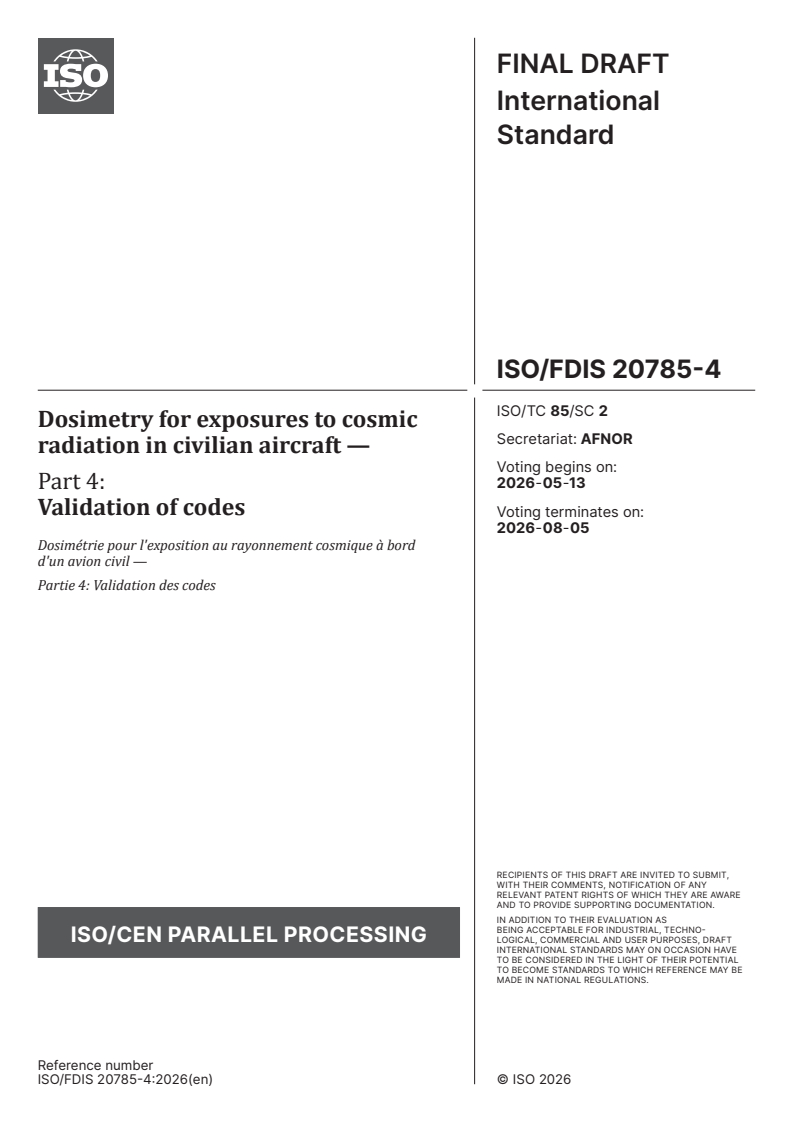
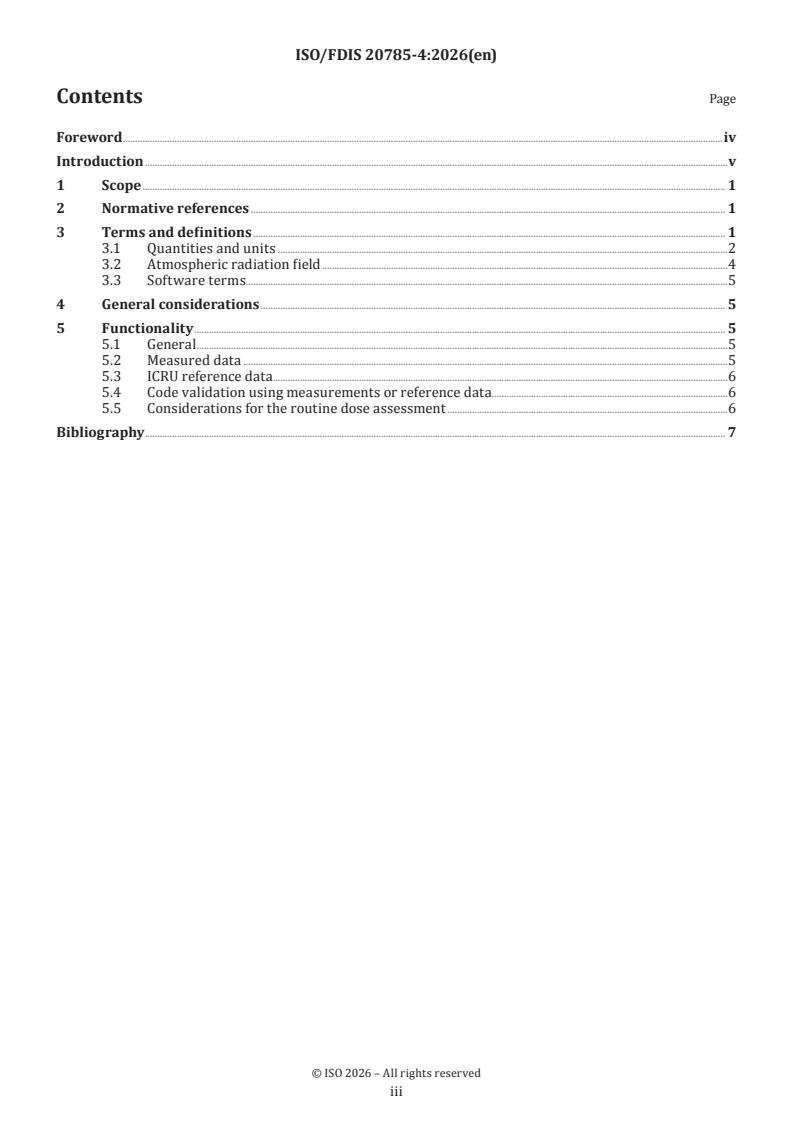
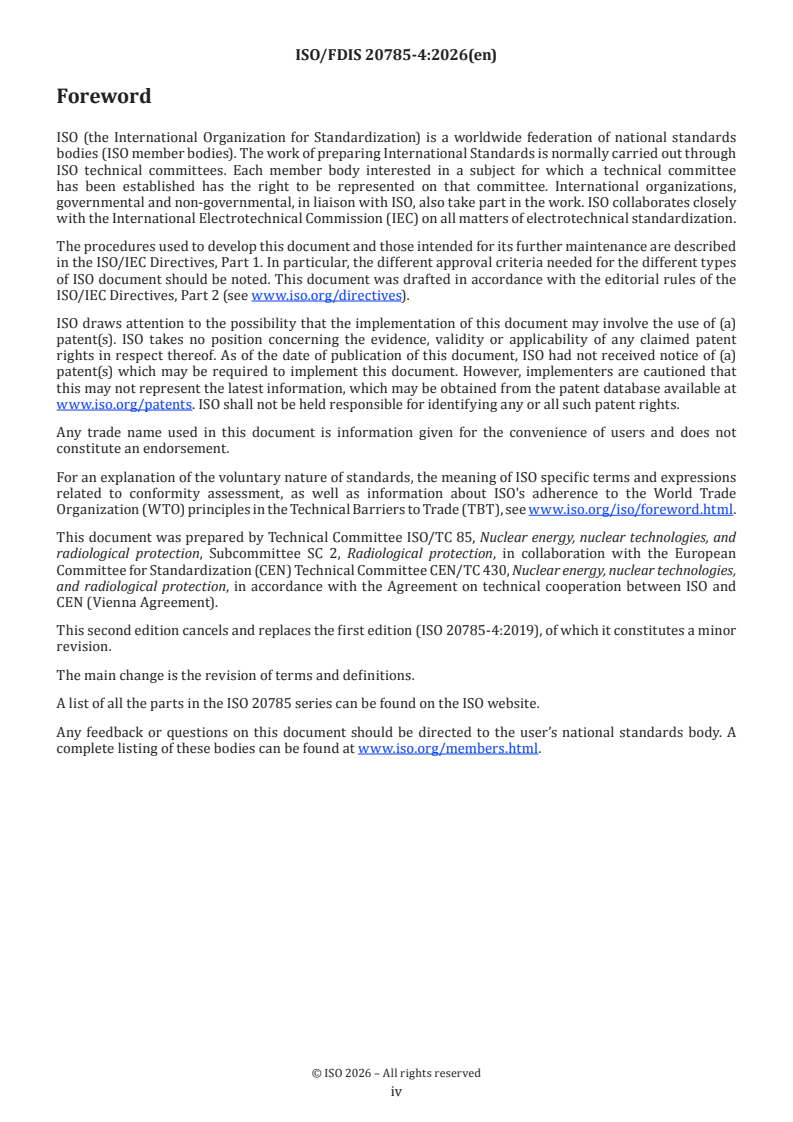
ISO/FDIS 20785-4 - Dosimetry for exposures to cosmic radiation in civilian aircraft — Part 4: Validation of codes
REDLINE ISO/FDIS 20785-4 - Dosimetry for exposures to cosmic radiation in civilian aircraft — Part 4: Validation of codes
ISO/FDIS 20785-4 - Dosimétrie pour les expositions au rayonnement cosmique à bord d'un avion civil — Partie 4: Validation des codes
Relations
- Effective Date
- 12-Feb-2026
- Effective Date
- 07-Jun-2025
- Effective Date
- 17-May-2025
Overview
ISO/FDIS 20785-4:2026, Dosimetry for exposures to cosmic radiation in civilian aircraft - Part 4: Validation of codes, is an international standard developed by ISO/TC 85/SC 2 that provides essential guidance for the validation of software codes used to calculate the doses of cosmic radiation that individuals receive onboard civilian aircraft. This standard offers a framework for radiation protection authorities and code developers to ensure that dosimetry software meets functional and regulatory requirements. It is particularly relevant for the assessment and management of occupational exposure among aircrew, aligning with global safety standards and best practices.
Key Topics
- Scope of Validation: ISO/FDIS 20785-4 addresses the validation procedures for codes that assess individual doses from cosmic radiation during civil aviation flights, including both direct calculation and benchmarking against measured or reference data.
- Functional Requirements: The standard outlines basic software requirements, including reliability, plausibility checks, data security, and traceability, to ensure accurate and consistent radiation dose calculations.
- Terms and Definitions: It clarifies key dosimetry terms such as absorbed dose, effective dose, ambient dose equivalent, and operational quantities in accordance with ISO 80000-10.
- Code Validation Methods: Guidance is provided on validating dose calculation codes by comparing predicted results against experimental or authoritative reference data (such as ICRU Report 84) from various representative flight routes and altitudes.
- Routine Assessment Practices: Emphasizes the importance of regular comparison flights and continuous validation to maintain accuracy of dose assessments in ongoing use.
- Measurement Consistency: Details consistent use of measurement protocols, especially for neutron spectra, which contribute significantly to ambient dose equivalent at aviation altitudes.
Applications
- Aviation Safety and Regulatory Compliance: Helps airlines, regulators, and radiation protection authorities meet legal and regulatory obligations related to occupational exposure to cosmic radiation, as mandated by national and international guidelines (e.g., EU Basic Safety Standards).
- Software Development and Testing: Offers practical criteria for developers building or improving radiation dose calculation codes, ensuring their software is suitable for formal approval and operational use.
- Radiation Monitoring and Risk Assessment: Supports the accurate evaluation of ionizing radiation risks for aircrew and passengers, essential for optimizing flight schedules, informing risk communication, and implementing special protection measures (such as for pregnancy).
- Operational Dose Estimation: Facilitates direct calculation of effective dose rates as a function of flight parameters (altitude, latitude, solar cycle phase), supporting retrospective and prospective dose assessments using validated software tools.
- Benchmarking and Quality Assurance: Enables comparison and harmonization of different dosimetry codes by providing standardized validation procedures, fostering data consistency across the aviation industry.
Related Standards
- ISO 20785-1:2020: Dosimetry for exposures to cosmic radiation in civilian aircraft - Conceptual basis for measurements
- ISO 20785-2:2020: Dosimetry for exposures to cosmic radiation in civilian aircraft - Characterization of instrument response
- ISO 20785-3:2023: Dosimetry for exposures to cosmic radiation in civilian aircraft - Measurements at aviation altitudes
- ISO 80000-10:2019/Amd 1:2025: Quantities and units - Atomic and nuclear physics
- ICRU Report 84: Reference data for the validation of doses from cosmic radiation exposure
- ISO/IEC/IEEE 29119: Software and systems engineering - Software testing
By leveraging ISO/FDIS 20785-4, organizations can enhance the reliability and accuracy of radiation dose assessment for aircrew, support regulatory compliance, and improve overall radiological protection in civil aviation. This standard is an essential reference for anyone involved in the development, deployment, or assessment of cosmic radiation dosimetry solutions in the aviation sector.
Buy Documents
ISO/FDIS 20785-4 - Dosimetry for exposures to cosmic radiation in civilian aircraft — Part 4: Validation of codes
REDLINE ISO/FDIS 20785-4 - Dosimetry for exposures to cosmic radiation in civilian aircraft — Part 4: Validation of codes
ISO/FDIS 20785-4 - Dosimétrie pour les expositions au rayonnement cosmique à bord d'un avion civil — Partie 4: Validation des codes
Get Certified
Connect with accredited certification bodies for this standard

BSI Group
BSI (British Standards Institution) is the business standards company that helps organizations make excellence a habit.

Bureau Veritas
Bureau Veritas is a world leader in laboratory testing, inspection and certification services.

DNV
DNV is an independent assurance and risk management provider.
Sponsored listings
Frequently Asked Questions
ISO/FDIS 20785-4 is a draft published by the International Organization for Standardization (ISO). Its full title is "Dosimetry for exposures to cosmic radiation in civilian aircraft — Part 4: Validation of codes". This standard covers: This document is intended for the validation of codes used for the calculation of doses received by individuals on board aircraft. It gives guidance to radiation protection authorities and code developers on the basic functional requirements which the code fulfils. Depending on any formal approval by a radiation protection authority, additional requirements concerning the software testing can apply.
This document is intended for the validation of codes used for the calculation of doses received by individuals on board aircraft. It gives guidance to radiation protection authorities and code developers on the basic functional requirements which the code fulfils. Depending on any formal approval by a radiation protection authority, additional requirements concerning the software testing can apply.
ISO/FDIS 20785-4 is classified under the following ICS (International Classification for Standards) categories: 13.280 - Radiation protection; 49.020 - Aircraft and space vehicles in general. The ICS classification helps identify the subject area and facilitates finding related standards.
ISO/FDIS 20785-4 has the following relationships with other standards: It is inter standard links to prEN ISO 20785-4, ISO/TR 6057:2023, ISO 20785-4:2019. Understanding these relationships helps ensure you are using the most current and applicable version of the standard.
ISO/FDIS 20785-4 is available in PDF format for immediate download after purchase. The document can be added to your cart and obtained through the secure checkout process. Digital delivery ensures instant access to the complete standard document.
Standards Content (Sample)
FINAL DRAFT
International
Standard
ISO/TC 85/SC 2
Dosimetry for exposures to cosmic
Secretariat: AFNOR
radiation in civilian aircraft —
Voting begins on:
2026-05-13
Part 4:
Validation of codes
Voting terminates on:
2026-08-05
Dosimétrie pour l'exposition au rayonnement cosmique à bord
d'un avion civil —
Partie 4: Validation des codes
RECIPIENTS OF THIS DRAFT ARE INVITED TO SUBMIT,
WITH THEIR COMMENTS, NOTIFICATION OF ANY
RELEVANT PATENT RIGHTS OF WHICH THEY ARE AWARE
AND TO PROVIDE SUPPOR TING DOCUMENTATION.
IN ADDITION TO THEIR EVALUATION AS
BEING ACCEPTABLE FOR INDUSTRIAL, TECHNO-
ISO/CEN PARALLEL PROCESSING LOGICAL, COMMERCIAL AND USER PURPOSES, DRAFT
INTERNATIONAL STANDARDS MAY ON OCCASION HAVE
TO BE CONSIDERED IN THE LIGHT OF THEIR POTENTIAL
TO BECOME STAN DARDS TO WHICH REFERENCE MAY BE
MADE IN NATIONAL REGULATIONS.
Reference number
FINAL DRAFT
International
Standard
ISO/TC 85/SC 2
Dosimetry for exposures to cosmic
Secretariat: AFNOR
radiation in civilian aircraft —
Voting begins on:
Part 4:
Validation of codes
Voting terminates on:
Dosimétrie pour l'exposition au rayonnement cosmique à bord
d'un avion civil —
Partie 4: Validation des codes
RECIPIENTS OF THIS DRAFT ARE INVITED TO SUBMIT,
WITH THEIR COMMENTS, NOTIFICATION OF ANY
RELEVANT PATENT RIGHTS OF WHICH THEY ARE AWARE
AND TO PROVIDE SUPPOR TING DOCUMENTATION.
© ISO 2026
IN ADDITION TO THEIR EVALUATION AS
All rights reserved. Unless otherwise specified, or required in the context of its implementation, no part of this publication may
BEING ACCEPTABLE FOR INDUSTRIAL, TECHNO-
ISO/CEN PARALLEL PROCESSING
LOGICAL, COMMERCIAL AND USER PURPOSES, DRAFT
be reproduced or utilized otherwise in any form or by any means, electronic or mechanical, including photocopying, or posting on
INTERNATIONAL STANDARDS MAY ON OCCASION HAVE
the internet or an intranet, without prior written permission. Permission can be requested from either ISO at the address below
TO BE CONSIDERED IN THE LIGHT OF THEIR POTENTIAL
or ISO’s member body in the country of the requester.
TO BECOME STAN DARDS TO WHICH REFERENCE MAY BE
MADE IN NATIONAL REGULATIONS.
ISO copyright office
CP 401 • Ch. de Blandonnet 8
CH-1214 Vernier, Geneva
Phone: +41 22 749 01 11
Email: copyright@iso.org
Website: www.iso.org
Published in Switzerland Reference number
ii
Contents Page
Foreword .iv
Introduction .v
1 Scope . 1
2 Normative references . 1
3 Terms and definitions . 1
3.1 Quantities and units .2
3.2 Atmospheric radiation field .4
3.3 Software terms.5
4 General considerations . 5
5 Functionality . 5
5.1 General .5
5.2 Measured data .5
5.3 ICRU reference data.6
5.4 Code validation using measurements or reference data.6
5.5 Considerations for the routine dose assessment .6
Bibliography . 7
iii
Foreword
ISO (the International Organization for Standardization) is a worldwide federation of national standards
bodies (ISO member bodies). The work of preparing International Standards is normally carried out through
ISO technical committees. Each member body interested in a subject for which a technical committee
has been established has the right to be represented on that committee. International organizations,
governmental and non-governmental, in liaison with ISO, also take part in the work. ISO collaborates closely
with the International Electrotechnical Commission (IEC) on all matters of electrotechnical standardization.
The procedures used to develop this document and those intended for its further maintenance are described
in the ISO/IEC Directives, Part 1. In particular, the different approval criteria needed for the different types
of ISO document should be noted. This document was drafted in accordance with the editorial rules of the
ISO/IEC Directives, Part 2 (see www.iso.org/directives).
ISO draws attention to the possibility that the implementation of this document may involve the use of (a)
patent(s). ISO takes no position concerning the evidence, validity or applicability of any claimed patent
rights in respect thereof. As of the date of publication of this document, ISO had not received notice of (a)
patent(s) which may be required to implement this document. However, implementers are cautioned that
this may not represent the latest information, which may be obtained from the patent database available at
www.iso.org/patents. ISO shall not be held responsible for identifying any or all such patent rights.
Any trade name used in this document is information given for the convenience of users and does not
constitute an endorsement.
For an explanation of the voluntary nature of standards, the meaning of ISO specific terms and expressions
related to conformity assessment, as well as information about ISO's adherence to the World Trade
Organization (WTO) principles in the Technical Barriers to Trade (TBT), see www.iso.org/iso/foreword.html.
This document was prepared by Technical Committee ISO/TC 85, Nuclear energy, nuclear technologies, and
radiological protection, Subcommittee SC 2, Radiological protection, in collaboration with the European
Committee for Standardization (CEN) Technical Committee CEN/TC 430, Nuclear energy, nuclear technologies,
and radiological protection, in accordance with the Agreement on technical cooperation between ISO and
CEN (Vienna Agreement).
This second edition cancels and replaces the first edition (ISO 20785-4:2019), of which it constitutes a minor
revision.
The main change is the revision of terms and definitions.
A list of all the parts in the ISO 20785 series can be found on the ISO website.
Any feedback or questions on this document should be directed to the user’s national standards body. A
complete listing of these bodies can be found at www.iso.org/members.html.
iv
Introduction
Aircraft crews are exposed to elevated levels of cosmic radiation of galactic and solar origin and secondary
radiation produced in the atmosphere, the aircraft structure and its contents. Following recommendations
[1]
of the International Commission on Radiological Protection (ICRP) in Publication 60 , the European Union
[2]
(EU) introduced a Basic Safety Standards Directive (BSS) which included exposure to natural sources of
ionizing radiation, including cosmic radiation, as occupational exposure for aircrew. International guidance
[3]
was also provided by the IAEA Safety Standards Series . This action was confirmed by ICRP Publications
[4] [5] [6]
103 and 132 , and the BSS was revised by EU.
[1] [4]
ICRP has defined the exposure to cosmic radiation as an existing exposure situation, because the source
exists before protection decisions can be made. In addition, exposure of aircraft crew to cosmic radiation is
[5]
occupational, and thus employers have a role to play in protection, even if options are limited in this case .
There is no contradiction in this, as occupational exposures can occur in existing exposure situations, and
this does not imply that protection measure cannot be planned.
The EU Directive requires account to be taken of the exposure of aircraft crew liable to receive more than
1 mSv per year. It then identifies the following four protection measures:
a) to assess the exposure of the crew concerned;
b) to take into account the assessed exposure when organising working schedules with a view to reducing
the doses of highly exposed crew;
c) to inform workers concerned with the health effects involved in their work;
d) to apply the same special protection during pregnancy to female crew in respect of the ‘child to be born’
as to other female workers.
The EU Council Directive should be incorporated into laws and regulations of EU Member States and would
be included in the aviation safety standards and procedures of the European Air Safety Agency. Other
[7] [8]
countries, such as Canada and Japan , have issued advisories to their airline industries to manage aircraft
crew exposure.
For regulatory and legislative purposes, the radiation protection quantities of interest are dose to the fetus
and effective dose . The cosmic radiation exposure of the body is essentially uniform and the maternal
abdomen provides no effective shielding to the fetus. As a result, the magnitude of equivalent dose to the
fetus can be put equal to that of the effective dose received by the mother. Doses on board aircraft are
generally predictable, and events comparable to unplanned exposure in other radiological workplaces
cannot normally occur (with the rare exceptions of extremely intense and energetic solar particle events).
Personal dosimeters for routine use are thus not needed nor practical, The preferred approach for the
assessment of doses of aircraft crew, where necessary, is to calculate directly the effective dose rate, as
a function of geographic location, altitude and solar cycle phase, and to fold these values with flight and
staff roster information to obtain estimates of effective doses for individuals. This approach is supported by
[9] [5] [10]
guidance from the ICRP in Publication 75 and Publication 132 , and the ICRU in Report 84 .
The role of calculations in this procedure is unique in routine radiation protection and it is widely accepted
that the calculated doses should be validated by measurement. Effective dose is not directly measurable.
The operational quantity of interest is ambient dose equivalent, H*(10). Indeed, as indicated in particular
in ICRU Report 84, the ambient dose equivalent is considered to be a conservative estimator of effective
dose if isotropic irradiation can be assumed. The operational quantity ambient dose equivalent is a good
estimator of effective dose and equivalent dose to the fetus for the radiation fields being considered, in the
same way that the use of the operational quantity personal dose equivalent is justified for the estimation of
effective dose for radiation workers. In order to validate the assessed doses obtained in terms of effective
dose, calculations can be made of ambient dose equivalent rates or route doses in terms of ambient dose
equivalent, and the results can be compared to measurements traceable to national standards. The
validation of calculations of ambient dose equivalent for a particular calculation method may be taken as a
validation of the calculation of effective dose by the same code. The alternative is to establish, a priori, that
the operational quantity ambient dose equivalent is a good estimator of effective dose and equivalent dose
v
to the fetus for the radiation fields being considered, in the same way that the use of the operational quantity
personal dose equivalent is justified for the estimation of effective dose for radiation workers.
The route dose is the best estimate of ambient dose equivalent for the actual route recorded for the aircrew.
However, the actual route flown for that specific flight may vary due to weather, scheduling, etc.
It should be noted that this document addresses galactic cosmic radiation (GCR) only. First discovered by
Victor Hess more than 100 years ago, GCR is a well understood and permanent source of ionizing radiation
both on Earth and in flight. GCR can be modelled with reasonable precision and accuracy. It should be
recognized that there are other sources of radiation that are intermittent. These sources cannot currently
be modelled prior to their occurrence, and are not a subject of this document. These sources include solar
proton events (often called solar particle events), solar neutron events, solar gamma events, solar magnetic
storms that alter the magnetic shielding and terrestrial gamma flashes which are associated with some
lightning. Exposures can also occur from shipments of radioactive material and also from any medical
procedures required as a condition of employment for aircrew. These intermittent sources can produce
radiation exposures that exceed limits for both aircrew and members of the public.
In order to adequately address the total radiation exposure for occupational workers and for members of the
public who fly, radiation exposure to intermittent sources needs to be addressed after an event occurs with
either radiation monitoring or with modelling.
vi
FINAL DRAFT International Standard ISO/FDIS 20785-4:2026(en)
Dosimetry for exposures to cosmic radiation in civilian
aircraft —
Part 4:
Validation of codes
1 Scope
This document is intended for the validation of codes used for the calculation of doses received by individuals
on board aircraft. It gives guidance to radiation protection authorities and code developers on the basic
functional requirements which the code fulfils.
Depending on any formal approval by a radiation protection authority, additional requirements concerning
the software testing can apply.
2 Normative references
The following documents are referre
...
ISO/TC 85/SC 2
Secretariat: AFNOR
Date: 2026-04-07xx
Dosimetry for exposures to cosmic radiation in civilian aircraft —
Part 4:
Validation of codes
Dosimétrie pour l'exposition au rayonnement cosmique à bord d'un avion civil —
Partie 4: Validation des codes
FDIS stage
TTTTTTTThhhhhhhhiiiiiiiis drs drs drs drs drs drs drs draaaaaaaafffffffftttttttt i i i i i i i is s s s s s s s susususususususubbbbbbbbmmmmmmmmiiiiiiiitttttttttttttttteeeeeeeed d d d d d d d ttttttttoooooooo aaaaaaaa ppppppppaaaaaaaarrrrrrrraaaaaaaallellellellellellellellel l l l l l l l vvvvvvvvooooooootttttttteeeeeeee i i i i i i i innnnnnnn IIIIIIIISSSSSSSSOOOOOOOO,,,,,,,, CCCCCCCCEEEEEEEEN.N.N.N.N.N.N.N.
All rights reserved. Unless otherwise specified, or required in the context of its implementation, no part of this publication
may be reproduced or utilized otherwise in any form or by any means, electronic or mechanical, including photocopying,
or posting on the internet or an intranet, without prior written permission. Permission can be requested from either ISO
at the address below or ISO’s member body in the country of the requester.
ISO copyright office
CP 401 • Ch. de Blandonnet 8
CH-1214 Vernier, Geneva
Phone: + 41 22 749 01 11
E-mail: copyright@iso.org
Website: www.iso.org
Published in Switzerland
ii
Contents
Foreword . iv
Introduction . v
1 Scope . 1
2 Normative references . 1
3 Terms and definitions . 1
3.1 Quantities and units . 1
3.2 Atmospheric radiation field . 4
3.3 Software terms . 5
4 General considerations . 5
5 Functionality . 5
5.1 General . 5
5.2 Measured data . 5
5.3 ICRU reference data . 5
5.4 Code validation using measurements or reference data . 6
5.5 Considerations for the routine dose assessment . 6
Bibliography . 7
iii
Foreword
ISO (the International Organization for Standardization) is a worldwide federation of national standards
bodies (ISO member bodies). The work of preparing International Standards is normally carried out through
ISO technical committees. Each member body interested in a subject for which a technical committee has been
established has the right to be represented on that committee. International organizations, governmental and
non-governmental, in liaison with ISO, also take part in the work. ISO collaborates closely with the
International Electrotechnical Commission (IEC) on all matters of electrotechnical standardization.
The procedures used to develop this document and those intended for its further maintenance are described
in the ISO/IEC Directives, Part 1. In particular, the different approval criteria needed for the different types of
ISO documentsdocument should be noted. This document was drafted in accordance with the editorial rules
of the ISO/IEC Directives, Part 2 (see www.iso.org/directives).
Attention is drawnISO draws attention to the possibility that some of the elementsimplementation of this
document may beinvolve the subjectuse of (a) patent(s). ISO takes no position concerning the evidence,
validity or applicability of any claimed patent rights in respect thereof. As of the date of publication of this
document, ISO had not received notice of (a) patent(s) which may be required to implement this document.
However, implementers are cautioned that this may not represent the latest information, which may be
obtained from the patent database available at www.iso.org/patents. ISO shall not be held responsible for
identifying any or all such patent rights. Details of any patent rights identified during the development of the
document will be in the Introduction and/or on the ISO list of patent declarations received (see ).
Any trade name used in this document is information given for the convenience of users and does not
constitute an endorsement.
For an explanation of the voluntary nature of standards, the meaning of ISO specific terms and expressions
related to conformity assessment, as well as information about ISO's adherence to the World Trade
Organization (WTO) principles in the Technical Barriers to Trade (TBT)), see
www.iso.org/iso/foreword.html.
This document was prepared by Technical Committee ISO/TC 85, Nuclear energy, nuclear technologies, and
radiological protection, Subcommittee SC 2, Radiological protection., in collaboration with the European
Committee for Standardization (CEN) Technical Committee CEN/TC 430, Nuclear energy, nuclear technologies,
and radiological protection, in accordance with the Agreement on technical cooperation between ISO and CEN
(Vienna Agreement).
This second edition cancels and replaces the first edition (ISO 20785-4:2019), of which has been technically
revisedit constitutes a minor revision.
The main changes are aschange is the revision of the terms and definitions.
A list of all the parts in the ISO 20785 series can be found on the ISO website.
Any feedback or questions on this document should be directed to the user’s national standards body. A
complete listing of these bodies can be found at www.iso.org/members.html.
iv
Introduction
Aircraft crews are exposed to elevated levels of cosmic radiation of galactic and solar origin and secondary
radiation produced in the atmosphere, the aircraft structure and its contents. Following recommendations of
[1]
the International Commission on Radiological Protection (ICRP) in Publication 60 , the European Union (EU)
[2]
introduced a Basic Safety Standards Directive (BSS) which included exposure to natural sources of ionizing
radiation, including cosmic radiation, as occupational exposure for aircrew. International guidance was also
[3] [4]
provided by the IAEA Safety Standards Series . This action was confirmed by ICRP Publications 103 and
[5] [6]
132 , and the BSS was revised by EU.
[1][4]
ICRP has defined the exposure to cosmic radiation as an existing exposure situation, because the source
exists before protection decisions can be made. In addition, exposure of aircraft crew to cosmic radiation is
[5]
occupational, and thus employers have a role to play in protection, even if options are limited in this case .
There is no contradiction in this, as occupational exposures can occur in existing exposure situations, and this
does not imply that protection measure cannot be planned.
The EU Directive requires account to be taken of the exposure of aircraft crew liable to receive more than
1 mSv per year. It then identifies the following four protection measures:
a) to assess the exposure of the crew concerned;
b) to take into account the assessed exposure when organising working schedules with a view to reducing
the doses of highly exposed crew;
c) to inform workers concerned with the health effects involved in their work; and
d) to apply the same special protection during pregnancy to female crew in respect of the ‘child to be born’
as to other female workers.
The EU Council Directive should be incorporated into laws and regulations of EU Member States and would
be included in the aviation safety standards and procedures of the European Air Safety Agency. Other
[7] [8]
countries, such as Canada and Japan , have issued advisories to their airline industries to manage aircraft
crew exposure.
For regulatory and legislative purposes, the radiation protection quantities of interest are dose to the fetus
and effective dose . The cosmic radiation exposure of the body is essentially uniform and the maternal
abdomen provides no effective shielding to the fetus. As a result, the magnitude of equivalent dose to the fetus
can be put equal to that of the effective dose received by the mother. Doses on board aircraft are generally
predictable, and events comparable to unplanned exposure in other radiological workplaces cannot normally
occur (with the rare exceptions of extremely intense and energetic solar particle events). Personal dosimeters
for routine use are thus not needed nor practical, The preferred approach for the assessment of doses of
aircraft crew, where necessary, is to calculate directly the effective dose rate, as a function of geographic
location, altitude and solar cycle phase, and to fold these values with flight and staff roster information to
obtain estimates of effective doses for individuals. This approach is supported by guidance from the ICRP in
[9] [5] [10]
Publication 75 and Publication 132 , and the ICRU in Report 84 .
The role of calculations in this procedure is unique in routine radiation protection and it is widely accepted
that the calculated doses should be validated by measurement. Effective dose is not directly measurable. The
operational quantity of interest is ambient dose equivalent , H*(10). Indeed, as indicated in particular in ICRU
Report 84, the ambient dose equivalent is considered to be a conservative estimator of effective dose if
isotropic irradiation can be assumed. The operational quantity ambient dose equivalent is a good estimator of
effective dose and equivalent dose to the fetus for the radiation fields being considered, in the same way that
the use of the operational quantity personal dose equivalent is justified for the estimation of effective dose for
radiation workers. In order to validate the assessed doses obtained in terms of effective dose, calculations can
v
be made of ambient dose equivalent rates or route doses in terms of ambient dose equivalent, and the results
can be compared to measurements traceable to national standards. The validation of calculations of ambient
dose equivalent for a particular calculation method may be taken as a validation of the calculation of effective
dose by the same code. The alternative is to establish, a priori, that the operational quantity ambient dose
equivalent is a good estimator of effective dose and equivalent dose to the fetus for the radiation fields being
considered, in the same way that the use of the operational quantity personal dose equivalent is justified for
the estimation of effective dose for radiation workers.
The route dose is the best estimate of ambient dose equivalent for the actual route recorded for the aircrew.
However, the actual route flown for that specific flight may vary due to weather, scheduling, etc.
It should be noted that this document addresses galactic cosmic radiation (GCR) only. First discovered by
Victor Hess more than 100 years ago, GCR is a well understood and permanent source of ionizing radiation
both on Earth and in flight. GCR can be modelled with reasonable precision and accuracy. It should be
recognized that there are other sources of radiation that are intermittent. These sources cannot currently be
modelled prior to their occurrence, and are not a subject of this document. These sources include solar proton
events (often called solar particle events), solar neutron events, solar gamma events, solar magnetic storms
that alter the magnetic shielding and terrestrial gamma flashes which are associated with some lightning.
Exposures can also occur from shipments of radioactive material and also from any medical procedures
required as a condition of employment for aircrew. These intermittent sources can produce radiation
exposures that exceed limits for both aircrew and members of the public.
In order to adequately address the total radiation exposure for occupational workers and for members of the
public who fly, radiation exposure to intermittent sources needs to be addressed after an event occurs with
either radiation monitoring or with modelling.
vi
Dosimetry for exposures to cosmic radiation in civilian aircraft —
Part 4:
Validation of codes
1 Scope
This document is intended for the validation of codes used for the calculation of doses received by individuals
on board aircraft. It gives guidance to radiation protection authorities and code developers on the basic
functional requirements which the code fulfils.
Depending on any formal approval by a radiation protection authority, additional requirements concerning
the software testing can apply.
2 Normative references
The following documents are referred to in the text in such a way that some or all of their content constitutes
requirements of this document. For dated references, only the edition cited applies. For undated references,
the latest edition of the referenced document (including any amendments) applies.
ISO 20785-1:2020, Dosimetry for exposures to cosmic radiation in civilian aircraft — Part 1: Conceptual basis
for measurements
ISO 20785-2:2020, Dosimetry for exposures to cosmic radiation in civilian aircraft — Part 2: Characterization
of instrument response
ISO 20785-3:2023, Dosimetry for exposures to cosmic radiation in civilian aircraft — Part 3: Measurements at
aviation altitudes
ISO 80000-10:2019/Amd 1:2025, Quantities and units — Part 10: Atomic and nuclear physics — Amendment 1
3 Terms and definitions
For the purposes of this document, the terms and definitions given in ISO 80000-10:2019/Amd 1:2025 for
consistent uses of quantities and units and the following apply.
ISO and IEC maintain terminologicalterminology d
...
PROJET FINAL
Norme
internationale
ISO/TC 85/SC 2
Dosimétrie pour les expositions au
Secrétariat: AFNOR
rayonnement cosmique à bord d'un
Début de vote:
avion civil —
2026-05-13
Partie 4:
Vote clos le:
2026-08-05
Validation des codes
Dosimetry for exposures to cosmic radiation in civilian aircraft —
Part 4: Validation of codes
LES DESTINATAIRES DU PRÉSENT PROJET SONT
INVITÉS À PRÉSENTER, AVEC LEURS OBSERVATIONS,
NOTIFICATION DES DROITS DE PROPRIÉTÉ DONT ILS
AURAIENT ÉVENTUELLEMENT CONNAISSANCE ET À
FOURNIR UNE DOCUMENTATION EXPLICATIVE.
OUTRE LE FAIT D’ÊTRE EXAMINÉS POUR
ÉTABLIR S’ILS SONT ACCEPTABLES À DES FINS
INDUSTRIELLES, TECHNOLOGIQUES ET COM-MERCIALES,
AINSI QUE DU POINT DE VUE DES UTILISATEURS, LES
PROJETS DE NORMES
TRAITEMENT PARALLÈLE ISO/CEN
INTERNATIONALES DOIVENT PARFOIS ÊTRE CONSIDÉRÉS
DU POINT DE VUE DE LEUR POSSI BILITÉ DE DEVENIR DES
NORMES POUVANT
SERVIR DE RÉFÉRENCE DANS LA RÉGLEMENTATION
NATIONALE.
Numéro de référence
PROJET FINAL
Norme
internationale
ISO/TC 85/SC 2
Dosimétrie pour les expositions au
Secrétariat: AFNOR
rayonnement cosmique à bord d'un
Début de vote:
avion civil —
2026-05-13
Partie 4:
Vote clos le:
2026-08-05
Validation des codes
Dosimetry for exposures to cosmic radiation in civilian aircraft —
Part 4: Validation of codes
LES DESTINATAIRES DU PRÉSENT PROJET SONT
INVITÉS À PRÉSENTER, AVEC LEURS OBSERVATIONS,
NOTIFICATION DES DROITS DE PROPRIÉTÉ DONT ILS
AURAIENT ÉVENTUELLEMENT CONNAISSANCE ET À
FOURNIR UNE DOCUMENTATION EXPLICATIVE.
DOCUMENT PROTÉGÉ PAR COPYRIGHT
OUTRE LE FAIT D’ÊTRE EXAMINÉS POUR
ÉTABLIR S’ILS SONT ACCEPTABLES À DES FINS
© ISO 2026 INDUSTRIELLES, TECHNOLOGIQUES ET COM-MERCIALES,
AINSI QUE DU POINT DE VUE DES UTILISATEURS, LES
Tous droits réservés. Sauf prescription différente ou nécessité dans le contexte de sa mise en œuvre, aucune partie de cette
PROJETS DE NORMES
TRAITEMENT PARALLÈLE ISO/CEN
INTERNATIONALES DOIVENT PARFOIS ÊTRE CONSIDÉRÉS
publication ne peut être reproduite ni utilisée sous quelque forme que ce soit et par aucun procédé, électronique ou mécanique,
DU POINT DE VUE DE LEUR POSSI BILITÉ DE DEVENIR DES
y compris la photocopie, ou la diffusion sur l’internet ou sur un intranet, sans autorisation écrite préalable. Une autorisation peut
NORMES POUVANT
être demandée à l’ISO à l’adresse ci-après ou au comité membre de l’ISO dans le pays du demandeur.
SERVIR DE RÉFÉRENCE DANS LA RÉGLEMENTATION
NATIONALE.
ISO copyright office
Case postale 401 • Ch. de Blandonnet 8
CH-1214 Vernier, Genève
Tél.: +41 22 749 01 11
E-mail: copyright@iso.org
Web: www.iso.org
Publié en Suisse Numéro de référence
ii
Sommaire Page
Avant-propos .iv
Introduction .v
1 Domaine d’application . 1
2 Références normatives . 1
3 Termes et définitions . 1
3.1 Grandeurs et unités .2
3.2 Champ de rayonnement atmosphérique .4
3.3 Termes logiciels .5
4 Considérations générales . 5
5 Fonctionnalité . 5
5.1 Généralités .5
5.2 Données mesurées .6
5.3 Données de référence de l’ICRU .6
5.4 Validation du code à l’aide de mesurages ou de données de référence .6
5.5 Facteurs à considérer pour l’évaluation des doses en routine .6
Bibliographie . 8
iii
Avant-propos
L’ISO (Organisation internationale de normalisation) est une fédération mondiale d’organismes nationaux
de normalisation (comités membres de l’ISO). L’élaboration des Normes internationales est en général
confiée aux comités techniques de l’ISO. Chaque comité membre intéressé par une étude a le droit de faire
partie du comité technique créé à cet effet. Les organisations internationales, gouvernementales et non
gouvernementales, en liaison avec l’ISO participent également aux travaux. L’ISO collabore étroitement avec
la Commission électrotechnique internationale (IEC) en ce qui concerne la normalisation électrotechnique.
Les procédures utilisées pour élaborer le présent document et celles destinées à sa mise à jour sont
décrites dans les Directives ISO/IEC, Partie 1. Il convient, en particulier, de prendre note des différents
critères d’approbation requis pour les différents types de documents ISO. Le présent document
a été rédigé conformément aux règles de rédaction données dans les Directives ISO/IEC, Partie 2
(voir www.iso.org/directives).
L’ISO attire l’attention sur le fait que la mise en application du présent document peut entraîner l’utilisation
d’un ou de plusieurs brevets. L’ISO ne prend pas position quant à la preuve, à la validité et à l’applicabilité de
tout droit de brevet revendiqué à cet égard. À la date de publication du présent document, l’ISO n’avait pas
reçu notification qu’un ou plusieurs brevets pouvaient être nécessaires à sa mise en application. Toutefois,
il y a lieu d’avertir les responsables de la mise en application du présent document que des informations
plus récentes sont susceptibles de figurer dans la base de données de brevets, disponible à l’adresse
www.iso.org/brevets. L’ISO ne saurait être tenue pour responsable de ne pas avoir identifié tout ou partie de
tels droits de brevet.
Les appellations commerciales éventuellement mentionnées dans le présent document sont données pour
information, par souci de commodité, à l’intention des utilisateurs et ne sauraient constituer un engagement.
Pour une explication de la nature volontaire des normes, la signification des termes et expressions
spécifiques de l’ISO liés à l’évaluation de la conformité, ou pour toute information au sujet de l’adhésion de
l’ISO aux principes de l’Organisation mondiale du commerce (OMC) concernant les obstacles techniques au
commerce (OTC), voir www.iso.org/avant-propos.
Le présent document a été élaboré par le comité technique ISO/TC 85, Énergie nucléaire, technologies
nucléaires et protection radiologique, sous-comité SC 2, Protection radiologique, en collaboration avec le
comité technique CEN/TC 430, Énergie nucléaire, technologies nucléaires et protection radiologique, du Comité
européen de normalisation (CEN), conformément à l'Accord de coopération technique entre l'ISO et le CEN
(Accord de Vienne).
Cette deuxième édition annule et remplace la première édition (ISO 20785-4:2019), qui a fait l’objet d’une
révision mineure.
La principale modification est la révision des termes et définitions.
Une liste de toutes les parties de la série ISO 20785 se trouve sur le site web de l’ISO.
Il convient que l’utilisateur adresse tout retour d’information ou toute question concernant le présent
document à l’organisme national de normalisation de son pays. Une liste exhaustive desdits organismes se
trouve à l’adresse www.iso.org/fr/members.html.
iv
Introduction
Le personnel navigant est exposé à des niveaux élevés de rayonnement cosmique d’origine galactique et
solaire, ainsi qu’au rayonnement secondaire produit dans l’atmosphère, dans la structure de l’avion et son
contenu. Suivant les recommandations de la Commission internationale de protection radiologique (CIPR)
[1]
dans la Publication 60, l’Union européenne (UE) a établi une Directive relative aux normes de sécurité
[2]
de base, classant parmi les expositions professionnelles du personnel navigant le cas de l’exposition aux
sources naturelles de rayonnements ionisants, y compris le rayonnement cosmique. Des recommandations
[3]
internationales ont également été fournies dans la série de normes de sécurité de l’IAEA. Cette action a été
[4] [5]
confirmée par les Publications 103 et 132 de la CIPR, et la Directive relative aux normes de sécurité de
[6]
base a fait l’objet d’une révision par l’UE.
[1][4]
La CIPR a défini l'exposition au rayonnement cosmique comme une situation d'exposition existante,
car la source existe avant que des décisions de protection puissent être prises. En outre, l'exposition du
personnel navigant au rayonnement cosmique est d’ordre professionnel et les employeurs ont donc un rôle à
[5]
jouer dans la protection, même si les options sont limitées dans ce cas. Il n'y a aucune contradiction à cet
égard car des expositions professionnelles peuvent survenir dans des situations d'exposition existantes, et
cela n'implique pas l’impossibilité de planifier des mesures de protection.
Cette Directive de l’UE exige de prendre en compte l’exposition du personnel navigant susceptible de recevoir
plus de 1 mSv par an. Elle identifie ensuite les quatre mesures de protection suivantes:
a) évaluation de l’exposition du personnel concerné;
b) prise en compte de l’exposition évaluée lors de l’organisation des programmes de travail, en vue de
réduire les doses du personnel navigant le plus fortement exposé;
c) information aux travailleurs concernés sur les effets de leur travail sur la santé;
d) application des mêmes règles de protection spécifiques en cas de grossesse pour le personnel navigant
féminin, eu égard à “l’enfant à naître”, que pour tout autre travailleur exposé de sexe féminin.
Il convient d’intégrer la Directive du Conseil de l’UE aux lois et réglementations des États membres de l’UE
ainsi que dans les normes et modes opératoires de sécurité de l’aviation de l’Agence européenne pour la
[7] [8]
sécurité aérienne (European Air Safety Agency). D’autres pays tels que le Canada et le Japon ont émis
des règles ou des recommandations à l’attention de leurs compagnies aériennes pour gérer la question de
l’exposition du personnel navigant.
Les grandeurs de protection concernées, dans un cadre réglementaire et législatif, sont la dose au fœtus
et la dose efficace. L’exposition de l’organisme au rayonnement cosmique est globalement uniforme et
l’abdomen maternel ne fournit aucune protection particulière au fœtus. Ainsi, la dose équivalente au fœtus
peut être considérée comme égale à la dose efficace reçue par la mère. Les doses liées à l’exposition à bord
des avions sont généralement prévisibles, et des événements comparables à des expositions non prévues
à d’autres postes de travail sous rayonnement ne peuvent pas habituellement se produire (à l’exception
rare des éruptions solaires extrêmement intenses produisant des particules solaires très énergétiques).
Le recours à des dosimètres individuels pour un usage en routine n’est pas considéré comme nécessaire.
L’approche préférée pour l’évaluation des doses reçues par le personnel navigant, si nécessaire, consiste à
calculer directement le débit de dose efficace, en fonction des coordonnées géographiques, de l’altitude et de
la phase du cycle solaire, et à combiner ces valeurs avec les informations concernant le vol et le tableau de
service du personnel, afin d’obtenir des estimations des doses efficaces pour les individus. Cette approche
[9] [5] [10]
est recommandée par la Publication 75 et la Publication 132 de la CIPR, et le Rapport 84 de l’ICRU.
Le rôle des calculs dans ce mode opératoire est unique par rapport aux méthodes d’évaluation
habituellement utilisées en radioprotection et il est largement admis qu’il convient de valider les doses
calculées par mesurage. La dose efficace n’est pas directement mesurable. La grandeur opérationnelle
utilisée est l’équivalent de dose ambiant, H*(10). En fait, comme l’indique en particulier le Rapport 84 de
l’ICRU, l’équivalent de dose ambiant est considéré comme un estimateur conservatif de la dose efficace si
l’irradiation peut être supposée isotrope. L’équivalent de dose ambiant constitue un bon estimateur de la
dose efficace et de la dose équivalente au fœtus pour les champs de rayonnement considérés, de la même
façon que l’utilisation de l’équivalent de dose individuel est justifiée pour l’estimation de la dose efficace des
v
travailleurs sous rayonnement. Afin de valider les doses évaluées en termes de dose efficace, il est possible
de calculer les débits d’équivalent de dose ambiant ou les doses pendant le vol, en termes d’équivalent de
dose ambiant, et de comparer les résultats à des mesurages traçables à des étalons nationaux. La validation
des calculs de l’équivalent de dose ambiant par une méthode de calcul particulière peut être considérée
comme la validation du calcul de la dose efficace par le même code. La variante consiste à établir, a priori,
que l’équivalent de dose ambiant constitue un bon estimateur de la dose efficace et de la dose équivalente
au fœtus pour les champs de rayonnements considérés, de la même façon que l’utilisation de l’équivalent de
dose individuel est justifiée pour l’estimation de la dose efficace des travailleurs sous rayonnement.
La dose pour une route donnée constitue une bonne estimation de l’équivalent de dose ambiant pour la route
réelle enregistrée pour le personnel navigant. Cependant, la route réelle suivie pour ce vol spécifique peut
varier en raison des conditions météorologiques, de la programmation des vols, etc.
Il convient de noter que le présent document porte uniquement sur le rayonnement cosmique galactique
(GCR). Découvert par Victor Hess il y a plus de 100 ans, le GCR est une source de rayonnements ionisants
permanente et bien comprise, tant sur Terre qu’en vol. Le GCR peut être modélisé avec une précision
et une exactitude raisonnable. Il convient de reconnaître qu’il existe d’autres sources de rayonnement
intermittentes. Comme il est actuellement impossible de modéliser ces sources avant leur apparition, elles
ne seront pas traitées dans le présent document. Ces sources comprennent les événements à protons solaires
(souvent appelés événements à particules solaires), les événements à neutrons solaires, les événements
solaires à rayonnement gamma, les tempêtes magnétiques solaires qui altèrent les blindages magnétiques
et les flashs gamma terrestres qui sont associés à certains éclairs. Des expositions peuvent également
résulter de l’expédition de substances radioactives ainsi que de protocoles médicaux requis préalablement
à l’embauche du personnel navigant. Ces sources intermittentes peuvent engendrer des expositions à des
rayonnements qui dépassent les limites fixées à la fois pour le personnel navigant et les passagers.
Afin de traiter correctement l’exposition aux rayonnements totale des travailleurs et des passagers, il est
nécessaire d’étudier l’exposition à des sources de rayonnement intermittentes après l’occurrence d’un
événement, soit par surveillance du rayonnement soit par modélisation.
vi
PROJET FINAL Norme internationale ISO/FDIS 20785-4:2026(fr)
Dosimétrie pour les expositions au rayonnement cosmique à
bord d'un avion civil —
Partie 4:
Validation des codes
1 Domaine d’application
Le présent document est destiné à la validation des codes utilisés pour calculer les doses reçues par les
individus à bord des avions. Il fournit aux autorités de radioprotection et aux développeurs de codes, des
recommandations concernant les exigences fonctionnelles de base auxquelles le code doit se conformer.
Suivant l’approbation formelle par une autorité de radioprotection, d’autres exigences concernant les essais
logiciels peuvent s’appliquer.
2 Références normatives
Les documents suivants sont cités dans le texte de sorte qu’ils constituent, pour tout ou partie de leur
contenu, des exigences du présent document. Pour les références datées, seule l’édition citée s’applique. Pour
les références non datées, la dernière édition du document de référence s’applique (y compris les éventuels
amendements).
ISO 20785-1:2020, Dosimétrie pour l'exposition au rayonnement cosmi
...