

ISO 18954:2026
(Main)Steel structures — Structural bolting — Test method to determine parameters of bolt tightening procedures
General Information
- Abstract
This document specifies a test method to determine parameters of bolt tightening procedures for pretensioned bolted connections to be used in structural steelwork. The methods to establish bolt tightening procedures given in this document are applicable to pretensioned bolted connections for which no approved tightening parameters exist in national or international standards. For example, in cases where bolting assemblies have to be tightened by turning the head instead of the nut, when conditions deviate from a given harmonized standard for pretensioning of bolting assemblies, or when stainless steel bolting assemblies are to be pretensioned. In these cases, tightening parameters as well as tightening procedures can be determined with the use of the Bolt Tightening Qualification Procedure (BTQP) given in this document.
- Status
- Published
- Publication Date
- 10-May-2026
- Technical Committee
- ISO/TC 167 - Steel and aluminium structures
- Drafting Committee
- ISO/TC 167 - Steel and aluminium structures
- Current Stage
- 6060 - International Standard published
- Start Date
- 11-May-2026
- Due Date
- 29-Aug-2026
- Completion Date
- 11-May-2026
Overview
ISO 18954:2026 sets out a comprehensive test method for determining the parameters of bolt tightening procedures used in pretensioned bolted connections for structural steelwork. This standard is particularly valuable in situations where no approved tightening parameters exist in national or international standards. The method, known as the Bolt Tightening Qualification Procedure (BTQP), is essential for qualifying bolting assemblies and defining secure tightening processes, especially when assemblies must be tightened by unconventional methods, such as turning the bolt head or when unique materials like stainless steel are used.
By following ISO 18954:2026, organizations can ensure the safe, repeatable, and reliable pretensioning of structural bolts, contributing to the integrity and longevity of steel structures. This standard is endorsed by ISO’s Technical Committee for steel and aluminium structures, reflecting international best practices.
Key Topics
- Applicability: Use of the standard for pretensioned bolted connections when existing standards do not cover the bolting configuration, tightening method, or materials, such as assemblies tightened by head rotation or involving stainless steel.
- Bolt Tightening Qualification Procedure (BTQP): A step-by-step process for qualifying bolt tightening parameters for a specific lot, lubricant, and tightening method.
- Testing Requirements:
- Minimum of 20 tightening tests per configuration
- Continuous measurement of pretensioning force, rotation angle, and torque during tests
- Fitness for Purpose Test: Verifies that the required pretension can be reliably achieved and that overtightening is avoided.
- Documentation: Detailed reporting requirements ensuring traceability, repeatability, and compliance, including sample description, test conditions, results, and conclusions.
- Evaluation Criteria: Statistical methods to determine acceptable tightening parameters, ensuring minimum pretension values and preventing overtightening or component failure.
Applications
The methods in ISO 18954:2026 are applied to:
- Bolting Assemblies Without Approved Procedures: When using non-standard or innovative bolting systems in steel structures, or when working with specialized materials like stainless steel.
- Unconventional Tightening Methods: When the assembly requires head-turning rather than nut-turning or when the configuration deviates from harmonized standards.
- Engineering, Quality Assurance, and Manufacturing: Structural engineers, fabricators, and contractors use this standard to validate and document bolting procedures, ensuring construction quality and compliance.
- Projects Requiring Custom Bolt Pretensioning: Critical infrastructure, bridges, and architectural steel constructions with unique design requirements benefit from the flexibility offered by ISO 18954:2026.
Related Standards
For comprehensive bolted structural steelwork, refer to the following related ISO standards:
- ISO 898-1, ISO 898-2, ISO 898-3: Mechanical properties of fasteners made of carbon and alloy steel (bolts, nuts, washers).
- ISO 3506-1, ISO 3506-2, ISO 3506-7: Properties of corrosion-resistant stainless steel fasteners.
- ISO 17607-1: General requirements and definitions for the execution of structural steelwork.
- ISO 17607-6: Steel structures - Bolting.
- ISO 4014, ISO 4017, ISO 4762: Fastener product standards for bolts and screws.
Practical Value
Adopting ISO 18954:2026 ensures:
- Greater reliability and safety for steel structures through validated bolt tightening procedures.
- Clear guidance and traceability for non-standard or innovative assembly applications.
- Enhanced quality assurance and risk mitigation in construction and manufacturing environments.
By integrating this standard into engineering practice, organizations support compliance with international steel structure bolting requirements, resulting in structures that are safe, durable, and engineered to the highest quality.
Get Certified
Connect with accredited certification bodies for this standard

DIBt (Deutsches Institut für Bautechnik)
German Institute for Building Technology.
DIN CERTCO
DIN Group product certification.

Aboma Certification B.V.
Specialized in construction, metal, and transport sectors.
Sponsored listings
Frequently Asked Questions
ISO 18954:2026 is a standard published by the International Organization for Standardization (ISO). Its full title is "Steel structures — Structural bolting — Test method to determine parameters of bolt tightening procedures". This standard covers: This document specifies a test method to determine parameters of bolt tightening procedures for pretensioned bolted connections to be used in structural steelwork. The methods to establish bolt tightening procedures given in this document are applicable to pretensioned bolted connections for which no approved tightening parameters exist in national or international standards. For example, in cases where bolting assemblies have to be tightened by turning the head instead of the nut, when conditions deviate from a given harmonized standard for pretensioning of bolting assemblies, or when stainless steel bolting assemblies are to be pretensioned. In these cases, tightening parameters as well as tightening procedures can be determined with the use of the Bolt Tightening Qualification Procedure (BTQP) given in this document.
This document specifies a test method to determine parameters of bolt tightening procedures for pretensioned bolted connections to be used in structural steelwork. The methods to establish bolt tightening procedures given in this document are applicable to pretensioned bolted connections for which no approved tightening parameters exist in national or international standards. For example, in cases where bolting assemblies have to be tightened by turning the head instead of the nut, when conditions deviate from a given harmonized standard for pretensioning of bolting assemblies, or when stainless steel bolting assemblies are to be pretensioned. In these cases, tightening parameters as well as tightening procedures can be determined with the use of the Bolt Tightening Qualification Procedure (BTQP) given in this document.
ISO 18954:2026 is classified under the following ICS (International Classification for Standards) categories: 91.080.13 - Steel structures. The ICS classification helps identify the subject area and facilitates finding related standards.
ISO 18954:2026 is available in PDF format for immediate download after purchase. The document can be added to your cart and obtained through the secure checkout process. Digital delivery ensures instant access to the complete standard document.
Standards Content (Sample)
International
Standard
ISO 18954
First edition
Steel structures — Structural
2026-05
bolting — Test method to determine
parameters of bolt tightening
procedures
Structures en acier — Boulonnerie de construction métallique —
Méthode d'essai pour déterminer les paramètres des procédures
de serrage des boulons
Reference number
© ISO 2026
All rights reserved. Unless otherwise specified, or required in the context of its implementation, no part of this publication may
be reproduced or utilized otherwise in any form or by any means, electronic or mechanical, including photocopying, or posting on
the internet or an intranet, without prior written permission. Permission can be requested from either ISO at the address below
or ISO’s member body in the country of the requester.
ISO copyright office
CP 401 • Ch. de Blandonnet 8
CH-1214 Vernier, Geneva
Phone: +41 22 749 01 11
Email: copyright@iso.org
Website: www.iso.org
Published in Switzerland
ii
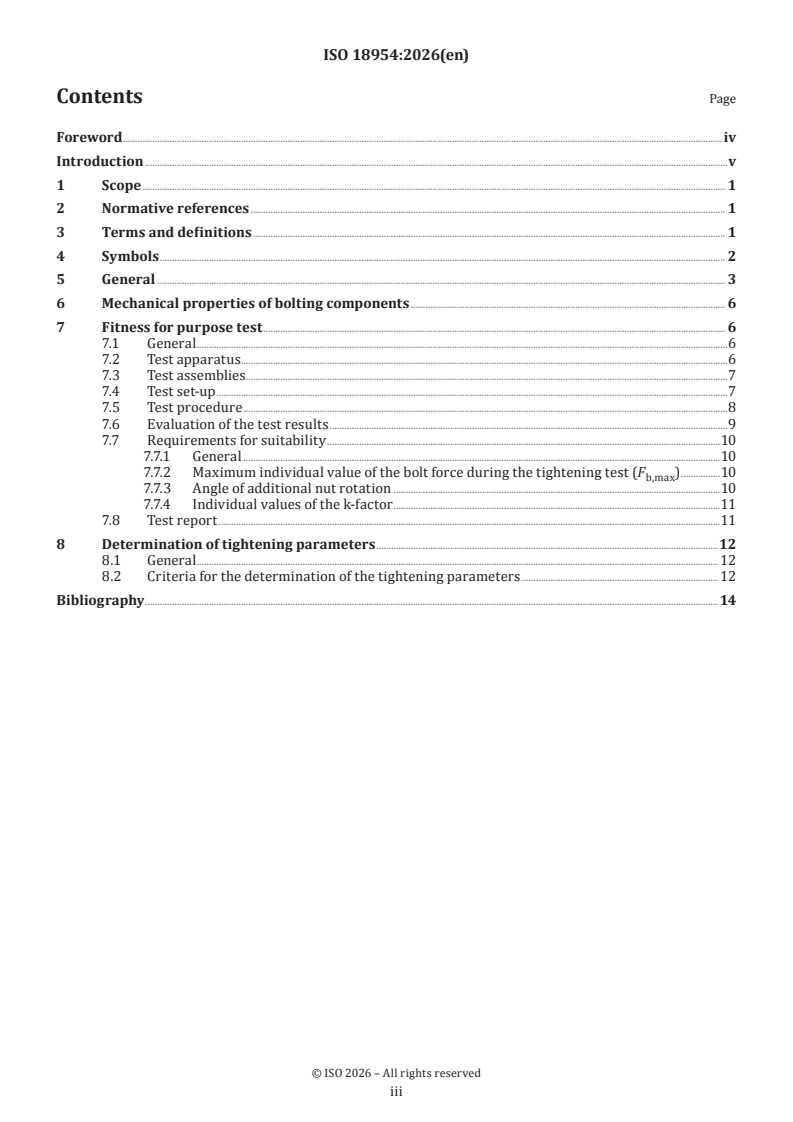
Contents Page
Foreword .iv
Introduction .v
1 Scope . 1
2 Normative references . 1
3 Terms and definitions . 1
4 Symbols . 2
5 General . 3
6 Mechanical properties of bolting components . 6
7 Fitness for purpose test . 6
7.1 General .6
7.2 Test apparatus.6
7.3 Test assemblies .7
7.4 Test set-up .7
7.5 Test procedure .8
7.6 Evaluation of the test results .9
7.7 Requirements for suitability .10
7.7.1 General .10
7.7.2 Maximum individual value of the bolt force during the tightening test (F ) .10
b,max
7.7.3 Angle of additional nut rotation .10
7.7.4 Individual values of the k-factor .11
7.8 Test report .11
8 Determination of tightening parameters .12
8.1 General . 12
8.2 Criteria for the determination of the tightening parameters . 12
Bibliography . 14
iii
Foreword
ISO (the International Organization for Standardization) is a worldwide federation of national standards
bodies (ISO member bodies). The work of preparing International Standards is normally carried out through
ISO technical committees. Each member body interested in a subject for which a technical committee
has been established has the right to be represented on that committee. International organizations,
governmental and non-governmental, in liaison with ISO, also take part in the work. ISO collaborates closely
with the International Electrotechnical Commission (IEC) on all matters of electrotechnical standardization.
The procedures used to develop this document and those intended for its further maintenance are described
in the ISO/IEC Directives, Part 1. In particular, the different approval criteria needed for the different types
of ISO document should be noted. This document was drafted in accordance with the editorial rules of the
ISO/IEC Directives, Part 2 (see www.iso.org/directives).
ISO draws attention to the possibility that the implementation of this document may involve the use of (a)
patent(s). ISO takes no position concerning the evidence, validity or applicability of any claimed patent
rights in respect thereof. As of the date of publication of this document, ISO had not received notice of (a)
patent(s) which may be required to implement this document. However, implementers are cautioned that
this may not represent the latest information, which may be obtained from the patent database available at
www.iso.org/patents. ISO shall not be held responsible for identifying any or all such patent rights.
Any trade name used in this document is information given for the convenience of users and does not
constitute an endorsement.
For an explanation of the voluntary nature of standards, the meaning of ISO specific terms and expressions
related to conformity assessment, as well as information about ISO's adherence to the World Trade
Organization (WTO) principles in the Technical Barriers to Trade (TBT), see www.iso.org/iso/foreword.html.
This document was prepared by Technical Committee ISO/TC 167, Steel and aluminium structures.
Any feedback or questions on this document should be directed to the user’s national standards body. A
complete listing of these bodies can be found at www.iso.org/members.html.
iv
Introduction
This document has been prepared to provide provisions and guidance in the testing of bolting assemblies
for pretensioning for which no tightening parameters exist, e.g. when bolts are pretensioned by turning the
head, for pretensioning of stainless steel bolting assemblies, when bolts need to be tightened in tapped holes
or when a special lubrication is used. This document gives provisions and guidance on how to qualify those
bolting assemblies for pretensioning and on how to determine secure tightening parameters.
v
International Standard ISO 18954:2026(en)
Steel structures — Structural bolting — Test method to
determine parameters of bolt tightening procedures
1 Scope
This document specifies a test method to determine parameters of bolt tightening procedures for
pretensioned bolted connections to be used in structural steelwork.
The methods to establish bolt tightening procedures given in this document are applicable to pretensioned
bolted connections for which no approved tightening parameters exist in national or international standards.
For example, in cases where bolting assemblies have to be tightened by turning the head instead of the nut,
when conditions deviate from a given harmonized standard for pretensioning of bolting assemblies, or
when stainless steel bolting assemblies are to be pretensioned. In these cases, tightening parameters as well
as tightening procedures can be determined with the use of the Bolt Tightening Qualification Procedure
(BTQP) given in this document.
2 Normative references
The following documents are referred to in the text in such a way that some or all of their content constitutes
requirements of this document. For dated references, only the edition cited applies. For undated references,
the latest edition of the referenced document (including any amendments) applies.
ISO 898-1, Mechanical properties of fasteners made of carbon steel and alloy steel — Part 1: Bolts, screws and
studs with specified property classes — Coarse thread and fine pitch thread
ISO 898-2, Fasteners — Mechanical properties of fasteners made of carbon steel and alloy steel — Part 2: Nuts
with specified property classes
ISO 898-3, Mechanical properties of fasteners made of carbon steel and alloy steel — Part 3: Flat washers with
specified property classes
ISO 3506-1, Fasteners — Mechanical properties of corrosion-resistant stainless steel fasteners — Part 1: Bolts,
screws and studs with specified grades and property classes
ISO 3506-2, Fasteners — Mechanical properties of corrosion-resistant stainless steel fasteners — Part 2: Nuts
with specified grades and property classes
ISO 3506-7, Fasteners — Mechanical properties of corrosion-resistant stainless steel fasteners — Part 7: Flat
washers with specified grades and property classes
ISO 17607-1, Steel structures — Execution of structural steelwork — Part 1: General requirements and terms
and definitions
3 Terms and definitions
For the purposes of this document, the terms and definitions given in ISO 17607-1 and the following apply.
ISO and IEC maintain terminology databases for use in standardization at the following addresses:
— ISO Online browsing platform: available at https:// www .iso .org/ obp
— IEC Electropedia: available at https:// www .electropedia .org/
3.1
bolting assembly lot
bolting assemblies tested and supplied together as a set comprising:
— bolts from a single manufacturing lot;
— nuts from a single manufacturing lot;
— washers from a single manufacturing lot
3.2
snug tight condition
condition that exists when all of the plies in a connection have been pulled into firm contact by the bolts in
the joint and all of the bolts in the joint have been tightened sufficiently to prevent the removal of the nuts
without the use of a wrench
Note 1 to entry: For pretensioned and slip-resistant joints, it is additionally the tightness of a bolt achieved by a few
impacts of an impact wrench, by the full effort of a person using a standard podger spanner or by application of an
electric torque wrench until the wrench starts to slow.
[SOURCE: ISO 17607-1:2023, 3.5.18, modified — Note 1 to entry modified, use of electric torque wrench was
added.]
3.3
pretensioning
DEPRECATED: preloading
method of installing bolts with a minimum specified pretension
[SOURCE: ISO 17607-1:2023, 3.5.30, modified — definition changed to emphasize method, Note 1 to entry
deleted.]
4 Symbols
A nominal stress area of the bolt, (mm )
s
d nominal bolt diameter, (mm)
F bolt force during the test, (kN)
b
F individual value of the bolt force related to a given nut rotation, torque or bolt elongation, (kN)
bi
F individual value of the maximum bolt force reached during the test, (kN)
bi,max
F mean value of F values, (kN)
bi,m bi
F nominal pretension level F = 0,7 ∙ f ∙ A
p,C p,C ub s
F specified pretension level below or equal to F = 0,7 ∙ f ∙ A (kN)
p p,C ub s
F the individual value of the bolt force F related to the considered tightening parameter (kN)
tpi p
F the minimum value of all F values (kN)
tp,min tpi
F the maximum value of all F values (kN)
tp,max tpi
F the mean value of all F values (kN)
tp,m tpi
F the 5 % fractile of all F values (kN)
tp,5 % tpi
F the 95 % fractile of all F values (kN)
tp,95 % tpi
f nominal tensile strength of the bolt material, (MPa)
ub
k individual value of the k-factor M/(d∙F )
i p
k mean value of the individual values of the k-factor of one test series
m
k the quantile factor according to Table 3
n
M tightening torque (Nm)
n the amount of test results within a test series
s standard deviation of a characteristic considered for a series of tests
F
V coefficient of variation of a characteristic considered for a series of tests
F
θ angle of rotation of the nut relative to the bolt, starting from a pretension of F = 2 kN (°)
b
θ individual value of the angle θ related to the considered tightening parameter, starting from a
tpi
pretension of F = 2 kN (°)
b
θ individual value of the angle θ at which the bolt force has first reached the value of F , starting
pi p
from a pretension of F = 2 kN (°)
b
θ individual value of the angle θ at which the bolt force has reached its maximum value F ,
1i bi, max
starting from a pretension of F = 2 kN (°)
b
θ individual value of the angle θ at which the test is stopped, starting from a pretension of F = 2 kN (°)
2i b
∆θ individual angle difference (θ - θ ), (°)
1i 1i pi
∆θ individual angle difference (θ - θ ), (°)
2i 2i pi
∆θ minimum required value of the angle difference ∆θ as specified in the relevant product standard
2i,min 2i
respectively Table 2 (°)
Σt clamp length given as the total thickness of the clamped parts between the nut bearing face and
the bolt head bearing face, (mm)
5 General
The given procedure in this document only applies if no rules and parameters for tightening exist, e.g. when
bolts are pretensioned by turning the head, for pretensioning of stainless steel bolting assemblies, when
bolts need to be tightened in tapped holes or when a special lubrication is used.
The test method to establish bolt tightening procedures (Bolt Tightening Qualification Procedure) provides
design and execution rules for pretensioning of stainless steel, carbon and alloy steel bolting assemblies
with bolting assemblies consisting of one bolt, one nut, and washers as required for the installation method.
One washer should be installed between the clamped parts and the bolt head and the other washer should
be installed between the clamped parts and the nut. Within the BTQP, clamped parts are represented by the
Bolt Tension Measurement Device (BTMD).
The give
...