

ISO 10840:2026
(Main)Plastics — Specifications and guidance for the use of standard fire tests
- Abstract
This document provides specifications and guidance for the use of standard fire testing for plastics and the products in the following aspects: selection of appropriate tests that reflect realistic end-use conditions; grouping of the reaction-to-fire characteristics that any given test or tests can measure; assessment of tests as to their relevance in areas such as material characterisation, quality control, pre-selection, end-product testing, environmental profiling and design for the environment (DfE); definition of potential problems that can arise when plastics are tested in standard fire tests. This document does not include specification for development or design of new fire-tests for plastics.
- Status
- Published
- Publication Date
- 04-Oct-2026
- Technical Committee
- ISO/TC 61/SC 4 - Burning behaviour
- Drafting Committee
- ISO/TC 61/SC 4/WG 12 - Reaction-to-fire performance of plastics
- Current Stage
- 6060 - International Standard published - 60 Publication
- Start Date
- 05-Oct-2026
- Due Date
- 24-Sep-2027
- Completion Date
- 24-Sep-2027
Buy Documents
ISO 10840:2026 - Plastics — Specifications and guidance for the use of standard fire tests
ISO 10840:2026 - Plastiques — Spécifications et lignes directrices pour l'utilisation d'essais au feu normalisés
ISO 10840:2026 is an International Standard from ISO for plastics. It gives specifications and guidance for using standard fire tests on plastics and products made of or incorporating plastics, so users can choose tests that match realistic end-use conditions and understand what each test result can and cannot tell them.
The document is aimed at people who need to assess reaction-to-fire performance in practice - for example in material selection, quality control, pre-selection, end-product testing, environmental profiling and design for the environment (DfE).
What does ISO 10840:2026 specify?
ISO 10840:2026 specifies how to use standard fire tests for plastics, and it sets out how to choose tests, interpret what they measure, and judge whether a test is relevant to a given application. It also covers the problems that can arise when plastics are tested by standard fire methods.
The scope is practical rather than developmental. ISO 10840:2026 does not cover the development or design of new fire tests for plastics.
The document is organized into these main parts:
- Clause 4 - enclosure fire scenarios
- Clause 5 - categories of fire tests
- Clause 6 - important considerations in the fire testing of plastics materials and products
- Clause 7 - advantages and disadvantages of scale in fire tests
- Clause 8 - potentially problematical specimen behaviour
- Annex A - end-user relevant preparation of test specimens
- Annex B - environmental impact assessment
| Annex | What it covers |
|---|---|
| Annex A | Mounting, fixing, substrates, air gaps, edges, joints, orientation and thermal attack for test specimens |
| Annex B | How fire tests can support assessment of adverse environmental impact from combustion products |
What are the key requirements of ISO 10840:2026?
ISO 10840:2026 is built around one main idea: the test method should fit the fire question being asked. In practice, that means separating materials screening from end-product assessment, and separating pre-flashover reaction-to-fire behaviour from post-flashover fire resistance considerations.
Fire scenarios and fire stages
Clause 4 explains enclosure fire scenarios and divides fire development into pre-ignition, fire growth, flash-over, fully developed fire and decay. It links those stages to the main parameters that matter in practice, especially ignitability, flame spread, heat release, smoke and toxic effluent release, and fire resistance.
That distinction matters because a test useful for early fire growth may not be suitable for a fully developed fire scenario. The document points readers to methods for ignition, flame spread, smoke, heat release, corrosivity and toxicity, depending on what part of the fire is being assessed.
Choosing the right type of fire test
Clause 5 groups fire tests into material characterisation tests, quality-control tests, pre-selection tests, end-product tests, fire tests based on the fire scenario, and fire safety engineering (FSE) uses. ISO 10840:2026 treats these as different tools for different decisions.
For example, quality-control tests need repeatability and clear acceptance criteria, while pre-selection tests are used to compare candidate materials early in design. End-product tests should reflect the real product configuration and use conditions as closely as possible. For FSE, the test data need to be quantitative and suitable for predictive methods.
Preparing specimens and running the test
Clause 6 highlights the main factors that can distort results: specimen chemistry and physical structure, sampling and conditioning, the ignition source, ventilation, apparatus design, burning effluents, collapse or deformation, and debris. ISO 10840:2026 also stresses the effect of thickness, shape, orientation, support and ageing.
In practice, this means the laboratory has to control specimen preparation carefully and report unusual behaviour such as shrinking, slumping, bubbling, intumescence, flaming drips or specimen collapse. Those effects can change heat exposure, flame spread and ignition behaviour, so they must be handled consistently and described in the report.
Scale, precision and uncertainty
Clause 7 compares large-scale, intermediate-scale and small-scale tests. Large-scale tests give the closest view of real product behaviour, especially where gravity, deformation, joints and fixings matter. Small-scale tests are usually more reproducible, but they are less representative of real mounting and end-use conditions.
ISO 10840:2026 also notes that apparatus design, calibration and measurement uncertainty affect how far test data can be used. Heat flux meters, temperatures, gas flows, gas concentration, humidity, time, size and mass all need calibration and records. That matters because test data are only useful if their precision and uncertainty are understood.
Known problem areas with plastics
Clause 8 identifies specimen behaviours that can make standard fire tests difficult to interpret. These include shrinking, bubbling, intumescence, extinguishing of pilot flames, slumping of thermoplastic sheets, flaming drips, edge effects and profiled products.
The practical point is that laboratories should anticipate these behaviours, use suitable mounting arrangements where appropriate, and explain in the test report how they affected the result. ISO 10840:2026 also draws attention to tests originally developed for other materials, where plastics may behave differently.
What terms does ISO 10840:2026 define?
ISO 10840:2026 uses the vocabulary in ISO 13943 and defines several terms for its own use.
- End-product test - a fire hazard assessment test on a complete product, piece, part, component or sub-assembly.
- Pre-selection test - a combustion characteristic test on a standardized shape used to help choose candidate materials, components or subassemblies for an end product.
- Spalling - breaking off of fragments or solid articles from a heated surface.
- Fire safety engineering (FSE) - an approach that uses quantitative fire-test data in predictive methods to support fire safety objectives.
- Flash-over - the rapid transition from a localized fire to ignition of the hot gas layer and exposed surfaces in an enclosure.
- Ignitability - the tendency of a material or product to ignite under a defined exposure.
Who uses ISO 10840:2026?
ISO 10840:2026 is used by plastics manufacturers, material suppliers, testing laboratories, product developers, fire safety engineers, and quality managers. It is also relevant to buyers and specifiers who need to understand whether a test result matches a real application.
In practice, suppliers use it to choose test methods for product stewardship or customer support, laboratories use it to prepare specimens and report unusual behaviour, and designers use it to decide whether pre-selection, end-product testing or scenario-based assessment is the right route.
What changed in ISO 10840:2026 from the previous edition?
ISO 10840:2026 is the third edition and cancels and replaces ISO 10840:2008. The foreword states that the document has been technically revised.
The stated main changes are:
- the reference documents were reviewed and updated
- the terms and definitions were reviewed and updated
- a new subclause 5.5 on fire safety engineering was added
Which standards are used with ISO 10840:2026?
ISO 10840:2026 normatively references ISO 10093 and ISO 13943. ISO 10093 provides standard ignition sources for fire tests, and ISO 13943 supplies the fire-safety vocabulary used in the document.
The document also relies on several companion standards for specific applications:
- ISO 23932-1 - general principles for fire safety engineering
- IEC 60695-1-11 and IEC 60695-1-12 - fire hazard assessment and fire safety engineering for electrotechnical products
- ISO 14934 series - calibration and use of heat flux meters
- ISO 15791-1 and ISO/TS 15791-2 - intermediate-scale fire tests for plastics products
- ISO 17422 - environmental aspects for plastics
- ISO 5659, ISO 5660-1 and related parts - smoke and heat release measurements
What does the ISO 10840:2026 document contain?
ISO 10840:2026 includes explanatory text, a fire-scenario framework, and guidance on matching test methods to end-use conditions. It also contains a figure showing fire development over time and a table linking fire phases to key parameters.
The annexes add practical detail. Annex A explains how specimen mounting, fixings, substrates, air gaps, edges, joints, orientation and thermal attack influence reaction-to-fire testing. Annex B sets out how fire tests can support assessment of the environmental impact of combustion products. The bibliography points readers to the most frequently used fire tests for plastics and related products.
Relations
- Effective Date
- 12-Feb-2026
- Effective Date
- 08-Feb-2025
- Effective Date
- 01-Oct-2024
Buy Documents
ISO 10840:2026 - Plastics — Specifications and guidance for the use of standard fire tests
ISO 10840:2026 - Plastiques — Spécifications et lignes directrices pour l'utilisation d'essais au feu normalisés
Get Certified
Connect with accredited certification bodies for this standard

DIN CERTCO
DIN Group product certification.
CIS Institut d.o.o.
Personal Protective Equipment (PPE) certification body. Notified Body NB-2890 for EU Regulation 2016/425 PPE.

Kiwa BDA Testing
Building and construction product certification.
Sponsored listings
Frequently Asked Questions
ISO 10840:2026 is a standard published by the International Organization for Standardization (ISO). Its full title is "Plastics — Specifications and guidance for the use of standard fire tests". This standard covers: This document provides specifications and guidance for the use of standard fire testing for plastics and the products in the following aspects: selection of appropriate tests that reflect realistic end-use conditions; grouping of the reaction-to-fire characteristics that any given test or tests can measure; assessment of tests as to their relevance in areas such as material characterisation, quality control, pre-selection, end-product testing, environmental profiling and design for the environment (DfE); definition of potential problems that can arise when plastics are tested in standard fire tests. This document does not include specification for development or design of new fire-tests for plastics.
This document provides specifications and guidance for the use of standard fire testing for plastics and the products in the following aspects: selection of appropriate tests that reflect realistic end-use conditions; grouping of the reaction-to-fire characteristics that any given test or tests can measure; assessment of tests as to their relevance in areas such as material characterisation, quality control, pre-selection, end-product testing, environmental profiling and design for the environment (DfE); definition of potential problems that can arise when plastics are tested in standard fire tests. This document does not include specification for development or design of new fire-tests for plastics.
ISO 10840:2026 is classified under the following ICS (International Classification for Standards) categories: 13.220.40 - Ignitability and burning behaviour of materials and products; 83.080.01 - Plastics in general. The ICS classification helps identify the subject area and facilitates finding related standards.
ISO 10840:2026 has the following relationships with other standards: It is inter standard links to EN ISO 10840:2026, ISO/TS 5346:2022, ISO 10840:2008. Understanding these relationships helps ensure you are using the most current and applicable version of the standard.
ISO 10840:2026 is available in PDF format for immediate download after purchase. The document can be added to your cart and obtained through the secure checkout process. Digital delivery ensures instant access to the complete standard document.
Standards Content (Sample)
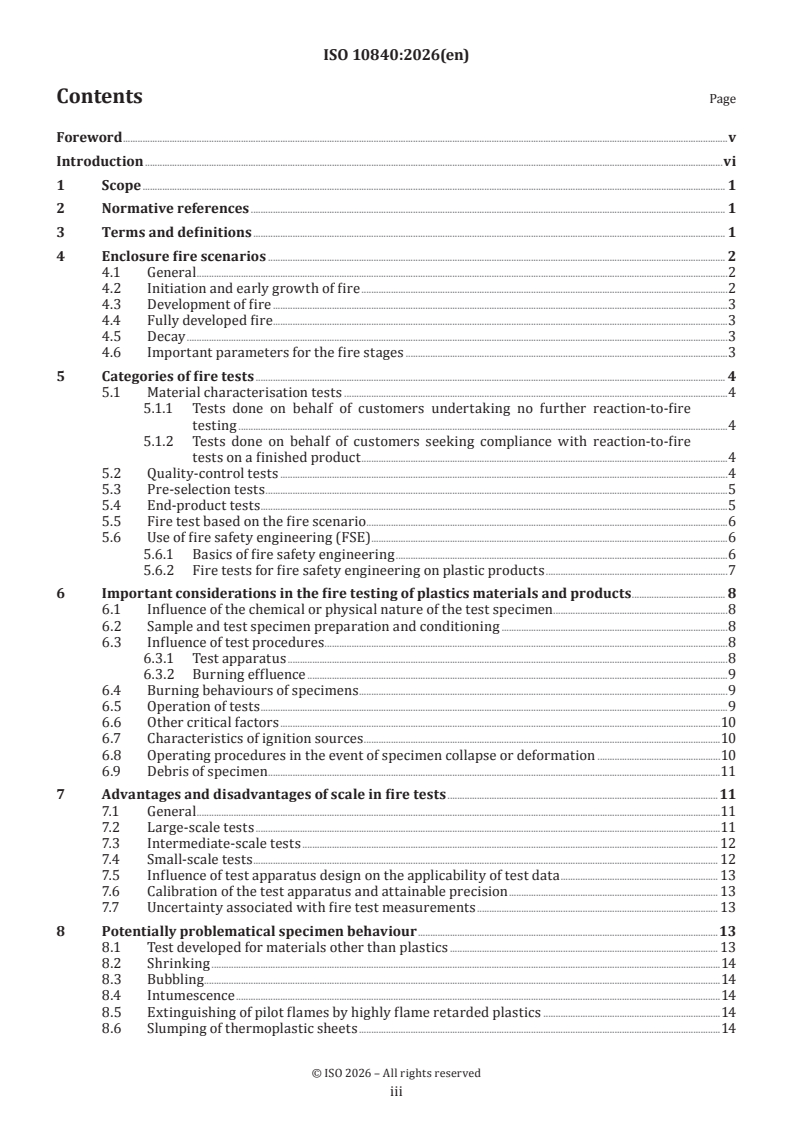
Contents
- Introduction
- 1 Scope
- 2 Normative references
- 3 Terms and definitions
- 3.1 end-product test
- 3.2 pre-selection test
- 3.3 spalling
- 4 Enclosure fire scenarios
- 4.1 General
- 4.2 Initiation and early growth of fire
- 4.3 Development of fire
- 4.4 Fully developed fire
- 4.5 Decay
- 4.6 Important parameters for the fire stages
- 5 Categories of fire tests
- 5.1 Material characterisation tests
- 5.2 Quality-control tests
- 5.3 Pre-selection tests
- 5.4 End-product tests
- 5.5 Fire test based on the fire scenario
- 5.6 Use of fire safety engineering (FSE)
- 6 Important considerations in the fire testing of plastics materials and products
- 6.1 Influence of the chemical or physical nature of the test specimen
- 6.2 Sample and test specimen preparation and conditioning
- 6.3 Influence of test procedures
- 6.4 Burning behaviours of specimens
- 6.5 Operation of tests
- 6.6 Other critical factors
- 6.7 Characteristics of ignition sources
- 6.8 Operating procedures in the event of specimen collapse or deformation
- 6.9 Debris of specimen
- 7 Advantages and disadvantages of scale in fire tests
- 7.1 General
- 7.2 Large-scale tests
- 7.3 Intermediate-scale tests
- 7.4 Small-scale tests
- 7.5 Influence of test apparatus design on the applicability of test data
- 7.6 Calibration of the test apparatus and attainable precision
- 7.7 Uncertainty associated with fire test measurements
- 8 Potentially problematical specimen behaviour
- 8.1 Test developed for materials other than plastics
- 8.2 Shrinking
- 8.3 Bubbling
- 8.4 Intumescence
- 8.5 Extinguishing of pilot flames by highly flame retarded plastics
- 8.6 Slumping of thermoplastic sheets
- 8.7 Detection of flaming drips
- 8.8 Edge effects
- 8.9 Profiles products
- Annex A
- Annex B
- Bibliography
Introduction
Many of the current reaction-to-fire tests were developed, prior to the widespread use of synthetic polymers, to assess products incorporating materials such as wood (in the building industry), paper (in electrical wires and cables), and naturally occurring fibres such as cotton, wool and horsehair (in many textile, furniture and electrical applications). The reaction-to-fire characteristics of these so-cold traditional materials are often very different from those of synthetic materials, especially thermoplastics. ISO/TC 61/SC 4 recognises the need for guidance for users of fire-test standards commonly applied to materials and products made of, or incorporating, plastics. In 2003, the first edition of ISO 10840 was published, based on the now withdrawn ISO TR 10840:1993 (Plastics – Burning behaviour – Guidance for development and use of fire test), which listed a series of potential problems associated with the reaction-tofire testing of plastics materials and products. ISO TR 10840, however, provided users of the test methods with no practical assistance on how to cope with the listed difficulties. This document provides detailed information about how to conduct standard fire tests which are more relatable to the real conditions of plastics products in a variety of applications. With more concerns expressed about the environmental impact of fires involving plastics, additional guidance has been included in the second edition, and extended in this third edition. Particular attention is given to the provision of guidance for inexperienced users who need to assess the fire performance of materials or products made of, or incorporating, plastics. This document also provides answers to frequently asked questions concerning fire tests; these cover factors such as cost, duration, complexity, required operator skills, quality of the data produced, relevance to fire hazard assessment as well as test repeatability and reproducibility. This document contains a bibliography of the most frequently used fire tests applied to the materials and products within the scope of ISO/TC 61/SC 4. The main focus of this document is on reaction-to-fire testing. Fire resistance testing has also been considered, in particular for the use of plastic construction of small ships, to take account of the widespread use of advanced polymer composites and related materials with superior thermo-mechanical stability which can be used in applications where there is a demand for some degree of fire resistance. This document provides specifications and guidance for use of fire test of plastics based on the fire [45] [46] safety engineering (FSE) using methodologies prescribed in ISO 23932-1 , IEC 60695-1-11 and [47] IEC 60695-1-12 .
This document also provides guidance on some standard fire tests which give data that is applicable for assessment of the potentially adverse environmental impact of combustion products that can be generated in large-scale fires involving plastics materials and products (see Annex B). NOTE The term, ‘adverse environmental impact’, covers undesirable direct effects on the environment as well as indirect effects on people of ISO 10840 through environmental exposure.
International Standard ISO 10840:2026(en) Plastics — Specifications and guidance for the use of standard fire tests
1 Scope
This document provides specifications and guidance for the use of standard fire testing for plastics and the products in the following aspects:
- selection of appropriate tests that reflect realistic end-use conditions;
- grouping of the reaction-to-fire characteristics that any given test or tests can measure;
- assessment of tests as to their relevance in areas such as material characterisation, quality control, preselection, end-product testing, environmental profiling and design for the environment (DfE);
- definition of potential problems that can arise when plastics are tested in standard fire tests. This document does not include specification for development or design of new fire-tests for plastics.
2 Normative references
The following documents are referred to in the text in such a way that some or all of their content constitutes requirements of this document. For dated references, only the edition cited applies. For undated references, the latest edition of the referenced document (including any amendments) applies. ISO 10093, Plastics — Fire tests — Standard ignition sources ISO 13943, Fire safety — Vocabulary
3 Terms and definitions
For the purposes of this document, the terms and definitions given in ISO 13943 and the following apply. ISO and IEC maintain terminology databases for use in standardization at the following addresses:
- ISO Online browsing platform: available at https:// www .iso .org/ obp
- IEC Electropedia: available at https:// www .electropedia .org/
3.1 end-product test
fire hazard assessment test on a complete product, piece, part component or sub-assembly
3.2 pre-selection test
combustion characteristic test made on a standardized shape, for the process of assessing and choosing candidate materials, components or subassemblies for making an end product
3.3 spalling
breaking off of fragments or solid articles from a heated surface
ISO 10840:2026(en)
4 Enclosure fire scenarios
4.1 General
A number of fire parameters influence the development of a fire. The fire parameters measured during the pre-flash-over and the post-flash-over conditions differ greatly. There are four main stages of fire development within an enclosure (i.e. pre-ignition, fire growth, flashover and fully developed fire), which are assessed using measurements of temperature and heat release rate in terms of time. Figure 1 shows the different phases in the development of fires, (see Table 1), within an [3] enclosure space (see ISO/TS 3814 ).
In Figure 1, the pre-ignition stage is in the duration from the start until ignition time. The fire growth stage starts at the ignition and continue until flash-over (see 4.2). The fully developed fire stage starts at the flashover (see 4.4) followed by fire decade stage (see 4.5). Sometimes, fire does not reach flash-over due to limited combustibles present or due to the intervention of active firefighting measures (e.g. sprinklers, fire brigades). Key X time Y1 heat release rate (kW) o Y2 temperature ( C) 1 ignition 2 flash-over 3 heat release rate curve 4 temperature curve Figure 1 — Development of fire in terms of temperature and heat release rate
4.2 Initiation and early growth of fire
This stage of fire includes the exposure of a product to a heat source, ignition and early development of a fire. [6] [7] ISO 871 gives a test method to determine the ignition temperature of plastic materials. ISO 3582 , ISO 4589 [8][9][10][11] [31] [12] [13] [33][34][35] [14] series , ISO 9239-1 , ISO 9772 , ISO 9773 , ISO 11925 series and ISO 12992
ISO 10840:2026(en) specify fire test method for determination of ignitability of plastics and building materials which contain [28] plastics by small heat sources. ISO 10093 specifies ignition sources for use in fire tests. ISO 1182 [23] [24] specifies the test methods for non-combustibility (no-ignition). IEC 60695-11-2 , IEC 60695-11-5 , [25] [27] IEC 60695-11-10 and IEC 60695-11-20 specify various test methods for determination of ignitability and flame spread of materials used in electrotechnical products (in many cases, plastics). Two types of combustion can exist at this stage, smouldering and flaming. Smouldering is a slow, flameless combustion producing very little heat, but having the potential to fill an enclosure with smoke and toxic [60] gases. A test method for measuring toxic gases in fire efluents is given in ISO/TS 19700 . After ignition, the development of a flaming fire will depend on the following effects:
- fire growth on first ignited item;
- fire spread to other items;
- the effect of intervention (portable extinguishers, sprinklers, fire brigades);
- the ventilation conditions.
4.3 Development of fire
As a fire develops, a hot smoke and gas layer usually builds up below the ceiling. The radiant heat transfer to combustible items accelerates the thermal decomposition of material below the smoke layer, and the [30] [19] [21] rate of fire spread increases. ISO 5658-2 , ISO 21367 and ISO 23949 specify test methods for the [48] determination of flame spread capability. ISO 5659 provides test method for smoke generation. [29] Heat release from burning materials and products governs the fire growth. ISO 1716 , ISO 5660 [49][50][51][52] [36] [15] [37] [53] series , ISO 12136 , ISO 13927 , ISO 14696 and ISO 24473 give fire test methods for measurement of heat release from burning materials and products. Flash-over, which usually occurs at temperatures around 600 °C, corresponds to an abrupt sudden transition from a localised fire to the ignition of the gas layer and to the sudden subsequent ignition of all exposed flammable surfaces, leading to a fully developed fire. The rate of heat release increases rapidly, and this leads to a rapid temperature rise within the enclosure. However, temperature at flash-over is not always the maximum temperature in the compartment of the fire. Flash-over is uncommon in large enclosures, as the required temperature conditions are not often reached.
4.4 Fully developed fire
A fire is regarded as fully developed when all fuel within an enclosure is burning. This stage usually follows flash-over, but some fires can become fully developed without passing through the flash-over phase.
4.5 Decay
The decay stage of a fire is reached when the fire load or available air has been consumed, or when the fire is suppressed. In the pre-flash-over phase reaction to fire characteristics of products are important, while in the post-flash-over phase resistance to fire parameters of complete assemblies apply.
4.6 Important parameters for the fire stages
Fire building regulations make a distinction between these two conditions. Table 1 summarises the important [48] fire parameters associated with reaction to fire and resistance to fire. ISO 5659 gives specification of test [55][56] method for measuring generation of smoke. ISO 11907 series give specifications for corrosivity tests. [57][58][59] Some literatures also give guidance for consideration on corrosivity.
ISO 10840:2026(en) Table 1 — Phases of fire Phase Stage Parameters Pre-flashover Fire initiation Ignitability Developing fire Fire growth (ignitability, flame spread, heat-, smoke- and toxic effluent release) Post-flash-over Developed fire Resistance to fire (load-bearing, integrity, insulation)
5 Categories of fire tests
5.1 Material characterisation tests
5.1.1 Tests done on behalf of customers undertaking no further reaction-to-fire testing
This type of testing imposes an obligation on the material supplier to assess reaction-to-fire characteristics of the material likely to be of relevance to the application of the customer’s product, or foreseeable misuse of the product as imposed by product stewardship aspects of Responsible Care programmes, or product liability litigation, or both. The objective should be to provide answers to questions such as:
a) Do the properties of the thermal decomposition products (heat release, smoke density, toxicity or corrosivity) pose a foreseeable problem?
b) Is the thermomechanical response of the material (e.g. melting or retreating from the heat source) likely to constitute a hazard or an advantage in the customer’s product application, or in foreseeable misuse scenarios?
5.1.2 Tests done on behalf of customers seeking compliance with reaction-to-fire tests on a finished product In this case, the test method(s) used by the material manufacturer should provide an indication of the likely influence on the product test result of material characteristics such as melting, dripping, or retreat from heat source.
5.2 Quality-control tests
Quality control fire tests can be conducted at manufacturers of materials and products for the purpose of examining that the quality of the products is maintained.
In order to select a quality control test, it is important to:
- decide which characteristics should be checked by the test;
- select or develop the appropriate test methodology;
- specify the required performance criteria;
- compare test result to ensure that the parameter measured by the quality-control test correlates with the key performance parameter being investigated.
It is necessary to specify:
- the characteristics which have to be checked by test;
- the appropriate test procedure;
- the required pass (acceptance) and fail (rejection) criteria of the test;
ISO 10840:2026(en) and then to compare test result with the specified criterion/criteria (acceptance level). Repeatability is of crucial importance in tests selected for the purpose of quality control; in this context the relevance of the test to any given application of the material is of secondary importance.
5.3 Pre-selection tests
Data developed using pre-selection tests requires careful consideration to ensure their relevance in relation to the intended application and to avoid misuse and erroneous interpretation. The actual fire performance of a product is affected by its surroundings, design variables such as shape and size, fabrication techniques, heat -transfer effects, the type of potential ignition source and the length of exposure to it.
The advantages of pre-selection testing are as follows.
a) To a first approximation a material which reacts more favourably than another when tested as a standard test specimen will usually also react more favourably when used as a finished part in the product. This will be valid provided that no overriding, interactive, product-specific effects are present. b) Data concerning relevant combustion characteristics can aid the selection of materials, components and sub-assemblies during the design stage.
c) The precision of pre-selection tests is usually higher, and their sensitivity can be superior when compared with end-product tests.
d) Pre-selection tests can be used in a decision-making process directed to minimize the fire hazard. Where applicable for the purpose of fire hazard assessment, they can lead to a reduction in the number of end-product tests with a consequent reduction in the total testing effort. e) When fire hazard requirements need to be upgraded quickly, it can be possible to do this by upgrading the requirements of a pre-selection test before modifying the end-product test. f) The grading and classification obtained from the pre-selection test results can be used to specify a basic minimum performance of materials used in product specifications. It should be noted that when pre-selection testing is used to replace some of the end-product testing, it is necessary to fix an increased margin of safety in an attempt to ensure satisfactory performance of the end product. Following a pre-selection procedure, it is necessary to implement a value analysis on the end product, in order not to over-specify materials where a more economical material can be used. In this case, [5] an end-product test is necessary. IEC 60695-1-30 gives guidance for preselection process.
5.4 End-product tests
These tests should reflect the end-use application scenario as far as is possible. Important factors to consider include relevance of configuration, orientation, ventilation and the nature of the ignition source. Reaction-to-fire testing for fire safety and for fire hazard assessment of products should be programmed as follows:
a) specify the fire hazard to be assessed (e.g. vision impairment by smoke); b) define the relevant product-application (or misuse) scenario and specify the required safety criterion; c) select the appropriate test method and specify the pass/fail criterion; d) conduct the tests and analyse the data; e) select acceptable or reject unacceptable candidate materials or products.
ISO 10840:2026(en) In case fire safety of a large constructions made of plastics must be considered within a scope of overall fire safety of the constructions, fire resistance of such product might need to be evaluated. [38] NOTE 1 ISO 30021 gives fire resistance test method on plastics including fibre reinforced plastics (FRP) for evaluation of fire safety of such product in small ships (crafts). It is also possible to develop an intermediate scale reaction-to-fire test that has close relationship to large scale reaction-to-fire test used for regulatory purposes.
[16] [17] NOTE 2 ISO 15791-1 and ISO/TS 15791-2 have been developed for application of intermediate-scale reactionto-fire tests.
5.5 Fire test based on the fire scenario
In case it becomes necessary to evaluate fire performance of plastics and/or product made of plastics in anticipated condition of use, fire scenario-based approach can be utilized. The fire scenario-based fire hazard assessment can be conducted in the process as described below:
a) define the target of the evaluation, i.e. plastic materials, product made of plastics; b) identify conditions where the target is used; c) establish fire scenario that realize the identifies conditions and existence of the target; d) identify fire performance parameters to evaluate fire performance of the target; e) establish criteria to decide acceptability of the target in the fire conditions; f) develop or choose fire test method(s) that realize the identified fire conditions and provide the results in terms of identified fire performance parameters g) evaluate the test results in light of established criteria. [46] Detailed process of scenario based fire hazard assessment is given in IEC 60695-1-11 . NOTE A fire test method of plastic materials in a condition of micro gravity is given in ISO 4589-4. Basic and overall approach fire safety evaluation based on the fire scenario and fire safety engineering is [45] [47] given in ISO 23932-1 and IEC 60695-1-12 .
5.6 Use of fire safety engineering (FSE)
5.6.1 Basics of fire safety engineering
[45] [42] [43] Basic approach on fire safety engineering is given in ISO 23932-1 , ISO 16732-1 , ISO 16733-1 and [44] ISO/TR 16738 give various specifications and information for the use of FSE. Additional fire safety engineering approach for electrotechnical products, which in most cases contain [46] [47] [26] plastics, is given in IEC 60695-1-11 , IEC 60695-1-12 and IEC 60695-11-11 . Fire safety engineering was developed and is continuing to develop to enable the design, implementation and maintenance of objects and structures in the built environment, using scientific principles, so that defined fire safety engineering objectives can be met. In order to do this, quantitative fire tests are used to provide input data for the necessary calculations.
When applied to a major project in the built environment, the fire engineering process is both complex and comprehensive. A flow chart illustrating such a fire safety engineering process is shown in Figure 2. Fire safety engineering should be used when safety objectives cannot adequately be met by prescriptive requirements and can also be used in parallel with prescriptive requirements, e.g. to support, from a scientific point of view, that such requirements are valid, or to further improve the fire safety of the product.
ISO 10840:2026(en)
5.6.2 Fire tests for fire safety engineering on plastic products
Any physical or chemical tests on plastics products, to be used in fire safety engineering, should provide data appropriate to enable ‘in-use’ plastics product performance to be assessed through utilization of predictive methods.
It follows that:
...
Contents
- Introduction
- 1 Domaine d’application
- 2 Références normatives
- 3 Termes et définitions
- 3.1 essai du produit fini
- 3.2 essai de présélection
- 3.3 éclatement
- 4 Scénarios d’incendie en espace clos
- 4.1 Généralités
- 4.2 Initiation et croissance précoce de l’incendie
- 4.3 Développement de l’incendie
- 4.4 Feu pleinement développé
- 4.5 Déclin
- 4.6 Paramètres importants relatifs aux étapes de l’incendie
- 5 Catégories d’essais au feu
- 5.1 Essais de caractérisation des matériaux
- 5.2 Essais de contrôle qualité
- 5.3 Essais de présélection
- 5.4 Essais des produits finis
- 5.5 Essai au feu basé sur le scénario d’incendie
- 5.6 Utilisation de l’ingénierie de la sécurité incendie (ISI)
- 6 Considérations importantes pour les essais au feu des matériaux et produits
- 6.1 Influence de la nature chimique ou physique de l’éprouvette d’essai
- 6.2 Préparation et conditionnement des échantillons et des éprouvettes d’essai
- 6.3 Influence des modes opératoires d’essai
- 6.4 Comportement au feu des éprouvettes
- 6.5 Exécution des essais
- 6.6 Autres facteurs critiques
- 6.7 Caractéristiques des sources d’allumage
- 6.8 Modes opératoires en cas d’effondrement ou de déformation de l’éprouvette
- 6.9 Débris d’éprouvette
- 7 Avantages et inconvénients de l’échelle dans les essais au feu
- 7.1 Généralités
- 7.2 Essais à grande échelle
- 7.3 Essais à échelle intermédiaire
- 7.4 Essais à petite échelle
- 7.5 Influence de la conception de l’appareillage d’essai sur l’applicabilité des données
- 7.6 Étalonnage de l’appareillage d’essai et précision atteignable
- 7.7 Incertitude associée aux mesures des essais au feu
- 8 Comportement potentiellement problématique des éprouvettes
- 8.1 Essai développé pour des matériaux autres que les plastiques
- 8.2 Retrait
- 8.3 Bullage
- 8.4 Intumescence
- 8.5 Extinction des flammes pilotes par des plastiques hautement ignifuges
- 8.6 Affaissement des feuilles thermoplastiques
- 8.7 Détection des gouttes enflammées
- 8.8 Effets de bord
- 8.9 Produits profilés
- Annexe A
- Annexe B
- Bibliographie
Introduction
Bon nombre des essais de réaction au feu actuels ont été développés, avant l’utilisation généralisée des polymères synthétiques, pour évaluer les produits incorporant des matériaux tels que le bois (dans l’industrie du bâtiment), le papier (dans les fils et câbles électriques) et les fibres naturelles comme le coton, la laine et le crin (dans de nombreuses applications textiles, d’ameublement et électriques). Les caractéristiques de réaction au feu de ces matériaux dits traditionnels sont souvent très différentes de celles des matériaux synthétiques, en particulier des thermoplastiques.
L’ISO/TC 61/SC 4 reconnaît le besoin de fournir des recommandations aux utilisateurs des normes d’essais au feu couramment appliquées aux matériaux et produits en plastiques ou contenant des plastiques. En 2003, la première édition de l’ISO 10840 a été publiée. Elle était basée sur l’ISO/TR 10840:1993 (Plastiques - Lignes directrices pour le développement et l’utilisation d’essais au feu), désormais retiré, qui énumérait une série de problèmes potentiels associés aux essais de réaction au feu des matériaux et produits plastiques. Cependant, l’ISO/TR 10840 ne fournissait aux utilisateurs des méthodes d’essai aucune assistance pratique pour faire face aux difficultés répertoriées.
Le présent document fournit des informations détaillées sur la façon de réaliser des essais au feu normalisés, qui sont plus en rapport avec les conditions réelles des produits plastiques dans une variété d’applications. En raison des préoccupations croissantes concernant l’impact environnemental des incendies impliquant des plastiques, des recommandations supplémentaires ont été ajoutées dans la deuxième édition et complétées dans cette troisième édition.
Une attention particulière est accordée à la fourniture de recommandations pour les utilisateurs inexpérimentés qui peuvent avoir besoin d’évaluer la performance au feu des matériaux ou des produits en plastiques ou contenant des plastiques. Le présent document fournit également des réponses aux questions fréquemment posées concernant les essais au feu; celles-ci couvrent des facteurs tels que le coût, la durée, la complexité, les compétences requises des opérateurs, la qualité des données produites, la pertinence pour l’analyse du danger d’incendie ainsi que la répétabilité et la reproductibilité des essais. Le présent document contient une bibliographie des essais au feu les plus fréquemment utilisés, appliqués aux matériaux et produits faisant partie du domaine d’application de l’ISO/TC 61/SC 4. Le présent document porte principalement sur les essais de réaction au feu. Les essais de résistance au feu ont également été envisagés, en particulier pour l’utilisation de plastique pour la construction de petits navires, afin de prendre en compte l’utilisation répandue de composites polymères avancés et de matériaux apparentés présentant une stabilité thermo-mécanique supérieure, qui peuvent être utilisés dans des applications où un certain degré de résistance au feu est nécessaire. Le présent document fournit des spécifications et des recommandations pour l'utilisation d'essais au feu des plastiques, dans le cadre de l'ingénierie de la sécurité incendie (ISI), en utilisant les méthodologies prescrites [45] [46] [47] dans l’ISO 23932-1 , l’IEC 60695-1-11 et l’IEC 60695-1-12 .
Le présent document fournit également des recommandations relatives à certains essais au feu normalisés qui fournissent des données applicables à l’évaluation de l’impact environnemental potentiellement négatif des produits de combustion susceptibles d’être générés lors d’incendies de grande envergure impliquant des matériaux et produits plastiques (voir l’Annexe B).
NOTE Le terme «impact environnemental négatif» couvre les effets directs indésirables sur l’environnement ainsi que les effets indirects sur les personnes indiqués dans l’ISO10840 par exposition environnementale.
Norme internationale ISO 10840:2026(fr) Plastiques — Spécifications et lignes directrices pour l'utilisation d'essais au feu normalisés
1 Domaine d’application
Le présent document fournit des spécifications et des recommandations pour l'utilisation d'essais au feu normalisés pour les plastiques et les produits, dans les domaines suivants:
- sélection des essais appropriés reflétant les conditions d’utilisation finales réalistes;
- regroupement des caractéristiques de réaction au feu pouvant être mesurées par un ou des essais;
- évaluation des essais quant à leur pertinence dans des domaines tels que la caractérisation des matériaux, le contrôle qualité, la présélection, les essais des produits finis, le profilage environnemental et la conception pour l’environnement (DfE).
- définition des problèmes potentiels qui peuvent survenir lors des essais au feu normalisés des plastiques. Le présent document n’inclut pas de spécification pour le développement ou la conception de nouveaux essais au feu pour les plastiques.
2 Références normatives
Les documents suivants sont cités dans le texte de sorte qu’ils constituent, pour tout ou partie de leur contenu, des exigences du présent document. Pour les références datées, seule l’édition citée s’applique. Pour les références non datées, la dernière édition du document de référence s’applique (y compris les éventuels amendements).
ISO 10093, Plastiques — Essais au feu — Sources d'allumage normalisées ISO 13943, Sécurité au feu — Vocabulaire
3 Termes et définitions
Pour les besoins du présent document, les termes et définitions donnés dans l’ISO 13943 ainsi que les suivants, s’appliquent.
L’ISO et l’IEC tiennent à jour des bases de données terminologiques destinées à être utilisées en normalisation, consultables aux adresses suivantes:
- ISO Online browsing platform: disponible à l’adresse https:// www .iso .org/ obp
- IEC Electropedia: disponible à l’adresse https:// www .electropedia .org/
3.1 essai du produit fini
essai d’évaluation du danger d’incendie sur un produit complet, une pièce, un composant ou un sousensemble
3.2 essai de présélection
essai de caractéristique de combustion réalisé sur une forme normalisée, pour le processus d’évaluation et de sélection des matériaux, composants ou sous-ensembles candidats pour fabriquer un produit fini
ISO 10840:2026(fr)
3.3 éclatement
rupture de fragments ou d’articles solides à partir d’une surface chauffée
4 Scénarios d’incendie en espace clos
4.1 Généralités
Un certain nombre de paramètres d’incendie influencent le développement d’un incendie. Les paramètres d’incendie mesurés pendant les conditions de pré-embrasement généralisé et de post-embrasement généralisé diffèrent grandement.
Il existe quatre étapes principales de développement d’un incendie dans une enceinte fermée (à savoir le pré-allumage, la croissance du feu, l’embrasement généralisé et le feu pleinement développé), qui sont évaluées à l’aide de mesures de la température et du débit calorifique en fonction du temps. La Figure 1 présente les différentes phases du développement d’un incendie (voir le Tableau 1) dans un espace clos (voir [3] l’ISO/TS 3814 ).
Sur la Figure 1, l’étape de pré-allumage correspond à la période allant du début jusqu'au moment de l'allumage. L’étape de croissance du feu commence au moment de l'allumage et se poursuit jusqu'au passage à l’embrasement généralisé (voir 4.2). L’étape du feu pleinement développé commence au moment du passage à l’embrasement généralisé (voir 4.4) et est suivie de l’étape de déclin du feu (voir 4.5). Il arrive parfois que l’incendie n'atteigne pas l’embrasement généralisé en raison de la présence limitée de combustibles ou de l’intervention de mesures actives de lutte contre l’incendie (par exemple, sprinklers, brigades de pompiers).
ISO 10840:2026(fr) Légende X temps Y1 débit calorifique (kW) Y2 température (°C) 1 allumage 2 embrasement généralisé 3 courbe de débit calorifique 4 courbe de température Figure 1 — Développement d’un incendie en termes de température et de débit calorifique
4.2 Initiation et croissance précoce de l’incendie
Cette phase de l’incendie comprend l’exposition d’un produit à une source de chaleur, l’allumage et le [6] développement initial du feu. L’ISO 871 définit une méthode d'essai permettant de déterminer la [7] [8][9][10][11] [31] température d’allumage des matériaux plastiques. L’ISO 3582 , la série ISO 4589 , l’ISO 9239-1 , [12] [13] [33][34][35] [14] l’ISO 9772 , l’ISO 9773 , la série ISO 11925 et l’ISO 12992 spécifient des méthodes d’essai au feu permettant de déterminer l’allumabilité des matières plastiques et des matériaux de construction contenant des matières plastiques, sous l’action de petites sources de chaleur. L’ISO 10093 spécifie les [28] sources d’allumage à utiliser lors des essais au feu. L’ISO 1182 spécifie les méthodes d'essai relatives à [23] [24] [25] l'incombustibilité (absence d’allumage). L’IEC 60695-11-2 , l’IEC 60695-11-5 , l’IEC 60695-11-10 et [27] l’IEC 60695-11-20 spécifient diverses méthodes d'essai permettant de déterminer l'inflammabilité et la propagation de la flamme des matériaux utilisés dans les produits électrotechniques (dans de nombreux cas, des matières plastiques).
Deux types de combustion peuvent exister à ce stade: le feu couvant et le flamboiement. Le feu couvant est une combustion lente et sans flamme produisant très peu de chaleur, mais ayant le potentiel de remplir un [60] espace clos de fumée et de gaz toxiques. L’ISO/TS 19700 présente une méthode d'essai permettant de mesurer les gaz toxiques présents dans les effluents d'incendie. Après l’allumage, le développement d’un incendie avec flamboiement dépendra des effets suivants:
- croissance du feu sur le premier objet enflammé;
- propagation du feu à d’autres objets;
ISO 10840:2026(fr) - effet de l’intervention (extincteurs portatifs, sprinklers, brigades de pompiers); - conditions de ventilation.
4.3 Développement de l’incendie
Au fur et à mesure qu’un incendie se développe, une couche de fumée et de gaz chauds se forme généralement sous le plafond. Le transfert de chaleur rayonnante aux objets combustibles accélère la décomposition thermique du matériau en dessous de la couche de fumée, et le taux de propagation du feu augmente. [30] [19] [21] L’ISO 5658-2 , l’ISO 21367 et l’ISO 23949 définissent des méthodes d'essai permettant de déterminer [48] la capacité de propagation des flammes. L’ISO 5659 définit une méthode d'essai relative à la production de fumée.
Le dégagement de chaleur provenant de la combustion des matériaux et des produits détermine la propagation [29] [49][50][51][52] [36] [15] [37] de l'incendie. L’ISO 1716 , la série ISO 5660 , l’ISO 12136 , l’ISO 13927 , l’ISO 14696 et [53] l’ISO 24473 définissent des méthodes d'essai au feu permettant de mesurer le dégagement de chaleur des matériaux et produits en combustion.
L’embrasement généralisé, qui se produit généralement à des températures autour de 600 °C, correspond à une transition soudaine et abrupte d’un incendie localisé à l’allumage de la couche de gaz et à l’allumage soudain de toutes les surfaces inflammables exposées, conduisant à un feu pleinement développé. Le débit calorifique augmente rapidement, et cela conduit à une élévation rapide de la température à l’intérieur de l’espace clos. Toutefois, la température d’embrasement généralisé n’est pas toujours la température maximale dans le compartiment de l’incendie. L’embrasement généralisé est rare dans les grands espaces clos, car les conditions de température nécessaires ne sont pas souvent atteintes.
4.4 Feu pleinement développé
Un feu est considéré comme pleinement développé lorsque tous les combustibles dans un espace clos sont en train de brûler. Cette étape suit généralement l’embrasement généralisé, mais certains feux peuvent devenir pleinement développés sans passer par la phase d’embrasement généralisé.
4.5 Déclin
Le stade de déclin d’un feu est atteint lorsque la charge calorifique ou l’air disponible a été consommé(e), ou lorsque le feu est supprimé. Dans la phase de pré-embrasement généralisé, les caractéristiques de réaction au feu des produits sont importantes, tandis que dans la phase de post-embrasement généralisé, les paramètres de résistance au feu des ensembles complets s’appliquent.
4.6 Paramètres importants relatifs aux étapes de l’incendie
La réglementation en matière de sécurité incendie dans les bâtiments établit une distinction entre ces deux conditions. Le Tableau 1 résume les paramètres d’incendie importants associés à la réaction au feu et à la [48] résistance au feu. L’ISO 5659 définit les spécifications de la méthode d'essai permettant de mesurer la [55][56] production de fumée. La série ISO 11907 définit les spécifications relatives aux essais de corrosivité. [57][58][59] Certaines publications fournissent également des recommandations concernant la prise en compte de la corrosivité.
Tableau 1 — Phases de l’incendie Phase Étape Paramètres Pré-embrasement Initiation du feu Allumabilité généralisé Développement du Croissance du feu (inflammabilité, propagafeu tion des flammes, libération de chaleur, de fumée et d’effluents toxiques) Post-embrasement Feu développé Résistance au feu (résistance mécanique, généralisé étanchéité au feu, isolation thermique)
ISO 10840:2026(fr)
5 Catégories d’essais au feu
5.1 Essais de caractérisation des matériaux
5.1.1 Essais effectués pour le compte de clients ne réalisant pas d’essais supplémentaires de
réaction au feu Ce type d’essai impose au fournisseur du matériau l’obligation d’évaluer les caractéristiques de réaction au feu du matériau, susceptibles d’être pertinentes pour l’application prévue du produit par le client, ou pour une mauvaise utilisation prévisible du produit, comme cela peut être exigé dans le cadre des programmes de gestion responsable des produits (Responsible Care), des obligations liées à la responsabilité du fournisseur, ou des deux. Il convient que l’objectif soit de fournir des réponses aux questions telles que:
a) Les propriétés des produits de décomposition thermique (dégagement de chaleur, densité de fumée, toxicité ou corrosivité) posent-elles un problème prévisible?
b) La réponse thermomécanique du matériau (par exemple, fusion ou retrait de la source de chaleur) estelle susceptible de constituer un danger ou un avantage dans l’application du produit du client, ou dans des scénarios de mauvaise utilisation prévisible?
5.1.2 Essais effectués pour le compte de clients cherchant à obtenir la conformité avec les essais de réaction au feu sur un produit fini Dans ce cas, il convient que la ou les méthodes d’essai utilisées par le fabricant du matériau fournissent une indication de l’influence probable sur le résultat d’essai du produit des caractéristiques du matériau telles que la fusion, la formation de gouttes ou le retrait de la source de chaleur.
5.2 Essais de contrôle qualité
Les essais au feu de contrôle qualité peuvent être réalisés chez les fabricants de matériaux et de produits afin de vérifier que la qualité des produits est maintenue.
Pour sélectionner un essai de contrôle qualité, il est important de:
- décider quelles caractéristiques il convient de vérifier par l’essai;
- sélectionner ou développer la méthodologie d’essai appropriée;
- spécifier les critères de performance requis;
- comparer les résultats d’essai pour s’assurer que le paramètre mesuré par l’essai de contrôle qualité est en corrélation avec le paramètre de performance clé étudié.
Il est nécessaire de spécifier:
- les caractéristiques qui doivent être vérifiées par essai;
- le mode opératoire d’essai approprié;
- les critères de réussite (acceptation) et d’échec (refus) requis pour l’essai; et ensuite de comparer le résultat d’essai avec le ou les critères spécifiés (niveau d’acceptation). La répétabilité est d’une importance cruciale dans les essais sélectionnés aux fins du contrôle qualité; dans ce contexte, la pertinence de l’essai pour toute application donnée du matériau est d’importance secondaire.
5.3 Essais de présélection
Les données développées à l’aide d’essais de présélection nécessitent une attention particulière pour assurer leur pertinence par rapport à l’application prévue et pour éviter les utilisations abusives et les interprétations erronées.
ISO 10840:2026(fr) La performance au feu réelle d’un produit est affectée par son environnement, les variables de conception telles que la forme et la taille, les techniques de fabrication, les effets de transfert de chaleur, le type de source d’allumage potentielle et la durée d’exposition à celle-ci. Les avantages des essais de présélection sont les suivants:
a) Lors d’une première approximation, un matériau qui réagit plus favorablement qu’un autre lorsqu’il est soumis à l’essai en tant qu’éprouvette d’essai normalisée réagira généralement aussi plus favorablement lorsqu’il sera utilisé comme pièce finie dans le produit. Cela sera valide à condition qu’aucun effet interactif, spécifique du produit, ne soit présent.
b) Les données concernant les caractéristiques pertinentes de la combustion peuvent aider à la sélection des matériaux, des composants et des sous-ensembles lors de la phase de conception. c) La précision des essais de présélection est généralement plus élevée, et leur sensibilité peut être supérieure à celle obtenue avec les essais des produits finis. d) Les essais de présélection peuvent être utilisés dans un processus décisionnel visant à réduire le plus possible le danger d’incendie. Le cas échéant, pour les besoins de l’analyse du danger d’incendie, ils peuvent conduire à une réduction du nombre d’essais des produits finis avec, par conséquent, une réduction de l’effort total d’essai.
e) Lorsqu’il est nécessaire d’augmenter rapidement les exigences de danger d’incendie, cela peut se faire en améliorant les exigences d’un essai de présélection avant de modifier l’essai du produit fini. f) La notation et la classification obtenues à partir des résultats des essais de présélection peuvent être utilisées pour spécifier une performance minimale de base des matériaux utilisés dans les spécifications des produits.
Il convient de noter que lorsque des essais de présélection sont utilisés pour remplacer certains essais de produits finis, il est nécessaire de fixer une marge de sécurité accrue pour tenter d’assurer une performance satisfaisante du produit fini. Après une présélection, il peut être nécessaire de réaliser une analyse sur le produit fini, afin de ne pas sur-spécifier les matériaux dans le cas où un matériau plus économique peut être [5] utilisé. Dans ce cas, un essai du produit fini est nécessaire, l'IEC 60695-1-30 fournit des recommandations concernant le processus de présélection.
5.4 Essais des produits finis
Il convient que ces essais reflètent autant que possible le scénario d’application finale. Les facteurs importants à considérer incluent la pertinence de la configuration, l’orientation, la ventilation et la nature de la source d’allumage.
Il convient de programmer les essais de réaction au feu pour la sécurité incendie et pour l’analyse du danger d’incendie des produits comme suit:
a) spécifier le danger d’incendie à évaluer (par exemple, gêne visuelle due à la fumée); b) définir le scénario pertinent d’application (ou de mauvaise utilisation) du produit et spécifier le critère de sécurité requis; c) sélectionner la méthode d’essai appropriée et spécifier le critère de réussite/d’échec; d) effectuer les essais et analyser les données; e) sélectionner les matériaux ou produits candidats acceptables ou rejeter les matériaux ou produits candidats inacceptables.
...