

ISO 5031:1977
(Main)Continuous mechanical handling equipment for loose bulk materials — Couplings and hose components used in pneumatic handling — Safety code
General Information
- Abstract
Specifies, in addition to the general safety rules set out in ISO/T 1819, the special safety rules for couplings and hose components used in the pneumatic handling of loose bulk materials. These safety rules apply regardless of the use for which the equipment is intended.
- Status
- Published
- Publication Date
- 30-Apr-1977
- Technical Committee
- ISO/TC 101 - Continuous mechanical handling equipment
- Drafting Committee
- ISO/TC 101 - Continuous mechanical handling equipment
- Current Stage
- 9093 - International Standard confirmed
- Start Date
- 05-May-2025
- Completion Date
- 29-Aug-2026
Buy Documents

ISO 5031:1977 - Continuous mechanical handling equipment for loose bulk materials — Couplings and hose components used in pneumatic handling — Safety code Released:5/1/1977

ISO 5031:1977 - Engins de manutention continue pour produits en vrac — Tuyauteries flexibles et raccords utilisés en manutention pneumatique — Code de sécurité Released:5/1/1977
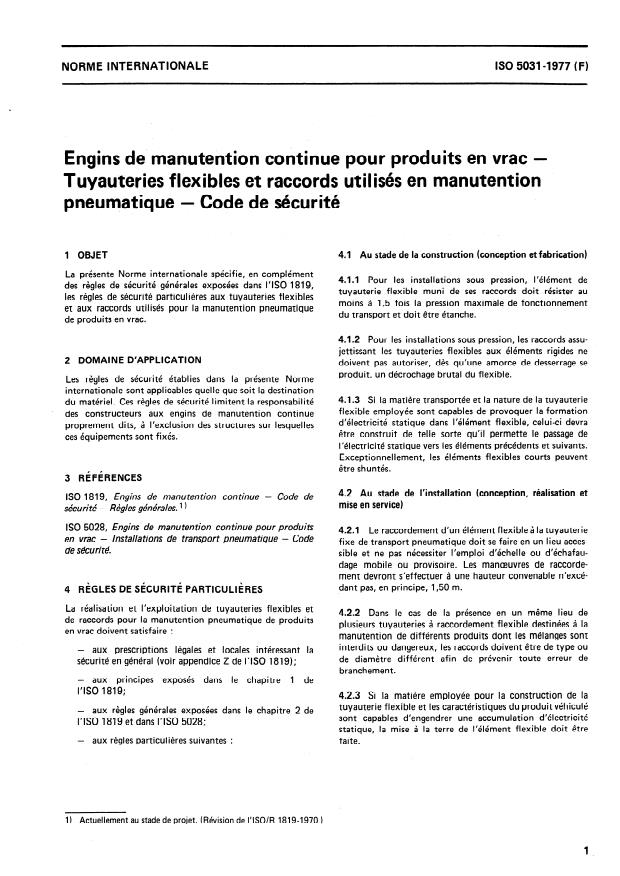

ISO 5031:1977 - Engins de manutention continue pour produits en vrac — Tuyauteries flexibles et raccords utilisés en manutention pneumatique — Code de sécurité Released:5/1/1977
Overview
ISO 5031:1977 - "Continuous mechanical handling equipment for loose bulk materials - Couplings and hose components used in pneumatic handling - Safety code" is a safety code that complements the general rules of ISO/T 1819. It defines special safety requirements for couplings and flexible hose components used in the pneumatic handling and transport of loose bulk materials. The requirements apply regardless of the intended use of the equipment and are aimed at ensuring safe design, installation, operation and maintenance.
Key topics and requirements
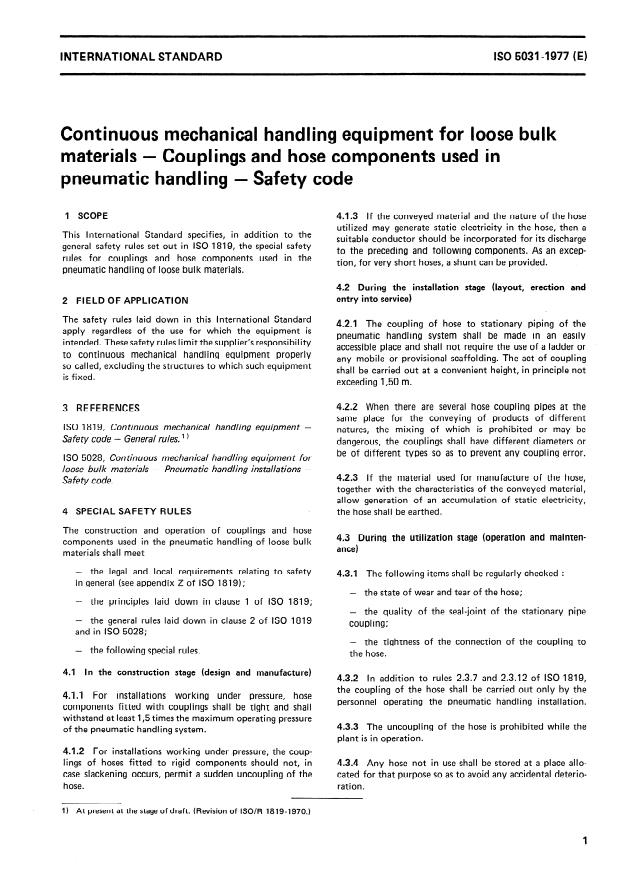
- Pressure resistance and leak-tightness: Flexible hose assemblies with their couplings must withstand at least 1.5 times the maximum working pressure of the transport system and be leak-tight.
- Anti-disengagement design: Couplings that attach flexible hoses to rigid pipework must not permit a sudden or violent disengagement if loosening begins.
- Static electricity control:
- Flexible elements must be constructed to permit passage of static electricity to adjacent elements where the transported product or hose material can generate charge.
- Grounding (earthing) is required when accumulation of electrostatic charge is possible. Short flexible elements may be shunted exceptionally.
- Accessible installation:
- Connections between flexible and fixed pipework must be at accessible locations and should not require ladders or temporary scaffolding.
- Work height for making connections should generally not exceed 1.50 m.
- Where multiple flexible connections exist for different products that must not mix, use different types or diameters to prevent wrong hookups.
- Operation and maintenance:
- Only authorized operating personnel may connect or disconnect flexible elements.
- Disconnection during operation is prohibited.
- Periodic inspections must verify hose condition, seal quality, and correct coupling tightening.
- Unused flexible hoses must be stored in a designated place to avoid accidental damage.
Applications and who uses this standard
ISO 5031 is intended for:
- Manufacturers and designers of pneumatic conveying systems and continuous mechanical handling equipment for loose bulk materials
- Plant engineers, safety managers and maintenance teams in bulk-handling industries (cement, grain, minerals, powders)
- Installers, commissioning personnel and inspectors responsible for pipework, flexible hoses and couplings
- Procurement and QA teams specifying safe couplings and hose assemblies
Adopting ISO 5031 helps reduce leak risks, prevent hazardous disconnections, minimize electrostatic ignition risks and improve safe access for installation and maintenance.
Related standards
- ISO/T 1819 - General safety code for continuous mechanical handling equipment (complementary rules)
- ISO 5028 - Safety code for pneumatic conveying installations for loose bulk materials
Keywords: ISO 5031, pneumatic handling, couplings, hose components, safety code, flexible hoses, loose bulk materials, static electricity, pressure resistance, installation, inspection.
Buy Documents
ISO 5031:1977 - Continuous mechanical handling equipment for loose bulk materials — Couplings and hose components used in pneumatic handling — Safety code Released:5/1/1977
ISO 5031:1977 - Engins de manutention continue pour produits en vrac — Tuyauteries flexibles et raccords utilisés en manutention pneumatique — Code de sécurité Released:5/1/1977
ISO 5031:1977 - Engins de manutention continue pour produits en vrac — Tuyauteries flexibles et raccords utilisés en manutention pneumatique — Code de sécurité Released:5/1/1977
Frequently Asked Questions
ISO 5031:1977 is a standard published by the International Organization for Standardization (ISO). Its full title is "Continuous mechanical handling equipment for loose bulk materials — Couplings and hose components used in pneumatic handling — Safety code". This standard covers: Specifies, in addition to the general safety rules set out in ISO/T 1819, the special safety rules for couplings and hose components used in the pneumatic handling of loose bulk materials. These safety rules apply regardless of the use for which the equipment is intended.
Specifies, in addition to the general safety rules set out in ISO/T 1819, the special safety rules for couplings and hose components used in the pneumatic handling of loose bulk materials. These safety rules apply regardless of the use for which the equipment is intended.
ISO 5031:1977 is classified under the following ICS (International Classification for Standards) categories: 53.040.30 - Pneumatic transport and its components. The ICS classification helps identify the subject area and facilitates finding related standards.
ISO 5031:1977 is available in PDF format for immediate download after purchase. The document can be added to your cart and obtained through the secure checkout process. Digital delivery ensures instant access to the complete standard document.
Standards Content (Sample)
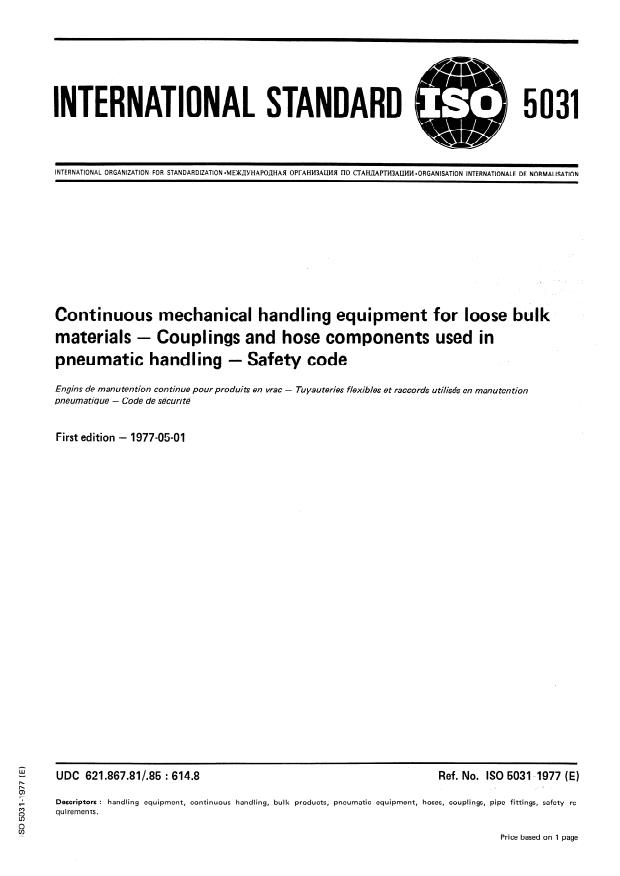
INTERNATIONAL STANDARD
INTERNATIONAL ORGANIZATION FOR STANDARDIZATION l MEXAYHAPOAHAJ ’l OPI-AHW3ALWI I-IO cTAHAAPTM3ALJtiW.ORGANISATION INTERNATIONALE DE NORMALISATION
Continuous mechanical handling equipment for loose bulk
materials - Couplings and hose components used in
pneumatic handling - Safety code
Engins de manu tention con tinue pour produits en vrac -
Tu yau teries flexibles et raccords u tihks en manu ten tion
pneumatique - Code de skurite’
First edition - 1977-05-01
UDC 621.867.81/.85 : 614.8 Red. No. ISO 5031-1977 (E)
Descriptors : handling equipment, continuous handling, bulk products, pneumatic equipment, hoses, couplings, Pipe fittings, safety re-
quirements.
Price based on 1 page
FOREWORD
ISO (the International Organization for Standardization) is a worldwide federation
of national Standards institutes (ISO member bodies). The work of developing
International Standards is carried out through ISO technical committees. Every
member body interested in a subject for which a technical committee has been set
up has the right to be represented on that committee. International organizations,
governmental and non-governmental, in liaison with ISO, also take part in the work.
Draft International Standards adopted by the technical committees are circulated
to the member bodies for approval before their acceptance as International
Standards by the ISO Council.
International Standard ISO 5031 was developed by Technical Committee
ISOITC 101, Continuous mechanical handling equipment, and was circulated to
the member bodies in February 1976.
lt has been approved by the member bodies of the following countries :
Austral ia Germany
South Africa, Rep. of
Austria lndia Spain
Belgium Sweden
Japan
Bulgaria Mexico Turkey
Czechoslovakia Netherlands United Kingdom
Finland
Poland U.S.S. R.
France
Romania Yugoslavia
No member body expressed disapproval of the document.
0 International Organkation for Standardkation, -1977 l
Printed in Switzerland
ISO 5031-1977 (E)
INTERNATIONAL STANDARD
Continuous mechanical handling equipment for Ioose bulk
materials - Couplings and hose components used in
pneumatic handling - Safety code
1 SCOPE 4.1.3 If the conveyed material and the nature of the hose
utilized may generate static electricity in the hose, then a
This International Standard specifies, in addition to the
suitable conductor should be incorporated for its discharge
general safety rules set out in ISO 1819, the special safety
to the preceding and following components. As an excep-
rules for couplings and hose components used in the
tion, for very short hoses, a Shunt tan be provided.
pneumatic handling of loose bulk materials.
4.2 During the installation Stage (layout, erectbn and
entry into service)
2 FIELD OF APPLICATION
The safety rules laid down in this International Standard
4.2.1 The coupling of hose
...
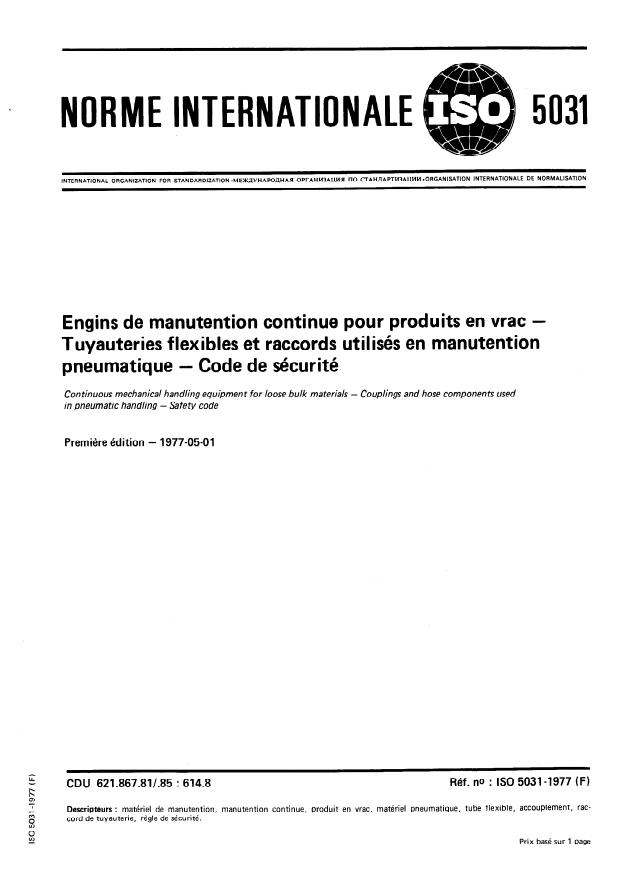
NORME INTERNATIONALE
INTERNATIONAL ORGANIZATION FOR STANDARDIZATION l ME’WCAYHAPOP[HAfl OPI-AHM3A~MII l-I0 CTAH~APTL13AL&WM =ORGANISATION INTERNATIONALE DE NORMALISATION
Engins de manutention continue pour produits en vrac -
Tuyauteries flexibles et raccords utilisés en manutention
pneumatique - Code de sécurité
Con tinuous mechanical handling equipmen t for loose bulk materials -
Couplings and hose components used
in pneumatic handling - Sa fety code
Première édition - 1977-05-01
CDU 621.867.81/.85 : 614.8 Réf. no : ISO 5031-1977 (F)
Descripteurs :
matériel de manutention, manutention continue, produit en vrac, matériel pneumatique, tube flexible, accouplement, rac-
tord de tuyauterie, règle de sécurité.
Prix basé sur 1 page
AVANT-PROPOS
L’ISO (Organisation internationale de normalisation) est une fédération mondiale
d’organismes nationaux de normalisation (comités membres de I’ISO). L’élaboration
des Normes internationales est confiée aux comités techniques de I’ISO. Chaque
comité membre intéressé par une étude a le droit de faire partiedu comité technique
Les organisations internationales, gouvernementales et non
correspondant.
gouvernementales, en liaison avec I’ISO, participent également aux travaux.
Les projets de Normes internationales adoptés par les comités techniques sont
soumis aux comités membres pour approbation, avant leur acceptation comme
Normes internationales par le Conseil de I’ISO.
La Norme internationale ISO 5031 a été élaborée par le comité technique
ISO/TC 101, Engins de manutention continue, et a été soumise aux comités
membres en février 1976.
Les comités membres des pays suivants l’ont approuvée :
Afrique du Sud, Rép. d’ Finlande
Roumanie
Allemagne France
Royaume-Uni
Australie Inde Suède
Autriche Japon Tchécoslovaquie
Belgique Mexique
Turquie
Bulgarie Pays-Bas U.R.S.S.
Espagne Pologne Yougoslavie
Aucun comité membre ne l’a désapprouvée.
@ Organisation internationale de normalisation, 1977 l
Imprimé en Suisse
NORME INTERNATIONALE
ISO5031-1977 (F)
Engins de’manutention continue pour produits en vrac -
Tuyauteries flexibles et raccords utilisés en manutention
pneumatique - Code de sécurité
1 OBJET 4.1 Au stade de la construction (conception et fabrication)
La présente Norme internationale spécifie, en complément
4.1.1 Pour les installations sous pression, l’élément de
des règles de sécurité générales exposées dans I’ISO 1819,
tuyauterie flexible muni de ses raccords doit résister au
les règles de sécurité particulières aux tuyauteries flexibles
moins à 1,5 fois la pression maximale de fonctionnement
et aux raccords utilisés pour la manutention pneumatique
du transport et doit être étanche.
de produits en vrac.
4.1.2 Pour les installations sous pression, les raccords assu-
jettissant les tuyauteries flexibles aux éléments rigides ne
2 DOMAINE D’APPLICATION
doivent pas autoriser, dès qu’une amorce de desserrage se
produit, un décrochage brutal du flexible.
Les règles de sécurité établies dans la présente Norme
internationale sont applicables quelle que soit la destination
4.1.3 Si
...
NORME INTERNATIONALE
INTERNATIONAL ORGANIZATION FOR STANDARDIZATION l ME’WCAYHAPOP[HAfl OPI-AHM3A~MII l-I0 CTAH~APTL13AL&WM =ORGANISATION INTERNATIONALE DE NORMALISATION
Engins de manutention continue pour produits en vrac -
Tuyauteries flexibles et raccords utilisés en manutention
pneumatique - Code de sécurité
Con tinuous mechanical handling equipmen t for loose bulk materials -
Couplings and hose components used
in pneumatic handling - Sa fety code
Première édition - 1977-05-01
CDU 621.867.81/.85 : 614.8 Réf. no : ISO 5031-1977 (F)
Descripteurs :
matériel de manutention, manutention continue, produit en vrac, matériel pneumatique, tube flexible, accouplement, rac-
tord de tuyauterie, règle de sécurité.
Prix basé sur 1 page
AVANT-PROPOS
L’ISO (Organisation internationale de normalisation) est une fédération mondiale
d’organismes nationaux de normalisation (comités membres de I’ISO). L’élaboration
des Normes internationales est confiée aux comités techniques de I’ISO. Chaque
comité membre intéressé par une étude a le droit de faire partiedu comité technique
Les organisations internationales, gouvernementales et non
correspondant.
gouvernementales, en liaison avec I’ISO, participent également aux travaux.
Les projets de Normes internationales adoptés par les comités techniques sont
soumis aux comités membres pour approbation, avant leur acceptation comme
Normes internationales par le Conseil de I’ISO.
La Norme internationale ISO 5031 a été élaborée par le comité technique
ISO/TC 101, Engins de manutention continue, et a été soumise aux comités
membres en février 1976.
Les comités membres des pays suivants l’ont approuvée :
Afrique du Sud, Rép. d’ Finlande
Roumanie
Allemagne France
Royaume-Uni
Australie Inde Suède
Autriche Japon Tchécoslovaquie
Belgique Mexique
Turquie
Bulgarie Pays-Bas U.R.S.S.
Espagne Pologne Yougoslavie
Aucun comité membre ne l’a désapprouvée.
@ Organisation internationale de normalisation, 1977 l
Imprimé en Suisse
NORME INTERNATIONALE
ISO5031-1977 (F)
Engins de’manutention continue pour produits en vrac -
Tuyauteries flexibles et raccords utilisés en manutention
pneumatique - Code de sécurité
1 OBJET 4.1 Au stade de la construction (conception et fabrication)
La présente Norme internationale spécifie, en complément
4.1.1 Pour les installations sous pression, l’élément de
des règles de sécurité générales exposées dans I’ISO 1819,
tuyauterie flexible muni de ses raccords doit résister au
les règles de sécurité particulières aux tuyauteries flexibles
moins à 1,5 fois la pression maximale de fonctionnement
et aux raccords utilisés pour la manutention pneumatique
du transport et doit être étanche.
de produits en vrac.
4.1.2 Pour les installations sous pression, les raccords assu-
jettissant les tuyauteries flexibles aux éléments rigides ne
2 DOMAINE D’APPLICATION
doivent pas autoriser, dès qu’une amorce de desserrage se
produit, un décrochage brutal du flexible.
Les règles de sécurité établies dans la présente Norme
internationale sont applicables quelle que soit la destination
4.1.3 Si
...