

ISO 23098-1:2026
(Main)Sustainable mobility and transportation — Mobility monitoring and services by data sharing platform — Part 1: Role model
- Abstract
This document describes a basic role model of smart city mobility monitoring and services by data sharing platform as a common platform for smart city instantiation. It provides a paradigm describing: a) a framework architecture for the provision of a mobility monitoring service; b) a description of the concept of operations and the role models; c) a conceptual architecture between actors involved in the provision or receipt of mobility monitoring service applications; d) references for the key documents on which the architecture is based; e) a taxonomy of the organization of generic procedures. It defines the basic role and functional model of service for the introduction of mobility monitoring services including infrastructure facilities to support mobility in urban and rural areas. In-vehicle control system is not within the scope of this document. This document is limited to the mobility monitoring services using physical and digital infrastructure.
- Status
- Published
- Publication Date
- 02-Nov-2026
- Current Stage
- 6060 - International Standard published
- Start Date
- 03-Nov-2026
- Completion Date
- 03-Nov-2026


ISO 23098-1:2026 is an ISO International Standard on mobility monitoring and services by data sharing platform. It gives a basic role model for smart city mobility monitoring services, including the framework architecture, the concept of operations and the actors involved. The standard is for organizations that plan, operate or regulate mobility services in urban and rural environments using physical and digital infrastructure.
What does ISO 23098-1:2026 specify?
ISO 23098-1:2026 specifies a common role model for smart city mobility monitoring and services by data sharing platform. Clause 1 limits the document to mobility monitoring services using physical and digital infrastructure, and excludes in-vehicle control system.
The document is organized into clauses on scope, references, terminology, abbreviated terms, service classification, mobility monitoring, shared data platform support, the role and function model, and service domains. Annex A gives examples of mobility monitoring and services by data sharing platform in practice.
| Annex | What it covers |
|---|---|
| Annex A | Informative examples of mobility monitoring and services by data sharing platform |
What are the key requirements of ISO 23098-1:2026?
ISO 23098-1:2026 is a conceptual standard, so its main value is the structure it gives to mobility services rather than a test method or product specification. The key clauses explain how to classify services, assign roles, and connect mobility operations to shared data platforms.
Clause 5 - gap and overlap analysis: ISO 23098-1:2026 positions itself alongside ISO 37156, ISO 37170 and ISO/TS 37172 as a complementary framework for data-linked city services. In practice, this helps a city or supplier decide whether a project belongs in this role model or in a data-exchange standard.
Clause 6 - service classification and evolution: ISO 23098-1:2026 classifies mobility services across guideway, highway, water and air, and across people, goods, urban, rural, public transport and emergency use. Tables 2 and 3 distinguish current emerging service status from future fully connected and automated mobility, which helps readers judge whether they are designing for today's deployment or a later automation stage.
Clause 7 - mobility monitoring through a data sharing platform: ISO 23098-1:2026 presents mobility monitoring as data collection, integration, analysis, service optimization, real-time updates, privacy/security and collaboration. In practice, this means operators need a platform that can combine vehicle, infrastructure and user data, then turn it into usable service information.
Clause 8 - shared data platform support: ISO 23098-1:2026 says the mobility service becomes fully functional with support from shared data platforms, including safety information, interactions with other modes, static signs, and dynamic digital and physical facilities. It also states that digital infrastructure should use an open, internationally standardized API platform, with AI and automated data aggregation tools, plus location and clock referencing methods for accurate data alignment.
Clause 9.3 - basic role model architecture: ISO 23098-1:2026 builds the architecture around smart city sensor data, a 3D HD point cloud map, digital infrastructure, mobility supporting facilities, physical infrastructure, a mobility service provider, communications and mobility users. This matters because it shows the service is not just software - it depends on data feeds, infrastructure and communications working together.
Clause 9.4 - application layer roles and options: ISO 23098-1:2026 allows users to use different service providers in different areas or for different services, and it allows a regional regulator to certify service providers. For a buyer or operator, this means the model supports both single-provider and multi-provider arrangements, depending on jurisdiction.
Clause 9.5 - detailed service roles: ISO 23098-1:2026 expands the operational roles to include the service control centre, mobility service user with nomadic device, transport provider, service vehicle, service mobility recorder, service vehicle owner, vehicle inspection and certification authority, first responders, regulator, regional transport authority, SCMS and traffic management centre. These roles explain who books the service, who operates the vehicle, who inspects it, who supports emergencies and who manages security credentials.
Clause 10 - service domains and use cases: ISO 23098-1:2026 groups platform-based services into regulated and unregulated applications, including infrastructure operation management, traffic management, road traffic management and enforcement. In practice, this is the section that helps map the role model to real services such as EFC, WIM, SPaT-MAP, dynamic map updates, EV charging, public transport information and freight controls.
What terms does ISO 23098-1:2026 define?
ISO 23098-1:2026 lists abbreviated terms in Clause 4, and the document uses several recurring technical terms in its role model.
- AI (artificial intelligence): Used in digital infrastructure to structure and integrate mobility data automatically.
- EV (electric vehicle): Used in the charging and mobility support examples, including charging facilities and charging management.
- SCMS (security credentials management system): The system that provides security certificates and supports security provisioning for mobility services.
- V2X (vehicle-to-everything): Communication between a vehicle and infrastructure or other relevant actors, used for safety and service support.
- METR (management of electronic traffic regulations): Digital traffic regulation information used to support safer and more efficient operation.
- Nomadic device: A user-carried device such as a smart phone that supports booking and payment.
- 3D HD point cloud map: A high-definition map built from point-cloud data and used by the digital infrastructure layer.
- Service control centre: The operational hub that handles booking, monitoring and emergency control for the service.
Who uses ISO 23098-1:2026?
ISO 23098-1:2026 is useful for smart city planners, transport authorities, traffic management centres, mobility service providers and public agencies that coordinate mobility data. It also matters to infrastructure owners, vehicle inspection and certification bodies, regulators, first responders and operators of digital platforms.
In practice, these groups use the standard to design service roles, assign responsibilities, structure data sharing and describe how mobility services interact with roads, waterways, airspace, users and supporting infrastructure. It is also relevant to organizations working on public transport information, freight operations, enforcement, EV charging, shared mobility and emergency mobility services.
Which standards are used with ISO 23098-1:2026?
ISO 23098-1:2026 has no normative references. It cites related standards and companion parts that help place the role model in context:
- ISO 23098-2 - companion part under preparation on unregulated service.
- ISO 23098-3 - companion part under preparation on regulated service.
- ISO 23098-4 - companion part under preparation on supplementary role for regulated service.
- ISO 16499-1 - role model for automated mobility using physical and digital infrastructure, noted in the introduction as a related baseline.
- ISO 37156 - data exchange and sharing for smart community infrastructures.
- ISO 37170 - data framework for infrastructure governance based on digital technology in smart cities.
- ISO/TS 37172 - data exchange and sharing for community infrastructures based on geographic information.
- ISO/TR 4445 - role model of ITS service application in smart cities, used as a baseline reference for the role model concept.
- ISO/TR 4448 (all parts) - public-area mobile robots, referenced for land use and kerb operation.
- ISO/TS 24315-1 - vocabulary for management of electronic traffic regulations (METR).
What does the ISO 23098-1:2026 document contain?
ISO 23098-1:2026 contains classification tables for service types and service evolution, then a sequence of role-model figures that move from the basic architecture to application-layer and service-role views. It uses those figures to show how smart city sensor data, maps, infrastructure, communications and users connect in a mobility service system.
Clause 10 adds grouped use cases for infrastructure operation management, traffic management, road traffic management, enforcement and service-provider functions. Annex A then gives practical examples such as shared mobility, traffic monitoring, public transit optimization, freight and logistics monitoring, parking, air quality monitoring and smart city dashboards.
The document is meant to support design, planning, governance and service definition. It gives readers a common way to describe who does what, what data moves where, and which infrastructure or communication functions are part of the mobility service ecosystem.
Get Certified
Connect with accredited certification bodies for this standard

BSI Group
BSI (British Standards Institution) is the business standards company that helps organizations make excellence a habit.

Bureau Veritas
Bureau Veritas is a world leader in laboratory testing, inspection and certification services.

DNV
DNV is an independent assurance and risk management provider.
Sponsored listings
Frequently Asked Questions
ISO 23098-1:2026 is a standard published by the International Organization for Standardization (ISO). Its full title is "Sustainable mobility and transportation — Mobility monitoring and services by data sharing platform — Part 1: Role model". This standard covers: This document describes a basic role model of smart city mobility monitoring and services by data sharing platform as a common platform for smart city instantiation. It provides a paradigm describing: a) a framework architecture for the provision of a mobility monitoring service; b) a description of the concept of operations and the role models; c) a conceptual architecture between actors involved in the provision or receipt of mobility monitoring service applications; d) references for the key documents on which the architecture is based; e) a taxonomy of the organization of generic procedures. It defines the basic role and functional model of service for the introduction of mobility monitoring services including infrastructure facilities to support mobility in urban and rural areas. In-vehicle control system is not within the scope of this document. This document is limited to the mobility monitoring services using physical and digital infrastructure.
This document describes a basic role model of smart city mobility monitoring and services by data sharing platform as a common platform for smart city instantiation. It provides a paradigm describing: a) a framework architecture for the provision of a mobility monitoring service; b) a description of the concept of operations and the role models; c) a conceptual architecture between actors involved in the provision or receipt of mobility monitoring service applications; d) references for the key documents on which the architecture is based; e) a taxonomy of the organization of generic procedures. It defines the basic role and functional model of service for the introduction of mobility monitoring services including infrastructure facilities to support mobility in urban and rural areas. In-vehicle control system is not within the scope of this document. This document is limited to the mobility monitoring services using physical and digital infrastructure.
ISO 23098-1:2026 is classified under the following ICS (International Classification for Standards) categories: 13.020.20 - Environmental economics. Sustainability; 35.240.60 - IT applications in transport. The ICS classification helps identify the subject area and facilitates finding related standards.
ISO 23098-1:2026 is available in PDF format for immediate download after purchase. The document can be added to your cart and obtained through the secure checkout process. Digital delivery ensures instant access to the complete standard document.
Standards Content (Sample)
International
Standard
ISO 23098-1
First edition
Sustainable mobility and
2026-11
transportation — Mobility
monitoring and services by data
sharing platform —
Part 1:
Role model
Mobilité et transport durable — Suivi de la mobilité et services
par plate-forme de partage de données —
Partie 1: Modèle de rôle
Reference number
© ISO 2026
All rights reserved.
This ISO publication is protected by copyright and is owned by ISO and/or its licensors.
The content of this ISO publication is provided under licence, not sold. Use is subject to the applicable licence terms issued by ISO,
an ISO member body, or an authorized third-party distributor.
Except as required for implementation or expressly permitted by a separate licence, no part of this ISO publication may be
reproduced, distributed, modified, used, or made available in any form or by any means – electronic or mechanical, including
photocopying, scanning, recording, or posting on internal or external digital platforms.
Any use beyond the scope of the granted rights is prohibited and may result in legal action.
ISO copyright office
CP 401 • CH-1214 Vernier, Geneva
Phone: +41 22 749 01 11
Email: copyright@iso.org
Website: www.iso.org
Published in Switzerland
ii
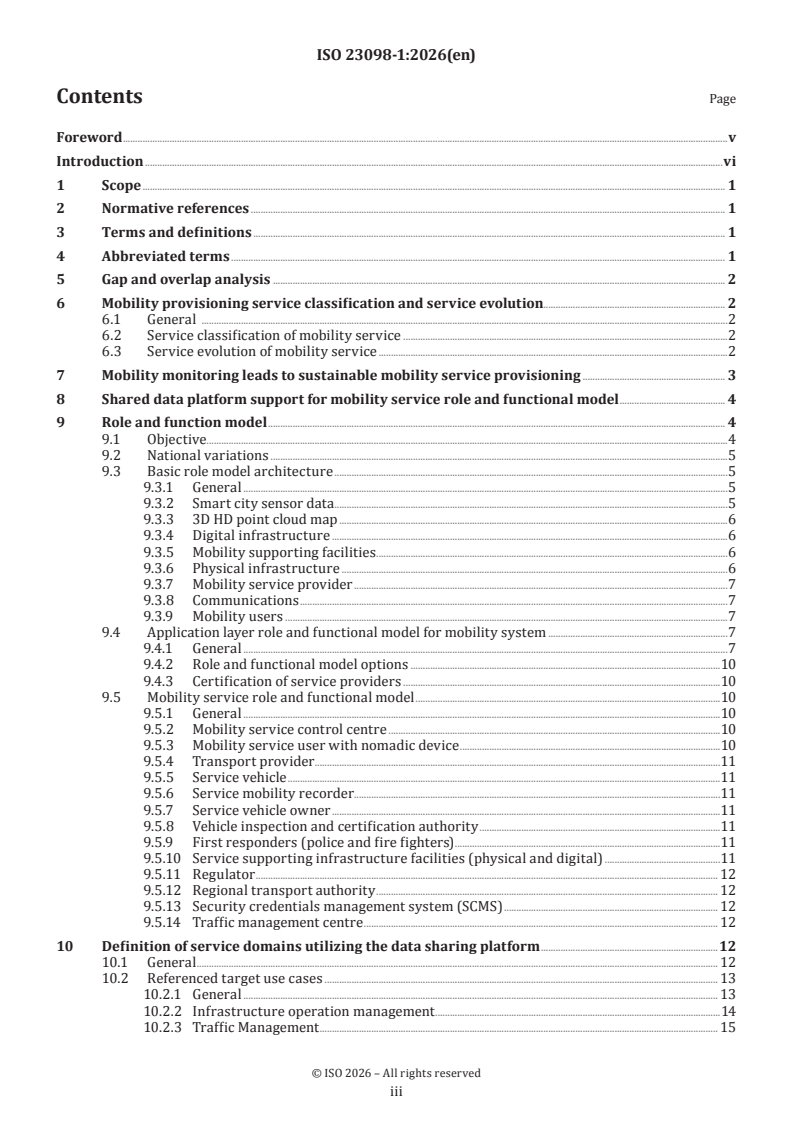
Contents Page
Foreword .v
Introduction .vi
1 Scope . 1
2 Normative references . 1
3 Terms and definitions . 1
4 Abbreviated terms . 1
5 Gap and overlap analysis . 2
6 Mobility provisioning service classification and service evolution. 2
6.1 General .2
6.2 Service classification of mobility service .2
6.3 Service evolution of mobility service .2
7 Mobility monitoring leads to sustainable mobility service provisioning . 3
8 Shared data platform support for mobility service role and functional model . 4
9 Role and function model . 4
9.1 Objective.4
9.2 National variations .5
9.3 Basic role model architecture .5
9.3.1 General .5
9.3.2 Smart city sensor data . . .5
9.3.3 3D HD point cloud map .6
9.3.4 Digital infrastructure .6
9.3.5 Mobility supporting facilities . .6
9.3.6 Physical infrastructure .6
9.3.7 Mobility service provider .7
9.3.8 Communications .7
9.3.9 Mobility users .7
9.4 Application layer role and functional model for mobility system .7
9.4.1 General .7
9.4.2 Role and functional model options .10
9.4.3 Certification of service providers .10
9.5 Mobility service role and functional model .10
9.5.1 General .10
9.5.2 Mobility service control centre .10
9.5.3 Mobility service user with nomadic device .10
9.5.4 Transport provider .11
9.5.5 Service vehicle .11
9.5.6 Service mobility recorder . .11
9.5.7 Service vehicle owner .11
9.5.8 Vehicle inspection and certification authority .11
9.5.9 First responders (police and fire fighters) .11
9.5.10 Service supporting infrastructure facilities (physical and digital) .11
9.5.11 Regulator . 12
9.5.12 Regional transport authority . 12
9.5.13 Security credentials management system (SCMS) . 12
9.5.14 Traffic management centre . 12
10 Definition of service domains utilizing the data sharing platform .12
10.1 General . 12
10.2 Referenced target use cases . 13
10.2.1 General . 13
10.2.2 Infrastructure operation management .14
10.2.3 Traffic Management . 15
iii
10.2.4 Road traffic management . 15
10.2.5 Enforcement .16
10.2.6 The role of service providers.17
Annex A (informative) Mobility monitoring and services by data sharing platform examples .20
Bibliography .23
iv
Foreword
ISO (the International Organization for Standardization) is a worldwide federation of national standards
bodies (ISO member bodies). The work of preparing International Standards is normally carried out through
ISO technical committees. Each member body interested in a subject for which a technical committee
has been established has the right to be represented on that committee. International organizations,
governmental and non-governmental, in liaison with ISO, also take part in the work. ISO collaborates closely
with the International Electrotechnical Commission (IEC) on all matters of electrotechnical standardization.
The procedures used to develop this document and those intended for its further maintenance are described
in the ISO/IEC Directives, Part 1. In particular, the different approval criteria needed for the different types
of ISO documents should be noted. This document was drafted in accordance with the editorial rules of the
ISO/IEC Directives, Part 2 (see www.iso.org/directives).
ISO draws attention to the possibility that the implementation of this document may involve the use of (a)
patent(s). ISO takes no position concerning the evidence, validity or applicability of any claimed patent
rights in respect thereof. As of the date of publication of this document, ISO had not received notice of (a)
patent(s) which may be required to implement this document. However, implementers are cautioned that
this may not represent the latest information, which may be obtained from the patent database available at
www.iso.org/patents. ISO shall not be held responsible for identifying any or all such patent rights.
Any trade name used in this document is information given for the convenience of users and does not
constitute an endorsement.
For an explanation of the voluntary nature of standards, the meaning of ISO specific terms and expressions
related to conformity assessment, as well as information about ISO's adherence to the World Trade
Organization (WTO) principles in the Technical Barriers to Trade (TBT), see www.iso.org/iso/foreword.html.
This document was prepared by Technical Committee ISO/TC 268, Sustainable cities and communities,
Subcommittee SC 2, Sustainable mobility and transportation.
A list of all parts in the ISO 23098 series can be found on the ISO website
Any feedback or questions on this document should be directed to the user’s national standards body. A
complete listing of these bodies can be found at www.iso.org/members.html.
v
Introduction
To achieve sustainable mobility and transportation for smart cities and communities using the International
Standards already developed by ISO, IEC and the Open Geospatial Consortium (OGC), there remain gaps that
need to be addressed through new International Standards on sustainable mobility and transportation.
International standardization of service roles and functional models is essential for the deployment of
comprehensive mobility services supporting users across land, water and air modes. These services facilitate
the movement of people, goods and resources within both urban and rural environments, including roads,
guided ways, waterways and airspaces.
ISO 16499-1 defines the role model for automated mobility.
Although several International Standards address aspects of mobility services, none currently define an
overall service role and functional model. This document aims to describe such a model to guide international
standard users in developing more efficient services without reinventing existing solutions. It aims to help
users understand how their work contributes to addressing challenges across the entire mobility service
ecosystem, leveraging both physical and digital infrastructure in smart cities and communities.
As various business use cases for mobility services continue to emerge and diversify, different methodologies
for presenting role and functional models may be used. Therefore, there is a need for a commonly understood
framework for representing these models. This document provides a common reference for service role and
functional model presentation, which future business cases can adopt as a baseline. It does not constrain the
development of new business models but rather supports and facilitates them.
The ISO 23098 series includes:
— ISO 23098-1
1)
— ISO 23098-2
2)
— ISO 23098-3
3)
— ISO 23098-4
1) Under preparation. Stage at the time of publication: ISO/CD 23098-2:2026.
2) Under preparation. Stage at the time of publication: ISO/DIS 23098-3:2026.
3) Under preparation. Stage at the time of publication: ISO/DIS 23098-4:2026.
vi
International Standard ISO 23098-1:2026(en)
Sustainable mobility and transportation — Mobility
monitoring and services by data sharing platform —
Part 1:
Role model
1 Scope
This document describes a basic role model of smart city mobility monitoring and services by data sharing
platform as a common platform for smart city instantiation. It provides a paradigm describing:
a) a framework architecture for the provision of a mobility monitoring service;
b) a description of the concept of operations and the role models;
c) a conceptual architecture between actors involved in the provision or receipt of mobility monitoring
service applications;
d) references for the key documents on which the architecture is based;
e) a taxonomy of the organization of generic procedures. It defines the basic role and functional model
of service for the introduction of mobility monitoring services including infrastructure facilities to
support mobility in urban and rural areas.
In-vehicle control system is not within the scope of this document.
This document is limited to the mobility monitoring services using physical and digital infrastructure.
2 Normative references
There are no normative references in this document.
3 Terms and definitions
No terms and definitions are listed in this document.
ISO and IEC maintain terminology databases for use in standardization at the following addresses:
— ISO Online browsing platform: available at https:// www .iso .org/ obp
— IEC Electropedia: available at https:// www .electropedia .org/
4 Abbreviated terms
AI artificial intelligence
EV electric vehicle
SCMS security credentials management system
5 Gap and overlap analysis
The following International Standards are for mechanisms for the data linkage of overall city data. This
document is for regulated and non-regulated services based upon those data linkages. Therefore, there are
no overlaps with those international standards, which are complementary to this document.
— ISO 37156
— ISO 37170
— ISO/TS 37172
6 Mobility provisioning service classification and service evolution
6.1 General
The mobility service classification and service evolution vision are described in this clause to explain the
current development and deployment situation of mobility services.
The purpose of the tables in 6.2 and 6.3 is to inform readers about the current development and deployment
situation of mobility services.
6.2 Service classification of mobility service
Service classification suggestions are shown in Table 1 below.
Service covers vast use cases as described in Table 1, including carrying people and goods, urban and rural
use, normal mobility uses, and emergency mobility use, such as during a pandemic or lockdown, where
human driving mobility cannot be used for moving people and goods.
Table 1 — Service classifications
Urban use Rural area
Mobility use [replac-
Used under
Modes of Mobility for for goods Mobility for ing ordi- Used under
pandemic
(Last/first
mobility people (including freight nary public emergency
status
mile use)
services) transport
(PT)]
Guideway A A A A A A A
Highway A A A A A A A
Water A A A A A A A
Air A A A A A A A
Key
A Applicable
6.3 Service evolution of mobility service
The expected service evolution is shown in Table 2 below. The deployment of the current service is for
limited use as the safety function and emergency case manoeuvring ability are not qualified as sufficiently
safe and reliable. However, the mobility system will evolve to a fully functional system in the future. As this
is anticipated, the mobility system service role and functional model of the mobility system, which defines
fully automated functions, is described.
Table 2 and Table 3 show where a current mobility service is within the full automation paradigm.
Table 2 — Mobility service evolution (current)
Shared and personal
Public transport use Integration with
Demand managed
use
Service type other modes of
use
(PT) transport
(Robot taxi)
Mobility for people C C C F
Mobility for goods C C C F
Dedicated lane use C C C F
General lane use C C C F
General services pur-
F F F F
poses
Key
C Current emerging status
F Future emerging status: reaching fully connected and automated mobility status
Table 3 — Mobility service evolution (future)
Service type Public trans- Shared and personal Demand managed Integration with
port use use use other modes of
transport
(PT) (Robot taxi)
Mobility for F F F F
people
Mobility for F F F F
goods
Dedicated F F F F
use area or
Mixed use
area
General F F F F
services pur-
poses
Key
F Future emerging status: reaching fully connected and automated mobility status
7 Mobility monitoring leads to sustainable mobility service provisioning
The concept of mobility monitoring for providing mobility services involves the use of a data sharing
platform to gather and analyse data related to transportation and mobility. This platform acts as a central
hub for collecting information from various sources, such as connected vehicles, public transportation
systems, GPS devices, mobile apps and other relevant sources.
This is an overview of how the mobility monitoring concept works:
Data collection: The data sharing platform collects data from different mobility sources, including vehicles,
transportation infrastructure and user devices. These data can include real-time location data, vehicle
speed, traffic conditions, public transportation schedules, user preferences and other relevant information.
Data integration: The collected data are integrated and organized within the platform, ensuring that they
can be easily accessed and analysed. This can involve data cleansing, international standardization and
transformation processes to create a unified data set.
Analysis and insights: The platform utilizes various analytical techniques, such as data mining, machine
learning and statistical modelling, to extract valuable insights from the integrated data. These insights can
help identify patterns, trends, and anomalies related to mobility, allowing for better decision-making and
optimization of services.
Service optimization: Based on the insights gained from the data analysis, mobility providers can optimize
their services. This can include adjusting routes, improving scheduling, enhancing the efficiency of public
transportation systems, or implementing demand-responsive services to better meet the needs of users.
Real-time updates and notifications: The platform enables real-time updates and notifications to users,
providing them with accurate and timely information about their transportation options. This can involve
informing users about traffic congestion, delays in public transportation, availability of alternative routes,
or personalized recommendations based on their preferences and historical travel patterns.
Data privacy and security: As mobility monitoring involves the collection and analysis of sensitive data,
privacy and security measures are crucial. The data sharing platform should be aware of data protection
policy requirements, ensuring the anonymization and encryption of personal information. Access controls
and authentication mechanisms should be in place to prevent unauthorized access or misuse of the data.
Collaborative ecosystem: The mobility monitoring concept promotes collaboration among different
stakeholders, including government agencies, transportation companies, urban planners and technology
providers. By sharing data and insights through the platform, these stakeholders can work together to
improve the overall mobility ecosystem, address transportation challenges and create more efficient and
sustainable transportation systems.
In summary, mobility monitoring through a data sharing platform enables the collection, integration, analysis
and utilization of data to enhance mobility services. By leveraging real-time data and insights, mobility
providers can optimize their operations, improve user experiences and contribute to the development of
smarter and more efficient transportation systems.
8 Shared data platform support for mobility service role and functional model
The mobility service is fully functional with the support from shared data platforms, such as safety
information provisioning, other mode mobility operation interactions, static signs, and dynamical digital
and physical facilities.
— For land use, kerb operation, see ISO TR 4448 series. Low speed automated driving system (LSADS)
can use kerbs for loading and unloading goods and people and the operation environment is carefully
considered for safer operation.
— For land use, management of electronic traffic regulations (METR), see ISO TR 24315-1. For the
efficient and safer operation of mobility systems, the electronic regulation information is given to the
vehicle, together with the safety information from infrastructure facilities, and the vehicle is operated
accordingly.
— Vehicle-to-everything (V2X) communication path between mobility vehicle and infrastructure (LTE, 5G
and beyond) is carefully designed and various communication paths between the mobility system and
infrastructure are in line with relevant International Standards.
— For categorizing land-use mobility system services based on infrastructure support platform utilization,
levels are defined according to level A (highest level: cooperative driving) through level E (basic level:
conventional infrastructure/no AV support), as developed by the EU INFRAMIX project. A technical
report issued by the EU INFRAMIX project proposes that automated mobility operation, according to the
service supporting infrastructure facilities (ISAD) concept, should be carefully studied. Adoption of this
concept is recommended for thorough discussion to classify the levels of support from infrastructure
facilities for automated driving (see Annex A).
9 Role and function model
9.1 Objective
This clause describes a generic role and functional model for the provision of mobility service. It provides
the general concept of role and functional model operations. This clause provides a role and functional model
definition and elaboration of the model at a conceptual level.
9.2 National variations
The definition of what comprises a mobility service application is an issue for national decision-making and
can vary from country to country. The instantiation of interoperable on-board (or nomadic devices, such
as smart phones) platforms for service application with common features is ideal, but it may vary from
country to country, as the provision of services. It is possible that certain countries mandate the use of such
a platform, while others offer it as an option to meet the requirements of the mobility service application
with minimum administration and paperwork (providing a good business case for operators to fit and use
the equipment). Certain countries may implement a single, government-operated, controlled, or contracted
service provider which is the single communication manager between the user and the service. Other
countries may provide a market-based solution with multiple service providers competing for the business
of vehicle operators.
9.3 Basic role model architecture
9.3.1 General
The role model concept architecture defined in ISO/TR 4445 is to be referred to as a baseline document.
Figure 1 shows the basic role model for mobility monitoring services for smart cities and communities.
NOTE 1 com: communications
NOTE 2 Smart city sensor includes information (nomadic device) from citizens.
Figure 1 — Basic model architecture for framework
9.3.2 Smart city sensor data
Smart city sensor data are collected by the smart city data aggregator, and it feeds those data to digital
infrastructure. The following are candidates for smart city sensor data:
— vehicle probe data from infrastructure sensors, vehicle onboard sensors;
— traffic counter data;
— weighing in motion (and onboard weighing motion) data and other enforcement data;
— toll data;
— CCTV camera captured video data;
— loop coil data;
— speed data from speed cameras;
— signal timing length and other parameters from central traffic control centre;
— vehicle breakdown data;
— other smart city sensor data.
9.3.3 3D HD point cloud map
Three-dimensional high definition (3D HD) point cloud map is created by the digital map provider in a smart
city, and it feeds those maps to digital infrastructure.
9.3.4 Digital infrastructure
Digital infrastructure: the data sharing platform should be created with public funds and operated by a
public/private partnership. In this role, the smart city sensor data, static, semi-dynamic and dynamic data
are automatically structured and integrated within a 3D HD map with the support of AI and other automated
data aggregation tools. The sensor data collected have different timing, unit, format and, therefore, such
automated tools should be employed. For data accuracy, the location referencing data and clock timing
methodologies, such as global navigation systems, broadcasting data and clock timing are essential. Other
location referencing technologies are available, such as radio frequency identification markings. Digital
infrastructure should be created using an open, internationally standardized application programming
interface (API) platform, so internationally standardized tools can be utilized for easy access by users.
9.3.5 Mobility supporting facilities
Mobility supporting facilities include battery charging facilities; dynamic charging facilities for electric
battery vehicles; physical infrastructure markings; physical traffic regulation signs; mobility monitoring
facilities; emergency responding service support facilities; traffic operation control centre facilities; fee
collection service facilities, such as road usage fee; battery EV charging facilities; online reservation and
online mobility usage fee payment facilities; other infrastructure platform facilities to support automated
mobility services. For the air and waterborne system, an AI traffic control centre is a key facility and each air
and waterborne vehicle needs to broadcast identification signals. For heavy air and water traffic, vehicle-to-
vehicle location data exchange becomes effective.
9.3.6 Physical infrastructure
Physical infrastructure encompasses tangible engineering facilities serving as the foundational carrier for
mobility services, including:
a) mobility space carriers, such as land-based facilities (vehicle parking facilities, passenger boarding/
disembarking facilities, roads, guided ways); water space for mobility; and air space for mobility;
b) mobility supporting facilities as described in 9.3.5;
c) basic support facilities, including power supply facilities, data transmission facilities and maintenance
facilities that ensure stable operation. Physical infrastructure interacts with digital infrastructure. It
provides hardware carriers and data sources for digital infrastructure, while digital infrastructure
enables operational optimization and status monitoring of physical infrastructure through data
analysis.
9.3.7 Mobility service provider
The role of a mobility service provider is to provide mobility services to users in smart cities and
communities. This service can be provided by the up and running digital infrastructure, which is refreshed
and enriched by the digital infrastructure role in the smart cities and communities. AI is an effective tool
for automated mobility data structuring. An enforcement report should be produced and can be used by the
enforcement agencies. Service user fees are a key factor in ensuring the sustainability of service provider
operations, and a subscription-based business model is therefore recommended.
9.3.8 Communications
Communication is a vital role that connects relevant roles. The emerging 5G technologies are candidates
for the role of smart city communication, which has low latency, high data capacity and multiple access.
Low earth orbit satellite systems and 6G cellular systems are also important candidates for smart city
communication media.
9.3.9 Mobility users
Smart city mobility users are connected physically and digitally with mobility service providers.
9.4 Application layer role and functional model for mobility system
9.4.1 General
The role model concept defined in ISO/TR 4445 is shown in Figure 2 below for reference only. This figure
describes all roles in smart city mobility service.
Figure 2 — Application layer role and functional model architecture using ISO/TR 4445
ISO TR 4445 only deals with road transport, and this document covers land, water and air transport.
Therefore, the road authority should be read as "road/water/air transport authority", as shown in Figures 3
and 4 below.
Figure 3 — Modified role and functional model architecture
Figure 4 — Mobility system role and functional model architecture
9.4.2 Role and functional model options
For the requirement of the role and functional model, it shall be possible for a mobility service application
user to use the services of different service providers in different geographical areas, or for the provision
of different services within the same geographical area. In these circumstances, where there is a market
of competing service providers, the solution may be expected to be that the users choose a single service
provider, who provides and maintains the service application of a nomadic device (such as a smart phone)
and delivers all services to which the user chooses to subscribe to. Other options are possible, but those
should be able to support the peer conceptual role and functional model.
9.4.3 Certification of service providers
The service provider can be certified by a regional regulator, and so some form of certification authority
(regulatory) role can form part of the role and functional model, but the role can be instantiated differently
by different jurisdictions. The vehicle inspection and certification can be performed by a designated party.
9.5 Mobility service role and functional model
9.5.1 General
This clause considers the roles of the actors and their interrelationship in greater detail, and their
relationship to the provision of the mobility service. Figure 5 below shows the functional model.
Figure 5 — Role and functional model architecture
9.5.2 Mobility service control centre
The service control centre is the body that monitors and takes emergency service controls on the vehicle
through service mobility recorder. The service user uses the service, through a service control centre, for
booking. External (outside of service) data sharing can be done through this service control centre. The
emergency support request can be issued from this centre to first responders. The cyber security measures
shall be used for security provision. The transport providers report service operation to this control centre.
9.5.3 Mobility service user with nomadic device
The user is the body that uses the mobility service. Booking and payment can be done through the service
control centre by using the nomadic device, which is carried by the user.
9.5.4 Transport provider
The transport provider is the body that provides mobility service, and it operates and maintains service
vehicles. Operational reports can be reported to the control centre. The transport providers can be selected
and audited by an inspection/certification authority, and the service vehicles can be frequently inspected
by that authority for safety operation. The corresponding authority can examine detailed procedures and
regulations of transport space operation. The service vehicle can use the transport space with a permit
issued by the regulator (municipalities) for picking up, loading people and goods, and getting off/unloading
people and goods.
9.5.5 Service vehicle
The system service vehicle is a component that provides service rides. The system service vehicles can be
property of the service vehicle owner, who provides the service vehicle for the service ride. The service
vehicle can be equipped with a service mobility recorder. In an emergency case, the service vehicle can be
treated by first responders. The system service vehicle can be operated with infrastructure support through
service infrastructure facilities that are appropriate for designated levels defined in the rules created and
regulated by the corresponding road authority. The interaction between the infrastructure and service
vehicle is essential for safe service. The support can include road signs, road markings, V2X communication-
based information, providing facilities, transport space-embedded supporting facilities, such as road
embedded electronic guided wires and air traffic control facilities.
9.5.6 Service mobility recorder
The service mobility recorder is a component that is equipped and installed or attached to the service
vehicle, and it provides operational support from the service control centre. The control centre monitors
vehicle operation and controls, as needed, for emergency cases.
9.5.7 Service vehicle owner
The service vehicle owner is a body that owns the service vehicles and provides them for service by lending
vehicles to the transport provider.
9.5.8 Vehicle inspection and certification authority
The vehicle inspection and certification authority can be a body that appoints and audits the system
transport provider. This authority can perform the safety facility/measure inspection of the service vehicle.
The regional managing authority can appoint this authority.
9.5.9 First responders (police and fire fighters)
The first responders (police and fire fighters) are a body that supports service in case of emergency upon
request from the service control centre.
9.5.10 Service supporting infrastructure facilities (physical and digital)
The service supporting infrastructure facilities (ISAD) (physical and digital) are components that support
service vehicles from infrastructure. The physical service supporting infrastructure includes transport
space signs, markings and transport space embedded devices. Digital service supporting infrastructure
includes information provisioning services, such as METR, a digital infrastructure database created, owned
and maintained by the regional transport authority and traffic management centre. The regional transport
authority and traffic management centre interact to ensure the safe operation of transport vehicles by
providing safety information through vehicle-to-infrastructure (V2I) communication facilities installed on
the infrastructure side.
9.5.11 Regulator
The regulator can be an entity that maintains transport operations, including the adjacent space where the
space is used by service vehicles for loading and unloading people and goods. This use can be operated and
maintained, and the use of this space can be permitted only for designated vehicles. Permits can be issued to
the transport provider.
9.5.12 Regional transport authority
The regional transport authority can be an entity that maintains safe transport operation and appoints
and audits vehicle inspection and the certification authority. It can own, operate and maintain service
supporting infrastructure facilities. Interaction with traffic management is anticipated, and it provides
efficient infrastructure support for mobility services.
9.5.13 Security credentials management system (SCMS)
The SCMS is a component that provides security provisioning for mobility services. The SCMS for service can
be created by the regional transport authority, and the SCMS service can be provided to the service control
centre. The security certificate issued by the SCMS can be installed in vehicles at the manufacturing factory
and refreshed frequently during operation through the control centre using over-the-air update functions.
9.5.14 Traffic management centre
The traffic management centre is a body that owns, operates and maintains the mobility service supporting
infrastructure facilities. It interacts with the regional transport authority.
10 Definition of service domains utilizing the data sharing platform
10.1 General
The data sharing platform should support the implementation of mobility service applications needed for
smart cities and communities. For example, data sharing can be implemented to assess infrastructure needs
and improve safety within cities.
Possible service applications can include:
— critical safety information provision: regulated service;
— safety driving support: unregulated service;
— infrastructure planning: regulated service;
— dynamic traffic management: regulated service;
— traffic rule enforcement: regulated service;
— dynamic map updates: unregulated service;
— emergency evacuation support: unregulated service;
— public transport user information service.
Where applicable, the definitions of regulated and unregulated services are those already established by
local authorities.
For deployment, further research or development of data sharing is recommended.
10.2 Referenced target use cases
10.2.1 General
Mobility service applications largely rely upon the data sharing platform. Data collected through the
mobility applications and services consist of smart city data that are held and maintained by the smart city
data management entity. Those mobility services can be grouped into two categories: the regulated services
provided by jurisdiction or the road operator, and the unregulated services by the public and private service
providers. The applications offered and managed by the jurisdiction, or the road operator, can be classified
in four groups including: infrastructure operation management, traffic management, road traffic operation
management and enforcement. The applications provided by the service providers can be offered through
public or private sectors. The classification of a service and applications is shown in Figure 6 below.
Figure 6 — Classification of smart city intelligence transport system (ITS) service and its
applications
Numerous emerging mobility service applications for a smart city deployment are growing rapidly. The
following list provides examples of those mobility applications:
— traffic management applications to ease traf
...