

ISO/PRF 23174-1
(Main)Sustainable mobility and transportation — Smart operation and maintenance — Part 1: Service role architecture
- Abstract
This document is part of a series and defines general rules including role and function models for guiding and to introduce, build and evaluate smart operation and maintenance in various types of urban mobility and transportation. This document mainly describes some basic requirements of smart operation and maintenance of urban transportation system for sustainable development. Mainly includes: a) Terms and definitions b) Basic function settings c) Basic support conditions d) Roles and function models The basic requirements specified in this document are applicable to sustainable cities that urgently need to improve the operation and maintenance efficiency of transportation systems, especially super-large cities and cities with limited compact land resources and high requirements for efficiency
- Status
- Not Published
- Current Stage
- 5020 - FDIS ballot initiated: 2 months. Proof sent to secretariat
- Start Date
- 27-Oct-2026
- Completion Date
- 31-Oct-2026
Buy Documents
ISO/PRF 23174-1 - Sustainable mobility and transportation — Smart operation and maintenance — Part 1: Service role architecture
REDLINE ISO/PRF 23174-1 - Sustainable mobility and transportation — Smart operation and maintenance — Part 1: Service role architecture
Buy Documents
ISO/PRF 23174-1 - Sustainable mobility and transportation — Smart operation and maintenance — Part 1: Service role architecture
REDLINE ISO/PRF 23174-1 - Sustainable mobility and transportation — Smart operation and maintenance — Part 1: Service role architecture
Get Certified
Connect with accredited certification bodies for this standard

BSI Group
BSI (British Standards Institution) is the business standards company that helps organizations make excellence a habit.

Bureau Veritas
Bureau Veritas is a world leader in laboratory testing, inspection and certification services.

DNV
DNV is an independent assurance and risk management provider.
Sponsored listings
Frequently Asked Questions
ISO/PRF 23174-1 is a draft published by the International Organization for Standardization (ISO). Its full title is "Sustainable mobility and transportation — Smart operation and maintenance — Part 1: Service role architecture". This standard covers: This document is part of a series and defines general rules including role and function models for guiding and to introduce, build and evaluate smart operation and maintenance in various types of urban mobility and transportation. This document mainly describes some basic requirements of smart operation and maintenance of urban transportation system for sustainable development. Mainly includes: a) Terms and definitions b) Basic function settings c) Basic support conditions d) Roles and function models The basic requirements specified in this document are applicable to sustainable cities that urgently need to improve the operation and maintenance efficiency of transportation systems, especially super-large cities and cities with limited compact land resources and high requirements for efficiency
This document is part of a series and defines general rules including role and function models for guiding and to introduce, build and evaluate smart operation and maintenance in various types of urban mobility and transportation. This document mainly describes some basic requirements of smart operation and maintenance of urban transportation system for sustainable development. Mainly includes: a) Terms and definitions b) Basic function settings c) Basic support conditions d) Roles and function models The basic requirements specified in this document are applicable to sustainable cities that urgently need to improve the operation and maintenance efficiency of transportation systems, especially super-large cities and cities with limited compact land resources and high requirements for efficiency
ISO/PRF 23174-1 is classified under the following ICS (International Classification for Standards) categories: 13.020.20 - Environmental economics. Sustainability; 35.240.60 - IT applications in transport. The ICS classification helps identify the subject area and facilitates finding related standards.
ISO/PRF 23174-1 is available in PDF format for immediate download after purchase. The document can be added to your cart and obtained through the secure checkout process. Digital delivery ensures instant access to the complete standard document.
Standards Content (Sample)
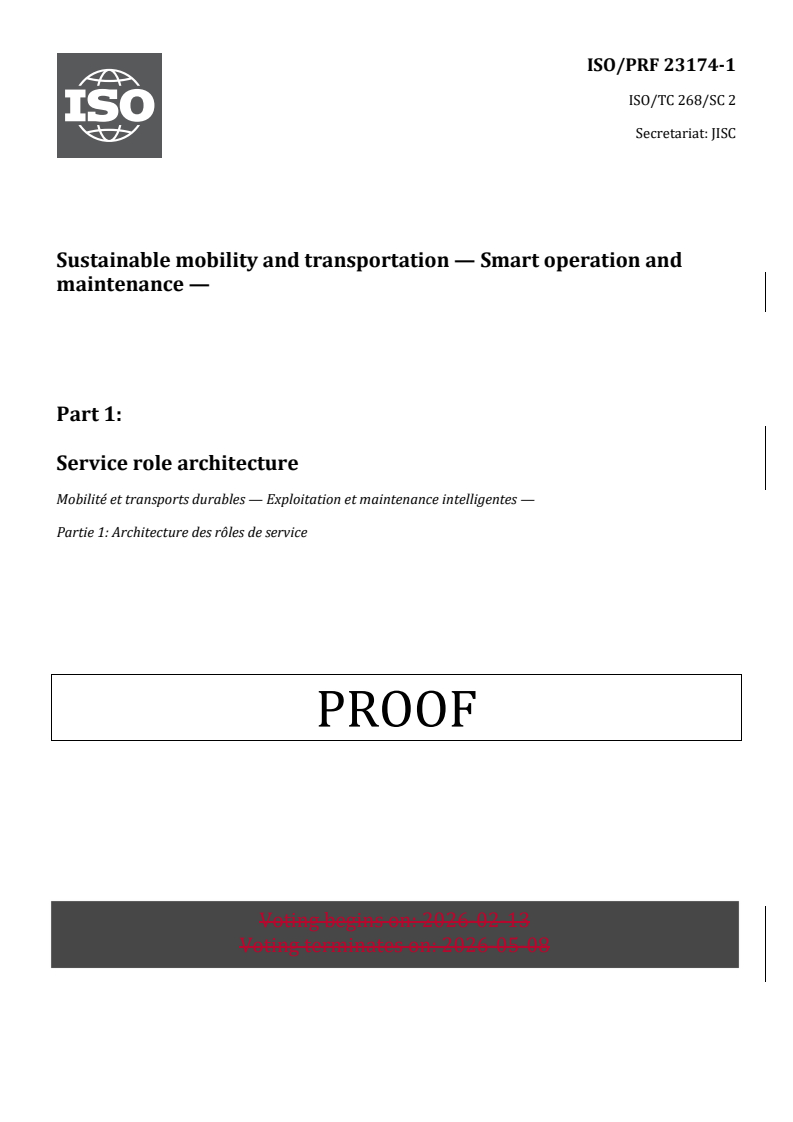
International
Standard
ISO 23174-1
First edition
Sustainable mobility and
transportation — Smart operation
and maintenance —
Part 1:
Service role architecture
Mobilité et transports durables — Exploitation et maintenance
intelligentes —
Partie 1: Architecture des rôles de service
PROOF/ÉPREUVE
Reference number
ISO 23174-1:2026(en) © ISO 2026
ISO 23174-1:2026(en)
© ISO 2026
All rights reserved.
This ISO publication is protected by copyright and is owned by ISO and/or its licensors.
The content of this ISO publication is provided under licence, not sold. Use is subject to the applicable licence terms issued by ISO,
an ISO member body, or an authorized third-party distributor.
Except as required for implementation or expressly permitted by a separate licence, no part of this ISO publication may be
reproduced, distributed, modified, used, or made available in any form or by any means – electronic or mechanical, including
photocopying, scanning, recording, or posting on internal or external digital platforms.
Any use beyond the scope of the granted rights is prohibited and may result in legal action.
ISO copyright office
CP 401 • CH-1214 Vernier, Geneva
Phone: +41 22 749 01 11
Email: copyright@iso.org
Website: www.iso.org
Published in Switzerland
PROOF/ÉPREUVE
ii
ISO 23174-1:2026(en)
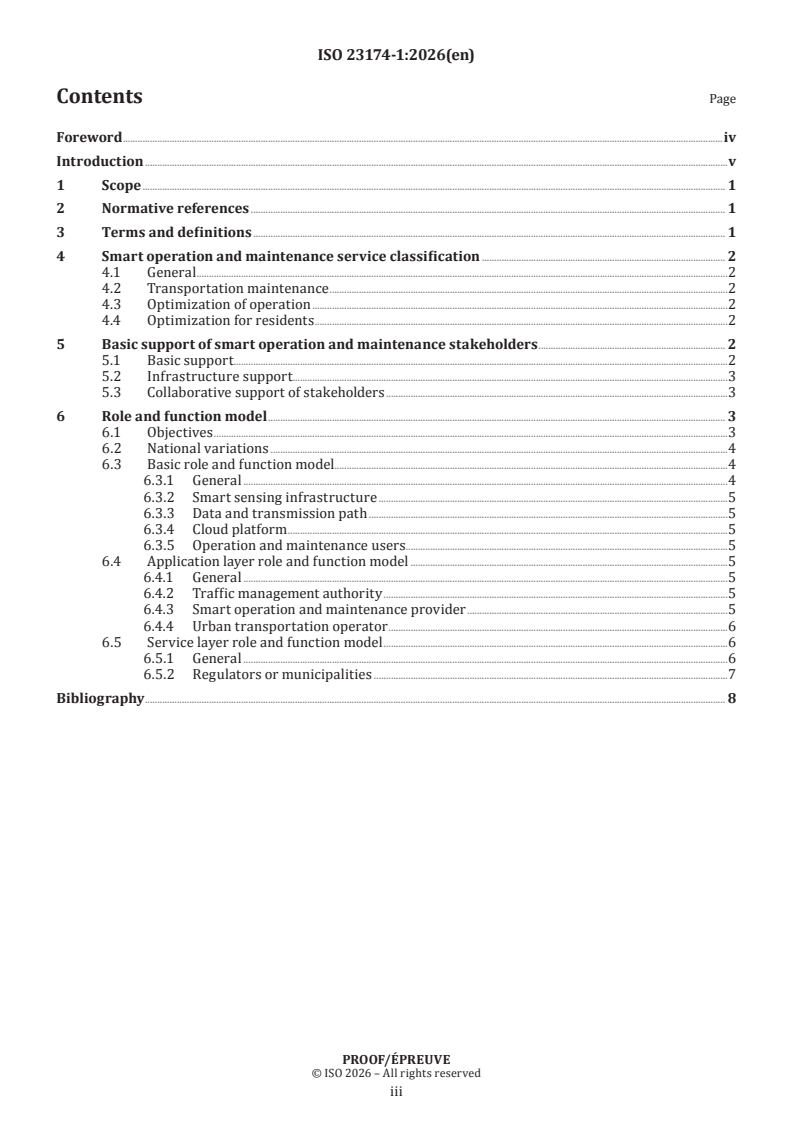
Contents Page
Foreword .iv
Introduction .v
1 Scope . 1
2 Normative references . 1
3 Terms and definitions . 1
4 Smart operation and maintenance service classification . 2
4.1 General .2
4.2 Transportation maintenance .2
4.3 Optimization of operation .2
4.4 Optimization for residents .2
5 Basic support of smart operation and maintenance stakeholders . 2
5.1 Basic support.2
5.2 Infrastructure support.3
5.3 Collaborative support of stakeholders .3
6 Role and function model . 3
6.1 Objectives .3
6.2 National variations .4
6.3 Basic role and function model.4
6.3.1 General .4
6.3.2 Smart sensing infrastructure .5
6.3.3 Data and transmission path .5
6.3.4 Cloud platform .5
6.3.5 Operation and maintenance users .5
6.4 Application layer role and function model .5
6.4.1 General .5
6.4.2 Traffic management authority .5
6.4.3 Smart operation and maintenance provider .5
6.4.4 Urban transportation operator .6
6.5 Service layer role and function model .6
6.5.1 General .6
6.5.2 Regulators or municipalities .7
Bibliography . 8
PROOF/ÉPREUVE
iii
ISO 23174-1:2026(en)
Foreword
ISO (the International Organization for Standardization) is a worldwide federation of national standards
bodies (ISO member bodies). The work of preparing International Standards is normally carried out through
ISO technical committees. Each member body interested in a subject for which a technical committee
has been established has the right to be represented on that committee. International organizations,
governmental and non-governmental, in liaison with ISO, also take part in the work. ISO collaborates closely
with the International Electrotechnical Commission (IEC) on all matters of electrotechnical standardization.
The procedures used to develop this document and those intended for its further maintenance are described
in the ISO/IEC Directives, Part 1. In particular, the different approval criteria needed for the different types
of ISO documents should be noted. This document was drafted in accordance with the editorial rules of the
ISO/IEC Directives, Part 2 (see www.iso.org/directives).
ISO draws attention to the possibility that the implementation of this document may involve the use of (a)
patent(s). ISO takes no position concerning the evidence, validity or applicability of any claimed patent
rights in respect thereof. As of the date of publication of this document, ISO had not received notice of (a)
patent(s) which may be required to implement this document. However, implementers are cautioned that
this may not represent the latest information, which may be obtained from the patent database available at
www.iso.org/patents. ISO shall not be held responsible for identifying any or all such patent rights.
Any trade name used in this document is information given for the convenience of users and does not
constitute an endorsement.
For an explanation of the voluntary nature of standards, the meaning of ISO specific terms and expressions
related to conformity assessment, as well as information about ISO's adherence to the World Trade
Organization (WTO) principles in the Technical Barriers to Trade (TBT), see www.iso.org/iso/foreword.html.
This document was prepared by Technical Committee ISO/TC 268, Sustainable cities and communities,
Subcommittee SC 2, Sustainable mobility and transportation.
[1]
A list of all parts in the ISO 23174 (all parts) series can be found on the ISO website.
Any feedback or questions on this document should be directed to the user’s national standards body. A
complete listing of these bodies can be found at www.iso.org/members.html.
PROOF/ÉPREUVE
iv
ISO 23174-1:2026(en)
Introduction
With the development of big data, artificial intelligence and other technologies, urban transportation is
striding into the intelligent stage. Building a safe, reliable, economical and efficient transportation system is
the common development goal of cities all over the world.
In order to meet the requirements of modern urban population growth and residents' travel safety,
convenience and reliability, there is a need for better management methods that can improve residents' travel
experience, ensure operation safety, reduce maintenance costs and promote environmental protection, so
as to support urban sustainable development and improve the level of urban transportation system.
Smart operation and maintenance is usually an intelligent method, aims to make urban transportation
realize advanced smart maintenance, avoids under maintenance and over maintenance to the greatest
extent, improves operation and maintenance efficiency and reduces costs.
At present, smart operation and maintenance of various types of urban transportation in the world have
great commonalities in technology, system composition and implementation methods. Under the framework
of intelligent surveillance, big data analysis and maintenance decision-making, the ultimate goals are
basically the same: to finally realize the smart control and optimization of real time in transport operation,
and improve passenger service quality and maintenance efficiency.
[2]
On the basis of ISO 37101 , a series of International Standards can be developed to guide the introduction,
construction and evaluation of smart operation and maintenance in various types of urban mobility and
transportation.
This document aims to provide basic guidelines and requirements, including basic support conditions,
roles and functional models, framework and service grading, basic process, application and evaluation,
etc., promoting the establishment of an economic, efficient and environment-friendly urban transportation
system that meets the needs of stakeholders.
PROOF/ÉPREUVE
v
International Standard ISO 23174-1:2026(en)
Sustainable mobility and transportation — Smart operation
and maintenance —
Part 1:
Service role architecture
1 Scope
This document defines general rules, including roles and function models to guide and introduce, build and
evaluate smart operation and maintenance in various types of urban mobility and transportation.
This document describes basic requirements of smart operation and maintenance of the urban transportation
system for sustainable development.
The basic guidelines and requirements specified in this document are applicable to sustainable cities that
urgently need to improve the operation and maintenance efficiency of transportation systems, especially
super-large cities and cities with limited compact land resources and high requirements for efficiency.
2 Normative references
The following documents are referred to in the text in such a way that some or all of their content constitutes
requirements of this document. For dated references, only the edition cited applies. For undated references,
the latest edition of the referenced document (including any amendments) applies.
ISO 37153, Smart community infrastructures — Maturity model for assessment and improvement
ISO 37155-1, Framework for integration and operation of smart community infrastructures — Part 1:
Recommendations for considering opportunities and challenges from interactions in smart community
infrastructures from relevant aspects through the life cycle
ISO 37155-2, Framework for integration and operation of smart community infrastructures — Part 2: Holistic
approach and the strategy for development, operation and maintenance of smart community infrastructure
...
ISO/TC 268/SC 2
Secretariat: JISC
Sustainable mobility and transportation — Smart operation and
maintenance —
Part 1:
Service role architecture
Mobilité et transports durables — Exploitation et maintenance intelligentes —
Partie 1: Architecture des rôles de service
PROOF
VVVVoooottttiiiing bng bng bng beeeegigigiginsnsnsns o o o on:n:n:n: 202 202 202 2026666----02020202----13131313
VoVoVoVotintintintingggg t t t tererererminminminminatatatateseseses o o o onnnn:::: 2222000022226666----00005555----08080808
ISO/DISPRF 23174-1:2026(en)
All rights reserved.
This ISO publication is protected by copyright and is owned by ISO and/or its licensors.
The content of this ISO publication is provided under licence, not sold. Use is subject to the applicable licence terms issued
by ISO, an ISO member body, or an authorized third-party distributor.
Except as required for implementation or expressly permitted by a separate licence, no part of this ISO publication may
be reproduced, distributed, modified, used, or made available in any form or by any means – electronic or mechanical,
including photocopying, scanning, recording, or posting on internal or external digital platforms.
Any use beyond the scope of the granted rights is prohibited and may result in legal action.
ISO copyright office
CP 401 • CH-1214 Vernier, Geneva
Phone: + 41 22 749 01 11
Email: copyright@iso.org
Website: www.iso.org
Published in Switzerland
ii
ISO/DISPRF 23174-1:2026(en)
Contents
Foreword . iv
Introduction . v
1 Scope . 1
2 Normative references . 1
3 Terms and definitions . 1
4 Smart operation and maintenance service classification . 2
4.1 General . 2
4.2 Transportation maintenance . 2
4.3 Optimization of operation . 2
4.4 Optimization for residents . 2
5 Basic support of smart operation and maintenance stakeholders . 2
5.1 Basic support . 2
5.2 Infrastructure support . 3
5.3 Collaborative support of stakeholders . 3
6 Role and function model . 3
6.1 Objectives . 3
6.2 National variations . 4
6.3 Basic role and function model . 4
6.4 Application layer role and function model . 6
6.5 Service layer role and function model . 7
Bibliography . 9
iii
ISO/DISPRF 23174-1:2026(en)
Foreword
ISO (the International Organization for Standardization) is a worldwide federation of national standards
bodies (ISO member bodies). The work of preparing International Standards is normally carried out through
ISO technical committees. Each member body interested in a subject for which a technical committee has been
established has the right to be represented on that committee. International organizations, governmental and
non-governmental, in liaison with ISO, also take part in the work. ISO collaborates closely with the
International Electrotechnical Commission (IEC) on all matters of electrotechnical standardization.
The procedures used to develop this document and those intended for its further maintenance are described
in the ISO/IEC Directives, Part 1. In particular, the different approval criteria needed for the different types of
ISO documents should be noted. This document was drafted in accordance with the editorial rules of the
ISO/IEC Directives, Part 2 (see www.iso.org/directives).
ISO draws attention to the possibility that the implementation of this document may involve the use of (a)
patent(s). ISO takes no position concerning the evidence, validity or applicability of any claimed patent rights
in respect thereof. As of the date of publication of this document, ISO had not received notice of (a) patent(s)
which may be required to implement this document. However, implementers are cautioned that this may not
represent the latest information, which may be obtained from the patent database available at
www.iso.org/patents. ISO shall not be held responsible for identifying any or all such patent rights.
Any trade name used in this document is information given for the convenience of users and does not
constitute an endorsement.
For an explanation of the voluntary nature of standards, the meaning of ISO specific terms and expressions
related to conformity assessment, as well as information about ISO's adherence to the World Trade
Organization (WTO) principles in the Technical Barriers to Trade (TBT), see www.iso.org/iso/foreword.html.
This document was prepared by Technical Committee ISO/TC 268, Sustainable cities and communities,
Subcommittee SC 2, Sustainable mobility and transportation.
A list of all parts in the ISO 23174 (all parts) ISO 23174 (all parts) series can be found on the ISO website.
Any feedback or questions on this document should be directed to the user’s national standards body. A
complete listing of these bodies can be found at www.iso.org/members.html.
iv
ISO/DISPRF 23174-1:2026(en)
Introduction
With the development of big data, artificial intelligence and other technologies, urban transportation is
striding into the intelligent stage. Building a safe, reliable, economical and efficient transportation system is
the common development goal of cities all over the world.
In order to meet the requirements of modern urban population growth and residents' travel safety,
convenience and reliability, there is a need for better management methods that can improve residents' travel
experience, ensure operation safety, reduce maintenance costs and promote environmental protection, so as
to support urban sustainable development and improve the level of urban transportation system.
Smart operation and maintenance is usually an intelligent method, aims to make urban transportation realize
advanced smart maintenance, avoids under maintenance and over maintenance to the greatest extent,
improves operation and maintenance efficiency and reduces costs.
At present, smart operation and maintenance of various types of urban transportation in the world have great
commonalities in technology, system composition and implementation methods. Under the framework of
intelligent surveillance, big data analysis and maintenance decision-making, the ultimate goals are basically
the same: to finally realize the smart control and optimization of real time in transport operation, and improve
passenger service quality and maintenance efficiency.
[2]
On the basis of ISO 37101 ,, a series of international standardsInternational Standards can be developed to
guide the introduction, construction and evaluation of smart operation and maintenance in various types of
urban mobility and transportation.
This document aims to provide basic guidelines and requirements, including basic support conditions, roles
and functional models, framework and service grading, basic process, application and evaluation, etc.,
promoting the establishment of an economic, efficient and environment-friendly urban transportation system
that meets the needs of stakeholders.
v
ISO/DISPRF 23174-1:2026(en)
Sustainable mobility and transportation — Smart operation and
maintenance —
Part 1:
Service role architecture
1 Scope
This document is part of a series and defines general rules, including roles and function models to guide and
introduce, build and evaluate smart operation and maintenance in various types of urban mobility and
transportation.
This document describes basic requirements of smart operation and maintenance of the urban transportation
system for sustainable development.
The basic guidelines and requirements specified in this document are applicable to sustainable cities that
urgently need to improve the operation and maintenance efficiency of transportation systems, especially
super-large cities and cities with limited compact land resources and high requirements for efficiency.
2 Normative references
The following documents are referred to in the text in such a way that some or all of their content constitutes
requirements of this document. For dated references, only the edition cited applies. For undated references,
the latest edition of the referenced document (including any amendments) applies.
ISO 37153, Smart community infrastructures — Maturity model for assessment and improvement
ISO 37155-1, Framework for integration and operation of smart community infrastructures — Part 1:
Recommendations for considering opportunities and challenges from interactions in smart community
infrastructures from relevant aspects through the life cycle
ISO 37155-2, Framework for integration and operation of smart community infrastructures — Part 2: Holistic
approach and the strategy for development, operation and maintenance of smart community infrastructures
3 Terms and definitions
For the purposes of this document, the following terms and definitions apply.
ISO and IEC maintain terminology databases for use in standardization at the following addresses:
— ISO Online browsing platform: available at https://www.iso.org/obp
— IEC Electropedia: available at https://www.electropedia.org/
3.1
smart operation and maintenance, noun
based on the application of big data and artificial intelligence technology, establish scientific operation and
maintenance strategies to achieve sustainable development of urban transportation.
ISO/DISPRF 23174-1:2026(en)
4 Smart operation and maintenance service classification
4.1 General
This subclauseclause clarifies the sustainable development support that smart operation and maintenance
can provide for urban transportation, and guides the planning, introduction, and construction in urban
developementdevelopment.
Considering the actual situationsituations of different citycities and transportation construction, there may be
differences in the functional settings. The factors leading to these differences include but are not limited to the
following:
a) traffic sizes or capacities;
b) traffic mode type;
c) current operation and maintenance costs;
d) traffic pressures in the target cities;
e) construction budget;
f) capabilities for building smart operation and maintenance.
Smart operation and maintenance should provide maintenance services, optimization of operation and
resident services for urban transportation.
4.2 Transportation maintenance
Smart operation and maintenance should be able to effectively optimize the o
...