

ISO 23308-3:2020
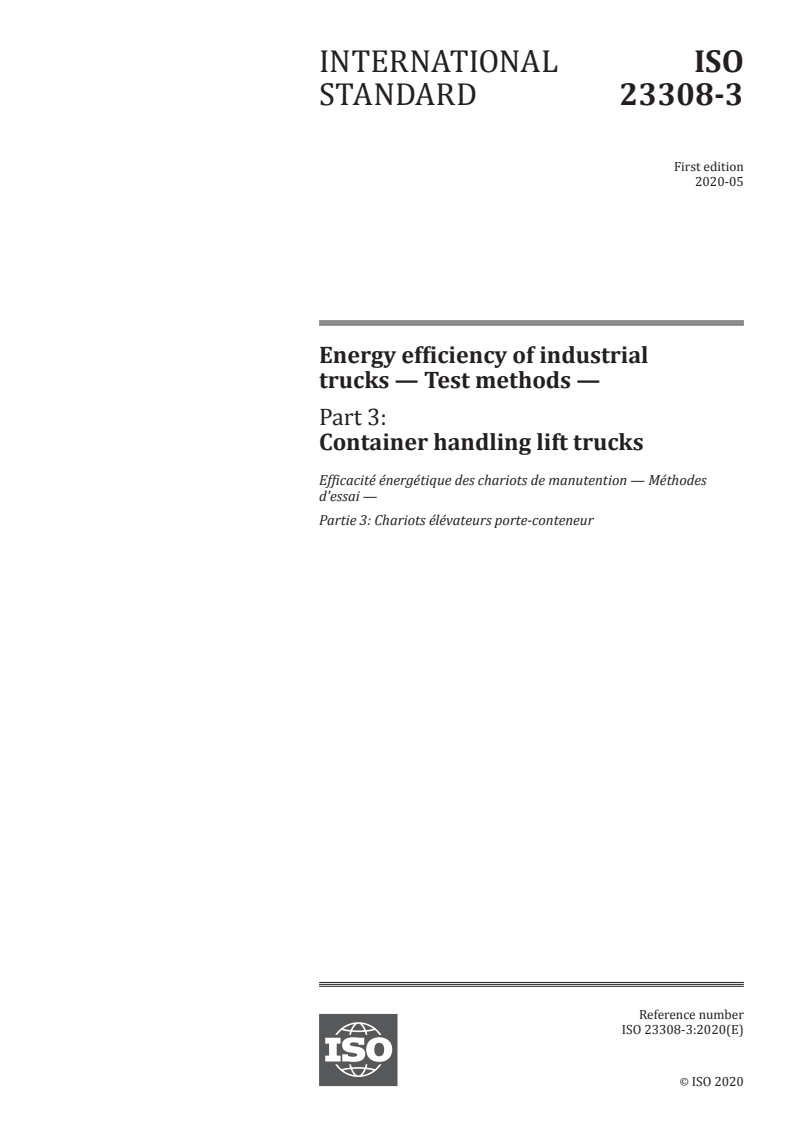
(Main)Energy efficiency of industrial trucks — Test methods — Part 3: Container handling lift trucks
General Information
- Abstract
This document specifies the method of energy consumption measurement for container handling lift trucks, as defined in ISO 5053‑1.
- Status
- Withdrawn
- Publication Date
- 28-May-2020
- Technical Committee
- ISO/TC 110/SC 5 - Sustainability
- Drafting Committee
- ISO/TC 110/SC 5/WG 1 - Energy efficiency
- Current Stage
- 9599 - Withdrawal of International Standard
- Start Date
- 06-Jun-2025
- Completion Date
- 29-Aug-2026
Buy Documents
ISO 23308-3:2020 - Energy efficiency of industrial trucks -- Test methods
ISO 23308-3:2020 - Energy efficiency of industrial trucks — Test methods — Part 3: Container handling lift trucks/29/2020
Overview
ISO 23308-3:2020 specifies a standardized test method for measuring energy consumption of container handling lift trucks. Part of the ISO 23308 series on energy efficiency of industrial trucks, this document defines test conditions, measurement procedures and an operating cycle tailored to container handlers (as defined in ISO 5053‑1). The standard helps quantify energy use for both laden and empty container handlers, enabling consistent comparison of truck energy efficiency across models and manufacturers.
Key topics and requirements
- Scope and purpose: Measurement of energy consumption for container handling lift trucks to assess energy efficiency.
- Test conditions:
- Travelling position requirements (operator visibility and container bottom ≤ 0.9 m above the seat index point per ISO 5353).
- Laden container handler tested with a test load of 70% of rated load.
- Empty container handler tested with a 20 ft container (height 2 591 mm, length 6.1 m) with minimum weight 2 200 kg.
- Variable-reach trucks: boom fully retracted in travelling position; simultaneous lift and extension permitted during testing.
- Measurement procedure:
- Measurement starts with the truck loaded, fully supported, twist locks engaged at travelling position (position A).
- Defined operating cycle with positions A → B → C → D → A, including lift/lower sequences and turning actions.
- Test parameters provided (example values): test duration 1 hour, travel distance 100 m per cycle layout, lift height about 4 m, and cycle rates (typical examples: 30 or 20 cycles/hour depending on configuration).
- Restrictions: travelling not permitted during lift/lowering or reach/retracting; loads are lifted/lowered without depositing.
- Test set-up specifics: references to positional requirements from ISO 22915 series for stability and additional requirements in ISO 23308-1.
Practical applications
- Manufacturers: benchmark energy performance during product development and validate efficiency claims.
- Fleet managers and end users: compare models and optimize procurement based on measured energy consumption for container handling operations.
- Market surveillance and certification bodies: verify compliance with energy measurement protocols.
- Consultants and service providers: perform standardized energy audits and efficiency assessments for port and intermodal equipment.
Related standards
- ISO 23308-1 (General test methods for industrial truck energy efficiency)
- ISO 5053-1 (Terminology and classification for industrial trucks)
- ISO 668 (Freight container classification and dimensions)
- ISO 22915-9 / ISO 22915-12 (Stability verification for container-handling trucks)
- VDI 2198 (basis for test cycles used in industry)
Keywords: energy efficiency, industrial trucks, container handling lift trucks, energy consumption measurement, ISO 23308-3, test methods, container handler testing.
Relations
- Effective Date
- 22-Oct-2022
Buy Documents
ISO 23308-3:2020 - Energy efficiency of industrial trucks -- Test methods
ISO 23308-3:2020 - Energy efficiency of industrial trucks — Test methods — Part 3: Container handling lift trucks/29/2020
Frequently Asked Questions
ISO 23308-3:2020 is a standard published by the International Organization for Standardization (ISO). Its full title is "Energy efficiency of industrial trucks — Test methods — Part 3: Container handling lift trucks". This standard covers: This document specifies the method of energy consumption measurement for container handling lift trucks, as defined in ISO 5053‑1.
This document specifies the method of energy consumption measurement for container handling lift trucks, as defined in ISO 5053‑1.
ISO 23308-3:2020 is classified under the following ICS (International Classification for Standards) categories: 53.060 - Industrial trucks. The ICS classification helps identify the subject area and facilitates finding related standards.
ISO 23308-3:2020 has the following relationships with other standards: It is inter standard links to ISO 23308-3:2025. Understanding these relationships helps ensure you are using the most current and applicable version of the standard.
ISO 23308-3:2020 is available in PDF format for immediate download after purchase. The document can be added to your cart and obtained through the secure checkout process. Digital delivery ensures instant access to the complete standard document.
Standards Content (Sample)
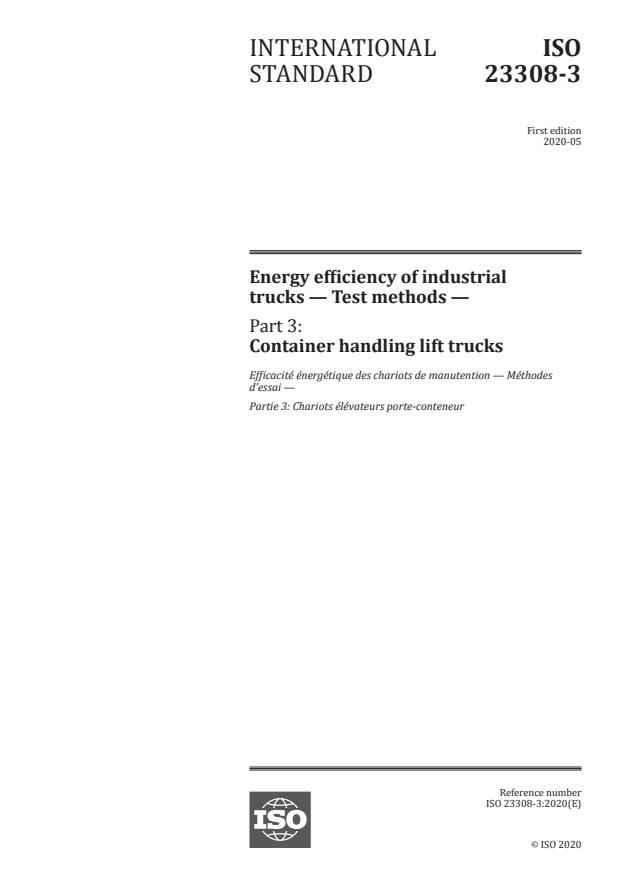
INTERNATIONAL ISO
STANDARD 23308-3
First edition
2020-05
Energy efficiency of industrial
trucks — Test methods —
Part 3:
Container handling lift trucks
Efficacité énergétique des chariots de manutention — Méthodes
d'essai —
Partie 3: Chariots élévateurs porte-conteneur
Reference number
©
ISO 2020
© ISO 2020
All rights reserved. Unless otherwise specified, or required in the context of its implementation, no part of this publication may
be reproduced or utilized otherwise in any form or by any means, electronic or mechanical, including photocopying, or posting
on the internet or an intranet, without prior written permission. Permission can be requested from either ISO at the address
below or ISO’s member body in the country of the requester.
ISO copyright office
CP 401 • Ch. de Blandonnet 8
CH-1214 Vernier, Geneva
Phone: +41 22 749 01 11
Fax: +41 22 749 09 47
Email: copyright@iso.org
Website: www.iso.org
Published in Switzerland
ii © ISO 2020 – All rights reserved
Contents Page
Foreword .iv
Introduction .v
1 Scope . 1
2 Normative references . 1
3 Terms and definitions . 1
4 Test conditions . 1
4.1 General . 1
4.2 Laden container handler . 1
4.3 Empty container handler . 2
5 Measurement procedure . 2
5.1 General . 2
5.2 Test set up . 2
5.3 Operating sequence . 2
Bibliography . 4
Foreword
ISO (the International Organization for Standardization) is a worldwide federation of national standards
bodies (ISO member bodies). The work of preparing International Standards is normally carried out
through ISO technical committees. Each member body interested in a subject for which a technical
committee has been established has the right to be represented on that committee. International
organizations, governmental and non-governmental, in liaison with ISO, also take part in the work.
ISO collaborates closely with the International Electrotechnical Commission (IEC) on all matters of
electrotechnical standardization.
The procedures used to develop this document and those intended for its further maintenance are
described in the ISO/IEC Directives, Part 1. In particular, the different approval criteria needed for the
different types of ISO documents should be noted. This document was drafted in accordance with the
editorial rules of the ISO/IEC Directives, Part 2 (see www .iso .org/ directives).
Attention is drawn to the possibility that some of the elements of this document may be the subject of
patent rights. ISO shall not be held responsible for identifying any or all such patent rights. Details of
any patent rights identified during the development of the document will be in the Introduction and/or
on the ISO list of patent declarations received (see www .iso .org/ patents).
Any trade name used in this document is information given for the convenience of users and does not
constitute an endorsement.
For an explanation of the voluntary nature of standards, the meaning of ISO specific terms and
expressions related to conformity assessment, as well as information about ISO's adherence to the
World Trade Organization (WTO) principles in the Technical Barriers to Trade (TBT) see www .iso .org/
iso/ foreword .html.
This document was prepared by Technical Committee ISO/TC 110, Industrial trucks, Subcommittee
SC 5, Sustainability.
Any feedback or questions on this document should be directed to the user’s national standards body. A
complete listing of these bodies can be found at www .iso .org/ members .html.
This document is intended to be used in conjunction with ISO 23308-1.
A list of all parts in the ISO 23308 series can be found on the ISO website.
iv © ISO 2020 – All rights reserved
IS
...
INTERNATIONAL ISO
STANDARD 23308-3
First edition
2020-05
Energy efficiency of industrial
trucks — Test methods —
Part 3:
Container handling lift trucks
Efficacité énergétique des chariots de manutention — Méthodes
d'essai —
Partie 3: Chariots élévateurs porte-conteneur
Reference number
©
ISO 2020
© ISO 2020
All rights reserved. Unless otherwise specified, or required in the context of its implementation, no part of this publication may
be reproduced or utilized otherwise in any form or by any means, electronic or mechanical, including photocopying, or posting
on the internet or an intranet, without prior written permission. Permission can be requested from either ISO at the address
below or ISO’s member body in the country of the requester.
ISO copyright office
CP 401 • Ch. de Blandonnet 8
CH-1214 Vernier, Geneva
Phone: +41 22 749 01 11
Fax: +41 22 749 09 47
Email: copyright@iso.org
Website: www.iso.org
Published in Switzerland
ii © ISO 2020 – All rights reserved
Contents Page
Foreword .iv
Introduction .v
1 Scope . 1
2 Normative references . 1
3 Terms and definitions . 1
4 Test conditions . 1
4.1 General . 1
4.2 Laden container handler . 1
4.3 Empty container handler . 2
5 Measurement procedure . 2
5.1 General . 2
5.2 Test set up . 2
5.3 Operating sequence . 2
Bibliography . 4
Foreword
ISO (the International Organization for Standardization) is a worldwide federation of national standards
bodies (ISO member bodies). The work of preparing International Standards is normally carried out
through ISO technical committees. Each member body interested in a subject for which a technical
committee has been established has the right to be represented on that committee. International
organizations, governmental and non-governmental, in liaison with ISO, also take part in the work.
ISO collaborates closely with the International Electrotechnical Commission (IEC) on all matters of
electrotechnical standardization.
The procedures used to develop this document and those intended for its further maintenance are
described in the ISO/IEC Directives, Part 1. In particular, the different approval criteria needed for the
different types of ISO documents should be noted. This document was drafted in accordance with the
editorial rules of the ISO/IEC Directives, Part 2 (see www .iso .org/ directives).
Attention is drawn to the possibility that some of the elements of this document may be the subject of
patent rights. ISO shall not be held responsible for identifying any or all such patent rights. Details of
any patent rights identified during the development of the document will be in the Introduction and/or
on the ISO list of patent declarations received (see www .iso .org/ patents).
Any trade name used in this document is information given for the convenience of users and does not
constitute an endorsement.
For an explanation of the voluntary nature of standards, the meaning of ISO specific terms and
expressions related to conformity assessment, as well as information about ISO's adherence to the
World Trade Organization (WTO) principles in the Technical Barriers to Trade (TBT) see www .iso .org/
iso/ foreword .html.
This document was prepared by Technical Committee ISO/TC 110, Industrial trucks, Subcommittee
SC 5, Sustainability.
Any feedback or questions on this document should be directed to the user’s national standards body. A
complete listing of these bodies can be found at www .iso .org/ members .html.
This document is intended to be used in conjunction with ISO 23308-1.
A list of all parts in the ISO 23308 series can be found on the ISO website.
iv © ISO 2020 – All rights reserved
IS
...