

ISO 16079-1:2026
(Main)Condition monitoring and diagnostics of wind turbines — Part 1: General guidelines
- Abstract
This document establishes basic guidelines for choosing condition monitoring methods for failure mode detection, diagnostics and prognostics of wind power plant components. This document does not specify IT systems used for condition monitoring of wind turbines.
- Status
- Published
- Publication Date
- 01-Jun-2026
- Technical Committee
- ISO/TC 108/SC 5 - Condition monitoring and diagnostics of machine systems
- Current Stage
- 6060 - International Standard published
- Start Date
- 02-Jun-2026
- Due Date
- 01-Nov-2026
- Completion Date
- 02-Jun-2026

ISO 16079-1:2026 is an International Standard published by ISO for condition monitoring and diagnostics of wind turbines. It gives basic guidelines for choosing condition monitoring methods for failure mode detection, diagnostics and prognostics of wind power plant components, mainly for manufacturers, operators and developers of condition monitoring systems.
What does ISO 16079-1:2026 specify?
ISO 16079-1:2026 specifies how to choose and prioritize condition monitoring methods for wind power plant components. It also states that it does not specify the information technology (IT) systems used for condition monitoring of wind turbines.
The document is organized into a short set of general clauses, followed by a worked methodology and informative annexes:
| Annex | What it covers |
|---|---|
| Annex A | P-F interval, ETTF and RUL |
| Annex B | Example of FMECA for a wind turbine drive train |
| Annex C | List of wind turbine components and their failure modes |
| Annex D | Brief introduction to the concept of FMECA |
Clause 4 covers the overall condition monitoring implementation, including set-up and diagnostic requirements. Clause 5 sets out the FMECA-based method used to identify and rank failure modes for monitoring.
What are the key requirements of ISO 16079-1:2026?
ISO 16079-1:2026 uses a risk-based selection process. The practical aim is to focus condition monitoring on the components and failure modes that matter most for availability, repair effort and damage avoidance.
Start with FMECA before FMSA
Clause 4 recommends a preliminary study based on failure modes, effects and criticality analysis (FMECA) before failure mode and symptoms analysis (FMSA). The FMECA output is then used as input to later, component-specific FMSA work in the ISO 16079 series. In practice, this means the team first decides what is worth monitoring, and only then defines the measurements and descriptors.
Rate component criticality using four factors
Clause 5.2 defines the component criticality factor as a combination of loss of production, repair effort, consequential damage and failure rate. Tables in the clause provide the rating criteria for each factor. In practice, this lets engineers separate a component that stops production from one that is merely inconvenient to repair.
Rate each failure mode with six criteria
Clause 5.3 defines the failure mode priority factor using failure mode type, ease of fault detection, repeatability of symptoms, ease of automatic monitoring, ease of detailed analysis and the P-F interval. The clause explains why well-documented, repeatable and measurable failure modes are better candidates for monitoring. In practice, this helps avoid spending effort on modes that are hard to detect reliably and would create false alarms.
Combine the two ratings into a monitoring priority number
Clause 5.1 and Clause 5.4 combine the criticality factor and the failure mode priority factor into a monitoring priority number. A normalized relative value is also given to make comparison easier across failure modes. In practice, this gives the maintenance or reliability team a repeatable way to decide where sensors, analytics and service attention give the best return.
Use the operating context when designing monitoring
Clause 4.1 says condition monitoring for wind turbines must account for remote locations, offshore access limits, variable loading, environmental effects and possible loss of network connectivity. It also notes that alarms should be reliable, descriptor measurements should be dependable, and faulty condition monitoring equipment must itself be detectable. In practice, this means the monitoring concept has to work in difficult field conditions, not only in the test room.
Treat AI as support, not a replacement
Clause 4.2 says artificial intelligence (AI) and machine learning can assist diagnostic specialists and prognostics, but they do not replace them. It also notes that condition monitoring detects actual faults, while AI works from estimated prediction, and that ISO/IEC 23894 can be used for AI risk management. In practice, this means AI can speed up triage and support RUL estimation, but a specialist still needs to handle complex diagnosis and tuning.
Use the timing concepts for planning
Annex A explains the P-F interval, estimated time to failure (ETTF) and remaining useful life (RUL). These concepts help the user judge how much time is available between fault detection and functional failure, and how much confidence and risk are involved. In practice, they support maintenance planning, parts ordering, crane scheduling and service timing.
What terms does ISO 16079-1:2026 define?
- Alarm - an operational signal or message that tells personnel a selected anomaly requiring corrective action has been found.
- Anomaly - an irregularity or abnormality in a system.
- Descriptor - a data item derived from raw or processed parameters or external observation, used to express symptoms and anomalies.
- Estimated time to failure (ETTF) - the estimated period from the current time to functional failure.
- P-F interval - the estimated period between the detection of a fault and functional failure.
- Remaining useful life (RUL) - the remaining time before system health falls below a failure threshold defined by the confidence of the ETTF and acceptable risk.
- Failure mode - the manner in which an equipment or machine failure can occur.
- FMECA - failure modes, effects and criticality analysis, used here to rank wind turbine components and failure modes for monitoring.
Who uses ISO 16079-1:2026?
ISO 16079-1:2026 is used by wind turbine manufacturers, wind power plant operators, condition monitoring system developers and diagnostic specialists. It is also relevant to maintenance planners, reliability engineers, service providers and buyers who need to specify what monitoring capability a turbine or fleet should have.
In practice, these users apply the document to:
- choose which components and failure modes to monitor first
- define measurement and descriptor needs
- set up a condition monitoring and diagnostics workflow
- support maintenance planning, spare parts planning and service scheduling
- compare monitoring options using a consistent priority method
What changed in ISO 16079-1:2026 from the previous edition?
ISO 16079-1:2026 is the second edition and cancels and replaces ISO 16079-1:2017. The document states that the main changes are editorial changes throughout the document.
Which standards are used with ISO 16079-1:2026?
- ISO 2041 - provides vibration, shock and condition monitoring vocabulary used in the definitions.
- ISO 13372 - provides core condition monitoring and diagnostics vocabulary and several source definitions.
- ISO 13379-1:2025 - provides the general data interpretation and diagnostics framework referenced for the V-model and the overall diagnostic approach.
- ISO 13381-1:2025 - provides prognostics guidance that underpins the ETTF concept used in the document and Annex A.
- ISO 16079-2 - the next part of the wind turbine series, focused on drivetrain monitoring.
- ISO/IEC 23894 - gives guidance for managing risks linked to AI development and use.
What does the ISO 16079-1:2026 document contain?
ISO 16079-1:2026 contains the general scope, vocabulary, an overview of condition monitoring implementation, and the FMECA-based selection method for wind turbine monitoring. Clause 4 describes the practical monitoring context, including alarms, descriptor measurements, ETTF and the role of AI.
Clause 5 contains the main rating method, including the formulas for the criticality factor, failure mode priority factor and monitoring priority number. Tables 1 and 2 provide the rating criteria, while the annexes add a timing explanation, a drive train example, a list of common components and failure modes, and a short introduction to FMECA.
Relations
- Effective Date
- 04-Nov-2023
Get Certified
Connect with accredited certification bodies for this standard

DNV
DNV is an independent assurance and risk management provider.

Lloyd's Register
Lloyd's Register is a global professional services organisation specialising in engineering and technology.
DNV Energy Systems
Energy and renewable energy certification.
Sponsored listings
Frequently Asked Questions
ISO 16079-1:2026 is a standard published by the International Organization for Standardization (ISO). Its full title is "Condition monitoring and diagnostics of wind turbines — Part 1: General guidelines". This standard covers: This document establishes basic guidelines for choosing condition monitoring methods for failure mode detection, diagnostics and prognostics of wind power plant components. This document does not specify IT systems used for condition monitoring of wind turbines.
This document establishes basic guidelines for choosing condition monitoring methods for failure mode detection, diagnostics and prognostics of wind power plant components. This document does not specify IT systems used for condition monitoring of wind turbines.
ISO 16079-1:2026 is classified under the following ICS (International Classification for Standards) categories: 27.180 - Wind turbine energy systems. The ICS classification helps identify the subject area and facilitates finding related standards.
ISO 16079-1:2026 has the following relationships with other standards: It is inter standard links to ISO 16079-1:2017. Understanding these relationships helps ensure you are using the most current and applicable version of the standard.
ISO 16079-1:2026 is available in PDF format for immediate download after purchase. The document can be added to your cart and obtained through the secure checkout process. Digital delivery ensures instant access to the complete standard document.
Standards Content (Sample)
International
Standard
ISO 16079-1
Second edition
Condition monitoring and
2026-06
diagnostics of wind turbines —
Part 1:
General guidelines
Surveillance et diagnostic d'état des éoliennes de production
d'électricité —
Partie 1: Lignes directrices générales
Reference number
© ISO 2026
All rights reserved. Unless otherwise specified, or required in the context of its implementation, no part of this publication may
be reproduced or utilized otherwise in any form or by any means, electronic or mechanical, including photocopying, or posting on
the internet or an intranet, without prior written permission. Permission can be requested from either ISO at the address below
or ISO’s member body in the country of the requester.
ISO copyright office
CP 401 • Ch. de Blandonnet 8
CH-1214 Vernier, Geneva
Phone: +41 22 749 01 11
Email: copyright@iso.org
Website: www.iso.org
Published in Switzerland
ii
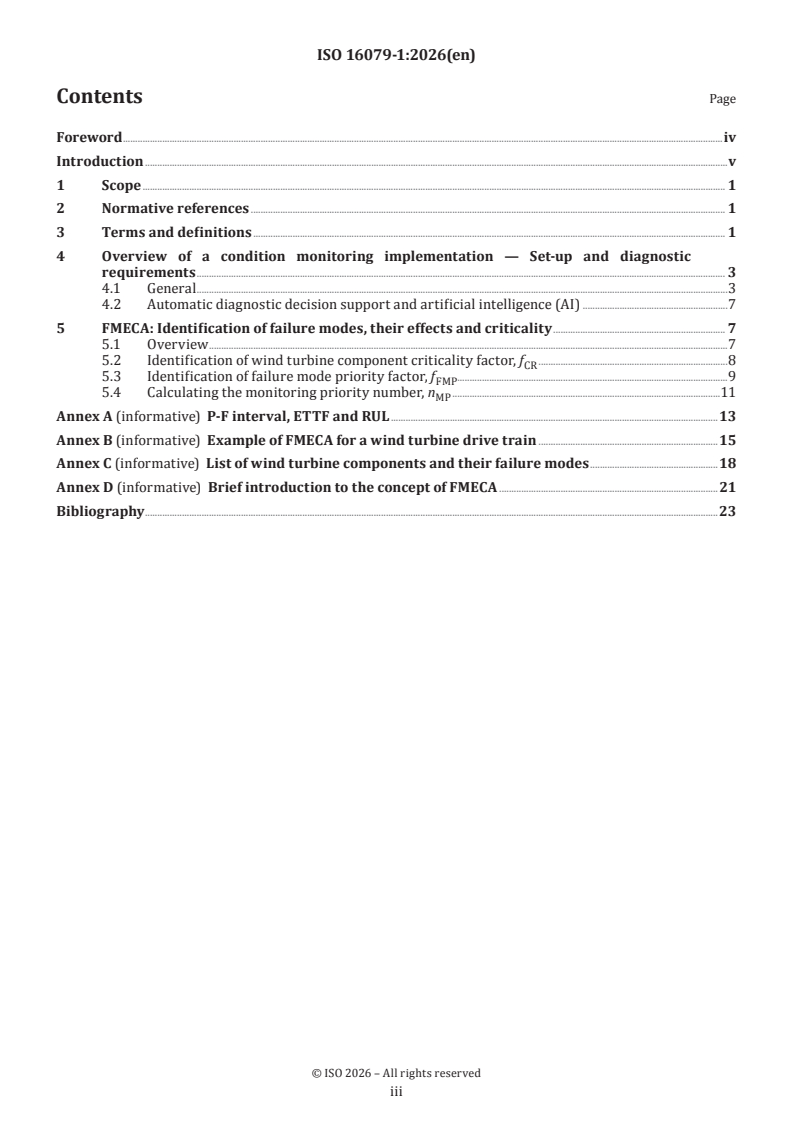
Contents Page
Foreword .iv
Introduction .v
1 Scope . 1
2 Normative references . 1
3 Terms and definitions . 1
4 Overview of a condition monitoring implementation — Set-up and diagnostic
requirements . 3
4.1 General .3
4.2 Automatic diagnostic decision support and artificial intelligence (AI) .7
5 FMECA: Identification of failure modes, their effects and criticality . 7
5.1 Overview .7
5.2 Identification of wind turbine component criticality factor, f .8
CR
5.3 Identification of failure mode priority factor, f . .9
FMP
5.4 Calculating the monitoring priority number, n .11
MP
Annex A (informative) P-F interval, ETTF and RUL .13
Annex B (informative) Example of FMECA for a wind turbine drive train .15
Annex C (informative) List of wind turbine components and their failure modes .18
Annex D (informative) Brief introduction to the concept of FMECA .21
Bibliography .23
iii
Foreword
ISO (the International Organization for Standardization) is a worldwide federation of national standards
bodies (ISO member bodies). The work of preparing International Standards is normally carried out through
ISO technical committees. Each member body interested in a subject for which a technical committee
has been established has the right to be represented on that committee. International organizations,
governmental and non-governmental, in liaison with ISO, also take part in the work. ISO collaborates closely
with the International Electrotechnical Commission (IEC) on all matters of electrotechnical standardization.
The procedures used to develop this document and those intended for its further maintenance are described
in the ISO/IEC Directives, Part 1. In particular, the different approval criteria needed for the different types
of ISO documents should be noted. This document was drafted in accordance with the editorial rules of the
ISO/IEC Directives, Part 2 (see www.iso.org/directives).
ISO draws attention to the possibility that the implementation of this document may involve the use of (a)
patent(s). ISO takes no position concerning the evidence, validity or applicability of any claimed patent
rights in respect thereof. As of the date of publication of this document, ISO had not received notice of (a)
patent(s) which may be required to implement this document. However, implementers are cautioned that
this may not represent the latest information, which may be obtained from the patent database available at
www.iso.org/patents. ISO are not be held responsible for identifying any or all such patent rights.
Any trade name used in this document is information given for the convenience of users and does not
constitute an endorsement.
For an explanation of the voluntary nature of standards, the meaning of ISO specific terms and expressions
related to conformity assessment, as well as information about ISO's adherence to the World Trade
Organization (WTO) principles in the Technical Barriers to Trade (TBT), see www.iso.org/iso/foreword.html.
This document was prepared by Technical Committee ISO/TC 108, Mechanical vibration, shock and condition
monitoring, Subcommittee SC 5, Condition monitoring and diagnostics of machine systems.
This second edition cancels and replaces the first edition (ISO 16079-1:2017), which has been editorially
revised.
The main changes are as follows:
— editorial changes throughout the document.
A list of all parts in the ISO 16079 series can be found on the ISO website.
Any feedback or questions on this document should be directed to the user’s national standards body. A
complete listing of these bodies can be found at https://www.iso.org/about/members.
iv
Introduction
0.1 General
Power production from wind turbines represents a significant and growing part of the global energy
market. As a consequence, predictability of the power production from wind power plants has become
as crucial as the predictability of power production from conventional power plants. As for conventional
power plants, an efficient maintenance programme for wind power plants adds significant value to the
reliability and predictability of the supply of energy. This document is the first in a series of International
Standards addressing the application of condition monitoring to wind turbines. It is an application of the
recommendations and best practices described in the generic standards developed under ISO/TC 108.
0.2 Aims of the ISO 16079 series
This document and subsequent documents in the ISO 16079 enable manufacturers and operators of wind
turbines, as well as developers of condition monitoring systems for these turbines to adopt shared concepts
and terminology. Additionally, these provide a methodology enabling users of this document to prioritize
and select which components to be monitored and which failure modes to be detected. This is intended to
implement the most efficient condition monitoring system, taking into account cost, detection capability,
complexity of the condition monitoring system and methods, as well as the available resources and
qualification levels of the monitoring personnel.
It is not the intention of this document or subsequent documents in the ISO 16079 series to cover any aspects
of safety monitoring systems.
0.3 Time-proven experience
The condition monitoring strategies presented in the ISO 16079 series are based on time-proven experience.
Only conservative, well-proven methods and best practices are applied. This means that the detection of
certain failure modes may be left out if their behaviour and their related symptoms are not well-documented.
As new condition monitoring techniques mature, this document and subsequent documents in the ISO 16079
series will be updated accordingly, see Figure 1.
Figure 1 — Links between the wind turbine-specific International Standards and the general
International Standards (relation to the generic standards of ISO/TC 108)
v
International Standard ISO 16079-1:2026(en)
Condition monitoring and diagnostics of wind turbines —
Part 1:
General guidelines
1 Scope
This document establishes basic guidelines for choosing condition monitoring methods for failure mode
detection, diagnostics and prognostics of wind power plant components.
This document does not specify IT systems used for condition monitoring of wind turbines.
2 Normative references
The following documents are referred to in the text in such a way that some or all of their content constitutes
requirements of this document. For dated references, only the edition cited applies. For undated references,
the latest edition of the referenced document (including any amendments) applies.
ISO 2041, Mechanical vibration, shock and condition monitoring — Vocabulary
ISO 13372, Condition monitoring and diagnostics of machines — Vocabulary
3 Terms and definitions
For the purposes of this document, the terms and definitions given in ISO 2041 and ISO 13372 and the
following apply.
ISO and IEC maintain terminology databases for use in standardization at the following addresses:
— ISO Online browsing platform: available at https:// www .iso .org/ obp/ ui
— IEC Electropedia: available at https:// www .electropedia .org/
3.1
alarm
operational signal or message designed to notify personnel when a selected anomaly (3.2), or a logical
combination of anomalies, which requires a corrective action, is encountered
[SOURCE: ISO 13372:2012, 4.2, modified — “requiring” has been replaced by “which requires”]
3.2
anomaly
irregularity or abnormality in a system
[SOURCE: ISO 13372:2012, 4.4]
3.3
component
sub-component
component part
part of a geared wind turbine, typically the main bearing, gearbox and generator
Note 1 to entry: Each of these components in the strictest sense of the definition can also contain several sub-
components or component parts such as a generator bearing or planet gear.
3.4
consequential damage
secondary damage
subsequent damage
phenomena whereby degradation of one component (3.3) can cause failures (3.7) in other components
3.5
descriptor
condition monitoring descriptor
data item derived from raw or processed parameters or external observation
Note 1 to entry: Descriptors are used to express symptoms (3.15) and anomalies (3.2). The descriptors used for
condition monitoring and diagnostics are generally those obtained from condition monitoring systems. However,
operational parameters, like any other measurement, can be considered as descriptors.
[SOURCE: ISO 13372:2012, 6.2, modified — the admitted term "feature" has been replaced by “condition
monitoring descriptor” and the Note 1 to entry has been added.]
3.6
estimated time to failure
ETTF
lead time
estimation of the period from the current point in time to the point in time where the monitored machine
has a functional failure (3.8)
[SOURCE: ISO 13381-1:2025, 3.8, modified — the term "lead time" has been added.]
3.7
failure
termination of the ability of a component (3.3) or a machine to perform a required function
Note 1 to entry: Failure is an event as distinguished from fault (3.10), which is a state.
[SOURCE: ISO 13372:2012, 1.7, modified — “item” has been replaced with "component" and “machine”.]
3.8
functional failure
F
point in time when the machine stops performing its function
3.9
failure mode
manner in which an equipment or machine failure (3.7) can occur
Note 1 to entry: A machine can have several failure modes (e.g. rubbing, spalling, unbalance, electrical discharge
damage and looseness). A failure mode produces symptoms (3.15) indicating the presence of a fault (3.10).
3.10
fault
condition of a machine that occurs when one of its components (3.3) or assembly degrades or exhibits
abnormal behaviour, which can lead to functional failure (3.8) of the machine
Note 1 to entry: See also potential failure (3.12).
Note 2 to entry: A fault can be the result of a failure (3.7) but can exist without a failure.
[SOURCE: ISO 13372:2012, 1.8, modified — the scope of application has been added, "failure" has been
replaced by "functional failure" and the Notes to entry have been changed.]
3.11
P-F interval
estimate of the period from the detection of a fault (3.10) [potential failure (3.12)] and functional failure (3.8)
Note 1 to entry: ETTF (3.6) is equal to or less than the P-F interval.
Note 2 to entry: See also estimated time to failure (3.6).
Note 3 to entry: For efficient planning of a maintenance action, it is useful to know the P-F interval of a specific failure
mode (3.9). Refer to Annex A for further explanation of P-F interval, ETTF (3.6) and RUL (3.13).
3.12
potential failure
P
potential for failure
point in time when a fault (3.10) becomes detectable
3.13
remaining useful life
RUL
remaining time before system health falls below a failure threshold defined by the confidence level of the
ETTF (3.6) and the acceptable risk
Note 1 to entry: The capability to predict RUL is the goal of the prognostic process.
Note 2 to entry: Refer to Annex A for further explanation of P-F interval (3.11), ETTF (3.6) and RUL.
3.15
symptom
perception, made by means of human observations and measurements [descriptors (3.5)], which can indicate
the presence of one or more faults (3.10) with a certain probability
[SOURCE: ISO 13372:2012, 9.4, modified — the scope of application has been added and the term “with a
certain probability” has been added]
4 Overview of a condition monitoring implementation — Set-up and diagnostic
requirements
4.1 General
An efficient condition monitoring system is an important part of an effective maintenance programme for
wind power plants to:
a) obtain predictability in power production;
b) providing stable power production;
c) lower wind turbine maintenance costs by
1) reducing the development of failures to a serious state,
2) reducing consequential damage, and
3) being able to plan service months ahead;
d) reduce the throughlife cost by
1) reducing loss of availability,
2) allowing continued operation under fault conditions (perhaps with the appropriate restrictions in
place), and
3) supporting failure investigations to prevent repetitive events.
Condition monitoring, in general, requires:
e) reliable alarms. An alarm is triggered only when the confidence level of the diagnosis and prognosis is
high. Wind turbines are placed in remote locations and many wind turbines are located offshore where
access is limited and costly.
f) an ETTF. This is for supporting efficient maintenance planning (e.g. utilization of cranes, staff, ordering
of spare parts, etc.).
g) reliable descriptor measurements. In addition to self-excited forces, a wind turbine is also subject to
environmental occurrences. The compact structure can cause measurement readings from one machine
part to be affected by other machine parts.
h) detection of a faulty condition monitoring system. A working data acquisition system is the basis of a
reliable condition monitoring systems. Any equipment can fail. It is essential that faulty equipment is
detected to ensure a reliable condition monitoring process.
i) a complex IT landscape. A condition monitoring system is required to monitor thousands of wind
turbines connected to a central server via complex worldwide data networks. (This requirement is
outside the scope of this document.)
Condition monitoring of wind turbines presents some additional challenges compared to condition
monitoring of other machinery:
— Access to the nacelle is difficult and potentially dangerous and in many countries is not allowed during
operation, so online systems can be required for measurements which have traditionally used hand-held
methods.
— Wind turbine loading varies significantly with time and cannot be easily influenced without changing
operational parameters. To reduce this need for operational change, extra measures shall be taken to
ensure repeatability of measurements.
— Self-excitation of the structures, extremes of ambient temperature and the likelihood of lightning strikes
present a severe test of the robustness of all systems.
— Wind turbines are often in remote locations, the condition monitoring systems shall be able to function
when network connectivity is lost.
In order to implement condition monitoring and diagnostic procedures according to the faults that can occur
in the wind turbine, this guideline recommends following the V-model as illustrated in ISO 13379-1.
An overview of this procedure is shown in Figure 2. The left branch corresponds to the preliminary study
which prepares the necessary data for condition monitoring and diagnostics for a wind turbine. The right
branch of the diagram corresponds to the condition monitoring and diagnostics activities that are normally
undertaken after the wind turbine has been commissioned. Data reduction is a big issue for condition
monitoring systems. Note that data reduction process starts in the phase of the preliminary study as an
outcome of the analysis process where it is prioritized which kind of failure modes are relevant to monitor.
The scopes of this and subsequent documents, such as ISO 16079-2, are shown in Figure 2.
[SOURCE: ISO 13379-1:2025, Figure 1]
Figure 2 — Condition monitoring and diagnostic (CM and D) cycle - Design and use of the application
on a wind turbine applied to the concept of the ISO 13379-1
In accordance with ISO 13379-1, it is recommended that the preliminary study is carried out using the
following, see Figure 3:
A. A FMECA (failure modes, their effects and criticality analysis) procedure. The purpose of this docu-
ment is to facilitate this FMECA procedure.
B. A FMSA (failure mode and symptoms analysis) procedure, which shall be facilitated in the component
specific parts of the ISO 16079 series.
Figure 3 — Necessity of using FMECA before FMSA
To prepare a FMECA as described in this document:
— list the major wind turbine components;
— determine the criticality factor for each component, taking into account how it is for the process, the ease
of repair, availability and cost of spares, repair time, the risk of consequential damage, the location of the
wind turbine and the failure rate of the component if such knowledge is available;
— identify the failure modes for each component. Prioritization of each failure mode to be monitored for,
with respect to detectability and ETTF;
— decide which failure modes shall be detected and diagnosed by taking into account the criticality of the
component and the cost efficiency of monitoring for the different failure modes.
NOTE Annex D provides a brief introduction to the concept of FMECA.
Steps to be included in the FMSA, such as those described in the ISO 16079 series are:
— decide under which operating conditions the different faults can be best observed and specify reference
conditions;
— identify the symptoms that can help in assessing the condition of the machine and that shall be used for
diagnostics;
— list the descriptors that shall be used to evaluate (recognize) the different symptoms;
— identify the necessary measurements and transducers from which the descriptors will be derived or
computed.
Figure 4 shows the relationship between the requirements of this document and others (such as component
specific part of the ISO 16079 series).
NOTE The output of the FMECA is used as an input to the FMSA.
Figure 4 — Relationship between this document and ISO 16079-2
4.2 Automatic diagnostic decision support and artificial intelligence (AI)
Additionally to the traditional condition monitoring systems that provide basic anomaly monitoring data to
specialists who would interpret this information and predict when and what type of service shall be carried
out, AI and machine learning can be used for evaluating asset health, to simplify the specialist’s task making
it more efficient.
There are systems on the market for automatic diagnostic decision support and prognostics to predict when
required maintenance or operation conditions changes should be carried out. These systems, which are
outside the scope of this document, can be based on statistical analytics when large amount of historical data
is available, or on a physics model if the model and operating load are well understood. In either case, these
systems can save a lot of time for the diagnostic specialists by predicting basic diagnostics so the specialist
can focus on the more complex tasks, and/or making the job more efficient enabling more machines to be
looked after by a single individual.
AI can be very useful from a machine healthcare point of view, but data science is still being developed and
there are currently no standards (at the release of this document) to ensure optimal performance, therefore,
it is important to understand that AI algorithms:
— with and without machine learning can support the diagnostic specialist but not replace this person. The
specialist is needed for complex diagnostics (e.g. cases of multiple faults, configuring and fine-tuning the
system, etc.), so AI should be considered as an assistant rather than a replacement for a specialist;
— are based on estimated prediction while condition monitoring is based on actual fault detection. For this
reason, AI cannot replace condition monitoring functionality, but condition monitoring used together
with AI can improve the accuracy of determining RUL of components.
With the development of AI algorithms, their use can be assessed using ISO/IEC 23894, to manage risks
specific related to AI development and use products, systems, services, and functions.
5 FMECA: Identification of failure modes, their effects and criticality
5.1 Overview
The purpose of this clause is to provide an overview of the FMECA procedure. The result of the FMECA is
a monitoring priority number, n , for each of the wind turbine components. The n enables the users of
MP MP
this document to focus their condition monitoring effort where it is most cost beneficial and by combining it
with a FMSA for each wind turbine component, use the results to specify requirements for the wind turbine
condition monitoring system.
The n is defined as shown by Formula (1):
MP
n = f × f (1)
MP CR FMP
where
n is the monitoring priority number;
MP
f is the criticality factor (i.e. the criticality of each wind turbine component);
CR
f is the failure mode priority factor (i.e. the prioritization of each failure mode), with respect to
FMP
detectability and ETTF .
In order to have a uniform reference for the FMECA and to guide the procedure, f and f shall be assessed
CR FMP
using the criteria specified in Tables 1 and 2.
Using these two tables, the procedure for the FMECA is as follows:
a) list the components to be included in the FMECA;
b) use Table 1 to identify the criticality factor, f , for each component;
CR
c) use Table 2 to identify the failure mode priority factor, f , for the failure modes of each component;
FMP
d) finalize the FMECA by combining f with f into the monitoring priority number, n .
CR FMP MP
Figure 5 presents the process overview.
Figure 5 — Overview of the FMECA process
5.2 Identification of wind turbine component criticality factor, f
CR
There are four criteria which are combined into the f , as shown by Formula (2):
CR
f = f + f + f + f (2)
CR LP RE CD FR
where
f is the loss of production;
L
...