

ISO/CD TS 19392-7
(Main)Paints and varnishes — Coating systems for wind-turbine rotor blades — Part 7: Determination and evaluation of resistance to hail
General Information
- Abstract
This document describes test procedures to assess the hail resistance properties of rotor blade coating systems using ice particles.
- Status
- Not Published
- Technical Committee
- ISO/TC 35/SC 9 - General test methods for paints and varnishes
- Drafting Committee
- ISO/TC 35/SC 9 - General test methods for paints and varnishes
- Current Stage
- 3099 - CD approved for registration as DIS
- Start Date
- 19-Jan-2026
- Completion Date
- 29-Aug-2026
Buy Documents


ISO/CD TS 19392-7 - Paints and varnishes — Coating systems for wind-turbine rotor blades — Part 7: Determination and evaluation of resistance to hail
REDLINE ISO/CD TS 19392-7 - Paints and varnishes — Coating systems for wind-turbine rotor blades — Part 7: Determination and evaluation of resistance to hail
Overview
ISO/CD TS 19392-7: Paints and varnishes - Coating systems for wind-turbine rotor blades - Part 7: Determination and evaluation of resistance to hail is a technical specification developed by ISO. The document defines standardized test procedures to evaluate the resistance of coating systems applied to wind-turbine rotor blades against hail impact using simulated ice particles.
Hail-induced erosion is a significant concern in the wind energy sector, as hailstones can damage blade coatings, leading to degradation, loss of protective layers, and, ultimately, exposure and damage to composite substrates. Adhering to standardized hail resistance test methods helps manufacturers, suppliers, and users assess and improve the durability of protective coatings, supporting longer service life and lower maintenance costs in wind turbine operations.
Key Topics
- Hail Resistance Testing: Specifies procedures for preparing simulated hail ice (SHI) projectiles, test specimens, and testing using gas-propelled impact rigs.
- Sample Preparation and Conditioning: Outlines requirements for test panel substrates, coating application, and pre-test conditioning in accordance with supplier instructions and referenced ISO standards.
- Test Parameters: Guidance for selecting representative environmental and operational parameters such as:
- Impact velocity and angle (reflecting real-world turbine conditions)
- Hail particle sizes and chemical compositions
- Temperature control during testing
- Damage Assessment and Rating: Provides criteria for visual and instrumental evaluation of surface degradation, including gloss reduction, material loss, and more advanced techniques (optical analysis, roughness measurements, mass loss, and dye penetration tests).
- Reporting and Repeatability: Specifies the structure for comprehensive test reports to ensure transparency, repeatability, and comparability of results.
Applications
Implementing the test methods from ISO/CD TS 19392-7 provides practical value in several areas:
- Quality Assurance for Coating Manufacturers: Enables consistent, reproducible measurement of hail resistance in product development and research, supporting claims of durability and aiding in product differentiation.
- Specification and Procurement: Allows wind farm operators and blade manufacturers to request or specify coatings with proven hail resistance, minimizing risk of costly repairs, unplanned maintenance, and downtime.
- Performance Benchmarking: Assists in comparative assessment of various coating systems under standardized, controlled conditions, fostering continual improvements.
- Compliance and Risk Management: Supporting compliance with industry best practices and meeting contractual or regulatory requirements for wind turbine installations in hail-prone regions.
Related Standards
ISO/CD TS 19392-7 is part of the broader ISO 19392 series, which outlines comprehensive test methods for coating systems used on wind-turbine rotor blades. Other standards and references relevant to this document include:
- ISO 1513: Paints and varnishes - Examination and preparation of test samples for testing
- ISO 4618: Paints and varnishes - Vocabulary
- ISO 15528: Paints, varnishes and raw materials for paints and varnishes - Sampling
- ISO 21920-2: Geometrical product specifications (GPS) - Surface roughness parameters
- ISO 25014: Paints and varnishes - Cross-sectional microscopy
- ISO 2808: Paints and varnishes - Determination of film thickness
By following ISO/CD TS 19392-7, stakeholders in the wind energy industry can ensure rigorous assessment of coating systems' hail resistance, contributing to improved performance, reliability, and sustainability of wind-turbine rotor blades.
Buy Documents
ISO/CD TS 19392-7 - Paints and varnishes — Coating systems for wind-turbine rotor blades — Part 7: Determination and evaluation of resistance to hail
REDLINE ISO/CD TS 19392-7 - Paints and varnishes — Coating systems for wind-turbine rotor blades — Part 7: Determination and evaluation of resistance to hail
Get Certified
Connect with accredited certification bodies for this standard

DNV
DNV is an independent assurance and risk management provider.

Lloyd's Register
Lloyd's Register is a global professional services organisation specialising in engineering and technology.
DNV Energy Systems
Energy and renewable energy certification.
Sponsored listings
Frequently Asked Questions
ISO/CD TS 19392-7 is a draft published by the International Organization for Standardization (ISO). Its full title is "Paints and varnishes — Coating systems for wind-turbine rotor blades — Part 7: Determination and evaluation of resistance to hail". This standard covers: This document describes test procedures to assess the hail resistance properties of rotor blade coating systems using ice particles.
This document describes test procedures to assess the hail resistance properties of rotor blade coating systems using ice particles.
ISO/CD TS 19392-7 is classified under the following ICS (International Classification for Standards) categories: 27.180 - Wind turbine energy systems; 87.040 - Paints and varnishes. The ICS classification helps identify the subject area and facilitates finding related standards.
ISO/CD TS 19392-7 is available in PDF format for immediate download after purchase. The document can be added to your cart and obtained through the secure checkout process. Digital delivery ensures instant access to the complete standard document.
Standards Content (Sample)
FINAL DRAFT
Technical
Specification
ISO/DTS 19392-7
ISO/TC 35/SC 9
Paints and varnishes — Coating
Secretariat: BSI
systems for wind-turbine rotor
Voting begins on:
blades —
2026-05-26
Part 7:
Voting terminates on:
2026-07-21
Determination and evaluation of
resistance to hail
Peintures et vernis — Matériaux de revêtement pour pales de
turbines éoliennes —
Partie 7: Détermination et évaluation de la résistance à la grêle
RECIPIENTS OF THIS DRAFT ARE INVITED TO SUBMIT,
WITH THEIR COMMENTS, NOTIFICATION OF ANY
RELEVANT PATENT RIGHTS OF WHICH THEY ARE AWARE
AND TO PROVIDE SUPPOR TING DOCUMENTATION.
IN ADDITION TO THEIR EVALUATION AS
BEING ACCEPTABLE FOR INDUSTRIAL, TECHNO-
LOGICAL, COMMERCIAL AND USER PURPOSES, DRAFT
INTERNATIONAL STANDARDS MAY ON OCCASION HAVE
TO BE CONSIDERED IN THE LIGHT OF THEIR POTENTIAL
TO BECOME STAN DARDS TO WHICH REFERENCE MAY BE
MADE IN NATIONAL REGULATIONS.
Reference number
ISO/DTS 19392-7:2026(en) © ISO 2026
FINAL DRAFT
ISO/DTS 19392-7:2026(en)
Technical
Specification
ISO/DTS 19392-7
ISO/TC 35/SC 9
Paints and varnishes — Coating
Secretariat: BSI
systems for wind-turbine rotor
Voting begins on:
blades —
Part 7:
Voting terminates on:
Determination and evaluation of
resistance to hail
Peintures et vernis — Matériaux de revêtement pour pales de
turbines éoliennes —
Partie 7: Détermination et évaluation de la résistance à la grêle
RECIPIENTS OF THIS DRAFT ARE INVITED TO SUBMIT,
WITH THEIR COMMENTS, NOTIFICATION OF ANY
RELEVANT PATENT RIGHTS OF WHICH THEY ARE AWARE
AND TO PROVIDE SUPPOR TING DOCUMENTATION.
© ISO 2026
IN ADDITION TO THEIR EVALUATION AS
All rights reserved. Unless otherwise specified, or required in the context of its implementation, no part of this publication may
BEING ACCEPTABLE FOR INDUSTRIAL, TECHNO-
LOGICAL, COMMERCIAL AND USER PURPOSES, DRAFT
be reproduced or utilized otherwise in any form or by any means, electronic or mechanical, including photocopying, or posting on
INTERNATIONAL STANDARDS MAY ON OCCASION HAVE
the internet or an intranet, without prior written permission. Permission can be requested from either ISO at the address below
TO BE CONSIDERED IN THE LIGHT OF THEIR POTENTIAL
or ISO’s member body in the country of the requester.
TO BECOME STAN DARDS TO WHICH REFERENCE MAY BE
MADE IN NATIONAL REGULATIONS.
ISO copyright office
CP 401 • Ch. de Blandonnet 8
CH-1214 Vernier, Geneva
Phone: +41 22 749 01 11
Email: copyright@iso.org
Website: www.iso.org
Published in Switzerland Reference number
ISO/DTS 19392-7:2026(en) © ISO 2026
ii
ISO/DTS 19392-7:2026(en)
Contents Page
Foreword .iv
Introduction .v
1 Scope . 1
2 Normative references . 1
3 Terms and definitions . 1
4 Principle . 1
5 Equipment and apparatus . 1
5.1 Equipment for simulated hail ice (SHI) formation .1
5.2 Equipment for testing of hail impact .2
5.3 Test panels .2
5.3.1 Substrate .2
5.3.2 Preparation .2
5.3.3 Conditioning .2
5.3.4 Thickness of the coating system .2
5.3.5 Roughness of the coating surface .2
6 Sampling . 2
7 Procedure . 3
7.1 Number of determinations .3
7.2 Examination before impact testing .3
7.3 Test parameters .3
7.4 Test protocol .3
7.5 Drying .4
8 Evaluation . 4
9 Precision . 5
10 Test report . 5
Annex A (informative) Typical hail mould . 6
Annex B (informative) Examples of test rig configurations . 7
Bibliography . 9
iii
ISO/DTS 19392-7:2026(en)
Foreword
ISO (the International Organization for Standardization) is a worldwide federation of national standards
bodies (ISO member bodies). The work of preparing International Standards is normally carried out through
ISO technical committees. Each member body interested in a subject for which a technical committee
has been established has the right to be represented on that committee. International organizations,
governmental and non-governmental, in liaison with ISO, also take part in the work. ISO collaborates closely
with the International Electrotechnical Commission (IEC) on all matters of electrotechnical standardization.
The procedures used to develop this document and those intended for its further maintenance are described
in the ISO/IEC Directives, Part 1. In particular, the different approval criteria needed for the different types
of ISO documents should be noted. This document was drafted in accordance with the editorial rules of the
ISO/IEC Directives, Part 2 (see www.iso.org/directives).
ISO draws attention to the possibility that the implementation of this document may involve the use of (a)
patent(s). ISO takes no position concerning the evidence, validity or applicability of any claimed patent
rights in respect thereof. As of the date of publication of this document, ISO had not received notice of (a)
patent(s) which may be required to implement this document. However, implementers are cautioned that
this may not represent the latest information, which may be obtained from the patent database available at
www.iso.org/patents. ISO shall not be held responsible for identifying any or all such patent rights.
Any trade name used in this document is information given for the convenience of users and does not
constitute an endorsement.
For an explanation of the voluntary nature of standards, the meaning of ISO specific terms and expressions
related to conformity assessment, as well as information about ISO's adherence to the World Trade
Organization (WTO) principles in the Technical Barriers to Trade (TBT), see www.iso.org/iso/foreword.html.
This document was prepared by Technical Committee ISO/TC 35, Paints and varnishes, Subcommittee SC 9,
General test methods for paints and varnishes.
A list of all parts in the ISO 19392 series can be found on the ISO website.
Any feedback or questions on this document should be directed to the user’s national standards body. A
complete listing of these bodies can be found at www.iso.org/members.html.
iv
ISO/DTS 19392-7:2026(en)
Introduction
In the wind energy industry, coatings are applied to the surfaces of rotor blades to protect the glass fibre or
carbon fibre reinforced polymer composite substrate. Rain drops and hailstones can damage these coatings
in such a way that individual layers are removed or the whole coating delaminates from the substrate. This
document describes methods which simulate hail erosion. For further information on modelling hail impact
on surfaces see Reference [11].
v
FINAL DRAFT Technical Specification ISO/DTS 19392-7:2026(en)
Paints and varnishes — Coating systems for wind-turbine
rotor blades —
Part 7:
Determination and evaluation of resistance to hail
1 Scope
This document specifies test procedures to assess the hail resistance properties of wind-turbine rotor blade
coating systems using ice particles.
2 Normative references
The following documents are referred to in the text in such a way that some or all of their content constitutes
requirements of this document. For dated references, only the edition cited applies. For undated references,
the latest edition of the referenced document (including any amendments) applies.
ISO 1513, Paints and varnishes — Examination and preparation of test samples
ISO 4618, Paints and varnishes — Vocabulary
ISO 15528, Paints, varnishes and raw materials for paints and varnishes — Sampling
3 Terms and definitions
For the purposes of this document, the terms and definitions given in ISO 4618 and the following apply.
ISO and IEC maintain terminology databases for use in standardization at the following addresses:
— ISO Online browsing platform: available at https:// www .iso .org/ obp
— IEC Electropedia: available at https:// www .electropedia .org/
3.1
erosion
wear of material by mechanical impact of solid particles or liquids
4 Principle
Hail erosion from the impact of hailstones is often responsible for leading edge erosion and damage of the
coating systems and substrate composite materials of wind turbine blades.
5 Equipment and apparatus
5.1 Equipment for simulated hail ice (SHI) formation
Simulated hail ice (SHI) projectiles can be formed using moulds [for example polytetrafluor
...
Style Definition
...
Style Definition
...
Style Definition
ISO/TS DTS 19392-7:2026(E) .
Style Definition
...
ISO/TC 35/SC 9/WG 32
Style Definition
...
Style Definition
Secretariat: BSI
...
Style Definition
...
Date: 2026-01-0905-12
Style Definition
...
Style Definition
...
Style Definition
...
Style Definition
...
Style Definition
...
Style Definition
Paints and varnishes — Coating systems for wind-turbine rotor
...
Style Definition
blades —
...
Style Definition
...
Style Definition
...
Style Definition
...
Style Definition
...
Style Definition
...
Part 7:
Style Definition
...
Determination and evaluation of resistance to hail
Style Definition
...
Style Definition
...
Style Definition
...
Style Definition
...
Style Definition
...
Style Definition
...
Style Definition
...
Style Definition
...
Style Definition
...
Style Definition
...
DTS stage
Style Definition
...
Style Definition
...
Style Definition
...
Warning for WDs and CDs
Style Definition
...
Style Definition
...
This document is not an ISO International Standard. It is distributed for review and comment. It is subject to change
without notice and may not be referred to as an International Standard.
Style Definition
...
Style Definition
...
Recipients of this draft are invited to submit, with their comments, notification of any relevant patent rights of which
they are aware and to provide supporting documentation. Style Definition
...
Style Definition
...
Style Definition
...
Style Definition
...
Style Definition
...
Peintures et vernis — Matériaux de revêtement pour pales de turbines éoliennes —
Style Definition
...
Partie 7: Détermination et évaluation de la résistance à la grêle
Style Definition
...
Style Definition
...
...
Style Definition
...
Formatted
...
Formatted
...
Formatted
...
Formatted
...
Formatted
...
Formatted
...
Formatted
...
Formatted
...
Formatted
...
ISO #####-#:####(X/DTS 19392-7:(en)
Formatted: Font: 11 pt, Bold
Formatted: Font: 11 pt, Bold
Formatted: HeaderCentered, Left, Space After: 0 pt,
Line spacing: single
Formatted: Indent: Left: 0 cm, Right: 0 cm, Space
All rights reserved. Unless otherwise specified, or required in the context of its implementation, no part of this publication
Before: 0 pt, No page break before, Adjust space
may be reproduced or utilized otherwise in any form or by any means, electronic or mechanical, including photocopying,
between Latin and Asian text, Adjust space between
or posting on the internet or an intranet, without prior written permission. Permission can be requested from either ISO
Asian text and numbers, Border: Top: (No border)
at the address below or ISO’s member body in the country of the requester.
Formatted: Left: 1.5 cm, Right: 1.5 cm, Bottom: 1 cm,
ISO copyright office Header distance from edge: 1.27 cm, Footer distance
from edge: 0.5 cm
CP 401 • Ch. de Blandonnet 8
CH-1214 Vernier, Geneva
Phone: + 41 22 749 01 11
Formatted: English (United Kingdom)
EmailE-mail: copyright@iso.org
Formatted: English (United Kingdom)
Website: www.iso.orgwww.iso.org
Published in Switzerland
Formatted: English (United Kingdom)
Formatted: Font: 10 pt
Formatted: Font: 10 pt
Formatted: Font: 11 pt
Formatted: FooterPageRomanNumber, Space After: 0
pt, Line spacing: single
ii © ISO #### 2026 – All rights reserved
ii
ISO/TS DTS 19392-7:2026(E:(en)
Formatted: Font: 11 pt, Bold
Formatted: Font: 11 pt, Bold
Formatted: Font: 11 pt, Bold
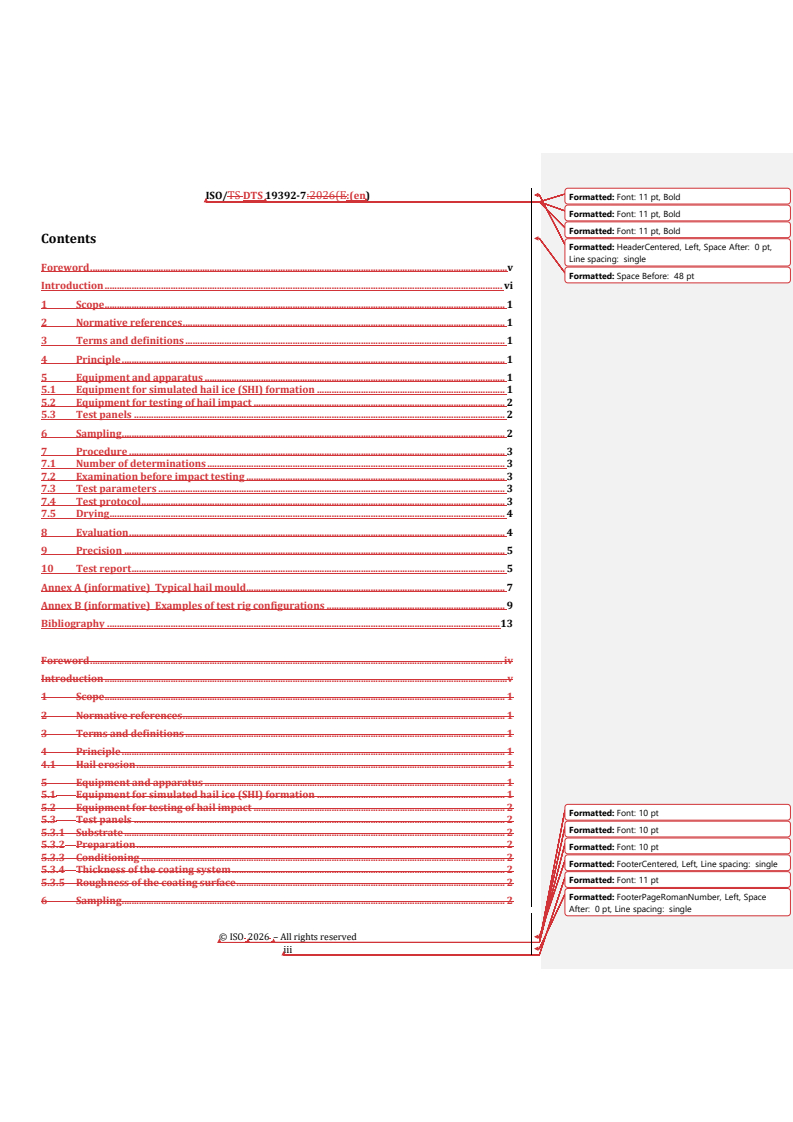
Contents
Formatted: HeaderCentered, Left, Space After: 0 pt,
Line spacing: single
Foreword . v
Formatted: Space Before: 48 pt
Introduction . vi
1 Scope . 1
2 Normative references . 1
3 Terms and definitions . 1
4 Principle . 1
5 Equipment and apparatus . 1
5.1 Equipment for simulated hail ice (SHI) formation . 1
5.2 Equipment for testing of hail impact . 2
5.3 Test panels . 2
6 Sampling . 2
7 Procedure . 3
7.1 Number of determinations . 3
7.2 Examination before impact testing . 3
7.3 Test parameters . 3
7.4 Test protocol . 3
7.5 Drying . 4
8 Evaluation . 4
9 Precision . 5
10 Test report . 5
Annex A (informative) Typical hail mould . 7
Annex B (informative) Examples of test rig configurations . 9
Bibliography . 13
Foreword . iv
Introduction . v
1 Scope . 1
2 Normative references . 1
3 Terms and definitions . 1
4 Principle . 1
4.1 Hail erosion . 1
5 Equipment and apparatus . 1
5.1 Equipment for simulated hail ice (SHI) formation . 1
5.2 Equipment for testing of hail impact . 2
Formatted: Font: 10 pt
5.3 Test panels . 2
Formatted: Font: 10 pt
5.3.1 Substrate . 2
5.3.2 Preparation . 2
Formatted: Font: 10 pt
5.3.3 Conditioning . 2
Formatted: FooterCentered, Left, Line spacing: single
5.3.4 Thickness of the coating system . 2
Formatted: Font: 11 pt
5.3.5 Roughness of the coating surface . 2
Formatted: FooterPageRomanNumber, Left, Space
6 Sampling . 2
After: 0 pt, Line spacing: single
© ISO 2026 – All rights reserved
iii
ISO #####-#:####(X/DTS 19392-7:(en)
Formatted: Font: 11 pt, Bold
Formatted: Font: 11 pt, Bold
Formatted: HeaderCentered, Left, Space After: 0 pt,
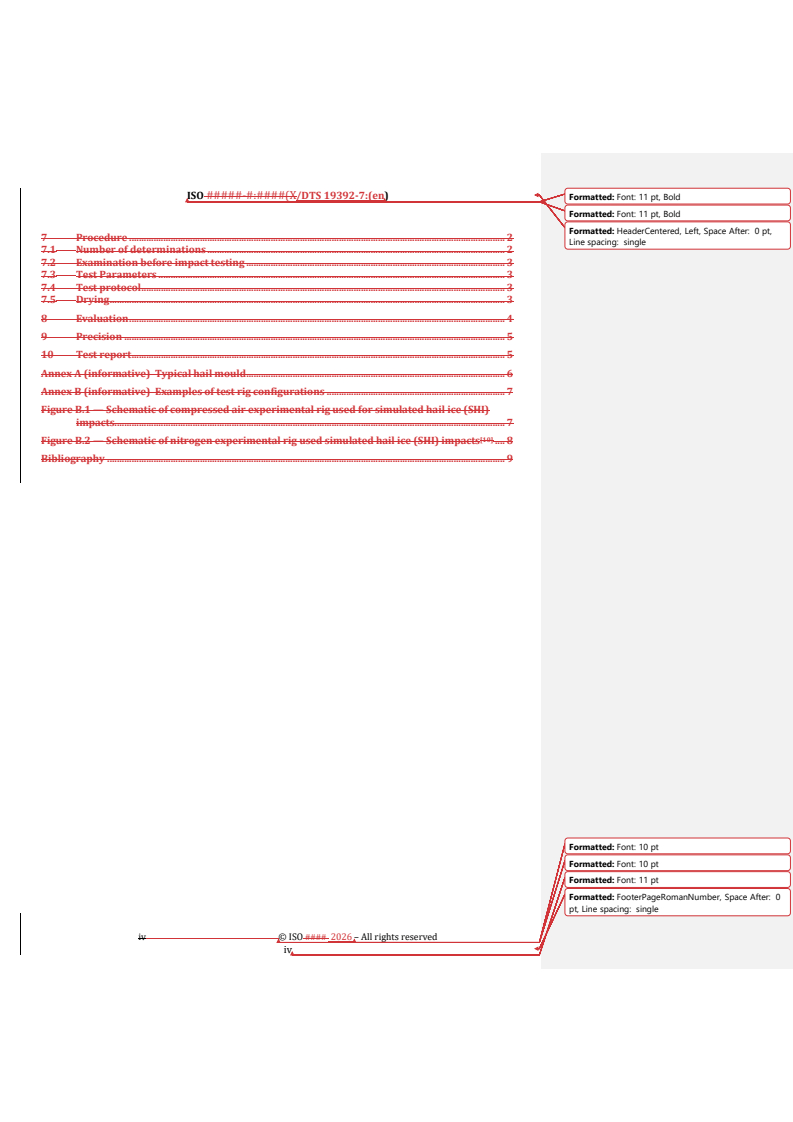
7 Procedure . 2
Line spacing: single
7.1 Number of determinations . 2
7.2 Examination before impact testing . 3
7.3 Test Parameters . 3
7.4 Test protocol . 3
7.5 Drying . 3
8 Evaluation . 4
9 Precision . 5
10 Test report . 5
Annex A (informative) Typical hail mould . 6
Annex B (informative) Examples of test rig configurations . 7
Figure B.1 — Schematic of compressed air experimental rig used for simulated hail ice (SHI)
impacts. 7
[10]
Figure B.2 — Schematic of nitrogen experimental rig used simulated hail ice (SHI) impacts . 8
Bibliography . 9
Formatted: Font: 10 pt
Formatted: Font: 10 pt
Formatted: Font: 11 pt
Formatted: FooterPageRomanNumber, Space After: 0
pt, Line spacing: single
iv © ISO #### 2026 – All rights reserved
iv
ISO/TS DTS 19392-7:2026(E:(en)
Formatted: Font: 11 pt, Bold
Formatted: Font: 11 pt, Bold
Formatted: Font: 11 pt, Bold
Foreword
Formatted: HeaderCentered, Left, Space After: 0 pt,
Line spacing: single
ISO (the International Organization for Standardization) is a worldwide federation of national standards
bodies (ISO member bodies). The work of preparing International Standards is normally carried out through
ISO technical committees. Each member body interested in a subject for which a technical committee has been
established has the right to be represented on that committee. International organizations, governmental and
non-governmental, in liaison with ISO, also take part in the work. ISO collaborates closely with the
International Electrotechnical Commission (IEC) on all matters of electrotechnical standardization.
The procedures used to develop this document and those intended for its further maintenance are described
in the ISO/IEC Directives, Part 1. In particular, the different approval criteria needed for the different types of
ISO documents should be noted. This document was drafted in accordance with the editorial rules of the
ISO/IEC Directives, Part 2 (see www.iso.org/directiveswww.iso.org/directives).
ISO draws attention to the possibility that the implementation of this document may involve the use of (a)
Formatted: English (United Kingdom)
patent(s). ISO takes no position concerning the evidence, validity or applicability of any claimed patent rights
in respect thereof. As of the date of publication of this document, ISO had not received notice of (a) patent(s)
which may be required to implement this document. However, implementers are cautioned that this may not
represent the latest information, which may be obtained from the patent database available at
www.iso.org/patents.www.iso.org/patents. ISO shall not be held responsible for identifying any or all such
Formatted: English (United Kingdom)
patent rights.
Any trade name used in this document is information given for the convenience of users and does not
constitute an endorsement.
For an explanation of the voluntary nature of standards, the meaning of ISO specific terms and expressions
related to conformity assessment, as well as information about ISO's adherence to the World Trade
Organization (WTO) principles in the Technical Barriers to Trade (TBT), see
Formatted: Font color: Auto
www.iso.org/iso/foreword.htmlwww.iso.org/iso/foreword.html.
This document was prepared by Technical Committee ISO/TC 35, Paints and varnishes, Subcommittee SC 9,
General test methods for paints and varnishes.
A list of all parts in the ISO 19392 series can be found on the ISO website.
Formatted: Font: Cambria
Any feedback or questions on this document should be directed to the user’s national standards body. A
complete listing of these bodies can be found at www.iso.org/members.htmlwww.iso.org/members.html.
Formatted: Font: 10 pt
Formatted: Font: 10 pt
Formatted: Font: 10 pt
Formatted: FooterCentered, Left, Line spacing: single
Formatted: Font: 11 pt
Formatted: FooterPageRomanNumber, Left, Space
After: 0 pt, Line spacing: single
© ISO 2026 – All rights reserved
v
ISO #####-#:####(X/DTS 19392-7:(en)
Formatted: Font: 11 pt, Bold
Formatted: Font: 11 pt, Bold
Formatted: HeaderCentered, Left, Space After: 0 pt,
Introduction
Line spacing: single
In the wind energy industry, coatings are applied to the surfaces of rotor blades to protect the glass fibre or
carbon fibre reinforced polymer composite substrate. Rain drops and hailstones can damage these coatings in
such a way that individual layers are removed or the whole coating delaminates from the substrate. This
document describes methods which simulatessimulate hail erosion. For some thoughtsfurther information on
modelling hail impact on surfaces see [11]. Reference[11].
Formatted: Font: 10 pt
Formatted: Font: 10 pt
Formatted: Font: 11 pt
Formatted: FooterPageRomanNumber, Space After: 0
pt, Line spacing: single
vi © ISO #### 2026 – All rights reserved
vi
ISO/TS DTS 19392-7:2026(E:(en)
Formatted: Font: 11 pt, Bold
Formatted: Font: 11 pt, Bold
Formatted: Font: 11 pt, Bold
Formatted: HeaderCentered, Left, Space After: 0 pt,
Paints and varnishes — Coating systems for wind-turbine rotor
Line spacing: single
blades —
Formatted: Main Title 2, Space After: 0 pt
Part 7:
Formatted: Top: 1.4 cm, Bottom: 1 cm, Section start:
Determination and evaluation of resistance to hail
New page, Header distance from edge: 1.27 cm, Footer
distance from edge: 0.5 cm
1 Scope
Formatted: Font: Bold
This document specifies test procedures to assess the hail resistance properties of wind-turbine rotor blade
coating systems using ice particles.
2 Normative references
The following documents are referred to in the text in such a way that some or all of their content constitutes
requirements of this document. For dated references, only the edition cited applies. For undated references,
the latest edition of the referenced document (including any amendments) applies.
ISO 1513, Paints and varnishes — Examination and preparation of test samples for testing
ISO 4618, Paints and varnishes — Vocabulary
ISO 15528, Paints, varnishes and raw materials for paints and varnishes — Sampling
Formatted: Font: Not Italic
3 Terms and definitions
For the purposes of this document, the terms and definitions given in ISO 4618 and the following apply.
ISO and IEC maintain terminology databases for use in standardization at the following addresses:
— ISO Online browsing platform: available at https://www.iso.org/obphttps://www.iso.org/obp
Formatted: No underline, Font color: Auto
Formatted: List Continue 1, No bullets or numbering,
— IEC Electropedia: available at https://www.electropedia.org/https://www.electropedia.org/
Don't keep with next
Formatted: No underline, Font color: Auto
3.1 3.1
erosion
Formatted: TermNum2
wear of material by mechanical impact of solid particles or liquids
4 Principle
4.1 Hail erosion
Hail erosion from the impact of hailstones is often responsible for leading edge erosion and damage of the
coating systems and substrate composite materials of wind turbine blades.
5 Equipment and apparatus
Formatted: Font: 10 pt
Formatted: Font: 10 pt
5.1 Equipment for simulated hail ice (SHI) formation
Formatted: Font: 10 pt
Simulated hail ice (SHI) projectiles can be formed using moulds [for example polytetrafluoroethylene (PTFE)]
Formatted: FooterCentered, Left, Line spacing: single
of different sizes informed from the meteorological study (common sizes are: 5 mm, 10 mm, 15 mm and
20 mm diameter). An example of a hail mould can be found in Annex A.Annex A. The moulds can consist of two Formatted: Font: 11 pt
parts with hemispherical halves which, when aligned with the aid of guiding pins, form spheres. The two
Formatted: FooterPageNumber, Left, Space After: 0 pt,
halves of each mould can be secured using clamps. Each individual sphere in the mould is connected to a small
Line spacing: single
© ISO 2026 – All rights reserved
ISO #####-#:####(X/DTS 19392-7:(en)
Formatted: Font: 11 pt, Bold
Formatted: Font: 11 pt, Bold
Formatted: HeaderCentered, Left, Space After: 0 pt,
diameter aperture so that the solution can be inserted using a hypodermic needle. A small addition of dye in
Line spacing: single
the solution is advised to aid particle tracking. The solution composition should be informed from
environmental and meteorological studies. When filled, the moulds can then be placed in a freezer at typically
−18 °C. After allowing sufficient time for the solution to freeze the simulated hail ice (SHI) projectiles can be
[9][9]
removed and used. .
NOTE A composition of artificial rain for the Baltic Sea for example is provided in ISO 16773--4:2017, Annex
...