

IEC 81346-14:2026
(Main)Industrial systems, installations and equipment and industrial products — Structuring principles and reference designations — Part 14: Manufacturing and processing systems
- Abstract
This document, published jointly by IEC and ISO, provides, in combination with IEC 81346‑1 and IEC 81346‑2, rules and recommendations on the structuring of systems and the information on systems of manufacturing systems. It also provides additional classification schemes to those of IEC 81346‑2 for use in reference designations within manufacturing systems. It is published as a double logo standard. The structuring principles and the classes of objects are intended to provide a clear identification and localization of the objects, and for use in their labelling in the manufacturing plant, for their designation in technical documents and for the designation of the technical documents as well. The requirements in this document apply for processing, transportation and storage of products, as well as for systems to support the manufacturing process such as electrical systems, management systems and waste disposal systems. This document applies to different areas within the manufacturing industry such as light industry, electrical and optical industry, chemical industry, material industry and heavy industry. This document is not applicable for designations related to product individuals (e.g. inventory number, serial number) nor to the products manufactured. This document is also a horizontal publication intended for use by technical committees in preparation of publications related to reference designations in accordance with the principles laid down in IEC Guide 108.
- Status
- Published
- Publication Date
- 21-May-2026
- Technical Committee
- ISO/TC 10 - Technical product documentation
- Drafting Committee
- ISO/TC 10 - Technical product documentation
- Current Stage
- 6060 - International Standard published - 60 Publication
- Start Date
- 22-May-2026
- Due Date
- 24-May-2026
- Completion Date
- 24-May-2026
Buy Documents
IEC 81346-14:2026 - Industrial systems, installations and equipment and industrial products — Structuring principles and reference designations — Part 14: Manufacturing and processing systems
IEC 81346-14:2026 - Systèmes, installations et équipements industriels, et produits industriels — Principes de structuration et désignations de référence — Partie 14: Systèmes de fabrication et de traitement
IEC 81346-14:2026 is a joint IEC and ISO International Standard for manufacturing and processing systems. It specifies how to structure those systems and how to assign reference designations and classification letter codes so objects can be identified, located, labelled and documented consistently. It is aimed at plant engineers, documentation teams, system designers, and technical committees that prepare sector-specific reference designation publications.
What does IEC 81346-14:2026 specify?
IEC 81346-14:2026 gives manufacturing-specific rules and recommendations for structuring systems and for representing system information in reference designations. It builds on IEC 81346-1 and IEC 81346-2, and adds classification schemes for use within manufacturing systems.
The scope covers processing, transportation and storage of products, plus supporting systems such as electrical systems, management systems and waste disposal systems. It is written for manufacturing areas such as light industry, electrical and optical industry, chemical industry, material industry and heavy industry. It focuses on system-level designation, not on serial numbers, inventory numbers or the manufactured products themselves.
The document is organized into clauses on concepts, structuring principles, construction and presentation of reference designations, labelling, object properties and application. Its annexes add models, examples and manufacturing-specific classification rules.
| Annex | What it covers |
|---|---|
| A-D | Information model, object life cycle, manipulation of objects, and interpretation of reference designations using different aspects |
| E, G, I, J | Normative rules for several top nodes, sub-objects, relations between objects, and sector-specific parts of the 81346 series |
| K-N | Metadata resource, documentation guidance, fundamental ideas for the document, and relationship to other standards |
| AA | Classification letter codes for systems in manufacturing |
| BB | Worked examples of reference designations within a system |
What are the key requirements of IEC 81346-14:2026?
IEC 81346-14:2026 adds manufacturing-specific structure rules to the IEC 81346 system. The most important points are how it classifies systems, how it uses aspects, and how it builds reference designations.
System types and how they relate
Clause 4.3 separates prime systems, technical systems and component systems. A prime system provides an overall manufacturing step or supports such a step, a technical system provides the technical solution for a specific step or its support, and a component system is a well-defined system with a known function and implementation. In practice, this lets users separate plant-level functions from the technical means that realize them and from off-the-shelf component systems.
A technical system may include another technical system, but it shall not include a prime system. A component system may include another component system, but it shall not include a prime system or a technical system. This keeps the hierarchy clear when several suppliers or design teams work on one plant.
Aspects used for structuring
Clause 4.7 adds two location aspects: the host installation aspect and the site of installation aspect. The host installation aspect relates an object to a location inside or on a product or product assembly, while the site of installation aspect relates an object to a location inside a larger location such as a site, building or storey. In practice, this helps separate where something is mounted from where the whole plant or building is situated.
Clause 5 says structures may be function-oriented, product-oriented, location-oriented, type-oriented or based on other aspects. It also states that an object identifier should be based on one aspect only, and that multiple aspects are used when the application really needs them. That matters because it avoids mixed, hard-to-read designations.
Reference designation format
Clause 6.2.1 gives the prefix signs for the different aspects: = for function, - for product, + for host installation, ++ for site of installation, % for type and # for other aspects. This is the core notation used in drawings, documents and plant labels, so the same object can be identified consistently across engineering deliverables.
Clause 6.2.3.101 links one-, two- and three-letter codes to prime systems, technical systems and component systems. For prime systems and technical systems, the classification schemes in Annex AA are used; for component systems, IEC 81346-2:- Table 2 is used. Clause 6.2.3.103 allows IEC 81346-2, Annex AA or a user-defined scheme for the type aspect, but the chosen scheme has to be identified in the document or supporting documentation. That makes the code traceable instead of ambiguous.
Manufacturing classification schemes
Annex AA is the manufacturing-specific extension. Table AA.1 classifies prime systems such as transport, storage, control, supply, protection, merging, separating, forming, altering and support-related systems. Table AA.2 classifies technical systems by their inherent function, for example merging, separation shaping, treatment, separating substance, supply, transportation, manipulating, management, information presenting, protection and storage systems. In practice, these tables give engineers a common vocabulary for naming systems in plant models, diagrams and reference designations.
What terms does IEC 81346-14:2026 define?
- Information - Intelligence or knowledge that can be represented in forms suitable for communication, storage or processing.
- Data - A formalized representation of information that can be processed by people or machines.
- Plant - An assembly of different systems on a specific site.
- Manufacturing - Production or processing in defined quantities.
- Production - Making a single product by a particular series of actions.
- Processing - Treating matter or information by a particular series of actions.
- Prime system - A system that provides an overall manufacturing step or support for such a step.
- Technical system - A system that provides the technical solution for a specific manufacturing step or its support.
- Component system - A well-defined system with respect to both function and implementation.
- Reference designation system for manufacturing systems [RDS-MS] - The designation approach the document says can improve planning, design, utilization and maintenance of manufacturing systems.
Who uses IEC 81346-14:2026?
IEC 81346-14:2026 is used by engineers, plant designers, documentation specialists, integrators and maintenance planners who need a common way to name and locate objects in manufacturing systems. It is also relevant to quality managers and buyers who review plant documentation and want consistent identification across drawings, labels and technical files.
The document applies across light industry, electrical and optical industry, chemical industry, material industry and heavy industry. It is also intended for technical committees preparing standards on reference designations in line with IEC Guide 108. That makes it useful whenever a sector needs its own structured naming rules without breaking compatibility with the broader 81346 series.
Which standards are used with IEC 81346-14:2026?
- IEC 81346-1:2022 - Provides the basic rules for structuring principles and reference designations. IEC 81346-14:2026 is meant to be read with it.
- IEC 81346-2:- - Provides classification of objects and codes for classes. This part relies on it for component systems, location aspect classes and part of the type aspect.
- ISO 81346-10:2022 - Provides the structuring principles for power supply systems, which are referenced in the introduction as part of the broader 81346 family.
- ISO 81346-12 - Provides the structuring principles for construction works and building services, which are also referenced in the introduction.
- IEC Guide 108 - Gives guidance for horizontal publications and is named as the basis for using this document in other technical committees.
What does the IEC 81346-14:2026 document contain?
Clause 4 sets out the concept model for objects, aspects, systems, product individuals, locations and relations between concepts. Clause 5 explains how structures are formed by aspect, including function-oriented, product-oriented, location-oriented and type-oriented structures.
Clause 6 gives the construction rules for reference designations, including single-level and multi-level forms, letter codes, and the way different structures can exist within the same aspect. Tables 101 and 102 give practical examples of class-code use and complete reference designations.
Annex AA contains the manufacturing classification tables for prime systems and technical systems. Annex BB gives worked examples with figures for a material handling plant and a chemical treatment system, showing how the codes are used in process diagrams, overview diagrams and structure trees.
Buy Documents
IEC 81346-14:2026 - Industrial systems, installations and equipment and industrial products — Structuring principles and reference designations — Part 14: Manufacturing and processing systems
IEC 81346-14:2026 - Systèmes, installations et équipements industriels, et produits industriels — Principes de structuration et désignations de référence — Partie 14: Systèmes de fabrication et de traitement
Get Certified
Connect with accredited certification bodies for this standard

IMQ S.p.A. (Certification)
Italian electrical product certification.

SLG Prüf- und Zertifizierungs GmbH
German testing and certification body.

UL Solutions
Global safety science company with testing, inspection and certification.
Sponsored listings
Frequently Asked Questions
IEC 81346-14:2026 is a standard published by the International Organization for Standardization (ISO). Its full title is "Industrial systems, installations and equipment and industrial products — Structuring principles and reference designations — Part 14: Manufacturing and processing systems". This standard covers: This document, published jointly by IEC and ISO, provides, in combination with IEC 81346‑1 and IEC 81346‑2, rules and recommendations on the structuring of systems and the information on systems of manufacturing systems. It also provides additional classification schemes to those of IEC 81346‑2 for use in reference designations within manufacturing systems. It is published as a double logo standard. The structuring principles and the classes of objects are intended to provide a clear identification and localization of the objects, and for use in their labelling in the manufacturing plant, for their designation in technical documents and for the designation of the technical documents as well. The requirements in this document apply for processing, transportation and storage of products, as well as for systems to support the manufacturing process such as electrical systems, management systems and waste disposal systems. This document applies to different areas within the manufacturing industry such as light industry, electrical and optical industry, chemical industry, material industry and heavy industry. This document is not applicable for designations related to product individuals (e.g. inventory number, serial number) nor to the products manufactured. This document is also a horizontal publication intended for use by technical committees in preparation of publications related to reference designations in accordance with the principles laid down in IEC Guide 108.
This document, published jointly by IEC and ISO, provides, in combination with IEC 81346‑1 and IEC 81346‑2, rules and recommendations on the structuring of systems and the information on systems of manufacturing systems. It also provides additional classification schemes to those of IEC 81346‑2 for use in reference designations within manufacturing systems. It is published as a double logo standard. The structuring principles and the classes of objects are intended to provide a clear identification and localization of the objects, and for use in their labelling in the manufacturing plant, for their designation in technical documents and for the designation of the technical documents as well. The requirements in this document apply for processing, transportation and storage of products, as well as for systems to support the manufacturing process such as electrical systems, management systems and waste disposal systems. This document applies to different areas within the manufacturing industry such as light industry, electrical and optical industry, chemical industry, material industry and heavy industry. This document is not applicable for designations related to product individuals (e.g. inventory number, serial number) nor to the products manufactured. This document is also a horizontal publication intended for use by technical committees in preparation of publications related to reference designations in accordance with the principles laid down in IEC Guide 108.
IEC 81346-14:2026 is classified under the following ICS (International Classification for Standards) categories: 01.110 - Technical product documentation; 29.020 - Electrical engineering in general. The ICS classification helps identify the subject area and facilitates finding related standards.
IEC 81346-14:2026 is available in PDF format for immediate download after purchase. The document can be added to your cart and obtained through the secure checkout process. Digital delivery ensures instant access to the complete standard document.
Standards Content (Sample)
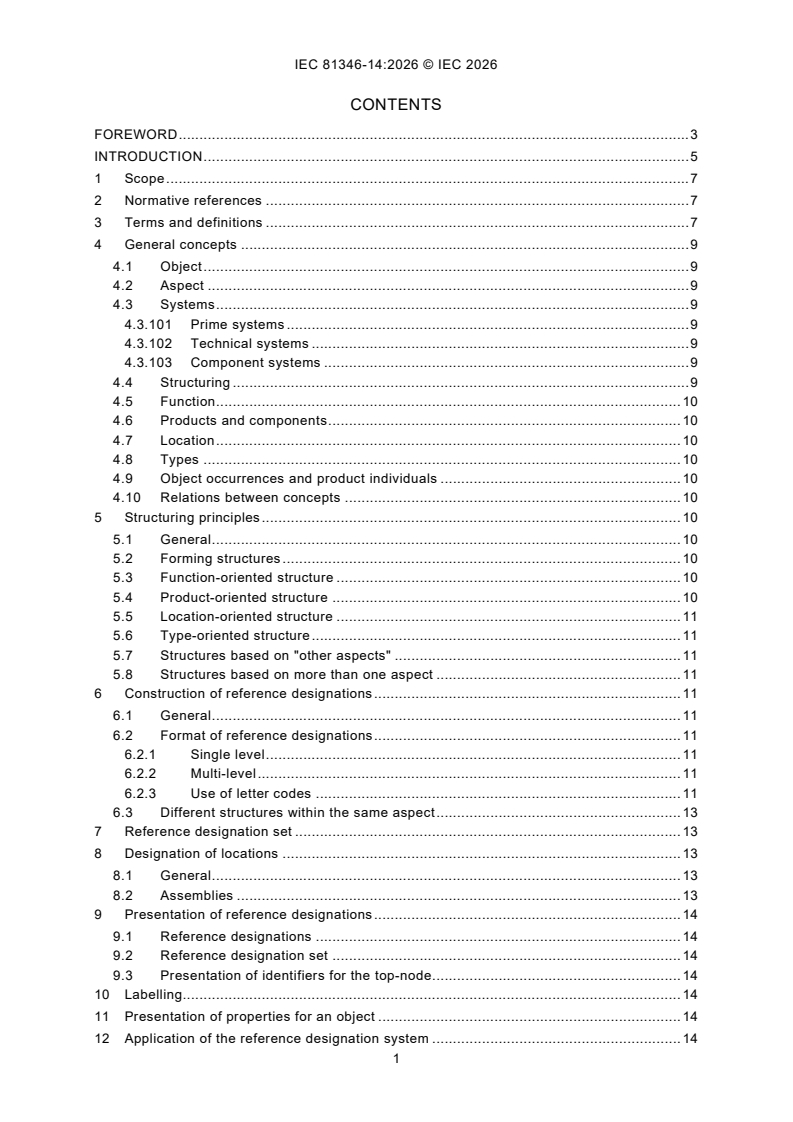
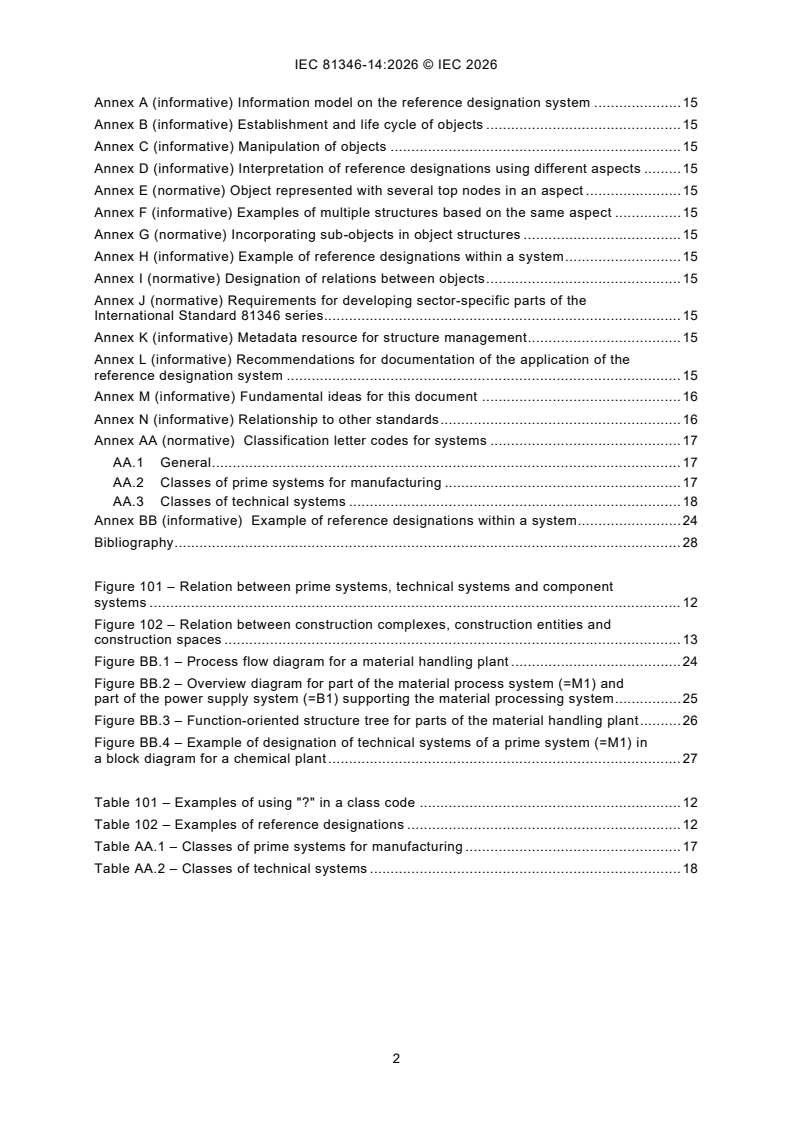
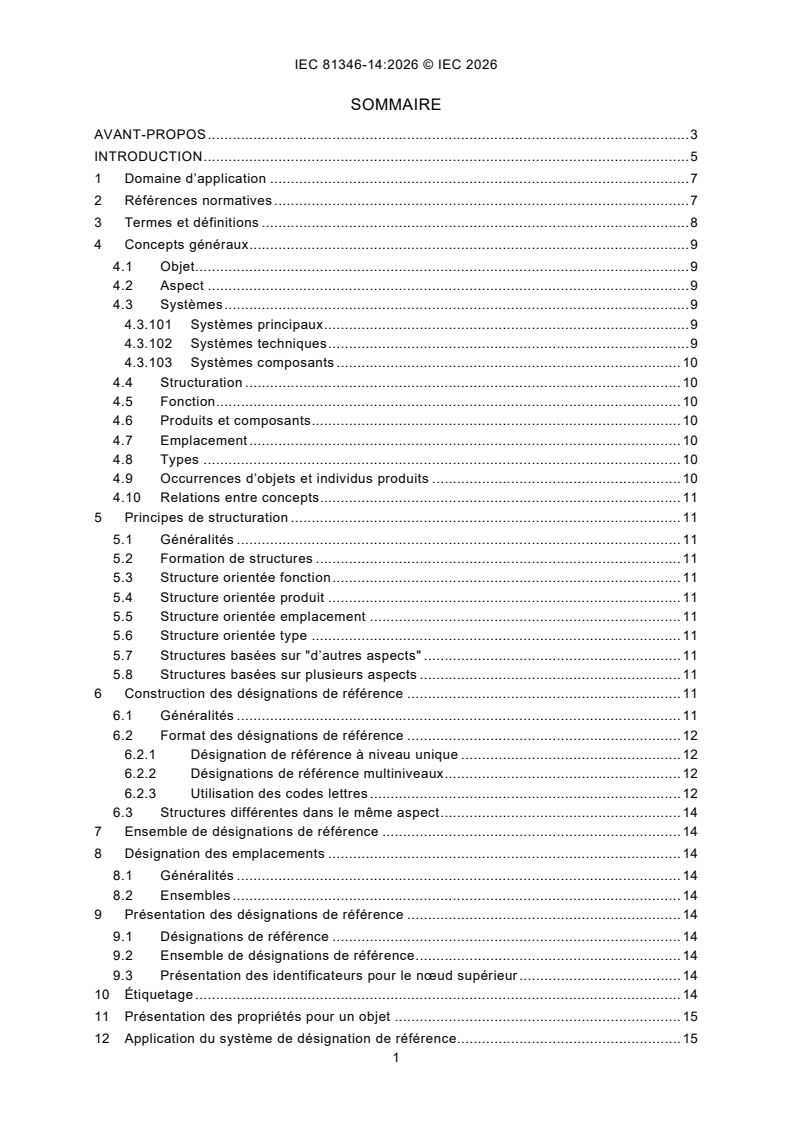
Contents
- 1 Scope
- 2 Normative references
- 3 Terms and definitions
- 3.1 information
- 3.2 data
- 3.3 plant
- 3.4 manufacturing
- 3.5 production
- 3.6 processing
- 3.7 equipment
- 3.8 gaseous matter
- 3.9 liquid matter
- 3.10 solid matter
- 4 General concepts
- 4.1 Object
- 4.2 Aspect
- 4.3 Systems
- 4.4 Structuring
- 4.5 Function
- 4.6 Products and components
- 4.7 Location
- 4.8 Types
- 4.9 Object occurrences and product individuals
- 4.10 Relations between concepts
- 5 Structuring principles
- 5.1 General
- 5.2 Forming structures
- 5.3 Function-oriented structure
- 5.4 Product-oriented structure
- 5.5 Location-oriented structure
- 5.6 Type-oriented structure
- 5.7 Structures based on "other aspects"
- 5.8 Structures based on more than one aspect
- 6 Construction of reference designations
- 6.1 General
- 6.2 Format of reference designations
- Annex BB shows an example reference designation within a system based on a functional-
- 6.3 Different structures within the same aspect
- 7 Reference designation set
- 8 Designation of locations
- 8.1 General
- 8.2 Assemblies
- 9 Presentation of reference designations
- 9.1 Reference designations
- 9.2 Reference designation set
- 9.3 Presentation of identifiers for the top-node
- 10 Labelling
- 11 Presentation of properties for an object
- 12 Application of the reference designation system
- Annex A (informative) Information model on the reference designation
- Annex B (informative) Establishment and life cycle of objects
- Annex C (informative) Manipulation of objects
- Annex D (informative) Interpretation of reference designations using
- Annex E (normative) Object represented with several top nodes in an
- Annex F (informative) Examples of multiple structures based on the same
- Annex G (normative) Incorporating sub-objects in object structures
- Annex H (informative) Example of reference designations within a system
- Annex I (normative) Designation of relations between objects
- Annex J (normative) Requirements for developing sector-specific parts of
- Annex K (informative) Metadata resource for structure management
- Annex L (informative) Recommendations for documentation of the
- Annex M (informative) Fundamental ideas for this document
- Annex N (informative) Relationship to other standards
- Annex AA
- Annex BB
- Bibliography
INTRODUCTION This document considers and supports planning, design, utilization and maintenance of manufacturing systems. The application of a reference designation system for manufacturing systems (RDS-MS) can lead to new views and structuring of these activities and thereby offers opportunities and potential for increasing efficiency and economization. This document is aligned with the structuring rules provided in IEC 81346-1, and the classification principles of IEC 81346-2. It also follows the principles for the classification of prime systems and technical systems provided in ISO 81346-10 and ISO 81346-12. The focus of this document is to define classes of systems which are used in manufacturing, and to provide general guidelines for structuring of these systems. The following advantages of designation systems in accordance with this document and the 81346 International Standard series are:
- the reference designation system can be applied to several technical fields. Mechanical, electrical and process equipment can be treated the same way – a basis for companywide synergy effects;
- the reference designation system allows for the integration of any kind of systems and components without changing the once defined designations;
- the application of different aspects allows, for instance, for the designation of functions independently from realizing products and their location. The different representation of systems through multiple aspects and the relations between these allows for a more inclusive and complete reference model of systems.
The users of this document will be able to manage objects, relations among these and related properties in a more efficient and consistent way. When implemented, information across various data processing systems can be handled in an unambiguous way. Manufacturing is considered as a major part in the five-sector model of the economic sector. The influence and importance of manufacturing ripples throughout the entire model as described in the following:
- primary sector (natural sector):
This sector involves the extraction and production of raw materials, for example, farming, mining, fishing, forestry. The secondary sector relies heavily on this sector for the raw materials needed to produce products.
EXAMPLE 1 A steel manufacturer needs iron from the mining industry. A tyre manufacturer needs rubber from the agricultural industry. A car manufacturer needs steel and tyres, thus, implicitly needing iron from the mining industry and rubber from the agricultural industry.
- secondary sector (industrial sector):
This sector takes the raw materials from the primary sector and transforms them into finished products. This includes factories producing for example, cars, clothing, electronics, steel, dairies, breweries. Building and construction is also part of this sector. - tertiary sector (service sector):
This sector provides services to both individuals and businesses. While manufacturing is not directly part of this sector, it relies heavily on it.
EXAMPLE 2 Transportation services to move products. Financial services to handle transactions. Marketing services to sell products.
- quaternary sector (information sector):
This sector deals with information processing and knowledge sharing. It includes IT, research and development, and consulting. Manufacturing increasingly relies on this sector for technological advancements, process optimization, and data analysis.
- quinary sector (human services sector):
This sector involves services that focus on human development and well-being, such as education, healthcare, and social work. While not directly involved in production, this sector contributes to a skilled and healthy workforce, which is essential for a thriving manufacturing industry.
The different sectors of the five-sector model of the economic sector can be subdivided into subsectors or industries.
For the primary sector (natural sector), the following subsectors are common:
- biotic sector;
- geological sector.
For the secondary sector (industrial sector), the following subsectors are common:
- construction, partly covered by ISO 81346-12.
- manufacturing sector;
- chemicals;
- electrical and optical;
- heavy industry;
- light industry;
- materials.
- utilities, partly covered by ISO 81346-10.
This document is intended to cover manufacturing systems from the geological aspect of the primary sector, such as minerals, fossil fuels, and land. It is also intended to cover manufacturing and construction subsectors from the secondary sector. The specifications in this document apply for processing, transportation and storage of final products, as well as for auxiliary systems to support the manufacturing process such as electrical systems, management systems and waste disposal systems.
1 Scope
This part of 81346 International Standard, published jointly by IEC and ISO, provides, in combination with IEC 81346-1 and IEC 81346-2, rules and recommendations on the structuring of systems and the information on systems of manufacturing systems. It also provides additional classification schemes to those of IEC 81346-2 for use in reference designations within manufacturing systems.
The structuring principles and the classes of objects are intended to provide a clear identification and localization of the objects, and for use in their labelling in the manufacturing plant, for their designation in technical documents and for the designation of the technical documents as well.
The requirements in this document apply for processing, transportation and storage of products, as well as for systems to support the manufacturing process such as electrical systems, management systems and waste disposal systems.
This document applies to different areas within the manufacturing industry such as light industry, electrical and optical industry, chemical industry, material industry and heavy industry. This document is not applicable for designations related to product individuals (e.g. inventory number, serial number) nor to the products manufactured.
This document is also a horizontal publication intended for use by technical committees in preparation of publications related to reference designations in accordance with the principles laid down in IEC Guide 108.
2 Normative references
The following documents are referred to in the text in such a way that some or all of their content constitutes requirements of this document. For dated references, only the edition cited applies. For undated references, the latest edition of the referenced document (including any amendments) applies.
IEC 81346-1:2022, Industrial systems, installations and equipment and industrial products - Structuring principles and reference designations - Part 1: Basic rules IEC 81346-2:—, Industrial systems, installations and equipment and industrial products - Structuring principles and reference designations - Part 2: Classification of objects and codes
for classes
3 Terms and definitions
For the purposes of this document, the terms and definitions given in IEC 81346-1:2022,
IEC 81346-2:— and the following apply.
ISO and IEC maintain terminology databases for use in standardization at the following addresses:
- IEC Electropedia: available at https://www.electropedia.org/
- ISO Online browsing platform: available at https://www.iso.org/obp
Third edition under preparation. Stage at time of publication IEC FDIS 81346-2:2026.
Third edition under preparation. Stage at time of publication IEC FDIS 81346-2:2026.
3.1 information
intelligence or knowledge capable of being represented in forms suitable for communication, storage or processing Note 1 to entry: Information may be represented for example by signs, symbols, pictures or sounds. [SOURCE: IEC 60050-701:1988, 701-01-01]
3.2 data
representation of information (3.1) in a formalized manner suitable for human or automatic processing Note 1 to entry: Processing includes communication and interpretation. Note 2 to entry: In English, the word "data" is generally used in plural form. For use in singular form, it can be called "data item".
[SOURCE: IEC 60050-171:2019, 171-01-02]
3.3 plant
assembly of different systems on a specific site [SOURCE: ISO 81346-10:2022, 3.10]
3.4 manufacturing
<structuring principles and reference designations> production or processing in defined quantities
3.5 production
<structuring principles and reference designations> making a single product by a particular series of actions
3.6 processing
<structuring principles and reference designations> treating matter or information by a particular series of actions
3.7 equipment
single apparatus or set of devices or apparatuses, or the set of main devices of an installation, or all devices necessary to perform a specific task Note 1 to entry: Examples of equipment are a power transformer, the equipment of a substation, measuring equipment.
[SOURCE: IEC 60050-151:2001, 151-11-25]
3.8 gaseous matter
compressible medium which takes shape of its surrounding container
3.9 liquid matter
incompressible medium which takes shape of its surrounding container
3.10 solid matter
incompressible medium which does not take shape of its surrounding container
4 General concepts
4.1 Object
IEC 81346-1:2022, 4.1 applies.
4.2 Aspect
IEC 81346-1:2022, 4.2 applies.
4.3 Systems
IEC 81346-1:2022, 4.3 applies.
Add the following subclauses:
4.3.101 Prime systems A prime system provides an overall manufacturing step in the manufacturing process or provides a support for such steps.
A prime system shall be classified in accordance with to the classification scheme in Annex AA, Table AA.1.
A prime system may incorporate another prime system as one of its constituent system elements.
4.3.102 Technical systems A technical system provides a technical solution for a specific step in the manufacturing process or provides the necessary support for such a technical solution. A technical system shall be classified in accordance with the scheme defined in Annex AA, Table AA.2 A technical system may incorporate another technical system recursively as one of its elements. A technical system shall not incorporate a prime system.
4.3.103 Component systems Component systems are systems that are well defined with respect to both their inherent function and implementation.
A component system shall be classified in accordance with IEC 81346-2:—, Table 2. A component system may incorporate another component system recursively as one of its elements. A component system shall not incorporate a prime system or a technical system. NOTE A component system is usually considered as an off-the-shelf product.
4.4 Structuring
IEC 81346-1:2022, 4.4 applies.
4.5 Function
IEC 81346-1:2022, 4.5 applies.
4.6 Products and components
IEC 81346-1:2022, 4.6 applies with the following additional note:
NOTE 101 In the context of this document, it is important to note the difference between a product and the product aspect. A product is the result of the process (work) and is the "thing" that is delivered. The product aspect is a way to view a system in order to "see" the objects in that system.
4.7 Location
IEC 81346-1:2022, 4.7 applies with the following addition:
Two different aspects shall be applied:
- Host installation aspect: this location aspect shall be applied to relate the location of an object to locations inside or on a product or product assembly. EXAMPLE 101 Objects viewed in host of installation are for example locations within or on a cubicle, a console or a panel.
- Site of installation aspect: this location aspect shall be applied to relate the location of an object to a location defined inside a larger location irrespective of the existence of physical objects making up that larger location.
EXAMPLE 102 Objects viewed in the site of installation aspect are a site, a construction entity (a building), a part of a building, a storey.
4.8 Types
IEC 81346-1:2022, 4.8 applies.
4.9 Object occurrences and product individuals
IEC 81346-1:2022, 4.9 applies.
4.10 Relations between concepts
IEC 81346-1:2022, 4.10 applies.
5 Structuring principles
5.1 General
IEC 81346-1:2022, 5.1 applies.
5.2 Forming structures
IEC 81346-1:2022, 5.2 applies.
5.3 Function-oriented structure
IEC 81346-1:2022, 5.3 applies.
5.4 Product-oriented structure
IEC 81346-1:2022, 5.4 applies.
5.5 Location-oriented structure
IEC 81346-1:2022, 5.5 applies.
5.6 Type-oriented structure
IEC 81346-1:2022, 5.6 applies.
5.7 Structures based on "other aspects"
IEC 81346-1:2022, 5.7 applies.
5.8 Structures based on more than one aspect
An identifier of an object should be based on one aspect only. Where multiple aspects are required, IEC 81346-1:2022, 5.8 applies.
6 Construction of reference designations
6.1 General
IEC 81346-1:2022, 6.1 applies.
6.2 Format of reference designations
6.2.1 Single level
IEC 81346-1:2022, 6.2.1 applies with the following modifications:
Replace Rule 7 with the following:
Rule 7: The prefix signs used to indicate the type of aspect in a reference designation shall be:
a) "=" (EQUALS SIGN) when relating to the function aspect of the object; b) "‒" (MINUS SIGN) when relating to the product aspect of the object; c) "+" (PLUS SIGN) when relating to the host installation aspect of the object; d) "++" (PLUS SIGN, PLUS SIGN) when relating to the site of installation aspect of the object; e) "%" (PERCENT SIGN) when relating to the type aspect of the object; f) "#" (NUMBER SIGN) when relating to other aspects of the object.
6.2.2 Multi-level
IEC 81346-1:2022, 6.2.2 applies.
6.2.3 Use of letter codes
IEC 81346-1:2022, 6.2.3 applies with the addition of the following subclauses:
6.2.3.101 Letter codes for the functional aspect and product aspect Figure 101 illustrates the application of the ONE- TWO- and THREE-letter codes related to prime systems (ONE), technical systems (TWO) and component systems (THREE).
...
Contents
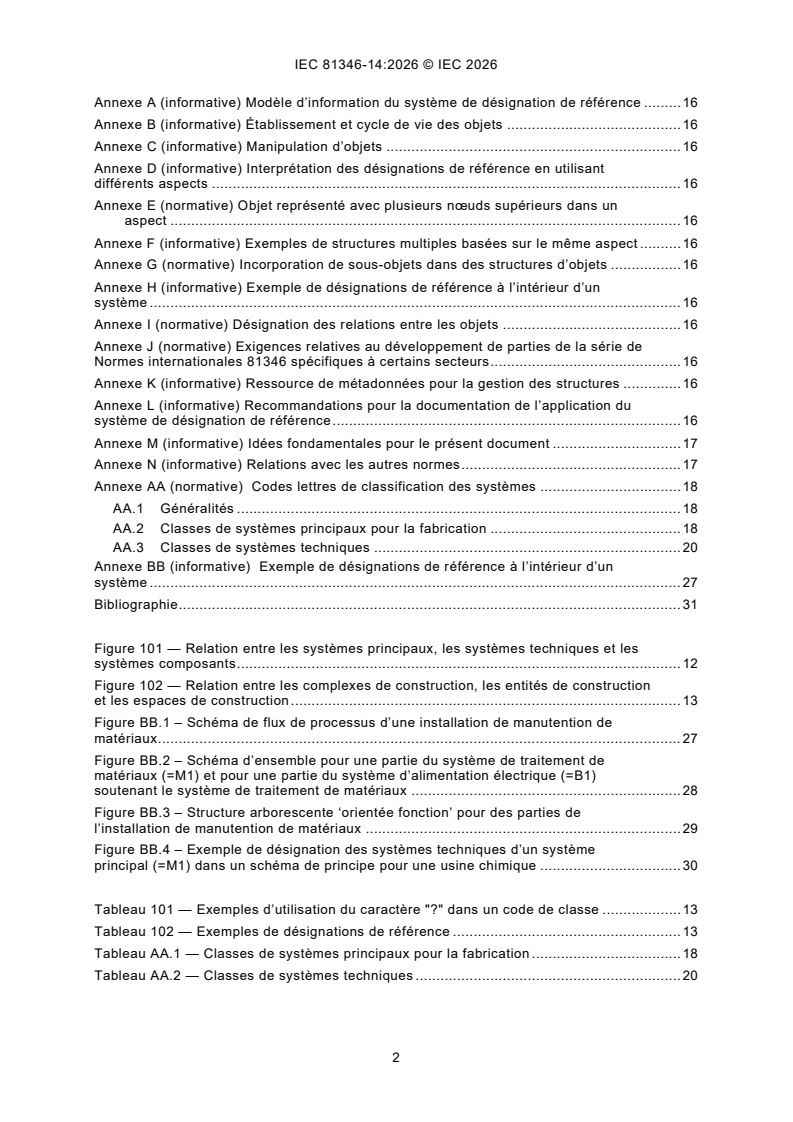
- 1 Domaine d’application
- 2 Références normatives
- 3 Termes et définitions
- 3.1 information
- 3.2 donnée
- 3.3 installation (industrielle)
- 3.4 fabrication
- 3.5 production
- 3.6 traitement
- 3.7 équipement
- 3.8 matière gazeuse
- 3.9 matière liquide
- 3.10 matière solide
- 4 Concepts généraux
- 4.1 Objet
- 4.2 Aspect
- 4.3 Systèmes
- 4.4 Structuration
- 4.5 Fonction
- 4.6 Produits et composants
- 4.7 Emplacement
- 4.8 Types
- 4.9 Occurrences d’objets et individus produits
- 4.10 Relations entre concepts
- 5 Principes de structuration
- 5.1 Généralités
- 5.2 Formation de structures
- 5.3 Structure orientée fonction
- 5.4 Structure orientée produit
- 5.5 Structure orientée emplacement
- 5.6 Structure orientée type
- 5.7 Structures basées sur "d’autres aspects"
- 5.8 Structures basées sur plusieurs aspects
- 6 Construction des désignations de référence
- 6.1 Généralités
- 6.2 Format des désignations de référence
- 6.3 Structures différentes dans le même aspect
- 7 Ensemble de désignations de référence
- 8 Désignation des emplacements
- 8.1 Généralités
- 8.2 Ensembles
- 9 Présentation des désignations de référence
- 9.1 Désignations de référence
- 9.2 Ensemble de désignations de référence
- 9.3 Présentation des identificateurs pour le nœud supérieur
- 10 Étiquetage
- 11 Présentation des propriétés pour un objet
- 12 Application du système de désignation de référence
- Annexe A (informative) Modèle d’information du système de désignation de
- Annexe B (informative) Établissement et cycle de vie des objets
- Annexe C (informative) Manipulation d’objets
- Annexe D (informative) Interprétation des désignations de référence en
- Annexe E (normative) Objet représenté avec plusieurs nœuds supérieurs
- Annexe F (informative) Exemples de structures multiples basées sur le
- Annexe G (normative) Incorporation de sous-objets dans des structures
- Annexe H (informative) Exemple de désignations de référence à l’intérieur
- Annexe I (normative) Désignation des relations entre les objets
- Annexe J (normative) Exigences relatives au développement de parties de
- Annexe K (informative) Ressource de métadonnées pour la gestion des
- Annexe L (informative) Recommandations pour la documentation de
- Annexe M (informative) Idées fondamentales pour le présent document
- Annexe N (informative) Relations avec les autres normes
- Annexe AA
- Annexe BB
- Bibliographie
INTRODUCTION Le présent document prend en compte et soutient l’organisation, la conception, l’utilisation et la maintenance des systèmes de fabrication. L’application d’un système de désignation de référence pour les systèmes de fabrication (RDS-MS) peut conduire à de nouvelles vues et à une nouvelle structuration de ces activités et offre ainsi des possibilités et le potentiel de gagner en efficacité et d’accroître les économies.
Le présent document est aligné sur les règles de structuration prévues dans l’IEC 81346-1 et les principes de classification de l’IEC 81346-2. Il suit également les principes de classification des systèmes principaux et des systèmes techniques énoncés dans l’ISO 81346-10 et l’ISO 81346-12.
L’objet spécifique du présent document est de définir des classes de systèmes utilisés dans l’industrie manufacturière et de fournir des lignes directrices générales pour la structuration de ces systèmes.
Les systèmes de désignation conformes au présent document et à la série IEC 81346 de Normes internationales présentent les avantages suivants:
- le système de désignation de référence peut être appliqué à plusieurs domaines techniques. Les équipements mécaniques, électriques et de traitement peuvent être traités de la même manière, comme base pour créer des effets de synergie à l’échelle de l’entreprise;
- le système de désignation de référence permet l’intégration de tout type de systèmes et de composants sans modifier les désignations déjà définies;
- l’application de différents aspects permet par exemple de désigner des fonctions indépendamment de la réalisation des produits et de leur emplacement. La représentation différente des systèmes à travers de multiples aspects, et de leurs relations entre eux, permet d’obtenir un modèle de référence de systèmes plus inclusif et plus complet. Les utilisateurs du présent document sont en mesure de gérer les objets, les relations entre eux et les propriétés correspondantes d’une manière plus efficace et plus cohérente. Lorsque la présente norme est mise en œuvre, les informations contenues dans les différents systèmes de traitement des données peuvent être traitées sans ambiguïté. L’industrie manufacturière est considérée comme un élément majeur de notre modèle d’économie à cinq secteurs. L’influence et l’importance de l’industrie manufacturière se répercutent sur l’ensemble du modèle, comme décrit ci-dessous:
- secteur primaire (secteur naturel):
Ce secteur implique l’extraction et la production de matières premières, par exemple l’agriculture, l’exploitation minière, la pêche et la sylviculture. Le secteur secondaire dépend fortement de ce secteur pour les matières premières nécessaires pour fabriquer ses produits.
EXEMPLE 1 Une aciérie a besoin de fer provenant de l’industrie minière. Un fabricant de pneus a besoin de caoutchouc provenant de l’industrie agricole. Un constructeur automobile a besoin d’acier et de pneus, et donc implicitement de fer provenant de l’industrie minière et de caoutchouc provenant de l’industrie agricole. - secteur secondaire (secteur industriel):
Ce secteur prend les matières premières du secteur primaire et les transforme en produits finis. Il comprend les usines produisant par exemple des voitures, des vêtements, des appareils électroniques, de l’acier, des produits laitiers, des produits de l’industrie des brasseries. Le bâtiment et la construction font également partie de ce secteur. - secteur tertiaire (secteur des services):
Ce secteur fournit des services aux particuliers et aux entreprises. Bien que l’industrie manufacturière ne fasse pas directement partie de ce secteur, elle en dépend fortement. EXEMPLE 2 Services de transport pour acheminer les produits. Services financiers pour traiter les transactions. Services de marketing pour vendre les produits.
- secteur quaternaire (secteur de l’information):
Ce secteur s’occupe du traitement de l’information et du partage des connaissances. Il comprend l’informatique, la recherche et le développement, ainsi que le conseil. L’industrie manufacturière s’appuie de plus en plus sur ce secteur pour les avancées technologiques, l’optimisation des processus et l’analyse des données. - secteur quinaire (secteur des services à la personne):
Ce secteur comprend les services axés sur le développement humain et le bien-être, tels que l’éducation, la santé et le travail social. Bien qu’il ne soit pas directement impliqué dans la production, ce secteur contribue à une main-d’œuvre qualifiée et en bonne santé, ce qui est essentiel pour une industrie manufacturière prospère.
Les différents secteurs du modèle d’économie à cinq secteurs peuvent être subdivisés en sous-secteurs ou en industries.
Pour le secteur primaire (secteur naturel), les sous-secteurs suivants sont courants:
- secteur biotique,
- secteur géologique.
Pour le secteur secondaire (secteur industriel), les sous-secteurs suivants sont courants:
- construction, partiellement couverte par l’ISO 81346-12;
- secteur manufacturier:
- produits chimiques,
- électricité et optique,
- industrie lourde,
- industrie légère,
- matériaux;
- entreprises du secteur public, partiellement couvertes par l’ISO 81346-10. Le présent document est destiné à couvrir les systèmes de fabrication du point de vue géologique du secteur primaire, tels que les minéraux, les combustibles fossiles et le sol. Il est également destiné à couvrir les sous-secteurs manufacturier et de la construction du secteur secondaire.
Les spécifications du présent document s’appliquent au traitement, au transport et au stockage des produits finis, ainsi qu’aux systèmes auxiliaires pour soutenir le processus de fabrication, tels que les systèmes électriques, les systèmes de gestion et les systèmes d’élimination des déchets.
1 Domaine d’application
La présente partie de la Norme internationale IEC 81346, publiée conjointement par l’IEC et l’ISO, fournit, en combinaison avec l’IEC 81346-1 et l’IEC 81346-2, des règles et recommandations sur la structuration des systèmes, ainsi que des informations sur les systèmes de fabrication. Elle fournit également des hiérarchies de classification supplémentaires qui viennent compléter celles de l’IEC 81346-2 pour une utilisation dans les désignations de référence au sein des systèmes de fabrication. Les principes de structuration et les classes d’objets sont destinés à permettre une identification et une localisation claires des objets. Ils sont conçus pour être utilisés sur l’étiquetage des objets au sein de l’installation de fabrication, pour désigner ces objets dans les documents techniques et pour désigner les documents techniques également. Les exigences du présent document s’appliquent au traitement, au transport et au stockage des produits, ainsi qu’aux systèmes destinés à soutenir le processus de fabrication, tels que les systèmes électriques, les systèmes de gestion et les systèmes d’élimination des déchets. Le présent document s’applique à différents domaines de l’industrie manufacturière, tels que l’industrie légère, l’industrie électrique et optique, l’industrie chimique, l’industrie des matériaux et l’industrie lourde.
Le présent document ne s’applique pas aux désignations liées aux produits individuels (par exemple numéro d’inventaire, numéro de série) ni aux produits fabriqués. Le présent document est également une publication horizontale destinée à être utilisée par les comités techniques pour l’établissement de publications liées aux désignations de référence conformément aux principes exposés dans le Guide 108 de l’IEC.
2 Références normatives
Les documents suivants sont cités dans le texte de sorte qu’ils constituent, pour tout ou partie de leur contenu, des exigences du présent document. Pour les références datées, seule l’édition citée s’applique. Pour les références non datées, la dernière édition du document de référence s’applique (y compris les éventuels amendements). IEC 81346-1:2022, Systèmes industriels, installations et appareils, et produits industriels - Principes de structuration et désignations de référence - Partie 1: Règles de base IEC 81346-2:—, Systèmes industriels, installations et appareils, et produits industriels - Principes de structuration et désignations de référence - Partie 2: Classification des objets et
codes pour les classes
Troisième édition en cours d’établissement. Stade au moment de la publication: IEC FDIS 81346-2:2026.
3 Termes et définitions
Pour les besoins du présent document, les termes et les définitions de l’IEC 81346-1:2022,
l’IEC 81346-2:— , ainsi que les suivants, s’appliquent.
L’ISO et l’IEC tiennent à jour des bases de données terminologiques destinées à être utilisées en normalisation, consultables aux adresses suivantes:
- IEC Electropedia: disponible à l’adresse https://www.electropedia.org/
- ISO Online browsing platform: disponible à l’adresse https://www.iso.org/obp
3.1 information
renseignement ou élément de connaissance susceptible d’être représenté sous une forme adaptée à une communication, un enregistrement ou un traitement Note 1 à l’article: Les informations peuvent se présenter par exemple sous la forme de signes, symboles, images ou sons.
[SOURCE: IEC 60050-701:1988, 701-01-01]
3.2 donnée
représentation d’une information (3.1) sous une forme conventionnelle convenant au traitement par des moyens humains ou automatiques Note 1 à l’article: Le traitement inclut la communication et l’interprétation. Note 2 à l’article: En anglais, le mot "data" est généralement utilisé au pluriel. Pour un usage au singulier, on peut utiliser "data item".
[SOURCE: IEC 60050-171:2019, 171-01-02]
3.3 installation (industrielle)
assemblage de différents systèmes sur un site spécifique [SOURCE: ISO 81346-10:2022, 3.10]
3.4 fabrication
<principes de structuration et désignations de référence> production ou traitement en quantités définies
3.5 production
<principes de structuration et désignations de référence> fabrication d’un produit unique par une série particulière d’actions
3.6 traitement
<principes de structuration et désignations de référence> traitement de matière ou d’information par une série particulière d’actions
Troisième édition en cours d’établissement. Stade au moment de la publication: IEC FDIS 81346-2:2026.
3.7 équipement
matériel appareil unique ou ensemble de dispositifs ou appareils, ou ensemble des dispositifs principaux d’une installation, ou ensemble des dispositifs nécessaires à l’accomplissement d’une tâche particulière Note 1 à l’article: Des exemples d’équipement ou de matériel sont un transformateur de puissance, l’équipement d’une sous-station, un équipement de mesure.
[SOURCE: IEC 60050-151:2001, 151-11-25]
3.8 matière gazeuse
milieu compressible qui prend la forme du contenant qui l’entoure
3.9 matière liquide
milieu incompressible qui prend la forme du contenant qui l’entoure
3.10 matière solide
milieu incompressible qui ne prend pas la forme du contenant qui l’entoure
4 Concepts généraux
4.1 Objet
L’IEC 81346-1:2022, 4.1, s’applique.
4.2 Aspect
L’IEC 81346-1:2022, 4.2, s’applique.
4.3 Systèmes
L’IEC 81346-1:2022, 4.3, s’applique.
Ajouter les paragraphes suivants:
4.3.101 Systèmes principaux Un système principal fournit une étape de fabrication globale dans le processus de fabrication ou fournit un soutien pour de telles étapes.
Un système principal doit être classé conformément à la hiérarchie de classification fournie à l’Annexe AA, Tableau AA.1.
Un système principal peut comprendre, parmi ses éléments constituants, un autre système principal.
4.3.102 Systèmes techniques Un système technique fournit une solution technique pour une étape spécifique du processus de fabrication ou fournit le soutien nécessaire pour une telle solution technique. Un système technique doit être classifié conformément à la hiérarchie de classification définie à l’Annexe AA, Tableau AA.2.
Un système technique peut comprendre de manière récursive, parmi ses éléments constituants, un autre système technique. Un système technique ne doit pas comporter de système principal. 4.3.103 Systèmes composants Les systèmes composants sont des systèmes bien définis en ce qui concerne à la fois leur fonction inhérente et leur mise en œuvre.
Un système composants doivent être classifié conformément à l’IEC 81346-2:—, Tableau 2. Un système composants peut comprendre de manière récursive, parmi ses éléments constituants, un autre système composants. Un système composants ne doit pas comporter de système principal ni de système technique.
NOTE Un système composants est généralement considéré comme un produit grand public.
4.4 Structuration
L’IEC 81346-1:2022, 4.4, s’applique.
4.5 Fonction
L’IEC 81346-1:2022, 4.5, s’applique.
4.6 Produits et composants
L’IEC 81346-1:2022, 4.6, s’applique en tenant compte de la note supplémentaire suivante:
NOTE 101 Dans le contexte du présent document, il est important de noter la différence entre un produit et l’aspect produit. Un produit est le résultat du processus (travail) et la "chose" qui est livrée. L’aspect produit est un moyen de visualiser un système afin de "voir" les objets de ce système.
4.7 Emplacement
L’IEC 81346-1:2022, 4.7, s’applique avec l’ajout suivant:
Deux aspects différents doivent être appliqués:
- aspect "hôte d’installation": cet aspect emplacement doit être appliqué pour relier l’emplacement d’un objet aux emplacements situés à l’intérieur ou sur un produit ou un ensemble de produits; EXEMPLE 101 Les objets vus dans l’hôte d’installation sont par exemple des emplacements à l’intérieur ou sur une armoire, une console ou un panneau.
- aspect "site d’installation": cet aspect emplacement doit être appliqué pour relier l’emplacement d’un objet à un emplacement défini à l’intérieur d’un emplacement plus grand, indépendamment de l’existence d’objets physiques composant cet emplacement plus grand.
EXEMPLE 102 Les objets vus dans l’aspect "site d’installation" sont un site, une entité de construction (un bâtiment), une partie d’un bâtiment, un étage.
4.8 Types
L’IEC 81346-1:2022, 4.8, s’applique.
4.9 Occurrences d’objets et individus produits
L’IEC 81346-1:2022, 4.9, s’applique.
4.10 Relations entre concepts
L’IEC 81346-1:2022, 4.10, s’applique.
5 Principes de structuration
5.1 Généralités
L’IEC 81346-1:2022, 5.1, s’applique.
5.2 Formation de structures
L’IEC 81346-1:2022, 5.2, s’applique.
5.3 Structure orientée fonction
L’IEC 81346-1:2022, 5.3, s’applique.
5.4 Structure orientée produit
L’IEC 81346-1:2022, 5.4, s’applique.
5.5 Structure orientée emplacement
L’IEC 81346-1:2022, 5.5, s’applique.
5.6 Structure orientée type
L’IEC 81346-1:2022, 5.6, s’applique.
5.7 Structures basées sur "d’autres aspects"
L’IEC 81346-1:2022, 5.7, s’applique.
5.8 Structures basées sur plusieurs aspects
Il convient qu’un identificateur d’objet soit basé sur un seul aspect. Lorsque plusieurs aspects sont exigés, l’IEC 81346-1:2022, 5.8, s’applique.
6 Construction des désignations de référence
6.1 Généralités
L’IEC 81346-1:2022, 6.1, s’applique.
6.2 Format des désignations de référence
6.2.1 Désignation de référence à niveau unique
L’IEC 81346-1:2022, 6.2.1, s’applique avec les modifications suivantes:
Remplacer la Règle 7 par ce qui suit:
Règle 7 Les signes utilisés comme préfixe pour indiquer le type d’aspect dans une désignation de référence doivent être:
a) "=" (SIGNE ÉGAL) lorsqu’il est fait référence à l’aspect fonction de l’objet; b) "–" (SIGNE MOINS) lorsqu’il est fait référence à l’aspect produit de l’objet; c) "+" (SIGNE PLUS) lorsqu’il est fait référence à l’aspect hôte d’installation de l’objet; d) "++" (SIGNE PLUS, SIGNE PLUS) lorsqu’il est fait référence à l’aspect site d’installation de l’objet; e) "%" (SIGNE POUR CENT) lorsqu’il est fait référence à l’aspect type de l’objet; f) "#" (CROISILLON) lorsqu’il est fait référence à d’autres aspects de l’objet.
6.2.2 Désignations de référence multiniveaux
L’IEC 81346-1:2022, 6.2.2, s’applique.
6.2.3 Utilisation des codes lettres
L’IEC 81346-1:2022, 6.2.3, s’applique avec l’ajout des paragraphes suivants:
6.2.3.101 Codes lettres pour l’aspect fonctionnel et l’aspect produit La Figure 101 représente l’application des codes à UNE, DEUX et TROIS lettres relatifs aux systèmes principaux (UNE lettre), aux systèmes techniques (DEUX lettres) et aux systèmes composants (TROIS lettres).
Figure 101 — Relation entre les systèmes principaux, les systèmes techniques et les systèmes composants Pour la désignation des systèmes principaux et des systèmes techniques en fonction de leur aspect fonctionnel, de leur aspect produit ou de leur aspect type, les hiérarchies de classification de l’Annexe AA doivent s’appliquer.
Pour la désignation des systèmes composants en fonction de leur aspect fonctionnel, de leur aspect produit ou de leur aspect type, la hiérarchie de classification de l’IEC 81346-2:—, Tableau 2, doit s’appliquer.
...