

ISO 16073-8:2019
(Main)Wildland firefighting personal protective equipment — Requirements and test methods — Part 8: Hearing
General Information
- Abstract
This document specifies the minimum performance requirements and methods of test for hearing protection used when wildland firefighting. This document covers the general design of the personal protective equipment (PPE), the minimum levels of performance for the materials employed and the methods of test used. The PPE is not intended to provide protection during fire entrapment. This document does not cover PPE for structural firefighting (see ISO 11999 series), for use against chemical, biological, radiological and nuclear hazards, or for use where a reflective outer surface is required (see ISO 15538). Activities in support of wildland firefighting, such as the cutting of trees and the use of a chainsaw can require additional protection to that provided in this document. Users are directed to those relevant standards for the requirements associated with such protection.
- Status
- Published
- Publication Date
- 16-Oct-2019
- Technical Committee
- ISO/TC 94/SC 14 - Firefighters' personal equipment
- Drafting Committee
- ISO/TC 94/SC 14/WG 3 - Wildland firefighting
- Current Stage
- 9060 - Close of review
- Completion Date
- 04-Jun-2030
Buy Documents

ISO 16073-8:2019 - Wildland firefighting personal protective equipment -- Requirements and test methods

ISO 16073-8:2019 - Wildland firefighting personal protective equipment — Requirements and test methods — Part 8: Hearing/17/2019
Overview
ISO 16073-8:2019 - Wildland firefighting personal protective equipment - Part 8: Hearing, specifies minimum performance requirements and test methods for hearing protection used during wildland firefighting. The standard covers design, materials and testing of ear-muffs, ear-plugs and ear-muffs integrated with industrial safety helmets. It is intended for prolonged use in wildland firefighting operations and is not intended to provide entrapment-level fire protection or to cover structural, CBRN or reflective-surfaced PPE.
Key topics and requirements
- Scope and application: Defines hearing protection for wildland firefighting and notes situations requiring additional safeguards (e.g., chainsaws, tree cutting, heavy machinery).
- Performance and test methods: Specifies minimum performance levels and references established test standards for hearing protectors (see EN 352 series).
- Types of protectors:
- Ear-muffs - compliance with EN 352-1.
- Ear-plugs - compliance with EN 352-2.
- Ear-muffs attached to helmets - compliance with EN 352-3.
- Interface with other PPE: Addresses compatibility with helmets and other wildland PPE to ensure fit and function without increasing heat stress or ergonomic penalties.
- Marking and identification: Requires durable product marking (manufacturer ID, model, orientation/left-right/top-front where applicable).
- Manufacturer’s information: Mandates user instructions and documentation including product identification, sound attenuation values, size ranges, materials, fitting/maintenance guidance, storage/cleaning, warnings, mass (grams) and limitations of use.
- Risk assessment guidance: Emphasizes performing a risk assessment to determine when hearing protection is needed and which type is appropriate.
Applications and users
ISO 16073-8:2019 is used by:
- Wildland firefighters and crew managers selecting appropriate hearing protection for operational tasks.
- PPE manufacturers and designers developing ear-plugs, ear-muffs or helmet-mounted solutions for wildland environments.
- Procurement officers and safety managers specifying compliant hearing protectors for wildland firefighting stock.
- Test laboratories and certification bodies applying referenced EN/ISO test methods.
- Training officers who instruct firefighters on selection, fitting, care and limitations of hearing PPE.
Related standards
- ISO/TR 19591 (terms and definitions)
- EN 352-1 / EN 352-2 / EN 352-3 (hearing protector test requirements)
- EN 458 (selection, use, care and maintenance guidance)
- ISO 11999 series (structural firefighting PPE) and ISO 15538 (reflective clothing) for other firefighting contexts
Keywords: ISO 16073-8:2019, wildland firefighting personal protective equipment, hearing protection, ear-muffs, ear-plugs, EN 352, PPE standards, hearing protectors, manufacturer information.
Relations
- Revises
ISO 16073:2011 - Wildland firefighting personal protective equipment — Requirements and test methods - Effective Date
- 15-Jul-2017
Buy Documents
ISO 16073-8:2019 - Wildland firefighting personal protective equipment -- Requirements and test methods
ISO 16073-8:2019 - Wildland firefighting personal protective equipment — Requirements and test methods — Part 8: Hearing/17/2019
Get Certified
Connect with accredited certification bodies for this standard

CIS Institut d.o.o.
Personal Protective Equipment (PPE) certification body. Notified Body NB-2890 for EU Regulation 2016/425 PPE.

Kiwa BDA Testing
Building and construction product certification.
Kmetijski inštitut Slovenije
Agricultural Institute of Slovenia. Soil testing, plant health, agricultural product analysis.
Sponsored listings
Frequently Asked Questions
ISO 16073-8:2019 is a standard published by the International Organization for Standardization (ISO). Its full title is "Wildland firefighting personal protective equipment — Requirements and test methods — Part 8: Hearing". This standard covers: This document specifies the minimum performance requirements and methods of test for hearing protection used when wildland firefighting. This document covers the general design of the personal protective equipment (PPE), the minimum levels of performance for the materials employed and the methods of test used. The PPE is not intended to provide protection during fire entrapment. This document does not cover PPE for structural firefighting (see ISO 11999 series), for use against chemical, biological, radiological and nuclear hazards, or for use where a reflective outer surface is required (see ISO 15538). Activities in support of wildland firefighting, such as the cutting of trees and the use of a chainsaw can require additional protection to that provided in this document. Users are directed to those relevant standards for the requirements associated with such protection.
This document specifies the minimum performance requirements and methods of test for hearing protection used when wildland firefighting. This document covers the general design of the personal protective equipment (PPE), the minimum levels of performance for the materials employed and the methods of test used. The PPE is not intended to provide protection during fire entrapment. This document does not cover PPE for structural firefighting (see ISO 11999 series), for use against chemical, biological, radiological and nuclear hazards, or for use where a reflective outer surface is required (see ISO 15538). Activities in support of wildland firefighting, such as the cutting of trees and the use of a chainsaw can require additional protection to that provided in this document. Users are directed to those relevant standards for the requirements associated with such protection.
ISO 16073-8:2019 is classified under the following ICS (International Classification for Standards) categories: 13.220.10 - Fire-fighting; 13.340.20 - Head protective equipment. The ICS classification helps identify the subject area and facilitates finding related standards.
ISO 16073-8:2019 has the following relationships with other standards: It is inter standard links to ISO 16073:2011. Understanding these relationships helps ensure you are using the most current and applicable version of the standard.
ISO 16073-8:2019 is available in PDF format for immediate download after purchase. The document can be added to your cart and obtained through the secure checkout process. Digital delivery ensures instant access to the complete standard document.
Standards Content (Sample)
INTERNATIONAL ISO
STANDARD 16073-8
First edition
2019-10
Wildland firefighting personal
protective equipment —
Requirements and test methods —
Part 8:
Hearing
Équipement de protection individuelle pour la lutte contre les feux
d'espaces naturels — Exigences et méthodes d'essai —
Partie 8: Protecteurs individuels contre le bruit
Reference number
©
ISO 2019
© ISO 2019
All rights reserved. Unless otherwise specified, or required in the context of its implementation, no part of this publication may
be reproduced or utilized otherwise in any form or by any means, electronic or mechanical, including photocopying, or posting
on the internet or an intranet, without prior written permission. Permission can be requested from either ISO at the address
below or ISO’s member body in the country of the requester.
ISO copyright office
CP 401 • Ch. de Blandonnet 8
CH-1214 Vernier, Geneva
Phone: +41 22 749 01 11
Fax: +41 22 749 09 47
Email: copyright@iso.org
Website: www.iso.org
Published in Switzerland
ii © ISO 2019 – All rights reserved
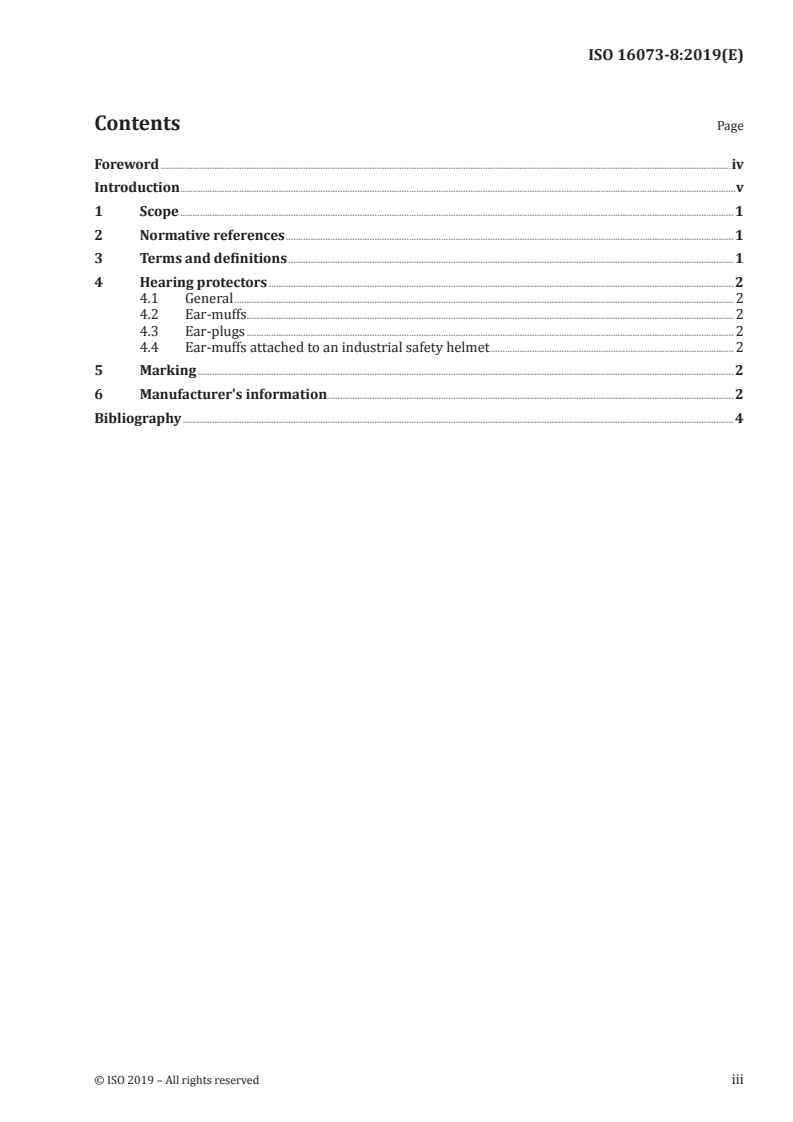
Contents Page
Foreword .iv
Introduction .v
1 Scope . 1
2 Normative references . 1
3 Terms and definitions . 1
4 Hearing protectors . 2
4.1 General . 2
4.2 Ear-muffs. 2
4.3 Ear-plugs . 2
4.4 Ear-muffs attached to an industrial safety helmet . 2
5 Marking . 2
6 Manufacturer's information . 2
Bibliography . 4
Foreword
ISO (the International Organization for Standardization) is a worldwide federation of national standards
bodies (ISO member bodies). The work of preparing International Standards is normally carried out
through ISO technical committees. Each member body interested in a subject for which a technical
committee has been established has the right to be represented on that committee. International
organizations, governmental and non-governmental, in liaison with ISO, also take part in the work.
ISO collaborates closely with the International Electrotechnical Commission (IEC) on all matters of
electrotechnical standardization.
The procedures used to develop this document and those intended for its further maintenance are
described in the ISO/IEC Directives, Part 1. In particular, the different approval criteria needed for the
different types of ISO documents should be noted. This document was drafted in accordance with the
editorial rules of the ISO/IEC Directives, Part 2 (see www .iso .org/directives).
Attention is drawn to the possibility that some of the elements of this document may be the subject of
patent rights. ISO shall not be held responsible for identifying any or all such patent rights. Details of
any patent rights identified during the development of the document will be in the Introduction and/or
on the ISO list of patent declarations received (see www .iso .org/patents).
Any trade name used in this document is information given for the convenience of users and does not
constitute an endorsement.
For an explanation of the voluntary nature of standards, the meaning of ISO specific terms and
expressions related to conformity assessment, as well as information about ISO's adherence to the
World Trade Organization (WTO) principles in the Technical Barriers to Trade (TBT), see www .iso
.org/iso/foreword .html.
This document was prepared by Technical Committee ISO/TC94, Personal safety — Protective equipment,
Subcommittee SC14, Firefighters personal equipment.
This first edition of ISO 16073-8, together with ISO 16073-1 to ISO 16073-7, cancels and replaces
ISO 16073:2011.
The main changes are as follows:
— the content has been reviewed and separated into several parts;
— the respiratory protection has been deleted from the document.
A list of all parts in the ISO 16073 series can be found on the ISO website.
Any feedback or questions on this document should be directed to the user’s national standards body. A
complete listing of these bodies can be found at www .iso .org/members .html.
iv © ISO 2019 – All rights reserved
Introduction
Wildland firefighting involves work carried out mostly in summer temperatures and for many hours,
during which the firefighter can develop high levels of metabolic heat. As a consequence, the personal
protective equipment (PPE) is required to be light, flexible and commensurate with the risks to which the
firefighter can be exposed in order to be effective without introducing excessive heat stress to the wearer.
It is important to train firefighters in the selection, use, care and maintenance of the PPE covered by
this document, including an understanding of its limitations.
It is intended that a risk assessment be undertaken to determine if the PPE covered by this document is
suitable for its intended use and the expected exposure.
This document provides minimum performance requirements for wildland firefighters' personal
protective equipment hearing protection, designed for use for extended periods during wildland
firefighting.
...
INTERNATIONAL ISO
STANDARD 16073-8
First edition
2019-10
Wildland firefighting personal
protective equipment —
Requirements and test methods —
Part 8:
Hearing
Équipement de protection individuelle pour la lutte contre les feux
d'espaces naturels — Exigences et méthodes d'essai —
Partie 8: Protecteurs individuels contre le bruit
Reference number
©
ISO 2019
© ISO 2019
All rights reserved. Unless otherwise specified, or required in the context of its implementation, no part of this publication may
be reproduced or utilized otherwise in any form or by any means, electronic or mechanical, including photocopying, or posting
on the internet or an intranet, without prior written permission. Permission can be requested from either ISO at the address
below or ISO’s member body in the country of the requester.
ISO copyright office
CP 401 • Ch. de Blandonnet 8
CH-1214 Vernier, Geneva
Phone: +41 22 749 01 11
Fax: +41 22 749 09 47
Email: copyright@iso.org
Website: www.iso.org
Published in Switzerland
ii © ISO 2019 – All rights reserved
Contents Page
Foreword .iv
Introduction .v
1 Scope . 1
2 Normative references . 1
3 Terms and definitions . 1
4 Hearing protectors . 2
4.1 General . 2
4.2 Ear-muffs. 2
4.3 Ear-plugs . 2
4.4 Ear-muffs attached to an industrial safety helmet . 2
5 Marking . 2
6 Manufacturer's information . 2
Bibliography . 4
Foreword
ISO (the International Organization for Standardization) is a worldwide federation of national standards
bodies (ISO member bodies). The work of preparing International Standards is normally carried out
through ISO technical committees. Each member body interested in a subject for which a technical
committee has been established has the right to be represented on that committee. International
organizations, governmental and non-governmental, in liaison with ISO, also take part in the work.
ISO collaborates closely with the International Electrotechnical Commission (IEC) on all matters of
electrotechnical standardization.
The procedures used to develop this document and those intended for its further maintenance are
described in the ISO/IEC Directives, Part 1. In particular, the different approval criteria needed for the
different types of ISO documents should be noted. This document was drafted in accordance with the
editorial rules of the ISO/IEC Directives, Part 2 (see www .iso .org/directives).
Attention is drawn to the possibility that some of the elements of this document may be the subject of
patent rights. ISO shall not be held responsible for identifying any or all such patent rights. Details of
any patent rights identified during the development of the document will be in the Introduction and/or
on the ISO list of patent declarations received (see www .iso .org/patents).
Any trade name used in this document is information given for the convenience of users and does not
constitute an endorsement.
For an explanation of the voluntary nature of standards, the meaning of ISO specific terms and
expressions related to conformity assessment, as well as information about ISO's adherence to the
World Trade Organization (WTO) principles in the Technical Barriers to Trade (TBT), see www .iso
.org/iso/foreword .html.
This document was prepared by Technical Committee ISO/TC94, Personal safety — Protective equipment,
Subcommittee SC14, Firefighters personal equipment.
This first edition of ISO 16073-8, together with ISO 16073-1 to ISO 16073-7, cancels and replaces
ISO 16073:2011.
The main changes are as follows:
— the content has been reviewed and separated into several parts;
— the respiratory protection has been deleted from the document.
A list of all parts in the ISO 16073 series can be found on the ISO website.
Any feedback or questions on this document should be directed to the user’s national standards body. A
complete listing of these bodies can be found at www .iso .org/members .html.
iv © ISO 2019 – All rights reserved
Introduction
Wildland firefighting involves work carried out mostly in summer temperatures and for many hours,
during which the firefighter can develop high levels of metabolic heat. As a consequence, the personal
protective equipment (PPE) is required to be light, flexible and commensurate with the risks to which the
firefighter can be exposed in order to be effective without introducing excessive heat stress to the wearer.
It is important to train firefighters in the selection, use, care and maintenance of the PPE covered by
this document, including an understanding of its limitations.
It is intended that a risk assessment be undertaken to determine if the PPE covered by this document is
suitable for its intended use and the expected exposure.
This document provides minimum performance requirements for wildland firefighters' personal
protective equipment hearing protection, designed for use for extended periods during wildland
firefighting.
...