

ISO 5556:2023
(Main)Ships and marine technology — Sea-going vessels — Single-drum winches for oceanographic research
General Information
- Abstract
This document specifies requirements for the design, construction, safety, performance and acceptance testing of single-drum winches for oceanographic research (hereafter referred as to “single-drum winches”) with hydraulic or electric drive. Single-drum winches are mainly used for fixed-point and towing marine survey, involving marine geological sampling, seawater water body parameter measurement and marine biological survey.
- Status
- Published
- Publication Date
- 01-Jun-2023
- Technical Committee
- ISO/TC 8/SC 4 - Outfitting and deck machinery
- Drafting Committee
- ISO/TC 8/SC 4 - Outfitting and deck machinery
- Current Stage
- 6060 - International Standard published
- Start Date
- 02-Jun-2023
- Due Date
- 14-Oct-2023
- Completion Date
- 02-Jun-2023
Buy Documents
ISO 5556:2023 - Ships and marine technology — Sea-going vessels — Single-drum winches for oceanographic research Released:2. 06. 2023
ISO 5556:2023 - Navires et technologie maritime — Navires de haute mer — Treuils de recherche océanographique a tambour simple Released:2. 06. 2023
Overview
ISO 5556:2023 - Ships and marine technology - Sea-going vessels - Single-drum winches for oceanographic research - defines minimum requirements for the design, construction, safety, performance and acceptance testing of single-drum winches with hydraulic or electric drive used in oceanographic research and marine survey operations. The standard covers equipment used for fixed‑point and towing surveys including geological sampling, seawater parameter measurement and biological sampling.
Key topics and technical requirements
- Scope & terminology: Defines key terms such as safe working load (SWL), nominal speed, top layer working load and dynamic factor (see Clause 3).
- Design and strength: Structural parts must meet strength limits expressed relative to material yield strength (see Clause 4.2). Holding load and allowable stresses are defined to account for dynamic ship motion.
- Drum design and spooling:
- For steel wire ropes the drum diameter shall be at least 16× the rope diameter; manufacturer requirements apply for other cable types (electro‑mechanical, optical fibre, synthetic).
- Minimum rope margin, groove shell for multi‑layer spooling, and at least 5 laps remaining rope under normal conditions (Clauses 4.3–4.4).
- Rope guide sheave diameters similarly constrained (16× for steel wire).
- Drive, brake and speed control:
- Electric drives comply with IEC 60092 and electrical protection per IP56 (IEC 60529); hydraulic drives to ISO 4413 (Clause 4.5).
- Independent drive with reversing, stepless speed control (0 to max) and overload protection; continuous running capability under SWL and nominal speed (generally ≥30 min).
- Normally closed brake capable of resisting holding load without damage; braking must avoid excessive shock (Clause 4.6–4.7).
- Safety, alarms and auxiliary functions:
- Visual and audible alarms for misoperation, overload, overspeed, insufficient rope margin; hydraulic systems require oil temperature/level and filter alarms (Clause 4.8).
- Optional Active Heave Compensation (AHC) to reduce wave motion effects on deployed gear (Clause 4.9).
- Control and testing: Local and remote/portable controls with operation parameter displays; acceptance tests include function, static and dynamic load tests and optional AHC tests (Clause 5).
Applications and users
ISO 5556:2023 is essential for:
- Shipbuilders and naval architects specifying deck machinery for research vessels
- Winch manufacturers and OEMs designing oceanographic single-drum winches
- Research institutions, survey contractors and vessel operators procuring, installing or certifying winches
- Classification societies and inspectors performing acceptance testing and certification
Related standards
- ISO 3828 (deck machinery vocabulary)
- ISO 7825 (deck machinery general requirements)
- ISO 4413 (hydraulic systems)
- IEC 60092 (ship electrical installations)
- IEC 60529 (IP Code)
ISO 5556:2023 provides a practical, safety‑focused framework to ensure reliable single‑drum winch performance in oceanographic research and marine survey operations.
Buy Documents
ISO 5556:2023 - Ships and marine technology — Sea-going vessels — Single-drum winches for oceanographic research Released:2. 06. 2023
ISO 5556:2023 - Navires et technologie maritime — Navires de haute mer — Treuils de recherche océanographique a tambour simple Released:2. 06. 2023
Get Certified
Connect with accredited certification bodies for this standard

DNV
DNV is an independent assurance and risk management provider.

Lloyd's Register
Lloyd's Register is a global professional services organisation specialising in engineering and technology.

FSC International
Forest Stewardship Council certification.
Sponsored listings
Frequently Asked Questions
ISO 5556:2023 is a standard published by the International Organization for Standardization (ISO). Its full title is "Ships and marine technology — Sea-going vessels — Single-drum winches for oceanographic research". This standard covers: This document specifies requirements for the design, construction, safety, performance and acceptance testing of single-drum winches for oceanographic research (hereafter referred as to “single-drum winches”) with hydraulic or electric drive. Single-drum winches are mainly used for fixed-point and towing marine survey, involving marine geological sampling, seawater water body parameter measurement and marine biological survey.
This document specifies requirements for the design, construction, safety, performance and acceptance testing of single-drum winches for oceanographic research (hereafter referred as to “single-drum winches”) with hydraulic or electric drive. Single-drum winches are mainly used for fixed-point and towing marine survey, involving marine geological sampling, seawater water body parameter measurement and marine biological survey.
ISO 5556:2023 is classified under the following ICS (International Classification for Standards) categories: 47.020.50 - Deck equipment and installations; 47.040 - Seagoing vessels. The ICS classification helps identify the subject area and facilitates finding related standards.
ISO 5556:2023 is available in PDF format for immediate download after purchase. The document can be added to your cart and obtained through the secure checkout process. Digital delivery ensures instant access to the complete standard document.
Standards Content (Sample)
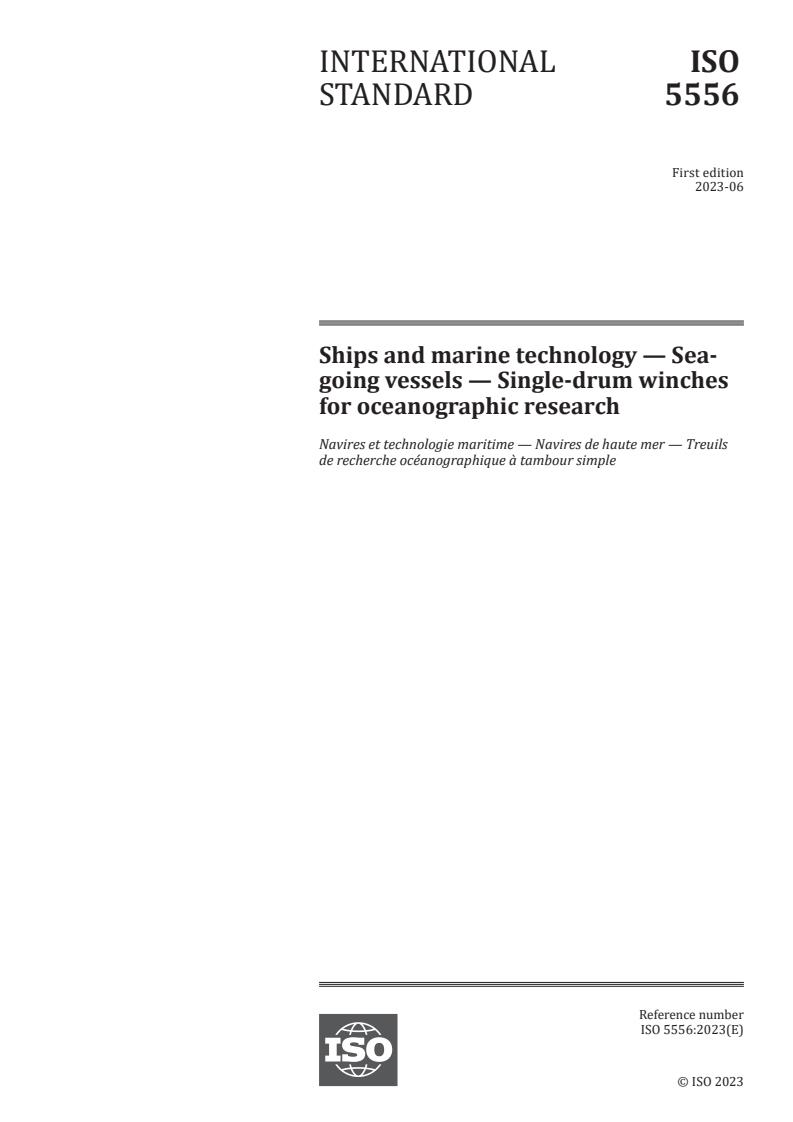
INTERNATIONAL ISO
STANDARD 5556
First edition
2023-06
Ships and marine technology — Sea-
going vessels — Single-drum winches
for oceanographic research
Navires et technologie maritime — Navires de haute mer — Treuils
de recherche océanographique à tambour simple
Reference number
© ISO 2023
All rights reserved. Unless otherwise specified, or required in the context of its implementation, no part of this publication may
be reproduced or utilized otherwise in any form or by any means, electronic or mechanical, including photocopying, or posting on
the internet or an intranet, without prior written permission. Permission can be requested from either ISO at the address below
or ISO’s member body in the country of the requester.
ISO copyright office
CP 401 • Ch. de Blandonnet 8
CH-1214 Vernier, Geneva
Phone: +41 22 749 01 11
Email: copyright@iso.org
Website: www.iso.org
Published in Switzerland
ii
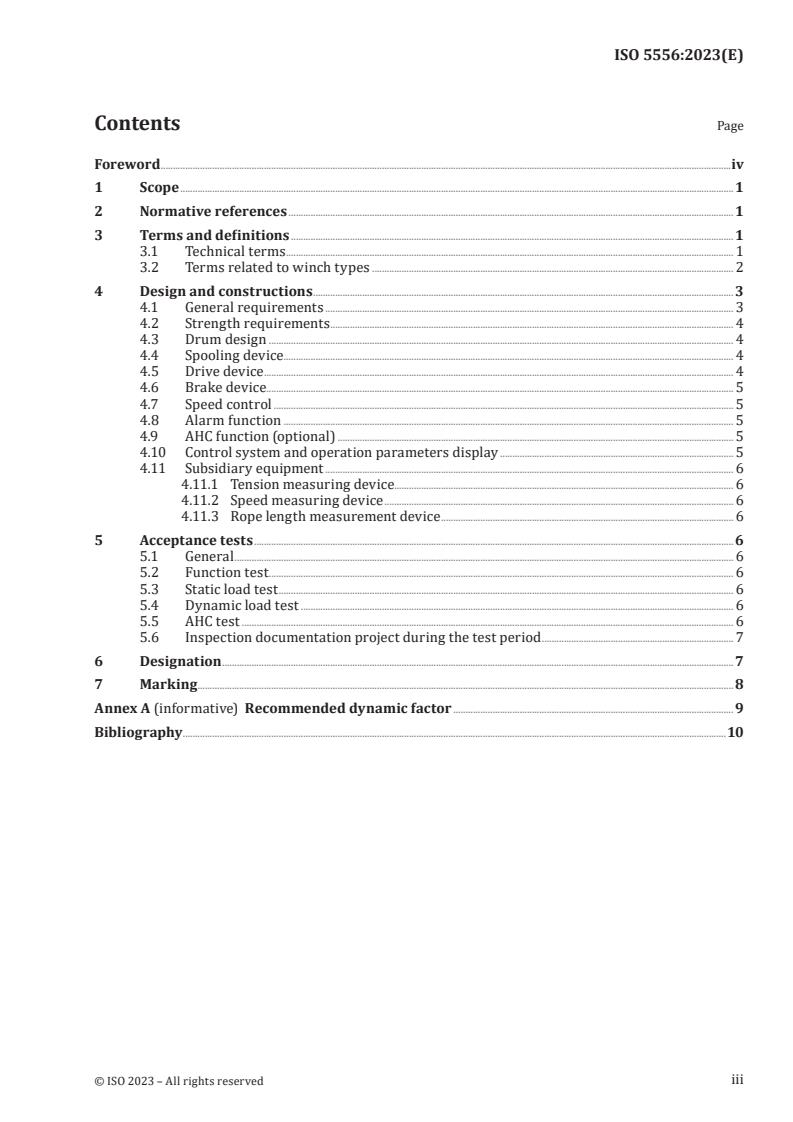
Contents Page
Foreword .iv
1 Scope . 1
2 Normative references . 1
3 Terms and definitions . 1
3.1 Technical terms . 1
3.2 Terms related to winch types . 2
4 Design and constructions . 3
4.1 General requirements . 3
4.2 Strength requirements . 4
4.3 Drum design . 4
4.4 Spooling device. 4
4.5 Drive device . 4
4.6 Brake device. 5
4.7 Speed control . 5
4.8 Alarm function . 5
4.9 AHC function (optional) . 5
4.10 Control system and operation parameters display . 5
4.11 Subsidiary equipment . 6
4.11.1 Tension measuring device. 6
4.11.2 Speed measuring device . 6
4.11.3 Rope length measurement device . 6
5 Acceptance tests .6
5.1 General . 6
5.2 Function test . 6
5.3 Static load test . 6
5.4 Dynamic load test . 6
5.5 AHC test . 6
5.6 Inspection documentation project during the test period . 7
6 Designation . 7
7 Marking . . 8
Annex A (informative) Recommended dynamic factor . 9
Bibliography .10
iii
Foreword
ISO (the International Organization for Standardization) is a worldwide federation of national standards
bodies (ISO member bodies). The work of preparing International Standards is normally carried out
through ISO technical committees. Each member body interested in a subject for which a technical
committee has been established has the right to be represented on that committee. International
organizations, governmental and non-governmental, in liaison with ISO, also take part in the work.
ISO collaborates closely with the International Electrotechnical Commission (IEC) on all matters of
electrotechnical standardization.
The procedures used to develop this document and those intended for its further maintenance are
described in the ISO/IEC Directives, Part 1. In particular, the different approval criteria needed for the
different types of ISO documents should be noted. This document was drafted in accordance with the
editorial rules of the ISO/IEC Directives, Part 2 (see www.iso.org/directives).
ISO draws attention to the possibility that the implementation of this document may involve the use
of (a) patent(s). ISO takes no position concerning the evidence, validity or applicability of any claimed
patent rights in respect thereof. As of the date of publication of this document, ISO had not received
notice of (a) patent(s) which may be required to implement this document. However, implementers are
cautioned that this may not represent the latest information, which may be obtained from the patent
database available at www.iso.org/patents. ISO shall not be held responsible for identifying any or all
such patent rights.
Any trade name used in this document is information given for the convenience of users and does not
constitute an endorsement.
For an explanation of the voluntary nature of standards, the meaning of ISO specific terms and
expressions related to conformity assessment, as well as information about ISO's adherence to
the World Trade Organization (WTO) principles in the Technical Barriers to Trade (TBT), see
www.iso.org/iso/foreword.html.
This document was prepared by Technical Committee ISO/TC 8, Ships and marine technology,
Subcommittee SC 4, Outfitting and deck machinery.
Any feedback or questions on this document should be directed to the user’s national standards body. A
complete listing of these bodies can be found at www.iso.org/members.html.
iv
INTERNATIONAL STANDARD ISO 5556:2023(E)
Ships and marine technology — Sea-going vessels —
Single-drum winches for oceanographic research
1 Scope
This document specifies requirements for the design, construction, safety, performance and acceptance
testing of single-drum winches for oceanographic research (hereafter referred as to “single-drum
winches”) with hydraulic or electric drive.
Single-drum winches are mainly used for fixed-point and towing marine survey, involving marine
geological sampling, seawater water body parameter measurement and marine biological survey.
2 Normative references
The following documents are referred to in the text in such a way that some or all of their content
constitutes requirements of this document. For dated references, only the edition cited applies. For
undated references, the latest edition of the referenced document (including any amendments) applies.
ISO 3828, Shipbuilding and marine structures — Deck machinery — Vocabulary and symbols
ISO 4413, Hydraulic fluid power — General rules and safety requirements for systems and their components
ISO 7825, Shipbuilding — Deck machinery — General requirements
IEC 60092 (all parts), Electrical installations in ships
IEC 60529, Degrees of protection provided by enclosures (IP Code)
3 Terms and definitions
For the purposes of this document, the terms and definitions given in ISO 3828 and the following apply.
ISO and IEC maintain terminology databases for use in standardization at the following addresses:
— ISO Online browsing platform: available at https:// www .iso .org/ obp
— IEC Electropedia: available at https:// www .electropedia .org/
3.1 Technical terms
3.1.1
safe working load
SWL
maximum static load, under design operation sea state, which the winch is certified to recover while
the rope is at the first layer of the drum
3.1.2
nominal speed
maximum speed while the winch recovering the safe working load (3.1.1) and the rope is at the first
layer of the drum
3.1.3
top layer working load
TWL maximum static load, under design operation sea state, which the winch is certified to recover
while the rope is at the top layer of the drum
3.1.4
top layer speed
maximum speed while the winch recovering the top layer working load (3.1.3) and the rope is at the top
layer of the drum
3.1.5
dynamic factor
variable factor representing the dynamic effects induced due to the ship motion including rolling, pitch
and heaving, while the winch is working under the design operation sea states, and by which the safe
working load (3.1.1) is mu
...
NORME ISO
INTERNATIONALE 5556
Première édition
2023-06
Navires et technologie maritime —
Navires de haute mer — Treuils
de recherche océanographique à
tambour simple
Ships and marine technology — Sea-going vessels — Single-drum
winches for oceanographic research
Numéro de référence
DOCUMENT PROTÉGÉ PAR COPYRIGHT
© ISO 2023
Tous droits réservés. Sauf prescription différente ou nécessité dans le contexte de sa mise en œuvre, aucune partie de cette
publication ne peut être reproduite ni utilisée sous quelque forme que ce soit et par aucun procédé, électronique ou mécanique,
y compris la photocopie, ou la diffusion sur l’internet ou sur un intranet, sans autorisation écrite préalable. Une autorisation peut
être demandée à l’ISO à l’adresse ci-après ou au comité membre de l’ISO dans le pays du demandeur.
ISO copyright office
Case postale 401 • Ch. de Blandonnet 8
CH-1214 Vernier, Genève
Tél.: +41 22 749 01 11
E-mail: copyright@iso.org
Web: www.iso.org
Publié en Suisse
ii
Sommaire Page
Avant-propos .iv
1 Domaine d'application .1
2 Références normatives .1
3 Termes et définitions . 1
3.1 Termes techniques . 1
3.2 Termes liés aux types de treuil . 2
4 Conception et constructions .4
4.1 Exigences générales . 4
4.2 Exigences de résistance . 4
4.3 Conception du tambour . 4
4.4 Dispositif d’enroulement . 4
4.5 Dispositif d’entraînement . 5
4.6 Dispositif de freinage . 5
4.7 Commande de la vitesse . 5
4.8 Fonction d’alarme . 5
4.9 Fonction AHC (facultative) . 5
4.10 Système de commande et affichage des paramètres de fonctionnement . 6
4.11 Équipement secondaire . 6
4.11.1 Dispositif de mesure de la tension . . 6
4.11.2 Dispositif de mesure de la vitesse . 6
4.11.3 Dispositif de mesure de la longueur du câble . 6
5 Essais d'acceptation .6
5.1 Généralités . 6
5.2 Essai de fonctionnement . 6
5.3 Essai de charge statique . 6
5.4 Essai de charge dynamique . 7
5.5 Essai de compensation active du martèlement . 7
5.6 Projet de documentation d’inspection pendant la période d'essai . 7
6 Désignation . 7
7 Marquage . 8
Annexe A (informative) Facteur dynamique recommandé . 9
Bibliographie .10
iii
Avant-propos
L'ISO (Organisation internationale de normalisation) est une fédération mondiale d'organismes
nationaux de normalisation (comités membres de l'ISO). L'élaboration des Normes internationales est
en général confiée aux comités techniques de l'ISO. Chaque comité membre intéressé par une étude
a le droit de faire partie du comité technique créé à cet effet. Les organisations internationales,
gouvernementales et non gouvernementales, en liaison avec l'ISO participent également aux travaux.
L'ISO collabore étroitement avec la Commission électrotechnique internationale (IEC) en ce qui
concerne la normalisation électrotechnique.
Les procédures utilisées pour élaborer le présent document et celles destinées à sa mise à jour sont
décrites dans les Directives ISO/IEC, Partie 1. Il convient, en particulier de prendre note des différents
critères d'approbation requis pour les différents types de documents ISO. Le présent document
a été rédigé conformément aux règles de rédaction données dans les Directives ISO/IEC, Partie 2
(voir www.iso.org/directives).
L’ISO attire l’attention sur le fait que la mise en application du présent document peut entraîner
l’utilisation d’un ou de plusieurs brevets. L’ISO ne prend pas position quant à la preuve, à la validité et
à l’applicabilité de tout droit de propriété revendiqué à cet égard. À la date de publication du présent
document, l’ISO n'avait pas reçu notification qu’un ou plusieurs brevets pouvaient être nécessaires à sa
mise en application. Toutefois, il y a lieu d’avertir les responsables de la mise en application du présent
document que des informations plus récentes sont susceptibles de figurer dans la base de données de
brevets, disponible à l'adresse www.iso.org/brevets. L’ISO ne saurait être tenue pour responsable de ne
pas avoir identifié tout ou partie de tels droits de brevet.
Les appellations commerciales éventuellement mentionnées dans le présent document sont données
pour information, par souci de commodité, à l’intention des utilisateurs et ne sauraient constituer un
engagement.
Pour une explication de la nature volontaire des normes, la signification des termes et expressions
spécifiques de l'ISO liés à l'évaluation de la conformité, ou pour toute information au sujet de l'adhésion
de l'ISO aux principes de l’Organisation mondiale du commerce (OMC) concernant les obstacles
techniques au commerce (OTC), voir le lien suivant: www.iso.org/iso/fr/avant-propos.
Le présent document a été élaboré par le comité technique ISO/TC 8, Navires et technologie maritime,
sous-comité SC 4, Équipement et auxiliaires de pont.
Il convient que l’utilisateur adresse tout retour d’information ou toute question concernant le présent
document à l’organisme national de normalisation de son pays. Une liste exhaustive desdits organismes
se trouve à l’adresse www.iso.org/fr/members.html.
iv
NORME INTERNATIONALE ISO 5556:2023(F)
Navires et technologie maritime — Navires de haute mer —
Treuils de recherche océanographique à tambour simple
1 Domaine d'application
Le présent document spécifie les exigences relatives à la conception, à la construction, à la sécurité, aux
performances et aux essais d’acceptation des treuils de recherche océanographique à tambour simple
(ci-après désignés «treuils à tambour simple») et à entraînement hydraulique ou électrique.
Les treuils à tambour simple sont principalement utilisés pour les relevés maritimes à points fixes et en
dérive, y compris pour l'échantillonnage géologique marin, la mesure des paramètres des masses d'eau
de mer et les études biologiques marines.
2 Références normatives
Les documents suivants sont cités dans le texte de sorte qu’ils constituent, pour tout ou partie de leur
contenu, des exigences du présent document. Pour les références datées, seule l’édition citée s’applique.
Pour les références non datées, la dernière édition du document de référence s'applique (y compris les
éventuels amendements).
ISO 3828, Construction navale et structures maritimes — Auxiliaires de pont — Vocabulaire et symboles
ISO 4413, Transmissions hydrauliques — Règles générales et exigences de sécurité relatives aux systèmes et
leurs composants
ISO 7825, Construction navale — Auxiliaires de pont — Prescriptions générales
IEC 60092 (toutes les parties), Installations électriques à bord des navires
IEC 60529, Degrés de protection procurés par les enveloppes (code IP)
3 Termes et définitions
Pour les besoins du présent document, les termes et les définitions de l'ISO 3828 ainsi que les suivants
s'appliquent.
L'ISO et l'IEC tiennent à jour des bases de données terminologiques destinées à être utilisées en
normalisation, consultables aux adresses suivantes:
— ISO Online browsing platform: disponible à l’adresse https:// www .iso .org/ obp
— IEC Electropedia: disponible à l’adresse https:// www .electropedia .org/
3.1 Termes techniques
3.1.1
charge maximale utile
CMU
charge statique maximale, aux conditions de mer, correspondant au fonctionnement prévu lors de la
conception, que le treuil est certifié pouvoir récupérer lorsque le câble se trouve sur la première couche
du tambour
3.1.2
vitesse nominale
vitesse maximale pendant que le treuil récupère la charge maximale utile (3.1.1) et que le câble se trouve
sur la première couche du tambour
3.1.3
charge utile sur la couche supérieure
TWL
charge statique maximale, aux conditions de mer, correspondant au fonctionnement prévu lors
de la conception, que le treuil est certifié pouvoir récupérer lorsque le câble se trouve sur la couche
supérieure du tambour
3.1.4
vitesse à la couche supérieure
vitesse maximale pendant que le treuil récupère la charge utile sur la couche supérieure (3.1.3) et que le
câble se trouve sur la couche supérieure du tambour
3.1.5
facteur dynamique
facteur variable représentant les effets dynamiques induits par le mouvement du navire, y compris
le roulis, le tangage et le martèlement, etc., pendant que le treuil fonctionne, aux conditions de mer,
correspondant au fonctionnement prévu lors de la conception, et par lequel la charge maximale utile
(3.1.1) est multipliée pour représenter la charge exercée sur le système liée à tous les effets dynamiques
Note 1 à l'article: La valeur du facteur dynamique est indiquée à l’Annexe A.
3.1.6
effort au frein
charge statique maximale sur le treuil à laquelle le frein peut résister
3.2 Termes liés aux types de treuil
3.2.1
treuil version gauche à câble d’enroulement horizontal
LH
treuil où l'unité d'entraînement est située sur le côté gauche du tambour, et où le sens de traction du
câble est perpendiculaire à l'axe du tambour
Note 1 à l'article: Voir Figure 1 a).
3.2.2
treuil version droite à câble d’enroulement horizontal
RH
treuil où l'unité d'entraînement est située sur le côté droit du tambour, et où le se
...