


ISO 286-1:2010
(Main)Geometrical product specifications (GPS) - ISO code system for tolerances on linear sizes - Part 1: Basis of tolerances, deviations and fits
Geometrical product specifications (GPS) - ISO code system for tolerances on linear sizes - Part 1: Basis of tolerances, deviations and fits
ISO 286-1:2010 establishes the ISO code system for tolerances to be used for linear sizes of features of the following types: a) cylinder; b) two parallel opposite surfaces. ISO 286-1:2010 defines the basic concepts and the related terminology for this code system. It provides a standardized selection of tolerance classes for general purposes from amongst the numerous possibilities. Additionally, it defines the basic terminology for fits between two features of size without constraints of orientation and location and explains the principles of “basic hole” and “basic shaft”.
Spécification géométrique des produits (GPS) — Système de codification ISO pour les tolérances sur les tailles linéaires — Partie 1: Base des tolérances, écarts et ajustements
L'ISO 286-1:2010 établit un système de codification à utiliser pour les tailles des entités dimensionnelles des types suivants: a) cylindre; b) deux surfaces parallèles opposées. L'ISO 286-1:2010 définit les concepts fondamentaux et la terminologie relative à ce système de codification. Elle fournit une sélection normalisée des classes de tolérances pour usage général parmi les nombreuses possibilités. En outre, elle définit la terminologie de base pour les ajustements entre deux entités dimensionnelles sans contrainte d'orientation et de position et explique les principes «d'alésage normal» et «d'arbre normal».
General Information
Relations
Overview
ISO 286-1:2010 - part of the Geometrical Product Specifications (GPS) family - establishes the ISO code system for tolerances on linear sizes. It sets out the basic concepts, terminology and coding rules used to specify tolerances and fits for two feature types: cylinders (e.g., holes and shafts) and two parallel opposite surfaces (e.g., slots, keys). ISO 286-1:2010 defines how limit deviations and tolerance classes are named, read and selected to achieve required functional fits between mating parts.
Key topics and technical requirements
- Scope and feature types: applies to cylinders and two parallel opposite surfaces used as features of size.
- Core terminology: defines nominal size, actual size, limits of size (ULS/LLS), deviation, fundamental deviation, tolerance and tolerance interval.
- ISO code system: describes the composition of a tolerance class (fundamental deviation letter + standard tolerance grade, e.g., h9, IT7) and the writing/reading rules for class designation.
- Limit deviations and placement: explains upper/lower limit deviations (ES/EI for holes, es/ei for shafts), and how these establish the position of the tolerance interval relative to nominal size.
- ISO fit system: gives the basic method to determine fits (clearance, interference, transition) between mating features and explains the principles of basic hole and basic shaft. The precondition is identical nominal sizes for hole and shaft.
- Selection guidance: provides standardized selection of commonly used tolerance grades and guidance on choosing tolerance classes for general purposes.
- Interaction with other GPS rules: notes the change in size association criterion (ISO 14405-1) from the envelope to the two‑point criterion and advises when form tolerances or envelope control may be needed to ensure intended function.
Practical applications and users
ISO 286-1:2010 is essential for:
- Mechanical and design engineers specifying dimensional tolerances and fits in drawings and CAD models.
- Manufacturing engineers selecting tolerances for machining, turning, broaching, grinding and quality processes.
- Quality, metrology and inspection teams interpreting limits of size, measuring parts and verifying conformity.
- Procurement and supply chain professionals ensuring interchangeability and component compatibility. Typical applications include shafts and holes for bearings, pins and bores, keyed shafts, dowel assemblies, and general mass production where functional fits and interchangeability matter.
Related standards
- ISO 286-2: Tables of standard tolerance grades and limit deviations for holes and shafts (complements Part 1).
- ISO 14405-1: Dimensional tolerancing - Linear sizes (association criteria and size definition).
- ISO 14660-1 / -2: GPS general terms and definitions relevant to features of size.
ISO 286-1:2010 provides the conceptual backbone for specifying linear size tolerances and fits, enabling consistent, internationally accepted tolerance communication across design, production and inspection.
Frequently Asked Questions
ISO 286-1:2010 is a standard published by the International Organization for Standardization (ISO). Its full title is "Geometrical product specifications (GPS) - ISO code system for tolerances on linear sizes - Part 1: Basis of tolerances, deviations and fits". This standard covers: ISO 286-1:2010 establishes the ISO code system for tolerances to be used for linear sizes of features of the following types: a) cylinder; b) two parallel opposite surfaces. ISO 286-1:2010 defines the basic concepts and the related terminology for this code system. It provides a standardized selection of tolerance classes for general purposes from amongst the numerous possibilities. Additionally, it defines the basic terminology for fits between two features of size without constraints of orientation and location and explains the principles of “basic hole” and “basic shaft”.
ISO 286-1:2010 establishes the ISO code system for tolerances to be used for linear sizes of features of the following types: a) cylinder; b) two parallel opposite surfaces. ISO 286-1:2010 defines the basic concepts and the related terminology for this code system. It provides a standardized selection of tolerance classes for general purposes from amongst the numerous possibilities. Additionally, it defines the basic terminology for fits between two features of size without constraints of orientation and location and explains the principles of “basic hole” and “basic shaft”.
ISO 286-1:2010 is classified under the following ICS (International Classification for Standards) categories: 17.040.10 - Limits and fits. The ICS classification helps identify the subject area and facilitates finding related standards.
ISO 286-1:2010 has the following relationships with other standards: It is inter standard links to ISO/IEC 11574:1994, ISO 1829:1975, ISO 286-1:1988. Understanding these relationships helps ensure you are using the most current and applicable version of the standard.
You can purchase ISO 286-1:2010 directly from iTeh Standards. The document is available in PDF format and is delivered instantly after payment. Add the standard to your cart and complete the secure checkout process. iTeh Standards is an authorized distributor of ISO standards.
Standards Content (Sample)
INTERNATIONAL ISO
STANDARD 286-1
Second edition
2010-04-15
Geometrical product specifications
(GPS) — ISO code system for tolerances
on linear sizes —
Part 1:
Basis of tolerances, deviations and fits
Spécification géométrique des produits (GPS) — Système de
codification ISO pour les tolérances sur les tailles linéaires —
Partie 1: Base des tolérances, écarts et ajustements
Reference number
©
ISO 2010
PDF disclaimer
This PDF file may contain embedded typefaces. In accordance with Adobe's licensing policy, this file may be printed or viewed but
shall not be edited unless the typefaces which are embedded are licensed to and installed on the computer performing the editing. In
downloading this file, parties accept therein the responsibility of not infringing Adobe's licensing policy. The ISO Central Secretariat
accepts no liability in this area.
Adobe is a trademark of Adobe Systems Incorporated.
Details of the software products used to create this PDF file can be found in the General Info relative to the file; the PDF-creation
parameters were optimized for printing. Every care has been taken to ensure that the file is suitable for use by ISO member bodies. In
the unlikely event that a problem relating to it is found, please inform the Central Secretariat at the address given below.
© ISO 2010
All rights reserved. Unless otherwise specified, no part of this publication may be reproduced or utilized in any form or by any means,
electronic or mechanical, including photocopying and microfilm, without permission in writing from either ISO at the address below or
ISO's member body in the country of the requester.
ISO copyright office
Case postale 56 • CH-1211 Geneva 20
Tel. + 41 22 749 01 11
Fax + 41 22 749 09 47
E-mail copyright@iso.org
Web www.iso.org
Published in Switzerland
ii © ISO 2010 – All rights reserved
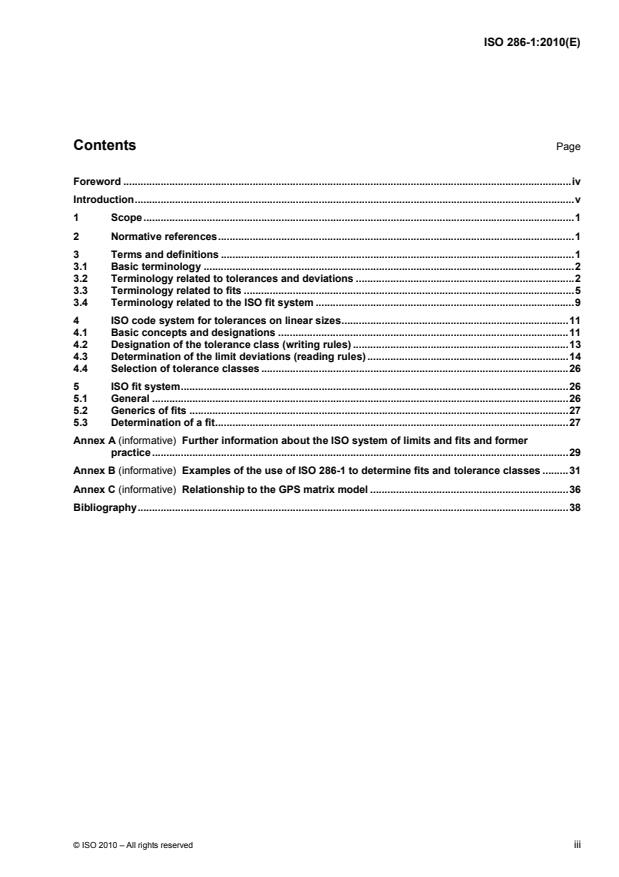
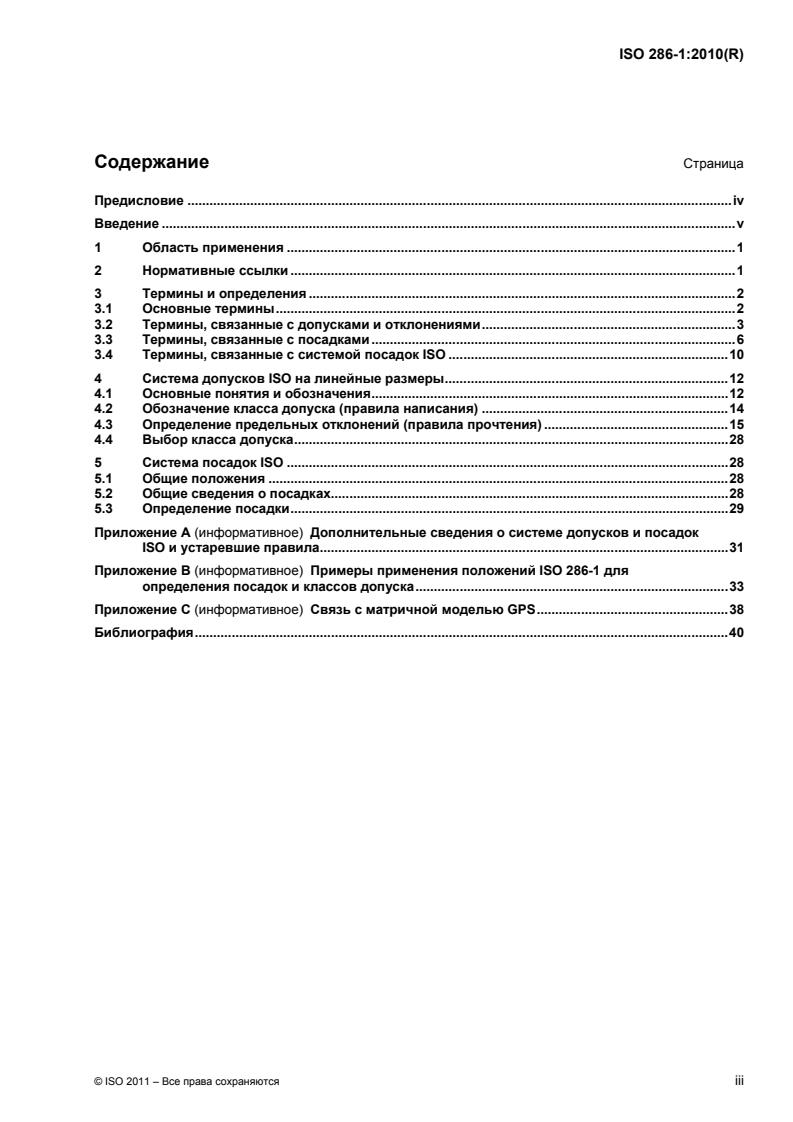
Contents Page
Foreword .iv
Introduction.v
1 Scope.1
2 Normative references.1
3 Terms and definitions .1
3.1 Basic terminology .2
3.2 Terminology related to tolerances and deviations .2
3.3 Terminology related to fits .5
3.4 Terminology related to the ISO fit system .9
4 ISO code system for tolerances on linear sizes.11
4.1 Basic concepts and designations .11
4.2 Designation of the tolerance class (writing rules) .13
4.3 Determination of the limit deviations (reading rules).14
4.4 Selection of tolerance classes .26
5 ISO fit system.26
5.1 General .26
5.2 Generics of fits .27
5.3 Determination of a fit.27
Annex A (informative) Further information about the ISO system of limits and fits and former
practice.29
Annex B (informative) Examples of the use of ISO 286-1 to determine fits and tolerance classes .31
Annex C (informative) Relationship to the GPS matrix model .36
Bibliography.38
Foreword
ISO (the International Organization for Standardization) is a worldwide federation of national standards bodies
(ISO member bodies). The work of preparing International Standards is normally carried out through ISO
technical committees. Each member body interested in a subject for which a technical committee has been
established has the right to be represented on that committee. International organizations, governmental and
non-governmental, in liaison with ISO, also take part in the work. ISO collaborates closely with the
International Electrotechnical Commission (IEC) on all matters of electrotechnical standardization.
International Standards are drafted in accordance with the rules given in the ISO/IEC Directives, Part 2.
The main task of technical committees is to prepare International Standards. Draft International Standards
adopted by the technical committees are circulated to the member bodies for voting. Publication as an
International Standard requires approval by at least 75 % of the member bodies casting a vote.
Attention is drawn to the possibility that some of the elements of this document may be the subject of patent
rights. ISO shall not be held responsible for identifying any or all such patent rights.
ISO 286-1 was prepared by Technical Committee ISO/TC 213, Dimensional and geometrical product
specifications and verification.
This second edition of ISO 286-1 cancels and replaces ISO 286-1:1988 and ISO 1829:1975, which have been
technically revised.
ISO 286 consists of the following parts, under the general title Geometrical product specifications (GPS) —
ISO code system for tolerances on linear sizes:
⎯ Part 1: Basis of tolerances, deviations and fits
⎯ Part 2: Tables of standard tolerance grades and limit deviations for holes and shafts
iv © ISO 2010 – All rights reserved
Introduction
This International Standard is a geometrical product specification (GPS) standard and is to be regarded as a
general GPS standard (see ISO/TR 14638). It influences chain links 1 and 2 of the chain of standards on size
in the general GPS matrix.
For more detailed information on the relation of this part of ISO 286 to the GPS matrix model, see Annex C.
The need for limits and fits for machined workpieces was brought about mainly by the requirement for
interchange ability between mass produced parts and the inherent inaccuracy of manufacturing methods,
coupled with the fact that “exactness” of size was found to be unnecessary for the most workpiece features. In
order that fit function could be satisfied, it was found sufficient to manufacture a given workpiece so that its
size lay within two permissible limits, i.e. a tolerance, this being the variation in size acceptable in manufacture
while ensuring the functional fit requirements of the product.
Similarly, where a specific fit condition is required between mating features of two different workpieces, it is
necessary to ascribe an allowance, either positive or negative, to the nominal size to achieve the required
clearance or interference. This part of ISO 286 gives the internationally accepted code system for tolerances
on linear sizes. It provides a system of tolerances and deviations suitable for two features of size types:
“cylinder” and “two parallel opposite surfaces”. The main intention of this code system is the fulfilment of the
function fit.
The terms “hole”, “shaft” and “diameter” are used to designate features of size type cylinder (e.g. for the
tolerancing of diameter of a hole or shaft). For simplicity, they are also used for two parallel opposite surfaces
(e.g. for the tolerancing of thickness of a key or width of a slot).
The pre-condition for the application of the ISO code system for tolerances on linear sizes for the features
forming a fit is that the nominal sizes of the hole and the shaft are identical.
The previous edition of ISO 286-1 (published in 1988) had the envelope criterion as the default association
criterion for the size of a feature of size; however, ISO 14405-1 changes this default association criterion to
the two-point size criterion. This means that form is no longer controlled by the default specification of size.
In many cases, the diameter tolerances according to this part of ISO 286 are not sufficient for an effective
control of the intended function of the fit. The envelope criterion according to ISO 14405-1 may be required. In
addition, the use of geometrical form tolerances and surface texture requirements may improve the control of
the intended function.
INTERNATIONAL STANDARD ISO 286-1:2010(E)
Geometrical product specifications (GPS) — ISO code system
for tolerances on linear sizes —
Part 1:
Basis of tolerances, deviations and fits
1 Scope
This part of ISO 286 establishes the ISO code system for tolerances to be used for linear sizes of features of
the following types:
a) cylinder;
b) two parallel opposite surfaces.
It defines the basic concepts and the related terminology for this code system. It provides a standardized
selection of tolerance classes for general purposes from amongst the numerous possibilities.
Additionally, it defines the basic terminology for fits between two features of size without constraints of
orientation and location and explains the principles of “basic hole” and “basic shaft”.
2 Normative references
The following referenced documents are indispensable for the application of this document. For dated
references, only the edition cited applies. For undated references, the latest edition of the referenced
document (including any amendments) applies.
1)
ISO 286-2 , Geometrical product specifications (GPS) — ISO code system for tolerances on linear sizes —
Part 2: Tables of standard tolerance grades and limit deviations for holes and shafts
ISO 14405-1, Geometrical product specifications (GPS) — Dimensional tolerancing — Part 1: Linear sizes
ISO 14660-1:1999, Geometrical Product Specifications (GPS) — Geometrical features — Part 1: General
terms and definitions
ISO 14660-2:1999, Geometrical Product Specifications (GPS) — Geometrical features — Part 2: Extracted
median line of a cylinder and a cone, extracted median surface, local size of an extracted feature
3 Terms and definitions
For the purposes of this document, the terms and definitions given in ISO 14405-1 and ISO 14660-1 and the
following apply. It should be noted, however, that some of the terms are defined in a more restricted sense
than in common usage.
1) To be published. (Revision of ISO 286-2:1988)
3.1 Basic terminology
3.1.1
feature of size
geometrical shape defined by a linear or angular dimension which is a size
[ISO 14660-1:1999, definition 2.2]
NOTE 1 The feature of size can be a cylinder, a sphere, two parallel opposite surfaces.
NOTE 2 In former editions of international standards, such as ISO 286-1 and ISO/R 1938, the meanings of the terms
“plain workpiece” and “single features” are close to that of “feature of size”.
NOTE 3 For the purpose of ISO 286, only features of size type cylinder as well as type-two parallel opposite surfaces,
defined by a linear dimension, apply.
3.1.2
nominal integral feature
theoretically exact integral feature as defined by a technical drawing or by other means
[ISO 14660-1:1999, definition 2.3]
3.1.3
hole
internal feature of size of a workpiece, including internal features of size which are not cylindrical
NOTE See also Introduction.
3.1.4
basic hole
hole chosen as a basis for a hole-basis fit system
NOTE 1 See also 3.4.1.1.
NOTE 2 For the purpose of the ISO code system, a basic hole is a hole for which the lower limit deviation is zero.
3.1.5
shaft
external feature of size of a workpiece, including external features of size which are not cylindrical
NOTE See also Introduction.
3.1.6
basic shaft
shaft chosen as a basis for a shaft-basis fit system
NOTE 1 See also 3.4.1.2.
NOTE 2 For the purposes of the ISO code system, a basic shaft is a shaft for which the upper limit deviation is zero.
3.2 Terminology related to tolerances and deviations
3.2.1
nominal size
size of a feature of perfect form as defined by the drawing specification
See Figure 1.
NOTE 1 Nominal size is used for the location of the limits of size by the application of the upper and lower limit
deviations.
NOTE 2 In former times, this was referred to as “basic size”.
2 © ISO 2010 – All rights reserved
3.2.2
actual size
size of the associated integral feature
NOTE 1 “Associated integral feature” is defined in ISO 14660-1:1999, 2.6.
NOTE 2 The actual size is obtained by measurement.
3.2.3
limits of size
extreme permissible sizes of a feature of size
NOTE To fulfil the requirement, the actual size shall lie between the upper and lower limits of size; the limits of size
are also included.
3.2.3.1
upper limit of size
ULS
largest permissible size of a feature of size
See Figure 1.
3.2.3.2
lower limit of size
LLS
smallest permissible size of a feature of size
See Figure 1.
3.2.4
deviation
value minus its reference value
NOTE For size deviations, the reference value is the nominal size and the value is the actual size.
3.2.5
limit deviation
upper limit deviation or lower limit deviation from nominal size
3.2.5.1
upper limit deviation
ES (to be used for internal features of size)
es (to be used for external features of size)
upper limit of size minus nominal size
See Figure 1.
NOTE Upper limit deviation is a signed value and may be negative, zero or positive.
Key
1 tolerance interval
2 sign convention for deviations
a
Nominal size.
b
Upper limit of size.
c
Lower limit of size.
d
Upper limit deviation.
e
Lower limit deviation (in this case also fundamental deviation).
f
Tolerance.
NOTE The horizontal continuous line, which limits the tolerance interval, represents the fundamental deviations for a
hole. The dashed line, which limits the tolerance interval, represents the other limit deviation for a hole.
Figure 1 — Illustration of definitions (a hole is used in the example)
3.2.5.2
lower limit deviation
EI (to be used for internal features of size)
ei (to be used for external features of size)
lower limit of size minus nominal size
See Figure 1.
NOTE Lower limit deviation is a signed value and may be negative, zero or positive.
3.2.6
fundamental deviation
limit deviation that defines the placement of the tolerance interval in relation to the nominal size
NOTE 1 The fundamental deviation is that limit deviation, which defines that limit of size which is the nearest to the
nominal size (see Figure 1 and 4.1.2.5).
NOTE 2 The fundamental deviation is identified by a letter (e.g. B, d).
4 © ISO 2010 – All rights reserved
3.2.7
∆ value
variable value added to a fixed value to obtain the fundamental deviation of an internal feature of size
See Table 3.
3.2.8
tolerance
difference between the upper limit of size and the lower limit of size
NOTE 1 The tolerance is an absolute quantity without sign.
NOTE 2 The tolerance is also the difference between the upper limit deviation and the lower limit deviation.
3.2.8.1
tolerance limits
specified values of the characteristic giving upper and/or lower bounds of the permissible value
3.2.8.2
standard tolerance
IT
any tolerance belonging to the ISO code system for tolerances on linear sizes
NOTE The letters in the abbreviated term “IT” stand for “International Tolerance”.
3.2.8.3
standard tolerance grade
group of tolerances for linear sizes characterized by a common identifier
NOTE 1 In the ISO code system for tolerances on linear sizes, the standard tolerance grade identifier consists of IT
followed by a number (e.g. IT7); see 4.1.2.3.
NOTE 2 A specific tolerance grade is considered as corresponding to the same level of accuracy for all nominal sizes.
3.2.8.4
tolerance interval
variable values of the size between and including the tolerance limits
NOTE 1 The former term “tolerance zone”, which was used in connection with linear dimensioning (according to
ISO 286-1:1988), has been changed to “tolerance interval” since an interval refers to a range on a scale whereas a
tolerance zone in GPS refers to a space or an area, e.g. tolerancing according to ISO 1101.
NOTE 2 For the purpose of ISO 286, the interval is contained between the upper and the lower limits of size. It is
defined by the magnitude of the tolerance and its placement relative to the nominal size (see Figure 1).
NOTE 3 The tolerance interval does not necessarily include the nominal size (see Figure 1). Tolerance limits may be
two-sided (values on both sides of the nominal size) or one-sided (both values on one side of the nominal size). The case
where the one tolerance limit is on one side, the other limit value being zero, is a special case of a one-sided indication.
3.2.8.5
tolerance class
combination of a fundamental deviation and a standard tolerance grade
NOTE In the ISO code system for tolerances on linear sizes, the tolerance class consists of the fundamental
deviation identifier followed by the tolerance grade number (e.g. D13, h9, etc.), see 4.2.1.
3.3 Terminology related to fits
The concepts in this clause relate only to nominal features of size (perfect form). For the model definition of a
nominal feature of size, see ISO 17450-1:—, 3.18.
For the determination of a fit, see 5.3.
3.3.1
clearance
difference between the size of the hole and the size of the shaft when the diameter of the shaft is smaller than
the diameter of the hole
NOTE In the calculation of clearance, the obtained values are positive (see B.2).
3.3.1.1
minimum clearance
〈in a clearance fit〉 difference between the lower limit of size of the hole and the upper limit of size of the shaft
See Figure 2.
3.3.1.2
maximum clearance
〈in a clearance or transition fit〉 difference between the upper limit of size of the hole and the lower limit of size
of the shaft
See Figures 2 and 4.
3.3.2
interference
difference before mating between the size of the hole and the size of the shaft when the diameter of the shaft
is larger than the diameter of the hole
NOTE In the calculation of an interference, the obtained values are negative (see B.2).
3.3.2.1
minimum interference
〈in an interference fit〉 difference between the upper limit of size of the hole and the lower limit of size of the
shaft
See Figure 3.
3.3.2.2
maximum interference
〈in an interference or transition fit〉 difference between the lower limit of size of the hole and the upper limit of
size of the shaft
See Figures 3 and 4.
3.3.3
fit
relationship between an external feature of size and an internal feature of size (the hole and shaft of the same
type) which are to be assembled
3.3.3.1
clearance fit
fit that always provides a clearance between the hole and shaft when assembled, i.e. the lower limit of size of
the hole is either larger than or, in the extreme case, equal to the upper limit of size of the shaft
See Figure 2.
3.3.3.2
interference fit
fit that always provides an interference between the hole and the shaft when assembled, i.e. the upper limit of
size of the hole is either smaller than or, in the extreme case, equal to the lower limit of size of the shaft
See Figure 3.
6 © ISO 2010 – All rights reserved
3.3.3.3
transition fit
fit which may provide either a clearance or an interference between the hole and the shaft when assembled
See Figure 4.
NOTE In a transition fit, the tolerance intervals of the hole and the shaft overlap either completely or partially;
therefore, if there is a clearance or an interference depends on the actual sizes of the hole and the shaft.
Key
1 tolerance interval of the hole
2 tolerance interval of the shaft, case 1: when the upper limit of size of the shaft is lower than the lower limit of size of
the hole, the minimum clearance is larger than zero
3 tolerance interval of the shaft, case 2: when the upper limit of size of the shaft is identical to the lower limit of size of
the hole, the minimum clearance is zero
a
Minimum clearance.
b
Maximum clearance.
c
Nominal size = lower limit of size of the hole.
NOTE The horizontal continuous wide lines, which limit the tolerance intervals, represent the fundamental deviations.
The dashed lines, which limit the tolerance intervals, represent the other limit deviations.
Figure 2 — Illustration of definitions of a clearance fit (nominal model)
Key
1 tolerance interval of the hole
2 tolerance interval of the shaft, case 1: when the lower limit of size of the shaft is identical to the upper limit of size of
the hole, the minimum interference is zero
3 tolerance interval of the shaft, case 2: when the lower limit of size of the shaft is larger than the upper limit of size of
the hole, the minimum interference is larger than zero
a
Maximum interference.
b
Minimum interference.
c
Nominal size = lower limit of size of the hole.
NOTE The horizontal continuous wide lines, which limit the tolerance intervals, represent the fundamental deviations.
The dashed lines, which limit the tolerance intervals, represent the other limit deviations.
Figure 3 — Illustration of definitions of an interference fit (nominal model)
8 © ISO 2010 – All rights reserved
Key
1 tolerance interval of the hole
2-4 tolerance interval of the shaft (some possible placements are shown)
a
Maximum clearance.
b
Maximum interference.
c
Nominal size = lower limit of size of the hole.
NOTE The horizontal continuous wide lines, which limit the tolerance intervals, represent the fundamental deviations.
The dashed lines, which limit the tolerance intervals, represent the other limit deviations.
Figure 4 — Illustration of definitions of a transition fit (nominal model)
3.3.4
span of a fit
arithmetic sum of the size tolerances on two features of size comprising the fit
See Figure B.1.
NOTE 1 The span of a fit is an absolute value without sign and expresses the possible nominal variation of the fit.
NOTE 2 The span of a clearance fit is the difference between the maximum and minimum clearances. The span of an
interference fit is the difference between the maximum and minimum interferences. The span of a transition fit is the sum
of the maximum clearance and maximum interference (see Annex B).
3.4 Terminology related to the ISO fit system
3.4.1
ISO fit system
system of fits comprising shafts and holes toleranced by the ISO code system for tolerances on linear sizes
NOTE The pre-condition for the application of the ISO code system for tolerances on linear sizes for the features
forming a fit is that the nominal sizes of the hole and the shaft are identical.
3.4.1.1
hole-basis fit system
fits where the fundamental deviation of the hole is zero, i.e. the lower limit deviation is zero
See Figure 5.
NOTE A fit system in which the lower limit of size of the hole is identical to the nominal size. The required clearances
or interferences are obtained by combining shafts of various tolerance classes with basic holes of a tolerance class with a
fundamental deviation of zero.
3.4.1.2
shaft-basis fit system
fits where the fundamental deviation of the shaft is zero, i.e. the upper limit deviation is zero
See Figure 6.
NOTE A fit system in which the upper limit of size of the shaft is identical to the nominal size. The required
clearances or interferences are obtained by combining holes of various tolerance classes with basic shafts of a tolerance
class with a fundamental deviation of zero.
Key
1 basic hole “H”
2 tolerance interval of the basic hole
3 tolerance interval of the different shafts
a
Nominal size.
NOTE 1 The horizontal continuous lines, which limit the tolerance intervals, represent the fundamental deviations for a
basic hole and different shafts.
NOTE 2 The dashed lines, which limit the tolerance intervals, represent the other limit deviations.
NOTE 3 The figure shows the possibility of combinations between a basic hole and different shafts, related to their
standard tolerance grades.
NOTE 4 Possible examples of hole-basis fits are: H7/h6, H6/k5, H6/p4.
Figure 5 — Hole-basis fit system
10 © ISO 2010 – All rights reserved
Key
1 basic shaft “h”
2 tolerance interval of the basic shaft
3 tolerance interval of the different holes
a
Nominal size.
NOTE 1 The horizontal continuous lines, which limit the tolerance intervals, represent the fundamental deviations for a
basic shaft and different holes.
NOTE 2 The dashed lines, which limit the tolerance intervals, represent the other limit deviations.
NOTE 3 The figure shows the possibility of combinations between a basic shaft and different holes, related to their
standard tolerance grades.
NOTE 4 Possible examples of shaft-basis fits are: h6/G7, h6/H6, h6/M6.
Figure 6 — Shaft-basis fit system
4 ISO code system for tolerances on linear sizes
4.1 Basic concepts and designations
4.1.1 Relation to ISO 14405-1
A feature of size may be toleranced by using the ISO code system defined in this part of ISO 286 or by using
+ and − tolerancing according to ISO 14405-1. Both indications are equivalent.
x
EXAMPLE 1 32 y is equivalent to 32 “code”
where
32 is the nominal size, in millimeters;
x is the upper tolerance limit (x can be positive, zero or negative);
y is the lower tolerance limit (y can be positive, zero or negative);
“code” is the tolerance class according to 4.2.1.
If a fit shall be toleranced, the envelope requirement according to ISO 14405-1 may be indicated (see A.2).
x
EXAMPLE 2 32 y is equivalent to 32 “code”
4.1.2 Tolerance class
4.1.2.1 General
The tolerance class contains information on the magnitude of the tolerance and the position of the tolerance
interval relative to the nominal size of the feature of size.
4.1.2.2 Magnitude of the tolerance
The tolerance class expresses the magnitude of the tolerance. The magnitude of the tolerance is a function of
the standard tolerance grade number and the nominal size of the toleranced feature.
4.1.2.3 Standard tolerance grades
The standard tolerance grades are designated by the letters IT followed by the grade number, e.g. IT7.
Values of standardised tolerances are given in Table 1. Each of the columns gives the values of the
tolerances for one standard tolerance grade between standard tolerance grades IT01 and IT18 inclusive.
Each row in Table 1 is representing one range of sizes. The limits of the ranges of sizes are given in the first
column of Table 1.
NOTE 1 When the standard tolerance grade is associated with a letter or letters representing a fundamental deviation
to form a tolerance class, the letters IT are omitted, e.g. H7.
NOTE 2 From IT6 to IT18, the standard tolerances are multiplied by the factor 10 at each fifth step. This rule applies to
all standard tolerances and may be used to extrapolate values for IT grades not given in Table 1.
EXAMPLE For the nominal size range 120 mm up to and including 180 mm, the value of IT20 is:
IT20 = IT15 × 10 = 1,6 mm × 10 = 16 mm
4.1.2.4 Placement of tolerance interval
The tolerance interval (former term: tolerance zone) is a variable value contained between the upper and the
lower limits of size. The tolerance class expresses the position of the tolerance interval relative to the nominal
size, by means of the fundamental deviation. The information on the position of the tolerance interval, i.e. on
the fundamental deviation, is identified by one or more letters, called the fundamental deviation identifiers:
A graphical overview of the position of the tolerance intervals relative to the nominal sizes and the signs
(+ or −) of the fundamental deviations for holes and shafts are given in Figures 7, 8 and 9.
4.1.2.5 Fundamental deviation
The fundamental deviation is that limit deviation, which defines that limit of size, which is the nearest to the
nominal size (see Figure 7).
The fundamental deviations are identified and controlled by:
⎯ upper case letter(s) for holes (A . . . ZC), see Tables 2 and 3;
⎯ lower case letter(s) for shafts (a . . . zc), see Tables 4 and 5.
12 © ISO 2010 – All rights reserved
NOTE 1 To avoid confusion, the following letters are not used: I, i; L, l; O, o; Q, q; W, w.
NOTE 2 The fundamental deviations are not defined individually for each specific nominal size, but for ranges of
nominal sizes as given in Tables 2 to 5.
The fundamental deviation in micrometres is a function of the identifier (letter) and the nominal size of the
toleranced feature.
Tables 2 and 3 contain the signed values of the fundamental deviations for hole tolerances. Tables 4 and 5
contain the signed values of the fundamental deviations for shaft tolerances.
The sign + is used when the tolerance limit identified by the fundamental deviation is above nominal size and
the sign − is used when the tolerance limit identified by the fundamental deviation is below nominal size.
Each of the columns in Tables 2 to 5 gives the values of the fundamental deviation for one fundamental
deviation identifier letter. Each of the rows is representing one range of sizes. The limits of the ranges of sizes
are given in the first column of the tables.
The other limit deviation (upper or lower) is established from the fundamental deviation and the standard
tolerance (IT) as shown in Figures 8 and 9.
NOTE 3 The concept of fundamental deviations does not apply to JS and js. Their tolerance limits are distributed
symmetrically about the nominal size line (see Figures 8 and 9).
NOTE 4 The ranges of sizes in Tables 2 to 5 are in many cases (for deviations a to c and r to zc or A to C and R to ZC)
subdivisions of the main ranges of Table 1.
The last six columns on the right side of Table 3 contain a separate table with ∆-values. ∆ is a function of the
tolerance grade and the nominal size of the toleranced feature. It is only relevant for deviations K to ZC and
for standard tolerance grades IT3 to IT7/IT8.
The value of ∆ shall be added to the fixed value given in the main table, whenever +∆ is indicated, to form the
correct value of the fundamental deviation.
4.2 Designation of the tolerance class (writing rules)
4.2.1 General
The tolerance class shall be designated by the combination of an upper-case letter(s) for holes and lower-
case letters for shafts identifying the fundamental deviation and by the number representing the standard
tolerance grade.
EXAMPLE H7 (holes), h7 (shafts).
4.2.2 Size and its tolerance
A size and its tolerance shall be designated by the nominal size followed by the designation of the required
tolerance class, or shall be designated by the nominal size followed by + and/or − limit deviations
(see ISO 14405-1).
In the following examples the indicated limit deviations are equivalent to the indicated tolerance classes.
EXAMPLE 1
ISO 286 ISO 14405-1
+0,025
32 H7 ≡
80 js15 ≡ 80 ± 0,6
−0,012
≡
100 g6
100−0,034
NOTE When using + or − tolerancing determined from a tolerance class, the tolerance class may be added in
brackets for auxiliary information purposes and vice versa.
+0,025 +0,025
( )
EXAMPLE 2 32 H7 0 32 0 (H7)
4.2.3 Determination of a tolerance class
Determination of a tolerance class is derived from fit requirements (clearances, interferences), see 5.3.4.
4.3 Determination of the limit deviations (reading rules)
4.3.1 General
The determination of the limit deviations for a given toleranced size, e.g. the transformation of a tolerance
class into + and − tolerancing can be performed by the use of:
⎯ the Tables 1 to 5 of this part of ISO 286 (see 4.3.2); or
⎯ the tables of ISO 286-2 (see 4.3.3). Only selected cases are covered.
4.3.2 Determination of limit deviations using the tables of this part of ISO 286
4.3.2.1 General
The tolerance class is decomposed into the fundamental deviation identifier and the standard tolerance grade
number.
EXAMPLE Toleranced size for a hole 90 F7 and for a shaft 90 f7
where
90 is the nominal size in millimetres;
F is the fundamental deviation identifier for a hole;
f is the fundamental deviation identifier for a shaft;
7 is the standard tolerance grade number;
is the envelope requirement according to ISO 14405-1 (if necessary).
4.3.2.2 Standard tolerance grade
From the standard tolerance grade number, the standard tolerance grade (ITx) is obtained.
From the nominal size and the standard tolerance grade the magnitude of the tolerance, e.g. the standard
tolerance value is obtained by the use of Table 1.
14 © ISO 2010 – All rights reserved
EXAMPLE 1 Toleranced size for a hole 90 F7 and for a shaft 90 f7
The standard tolerance grade number is “7”, hence, the standard tolerance grade is IT7.
The standard tolerance value has to be taken from Table 1 in the line of the nominal size range above 80 mm up to and
including 120 mm and in the column of the standard tolerance grade IT7.
Consequently, the standard tolerance value is: 35 µm.
EXAMPLE 2 Toleranced size for a hole 28 P9
The standard tolerance grade number is “9”, hence, the standard tolerance grade is IT9.
The standard tolerance value has to be taken from Table 1 in the line of the nominal size range above 18 mm up to and
including 30 mm and in the column of the standard tolerance grade IT9.
Consequently the standard tolerance value is: 52 µm.
4.3.2.3 Position of the tolerance interval
From the nominal size and the fundamental deviation identifier the fundamental deviation ( the upper or lower
limit deviation) is obtained by use of Tables 2 and 3 for holes (upper-case letters) and Tables 4 and 5 for
shafts (lower-case letters).
EXAMPLE 1 Toleranced size for a hole 90 F7
The fundamental deviation identifier is “F”, hence, this is a hole case and Table 2 applies.
From Table 2, line “80 to 100” and column “F”, the lower limit deviation EI is: +36 µm.
EXAMPLE 2 Toleranced size for a shaft 90 f7
The fundamental deviation identifier is “f”, hence, this is a shaft case and Table 4 applies.
From Table 4, line “80 to 100” and column “f”, the upper limit deviation es is: −36 µm.
EXAMPLE 3 Toleranced size for a hole 28 P9
The fundamental deviation identifier is “P”, hence, this is a hole case and Table 3 applies.
From Table 3, line “24 to 30” and column “P”, the upper limit deviation ES is: −22 µm.
4.3.2.4 Establishment of limit deviations
One of the limit deviations (upper or lower) has already been determined in 4.3.2.3. The other limit deviations
(upper or lower) are obtained by calculation according to the formulae given in Figures 8 and 9 and using the
standard tolerance values of Table 1.
EXAMPLE 1 Toleranced size for a hole 90 F7
According to 4.3.2.2 IT7 = 35 µm
According to 4.3.2.3 Lower limit deviation EI = +36 µm
According to formula in Figure 8 Upper limit deviation ES = EI + IT = +36 + 35 = +71 µm
+0,071
From that follows: 90 F7 ≡ 90+0,036
EXAMPLE 2 Toleranced size for a shaft 90 f7
According to 4.3.2.2 IT7 = 35 µm
According to 4.3.2.3 Upper limit deviation es = −36 µm
According to formula in Figure 9 Lower limit deviation ei = es − IT = −36 − 35 = −71 µm
−0,036
From that follows: 90 f7 ≡−90 0,071
EXAMPLE 3 Toleranced size for a hole 29 P9
According to 4.3.2.2 IT7 = 52 µm
According to 4.3.2.3 Upper limit deviation ES = −22 µm
According to formula in Figure 8 Lower limit deviation EI = ES − IT = −22 − 52 = −74 µm
−0,022
From that follows: 28 P9 ≡−28 0,074
4.3.2.5 Establishment of limit deviations using ∆-values
For determining the fundamental deviations K, M and N for standard tolerance grades up to and including IT8
and P to ZC up to and including IT7, the values ∆ from the columns on the right of Table 3 shall be taken into
consideration.
EXAMPLE 1 Toleranced size for a hole 20 K7
Table 1: IT7 in the range above 18 mm up to and including 30 mm IT7 = 21 µm
Table 3: ∆ in the range above 18 mm up to and including 24 mm for IT7 ∆ = 8 µm
For K in the range above 18 mm up to and including 24 mm:
Upper limit deviation ES = −2 + ∆ = −2 + 8 = +6 µm
Lower limit deviation EI = ES − IT = +6 − 21 = −15 µm
+0,006
From that follows: 20 K7 ≡−20 0,015
EXAMPLE 2 Toleranced size for a hole 40 U6
Table 1: IT6 in the range above 30 mm up to and including 50 mm IT6 = 16 µm
Table 3: ∆ in the range above 30 mm up to and including 40 mm for IT6 ∆ = 5 µm
For U in the range above 30 mm up to and including 40 mm:
Upper limit deviation ES = −60 + ∆ = −60 + 5 = −55 µm
Lower limit deviation EI = ES − IT = −55 − 16 = −71 µm
−0,055
From that follows: 40 U6 ≡−40 0,071
NOTE For this interference fit, the envelope requirement has been omitted intentionally. For strong interference fits, it
is not necessary to apply the envelope requirement.
4.3.3 Determination of limit deviations using the tables of ISO 286-2
The limit deviations for a given toleranced size may be selected from the Tables of ISO 286−2.
EXAMPLE Given toleranced size: 60 M6
In Table 9 of ISO 286-2:—, the limit deviations have to be taken in the line of the nominal size range above 50 mm up to
and including 80 mm and in the column of the standard tolerance grade number 6.
Consequently, the limit deviations are:
Upper limit deviation ES = −5 µm
Lower limit deviation EI = −24 µm
−0,005
−0,024
From that follows: 60 M6 ≡ 60
16 © ISO 2010 – All rights reserved
a) Holes (internal features of size)
b) Shafts (external features of size)
Key
EI, ES fundamental deviations of holes (examples)
ei, es fundamental deviations of shafts (examples)
a
Nominal size.
NOTE 1 According to convention, the fundamental deviation is the one defining the nearest limit to the nominal size.
NOTE 2 For details concerning fundamental deviations for J/j, K/k, M/m and N/n, see Figures 8 and 9.
Figure 7 — Schematic representation of the placement of the tolerance interval
(fundamental deviation) relative to the nominal size
Limit deviations
AtoG H JS J K M NPtoZC
+
J6
J7
M7
J8
_
M8
ES=+EI IT ES= ES== ES>0 ES (see Table 2 and 3) ES<0
0+IT + IT/2IT/2
(see (see Table 3)
Table 2)
EI =
EI>0 EI=0 EI=-ES IT
- IT/2
(see Table 2)
IT see Table 1
Key
1 K1 to K3, and also K4 to K8 for sizes for which — < nominal size u 3 mm (for the significance of the dash, see e.g.
footnote “a” to Table 2)
2 K4 to K8 for sizes: 3 mm < nominal size u 500 mm
3 K9 to K18
4 M1 to M6
5 M9 to M18
6 N1 to N8
7 N9 to N18
NOTE The represented tolerance intervals correspond approximately to a nominal size range of above 10 mm up to
and including 18 mm.
Figure 8 — Limit deviations for holes
18 © ISO 2010 – All rights reserved
EI
IT
ES
EI ES
ES
EI
Limit deviations
atog h js j k mtozc
+
1 4
2 3
j7
j8
_
es<0 es=0 es = + IT/2 es=+ei IT es=+ei IT es=+ei IT
(see Table 4)
ei=-esIT ei=0-IT ei = - IT/2 ei< 0 ei=0or>0 ei=>0
(see Table 4) (see Table 5) (see Table 5)
IT see Table 1
Key
1 j5, j6
2 k1 to k3, and also k4 to k7 for sizes for which — < nominal size u 3 mm (for the significance of the dash, see e.g.
footnote “a” to Table 2)
3 k4 to k7 for sizes for which 3 mm < nominal size u 500 mm
4 k8 to k18
NOTE The represented tolerance intervals correspond approximately to a nominal size range of above 10 mm up to
and including 18 mm.
Figure 9 — Limit deviations for shafts
ei
es
ei es
ei
es
Table 1 — Values of standard tolerance grades for nominal sizes up to 3 150 mm
Standard tolerance grades
Nominal size
mm
IT01 IT0 IT1 IT2 IT3 IT4 IT5 IT6 IT7 IT8 IT9 IT10 IT11 IT12 IT13 IT14 IT15 IT16 IT17 IT18
Standard tolerance values
Up to
and
Above
inclu-
µm mm
ding
— 3 0,3 0,5 0,8 1,2 2 3 4 6 10 14 25 40 60 0,10,140,25 0,4 0,6 1 1,4
3 6 0,4 0,6 1 1,5 2,5 4 5 8 12 18 30 48 75 0,12 0,18 0,3 0,48 0,75 1,2 1,8
6 10 0,4 0,6 1 1,5 2,5 4 6 9 15 22 36 58 90 0,15 0,22 0,36 0,58 0,9 1,5 2,2
10 18 0,5 0,8 1,2 2 3 5 8 11 18 27 43 70 1100,180,270,43 0,7 1,1 1,8 2,7
18 30 0,6 1 1,5 2,5 4 6 9 13 21 33 52 84 1300,210,330,52 0,84 1,3 2,1 3,3
30 50 0,6 1 1,5 2,5 4 7 11 16 25 39 62 100 1600,250,390,62 1 1,6 2,5 3,9
50 80 0,8 1,2 2 3 5 8 13 19 30 46 74 120 190 0,30,460,74 1,2 1,9 3 4,6
80 120 1 1,5 2,5 4 6 10 15 22 35 54 87 140 2200,350,540,87 1,4 2,2 3,5 5,4
120 180 1,2 2 3,5 5 8 12 18 25 40 63 100 160 250 0,40,63 1 1,6 2,5 4 6,3
180 250 2 3 4,5 7 10 14 20 29 46 72 115 185 290 0,46 0,72 1,15 1,85 2,9 4,6 7,2
250 315 2,5 4 6 8 12 16 23 32 52 81 130 210 320 0,52 0,81 1,3 2,1 3,2 5,2 8,1
315 400 3 5 7 9 13 18 25 36 57 89 140 230 360 0,57 0,89 1,4 2,3 3,6 5,7 8,9
400 500 4 6 8 10 15 20 27 40 63 97 155 250 400 0,63 0,97 1,55 2,5 4 6,3 9,7
500 630 9 11 16 22 32 44 70 110 175 280 440 0,7 1,1 1,75 2,8 4,4 7 11
630 800 10 13 18 25 36 50 80 125 200 320 500 0,8 1,25 2 3,2 5 8 12,5
800 1 000 11 15 21 28 40 56 90 140 230 360 560 0,9 1,4 2,3 3,6 5,6 9 14
1 000 1 250 13 18 24 33 47 66 105 165 260 420 660 1,05 1,65 2,6 4,2 6,6 10,5 16,5
1 250 1 600 15 21 29 39 55 78 125 195 310 500 780 1,25 1,95 3,1 5 7,8 12,5 19,5
1 600 2 000 18 25 35 46 65 92 150 230 370 600 920 1,5 2,3 3,7 6 9,2 15 23
2 000 2 500 22 30 41 55 78 110 175 280 440 700 1 100 1,75 2,8 4,4 7 11 17,5 28
2 500 3 150 26 36 50 68 96 135 210 330 540 860 1 350 2,1 3,3 5,4 8,6 13,5 21 33
20 © ISO 2010 – All rights reserved
...
NORME ISO
INTERNATIONALE 286-1
Deuxième édition
2010-04-15
Spécification géométrique des produits
(GPS) — Système de codification ISO
pour les tolérances sur les tailles
linéaires —
Partie 1:
Base des tolérances, écarts et
ajustements
Geometrical product specifications (GPS) — ISO code system for
tolerances on linear sizes —
Part 1: Basis of tolerances, deviations and fits
Numéro de référence
©
ISO 2010
PDF – Exonération de responsabilité
Le présent fichier PDF peut contenir des polices de caractères intégrées. Conformément aux conditions de licence d'Adobe, ce fichier
peut être imprimé ou visualisé, mais ne doit pas être modifié à moins que l'ordinateur employé à cet effet ne bénéficie d'une licence
autorisant l'utilisation de ces polices et que celles-ci y soient installées. Lors du téléchargement de ce fichier, les parties concernées
acceptent de fait la responsabilité de ne pas enfreindre les conditions de licence d'Adobe. Le Secrétariat central de l'ISO décline toute
responsabilité en la matière.
Adobe est une marque déposée d'Adobe Systems Incorporated.
Les détails relatifs aux produits logiciels utilisés pour la création du présent fichier PDF sont disponibles dans la rubrique General Info
du fichier; les paramètres de création PDF ont été optimisés pour l'impression. Toutes les mesures ont été prises pour garantir
l'exploitation de ce fichier par les comités membres de l'ISO. Dans le cas peu probable où surviendrait un problème d'utilisation,
veuillez en informer le Secrétariat central à l'adresse donnée ci-dessous.
DOCUMENT PROTÉGÉ PAR COPYRIGHT
© ISO 2010
Droits de reproduction réservés. Sauf prescription différente, aucune partie de cette publication ne peut être reproduite ni utilisée sous
quelque forme que ce soit et par aucun procédé, électronique ou mécanique, y compris la photocopie et les microfilms, sans l'accord écrit
de l'ISO à l'adresse ci-après ou du comité membre de l'ISO dans le pays du demandeur.
ISO copyright office
Case postale 56 • CH-1211 Geneva 20
Tel. + 41 22 749 01 11
Fax + 41 22 749 09 47
E-mail copyright@iso.org
Web www.iso.org
Publié en Suisse
ii © ISO 2010 – Tous droits réservés
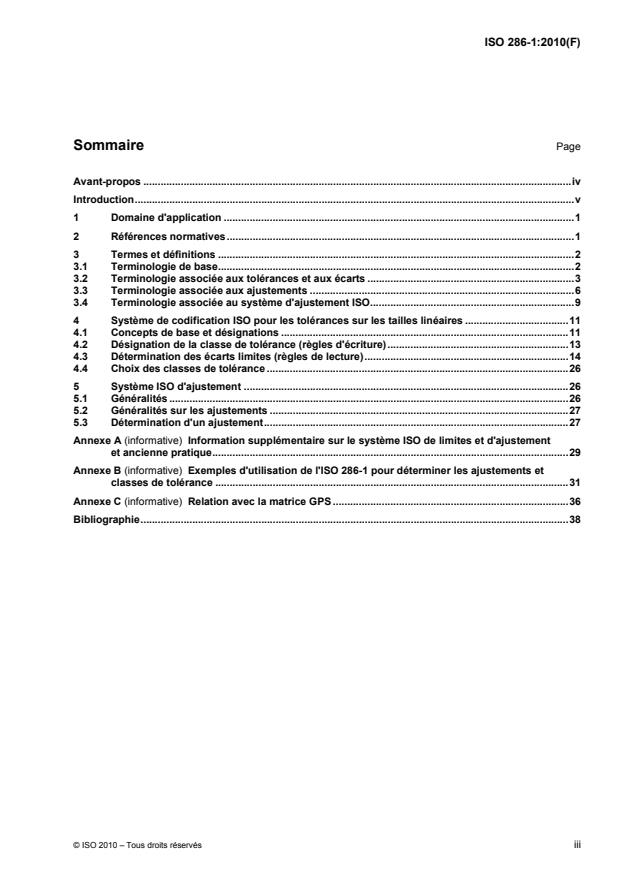
Sommaire Page
Avant-propos .iv
Introduction.v
1 Domaine d'application .1
2 Références normatives.1
3 Termes et définitions .2
3.1 Terminologie de base.2
3.2 Terminologie associée aux tolérances et aux écarts .3
3.3 Terminologie associée aux ajustements .6
3.4 Terminologie associée au système d'ajustement ISO.9
4 Système de codification ISO pour les tolérances sur les tailles linéaires .11
4.1 Concepts de base et désignations .11
4.2 Désignation de la classe de tolérance (règles d'écriture).13
4.3 Détermination des écarts limites (règles de lecture).14
4.4 Choix des classes de tolérance .26
5 Système ISO d'ajustement .26
5.1 Généralités .26
5.2 Généralités sur les ajustements .27
5.3 Détermination d'un ajustement.27
Annexe A (informative) Information supplémentaire sur le système ISO de limites et d'ajustement
et ancienne pratique.29
Annexe B (informative) Exemples d'utilisation de l'ISO 286-1 pour déterminer les ajustements et
classes de tolérance .31
Annexe C (informative) Relation avec la matrice GPS .36
Bibliographie.38
Avant-propos
L'ISO (Organisation internationale de normalisation) est une fédération mondiale d'organismes nationaux de
normalisation (comités membres de l'ISO). L'élaboration des Normes internationales est en général confiée
aux comités techniques de l'ISO. Chaque comité membre intéressé par une étude a le droit de faire partie du
comité technique créé à cet effet. Les organisations internationales, gouvernementales et non
gouvernementales, en liaison avec l'ISO participent également aux travaux. L'ISO collabore étroitement avec
la Commission électrotechnique internationale (CEI) en ce qui concerne la normalisation électrotechnique.
Les Normes internationales sont rédigées conformément aux règles données dans les Directives ISO/CEI,
Partie 2.
La tâche principale des comités techniques est d'élaborer les Normes internationales. Les projets de Normes
internationales adoptés par les comités techniques sont soumis aux comités membres pour vote. Leur
publication comme Normes internationales requiert l'approbation de 75 % au moins des comités membres
votants.
L'attention est appelée sur le fait que certains des éléments du présent document peuvent faire l'objet de
droits de propriété intellectuelle ou de droits analogues. L'ISO ne saurait être tenue pour responsable de ne
pas avoir identifié de tels droits de propriété et averti de leur existence.
L'ISO 286-1 a été élaborée par le comité technique ISO/TC 213, Spécifications et vérification dimensionnelles
et géométriques des produits.
Cette deuxième édition de l'ISO 286-1 annule et remplace l'ISO 286-1:1988 et l'ISO 1829:1975, qui ont fait
l'objet d'une révision technique.
L'ISO 286 comprend les parties suivantes, présentées sous le titre général Spécification géométrique des
produits (GPS) — Système de codification ISO pour les tolérances sur les tailles linéaires:
⎯ Partie 1: Base des tolérances, écarts et ajustements
⎯ Partie 2: Tables des degrés de tolérance normalisés et des écarts limites des alésages et des arbres
iv © ISO 2010 – Tous droits réservés
Introduction
La présente partie de l'ISO 286 est une norme de spécification géométrique des produits (GPS) et est à
considérer comme une norme GPS générale (voir l'ISO/TR 14638). Elle influence les maillons 1 et 2 de la
chaîne de normes sur la taille dans la matrice GPS générale.
Pour de plus amples informations sur les relations entre la présente partie de l'ISO 286 et la matrice GPS, voir
l'Annexe C.
L'exigence d'interchangeabilité entre des pièces de grande fabrication et l'inexactitude inévitable des
méthodes de fabrication, associées au fait que, pour la plupart des éléments de pièces, une exactitude
dimensionnelle parfaite n'est pas nécessaire, ont mis l'accent sur le besoin d'un système de tolérances et
d'ajustements. Afin d'assurer une fonction d'ajustement, il a été jugé suffisant de fabriquer une pièce donnée
de telle sorte que sa taille se situe entre deux limites admissibles, c'est-à-dire une tolérance, celle-ci étant la
variation de taille admissible en fabrication pour garantir les exigences d'ajustement fonctionnel du produit.
De la même façon, quand une condition d'ajustement spécifique est requise entre les éléments en contact de
deux pièces différentes, une certaine marge est nécessaire, soit en plus, soit en moins, par rapport à la taille
nominale pour obtenir le jeu ou le serrage requis. La présente partie de l'ISO 286 donne le système de
codification ISO pour les tolérances sur les tailles linéaires. Elle fournit un système de codification de
tolérances et d'écarts adapté à deux types d'entités dimensionnelles: le type «cylindre» et le type «deux plans
parallèles opposés». L'intention de ce système de codification est la garantie de la fonction d'ajustement.
Les termes «alésage», «arbre» et «diamètre» sont utilisés pour désigner les entités dimensionnelles de type
cylindre (par exemple pour la codification d'un diamètre d'alésage ou d'arbre). Par souci de simplification, ils
sont également utilisés pour les entités dimensionnelles définis par deux plans parallèles opposés (par
exemple pour le tolérancement de l'épaisseur d'une clavette ou de la largeur d'une rainure).
La précondition pour l'application du système ISO de codification pour les tolérances sur les tailles linéaires
pour les éléments formant un assemblage est que les tailles nominales de l'alésage et de l'arbre soient égales.
La précédente édition de l'ISO 286-1 (publiée en 1988) retenait le critère de l'enveloppe comme critère
d'association par défaut pour la dimension d'une entité dimensionnelle; l'ISO 14405-1 diffère en revanche sur
ce point et retient le critère de taille en deux points comme critère d'association par défaut. Cela signifie que la
forme n'est plus maîtrisée dans la spécification de taille par défaut.
Dans de nombreux cas, les tolérances de diamètre selon la présente partie de l'ISO 286 ne sont pas
suffisantes pour un contrôle efficace de la fonction d'ajustement prévue. Le critère d'enveloppe selon
l'ISO 14405-1 peut être exigé. En outre, l'utilisation de tolérances géométriques de forme et d'exigence d'état
de surface peut améliorer la maîtrise de la fonction attendue.
NORME INTERNATIONALE ISO 286-1:2010(F)
Spécification géométrique des produits (GPS) — Système de
codification ISO pour les tolérances sur les tailles linéaires —
Partie 1:
Base des tolérances, écarts et ajustements
1 Domaine d'application
La présente partie de l'ISO 286 établit un système de codification à utiliser pour les tailles des entités
dimensionnelles des types suivants:
a) cylindre;
b) deux surfaces parallèles opposées.
Elle définit les concepts fondamentaux et la terminologie relative à ce système de codification. Elle fournit une
sélection normalisée des classes de tolérances pour usage général parmi les nombreuses possibilités.
En outre, elle définit la terminologie de base pour les ajustements entre deux entités dimensionnelles sans
contrainte d'orientation et de position et explique les principes «d'alésage normal» et «d'arbre normal».
2 Références normatives
Les documents de référence suivants sont indispensables pour l'application du présent document. Pour les
références datées, seule l'édition citée s'applique. Pour les références non datées, la dernière édition du
document de référence s'applique (y compris les éventuels amendements).
1)
ISO 286-2:— , Spécification géométrique des produits (GPS) — Système de codification ISO pour les
tolérances sur les tailles linéaires — Partie 2: Tableaux des degrés de tolérance normalisés et des écarts
limites des alésages et des arbres
ISO 14405-1, Spécification géométrique des produits (GPS) — Tolérancement dimensionnel — Partie 1:
Tailles linéaires
ISO 14660-1:1999, Spécification géométrique des produits (GPS) — Éléments géométriques — Partie 1:
Termes généraux et définitions
ISO 14660-2:1999, Spécification géométrique des produits (GPS) — Éléments géométriques — Partie 2:
Ligne médiane extraite d'un cylindre et d'un cône, surface médiane extraite, taille locale d'un élément extrait
1) À publier. (Révision de l'ISO 286-2:1988)
3 Termes et définitions
Pour les besoins du présent document, les termes et définitions donnés dans l'ISO 14405-1, et dans
l'ISO 14660-1, ainsi que les suivants s'appliquent. Il est cependant à noter que certains de ces termes sont
définis avec un sens plus étroit que le sens usuel.
3.1 Terminologie de base
3.1.1
entité dimensionnelle
forme géométrique définie par une dimension linéaire ou angulaire du type taille
[ISO 14660-1:1999, définition 2.2]
NOTE 1 Les entités dimensionnelles peuvent être un cylindre, une sphère, deux surfaces opposées parallèles.
NOTE 2 Dans des éditions précédentes de normes internationales, telles que l'ISO 286-1 et l'ISO/R 1938, le sens des
termes «pièce lisse» et «éléments simples» avait un sens proche de celui «d'entité dimensionnelle».
NOTE 3 Pour les besoins de l'ISO 286, seules les entités dimensionnelles de type cylindre et de type deux surfaces
opposées parallèles, définis par une dimension linéaire, s'appliquent.
3.1.2
élément intégral nominal
élément intégral théorique exact défini par un dessin technique ou d'autres moyens
[ISO 14660-1:1999, définition 2.3]
3.1.3
alésage
entité dimensionnelle intérieure d'une pièce, incluant les entités dimensionnelles intérieures non cylindriques
NOTE Voir aussi l'Introduction.
3.1.4
alésage normal
alésage choisi comme base pour un système d'ajustements à alésage normal
NOTE 1 Voir aussi 3.4.1.1.
NOTE 2 Pour les besoins du présent système de codification ISO, un alésage normal est un alésage pour lequel l'écart
limite inférieur est nul.
3.1.5
arbre
entité dimensionnelle extérieure d'une pièce, incluant les entités dimensionnelles extérieures non cylindriques
NOTE Voir aussi l'Introduction.
3.1.6
arbre normal
arbre choisi comme base pour un système d'ajustements à arbre normal
NOTE 1 Voir aussi 3.4.1.2.
NOTE 2 Pour les besoins du présent système de codification ISO, un arbre normal est un arbre pour lequel l'écart
limite supérieur est nul.
2 © ISO 2010 – Tous droits réservés
3.2 Terminologie associée aux tolérances et aux écarts
3.2.1
taille nominale
taille d'un élément de forme parfaite tel que défini sur le dessin
Voir Figure 1.
NOTE 1 La taille nominale est utilisée pour la position des limites de taille par l'application des écarts supérieur et
inférieur.
NOTE 2 En anglais, on employait auparavant le terme «basic size» à la place de «nominal size».
3.2.2
taille réelle
taille de l'élément intégral associé
NOTE 1 Le terme «élément intégral associé» est défini dans l'ISO 14660-1:1999, 2.6.
NOTE 2 La taille réelle est obtenue par mesurage.
3.2.3
limites de taille
tailles admissibles extrêmes d'une entité dimensionnelle
NOTE Pour satisfaire aux exigences, il convient que la taille réelle se situe entre les limites supérieure et inférieure
de taille, limites incluses.
3.2.3.1
limite supérieure de taille
ULS
plus grande taille admissible d'une entité dimensionnelle
Voir Figure 1.
3.2.3.2
limite inférieure de taille
LLS
plus petite taille admissible d'une entité dimensionnelle
Voir Figure 1.
3.2.4
écart
valeur moins sa valeur de référence
NOTE Pour les écarts de taille, la valeur de référence est la taille nominale et la valeur est la taille réelle.
3.2.5
écart limite
écart limite supérieur ou écart limite inférieur par rapport à la taille nominale
3.2.5.1
écart limite supérieur
ES (à utiliser pour les entités dimensionnelles intérieures)
es (à utiliser pour les entités dimensionnelles extérieures)
limite supérieure de taille moins la taille nominale
Voir Figure 1.
NOTE L'écart limite supérieur est une valeur signée et il peut être négatif, nul ou positif.
Légende
1 intervalle de tolérance
2 convention de signe pour les écarts
a
Taille nominale.
b
Limite supérieure de taille.
c
Limite inférieure de taille.
d
Écart limite supérieur.
e
Écart limite inférieur (dans ce cas, également écart fondamental).
f
Tolérance.
NOTE La ligne continue horizontale qui limite l'intervalle de tolérance, représente les écarts fondamentaux pour un
alésage. La ligne en pointillés, qui limite l'intervalle de tolérance, représente l'autre écart de limite pour un alésage.
Figure 1 — Illustration de la définition (un alésage est utilisé comme exemple)
3.2.5.2
écart limite inférieur
EI (à utiliser pour les entités dimensionnelles intérieures)
ei (à utiliser pour les entités dimensionnelles extérieures)
limite inférieure de taille moins taille nominale
Voir Figure 1.
NOTE L'écart limite inférieur est une valeur signée et il peut être négatif, nul ou positif.
3.2.6
écart fondamental
écart limite qui définit le placement de l'intervalle de tolérance relativement à la taille nominale
NOTE 1 L'écart fondamental est celui des écarts limites qui définit la limite de taille qui est le plus proche de la taille
nominale (voir Figure 1 et 4.1.2.5).
NOTE 2 L'écart fondamental est identifié par une lettre (par ex, B, d).
4 © ISO 2010 – Tous droits réservés
3.2.7
valeur ∆
valeur variable ajoutée à une valeur fixe pour obtenir l'écart fondamental d'une entité dimensionnelle
intérieure
Voir Tableau 3.
3.2.8
tolérance
différence entre la limite supérieure de taille et la limite inférieure de taille
NOTE 1 La tolérance est une valeur absolue non affectée de signe.
NOTE 2 La tolérance est également la différence entre l'écart limite supérieur et l'écart limite inférieur.
3.2.8.1
limites de tolérance
valeurs spécifiées de la caractéristique donnant les bornes supérieure et/ou inférieure de la valeur admissible
3.2.8.2
tolérance normalisée
IT
toute tolérance appartenant au système de codification ISO pour les tolérances sur les tailles linéaires
NOTE Les lettres du terme abrégé «IT» correspondent à «International Tolerance».
3.2.8.3
degré de tolérance normalisé
groupe de tolérances sur les tailles linéaires caractérisé par un identificateur commun
NOTE 1 Dans le système de codification ISO pour les tolérances sur les tailles linéaires, l'identificateur du degré de
tolérance normalisé est constitué des lettres IT suivi par un nombre (par exemple IT7); voir 4.1.2.3.
NOTE 2 Un degré de tolérance spécifique est considéré comme correspondant au même niveau d'exactitude pour
toutes les tailles nominales.
3.2.8.4
intervalle de tolérance
valeurs variables de la taille comprises entre et incluant les limites de tolérance
NOTE 1 L'ancien terme «zone de tolérance» utilisé en relation avec la cotation dimensionnelle (selon
l'ISO 286-1:1988) a été changé en «intervalle de tolérance» puisque un intervalle se réfère à une étendue sur une échelle,
tandis qu'une zone de tolérance se réfère en GPS à un espace ou à une surface, comme dans le cas du tolérancement
selon l'ISO 1101.
NOTE 2 Pour les besoins de l'ISO 286, l'intervalle est contenu entre les limites supérieure et inférieure de taille. Il est
défini par la grandeur de la tolérance et son placement par rapport à la taille nominale (voir Figure 1).
NOTE 3 L'intervalle de tolérance n'inclut pas nécessairement la taille nominale (voir Figure 1). Les limites de tolérance
peuvent être bilatérales (valeurs des deux côtés de la taille nominale) ou unilatérales (les deux valeurs sont d'un côté de
la taille nominale). Le cas où une limite de tolérance est d'un côté, l'autre valeur limite étant zéro, constitue un cas limite
d'un indication unilatérale.
3.2.8.5
classe de tolérance
combinaison d'un écart fondamental et d'un degré de tolérance normalisé
NOTE Dans le système de codification ISO pour les tolérances sur les tailles linéaires, la classe de tolérance est
constituée de l'identificateur de l'écart fondamental suivi par le nombre correspondant au degré de tolérance (par exemple
D13, h9, etc.), voir 4.2.1.
3.3 Terminologie associée aux ajustements
Les concepts du présent article se rapportent uniquement aux entités dimensionnelles nominales (forme
parfaite). Pour le modèle de définition d'une entité dimensionnelle, voir l'ISO 17450-1:—, 3.18.
Pour la détermination d'un ajustement, voir 5.3.
3.3.1
jeu
différence entre la taille de l'alésage et la taille de l'arbre lorsque le diamètre de l'arbre est plus petit que le
diamètre de l'alésage
NOTE Dans le calcul du jeu, les valeurs obtenues sont positives (voir B.2).
3.3.1.1
jeu minimal
〈ajustement avec jeu〉 différence entre la limite inférieure de taille de l'alésage et la limite supérieure de taille
de l'arbre
Voir Figure 2.
3.3.1.2
jeu maximal
〈ajustement avec jeu ou ajustement incertain〉 différence entre la limite supérieure de taille de l'alésage et la
limite inférieure de taille de l'arbre
Voir Figures 2 et 4.
3.3.2
serrage
différence avant le montage entre la taille de l'alésage et la taille de l'arbre lorsque le diamètre de l'arbre est
plus grand que le diamètre de l'alésage
NOTE Dans le calcul du jeu, les valeurs obtenues sont négatives (voir B.2).
3.3.2.1
serrage minimal
〈ajustement avec serrage〉 différence entre la limite supérieure de taille de l'alésage et la limite inférieure de
taille de l'arbre
Voir Figure 3.
3.3.2.2
serrage maximal
〈ajustement avec serrage ou ajustement incertain〉 différence entre la limite inférieure de taille de l'alésage et
la limite supérieure de taille de l'arbre
Voir Figures 3 et 4.
3.3.3
ajustement
relation entre une entité dimensionnelle externe et une entité dimensionnelle interne (alésage et arbre de
même type) qui sont prévus pour être assemblés
3.3.3.1
ajustement avec jeu
ajustement assurant toujours un jeu entre l'alésage et l'arbre après assemblage, c'est-à-dire un ajustement
dans lequel la limite inférieure de taille de l'alésage est soit plus grande que la limite supérieure de taille de
l'arbre soit, dans le cas extrême, égale à la limite supérieure de taille de l'arbre
Voir Figure 2.
6 © ISO 2010 – Tous droits réservés
3.3.3.2
ajustement avec serrage
ajustement assurant toujours un serrage entre l'alésage et l'arbre après assemblage, c'est-à-dire un
ajustement dans lequel la limite supérieure de taille de l'alésage est soit plus petite que la limite inférieure de
taille de l'arbre soit, dans le cas extrême, égale à la limite inférieure de taille de l'arbre
Voir Figure 3.
Légende
1 intervalle de tolérance de l'alésage
er
2 intervalle de tolérance de l'arbre, 1 cas: quand la limite supérieure de taille de l'arbre est inférieure à la limite
inférieure de taille de l'alésage, le jeu minimal est plus grand que zéro
ème
3 intervalle de tolérance de l'arbre, 2 cas: quand la limite supérieure de taille de l'arbre est égale à la limite
inférieure de taille de l'alésage, le jeu minimal est zéro
a
Jeu minimal.
b
Jeu maximal.
c
Taille nominale = limite inférieure de taille de l'alésage.
NOTE Les lignes épaisses continues horizontales, qui limitent les intervalles de tolérance, représentent les écarts
fondamentaux. Les lignes en pointillés, qui limitent les intervalles de tolérance, représentent les autres écarts limites.
Figure 2 — Illustration des définitions d'un ajustement avec jeu (modèle nominal)
Légende
1 intervalle de tolérance de l'alésage
er
2 intervalle de tolérance de l'alésage, 1 cas: quand la limite inférieure de taille de l'arbre est égale à la limite
supérieure de taille de l'alésage, le serrage minimal est zéro
ème
3 intervalle de tolérance de l'arbre, 2 cas: quand la limite inférieure de taille de l'arbre est supérieure à la limite
supérieure de taille de l'alésage, le serrage minimal est plus grand que zéro
a
Serrage maximal.
b
Serrage minimal.
c
Taille nominale = limite inférieure de taille de l'alésage.
NOTE Les lignes épaisses continues horizontales, qui limitent les intervalles de tolérance, représentent les écarts
fondamentaux. Les lignes en pointillés, qui limitent les intervalles de tolérance, représentent les autres écarts limites.
Figure 3 — Illustration des définitions d'un ajustement avec serrage (modèle nominal)
3.3.3.3
ajustement incertain
ajustement assurant tantôt un jeu, tantôt un serrage entre l'alésage et l'arbre après assemblage
Voir Figure 4.
NOTE Dans un ajustement incertain, les intervalles de tolérance de l'alésage et de l'arbre se chevauchent totalement
ou partiellement; il dépend donc des tailles réelles de l'alésage et de l'arbre qu'il y ait jeu ou serrage.
3.3.4
étendue d'un ajustement
somme arithmétique des tolérances sur la taille de deux entités dimensionnelles comprenant l'ajustement
Voir Figure B.1.
NOTE 1 L'étendue de l'ajustement est une valeur absolue non affectée de signe et exprime la variation nominale
possible de l'ajustement.
NOTE 2 L'étendue d'un ajustement avec jeu est la différence entre le jeu maximal et le jeu minimal. L'étendue d'un
ajustement avec serrage est la différence entre le serrage maximal et le serrage minimal. L'étendue d'un ajustement
incertain est la somme du jeu maximal et du serrage maximal (voir Annexe B).
8 © ISO 2010 – Tous droits réservés
Légende
1 intervalle de tolérance de l'alésage
2-4 intervalle de tolérance de l'arbre (quelques emplacements possibles sont montrés)
a
Jeu maximal.
b
Serrage maximal.
c
Taille nominale = limite inférieure de taille de l'alésage.
NOTE Les lignes épaisses continues horizontales, qui limitent les intervalles de tolérance, représentent les écarts
fondamentaux. Les lignes en pointillés, qui limitent les intervalles de tolérance, représentent les autres écarts limites.
Figure 4 — Illustrations des définitions d'un ajustement incertain (modèle nominal)
3.4 Terminologie associée au système d'ajustement ISO
3.4.1
système d'ajustement ISO
système d'ajustements comprenant les alésages et les arbres tolérancés par le système de codification ISO
pour les tolérances sur les tailles linéaires
NOTE La condition préalable pour l'application du système de codification ISO pour les tolérances sur les tailles
linéaires pour les éléments formant un ajustement est que les tailles nominales de l'alésage et de l'arbre soient identiques.
3.4.1.1
système d'ajustement à alésage normal
système d'ajustements où l'écart fondamental de l'alésage est nul, c'est-à-dire où l'écart inférieur limite est
zéro
Voir Figure 5.
NOTE Il s'agit d'un système d'ajustement dans lequel la limite inférieure de taille de l'alésage est identique à la taille
nominale. Les jeux ou serrages requis sont obtenus en combinant des arbres de classes de tolérances variées avec des
alésages normaux de classe de tolérance avec un écart fondamental de zéro.
3.4.1.2
système d'ajustement à arbre normal
système d'ajustements où l'écart fondamental de l'arbre est nul, c'est-à-dire où l'écart supérieur est zéro
Voir Figure 6.
NOTE Il s'agit d'un système d'ajustement dans lequel la limite inférieure de taille de l'arbre est identique à la taille
nominale. Les jeux ou serrages requis sont obtenus en combinant des alésages normaux de classes de tolérances
variées avec des arbres de classe de tolérance avec un écart fondamental de zéro.
Légende
1 alésage normal «H»
2 intervalle de tolérance de l'alésage normal
3 intervalle de tolérance des différents arbres
a
Taille nominale.
NOTE 1 Les lignes épaisses continues horizontales, qui limitent les intervalles de tolérance, représentent les écarts
fondamentaux pour un alésage normal et différents arbres.
NOTE 2 Les lignes en pointillés, qui limitent les intervalles de tolérance, représentent les autres écarts limites.
NOTE 3 La figure montre la possibilité de différentes combinaisons entre un alésage normal et différents arbres, en
relation avec leurs degrés de tolérance normalisés
NOTE 4 Des exemples possibles d'ajustements à alésage normal sont: H7/h6, H6/k5, H6/p4).
Figure 5 — Système d'ajustement à alésage normal
10 © ISO 2010 – Tous droits réservés
Légende
1 arbre normal «h»
2 intervalle de tolérance de l'arbre normal
3 intervalle de tolérance des différents alésages
a
Taille nominale.
NOTE 1 Les lignes continues horizontales, qui limitent les intervalles de tolérance, représentent les écarts
fondamentaux pour un arbre normal et différents alésages.
NOTE 2 Les lignes en pointillés, qui limitent l'intervalle de tolérance, représentent les autres écarts limites.
NOTE 3 La figure montre la possibilité de différentes combinaisons entre un arbre normal et différents alésages, en
relation avec leur degrés de tolérance normalisés
NOTE 4 Des exemples possibles d'ajustements à arbre normal sont: h6/G/7, h6/H6, h6/M6).
Figure 6 — Système d'ajustement à arbre normal
4 Système de codification ISO pour les tolérances sur les tailles linéaires
4.1 Concepts de base et désignations
4.1.1 Relation avec l'ISO 14405-1
Une entité dimensionnelle peut-être tolérancée en utilisant le système de codification ISO défini dans la
présente partie de l'ISO 286 ou en utilisant le tolérancement + et − conformément à l'ISO 14405-1. Les deux
indications sont équivalentes.
x
EXEMPLE 1 32 y est équivalent à 32 «code»
où
32 est la taille nominale en millimètres;
x est la limite supérieure de tolérance (x peut être positif, nul ou négatif);
y est la limite inférieure de tolérance (y peut être positif, nul ou négatif);
«code» est la classe de tolérance selon 4.2.1.
Si un ajustement est à tolérancer, l'exigence d'enveloppe selon l'ISO 14405-1 peut être indiquée (voir A.2).
x
EXEMPLE 2 32 y est équivalent à 32 «code»
4.1.2 Classe de tolérance
4.1.2.1 Généralités
La classe de tolérance contient l'information sur la grandeur de la tolérance et la position de l'intervalle de
tolérance par rapport à la taille nominale de l'entité dimensionnelle.
4.1.2.2 Grandeur de la tolérance
La classe de tolérance exprime la grandeur de la tolérance. La grandeur de la tolérance est définie à partir du
nombre correspondant au degré de tolérance normalisé et de la taille nominale de l'élément tolérancé.
4.1.2.3 Degrés de tolérance normalisés
Les degrés de tolérance normalisés sont désignés par les lettres IT suivies d'un nombre, par exemple IT7.
Les valeurs des tolérances normalisées sont données dans le Tableau 1. Chacune des colonnes donne les
valeurs des tolérances pour un degré de tolérance normalisé compris entre IT01 et IT18, inclus. Chaque ligne
dans le Tableau 1 représente une plage de tailles. Les limites des plages de tailles sont données dans la
première colonne du Tableau 1.
NOTE 1 Lorsque le degré de tolérance normalisé est associé à une lettre ou à des lettres représentant un écart
fondamental pour donner une classe de tolérance, les lettres IT sont omises, ce qui donne par exemple H7.
NOTE 2 De IT6 à IT18, les tolérances normalisées sont multipliées par un facteur 10 tous les cinq paliers. Cette règle
s'applique à toutes les tolérances normalisées et peut être employée pour extrapoler des valeurs pour des degrés IT qui
ne sont pas donnés dans le Tableau 1.
EXEMPLE Pour la plage de tailles nominales de 120 mm à 180 mm compris, la valeur de IT20 est:
IT20 = IT15 × 10 = 1,6 mm × 10 = 16 mm
4.1.2.4 Placement de l'intervalle de tolérance
L'intervalle de tolérance (anciennement: zone de tolérance) est une valeur variable comprise entre les limites
inférieure et supérieure de la taille. La classe de tolérance exprime la position de l'intervalle de tolérance par
rapport à la taille nominale au moyen de l'écart fondamental. L'information sur la position de l'intervalle de
tolérance, c'est-à-dire sur l'écart fondamental, est identifiée par une ou plusieurs lettres dénommées
identifiant d'écart fondamental.
Un graphique général de la position de l'intervalle de tolérance en fonction de la taille nominale et du signe
(+ ou −) de l'écart fondamental pour des alésages et des arbres est donnée aux Figures 7, 8 et 9.
4.1.2.5 Écart fondamental
L'écart fondamental est l'écart limite, qui définit la taille limite, qui est la plus proche de la taille nominale
(voir Figure 7).
12 © ISO 2010 – Tous droits réservés
Les écarts fondamentaux sont identifiés et définis par:
⎯ lettre(s) majuscule(s) pour les alésages (A . . . ZC), voir Tableaux 2 et 3;
⎯ lettre(s) minuscule(s) pour les arbres (a . . . zc), voir Tableaux 4 et 5.
NOTE 1 Pour éviter la confusion, les lettres suivantes ne sont pas employées: I, i; L, l; O, o; Q, q; W, w.
NOTE 2 Les écarts fondamentaux ne sont pas définis individuellement pour chaque taille nominale spécifique, mais
pour des plages de tailles nominales telles qu'indiquées dans les Tableaux 2 à 5.
L'écart fondamental, exprimé en micromètres, est une fonction de l'identifiant (lettre) et de la taille nominale
de l'élément tolérancé.
Les Tableaux 2 et 3 contiennent les valeurs signées des écarts fondamentaux pour les tolérances d'alésage.
Les Tableaux 4 et 5 contiennent les valeurs signées des écarts fondamentaux pour les tolérances d'arbre.
Le signe + est employé lorsque la limite de tolérance identifiée par l'écart fondamental est supérieur à la taille
nominale et le signe − est employé lorsque la limite de tolérance identifiée par l'écart fondamental est inférieur
à la taille nominale.
Chaque colonne dans les Tableaux 2 à 5 donne les valeurs de l'écart fondamental pour une lettre identifiant
l'écart fondamental. Chaque ligne représente une plage de tailles. Les limites des plages de tailles sont
données dans la première colonne des tableaux.
L'autre écart limite (supérieur ou inférieur) est établi à partir de l'écart fondamental et de la tolérance
normalisée (IT) comme représenté aux Figures 8 et 9.
NOTE 3 Le concept d'écarts fondamentaux ne s'applique pas aux JS et aux js. Leurs limites de tolérance sont
distribuées symétriquement autour de la droite des tailles nominales (voir Figures 8 et 9).
NOTE 4 Les plages de tailles dans les Tableaux 2 à 5 sont dans la plupart des cas (pour les écarts de a à c et de r à
zc ou de A à C et de R à ZC) des subdivisions des plages principales dans le Tableau 1.
Les six dernières colonnes de droite dans le Tableau 3 contiennent un tableau séparé avec des valeurs ∆. ∆
est une fonction du degré de tolérance et de la taille nominale de l'élément tolérancé. Il est seulement
approprié pour les écarts K à ZC et pour les degrés de tolérance normalisés IT3 à IT7/IT8.
La valeur de ∆ doit être ajoutée à la valeur fixée donnée dans le tableau principal, chaque fois que +∆ est
indiqué, pour former la valeur correcte de l'écart fondamental.
4.2 Désignation de la classe de tolérance (règles d'écriture)
4.2.1 Généralités
La classe de tolérance doit être désignée par une ou plusieurs lettres majuscules (pour les alésages) et une
ou plusieurs lettres minuscules (pour les arbres) identifiant l'écart fondamental, suivies du nombre
représentant le degré de tolérance normalisé.
EXEMPLE H7 (alésage), h7 (arbre).
4.2.2 Taille et sa tolérance
Une taille et sa tolérance doivent être désignées par la valeur nominale de la taille suivie de la désignation de
la classe de tolérance requise ou par la valeur nominale de la taille suivie par les écarts limites + et/ou − (voir
l'ISO 14405-1).
Dans les exemples suivants, les écarts limites indiqués sont équivalents aux classes de tolérance indiquées.
EXEMPLE 1
ISO 286 ISO 14405-1
+ 0,025
32 0
32 H7 ≡
80 ± 0,6
≡
80 js15
− 0,012
100 − 0,034
100 g6
≡
NOTE En utilisant le tolérancement + ou − déterminé à partir d'une classe de tolérance, la classe de tolérance peut
être ajoutée entre parenthèses pour information auxiliaire et vice versa.
+ 0,025 + 0,025
()
EXEMPLE 2 32 H7 0 32 0 (H7)
4.2.3 Détermination d'une classe de tolérance
La détermination d'une classe de tolérance provient des conditions d'ajustement (jeux, serrages), voir 5.3.4.
4.3 Détermination des écarts limites (règles de lecture)
4.3.1 Généralités
La détermination des écarts limites pour une taille tolérancée donnée, par exemple la transformation d'une
classe de tolérance en tolérancement + et −, peut être faite par l'utilisation
⎯ des Tableaux 1 à 5 de la présente partie de l'ISO 286 (voir 4.3.2), ou
⎯ des tableaux de l'ISO 286-2 (voir 4.3.3). Seuls les cas choisis sont couverts.
4.3.2 Détermination des écarts limites en utilisant les tableaux de la présente partie de l'ISO 286
4.3.2.1 Généralités
La classe de tolérance est composée de l'identifiant de l'écart fondamental et du nombre correspondant au
degré de tolérance normalisé.
EXEMPLE Taille tolérancée pour un alésage 90 F7 et pour un arbre 90 f7
où
90 est la taille nominale, en millimètres;
F est l'identifiant de l'écart fondamental pour un alésage;
f est l'identifiant de l'écart fondamental pour un arbre;
7 est le nombre correspondant au degré de tolérance normalisé;
est l'exigence d'enveloppe selon l'ISO 14405-1 (si nécessaire).
4.3.2.2 Degré de tolérance normalisé
À partir du nombre correspondant au degré de tolérance normalisé, le degré de tolérance normalisé (ITx) est
obtenu.
14 © ISO 2010 – Tous droits réservés
À partir de la taille nominale et du degré de tolérance normalisé, la grandeur de la tolérance, par exemple la
valeur de tolérance normalisée, est obtenue en utilisant le Tableau 1.
EXEMPLE 1 Taille tolérancée pour un alésage 90 F7 et pour un arbre 90 f7
Le nombre correspondant au degré de tolérance normalisé est «7», donc le degré de tolérance normalisé est IT7.
La valeur de tolérance normalisée doit être extraite du Tableau 1 dans la ligne correspondant aux tailles nominales
comprises entre 80 mm et 120 mm inclus et dans la colonne du degré de tolérance normalisé IT7.
En conséquence, la valeur de la tolérance normalisée est: 35 µm.
EXEMPLE 2 Taille tolérancée pour un alésage 28 P9
Le nombre correspondant au degré de tolérance normalisé est «9», donc le degré de tolérance normalisé est IT9.
La valeur de tolérance normalisée doit être extraite du Tableau 1 dans la ligne correspondant aux tailles nominales
comprises entre 18 mm et 30 mm inclus et dans la colonne du degré de tolérance normalisé IT9.
En conséquence la valeur de la tolérance normalisée est: 52 µm.
4.3.2.3 Position de l'intervalle de tolérance
À partir de la taille nominale et de l'identifiant, l'écart fondamental (l'écart limite supérieur et inférieur) est
obtenu à l'aide des Tableaux 2 et 3 pour les alésages (lettres majuscules) et des Tableaux 4 et 5 pour les
arbres (lettres minuscules).
EXEMPLE 1 Taille tolérancée pour un alésage 90 F7
L'identifiant de l'écart fondamental est «F», c'est un cas relatif à un «alésage» et le Tableau 2 s'applique.
À partir du Tableau 2, ligne «80 à 100» et colonne «F», l'écart limite inférieur, EI, est: +36 µm.
EXEMPLE 2 Taille tolérancée pour un arbre 90 f7
L'identifiant de l'écart fondamental est «f», c'est un cas relatif à un «arbre» et le Tableau 4 s'applique.
À partir du Tableau 4, ligne «80 à 100» et colonne «f», l'écart limite supérieur, es, est: −36 µm.
EXEMPLE 3 Taille tolérancée pour un alésage 28 P9
L'identifiant de l'écart fondamental est «P», c'est un cas relatif à un «alésage» et le Tableau 3 s'applique.
À partir du Tableau 3, ligne «24 à 30» et colonne «P», l'écart limite supérieur, ES, est: −22 µm.
4.3.2.4 Détermination de l'écart limite
Un des écarts limites (supérieurs ou inférieurs) a déjà été déterminé en 4.3.2.3. Les autres écarts limites
(supérieurs ou inférieurs) sont obtenus par calcul selon les formules données aux Figures 8 et 9 et en utilisant
les valeurs de tolérance normalisées dans le Tableau 1.
EXEMPLE 1 Taille tolérancée pour un alésage 90 F7
Selon 4.3.2.2, IT7 = 35 µm
Selon 4.3.2.3, l'écart limite inférieur EI = +36 µm
Selon la formule de la Figure 8, l'écart limite supérieur ES = EI + IT = +36 + 35 = +71 µm
+ 0,071
À partir de ce qui précède on obtient: 90 F7 ≡+90 0,036
EXEMPLE 2 Taille tolérancée pour un arbre 90 f7
Selon 4.3.2.2, IT7 = 35 µm
Selon 4.3.2.3, l'écart limite supérieur es = −36 µm
Selon la formule de la Figure 9, l'écart limite inférieur ei = es − IT = −36 − 35 = −71 µm
− 0,036
À partir de ce qui précède, on obtient: 90 f7 ≡−90 0,071
EXEMPLE 3 Taille tolérancée pour un alésage 29 P9
Selon 4.3.2.2, IT7 = 52 µm
Selon 4.3.2.3, l'écart limite supérieur ES = −22 µm
Selon la formule de la Figure 8, l'écart limite inférieur EI = ES − IT = −22 − 52 = −74 µm
− 0,022
À partir de ce qui précède, on obtient: 28 P9 ≡−28 0,074
4.3.2.5 Établissement de l'écart limite en utilisant les valeurs ∆
Pour déterminer les écarts fondamentaux K, M et N, pour les degrés de tolérance normalisés inférieurs ou
égaux à IT8, et P à ZC, pour les degrés de tolérance normalisés inférieurs ou égaux à IT7, les valeurs ∆ des
colonnes du côté droit du Tableau 3 doivent être prises en compte.
EXEMPLE 1 Taille tolérancée pour un alésage 20 K7
Tableau 1: IT7 dans la plage de valeurs nominales supérieures à 18 mm et inférieures ou égales à 30 mm donne
IT7 = 21 µm
Tableau 3: ∆ dans la plage de valeurs nominales supérieures à 18 mm et inférieures ou égales à 24 mm pour IT7 donne
∆ = 8 µm
Pour K dans la plage de valeurs nominales supérieures à 18 mm et inférieures ou égales à 24 mm:
Écart limite supérieur ES = −2 + ∆ = −2 + 8 = +6 µm
Écart limite inférieur EI = ES − IT = +6 − 21 = −15 µm
+ 0,006
À partir de ce qui précède on obtient: 20 K7 ≡−20 0,015
EXEMPLE 2 Taille tolérancée pour un alésage 40 U6
Tableau 1: IT6 dans la plage de valeurs nominales supérieures à 30 mm et inférieures ou égales à 50 mm donne
IT6 = 16 µm
Tableau 3: ∆ dans la plage de valeurs nominales supérieures à 30 mm et inférieures ou égales à 40 mm pour IT6 donne
∆ = 5 µm
Pour U dans la plage de valeurs nominales supérieures à 30 mm et inférieures ou égales à 40 mm:
Écart limite supérieur ES = −60 + ∆ = −60 + 5 = −55 µm
Écart limite inférieur EI = ES − IT = −55 − 16 = −71 µm
− 0,055
À partir de ce qui précède on obtient: 40 U6 ≡−40 0,071
NOTE Pour cet ajustement avec serrage, l'exigence d'enveloppe a été omise intentionnellement. Pour des
ajustements avec serrage fort, il n'est pas nécessaire d'appliquer l'exigence d'enveloppe.
4.3.3 Détermination des écarts limites à partir des tableaux de l'ISO 286-2
Les écarts limites pour une tolérance de taille donnée peuvent être choisis à partir des tableaux de
l'ISO 286-2.
EXEMPLE Tolérance de taille donnée pour un alésage 60 M6
Dans le Ta
...
МЕЖДУНАРОДНЫЙ ISO
СТАНДАРТ 286-1
Второе издание
2010-04-15
Геометрические характеристики
изделий (GPS). Система кодов ISO для
допусков к линейным размерам.
Часть 1. База допусков, отклонений и
посадок
Geometrical product specifications (GPS) — ISO code system for
tolerances on linear sizes —
Part 1: Basis of tolerances, deviations and fits
Ответственность за подготовку русской версии несёт GOST R
(Российская Федерация) в соответствии со статьёй 18.1 Устава ISO
Ссылочный номер
©
ISO 2010
Отказ от ответственности при работе в PDF
Настоящий файл PDF может содержать интегрированные шрифты. В соответствии с условиями лицензирования, принятыми
фирмой Adobe, этот файл можно распечатать или смотреть на экране, но его нельзя изменить, пока не будет получена
лицензия на установку интегрированных шрифтов в компьютере, на котором ведется редактирование. В случае загрузки
настоящего файла заинтересованные стороны принимают на себя ответственность за соблюдение лицензионных условий
фирмы Adobe. Центральный секретариат ISO не несет никакой ответственности в этом отношении.
Adobe – торговый знак фирмы Adobe Systems Incorporated.
Подробности, относящиеся к программным продуктам, использованным для создания настоящего файла PDF, можно найти в
рубрике General Info файла; параметры создания PDF были оптимизированы для печати. Были приняты во внимание все
меры предосторожности с тем, чтобы обеспечить пригодность настоящего файла для использования комитетами-членами
ISO. В редких случаях возникновения проблемы, связанной со сказанным выше, просьба проинформировать Центральный
секретариат по адресу, приведенному ниже.
ДОКУМЕНТ ЗАЩИЩЕН АВТОРСКИМ ПРАВОМ
© ISO 2010
Все права сохраняются. Если не указано иное, никакую часть настоящей публикации нельзя копировать или использовать в
какой-либо форме или каким-либо электронным или механическим способом, включая фотокопии и микрофильмы, без
предварительного письменного согласия ISO, которое должно быть получено после запроса о разрешении, направленного по
адресу, приведенному ниже, или в комитет-член ISO в стране запрашивающей стороны.
ISO copyright office
Case postale 56 • CH-1211 Geneva 20
Tel. + 41 22 749 01 11
Fax + 41 22 749 09 47
E-mail copyright@iso.org
Web www.iso.org
Опубликовано в Швейцарии
ii © ISO 2010 – Все права сохраняются
Содержание Страница
Предисловие .iv
Введение .v
1 Область применения .1
2 Нормативные ссылки .1
3 Термины и определения .2
3.1 Основные термины.2
3.2 Термины, связанные с допусками и отклонениями.3
3.3 Термины, связанные с посадками .6
3.4 Термины, связанные с системой посадок ISO .10
4 Система допусков ISO на линейные размеры.12
4.1 Основные понятия и обозначения.12
4.2 Обозначение класса допуска (правила написания) .14
4.3 Определение предельных отклонений (правила прочтения) .15
4.4 Выбор класса допуска.28
5 Система посадок ISO .28
5.1 Общие положения .28
5.2 Общие сведения о посадках.28
5.3 Определение посадки.29
Приложение A (информативное) Дополнительные сведения о системе допусков и посадок
ISO и устаревшие правила.31
Приложение B (информативное) Примеры применения положений ISO 286-1 для
определения посадок и классов допуска.33
Приложение С (информативное) Связь с матричной моделью GPS.38
Библиография.40
Предисловие
Международная организация по стандартизации (ISO) является всемирной федерацией национальных
организаций по стандартизации (комитетов-членов ISO). Разработка международных стандартов
обычно осуществляется техническими комитетами ISO. Каждый комитет-член, заинтересованный в
деятельности, для которой был создан технический комитет, имеет право быть представленным в этом
комитете. Международные государственные и негосударственные организации, имеющие связи с ISO,
также принимают участие в работах. Что касается стандартизации в области электротехники, то ISO
работает в тесном сотрудничестве с Международной электротехнической комиссией (IEC).
Проекты международных стандартов разрабатываются в соответствии с правилами, установленными в
Директивах ISO/IEC, Часть 2.
Основная задача технических комитетов заключается в подготовке международных стандартов.
Проекты международных стандартов, принятые техническими комитетами, рассылаются комитетам-
членам на голосование. Их опубликование в качестве международных стандартов требует одобрения
не менее 75 % комитетов-членов, принимающих участие в голосовании.
Следует иметь в виду, что некоторые элементы настоящего документа могут быть объектом
патентного права. ISO не может нести ответственность за идентификацию какого-либо одного или всех
патентных прав.
ISO 286–1 подготовлен Техническим комитетом ISO/TC 213, Размерные и геометрические
требования к изделиям и их проверка.
Настоящее второе издание ISO 286–1 отменяет и заменяет ISO 286–1:1988 и ISO 1829:1975, которые
были технически пересмотрены.
ISO 286 состоит из следующих частей, объединенных общим наименованием Геометрические
характеристики изделий. Система допусков ISO на линейные размеры:
— Часть 1. Основные положения, допуски, отклонения и посадки
— Часть 2. Таблицы классов допусков и предельных отклонений отверстий и валов
iv © ISO 2011 – Все права сохраняются
Введение
Настоящий международный стандарт является стандартом на геометрические характеристики изделий
(GPS) и должен рассматриваться как общий стандарт GPS (см. ISO/TR 14638). Его положения следует
учитывать в связующих звеньях 1 и 2 серии стандартов на размеры в матричной модели GPS.
Для получения более полной информации о связи настоящей части ISO 286 с матричной моделью
GPS см. Приложение С.
Необходимость установления предельных размеров и посадок для деталей машинной обработки была
вызвана преимущественно требованием обеспечения взаимозаменяемости деталей массового
производства, а также неточностью, присущей способам обработки, в совокупности с обнаружением
того факта, что собственно “точность” размера не является необходимой для большинства элементов
детали. Выяснилось, что для того, чтобы посадка выполняла свое назначение, достаточно изготовить
данную деталь таким образом, чтобы размер находился между двух допустимых пределов, т.е. в
допуске. Это существование колебания размера допускается в производстве до тех пор, пока
обеспечивается выполнение функциональных требований к посадке изделия.
Таким же образом, там, где требуются конкретные условия посадки между сопрягаемыми элементами
двух различных деталей, необходимо предусмотреть допустимое отклонение, положительное или
отрицательное, от номинального размера для достижения требуемого зазора или натяга. В настоящей
части ISO 286 изложена международная принятая система допусков на линейные размеры,
содержащая систему допусков и отклонений, применимую к двум типам размерных элементов:
цилиндр и две параллельные плоскости. Основным назначением данной системы является
обеспечение выполнения посадкой своих функций.
Термины “отверстие”, “вал” и “диаметр” применяют для обозначения размерного элемента – цилиндра
(например, для установления допуска диаметра отверстия или вала). Для упрощения их также
используют для двух параллельных плоскостей (например, для установления допуска на толщину
шпонки или ширину шлицевого паза).
Применение системы допусков ISO на линейные размеры заранее подразумевает, что номинальные
размеры вала и отверстия, образующих посадку, одинаковы.
В предыдущем издании ISO 286–1 (опубликовано в 1988 году) для интерпретации размера размерного
элемента по умолчанию применялось правило внешней границы, однако положения ISO 14405–1
меняют существующую интерпретацию на двухточечное измерение. Это означает, что характеристика
размера по умолчанию более не контролирует отклонения формы.
Во многих случаях допуска диаметра, установленного согласно настоящей части ISO 286,
недостаточно для полного контроля за выполнением посадкой своих предназначенных функций.
Возможно, будет необходимо установить требование к внешней границе. В дополнение к
вышеуказанному возможно использование геометрических допусков формы и требований к структуре
поверхности.
МЕЖДУНАРОДНЫЙ СТАНДАРТ ISO 286-1:2010(R)
Геометрические характеристики изделий (GPS). Система
кодов ISO для допусков к линейным размерам.
Часть 1.
База допусков, отклонений и посадок
1 Область применения
Настоящая часть ISO 286 устанавливает систему допусков ISO на линейные размеры следующих
геометрических элементов:
а) цилиндр;
b) две параллельные плоскости.
В стандарте изложены основные положения и соответствующие термины и определения, относящиеся
к данной системе допусков, содержащей упорядоченные классы допусков общего применения из
множества возможных.
Стандарт также содержит термины и определения, касающиеся посадок, образуемых двумя
размерными элементами, без ограничения ориентации и месторасположения, и поясняет принципы
“основного вала” и “основного отверстия”.
2 Нормативные ссылки
Следующие ссылочные документы являются обязательными при применении настоящего документа.
Для датированных ссылок применяется только указанная редакция ссылочного документа. Для
недатированных ссылок применяется последняя редакция ссылочного документа (включая все
поправки).
1)
ISO 286-2 , Геометрические характеристики изделий (GPS). Система допусков ISO на линейные
размеры. Часть 2. Таблицы классов допусков и предельных отклонений отверстий и валов
ISO 14405-1, Геометрические характеристики изделий (GPS). Установление размерных допусков.
Часть 1. Линейные размеры
ISO 14660-1:1999, Геометрические характеристики изделий (GPS). Геометрические элементы.
Часть 1. Общие термины и определения
ISO 14660-2:1999, Геометрические характеристики изделий (GPS). Геометрические элементы.
Часть 2. Выявленная средняя линия цилиндра и конуса, выявленная средняя поверхность, местный
размер выявленного элемента
1) Готовится к публикации (взамен ISO 286–2:1998).
3 Термины и определения
В настоящем стандарте применены термины и определения, установленные в ISO 14405-1 и
ISO 14660–1, а также нижеследующие термины и определения. Однако, следует отметить, что
некоторые из терминов применены в более в узком понимании, чем в общем случае.
3.1 Основные термины
3.1.1
размерный элемент
feature of size
геометрическая форма, определяемая линейным или угловым размером
[ISO 14660-1:1999, определение 2.2]
ПРИМЕЧАНИЕ 1 Размерными элементами могут быть цилиндр, сфера, две параллельные плоскости.
ПРИМЕЧАНИЕ 2 В предыдущих версиях стандартов, таких как ISO 286-1 и ISO/R 1938, термины “гладкая
деталь” и “гладкий элемент детали” используются примерно в том же значении, что и термин “размерный элемент”.
ПРИМЕЧАНИЕ 3 Положения настоящего стандарта распространяются только на такие определяемые
линейным размером размерные элементы, как цилиндр и две параллельные плоскости.
3.1.2
полный номинальный геометрический элемент
nominal integral feature
точный, полный геометрический элемент, определенный чертежом или другими средствами
[ISO 14660-1:1999, определение 2.3]
3.1.3
отверстие
hole
внутренний размерный элемент детали (включая внутренние размерные элементы, не являющиеся
цилиндрическими)
ПРИМЕЧАНИЕ Также см. Введение.
3.1.4
основное отверстие
basic hole
отверстие, выбранное за базовое для посадок в системе основного отверстия
ПРИМЕЧАНИЕ 1 Также см. 3.4.1.1.
ПРИМЕЧАНИЕ 2 В системе допусков ISO на линейные размеры основным отверстием является отверстие,
нижнее предельное отклонение которого равно нулю.
3.1.5
вал
shaft
наружный размерный элемент детали (включая наружные размерные элементы, не являющиеся
цилиндрическими)
ПРИМЕЧАНИЕ Также см. Введение.
3.1.6
основной вал
basic shaft
вал, выбранный за базовый для посадок в системе основного вала
2 © ISO 2011 – Все права сохраняются
ПРИМЕЧАНИЕ 1 Также см. 3.4.1.2.
ПРИМЕЧАНИЕ 2 В системе допусков ISO на линейные размеры основным валом является вал, верхнее
предельное отклонение которого рано нулю.
3.2 Термины, связанные с допусками и отклонениями
3.2.1
номинальный размер
nominal size
размер геометрического элемента идеальной формы, определенной чертежом
См. Рисунок 1.
ПРИМЕЧАНИЕ 1 Номинальный размер используется для определения положения предельных размеров путем
установления верхнего и нижнего предельных отклонений.
ПРИМЕЧАНИЕ 2 В прежней международной практике термин “номинальный размер” (nominal size) обозначался
как “основной размер” (basic size).
3.2.2
действительный размер
actual size
размер присоединенного полного элемента
ПРИМЕЧАНИЕ 1 Определение термина “присоединенный полный элемент” (associated integral feature) дано в
ISO 14660-1:1999, 2.6.
ПРИМЕЧАНИЕ 2 Действительный размер получают путем измерения.
3.2.3
предельные размеры
limits of size
предельно допустимые размеры размерного элемента
ПРИМЕЧАНИЕ Действительный размер должен находиться между верхним и нижним предельным размерами
или может быть равен им.
3.2.3.1
верхний предельный размер
upper limit of size
ULS
наибольший допустимый размер размерного элемента
См. Рисунок 1.
3.2.3.2
нижний предельный размер
lower limit of size
LLS
наименьший допустимый размер размерного элемента
См. Рисунок 1.
3.2.4
отклонение
deviation
алгебраическая разность между значением и контрольным значением
ПРИМЕЧАНИЕ Для отклонений размеров контрольным значением является номинальный размер, а
значением – действительный размер.
3.2.5
предельное отклонение
limit deviation
верхнее предельное отклонение или нижнее предельное отклонение от номинального размера
3.2.5.1
верхнее предельное отклонение
upper limit deviation
ES (используют для внутренних размерных элементов)
еs (используют для наружных размерных элементов)
алгебраическая разность между верхним предельным размером и номинальным размером
См. Рисунок 1.
ПРИМЕЧАНИЕ Верхнее предельное отклонение представляет собой число со знаком и может быть
отрицательным, нулевым или положительным.
Обозначение
1 интервал допуска
2 правило знаков для отклонений
a
Номинальный размер.
b
Верхний предельный размер.
c
Нижний предельный размер.
d
Верхнее предельное отклонение.
e
Нижнее предельное отклонение (в данном случае оно является и основным отклонением).
f
Допуск.
ПРИМЕЧАНИЕ Непрерывная горизонтальная линия, ограничивающая интервал допуска, представляет
основное отклонение отверстия. Штриховая линия, ограничивающая интервал допуска, представляет другое
отклонение отверстия.
Рисунок 1 — Графическое пояснение терминов (на примере отверстия)
4 © ISO 2011 – Все права сохраняются
3.2.5.2
нижнее предельное отклонение
lower limit deviation
EI (используют для внутренних размерных элементов)
еi (используют для наружных размерных элементов)
алгебраическая разность между нижним предельным размером и номинальным размером
См. Рисунок 1.
ПРИМЕЧАНИЕ Нижнее предельное отклонение представляет собой число со знаком и может быть
отрицательным, нулевым или положительным.
3.2.6
основное отклонение
fundamental deviation
предельное отклонение, определяющее расположение интервала допуска относительно номинального
размера
ПРИМЕЧАНИЕ 1 Основным отклонением является то из предельных отклонений, которое устанавливает
предельный размер, ближайший к номинальному (см. Рисунок 1 и 4.1.2.5).
ПРИМЕЧАНИЕ 2 Основное отклонение обозначается буквой (например, B, d).
3.2.7
Δ поправка
Δ value
поправка, имеющая переменное значение и добавляемая к постоянному значению для получения
основного отклонения внутреннего размерного элемента
См. Таблицу 3.
3.2.8
допуск
tolerance
разность между верхним и нижним предельными размерами
ПРИМЕЧАНИЕ 1 Допуск является абсолютной величиной, не имеющей знака.
ПРИМЕЧАНИЕ 2 Допуск также можно определить как разность между верхним предельным отклонением и
нижним предельным отклонением.
3.2.8.1
пределы допуска
tolerance limits
заданные значения характеристики, определяющие верхнюю и/или нижнюю границы допустимого значения
3.2.8.2
стандартный допуск
standard tolerance
IT
любой из допусков, устанавливаемых системой допусков ISO на линейные размеры
ПРИМЕЧАНИЕ Буквы в аббревиатуре IT являются сокращением от словосочетания “Международный допуск”
(“International Tolerance”).
3.2.8.3
квалитет, квалитет стандарта
standard tolerance grade
группа допусков на линейные размеры, характеризующаяся общим обозначением
ПРИМЕЧАНИЕ 1 В системе допусков ISO на линейные размеры обозначение квалитета состоит из номера,
следующим за аббревиатурой IT (например, IT7); см. 4.1.2.3.
ПРИМЕЧАНИЕ 2 Один определенный квалитет рассматривается как соответствующий одному уровню точности
для всех номинальных размеров.
3.2.8.4
интервал допуска
tolerance interval
переменные значения размера между пределами допуска, включая их
ПРИМЕЧАНИЕ 1 Прежний термин “поле допуска” (согласно ISO 286-1:1998), использовавшийся ранее для
линейных размеров, был изменен на термин “интервал допуска” в связи с тем, что термин “интервал допуска”
указывает на диапазон шкалы, в то время как термин “поле допуска” в отношении геометрических характеристик
изделий указывает на область в плоскости или пространстве, например, при установлении допусков согласно
ISO 1101.
ПРИМЕЧАНИЕ 2 В настоящем стандарте интервал допуска заключен между верхним и нижним предельными
размерами. Он определяется величиной допуска и его расположением относительно номинального размера (см.
Рисунок 1).
ПРИМЕЧАНИЕ 3 Номинальный размер не обязательно находится внутри интервала допуска (см. Рисунок 1).
Пределы допуска могут быть двусторонними (значения по обе стороны от номинального размера) или
односторонними (оба значения по одну сторону от номинального размера). Случай, когда один предел допуска
располагается по одну сторону, а другое предельное значение равно нулю, является особым случаем
одностороннего указания.
3.2.8.5
класс допуска
tolerance class
комбинация основного отклонения и квалитета
ПРИМЕЧАНИЕ В системе допусков ISO на линейные размеры класс допуска состоит из комбинации
обозначения основного отклонения и следующего за ним номера квалитета (например, D13; h9 и т.д.), см. 4.2.1.
3.3 Термины, связанные с посадками
Изложенные в этом подразделе принципы относятся только к номинальным размерным элементам
(совершенной формы). Определение модели номинального размерного элемента дано в
ISO 17450:1—, 3.18.
Методы определения посадок даны cм. 5.3.
3.3.1
зазор
clearance
разность между размерами отверстия и вала, если диаметр вала меньше диаметра отверстия
ПРИМЕЧАНИЕ Значение, полученное при вычислении зазора, является положительным числом (см. В.2).
3.3.1.1
наименьший зазор
minimum clearance
разность между нижним предельным размером отверстия и верхним предельным размером вала в
посадке с зазором
См. Рисунок 2.
6 © ISO 2011 – Все права сохраняются
3.3.1.2
наибольший зазор
maximum clearance
разность между верхним предельным размером отверстия и нижним предельным размером вала в
посадке с зазором
См. Рисунки 2 и 4.
3.3.2
натяг
interference
разность размеров отверстия и вала до сборки, если диаметр вала больше диаметра отверстия
ПРИМЕЧАНИЕ Значение, полученное при вычислении натяга, является отрицательным числом (см. В.2).
3.3.2.1
наименьший натяг
minimum interference
разность между верхним предельным размером отверстия и нижним предельным размером вала в
посадке с натягом
См. Рисунок 3.
3.3.2.2
наибольший натяг
maximum interference
разность между нижним предельным размером отверстия и верхним предельным размером вала в
посадке с натягом или переходной
См. Рисунки 3 и 4.
3.3.3
посадка
fit
характер соединения наружного размерного элемента и внутреннего размерного элемента (отверстия
и вала одного и того же типа), участвующих в сборке
3.3.3.1
посадка с зазором
clearance fit
посадка, при которой в соединении отверстия и вала всегда образуется зазор, т.е. нижний предельный
размер отверстия больше или (в крайнем случае) равен верхнему предельному размеру вала
См. Рисунок 2.
3.3.3.2
посадка с натягом
interference fit
посадка, при которой в соединении отверстия и вала всегда образуется натяг, т.е. верхний предельный
размер отверстия больше или (в крайнем случае) равен нижнему предельному размеру вала
См. Рисунок 3.
3.3.3.3
переходная посадка
transition fit
посадка, при которой в соединении отверстия и вала возможно получение как зазора, так и натяга
См. Рисунок 4.
ПРИМЕЧАНИЕ В переходной посадке интервал допуска отверстия и интервал допуска вала перекрываются
частично или полностью; следовательно, наличие зазора или натяга в соединении зависит от действительных
размеров отверстия и вала.
a) Подробное b) Упрощенное
Обозначение
1 интервал допуска отверстия
2 интервал допуска вала, случай 1: верхний предельный размер вала ниже, чем нижний предельный размер
отверстия, наименьший зазор больше нуля
3 интервал допуска вала, случай 2: верхний предельный размер вала совпадает с нижним предельным
размером отверстия, наименьший зазор равен нулю
а
Наименьший зазор;
b
Наибольший зазор;
с
Номинальный размер = нижний предельный размер отверстия.
ПРИМЕЧАНИЕ Непрерывные горизонтальные основные линии, ограничивающие интервалы допусков,
представляют основные отклонения. Штриховые линии, ограничивающие интервалы допусков, представляют
другие предельные отклонения.
Рисунок 2 — Графическое пояснение посадки с зазором (номинальная модель)
8 © ISO 2011 – Все права сохраняются
a) Подробное b) Упрощенное
Обозначение
1 интервал допуска отверстия
2 интервал допуска вала, случай 1: нижний предельный размер вала совпадает с верхним предельным
размером отверстия, наименьший натяг равен нулю
3 интервал допуска вала, случай 2: нижний предельный размер вала больше, чем верхний предельный размер
отверстия, наименьший натяг больше нуля
а
Наибольший натяг.
b
Наименьший натяг;
с
Номинальный размер = нижний предельный размер отверстия.
ПРИМЕЧАНИЕ Непрерывные горизонтальные основные линии, ограничивающие интервалы допусков,
представляют основные отклонения. Штриховые линии, ограничивающие интервалы допусков, представляют
другие предельные отклонения.
Рисунок 3 — Графическое пояснение посадки с натягом (номинальная модель)
a) Подробное b) Упрощенное
Обозначение
1 интервал допуска отверстия;
2–4 интервал допуска вала (показано несколько возможных расположений);
а
Наибольший зазор;
b
Наибольший натяг;
с
Номинальный размер = нижний предельный размер отверстия.
ПРИМЕЧАНИЕ Непрерывные горизонтальные основные линии, ограничивающие интервалы допусков,
представляют основные отклонения. Штриховые линии, ограничивающие интервалы допусков, представляют
другие предельные отклонения.
Рисунок 4 — Графическое пояснение переходной посадки (номинальная модель)
3.3.4
разброс посадки
span of a fit
арифметическая сумма допусков размеров двух размерных элементов, образующих посадку
См. Рисунок В.1.
ПРИМЕЧАНИЕ 1 Разброс посадки является абсолютной величиной без знака и отображает возможное
номинальное колебание посадки.
ПРИМЕЧАНИЕ 2 Разброс посадки с зазором является разностью между наибольшим и наименьшим зазорами.
Разброс посадки с натягом является разностью между наибольшим и наименьшим натягами. Разброс переходной
посадки является суммой наибольшего зазора и наибольшего натяга (см. Приложение В).
3.4 Термины, связанные с системой посадок ISO
3.4.1
система посадок ISO
ISO fit system
система посадок, образующихся при соединении валов и отверстий, допуски на линейные размеры
которых установлены согласно системе допусков ISO на линейные размеры
ПРИМЕЧАНИЕ Для применения системы допусков ISO на линейные размеры необходимо, чтобы
номинальные размеры вала и отверстия, образующих посадку, были одинаковы.
3.4.1.1
посадки в системе отверстия
hole-basis fit system
посадки, в которых основное отклонение отверстия равно нулю, т.е. нижнее предельное отклонение равно нулю
10 © ISO 2011 – Все права сохраняются
См. Рисунок 5.
ПРИМЕЧАНИЕ Посадки в системе отверстия – посадки, в которых нижний предельный размер отверстия
равен номинальному размеру. Требуемые зазоры или натяги достигаются сочетанием валов с различными
классами допусков с основными отверстиями, класс допуска которых имеет нулевое основное отклонение.
3.4.1.2
посадки в системе вала
shaft-basis fit system
посадки, в которых основное отклонение вала равно нулю, т.е. верхнее предельное отклонение равно
нулю
См. Рисунок 6.
ПРИМЕЧАНИЕ Посадки в системе вала – посадки, в которых верхний предельный размер вала равен
номинальному размеру. Требуемые зазоры или натяги достигаются сочетанием отверстий с различными классами
допусков с основными валами, класс допуска которых имеет нулевое основное отклонение.
Обозначение
1 основное отверстие «Н»
2 интервал допуска основного отверстия
3 интервал допуска различных валов
а
Номинальный размер.
ПРИМЕЧАНИЕ 1 Непрерывные горизонтальные основные линии, ограничивающие интервалы допусков,
представляют основные отклонения основного отверстия и различных валов.
ПРИМЕЧАНИЕ 2 Штриховые линии, ограничивающие интервалы допусков, представляют другие предельные
отклонения.
ПРИМЕЧАНИЕ 3 На рисунке показаны возможные сочетания основного отверстия и различных валов в
соответствии с их квалитетами.
ПРИМЕЧАНИЕ 4 Возможные примеры посадок в системе отверстия: H7/h6, H6/k5, H6/p4.
Рисунок 5 — Посадки в системе отверстия
Обозначение
1 основное отверстие “h”
2 интервал допуска основного вала
3 интервал допуска различных отверстий
а
Номинальный размер.
ПРИМЕЧАНИЕ 1 Непрерывные горизонтальные основные линии, ограничивающие интервалы допусков,
представляют основные отклонения основного вала и различных отверстий.
ПРИМЕЧАНИЕ 2 Штриховые линии, ограничивающие интервалы допусков, представляют другие предельные
отклонения.
ПРИМЕЧАНИЕ 3 На рисунке показаны возможные сочетания основного вала и различных отверстий в
соответствии с их квалитетами.
ПРИМЕЧАНИЕ 4 Возможные примеры посадок в системе вала: h6/G7, h6/H6, h6/M6.
Рисунок 6 — Посадки в системе вала
4 Система допусков ISO на линейные размеры
4.1 Основные понятия и обозначения
4.1.1 Связь с ISO 14405–1
Допуск на размерный элемент может быть установлен согласно системе допусков ISO на линейные
размеры, описываемой в настоящей части ISO 286, либо согласно ISO 14405–1 — указанием
предельных отклонений. Оба варианта эквивалентны.
x
ПРИМЕР 1 Обозначение 32 эквивалентно обозначению 32 “шифр”,
y
где
32 – номинальный размер
х – верхний предел допуска
у – нижний предел допуска
“шифр” – класс допуска согласно 4.2.1.
12 © ISO 2011 – Все права сохраняются
В дополнение к допуску размера элемента, входящего в посадку, может быть указано требование к
внешней границе согласно ISO 14405–1 (см. A.2).
x
ПРИМЕР 2 Обозначение 32 эквивалентно обозначению 32 “шифр”
y
4.1.2 Класс допуска
4.1.2.1 Общие положения
Класс допуска содержит информацию о величине допуска и положении интервала допуска
относительно номинального размера размерного элемента.
4.1.2.2 Величина допуска
Класс допуска отображает величину допуска. Величина допуска зависит от номера квалитета и
номинального размера размерного элемента.
4.1.2.3 Квалитеты
Обозначение квалитета состоит из номера квалитета, следующим за аббревиатурой IT, например, IT7.
Значения стандартных допусков приведены в Таблице 1. Каждая колонка содержит значения допусков
для одного квалитета, начиная с IT01 и заканчивая IT18 (включительно). Каждый ряд таблицы
представляет один интервал размеров. Границы интервалов содержатся в первой колонке Таблицы 1.
ПРИМЕЧАНИЕ 1 Если квалитет связан с буквой (или буквами), означающей основное отклонение, которая
входит в обозначение класса допуска, аббревиатура IT опускается, например, H7.
ПРИМЕЧАНИЕ 2 В квалитетах с IT6 до IT8, допуски умножаются на 10 при переходе с данного квалитета на
пять квалитетов грубее. Это правило распространяется на все допуски системы и может быть применено для
получения значений допусков квалитетов, отсутствующих в Таблице 1.
ПРИМЕР Для интервала номинальных размеров свыше 120 мм до 180 мм (включительно) значение допуска
квалитета IT20 вычисляется по формуле:
IT20 = IT15 × 10 = 1,6 мм × 10 = 16 мм
4.1.2.4 Положение интервала допуска
Интервал допуска (прежний термин: “поле допуска”) — переменная величина, заключенная между
верхним и нижним предельными размерами. Класс допуска отображает положение интервала допуска
относительно номинального размера посредством основного отклонения, входящего в обозначение
класса допуска. Положение интервала допуска, т.е. положение основного отклонения, определяется
одной или несколькими буквами, называемыми идентификаторами основного отклонения.
Графическое представление положения интервала допуска относительно номинального размера и
знаки (+ или –) основных отверстий и валов представлены на Рисунках 7, 8 и 9.
4.1.2.5 Основное отклонение
Основным отклонением является то из предельных отклонений, которое устанавливает предельный
размер, ближайший к номинальному (см. Рисунок 7).
Основные отклонения обозначают следующим образом:
— прописной латинской буквой (буквами) для отверстий (A…ZC), см. Таблицы 2 и 3;
— строчной латинской буквой (буквами) для валов (a…zc), см. Таблицы 4 и 5.
ПРИМЕЧАНИЕ 1 Во избежание путаницы, следующие буквы не используют: I, i; L, l; O, o; Q, q; W, w.
ПРИМЕЧАНИЕ 2 Основное отклонение определяется не для каждого конкретного номинального размера, а для
интервала номинальных размеров, как показано в Таблицах 2–5.
Основное отклонение в микрометрах зависит от идентификатора основного отклонения (буквы или
букв) и номинального размера элемента, в отношении которого устанавливается допуск.
Числовые значения основных отклонений (со знаком) отверстий приведены в Таблицах 2 и 3, а
числовые значения основных отклонений (со знаком) валов — в Таблицах 4 и 5.
Знак + (плюс) применяют в случае, когда предел допуска, определенный основным отклонением,
располагается выше номинального размера, и знак – (минус) — в случае, когда предел допуска,
определенный основным отклонением, располагается ниже номинального размера.
Каждая колонка Таблиц 2–5 содержит числовые значения основных отклонений для одного буквенного
идентификатора основного отклонения. Каждый ряд таблиц представляет один интервал размеров.
Границы интервалов содержатся в первых колонках таблиц.
Другое предельное отклонение (верхнее или нижнее) получают из основного отклонения и допуска (IT),
как показано на Рисунках 8 и 9.
ПРИМЕЧАНИЕ 3 Понятие об “основном отклонении” не распространяется на JS и js. Их пределы допуска
распределяются симметрично относительно линии, представляющей номинальный размер (см. Рисунки 8 и 9).
ПРИМЕЧАНИЕ 4 Интервалы размеров, указанные в Таблице 1, в Таблицах 2–5 во многих случаях (для
отклонений a…c и r…zc или A…C и R…ZC) подразделяются на несколько интервалов.
Последние шесть колонок в правой части Таблицы 3 содержат отдельную таблицу с Δ–поправками. Δ
зависит от квалитета и номинального размера элемента, в отношении которого устанавливается
допуск. Это имеет отношение только к отклонениям K…ZC и квалитетам IT3…IT7/IT8.
Во всех случаях, когда в таблице указано + Δ, числовое значение Δ прибавляют к постоянному
значению, указанному в основной таблице, для получения правильного основного отклонения.
4.2 Обозначение класса допуска (правила написания)
4.2.1 Общие положения
Класс допуска обозначают сочетанием идентификатора основного отклонения (прописной буквы (букв)
для отверстий и строчной буквы (букв) для валов) и номера квалитета.
ПРИМЕР H7 (отверстия), h7 (валы).
4.2.2 Размер и его допуск
Размер и его допуск указывают либо сочетанием номинального размера и класса допуска, либо
сочетанием номинального размера и предельных отклонений (со знаком плюс или минус), см. ISO 14405-1.
Обозначение класса допуска и предельные отклонения указывают после номинального размера.
В приведенных ниже примерах указанные предельные отклонения эквивалентны указанному классу допуска.
ПРИМЕР 1
ISO 286 ISO 14405—1
+0,025
32 H7 ≡ 32
14 © ISO 2011 – Все права сохраняются
80 js5 ≡ 80 ± 0,6
−0,012
≡
100 g6
- 0,034
ПРИМЕЧАНИЕ Если предельные отклонения установлены классом допуска, допускается дополнительно к
предельным отклонениям добавлять в скобках класс допуска и наоборот, к классу допуска допускается
дополнительно в скобках добавлять предельные отклонения.
+ 0,025 + 0,025
⎛ ⎞
ПРИМЕР 2 32H7 32 ()H7
⎜ ⎟
0 0
⎝ ⎠
4.2.3 Назначение класса допуска
Класс допуска назначают, исходя из требований к посадке (зазоров, натягов), см. 5.3.4.
4.3 Определение предельных отклонений (правила прочтения)
4.3.1 Общие положения
Определение предельных отклонений для заданного размера с допуском, например, перевод класса
допуска в предельные отклонения, выполняют посредством:
— Таблиц 1–5 настоящей части ISO 286 (см. 4.3.2); или
— Таблиц ISO 286-2 (см. 4.3.3). Рассматриваются только выбранные случаи.
4.3.2 Определение предельных отклонений по таблицам настоящей части ISO 286
4.3.2.1 Общие положения
Обозначение класса допуска расчленяют на идентификатор основного отклонения и номер квалитета.
ПРИМЕР Размер отверстия с допуском: 90F7 , размер вала с допуском: 90f7 ,
где
90 — номинальный размер в миллиметрах;
F — идентификатор основного отклонения для отверстия;
f — идентификатор основного отклонения для вала;
7 — номер квалитета;
— требование к внешней границе согласно ISO 14405–1 (при необходимости).
4.3.2.2 Квалитет
Из номера квалитета формируют обозначение самого квалитета (IT x).
Величину допуска, например, числовое значение стандартного допуска, находят в Таблице 1 на
основании номинального размера и квалитета.
ПРИМЕР 1 Размер отверстия с допуском: 90F7 , размер вала с допуском: 90f7 ,
Номер квалитета – “7”, следовательно, обозначение квалитета – IT7.
Числовое значение стандартного допуска находят в Таблице 1 на пересечении ряда с интервалом размеров
свыше 80 мм до 120 мм (включительно), с колонкой квалитета IT7.
Следовательно, числовое значение стандартного допуска составляет 35 мкм.
ПРИМЕР 2 Размер отверстия с допуском: 28P9
Номер квалитета – “9”, следовательно, обозначение квалитета – IT9.
Числовое значение стандартного допуска находят в Таблице 1 на пересечении ряда с интервалом размеров
свыше 18 мм до 30 мм (включительно), с колонкой квалитета IT9.
Следовательно, числовое значение стандартного допуска составляет 52 мкм.
4.3.2.3 Положение интервала допуска
Основное отклонение (верхнее или нижнее предельное отклонение) находят в Таблицах 2 или 3 или в
Таблицах 4 и 5, на основании номинального размера и идентификатора основного отклонения.
ПРИМЕР 1 Размер отверстия с допуском: 90F7
Идентификатор основного отклонения – “F”, следовательно, речь идет об отверстии и применении Таблицы 2.
В Таблице 2 на пересечении ряда “св. 80 до 100” с колонкой “F” находят числовое значение нижнего предельного
отклонения EI: +36 мкм.
ПРИМЕР 1 Размер вала с допуском: 90f7
Идентификатор основного отклонения – “f”, следовательно, речь идет о вале и применении Таблицы 4.
В Таблице 4 на пересечении ряда “св. 80 до 100” с колонкой “f” находят числовое значение верхнего предельного
отклонения es: –36 мкм.
ПРИМЕР 3 Размер отверстия с допуском: 28P9
Идентификатор основного отклонения – “P”, следовательно, речь идет об отверстии и применении Таблицы 3.
В Таблице 3 на пересечении ряда “св. 24 до 30” с колонкой “P” находят числовое значение верхнего предельного
отклонения ES: –22 мкм.
4.3.2.4 Установление предельных отклонений
Одно из предельных отклонений (верхнее или нижнее) уже установлено (см. 4.3.2.3). Другое
предельное отклонение (верхнее или нижнее) получают путем вычисления по формулам,
приведенным на Рисунках 8 и 9, с использованием числовых значений стандартных допусков (см.
Таблицу 1).
ПРИМЕР 1 Размер отверстия с допуском: 90F7
Согласно 4.3.2.2 IT7 = 35 мкм
Согласно 4.3.2.3 Нижнее предельное отклонение EI = +36 мкм
Согласно формуле на Рисунке 8 Верхнее предельное отклонение ES = EI + IT = +36 + 35 = +71 мкм
+ 0,071
Следовательно, 90F7 ≡ 90 .
+ 0,036
ПРИМЕР 2 Размер вала с допуском: 90f7
Согласно 4.3.2.2 IT7 = 35 мкм
Согласно 4.3.2.3 Верхнее предельное отклонение es = –36 мкм
16 © ISO 2011 – Все права сохраняются
Согласно формуле на Рисунке 9 Нижнее предельное отклонение ei = ei + IT = –36 – 35 = –71 мкм
− 0,036
Следовательно, 90f7 ≡ 90 .
− 0,071
ПРИМЕР 3 Размер отверстия с допуском: 29P9
Согласно 4.3.2.2 IT7 = 52 мкм
Согласно 4.3.2.3 Верхнее предельное отклонение ES = –22 мкм
Согласно формуле на Рисунке 8 Нижнее предельное отклонение EI = ES – IT = –22 – 52 = –74 мкм
+ 0,071
Следовательно, 90F7 ≡ 90 .
+ 0,036
Верхнее предельное отклонение ES = (согласно 4.3.2.3).
Нижнее предельное отклонение (согласно формуле на Рисунке 8).
− 0,022
Следовательно, 28P9 ≡ 28 .
− 0,074
4.3.2.5 Установление предельных отклонений с применением Δ–поправок
Для определения числовых значений основных отклонений K, M и N до 8-го квалитета (включительно)
и основных отклонений от P до ZC до 7-го квалитета (включительно) следует использовать значения
поправок Δ в графах справа Таблицы 3.
ПРИМЕР 1 Размер отверстия с допуском: 20K7
Таблица 1: для интервала размеров свыше 18 мм до 30 мм (включительно) IT7 = 21 мкм
Таблица 3: для интервала размеров свыше 18 мм до 24 мм (включительно) для квалитета IT7 Δ = 8 мкм
Для K для интервала размеров свыше 18 мм до 24 (включительно):
Верхнее предельное отклонение ES = –2 + Δ = –2 + 8 = +6 мкм
Нижнее предельное отклонение EI = ES – IT = +6 – 21 = –15 мкм
+ 0,006
Следовательно, 20K7 ≡ 20
− 0,015
ПРИМЕР 2 Размер отверстия с допуском: 40U6
Таблица 1: для интервала размеров свыше 30 мм до 50 мм (включительно) IT6 = 16 мкм
Таблица 3: для интервала размеров свыше 30 мм до 40 (включительно), для квалитета IT6 Δ = 5 мкм
Для U для интервала размеров свыше 30 мм до 40 (включительно):
Верхнее предельное отклонение ES = –60 + Δ = –60 + 5 = –55 мкм;
Нижнее предельное отклонение EI = ES – IT = –55 – 16 = –71 мкм.
− 0,055
Следовательно, 40U6 ≡ 40 .
− 0,071
ПРИМЕЧАНИЕ Требование к внешней границе в приведенной в Примере 2 посадке с натягом не было
указано намеренно. Для посадок с большим натягом это требование не является необходимым.
4.3.3 Определение предельных отклонений по таблицам ISO 286–2
Предельные отклонения для размера с допуском можно получить из таблиц ISO 286–2.
ПРИМЕР Указанный размер с допуском: 60M6
Предельные отклонения находят в Таблице 9 ISO 286–2:— на пересечении ряда с интервалом размеров свыше
50 мм до 80 мм (включительно), с колонкой квалитета с порядковым номером 6.
Следовательно, предельные отклонения следующие:
Верхнее предельное отклонение ES = –5 мкм;
Нижнее предельное отклонение EI = –24 мкм.
− 0,005
Следовательно, 60M6 ≡ 60 .
− 0,024
18 © ISO 2011 – Все права сохраняются
а) Отверстия (внутренние размерные элементы)
b) Валы (наружные размерные элементы)
Обозначение
EI, ES основные отклонения отверстий (примеры)
ei, es основные отклонения валов (примеры)
а
Номинальный размер.
ПРИМЕЧАНИЕ 1 Основным отклонением является то из предельных отклонений, которое устанавливает
предельный размер, ближайший к номинальному.
ПРИМЕЧАНИЕ 2 Подробности, касающиеся основных отклонений J/j, K/k, M/m и N/n, показаны на Рисунках 8 и 9.
Рисунок 7 — Графическое представление положения интервала допуска
(основного отклонения) относительно номинального размера
Обозначение
1 от K1 до K3 и от K4 до K8 для размеров, для которых — < номинальный размер u 3 мм (для понимания
смысла тире см., например, сноску “а” к Таблице 2)
2 от K4 до K8 для номинальных размеров в интервале св. 3 мм до 500 мм (включительно)
3 от K9 до K18
4 от M1 до M6
5 от M9 до M18
6 от N1 до N8
7 от N9 до N18
ПРИМЕЧАНИЕ Изображенные на рисунке интервалы допуска примерно соответствуют интервалу
номинальных размеров свыше 10 мм и до 18 мм (включительно).
Рисунок 8 — Предельные отклонения отверстий
20 © ISO 2011 – Все права сохраняются
Обозначение
1 j5, j6
2 от k1 до k3 и от k4 до k7 для размеров, для которых — < номинальный размер u 3 мм (для понимания
смысла тире см., например, сноску “а” к Таблице 2)
3 от k4 до k7 для номинальных размеров в интервале св. 3 мм до 500 мм (включительно)
4 от k8 до k18
ПРИМЕЧАНИЕ Изображенные на рисунке интервалы допуска примерно
...
Questions, Comments and Discussion
Ask us and Technical Secretary will try to provide an answer. You can facilitate discussion about the standard in here.
Loading comments...