

ISO 7397-1:1993
(Main)Passenger cars — Verification of driver's direct field of view — Part 1: Vehicle positioning for static measurement
General Information
- Abstract
Establishes the initial procedure for positioning of a passenger car relative to a three-dimensional reference system, as given in ISO 4130, for the purposes of static measurements on the vehicle. It enables verification of the driver's forward 180° field of view, however, the procedure shown may also be followed for checking other aspects of vehicle design.
- Status
- Published
- Publication Date
- 23-Jun-1993
- Technical Committee
- ISO/TC 22/SC 35 - Lighting and visibility
- Drafting Committee
- ISO/TC 22/SC 35/WG 3 - Visibility
- Current Stage
- 9020 - International Standard under periodical review
- Start Date
- 15-Jul-2026
- Completion Date
- 15-Jul-2026
Buy Documents

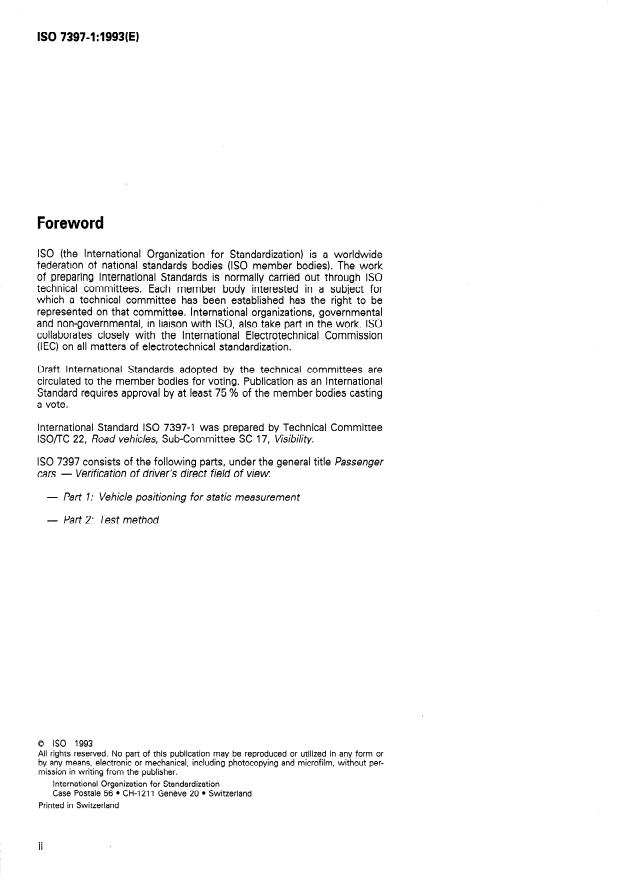


ISO 7397-1:1993 - Passenger cars — Verification of driver's direct field of view — Part 1: Vehicle positioning for static measurement Released:6/24/1993

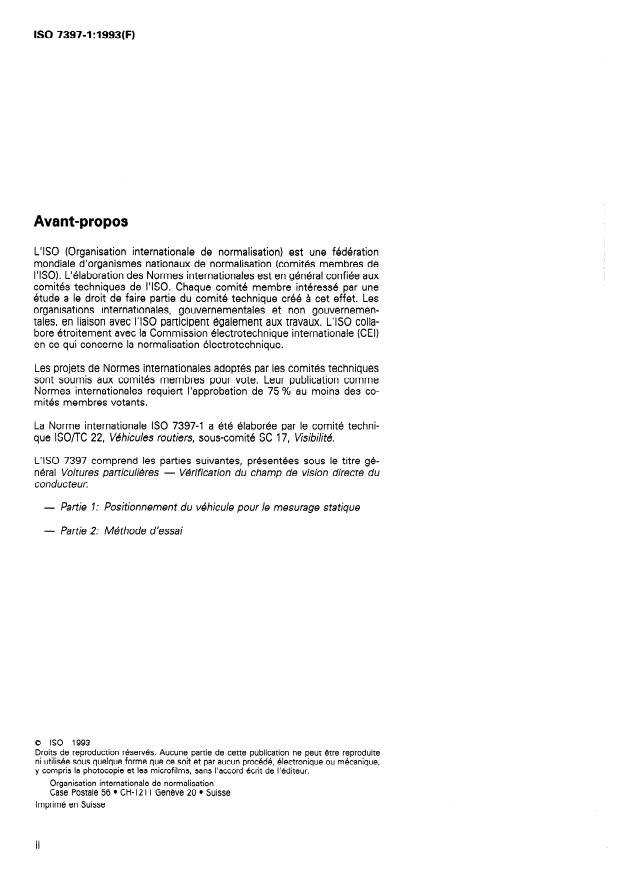


ISO 7397-1:1993 - Voitures particulieres — Vérification du champ de vision directe du conducteur — Partie 1: Positionnement du véhicule pour le mesurage statique Released:6/24/1993



ISO 7397-1:1993 - Voitures particulieres — Vérification du champ de vision directe du conducteur — Partie 1: Positionnement du véhicule pour le mesurage statique Released:6/24/1993
Overview
ISO 7397-1:1993 specifies the initial procedure for positioning a passenger car relative to a three‑dimensional reference system (as given in ISO 4130) for the purpose of static measurement. The procedure enables verification of the driver's forward 180° direct field of view and may be applied to other vehicle design checks that require consistent, repeatable static setups.
This part of ISO 7397 focuses on establishing vehicle attitude and locating fiducial marks so that subsequent tests (e.g., the test method in ISO 7397-2) can be conducted against a known, three‑dimensional reference. It is intended to support ergonomics, visibility verification, and regulatory or design review processes.
Key Topics
- Three-dimensional reference system: Positioning is referenced to the 3D system described in ISO 4130 to ensure consistent orientation and ground dimensions.
- Fiducial marks: The standard requires use of three or more physical points (holes, surfaces, marks or indentations) on the vehicle body, supplied or defined by the manufacturer, to align the vehicle to the reference system.
- Vehicle attitude and grounding: Requirements include a hard, flat, level test surface large enough to contain the vehicle and test equipment, and means to locate and secure the vehicle (for example jacks or supports) to maintain the defined attitude.
- Static measurement preparation: Defines the initial setup steps so that static measurements of the direct field of view and other visibility-related assessments are reproducible and objective.
- Scope and applicability: While explicitly enabling verification of the forward 180° direct field of view, the positioning procedure may be followed for other static design checks related to ergonomics and driver visibility.
Applications
The practical uses of ISO 7397-1:1993 include:
- Preparing passenger cars for static visibility and ergonomics tests in vehicle development and compliance testing.
- Establishing a repeatable test setup for human factors assessments and design reviews focusing on driver sightlines.
- Providing a common reference procedure for laboratories and manufacturers to reduce variability in static measurement results.
Benefits:
- Repeatability: Standardized positioning reduces measurement variability.
- Traceability: Use of fiducial marks and ISO 4130 reference system links test results to a documented spatial framework.
- Versatility: Procedure supports a range of static checks beyond the 180° field of view.
Related Standards
- ISO 7397-2 - Passenger cars - Verification of driver’s direct field of view - Part 2: Test method (complements Part 1 by defining the measurement procedures).
- ISO 4130:1978 - Road vehicles - Three‑dimensional reference system and fiducial marks (provides definitions and the 3D reference used by ISO 7397-1).
For engineers, test labs and regulatory bodies, ISO 7397-1:1993 is a foundational document that ensures vehicle positioning for static visibility assessments is consistent, objective and aligned with international reference systems.
Buy Documents
ISO 7397-1:1993 - Passenger cars — Verification of driver's direct field of view — Part 1: Vehicle positioning for static measurement Released:6/24/1993
ISO 7397-1:1993 - Voitures particulieres — Vérification du champ de vision directe du conducteur — Partie 1: Positionnement du véhicule pour le mesurage statique Released:6/24/1993
ISO 7397-1:1993 - Voitures particulieres — Vérification du champ de vision directe du conducteur — Partie 1: Positionnement du véhicule pour le mesurage statique Released:6/24/1993
Get Certified
Connect with accredited certification bodies for this standard

TÜV Rheinland
TÜV Rheinland is a leading international provider of technical services.

TÜV SÜD
TÜV SÜD is a trusted partner of choice for safety, security and sustainability solutions.

DEKRA Certification Inc.
DEKRA US certification services.
Sponsored listings
Frequently Asked Questions
ISO 7397-1:1993 is a standard published by the International Organization for Standardization (ISO). Its full title is "Passenger cars — Verification of driver's direct field of view — Part 1: Vehicle positioning for static measurement". This standard covers: Establishes the initial procedure for positioning of a passenger car relative to a three-dimensional reference system, as given in ISO 4130, for the purposes of static measurements on the vehicle. It enables verification of the driver's forward 180° field of view, however, the procedure shown may also be followed for checking other aspects of vehicle design.
Establishes the initial procedure for positioning of a passenger car relative to a three-dimensional reference system, as given in ISO 4130, for the purposes of static measurements on the vehicle. It enables verification of the driver's forward 180° field of view, however, the procedure shown may also be followed for checking other aspects of vehicle design.
ISO 7397-1:1993 is classified under the following ICS (International Classification for Standards) categories: 43.100 - Passenger cars. Caravans and light trailers. The ICS classification helps identify the subject area and facilitates finding related standards.
ISO 7397-1:1993 is available in PDF format for immediate download after purchase. The document can be added to your cart and obtained through the secure checkout process. Digital delivery ensures instant access to the complete standard document.
Standards Content (Sample)
INTERNATIONAL ISO
STANDARD 7397-1
First edition
1993-07-01
- Verification of driver’s
Passenger cars
direct field of view -
Part 1:
Vehicle positioning for static measurement
Voitures particulkres - Wrification du champ de Vision directe du
conducteur -
Partie 1: Positionnement du vbhicule pour Ie mesurage statique
Reference number
ISO 7397=1:1993(E)
Foreword
ISO (the International Organization for Standardization) is a worldwide
federation of national Standards bodies (ISO member bodies). The work
of preparing International Standards is normally carried out through ISO
technical committees. Esch member body interested in a subject for
which a technical committee has been established has the right to be
represented on that committee. International organizations, governmental
and non-governmental, in liaison with ISO, also take patt in the work. ISO
collaborates closely with the International Electrotechnical Commission
(1 EC) on all matters of electrotechnical standardization.
Draft International Standards adopted by the technical committees are
circulated to the member bodies for voting. Publication as an International
Standard requires approval by at least 75 % of the member bodies casting
a vote.
International Standard ISO 7397-1 was prepared by Technical Committee
lSO/TC 22, Road vehicles, Sub-Committee SC 17, Visibility.
ISO 7397 consists of the following Parts, under the general title Passenger
cars - Verification of driver’s direct field of view
- Part 1: Vehicle positioning for static measurement
- Part 2: Test method
0 ISO 1993
All rights reserved. No part of this pubiication may be reproduced or utilized in any form or
by any means, electronie or mechanical, including photocopying and microfilm, without per-
mission in writing from the publisher.
International Organization for Standardization
Case Postale 56 l CH-l 211 Geneve 20 l Switzerland
Printed in Switzerland
t
INTERNATIONAL STANDARD ISO 7397~‘1:1993(E)
Passenger cars
- Verification of driver’s direct field
of view -
Part 1:
Vehicle positioning for static measurement
hicle body, as defined by the manufacturer.
1 Scope
[ISO 4130:1978, definition 3.21
This patt of ISO 7397 establishes the initial procedure
NOTES
for positioning of a passenger car
...
ISO
NORME
7397-1
INTERNATIONALE
Première édition
1993-07-01
Voitures particulières - Vérification du
champ de vision directe du conducteur -
Partie 1: ’
Positionnement du véhicule pour le mesurage
statique
Verification of driver’s direct field of view -
Passenger cars -
Part 7: Vehicle positioning for static measurement
60 73974:1993(F)
Avant-propos
L’ISO (Organisation internationale de normalisation) est une fedération
m,ondiale d’organismes nationaux de normalisation (comités membres de
I’ISO). L’elaboration des Normes internationales est en général confiée aux
comites techniques de I’ISO. Chaque comite membre interesse par une
étude a le droit de faire partie du comite technique créé à cet effet. Les
organisations internationales, gouvernementales et non gouvernemen-
tales, en liaison avec I’ISO participent également aux travaux. L’ISO colla-
bore Rtroitement avec la Commission électrotechnique internationale (CEI)
en ce qui concerne la normalisation électrotechnique.
Les projets de Normes internationales adoptes par les comités techniques
sont soumis aux comités membres pour vote. Leur publication comme
Normes internationales requiert l’approbation de 75 % au moins des co-
mités membres votants.
La Norme internationale ISO 7397-l a eté élaborée par le comite techni-
que ISOFC 22, Véhicules routiers, sous-comité SC 17, Visibilité.
L’ISO 7397 comprend les parties suivantes, présentées sous le titre gé-
néral Voitures particulières - Vgrification du champ de vision directe du
conducteur:
- Partie 1: Positionnement du vghicule pour le mesurage statique
- Partie 2: Méthode d’essai
0 ISO 1993
Droits de reproduction reserves. Aucune partie de cette publication ne peut être reproduite
ni utilisée sous quelque forme que ce soit et par aucun procédé, électronique ou mécanique,
y compris la photocopie et les microfilms, sans l’accord écrit de l’éditeur.
Organisation internationale de normalisation
Case Postale 56 l CH-l 211 Geneve 20 l Suisse
Imprimé en Suisse
ii
ISO 73974:1993(F)
NORME INTERNATIONALE
Voitures particulières - Vérification du champ de
vision directe du conducteur -
Partie 1:
Positionnement du véhicule pour le mesurage statique
3 Définitions
1 Domaine d’application
Pour les besoins de I’ISO 7397, les définitions sui-
La présente partie de I’ISO 7397 etablit la méthode
de positionnement initiale d’une voiture particulière vantes s’appliquent.
dans un système de référence tridimensionnel, tel
que donne dans I’ISO 4130, permettant d’effectuer
3.1 points repères: Trois points ou plus, matéria-
des mesurages statiques sur le véhicule.
lisés sur la carrosserie du véhicule (trous, surfaces
...
ISO
NORME
7397-1
INTERNATIONALE
Première édition
1993-07-01
Voitures particulières - Vérification du
champ de vision directe du conducteur -
Partie 1: ’
Positionnement du véhicule pour le mesurage
statique
Verification of driver’s direct field of view -
Passenger cars -
Part 7: Vehicle positioning for static measurement
60 73974:1993(F)
Avant-propos
L’ISO (Organisation internationale de normalisation) est une fedération
m,ondiale d’organismes nationaux de normalisation (comités membres de
I’ISO). L’elaboration des Normes internationales est en général confiée aux
comites techniques de I’ISO. Chaque comite membre interesse par une
étude a le droit de faire partie du comite technique créé à cet effet. Les
organisations internationales, gouvernementales et non gouvernemen-
tales, en liaison avec I’ISO participent également aux travaux. L’ISO colla-
bore Rtroitement avec la Commission électrotechnique internationale (CEI)
en ce qui concerne la normalisation électrotechnique.
Les projets de Normes internationales adoptes par les comités techniques
sont soumis aux comités membres pour vote. Leur publication comme
Normes internationales requiert l’approbation de 75 % au moins des co-
mités membres votants.
La Norme internationale ISO 7397-l a eté élaborée par le comite techni-
que ISOFC 22, Véhicules routiers, sous-comité SC 17, Visibilité.
L’ISO 7397 comprend les parties suivantes, présentées sous le titre gé-
néral Voitures particulières - Vgrification du champ de vision directe du
conducteur:
- Partie 1: Positionnement du vghicule pour le mesurage statique
- Partie 2: Méthode d’essai
0 ISO 1993
Droits de reproduction reserves. Aucune partie de cette publication ne peut être reproduite
ni utilisée sous quelque forme que ce soit et par aucun procédé, électronique ou mécanique,
y compris la photocopie et les microfilms, sans l’accord écrit de l’éditeur.
Organisation internationale de normalisation
Case Postale 56 l CH-l 211 Geneve 20 l Suisse
Imprimé en Suisse
ii
ISO 73974:1993(F)
NORME INTERNATIONALE
Voitures particulières - Vérification du champ de
vision directe du conducteur -
Partie 1:
Positionnement du véhicule pour le mesurage statique
3 Définitions
1 Domaine d’application
Pour les besoins de I’ISO 7397, les définitions sui-
La présente partie de I’ISO 7397 etablit la méthode
de positionnement initiale d’une voiture particulière vantes s’appliquent.
dans un système de référence tridimensionnel, tel
que donne dans I’ISO 4130, permettant d’effectuer
3.1 points repères: Trois points ou plus, matéria-
des mesurages statiques sur le véhicule.
lisés sur la carrosserie du véhicule (trous, surfaces
...