

ISO 8216-3:1987
(Main)Petroleum products — Fuels (class F) — Classification — Part 3: Family L (Liquefied petroleum gases)
General Information
- Abstract
Should be read in conjunction with ISO 8216-0. These gases may be derived from crude oil processing or recovered from natural gas and/or crude oil production. The detailed classification system products are designated in a uniform manner, either in the complete form or in the abbreviated form.
- Status
- Published
- Publication Date
- 25-Mar-1987
- Technical Committee
- ISO/TC 28/SC 4 - Classifications and specifications
- Drafting Committee
- ISO/TC 28/SC 4 - Classifications and specifications
- Current Stage
- 9093 - International Standard confirmed
- Start Date
- 25-Sep-2025
- Completion Date
- 29-Aug-2026
Buy Documents
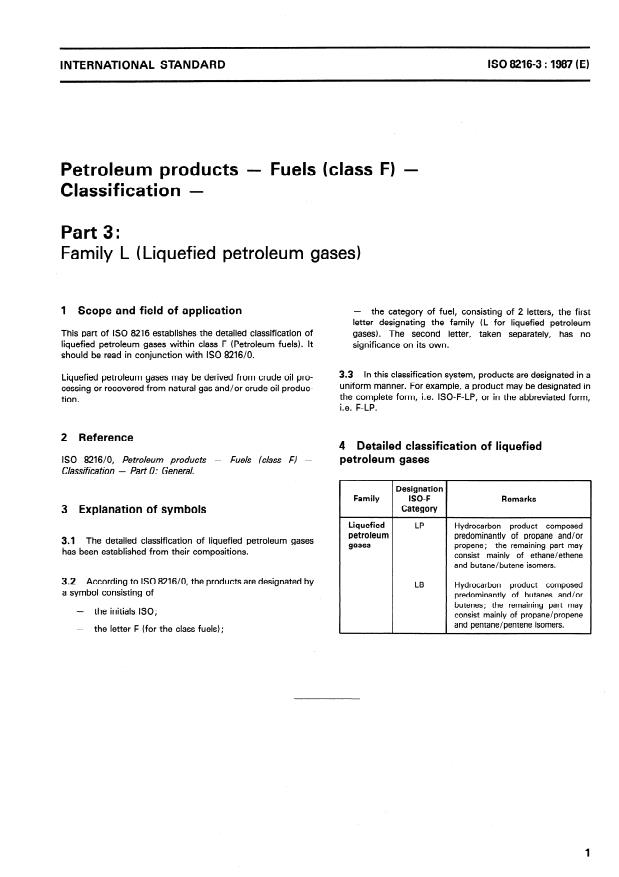

ISO 8216-3:1987 - Petroleum products — Fuels (class F) — Classification — Part 3: Family L (Liquefied petroleum gases) Released:3/26/1987
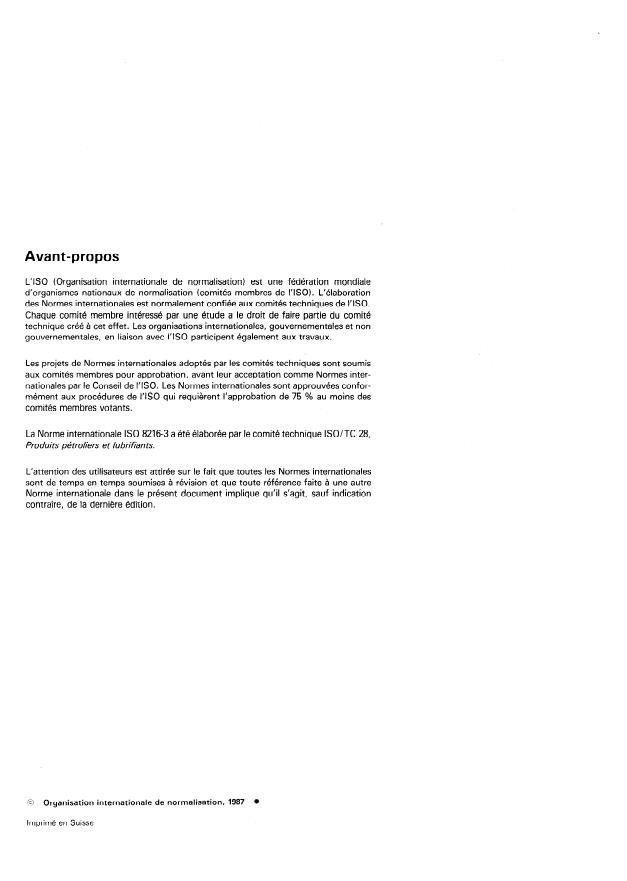
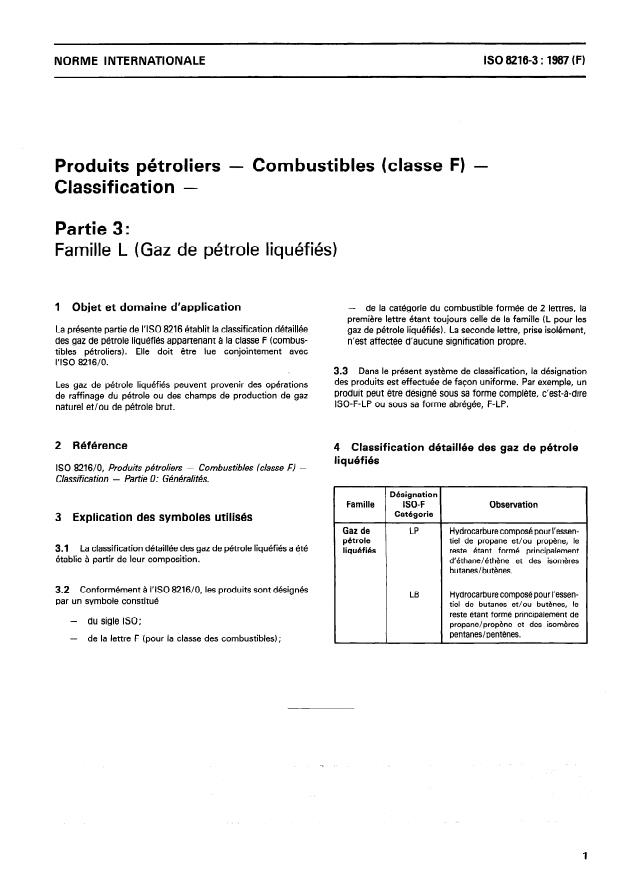

ISO 8216-3:1987 - Produits pétroliers — Combustibles (classe F) — Classification — Partie 3: Famille L (Gaz de pétrole liquéfiés) Released:3/26/1987
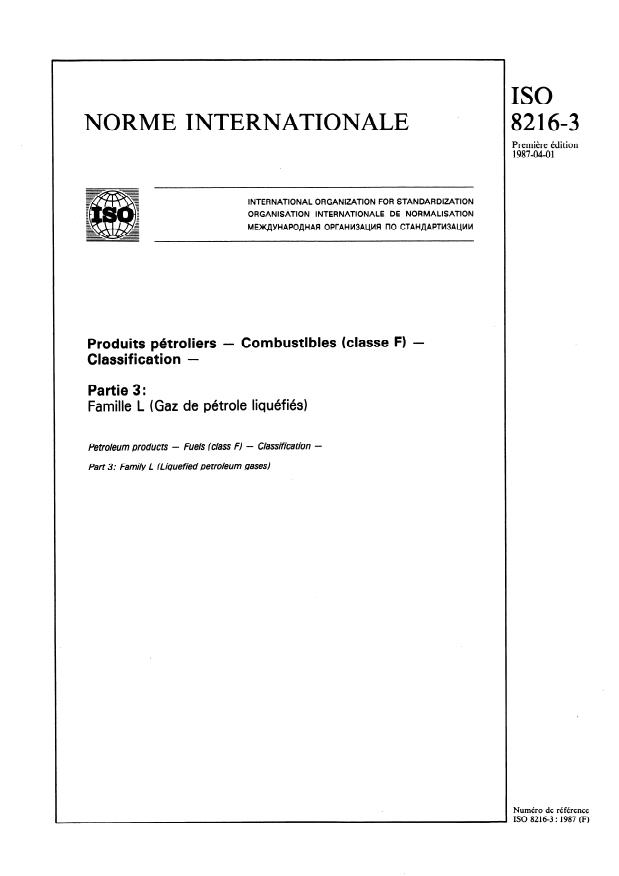
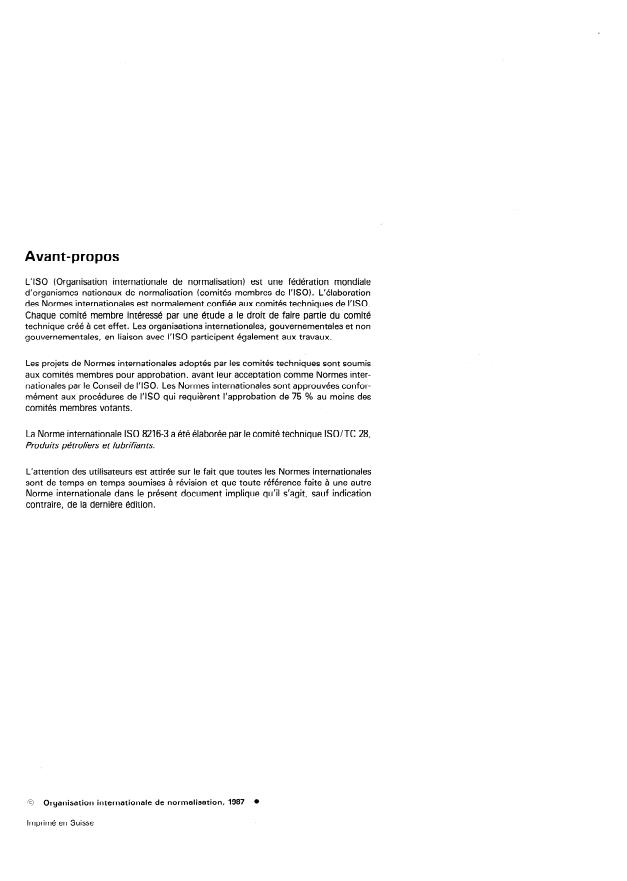
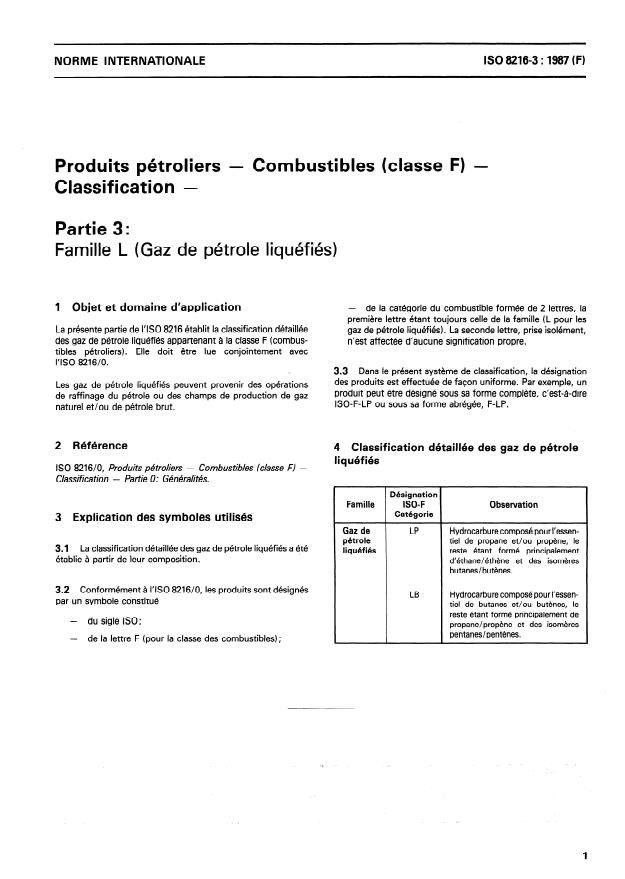

ISO 8216-3:1987 - Produits pétroliers — Combustibles (classe F) — Classification — Partie 3: Famille L (Gaz de pétrole liquéfiés) Released:3/26/1987
Overview
ISO 8216-3:1987 is Part 3 of the ISO 8216 series and provides a detailed classification system for Liquefied Petroleum Gases (LPG) assigned to Family L within Fuels (class F). This part is intended to be read in conjunction with ISO 8216-0 (Generalities). The standard defines uniform product designation practices and classification by composition to ensure consistent identification, handling and use of LPG products across refining, natural gas recovery and crude oil production chains.
Key Topics
- Scope and relationship to ISO 8216-0: ISO 8216-3 complements the general rules in Part 0 and applies those rules specifically to Family L (LPG).
- Classification by composition: The LPG classification is established from the predominant hydrocarbon composition (for example, propane/propene-rich or butane/butene-rich streams).
- Designation format: Products may be designated in either a full form (e.g. ISO-F-LP) or an abbreviated form (e.g. F-LP) to provide a uniform, readily interpretable identifier.
- Symbols and category codes: The standard uses family and category letters to indicate primary composition (examples in the document include LP for propane/propene-dominant LPG and LB for butane/butene-dominant LPG).
Practical keywords: ISO 8216-3:1987, Liquefied Petroleum Gases, LPG classification, Fuels class F, product designation, ISO 8216-0.
Applications
ISO 8216-3:1987 supports practical use in several domains:
- Regulatory compliance: Provides a consistent basis for regulators to reference LPG categories and to align national or regional rules with international terminology.
- Commercial trade and procurement: Uniform product designation reduces ambiguity in supply contracts, specifications and shipping documentation.
- Industry operations and safety: Clear classification by composition helps downstream users, transporters and storage operators assess compatibility, handling precautions and appropriate safety measures.
- Quality assurance and testing: Laboratories and quality teams can reference classification terms when reporting composition-related results and conforming to agreed product definitions.
Related Standards
- ISO 8216-0 - General principles for classification of petroleum fuels (read jointly with Part 3).
- Other ISO and national standards for petroleum product specifications, transport and safety should be consulted when applying classifications in regulatory, testing and operational contexts.
Practical value
ISO 8216-3:1987 delivers a concise framework for naming and classifying LPG streams based on composition, improving clarity across refining, gas recovery and commercial supply chains. By adopting the uniform designation forms and category symbols, organizations can streamline documentation, enhance safety communication and reduce contractual disputes related to product identity.
For implementation, always cross-reference ISO 8216-0 for general rules and consult applicable regulatory and safety standards relevant to your jurisdiction.
Buy Documents
ISO 8216-3:1987 - Petroleum products — Fuels (class F) — Classification — Part 3: Family L (Liquefied petroleum gases) Released:3/26/1987
ISO 8216-3:1987 - Produits pétroliers — Combustibles (classe F) — Classification — Partie 3: Famille L (Gaz de pétrole liquéfiés) Released:3/26/1987
ISO 8216-3:1987 - Produits pétroliers — Combustibles (classe F) — Classification — Partie 3: Famille L (Gaz de pétrole liquéfiés) Released:3/26/1987
Get Certified
Connect with accredited certification bodies for this standard

Element Materials Technology
Materials testing and product certification.

ABS Group Brazil
ABS Group certification services in Brazil.

ABS Quality Evaluations Inc.
American Bureau of Shipping quality certification.
Sponsored listings
Frequently Asked Questions
ISO 8216-3:1987 is a standard published by the International Organization for Standardization (ISO). Its full title is "Petroleum products — Fuels (class F) — Classification — Part 3: Family L (Liquefied petroleum gases)". This standard covers: Should be read in conjunction with ISO 8216-0. These gases may be derived from crude oil processing or recovered from natural gas and/or crude oil production. The detailed classification system products are designated in a uniform manner, either in the complete form or in the abbreviated form.
Should be read in conjunction with ISO 8216-0. These gases may be derived from crude oil processing or recovered from natural gas and/or crude oil production. The detailed classification system products are designated in a uniform manner, either in the complete form or in the abbreviated form.
ISO 8216-3:1987 is classified under the following ICS (International Classification for Standards) categories: 75.160.30 - Gaseous fuels. The ICS classification helps identify the subject area and facilitates finding related standards.
ISO 8216-3:1987 is available in PDF format for immediate download after purchase. The document can be added to your cart and obtained through the secure checkout process. Digital delivery ensures instant access to the complete standard document.
Standards Content (Sample)
IS0
INTERNATIONAL STANDARD 8216-3
First edition
1987-04-01
INTERNATIONAL ORGANIZATION FOR STANDARDIZATION
ORGANISATION INTERNATIONALE DE NORMALISATION
MEXP,YHAPOAHAR OPI-AHM3A~MR IlO CTAHJJAPTM3A~MM
Petroleum products - Fuels (class F) -
Classification -
Part 3:
Family L (Liquefied petroleum gases)
Combustiles Masse F) - Classification -
Produits ph troliers -
Partie 3: Famille L fGaz de pktrole liquHi6sl
Reference number
IS0 8216-3: 1987 (E)
Foreword
IS0 (the International Organization for Standardization) is a worldwide federation of
national standards bodies (IS0 member bodies). The work of preparing International
Standards is normally carried out through IS0 technical committees. Each member
body interested in a subject for which a technical committee has been established has
the right to be represented on that committee. International organizations, govern-
mental and non-governmental, in liaison with ISO, also take part in the work.
Draft International Standards adopted by the technical committees are circulated to
the member bodies for approval before their acceptance as International Standards by
the IS0 Council. They are approved in accordance with IS0 procedures requiring at
least 75 % approval by the member bodies voting.
International Standard IS0 8216-3 was prepared by Technical Committee ISO/TC 28,
Petroleum products and lubricants.
Users should note that all International Standards undergo revision from time to time
and that any reference made herein to any other International Standard implies its
latest edition, unless otherwise stated.
0 International Organization for Standardization, 1987
Printed in Switzerland
IS0 8216-3 : 1987 (E)
INTERNATIONAL STANDARD
Petroleum products - Fuels (class F) -
C
...
ISO
NORME INTERNATIONALE 8216-3
Première édition
1987-04-o 1
INTERNATIONAL ORGANIZATION FOR STANDARDIZATION
ORGANISATION INTERNATIONALE DE NORMALISATION
. MEXflYHAPOAHAFI OPTAHM3A~MR Il0 CTAH~APTM3A~MM
Combustibles (classe F) -
Produits pétroliers -
Classification -
Partie 3:
Famille L (Gaz de pétrole liquéfiés)
Petroleum products - Fuels Mass F) - Classification -
Part 3: Family 1 (Liquefied petroleum gases)
Numéro de référence
~ ISO 8216-3: 1987 (F)
Avant-propos
L’ISO (Organisation internationale de normalisation) est une fédération mondiale
d’organismes nationaux de normalisation (comités membres de I’ISO). L’élaboration
des Normes internationales est normalement confiée aux comités techniques de I’ISO.
Chaque comité membre intéressé par une étude a le droit de faire partie du comité
technique créé à cet effet. Les organisations internationales, gouvernementales et non
gouvernementales, en liaison avec I’ISO participent également aux travaux.
Les projets de Normes internationales adoptés par les comités techniques sont soumis
aux comités membres pour approbation, avant leur acceptation comme Normes inter-
nationales par le Conseil de I’ISO. Les Normes internationales sont approuvées confor-
mément aux procédures de I’ISO qui requièrent l’approbation de 75 % au moins des
comités membres votants.
La Norme internationale ISO 8216-3 a été élaborée par le comité technique ISO/TC 28,
Produits pétroliers et lubrifian ts.
L’attention des utilisateurs est attirée sur le fait que toutes les Normes internationales
sont de temps en temps soumises à révision et que toute référence faite à une autre
Norme internationale dans le présent document implique qu’il s’agit, sauf indication
contraire, de la dernière édition.
Organisation internationale de normalisation, 1987
Imprimé en Suisse
ISO 8216-3 : 1987 (FI
NORME INTERNATIONALE
Combustibles (classe F) -
Produits pétroliers -
Classi
...
ISO
NORME INTERNATIONALE 8216-3
Première édition
1987-04-o 1
INTERNATIONAL ORGANIZATION FOR STANDARDIZATION
ORGANISATION INTERNATIONALE DE NORMALISATION
. MEXflYHAPOAHAFI OPTAHM3A~MR Il0 CTAH~APTM3A~MM
Combustibles (classe F) -
Produits pétroliers -
Classification -
Partie 3:
Famille L (Gaz de pétrole liquéfiés)
Petroleum products - Fuels Mass F) - Classification -
Part 3: Family 1 (Liquefied petroleum gases)
Numéro de référence
~ ISO 8216-3: 1987 (F)
Avant-propos
L’ISO (Organisation internationale de normalisation) est une fédération mondiale
d’organismes nationaux de normalisation (comités membres de I’ISO). L’élaboration
des Normes internationales est normalement confiée aux comités techniques de I’ISO.
Chaque comité membre intéressé par une étude a le droit de faire partie du comité
technique créé à cet effet. Les organisations internationales, gouvernementales et non
gouvernementales, en liaison avec I’ISO participent également aux travaux.
Les projets de Normes internationales adoptés par les comités techniques sont soumis
aux comités membres pour approbation, avant leur acceptation comme Normes inter-
nationales par le Conseil de I’ISO. Les Normes internationales sont approuvées confor-
mément aux procédures de I’ISO qui requièrent l’approbation de 75 % au moins des
comités membres votants.
La Norme internationale ISO 8216-3 a été élaborée par le comité technique ISO/TC 28,
Produits pétroliers et lubrifian ts.
L’attention des utilisateurs est attirée sur le fait que toutes les Normes internationales
sont de temps en temps soumises à révision et que toute référence faite à une autre
Norme internationale dans le présent document implique qu’il s’agit, sauf indication
contraire, de la dernière édition.
Organisation internationale de normalisation, 1987
Imprimé en Suisse
ISO 8216-3 : 1987 (FI
NORME INTERNATIONALE
Combustibles (classe F) -
Produits pétroliers -
Classi
...